

Politics
Didsbury for Palestine battle Siemens over activities in Occupied Palestinian Territories



One Manchester-based grassroots campaign group has spent over a year pressing Siemens PLC on its role in sustaining Israel’s occupation. They say Siemens’ pained responses and denialism amount to little more than corporate stonewalling. They shared the full correspondence trail with the Canary.
Didsbury for Palestine (D4P), a community campaign group based in Manchester, has issued a series of increasingly urgent demands to Siemens PLC. Siemens has been a BDS target for many years.
Siemens’ UK headquarters sit on Princess Road in Didsbury, south Manchester. Separately, pro-Palestine direct actionists targeted Siemens’ Cambridge offices in October 2024
D4P calls on the multinational technology giant to end all business activities which the group says contribute to human rights violations in occupied Palestine. They faced twelve months of correspondence, held peaceful protests, and made repeated requests for a face-to-face meeting — all rebuffed or ignored.
D4P say Siemens has failed to provide a single piece of concrete, citable evidence that its operations comply with international human rights law.

One year of stonewalling
The campaign launched on 21 May 2025, when D4P delivered their first letter by hand to Siemens’ Didsbury head offices, addressed to the company’s CEO Dr. Carl Ennis.
The letter set out a damning catalogue of concerns:
- Siemens’ supply of rolling stock for Israel’s A1 railway line, which crosses into the occupied West Bank on confiscated Palestinian land;
- Potential complicity in the Great Sea Interconnector energy project, which D4P says will supply electricity to illegal settlements; and
- The provision of surveillance equipment — including radar, control systems, and night vision technology — to the Israeli Prison Service for use in Israeli facilities. These include Ktzi’ot Prison, where Palestinian detainees — including children — are reportedly held without charge, tortured, and starved.
Dr. Ennis did not respond.
On 30 July 2025, D4P wrote again. This time, the group warned that a peaceful public protest would follow if Siemens continued to ignore them. They noted that Manchester City Councillor Richard Kilpatrick of Didsbury West (Lib-Dem) had offered to facilitate and mediate a meeting. Still, no meeting was offered.
On 5 August 2025 — more than two months after the original letter — Siemens’ Head of Communications, Karen Fenwick, finally replied.
Partial admission of complicity
Her letter expressed “deepest sympathy” for those who had suffered casualties and referenced a €1 million donation to the International Red Cross. (The same IRC repeatedly targeted by Zionist munitions.) Fenwick announced that Siemens was “applying heightened due diligence” in relation to the occupied territories.
According to international law, any commercial activity in illegally occupied territories — especially co-ordinated with the illegally occupying entity, which Israel is — should not take place and is considered illegal.
Fenwick confirmed that Siemens was supplying Double Deck Electrical Multiple Unit (DDEMU) trains to Israel Railways and maintaining them under a long-term contract from 2018. She denied involvement in the Israeli Prison Service. She also dismissed the Great Sea Interconnector as being “Siemens Energy project,” calling it a “separate entity.” Siemens is named as a “preferred contractor” on the energy project’s website.
D4P was not satisfied. In September 2025, the group wrote again, thanking Siemens for finally responding but pressing for the promised meeting. No meeting was offered.
Eight questions Siemens couldn’t answer
On 24 February 2026, D4P sent their most detailed letter yet.
D4P cited eight specific, evidenced questions covering every aspect of Siemens’ activities in Israel and the Occupied Palestinian Territories. They renewed their request for a meeting during March 2026.
D4P’s letter concerned the following activities, each subheading substantiated with endnote citations:
- Siemens’ Human Rights Due Diligence
- Israel Railways Double Deck Electrical Multiple Units (DDEMU)
- Siemens’ Supply Chain and Use of Extal
- Siemens and the Israeli Prison Service
- Siemens Software Licensed for Military Use
- Great Sea Interconnector
- General Questions on Siemens’ Operations in Israel
- Siemens’ Sponsorship of the ADS Group Arms Industry Dinner
Their questions were grounded in documented findings from the ICJ, Amnesty International, Human Rights Watch, B’Tselem, and UN bodies. They asked for dates, methodology, copies or summaries of due diligence reviews, and direct responses to findings of apartheid. No meeting took place.
Siemens finally replied in May 2026; the Canary has seen the response in full.
The corporation’s response — again signed by comms head Karen Fenwick — was an assessment of D4P’s own critical analysis:
brief, generic, and avoids engaging with the majority of the substantive questions.
Conversely, Fenwick’s letter concluded:
We believe we have comprehensively addressed your questions and have no additional information to provide.
D4P’s point-by-point rebuttal tells a different story.

Siemens enable railways on stolen land
D4P’s concerns target Siemens’ contract with Israel Railways, with which they admit commercial involvement.
Siemens confirmed it is supplying 141 DDEMU trains — 60 plus 81 — under a 2018 contract that includes 15 years of maintenance with an option to extend to a total of 29 years, potentially running until 2046 or beyond.
The A1 line — the Tel Aviv to Jerusalem fast rail route — runs through the occupied West Bank, on privately owned Palestinian land. The ICJ, Amnesty International, Human Rights Watch, and B’Tselem have all concluded that Israel operates a system of apartheid against Palestinians.
Palestinians are — in practice, if not (yet) in law — excluded from using this railway as full citizens.
Siemens’ response? That:
an internal and external legal review at the time concluded that this business was in line with our human rights due diligence obligations.
Fenwick added:
We are not aware of any negative impacts related to human rights in connection with our delivery.
Under UN Guiding Principles, which Siemens supposedly oblige, companies have an obligation to be aware of whether their logistical operations or services are being used in war-crimes or human rights abuses.
D4P’s own analysis of this pishy response, in turn, is astonishing:
- No dates were given for the reviews;
- No external reviewer was named;
- No methodology was provided;
- No documentation was shared;
- Siemens refused to say whether it accepts the ICJ’s apartheid findings;
- Siemens refused to acknowledge Palestinian exclusion from the line;
- Siemens avoided any (over-)due assessment of whether the trains carry military personnel or serve settlement-supporting functions; and
- Siemens offered a geographical defence that D4P considers legally irrelevant: that only “short sections” of the A1 run through disputed territory.
Under international humanitarian law, D4P’s assessment notes, the length of the encroachment is entirely immaterial. Any and all use of confiscated private Palestinian land is unlawful under international law.
Siemens — ‘We are not aware’ — the Prison Service question
Regarding the Israeli Prison Service, Siemens’ position is particularly striking.
D4P raised documented reports of torture, starvation, and the detention of children without charge at facilities including Ktzi’ot Prison. Israeli human rights group B’Tselem labelled the prisons “living hell.”
D4P had asked whether Siemens has ever supplied surveillance equipment — radar, control systems, night vision, etc. — to these prisons. Siemens’ response in May 2026 read:
We have not been serving prisons in Israel for the past 15 years. We are not aware that we have been serving prisons (e.g. via partners) prior to this period.
The phrase “we are not aware” — rather than “we have not” — is not lost on D4P:
- The company provided no dates for when any such supply may have ceased;
- No audit confirming that its technology is no longer operational in these facilities; and
- No answer to whether it has investigated indirect supply through partners or subcontractors.

Software, settlements and an arms dinner
D4P also pressed Siemens on reports that its software is licensed via a company called McKit Systems to the Israeli Ministry of Defence, Elbit Systems, RAFAEL, and Israel Aerospace Industries. McKit’s own website states explicitly that it “represents the leading global compan[y] SIEMENS PLM Software”.
Elbit, Rafael, IAI, and, of course, the Israeli state are all entities well-documented for their wilful involvement in war-criminal Zionist military operations, including the ongoing genocide in Gaza.
Siemens’ response? That:
Siemens does not comment on relationships with third parties.
Understandably, D4P describe this part as the “least transparent section” of Siemens’ response:
- Siemens did not deny their plausibly complicit licensing activities;
- Siemens provided no due diligence information, on background or whatsoever; and
- Siemens also offered no assessment of whether such licensing was compatible with its commitments under the UN Global Compact.
Then there’s the EU-co-funded Great Sea Interconnector. It’s a power cable project intended to link Greek and Cypriot grids to Israel, with supply to illegal settlements in East Jerusalem and the occupied West Bank.
Siemens once again sought to distance itself through corporate structuring. Fenwick noted that Siemens AG holds only approximately 6% of Siemens Energy and therefore it:
cannot and does not control management decisions.
The conglomerate declined to address whether the project would supply settlements, and provided no evidence of brand-protection or supply-chain safeguards.
Perhaps most strikingly, D4P noted that Siemens sponsored the ADS Group arms industry dinner on 27 January 2026 at the Marriott Grosvenor House. The event was well-attended by companies knowingly supplying weapons to Israel amidst its multiple bloody and illegal wars.
When asked to explain this decision, and how it was reconciled with Siemens’ purported “human rights commitments,” the company replied that:
all sponsorship activities undergo due process in accordance with the provisions of our Business Conduct Guidelines.
More corporate social responsibility dress-up. Once again: no rationale, no assessment, no reconciliation.
‘Comprehensively addressed’: a claim D4P rejects
The Canary stresses that, across all eight questions in its May 2026 response, Siemens provided no dates, no documents, no assessments, no external evidence, and no specifics.
D4P’s own critical analysis concludes that the response “does not meet the standards of transparency, specificity, or due diligence disclosure” required under the UN Guiding Principles on Business and Human Rights. This is despite the UNGPs being a framework which Siemens itself repeatedly invokes.
The group notes a fundamental contradiction at the heart of Siemens’ position:
- The company cites its commitment to the UNGPs as evidence of its good conduct; but
- The UNGPs themselves require companies to properly demonstrate — not merely assert — that they have carried out comprehensive due diligence.
Thus went a year of letters, peaceful leafleting campaigns at Siemens’ Didsbury gates, and repeated offers of mediated dialogue facilitated by an elected councillor.
Siemens met D4P, at every turn, with delay, deflection, and the same formulaic reassurances. Karen Fenwick’s position, repeated across multiple letters, is that Siemens has already said everything it has to say.
Didsbury for Palestine disagree. They’ll continue pressing the company until it can answer, with evidence, whether its trains, its software, its energy infrastructure, and its presence in Israel are contributing to what the ICJ has described as an unlawful occupation of Palestinian land.
D4P mobilises at 12pm–2pm on Friday 22 May outside Siemens and calls on all supporters to join them at:
The junction of Barlow Moor Road / Princess Parkway, Didsbury, Manchester, M20 2ZA
Didsbury for Palestine can be contacted at d4palestine@gmail.com
Featured image via Siemens website



Credit: 2026 Sport England. All Rights Reserved

Lisa Dodd-Mayne, Executive Director, Partnerships and Place
| Sport England
As devolution reshapes local decision-making across England, Sport England is urging leaders to embed physical activity into plans for healthier, more connected and economically resilient communities.
Devolution is fundamentally about how places work.
As new strategic authorities take shape and local government reorganisation continues across England, decisions about transport, housing, economic growth and public services are increasingly being made at a more local level – closer to the realities of place.
In that context, sport and physical activity cut across many of these issues shaping local places.
Sport and physical activity are often treated as standalone services, sitting within leisure budgets and recreation planning. Yet in practice, they sit at the intersection of some of the most important outcomes facing local leaders – health, opportunity, transport connectivity and community cohesion.
The focus is less on whether physical activity is relevant to devolution, and more on how early it is considered in the conversation.
When brought in late, sport and physical activity can often be treated as add-ons. When considered from the outset, they become part of how places are designed, how communities function and how local systems operate.
That distinction matters.
The evidence base is substantial. Our latest research estimates that, in the last year alone, community sport and physical activity generated more than £122bn in social value across England. That includes improved wellbeing, stronger social connections and reduced pressure on health and care services.
In other words, this is not a standalone area. Its relevance is most clearly seen not in isolation, but through its interaction with wider priorities and systems.
Take transport.
As active travel becomes more central to local and regional transport planning, walking, wheeling and cycling are increasingly being discussed alongside congestion, air quality and carbon reduction. But they are also fundamentally about how people access jobs, education, services and opportunity.
When physical activity is built into transport planning from the outset, it helps shape systems that support everyday movement.
The same applies to housing and planning.
As local areas plan for growth and new development, there is growing emphasis on placemaking and design quality. Access to green space, safe walking and cycling routes, and opportunities for recreation are increasingly recognised as core features of successful communities.
These are not peripheral considerations. They influence long-term health outcomes, social interaction and the liveability of new places over decades.
In regeneration and economic development, the link is equally clear.
Investment in public spaces, parks, leisure infrastructure and active travel networks contributes to places that are more attractive to live in, work in and invest in. Major events bring visibility and economic uplift, but the quality of everyday environments also determines whether places feel active and connected.
There is also a growing intersection with health.
Local health systems are managing rising demand linked to inactivity, long-term conditions and poor mental wellbeing. This is not a challenge can be addressed in isolation.
Physical activity is increasingly being considered as part of wider prevention-focused approaches – not as a substitute for clinical care, but as a complementary part of how people stay well for longer and remain connected to their communities.
This is where place-based working becomes particularly relevant.
One of the most consistent lessons from devolution to date is that outcomes improve when organisations work around place and shared priorities.
Place-based approaches allow local partners to align investment, insight and delivery around the specific needs of communities, rather than the structures of individual services.
Sport and physical activity fit naturally into this way of working.
In Greater Manchester, GM Moving has become a widely referenced example of this approach in practice. Physical activity has been positioned within a broader system focus on population health, inequalities and wellbeing, bringing together local authorities, health partners, voluntary organisations and communities around shared outcomes.
Importantly, this has not been driven by a single organisation, but through sustained collaboration across the system.
A similar approach can be seen in Cumbria, where partners have worked across rural and dispersed communities to better align physical activity provision with local need. The focus there has been on accessibility, place-specific barriers and collaboration across sectors to ensure activity reflects geography.
While the contexts differ, the underlying principle is consistent – physical activity has the greatest impact when it is embedded in wider place-based strategies, rather than operating alongside them.
That’s why we’re expanding our focus on place-based investment, including a £250m commitment to more than 90 communities experiencing the highest levels of inactivity and inequality. The aim is to support long-term, locally-led approaches, shaped by local evidence and delivered in partnership with wider system stakeholders. Through this work, we’re connecting Active Partnerships, local government, health, transport, education and voluntary sector organisations. The focus is increasingly on enabling collaboration across systems, rather than delivering in isolation.
As devolution continues to evolve, different areas will naturally take different approaches based on their priorities and governance models. That variation is both expected and necessary.
But across those differences, one theme is becoming clearer.
Where physical activity is linked to wider strategic goals – whether that is improving health, supporting growth, strengthening communities or improving quality of place – it is more likely to be sustained, scaled and embedded.
The opportunity, then, is not to elevate sport and physical activity as a separate agenda, but to recognise its role within the decisions that are already reshaping places.
Recognising the pace of change across devolution and local government reorganisation, Sport England has recently published a Devolution Policy Position Statement to help local leaders, strategic authorities and partners better understand the role sport and physical activity can play in delivering local growth, prevention and wellbeing ambitions. Further information, guidance and support can be accessed at www.sportengland.org/devolution-statement.

Andy Burnham is right to put social care at the heart of the political debate. He’s also right to say politicians shouldn’t “flinch” from difficult conversations about funding.
But if social care reform becomes yet another argument about who pays, we’ll miss a much bigger problem hiding in plain sight.
The uncomfortable truth is that we’ve built a social care system that spends too much time deciding who doesn’t qualify for support.
Funding matters. There is no question that local authorities need greater resources to meet growing demand. But the solution to a social care system that works for everyone goes beyond funding alone.

MDU warns Chancellor clinical negligence system ‘not fit for purpose’

Northern Ireland RE curriculum is ‘indoctrination’ – Supreme Court
At Access Social Care, we provide free legal advice to people trying to access the support they need to live independently and participate fully in their communities. What we see time and again is a system that creates barriers to care through rationing.
That isn’t because social workers or council staff don’t care – far from it. It is because financial pressures have shaped a culture where the priority often becomes managing demand rather than promoting wellbeing.
When budgets are stretched, the incentive is to restrict access, tighten eligibility and focus resources on those in the most acute need. Support that could prevent problems from escalating is delayed or denied because the system is under pressure to concentrate on immediate crises.
The result is a vicious cycle. A disabled person who could remain in work with the right support loses their independence. An older person struggles at home until a preventable fall lands them in hospital. An unpaid carer carries more and more responsibility until they reach breaking point themselves.
These outcomes are bad for individuals, bad for families and, ultimately, bad for public finances. Yet too often they are treated as inevitable.
What makes this particularly troubling is that it runs counter to the principles at the heart of the Care Act. The legislation is built around wellbeing. It recognises that social care should help people maintain dignity, independence, relationships and control over their own lives.
A system built around wellbeing cannot be judged by how effectively it keeps people out. Yet that is often what happens in practice. Cycles of review, reassessment and cuts can become exercises in reducing support rather than understanding what people need to live well.
This is why I welcome Andy Burnham’s intervention. Social care has too often been treated as an issue that can be postponed until another day. It is encouraging to hear a politician with leadership ambitions recognising it as one of the defining challenges of our time.
But real reform requires more than a new funding settlement. We need a deeper cultural shift away from rationing and towards prevention. Away from gatekeeping and towards enabling people to live the lives they want. Away from asking how many people we can keep out of the system and towards asking how many people we can help thrive.
Politicians are right to debate how social care should be funded. They should. But they also need to answer a more fundamental question: what is social care actually for? Because until we stop measuring success by how many people we can exclude, we’ll never build the system people deserve.



UK households are still feeling the squeeze, and the weekly shop remains one of their biggest pressure points. With economic headwinds set to persist, that strain is unlikely to ease soon.
Rising energy prices, global instability, and the cumulative impact of government policy are all adding to the costs faced by food and drink manufacturers. The Food and Drink Federation now expects food inflation to reach around 10 per cent by the end of 2026.1
Families face a cost-of-living emergency – and the government needs to act now to minimise the impact.
Food and drink manufacturers are already playing their part
At Suntory Beverage & Food GB&I, the makers of Lucozade and Ribena, we are investing in British manufacturing. Our Coleford factory in Gloucestershire has been producing Ribena since 1946. It is a heritage site rooted in the Forest of Dean, but also part of a modern global business combining long-term Japanese investment and expertise with iconic British brands.
We are investing £57m to update our manufacturing capability, including a new high-speed manufacturing line and a more efficient blackcurrant presser.
These investments support regional jobs, modernise production and help us continue making the drinks consumers know and love at an affordable price.
But business investment alone cannot keep a lid on rising costs.
Government has a role to play, too
Food and drink manufacturers have not received the same support as other sectors. We know ministers face difficult choices and public money is limited, but there are ways to help businesses manage costs without increasing taxpayer spending.
The most important is policy stability.
Government must look carefully at the cumulative impact of regulation on food and drink manufacturers, especially when families are facing growing bills. The most immediate lever that can be pulled is to stop the application of the updated 2018 Nutrient Profiling Model (NPM) to existing High in Fat, Salt and Sugar (HFSS) restrictions.
An unnecessary change that hits consumers hardest
The NPM is the system the government uses to determine whether products are classified as “less healthy”, or “HFSS”. Products that are classified as HFSS face restrictions on advertising, placement and price promotions.
We recognise that we have a role to play in tackling obesity, which is why SBF GB&I was an early mover on sugar reduction. We invested heavily to remove more than 50 per cent of the sugar from our drinks – long before the HFSS rules came into effect.
Applying the updated model now creates two obvious problems. First, it moves the goalposts for the very businesses that have already invested, reformulated and adapted to the current rules in good faith. Then, it removes promotional benefits from consumers at the worst possible time.
For soft drinks, the change would be significant. The updated model would mean only drinks with less than 0.9g of sugar per 100ml could be promoted. It would bring a huge number of iconic British brands into scope, including much of our long-reformulated portfolio that is there to help hardworking families through their day.
This is not a small technical adjustment. It would also see shoppers being unable to benefit from deals on their favourite food and drink, while creating further uncertainty for manufacturers at precisely the moment they are being asked to invest, innovate and help shield households from rising costs.
There is also a basic sequencing issue. The most recent changes only happened in January under the existing model. Those rules should be evaluated properly before deciding to go further.
One simple solution
The government should take a moment to reconsider. It must retain the 2004/05 NPM for current HFSS advertising, placement and promotions restrictions.
The existing framework is already encouraging reformulation and should be given time to work. Indeed, the FDF’s latest Shaping a Healthier Future report finds that, in the last five years, the food and drink industry has cut the salt, sugar and calories they contribute to the British grocery market by nearly a fifth.
If ministers do decide to proceed with the updated model, implementation should be delayed. Any change must be backed by a full impact assessment covering business costs, product availability, innovation, investment and consumer prices.
SBF GB&I is investing in the UK and doing what it can to manage rising costs. The best support the government can give now is stability: retain the existing NPM, give current HFSS rules time to work, and avoid adding further uncertainty for manufacturers and families.
References

The post The England penalties joke that ended Andrew Lawrence’s career appeared first on spiked.

A Bradford grooming-gang has been jailed for a total of 188 years for the four-year-long sexual abuse of a teenage girl. The abuse took place between 2007 and 2011, when the victim was aged between 14 and 18 years. In total, 15 men were found guilty of 88 counts of rape at Bradford Crown Court.
All men appear – from their names and appearance – to be Muslims of South Asian heritage. Most of the gang members hail from Bradford, while some are from nearby towns such as Keighley, Halifax and Batley. The victim gave a harrowing testimony. She said her childhood had been stolen from her and that the horrific abuse she suffered would always live with her.
The latest Bradford grooming-gang case follows the trial of another grooming gang, operating in nearby Kirklees. Twenty people were jailed for a total of 277 years for the sexual abuse of three young girls (one of whom was just 12 at the time) during the 1990s and 2000s. Judging by their names and appearance, 19 of the 20 convicted were ethnic-minority Muslim men. The exception was 45-year-old Donna Lynn, who was convicted for controlling prostitution. The oldest of the 20 convicted was 87-year-old Ibrahim Khalifa, from Bradford.
Grooming gangs are a nationwide scourge. But the recent wave of convictions in West Yorkshire illustrates, once again, a vital aspect of the scandal – namely, that grooming gangs have flourished in segregated Muslim communities, especially among those of Pakistani heritage.
Last year’s national audit on grooming gangs by Baroness Louise Casey drew attention to precisely this problem. It concluded that there was enough evidence to show that ‘disproportionate numbers of men from Asian ethnic backgrounds among suspects for group-based child sexual exploitation’. She urged the authorities to make far more of an effort to explore why it appeared that men of Asian, and specifically Pakistani heritage, were disproportionately represented among perpetrators. Only then can we better understand and tackle grooming-gang activity.
Casey’s findings built on the work, published in 2020, of social-work academics Kish Bhatti-Sinclair and Charles Sutcliffe. They showed that men with Muslim-sounding names, especially of Pakistani heritage, ‘dominate [group localised child sexual exploitation] prosecutions’.
It’s clear that any national statutory inquiry into the grooming gangs must explore the societal and cultural drivers of grooming-gang activity. And it appears that West Yorkshire, and especially Bradford, are key areas for investigation. Above all, it is essential to shine a light on poorly integrated Muslim communities, many of whom originate from the district of Mirpur in Azad Kashmir.
While Mirpur is a part of Kashmir, its inhabitants predominantly share their customs and culture with Punjabis, Pakistan’s majority ethnic group. Certain attitudes are prevalent among men from Mirpur, including violent misogyny and a tendency towards religious supremacism. It appears that communities originating from this area now live in West Yorkshire, and many have formed patriarchal clans along kinship lines, reinforced by cousin marriage.
The emergence of Mirpuri-heritage grooming gangs over the past few decades highlights the dangers of segregation, including familial insularity, multi-generational cohesion and tight-knit community networks based on cultural codes of ‘secrecy’ and ‘protection’. It seems as if certain attitudes and sentiments prevalent among communities in Mirpur have persisted and even been exacerbated thanks to de facto segregation in the UK.
This all needs looking at, honestly and openly. The authorities have been paralysed by political correctness and in thrall to identity politics for far too long. We need to explore, without fear, the social and cultural factors driving grooming-gang activity. Or else we will continue to put the most vulnerable children in our society at risk.
Rakib Ehsan is the author of Beyond Grievance: What the Left Gets Wrong about Ethnic Minorities, which is available to order on Amazon.


Graham Platner was far from establishment Democrats’ first choice to take on GOP Sen. Susan Collins. But they’re lining up behind him now — even if some are doing so begrudgingly.
With votes still being counted in Maine on early Wednesday morning, Platner looked to be winning just shy of three-quarters of the Democratic primary ballots. The strong showing marks a stunning political journey for the oysterman despite his many scandals — and it’s likely to quell murmurs from national Democrats that he could be pushed to withdraw from the race and replaced by another candidate.
Senate Minority Leader Chuck Schumer, who had recruited Gov. Janet Mills for the must-win Senate race — only to watch her drop out in April after trailing Platner in polls and fundraising — expressed confidence in the oysterman’s candidacy Tuesday.
Still, he wasn’t exactly effusive and focused most of his attention on defeating Collins.
“Susan Collins has never been more vulnerable after she voted with Trump 96 percent of the time, confirmed his far-right judicial nominees, and took millions from special interests while voting to rip health care away from Mainers,” Schumer and Democratic Senatorial Campaign Committee Chair Kirsten Gillibrand said in a statement. “In November, Maine voters will elect Graham Platner, and we will win a Senate majority.”
Senate Majority PAC, the super PAC aligned with Democratic leadership, similarly sought to draw contrast between Platner and Collins.
“The difference between the two couldn’t be plainer: Platner’s agenda supports working people and families, while Collins upholds Washington’s status quo,” spokesperson Lauren French said in a statement.
Even avowedly centrist Democrats focused on the importance of defeating Collins and winning back Senate control — though they continued to hint their concerns that Platner could blow it for them.
“This is a must-win seat,” said Lanae Erickson, senior vice president at Third Way. “Susan Collins has done nothing more than carry water for Trump. If we fail to beat her this year, that’s an own goal.”
Platner’s resounding win might quiet some of his Democratic dissenters, but he’ll still have to hold together a broad coalition to defeat Collins and shore up Democratic and independent voters — a group the Republican senator has long overperformed with — who may remain skeptical of his candidacy in light of his many controversies. And the same Democrats who have been worried about his candidacy remain concerned that more hits might be coming about his past.
Republicans didn’t waste time unloading on Platner and his long list of scandals in a preview of what’s to come for the next five months.
“Platner is easily the most toxic candidate of the cycle and the fact that Democrats have embraced him in service of a radical socialist agenda has placed the final nail in the coffin of their chances to win Maine in November,” Republican National Chair Joe Gruters said in a statement.
The National Republican Senatorial Committee released a new digital ad contrasting Collins and Platner that highlights his tattoo and profile on the messaging app Kik, while the Senate Leadership Fund launched a website running through much of the opposition research about him.
Republican groups, led by the SLF and the pro-Collins Pine Tree Results PAC, have already booked nearly $70 million in TV ad time in Maine from now through the general election, according to data from AdImpact, which tracks political advertising. Democrat groups have $26 million booked so far.
Platner, in a victory speech in Blue Hill, Maine, on Tuesday night, argued that the focus on his past had proven to be the wrong strategy.
“The national pundits, the political establishment, they keep looking for that one story, that one headline, that one moment in my life that they can define the campaign by,” he told a crowd of cheering supporters. “But in trying so hard to understand me, they failed to understand that this is not about me at all. This is a movement about us.”
Progressives bet big on Platner, arguing establishment candidates were part of Democrats’ failed strategy against Collins in previous elections and that Platner’s insurgent candidacy was worth the risk. His campaign drew unprecedented grassroots attention in Maine, with large crowds attending his events across the state.
Progressives who had long backed Platner’s candidacy were taking a victory lap Tuesday night.
“Tonight should be a wake-up call for a Democratic establishment that has spent too long underestimating the appeal of economic populism and outsider politics,” said Adam Green, co-founder of the Progressive Change Campaign Committee, which was an early endorser of Platner. “Platner’s November victory will set the Democratic Party on a bolder economic-populist course.”
Platner’s Tuesday primary win followed a tumultuous week for his candidacy. He enters the general election for one of the nation’s most closely watched Senate races still shaking off the latest scandal: a New York Times report featuring accounts from several of his ex-girlfriends alleging disturbing past behavior. One woman also claimed Platner had known one of his tattoos resembled a Nazi symbol when he got it.
Platner denied ever being physically violent but admitted to being a “bad boyfriend” in past relationships. He has also denied knowing the tattoo, which had covered up last fall, was related to the Nazis.
The story, which came on the heels of reporting that Platner had exchanged sexual messages with women while married, ignited another firestorm surrounding his candidacy just days before the primary. Some Democrats immediately came to his defense — including fellow progressive California Rep. Ro Khanna, who appeared alongside Platner at a campaign event in Maine in the days following the allegations.
“We reject, unequivocally, misogyny. But you know who else rejects it? Graham Platner,” Khanna said at the rally. “He understood that those years that he came back were not the best years of his life.”
Khanna also told NBC News that Platner should apologize to the women.
Platner drew some more big-name support in the immediate lead up to the primary: Sen. Brian Schatz, likely to be the next Democratic Whip, held a virtual fundraiser for Platner over the weekend, his first public indication of support. Left-leaning Sen. Tina Smith of Minnesota gave Platner a major boost on Monday amid the controversy, writing in a post that he would win “because he has connected with Mainers on what they really care about” and “because he’s not part of the Washington establishment.”
Still, others like Sen. Elissa Slotkin, a potential 2028 presidential candidate, deflected on answering questions about the allegations and expressed deep frustration: “I look forward to the day where I am not answering every single week a question about bad behavior by another dude,” she told MS NOW this past weekend.
Not every Democrat was quick to line up behind Platner on Tuesday night. Mills, in a lengthy statement, did not mention the oysterman. Despite having suspended her campaign, she had reminded voters up until Election Day that she remained on the ballot.
“I am grateful to Maine people and incredibly proud of what we have accomplished together. I will continue to fight with everything I have to improve the lives and livelihoods of Maine people,” the two-term governor said.
Liz Crampton contributed to this report.


Former Nevada Assembly Majority Leader Teresa Benitez-Thompson won the Democratic primary for the state’s 2nd Congressional District on Tuesday, giving the party a serious candidate in its attempt to flip the red seat.
The northern Nevada district is currently represented by GOP Rep. Mark Amodei, whose retirement prompted crowded primaries on both sides. It encompasses Reno as well as numerous rural “cow counties” and was won by President Donald Trump by 14 points and 11 points the last two elections. The district has never been represented by a Democrat.
But Democrats are hopeful that this is the kind of seat that could become competitive in a large enough blue wave, as Nevada struggles under the weight of Trump’s economic agenda.
Beneitez-Thompson beat out seven Democrats in the primary, who mostly cast themselves as antagonists to Republicans in Washington and vowed to work to decrease high costs of living that have hit Nevadans particularly hard.
She served a decade in the state Assembly, finishing as majority leader. After she was term-limited in 2024, she worked as chief of state for Attorney General Aaron Ford, who is running to challenge GOP Gov. Joe Lombardo. Before entering politics, Benitez-Thompson worked as a social worker and funded her college education with beauty pageant scholarships.
During the primary, she earned the influential endorsement of the International Brotherhood of Teamsters for her vow to repeal right-to-work laws. She has also spoken out against federal funding cuts under the Trump administration that she says have harmed rural communities, like the U.S. Forest Service scaling back its presence in Nevada.


Leaked military documents show how AI helps Israel’s killer drones target and surveil Palestinians. The algorithms also allow the settler-colonial military to gather information and build a sharper picture of the ‘battlefield’.
The technology is added on to Hermes drones which patrol occupied Palestine. Israeli newspaper Haaretz reported in June:
The algorithm independently analyzes the intelligence gathered by the drones’ sensors and cameras, automatically detecting targets, classifying them and deciding whether to track them or pass them on – to the command center, air force pilots or troops on the ground.
The paper said the leaked files “reveal a previously unreported system known as Server in the Sky, or SITS”.
Running on a computer installed on a drone, the “onboard” analytics software uses algorithms to carry out a wide range of unmanned missions that utilize AI analysis and decision-making.
The technology is terrifying, particularly for Palestinians and Lebanese people who live under Israeli military occupation.
Haaretz wrote:
The server and the analytics it runs also allow the drone fleet to be managed autonomously, handing over tasks as the drones surveil a defined sector, shifting the burden among these unmanned aircraft to maintain continuous visibility.
For example, if cloud cover suddenly blocks one drone’s view, or another must break off to dodge a ground-to-air missile, coverage passes automatically to another available drone.
Israel intelligence tech: How does it work?
Journalists said that the documents corroborated reports from ex-military whistleblowers from an organisation called Breaking the Silence.
That testimony exposes “what one source calls the growing ‘algorithmicization’ of the IDF’s unmanned systems”.
The technology can be fitted to both Hermes 450 and Hermes 900 drones. These also carry missile payloads. Hermes are the workhorse of the occupation forces and pose a familiar threat to the people of Palestine and Lebanon.
The system forms a key part of Israel intelligence and surveillance known as wide area persistent surveillance, or WAPS.
Israeli officials confirmed to Haaretz it has been used in the Gaza genocide and and the illegal invasion of Lebanon.
The [surveillance] payload is mounted on the Hermes 450 or 900, holding a set of 10 advanced cameras that use electro-optical sensors that can visually capture – in real time and from a single drone – 80 square kilometers (31 square miles).
So-called “intelligence forensics” allow Israel to “play back video in real time and in retrospect, pulling together different vantage points”.
Analysts use this function to “trace an object back to its point of origin, or reconstruct a chain of events after the fact”.
Elements of the technology are automatic, though reporters said it wasn’t clear what that meant.
What we learnt in 2024
+972 Magazine detailed the Israeli military’s use of AI in April 2024. The Israeli-Palestinian-led outlet warned:
Formally, the Lavender system is designed to mark all suspected operatives in the military wings of Hamas and Palestinian Islamic Jihad (PIJ), including low-ranking ones, as potential bombing targets.
However:
During the early stages of the war, the army gave sweeping approval for officers to adopt Lavender’s kill lists, with no requirement to thoroughly check why the machine made those choices or to examine the raw intelligence data on which they were based.
It seems improbable that civilians were not pulled into Israel’s killing machine as part of the process given such indifferent oversight. The same drones are used by countries like India, Brazil and Singapore and even for EU border surveillance. Showing once again that Israel’s genocidal assaults on Palestine and Lebanon are a laboratory for killing technology with global implications.
Featured image via Oren Ravid/ Getty Images
By Joe Glenton


In northern Nigeria, US-backed airstrikes have killed dozens of civilians, locals say.
The US previously announced that 175 Islamic State militants had been killed in May. US Africa Command (AFRICOM) has a large neocolonial footprint on the continent.
Drop Site News reported this week:
The strikes were part of an expanding war between the Nigerian government and local Islamist groups which has drawn the increased involvement of the Trump administration, with little scrutiny. Metele, a remote community in northern Borno State near the Nigeria-Niger border, has long been affected by insurgent activities.
Reporters added:
Security sources and local residents have frequently identified the area and its surroundings as locations where fighters affiliated with the Islamic State West Africa Province (ISWAP) operate.
At the time, AFRICOM chief general, Dagvin Anderson, said:
As President Trump shared last night, AFRICOM in coordination with the Armed Forces of Nigeria, bravely and valiantly conducted a successful mission that resulted in the elimination of Abu-Bilal al-Minuki, and multiple other ISIS leaders.
Nigeria: Dozens killed and injured
Reports from the ground tell a different story. Metele’s village head, Zannah Abba Aji, told Drop Site News:
The community experienced a tragic airstrike attack recently which caused heavy casualties and destruction in Metele.
Many innocent civilians were affected during the incident.
Aji compiled a list of 27 civilians killed in the strikes, including 12 women and children.
Doctor Adam Asil Tijjani confirmed that “several noncombatants had been killed in the strikes”. He told Drop Site:
…two women and four children received in the aftermath of the bombings had died from their injuries there.
Those injuries included:
…burns, fractures, shrapnel wounds, and trauma-related injuries.
Eyewitness Goni Ahmed also described the horror:
First, we heard aircraft overhead. Shortly afterward, there were loud explosions that shook the ground. After the blasts, I could hear people shouting, crying, and calling for assistance. The sounds of panic and confusion continued for quite some time.
In the moments before:
Children were playing, women were preparing meals, and there was nothing to suggest that anything unusual was about to happen.
Civilian Protection Center of Excellence scrapped
The Trump administration intentionally axed a new civilian casualty accountability unit called the Civilian Protection Center of Excellence, Propublica reported in March.
The civilian protection mission was dissolved as Defense Secretary Pete Hegseth made “lethality” a top priority.
The outlet added:
Dismantling the fledgling harm-reduction effort, defense analysts say, is among several ways the Trump administration has reorganized national security around two principles: more aggression, less accountability.
The US practice of training local forces and backing them with airpower has shattered communities across the world. Trump cancelling a US accountability monitor has certainly compounded the issue.
However, the truth is, this is a US approach to ‘counter-terrorism’ that has thrived under both Democratic and Republican administrations.
The suffering in Africa barely figures in the grand calculations of empire, whoever is running it on the day.
Featured image via Ahmed Kingimi/ Reuters
By Joe Glenton


Fascist Israeli security minister, Itamar Ben-Gvir, has told a meeting of Netanyahu’s cabinet that the occupation regime needs to abduct more Lebanese women and children.
He told his fellow monsters ministers that killing many Lebanese resistance fighters is good but that “arresting their women and children”…
This is what hurts them most.
Ben-Gvir/Israel’s actions met with impunity and silence
As the International Committee of the Red Cross notes, collective punishment of civilians is unequivocally a war crime. The minister is used to getting away with committing and inciting war crimes.
So far, the UK government has not condemned this one. Or even mentioned it.
Featured image via the Canary
By Skwawkbox

Disappearance of alleged Israeli spy puts Lebanese state in a tough spot

Kyrie Draws Trade Interest from Pistons, Wolves, Rockets and Lakers
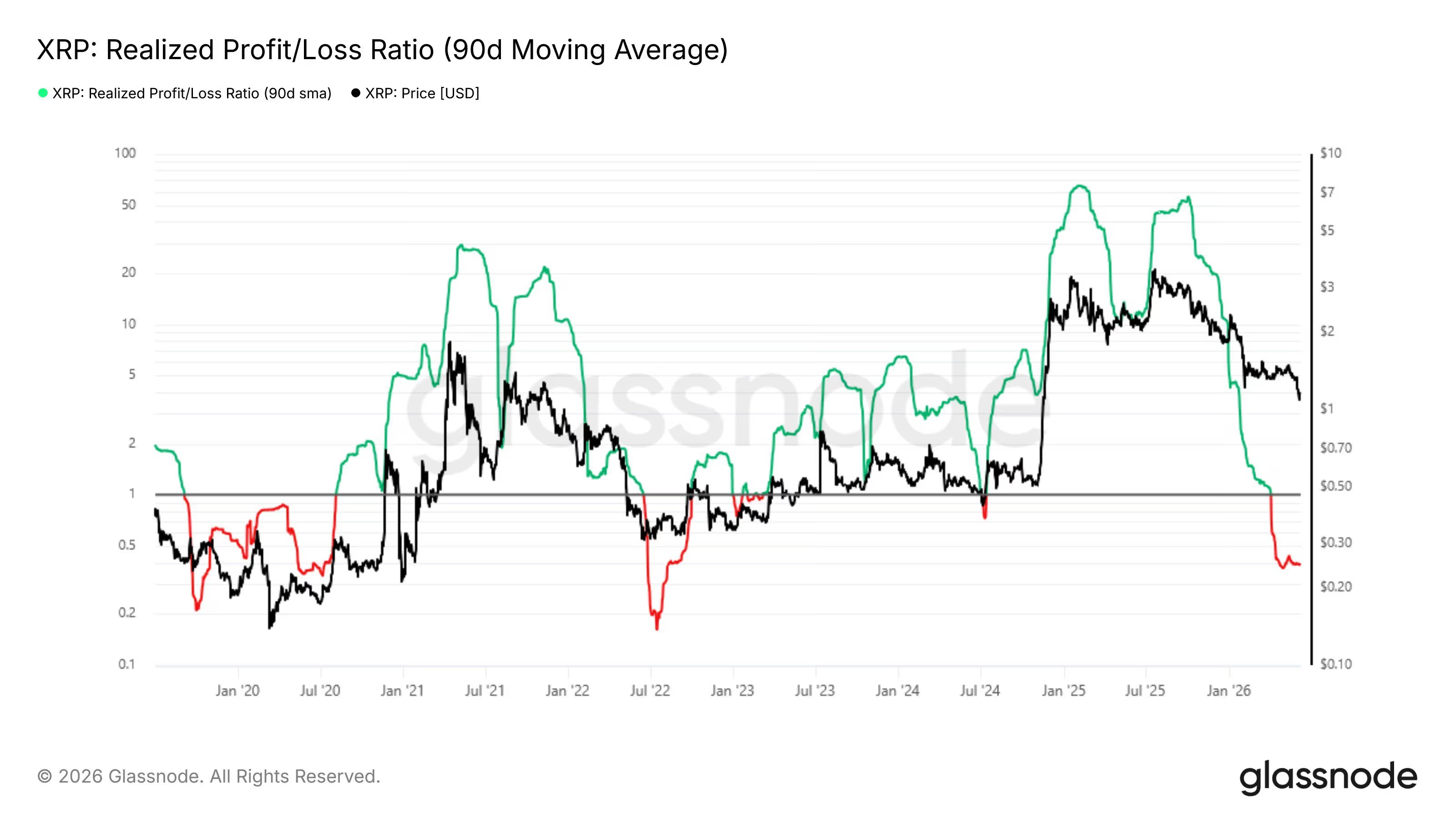
XRP market shows signs of capitulation as holders sell at loss



-

 Fashion5 days ago
Weekend Open Thread: Evereve – Corporette.com
-
 Crypto World5 days ago
Jensen Huang Approves Samsung, SK Hynix, and Micron for NVIDIA (NVDA) HBM4 Memory Supply
-

 Crypto World2 days ago
Anatomy of the June crypto crash: Fed, Iran, Saylor
-
 Entertainment3 days ago
The Best Mystery Series of All Time Is Surging on Streaming 30 Years After It Ended
-

 NewsBeat2 days ago
Alexander Zverev wins the French Open to finally earn a 1st Grand Slam title
-

 Tech4 days ago
Suspicious Polyfill login prompts pop up on Toshiba, Muji websites
-
 Crypto World4 days ago
Senator Cynthia Lummis Calls CLARITY Act the Most Consequential Financial Legislation of This Generation
-

 Tech3 days ago
Microsoft unveils seven homegrown AI models in new bid for ‘long term self-sufficiency’
-

 Tech5 days ago
Microsoft launches MXC, an OS-level sandbox for AI agents, with OpenAI and Nvidia already on board
-
 Business3 days ago
The Pain Points Taking a Fragile Tech Rally Down a Notch
-

 Business5 days ago
(VIDEO) Justin Bieber Delivers Surprise Happy Birthday Serenade to Diners at Los Angeles Mexican Restaurant
-
Crypto World5 days ago
LBank Surpasses 25 Million Users Worldwide as AFA Partnership Continues to Drive Global Growth
-

 Crypto World3 days ago
Trump’s AI Ownership Plan Could Benefit Anthropic at OpenAI’s Expense
-

 Tech5 days ago
Meta steals a tactic from Tesla and builds data centers in tents
-

 Tech4 days ago
Von der Leyen’s AI envoy pick draws conflict-of-interest fire
-
 Sports17 hours ago
Bangladesh beat Australia after 20 years in ODIs, register only their second win over six-time world champions | Cricket News
-
 Crypto World2 days ago
Eli Lilly (LLY) Stock Surges 4% Following Breakthrough Sleep Apnea Trial Results
-

 Business2 days ago
High Stakes for Wembanyama as New York Pushes for 3-0 Lead
-

 Tech4 days ago
Hackers now exploit SolarWinds Serv-U flaw to crash servers
-

 Tech5 days ago
RCS Messages Between iPhone and Android Get End-to-End Encryption With iOS 26.5
You must be logged in to post a comment Login