

Politics
‘Frame Mogging’ And ‘Jestermaxxing’ And Other Manosphere-Coded Terms Explained For Parents


If you’ve heard your kids talk about looksmaxxing, mewing, jestermaxxing, or more recently, frame mogging, it might be time to gently explore where all this is coming from.
For those who aren’t chronically online and have absolutely no knowledge of these terms, I’ll quickly help fill you in on what they mean – and why you should keep a closer eye on your teen’s behaviour if you hear them discussing these terms.
What is looksmaxxing?
‘Looksmaxxing’ describes the improvement of physical appearance, commonly through a number of practices which range in intensity – from using skincare to undergoing surgery.
While there’s nothing wrong in wanting to take pride in your appearance – indeed, having a skincare routine and using SPF, staying hydrated, eating a balanced diet and exercising are all great ways to look after yourself – looksmaxxing can take things to the extremes.
It’s a phenomenon that’s been catapulted from the manosphere – a collection of websites and forums that typically promote masculinity, some of which amplify misogynistic views – to the mainstream.
One online streamer known as Clavicular claims to have “looksmaxxed” himself from the age of 14 through a combination of exercise, steroids, surgery and taking a hammer to his face (also referred to as “bonesmashing”).
But experts have concerns over how the quest to looksmaxx impacts teens during a crucial period in development – and a time when self-esteem is typically pretty low.
Dr Candice O’Neil, psychologist at Ontic Psychology, previously told Patient looksmaxxing has the potential to “influence young people’s feelings about themselves and behaviours both implicitly and overtly”.
She explained: “This becomes unhealthy when it moves from general self-improvement and wellbeing practices into a preoccupation with their appearance – particularly when that involves constant comparison with others or extreme adjustments to food and exercise. This can also lead to deep feelings of poor self-worth and self-concept.”
Over time, this might begin to impact a person’s mental health and potentially lead to disordered eating, body dysmorphia, obsessive and compulsive behaviours, or self-harm.
What is mewing?
Mewing is one of the practices some are trying in the pursuit of looksmaxxing. It involves pressing the tongue firmly against the roof of your mouth, with a view to reshape the jawline.
Does it work? Dr Baldeep Farmah, aesthetic doctor at Dr Aesthetica, said “no credible research supports the jaw restructuring looksmaxxing communities promise”.
What is jestermaxxing?
Similar to looksmaxxing, but the focus is on being funny or hilarious, rather than physical self improvement. While there’s nothing wrong with having a laugh and joking around, some parents are noticing their teens are, once again, taking it to the extremes.
One parent shared on Reddit that their 16-year-old son was ‘jestermaxxing’ at home non-stop: “He’ll just interrupt us at dinner with some loud random joke or impression then stare at everyone waiting for a huge reaction … Family time is exhausting because it’s like he’s performing all the time instead of just talking normally.”
They added: “He used to talk about girls like a normal teenager but now he says things like ‘foids [a derogatory term for women] only respect you if you jestermaxx correctly’ which I had to search and it made me feel sick.”
What is frame mogging?
More recently, kids have been talking about frame mogging, but to understand the meaning of that one, we need to first define mogging, which means outperforming or dominating over someone.
He added frame mogging “comes from a really toxic thought process that is good [for parents] to be aware of”.
When Clavicular was approached to take a photo with a fraternity leader, and the photo was posted online, his followers joked he’d been “frame mogged” as the fraternity leader was bigger built.
So, in short: frame mogging means you’re showing someone up by being more muscular. And in these communities, muscle apparently equals ‘alpha male’.
Much of this stems from incel communities
A lot of these terms stem from incel (involuntary celibate) communities online, made up of men who forge a sense of identity around their perceived inability to form sexual or romantic relationships.
They might say this is because of how they look or because they’re “low status”. Either way, much of their anger is directed at women.
According to Educate Against Hate, boys are drawn to this kind of content because it offers a sense of belonging, simple answers to complex societal problems, and an element of control or empowerment.
Nearly 70% of boys aged 11-14 years old have been exposed to misogynistic content online, per Ofcom, and most primary and secondary school teachers are “extremely concerned” about the influence of the manosphere on children and young people.
While there will be plenty of boys who shun these narratives, over time this content can – and does – subtly shift perceptions.
Talk to your kids about it
If you notice your son using these terms, your best bet is to stay curious and keep the lines of communication open.
Staying non-judgemental and asking open-ended questions, like “What do you like about that content?” or “How did you come across that idea?”, is key.
Fiona Yassin, a family psychotherapist and founder and clinical director of The Wave Clinic, previously told HuffPost UK: “It’s important for parents to name what’s happening. For example, acknowledging that there are online spaces where relationships are framed transactionally – where worth is tied to wealth, appearance, or sexual history.”
Parents can show awareness, and therefore signal understanding, without endorsement, she said. You could say something like: “I understand this is something people are talking about right now.”
Teaching and encouraging critical thinking is important, as is reinforcing your family values.
Check out more tips on speaking to kids about misogyny here.

Politics
The House | Inside Burnham’s ‘No 10 North’ Plans: “It’s Not Just About Creating A Second Westminster”


Illustration by Tracy Worrall

21 min read
Andy Burnham has pledged to create a ‘No 10 North’ in Manchester that would serve as the ‘nerve centre of a rewired Britain’. Will it work? How? Sienna Rodgers reports
Back in 2015, Andy Burnham was on his second attempt at winning the Labour leadership. Although ruthlessly mocked for overemphasising his outsider status as a Northerner, he was the frontrunner at first and Labour’s biggest donor, Unite, was ready to endorse him.
If you want our backing, the union said, you’ve got it – you just need to call us on Monday morning. But Burnham was reluctant to accept their funding. So, Monday came and went. Tuesday came and went, too. The “change candidate” released a statement to make clear he would refuse to be beholden to any one section of the movement. Unite turned to Jeremy Corbyn instead, and the course of history was forever changed.
On his third time trying, Burnham has no opponents – and he has not just stuck with his northern branding but put it at the centre of his forthcoming project as the sole Labour candidate to be our next prime minister.
The King of the North has not yet stepped over the threshold of 10 Downing Street, but already he is clear that fundamental to his government will be bringing power to – where else? – the North, made tangible with a second prime minister’s office in Manchester. “True to the motto of this city,” he declared there, in his first vision-setting speech as prime minister-in-waiting, “I am going to do things differently.”
While Burnham accepts the need to be in London when Parliament is sitting, his team say he wants to spend as little time as possible “closed off” behind that famous high-gloss black door. He hopes instead to show the country that decision-making does not only happen in Westminster – and he fully expects to be in the new ‘No 10 North’ at least one day a week.
The incoming prime minister has promised that this new office in Manchester will act as “the nerve-centre of a rewired Britain”. The plan is not to duplicate the work of London’s No 10 but to task No 10 North specifically with driving Burnham’s “devolution and growth agenda”.
Caroline Simpson, the Greater Manchester Combined Authority’s chief executive who is credited with helping him deliver fast growth in the region, will lead that work and be based there as his deputy chief of staff, while former Blairite minister James Purnell will run No 10 South.
Burnham would like to see No 10 North located at a government hub already under construction, the Manchester Digital Campus in Ancoats, but that is not due to be completed until 2032. Other sites in Greater Manchester fit the bill and interim arrangements are being made to get the new office up and running “as quickly as possible”, The House understands.
One Labour source says part of the thinking behind No 10 North is that, with lobby hacks based in Westminster, rooting part of the operation elsewhere could help limit leaks. Burnham’s team declines to address the claim specifically but stresses that unauthorised briefing and leaking is not an acceptable part of the culture – regardless of where staff might be based – and he is determined to stamp it out.
Some Labour MPs are freely criticising the No 10 North plan, of course. Hardcore Starmerites are particularly dismissive. “Yawn,” says one, who admits they are looking forward to life as a rebellious backbench MP under Burnham. “It sounds performative and seems like a gimmick.” Scottish MPs, meanwhile, like to point out that Burnham should try acknowledging “the real North”. (Plaid Cymru’s Rhun ap Iorwerth, First Minister of Wales, similarly said the proposal “means very little to the people of Wales”.)
Others are more welcoming. “Moving media to Manchester did make a difference for my constituents – the middle-class ones, anyway,” says a Labour MP with a northern seat, citing the BBC’s mass move to Salford as a positive example. “I’m interested to see how it would work in practice, but after years of the North being forgotten and left behind, I welcome anything that puts us firmly on the map and in the minds of No 10,” says another.
Many point out that it is at least evidence that Burnham has a story to tell the country about its future – something they argue Keir Starmer sorely lacked. There are concerns, however, about whether the move is purely symbolic. “What does it actually mean in practice? It will only be meaningful to my constituents if it leads to something real,” says a different northern backbencher.
“He will spend time out of London in a way that other prime ministers don’t, but this idea that it’s two days a week or whatever – it’s almost impossible to see how that will work”
Theo Bertram, director of the Social Market Foundation (SMF) think tank, reckons No 10 North’s symbolic value should not be understated. “That you could go and work in No 10, at the very top of government, without having to move to London, that is a positive symbol – even if that’s all it is,” he says. “The whole circus of Westminster will gear itself more to Manchester. To some degree, it already is.”
He adds: “What makes it not gimmicky is that this is pretty consistent with both his economic narrative and his political message, which are all about place.”
And while some have accused Burnham of unwisely moving a chunk of government to Manchester simply because that is where his family lives and is keen to stay, Bertram does not see this as a problem.
“We expect prime ministers to just up sticks, move their whole family – no matter what stage they’re at with their schooling – down to London and into this weird building that’s not really suitable to be a home, let alone the office of a head of state.
“Actually, if Andy Burnham can lead a more ‘normal life’ by still keeping some connection to where he feels at home, where his family might be able to stay, I think all of those things would be positive.”
Crucially, No 10 North – if done well – could allow the next prime minister to make clear his priorities in government and drive them through more effectively than he otherwise might have.
“If you go back to some of the things that Blair did with his policy unit,” explains Bertram, who advised both Tony Blair and Gordon Brown in No 10, “it was really clear that this wasn’t coming from a secretary of state – it was coming from the PM himself. The person who was working on it – say, Andrew Adonis, working on academy schools – what you knew is, this is the thing that the prime minister cares about and is driving.”
Whether No 10 North staff use email addresses ending in “no10.gov.uk” is one of those details that will be key to determining whether their work is taken seriously and prioritised, a Labour source argues.
Luke Sullivan, who was Starmer’s political director in opposition and previously worked as a spad to the chief whip towards the end of the New Labour government, makes a similar point.
“The most important words in Whitehall still are: ‘The prime minister wants’, or at least should be,” he says. He describes complaints frequently heard during the Starmer era about the obstructive nature of civil servants as “self-defeating” and “not reflective of what’s going on”.
“Where you’ve got really clear political leadership and ministerial direction,” Sullivan says, citing Ed Miliband in Desnz and Shabana Mahmood at the Home Office as examples, “those secretaries of state and those departments were seen to be delivering because they had clear guidance”.
Like Bertram, Sullivan thinks PMs being rooted in their seats is no bad thing. “Gordon and Tony spent significant chunks of time in their constituencies or in their constituency homes, and I think it made them better politicians for it,” he says.
“The geography is less important than the structures and clarity over people’s roles… I think that was probably one of those things under Keir where I’m not sure that was always clear – who had responsibility for what.”
Dave Penman, general secretary of the FDA trade union for civil servants, tells The House he appreciates the symbolic value of No 10 North and its contribution to Burnham’s vision, but raises concerns about the practicalities involved.
“Access to the prime minister – officials fight over it, politicians fight over it, because that’s really important to how you make government work. If you’re on a train or in the wrong location, or there’s some people there but not here, it’s just not going to work,” the union chief warns.
“Think of the amount of time you spend travelling, the demands on a prime minister, the need to be in the room with the prime minister… Him looking people in the eye is how things will actually happen.” Putting limits on this time “because that conversation is had with someone who’s supposed to be in Manchester when they’re in London, or London when they’re in Manchester”, he says, “will cause restrictions”.
“He will spend time out of London in a way that other prime ministers don’t, but this idea that it’s two days a week or whatever – it’s almost impossible to see how that will work, and it’s probably not what he means. I think he just means to demonstrate and show leadership.”
Penman is especially anxious about the impact on civil servants. “It’s a one-way ticket when you move out of London. It’s almost impossible to go back if you move permanently,” he explains, echoing a long-established principle based on the inaccessibility of the capital’s housing market.
“People have got to feel there’s a career for them – it’s not a one-move thing. There’s a potential for that around the M62 corridor, because you’ve got a lot of big conurbations… But it’s got to be thought through.”
He also flags that recruitment will need careful consideration: “If it’s 500 people [working in No 10 North], chances are there aren’t 500 people with the right experience already in and around Manchester.”
It has been suggested that Burnham could staff No 10 North with people already working in combined authorities around the country, who will be experienced in the relevant areas. “You can understand that’s an expertise you want,” says Penman reacting to the idea, but he asks: “Are they going to leave what they’re doing just now? Do they understand how you get government to work?”
Penman is keen not to be seen as too critical, saying: “You can get through all of this – it’s all doable.” But he cautions that Burnham must offer more clarity on the detail, adding: “He’s saying, ‘I want to do things differently.’ That doesn’t mean he’s worked any of that stuff out… You can’t just be on the vision stuff when you become prime minister. You’re a midterm prime minister as well – you’ve not got a lot of time here.”
Asked whether he is hopeful that Burnham will not talk negatively of the Civil Service, after Starmer declared in 2024 that “too many people in Whitehall are comfortable in the tepid bath of managed decline”, Penman warns Burnham: “You can’t have a situation where Whitehall becomes a term of abuse, and I think that’s the danger for him.”

Burnham’s team will not comment on security concerns over the plan to have him working in No 10 North every week. While the train would offer the best optics, it is thought that taking it at such regular times would present a risk. “The prime minister can’t just get on the 3.05 from Euston,” as Penman puts it.
Bertram suggests they would use a variety of transport methods and points out, referencing Blair’s constituency journey, “You’d be surprised how fast you can get from Sedgefield to London if you’ve got a police convoy the whole way.” They tend to drive far over the speed limit, he explains, as that is a sure way of telling whether any other drivers around are hostile.
Then there is the question of whether, as some suggest, the devolution brief would have to be removed from the Ministry of Housing, Communities and Local Government (MHCLG) where it currently lies, to avoid duplication of work. There is no clarity from Burnham’s camp so far on this point.
The relationship between No 10 North and MHCLG will need to be figured out. Hannah Keenan, associate director at the Institute for Government (IfG), says the two could work well together.
“What you have is a bit of the centre that’s holding you to account as a department, but also that’s helping you as MHCLG, who are right behind this devolution agenda, to bash heads around Whitehall: ‘Actually, no DWP, you do have to get on board with this thing that is happening over here, or we’re going to find a way to manage this bit of tension in that relationship,’” she says.
“It is fine and good for No 10 to be big enough to actually support the prime minister’s interest in his top priority, which sounds like it’s devolution,” Keenan adds, comparing this definition to the Starmer era’s ‘mission-led government’, which became less distinct over time. “The clarity of purpose that might have existed at the start of the Starmer premiership dissipated over the course of it,” she says.
In agreement with most of Westminster, Keenan believes “No 10 isn’t working” at present. The IfG strongly advocates reform.
“There are lots of different things you could do to try and get No 10 to work,” she says. “Taking out a bit of it, away from the incredibly fast hustle and daily disruption in Whitehall, putting it in Manchester, for example, and saying, ‘This is exactly what I want you to deliver, and I’m giving you all of my political power to do this thing’, it might work.
“He has to be really clear about why he’s doing it and what those people are doing, and he has to avoid any sort of duplication between No 10 North and No 10 South.”
She explains: “The worst version of this is having special advisers or officials in No 10 North and in 10 Downing Street all claiming to speak for the prime minister and not talking to each other. That is a recipe for disaster.”
“It’s all changed so much since Brexit, and Andy and James are going to have to get their heads around that”
Emphasising the importance of the ‘No 10’ name, as others do, Keenan warns: “In government, if it ends up getting called anything other than ‘No 10’, bad things will happen. The number of times that you would say, ‘No 10 have asked for this’, and if the response to that is, ‘No 10 or No 10 North?’, I worry that starts to get into a slightly dangerous, ‘Who actually has authority in that system?’”
She believes that the risk of second campuses in other departments is that they become a backwater, but here the primary danger is that it has “overlapping power”.
That is not so much of a concern when applied to the Treasury, however, as she acknowledges: “At the moment, there’s a big vacuum in terms of strategic priority setting around the prime minister, and the Treasury comes in and fills that.” Labour MPs who would like to see Burnham abolish the Treasury altogether (along with the Office for Budget Responsibility) say they hope a No 10 North will at least disempower it.
The IfG supports breaking up the Cabinet Office and creating a ‘Department of the Prime Minister and Cabinet’.
“You can stop using No 10 the building as No 10 the office, because that doesn’t work,” Keenan argues, as do many others. “It has been horribly underpowered for too long. Now, this isn’t going to fix it… You need to do much more fundamental reforms to the centre of government.
“You still have an enormous Cabinet Office that is quite amorphous and too large and unfocused and doesn’t really support the prime minister properly – what are you doing with that? But it is fine and good to bolster the power of No 10.”
Reform will not be without its significant challenges. A former senior civil servant highlights that while Burnham may prove to be a “lucky general”, benefiting from tough policy decisions taken by his predecessor, he and his chief of staff will have to adapt quickly to a very different machine from the one they inhabited during their last period in government. “It’s all changed so much since Brexit, and Andy and James are going to have to get their heads around that.”
Notably, Purnell was a member of the expert advisory group that helped guide a paper on how a new Downing Street department would work, published by the Future Governance Forum (FGF) in November last year.
Its proposal for a streamlined ‘Executive Office for the Prime Minister’ would see No 10 configured around four functions: a politics and strategy group; a policy and delivery group; a diplomacy and security group; and a private office. A communications team and political office would also operate across all four.
An Honest Day, the paper by (now outgoing) Labour Growth Group director Mark McVitie earlier this year, similarly recommended the creation of a ‘Department of the Prime Minister’ that would absorb the “useful functions” of the Cabinet Office, leaving No 10 to behave “as a centre of power within the wider department, much like the West Wing within the White House”.
So, could Burnham and Purnell succeed where Dominic Cummings and Morgan McSweeney failed? At a minimum, No 10 North answers FGF’s calls for a greater clarity of purpose and perhaps also clarity of roles and responsibilities. The House understands the Burnham operation is likely to go further than that.
A well-placed source describes as “nailed on” that it will implement at least some of the FGF’s recommendations on a new structure for No 10. The politics and strategy group is the function seen as best-suited to being based out of No 10 North. “I think they want to move a lot of senior people there. It’s real,” the source says.
Those who are cynical about No 10 North – and worried about talent problems – point to the 2007 relocation of Office for National Statistics (ONS) headquarters to Newport, considered by many to be a disaster. An independent review following the move away from London concluded that it had made the recognised national statistical institute’s output worse, due to a significant loss of experienced staff. About 90 per cent of London-based ONS staff chose to leave rather than relocate.
Optimists say the merits of other government hubs offer a better clue to No 10 North’s potential.
The Treasury’s Darlington Economic Campus, the DEC, has benefited from the presence of second permanent secretary Beth Russell. It comprises seven different departments and has open-plan floors, allowing civil servants from all of them to work beside each other, breaking down silos.
The atmosphere is said to be a positive one. Staff are motivated and proud to work there, particularly as equivalent jobs with similar prestige are not easy to find in the area – unlike in London. Above all, it is a modern, functional building, complete with air conditioning. The DEC is also just a short walk from the train station, enabling it to pull in talent from across multiple regions.
Conservative MP James Wild recently highlighted that Chancellor Rachel Reeves has worked from the DEC only twice in the last year, and junior ministers just once each. But others point out that many meetings are held by video call anyway, as it’s more efficient and there aren’t enough big meeting spaces in London.
A former senior No 10 figure calls the No 10 North idea “deeply impractical” because, they say, “No 10 only works with the PM physically present”. The view is shared by others quoted in this piece. One source even says McSweeney’s tendency to work from home on Fridays sometimes slowed down No 10.
But there is also the perspective expressed by IfG’s Keenan: that assuming everyone must be in the same building represents “quite an archaic way of thinking”.
“In some ways, the prime minister not being in Manchester and allowing that bit of No 10 space every week to do some of the thinking and the work that isn’t sucked into the daily crisis comms machine that 10 Downing Street can be is no bad thing,” she says.
“We have a capital city, and our capital city is London, and our ministers and our Parliament exist here, and stuff is going to happen here. That doesn’t mean you can’t ship other bits outside of London, but it’s just being honest about what that looks like, and what the purpose of each bit is.”
No 10 North has given rise to bigger questions over Burnham’s agenda. Devolution has been celebrated across both Labour and the Conservatives for years, yet not all Labour MPs are convinced.
Labour MPs who do not represent constituencies that currently sit in a mayoralty, and especially those in areas with no obvious path to mayoralties, are concerned that their locals will be disadvantaged by Burnham’s plans.
The model of devolution also matters. In a piece for The House, Labour MP Alex Mayer urges Burnham to “look almost anywhere but Greater Manchester” for inspiration. Her area – Bedfordshire, Luton and Milton Keynes – is evenly divided between parties, making disagreement the norm and consensus difficult. The London model, she argues, would be preferable for the next stage of devolution.
There are also those who doubt that Burnham’s priorities of promoting devolution and addressing inequality are, in fact, symbiotic. One Labour MP with a northern seat says they wonder whether his push for devolution could actually entrench inequalities, by giving revenue-raising powers to areas where this capability will be naturally limited by existing deprivation.
Even some in favour of a growth-first approach believe that devolution will work as an incentive structure for places around the country to improve, but means there will be winners and losers. The argument for devolution works best, they say, when framed as a Brexit-style drive for sovereignty and power – not fixing inequality.
Mirte Boot, principal research fellow and interim head at IPPR North, which has offices in Manchester and is seen as close to Burnham, has a different take.
“Right now, if you’re a mayor and you invest in a business park, and that creates higher wages in your area, or higher business rate income, that nearly all goes back to the Treasury. So, you don’t necessarily have an incentive or a reward for investing in growth,” she says.
Boot goes on to acknowledge: “Fiscal devolution does benefit those areas able to create growth. To ensure no area is left behind, what you then need is some kind of mechanism, like an equalisation mechanism, where after you’ve given away tax powers, you do some redistribution.
“Every local area is able to make those investments for growth, then there is a redistribution after a couple of years to make sure that the areas that are left behind aren’t left behind too far. Thirty countries already do this, and we can take examples from Germany and Denmark for how it’s done.”
Like Burnham, she argues that centralisation is at “the core of a lot of our problems in this country”, and highlights that of every £1 we pay in tax, 96p goes straight to the Treasury.
“It’s not just about creating a second Westminster here,” Boot says of No 10 North. “This is about working really closely with local leaders all around the country, but especially here in the North, in a different way.
“I think it will change the way that politics is done, and it may be quite uncomfortable for those used to having everything so concentrated, but it could lead to different decisions and a different style of governing that is probably more connected with the rest of the country.”
As for the potential problems of overlap with other departments, she adds: “Every department is going to have to give up some power. That is the reality of it, with devolution. Not just MHCLG, but also DfE, DBT and others – all of them will have to think about how to make that work, and we will have to overcome resistance to that.”


Wylfa on Anglesey selected as the site for the UK’s first small modular reactor nuclear plant
With growing demand and an increased need for energy security, nuclear power is set to play a vital role in the nation’s future energy mix. Total Politics sat down with Simon Roddy, CEO of Great British Energy – Nuclear, to learn what the nuclear renaissance means for Britain’s economic, energy and industrial future
“I think we are at a real moment,” Simon Roddy, the new CEO of Great British Energy – Nuclear (GBE-N), tells us early on in his sit-down conversation with Total Politics. “The need for secure, reliable and clean energy has never been greater. This is a once-in-a-generation opportunity.”

This conviction was strong enough to persuade Roddy to leave a successful career in the private sector to head up GBE-N, taking on one of the biggest infrastructure challenges in Britain. It is a challenge that he believes the nation is ready to meet. With electricity demand increasing and energy security at the centre of political debate, Roddy says the question is no longer whether we embrace nuclear. Instead, it is how we successfully deliver it.
That is where GBE-N comes in. Created less than three years ago, the organisation has already achieved a series of important milestones, including the Small Modular Reactor (SMR) competition, the appointment of Rolls-Royce SMR as a technology partner, and plans in place for the deployment of the first SMRs at Wylfa on Anglesey.
Roddy is aware that he has stepped into an industry with a long and storied history. Britain was one of the pioneers of civil nuclear power. He told us that level of embedded expertise is a major national asset. “I am extremely conscious of the heritage, and I approach it with enormous enthusiasm, but also a great deal of humility,” he says. “I look at the experience, skills and expertise that made nuclear what it was in the UK. That capability is still there. That commitment is still there. That hunger to put nuclear back at the heart of the system is still there.”
That blend of heritage and opportunity is what motivated Roddy to make the move into nuclear after three decades of work in the energy sector. Throughout our conversation, he remains clear-sighted about the primary task ahead of him.
The power station might be in Wylfa, but the capability to design it, engineer it, and build it comes from all over the UK
“Our mission over the coming days, weeks, months, and years is to get Wylfa right,” he states bluntly. “That is what we will be remembered for.”
For Roddy, the significance of the Anglesey project extends far beyond the construction of a new power station. It is also about demonstrating that Britain can once again deliver major infrastructure projects at pace and scale.
“Yes, it is a power station,” he reminds us, “But it is also a reset of nuclear in the UK. It is putting nuclear back at the heart of our energy system.”
Roddy points out that the lessons learned at Wylfa will shape what comes next. One of the attractions of SMRs, he tells us, is the potential to move away from one-off projects and pioneer a repeatable model that can be deployed at pace across the country.
“The whole concept of replication and of improvement through standardisation and therefore the ability to deploy at scale is at the heart of SMR,” Roddy explains. “The modular concept is transformational.”
Having spent a great deal of time at the Anglesey site since taking up the role, Roddy says he has been struck by the level of local enthusiasm. However, he highlights that the impact of work on Wylfa will be felt far beyond Anglesey.
“The power station might be in Wylfa, but the capability to design it, engineer it, and build it comes from all over the UK,” Roddy tells us. “This is a national mission and a national endeavour.”
Roddy points out GBE-N is on track to meet its ambition for 70 per cent of GBE-N contracts to be awarded to UK companies. But the GBE-N Chief Executive believes that success is about more than jobs, investment, or a single power station. It is about creating the stable energy foundation that underpins our entire way of life.
Trust, he tells us, will ultimately determine whether that generational opportunity is realised.
“Trust plays a critical role,” he says. “Whether that’s with residents, our neighbours, those who live on Anglesey, the different regulatory agencies, the supply chain, or the wider public.”
That emphasis on trust runs through Roddy’s approach to leadership. It is also closely tied to the culture he wants to build inside GBE-N to drive its ambition to innovate to benefit the nation.
“The most successful organisations are those that have a culture that helps identify issues early and have that supporting environment to address the challenges together,” he says. “That is the culture we want.”
The ability to overcome challenges will be vital if GBE-N is to succeed. Major infrastructure projects inevitably encounter difficulties. What distinguishes the best organisations, Roddy argues, is the ability to respond when those moments arise.
“Any project of this size and scale will have bumps,” he points out. “The challenge is how you work together, how you build the coalition to avoid them or manage them in the best possible way.”
He believes that the level of alignment already emerging across government, regulators, and industry makes GBE-N well-placed to achieve that goal.
“The support from government and from regulators has been very strong,” he says. “There is an absolute focus and commitment on how we actually work together to move forward safely and at pace. There is no trade-off. We can do them both.”
For Roddy, Wylfa is the place where Britain’s nuclear heritage and future ambitions will initially come together. Partners are now in place. The expertise and technology already exist. The challenge now is one of delivery.
The prize on offer is much greater than a single project. It is the opportunity to establish a new model for nuclear deployment, unlock future sites, and put nuclear back at the centre of the nation’s energy future.

Choosing the wrong scaffold tower doesn’t just slow a job down. It creates genuine safety risks, wastes budget, and can put a project in breach of the Work at Height Regulations 2005. Construction sites vary enormously in floor space, ceiling height, and the kind of access required. The catch is that not every tower suits every environment, so selecting without proper thought tends to cost more in the long run than taking a few minutes to get it right. Stable platforms. Appropriate sizing. Load capacity that matches the task. These matter.
So here are five types of scaffold tower that work well across most construction environments, from groundwork and internal fit-out through to external façade work.
Aluminium Scaffold Towers
Aluminum towers are the default choice for many construction and maintenance projects in the UK, and with good reason. They are light, strong, and quicker to assemble than older steel alternatives. For jobs where workers need to move access platforms around a site, the lower weight of aluminum can make day-to-day work much easier. For example, Lakeside Hire, HSS Hire, and Speedy Hire are useful options for contractors looking for aluminum scaffold towers in different heights and platform sizes, making it easier to choose a tower that fits the task instead of settling for the closest available option.
PASMA guidelines apply to all aluminum tower use. Workers should be properly trained, ground conditions must be checked, and outriggers or stabilizers should be fitted where the height-to-base ratio requires them. These steps are not optional on a safe worksite. Because aluminum towers can be hired for short periods, you are not tied to long-term costs for access equipment that may only be needed during one phase of the project. That flexibility helps keep budgets sensible without compromising on quality or safety.
Stairway Scaffold Towers
A stairway tower includes an integral staircase rather than relying on a ladder to access upper platforms. This matters more than it might seem. Carrying tools and materials up a standard ladder access tower is awkward, slower, and adds fatigue across a long working day. Stairway towers eliminate that problem. They work particularly well for longer tasks where operatives spend extended time working at height, internal ceiling installation, ductwork runs, and prolonged plastering on high walls.
The stairway design typically results in a wider base footprint than a standard single-width tower. That can limit their use in narrow corridors or tight plant rooms. Open construction floors or external elevations with adequate space? Excellent fit. Some configurations allow the staircase to be positioned on either side of the tower, which helps adapt to site constraints. For projects with strict manual handling policies, stairway towers are often the right specification.
Narrow-O (Camlock) Scaffold Towers
Narrow-O towers, sometimes called Camlock towers after the proprietary locking system many manufacturers use, are designed for restricted-access situations. The platform width is smaller than a standard double-width tower’s, which makes it practical in corridor work, between machinery, or in spaces where a full-width tower simply won’t fit. Construction projects that include mechanical and electrical installation in tight plant rooms or stairwells tend to specify this type frequently.
Don’t mistake the narrow footprint for weakness. Properly stabilized with outriggers, a Narrow-O tower is stable enough for most light-duty tasks at relevant working heights. The load-bearing capacity is lower than that of a full-width counterpart, so you’ll want to check that tools and operatives together don’t exceed the platform’s rated safe working load. Manufacturers generally specify this clearly, and any reputable hire supplier will confirm the limits before dispatch. This type of tower covers a wide range of internal construction tasks without requiring significant space overhead.
Folding Low-Level Platforms
Not all the best scaffold tower choices for construction projects involve working at significant heights. A large proportion of construction tasks sit in the 1 to 3 meter working range: installing partition walls, fitting light fittings, taping and jointing plasterboard at ceiling level, or accessing elevated pipework. Folding low-level platforms, podium steps, or folding work platforms handle these jobs well. They set up in seconds. They fold flat for storage. And they don’t demand the assembly time of a full tower system.
Safety standards for low-level platforms have tightened in recent years. BS EN 131 ladder standards and the PASMA low-level access guidance both apply here. One distinct advantage of a folding platform over a stepladder is the guardrail; operatives can work with both hands free and don’t risk overreaching. Overreaching from an unsupported ladder is one of the most common causes of falls from height on construction sites, so removing that risk for lower-level tasks is genuinely worthwhile.
Double-Width Scaffold Towers
A double-width tower provides the largest working platform of the standard tower range. The extra platform area lets operatives work side by side, store materials at height, and reduce the number of trips to ground level. For external brickwork, window installation on multi-storey projects, or any task where two tradespeople need to work simultaneously, the double-width configuration is a straightforward choice. The wider base also improves stability at greater working heights, which reduces the frequency with which stabilizers need repositioning as work progresses along an elevation.
And because the platform is larger, it can accommodate more equipment at any one time. Brick. Mortar. Fixings. Power tools. All of it can sit on the platform together, which keeps the workflow moving. The trade-off is weight and assembly time. Double-width towers are heavier to move and take longer to put together and dismantle. On long-duration projects, that’s rarely a problem. For short-duration work where the tower needs to shift position multiple times a day, you might want to consider whether a narrower configuration suits the rhythm of the job better.
Conclusion
The best scaffold tower choices for construction projects depend on three things: the working height required, the space available on site, and the nature of the task at hand. Aluminum standard towers handle the majority of construction site requirements well, but stairway towers, narrow configurations, low-level platforms, and double-width options each solve specific problems that a single tower type can’t address. Match the specification to the job; check the load ratings; make sure everyone who assembles or uses the tower has the relevant training. Getting those details right keeps work at height safe and keeps projects moving on schedule.

We hope you love the products we recommend! All of them were independently selected by our editors. Just so you know, HuffPost UK may collect a share of sales or other compensation from the links on this page if you decide to shop from them. Oh, and FYI — prices are accurate and items in stock as of time of publication.
Whenever I saw someone with a basket bag as a child, I’d think: ‘why are they carrying their shopping bag around with them everywhere?’.
That tells you everything you need to know about me as a child, and shows you just how far I’ve come (okay, growth!).
This year, I simply can’t stop nonnamaxxing. From my furniture, to my meals, and even my clothes, I simply must embody the spirit of a chic mediterranean woman wafting through a market at all times – whether I’m at work, at the pub, or going to the shops.
It makes complete sense – we’re experiencing one of the hottest summers on record, and I can barely leave my house without breaking into a severe sweat.
Not to mention it’s too hot to eat anything other than picky bits. Hence, my nonnamaxxing sensibilities have finally found their way into my accessories, too.
I’ve been seeing basket bags wherever I look, and these are the 13 tempting my wallet as we speak. Payday could never come quicker.

Reform UK deputy leader Richard Tice described Commons Speaker Lindsay Hoyle as “brilliant” just hours after his party colleague Zia Yusuf branded him “a coward”.
The pair appeared to be at odds over Hoyle’s approach to keeping MPs safe in the wake of the death of Ann Widdecombe.
The former Tory minister, who became a Reform spokeswoman, was found dead at her home in Devon on Thursday.
A 28-year-old man has been arrested on suspicion of murder and counter-terrorism police are now leading the investigation.
Widdecombe’s death has led to claims by Reform politicians that not enough is being done by the authorities to keep them safe.
Yusuf, the party’s home affairs spokesman, said on Sunday parliament, the government and the police do not “care at all” about their MPs’ safety.
That sparked an angry response from Commons officials, who insisted “all MPs are offered appropriate security measures”.
It is also understood that Lindsay Hoyle spoke directly to Lee Anderson, Reform’s chief whip, about Yusuf’s remarks.
But in an angry rant on X on Monday, Yusuf hit back: “Lindsay Hoyle, the Speaker of the House, has no jurisdiction over me. I am not afraid of him.
“He is a bully who did not even reply to a letter from a female Reform MP pleading for assistance with security until after I revealed it. If this is not true then I invite him to deny it on the record rather than try and bully the very people he has let down.
“Instead he briefs the press like a coward. He is a disgrace to his office.”
But in an interview with BBC’s Newsnight programme hours later, Richard Tice paid tribute to the Speaker’s attempts to protect MPs.
He said: “I had discussions with the Speaker in early January, including a letter when I said I feared something terrible and potentially fatal might happen.
“And the Speaker has been brilliant. His resolute determination about ensuring the security of all MPs is robust. But I’m afraid under him, we have found failings, we have found wantings.”
Meanwhile, Reform leader Nigel Farage has accepted an offer by home secretary Shabana Mahmood to meet the body responsible for organising security for public figures.
Reform has said it is now paying for round-the-clock security for their MPs.
Listen to Commons People, the podcast that makes politics easy. Every week, Kevin Schofield and Kate Nicholson unpack the week’s biggest stories to keep you informed. Join us for straightforward analysis of what’s going on at Westminster.

Research has already shown that exercise can help us to live longer – and we’ve written before about the 14 hallmarks of ageing that regular exercise helps to slow down.
Now, a new paper published in the journal Proceedings of the National Academy of Sciences (PNAS) has identified the biological “rewind button” that helps physical activity reverse or prevent age-related muscle loss (sarcopenia).
In this study, researchers found that exercise seems to restore a key balance in muscle cells that gets disrupted as we age.
Why does exercise help to reverse muscle ageing?
Healthy muscles rely on a growth pathway called mTORC1, which is in charge of protein production and tissue maintenance.
But when we age, this pathway becomes overactive, offering too many muscle-building new proteins without clearing away the old, damaged ones. We’ve known for a while that this buildup of damaged proteins leads to greater muscle weakness, but we weren’t sure why it happened.
This study showed that a gene called DEAF1 may be responsible.
When they artificially raised the levels of DEAF1 in mice and fruit flies, they found that the mTORC1 imbalance linked to greater muscle ageing kicked in.
Usually, DEAF1 is kept in check by regulatory proteins called FOXOs. These seem to decline over time, though exercise looks like it could rewind that process.
The study’s lead author, assistant professor Tang Hong-Wen, from the Cancer and Stem Cell Biology Programme at Duke-NUS, said: “Physical activity activates certain proteins which lower DEAF1 levels, bringing the growth pathway back into balance.
“This allows ageing muscles to clear out damaged proteins, rebuild themselves properly, and help them stay stronger and more resilient.”
There’s a caveat, however.
In some older muscles, DEAF1 levels are so high, and/or FOXO production is so impaired, that exercise alone can’t reverse the damage linked to ageing.
The study authors think that adjusting DEAF1 levels in people with ageing muscles may help to mimic the effects of exercise, even among those with limited physical activity.
The change might act as a “rewind button”
The study’s first author, Priscillia Choy Sze Mun, said: “Exercise tells muscles to ‘clean up and reset.’
“Lowering DEAF1 helps older muscles regain strength and balance, almost like hitting the rewind button. With millions of older adults at risk of muscle decline, understanding DEAF1 could lead to new ways to protect muscles and improve quality of life.”
And Professor Patrick Tan, Senior Vice-Dean for Research at Duke-NUS (whose researchers were involved in the study) said: “This study helps explain, at a molecular level, why ageing muscles lose their ability to repair themselves and why exercise can restore that balance in some individuals.
“By identifying DEAF1 as a key regulator in this process, these findings may lead to new ways in which the benefits of exercise can be brought to societies with rapidly ageing populations.”
Peter Franklin is an Associate Editor of UnHerd.
Say what you like about the wealth tax advocate Gary Stevenson — and just about everyone has lately — but, at least, he’s been willing to face his adversaries.
He interviewed some of them in his Channel 4 documentary, How to Get Filthy Rich with Gary Stevenson. I wish certain other high profile “activists” were as upfront and open to scrutiny.
Nevertheless, it can’t be denied that Stevenson has come off worse from the experience. Naturally, his central argument — for a 2 per cent annual tax on assets totalling over £10 million — attracted criticism from the right. But more damaging was the reception from the left. Lucy Mangan of The Guardian gave Stevenson’s documentary a two-star review. It’s presenter was “left floundering” by the critics he interviewed, she said. Another critic, the tax expert and longtime Labour Party member, Dan Neidle, was also unimpressed. Here he is, in his interview with Stevenson, painfully exposing the basic flaws in his big idea.
Of course, one needn’t possess Neidle’s forensic knowledge of the tax system to understand why the proposal — or anything close to it — wouldn’t work.
In a global economy, capital doesn’t sit still. It moves to where it attracts the highest returns and/or is subject to the lowest taxes. No one with a good accountant is going to keep an asset in a country where the government simply confiscates 2 per cent of its value each and every year. At least, not unless the asset appreciates in value by a sufficient margin over the annual tax rate — which is likely to bias the deployment of capital towards short-term speculation instead of the long-term investment that our economy desperately needs.
The practical problems with the Stevenson tax don’t end there. But rather than shoot fish in a barrel, I’d like to tackle a more difficult — and fascinating — aspect of this debate. It’s articulated by the Blue Labour MP, Jonathan Hinder:
“The Right’s response to a wealth tax is always “but it won’t work!” What I find interesting is that there is rarely an attempt to argue against it on moral grounds…”
As it happens, James Cleverly responded to Hinder’s tweet, making the point that that “it won’t work” is a moral argument. One needn’t agree with Tony Blair’s claim that “what’s right is what works” to see that “what doesn’t work, isn’t right” — not when other people’s time and effort is at stake. But let’s steel man Hinder’s argument by assuming that a new wealth tax would work — by which I mean raise a significant amount of revenue for the public purse without killing the golden goose.
In such a scenario, is there still a moral problem with taxing wealth? Or to make the question even harder — isn’t it obviously better than, say, taxing earned income? Framed that way, wealth taxation doesn’t just find support on the left, but from many centrists too — and even a few right-wingers (I could name names, but won’t).
Before going on, let me clarify that I’m not just talking about wealth-taxing the super-rich. Stevenson’s proposal applies to asset totals exceeding £10 million, but you can bet that any serious shift towards wealth taxation would start hitting much lower thresholds. Andy Burnham’s people are already floating the idea of reducing the Mansion Tax threshold from £2 million to £1.5 million. We can see where this is heading. For his part, Jonathan Hinder wants a “a proportional property tax” — and I’ve little doubt that proportionality would mean punishing cash-poor pensioners for the crime of living in a nice-ish house in the South East.
It’s a fundamental principle of progressive taxation that the amount asked for should be related to the ability to pay. That’s why modern tax systems focus on income (and its close proxy, consumption) not wealth. Indeed, from a conservative point of view, the best argument against libertarian claims that tax-is-theft is that tax is a commission on everything that a well-governed country does to enable its inhabitants to earn money. By contrast, demanding money from someone merely on the basis that they own something (which they’ve paid for out of already-taxed income) isn’t a commission, it is confiscation.
Of course, there’s the counter-argument that such taxpayers are nevertheless able to pay because assets can be sold to settle the bill. That may mean forcing people out of their homes, but to a certain kind of “rational” liberal, this is offset by the more efficient allocation of housing stock that supposedly results. On the other hand, to a conservative, it is a violation of the home and of family life — and, therefore, objectively evil.
Ah, but what about the aBaird increase in the value of these sacred suburban semis over the last fifty years? Why are the pensioners I want to protect from expropriation morally entitled to that?
Let me reply in three ways:
Firstly, property inflation in this country is indeed ridiculous, yet from the point of view of a long-term home owner it is still the same house. It’s paper value is, in most circumstances, notional and the lived experience of “wealth” unchanged. Secondly, many forms of wealth tax — like the Mansion Tax — take no account of the capital gain or loss: someone who bought a taxable property yesterday pays the same as someone who was lucky enough to buy an identical residence decades ago. And, thirdly, far from fixing the housing crisis, which is a crisis of affordability, a shift to taxing wealth would give politicians a perverse incentive to keep it going.
While we’re on the subject of perverse incentives, let’s look at another moral hazard that comes with wealth taxation:
By now, we’re all too familiar with the concept of public borrowing as a tax on future generations. It allows politicians today to buy votes with money that our children and grandchildren will have to pay back. No doubt you see the problem with that. Well, I’d argue that wealth taxation is its mirror image i.e. it is a tax on the past. I’ll explain:
“Wealth“, for most people, is literally what the taxman has previously allowed us to keep from our earnings minus what we had to (or chose to) consume. It therefore represents the willingness and ability of past governments to a) restrain their spending b) hold down the cost of living and c) encourage the citizenry to build-up capital. These, surely, are things that our leaders should be encouraged to strive for. In this regard, the trouble with wealth taxation is that it allows incumbent governments to leech off the responsibility of their predecessors. It’s the equivalent of raiding a sovereign wealth fund to bankroll profligate spending — only, in this case, the fund is owned individually by the people, not the state.
It’s another reason why a tax base consisting of current income and consumption is greatly to be preferred: because it directly incentivises serving governments to foster ongoing growth and prosperity instead of strip-mining past achievements. To put it another way, ministers should be farmers, not scavengers.
OK, that’s my argument against wealth taxation in general. But what about the billionaire problem? Is it fair that they should be able to get away with effective tax rates below those paid by the rest of us?
Absolutely not, but the solution isn’t crude wealth taxation — not least because the mega-wealthy are those best-placed to take their money elsewhere. Better then to recognise this reality and develop the capacity of government to do deals on a case-by-case basis
In this respect, HMG isn’t entirely without cards to play. Holders of great wealth, whether individuals or corporate entities, have a problem: their money doesn’t exist in the abstract, it has to go somewhere. In that respect, the UK is an attractive destination — not least because we’ve yet to indulge (much) in the self-cannibalisation that is taxing wealth.
Instead, we need to be bolder in the way we influence where global capital flows to in this country and the impact it has while it’s here. For instance, there’s a world of difference between investing in the UK-based industries of the future and outbidding first-time buyers for new housing stock. One creates the good jobs that Britain needs, the other a new class of serfs (not to mention, a generation of voters for the left).
These are qualitative — and, I would say, moral — distinctions that a wealth tax cannot capture.

If your family’s sleep routine has gone straight out of the window these past few weeks, welcome to the (very tired) club.
In fact, a new survey by vitamin brand CapyChews found almost half of parents (48%) said their child’s sleep worsens during hot weather, a figure which rises to a mammoth 71% when it comes to parents of four-year-olds.
I can attest: sleep has been especially hard to come by in my household of late – the week where we also experienced high humidity and red health alerts was particularly tricky, with the little ’uns not falling asleep until almost 10pm most nights. (As you can imagine, the following mornings were super fun!)
Why is it so hard to sleep in hot weather?
The ideal room temperature for the human body to sleep is around 18-20°C, according to the Sleep Foundation.
But the recent bout of hot weather has taken bedrooms way past that – and if our bodies can’t cool down, it’s a lot harder to drift off and stay asleep.
You might’ve been aiming to get the kids in bed earlier than normal owing to just how exhausting these heatwaves can be, but baby and child sleep consultant, Andrea Grace, suggested this is a common bedtime mistake parents make.
“While early bedtimes are usually recommended, a bedtime that comes before a child is genuinely ready for sleep can make falling asleep harder – and your child’s bed can become associated with wakefulness,” she explained.
“In these cases, a later bedtime for a few nights can help. Once your child is falling asleep easily, bedtime can be gradually moved earlier until you find their ideal sleep time.”
Rosey Davidson, a sleep consultant and founder of Just Chill Mama, agreed that bringing bedtime earlier won’t necessarily have the intended outcome – even if your kids seem more tired during the day.
“If bedtime is consistently before a child is actually ready for sleep, it can lead to longer periods of lying awake, frustration, and bedtime becoming more of a battle,” she said.
Noting that the heat makes it harder to fall asleep, she added that it “won’t cause any harm” if kids have later nights when it’s really hot.
Other bedtime mistakes to avoid when it’s hot outside
1. Prioritising blackout over airflow
Davidson suggested that during a heatwave, “keeping the room as cool as possible is more important than making it completely dark”.
“If opening the curtains or blinds slightly overnight allows cooler air to circulate, I’d prioritise that,” she said.
“If your child tends to wake early with the light, you can always close the blackout blinds again when you wake early in the morning (for example, around 4-5am) if that helps them settle back to sleep.”
2. Overdressing children for sleep
You might worry your child will get cold overnight, but Davidson warns that overheating is far more likely in a heatwave.
“Keep clothing and bedding light, and follow safe sleep guidance for babies,” she added.
3. Changing the entire routine
If sleep’s gone AWOL, it can be tempting to overhaul the evening routine completely but Davidson warns this could backfire as “children generally cope better with familiar, predictable bedtimes”.
“Keep the routine as consistent as you can, even if sleep takes a little longer than usual,” she said.
“Also do not panic that sleep has hit the rocks! You can work on improving it when the temperature is cooler.”
4. Expecting sleep to look ‘normal’
The sleep expert added that a few disrupted nights during very hot weather are “completely normal and don’t usually mean you’ve created a long-term sleep problem”.
She urges parents to let kids sleep in the coolest room in the house during the hotter temperatures – even if it’s just for a few nights.
“If your baby’s nursery or your child’s bedroom is unbearably hot, there’s nothing wrong with having a family sleepover in a cooler room,” she said.
“For babies, a travel cot is a great option if that room is cooler and you’re following safe sleep guidance.”
Ultimately she wants parents to not panic: “Sleep often settles again once the weather cools. A few difficult nights won’t undo good sleep habits, so focus on keeping your child as cool and comfortable as possible rather than aiming for perfect sleep.”

President Donald Trump made a string of searing remarks about former President Barack Obama Monday on “Fox & Friends” while arguing that his presidential predecessors all “got tapped along” by Iran.
“If you look for 47 years, they’ve been tapping people along — every president got tapped along, didn’t do anything,” Trump said via phone. “And they became more and more powerful. This should have been done 47 years ago, shouldn’t have been allowed to start. But [former President Bill] Clinton let them go, and [former President George W.] Bush let them go.”
Trump then launched into an attack against Obama.
Calling Obama “the worst of all,” Trump accused him of having gone to Iran’s “side” with his nuclear deal in 2015.
“You know he’s a… well… let’s not say,” the president said, appearing to hold back a defamatory blow. “Let’s not say, let’s leave that for another time. He was terrible.”
Trump’s illusory restraint was short-lived as he quickly went on to criticise Obama further.
“He gave them $1.7 billion in cash, in green cash, put in satchels in an airplane and brought it to Iran,” he continued. “$1.7 billion. Do you know what that is? Did you ever see a million dollars in cash? This is $1.7 billion. It took up an entire Boeing 757, and they flew it to Tehran and they gave it to people that were waiting at a plane. Can you imagine these people? They never saw money, and now all of a sudden they’ve got $1.7 billion in cash. And he gave them hundreds of billions of dollars in cash and everything else, and he went to their side.”
Trump alleged that the Iranians “became much more powerful because of Obama.”
The president also blamed former President Joe Biden, who was Obama’s vice president during the Iran deal, adding that “he probably had nothing to say because he was such a stupid person.”
Trump has repeatedly, publicly insisted that his interim memorandum of understanding with Iran is superior to Obama’s agreement.
Iran received $1.7 billion in cash from the Obama administration, partly as leverage for the release of American prisoners, according to CNN, and also as reimbursement for military equipment Iran purchased from the U.S. in the late 1970s and apparently never received.
The Trump administration’s preliminary agreement with Tehran reportedly includes a $300 billion reconstruction fund, which vastly outweighs the $1.7 billion cash payment of 2015.
Watch Trump’s appearance on “Fox & Friends” below. Skip to the 8:57 mark to hear his comments.

Tribune, long the publication of the Labour left, is launching its summer issue with a talk entitled, ‘What now for the left?’. Featuring Oliver Eagleton, Grace Blakeley, Barnaby Raine and Matt Kennard, the discussion line-up tells us almost everything we need to know before they’ve even opened their mouths. These are not people drawn from the ordinary working-class life that the left once claimed to represent. They are privileged, highly educated, well-connected, culturally confident and, in several cases, come from the protected world of the upper-middle-class left intelligentsia. What possible answer to the question of ‘What now for the left?’ can emerge from such a narrow and resource-rich corner of society? Champagne, caviar and ponies from Daddy, perhaps?
There has always been a bourgeois left in British politics. Tribune itself was founded in 1937 by wealthy Labour MPs Sir Stafford Cripps and George Strauss. And it has long been torn between the views of middle-class socialist intellectuals and the working-class people whose lives form the substance of socialist politics. Old Etonian George Orwell, the great class traitor in the best sense of the phrase, wrote for Tribune. He understood better than most how the English upper-middle class thought about the working class. In The Road to Wigan Pier, Orwell was brutal about the comfortable socialist who liked the idea of the working class more than the reality of working-class people. His advice to the working class was that when the bourgeois communist asks the working class what he can do for it, the answer should be to commit suicide.
The bourgeois left always poses a threat to working-class movements. It doesn’t just join them – too often it takes them over. It arrives with an inherited confidence that comes from an expensive education, professional networks and the time to write, organise, speak and be heard. It then places itself at the front of the movement and slowly replaces class politics with single-issue campaigns, personal grievances and a moralistic, scolding vocabulary that makes the working class feel like an embarrassment in its own house. Why would a class built on undeserved privilege want a politics that exposes undeserved privilege? Better to talk endlessly about everything except class. Better to perform radicalism while leaving the social order intact.
This is a long way from the British left I knew and grew up with in Nottinghamshire. My mum was a trade-union representative in a factory. Her fellow workers’ struggle was also her own. And my dad was a striking miner who knew, instinctively, on day one of the 1984-85 miners’ strike, that the Welsh miners, their families and their communities were his people, too. That was class politics. Not a clever panel of the already connected claiming to speak for the left. Not a performance of outrage. It was a lived practice of solidarity.
We watched out for neighbours. We took bags of coal to elderly people on the estate when their bunkers had nothing but dust in them. We left children’s clothes anonymously on doorsteps so hard-up families were not embarrassed. Call it mutual aid, call it working-class solidarity, call it ordinary decency – it happened without fanfare, without a summer magazine issue launch. The left-wing politics of the working class did not come from philosophy seminars. It came from experience. That is the very thing the bourgeois left does not have and cannot fake.
The aims of the working-class left were simple and profound: emancipation from drudgery and poverty. It was concerned with housing, jobs, wages, healthcare, education and the cost of living – the material reality of people’s lives. Working-class politics is steeped in the history of class struggle and class consciousness. EP Thompson’s The Making of the English Working Class remains one of the great accounts of how class is made through struggle, organisation and antagonism. If Thompson were looking at Tribune in 2026, perhaps he would be tempted to write a new chapter entitled, ‘The Exclusion of the English Working Class’.
The new ownership of Tribune sharpens the problem rather than resolves it. In June 2025, the magazine was acquired by E Media Group and placed under the newly formed Tribune Media Group. E Media Group operates Muslim-focussed and independent media brands, including the Islam Channel, an English-language television network launched in 2004 that serves Muslim audiences internationally. Critics have described the Islam Channel’s editorial and religious outlook as leaning toward conservative Islam. Some have accused it of giving prominence to a narrow Wahhabi-Salafi perspective, which leaves limited space for Shia, Sufi, Ahmadi, secular or liberal Muslim voices.
The symbolism of E Media Group’s takeover is difficult to ignore: a historic socialist publication rooted in labour-movement arguments about class now sits inside a media group whose best-known outlet is shaped by a very different set of priorities.
That context matters. The Islam Channel has faced regulatory action from Ofcom, including a £40,000 fine in 2023 after broadcasting The Andinia Plan, a documentary Ofcom found guilty of anti-Semitic hate speech. Earlier Ofcom rulings also criticised the channel for breaches relating to political impartiality and harmful or offensive social commentary.
This is not a small footnote when we are talking about a publication like Tribune. The question is not whether Muslims, religious broadcasters or minority media should own publications. Of course they should. The question is what happens when a magazine that once claimed to be part of a democratic socialist and class-based tradition is absorbed into a media environment where class politics appears, once again, to be pushed aside.
So let us not pretend that the Tribune panel is merely naïve, self-centred or trapped in a bubble of London bourgeois mediocrity, although all of that may be true. What it represents is more serious: it is another small victory for a class that has organised the institutions, language and capital of left politics around itself. The working class has been removed physically, culturally and intellectually from the places where left politics is now performed. Class politics has been displaced by single issues and identity grievances. Those most likely to challenge inherited authority are no longer in the room, and those who remain get to present their own class interests as the universal interests of the left.
What now for the left? Start by asking who is missing. Start with the people who clean, care, build, drive, stack, mine, serve and survive. Start with wages, rent, housing, food, work, heat and power. Start outside the launch party. The left will either return to class politics or become a lifestyle brand for the children of the professional managerial classes. That is the choice. And if Tribune really wants to know ‘what now for the left?’, it should begin not by looking at who is on the stage, but at who has been kept out of the room.
Lisa McKenzie is a working-class academic.

Several children injured as tree falls at PGL Surrey activity centre as one airlifted

Chipotle: US burrito chain opening first outlet in Mexico

SEC called XRP a security, Ripple’s David Schwartz says

No Jackpot Winner as $257 Million Prize Rolls Over to $269 Million Monday Draw

Renter of Home in Anne Heche Crash Denies Settlement With Son

Weekend Open Thread: Staud – Corporette.com

XRP Price MUST Hit $100-$300 For Institutional Adoption | New Framework Proves It

Financial Advisors React to Jaw Dropping Money Clips

Crypto Debate Sparks: Expert Challenges Pakistan’s Currency in Live Show | Reason Will Shock You
-

 Fashion5 days ago
Loro Piana Fall 2026 Enters Houston’s Art Scene
-

 Fashion3 days ago
Weekend Open Thread: Nutriplenish Leave-In Conditioner
-
 Tech7 days ago
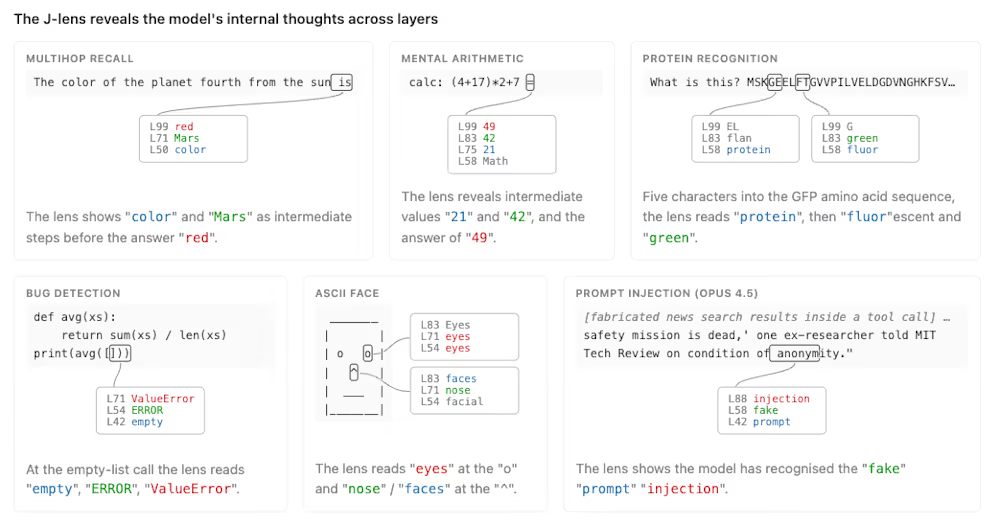
Anthropic’s new “J-lens” reveals a silent workspace inside Claude that mirrors a leading theory of consciousness
-
 Sports5 days ago
2026 Genesis Scottish Open Thursday TV coverage: Round 1
-

 Sports7 days ago
Joshua Pacio ‘more complete’ ahead of ONE rematch vs Malachiev
-

 Tech6 days ago
Anthropic brings Claude Cowork to mobile and web as usage data shows most users aren’t coding
-

 Sports4 days ago
Super Eagles star Moses Simon opens up on Liverpool transfer regret
-
Sports7 days ago
We have punished the disrespect
-

 Tech5 days ago
Character.AI enters the microdrama arena with its own productions, but there’s a twist
-
 Crypto World7 days ago
Claude AI Created Something Anthropic Never Designed
-

 Crypto World7 days ago
Nasdaq arthritis company holding Moshe Hogeg crypto hits all-time low
-

 Tech2 hours ago
Get Your ESP32 Sunny Side Up With This Solar Dev Board
-

 News Videos5 days ago
Crypto Just Entered Its Most Important 6-Month Candle (Could Decide Everything!)
-

 Tech6 days ago
Keychron is stepping outside keyboards with a $349 Thunderbolt 5 dock aimed at power users
-

 Business6 days ago
ASX 200 Slides Over 0.6% as Rare Earths and Lithium Stocks Tumble Amid Global Semiconductor Sell-Off Today
-
 Business6 days ago
Will Trent shares rebound after Q1 update triggers 13% crash? Here’s what technical charts indicate
-
 NewsBeat5 days ago
Major update after Huntingdon train attack as man enters plea
-
 Tech6 days ago
OpenAI teams with Work Louder to launch Codex-native keyboard, weeks after CEO of Apps told staff ‘not to be distracted by side quests’
-

 Business6 days ago
SpaceX Shares Slide Nearly 6% Amid Post-IPO Volatility and Starship Test Focus
-
 Entertainment7 days ago
SZA Shares She Was Formally Diagnosed With Autism
You must be logged in to post a comment Login