
Politics
Gary Stevenson’s wealth tax vs Dan Neidle’s land value tax: the difference explained



Gary Stevenson has been dismantling “childish” arguments against a wealth tax for years on YouTube. His Channel 4 documentary, How to Get Filthy Rich, packaged his arguments as a long-form show for a mainstream audience. Journalists focused on his clash with tax lawyer Dan Neidle, who called Gary’s annual wealth tax proposal “populist claptrap.” The sensationalism around the debate, however, belies a category error: a wealth tax and a land value tax target completely different things, and both can co-exist.
Comparing acres and Apple
In their discussion, Neidle accused Stevenson of being “unable to separate [his] emotional reaction to inequality with a rational assessment of the best tools for it,” only to then propose an inadequate tool for tackling inequality: the land value tax.
Through his non-profit Tax Policy Associates, Neidle has published a modelled land value tax that would progressively replace council tax and stamp duty over a decade, charging between 1.1%–1.7% of a property’s unimproved land value. His tax is a well-designed policy for a real problem: land wealth is absurdly concentrated in Britain, and taxing unimproved land value discourages the speculative land-banking that holds up the housing supply.
But for all the strengths of Dan’s proposal, taxing land is not appropriate for tackling the particularity of billionaire wealth in the 21st century. The idea of taxing land is, in fact, centuries old, pioneered by Henry George in the 1800s, and the logic, in many ways, is sound. The inequality of today’s economies, however, requires a different analysis.
The research of French economist Gabriel Zucman on billionaire wealth, distilled in his new book We Need To Tax Billionaires, underpins a lot of wealth tax proposals. Zucman’s account traces the growth in extreme wealth to appreciation in the companies people already control, more so than land holdings. Between March 2024 and March 2026 alone, global billionaire wealth increased by around 40%. Ultra-wealthy people, nowadays, typically hold their fortunes through personal holding companies that accumulate dividends and unrealised capital gains while reporting almost no taxable income, financing their lifestyles by borrowing against appreciating shares, rather than selling their assets, avoiding opportunities to be taxed.
To infinity, and beyond the taxman
Elon Musk is the clearest example of the mechanism that Zucman described, even if at one remove from British politics. Musk’s net worth is built almost entirely from his stakes in Tesla and SpaceX, with a tiny fraction held in cash. ProPublica’s analysis of leaked IRS data put his “true tax rate” against wealth growth at 3.27% between 2014 and 2018. Musk’s wealth is overwhelmingly not in land, so a land value tax, however well designed, could not affect it.
Research from the Resolution Foundation’s Wealth Tax Commission work shows this isn’t a quirk of Musk’s portfolio. For UK families with net wealth over £5 million per adult, wealth is far more dominated by business and financial assets than for families lower down the wealth distribution. The ultra-rich then hold proportionally less of their fortune in land than almost anyone else in the country. Land value tax is a real answer to a real problem, just not the one Gary Stevenson spent a whole documentary laying out.
Ground control to Gary Stevenson
Neidle’s rebuttal fails to engage with that distinction, arguing about methods of assessment, GDP growth and capital flight, but his criticisms were on the basis of poor analysis of the wealth of the ultra-rich. Even in terms of political pragmatism, though Neidle frames Stevenson’s idea as fringe, polling finds wealth taxes to be a lot more popular than a land value tax.
YouGov found that a wealth tax on assets above £10 million has net support across voters, including Conservatives and Reform. 64% of Conservative voters think the government should do more to tax people with net wealth over £10 million, and a majority of people considering voting Reform back a one-off wealth tax.
A wealth tax then would not only be suited to the problems presented by the growth of billionaire wealth, but would be a popular proposal across the political spectrum, rather than just ‘populist claptrap.’
Featured image via Channel 4
By Hugo Harvey



Responding to an article from Stephen Pollard, the editor of the Sunday Telegraph has publicly described Israel’s genocide as a “lie”. It comes as Nigel Farage’s Reform UK launched an attack on rivals Restore Britain over accusations of ‘antisemitism’:
Restore Britain has endorsed the monstrous lie that Israel is committing a genocide in Gaza – the opposite of the truth. The horseshoe theory of politics is being proved correct – a right-wing party has aligned itself with the far Left and extreme Islamists on this issue. It is…
— Allister Heath (@AllisterHeath) August 10, 2026
Israel’s Gaza genocide
Heath’s post finishes:
It is vital that retired actors, pro-Israel conservatives or observers of UK politics in Europe or America, including [Elon Musk] understand the truth about this party.
Restore’s talk of Gaza ‘genocide’ is as ridiculous as the Left’s
The issue for Heath and Pollard is that Restore politician Charlie Downes posted the following:

We’ve been heavily critical of Restore Britain, but Downes isn’t wrong to describe the situation as a genocide. He’s also not wrong to highlight the complicity of the British media.
Pollard’s piece opens with the following:
Genocide requires state intent. Instead, Israel deserves praise for the humanitarian care it has taken in its fight against terrorists
On the topic of “state intent”, Law for Palestine meticulously documented 500+ instances of “Israeli Incitement to Genocide”. They described this work in 2024 as follows:
Since the commencement of our investigative efforts on October 7th, 2023, Law for Palestine has meticulously amassed a compelling body of evidence exposing the proliferation of incitement to violence and genocidal intent perpetrated by Israeli officials and public figures, against Palestinians. Our documentation encompasses over 500 incitements of violence and genocidal incitement, appearing in the forms of social media posts, television interviews, and official statements from Israeli politicians, army personnel, journalists, and other influential personalities.
These reprehensible incitements have been categorized into significant thematic areas, including genocidal intent, forced displacement, and collective punishment. What makes this evidence all the more disconcerting is its origin, emanating from the upper echelons of the Israeli government, including the President, Prime Minister, Knesset members, military personnel, and law enforcement.
Nothing Pollard writes in his piece does anything to undo this reality. And speaking of reality, the Telegraph seems to exist on an entirely different plane of it than the rest of us:
Britain can’t stop climate change. Scrap net zero and embrace Mediterranean life https://t.co/AjtkLDpMsS
— Allister Heath (@AllisterHeath) July 29, 2026
Right VS Right
The Telegraph isn’t the only organisation attacking Restore Britain over alleged antisemitism. In an announcement given on Monday 10 August, Farage said that for Reform to work with Restore, his rivals would have to shed members like Downes. As GB Politics reported:
BREAKING: Reform UK leader Nigel Farage has ruled out any deal with Restore Britain unless Rupert Lowe expels Charlie Downes from the party
Nigel Farage has accused Charlie Downes of antisemitism after the Restore Britain spokesperson insinuated that Farage had been bought by Jewish supporters
These comments from Downes are less defensible, obviously. While it’s true that many people in the Zionist movement fund UK politicians, there are reasons why we highlight that they’re Zionists rather than Jews:
- Not all Jewish people are Zionists.
- Not all Zionists are Jewish.
Many non-Jewish American politicians are Zionists; the same is true of many non-Jewish European and British politicians. Many Western journalists are Zionists too, including the non-Jewish Allister Heath.
To be especially clear on what we’re talking about, Zionism is the ideology which dictates that Israel must exist as an expansionist colonial project in the Middle East. Both colonialism and expansionism are bad, which is why we oppose the ideology. When someone talks about opposing ‘Jews’, though, it seems like there’s something else at play.
Collaboration
With both Reform and the Telegraph attacking Restore, it does seem like there’s some degree of coordination. We’re not going to throw our support behind Downes, but we will acknowledge he was right about the genocide. And we’re far from the only people who hold that opinion:
'far left and extreme islamists' or as they're otherwise known, half the fucking country https://t.co/zXjQ7maymn pic.twitter.com/aurvI5hBII
— NJ (@NoJusticeMTG) August 10, 2026
Featured image via the Canary
By Willem Moore
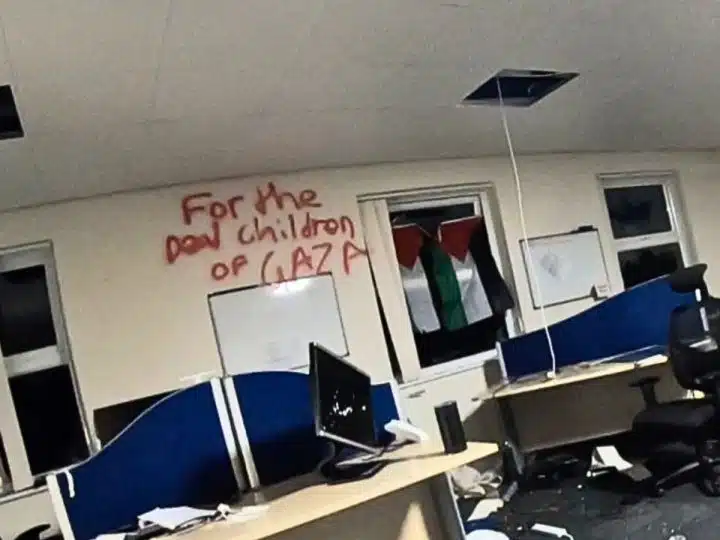

At approximately 3am on Sunday 9 August, a 2-person People Against Genocide (PAG) team broke into the Aberdeen facility of leading military tech and cyber warfare company, Ultra Intelligence & Communications (Ultra I&C).
Having entered the building, they barricaded themselves inside. The activists then set about dismantling equipment and computer equipment, in order to make it inoperable.
From inside the building, they also spray painted “For the dead children of Gaza” on the wall. And they obtained masses of documents from the weapons firm.
PAG has repeatedly targeted Ultra I&C facilities because it’s a key supplier to UAV Tactical Systems. UAV is a Leicester subsidiary of Elbit Systems, Israel’s biggest weapons maker. Elbit produces 85% of the Israeli military’s killer drone fleet, and 80% of its other weaponry and equipment.
Job listings for Ultra I&C’s Aberdeen site show that its work includes the manufacturing and maintenance of equipment. As well as working with Elbit, a data breach in 2024 confirmed that Ultra I&C, one of the main weapons companies operating in the UK, is also working directly with the Israeli military.
Previous actions against Ultra I&C
In June, PAG took action against the Ultra I&C Maidenhead facility. Four activists used modified suitcases, with lock-on devices, to barricade the plant, and shut it down.
Then, just a few weeks later, in July, PAG activists managed to get inside the Ultra I&C Tring plant. After barricading themselves inside, they destroyed satellites worth £3m. The Crown Prosecution Service claims these were about to be shipped to the Israeli military.
At the end of July, PAG visited the company’s Cambridge site, spray-painting slogans all over the walls in blood-red paint, telling it to “Drop Elbit”.
On 8 August, PAG targeted the Loudwater facility of Ultra Maritime, (also part of the Ultra group), at Knaves Beech Business Centre, Loudwater, High Wycombe. Activists smashed windows at the plant and covered the exterior walls in symbolic blood-red paint and graffiti.
The Aberdeen action coincided with the 20th anniversary of the action against Raytheon in Derry. Nine people broke into the facility to disrupt the supply of weapons for Israel to use against the Lebanese people in 2006. That action was part of a concerted local campaign in Derry against the factory. It resulted in Raytheon permanently shutting down in the area.
A spokesperson for People Against Genocide said:
Companies like Ultra I&C, which operate in our towns and cities, fuel and profit from the ongoing genocide in Gaza. Not only does Ultra I&C supply Israel’s biggest weapons firm, Elbit Systems, the firm also supplies the Israeli military directly. Previous actions have destroyed satellites made by the company, which were headed to Israel.
Since being appointed prime minister, the only message Andy Burnham has sent to the Israeli war machine is that it’s business as usual. His cabinet is full of Israeli stooges, and Britain is directly involved in the genocide in Gaza, which along with the pogroms on the West Bank, and the devastation of Southern Lebanon, is pushing the indigenous Palestinian people to the brink of annihilation.
That’s why we can’t expect anything from the government, and must take direct action in order to intervene and disrupt the genocidal supply chain ourselves.
By working for Elbit, and for the Israeli military directly, Ultra I&C are up to their necks in bloodshed. By occupying their Aberdeen factory today, we aim to intercede in their production of deadly weapons to prevent further Palestinian bloodshed.
We have to shut these weapons firms down. Free Palestine!
Featured image supplied
By The Canary
Politics
'I'll never bow down': Montana Democratic Senate nominee refuses to pave way for independent


Montana’s Democratic Senate nominee on Monday refused to drop her campaign to clear the way for an independent candidate, setting up a crowded race that is likely to help Republicans win in November.
Alani Bankhead made certain with hours to go before Monday’s deadline that she would not step aside to give independent Seth Bodnar — who is backed by former Sen. John Tester (D-Mont.) — a clearer run at Republican Kurt Alme.
“I’ll never bow down,” Bankhead said during a press conference ahead of the 7 p.m. Eastern Time deadline to drop out. “I am in this race to win it and I am staying through Nov. 3.”
Bankhead accused her opponents of being “hand picked” by the establishment while she won the Democratic Primary.
Her refusal to drop is no surprise. She told POLITICO earlier this month that it would take “a lighting bolt from God” to convince her to exit, and she’s cast Bodnar’s backing from Tester as proof that he’s more aligned with the establishment than she is.
It’s caused a significant headache for Democrats, who have had some success getting their candidates to drop out for independents in other deep-red states carried by President Donald Trump by wide margins in 2024. Democrats in Idaho, South Dakota and Nebraska have all dropped their bids, though legal challenges could still complicate some of those efforts.
But Montana is Democrats’ best shot of actually flipping a seat with an independent candidacy, and Bankhead remaining on the ballot is likely to complicate that path exponentially.
Polling has shown Bodnar in a competitive head-to-head position against Alme and closer than if Bankhead had a one-on-one contest. But with both on the ballot, Alme leads by more than 20 points. Democrats like Tester and former Gov. Steve Bullock have found success in the red-leaning state, but a split ticket all but cedes the race to the GOP and narrows Democrats’ path to a majority in the upper chamber.
Bodnar and his allies have upped their focus on Bankhead in recent days. A super PAC backing Bodnar has been hammering her on television while another group is posting signs around the state calling for her to drop out.
More than 20 local Democratic lawmakers recently called on Bankhead to drop out, as well as former Democratic Party leaders. But in the end, their argument wasn’t enough to change Bankhead’s mind.
Bodnar recently told reporters ahead of the Monday deadline that he, too, had no plans to drop — while publicly bashing Bankhead for the first time.
“On the Democratic side, millions of dollars of outside dark money poured into a primary to determine an outcome,” Bodnar said at a press conference. “Now they have a candidate who’s unvetted.”


Months of unusually dry weather have killed the grass that British farmer John Franklin’s sheep would normally graze on. Like other farmers, Franklin’s only contingency is to dip into the winter feed. He had been saving this feed for colder months, he told CGTN.
His 200-acre farm, which also runs a shop and cafe selling local produce, has lost a third of its income this year as crops fail to meet market specifications and yields drop.
He is not the only one. Research from the Energy and Climate Intelligence Unit (ECIU) suggests that the 2026 harvest is now likely to be one of the five worst since 1984
Climate-sceptical farmers can no longer ignore realities
In its latest study, latest, World Weather Attribution has reported that the June heatwave (where temperatures climbed to 37.7 degrees celsius) would have been unimaginable 50 years ago, adding that climate change is “unequivocally to blame.”
Martin Lines, CEO of the Nature Friendly Farming Network and a farmer from Cambridgeshire, said that even climate-sceptical farmers were facing the brutalities of climate change:
I’ve never known it this dry and hot on our farm. Even farmers I know who were sceptical of climate change are now saying they’re really worried about the future of their businesses and production, it’s just been completely brutal for our industry. And with high input costs because of the Iran war, planning crops for next year is a total nightmare. The nature-friendly practices we’ve deployed on the farm have helped our soils hold on to water for longer, but there’s only so much you can do to adapt to these sorts of extremes.
Consequences even for Clarkson
Jeremy Clarkson who has made a career out of dismissing climate worries as the preserve of “soup-throwing” activists and “Elton John-taxing” do-gooders, has found himself in an awkward position. His own Diddly Squat farm in Oxfordshire has not been immune to the same brutal conditions.
In his typical fashion, Clarkson wrote in the Times earlier this year:
I fully understand that a great many people are extremely worried about climate change and believe that unless we immediately give Israel to the Palestinians and throw soup over a few more paintings, the whole world will quickly become a blazing inferno. So understandably they fully support the concept of net zero and argue that the £7 zillion to implement it should be met by vigorously taxing Elton John and the nation’s bankers.
But even Clarkson might struggle to joke his way out of a parched field and shrivelled crop.
Featured image via the Canary
By The Canary
Politics
The House | We need to be frank about the breakdown of trust between ministers and civil servants


4 min read
I have spent a year trying to find out why political trust in Whitehall has deteriorated. The problems can be fixed – but first we need to be honest about them.
“I am concerned at what I see as a slow deterioration over time in the trust between ministers and civil servants”. So wrote David Normington, previously the top civil servant at the Home Office and, at the time, the first civil service commissioner.
That was almost a decade ago.
And yet we are still grappling – or rather failing to grapple – with the question of political trust in the civil service. Soon after Normington wrote the above in 2017, we saw a sharp deterioration in relations: see for reference anything from the antagonistic approach of Jacob Rees-Mogg and Dominic Cummings to Liz Truss’s attacks on the “Treasury orthodoxy”.
Recent attempts to improve the relationship have at best managed to stabilise it.
Rishi Sunak refused to condone his colleagues’ characterisation of Whitehall as “the blob”, and Keir Starmer began his premiership with a private note to civil servants assuring them, “you have my confidence, my support, and my respect.” Both are welcome. But five months later, Starmer was so frustrated with that same civil service that he accused too many of them of being “too comfortable in the tepid bath of managed decline”. It’s a phrase that has stuck around. I am sure that is in part because it is too clunky to ignore. But also in part because it was Starmer – the civil servant’s prime minister, as a former civil servant himself – who felt compelled to make the accusation. The much-hyped Labour reset of relations with the civil service had failed.
I have spent the past year trying to find out what is going wrong – why have the resets failed, and why do ministers not trust the civil service? To understand this, we’ve spoken to ministers, civil servants and special advisers to help us build a picture of how trust in the civil service is lost.
The vague, hand-wavey language we use around this relationship has to end
It is not the prettiest of pictures.
There are problems with underlying capability – both in policy advice and delivery.
But far more salient to politicians is how that capability is applied. We heard about a culture of overwhelming inertia and status quo bias where it feels impossible to get things done. We were told about a sense that the civil service lacks the professional curiosity it needs to address first-order questions and escape the trap of formulaic answers, compounded by the stifling of junior civil servants by their seniors. We heard about conflict aversion practiced to the extent that trade-offs don’t get surfaced at all, and about a civil service that leans back rather than leaning in to working alongside politicians. And we heard about a civil service that draws the line around what is ‘political’ so widely that it lacks the political judgement and understanding to properly advise ministers.
If all of that sounds very one-sided, it is. Trust is a two-way street. But in our system of elected politicians and a permanent civil service, it is the civil service that must earn the trust of the ministers they serve – or at least show themselves to be trustworthy.
It also sounds very negative. That is – again – intentional.
The vague, hand-wavey language we use around this relationship has to end. We all (ministers, officials, and anyone who has ever used the term “the blob”) need a proper way to describe what is going wrong. Otherwise we end up with either jibes about an amorphous mess of unelected bureaucrats, or meaningless platitudes about the need for ‘respect’. As we have seen, neither approach works. This mushy language means we are not pinpointing the real problems in the relationship, and so can’t do anything about them.
If you disagree with the above – great. Let me know, and let’s build a better picture together.
Hannah Keenan is an associate director at the Institute for Government

Let me open with an obvious point: Britain doesn’t have enough homes for its ever-growing population. Houses are in such demand that prices remain completely detached from average wages across most of the country; young adults are postponing family formation; and plenty of 20- and 30-year-olds are forced to live a sort of forever adolescence as they stay at home or live in the equivalent of student digs for years.
In response, we rightly hear how the crisis could be eased by an increased programme of house building across the nation. However, I submit we should also give far more attention to our existing housing stock – indeed, to many of the historic buildings this proud nation boasts.
Planning reforms are overdue, and we will need new developments to form part of any lasting solution to our low housing stock. Yet we run the risk of becoming so fixated on building afresh that we neglect the buildings we have. Across the country, Victorian and Georgian properties are falling into disrepair. I live in one – my own Victorian Glasgow tenement is undergoing ruinously expensive repairs at the moment (each of the eight owners has had to pay about 50 per cent of the value of their flats to fix them after decades of inattention from those in charge of the block).
This disregard is visible on any high street in any market town up and down the country, as upper floors above shops remain pretty rotten looking. Council or previously council-owned estates are in a parlous state. Indeed, a recent parliamentary report suggested that bringing historic buildings – including vacant upper floors above shops, former mills and civic buildings – back into use could create as many as 670,000 homes. Meanwhile, around four million homes in England fail the Decent Homes Standard, and nearly 94,000 social homes sit vacant, many awaiting repairs, despite chronic housing shortages. We have become strangely comfortable allowing perfectly serviceable buildings to decay while insisting that the only answer is to pour more concrete on to green fields.
The pattern is unfortunately not limited to housing. Eight years after the first devastating fire that gutted it, Charles Rennie Mackintosh’s Glasgow School of Art is still behind hoardings, and recent headlines suggest it may stay that way. We don’t have the wherewithal or imagination to repair it, despite it arguably being Scotland’s Notre Dame.
We’ve also seen historic churches disappearing at an alarming rate in the UK – over 3,500 churches have closed during the past 15 years or so. There are almost 1,000 churches and chapels in England currently deemed ‘at risk’ because of historical neglect.
The closing down and / or dilapidation of our churches is as clear a symbol we have of Britain’s awkward relationship with its own architectural inheritance. Some of these closed churches have become cafés or libraries, which is fine in its own way. They at least continue to provide a sense of civic togetherness, a congregationalist element.
Some have been converted into mosques. Former churches now cater to Muslim congregations in Stoke-on-Trent, Blackburn, Ipswich and many more places besides. Bradford’s Islamic population is now catered for by a landmark ‘mega mosque’, a conversion of the historic, beautiful and gigantic Heaton Mount university site into the newly minted ‘Mustafa Mount’. It seems that newer non-native religious communities have a confidence that many traditional Christian institutions lack, unable as they are simply to maintain the buildings they already possess.
None of this shows us as a nation willing to conserve its inheritance. We have become willing – or at least passive enough – to accept the really quite rapid disappearance of buildings and attendant institutions that previous generations spent centuries creating. It’s an aesthetic loss, for sure – it’s also an erosion of the character of the places around it, and a weakening of the sense that Britain is a civilisation with something worth preserving.
Conservation is not an indulgence. It is a recognition of the fact that a civilisation will always inherit far more than it creates. As Burke famously argued, society is a partnership ‘between those who are living, those who are dead, and those who are to be born’. Our buildings are a clear expression of that partnership. They show off generational craftsmanship (much of which is also disappearing), reflect local traditions and give us a sense of permanence in a world beset with a feeling of ennui and transience.
It’s no coincidence that Victorian terraces, Georgian crescents and Scottish tenements are some of the country’s most sought-after homes (before we realised the state it was in, my wife and I were besotted by our beautiful flat with all its period features). And they were built to last in a way that modern homes are not, as an architect friend of mine assures me.
Perhaps top of all points in favour of looking after our historic homes, they are already there. We don’t have to carve up greater swathes of the country to house our ever-growing population. As we’ve seen, more than half a million extra homes are already there for the taking, if only we had the will to breathe some life back into them.
So can we please have a conversation about memory in tandem with a conversation on housing? A nation confident in its future (which I would argue we are not, but which we should and could be) will always build the homes it needs for its citizens. A confident nation will also cherish what previous generations have gifted it. In continuing to neglect our architectural inheritance, we should not be surprised when the generations who follow us inherit not only fewer homes, but also a poorer country, less rooted in itself.
James Dixon is a Glasgow-based novelist, poet and playwright.

Few familiar with Westminster City Council will be surprised by its draft proposal to refuse licenses for new pubs and nightclubs unless they ban standing up while having a pint – an activity it calls ‘vertical drinking’. After all, when it comes to petty killjoy regulations, this council has form.
Take its attitude to takeaway pizza. After a blurry night out, I usually sit on the floor, in between the sofa and coffee table, in a relaxed heap, my face as close to the hot, greasy and preferably cheesy food as possible. Coupled with a can of cold Diet Coke, it’s the perfect end to a night out. In the morning, I am immeasurably grateful to myself for the carbs and fluid consumed in this state of nirvana.
Westminster council have found a way to spoil even this in Soho. The pizza restaurant ICCO on Greek Street has a limitation on its licence that dictates it may not sell pizza for takeaway after 11pm. The chain operates two other units, both outside of Westminster’s boundaries, that have no similar restrictions.
Shrief Kamel, creative director at ICCO, has said this causes no end of grief for his staff when the clock strikes 11. Customers line up hoping for a late-night snack, and his embarrassed team has to inform them that there is a ban on boxes. Tourists end their night in London on a sour note, and incredulous residents point to their nearby flats saying, ‘but I live just there’.
On the one night a month that it does operate as a takeaway after 11pm, it has to apply a week in advance and pay a fee for a ‘temporary event notice’. On other evenings, Shrief has encountered licensing officers attending the restaurant to search through bins, checking for timestamps showing takeaway pizza sold after 11pm (always in vain). Customers who do decide to eat in at the few tables the restaurant has aren’t even allowed to take leftovers with them if they depart after 11.
Like other restrictions on venues operating in Soho, the reason cited by the council for this strange ban is the dreaded ‘cumulative impact assessment’ (CIA). This is the method that the council employs to work out what effect a concentration of venues has on the ‘licensing objectives’ handed down to them by the 2003 Licensing Act. Although the Licensing Act isn’t something the council has the power to change, the act does not require the council to maintain use of the CIA (Camden council recently ditched its CIA).
The CIA is the same mechanism that Westminster council used in its draft policy to ban ‘vertical drinking’ in pubs. The policy, which is currently out for consultation, states that there will be a standard presumption to refuse all applications for any new pub or club. However, if space for ‘vertical drinking’ is removed, then the council will consider awarding a licence.
Several Westminster councillors have taken to social media to declare themselves proud ‘vertical’ drinkers, and have consistently denied the claim that this policy amounts to a ban on standing. However, the policy reveals the council’s aversion to ‘alcohol-led’ activities, and it has yet to lay out any substance as to what the policy actually intends. Moving past the faintly comical idea of a nightclub where customers must remain seated, it seems the council has not considered what effect this paragraph would have on prospective publicans. If the intention is really isn’t to ‘reduce the extent of, or to remove opportunities for’ standing in the pub, then why include the passage at all?
Westminster council seems incapable of acknowledging the positive contribution made by Soho’s venues to the reputation of London, the social lives of residents and visitors, or the many jobs they create. Not to mention the revenue these businesses generate for the council. Hospitality is viewed in this area, and I suspect increasingly across the country, as a problem to be managed, not an industry to be encouraged and celebrated.
The licensing officers told me earlier in the summer that they would like more people to engage with the consultation process and to bring their questions and concerns. Well, these are our questions and concerns.
One of the stated objectives of the draft policy is to help reduce social isolation. The British pub must be at the centre of that mission, and the post-night-out debrief over an open pizza box is a close second. The council must change its policy: let people stand, and let them have boxes for crying out loud.
Lucy Rogers is the head of community at Looking for Growth, the political movement to end decline and save Britain.


On 7 August, streamer Asmongold received a temporary ban after he made comments about the need to murder migrant children. Since then, Asmongold has actually doubled down on his initial comments:
asmongolds response to being banned for advocating to murder migrant children was to double down and then talk about other kinds of children that should also be murdered. i am not even joking. https://t.co/EruJRhwXuh
— hasanabi (@hasanthehun) August 10, 2026
Grim
Asmongold — real name Zack Hoyt — is one of the most popular right-wing streamers in the world. He’s also notorious for his personal hygiene, including his use of the infamous ‘rat alarm clock’. In his own words:
I’ve had many dead rats in the house, but there was a dead rat in the house… I use the dead rat as an alarm clock, because basically I live in Texas. It gets really hot in Texas, and whenever it would get really hot… the house would get hotter, and it would like cook the corpse of the rat, and it would make it smell worse.
So like I would wake up every morning at like 7:30 or 8:00 am.
Like I was ready to fucking go because the first thing that happened is I’d smell that goddamn rat. You know what the fuck? Yeah, this is a, that’s what, it’s a natural alarm. Yeah, free alarm clock.
In his latest controversy, Asmongold was commenting on a video which covered the recent incident in Ceuta. Said incident saw thousands of Moroccans making their way into a Spanish territory that’s situated on the African continent; it also involved Moroccan authorities assisting in the process. As Skwawkbox previously reported for the Canary:
Spanish Transport Minister Óscar Puente has suggested Israel is behind the ‘immigration crisis’ in Spain’s Ceuta enclave in Morocco.
Puente said:
The Moroccan government is widely considered a US client state and is heavily dependent on Israeli weapons supply. Israel and the US have been accused of coordinating the Ceuta crisis, in which thousands of Moroccans poured into the enclave and at least 67 people have died, to punish Spain. Spain’s resistance to Israel’s genocide in Gaza, its refusal to allow US warplanes to use Spanish bases and airspace to attack Iran and Spain’s condemnation of Israel’s racist attack on footballer Lamine Yamal have infuriated the imperialist regimes.
Witnessing footage of these scenes, Asmongold said:
I’d shoot whoever
He further specified:
kids, women, men, anybody.
Asmongold says undocumented children need to get shot if they cross the border with their parents.
"If you don't do that, they'll use women and children as shields to get themselves over." "These people are animals, they're savages" pic.twitter.com/eox5pZzl8D
— Hasanabi Productions (fan account) (@HasanabiProd) August 4, 2026
Asmongold isn’t sorry
Speaking after the ban, the streamer said said:
So, this is the funniest thing, by the way. I actually don’t even know this is why I got banned. Twitch has never communicated to me what the thing is that I did wrong that got me banned. I’m just guessing it’s probably the thing that everybody was mad about, right?
Asmongold also clarified how he feels about the comments now:
I apologize for absolutely nothing.
He added:
People can say I’m mean, they can say I’m evil, they can say everything, but they’re not saying I’m wrong.
Contrary to this, many people are in fact saying that he’s wrong:
Kyle Kulinski on Asmongold saying he thinks women and children crossing the border illegally are fair game to sh**t:
“He’s calling others animals and savages as he’s advocating for sh**ting children”
“YOU’RE the animal, YOU’RE the savage” pic.twitter.com/GZ86kXMC5J
— Substance (@SimplySubstance) August 7, 2026
Hey @Twitch, here’s Asmongold saying he’s not sorry and the behavior that got him suspended won’t stop because he believes he did nothing wrong. He then goes on to say he will submit an appeal. I sincerely hope you deny that appeal and consider an indefinite suspension. https://t.co/evnhej3EFA pic.twitter.com/faEAVk4Fik
— sus ಠ_ಠ (@susravioli) August 9, 2026
Hoyt continued:
And I think that ultimately we should look at a lot of these uncomfortable truths with a lot more of a clear mind rather than allowing it to be polluted by people that I think want to hurt us. People that want to put us in a position that is not advantageous.
And that’s the reason why I communicate the way that I do. It is hopefully to normalize this type of language and for people to see things for what they are rather than what they want them to be. And I think that’s for better and for worse. So that’s the reason why I talk the way that I do.
I’m not sorry.
Moving forwards
While he did vow to ‘tone down his language’, it wasn’t due to any moral concerns:
I’m going to try to obviously tone it down a little bit because I don’t want to get suspended all the time.
If Hoyt is allowed to continue on the platform despite his clarifying comments, it’s a pretty clear sign that Twitch is okay with the promotion of child murder — just so long as it’s tactfully done. And this shouldn’t be that surprising. After all, this stance is no different than that of all the governments and organisations that continued to support Israel despite its ongoing genocide in Gaza.
We live in an increasingly inhuman world, and Asmongold is the poster boy for that.
Featured image via Dexerto
By Willem Moore
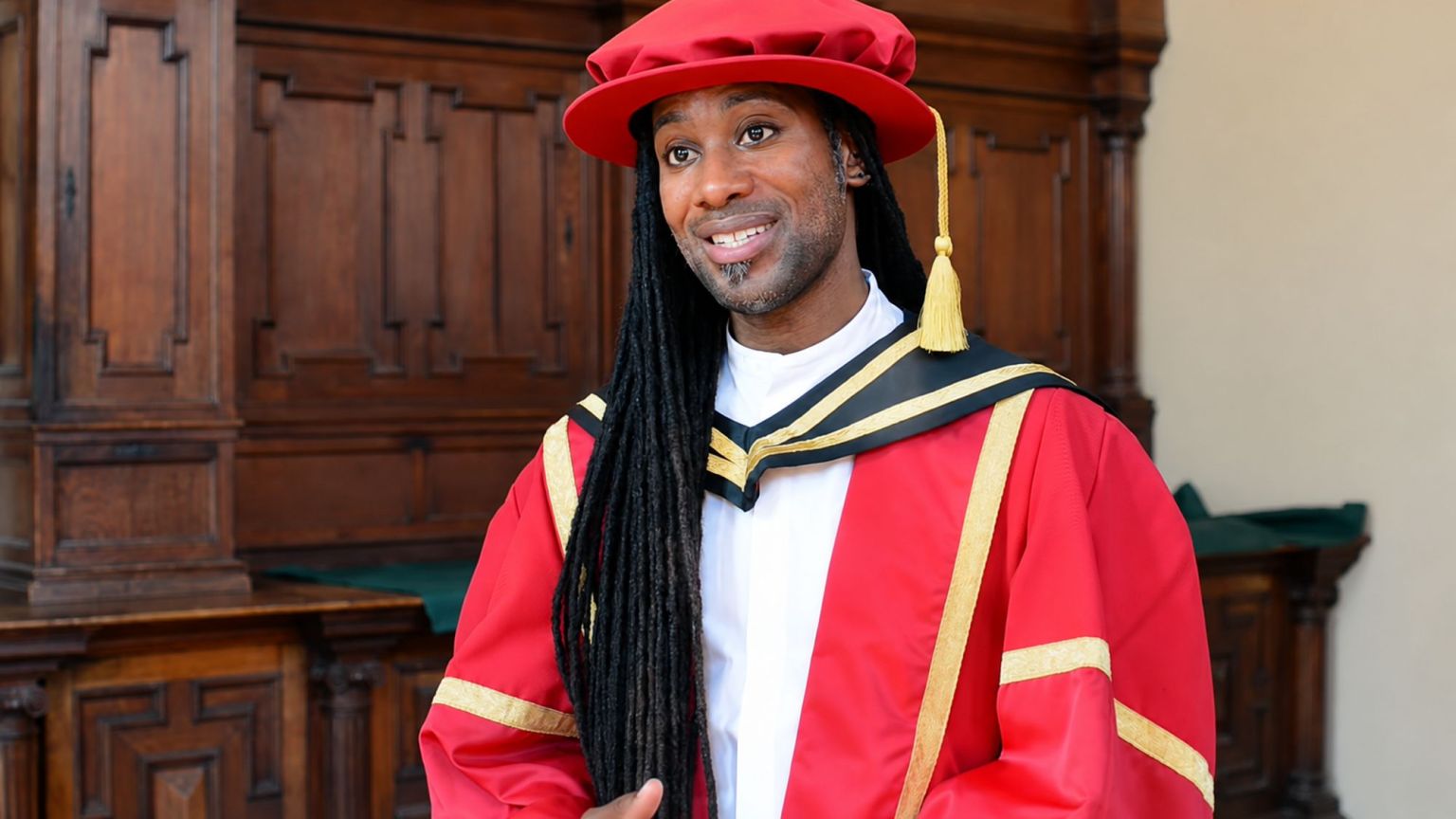
Has there ever been a dumber clever person than Jolyon Maugham? For someone with a first-class Durham degree who reached the dizzying heights of King’s Counsel, he doesn’t half swallow a lot of bullshit. First he fell for trans-fabulism, becoming one of the noisiest acolytes of the delirious idea that you can have a cock and be a woman. Now he’s fallen for the alleged fabulism of Jason Arday, the disgraced ex-prof famous for his long hair and tall tales.
No sooner had Arday’s thesis and origin story been called into question than Maugham and his nutty Good Law Project were rushing to his defence. The fox-killing, case-losing irritant headed an open letter claiming Arday was the victim of a ‘smear’ campaign by ‘right-wing newspapers’. The claim that Arday plagiarised the work of others is ‘entirely false’, said the letter-signers. It’s ‘racism’, they yelped, as if it were still 2020, as if the cynical deployment of that R-word by bourgeois pricks were still sufficient to tame public discussion. We stand in ‘unwavering solidarity’ with Arday, the letter said.
Turns out their solidarity wasn’t all that unwavering. As the accusations against Arday piled up, causing him to part ways with Cambridge, Maugham engaged in some frantic arse-covering. He wrote a Substack post in which he clings for dear life to the idea that the scrutiny of Arday is racist while also acknowledging he doesn’t know the full story. I’ve been on ‘holiday’, he says (yes, he puts ‘holiday’ in quote marks, because he is far too busy and important to take an actual vacation like you plebs). ‘I do not have the expertise to speculate on what effects [Arday’s] neurodivergence may have had on how he spoke [about his past]’, he writes.
I think this word salad might be the closest thing we’ll ever get to a mea culpa from the turbo-smug likes of Mr Maugham. The class of imperious, insufferable Brexit-allergic bores to which Mr Maugham belongs is never going to say: ‘Okay, okay, we fucked up.’ But they might, once in a while, confess to having ‘lacked the expertise’ to ‘speculate’ so cockily on a ‘matter of public interest’. I wish they’d just admit it – that for all their intellectual pretensions, they are the biggest eejits in Britain, blown this way and that by whatever ideological wind happens to be howling this week.
It’s not just Maugham. Virtually the entire Smart Set (sic) fell for Arday’s alleged grift. From Cambridge to the BBC, from ‘black academia’ to Simon & Schuster, every ivory-tower dweller fawned like a fool over this bloke with an iffy backstory whose academic work consisted of critical-race bollocks about ‘cultural appropriation’ and ‘racist’ pop music. The Arday scandal has exposed the breathtaking credulity of the credentialled classes. This is more than the fall of a ‘DEI darling’ – it’s the puncturing, at last, of the fake moral authority of the graduate classes who so love to lord it over the rest of us.
Another member of the smugocracy who fell at Arday’s feet was James O’Brien, the LBC knob jockey who’s built an entire career on being a clever wanker. He, too, rushed to Arday’s defence against the accusations of academic fakery. Later, when more info came out, O’Brien said he felt ‘like a mug’. Well, if the shoe fits. Someone uncovered an old chat between Arday and O’Brien, from 2023, in which the prof gushes for three minutes straight over O’Brien’s history-shaping moral bravery. O’Brien chokes up. In the future, someone’s going to dig up this recording in the rubble of whatever remains of human society and marvel at the sheer arseholery of the 21st century.
O’Brien, of course, once wrote a book called How To Be Right. Yet he’s wrong about pretty much everything. That’s the clever crowd summed up – their arrogance is entirely out of proportion with their intellect. They pose as the singular possessors of moral truth and yet chat shit morning, noon and night. That’s the great service of the Arday scandal – it has ripped away the cultural elites’ veil of enlightenment to reveal the wide-eyed idiocy beneath. The very people who snootily view ordinary people as ‘low-information’ – translation: thick – are themselves the giddy propagators of half-truths, harebrained beliefs and post-scientific drivel. I don’t know about you but I am done with being called stupid by people who believe in lesbians with cocks.
For years, especially following the votes for Brexit and Trump in 2016, Ivy League types wrung their untoiled hands over the dim-witted throng. They came to view the masses as putty in the hands of demagogues, easily swayable by the sophistry of snake-oil populists. Yet show me the Brexiteer who displayed even a fraction of the obsequious devotion shown by Hilary Cremin as she welcomed Arday to Cambridge in 2023. She’s the head of Cambridge’s Faculty of Education. She all but bowed as she greeted Arday in front of the cameras and gushed about him being ‘the best in the world’ at what he does, whatever that might be.
The Cambridge elites suspended every one of their critical faculties in the presence of this god-child of DEI, this man who they clearly hoped would wash away Cambridge’s sins of whiteness. It was undiluted demagoguery. The amount of ideological effluent that flows from our universities these days is extraordinary. It was on these leafy quads that trans irrationalism first took root. And where the demented cult of white guilt spread like a pox. And where people would need a lie-down if someone asked them: ‘Where are you from?’ I’ll never forget speaking on campuses in the late 2010s and being told Brexit was a product of mass stupidity by plummy twats who thought it was an act of genocidal erasure to say ‘he’ about a fat bloke in a boob tube.
The more that universities became factories of elite reproduction, the more awash they became with ideological folly. The more they morphed from citadels of knowledge into businesses that inculcate correct-think into the next generation of rulers, the more they’ve fallen victim to the demagogic trickery of wokeness. If we take one lesson from the Arday scandal, let it be that the ‘high information’ elites are far more vulnerable to dogma and delusion than the ‘low information’ working classes. Give me the bawdy scepticism of everyday Britain over the high-minded gibberish of the intellectual classes any day of the week.


Labour Defence Secretary Wes Streeting accepted a £30,000 donation from a think tank linked to convicted fraudster Sam Bankman-Fried.
David Lawrence
David Lawrence was the co-founder and treasurer of Labour for the Long Term (LLT). But just days before setting up the think tank, Lawrence received a £500,000 “gift” from Bankman-Fried. In 2024, the “crypto king” was jailed for 25 years in an $11 billion fraud case.
Lawrence previously worked as a parliamentary assistant to former Deputy Prime Minister David Lammy. Last February, Lammy held an “off the books” meeting with serial lobbyist Trevor Chinn, who has also made cash donations to Streeting in recent months.
In November 2023, Lawrence stepped down as the Labour parliamentary candidate for Basingstoke, officially citing personal reasons. But I’ve been told that a source close to his campaign claimed the real reason was the impending release of court documents linking him to convicted fraudster Bankman-Fried.
When questioned in December 2022, LLT refused to disclose the identities of its funders, describing donors simply as:
UK citizens who support the Labour Party.
American entrepreneur Bankman-Fried was not mentioned in their response.
‘Entirely plausible’ Labour knew
On an archived version of LLT’s website, Wes Streeting is listed first amongst their parliamentary supporters. Also listed were former party chair Anneliese Dodds; Labour Friends of Israel supporter Fleur Anderson; Andy Burnham’s Trade Envoy to Ukraine, Alex Sobel; and a smattering of Labour Party peers.
In August 2022, just over a month after Bankman-Fried’s £500,000 payment to Lawrence, Streeting accepted a £30,000 donation from LLT. He used it to hire Thomas Gardiner as a policy adviser. Gardiner went on to become a key member of Streeting’s team.
According to a Labour source I spoke to, it is “entirely plausible” that the party knew about the Bankman-Fried connection to LLT. This seems to be backed up by further claims this week that, at the time of the donation to Streeting, other Labour shadow ministers had been advised against accepting money from the think tank.
Who owns Streeting?
After being appointed by Burnham as Labour’s Defence Secretary, Streeting is now responsible for national security and armed forces operations, but new revelations about the donations he has been willing to accept throw his judgement into doubt.
This year has been particularly lucrative for Streeting. On June 19th, he accepted a £20,000 donation from Daniel Luhde-Thompson, a strategic adviser at Quadrature. Quadrature now hold one million shares in IOF-linked surveillance firm Palantir, a holding currently worth over £86 million, and Palantir now has a £330 million contract with the NHS.
On that very same day in June, Streeting accepted £12,000 from Trevor Chinn. Burnham’s new Defence Secretary claims to be an opponent of Israeli settlements, but Chinn, one of his most consistent donors, is President of the United Jewish Israel Appeal, which acts as the sole British organiser of so-called “Birthright Israel” trips and regularly promotes “excursions” into illegally-occupied lands.
This year, Streeting has also accepted two payments from Mike Craven, a former adviser to Tony Blair: £5000 on July 10th and another £5000 on May 16th. Craven has also funded Hamish Falconer, Burnham’s current Minister for Europe, and Josh Simons, the Labour MP who “gave up” his seat for Keir Starmer’s successor.
In 2024, Streeting held onto his own parliamentary seat by just 528 votes after an insurgent campaign by British-Palestinian independent candidate Leanne Mohamad. Now, with growing scrutiny into who funded his own campaign, it is unclear how long Streeting will be able to hold on to his seat in the cabinet.
Featured image via the Canary

Bitcoin: Siap untuk beli lagi.

Carabao Cup draw LIVE! Chelsea FC, Tottenham and West Ham learn second-round fate
Citizens & Northern director Katherine Shattuck buys $201 in stock


-

 Fashion3 days ago
Weekend Open Thread: Mattifying Sunscreen
-

 Fashion3 days ago
Frugal Friday’s Workwear Report: Cap-Sleeve Pointelle Crewneck Sweater
-

 Sports5 days ago
Jordan Coyle & Cordiamo take Laya Arena Stakes at RDS
-

 News Videos2 days ago
Can Astrology Help Find Gold and Silver Trends? A Financial Astrology Guide
-
 Business5 days ago
US stocks: Dow closes at record on Mideast optimism; SpaceX, AMD drag Nasdaq
-

 Crypto World7 days ago
US Tech Stocks See Largest 5-Week Inflow in History: Can Nasdaq Break Its Downtrend?
-

 Politics4 days ago
Reform UK And Greens Sink To Lowest Favourability Ratings To Date
-

 Business6 days ago
Nvidia Stock Climbs 2.5% as Chip Sector Rally Builds Ahead of AMD Earnings, Nvidia’s Own Report Looms
-

 Crypto World6 days ago
Polymarket targets $20 billion valuation as competition heats up in prediction market sector
-

 Tech6 days ago
OpenAI, Anthropic AI agents targeted real people and systems in cyber tests
-

 Business5 days ago
Supply chain issues impact Ingredion
-
 Crypto World6 days ago
CLARITY Act Senate Vote Locked In, But 60-Vote Hurdle Looms Large
-

 Tech3 days ago
Rinn Pharma & Biopharma to join NordicPharmaTrain network
-

 Business2 days ago
How to Start a Cleaning Business: A Step-by-Step Guide
-

 Crypto World7 days ago
The Senate has one week: CLARITY’s last August window
-

 Crypto World6 days ago
Dow and S&P 500 Hit Records on AI Earnings: When Will the Bubble Burst?
-

 Business1 day ago
Datadog: Best Of Breed For Multiple Reasons
-

 Business7 days ago
CNH Industrial Shares Jump Over 15% After Beating Estimates and Raising Full-Year Earnings Guidance
-

 Business2 days ago
BDC Weekly Review: Private BDC Q2 Numbers Are Strong
-
 Crypto World6 days ago
Dollar Index Trapped at 100 as Hawkish Fed Meets Official Selling
You must be logged in to post a comment Login