Connect with us
DAPA Banner

Politics

Grammys 2026: 37 Most Memorable Awards Show Performances Ever

Published

on

Grammys 2026: 37 Most Memorable Awards Show Performances Ever

Each year, the Grammys gathers some of the biggest musicians in the world under one roof to find out whether they’ve been honoured with the industry’s most prestigious accolade.

For the rest of us, though, what gets us tuning in year after year are the show-stopping performances, with huge stars gracing the stage to deliver memorable, impactful and, at times, outrageous renditions of their big hits, in the hopes of being the stand-out star of the evening.

With countless offerings to choose from, we’ve put together a timeline of 37 incredible performances that have stuck with us over the decades, beginning back in the 1980s…

Whitney Houston – Saving All My Love For You (1986)

Advertisement

For a lot of people, this 1986 Grammys performance will have been their first time hearing the unmistakeable and incomparable live vocals of Whitney Houston.

While this is far from the most awe-inspiring performance she’d give in her lifetime, this Grammys rendition of the early hit Saving All My Love allowed Whitney to show off her amazing potential, and was undoubtedly a glimmer of the greatness that would follow later in her career.

Whitney Houston – I Will Always Love You (1994)

Advertisement

Fast-forward another eight years, and Whitney had become one of the biggest stars on the planet, and was riding a huge wave of success after her appearance in The Bodyguard.

By the time the Grammys rolled around in 1994 there was no escaping I Will Always Love You – which, to be fair, was also the case for many years afterwards.

However, even the song’s loudest critics can’t deny that there’s no beating Whitney’s song in its flawless live form.

Aretha Franklin – Nessun Dorma (1998)

Advertisement

The story goes that Luciano Pavarotti had initially been scheduled to perform at the 1998 Grammys, but pulled out at the last minute on doctors’ orders, leaving his friend Aretha Franklin to step in instead.

With limited time to rehearse, the soul singer completely floored everyone with her vocals on the night.

It’s a rendition that – at least on paper – shouldn’t work on any level, but who could honestly argue with that voice?

Advertisement

Madonna – Nothing Really Matters (1999)

Her performance in the film Evita, mixed with her game-changing Ray Of Light album, helped breathe new life into Madonna’s career after a string of projects that had been met with a lukewarm reception in the early 90s.

Ray Of Light went on to gain critical acclaim and huge chart success, but the cherry on top was the Queen of Pop finally winning her first ever Grammy, and delivering this stunning and surprisingly haunting performance on the same night.

Eminem and Elton John – Stan (2001)

Advertisement

A collaboration that no one saw coming, Eminem and Elton John made headlines the world over when the Your Song singer stepped in to replace Dido’s parts on the song Stan.

This performance was considered by many to be a response to critics who panned Eminem’s past homophobic lyrics, particularly as the two stood together in solidarity at the end.

However, almost 20 years later, the rapper was still receiving criticism for his use of anti-LGBTQ+ language in his music

Advertisement

Christina Aguilera, Pink, Mya, Lil Kim, Missy Elliott and Patti LaBelle – Lady Marmalade (2002)

This Lady Marmalade performance allowed each of the track’s four performers to enjoy their time in the spotlight – complete with all the sequins, feathers and big hair it’s become synonymous with – before coming together as a four-piece.

As if there wasn’t enough talent on stage already, they were joined on stage first by its producer, Missy Elliott, and Lady Marmalade’s original performer, Patti LaBelle, who showed those younger viewers (and, indeed, artists) a thing or two about high notes.

Advertisement

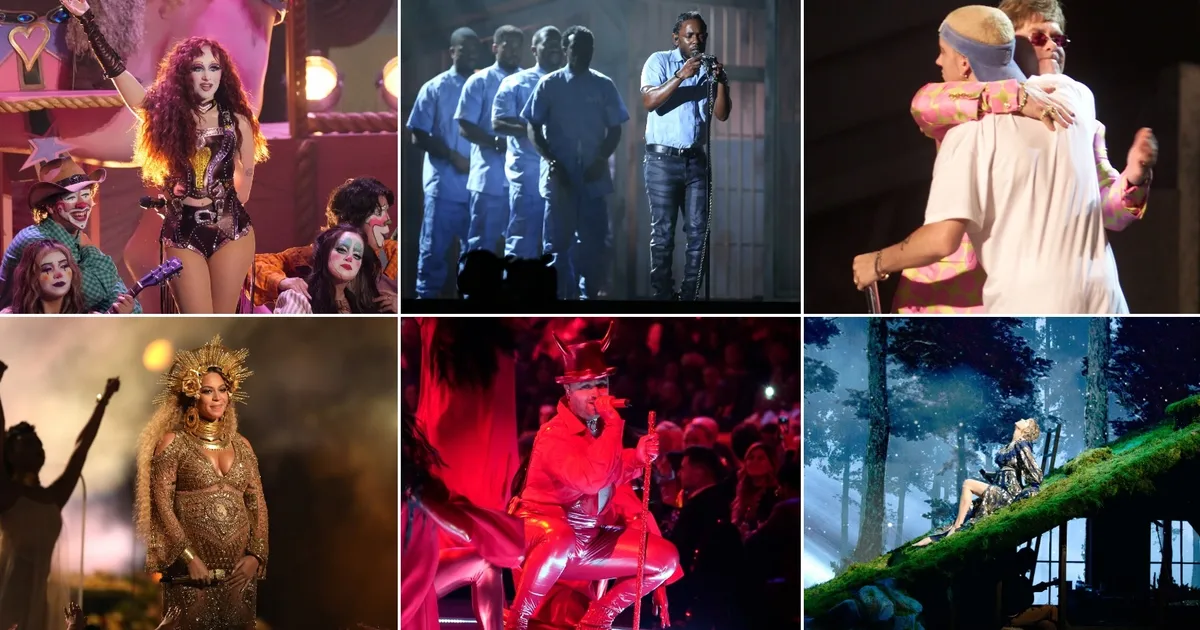
Prince and Beyoncé – Purple Rain/Baby, I’m A Star/Let’s Go Crazy/Crazy In Love (2004)

We all know that when it came to rising stars and new talent, no one had a better eye than Prince. It’s no surprise, then, that right at the beginning of Beyoncé’s solo career, he chose her to perform with him at the Grammys.

And no, in case you’re wondering, this is not Beyoncé’s last appearance on this list…

Advertisement

Gorillaz, De La Soul and Madonna – Feel Good Inc/Hung Up (2006)

Listen, we all know Madonna is a great pop star, but it’s not unfair to say that her sense of humour is something she’s… less associated with.

So, it was so great to see her interacting with Gorillaz at the Grammys in 2006, first crashing their performance of Feel Good Inc before launching into an energetic version of her own hit, Hung Up.

Advertisement

The Chicks – Not Ready To Make Nice (2007)

It had been a tough time for The Chicks – then still known by their old moniker The Dixie Chicks – in the lead-up to their performance at the 2007 Grammys.

The group had been at the centre of controversy when they criticised then-president George W Bush over the Iraq war, leading to them being shunned by the country music scene and receiving abuse and even death threats.

Their defiant appearance at the 2007 Grammys saw them address the backlash head-on in Not Ready To Make Nice, and the group wound up becoming the night’s big winners, taking home all five of the awards they’d been nominated for, including “the big three”.

Advertisement

Amy Winehouse – You Know I’m No Good/Rehab (2008)

By the time Amy Winehouse’s Grammys performance came around, the sad truth was that while everyone was talking about her, it was rarely in conjunction with her songwriting talents or incomparable vocal abilities.

In fact, her Grammys performance was aired live over satellite link, as she wasn’t granted a visa to travel to the US for the ceremony.

Advertisement

Still, with this performance, she managed to silence all of her critics, and remind everyone why she had become one of the world’s most famous people in the first place.

Beyoncé and Tina Turner – Déjà Vu/What’s Love Got To Do With It/Proud Mary (2008)

And as if duetting with Prince wasn’t enough, four years later Beyoncé was tasked with introducing the legendary Tina Turner, only for the two of them to perform the classic Proud Mary together.

Tina looked totally thrilled to be sharing the stage with Beyoncé, while Queen Bey truly held her own next to one of her idols, while managing not to outshine her.

Advertisement

It was the stuff legendary duets are made of. Also… what a brilliant intro from Cher.

Lady Gaga and Elton John – Poker Face/Speechless/Your Song (2010)

Lady Gaga had already become the biggest pop star in the world when she made her Grammys debut, so the stakes were pretty high for her first ever performance at the ceremony.

Did she manage to pull it off? Well, let’s see, shall we?

Advertisement

Ridiculous OTT introduction? Check. Giant sets? Check. Multiple songs? Check. Amazing outfit? Check. Casually performing with a musical legend, proving just a couple of years into her career that they were already contemporaries? Check.

We’d say that’s an emphatic yes.

Pink – Glitter In The Air (2010)

Advertisement

Pink’s fans had long been aware of quite how much she put into her live performances prior to her solo appearance on the Grammys stage, but in 2010, she made sure the world knew about it.

Singing the haunting ballad, Glitter In The Air, Pink first walked out into the crowd, before performing aerial acrobatics while hanging from the ceiling and belting out the track.

Jennifer Hudson – I Will Always Love You (2012)

Advertisement

In her lifetime, Whitney performed at the Grammys on multiple occasions, each time bringing the house down with her powerhouse vocals.

Her death in 2012 came just 24 hours before that year’s ceremony, and it would have been remiss for organisers not to pull together a tribute.

It was decided that Jennifer Hudson was the star with the vocal capabilities of doing Whitney justice, and with less than a day to prepare, we can’t imagine how she could possibly have bettered this stirring performance.

Adele – Rolling In The Deep (2012)

Advertisement

Another performance that hits even harder when you know the context behind it, the Grammys in 2012 marked Adele’s first live performance after undergoing throat surgery.

The world hadn’t heard her sing in a long time, and fears began to rise about whether she’d ever be able to match her old vocal offerings.

Clearly, we needn’t have worried.

Beyoncé and Jay-Z – Drunk In Love (2014)

Advertisement

The music world was still reeling from the shock release of her self-titled visual album when Beyoncé took to the stage at the Grammys in 2014.

This time, she wasn’t there as a member of Destiny’s Child, she wasn’t promoting a song from a film, and she wasn’t anyone’s special guest.

She was standing on her own two feet, and it felt like after years of being one of the world’s most famous singers, she’d really cemented her place as a superstar.

Advertisement

Macklemore & Ryan Lewis, Mary Lambert, Trombone Shorty, Madonna and Queen Latifah – Same Love/Open Your Heart (2014)

At a time when the debate around equal marriage was still raging on in America, Macklemore decided to use his slot at the Grammys to make a bold statement.

Performing his song Same Love, 33 couples of all different genders and sexualities gathered to tie the knot there and then (with Queen Latifah officiating, natch), before Madonna appeared in full cowboy attire to sing Open Your Heart with a gospel choir.

Advertisement

While on paper it sounds like a clunky and even arguably insincere stunt, we struggle to hold back tears every time we re-watch this clip.

Sia – Chandelier (2015)

When you’re a singer who’s become known for never showing your face and standing in a corner when you perform live, how do you make an impact at a public spectacle like the Grammys?

Advertisement

You bring in Maddie Ziegler, Kristen Wiig, a load of wigs and what appears to be the set of an episode of Hoarders, of course.

Katy Perry – By The Grace Of God (2015)

Best known for her elaborate and cartoonish performance style, Katy Perry stripped it right back for her Grammys performance in 2015.

Advertisement

She performed the lesser-known ballad By The Grace Of God, which discusses overcoming the suicidal feelings she felt after the end of her marriage to Russell Brand.

The performance was in support of victims of domestic violence and sexual abuse, with a short message from Barack Obama in support of the #ItsOnUs campaign playing shortly beforehand.

Kendrick Lamar – The Blacker The Berry/Alright (2016)

Advertisement

And talking about making a statement on the Grammys stage… wow.

While that year’s decision to award Taylor Swift Album Of The Year over Kendrick Lamar may have been controversial in 2016, his was the performance that had everyone talking.

Just watch it to see what we mean.

Lady Gaga – Space Oddity/Changes/Ziggy Stardust/Suffragette City/Rebel Rebel/Fashion/Fame/Let’s Dance/Heroes (2016)

Advertisement

Lady Gaga managed to squeeze in a whopping 10 of David Bowie’s iconic hits into her tribute, a performance that divided opinion.

Some felt it reminded viewers of Bowie’s greatness and influence on pop music, while others – including the late musician’s son – were less impressed by the elaborate performance (and the fact it was so heavily sponsored by Intel).

Beyoncé – Love Drought/Sandcastles (2017)

Advertisement

Adele may have won the three biggest awards at the 2017 Grammys, but even she admitted that the night really belonged to Beyoncé.

Bey’s elaborate and beautiful rendition of Love Drought and Sandcastles came shortly after the news that she and husband Jay-Z were expecting twins, and her 10-minute performance celebrated motherhood, serving as the perfect closer to her stunning Lemonade era.

Adele – Fastlove (2017)

A year after a rather shaky version of All I Ask, Adele opened the 2017 Grammys with a flawless rendition of Hello. Sadly, her second performance of the night didn’t go quite as smoothly.

Advertisement

Having been chosen to pay tribute to George Michael with a rearranged version of Fastlove, Adele restarted the performance a minute in, declaring: “I’m sorry. I can’t do it again like last year.

“I’m sorry for swearing and sorry for starting again, can we please start it again? I’m sorry, I can’t mess this up for [George]. I’m sorry.”

Kesha, Andra Day, Bebe Rexha, Camila Cabello, Cyndi Lauper and Julia Michaels – Praying (2018)

Advertisement

At the 2018 Grammys, the Time’s Up movement was a major talking point, which the stars in attendance honoured by wearing black and holding white roses on the red carpet.

This emphasis on honouring the survivors of sexual abuse, particularly in the workplace, made Kesha’s stunning version of Praying – surrounded by other female singers – all the more striking.

Janelle Monáe – Make Me Feel/PYNK (2019)

Advertisement

Janelle Monáe’s 2018 album Dirty Computer was accompanied by a short film of the same name, which was brought to life on the Grammys stage the following year.

And while Janelle may have gone home empty-handed on the night, this performance – which included provocative choreography, homages to Prince and *those* vulva trousers – was undoubtedly a stand-out.

Cardi B – Money (2019)

Advertisement

This performance was pretty much everything we love about Cardi B. It was in-your-face, it was loud, it was confident, it was totally extra, it was brilliant.

No, we’re not 100% convinced there wasn’t a bit of *ahem* help in the ol’ vocal department, but who else in the industry right now is going to give us a perfectly-executed routine on top of a grand piano, before giving a shout out to her infant daughter and strutting about in a leopard-print peacock tail?

Ariana Grande – Imagine/My Favourite Things/7 Rings/Thank U, Next (2020)

Advertisement

A year after snubbing the Grammys due to a dispute with organisers, this performance served as a victory lap for Ariana Grande at the end of her hugely successful Thank U, Next era.

After delivering some powerful vocals on album cut Imagine (and a quick blast of My Favourite Things from The Sound Of Music), Ari served a quick costume change and brought the house down with renditions of her chart-topping tunes 7 Rings and Thank U, Next.

Side note… in what world has a vocalist as iconic as Ariana Grande only ever performed at the Grammys once?

Tyler, The Creator, Boyz II Men And Charlie Wilson – EARFQUAKE/NEW MAGIC WAND (2020)

Advertisement

Tyler, The Creator brought his unique brand of showmanship to the Grammys stage in 2020, the same year he’d take home his first award from the Music Academy.

Despite clocking in at under five minutes, Tyler took us on a wild ride with this performance, which included a Boyz II Men cameo, pyrotechnics, moshing and a whole lot of bowl cuts.

Demi Lovato – Anyone (2020)

Advertisement

This 2020 performance can’t have been an easy one for Demi Lovato.

Not only was it the first time they’d sung live in public since their near-fatal overdose two years earlier, they were also debuting a brand new song about their experiences written just days after they were hospitalised.

Accompanied by just a piano, the extremely personal lyrics really shone, and although the singer had to begin the number again near the beginning due to being too choked up, they ended up completely nailing their performance, and there wasn’t a dry eye in the house.

Advertisement

Cardi B and Megan Thee Stallion – Body/Savage/WAP/Up (2021)

After dominating the charts with their number one song WAP in 2020, Cardi B and Megan Thee Stallion were finally able to give their track the live debut it deserved at the following year’s Grammys.

The pair each performed a string of their solo hits on the night, but it was when they came together for an outrageous, raunchy and all-round WAP-tastic routine to their much-discussed collab that they really stole the show.

Advertisement

Taylor Swift – Cardigan/August/Willow (2021)

On a somewhat more subdued note, Taylor Swift brought her Folklore album to life when she created a whole world for her 2021 Grammys performance.

As well as performing tracks from Folklore and its follow-up Evermore, she also scooped Album Of The Year on the night, marking her third win in the prestigious category.

Advertisement

Harry Styles – Watermelon Sugar (2021)

Bare-chested and wrapped up in a feather boa, Harry Styles certainly got the Grammys off to a special start in 2021 when he opened the show with this performance.

Frankly, we’ve still not recovered.

Advertisement

Sam Smith and Kim Petras – Unholy (2023)

If you cast your mind back to some of Sam Smith’s more subdued awards show appearances in the early years of their career, there was no indication a few years later they’d be dominating the conversation with a Grammys performance complete with choreography, pyrotechnics and a whooole lot of backlash from conservative critics.

Sam and collaborator Kim Petras gave their chart-topping hit Unholy its inaugural live performance at the 2023 Grammys – and it’s fair to say it got a few people talking.

Miley Cyrus – Flowers (2024)

Advertisement

To say that Miley Cyrus played the long game when it came to waiting for a Grammy would be something of an understatement.

The former Disney star finally won her first Grammy in 2024 – a full 17 years after releasing her first single – so when the time came to perform she was ready.

First, she chastised the audience for not getting up and dancing with her (“why are you acting like you don’t know this song?” she demanded during the first chorus), and then jubilantly declared “I just won my first Grammy!” towards the end of the performance.

Advertisement

And the fact it was all done in Bob Mackie with some of the biggest hair to grace awards season in recent years was just the cherry on top.

Joni Mitchell – Both Sides Now (2024)

Despite being an 11-time Grammy recipient, Joni Mitchell had somehow never actually performed at the ceremony until as recently as 2024.

Advertisement

At 80 years old, Joni proved to everyone watching why she’s still considered such a legendary force within the music scene, with a star-studded backing band for this rendition of her signature tune, Both Sides Now.

Chappell Roan – Pink Pony Club (2025)

By the time her Grammys debut came around, Chappell Roan was already a household name on both sides of the Atlantic thanks to hits like Good Luck, Babe!, Hot To Go! and Red Wine Supernova.

Advertisement

For her first time on the Grammy stage, Chappell decided to bring her signature hit Pink Pony Club to life with a cowgirl-inspired performance complete with rodeo clowns, a full live band and, naturally, an enormous candy-coloured horse in the middle of the fun.

Sabrina Carpenter – Espresso / Please Please Please (2025)

If there’s one thing we’ve loved about Sabrina Carpenter’s ascent to global stardom it’s having a pop star with a sense of humour at the top of their game.

Advertisement

She showed this off to great effect with her Grammys debut, a farce-inspired routine that was a little bit Chicago, a little bit Goldie Hawn, a little bit Muppet Show, a little bit Betty Boop, a little bit Cher and a whole lot Sabrina Carpenter.

The 2026 Grammys will take place on Sunday 1 February, with performances from the likes of Sabrina Carpenter, Addison Rae, Olivia Dean and Pharrell Williams to look forward to.

Source link

Advertisement
Continue Reading
Click to comment

You must be logged in to post a comment Login

Leave a Reply

Politics

Albany’s influence wars

Published

on

Gov. Kathy Hochul has taken almost $200,000 in campaign contributions from insurance companies amid her proposal to save them thousands.

Gov. Kathy Hochul has taken almost $200,000 in campaign contributions from insurance companies amid her proposal to save them thousands.

DAYS THE BUDGET IS LATE: 14

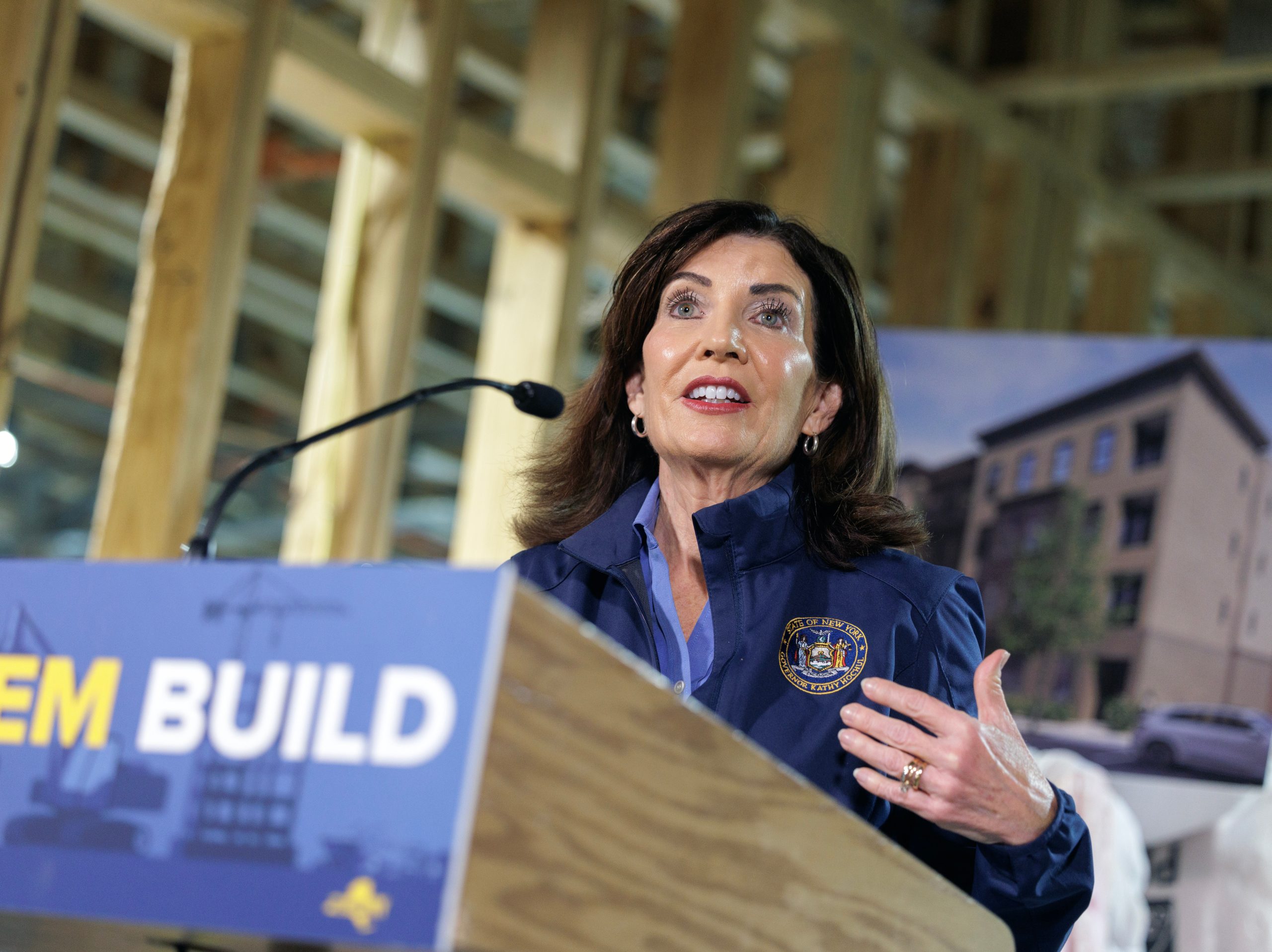
STONES AND GLASS STATEHOUSES: Gov. Kathy Hochul has raked in almost $200,000 in campaign contributions from insurance companies as she pushes for a proposal she argues would help save both their policyholders — as well as those same companies — lots of money.

But while reaping that campaign cash, Hochul has also attacked members of the Legislature for taking their own political contributions — and she is now arguing their political positions are tainted by those dollars in a way hers are not.

“I’m proud of what we’re doing,” Hochul told reporters today at an unrelated event in the Capital Region. “Money has no influence in what we’re doing.”

Advertisement

One of the sticking points holding up the now two-weeks-late-and-counting state budget is Hochul’s push to limit who can sue for damages when they’re in an auto accident. Right now, even if the accident is your fault, you can still reap a reward. Limiting who can receive damages would save insurers money, and, in theory, cut monthly insurance rates for New York’s millions of drivers, Hochul argues.

But members of the Legislature — who often receive political donations from the state’s trial lawyers, which represent plaintiffs in personal injury suits — say they’re skeptical the push would equate to any real savings for New Yorkers, and they worry it would prevent injured people from receiving the money they deserve in court.

On Monday, Deputy Senate Majority Leader Michael Gianaris made waves in the Capitol when he blamed Hochul for acting like an obstructionist in state budget negotiations.

“It takes three parties to agree, and the person who proposed the budget seems less than willing to appreciate that,” Gianaris said on the Senate floor. He later told reporters Hochul’s negotiating strategy is “a one-way street” when it comes to auto insurance reforms.

Advertisement

A few hours later, Hochul’s spokesperson Kara Cumoletti fired back: “If Sen. Gianaris is interested in making progress, he should urge his colleagues to support the governor’s efforts to lower auto insurance rates, rather than defending a broken system that benefits trial lawyers — one of the top donors to the Senate Campaign Committee he controls.”

Ouch.

Despite her spokesperson insinuating that those looking for Gianaris’ motivations need only follow the money, Hochul insisted her political contributions have nothing to do with her stances, which are driven by a tireless fight for affordability.

“I was responding to criticism that is trying to infer that we are the roadblocks; that we’re not trying to cooperate,” Hochul said today, explaining Cumoletti’s statement.

Advertisement

Since 2021, Hochul has received $194,250 from auto insurance companies and insurance industry associations, per public records. The state Democratic Party, which Hochul controls, also raked in $70,250 from those same groups between 2024 and 2025.

“If interests are aligned, then those interests are also aligned with the interests of every single New Yorker who wants to see their rates go down,” Hochul said when asked about those donations. “I don’t think the trial lawyers’ interests are aligned with New Yorkers.”

The New York State Trial Lawyers Association President Andrew Finkelstein responded in a statement accusing Hochul of getting “into bed with the insurance industry.”

“NYSTLA will fight both in the courthouse and out to keep the doors of justice open to everyone, not just the wealthy few,” Finkelstein said. “Albany is right to pull back the covers and expose who this plan really serves.” Jason Beeferman

Advertisement

From the Capitol

Legislators, including Democratic Assembly Majority Leader Crystal Peoples-Stokes, are announcing their retirements after filing for reelection.

NO CONCERNS OVER RETIREMENTS: Hochul brushed off any concerns caused by a rash of legislators who have announced their retirements after filing paperwork to get on the ballot, effectively letting them choose their own successors in some cases.

“The process is what it is,” Hochul said. “The vast, vast majority of the time, the system is such that candidates plan to run, they plan to stay, they petition to get on the ballot, and, again, if something unforeseen happens, there is a mechanism that’s in place, the committee on vacancies, that allows that person to be filled. I’m not concluding there’s something sinister about a process that has been in place for a long time.”

Republican state Sen. Jack Martins bowed out of a battleground Nassau County district over the weekend. He previously denied rumors he might retire — but announced his plans to do so after submitting petitions that let area party leaders select Assemblymember Jake Blumencranz to run in his stead.

In the Cortland area, Assemblymember Jeff Gallahan pointed to health concerns when announcing his retirement. He’s giving his spot on the Republican line to Mark Benjamin, the community relations director for a landfill.

Advertisement

And Democratic Assembly Majority Leader Crystal Peoples-Stokes announced her retirement last week. Her spot on the ballot will go to Buffalo Common Council Member Leah Halton-Pope, and the party will avoid the primary that likely would’ve occurred had Peoples-Stokes announced her plans earlier.

“I think Crystal Peoples-Stokes was planning to stay longer,” Hochul said. “I don’t know if this is some sort of conspiracy to do something untoward. She’s following the laws, and this is how it is. It’s actually pretty rare. It doesn’t happen with great regularity.” — Bill Mahoney

HOCHUL DEFENDS POPE: Hochul said President Donald Trump’s attacks on Pope Leo XIV are “abhorrent” in emotional comments to reporters today.

“The pope is a man of peace,” said Hochul, a Catholic. “He has a right to speak out and wise leaders would be right to listen to him.”

Advertisement

On Sunday, Trump, following a veiled critique from Leo that Jesus “does not listen to the prayers of those who wage war,” wrote on Truth Social that “Pope Leo is WEAK on Crime, and terrible for Foreign Policy.” Later that day, the president posted a picture that depicted himself as Jesus, an image he deleted the following morning.

Hochul told reporters that “Jesus would be rather shocked at what’s happening these days.”

“The Pope deserves more respect and for someone to release an image that equates the president of the United States with Jesus — or anyone with Jesus — is just reprehensible to, hopefully, everybody,” she said. — Jason Beeferman

FROM CITY HALL

City-run grocery stories were a key campaign promise for Mayor Zohran Mamdani.

BREAD AND ROSES: The mayor unveiled new details about five city-run grocery stores he plans open by the end of his term — a key campaign promise that has kindled strong feelings from opponents.

Advertisement

The stores will sit on city-owned land, absolving them of paying market-rate rent and property taxes. In exchange, the yet-to-be selected private operators will be contractually required to offer several staples like bread and eggs at a fixed price below the New York City average.

How far below, though, the administration still has not determined.

“What I can tell you is that when New Yorkers come to city-run grocery stores, they will see a clear price differential when it comes to those essentials,” Mamdani said at La Marqueta, the site of a $30 million grocery store set to open in 2029.

Unlike the East Harlem location, other city-run stores will not be built from the ground up, meaning they will open earlier. The first is set to welcome shoppers next year, for example.

Advertisement

While the mayor is planning just five stores, the concept of government grocers has sparked heated backlash from the mayor’s more moderate detractors. John Catsimatidis, owner of the supermarket chain Gristedes, threatened to close all of his stores if Mamdani won, a pledge he walked back after the democratic socialist’s November victory. Joe Anuta

BUSINESS AS USUAL: New York City Council Member Farah Louis returned to work Tuesday after federal investigators raided her home and her sister’s amid a federal probe on bribery and fraud allegations.

Louis, who has not been charged, appeared at a scheduled Zoning and Franchises subcommittee meeting, which she chairs.

As part of the investigation that led to the indictment, prosecutors have questioned whether Louis and her sister, Debbie Esther Louis, accepted kickbacks in exchange for steering city funds to shelter provider BRAHGS Home Care, according to a search warrant.

Advertisement

Louis directed more than $450,000 in city funds over five years to the nonprofit, according to city documents reviewed by Gothamist.

Louis left the building shortly after the hearing concluded and did not take questions. — Gelila Negesse 

FROM THE CAMPAIGN TRAIL

Former Rep. Anthony D’Esposito signaled an interest in returning to Congress earlier this year.

D’ESPOSIT-NO: Former Rep. Anthony D’Esposito will not be making a comeback bid for Congress against Democratic Rep. Laura Gillen in a battleground Long Island district.

D’Esposito, who is currently inspector general in the U.S. Labor Department, signaled his interest in returning to Congress earlier this year — though it was unclear if he would quit his job in the Trump administration to do so.

Advertisement

Last month at a House subcommittee hearing, he skirted questions about his congressional aspirations, and the politically powerful Nassau County Republican Committee backed John DeGrace, a former Valley Stream mayor, as its nominee. DeGrace declined the nomination last week, leaving the possibility of a D’Esposito return on the table.

But D’Esposito ruled it out in a statement Tuesday, the final day for local Republicans to choose a replacement candidate. He expressed his personal support for Hempstead Receiver of Taxes Jeanine Driscoll, whom he called a “dear friend.”

“I will continue serving as the 9th Inspector General of the U.S. Department of Labor, working with our team nationwide to root out fraud and put those who steal from Americans behind bars,” D’Esposito said in the statement. “It is an honor to serve in President Trump’s administration and on the Anti-Fraud Task Force led by Vice President JD Vance.”

Read more from Madison Fernandez in POLITICO Pro.

Advertisement

TRUMP BOOSTS BLAKEMAN: The president emphasized his support for Republican Nassau County Executive and gubernatorial candidate Bruce Blakeman shortly after an appearance on Fox Business that was ridiculed by Hochul’s campaign.

“Bruce Blakeman, the highly respected and very popular Nassau County Executive, who is running for Governor, is surging in the New York State Polls,” Trump wrote, after Blakeman appeared on Fox Business. “He is one of the best politicians in the U.S. Watch him work his magic!!!”

About 30 minutes before Trump’s post, Fox Business host Maria Bartiromo and her partner pressed Blakeman on the following:

“I’m not seeing a lot of you, where have you been Bruce?”

Advertisement

“I don’t see enough of you. I need to start seeing you more on social media.”

“How are you going to get New Yorkers out to actually vote for you, Bruce?”

Hochul’s campaign mocked the appearance for Blakeman as “humiliating.”

For his part, Blakeman responded to Bartiromo by saying New Yorkers are sick of the high cost of living in New York.

Advertisement

New Yorkers “want a new governor, a governor that puts them first, cares about them, will cut their utility bills in half, will lower taxes, create job prosperity and create safer neighborhoods,” Blakeman said. “I have the experience, the ability and policies that people want.” Jason Beeferman

IN OTHER NEWS

MATCH DAY: Train tickets to MetLife Stadium from New York City are projected to cost more than $100 during World Cup games — despite regular prices of $12.90. (The New York Times)

INDEPENDENT: Scotia Mayor David Bucciferro rejected Republican backing for his incumbent bid with Scotia-Glenville GOP Chairman David Lindsay announcing plans to run a candidate against Bucciferro. (Times Union)

RISK TOLERANCE: Wall Street firms continue hiring and expanding in New York City at record levels, even as Mamdani advances a tax-the-rich agenda that some predicted would drive companies out of the city. (THE CITY)

Advertisement

Missed this morning’s New York Playbook? We forgive you. Read it here.

Source link

Continue Reading

Politics

New Swalwell Accuser Speaks

Published

on

New Swalwell Accuser Speaks

!function(n){if(!window.cnx){window.cnx={},window.cnx.cmd=[];var t=n.createElement(‘iframe’);t.display=’none’,t.onload=function(){var n=t.contentWindow.document,c=n.createElement(‘script’);c.src=”//cd.connatix.com/connatix.player.js”,c.setAttribute(‘async’,’1′),c.setAttribute(‘type’,’text/javascript’),n.body.appendChild(c)},n.head.appendChild(t)}}(document);(new Image()).src=”https://capi.connatix.com/tr/si?token=19654b65-409c-4b38-90db-80cbdea02cf4″;cnx.cmd.push(function(){cnx({“playerId”:”19654b65-409c-4b38-90db-80cbdea02cf4″,”mediaId”:”24720d12-863d-421f-bcd5-62ec523362fd”}).render(“69dea061e4b0f26bda6270e7”);});

Source link

Continue Reading

Politics

No, Sadiq, London’s decline isn’t ‘disinformation’

Published

on

No, Sadiq, London’s decline isn’t ‘disinformation’

If the electorate isn’t happy with the way the country is going, you might assume this is down to social problems and poor governance. Not so for Labour politicians. According to them, the gullible British public must have been manipulated or misled by things they have seen or read in the right-wing media – especially online.

A case in point is the pint-sized culture warrior in City Hall, London mayor Sadiq Khan, whose city is not particularly happy these days. Concerns about crime and demographic change are long-standing in the capital. Recently, we’ve seen mobs of anti-social teenagers using the Easter holidays to loot supermarkets and menace shoppers in Clapham. Last week, a 21-year-old man was stabbed to death in Primrose Hill, the latest victim of gang violence that remains endemic. The borough of Tower Hamlets has essentially become Lutfur Rahman’s personal sectarian fiefdom, with UKIP marches banned, women prevented from partaking in fun-runs organised by mosques, and now a ministerial corruption probe over cash being ‘funnelled’ to Bangladeshi groups.

In the face of these alarming social problems, Khan instead warns that London is facing a ‘dark blizzard of disinformation’. Speaking at the Cambridge Disinformation Summit last week, he presented the findings of a City Hall report into the supposed scourge of disinformation today. The often-negative way London is talked about online poses ‘risks’ to ‘marginalised groups, democratic functioning, the economy’ and even ‘national security’, it claims, with London particularly ‘exposed’ to such narratives due to its ‘global visibility, diversity and political prominence’.

Advertisement

Funnily enough, all the disinformation ‘narratives’ it warns of are precisely the kinds of political arguments most damaging to a right-on Labour mayor who bluntly insists that Britain’s ‘diversity’ is its biggest strength. These include claims that London is ‘unsafe or in decline’, or that women and girls are at risk from sexual assaults by immigrants – ‘narratives’, which it admits, ‘often draw on real offences’. Apparently, it’s also ‘misleading’ to point out how vastly London has changed, as in claims of ‘“Islamisation”, demographic replacement or preferential treatment for particular groups’. Any suggestion that there might be two-tier policing of protests is also presented as malign and spurious.

Historically, the censorship Blob has tried to mask its authoritarian instincts by pretending that it is only worried about falsehoods, not political dissent as such. It has typically talked of ‘disinformation’ as being deliberate false propaganda, usually disseminated by a foreign power. Meanwhile, ‘misinformation’ usually refers to untruths shared by hapless dupes. Of course, it was always obvious that both were mere euphemisms for opinions people like Sir Sadiq didn’t want to hear. And now, they’re not even bothering to pretend.

Advertisement

Enjoying spiked?

Why not make an instant, one-off donation?

We are funded by you. Thank you!

Advertisement


Please wait…

Advertisement
Advertisement

Indeed, Khan’s City Hall report warns of ‘malinformation’ – information that, despite being ‘based on fact’, is used ‘out of context to support misleading conclusions’. So even information that the mayor admits is true is considered a threat if it leads people to the wrong conclusions. A footnote then gives the game away: ‘“Mis- / disinformation” is used as a shorthand for misleading or harmful information.’ So Khan and his cronies want political narratives censored – even if they are based on fact.

Worse, Khan suggests that it is online discourse that’s causing London’s problems, not his own soft-on-crime policies as mayor. Negative social-media commentary has put London in a ‘toxic feedback loop’, he claims, meaning that ‘as extremists erode trust in our city and its institutions, it gets easier and easier for them to twist online anger into offline violence’. So if there are muggings, stabbings or grooming gangs in London, these are actually the fault of outrage about them online?

Advertisement

We’ve seen this kind of bizarre, topsy-turvy reasoning before. In the run up to the Gorton and Denton by-election, Green Party candidate Hannah Spencer blamed the 2017 Manchester Arena bombing on the rhetoric of the right, accusing her Reform UK rival, Matthew Goodwin, of ‘dividing people’. These are extraordinary, ghoulish claims. In this warped world, the original problem the public is rightly aggrieved about is somehow caused by the subsequent outrage it generates online.

What follows inevitably from this mindset is the belief that the best way to solve social problems is through restricting what can be said. Tellingly, other speakers at the invitation-only disinformation conference included Imran Ahmed, chief executive of the notorious pro-censorship campaign group, the Centre for Countering Digital Hate. This three-day summit was in truth a chummy, secretive gathering of leading lights of the global censorship industrial complex.

‘I see disinformation as preparing the landscape for corruption’, declared its chair, Alan Jagolinzer, while calling for lots more money to be funnelled to anti-disinformation crusaders like him and his chums. This was a gathering of snooty globalists who disdain free expression and believe that the only reason for the rise of populism is that they haven’t censored dissent enough. No wonder Khan felt right at home.

Advertisement

Sadiq Khan has been a disaster for London. The capital is dirtier, less safe and more expensive than at any time in recent memory. This creeping decrepitude isn’t misinformation, disinformation or malinformation. There is a simpler word for it: the truth.

Laurie Wastell is an associate editor at the Daily Sceptic and host of the podcast, The Sceptic. Follow him on X: @l_wastell.

Advertisement

Source link

Continue Reading

Politics

Southport inquiry, Prevent and a risky fixation on ‘terrorist ideology’

Published

on

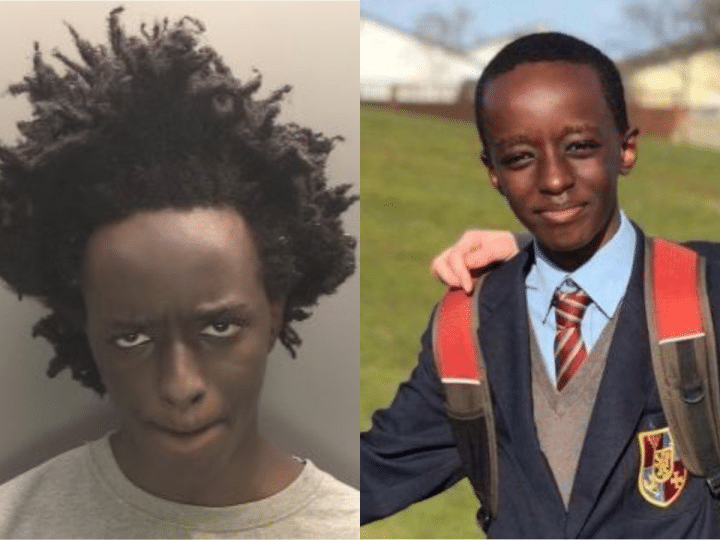
Axel Rudakubana as an adult on the left and in stark contrast on the right, where he's pictured as a young child in school uniform looking happy

It makes for particularly interesting reading alongside comments made earlier this month by the Prevent assistant commissioner, Laurence Taylor. He claimed the counter-terrorism scheme was being overwhelmed by a massive influx of referrals.

Trends indicate that Prevent will receive more than 10,000 referrals in 2026, representing a 33% increase compared to 2024. However, Taylor argued that this doesn’t necessarily represent an uptick in the radical ideologies that Prevent was (nominally) set up to combat.

In fact, the majority of these referrals are apparently unrelated to extremist ideologies. Instead, they’re issued over concerns about people becoming interested in violence. As such, Taylor claimed that Prevent’s time is being wasted, leaving it less able to deal with actual threats.

We at the Canary phrased this another way:

Advertisement

That is, the UK has invested so much in the very idea that (Muslim) terrorism is the greatest threat to our safety that we’ve actively started to damage the capacity to respond to non-terror threats.

The Southport inquiry report has only added weight to that assertion.

Axel Rudakubana as an adult on the left and in stark contrast on the right, where he's pictured as a young child in school uniform looking happy

‘Referrals ought to have been made’

The report’s foreword notes that no single agency was willing to “accept that it had the lead role in managing the risk” Rudakubana, referred to as “AR”, posed.

One of several examples of this failure, was that:

Prevent declined to refer AR’s case to a Channel panel on three occasions when, based on the information that should have been known to Counter Terrorism Policing North West (CTPNW), referrals ought to have been made.

However, it also makes clear that Prevent was the most likely candidate to take the lead.

Advertisement

While Prevent, by the nature of the cases which it routinely deals with, would have been the most likely framework to be able to address AR’s risk, none of these three frameworks [Prevent, Working Together to Safeguard Children, Early Help] was by any means a perfect fit. The risk of harm posed by AR fell between their respective remits.

Rudakubana’s school referred him to Prevent no less than three times. However, Prevent never escalated his case to Channel. Channel’s aim is to provide support to stop extremist ideology from developing into criminal behavior.

The teen, 17, ‘had not displayed any extremist views’

Of the three referrals, the report acknowledges the failure to escalate the first as the most fundamental failure.

One of the main reasons for this was that, during a visit from Prevent:

AR had not displayed any extremist views, or counter-terrorism or domestic extremism ideology during the conversation. He failed to demonstrate any interest in politics or religion, and he had not revealed grievances against particular groups.

The report earlier states that officers had searched actively for evidence of ideological motivations.

Advertisement

It is to be stressed that the police searched for and were unable to find any evidence of AR having pursued an ideological cause, whether political, religious or racial.

Although he had downloaded an image of the Twin Towers and an academic paper containing the Al-Qaeda training manual, these two items were patently insufficient to support a suggestion that he was motivated by Islamic fundamentalism when balanced against the remainder of the material in his possession.

To the contrary, Rudakubana reportedly possessed materials mocking various religions. Among these, Islam, Judaism and Christianity, were particularly prominent. However, the report stresses that the “significant quantity” of “grossly offensive” anti-Islamic material was of particular note.

Bebe King, Elsie Dot Stancombe and Alice da Silva Aguiar

‘Mixed, unstable or unclear’

It would be easy to dismiss Prevent’s failure here as a one-off incident, but the report shows that this sidelining of non-ideological motivations is a pervasive issue.

In 2017-18, 8% [of] individuals referred to Prevent due to concerns around Islamist extremism or right-wing extremism ultimately received support via Channel.

The corresponding figure for individuals referred due to concerns about ‘mixed, unstable or unclear’ ideologies was less than 1%.

Advertisement

While there are likely to be many reasons for this, as we have seen in recent tragic attacks, the motivations of the terrorists responsible sometimes remain unclear even after the event, so we need to pay due regard to this complex issue in order to better protect the public.

After Rudakubana’s attack, Prevent referrals started to rise dramatically. However, more than 50% of the individuals concerned had no clear ideological motivation. In a Guardian interview, Prevent’s assistant commissioner reasoned that this was because there’s simply nowhere else to report these kinds of concerns.

On this subject, the Canary previously argued:

Prevent, despite ostensibly being set up to target all extremist ideology, has disproportionately targeted Muslims from its outset. In fact, hundreds of babies and toddlers have been referred to the scheme, overwhelmingly due to “Islamist concerns”.

In 2022, the Shawcross review even had the nerve to call for a renewed focus on Islamic extremism, calling the definition of neo-Nazism has “expanded too widely”.

Advertisement

And now, we’re being told that non-ideological motivations are falling through the cracks precisely because of the state’s obsession with terrorist ideology? And, in fact, we have no real mechanisms in place for concerns of non-terrorist violence?

The phase one Southport inquiry report has shown this to be true in tragic detail. Officers searched and questioned Rudakubana for evidence of ideological motives — Islamist or otherwise. Finding none, they failed to escalate his case further.

Beyond that, no agency was a “perfect fit” for Rudakubana, so none stepped forward to take the lead. Because he wasn’t an obvious terrorist or a case for social care, mental health services, or some other agency, he fell through the cracks. As a result, three young girls are now dead.

Featured image via Peter Powell/ AFP/ Getty Images

Advertisement

Source link

Continue Reading

Politics

Soaring energy costs are killing Britain’s AI ambitions

Published

on

Soaring energy costs are killing Britain’s AI ambitions

OpenAI announced last week that it is to pause Stargate UK. This was the multibillion-pound project designed to boost artificial-intelligence (AI) infrastructure in the UK. It was to include a large data centre in north-east England, in partnership with tech firms Nvidia and Nscale. Explaining its decision to put the project on hold, OpenAI pointed to a difficult regulatory environment and, above all, the UK’s high energy costs.

Unfortunately, this is not a shock. OpenAI’s struggle is an all too familiar and depressing tale of a deep, structural problem in the British economy – namely, our extortionate energy prices, which are some of the highest in the world.

After all, training frontier AI models and running data centres requires affordable and abundant energy. When energy is expensive, the cost of doing everything increases. This means that previously viable business models fall apart, and companies will think again about scaling up their operations, or will expand where energy is cheaper.

Advertisement

The repercussions of high energy prices reach far beyond cutting-edge technology. They determine whether a steel plant can stay open, whether a salt plant will close, and whether a new factory is built in the UK or elsewhere. If it costs far more to run a factory here than it does abroad, then industries and jobs will move.

It is the British people who then lose out. Industries that once defined and knit together communities are disappearing. Jobs that once powered the local economies of villages, towns and cities across the UK are moving to other countries. Wages that previously kept pubs and high streets alive now barely cover the basics. The impacts are felt not just through those industries that we lose, but also through those that never arrive.

Advertisement

Enjoying spiked?

Why not make an instant, one-off donation?

We are funded by you. Thank you!

Advertisement


Please wait…

Advertisement
Advertisement

This is the price the UK is paying for successive governments’ prioritising of ideology over affordable and secure energy. If we continue down this path, we will disqualify ourselves from hosting new and growing industries at scale.

This is why the pause of Stargate UK matters. It’s a signal – another flashing warning light – that Britain is not a viable location for those seeking to shape the technologies and capabilities of mankind tomorrow. But this outcome is not inevitable: those breakthroughs can still happen here, those jobs can still be created across the country, and those businesses can still scale up in Britain.

Advertisement

What we are seeing is not a product of fate, geography or an immutable characteristic of our isles. It is the result of political choice – a choice that has meant the country responsible for pioneering the Industrial Revolution is now failing to produce abundant and affordable energy. Government after government has backed down to consultants, lawyers, lobbyists and activists.

The government does not have to cave. Our politicians can change course. They can choose to rebuild our domestic energy production. They can prioritise the energy bills of households and companies across the country over pats on the back by their friends at Westminster dinner parties.

The choice is stark. With cheaper energy, industries can grow, businesses can scale up, families can afford a meal out. With the most expensive energy in the world, food costs more to produce and transport, businesses face higher overheads and those industries that could come here may choose elsewhere.

Advertisement

This is not a question of capabilities: Britain has the talent, expertise and potential. Instead, it is a question of will. If we continue down our current path, we will watch from the sidelines as other nations capture the benefits of tomorrow’s world. If we change course, we can bring back industries and jobs across the country, and define the future once again.

Dr Lawrence Newport is the CEO and co-founder of Looking for Growth, the political movement to end decline and save Britain.

Advertisement

Source link

Continue Reading

Politics

ICJP writes to UNESCO over Ben-Gvir raid of Al-Aqsa

Published

on

ICJP writes to UNESCO over Ben-Gvir raid of Al-Aqsa

The International Centre of Justice for Palestinians has written to the director of world heritage at UNESCO. It’s to raise concerns over the recent raiding of Al-Aqsa Mosque in occupied East Jerusalem by Israeli settlers, alongside far-right Israeli minister and all-round nightmare Itamar Ben Gvir. This came at a time of rapidly increasing religious persecution of Palestinian Christians and Muslims in the occupied Palestinian territory by Israeli authorities.

Ben Gvir raiding Al-Aqsa again

This follows Israel’s increasing attempts to consolidate total sovereignty over Al-Aqsa, which is the third holiest site in Islam, and is emblematic of Israel’s primary aim of Judaisation of Muslim and Christian holy and heritage sites across the occupied Palestinian territory.

UNESCO’s role in safeguarding the protection of Palestinian cultural, historical, and religious heritage sites is of fundamental importance in the face of increasing Israeli attempts to erase Palestinian cultural heritage, which includes its continued weaponisation of archaeology to appropriate Palestinian land.

It is paramount that the UN strongly condemns the move by Ben-Gvir to consolidate Israeli control of Al-Aqsa, his unlawful raid of the compound, and for the UN and UNESCO to immediately take preventative measures that stop the Israeli authorities from deepening its persecution of Palestinian Muslims and Muslim holy sites across the occupied Palestinian territory.

Advertisement

In his capacity as minister for national security, Ben Gvir has also indicated his plans for Israeli authorities to oversee the admitting of up to 150 Israelis or Muslims at a time in the Al-Aqsa compound. This move would place Ben Gvir in effective control of the Mosque’s affairs, side-lining the Jerusalem Islamic Waqf, which holds recognised exclusive administrative authority, including control over access, and has done so for 839 years.

It is also profoundly concerning that Ben Gvir’s raid of Al-Aqsa Mosque was permitted at a time when the site remains unlawfully closed to Palestinian Muslims. The compound has now been inaccessible for over a month, including throughout the recent holy month of Ramadan, raising serious alarm. This development sets a dangerous precedent, further entrenching patterns of discrimination and exacerbating the risk of religious persecution against Palestinian Muslims.

Freedom of religion and belief

Ben Gvir has also pushed for the Knesset to introduce legislation to curtail the Muslim call to prayer. Meanwhile, on the recent Palm Sunday, the Archbishop of Jerusalem was denied access to the Church of the Holy Sepulchre, the holiest site in Christianity.

The prolonged and deliberate restriction of access to Al-Aqsa Mosque by Israeli authorities constitutes a grave breach of Israel’s obligations under international law. Such measures amount to religious persecution of Palestinian Muslims and impose unlawful restrictions on fundamental rights, including freedom of movement, freedom of religion, and the right to practice one’s faith.

Advertisement

These rights are firmly protected under international legal frameworks, rendering continued encroachment upon Palestinian religious and cultural sites across the occupied Palestinian territory unlawful under international humanitarian law.

Israel’s actions regarding Al-Aqsa follow a similar pattern to those seen following the progressive Judaisation of the Ibrahimi Mosque in Hebron. In January 2026, Israel barred the mosque’s Palestinian directors and seized planning rights over part of the site, in contravention to longstanding arrangements.

Despite its administration by Palestinians and use as a mosque for more than 1,400 years, Israel has continually increased Jewish access to the site in its attempts to consolidate Israeli and Jewish sovereignty over it, increasingly so after the 1994 massacre of Palestinian Muslims at the mosque by a Jewish settler.

Órlaith Roe, ICJP public affairs and communications, said:

Advertisement

It is paramount that the UN adopts the findings of its own special rapporteurs and recognises the apartheid system that Israel perpetuates, including a system of religious apartheid that violates international law.

The safeguarding of Palestinian cultural, historical, and religious sites from Israeli appropriation and attacks is a duty the UN cannot afford to fail in upholding.

Featured image via the Canary

Source link

Advertisement
Continue Reading

Politics

Southport attack inquiry stresses ‘fundamental failure’ of authorities

Published

on

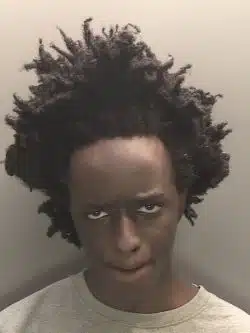
Axel Rudakubana's mug shot in which he looks unkempt and wild, and has his mouth tightly shut

The Southport Inquiry has highlighted the “fundamental failure” of authorities to prevent the horrific 2024 murder of Bebe King, Elsie Dot Stancombe and Alice da Silva Aguiar.

Inquiry chairperson, Adrian Fulford, began the report, released on Monday, by describing the events of 29 July 2024 as “one of the darkest moments in recent national memory”.

The report concluded by saying that authorities could have prevented the murderer, Axel Rudakubana, referred to as “AR”, from eventually killing Bebe, six; Elsie, seven; and Alice, nine at Hart Space dance studio in Southport.

Blame was also attributed to his parents.

Advertisement

Wholly separately, therefore, from my view that the attack would not have occurred had AR’s parents reported what they knew in late July 2024, if appropriate arrangements and reasonable resources had been in place to address the risk that AR posed to others from December 2019 onwards, it is highly likely that the tragedy of 29 July 2024 would not have occurred.

Southport inquiry: Authorities knew about the risk, but failed to intervene

The report went on to detail the woefully inadequate actions of authorities, insisting that:

There was a fundamental failure by any organisation, or multi-agency arrangement, to take ownership of the risk that AR posed.

Despite authorities having sufficient information to warrant close attention, it added, there was a “pervasive failure to act on AR’s dangerousness”. This was “significantly troubling”, it asserted.

Agencies from social services to the police and Prevent, the Government’s strategy to stop people becoming terrorists or supporting terrorism, tried on numerous occasions to explain away AR’s highly concerning behaviour as a “mental health” issue.

This reflected a poor understanding of both ASD [Autism Spectrum Disorder] itself and a misunderstanding of the ability of mental health services to ‘treat’ or address it.

Axel Rudakubana's mug shot in which he looks unkempt and wild, and has his mouth tightly shut

It should have already been clear for all agencies from 2019 that Rudakubana “posed a high risk of harm to others”.  

Advertisement

In October 2019, he repeatedly carried a knife to his former school with the intention to inflict serious harm.

Then in December of that year, he took weapons with him to kill a pupil he perceived had previously bullied him, the report shared. Instead, another student was assaulted at random.

Fulford said December 2019 was a “watershed event”.

As the subsequent narrative will reveal, nothing occurred during the next five years to indicate that this level of danger had diminished. To the contrary, as time passed the authorities, with certain minor exceptions, had an
ever‑reducing understanding of AR’s preoccupations and intentions. Interaction between AR and the relevant organisations became, at best, something of a token.

The report also criticised the:

Advertisement
  • Severe lack of attention authorities have paid to “online knife and machete marketing” and “inadequate…enforcement of the existing law”.
  • “Lack of provision” at Lancashire County Council (LCC) “for violence fixated young people who have been excluded either for acting violently or for carrying knives to school”, and “the impact of combined underfunding and underperformance at LCC which saw no meaningful intervention in alternative education provision for AR for the final two years before the attack”.
  • Long waiting times for expert diagnoses.
  • The failure of Rudakubana’s parents to fully share information that could have sparked stronger action from authorities.

Fundamental change to fix broken systems

Bebe King, Elsie Dot Stancombe and Alice da Silva Aguiar in separate school photos supplied by their parents
Bebe King, Elsie Dot Stancombe and Alice da Silva Aguiar. Credit: BBC News

Elsie’s parents, the report noted, have called for “systemic changes in order to prevent similar tragedies” alongside the parents of other survivors of the attack.

They stress that the incident should not be viewed merely as an example of ‘knife crime’ but rather a failure by the authorities to prevent an individual who was intent on harming children from committing these crimes.

Southport councillor, Sean Halsall, added to this message. He told the Canary:

We need to make sure that everything that comes out of this inquiry is implemented properly and properly resourced, that things aren’t done half-heartedly, that it isn’t a sticking plaster but the fundamental change that makes sure we fix these broken systems.

A key reflection from the inquiry is “the amount of times that stage agencies failed the family and those little girls”, he added.

[These authorities] passed the parcel until the parcel exploded, and we’re here with the aftermath of three families who will be forever grieving the loss of their daughters.

Apart from building state agencies that properly support families and individuals in need of special attention, he also insisted on paying attention to how a young person can get hold of a dangerous weapon in the first place. He said:

For any teenager to be able to get hold of these things, it’s incredibly worrying and tells me that we are not going anywhere near far enough at regulating these companies that profiteer off of these sales, profiteer off of putting human lives at risk.

He added:

Advertisement

We can’t look past austerity and the damage to the social fabric that’s done with removing the youth centres and youth clubs and mental health support services for young people.

There are indeed many lessons to learn, as the inquiry has shown. To truly honour the memories of Bebe, Elsie, and Alice, we need to demand the government learns those lessons and acts on them quickly.

Featured image via the Canary

Source link

Advertisement
Continue Reading

Politics

Trump deletes Jesus meme after backlash

Published

on

Trump deletes Jesus meme after backlash

As we reported on 13 April, Donald Trump posted a meme in which he was depicted as Jesus. Because this is what Christians consider a ‘sin’, the picture provoked backlash amongst his Christian followers. This led to the following:

Instead of apologising, however, Trump has opted to insult everyone’s intelligence:

Trump backlash

To be completely fair to Trump, he is very rich. Maybe when he goes to the hospital, he is treated by robed doctors with glowing gold hands. You’d certainly like to think that sort of wealth could buy you heaven on Earth; if not, what’s the point (besides rampant and un-Christ-like greed)?

To give you an idea of the backlash Trump received, this is how MAGA responded on Truth Social – his own personal social media site:

If you’ve never visited Truth Social, it’s worth knowing that it’s the most heavily advertised-to social media site there is. If you go to Trump’s profile page, you get three ads before you get to his first post:

Advertisement

You get two more ads immediately after his first post:

You then get another two ads after every subsequent post.

The reason we’re pointing this out is so you understand that the people who post there are willing to ignore a lot to demonstrate their love for Trump.

Now, these same people think Trump is the anti-Christ.

Advertisement

Which, to be fair, he very well may be.

Trump also lost the support of Knights Templar International – a global movement of divorced religious supremacists:

People have pointed out that Trump’s supporters are funny when it comes to what they will or won’t tolerate:

Advertisement

“Only the fake news”

This is how Trump excused his deadly sin:

When asked if posted a picture of himself as Jesus, Trump said:

I thought it was me as a doctor, and had to do with Red Cross – as a Red Cross worker there, which we support. And only the fake news could come up with that one. …

I just heard about it, and I said, how did they come up with that?

It’s supposed to be me as a doctor making people better, and I do make people better. I make people a lot better.

As an example, the 11,000, I understand your husband’s going through treatment.

Advertisement

The woman he asked responded “yes, sir”, with Trump continuing:

He’s going through some very serious cancer treatment, so this goes a long way.

Okay, so is it better that he thinks he’s responsible for medical treatments?

Because he quite obviously isn’t a doctor.

In fact, Trump is shaping up to be the worst thing for US healthcare since Covid, as we reported in September 2025:

Advertisement

Trump’s ‘Big, Beautiful Bill’… has made “deep cuts to Medicaid and Medicare” among other areas. It’s expected these cuts will lead to the closure of many rural hospitals (300 were already at “immediate risk” of closure in July this year).

People are mocking Trump’s excuses, anyway:


Advertisement

Secular Talk’s Kyle Kulinski, meanwhile, offered a more honest version of the original meme:

One nation under Trump

Trump’s war with Pope Leo has also continued, with JD Vance speaking out on behalf of his boss:

As he literally just depicted himself as Christ for political purposes, Trump isn’t best placed to ask religious figures to stay out of politics.

Featured image via Fox News

Advertisement

Source link

Continue Reading

Politics

The Sun is losing money fast

Published

on

The Sun is losing money fast

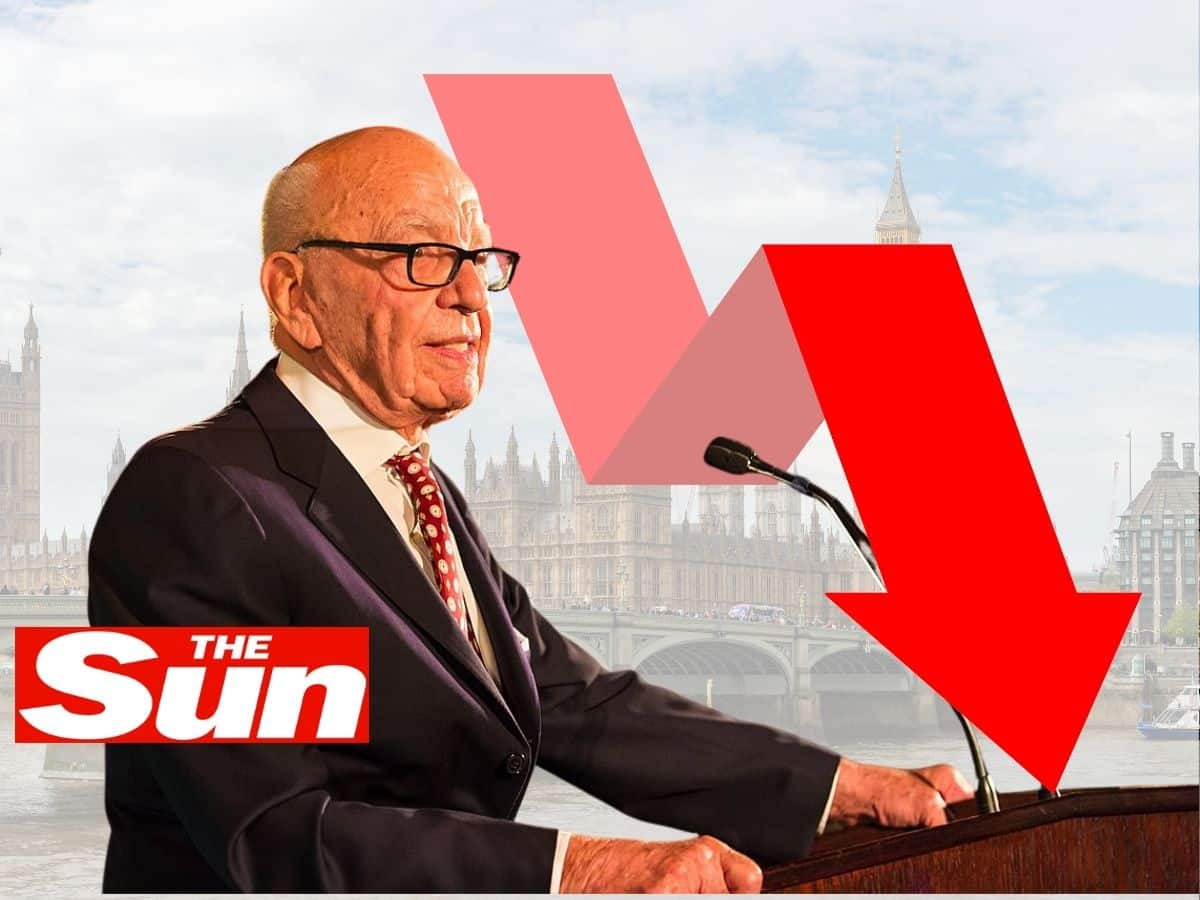
According to London Centric’s Jim Waterson, the Sun is in dire straits:

The Sun’s accounts are out and I haven’t seen anyone report on them so…*Pre-tax loss of £31m*Revenue down from £296m to £273m (Sub now in the same ballpark as the Guardian)*Phone hacking costs (now into its third decade) of £36.6m*Big fall in audience but still claim to be UK’s number one brand

Jim Waterson (@jim.londoncentric.media) 2026-04-14T05:37:11.975Z

Of course, none of this means the rag is at risk of shutting down. As we all know, the Sun doesn’t exist to publish news or even make money; it exists to bully politicians into listening to owner Rupert Murdoch.

The Sun is a propaganda paper

Over on X/Twitter, the popular Flying Rodent account asked the following:

Advertisement

It’s been a long time since the Sun made a profit, which raises questions like “what is the paper’s actual purpose, if it isn’t for making money”.

As Waterson noted, the Sun has incurred phone hacking costs of £36.6m. This substantial figure makes it abundantly clear that something is not right in media land. Despite this, political scrutiny on the matter has dried up.

As we reported in November 2025:

The Sun newspaper has yet again agreed to pay through the nose because of its past reporting. In this instance, they’ve apologised to Christopher Jefferies and paid him “substantial damages”.

Despite this happening fairly frequently, Keir Starmer has abandoned completing the Leveson 2 inquiry into press standards. It would be pretty awkward if he didn’t, of course, given the fact that he occasionally writes for the Sun now.

Starmer began his Labour leadership campaign with a promise to never speak to the Sun. He would betray that promise as soon as he could, jumping into bed with the Sun at the first available opportunity.

Advertisement

He did this despite how unpopular the tabloid has always been with Labour members. Now, Labour have found themselves having to draft national MPs to canvass for London councils in the local elections because so many of their activists have moved on:

The point we’re making is that it was never in Starmer’s political interests to ally himself with the Sun. Presumably, he felt like he would suffer more damage if he spurned the Murdoch rag. This ended up proving false, but it still demonstrates how well trained our politicians have become by the Sun.

Turning the page

We’re now in a moment where the British press aren’t just failing financially. The Greens have overtaken Labour in the polls, and leader Zack Polanski has shown you can stand up to the tabloids without suffering political consequences. If anything, it seems that pushing back against the billionaire-owned media is viewed as a selling point.

Advertisement

In other words, Murdoch may be happy to lose money now, but that situation won’t last forever.

Featured image via Hudson Institute (Wikimedia)

Advertisement

Source link

Advertisement
Continue Reading

Politics

Climate crisis threatens sports revenue

Published

on

Climate crisis threatens sports revenue

Climate change is no longer just an environmental challenge far removed from the stadiums; it has become a direct threat to one of the world’s largest industries.

A recent report published by Reuters reveals that the global sports economy, valued at approximately $2.3 trillion annually, is facing risks that could derail its growth trajectory in the coming years.

The report paints a clear picture of a sector accustomed to rapid growth, with projections indicating its value will reach $3.7 trillion by 2030 and $8.8 trillion by 2050. However, these ambitious figures are now clashing with the volatile reality of climate change, which threatens to transform growth into losses.

$500 billion at risk

According to the data, extreme weather events, from heat waves to floods and snow shortages, could lead to losses exceeding $500 billion by 2030, resulting from the disruption of tournaments, declining attendance, and disruptions to broadcasting and sponsorship revenues.

Advertisement

The impact extends beyond direct losses, reaching supply chains and the sports equipment industry, highlighting the vulnerability of the sports economy to any climate disruption.

The report reveals that the economic power of sports lies not only in professional competitions but in a broader system. This system is spearheaded by sports tourism, valued at $672 billion, followed by merchandise and equipment at $612 billion, and professional sports at $140 billion.

Ironically, the fastest-growing sector, sports tourism, is also the most vulnerable to climate change. It is projected to account for approximately 60% of revenue growth until 2030, placing it squarely in danger.

Outdoor sports

The industry relies heavily on outdoor sports, which constitute more than 90% of television broadcasting revenue and around 76% of sponsorship revenue.

Advertisement

This dependence means that any climate disruption, even a temporary one, can trigger a cascade of losses that severely impacts the core of revenue.

From local losses to a global threat: The figures paint a clearer picture of the crisis, with estimates suggesting that bad weather costs community sport in Britain alone around $433 million annually.

Globally, losses could reach 14% of revenue by 2030, potentially reaching $1.6 trillion by 2050.

Featured image via the Canary

Advertisement

Source link

Continue Reading

Trending

Copyright © 2025