
Politics
Inheritourism Reveals Why We Travel Differently


There’s a seemingly endless array of quippy terms to describe rising travel trends and preferences.
One particularly interesting term is “inheritourism”, which really gets to the heart of why different individuals travel the way that they do and how family plays a role.
Below, travel experts break down the meaning of “inheritourism”, as well as the benefits and drawbacks of this holiday phenomenon.
What is ‘inheritourism’?
“Inheritourism reflects how travel preferences are passed down across generations,” said Jess Petitt, senior vice president or strategy, insights and full service brands at Hilton.
“Many people inherit travel preferences from their parents, with family experiences often shaping how people travel well into adulthood.”
A 2026 travel report from Hilton identified “inheritourism” as a notable trend for the new year – with 66% of travellers surveyed by the hotel brand saying that their parents have influenced their choice of accommodations, 60% saying they guided their choice of loyalty programs and 73% saying they shaped their general travel style.
“I think inheritourism shows up most clearly in how people define what ‘comfortable’ travel looks like,” said travel blogger Esther Susag. “Many travellers inherit not just destinations, but entire travel styles from their parents. For example, I often notice that people who grew up only doing cruises or all-inclusive resorts tend to gravitate back to those formats as adults.”
Travellers accustomed to the ease of having everything in one place might be more hesitant to go off the beaten path with independent accommodations, hidden gem destinations or locations that require more planning or cultural navigation.
“That same pattern extends into how people pay for travel,” Susag said. “I’ve noticed that travellers whose parents used travel credit cards and understood points and miles tend to feel much more comfortable navigating loyalty programs and booking elevated experiences. On the other hand, people who grew up saving for years for one big trip and paying mostly in cash or with a single credit card often carry that same cautious mindset forward and are hesitant to open multiple cards or experiment with points strategies.”
She added that many parents remain deeply involved in their adult children’s travel decisions, often financing trips with their own loyalty points or preferred brands. Multigenerational travel is increasingly popular, thus exposing new generations to the same kinds of choices.
“Over time, that becomes their baseline for what travel ‘should’ look like,” Susag said. “As travel has become more expensive and more intentional, people are less willing to experiment and more likely to stick with what they know works. That often means repeating the travel patterns they grew up with, whether that’s specific destinations, hotel brands or trip formats.”

Flashpop via Getty Images
It’s only natural that people who grew up travelling in a certain way as children would adopt similar preferences. Katy Nastro, a spokesperson and travel expert for the flight alert service Going, pointed to the cliché “the apple doesn’t fall far from the tree”.
“I personally grew up going to warm beach destinations to escape the New York winter every February,” Nastro said. “I wholeheartedly believe that the desire for a warmer weather destination during the month of February versus a cold weather trip is not just a preference but is now a personality trait inherited from my family travels as a child.”
She believes the same pattern is evident in the families attracted to “the magic of Disney” with Disney theme parks vacations over multiple generations. Our early memories can inform what we find meaningful and rewarding as we grow up.
“My family chooses the mountains over the beach always, because it’s where I grew up vacationing – and if you ask me, it’s just better,” Petitt said. “Those experiences are also what I’m excited to share with my kids, building on those memories. If we never visit a beach as a family, that would be OK by me.”
Family travel habits strongly influence people’s choices – but is that a good thing?
“Any travel is beneficial in my opinion,” Nastro said. “And in theory, inheritourism can create generational travel because people are inclined to continue the tradition of travel to a certain place, hotel, etc. The only downside may be that this perpetuates a blinder affect where people don’t tend to branch away from what they know, and thus never really explore beyond their comfort zone.”
She added that inheritourism might lead people to miss out on good deals if they can’t look beyond the specific brands or locations they’ve “inherited”.
“Travellers may avoid less popular destinations or more immersive experiences because they feel less predictable or convenient,” Susag said. “That said, awareness is growing, and many people are starting to challenge those habits once they realise there are other ways to travel that still feel safe and rewarding.”
Overall, she sees a mix of downsides and benefits to the influence of inheritourism today.
“On the positive side, inheritourism makes travel more accessible and lowers the barrier to entry for a lot of people,” Susag said. “It also encourages multigenerational travel and shared experiences, which can be incredibly meaningful.”
Inheritourism can serve as “a foundation, rather than a fixed path,” she emphasised. Travellers can carry forward meaningful traditions but also cultivate their own.
“People tend to start by recreating the trips and habits they grew up with, then adapt them as their confidence grows and their priorities shift,” Susag said. “Whether that means exploring less traditional destinations, traveling more independently or becoming more intentional about how they spend on travel, many travellers eventually build on what they inherited rather than abandoning it altogether.”
As in other areas of life, parents tend to set the norms and serve as trusted sources for young adults as they make decisions.
“In a world of digital overwhelm and an abundance of choice, travellers are looking to their inner circle to inform their travel decisions,” Petitt said.
“When seeking an experience beyond what is familiar, inherited preferences and trusted travel habits serve as a starting point for discovering something new. The key is balance – while inheritourism offers comfort and confidence, the greatest benefit comes when those familiar influences open the door to exploration, rather than limit it.”



9 min read
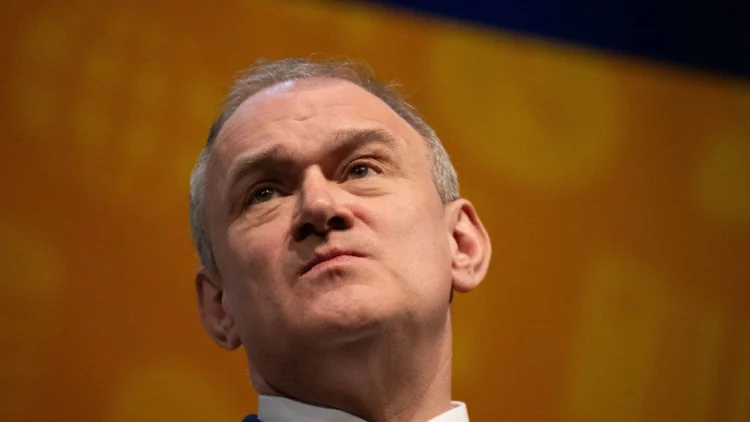
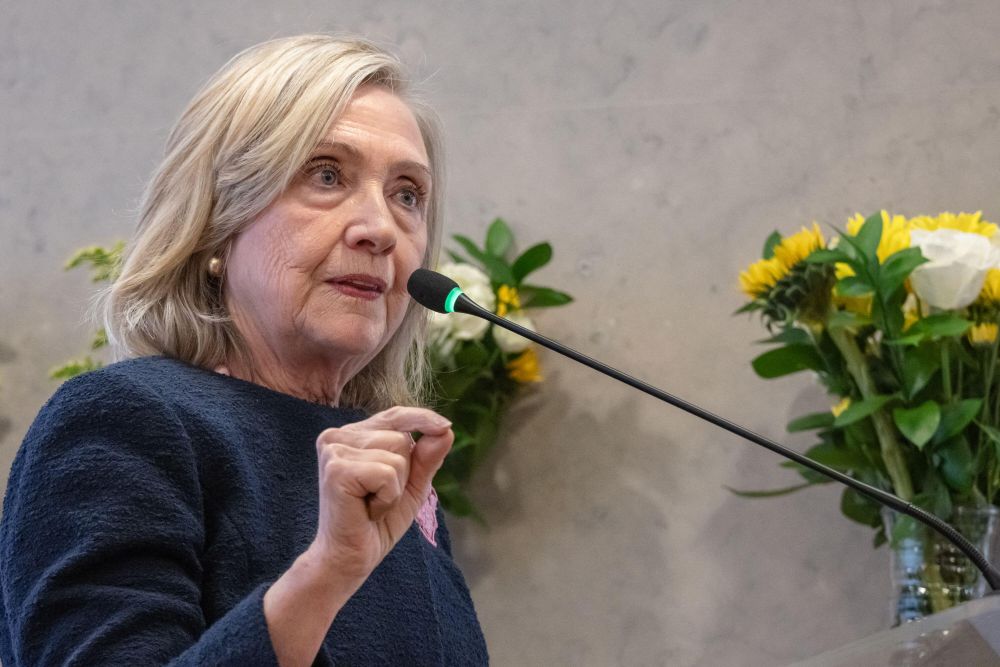
Former US presidential candidate Hillary Clinton privately urged Liberal Democrat leader Ed Davey to “stand up to bullies” like Reform UK during a recent visit to London.
In an interview with PoliticsHome ahead of the 7 May local elections, Davey revealed that he had a “long chat” with the former US secretary of state when she spoke at a business reception in the capital late last year.
“We talked about how we need to fight Reform in the way they need to fight Donald Trump, and she gave me some choice advice, which I’m not going to repeat because that would be unfair on her,” he said.
When pressed, he added: “She said you have to be very strong and stand up to bullies and don’t cave in and cosy up to them. She didn’t say she was criticising Keir Starmer, but I think the approach we [the Lib Dems] have taken, and the approach that someone like the Liberal Prime Minister of Canada, Mark Carney, has taken, is the sort of approach she will endorse.”
He described Clinton as “very friendly and very warm”: “You could tell that she realised that we had shared values.”
Davey sat down with PoliticsHome a month out from voters going to the polls for highly-anticipated elections in Scotland, Wales and council areas across England.
Ahead of those elections, the Lib Dems have sought to frame themselves as part of the broader pushback against the rise of the populist right, taking strong positions against Trump and his actions in Iran, and calling on King Charles and Queen Camilla’s planned visit to the US to be cancelled over the US president’s treatment of the UK.
Speaking at the party’s local election campaign launch in Birmingham on Friday, Davey accused Nigel Farage’s Reform of “importing the divisive, nasty politics of Donald Trump into the UK”, adding: “This does not sit well with British values.”
The Lib Dem leader said he hopes that the Democratic Party defeats the Republicans in the US midterm elections in November, and while he joked that his party was “pretty busy in the UK at the moment”, he said they do have a “good relationship with a lot of Democrats”.
“We’ve helped Democrat politicians in the past,” he said.
“They have a good relationship with our party. We had a good relationship with a few Republicans, but I’m afraid lots of Republicans from that great party have now backed the MAGA movement and now support Donald Trump and some of his nasty, divisive, damaging policies.”
As well as Canadian Prime Minister Carney, Davey praised the “strong leadership” of Spanish Prime Minister Pedro Sánchez, who on Wednesday issued a thinly veiled swipe at the Trump administration by saying Spain “will not applaud those who set the world on fire just because they show up with a bucket”.
With Trump continuing to be a deeply unpopular figure in the UK, Davey hopes that his party’s opposition to the US president will boost Lib Dem prospects on 7 May.
Last month, The Spectator obtained internal plans revealing a belief among Lib Dem strategists that their position on the Iran war will pay dividends at those elections, with a memo reading: “For the first time since the Iraq war… we have a chance to turn a distinctive and principled Liberal Democrat position on foreign affairs into significant election gains.”
However, despite leading the Liberal Democrats to their best general election result two years ago, Davey is heading next month’s locals under pressure from restless Lib Dem MPs who complain that the party is drifting and failing to capitalise on the 2024 success.
The polls are the polls, but the elections are the elections
Most opinion polls show that the Lib Dems have hovered around 12 per cent of the national vote since the 2024 general election, with no significant increase.
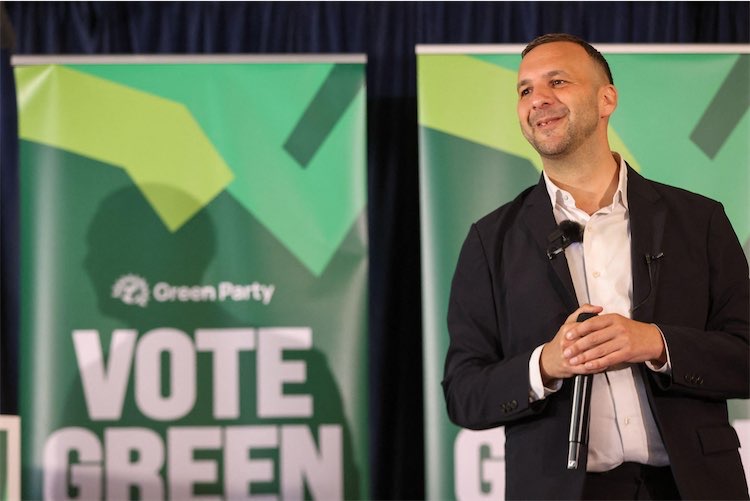
Last month, PoliticsHome reported concern within the party that a handful of Lib Dem MPs could be tempted to join Zack Polanski’s surging Greens.
“I’m restless like they are… I share their restlessness,” Davey told PoliticsHome, while stressing that his MPs and the party “work really well together”.
However, in a bid to face down his critics, the Lib Dem leader pointed to his electoral record.
“The polls are the polls, but the elections are the elections,” he told PoliticsHome.
“Winning elections is what we’ve done under my leadership. If we make net gains in May, it will be the eighth year in a row we’ve made net gains, the sixth under my leadership. It’s never happened before. That’s a continual increase, year on year.
“This year we could well beat Labour and the Tories for the number of councillors we elect for the second year in a row, and it’s never happened previously.”
He insisted that the Lib Dems are “still the most united parliamentary party” despite recent negative briefings.
“Labour could have a leadership election after May, the Tories could. They’re certainly losing MPs to Reform, and then Reform is losing those MPs on the other side. We haven’t, we won’t, and we will work really well together. I am determined to lead us into the next election and show that we have the ideas for our country,” he said.
One complaint among uneasy Lib Dems is that the party currently lacks a clear identity and target audience, having spent recent years focusing its electoral strategy on former Conservative voters in the south of England.
According to Davey, the party now has an opportunity to pick up former Green supporters who care deeply about the environment but are not as left-wing as the party’s self-described eco-populist leader, Zack Polanski.
“You’re going to see a fracturing of the Green Party in the sense that there’s a lot of the former Greens before this Corbynista push, who were much more middle of the road,” he said.
“Their focus was on the environment… The stuff that they [the Greens] are now talking about, they don’t really buy… they don’t like what they’re seeing.”
The discussion heading into 7 May has been dominated by the rise of the Greens and Reform, and their threat to the historic two-party dominance of Labour and the Conservatives.
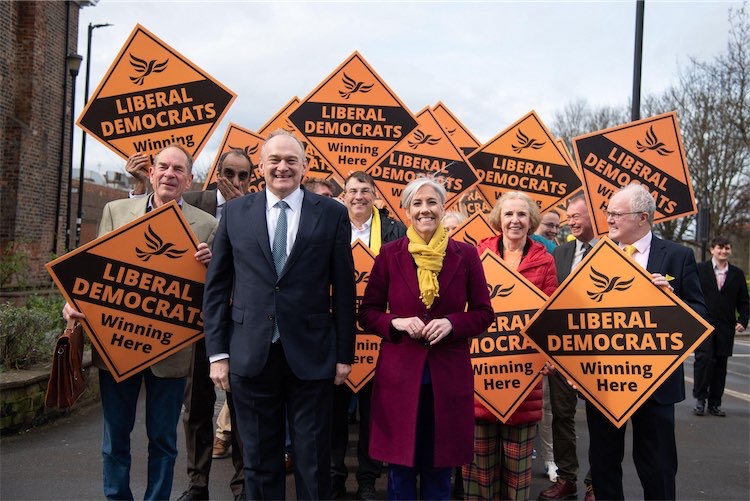
However, the Lib Dems are hopeful of making gains across the country next month, including in East and West Surrey, Hampshire, Portsmouth, and some areas in the north of England, such as Stockport and Newcastle.
Asked what distinct message the Lib Dems are offering to voters, Davey told PoliticsHome they were positioning themselves as “local champions” who will fix church roofs – a deliberate echo of Conservative leader Kemi Badenoch, who mockingly described a Lib Dem “somebody who is good at fixing their church roof” last year.
At the campaign launch on Friday, PoliticsHome spoke to Lib Dem councillors and candidates who felt that while it was unlikely they – or any party – would win outright control of Birmingham Council, the Lib Dems could be left in a good position to play a “leading role” in the administration after the elections.
The question of who Davey would be prepared to work with could be one he faces increasingly in the future, as the fragmentation of UK politics into a multi-party system shows no signs of going away.
Davey was clear that his party has ruled out working with Reform, and the leader of the Scottish Liberal Democrats, Alex Cole-Hamilton, has ruled out entering a coalition with the Scottish National Party (SNP).
However, the party has not ruled out a coalition with Labour, the Green Party, independent candidates, or Plaid Cymru in Wales. Jane Dodds, the leader of the Welsh Liberal Democrats and the only Lib Dem member of the Senedd, said this week that the Lib Dems would only work with Plaid Cymru if they “confirm that they will not spend a penny of government money on independence”.
Asked whether his party might enter an agreement with the Welsh nationalist party, Davey said he had not spoken to Dodds about it yet.
“I’d be really surprised, given our opposition to independence,” he said.
“You would have to speak to Alex Cole-Hamilton and Jane Dodds, because they will run those negotiations. They’re devolved administrations.”
Liberal Democrat MP Roz Savage told The House magazine in March that the party “needs a plan” for a coalition scenario after the next general election, having been “badly burned” by their experience sharing power with David Cameron’s Conservatives.
Asked whether any resulting coalitions from the May elections could provide test cases for where Lib Dems could work with other parties after a general election, Davey said: “Good question, but I am very focused on the local elections and the next general election, maximising Liberal Democrat victories.”
The challenge for Davey and his party, however, is that the 7 May elections are so unpredictable that they are struggling to predict where they might make the strongest gains.
“It’s complicated, because you’ve got the two old parties’ votes collapsing,” the former cabinet minister said.
“Where we’re strong, we’re big beneficiaries of that, but then there’s Reform coming in… And so we’re finding it quite difficult to read the canvassing, because the Reform vote is a little bit shy.”
Davey suggested the Lib Dems could cause “a bit of a surprise” in Birmingham, pointing to the fact that his party are fielding an expanded list of 101 candidates in the city and describing local campaigners as having “really gone for it”.
In the bid for attention in an increasingly fragmented political landscape, Davey intends to continue carrying out publicity stunts for the cameras. Most recently, he was pictured playing chess with Hull City Council leader Mike Ross at the Hull campaign launch last week.
Davey – similarly to Chancellor Rachel Reeves – played chess competitively until he was about 12 years old, though he said he would “not put myself up as a great chess player” anymore.
“Playing the long game, that’s the key thing in chess,” he said.
“You play all your moves, you don’t get worried if you make a sacrifice here, you work out where you’re going to go.”

The post Why Bonnie Blue is good for feminism, with Zoe Strimpel appeared first on spiked.
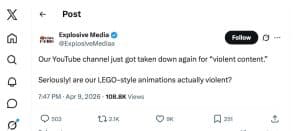
The YouTube platform has (again) removed the account of Explosive Media, the makers of Iran’s ‘Lego’-style and intensely viral propaganda videos mocking Donald Trump, Benjamin Netanyahu and their failures.
Explosive Media announced the ban on X:

The group’s accounts on X, UpScrolled, Instagram and other platforms are so far unaffected. Explosive Media marked the occasion by releasing a new video, Loser 2 — described as a ‘banger’ — mocking Trump’s endless lies, his loss to Iran in his and Israel’s illegal war and his guilt in the crimes of serial child-rapist and Israeli spy Jeffrey Epstein. It also directly refers to Trump being behind the ban:
Iranians just published the new very banger LEGO AI movie that Trump almost wants to put onto agreement list to stop them.
Do whatever you need to do but don’t let Trump watch this 😭🤣😂 pic.twitter.com/y66Mr7Yadk
— Furkan Gözükara (@FurkanGozukara) April 11, 2026
Featured image via the Canary
Reform — There’s a genre of horny older men who don’t seem to understand that the internet is a place others inhabit — a place where people can see what they’re up to. These men often use their actual faces as their profile pictures; probably because they lack the wherewithal to realise they could not do that.
Despite their real names and faces being visible, these men will pepper sex workers with messages like ‘very big boobs‘ and ‘Yes I would love to have some fun‘.
When you see these wretched individuals online, you think to yourself ‘what on Earth do these people do in the real world‘? In the case of Stephen Hammond, the answer is ‘run to be a Reform UK councillor‘:
Married man too, tut tut.
— Reform Party UK Exposed 🇬🇧 (@reformexposed) April 11, 2026
Reform — Aroused ignoramus
If you can’t open the images above, know that Hammond was replying to a woman in her underwear who was asking:
Does this help you love me more
Hammond responded:
Yes I would love to have some fun
He’s not having fun now, clearly, as he’s deleted his Threads account.
From that same account, Hammond recently posted:
Hi all friends and family, just a quick note to inform you that I am now running for Councillor with the Reform UK party at the Holmewood and Brierly ward in Bradford district, we will be out and about in the ward very soon, and looking to get Labour out of the Bradford Council so we can start putting the good, if you are in the Ward please look out for us we will be only to [sic] glad to listen to any problems and try to solve them the best we can.
Good god, Stephen, are they rationing full stops in Bradford? No wonder you want to get rid of Labour if they are!
Punctuation aside, the above post reveals that Hammond uses his “friends and family” account for horny posting.
This is not good.
As reprehensible as many UK politicians are, they do at least have the self-preservation instincts needed to indulge themselves behind closed doors.
We’re not sure we want to live in a country in which public services are run by people with zero common sense and minus zero impulse control.
It gets worse
The good people at Reform Party UK Exposed posted some of Hammond’s other posts:

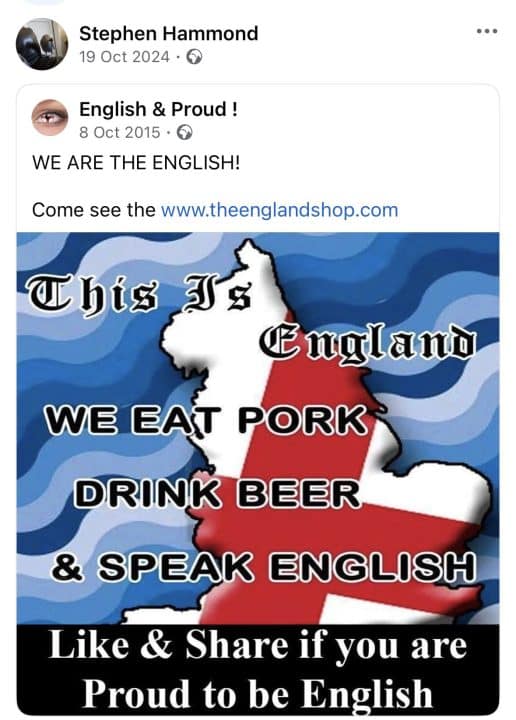
You know a culture is thriving when your list of things to be proud of includes ‘speak our own language‘.
Not to tell these dipshits how to make their rancid memes, but they should probably replace ‘pork’ with ‘bacon’. English people have never made a big deal out of eating pork; they’re just saying this because they think it will upset Muslims.
Your culture isn’t doing well when you do things to upset others rather than to enrich your own spirit!
Hammond also believed this eyesore of a meme “keeps getting deleted from the internet”:

According to Hammond, “genocide” is when someone moves into your area and opens a shop.
Also, remember in the last meme when Hammond was proud to “speak English”? Well now he’s worrying about “FOREIGN HOARDS”.
You mean “FOREIGN HORDES”, dipshit.
Aren’t you a ‘learn the language or get out‘ guy?
Further proving Hammond can’t speak the language he’s proud to speak:
 We’d stick to the pork and beer if we were you, Stephen.
Local erections
Hammond is far from the only unseemly candidate that Reform have lined up for the local elections:
We keep thinking Reform can’t top themselves, and yet every day the candidates just get worse and worse.
Featured image via Stephen Hammond
Jolyon Maugham’s Good Law Project has lodged a complaint with the Information Commissioner about the gender-critical organisation, Protect and Teach, accusing it of failing to disclose ‘who they are or how they’re handling people’s data’. ‘If a group won’t say who they are’, the Good Law Project asserts, ‘it raises a vital question: what are they trying to hide? If your views are so toxic you won’t put your name to them, then maybe you shouldn’t be saying them at all.’
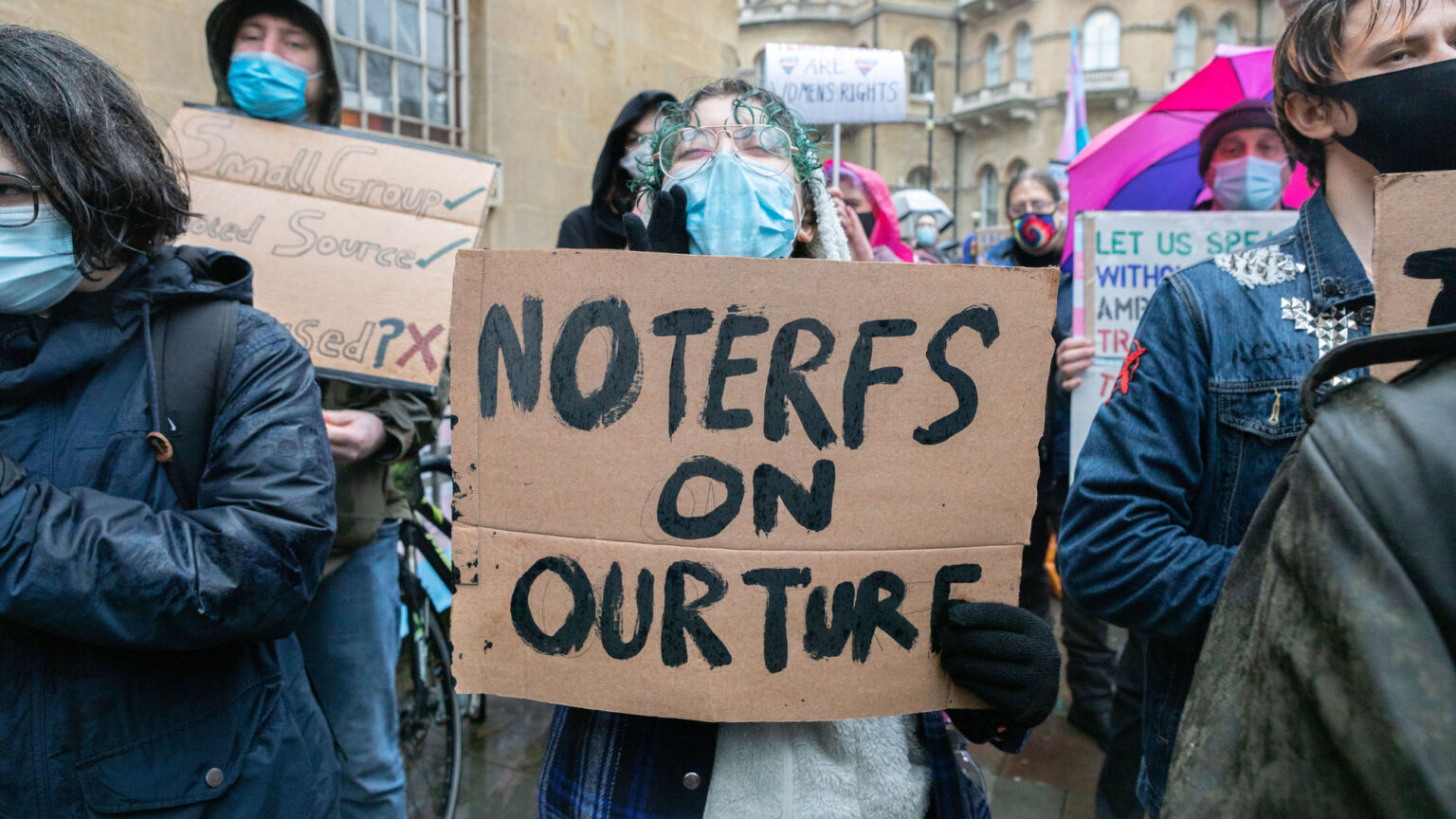
True or not, these pettifogging legal gripes entirely miss the point. The fact is that campaigners are concealing their identities not because of the supposed ‘toxicity’ of their beliefs, but because they are concerned about their safety and that of their families. For gender-critical feminists, speaking in public has become a very dangerous business.
The first hints of the current wave of violence began last year. Following the landmark judgment in For Women Scotland Ltd vs The Scottish Ministers, in which the Supreme Court confirmed that ‘sex’ in the Equality Act refers to biological sex, the women behind the campaign reported being inundated with death threats and misogynistic abuse. They also described the damage their views had caused to their employment and business interests.
Trans activists soon turned their attention to officials. The then chairwoman of the Equality and Human Rights Commission (EHRC), Baroness Falkner, told parliament’s Women and Equalities Committee that she had been forced to cancel a meeting after police warned of a ‘serious risk’ of violence. Trans activists had made it harder for her staff to come to work in safety, she told MPs, adding: ‘The level of agitation that they can cause in terms of personal attacks, libellous attacks, defamation, where our family members are affected – our intimate family members have to think about how they’re going about to their place of work – has got to stop.’
You don’t even have to be a gender-critical feminist to risk the wrath of activists. Sally Dunsmore, the director of the Oxford Literary Festival, last year dared to programme a discussion between gender-critical writers Julie Bindel and Helen Joyce. Several guests, including an Oxford lecturer in English, pulled out, while other activists threatened Dunsmore directly, telling her she would be ‘put in a box and burnt’.
Now, those threats are taking on a more explicitly criminal and violent form. A militant trans-activist group known as Bash Back has issued a ‘direct action’ guide urging members to identify ‘transphobic’ targets – including MPs – and ensure they are ‘hit repeatedly until they desist’ from their ‘transphobic’ activities. The guide admits Bash Back’s campaigning would be ‘rarely legal’, and warns participants that they could face charges including criminal damage, possession of an offensive weapon and aggravated trespass. An equipment section lists items such as a hammer and advises activists to clean tools with alcohol or dispose of them after use in ‘unsurveilled residential bins’.
They’re not mucking around. Bash Back has already claimed responsibility for attacks on the constituency office of health secretary Wes Streeting, and for hacking the website of the Free Speech Union. It also targeted the offices of the EHRC last year, smashing windows and spraying the building with pink paint.
Despite Maugham’s supposed opposition to ‘toxic’ attitudes, his own response to Bash Back’s activities was favourable. He described this campaign of violence and intimidation as ‘the inevitable, and I would say legitimate’ response to a society whose ‘politics and media systematically dehumanise trans people’.
Maugham’s hypocrisy highlights what has become a familiar defence of trans activism. Allowing a gender-critical feminist to speak is cast as an act of both real and symbolic violence, where every dissenting utterance becomes an attack on vulnerable gender-confused children. Like Maugham, they claim that the clock’s already struck midnight, and there’s no time for the weary conventions of civility, tolerance or open debate.
On campus, where the sort of people Bash Back is now urging activists to target are very often to be found, the implications of this rhetoric have already been severe. At the Committee for Academic Freedom, we regularly deal with cases involving gender-critical academics who are reluctant to take their concerns public for fear of reprisals.
This is reinforced by the government-commissioned review of data, statistics and research on sex and gender, led by Professor Alice Sullivan and published in 2024. It recorded not merely isolated complaints, but also a broader chilling effect: gender-critical academics describe moderating how they frame arguments, avoiding open discussion, narrowing what they were prepared to teach or research, and hesitating to pursue work touching on biological sex for fear of complaints, ostracism, managerial disapproval or damage to their careers.
If direct threats of violence are now being added to this already hostile climate, the reluctance to attach one’s name to advocacy concerning the importance of biological sex – or to pursue research on that topic, organise conferences, supervise PhDs or teach on it at all – begins to look less like evasion and more like self-defence.
The Good Law Project is free to campaign as it wishes, but it should at least be honest about where the ‘toxic’ climate it bemoans is actually coming from.
Freddie Attenborough is director of research for the Committee for Academic Freedom.
Britain First — The British far-right try to present themselves as the antidote to what they would have you believe is the sickness of multiculturalism. In reality, they’re a bunch of sad and angry people who desperately want the world to reflect their own self-loathing.
Never has this been more obvious than in the following clip:
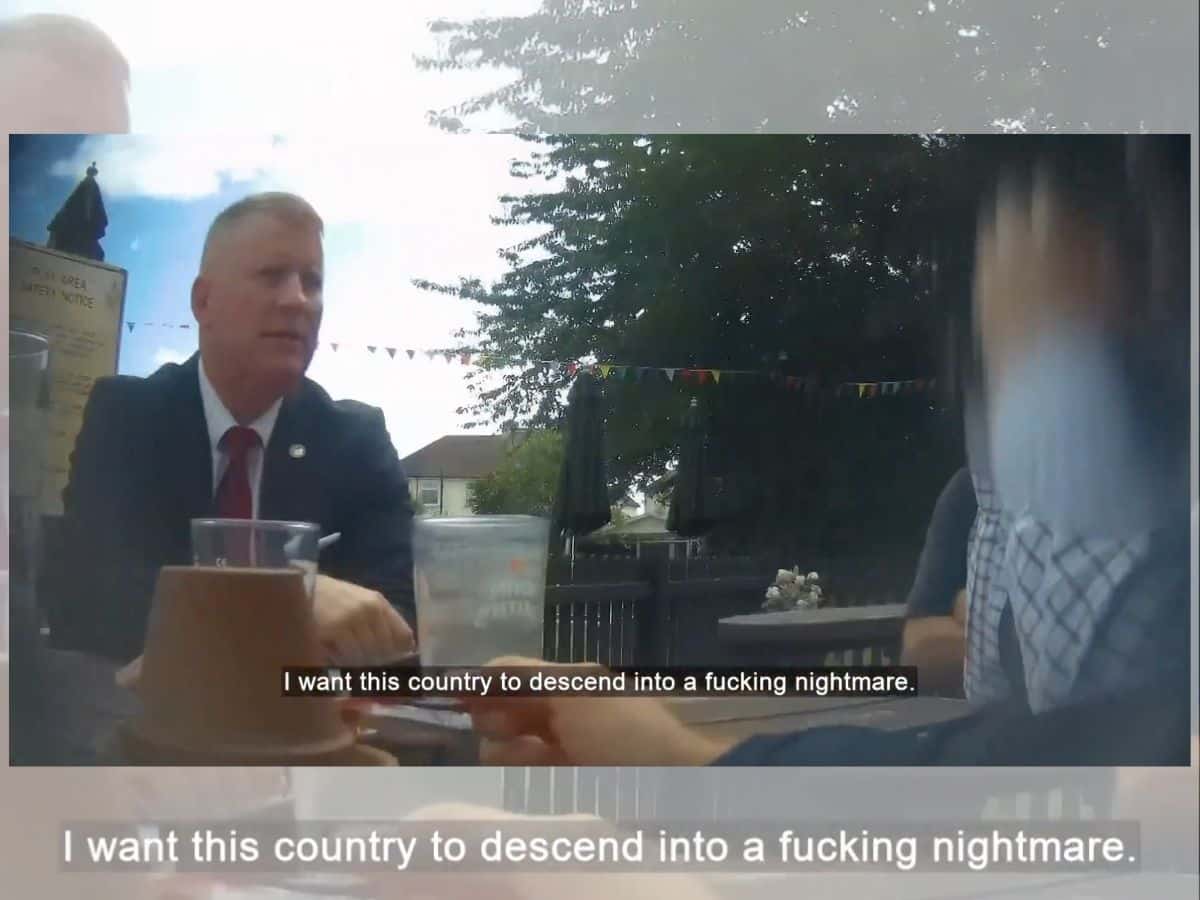
🇬🇧 Far right extremist Paul Golding exposed in a secret recording:
“I want this country to become a shithole. I want this country to descend into a fucking nightmare”
They don’t care about the country. They thrive off discord. pic.twitter.com/N0Sb9yvq33
— smile2jannah (@smile2jannah) April 12, 2026
Nightmare
The man in the video about is Paul Golding, the leader of Britain First. As Hope not Hate documented:
Golding first emerged into prominence in 1999 as a teenage member of the fascist British National Party (BNP), and was quickly appointed editor of the youth publication Excalibur. Given the title of Director of Publicity, Golding also briefly took the reins of the BNP’s flagship magazine, Identity, having established a close relationship with then-leader Nick Griffin.
Additionally:
In Belfast, Golding helped [Jim Dowson – far-right fundraiser] launch Britain First, returning to England in 2013 in the hopes of building links with the English Defence League and various splinters. Now at the helm of a confrontational new vehicle, Golding quickly gained notoriety for his extreme worldview, relentless fear-mongering and inflammatory actions, leading Britain First’s “patrols” and attempts to intimidate opponents. Examples include threatening to bury a pig at the site of a planned mosque in Dudley in order to “contaminate” the land and prevent its construction.
For some reason, Western fascists think Muslims are vulnerable to pigs in the same way that vampires are sensitive to garlic.
Well, we say ‘for some reason’ — we know what the reason is — it’s because they’re thick.
Hope not Hate added:
Branded a “narcissist” by a prominent former member, Golding’s temperament and tactics have been at the centre of many rifts within the group, including with Dowson, who quit the group in 2014, describing Golding’s “mosque invasions” as “provocative and counterproductive”, as well as “unacceptable and unchristian”.
To be fair, Jesus did cause a ruckus in a temple; it’s just he was going after money lenders — not everyday worshippers.
The British nightmare
In the undercover recording of Golding, he’s caught saying:
In ten years, society is going to be violent and horrific – a horrific place.
I’m not interested in appealing to the masses right now.
The moment that we’re waiting for is fast approaching.
I want this country to become a shithole.
I want this country to descend into a fucking nightmare.
Because that’s the only thing that’s going to get people off their backsides.
As is obvious from his other activities, Golding recognises that Britain isn’t a nightmare now, so he’s trying to turn it into one.
Basically, he’s like every other fascist in history.
No doubt because he knows he can’t function in a normal, caring society — only one in which cruelty is the default.
Britain First — ‘The fear’
Showing what kind of a man Golding is, Hope not Hate also reported the following about Golding:
Golding, who for a time was in a relationship with the now-former Deputy Leader Jayda Fransen, was recorded in December 2015 admitting to having violently attacked her, as well as another woman. Fransen told the BBC in 2019 that the abuse went on for five years, and “didn’t take long to start” after she joined Britain First in 2014. She said: “There were incidents that could have gone so badly wrong. I could have ended up really hurt or worse. I guess that is where the fear came in because I thought I am going to end up dead”.
Clearly, it’s Golding himself who’s the “fucking nightmare”.
Featured image via undercover recording

Several South Korean government officials have called out Israel on social media, urging it to break free from the “chain of hatred” and the “memory of victimhood”. Basically, South Korea found a professional way to tell Israel to stop playing the victim.
The first statement came from Lee Jae Myung, the President of the Republic of Korea. It was in response to a video in which an Israeli soldier threw a Palestinian man off a roof. He stated:
I need to look into whether this is true, and if so, what measures have been taken.
The forced comfort women issue that we are raising is no different from the Jewish massacre or wartime killings.
In response, the Israeli Foreign Ministry issued a statement.
The remarks by the President of Korea, Lee Jae Myung, including the trivialization of the massacre of Jews on the eve of Holocaust Remembrance Day in Israel, are unacceptable and warrant strong condemnation.
President Lee Jae Myung, for some strange reason, chose to dig up a… https://t.co/sQzisQGxa5
— Israel Foreign Ministry (@IsraelMFA) April 10, 2026
It stated:
including the trivialization of the massacre of Jews on the eve of Holocaust Remembrance Day in Israel, are unacceptable and warrant strong condemnation.
Israel wants to keep bringing up the Holocaust while committing another one. At what point does the world realise it’s just an excuse?
And why are Palestinian lives, or Korean lives, worth less than the lives of Israelis?
The President of South Korea said a video of the IOF tossing a Palestinian child off of a roof reminded him of Japanese crimes against Koreans during colonialism and the Holocaust
israel says this “trivializes” the Holocaust. As if Koreans and Palestinians are inherently cheaper https://t.co/IcEX2cTBWD
— 박주현 (@hermit_hwarang) April 10, 2026
Israel is like the abusive man who refuses to go to therapy for his own childhood abuse. Your pain is not an excuse to cause more pain.
The account also claimed the video was fake. It wasn’t. Israel should know that tactic doesn’t work anymore.
The incident happened in 2024 in the West Bank. At least two other soldiers stood and watched.
Unsurprisingly, the statement also brings up Hezbollah and Hamas, and labels them ‘terrorists’. But from where I’m standing, the only terrorists are the US and Israel.
South Korea condemns indiscriminate killings
In response, Choo Mi-ae, the first female leader of South Korea’s Democratic Party, also put out a statement.
She pointed out the forced enslavement and sexual abuse by the Imperial Japanese Army during World War Two, along with the imprisonment, massacres, live burials in mines and military bases, chemical and biological experiments, and the Kantō earthquake massacre.
Essentially, she listed all the reasons that South Korea could be using to justify playing the victim and committing genocide. The difference, though? It isn’t.
She ended with:
No matter how much it is Israel, I strongly support President Lee Jae-myung for sending the message that indiscriminately killing civilians is wrong from a human rights perspective.
Are world leaders finally growing a backbone?
Of course, killing civilians is wrong from pretty much every perspective — unless you’re a genocidal war criminal.
Victimhood
Finally, Park Hong-geun, Minister of Planning and Budget, called on Israel to:
break free as soon as possible from the chain of hatred where the memory of victimhood leads to further perpetration
He then took a dig at Israel’s lack of universal human rights:
The Ministry of Economy and Finance will, in designing the future of the Republic of Korea, prioritize the people’s livelihood and national interests as core values, while never losing sight of universal human rights as the foundation of human civilization.
Of course, it’s rare for a US ally to stand up to Israel.
Wow, that’s extremely rare for a U.S. treaty ally.
South Korea’s president, addressing Israel: “It’s disappointing that you don’t even once reflect on the criticisms from people around the world who are suffering and struggling due to your relentless anti-human rights and… https://t.co/g16kNSNdC0
— Arnaud Bertrand (@RnaudBertrand) April 11, 2026
But really, far more world leaders should be saying the same thing.
More European leaders including UK – should be saying this. https://t.co/p9v3VBrq6M
— Paul Gosling (@PaulGosling1) April 11, 2026
Who’d have thought we would have all this crying and victimhood because the president of South Korea said that it’s wrong to throw people off a rooftop?
Israel thinks the Holocaust is a universal get-out-of-jail-free card. But it isn’t. At some point, you have to decide not to perpetrate the exact same crimes your own people are trying to heal from, or the cycle never ends.
Many world leaders are staying silent and refusing to call Israel’s actions what they are — war crimes. But silence only benefits the oppressor. Which is why the rare occasions that they do speak out are so important.
Feature image via 이재명 / YouTube

With the local elections looming, the serious parties are mobilising their supporters to hit the streets and engage with the public. Labour, meanwhile, are panicking, because Starmer encouraged the party’s grassroots to “leave”:
So hardly any volunteers left in Labour, they’re having to press gang MPs to save their council seats in London. This has been a long time coming. https://t.co/mfF8POIjec
— Cllr Alastair Binnie-Lubbock 💚🌍 🍉 (he/they) (@alastairis) April 10, 2026
Labour — Shaking off the fleas
In the post above, HuffPost’s Kevin Schofield wrote:
NEW: With the elections on May 7 less than a month away, Labour chair Anna Turley has written to 2024 intake MPs urging them to campaign in London when they return to Westminster next week.
She says: “Every London council seat is up for election in May. I know you’re all doing great work across the country but let’s use our time in the big smoke to help our Labour family there.”
An MP says: “Things must be bad.”
So, Labour are asking MPs to ignore their constituency work for a month so they can prop up the party’s failing London operation. Fair enough, it’s when they’re in Westminster, but it’s still time they could spend responding to constituents or making plans.
If you’re wondering what happened to all the Labour activists and door knockers – well – a lot of them left after Starmer said this:
“If you don’t like the changes we have made, I say, the door is open and you can leave”
and then we did.
en masse.
For the people would rather support someone like Zack Polanski that stands for something instead of someone like Keir Starmer who stands for nothing. https://t.co/njJ6e7daAv pic.twitter.com/aQ4iXJ2Fvw
— thelefttake (@thelefttake) April 3, 2026
As the BBC reported on 7 April:
Six million voters, more than 1,800 councillors across 32 boroughs. The simple numbers behind what could be one of London’s most complicated elections.
On 7 May every council in the capital will go to the polls to decide who will run their authorities over the next four years.
And no longer, it seems, can Labour, the Conservatives and the Liberal Democrats be confident that they alone will be running town halls.
The rise of Reform UK on the right and the Green Party on the left are presenting real and new challenges.
In other words, Starmer has fucked up so badly that he’s ended the political norms which have persisted for a century.
To be fair, he did have a lot of help from the Labour and Tory MPs who worked tirelessly to convince the public that the two-party system just doesn’t work.
The BBC continued:
After 7 May it’s possible five or even six parties will be in charge of various councils in London.
The previous red blanket, with Labour currently running 21 boroughs, becoming more of a patchwork quilt.
It will go lower
Beyond the local elections, Labour are also at risk of losing most of their MPs in the capital:
🗳️ Current #GE2029 seat estimate for London:
🔴 Lab: 22 (-37)
🟢 Grn: 17 (+17)
➡️ Ref: 15 (+15)
🔵 Con: 10 (+1)
🟠 Lib: 6 (=)
⚪️ Oth: 5 (+4)+/- vs GE2024 pic.twitter.com/9s2pzrh4Tq
— Stats for Lefties 🍉🏳️⚧️ (@LeftieStats) March 29, 2026
The way things are going, the above map could prove optimistic.
After all, if Starmer has proven one thing, it’s that he can always become more unpopular.
Featured image via The Canary

Iran has blamed the US for the failure of the ceasefire talks in Islamabad, Pakistan. In response, and in true toddler fashion, ‘President’ Trump threatened a naval blockade if “Iran wont bend”.
Iran’s Parliamentary Speaker, Mohammad Baqer Ghalibaf, said that Iran raised “forward-looking” initiatives during ceasefire negotiations in Pakistan, but the US failed to “gain the trust” of the delegation.
US-Iran negotiations — Sticking points
The US framed the lack of a breakthrough mainly around Iran’s refusal to meet its core demand: a firm commitment not to develop nuclear weapons.
In an interview, Vance said that the US refuses to give up its demand that Iran has no right to Uranium enrichment.
Iran: How can you negotiate with them, when this is the smartest one in their team? pic.twitter.com/KkTg1yipjx
— Bashkarma🇺🇸🌏🇷🇺 (@Karmabash) April 12, 2026
Which is hilarious, given that two of the most powerful militaries in the world have spent nearly two months indiscriminately bombing Iran and threatening to nuke it.
However, Iran has consistently said it has no intentions of building nuclear weapons and its nuclear programme is for civilian purposes. Several experts have backed this up. One said:
There was no evidence that Iran was close to a nuclear weapon.
Iran has said that it is willing to negotiate limits on its nuclear activities if sanctions are removed.
In 2015, Washington and Tehran signed a nuclear deal under US President Barack Obama. This put a limit on Iran’s uranium enrichment at 3.67% in return for sanctions relief. However, Trump withdrew Washington from the deal three years later and slapped sanctions back on Iran.
We are at war to return to the terms of a deal we already secured ten years ago, that was torn up because trump didn’t like the guy who negotiated the deal. Now we’ve lost 15 soldiers and spent a trillion dollars and are worse off than before. Racism is costly. https://t.co/nvNjIfozDj
— Tim (@trouble_man90) April 12, 2026
Since then, Iran has accelerated its uranium enrichment to 60%. However, to make an atomic bomb, 90% enrichment is required.
Iran — The right to self-defence
Importantly, though, you don’t see the US or Israel threatening to nuke Russia, South Korea, or even the UK. Why? Because those countries also have nukes — it would be the ultimate self-destruct button.
Of course, Israel and the US do not want Iran to have the tools it needs to defend itself. That way, they can continue to threaten it.
The US also demanded that Iran hand over enriched uranium and open the Strait of Hormuz — without recognising Iran’s sovereignty over it.
But unfortunately for Vance, unlike with his wife, coercive control does not work on a self-reliant sovereign nation.
In response to the US’s unreasonable demands, Esmaeil Baghaei, spokesman for the Iranian Ministry of Foreign Affairs, highlighted the importance of the US accepting Iran’s legitimate rights and interests.
He said:
The success of this diplomatic process depends on the seriousness and good faith of the opposing side, refraining from excessive demands and unlawful requests, and the acceptance of Iran’s legitimate rights and interests.
According to a Turkish journalist in Pakistan, Abbas Araghchi and Steve Witkoff nearly got into a physical altercation during the peace talks.
صحفي تركي في باكستان:
عباس عراقجي وويتكوف كادا يدخلان في مواجهة جسدية خلال المحادثات عن مضيق هرمز.
😂😂
— Hanzala (@Hanzpal2) April 12, 2026
We all know Araghchi would have fucked him up badly. Both in a fight of fists and in a fight of words.
Araghchi has a PhD in philosophy and has been working in foreign policy for 37 years. He is also fluent in three languages. But Witkoff? He’s a real estate developer.
‘Naval Blockade’
In one of Trump’s standard Truth Social posts, he claimed that the US Navy would start blocking the Strait of Hormuz.
Which Iran is already doing.
Is Trump going for a double blockade? Double negative makes a positive?
Or is he saving Iran the time and money and risking getting blown up in the process?
Toddler Trump added:
THIS IS WORLD EXTORTION, and Leaders of Countries, especially the United States of America, will never be extorted. I have also instructed our Navy to seek and interdict every vessel in International Waters that has paid a toll to Iran. No one who pays an illegal toll will have safe passage on the high seas.
Previously, Trump threatened tariffs on practically every nation. The difference here is that the Strait of Hormuz is shared Iranian/Omani sovereign territory. They have the right to impose tariffs on its seas.
Plenty of other waterways have tariffs. For example, the Panama Canal charges ships to pass through, with the cost depending on the ship’s size.
Similarly, the Suez Canal collects tolls dependent on vessel type and size.
What has become clear in recent days is that Donald Trump wants control of the Strait of Hormuz. He previously suggested that the US may consider charging a toll across the Strait, which would require direct US military control over the strategic waterway.
Colonialism
This is colonialism in action. Masked as “ending disruption.” One which the US itself caused.
There would be no problem if the US and Israel hadn’t caused one. It’s not that hard to go about your daily life without feeling the need to murder Brown children. Get a hobby, read a book, build a LEGO set.
But this bullshit colonialist mindset is exactly why so many innocent people are being murdered in West Asia. The US and Israel bomb schoolgirls in Iran in an illegal and unprovoked attack. Iran defends itself and closes the Strait of Hormuz. The US wants to reopen the Strait and control it, which, by the way, would not be closed if it weren’t for its own actions.
Trump is a power-hungry terrorist who is willing to destroy the lives of Brown people just so he can feed his own ego.
Feature image via HG

A large humanitarian ‘Global Sumud Flotilla” has left Barcelona with essential supplies for Gaza, which continues to starve under Israeli blockade and bombing. Earlier flotillas and their volunteer crews have faced attack and abduction by the Israeli occupation, but have raised international awareness of Israel’s ongoing genocide in Gaza. The convoy, which will grow to more than 70 vessels and over a thousand participants as it sails, is the fifth flotilla to set sail since the beginning of 2025 and the largest so far.
Large crowds of well-wishers turned out on a grey day to see the volunteers on their way, as footage and photos provided by crew member and former parliamentary candidate Corrie Drew show:
The Israel lobby and its media brigades have already started their attacks. The Jerusalem Post crowed over the fact that bad weather means the supposedly “faltering” flotilla will not leave the Spanish coast until a local storm passes. It also questioned why the convoy is leaving during a supposed ceasefire in Gaza — ignoring the fact that Israel is murdering Palestinians and stealing territory daily in typical ‘you cease, we fire’ fashion, and continues its illegal starvation blockade.
However, spirits and defiance among the crew are high. Organisers say that boats will continue to sail until Gaza is free and open. Irish actor Liam Cunningham, who supports its mission, said that:
every kilogram of aid on these ships is a failure [of state government], because all the people on these ships who give their time to help their fellow human beings are doing what their governments have a legal obligation to do.
Featured image via the Canary

Marie-Louise Eta signs for Union Berlin, 1st woman to lead Bundesliga team | Football News

Five signs data drift is already undermining your security models

Wout van Aert wins Paris-Roubaix, stopping Tadej Pogacar from making history


-

 Business7 days ago
Three Gulf funds agree to back Paramount’s $81 billion takeover of Warner, WSJ reports
-

 Politics2 days ago
US brings back mandatory military draft registration
-

 Fashion2 days ago
Weekend Open Thread: Veronica Beard
-

 Tech5 days ago
How Long Can You Drive With Expired Registration? What Florida Law Says
-

 Politics5 hours ago
World Cup exit makes Italy enter crisis mode
-
 Sports2 days ago
Man United discover Nico Schlotterbeck transfer fee as defender reaches Dortmund agreement
-

 Fashion6 days ago
Massimo Dutti Offers Inspiration for Your Summer Mood Board
-

 Crypto World3 days ago
Canary Capital Files SEC Registration for PEPE ETF
-

 Fashion5 days ago
Let’s Discuss: DEI in 2026
-

 Business2 days ago
Tesla Model Y Tops China Auto Sales in March 2026 With 39,827 Registrations, Beating Cheaper EVs and Gas Cars
-

 Crypto World4 days ago
Bitcoin recovers as US and Iran Agree a Ceasefire Deal
-

 Politics3 days ago
Malcolm In The Middle OG Turned Down ‘Buckets Of Money’ To Appear In Reboot
-

 Business2 days ago
OpenAI Halts Stargate UK Data Centre Project Over Energy Costs and Copyright Row
-

 Business1 day ago
Ireland Fuel Protests Enter Day 5 as Blockades Spark Shortages and Government Prepares Support Package
-

 Tech6 days ago
Italian court says Netflix must refund customers up to $576 over price hikes
-

 Tech6 days ago
Haier is betting big that your next TV purchase will be one of these
-

 Tech6 days ago
Gamer Restores the Original PlayStation Portal From Two Decades Ago
-

 Tech6 days ago
The Xiaomi 17 Ultra has some impressive add-ons that make snapping photos really fun
-

 Tech6 days ago
Samsung just gave up on its own Messages app
-

 Politics3 days ago
LBC Presenter Mocks Trump Over Iran War Failures
You must be logged in to post a comment Login