

Politics
Labour drafting MPs to canvass London


With the local elections looming, the serious parties are mobilising their supporters to hit the streets and engage with the public. Labour, meanwhile, are panicking, because Starmer encouraged the party’s grassroots to “leave”:
So hardly any volunteers left in Labour, they’re having to press gang MPs to save their council seats in London. This has been a long time coming. https://t.co/mfF8POIjec
— Cllr Alastair Binnie-Lubbock 💚🌍 🍉 (he/they) (@alastairis) April 10, 2026
Labour — Shaking off the fleas
In the post above, HuffPost’s Kevin Schofield wrote:
NEW: With the elections on May 7 less than a month away, Labour chair Anna Turley has written to 2024 intake MPs urging them to campaign in London when they return to Westminster next week.
She says: “Every London council seat is up for election in May. I know you’re all doing great work across the country but let’s use our time in the big smoke to help our Labour family there.”
An MP says: “Things must be bad.”
So, Labour are asking MPs to ignore their constituency work for a month so they can prop up the party’s failing London operation. Fair enough, it’s when they’re in Westminster, but it’s still time they could spend responding to constituents or making plans.
If you’re wondering what happened to all the Labour activists and door knockers – well – a lot of them left after Starmer said this:
“If you don’t like the changes we have made, I say, the door is open and you can leave”
and then we did.
en masse.
For the people would rather support someone like Zack Polanski that stands for something instead of someone like Keir Starmer who stands for nothing. https://t.co/njJ6e7daAv pic.twitter.com/aQ4iXJ2Fvw
— thelefttake (@thelefttake) April 3, 2026
As the BBC reported on 7 April:
Six million voters, more than 1,800 councillors across 32 boroughs. The simple numbers behind what could be one of London’s most complicated elections.
On 7 May every council in the capital will go to the polls to decide who will run their authorities over the next four years.
And no longer, it seems, can Labour, the Conservatives and the Liberal Democrats be confident that they alone will be running town halls.
The rise of Reform UK on the right and the Green Party on the left are presenting real and new challenges.
In other words, Starmer has fucked up so badly that he’s ended the political norms which have persisted for a century.
To be fair, he did have a lot of help from the Labour and Tory MPs who worked tirelessly to convince the public that the two-party system just doesn’t work.
The BBC continued:
After 7 May it’s possible five or even six parties will be in charge of various councils in London.
The previous red blanket, with Labour currently running 21 boroughs, becoming more of a patchwork quilt.
It will go lower
Beyond the local elections, Labour are also at risk of losing most of their MPs in the capital:
🗳️ Current #GE2029 seat estimate for London:
🔴 Lab: 22 (-37)
🟢 Grn: 17 (+17)
➡️ Ref: 15 (+15)
🔵 Con: 10 (+1)
🟠 Lib: 6 (=)
⚪️ Oth: 5 (+4)+/- vs GE2024 pic.twitter.com/9s2pzrh4Tq
— Stats for Lefties 🍉🏳️⚧️ (@LeftieStats) March 29, 2026
The way things are going, the above map could prove optimistic.
After all, if Starmer has proven one thing, it’s that he can always become more unpopular.
Featured image via The Canary

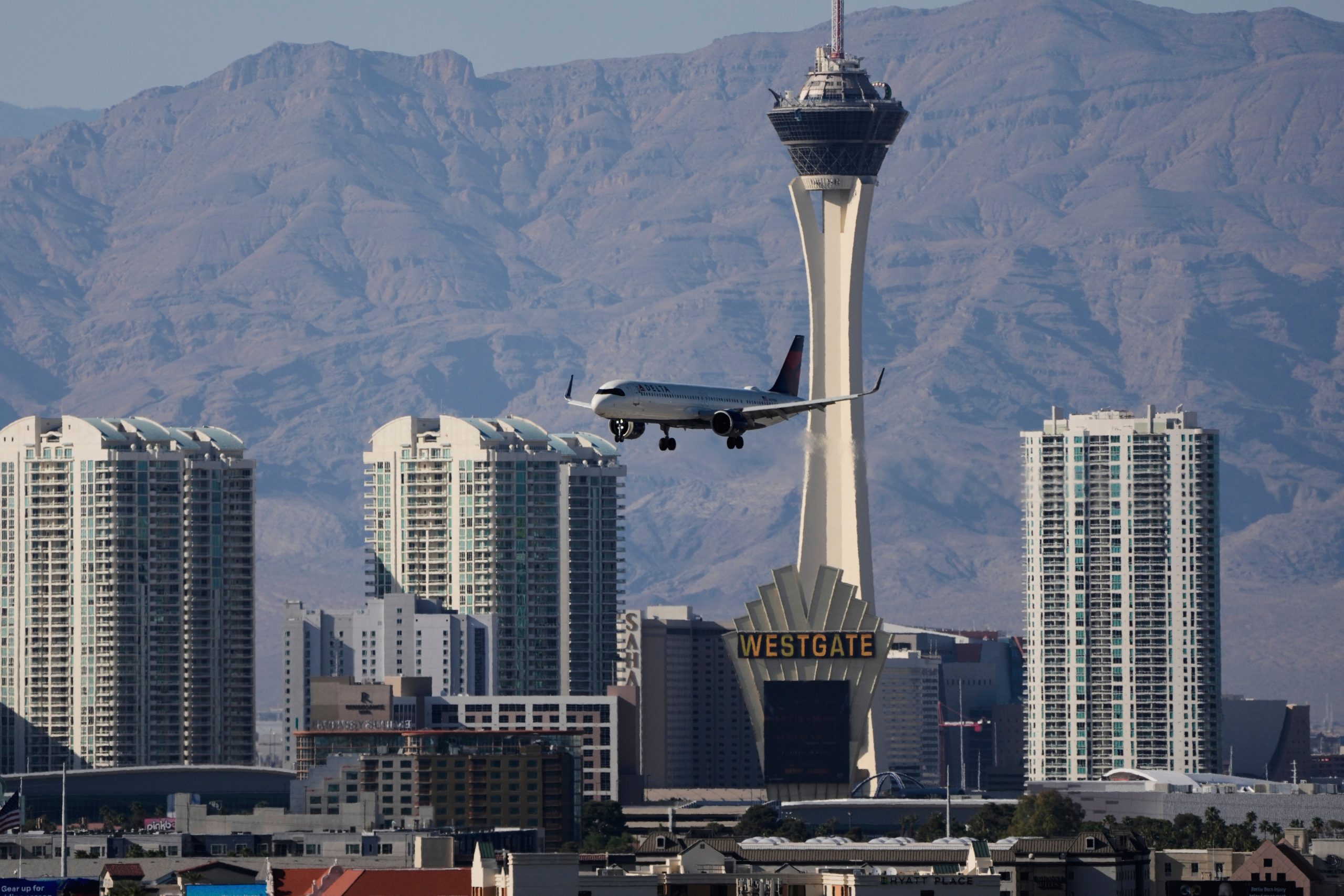

President Donald Trump’s trade war has driven Canadians from Las Vegas. Democrats think it will help them protect their Nevada battleground seats in November.
Last year, as Trump levied tariffs on Canada, visits from Canadians — who account for up to half of Las Vegas’ foreign tourism — dropped off by 17 percent. That played a large role in a 7.5 percent year-over-year decline in total tourist visits, making 2025 the worst non-pandemic year for Las Vegas since the city started tracking data in 1970. Now, as peak tourism season arrives in a battleground state where Republicans’ control of the House could be won or lost, Democrats are pushing voters to see the tourism slump as a direct impact of Trump’s levies.
“Trump instituted his reckless tariffs. In response, Canadians have literally boycotted traveling to America,” said Rep. Susie Lee (D-Nev.), whose Las Vegas-area seat is Republicans’ top target in the state. “That has had a significant impact on our tourism.”
Trump narrowly carried Lee’s district in 2024 and nearly won two other Vegas-area districts held by Democrats. Republicans are less bullish than they were a year ago about flipping the seats, but they view Lee’s as their best chance.
The races are a rare example of the international politics of tariffs — beyond their direct economic impact — playing a major role in an election. Unlike the upper Midwest or the Great Plains, Nevada doesn’t have a large manufacturing or agricultural sector jolted by the tariffs. Instead, the product most affected is the state’s Canadian visitors — who, on any given year, make up between 25 and 50 percent of Las Vegas’ foreign tourism market.
Spokespeople for the Republican National Committee and the National Republican Congressional Committee criticized Nevada’s Democratic congresspeople for voting against last year’s reconciliation bill, which included a “no tax on tips” provision. “If they actually cared about affordability, they wouldn’t have spent years making Nevada harder and more expensive to live in,” NRCC spokesperson Christian Martinez said.
Kush Desai, spokesperson for the White House, noted the “vast majority of Las Vegas tourists are Americans,” adding that the Trump administration “is focused on unleashing the historic job, wage, and economic growth that the American people experienced during President Trump’s first term with the President’s proven agenda of tax cuts, deregulation, and energy abundance.”
Many Canadians, incensed by Trump’s tariffs and his “51st state” taunts, have boycotted U.S. products and tourist destinations in retaliation. It coincides with an overall dropoff in Canadians’ view of their southern neighbor: According to a POLITICO Poll in February, a majority of Canadians now think the U.S. is an unreliable ally.
Even some Nevada Republicans acknowledge the problem. “The Canadians aren’t coming the way they were. Wonder why that is, huh?” Rep. Mark Amodei (R-Nev.), who isn’t running for reelection in his northern Nevada seat, said with a chuckle. “The communications for the tariff stuff was suboptimal.”
The dropoff in Canadian visitors played a role in stagnating a Las Vegas hospitality sector reliant on wealthy international visitors spending in the city’s casinos and hotels. A string of Las Vegas restaurants closed in recent months, some citing a downturn in visitors. And while employment has increased recently in the entertainment and recreation sectors, hiring in food and accommodation has been stagnant, according to Andrew Woods, an economist at the University of Nevada, Las Vegas.
The decline has been severe enough that local industry is taking dramatic steps to try to lure back lost business amidst an ongoing boycott from Canada. A group of Las Vegas resorts is offering to treat Canadian dollars at par with U.S. dollars, effectively a 30 percent discount, and hosting free concerts featuring Canadian artists. And the city’s tourism office recently launched a $3.5 million marketing campaign targeting Canadian visitors.
But it’s hard to overcome national patriotic fury with an ad campaign.
“Despite the efforts of our major operators in Las Vegas, the headwinds are coming from these external forces and the policies of this administration, and that’s what’s creating the economic uncertainty that we’re facing right now in Las Vegas,” said Rep. Steven Horsford (D-Nev.), whose district Trump lost by less than 3 points.
Overall tourist visits ticked up in February and March from those months the year earlier, offering a silver lining to the service industry. But the previous year of declining numbers created a deep hole to dig out of, said Ted Pappageorge, secretary/treasurer of the state’s powerful Culinary Union, which represents 60,000 cooks, roomkeepers and other hospitality workers in the state. If the low numbers continue, the union — which endorsed Democrats in all four of Nevada’s congressional races — is considering putting together relief efforts for its struggling members like it did during Covid, which included food, utility and rent assistance.
“If there’s anything like the reduction in visitation that happened last year, if that happens this year, then we’ll be in relief effort territory for our members,” said Pappageorge, noting “thousands and thousands of hours” have been cut for his union’s members this year due to reductions and restaurant closures.
Marty O’Donnell — the GOP front-runner to face Lee, who has the backing of Trump and the NRCC — was once skeptical of tariffs, but now says he “fully support(s)” the president’s trade policy.
“I’m now a convert, because what I see Donald Trump doing with tariffs is not something I ever anticipated,” O’Donnell said in an interview. “He uses it as a negotiating tool in a way that I never anticipated, and I actually love what he’s doing.”
O’Donnell said tariffs aren’t at the top of voters’ list of concerns. “I don’t hear anybody complaining about tariffs,” he said. “I just don’t think it’s an issue. I think there are way, way more important issues.”
One Nevada Republican strategist assisting multiple campaigns this cycle, granted anonymity to speak candidly about GOP strategy, admitted that Canadians were upset by Trump’s threats to make the country the “51st state” last year. But he and other Republicans pointed to an uptick in visitors in February and March. The strategist also noted the fact that Nevada added jobs at a faster rate than any other state in April, even though it has the nation’s third-highest unemployment rate. Those recent economic wins take the air out of Democrats’ attack, the strategist said.
“There are some bright spots,” O’Donnell senior adviser Keith Schipper said. “We’re talking about tariffs less so now than even six months, eight months ago.”
Republicans also point to the popularity of Republican Gov. Joe Lombardo, who they hope can win reelection in a tough environment and pull down-ballot candidates over the finish line. In a February poll, he was still viewed positively by a majority of Nevada voters even as Trump’s job approval dipped to 41 percent.
Not all economic indicators are dire, said Woods, the UNLV economist. The high-end hospitality sector is doing well, and an uptick in convention and business travelers has more than replaced the loss of Canadian tourists in numbers. “Canadian visitors, though, tend to stay longer and make Vegas their prime destination compared to other international tourists, which is good for our economy,” he said.
The local tourism drop lands on top of other economic concerns that are impacting everyone. A new CNN/SSRS poll conducted in late April and early May found that 77 percent of U.S. voters say Trump’s policies have increased the cost of living in their own community. And a surge in energy prices driven by the war in Iran led to inflation reaching its highest point in three years.
But Las Vegas is still an industry town. And with the main industry suffering, Democrats are banking on their races going their way.
“There’s a lot of service industry folks here, and so those folks are in the social circles in town,” said John Oceguera, the former Democratic speaker of the Nevada Assembly. “Whether you’re at a little league baseball game or a school event or whatnot, people are talking about that.”
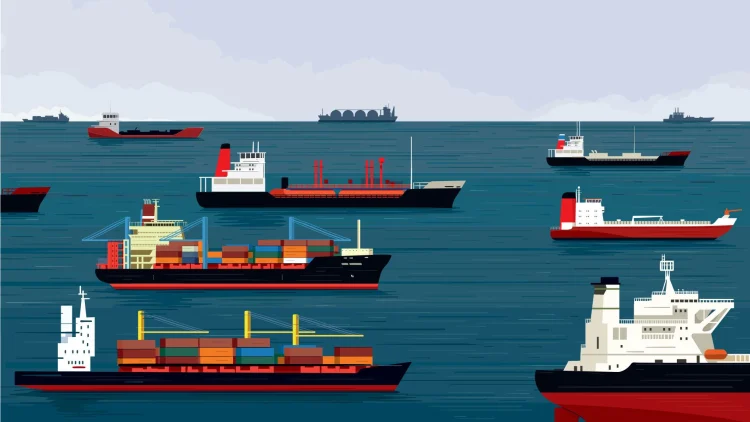

Illustration by Tracy Worrall

9 min read
Supply chains have been badly hit by the closure of the Strait of Hormuz, but – as Noah Vickers reports – the worst could still be to come.
The war in Iran and the closure of the Strait of Hormuz has wrought significant harm on the global economy, but for the shipping industry, it is only the latest disruption in a series of damaging episodes.
The Covid pandemic triggered a collapse in maritime trade. Then, in 2021, the Ever Given ship blocked up the Suez Canal for five catastrophic days and, in 2023, Houthi rebels in the Red Sea began attacking ships in the Bab al-Mandab strait. From 2023 into 2024, Panama experienced one of its worst droughts in recorded history, limiting the number and weight of ships which could pass through its vital canal – a situation likely to become more frequent with climate change.
The closure of Hormuz, which normally accommodates roughly a quarter of the world’s seaborne oil trade, has therefore added pain to a system already dealing with multiple headaches. But experts warn the impacts on supply chains could become far worse if the conflict drags on over several months, while concerns grow that it could set a precedent for other maritime chokepoints to be weaponised.
In a recent analysis, maritime research consultancy Drewry found that while a short war would be “manageable” for the container shipping industry, a longer conflict of up to a year would “impose a severe shock that will reverberate for years to come”.
A crucial issue is the supply of bunker fuel used by vessels. Since the start of the war, bunker prices have risen by between 60 and 80 per cent.
Drewry’s senior manager for container research, Simon Heaney, tells The House: “The risk from a fuel perspective goes from being a cost risk, which it currently is, to becoming more of a supply risk.
“At the moment, significant inventories have created a buffer, but as those stocks deplete, there could be an issue in terms of just physically getting these ships to do their job.
“I think we’re a long way off from that, but if it carries on for that duration [of up to a year], you’ll see some panic. It will have an impact in terms of how fast ships go – they will slow down to preserve consumption…
“It will start to move from what is currently a fairly limited network issue – a regional problem, and a slight hike in costs – to something much bigger, and it will have wider effects.”
An analysis by S&P Global Market Intelligence meanwhile warns that fuel shortages will have “implications for agriculture, mining and industry as well as transport”, with parts of Africa and south Asia thought to be most exposed.
Sourcing alternative fuels to gasoline and diesel “may be limited”, it adds, as countries start restricting “exports of their own production to protect domestic markets, as has already been the case with mainland China and South Korea”. The Malaysian government has similarly said it will prioritise its domestic supply.
The analysis also highlights the Middle East’s importance in supplying raw materials, gases, plastics and fertilisers to industries around the world, with the potential to “bring down entire supply networks”.
For instance, it points out that while Taiwan’s imports from the region are equivalent to only 2.39 per cent of its GDP, a loss of helium supplies could cripple its electronics output equivalent to 25.2 per cent of its national output.
Nor would the UK be immune to some of these impacts.
“We’ve got exposure to diesel, sulphur, unwrought aluminium,” says Chris Rogers, S&P’s head of supply chain research. “About a third of our imports of unwrought aluminium come from the region, so there is that economic effect even for the UK, directly.”
He points out that the peak shipping season, which typically starts in July, is still to come, meaning that capacity will soon become more stretched. In addition, due to the length of voyages undertaken on different trade routes, there is a substantial time-lag for the impact of disruptions like Hormuz to be felt.
“If we look, for example, at shipping from the Middle East to the United States, in April, the volumes only fell by 25 per cent year-on-year because the last boats hadn’t yet arrived,” says Rogers.
“The UK is still seeing some of that as well, because it’s a similar kind of journey time. It’s only really over the next few weeks that the boats that should have arrived, won’t have arrived… To a certain extent, we could have peace today and there would still be an impact.”
To substitute some of the lost trade to and from the Gulf, the shipping industry has been forced to rapidly utilise several overland alternatives across and around the Arabian peninsula.
MSC, the world’s largest container shipping line, is using the Red Sea ports at King Abdullah and Jeddah, while CMA CGM, the third-largest carrier, has utilised the Turkish port of Mersin.
“They’re using a variety of avenues – it’s not all being concentrated into a couple of substitute ports,” says Heaney. “There are different ways in, but even with these multi-modal solutions, the amount of goods in and out of the Gulf is going to be drastically lower.”
Bolstering these links and building new ones, he warns, will be “urgent”, as countries on the Gulf were “very ill-prepared” for such disruption to their trade flows.
Could other nations follow Iran’s example by using chokepoints as leverage? At an April symposium in Jakarta, Indonesian finance minister Purbaya Yudhi Sadewa floated the possibility of imposing a toll on ships through the Strait of Malacca – before quickly playing the idea down.
There could be an issue in terms of just physically getting these ships to do their job
“Whether that was a serious suggestion, I doubt,” says Heaney, “but it’s sort of a warning sign: don’t mess with us, because we could do something similar. In the absence of a nuclear deterrent, it’s an economic deterrent they could at least flag, without necessarily needing to deploy.”
Rogers points out that closing either Malacca or Panama would severely hit the economies of the countries in control of those chokepoints. A more realistic threat could come from China.
“The bigger question isn’t ‘Would Singapore or Malaysia feel emboldened to close the Strait of Malacca?,’” says Rogers. The question, he suggests, is: “Does China feel more emboldened to say ‘American sea power ain’t all that, so actually we could blockade Taiwan, and the American navy’s not going to be able to unblockade [it], they’re not going to be able to guarantee shipping’.”
For the shipping industry, the closure of Hormuz has further underscored the need for global trade networks to become more flexible and resilient.
“A lot of talk has gone into resilience and how you make supply chains more robust and able to withstand these shocks that are coming at a far greater speed than ever before,” says Heaney. “You can never eliminate it, but I think we are going to see a recognition that we need to diversify and not put all our eggs in one corridor.
“Even if the Red Sea opens and Suez transits are safe all of a sudden and Hormuz is safe, there needs to be investment and diversification in terms of the routing, just so there is a bit more redundancy in te whole system.”

If cargo distributors can devise “chokepoint-immune supply networks”, says Rogers, with Europe sourcing goods from Turkey and North Africa, and countries in the Americas sourcing more from one another, that could also reduce the scope for severe disruption.
But Jim Hall, an Oxford professor who recently co-authored a research paper on maritime chokepoints, is sceptical about whether this response, known as ‘near-shoring’, would provide much of a solution.
“We know that globalisation is only partially going into reverse, and much as Trump or whoever it may be would wish it away, actually, it brings us a great deal of benefit,” he says.
“I don’t think near-shoring, on-shoring, is going to much reduce our exposure to chokepoint-related disruptions to global trade. Decarbonisation of our economies would do more in that sense.”
The changing climate will also prompt interest from shipping firms in whether more use can be made of the Arctic Sea. The route from north-west Europe to east Asia via Russia’s northern coast is roughly 40 per cent shorter than taking the Suez Canal, but the route is only free of ice during the warmer months of the year and specific vessel types are needed even then.
“They’re smaller [vessels], so you don’t get the economies of scale,” says Heaney. “Even though the climate is making the season that you could use the Arctic a bit longer, it’s debatable how long that is and it’s not necessarily reliable.”
While some Chinese firms have been carrying out test runs along the route, the economics still don’t stack up for large western carriers, he argues – and nor does travelling through Russian waters do any favours for their brand image: “The PR, the optics, from a major carrier perspective are terrible, so none of them really want to touch it with a bargepole.”
Maritime chokepoints show no sign of becoming less critical to the world’s economy, as ships continue to carry about 80 per cent of traded volumes and 50 per cent of traded value worldwide.
Hall’s research, published late last year, found that disruptions at chokepoints affect around $192bn worth of maritime trade each year, which in turn result in estimated economic losses of about $14bn annually, through delays, rerouting, insurance premiums and higher freight costs.
Environmental threats, like tropical cyclones in the Taiwan Strait and droughts in the Panama Canal, account for some of the risk. But Hormuz has demonstrated just how much disruption can be caused when states decide to flout the internationally agreed principle of freedom of navigation.
“It is dawning on smaller nations, who geographically happen to have this leverage,” warns Heaney, “that all of a sudden, here is something you’ve got, that you could potentially use to your advantage.”
Politics
The House | Big changes will need to be made to the assisted dying legislation for success next time
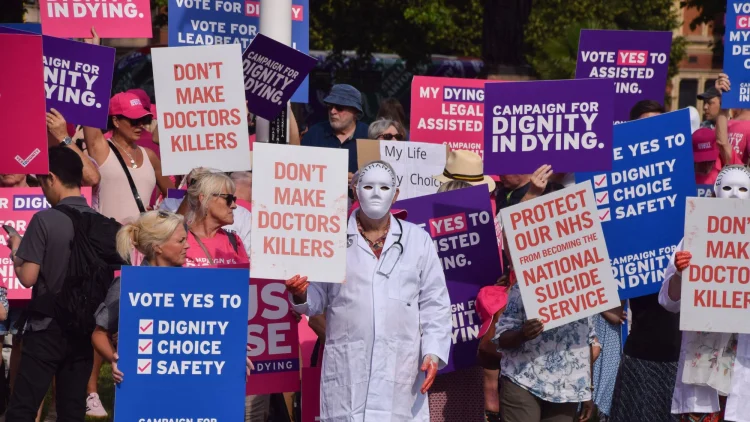

Supporters and opponents of the assisted dying bill gather in Parliament Square June 2025 (Vuk Valcic/Alamy)
6 min read
Kim Leadbeater’s assisted dying bill failed to make it through the Lords. To be more successful next time, a different approach will be needed, write KCL professors Alex Ruck Keene KC, Gareth Owen and Katherine Sleeman
Feelings are running high following the failure of the Terminally Ill Adults (End of Life) Bill to progress. Trust between supporters and opponents is low, and the space for those who are neutral (or even supportive) as to the principle, but concerned about the practicalities, appears to be diminishing.
Some are talking up the potential for bringing matters back by way of a Private Members’ Bill in the new session, and using the Parliament Act to ensure its passage through the Lords. Other parliamentarians are floating the idea of a commission based on the Kim Leadbeater bill.
Here, we identify some of the lessons that have been learned since October 2024 and set out a proposal for a way to progress – the aim of which is neither to find the long grass nor simply put forward a further iteration of a bill even its own sponsors are not content with.
Lessons learned
Having closely observed, and at stages been in the room for, the process to date, we suggest that the parliamentary debates have helpfully brought out the following five points.
First, the six-month criteria in truth satisfies nobody. For those who wish precision, it offers false hope, given the impossibility of accurately judging prognosis. For those with degenerative conditions, it excludes unfairly. It is acutely telling in this regard that still no explanation has been advanced why this apparent unfairness does not, in fact, amount to discrimination for purposes of the European Convention on Human Rights.
Second, the arrangements for the panel proposed in the Leadbeater bill satisfy nobody either. For those who wish an additional pre-death safeguard, the panel is neither judicial fish nor truly inquisitorial fowl. For those who wish assistance to be easily accessible, it is simply a bureaucratic (and expensive) hurdle.
Third, seeking to house assisted dying within healthcare is both unnecessary and causes avoidable problems. It is unnecessary because, as Switzerland has demonstrated for over 80 years, there is no reason why the provision of assistance to die needs to be seen as a ‘treatment;’ or why those providing assistance – even if some may be medical practitioners – need to be doing so as part of medical practice.
It causes avoidable problems, including the distortion of laws as fundamental as the NHS Constitution and the Mental Capacity Act, for the benefit of (objectively) a very small number of people. And medical opposition to assisted dying would probably diminish markedly if delivery were taken out of healthcare.
Fourth, the interaction with suicide prevention is something that cannot be wished away. The state’s duty to secure life, and obligations to address suicidality through the prism of the Mental Health Act 1983, are not discharged simply because a person is terminally ill. Nor is this a dilemma that can be resolved by policing the language used to describe death following assistance under a framework provided for by the bill.
Seeking to house assisted dying within healthcare is both unnecessary and causes avoidable problems
Fifth, a Private Members’ Bill is simply not the appropriate way to bring forward legislation with such significant, and systemic, impacts. Campaigners have every right to seek to put matters on the agenda; they do not, however, have responsibility for, nor expertise in, making law. The undue weight that the Private Members’ Bill process gives to single issue lobby groups creates unhelpful distortions. An issue as complex as assisted dying requires a clear boundary between the role of the campaigner and that of the legislator.
The way forward
We urge the House of Commons not to seek to reintroduce the Terminally Ill Adults (End of Life) Bill as a Private Members’ Bill following the ballot later this month. Instead, we suggest the need to develop a route that could lead to a government bill. That requires recognition that – while the question of whether assistance with death should be available, and to whom, are quintessentially questions of conscience – the question of how such assistance should be provided is, paradigmatically, ‘government business’.
So, how to proceed? We suggest an independent review, whose terms of reference provide for it to move forward on a twin-track basis:
(1) Operationalising assisted dying (without reference to eligibility criteria), drawing on the work done in Jersey, and as well on work done by bodies such as the Nuffield Trust in its August 2025 report, Assisted dying in practice: international experiences and implications for health and social care. Operationalisation would include consideration of safeguards (for instance pre-death confirmation), commissioning and delivery (including outside of the NHS). It would also require operationalisation on a ‘whole systems’ approach, requiring – for instance – the review to consider how assisted dying is to be made to work alongside palliative care and suicide prevention.
(2) Facilitating an informed debate about the eligibility criteria for receipt of assistance. This would enable discussion about whether ‘suffering’ should be a criterion and whether dementia or frailty should be within scope, for example. Many who have followed the debates to date might be surprised to learn that, despite the rhetoric, ‘suffering’ was not a word which in fact appeared in the bill, and also that the bill effectively excluded dementia.
In relation to (2), the question would inevitably arise: discussion by whom? We suggest that the independent review can – and should – outline suggestions as to the best way to achieve this, for instance a Jersey-style citizens’ jury, or free vote in Parliament, or some combination.
The overall mechanism must be a government bill, however. Whether this is a matter for the current government, or whether it requires a manifesto commitment, depends on the perceived priority of this issue. What is immediately clear is that good law will not be achieved either by persisting with the model contained in the Terminally Ill Adults Bill, nor by seeking to reintroduce it as a Private Members’ Bill.
Alex Ruck Keene KC (Hon) is a barrister and professor focused on mental capacity
Gareth Owen is a consultant psychiatrist and professor of psychological medicine, ethics and law
Katherine Sleeman is an honorary consultant in palliative medicine at King’s College hospital, and Laing Galazka chair at King’s College London
All three are members of the Complex Life and Death Decisions research group at KCL
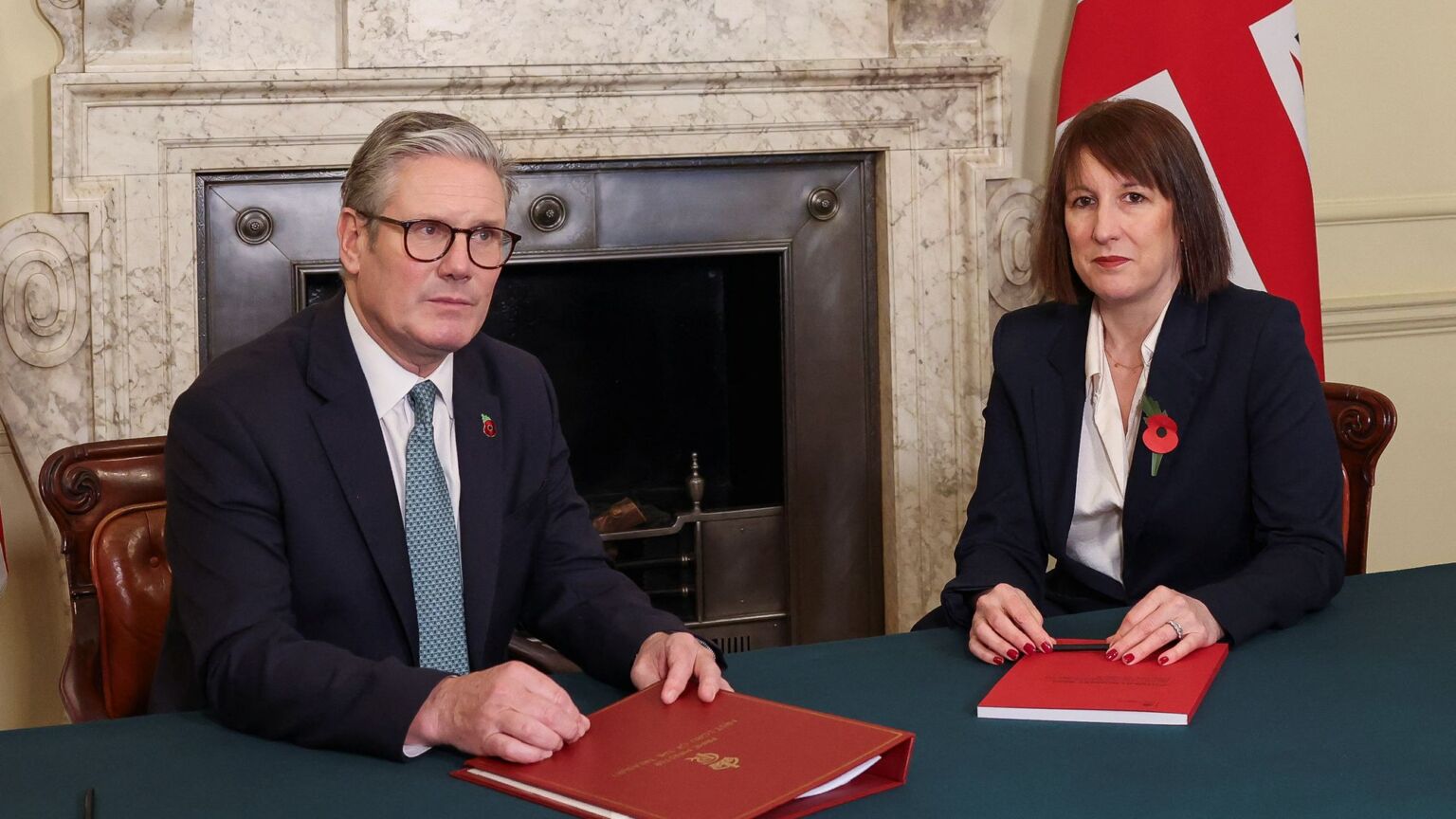
There is a spectre haunting Britain – the spectre of zombie socialism. This is not socialism in the old sense. It’s not rooted in organised labour, industrial progress or democratic solidarity. Rather, this is a hollowed-out copy of socialism, sustained by middle-class ‘progressives’, institutional decay and nostalgia for a state that no longer exists.
You can see this spectre stalking not only the remnants of Corbynism inside the Labour Party, but increasingly the modern Green Party of England and Wales, too. Nationalisation, mass council-house building and expanded public ownership are no longer advanced as serious programmes for national renewal. They function instead as moral postures – a way for progressive professionals to distinguish themselves from the managerial centrism of the Blair years and the compromises of neoliberalism.
But there is a profound contradiction at the heart of this zombie socialism. Traditionally understood, social democracy rests on a belief in the nation state. It requires borders, democratic accountability, shared civic obligations and a population willing to act as a national public. Yet most on the contemporary Labour left and in the Green movement are deeply hostile to precisely those assumptions.
The postwar labour movement emerged organically from British civil society – from trade unions, working men’s clubs, municipal politics and industrial communities. Its reforms were justified unapologetically in national terms. Council housing, the National Health Service and nationalised industries were presented as instruments through which Britain, collectively, might improve itself.
Today’s ‘progressive’ politics operates within an entirely different moral universe, shaped by globalisation and elite cosmopolitanism. The nation is frequently regarded with suspicion – treated as exclusionary, backward or morally tainted. As New Labour muse and sociologist Anthony Giddens argued in The Third Way, resistance to globalisation and attachment to the nation state bear all the hallmarks of the ‘far right’. In place of democratic national solidarity came the language of transnational obligations, diversity management and universal rights detached from citizenship itself.
This helps explain why Keir Starmer’s Labour, despite partially adopting the rhetoric of social democracy, has yielded so little change in practice. Grand manifesto promises of a nationalised energy body, renationalised railways and mass housebuilding have already dissolved into familiar managerial drift. Housing construction has slowed significantly rather than accelerated, while state intervention increasingly takes the form of branding, regulatory announcements and public-relations exercises.
This is not merely a failure of political will. It reflects the disappearance of the social foundations that once made social democracy viable. The great reforms of the 20th century were not benevolent gifts from enlightened elites. They were concessions extracted through organised working-class pressure. Trade unions, industrial militancy and mass democratic organisation forced the state to expand welfare provision, public housing and collective ownership.
That pressure does not exist today. Britain’s working class is fragmented, institutionally weak and politically under-represented. As a result, governments face little meaningful pressure to pursue ambitious programmes of reconstruction. They can comfortably adopt the rhetoric of social-democratic reform while indefinitely postponing substantive action.
Instead, the modern state increasingly sees its role not as advancing working-class interests, but as containing popular passions. The political class appears more anxious about populist discontent and the expression of ‘incorrect’ opinions than about economic stagnation or industrial decline. This helps explain why governments often display greater enthusiasm for policing speech, regulating behaviour and restricting protest than for building infrastructure or reviving productive industry. State capacity has not vanished – it has simply been redirected toward managing the public.
For all its faults, Old Labour sought to expand productive capacity and construct institutions capable of reshaping society. Today’s progressive politics, in contrast, is far more interested in targeting morally disapproved groups for symbolic punishment. Labour’s campaigns against private schools, private landlords and other allegedly privileged minorities are cases in point. These don’t amount to coherent economic reform, but nor is that their point. They are better understood as public demonstrations of moral virtue.
This reflects the sociological transformation of the left itself. Radical demands no longer emerge primarily from organised labour, but from educated middle-class professionals clustered within universities, NGOs, the public sector and the cultural industries. Their politics is intensely moralised and individualised. Social problems are increasingly interpreted not through the lens of national development or class organisation, but through identity and personal values.
The contradictions become most obvious around immigration and citizenship. Welfare states depend on the existence of a shared political community, on citizens who recognise one another as members of a common national project. Yet large sections of the progressive left appear more comfortable articulating abstract universal rights than defending the interests of the British public.
Indeed, last year, then home secretary Yvette Cooper secured a High Court ruling preventing the closure of the Bell asylum hotel in Epping, Essex, on the grounds that the ‘human rights’ of asylum seekers trumped the safety of local residents. When ministers elevate the rights of migrants above the concerns of British citizens, they erode the solidarity upon which social democracy ultimately depends. A state cannot indefinitely weaken national cohesion while simultaneously expanding its obligations to all-comers.
The Greens have consciously inherited much of the emotional energy once attached to Corbynism. This is because they offer the aesthetics of radicalism while remaining fully embedded within the assumptions of globalised liberalism. They promise state intervention without confronting the erosion of sovereignty, borders and democratic accountability that make such interventions ineffective or impossible. As with the Labour-left slogan ‘love socialism, hate Brexit’, this is a contradiction in terms.
The deeper question confronting Britain is not simply whether the state should intervene more or less. It is whether there is still a cohesive community capable of sustaining any ambitious collective projects at all. In the absence of national sovereignty and an empowered working class, ‘socialism’ and ‘social democracy’ will remain empty slogans.
Neil Davenport is a writer based in London.


Speaking at the Ivor Novello awards, singer CMAT has spoken out against Reform UK and the far right. She’s also called on her fellow artists to get off the fence and to take a stand:
"I have no time, sympathy or empathy for anybody that decides to make life more difficult for people who are just trying to live" – @cmatbaby sticks it to Reform, Farage and fascists during her powerful @IvorsAcademy speech#CMAT #IvorNovello2026 pic.twitter.com/wMS1dVI9MS
— NME (@NME) May 22, 2026
CMAT “F*ck Reform”
CMAT (real name Ciara Mary-Alice Thompson) was born in Dublin — the capital of the Republic of Ireland. She has spoken out on social issues before, and is a fierce defender of trans rights. As part of this, CMAT released a t-shirt that raises money for the Transgender Equality Network Ireland which claims that “The T in CMAT stands for Trans rights”. Thompson also spoke out against the singer Roisin Murphy:
View this post on Instagram
Speaking on trans rights and the law, the Canary’s Em Colquhoun wrote:
Prioritising the legal definitions of sex and gender over and above the reality of trans lives will always be reductive, further entrenching a ‘hostile environment‘ for trans people. But that is precisely what lawfare-waging TERFs want. The more convoluted the law, the colder the chilling effect on LGBTQ+ people’s freedoms of movement and expression.
At the end of the day, it’s not the law that needs to be changed, but the general attitudes towards trans people in this country. The law may influence this, but the problems have taken root far deeper than statutes.
Luck of the draw
Speaking to Ivor Novello Awards audience, Irish singer CMAT said:
I happen to be a legal immigrant in this country only because Ireland was lucky enough to get colonised 8 years ago by England. And that is actually the only difference between me and you admin wise.
As Thompson notes, Irish citizens can live and work in the UK. She’s certainly not British, however, and she’s clearly not aligned with the rampant flag shaggers who want to keep other migrants out.
The reason these fascist goons aren’t campaigning to send Thompson back is simple; it’s because the ‘anti-migration’ movement is just racism rebranded. And this is why so many Reform politicians keep finding themselves exposed for blatantly racist comments.
Speaking on her philosophy of songwriting, Thompson explained:
I have a very specific idea of what songwriting is supposed to be for and I think it is to reflect the times through your own personal view so that everybody can have something to connect to and something to learn from years later.
As an example of what she’s talking about, there’s a song on her most recent album titled Lord, Let that Tesla Crash. That’s particularly relevant today, because Tesla owner Elon Musk came out to support the far-right Restore Britain:
Restore Britain https://t.co/y6b0RnO7p7
— Elon Musk (@elonmusk) May 24, 2026
Stand for something
Closing out her speech, Thompson called on her peers to do more to meet the moment:
Now what would compel my fellow artists in the room, it is not the time to sit on the fence. Fascism is on the rise. That c*nt Bertie Ahern recently showed his true colours.
Providing context on this, the Canary’s Robert Freeman wrote:
Taoiseach (prime minister) Micheál Martin has responded tepidly to appallingly bigoted remarks by his predecessor Bertie Ahern on a voter’s doorstep. The voter recorded the ex-Fianna Fáil leader saying he didn’t approve of Africans entering Ireland, and vilifying the next generation of Muslims who he said were set to cause “problems.”
Instead of condemning Ahern’s overt racism and Islamophobia, Martin said the remarks were “not appropriate,” “correct, or proper” — a slap on the wrist at best.
Thompson finished by saying:
F*ck Reform.
F*ck Nigel Farage.
I have no time, sympathy, or empathy for anybody that decides to make life more difficult for people who are just trying to live. And that’s what this record is about.
There are many good reasons to figuratively “f*ck” Reform too. As Ed Sykes recently reported for the Canary, the Greater Manchester Police arrested several Labour operators in May on the suspicion that they ran fake candidates in the Tameside local elections. Reform attempted to capitalise on this, as Sykes reported:
In Gorton and Denton, Farage’s party lost by well over 4,000 votes. But it had a tantrum anyway. It quickly blamed ‘family voting‘ for the result, trying to sow seeds of suspicion, particularly about Muslim backers of the Green Party, by suggesting men had told their wives how to vote.
Greater Manchester Police ended its investigation into Reform’s allegations a month later because there was no reliable evidence.
That hasn’t stopped Reform voices continuing to spread smears and misinformation, though. Because like Farage, racist Gorton-and-Denton-by-election-loser Matt Goodwin also responded to the news of the Tameside arrests by referring back to the Islamophobic lies about Gorton and Denton and failing to mention Tameside itself.
And this is really just the tip of the iceberg when it comes to the reasons why Farage & .co can go f*ck themselves.
CMAT’s latest album EURO-COUNTRY is available now.
Featured image via Getty Images (Eamonn M.McCormack)
By Willem Moore


In recent weeks, there has been increasing evidence of authorities in the north of Ireland aligning themselves with dangerous far-right thugs. On May 1, the racists and Islamophobes of Our Northern Ireland Voice (ONIV) shared a video showing a group of men assaulting a person they described as a “Pakistani male”.
Later identified as Mohammed Manai, the thugs allege he was attempting to enter a primary school, though no evidence has been produced for his alleged crime. However, thanks to ONIV, video evidence does exist of thugs attacking Manai with punches and knees to the body as they pin him to the ground.
Despite this proof of criminal violence, the Police Service of Northern Ireland (PSNI) instead arrested Manai, but not any of those who brutally set upon him. Manai remains on remand (held in police custody), despite reports that his:
…full case file is not due to be with prosecutors from police by mid-June.
Thugs attack person of colour, but police arrest only the victim
The PSNI are holding Manai for the generic catch-all charge of alleged “disorderly behaviour”. However, if the police are detaining the man purely on the basis of witness statements from those who attacked him, it represents a disgraceful failure by the police force.
In messages passed to the Canary from ONIV’s then-private Facebook forum, commenters refer to Manai as a “scumbag immigrant”. The forum has since been made public, exposing the torrent of hateful bile circulating within it. The PSNI have not yet used hate speech legislation to prosecute these commenters.

The reason ONIV seems confident to expose their previously internal messaging seems clear. On the same day that Manai was attacked, ONIV staged a protest at Causeway Coast and Glens Borough Council’s Coleraine offices. The result of that was securing a meeting with the council’s chief executive David Jackson.
As pointed out by the Belfast Telegraph, the meeting essentially amounts to local authorities endorsing the work of racist thugs, who are currently attempting to assemble nightly patrols in the Coleraine area. Ostensibly to ‘protect’ local residents, their real purpose is to intimidate local people of colour. A May 20 post on ONIV Facebook asks for:
…men out there willing to stand together and help protect and strengthen our community presence…
This is next to posts screaming:
At the end of the day, if nobody takes a stand now against Third Worlders..In time, we’ll have nowhere to stand!!
North of Ireland council endorsing violent racists
It’s more likely that local residents need protection from ONIV, given their leader Dan Grundle (who also goes under the surname Douglas) has been convicted for loyalist rioting. Fellow member Mark Brown is a Nazi ex-National Front leader who was convicted for a racially motivated attack in 2019. Brown punched a taxi driver in the head and called him a “Muslim cunt” and “low-rent Jihadi bastard”. Yet these people were invited in to the offices of their local council, on the basis of them having:
…raised concerns regarding HMO [House in Multiple Occupation] enforcement with council officials.
These are the words of a council spokesperson. A “council source” told the Telegraph:
Council officials are saying that they didn’t know about Mark Brown’s background, which isn’t good enough because you don’t have meetings with people you don’t know, especially high-profile Nazis about a topic as inflammatory as immigration.
As previously reported by the Canary, low quality HMOs are a real issue, as is lack of social housing generally. Such properties are often used to house immigrants. The outrage should be that anyone is forced to live in such sub-standard housing, but the issue is exploited by the far-right to drive resentment of new arrivals to the Six Counties.
Housing failures once again leveraged by far-right
A post provided to the Canary from an observer of the ONIV group shows “Irish only” graffiti painted on houses in the south of Ireland, with an ONIV admin suggesting that this tactic should perhaps:
…be the kind of response to any property approved as an HMO intended to house immigrants in Northern Ireland [sic] ?

Commenters say:
Get invaders out of every country illegal immigrants all of them
Another states “Only way to sort it”.
End Deportations Belfast (EDB), which opposes “border regimes, detention and deportation” in the north of Ireland, recently pointed out another state authority doing the far-right’s work. EDB report receiving:
…disturbing information and video footage regarding an ongoing immigration raid in Castlewellan.
It showed Immigration Compliance Enforcement (ICE) officers in Castlewellan “searching for People of Colour (POC) on the street.” EDB point out that:
Home Office official policy is clear, that immigration officers must not engage a person simply on the basis of their appearance, race, colour, ethnic origin or nationality.
It won’t surprise anyone that immigration enforcement is engaging in racist practices, though it is more alarming in a climate of “spiralling” race hate crimes, as EDB points out. Combined with the PSNI turning a blind eye to the likes of ONIV’s racists, and their local council endorsing them, these horrifying figures may climb further still.
Featured image via Charles McQuillan/Getty Images
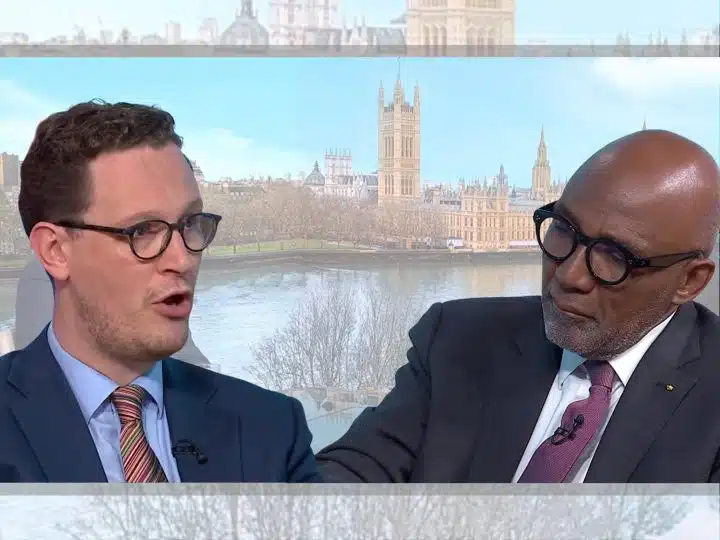

The cost of living is an ongoing crisis in modern Britain. In response to this, the government has unveiled a ‘Summer Savings’ plan which will provide minimal savings for a single month — specifically August. In response to this, Sky News’s Trevor Phillips has laid into Labour minister Darren Jones:
As several people have pointed out, do Trevor's figures add up?
— Saul Staniforth (@SaulStaniforth) May 24, 2026
Summer Savings
As we reported on 22 May, the Great British Summer savings plan includes free bus tickets for children, in addition to:
a temporary reduction in VAT across Scotland, England and Wales from June to September. The reduction applies to admission tickets for family shows and attractions and children’s menu meals.
On the topic of free buses, transport union TSSA said:
the chancellor should now look at extending support as part of a wider package of help, well beyond the summer months. Not only would doing so assist those most in need, it will help the wider economy.
Sadly, the Cost-of-Living crisis is a year-round affair. But while things continue to get worse for ordinary Britons, the super-wealthy are experiencing bumper year after bumper year. Do you think there could be a connection between those two things?
Writing on the Summer Savings plan, the Canary’s James Wright reported:
The way Labour is conducting the policies show a further entrenchment of corporatism. The government is proposing policies to supermarkets that the corporations can choose whether or not to accept. Indeed, corporations rejected a proposal on price controls on food staples.
As he noted, there is nothing preventing companies from pocketing the VAT savings — not from a legal perspective, anyway. Wright added that the huge profits companies are making demonstrates that the Cost-of-Living crisis is manufactured. In a similar vein, the Canary’s Maddison Wheeldon described the crisis as follows in relation to supermarkets:
our political and media establishment has abandoned the very people it claims to represent. Instead of standing up for the public, politicians and the mainstream media now ask us to sympathise with supermarkets operating in an industry that continues to generate enormous profits.
Meanwhile, those same supermarkets have posted record-breaking profits throughout the cost-of-living crisis. Or, more accurately, the cost of greed crisis. Now, profits look set to rise yet again while more hard-working families fall into food poverty.
Because this crisis seems to be never-ending, many are now calling for bold solutions to tackle the issue once and for all:
Nationalise Morrisons, use it as the foundation for a new, publicly-owned grocery store selling high quality, affordable food. National-level version of the Mamdani plan in New York.
Need to think big in a world with repeated, major shocks to essential supply systems. pic.twitter.com/vlXweJl5HO
— James Meadway (@meadwaj) May 22, 2026
Labour, meanwhile, is proposing limited-time discounts.
Theme park that thought
Here’s what Phillips said to Jones in the clip at the top:
I looked at the entry passes to Thorpe Park, Alton Towers, Legoland, Chessington. They all come in around about 32 quid if you book online, which means that the saving you’re offering is £1.64 for the average family with two children. A family’s got to pay £128 just to get into the park. Then they’ve got to pay travel and all the rest of it. Free travel on buses for some kids and £1.64 off a bill that most families will see as £200, £250; it’s not very impressive, is it? It’s not going to make much of a difference
Darren Jones (chancellor of the Duchy of Lancaster) responded:
Savings are small, helpful contributions to just help lift the pressure a bit for families during the summer months.
Phillips repeated:
£1.64 off a bill of nearly £200?
Jones expanded:
Trevor, I don’t think you understand. There are many families who can’t afford to take their kids out for a meal or to a theme park.
And angry Phillips continued:
A family can’t afford to take their kids out for a meal is not going to spend £200 going to a theme park. The point is, you’re trumpeting this, but it’s really a tiny, tiny gesture.
Labour — calculations
As some highlighted, however, Phillips calculation may be off by a factor of ten:
What’s he talking about? The saving would be £16.
I’m not here to defend Labour, but a £32 ticket is
£26.67 + £5.33 VAT.
Cutting VAT to 5% makes it £26.67 + £1.33 VAT
So, £28 per ticket, instead of £32, saving £4 per ticket.— Steve Paxton (@Steve__Paxton) May 24, 2026
It’s still accurate to suggest this small amount won’t make much difference, though. As such, it’s no surprise that Labour is losing voters to the more ambitious Green Party. As the Canary’s HG wrote:
YouGov’s new study of the 2026 local elections shows that only 46% of Labour voters from 2024 who went to the polls remained loyal to the party. More previous voters backed the Green Party (22%) than voted for Reform (6%).
Starmer has practically bet his party on trying to beat Reform. In the process, he has created the perfect opportunity for the Green Party and a more progressive version of British oolitics. Importantly, the local elections showed us that many people want that alternative – and Labour have paved the way for their own demise.
Some are hoping that switching from Keir Starmer to Andy Burnham could make all the difference, but Burnham is just as eager to chase Reform voters as Starmer. As Antifabot reported for the Canary:
Greater Manchester mayor and Makerfield by-election hopeful Andy Burnham has dumped his past defence of Trans people to protect his bid for Westminster, it seems. Journalist Alex Wickham has revealed that Burnham now backs the Equality and Human Rights Commission (EHRC) restrictions on single-sex spaces. This u-turn appears to be nothing but a transparent bid for Reform votes, something we could have predicted coming a mile off.
The Canary’s Cameron Baillie added:
Burnham might be a shot better than Starmer, sure. But don’t be fooled into thinking he can be trusted. Why trust a man who’s shape-shifted so often throughout his career? He’ll only shift again.
Labour — reverse course
The years of crushing austerity inflicted on this country have left most of us much poorer than we would have been without it. At the same time, it’s proven to be a bountiful time for the rich, with their wealth growing to obscene levels. As Tax Justice report:
The richest 350 individuals and families in the UK now hold over £784 billion — that’s more wealth than 50% of the UK population (35 million people) and more than the UK spends annually on healthcare, education, defence, policing and housing combined.
The 1.4% growth in the Rich List’s hoarded fortunes means a single person with a net worth of £1bn would be £14 million better off at the end of the year, even after their lavish annual expenses. Despite the Times’ attempt to pitch this as a “stagnation”, the truth is this represents an enormous growth— £14 million is 7x more than the average person will spend in their whole lifetime. The roughly 1% average increase seen in the last 4 years is, more accurately, a less steep increase, relative to the absurd, astronomical growth of the Rich List’s fortunes from 2000 to 2022, which grew around 600%.
Are you more than 600% better off than you were 27 years ago?
We’ve moved well beyond the point where half-measures can make a difference. And if these Labour politicians refuse to acknowledge that, they will be replaced by one party or another.
Featured image via Sky News
By Willem Moore
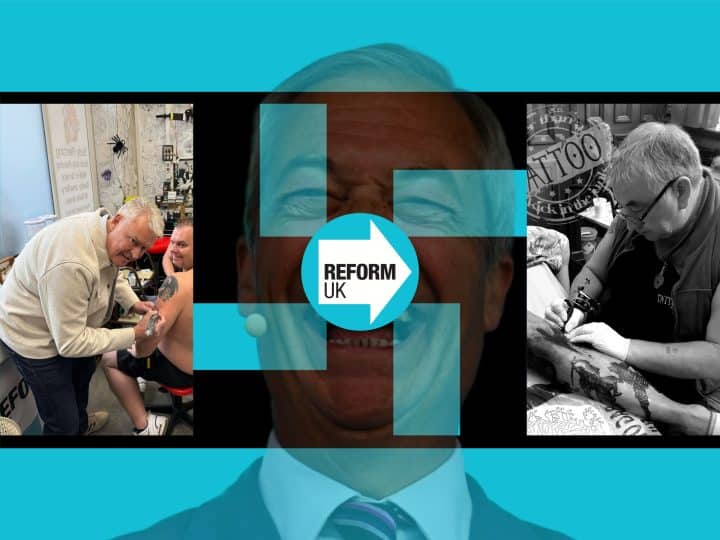

Another Reform member has been exposed for having an alleged link to Adolf Hitler’s Nazi Party. The latest is Barnsley councillor Andy Arnold who was photographed over multiple years with a Swastika tattoo. In response, Arnold’s wife has claimed it was actually a Buddhist symbol of peace:
Swastika tattoo visible in public social media photos of Reform UK councillor Andy Arnold https://t.co/6i2H313usn
— The Star, Sheffield (@SheffieldStar) May 23, 2026
Reform — Symbolism
Putting it mildly, the Star reported:
The swastika is strongly associated with Nazi Germany and Adolf Hitler’s regime and the Holocaust
Although it’s true the Swastika has existed for thousands of years, most people in Britain don’t know that. As such, it’s a strange thing for a white Brit to get tattooed on their forearm.
Arnold’s wife defended the tattoo as follows:
The only context I can provide is that, in his late teens, my husband briefly explored Buddhism and had a symbol tattooed on his arm during that period.
He has never been involved with, supported, or held views associated with Nazism or any extremist ideology.
The problem is he’s in Reform UK; a party which scapegoats migrants like Hitler scapegoated the Jews; a party pursuing mass-deportation policies reminiscent of 1930s Germany.
Speaking of deportations and Swastikas, members of the British far-right recently launched ‘Operation Overlord’ which saw activists travelling to France to bother refugees. As the Canary’s Joe Glenton wrote:
A far-right group that started going to Calais to hassle asylum seekers seems to have fallen out. They’ve also managed to get banned by the French government after swastika graffiti started appearing everywhere. Incredible work, boys.
The group named itself Operation Overlord after the D-Day landings. An operation in which US and British troops spent a good few days killing people who shared virtually the exact political views of these chicken nugget-brained man-babies. This lot were – note, WERE – closely tied to Operation Raise the Colours. Yes, the flags-on-lamp-posts people. The Overlord group started up in 2024. Their modus operandi was to strut around French beaches making macho content.
Misunderstandings
Mrs Arnold continued:
The tattoo was later covered because the symbol was frequently misunderstood and people incorrectly associated it with something entirely different from its original religious context.
Unfortunately, the meaning was often misinterpreted without understanding the background behind it.
Oh wow, who could have seen that coming?
While it’s not impossible to believe that a boneheaded teenager with an interest in tattoos and Eastern spirituality might get a Swastika tattoo, the problem is Arnold had his until at least 2024. He’s no spring chicken, either, so he put up with several decades of ‘misunderstandings’ before making the change.
This is the tattoo in question by the way (see his left arm):

Given that Arnold is in fact himself a tattoo artist, it’s a problem he could easily have rid himself of if he wanted to.
Reform’s hippy to Hitler pipeline
If Arnold is telling the truth, he wouldn’t be the first white Brit to dabble with the Eastern swastika. He also wouldn’t be the most famous, with that award going to Kula Shaker frontman Crispian Mills. As Far Out magazine reported:
The influence of Indian culture and raga rock was pertinent in all that Kula Shaker did, but this wound up landing Mills in some very hot water in 1997 when he claimed in interviews that the swastika was a “brilliant image” with respect to its traditional Indian origins. For those unaware, the swastika was originally a symbol used in the Hindu religion to denote wellbeing and prosperity before it was reappropriated by the Nazis. However, for obvious reasons, when Mills said this, the reaction wasn’t exactly receptive.
Prompting a deluge from the British press, Mills and the rest of the band were exiled to the land of what we would now consider ‘cancel culture’, with The Independent in particular running an especially bruising line that said the frontman “had dabbled with Nazism”.
At a first glance, Arnold’s tattoo does look more like the Buddhist version than the Nazi one, but as Reform Party UK Exposed highlighted:
Educate yourself. pic.twitter.com/aYHv8mDKnI
— Reform Party UK Exposed
 (@reformexposed) May 22, 2026
The thing is, it actually wouldn’t be that surprising if Arnold went on a journey from hippy to fascist. This might be surprising to hear if you’ve never met or thought about hippies, but some of these people are inherently vulnerable to far-right propaganda.
As Ossiana Tepfenhart wrote on Medium:
In order to radicalize someone, you need to hook them in and appeal to them. This tends to happen with people who have a lot of the traits found in crunchy/spiritual/rave groups, including:
- You feel locked out or unheard by mainstream society. This is basically spirituality groups and rave groups in a nutshell. Radicalization can only happen when you don’t feel accepted by the people around you.
- You don’t trust society or conventional beliefs. Crunchy people, for example, are very skeptical of processed foods and are more likely to lean on alternative medicine. This flies in the face of traditional wisdom which tells you to trust in science rather than “woo woo” stuff.
- You are jaded with the shitty behavior you see in others. A lot of people distrust doctors because they were treated badly by them. A lot of people also have severe trauma related to traditional religious organizations that they haven’t unpacked.
- You just want an answer to make the world make sense. Many people in hippie-esque circles feel lost about their sense of the world. Radicalization is rough because it literally seeks out people who want an answer and a way to live and pretends to give them what they need.
So yeah. Radicalization towards the right wing happens when you take disaffected people, often with trauma, and claim to give them an easy-to-use solution to all their problems. Little do they know they’re being sold a bad bag.
Traditionalism
Tepfenhart is far from the only one observing this pipeline. Getting away from the Eastern connection, Catherine Tebaldi of the Global Network on Extremism & Technology wrote:
Digital traditionalist women carefully cultivate winsome images on Instagram: harvesting fields of beets with the folds of muslin dresses and aprons spilling around bare feet, canning and pickling them in vegetable jars surrounded by laughing blonde children. In the winter, the family stamps sugar cookies with intricate runic patterns, or braid evergreen branches and holly to celebrate the festival of Yule. The accompanying text and videos celebrate health and wellness, but this goes beyond simply bodily health to what they call “reviving folk vitality”: celebrating northern European tradition, heroic men and women at home with a large white family; herbalism and natural health; paganism and occult mythology, and the belief in a white racial spirituality.
This ideology has can be traced through history to the ‘fascist ecology’ of the Third Reich; the Nazi Party had a ‘green wing’ preoccupied with ecology, eugenics and esoteric racial essences. To describe the group with deep roots in the far-right and in contemporary practices of health and nature I use the term Granola Nazis. Their style is taken up by a broader anti-modern movement of digital traditionalism.
And now we’ve come full circle. The Nazis also chose the Swastika for its ancient history, and while an interest in traditionalism and history isn’t itself an indicator that a person is far right, it’s certainly a contributing factor when presenting in someone with a tendency towards selfishness.
So yeah, the truth is we can’t definitively say that Arnold’s tattoo is a Nazi symbol. At the same time, if Arnold was a councillor in 1930s Germany, we can guess which party he would have gravitated towards.
Featured image via Getty Images (Finnbarr Webster)
By Willem Moore
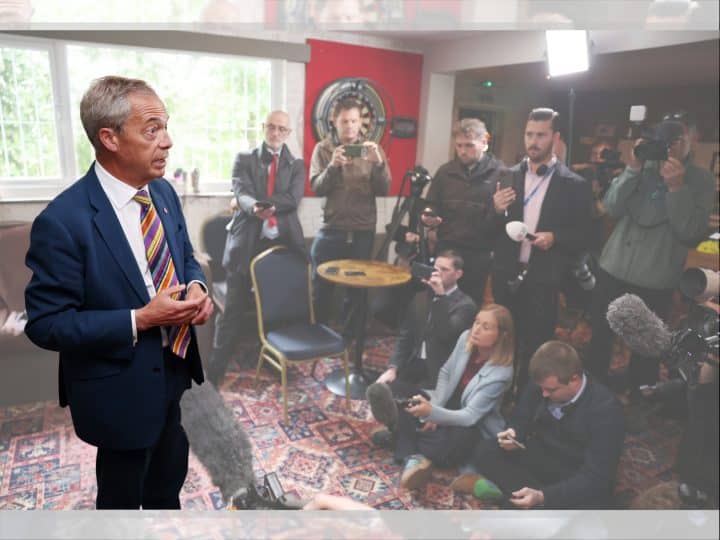

Reform UK unveiled an attention-grabbing new policy proposal on Sunday 24 May:
Reform will scrap income tax on overtime.
It's time to make work pay. pic.twitter.com/Q0luvT9WPM
— Nigel Farage MP (@Nigel_Farage) May 24, 2026
The problem for Reform is that the policy has also grabbed the attention of people who think things through.
Reform — “Avoidance opportunities”
Sam Dumitriu of the Britain Remade thinktank had 5 points on the new policy:
1. This appears to be an import of Trump’s extremely dumb (but clearly popular) ‘no tax on tips’ policy.
2. If your aim is to boost growth and incentivise work, this isn’t a good use of £5bn. It’s a luxury policy in all honesty: can they honestly say £5bn couldn’t go further elsewhere (either in tax cuts, infrastructure investment, or just improving public services)?
3. This will likely create lots of avoidance opportunities.
4. There will also be genuine cases of unfairness. What about workers with second jobs?
5. This is likely to create a massive cliff-edge problem where taking an extra hour of overtime or getting a raise leaves someone thousands of pounds worse off.
To be clear, Britain Remade isn’t a left-wing think tank; it’s actually linked to the Tories. You could respond by saying ‘well of course they’d object to a Reform policy‘, but arguably the Tories would be more likely to steal it it it made sense (and it wouldn’t be the first time they’d poached an idea from Farage).
One banker offered a perspective on how businesses could exploit these “avoidance opportunities”:
If someone on £75k/year with a 41 hour week with 1 hour guaranteed overtime restructured the contract to earn minimum wage (age 21+ at £12.21/hour) for the first 40 hours which is £25,396.80 and the remaining £49,603.20 is overtime this would reduce their tax by about £17,000! https://t.co/XWUInbOlwt
— David Hollidge (@DavidHollidge) May 23, 2026
This tax specialist did the same:
I've only been thinking about this for about 10 minutes, but take someone earning, say, £50k in a 40 hour week doing an hour's overtime (extra £1,250 a year). Their hourly rate is currently £24/hr.
They could agree to change their contract so that:
– The first 40 hours a… https://t.co/jwWlj2vR6X — Stuart (@StuartMaggs) May 23, 2026
Steve Loftus is another figure on the centre right who took issue with Reform’s policy, noting:
France did this in 2007 in almost exactly the same way.
It cost €4.5b a year in lost revenue for no gain. No more hours were worked, people just shifted their work to game the system.
It did nothing but give people more take home pay and it ended in 2012.
But if you want to give people more take home pay there are a dozen easier way to do it.
Gimmicks
Finally getting to someone who isn’t a banker or a tax wonk, trade unionist commenter Josh noted:
The UK working time directive means you can't be forced to work more than an average of 48 hours a week.
Reform's attempts to normalise 40+ hour working weeks are a clear attempt to set an agenda of rolling back on employment rights workers have fought for over the past century https://t.co/hU9Wp88TgF
— Josh
 (@jhendy_10) May 23, 2026
The Trades Union Congress’s general secretary Paul Nowak, meanwhile, said the following:
Nigel Farage’s overtime tax proposal is just a cynical gimmick.
Working people don’t need politicians encouraging a culture of ever-longer hours. They need decent pay rises, secure jobs and strong rights at work.
If Mr Farage was truly serious about reducing the tax burden on workers, he’d support fairer taxes on wealth and clamping down on tax avoiders in his own ranks like Richard Tice. But that might upset his corporate donors.
He added:
Reform want to strip away protections that keep workers safe and healthy – including limits on excessive hours and rights to paid holidays and rest breaks.
And Farage’s claim to stand up for working people is frankly laughable. He wants to tear up the Employment Rights Act and scrap protections like day one sick pay, bans on exploitative zero-hours contracts and measures to stop fire-and-rehire abuses.
This is not a plan to make work pay. It’s a charter for weaker rights, longer hours and exhaustion at work.
And what about the millions of workers – mainly women – who work part time? Does Nigel Farage think their jobs matter less?
Popularity contest
While Reform is proposing ill-thought-out tinkering, the Green Party has been proposing more serious solutions. As the Canary’s Rachel Charlton-Dailey wrote:
the Greens have proposed to introduce a 10:1 pay ratio. This would mean the highest-paid person in a company couldn’t earn more than ten times what the lowest-earning employees do.
In practice, minimum-wage employees would get a pay rise, but crucially, we would also see the end to sky-high executive salaries and ridiculous bonuses.
The overtime tax policy has at least proven to be popular with the Sun’s Kate Ferguson:
Breaking news – a politician actually proposes to cut tax.
Reform UK will stop taking workers for mugs and ban tax on overtime.
Robert Jenrick writes for us on Reform UK's new policy… — Kate Ferguson (@kateferguson4) May 23, 2026
 https://t.co/jbX2LUZGBw
So it’s a question of who you trust; the nation’s least trustworthy newspaper or everyone else.
Featured image via Getty Images (Ryan Jenkinson)
By Willem Moore
Politics
Serious scabies outbreak in Israeli occupation prisons is part of the policy of torture and slow killing used against Palestinian political prisoners
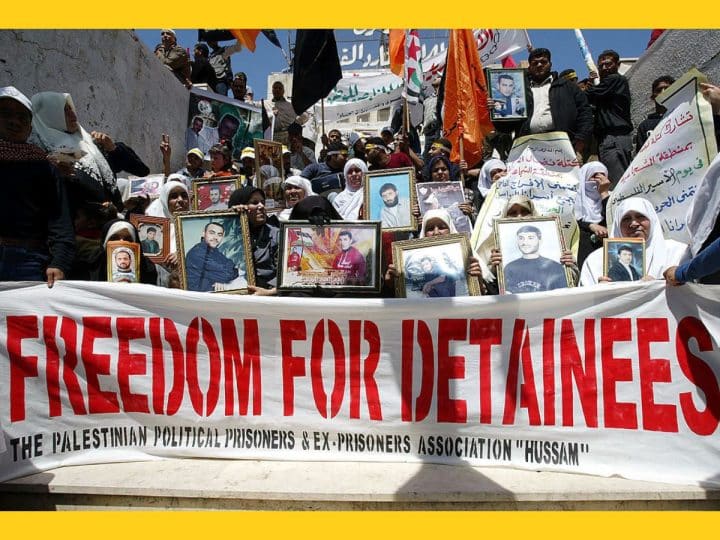

A dangerous and rapidly escalating outbreak of the skin disease scabies is again sweeping through Israeli occupation prisons. This is causing huge suffering to the many thousands of Palestinian political prisoners who, for the past few years, have intentionally had the worst conditions ever inflicted on them.
Abdullah al-Zighari, head of the Palestinian Prisoners’ Society, told the Canary:
The Israeli occupation system is carrying out acts of retaliation against Palestinian detainees in Israeli prisons, by denying them the necessary medical care, posing a serious threat to their lives.
“Intentional health catastrophe” and deliberate deprivation of treatment for Palestinian prisoners in Israeli occupation prisons
During April and May, Palestinian Prisoners’ Society (PPS) lawyers conducted dozens of visits to Palestinian political prisoners. They found “shocking levels of human suffering and an intentional health catastrophe…amid deliberate deprivation of treatment and healthcare”.
These lawyers witnessed a complete lack of minimum hygiene standards and humane care. They have stated that diseases and epidemics are “being used as systematic tools of torture against Palestinian political prisoners”. In overcrowded cells, where no fewer than eight prisoners are held, at least three of them are infected with scabies.
Israeli occupation authorities have also cancelled many scheduled lawyer visits in the past few days, citing scabies infections in the prisons.
The testimonies of widespread scabies infections were from Ofer, Megiddo, Naqab and Ganot prisoners. In Megiddo, Palestinians have also experienced other serious health problems. These include severe abdominal and head pain, and intense aches, raising grave concerns about the spread of additional diseases and epidemics.
The health conditions, according to the PPS, are “deadly”. Some prisoners have remained infected with scabies for more than five consecutive months, without any serious medical intervention or treatment.
If left untreated, scabies causes bacterial skin infections which can spread into the bloodstream and become life-threatening. Because of the occupation’s intentional absence of any treatment, the PPS states that many prisoners now also suffer from boils, ulcers and severe infections. Others are unable to sleep due to intense itching and continuous pain. Some are unable to move normally because their health has deteriorated so badly.
Prisoners have told the PPS lawyers that their psychological suffering has reached unprecedented levels. This is due to the prolonged physical and mental exhaustion they have suffered for many months due to scabies.
Systematic policy of Israeli occupation prison system to destroy political prisoners physically and psychologically.
The policies and measures imposed by the occupation’s prison administration have led to this serious outbreak, which continues to spread. Prisoners are intentionally deprived of personal hygiene supplies, cells are severely overcrowded, and there is a lack of ventilation. Prisoners are deprived of sunlight, and are also forced to wash and wear clothes while still wet. This is because the Israeli occupation has intentionally ensured there is a severe lack of clothing inside prisons.
According to the PPS lawyers:
The prison system is using disease, epidemics and medical crimes as tools of slow killing against detainees, within a systematic policy aimed at destroying them physically and psychologically. These policies have, since the start of the genocide in Gaza, led to the killing of 89 identified Palestinian prisoners in Israeli occupation prisons.
Diseases, including scabies, were among the most prominent factors contributing to the deaths of several prisoners. These deaths occurred amid the continued policy of denial of treatment, and ongoing medical crimes. This continuous state of complicity must come to an end.
Al Zighari tells us:
This scabies outbreak comes within the context of a systematic campaign of revenge. The Israeli occupation authorities bear full responsibility for this, alongside the international human rights and legal system that has failed to provide protection for Palestinian detainees inside prisons. The world must assume its responsibilities and act urgently to stop the extermination and abuses being inflicted upon Palestinian detainees inside Israeli prisons.
There are currently around 9400 Palestinian prisoners, 3600 of whom are imprisoned without trial or charge. 84 of these are women, 360 are children.

Featured image via Abid Katib/Getty Images
By Charlie Jaay

Maaya Rajeshwaran Revathi looks to find her feet on clay at Junior French Open | Tennis News

One engineer’s bizarre crusade against hyperscalers

Opta’s Premier League team of the season – Raya, Gabriel, Saliba, Fernandes, Haaland, Anderson, Rice


-

 Crypto World4 days ago
Blockchain.com files with SEC for U.S. IPO
-

 Fashion3 days ago
Holiday Weekend Open Thread – Corporette.com
-

 Crypto World3 days ago
Bitcoin Accumulation Weakens as BTC Realized Losses Hit $600M
-

 Business3 days ago
Dell Technologies DELL Stock Surges 15% on AI Server Momentum and Analyst Upgrades in 2026
-

 Crypto World3 days ago
Space X IPO Is ‘Bad News’ for Tech Stocks: But What About Bitcoin?
-

 Politics3 days ago
Makerfield: a tale of two social-media histories
-

 Crypto World2 days ago
Robinhood crypto COO Tanya Denisova exits
-

 Crypto World3 days ago
MicroStrategy’s Saylor Says Miners No Longer Set Bitcoin Price, Another Force Has Taken Over
-

 Business18 hours ago
NYT Strands Answers May 24 2026 Revealed for Puzzle No. 812 Theme Summer Essentials
-
 Tech3 days ago
A 0.12% parameter add-on gives AI agents the working memory RAG can’t
-

 Crypto World3 days ago
AI infrastructure race heats up as IREN pitches full-stack strategy, WhiteFiber lands $160M deal
-

 Tech4 days ago
WhatsApp ads could make Irish debut after discussions with DPC
-

 Tech3 days ago
You Can Now Add ChatGPT To PowerPoint
-

 Business3 days ago
Trump Invests $1M-$5M in Kura Sushi USA Chain With 27 California Locations
-
 Crypto World7 days ago
Revolut Launches Dogecoin Debit Card Across UK and EU
-
 NewsBeat4 days ago
Charity run by Reform leader Malcolm Offord accused of ‘law breaking’ over Scottish registration
-

 Sports3 days ago
2026 CJ Cup Byron Nelson leaderboard: Brooks Koepka finds putting stroke in Round 1
-
Business3 days ago
Goldman Sachs reinstates Ageas stock coverage with neutral rating
-

 Crypto World5 days ago
Exa Labs raises $250 million in funding led by a16z
-

 Crypto World3 days ago
Trump Media’s Bitcoin Stash Shrinks Again as 2,650 BTC Lands on Crypto.com
You must be logged in to post a comment Login