
Politics
Iran claims to have bombed Netanyahu’s office

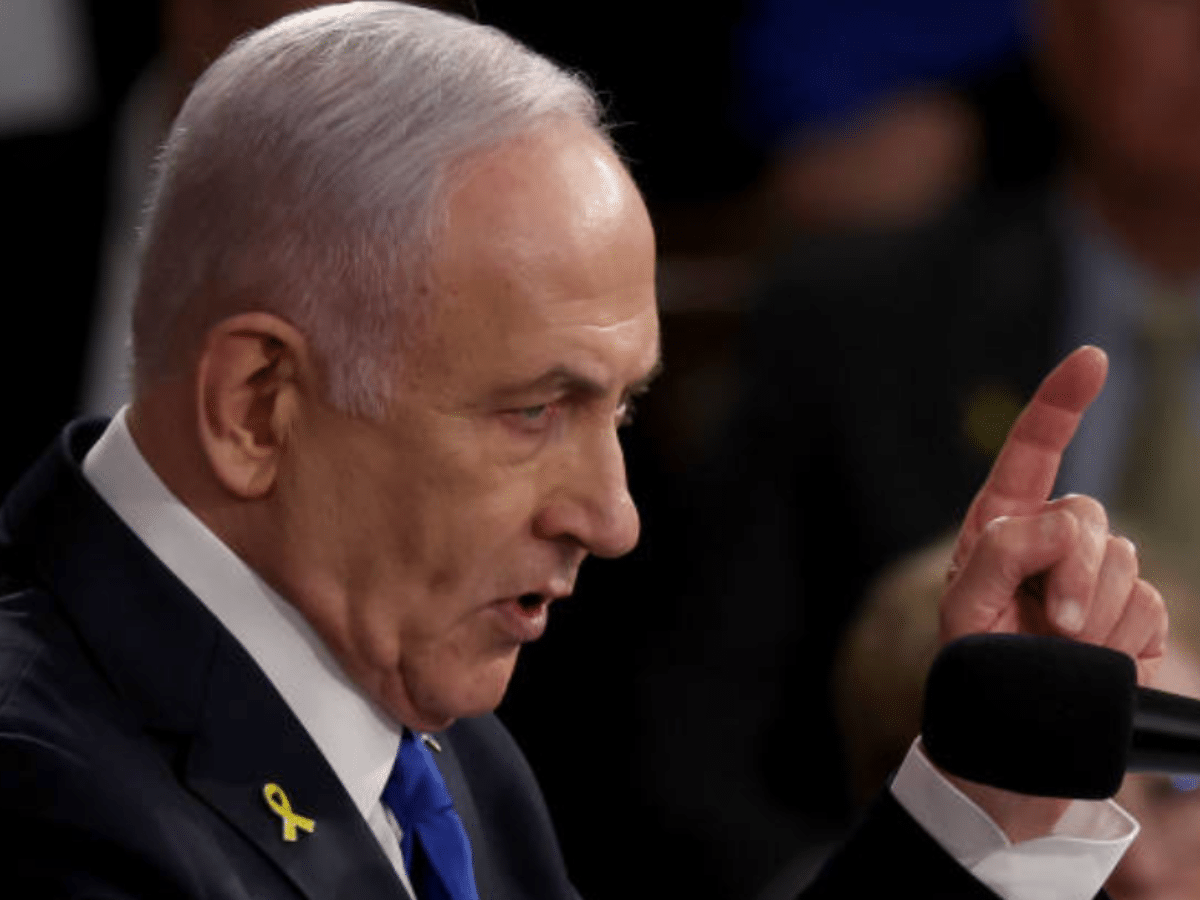
Iran says it has bombed wanted war criminal Benjamin Netanyahu’s office in Israel. The Islamic Revolutionary Guard Corps are also claiming that they have attacked the Israeli air force headquarters.
Palestine Chronicle reported that:
According to Tasnim News Agency, the Public Relations office of the Islamic Revolutionary Guard Corps announced that the office of Israeli Prime Minister Benjamin Netanyahu and the location of the commander of the Israeli air force were attacked in what it described as “targeted and surprise attacks.”
The Times of Israel has reported that:
Israel says there were no injuries in the strikes.
And, Netanyahu’s office have dismissed Iran’s claims that the “fate” of the Israeli PM is unclear. As yet, details remain entirely unclear – Iran’s assertions have not been verified, nor has Netanyahu’s location.
At the weekend, Netanyahu – along with various co-criminal Western leaders – crowed about the assassination of Iranian leader Ali Khamenei and his family. It’s hard to argue that turnabout is not fair play. However, it will be no surprise to see Keir Starmer and other ‘leaders’ condemn Iran for ‘disproportionately’ retaliating for what Israel did to it – just as Starmer did on 1 March after the US and Israel slaughtered Iranian schoolchildren and bombed hospitals.
Featured image via the Canary


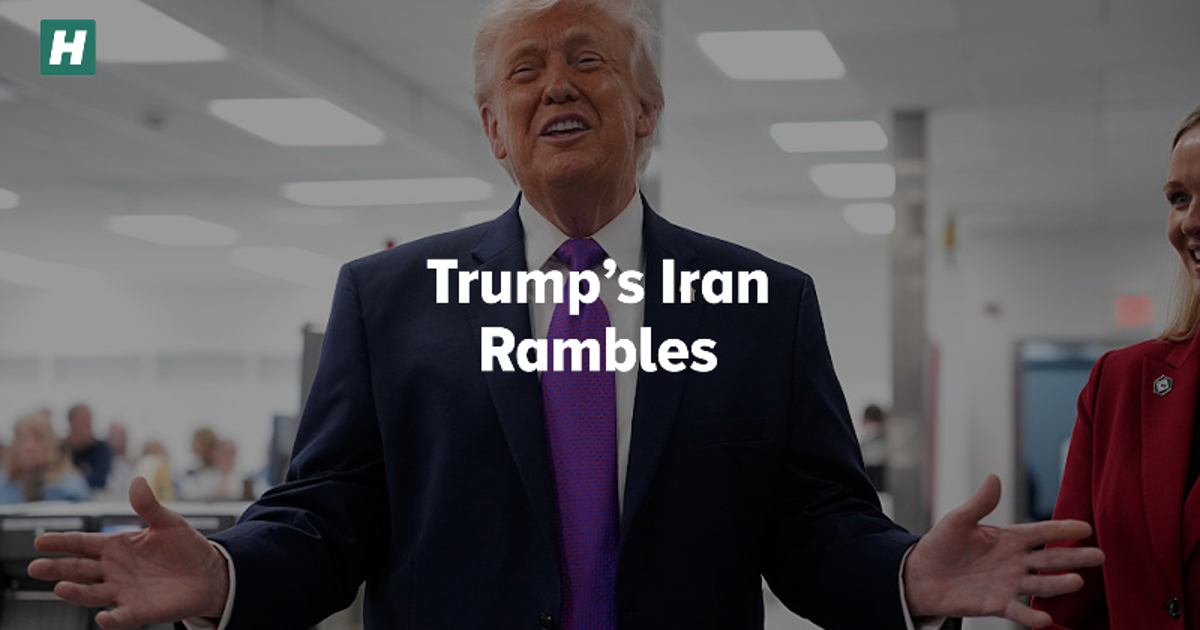
US president Donald Trump has been waffling about peace talks amid his stalling war on Iran. Meanwhile, Iranian officials have flatly denied that any discussions have taken place. One official even said that Iran was busy carrying out “complete and remorseful punishment” of its enemies.
The US and Israel attacked Iran on 28 February in an unprovoked, unlawful strike. Omani officials revealed at the time that Iran had been offering unprecedented concessions during negotiations. The Pentagon has since stated there was no imminent threat from Iran. And the UN’s atomic watchdog, the IAEA, has said there is no evidence that Iran was developing a nuclear weapon.
In one interview posted on 23 March, Trump claimed that talks were already taking place:
NOW – Trump on Iran: “We’ve had very strong talks… they very much want to make a deal.” pic.twitter.com/zgZSQ1TXyy
— Disclose.tv (@disclosetv) March 23, 2026
When challenged on this claim, Trump said Iran needed better PR:
Well, they’re gonna have to get themselves better public relations people. We’ve had very strong talks. Mr Witkoff and Kushner had them. They went perfectly.
Q: Iran’s foreign ministry says you’re not telling the truth when it comes to productive conversations to end the war
TRUMP: Well, they’re gonna have to get themselves better public relations people. We’ve had very strong talks. Mr Witkoff and Kushner had them. They went… pic.twitter.com/LrCq8tCM6c
— Open Source Intel (@Osint613) March 23, 2026
It was even claimed the US Republican leader had postponed further strikes on Iranian energy infrastructure due to these alleged talks.
Breaking news: Donald Trump has postponed his threatened attacks on Iranian energy infrastructure following ‘good and productive’ talks with Iran. https://t.co/3N8P9BbwjJ pic.twitter.com/QhBCfKeV26
— Financial Times (@FT) March 23, 2026
There was some evidence that energy markets had bounced back as a result of Trump’s comments:
Brent Crude prices fell 12% after President Trump announced constructive talks between US and Iran and postponed planned strikes on Iranian power plants pic.twitter.com/0GopBm6oSz
— Reuters (@Reuters) March 23, 2026
Al Jazeera reported:
The US president adds that the two sides have had “major points of agreement” during the talks he claims US officials have held with Iran.
Trump’s full interview on the supposed talks can be accessed here.
Iran denies talks
Yet Iran has completely rejected and contradicted Trump’s claims. Axios cited a source which said no negotiations had occurred:
🚨 BREAKING: Iran speaker named in Axios report says “no negotiations” taking place with U.S. in fresh posts
Iran’s parliament speaker Mohammad Bagher Ghalibaf – identified in Axios reporting as a key figure in alleged backchannel talks – said moments ago on X that “no… https://t.co/ILywe6Amb9
— Drop Site (@DropSiteNews) March 23, 2026
And Iranian parliamentary speaker Mohammad Bagher Ghalibaf appears to be in no mood to negotiate:
No negotiations have been held with the US, and fake news is used to manipulate the financial and oil markets and escape the quagmire in which the US and Israel are trapped.
One unnamed Iranian source told Al Jazeera that:
Trump “backed down” after being warned that Iran would target power plants across the Gulf and in Israel.
The report added that Trump had said talks with Iran were underway despite the source denying any such communication.
The outlet added that:
The claims could not be independently verified, and there has been no immediate comment from Iranian officials.
Trump threatened to hit Iranian energy infrastructure on 22 March:
If Iran doesn’t FULLY OPEN, WITHOUT THREAT, the Strait of Hormuz, within 48 HOURS from this exact point in time, the United States of America will hit and obliterate their various POWER PLANTS, STARTING WITH THE BIGGEST ONE FIRST.
As is often the case, Trump’s abrupt shift from belligerence to unverified claims of progress in talks is difficult to decode. What is clear, however, is that the US war effort is stalling. The war is deeply unpopular domestically, and has, in effect, transformed Iran into an oil superpower—tightening its grip over one of the world’s most critical oil choke points.
Worse yet, America’s flagship aircraft carrier, the USS Ford, has limped to Crete for repairs after a serious fire. Meanwhile, US rivals like China are watching to see how they can turn this latest US blunder to their advantage.
Trump is known for believing he can shape reality through bullying, dealmaking, and cajoling. For now, that belief appears to have hit an Iran-shaped brick wall.
Featured image via the Canary
!function(n){if(!window.cnx){window.cnx={},window.cnx.cmd=[];var t=n.createElement(‘iframe’);t.display=’none’,t.onload=function(){var n=t.contentWindow.document,c=n.createElement(‘script’);c.src=”//cd.connatix.com/connatix.player.js”,c.setAttribute(‘async’,’1′),c.setAttribute(‘type’,’text/javascript’),n.body.appendChild(c)},n.head.appendChild(t)}}(document);(new Image()).src=”https://capi.connatix.com/tr/si?token=19654b65-409c-4b38-90db-80cbdea02cf4″;cnx.cmd.push(function(){cnx({“playerId”:”19654b65-409c-4b38-90db-80cbdea02cf4″,”mediaId”:”11734195-b25f-4a13-a9a8-b8f5e0694fcd”}).render(“69c19f60e4b0964b57004cc2”);});

Billionaire Marc Andreessen has claimed that “introspection” is of little value and only goes back 400 years. He also said he engages in “zero” or “as little as possible” deep thinking, noting that:
I find that people who dwell on the past, get stuck the past.
Ever heard of philosophy?
Andreessen, a Silicon Valley Venture Capitalist, made the comments on the Founders podcast:
Billionaire Marc Andreessen says he has “zero” introspection, and that the idea itself is a modern invention. pic.twitter.com/6bgxdxvfmt
— More Perfect Union (@MorePerfectUS) March 16, 2026
Andreessen claims:
If you go back 400 years ago, it would never have occurred to anybody to be introspective… Great men of history didn’t sit around doing this stuff at any prior point right?
He must be trolling, right? Even before Ancient Greece, highly influential philosophy in Persia (modern-day Iran) dates back to 1700–1800 BCE. Zarathustra, as well as Hammurabi’s Code (c. 1754 BCE), introduced revolutionary ethical concepts that later Western philosophers like Immanuel Kant built upon through Deontology (acting as if everyone followed your example). Then there’s the opposing theory: Utilitarianism (the greatest good for the greatest number).
No wonder Andreessen has ‘zero’ introspection. He clearly thinks little of established ethical frameworks. The billionaire probably finds it convenient not to reflect on his actions, as he now simply takes stakes in businesses and lets the money roll in. Meanwhile, 90 percent of Americans own just around 10 percent of the stocks.
Philosophy was the original subject, before Plato taught Aristotle in around 400-300 BCE. Aristotle then categorised study into different subjects. This was the literal foundation of Western academic thought and educational systems.
Introspection: high value
Introspection is highly important, but it must be coupled with study. Otherwise you are just going over ideas that prior thinkers have dedicated their lives to.
It’s obvious why billionaires want to promote mindless consumerism. The thing is, will people continue to dumb themselves down?
Featured image via X/Twitter
Rattled…

4 min read
The Committee on Standards plays a unique role within the House of Commons. It is unusual compared to other select committees as it fulfils several functions.
Firstly, the committee (alike other committees) undertakes a policy function. It is responsible for recommending any modifications to the Code of Conduct as may from time to time appear to be necessary.
The committee also undertakes a key role in enforcing the code, considering and reporting on the commissioner’s memoranda on individual cases (the process is described in more detail below.)
The committee is also unique as it includes lay members. Lay members have full voting rights on the committee. The inclusion of lay members means it is not just MPs involved in the decision-making process. As there are equal numbers of lay members and MPs on the committee, and the chair (an MP) does not vote, lay members effectively hold the majority.
In addition, the lay members have the power to append an opinion to any committee report. The lay members are always asked whether they wish to submit an opinion before a report is finalised.
Policy functions:
Over this year, the committee will revisit the Code of Conduct to ensure that it remains up to date and fit for purpose in the current day. The committee will be sure to speak to colleagues across the House for their input on this important matter.
The committee also has the power to update the guide to the rules for All-Party Parliamentary Groups. In the coming year, the committee is likely to review the operation of All-Party Parliamentary Groups. This work would build upon the committee’s previous work from 2023.
Considering individual cases:
The Committee on Standards oversees the work of the independent parliamentary commissioner. The commissioner is an independent officer of the House of Commons.
The commissioner is responsible for the monitoring and operation of the House of Commons Code of Conduct and registers (including investigating alleged breaches). Under the Standing Orders of the House, the rectification procedure means the commissioner may conclude an investigation without making a referral to the committee.
The committee is not involved with the commissioner’s investigations, nor with what he puts in the accompanying memoranda.
The role of the committee is to consider alleged breaches of the Code of Conduct which have been drawn to the committee’s attention by the commissioner. The committee does not have the jurisdiction to open its own investigations.
When the committee considers a case referred to it, it must decide whether there has been a breach of the code. Should the committee decide that there has been a breach, it has a range of sanctions available to it; the most serious ones, such as suspension, must be agreed by the House itself.
The committee has recently dealt with three cases which resulted in minor breaches. They were in relation to APPGs, timely declarations of interest, and lobbying the commissioner.
The House agreed on 18 October 2022 to introduce an appeals process in the House’s standards system. This means that Members found by the Committee on Standards to have breached the Code of Conduct have a right of appeal to the Independent Expert Panel. The process for appeals is set out in chapter 6 of the Procedural Protocol agreed by the House. An appeal can only be made on specified grounds. Under the protocol, where the committee has recommended a sanction that requires a decision of the House, the House will only consider any motion relating to the committee’s recommended sanction after any appeal process has fully concluded, or the deadline for appeals lapses, or the Member has confirmed to the panel that they do not wish to appeal.
It is also important to note that the committee does not consider cases relating to bullying, sexual misconduct or harassment. These cases are considered by the Independent Complaints and Grievance Scheme.
Oversight function:
The Committee on Standards also oversees the work of the Parliamentary Commissioner for Standards. This includes examining the arrangements proposed by the commissioner for the compilation maintenance and accessibility of the Register of Members’ Financial Interests and any other registers established by the House.
On the 13th of January, the committee held an evidence session with the Commissioner for Standards. The committee questioned the commissioner on a range of matters relating to his work.
On the afternoon of 21 March, 18-year-old Zionist settler, Yehuda Sherman, died when his quad-bike collided with a Palestinian owned vehicle. Sherman, who lived in the illegal outpost of Shuva Yisrael—in the northern occupied West Bank—was supposedly carrying out a “security patrol”. This is when the crash occurred.
Revenge attacks by Zionist settlers
In the immediate aftermath of his death, 20 locations across the occupied West Bank witnessed violent settler terrorist attacks.
Late on Saturday, Israeli settlers stormed the village of al-Fandaqumiya and the town of Seilat al-Dahr, south of Jenin, late on Saturday. They smashed windows and used Molotov cocktails to set fire to vehicles and homes, and they brutally attacked Palestinians.
The violence continued throughout the night into Sunday morning, in what international media sources have described as revenge attacks.
Settlers also hurled rocks at an ambulance belonging to the Palestinian Red Crescent Society (PACS) in another unprovoked attack. PACS personnel reported that the violent mob smashed the ambulance’s windscreen. This took place while they were responding to a traffic accident near the Shilo settlement in Ramallah.

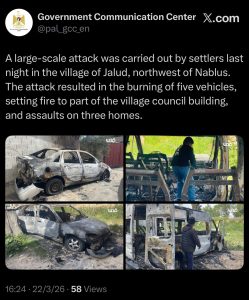
In the early hours of Sunday, 22 March, a terrorist mob of Zionist settlers carried out attacks on the Palestinian towns of Jalud, and Qaryout, in Nablus. They burnt homes and vehicles, and violently assaulted Palestinians residents who reported multiple injuries.
Apartheid deepens in the occupied West Bank
Palestinian news agency WAFA reported similar incidents in Masafer Yatta, south of Hebron. Settlers, flanked by Israeli occupation forces (IOF), stormed the area. They injured two Palestinians, and three others were arrested by the IOF, while providing cover for illegal settlers.
The Palestinian Ministry of Foreign Affairs issued a statement condemning these calculated attacks, which is described as:
organised settler terrorism as part of a genocidal war against the Palestinian people.
Sherman’s funeral took place on the Sunday afternoon, at Elon Moreh settlement, northeast of Nablus. More than 500 people attended, including far-right finance minister and head of the Religious Zionism party, Bezalel Smotrich. Additionally, Smotrich has been described by credible sources as a “religiously dedicated Israeli settler.”
To secure unrestricted travel routes for Israelis attendees, the IOF closed off access to Route 60—the main north-south road in the West Bank. The road serves as a lifeline for rural Palestinian communities travelling to cities in the West Bank for work and school. Furthermore, the closure was announced on the last day of the Muslim Eid holiday. As a result, many Palestinians who had been visiting relatives were prevented from returning home.
Since 7 October 2023, the Israeli occupation has installed more than 915 barriers restricting the freedom of movement for Palestinians. These include iron gates, as well as arbitrary and excessive checkpoints outside almost every village and town in the occupied West Bank. As most Palestinian communities are surrounded by iron gates, the IOF can close these at will. This further restricts the movement of West Bankers.
Settler impunity
Far-right Israeli voices have vocally condemned Sherman’s death as “murder,” without providing any supporting evidence. In a post on X, Smotrich wrote the following tribute:
I participate wholeheartedly in the grief of my friends and longtime partners, Yehoshua and Sima Sherman and their family, over the murder of their son, Yehuda Shmuel Sherman, may God avenge his blood, who fell while guarding our land in the settlement in the soil of Samaria [a biblical term used by Israelis to describe the northern West Bank].
Extremist, criminal national security minister Itamar Ben Gvir also posted a tribute, claiming Sherman was “murdered in the defense of the land of Samaria.”
One funeral attendee, quoted by the Times of Israel reported that Sherman had been fulfilling a “strategic mission” to expel Palestinians from the West Bank. This would bring about Jewish settlement in the territory. They said that:
Every day, he took his herd out [to pasture] to remove the enemy from all the territory there so that Jews will come back to this place.
Sherman’s father Yehoshua—aligned withSmotrich’s Religious Zionist party—pledged to continue his son’s work by establishing new illegal settlement outposts in the coming days. He also called for the abrogation of the Oslo agreement.
כאב גדול על הרצחו של יהודה שמואל שרמן הי”ד, שנרצח בהגנה על אדמת השומרון.
מחבק את הוריו יהושע וסימה ואת כל בני המשפחה, ומשתתף בצערם העמוק. עם ישראל כולו איתכם.
מחזק את קהילת אלון מורה ואת תושבי השומרון.
נמשיך להיאחז בארץ, לבנות ולהמשיך את דרכו.יהי זכרו ברוך 🕯 pic.twitter.com/bB66ZS8jOu
— איתמר בן גביר (@itamarbengvir) March 22, 2026
A translation of the post above reads:
Great pain over the murder of Yehuda Shmuel Sherman, may God avenge his blood, who was murdered in defense of the land of Samaria.
Embracing his parents Yehoshua and Sima and all family members, and sharing in their profound grief. The entire people of Israel are with you.
Strengthening the community of Alon Moreh and the residents of Samaria. We will continue to hold on to the land, to build, and to carry on his path.
May his memory be blessed.
Settler violence in the occupied West Bank has increased exponentially since the start of the genocide in Gaza, and has intensified again with the US-Israeli led attacks on Iran.
Settler terrorism grips the West Bank
On 21 March, diplomats from 13 European countries and Canada issued a joint statement condemning the surge in settler attacks against Palestinians in the occupied West Bank. They described the violence as “settler terror,” and warned it is contributing to the forced displacement of Palestinian communities. Furthermore, they called on Israel to ensure accountability and protect civilians.
The Palestinian Ministry of Foreign Affairs has repeatedly called on global governing bodies, particularly the UN, to implement resolutions aimed at disarming settlers and holding them accountable for acts of terrorism.
Ministry of Foreign Affairs Condemns Deadly Settler Attack in Qaryout, Calls for Immediate International Intervention
The Ministry of Foreign Affairs and Expatriates strongly condemns the deliberate attack carried out by Israeli settlers on Monday in the village of Qaryout,…
— State of Palestine – MFA 🇵🇸🇵🇸 (@pmofa) March 3, 2026
This includes imposing travel bans, freezing their assets, placing them on international terrorism lists, and targeting the financial networks and goods associated with settlements.
Featured images and videos via author

On 17 March 2026, the staff at Castle Grange and Claremont House were formally told the specialist dementia care homes they work in are being transferred to a private provider. Mulberry Care Homes already runs a care home in Kirklees. However, the Care Quality Commission has assessed it as ‘requires improvement’.
Despite this rating Kirklees council is seeking to cut its losses and sell the home. This is leaving residents and their families to pick up the pieces. And, as they await the next steps, they’ve had no formal information from the council.
The ‘Save our Kirklees Dementia Homes from Privatisation’ group has tirelessly campaigned against this sell off. Just as it also fought to prevent Kirklees council from closing them. It is only thanks to this campaign that the homes didn’t close two years ago. But this council was not impressed or deterred from pressing ahead to offload them to the private sector.
The campaign includes close relatives of residents at both homes. And it has fought for the last two-and-a-half years to keep these excellent and caring homes in the public sector. Campaigners have received overwhelming support from the public and local community.
Labour banned questions on dementia homes
The campaigners have taken questions and petitions to the council to press their case. For their
troubles, they feel they have been patronised, ignored and finally silenced by an uncaring council. Six months ago, the ruling Labour group banned ALL councillors from asking any questions on the topic at council meetings.
Campaigners were also prevented from addressing the council and had to resort to standing outside town hall meetings lobbying individual councillors. Left with no alternative, they took their case to the High Court in Leeds in September 2025.
Regrettably the judge ruled in the council’s favour and the campaign appealed to the Court of
Appeal, where they tragically lost again. The rulings were on legal technicalities, not on the morality of selling off these dementia homes from under the residents to a failing private provider. The legal route was the last resort for the campaign and the council has acted with indecent haste
to tell staff they will now be transferring over to a new employer on worse terms and conditions!
Understandably staff, residents and families are devastated. Evidence shows that the private
sector provides worse standards of care compared to the public sector. The council is aware of
this but has chosen to fall back on erroneous figures to try and prove it is too expensive.
The campaign has consistently disputed these figures and produced a detailed dossier to prove its case. The campaign is now assessing its options and will monitor very carefully the new owners and the care they offer.
A spokesperson for ‘Save our Kirklees Dementia Homes from Privatisation’ said:
We all went to Leeds in September for the High Court hearing, and many of us also attended the Appeal hearing at the Royal Courts of Justice on 5 March. We are gutted we lost the case but we have fought all the way and continue to believe very strongly the council is making a huge mistake.
We would like to thank the staff, the community, those councillors who have believed in us and our legal team at Irwin Mitchell for all their support. We are naturally down but not unbowed. We owe it to everyone to ensure this new provider is kept on their toes and that the council fulfils its duty to monitor standards.
For those voting in the elections on 7 May, please ask your candidates where they stand on privatisation of public services and vote accordingly.
Featured image via the Canary
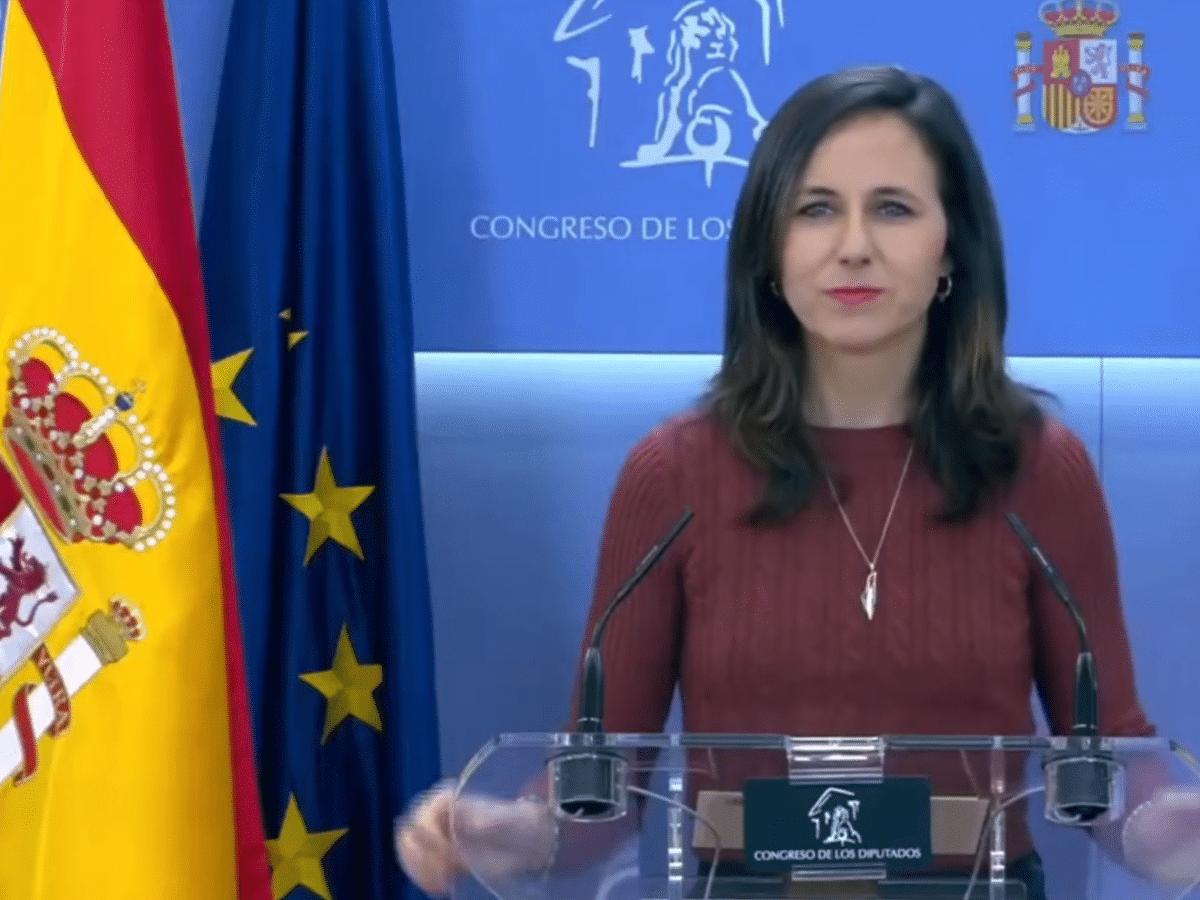
Spanish MP Ione Belarra delivered a forceful speech condemning Israel, declaring that it “must be stopped.”
Belarra has often been outspoken, alongside Prime Minister Pedro Sánchez, in opposing Israel’s actions in Gaza. She argues that Israel’s military campaign is a genocide and has long called on the international community to act decisively.
She also condemned further Israeli strikes beyond Gaza, specifically their military actions against Iran and Lebanon. Belarra astutely described them as part of a broader and increasingly unlawful escalation. Since late February, Spanish leaders have continued to press other countries to uphold international law and the rules-based global system to little avail.
Refusing to give up, Belarra has now issued a stark and urgent warning to world leaders, insisting that their failure to restrain Israel could lead to wider devastation far beyond Palestine.
BREAKING : 🇪🇸 Spanish MP Ione Belarra sent chilling warning about Israel
“If we do not stop Israel now, what they are already doing to Palestine, they will do to the entire world. THEY MUST BE STOPPED.” 🔥
Another Fearless voice from Spain after Pedro Sánchez. RESPECT 🫡 pic.twitter.com/9yeJym0Ibh
— Ankit Mayank (@mr_mayank) March 22, 2026
Israel is the true threat to global peace and stability
Principled activists and leaders have relentlessly called on international governments to show backbone and act with moral clarity. They argue that Israel is committing genocide in Gaza after decades of occupying Palestinian territories since 1948 and demand that the world confront it now.
They point to Spain – under PM Pedro Sánchez – as setting the pace, with one of the strongest efforts in Europe to hold Israel accountable for its crimes.
This warning from Belarra follows prior moves by Spain to apply political pressure against Israel. The Spanish government have stood out on the world stage for its actions such as the banning of arm sales, refusing to allow access to military bases and recently recalling Spain’s Ambassador from Israel.
Spain appears to be stepping up its campaign to wake world leaders to what it warns is a dangerous reality: Israel’s aggression will not stop at the Middle East.
Belarra has compared Israel and its genocide against Palestinians to Nazi Germany from the outset:
This adds to a list of powerful speeches given by this courageous Spanish MP; she regularly speaks out against Israel in the Spanish parliament. Here, she has even called NATO a “criminal alliance” and insisted Spain bow out:
🚨🇪🇸🇺🇸🇮🇷 BREAKING: Spanish MP Ione Belarra of Podemos urges Spain to “expel the American army,” close all U.S. bases in the country, and leave the “criminal alliance” of NATO.
She calls the U.S. and Israel “the greatest threat to the security of humanity.” pic.twitter.com/OHOmwD2fWh
— Jackson Hinkle 🇺🇸 (@jacksonhinklle) March 19, 2026
A reminder of the catastrophic hellscape that has been inflicted on Palestinian civilians at the hands of the IDF and its lackies:
If you’re outraged by the destruction in Israel but not the destruction in Palestine, Lebanon and Iran. Then you’re the problem. pic.twitter.com/qn1cMIqxtB
— Mohamad Safa (@mhdksafa) March 22, 2026
This X post shows the sheer scale of opposition to the US and Israel amongst the Spanish population:
Massive turnout in Madrid, Spain this weekend to protest the U.S. and Israel’s war against Iran. pic.twitter.com/b7PYzAf6fR
— Power to the People ☭🕊 (@ProudSocialist) March 15, 2026
This video shared in the X post shows Israel and the US declaring more countries as ‘enemies’. This reinforces Belarra’s warning that their military reach will eventually extend even further:
Nicholas J. Fuentes – In what universe are Canada, France, the UK, Poland, Norway, Spain, Portugal, Malta, and Ireland our ENEMIES — and Israel our greatest ally?” pic.twitter.com/sLdBZTfWPs
— Ounka (@OunkaOnX) January 11, 2026
Keep going, Spain!
Spain and its elected officials are leading the way internationally in the fight against fascism and violent extremism. Israel and the US are being led by toddler tyrants who prioritise their own self-interest and power over accountability and human cost.
As Ione Belarra warns, this hostile supremacy poses a threat to everyone. Countries with ties to the US – and especially those hosting its military bases – now face the strategic risks those installations have always carried: tools to exert pressure and project power, often at the expense of their own national interests.
Like Spanish citizens, we need principled leadership in the UK – leaders who stand up to genocidal warmongers and say no.
They’ve already sold out our interests for private profit. We must not let them sell out our country to a terrorist state too.
Featured image via YouTube screenshot/Vozpopuli
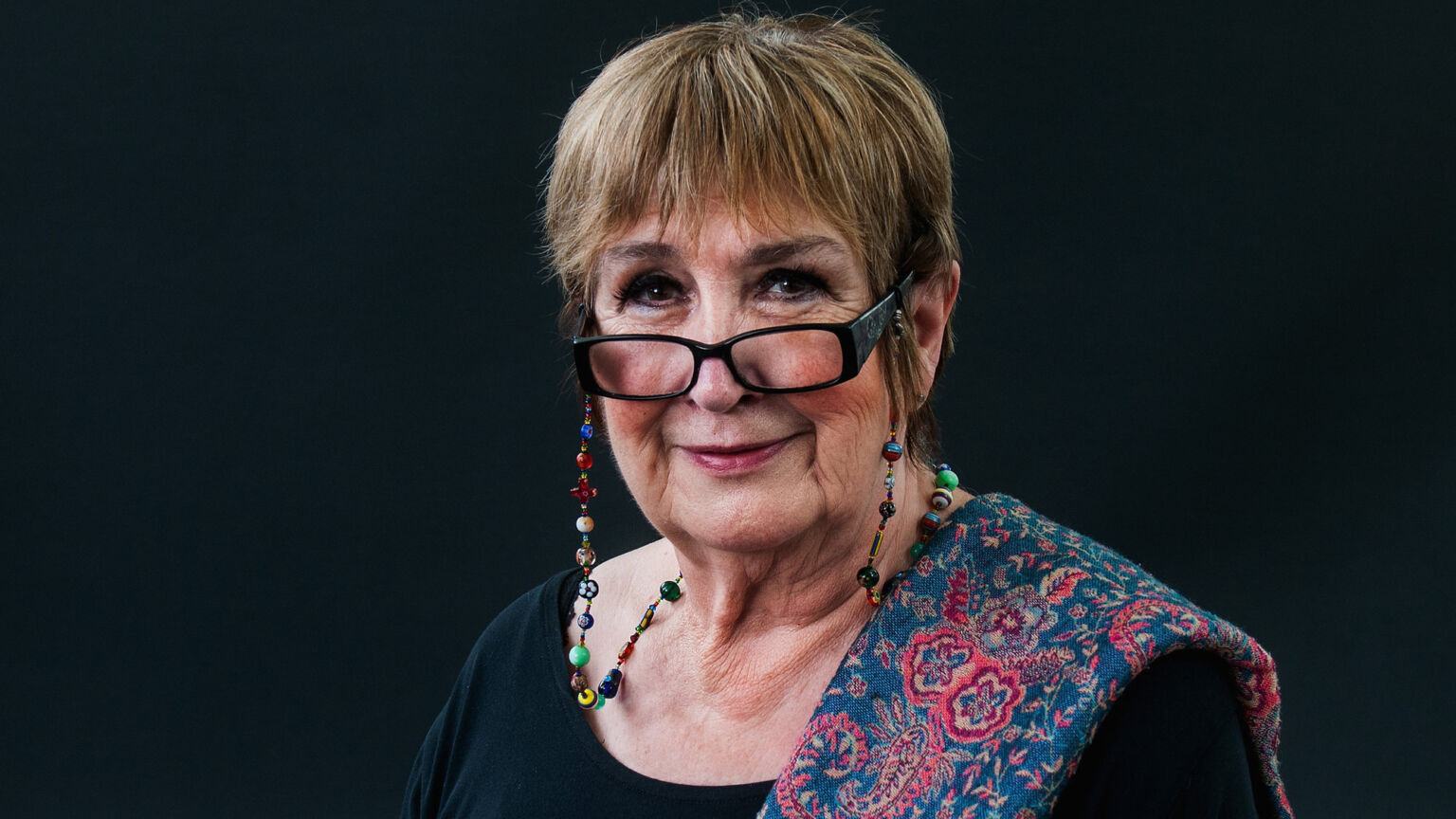
Journalist and broadcaster Dame Jenni Murray died last week at the age of 75.
Born in Barnsley in South Yorkshire in 1950, Murray began her journalistic career at BBC Radio Bristol in 1973, before becoming a presenter and reporter for regional news programme, South Today. A warm but probing interviewer, she became a presenter on BBC’s Newsnight from 1983 until 1985, and then on BBC Radio 4’s flagship news programme, Today, in 1987. But it was as the host of Radio 4’s Woman’s Hour, a role she held for over 30 years until she stepped down in 2020, that she was best known.
She was also a prominent feminist voice in the media. Alongside her work on Woman’s Hour, she focussed on women’s issues in her journalism for the Guardian among other outlets, and in her own books, including Is It Me or I It Hot in Here?, tackling everything from menopause to sexist beauty standards. Climbing the ranks at the BBC when it really was a boys’ club, Murray, with her clipped and serious questioning style, was a heroine for many aspiring female journalists.
But it was in 2017 that Murray showed her feminist courage. In an article for The Sunday Times in March 2017, entitled ‘Be trans and be proud – but don’t call yourself a real woman’, Murray outed herself as possibly the only member of the media elite at the time who wasn’t going to get on the ‘transwomen are women’ bandwagon. Murray wrote that ‘it takes more than a sex change and makeup’ to become a woman.
In a long, eloquent article detailing her position, Murray recounted experiences she had had with transwomen – the Reverend Carol Stone and India Willoughby among them – who had disappointed her by clinging to stereotypes of what it meant to be a woman. Murray argued that men, who had enjoyed all the privileges and power that she argued women were often refused, could not suddenly shop in a different section of the department store and call themselves ladies. She described her ‘fury that a male-to-female transsexual could be so ignorant of the politics that have preoccupied women for centuries’. Referencing the British Medical Association’s request for employees to use ‘inclusive’ phrases like ‘chest-feeding’, Murray responded: ‘I breastfed my kids and it was my breast that was cut off when I had cancer. No debate.’
This article would come to define much of Murray’s later career. She faced cancellations and countless protests at several universities where she was scheduled to speak. At Oxford University, protesters hung a ‘transwomen are real women’ sign. At the University of Hull, students decided to drop plans to name a lecture theatre after her, with Hull Students’ Union president claiming that her views made her ineligible as a ‘role model for students’. And trans activists were interviewed on television claiming to be frightened to be in the presence of Murray.
The BBC responded to the trans-activist pressure by preventing Murray from discussing any trans-related issues on Woman’s Hour – a behind-closed-doors decision Murray herself revealed in a 2020 article for the Daily Mail. Murray described stepping away from Woman’s Hour as being ‘free of the leash’.
Murray’s no-nonsense attitude to the issues and challenges facing women, from marital rape to women’s healthcare (Murray herself was diagnosed with breast cancer in 2006), gave her the kind of confidence to challenge trans ideology. Her commonsense challenge to the idea that men could become women with a wardrobe change and a visit to the doctors was a brave and brilliant intervention during a time of madness.
Many of Murray’s former colleagues have celebrated her journalistic integrity since the announcement of her death. Her passing should also provoke some soul-searching among a fair few of them, too – particularly those who have quietly moved TERFside now that it is no longer career-ending. Many failed to stand with Murray when she chose to say what she knew to be true. They looked the other way as she defended women’s rights – just as she had done all her life.
A pioneering journalist, cutting it in what was once a male-dominated industry, Murray remains an inspiration to many. She set a moral, political and journalistic example that others would do well to follow.
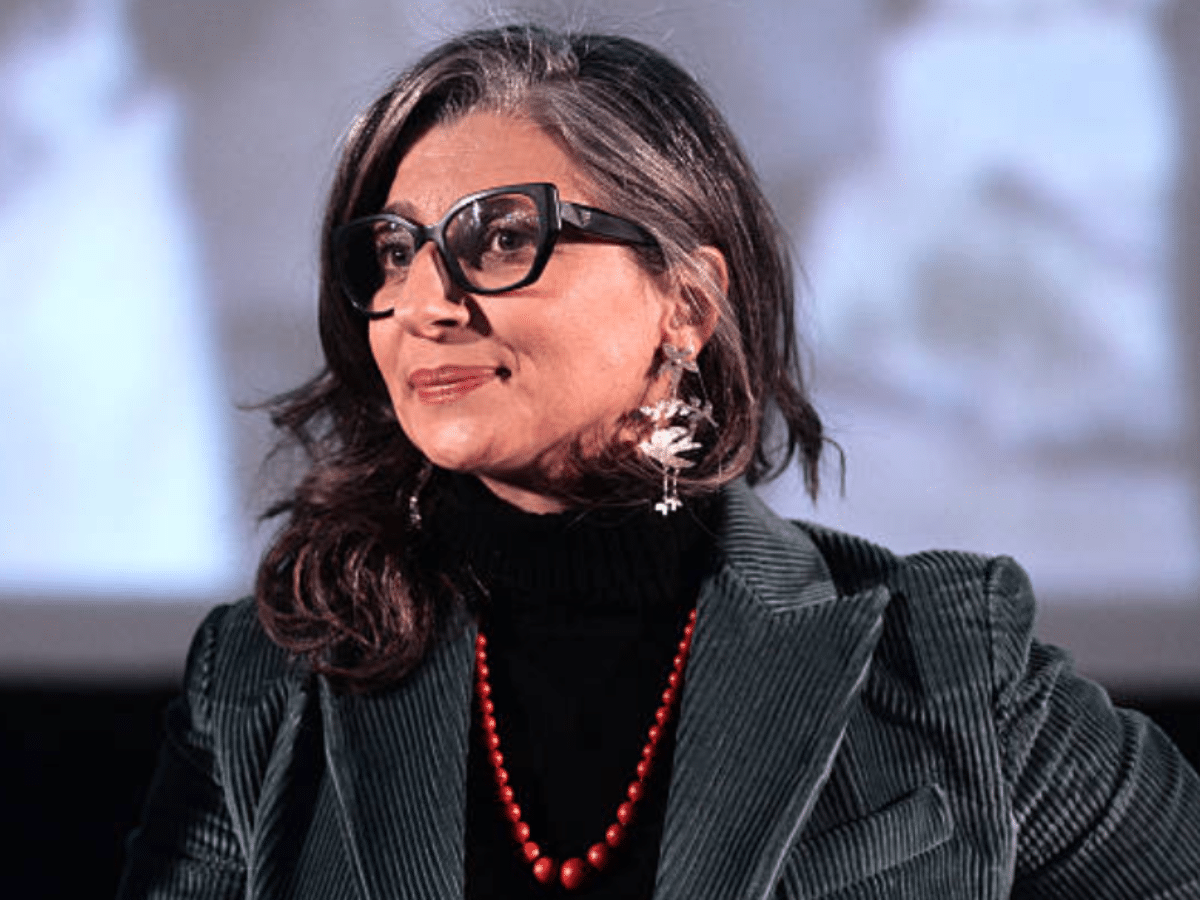
UN Special Rapporteur for the Occupied Palestinian Territories Francesca Albanese has once again urged UN member states to wake up to the reality on the ground in the Middle East. Ahead of her eighth report on Israel’s genocidal actions against Palestinians, she warns that Israel poses a serious threat to international peace and security.
In turn, Albanese highlighted the extensive evidence she has gathered in her urgent UN reports and reinforces her call to world leaders to uphold their humanitarian duty by intervening to stop the mass killing of innocent men, women, and children.
Finally, she stresses that only those in positions of power can hold Israel accountable under international law. In turn, this could work to prevent a dark, sinister future for the global population as a result of the new world order enforced by the US and Israel that ‘might is always right’.
A world order that will hurt any and all countries who have anything of value to imperial interests.
Dear UN Member States,
As I prepare to deliver my 8th report to the UN, I reiterate: Israel poses a threat to international peace and security.
I have documented its most egregious crimes. Now the obligation to act, and stop it, sparing innocent lives, rests with you. https://t.co/2tP4sK4nvl
— Francesca Albanese, UN Special Rapporteur oPt (@FranceskAlbs) March 22, 2026
Francesca Albanese tells UN member states to stop ignoring legal obligations
Albanese is continuing in her mission to press the UN into action, tirelessly reminding it of the vital purpose it was created to serve. The UN was formed after WWII in 1945 in order to promote cooperation amongst international leaders, enforcing a rules-based system which would foster and maintain peace and security.
If international law was applied without fear or favour, the world would see far less bloodshed and far less aggressive vitriol from hostile states. However, since its inception, the world’s most powerful states have used the international body as a way of beating down states they wish to exploit whilst shielding themselves from accountability for crimes committed by the West.
The US has consistently vetoed any effective resolutions put forward by the UN, often making its lackies toe the line and abstain from having a view. The US even saw fit to veto a UN resolution which would have allowed for unrestricted aid to enter Gaza, as we wrote back in September:
The United Nations Security Council (UNSC) has voted on a draft resolution put forward by its ten ‘non-permanent’ members demanding an immediate, unconditional and permanent ceasefire in Gaza, the immediate release of all hostages and the immediate lifting of Israel’s blockade on food and medicines – and ordering on the occupying power to ensure safe and unhindered distribution to all in need.
The US representative vetoed the UN resolution, condemning around 1.5 million surviving civilians in Gaza to starvation as they continue to be bombed and displaced by the coloniser.
Allowing these abuses only emboldens tyrannical leaders. After all, veto powers that block widely supported resolutions undermine the rules-based system and threaten international peace and security. This only reinforces Albanese’s assertion that Israel, and those who provide diplomatic cover, are the ultimate threat to the wellbeing of the global civilian population.
Many have long called for an end to this ability to stack the deck through the veto capability, urgently calling for reform in the Security Council:
Calls are growing for the UN Security Council to be reformed after the US used its veto power to block a Gaza ceasefire resolution, a move welcomed by Israeli PM Netanyahu ⤵️ pic.twitter.com/MvnplAht8z
— Al Jazeera English (@AJEnglish) December 10, 2023
A world leader leading the way is Spain’s PM Pedro Sanchez, who recently supported calls to end veto power in the UN:
Spanish PM Sánchez Calls to End UN Security Council Veto Power
Prime Minister Pedro Sánchez urges reform of the UN Security Council, arguing that the veto system undermines international decision-making and global cooperation. #WashingtonEye pic.twitter.com/3QYCkRRwBf
— Washington Eye (@washington_EY) March 11, 2026
Investigative journalist Peter Cronau has further reinforced Albanese’s demand for the UN to act:
The United Nations has an OBLIGATION to take action against Israel for its repeated egregious breaches of humanitarian and international law. https://t.co/s9ocdUpZZ4 pic.twitter.com/fbkOVuRJ6g
— Peter Cronau (@PeterCronau) March 22, 2026
Where is the UN’s backbone now?
Legal scholar Nimer Sultany has compared prior decisions made by the UN General Assembly (UNGA) to the lack of action taken today:
The UNGA should act.
In December 1982 (37/123), the UNGA declared “once more” that “Israel’s record and actions confirm that it is not a peace loving Member state” and called upon all states to suspend military, diplomatic, economic, and cultural relations with Israel. https://t.co/0thhg1WNHh pic.twitter.com/a7WY61uuvA
— Nimer Sultany (@NimerSultany) March 23, 2026
Going further, Sultany highlighted the silence from the UN Security Council (UNSC) regarding the illegal attacks on Iran:
In 1981 the UNSC “strongly condemned” Israel’s attack on Iraq’s nuclear research centre. And considered that Iraq is entitled to “appropriate redress”.
Now the UNSC is silent on Israel’s attack on Iran. pic.twitter.com/ktTx76J2Qj
— Nimer Sultany (@NimerSultany) March 23, 2026
Al Jazeera’s Marwan Bishara underscored how Israel’s abuses seem to have no end in sight:
With no end in sight ..,, https://t.co/k5k1JYQl7H
— Marwan (@marwanbishara) March 23, 2026
Better late than never
Francesca Albanese’s plea to the UN and its member states comes at a dangerously bleak moment for modern civilisation. Israel and the US are being led by self-interested, reckless, and fanatical leaders who prioritise settler colonialism above all else.
When greed and cruelty run unchecked, staying silent about crimes abroad only legitimises these dangerous actions – and leaves all states vulnerable to those who seek to take from them next.
We hope the UN and Western leaders finally heed Albanese’s call – after all, it’s better to act late than never at all.
Featured image via the Canary

Trump makes fuzzy claims about Iran “peace talks”

Fulham Move Closer to Permanent Deal for Samuel Chukwueze

Community Shield moves to Cardiff as Wembley booked by The Weeknd


-
 Crypto World3 days ago
NIO (NIO) Stock Plunges 6.5% as Shelf Registration Sparks Dilution Worries
-

 Fashion3 days ago
Weekend Open Thread: Adidas – Corporette.com
-

 Politics3 days ago
Jenni Murray, Long-Serving Woman’s Hour Presenter, Dies Aged 75
-
 Tech6 days ago
Are Split Spacebars the Next Big Gaming Keyboard Trend?
-
 Business7 days ago
How the UK and China Trade Agreement Could Shape UK Businesses in 2026
-

 Crypto World2 days ago
Best Crypto to Buy Now: Strategy Just Spent $1.57 Billion on Bitcoin During Fear While Early Investors Quietly Enter Pepeto for 150x Potential
-

 News Videos5 days ago
RBA board divided on rate cut, unusually buoyant share market | Finance Report | ABC NEWS
-

 Crypto World2 days ago
Bitcoin Price News: Bhutan Sells $72 Million in BTC Under Fiscal Pressure, but the Smart Money Entering Pepeto Sees What the Market Does Not
-

 Politics5 days ago
The House | The new register to protect children from their abusers shows Parliament at its best
-

 Tech4 days ago
inKONBINI Lets You Spend Summer Days Behind the Register
-
 Politics6 days ago
Real-time pollution monitoring calls after boy nearly dies
-

 Crypto World5 days ago
Canada’s FINTRAC revokes registrations of 23 crypto MSBs in AML crackdown
-

 Sports9 hours ago
Remo Stars and Kano Pillars Strengthen Survival Hopes in NPFL
-

 News Videos5 days ago
PARLIAMENT OF MALAWI – PAC MEETING WITH REGISTRAR OF FINANCIAL ON AMARYLLIS HOTEL – INQUIRY LIVE
-
 NewsBeat5 days ago
Residents in North Lanarkshire reminded to register to vote in Scottish Parliament Election
-

 Politics4 days ago
Gender equality discussions at UN face pushbacks and US resistance
-

 Business1 day ago
No Winner in March 21 Drawing as Prize Rolls to $133 Million for Next
-

 Business5 days ago
Who Was Alex Pretti? 5 Key Facts About the ICU Nurse Killed by Federal Agents in Minneapolis
-

 Tech1 day ago
Give Your Phone a Huge (and Free) Upgrade by Switching to Another Keyboard
-

 Sports8 hours ago
Gary Kirsten Accuses Pakistan Cricket Board Of ‘Interference’, Mohsin Naqvi Responds
You must be logged in to post a comment Login