

Politics
People Aren’t Buying Trump’s Excuse For Missing Jr.’s Wedding


Trump Jr. is set to marry model-socialite Bettina Anderson this weekend in the Bahamas, but it doesn’t look like his dad will be in attendance based on what he told reporters on Thursday.
Spoiler alert: If you’re looking for enthusiasm, you’ve come to the wrong place.
“He’d like me to go, but it’s gonna be just a small, little, private affair, and I’m gonna try and make it,” Trump said. “I said, you know, this is not good timing for me. I have a thing called Iran and other things.”
He added that if he does attend, “I get killed. If I don’t attend, I get killed. By the fake news, of course.”
The president’s waffling over whether he’ll attend his son’s wedding inspired a tizzy on social media among people who couldn’t believe he’d miss an important family event.
Donald Trump Jr. had not commented on his Dad’s inability to commit to attending his wedding as of Thursday evening.
Subscribe to Commons People, the podcast that makes politics easy. Every week, Kevin Schofield and Kate Nicholson unpack the week’s biggest stories to keep you informed. Join us for straightforward analysis of what’s going on at Westminster.

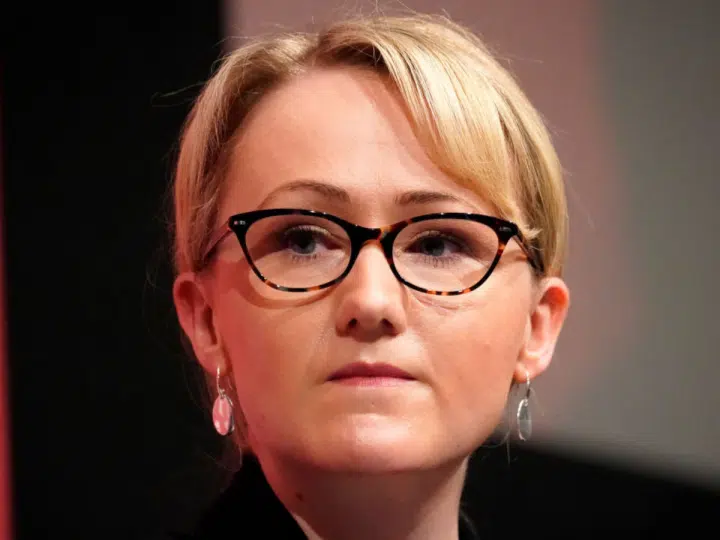
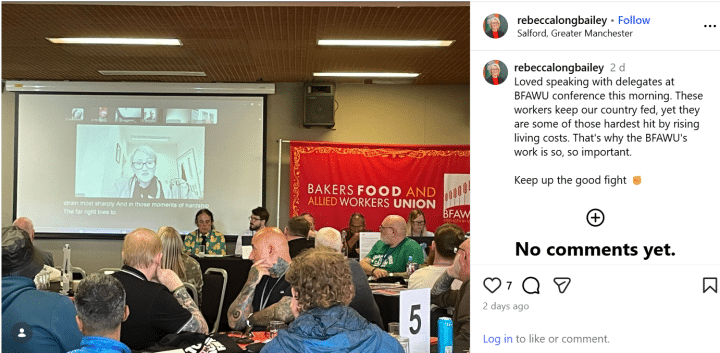
MP Rebecca Long Bailey recently spoke at the conference for the Bakers, Food and Allied Workers Union and delivered a fierce rebuke to what the Labour Party has become under Keir Starmer.
Referring to the murkiness of Peter Mandelson’s appointment, and the way in which the party has forgotten working class people, Long-Bailey insisted the party must remember and revive its trade union values.
Her calls coincide with millionaire Nigel Farage telling unions to “ditch Labour” and affiliate with his party which only truly seeks to benefit its vested interests — the super-rich.
These are the highlights from her address…
Long-Bailey’s wish is ‘more compassion, more courage, more unity’
During her conference speech, Long-Bailey discussed the struggle which ordinary people are living in, and how vulnerable our communities are to divisive parties like Farage’s racist Reform UK.
She said:
We’re in really unstable and worrying political times, and we’re gathering in a moment that demands so much from all of us.
More compassion, more courage and more unity because in difficult economic times — when families are struggling to get by, when wages are stagnant, rents are soaring and people are anxious about their futures — it’s our communities who feel the strain most sharply.
And in those moments of hardship the far right tries to seep into the cracks of society, whispering division, sowing hatred, pushing the poisonous idea that one group of people’s misfortune is somehow caused by another group’s existence. And we’ve been here before and we understand that racism and division don’t come from strength — they come from fear and manipulation.
The far-right feeds on despair, they feed on insecurity and on the deliberate neglect of working-class communities by those who hold power and wealth. And they’re trying to pit neighbour against neighbour, worker against worker, British-born against migrant, white against Black — while the real culprits of inequality, those who are extracting wealth from our labour and our public services, go unchallenged.
Public’s faith in Labour ‘shaken’
Long-Bailey then delivered a sharp criticism of what Starmer’s Labour has become under his woeful leadership.
The Labour MP said:
And you know, the very bulwark against it, the party that was created to challenge wealth and power and to hand it to our community needs — well, it’s lost its way. And I was at the local election count in Salford not so long ago.
Salford’s group, we were lucky that we were only one-third of seats up. But those one-third of seats were completely wiped out. I think we kept about two Labour seats out of all of them.
And I watched good people lose that should never have lost. Councillors who spent years fighting for their communities. Men and women who answered calls late at night from frightened residents, who battled for food banks, youth services, warm spaces and housing support, whilst Westminster barely even noticed that places like ours existed. People who worked themselves into exhaustion because they actually believed that public service still meant something.
And it wasn’t them who failed our communities. It wasn’t our local councillors who made pensioners freeze in the winter by cutting the winter fuel allowance. It wasn’t our local councillors who kept the cruel two-child cap and suspended MPs like me for voting to scrap it while children were going hungry. And it wasn’t our local councillors who talked about cutting support for disabled people who were already struggling to survive.
And whilst the party might have thankfully u-turned on all of these stupid and devastating policy decisions that no Labour government should have ever made, the damage was already done. And it was compounded by scandals in Westminster, people accepting free stuff left, right and centre, all the murky business about Peter Mandelson, and people’s faith in the Labour Party and what we actually stood for was shaken.
‘Labour in Westminster abandoned them first’
Long-Bailey pointed to how the party has forgotten its political tradition of fighting for the working class.
She said:
Our communities aren’t just some piece on the Westminster chessboard to be moved about by rich and powerful people. We know that it’s the woman working every hour she can and still lying awake wondering how she’s going to pay the bills. It’s the pensioners who spent 40 or 50 years working their hearts out and now sit wrapped in blankets because eating’s become a luxury.
It’s the lad in a warehouse breaking his back while billionaires are making more money than they are ever going to see in a lifetime. And it’s our community battered by cuts, poverty and neglect and are still somehow finding the strength to look after one another when they know politics has failed them.
Our communities are proud communities, they’re generous communities, working class communities with dignity and resilience running through their veins and they were crying out for a Labour government at the top to fight for them. From what I saw all those weeks ago, it was pain, it was anger and it was the same question asked time and time again: what does Labour actually stand for? And that’s why people turned away. Not because they abandoned Labour values, but because they felt that Labour in Westminster abandoned them first.
Without Labour, ‘what comes next could be very dark’
Stating that Labour is more scared of “upsetting billionaires and newspaper editors than actually looking after our working-class communities”, Long-Bailey says Labour has lost its soul.
In contrast, she argued that the party’s soul came from a working class movement that “demanded dignity and justice in a system that was rigged against them…to confront wealth and power, not sit comfortably beside it.”
Like many across the country, she believes Labour has abandoned much of that tradition, creating a political vacuum that parties such as Reform and the Green Party have moved to fill. Nevertheless, she remains convinced that the party can still recover and reconnect with its roots.
She said:
But despite everything they’re still searching for hope. They’re still desperate for the national party to stand for the very things that all of us do in this union and those values don’t come from dividing working people against each other because the real divide in this country isn’t between ordinary people — it’s between those who struggle to survive and those who profit from that struggle, and Labour should have the courage to say that again because Britain needs a movement with fire in its heart once more.
It’s got to have a movement that will rebuild council housing, rebuild industry, rebuild broken community — a movement that will redistribute wealth and power instead of allowing it to pool endlessly at the top. It is a movement that will stand shoulder to shoulder with our communities and say we will fight for you.
***
And what happened at that local election, it wasn’t just a bad night for Labour, it was existential. It was a siren call that if the Labour Party does not regain its soul and represent the very people it was created to serve, then put simply, it will cease to exist. And what comes next could be very, very dark. Hundreds of years of struggle and fight could be gone overnight. And that’s how pivotal this moment in history is.
Long-Bailey reaffirmed her earlier comments that the prime minister must go. She called for a timetable for transition and a new leader who will rebuild the Labour Party to properly represent working class communities who “deserve dignity, security, hope and a future worth believing in”.
Burnham: Not perfect but ‘better than where we are’
She then touched on Andy Burnham’s leadership bid, stating that he isn’t as left wing as she would like, but that she reckons he’s better than Starmer.
He’s done a really good job as Greater Manchester mayor. He seems to be quite popular on the doors in our community and, while he’s not as left as I would like him to be, he’s definitely better than where we are at the moment. And I think if he worked with every group in the party, and brought the left in on the ideas that we’ve been championing for so long, I think it could be hugely positive.
Immigration is not to blame for everything
Speaking about the bad actors seeking to scapegoat marginalised groups, the Salford MP criticised Labour for poor communication.
She said the party hasn’t been clearly explaining that the issues facing communities aren’t “due to immigration”.
It’s been caused by an economic model that’s been controlled by very powerful people who don’t have the interest about working past communities at heart for over 40 years.
What’s needed for change is a prime minister with “real trade union, working class values at their very heart”. A Labour leader who sounds and speaks like us, and with both feet in the “real world”.
…we’ve got to have somebody that sees outside of Westminster and actually understands what real people and real families are going through.
Featured image via Christopher Furlong/ Getty Image
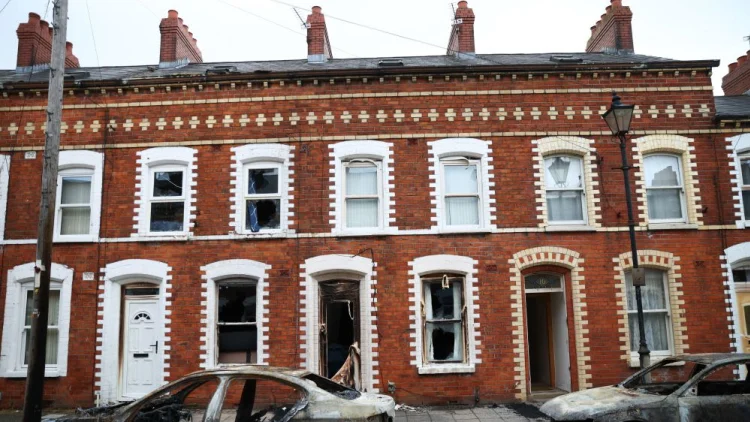

The Prime Minister said those responsible for the violence and disorder would “feel the full force of the law”. (Alamy)

2 min read
Keir Starmer has said that rioters who set fire to homes and cars in Belfast on Tuesday night targeted people because of their background, warning that he will not “tolerate it”.
He added that there is “no justification” for people “who encouraged it, online or elsewhere”.
The violent unrest in Northern Ireland on Tuesday night came after a man was charged with attempted murder in Belfast following a knife attack in the city, with footage of the attack shared widely on social media.
The Police Service of Northern Ireland (PSNI) said yesterday that the alleged attacker was of Sudanese descent and in his 30s. On Wednesday, he was named as Hadi Alodid. He is appearing in court this morning, accused of attempted murder. The court has heard that the victim, who remains in hospital, has lost his left eye as a result of the attack.
Footage showed rioters setting fire to vehicles and houses in Belfast on Tuesday night, which Northern Irish First Minister Michelle O’Neill condemned as “outright thuggery”. There were reports of masked groups targeting homes lived in by non-white residents.
In a statement this morning, Starmer said those responsible for the disorder overnight would “feel the full force of the law”.
“The scenes in Belfast last night were shocking and completely unacceptable. There is no justification for the violence and disorder that we saw threatening our communities, nor for those who encouraged it, online or elsewhere,” he said.
The PM added: “It is clear that people were targeted last night because of their background and I will not tolerate it.
“Those responsible will feel the full force of the law. I’ve spoken to the Chief Constable of the Police Service of Northern Ireland to convey my thanks to them and the frontline emergency services for their bravery in keeping people safe.
“I’ve also spoken to the First Minister and Deputy First Minister (Emma-Little Pengelly) to discuss the ongoing situation. Appealing for calm must be the priority, and that is what I urge now. We must let the police get on with their work.”
Rafe Fletcher is the founder of CWG.
Bed was the most attractive option after a 24-hour trip from Singapore to Maidstone last week. But our two hungry young children wanted an evening out at my in-laws’ favourite local Thai restaurant.
The food impressed discerning south-east Asian palates but the bill of £165 was steep for a fairly spartan order. Particularly for casual dining in a town less affluent than its surrounding villages. Those wealthier enclaves obscure Britain’s relative deprivation when it comes to average household disposable income. OECD figures from 2021 put this at US$26,884.
It lags not just other major European economies like France and Germany. But also, Slovenia, Ireland, and Belgium.
Recent rhetoric pins the blame on so-called profiteering.
But the Institute for Economic Affairs (IEA) counters the public perception that businesses are enjoying a profit bonanza at the consumer’s expense. In its April paper, A Growth Mindset?, Brits surveyed guessed the hospitality sector made a 40 per cent margin. In fact, it’s about five percent. The Kent proprietor pocketed only £8 from our custom after paying taxes, rent, suppliers, and salaries.
Findings were similar across the board.
Brits think rail companies make 45 per cent, supermarkets 50 per cent, and energy companies 57 per cent. The reality is three, three and 10 respectively. Most bizarrely, Brits also believe the NHS generates a 34 per cent profit. Given its revenue (in government funding) is over £200 billion, that would feasibly yield a trillion-dollar valuation resembling Meta or Apple. No wonder the story that Trump wanted to buy it gained traction.
It is, of course, not profitable in any way. And its sacred nature generates a consensus that anything else would be a moral transgression. That attitude pervades throughout public services. Hence, Pat McFadden’s unguarded moment of despair in his text to Peter Mandelson. McFadden lamented that Labour policy revolves around who it can tax to pay benefits to others. In other words, finding the money to give away stuff is its raison d’être.
Hosting Margaret Thatcher in 1985, Singapore’s founding Prime Minister Lee Kuan Yew praised her for challenging this attitude. Lee thought it complacent to assume “the creation of wealth came about naturally, and that what needed government attention and ingenuity was the redistribution of wealth”. Lee did not share Thatcher’s ideological attachment to the free market. He once refused her invitation to speak at the Conservative Party conference because his earlier political sympathies lay with the Labour Party. But he admired Thatcher’s obstinacy and believed her reforms necessary to arrest Britain’s economic malaise.
In his memoirs From Third World to First, Lee still assigns socialist origins to his outlook. He writes that unencumbered laissez-faire capitalism benefits too few. But he also believed the profit motive was fundamental in broadening wealth. He was ambivalent about whether this was delivered by the public or private sector, as long as it consistently produced more from less.
Sometimes this value-creation is straightforwardly commercial.
Singapore Airlines, established under Lee in 1972, has consistently been one of the world’s most profitable airlines. Like the other State-owned enterprises (SOEs) that together comprise almost a fifth of Singapore’s GDP, government ownership is no excuse for subsidisation. The same ethos applies to the country’s sovereign wealth funds, Temasek and GIC. They invest Singaporeans’ mandatory savings, seeking to generate returns above the guaranteed rates credited to contributors. The two entities currently have combined assets of around US$1.28 trillion.
The government exists not as a redistributive cost centre, but as a return-generating entity that invests in the country. Its public services provide wider and self-perpetuating value. For instance, Singaporeans pay for subsidised healthcare and housing through personalised savings accounts. In effect, its mandatory contributions are little different to taxation. But it creates accountability. The taxpayer expects a certain level of service for a bill they directly bear. And in turn, public services aren’t inundated with people using it like an all-you-can-eat buffet.
Atlanticist goggles sometimes cloud the right’s perception of Singapore. It is held up as a positive example of a small state and thriving free enterprise. But Singapore rejects that juxtaposition of an inefficient public sector and a productive private one. Given Britain’s post-1945 consensus has favoured big government, fixing it looks more realistic than shrinking it.
America’s laissez-faire model has put it top of that OECD disposable income pile. In 2021, its average household’s $46,425 was already $20,000 ahead of Britain’s. But the European countries that also sit above Britain operate with similarly interventionist governments. It implies that taxpayers are at least getting some value for their large contributions.
Staying in Amsterdam recently, next to the Eastern Docklands where the country’s own East India Company was an earlier paradigm of global capitalism, I heard familiar complaints. A resident friend talked about the perverse incentives of top marginal tax rates of 54 per cent. Other wealthy residents are spooked by new taxes on unrealised capital gains.
Yet the Netherlands sits comfortably above Britain when it comes to disposable income. The Dutch earn more and the cost of living is less. I don’t know the ins and outs of its national policy. But the recent ambitious extension to the Port of Rotterdam is an interesting contrast to Britain’s own HS2. The former was delivered on time and on budget and yields an annual profit. The latter is still uncompleted at a projected cost of $100 billion.
Britain finds itself in the worst of all worlds as it pursues what the journalist Christopher Snowdon calls a “capitalist command economy”. Businesses are technically in private hands but face a plethora of “instructions, targets and, increasingly, price controls”. It’s a cop-out in which the government intervenes but absolves itself of any duty to deliver.
Britain could make an evening out in Maidstone more affordable.
A less onerous minimum wage or pragmatic energy policies would lower businesses’ costs. Or it could try to make individuals richer, so £165 is a less significant chunk of take-home pay.
But instead, it makes profit the ignoble pursuit. And as it gives up on value creation, so it gives up on wealth.

If you’ve logged on to Twitter over the past few days, there’s one thing you’ve definitely seen, and that’s an image of Nigel Farage beating the governor of the Bank of England:

As it turns out, these deepfakes are being used to lure Farage fans into some sort of crypto scam. And the reason these scammers are using Farage as a lure is no doubt because the Reform leader has promoted crypto himself.
And this guy says he’s looking out for his supporters!
Farage de-bankered
If you’ve seen one image of Farage beating the Bank of England’s Andrew Bailey, you’ve seen several:
— MR B.E
 (@British_Enjoyer) June 9, 2026
The above image – in which Farage has a shooter – proclaims that “Britain needs to see this”. This suggests there was a live broadcast of Question Time in which the Reform leader pulled a gun on another guest, and that this somehow slipped under the radar.
In another image, things got so serious that America had to send one of their police officers over:
— MR B.E
(@British_Enjoyer) June 9, 2026
At this point, it’s almost like collecting Pokémon cards. And while the majority of the Pokémon in question are evolutions of Nigel Farage, there is now some variety:
Relieved to see a bit of variation from the meme accountshttps://t.co/n3Frfbvo2q
— Jessica Elgot (@jessicaelgot) June 9, 2026
We personally haven’t seen one of the rare/shiny Ed Milibands, but good luck catching them all.
Some questioned if the Faragalanche is a sign that Elon Musk’s advertising platform is struggling to attract serious clients:
All the ads in my Twitter feed are just AI images of Nigel Farage getting into fights on the set of Question Time.
This platform has to be losing so much money. pic.twitter.com/PhUj5yn3LV
— Tom Nicholas | Watch SLOW NEWS DAY on Nebula! (@Tom_Nicholas) June 9, 2026
Ironically, as the BBC highlighted:
Many of the adverts viewed by the BBC were posted by X user accounts with blue ticks – a symbol indicating a subscription to the platform’s Premium tier.
Platform owner Elon Musk previously touted changes to the verification badge as “the only realistic way to address advanced AI bot swarms taking over” after buying Twitter.
You can laugh at how ridiculous these images are, but the fact that there are so many demonstrates they’re working. People are clicking these. But what are they clicking themselves into?
Age of the Scam
By hovering over the links for some of the original posts used in the adverts, the BBC was able to identify that many of them would direct people to sites promoting AI cryptocurrency trading schemes or apps.
Hang on a minute, aren’t AI crypto schemes good? Because we seem to remember Nigel Farage promoting them?
I will be speaking at @TheBitcoinConf from 10pm UK time.
One-in-four 18 to 34 years olds own crypto.
Reform will take them seriously. https://t.co/LgyJdZ6FFe — Nigel Farage MP (@Nigel_Farage) May 29, 2025
“Take them seriously”, he said, as his wealthy backers rubbed their hands together. And lest we forget, Farage took £5m from a foreign-based crypto billionaire, and has been ducking media scrutiny since we learned of this:
Later this week it will have been 50 days since @Nigel_Farage last held a press conference.
Given he's had so long to get his story straight, @annaturley is calling on Farage to answer 50 key questions about his secret £5 million "gift". It's time he finally came clean. pic.twitter.com/G6ol6ZtiL7
— Labour Press (@labourpress) June 7, 2026
Here he is in April promoting the crypto scheme of former Tory chancellor Kwasi Kwarteng – the man who delivered the disastrous mini-budget:
BREAKING: Nigel Farage has purchased £2m of Bitcoin for Stack BTC – becoming the first sitting MP and the first UK political party leader in history to publicly buy Bitcoin.
A landmark moment for Bitcoin in British politics.$STAK @Nigel_Farage @blockchain @kwasi_stackbtc… pic.twitter.com/O614kKe5TN
— Stack BTC (@stackbtc_) April 13, 2026
No, Kwasi: your company gave Farage a sweetheart deal. A bonus he can exercise in just two years. Ordinary shareholders don't have this.
The penny-share nature of your firm means Farage is already ~£200k up (+93%). With crypto, hype creates value. https://t.co/maRks88jMO https://t.co/5v9a9j7m5K
— Fraser Nelson (@FraserNelson) April 13, 2026
Aren’t Reform supposed to be an antidote to the failed Tories?
People say that cryptocurrencies have no actual use. They say that because they’re too volatile to use as – you know – currency. Saying they’re ‘useless’, however, ignores two clear use cases:
- Purchasing contraband outside the ordinary financial system.
- Scams.
On the latter, Morgan Stanley writes:
-
Scammers target cryptocurrency because transfers are fast and typically irreversible.
-
Americans lose billions of dollars to crypto scammers each year, often through “too good to be true” tactics like doubling your investments, fake giveaways or job-fee scams.
While the above relates to Americans, don’t worry; Farage and his ilk are determined to import all of America’s ills. And for a sign of what that will look like should Farage take power, just look at what his buddy Trump has been up to:
The $TRUMP meme coin is one of four crypto projects that have turned into a financial jackpot for the president's family and a very bad bet for buyers. https://t.co/mg2JIJvnem
— HuffPost (@HuffPost) June 9, 2026
The Official Trump Meme Coin has now lost 98% of its value. — Peter Mallouk (@PeterMallouk) June 9, 2026
Elected officials should not be issuing, promoting, and profiting from speculative financial assets.
This should be illegal. pic.twitter.com/Bd1JV57SnI
Since taking office last year, the Trump family has amassed a staggering $2.3 billion fortune from crypto deals alone.
Any crypto legislation needs to stop the massive conflict of interests posed by Donald Trump and his family’s crypto ventures. pic.twitter.com/agarS1SuPV
— Elizabeth Warren (@SenWarren) June 9, 2026
Cattle
Here’s what Farage said about the ads, as reported by the BBC:
Speaking to broadcasters during a visit to Grangemouth on Tuesday, [Farage] added that he did not know “whether to laugh or whether to be angry” about the fake ads.
“The trouble is it’s an AI fake but it looks real in every way, and people know that the governor and I have had our disagreements over things over the years,” he said.
You’ll notice he didn’t go into detail about what the ads were pushing. He couldn’t; if he did, he’d be drawing attention to the fact that crypto is the biggest scam since snake oil.
In all likelihood, the people who are falling for these scams are doing so because they’ve bought into Farage’s shtick. This means many of them are the sort of people who deserve to get ripped off. It’s a problem for Farage, anyway, because the thing they’re getting ripped off by is the thing he’s telling them to invest in.
The question is this: is it a problem because they’re getting ripped off? Or is it a problem because they’re getting ripped off without Farage himself profiting?
Featured image via Paul Reid (Getty Images)
By Willem Moore

Serena Williams walked back into professional tennis after nearly four years away and immediately reminded the sport what she still carries: presence, power, and a competitive edge that hasn’t dimmed with time.
At 44, the 23‑time Grand Slam singles champion made a winning comeback in the doubles event at Queen’s, partnering 17‑year‑old Canadian Victoria Mboko to defeat third seeds Nicole Melichar‑Martinez and Erin Routliffe 7‑6 (7‑2) 6‑2. It was Williams’ first professional match since the 2022 US Open, and her first ever appearance at the historic Queen’s Club.
The reception matched the moment. A standing ovation greeted her as she stepped onto the Andy Murray Arena, a venue she had never played during her singles career. The response was warm, loud, and unmistakably appreciative of a player whose legacy stretches far beyond the numbers.
Serena Williams sets the tone
Williams and Mboko, an unseeded pairing with a 27‑year age gap, settled quickly into the contest. Williams’ serve was still heavy, still explosive and it clocked speeds up to 120 mph, a reminder that her trademark weapon remains intact.
The early break they secured didn’t hold, with Melichar‑Martinez and Routliffe recovering to force a tie‑break. The tie‑break belonged entirely to Williams and Mboko. They were confidently hitting, with smart court coverage, and a composed finish saw them take it 7‑2.
It was the kind of opening set that signalled Williams wasn’t here for nostalgia. She was here to compete.
Control and a calm finish
The second set was more straightforward, with Williams and Mboko secured a double break, tightening their grip on the match as the crowd leaned into every point. Williams fired two aces in the final game, closing out the win with the kind of authority that defined her peak years.
For a player who has spoken openly about “evolving” away from tennis rather than retiring, this was a return that looked natural, not forced. The movement was sharp, the timing improved as the match went on, and the partnership with Mboko, despite being brand new, clicked immediately.
A win achieved with ease, not expectation
Williams credited Mboko for her composure and impact, noting how naturally their games meshed despite having never played together before. The teenager held her own in the big moments, matching Williams’ intensity and contributing key points in both sets.
The dynamic was clear: Williams’ experience and power paired with Mboko’s energy and athleticism created a balanced, effective team. Their quarter-final opponents Leylah Fernandez and Laura Siegemund, will offer a different test, but the early signs suggest Williams and Mboko are more than just a feel‑good story.
Why Queen’s?
Williams’ decision to return at Queen’s raised eyebrows, but her explanation was characteristically straightforward. With her children out of school for the summer and a desire to play at a venue she had only ever watched from afar, the timing made sense.
Queen’s has long been a staple of the men’s grass‑court season, but its expansion to include women’s events created an opportunity Williams had never previously been able to take. For a player who has spent her career breaking norms, her debut at 44 felt fitting.
Just Tennis
Ahead of the tournament, Williams made it clear she had nothing to prove. Her competitive comeback wasn’t framed as a chase for records or a final push toward another major. Instead, it was about enjoyment, a fresh challenge, and reconnecting with a sport she shaped for more than two decades.
Her schedule reflects that mindset. She is set to play doubles at the Berlin Open next week, but has not confirmed whether she will enter Wimbledon. The door is open, but there is no rush, no pressure, no narrative being forced.
A return that resonates without hype
Williams’ comeback doesn’t need over‑dramatization.
It is a story rooted in longevity, not sentiment. Williams’ presence alone elevates any court she steps on, but her level of play, sharp, purposeful, competitive, is what makes this return meaningful.
The quarter‑final at Queen’s will offer a clearer picture of where Williams’ game sits in a competitive context. Fernandez and Siegemund are experienced, tactically smart, and comfortable on grass. It will be a different kind of test, one that requires rhythm and cohesion.
Williams has already achieved something significant: she has returned to professional tennis with a win, with authority, and with the same unmistakable aura that defined her prime.
Whether this comeback becomes a short chapter or a longer run, Serena Williams is clearly still a dazzling powerhouse.
Featured image via Getty/Paul Harding
By Faz Ali

Racist thugs have carried out a wave of pogroms in Belfast and nearby towns, setting fire to homes belonging to people of colour. The rioters also attacked businesses that they thought were the property of ‘foreigners’, ignited vehicles, and blocked roads.
The hate crimes followed an attack carried out in North Belfast, allegedly by a Sudanese man on the evening of Monday June 8. Footage shows the assailant on top of another man, with the attacker using a large knife to stab his victim. Police have charged the alleged perpetrator with attempted murder. The BBC reported on the status of the victim, saying:
A man in his 40s remains in hospital with serious injuries to his eyes, neck and back…
Since the attack, racist groups across social media have attempted to whip up a frenzy, using sensationalised imagery of the attack to exacerbate outrage. The Official Protestant Coalition page, notorious for attempting to incite riots, has subsequently celebrated the carnage. They have posted numerous scenes of destruction alongside heart emojis.
Concerned Parents Newtownabbey (CPN), whose racist and Islamophobic displays are responsible for creating a climate in which hate flourishes, sought to aid the destruction by urging people to turn off Ring doorbells and CCTV. This was to ensure hooligans would be less likely to be caught on camera.
Belfast: vile racists burn homes
Spurred on by this climate, mobs of masked white men set about wrecking the city and driving innocent families from their homes. In the area where CPN have put their hateful AI-generated abominations, hundreds of masked men roamed the area and set fire to vehicles.
On the Newtownards Road in East Belfast, thugs set a bus on fire. Footage on the X account BreakinNewz shows criminals entering a terraced house and setting the property on fire. One shouts “fuck the foreigners!”.
#Breaking — BreakinNewz (@BreakinNewz01) June 9, 2026
 #Ireland Footage showing multiple houses holding migrants have been set on fire in Belfast. pic.twitter.com/XztgrogOLF
In a reply to the same tweet, drone footage shows houses burning in what may be the aftermath of the first attack shown, or one of the other numerous acts of ethnic cleansing carried out by racist mobs. The Canary spoke to local activists working in migrant support networks, who said thugs torched at least ten homes. Countless more have fled their homes in terror.
The worst violence took place in loyalist locales, though there were also reports of small groups from nationalist areas taking part in the disorder.
The Northern Ireland Fire & Rescue Service (NIFRS) said they had:
…managed 256 calls resulting in attendance at 62 incidents.
NIFRS brought in “21 fire appliances” (usually meaning fire trucks) from across the north of Ireland to deal with the chaos.
DUP and TUV stir up mob
Democratic Unionist Party (DUP) politicians have performed their usual cynical dance of calling for calm, while simultaneously inciting a febrile atmosphere by emphasising a link between immigration and violence. Party leader Gavin Robinson did both in the Commons. He connected fictional “uncontrolled immigration” to the North Belfast attack, while warning about potential violent disorder in response.
DUP education minister Paul Givan did likewise on TalkTV. This is, of course, the same man who celebrates the horrors carried out by his favourite ethnostate, so-called ‘Israel’.
Traditional Unionist Voice leader Jim Allister went further still, complaining to hatemongers GB News about “people of violent disposition” with an “alien culture”. He suggested such violence is alien to “British culture”.
Far from being alien, extreme violence has been central to British culture for centuries. It was what enabled its empire to murder millions of people, and British brutality continues to this very day through their participation in the Gaza genocide.
The north of Ireland had thirty years of violence carried out almost exclusively by white men. The island as a whole endured 800 years of intermittent conflict, with British colonialism at the root. Hundreds of white men now carry out yearly violent pogroms against other ethnic groups. The north of Ireland has appalling gender violence rates, again perpetrated almost entirely by white men. Yet Allister and co expect us to believe that this Eden, a paradise of uninterrupted pacifism, has been robbed of its innocence by one Sudanese interloper.
In reality, the above politicians practice selective outrage when certain acts of violence have particular political use. That is, to convince the constituents they routinely fail that the problems in their lives are the result of immigrants, rather than useless politicians.
Ethnic cleansing now routine event in north of Ireland
People Before Profit’s Fiona Ferguson had a more sensible take, highlighting how:
…defence of workers’ rights, the fight for better living conditions, the fight for housing, the fight for public services and the fight against racism are one and the same.
She was calling on trade unions to recognise the scale of racist violence in Ireland and get more involved to stop it. The reality is stark: in the Six Counties, white thugs carrying out ethnic cleansing based on race has become a routine occurrence. It has happened three summers in a row, and all indicators are that racists and Islamophobes are becoming emboldened rather than deterred.
Inspired by a global far-right acting with impunity, and motivated by short-term political gain that distracts from their own incompetence, the worst of the unionist political class are happy to see their own towns and cities burn rather than confront this dystopian reality.
Featured image via Getty/Charles McQuillan


Credit: 2026 Sport England. All Rights Reserved

Lisa Dodd-Mayne, Executive Director, Partnerships and Place
| Sport England
As devolution reshapes local decision-making across England, Sport England is urging leaders to embed physical activity into plans for healthier, more connected and economically resilient communities.
Devolution is fundamentally about how places work.
As new strategic authorities take shape and local government reorganisation continues across England, decisions about transport, housing, economic growth and public services are increasingly being made at a more local level – closer to the realities of place.
In that context, sport and physical activity cut across many of these issues shaping local places.
Sport and physical activity are often treated as standalone services, sitting within leisure budgets and recreation planning. Yet in practice, they sit at the intersection of some of the most important outcomes facing local leaders – health, opportunity, transport connectivity and community cohesion.
The focus is less on whether physical activity is relevant to devolution, and more on how early it is considered in the conversation.
When brought in late, sport and physical activity can often be treated as add-ons. When considered from the outset, they become part of how places are designed, how communities function and how local systems operate.
That distinction matters.
The evidence base is substantial. Our latest research estimates that, in the last year alone, community sport and physical activity generated more than £122bn in social value across England. That includes improved wellbeing, stronger social connections and reduced pressure on health and care services.
In other words, this is not a standalone area. Its relevance is most clearly seen not in isolation, but through its interaction with wider priorities and systems.
Take transport.
As active travel becomes more central to local and regional transport planning, walking, wheeling and cycling are increasingly being discussed alongside congestion, air quality and carbon reduction. But they are also fundamentally about how people access jobs, education, services and opportunity.
When physical activity is built into transport planning from the outset, it helps shape systems that support everyday movement.
The same applies to housing and planning.
As local areas plan for growth and new development, there is growing emphasis on placemaking and design quality. Access to green space, safe walking and cycling routes, and opportunities for recreation are increasingly recognised as core features of successful communities.
These are not peripheral considerations. They influence long-term health outcomes, social interaction and the liveability of new places over decades.
In regeneration and economic development, the link is equally clear.
Investment in public spaces, parks, leisure infrastructure and active travel networks contributes to places that are more attractive to live in, work in and invest in. Major events bring visibility and economic uplift, but the quality of everyday environments also determines whether places feel active and connected.
There is also a growing intersection with health.
Local health systems are managing rising demand linked to inactivity, long-term conditions and poor mental wellbeing. This is not a challenge can be addressed in isolation.
Physical activity is increasingly being considered as part of wider prevention-focused approaches – not as a substitute for clinical care, but as a complementary part of how people stay well for longer and remain connected to their communities.
This is where place-based working becomes particularly relevant.
One of the most consistent lessons from devolution to date is that outcomes improve when organisations work around place and shared priorities.
Place-based approaches allow local partners to align investment, insight and delivery around the specific needs of communities, rather than the structures of individual services.
Sport and physical activity fit naturally into this way of working.
In Greater Manchester, GM Moving has become a widely referenced example of this approach in practice. Physical activity has been positioned within a broader system focus on population health, inequalities and wellbeing, bringing together local authorities, health partners, voluntary organisations and communities around shared outcomes.
Importantly, this has not been driven by a single organisation, but through sustained collaboration across the system.
A similar approach can be seen in Cumbria, where partners have worked across rural and dispersed communities to better align physical activity provision with local need. The focus there has been on accessibility, place-specific barriers and collaboration across sectors to ensure activity reflects geography.
While the contexts differ, the underlying principle is consistent – physical activity has the greatest impact when it is embedded in wider place-based strategies, rather than operating alongside them.
That’s why we’re expanding our focus on place-based investment, including a £250m commitment to more than 90 communities experiencing the highest levels of inactivity and inequality. The aim is to support long-term, locally-led approaches, shaped by local evidence and delivered in partnership with wider system stakeholders. Through this work, we’re connecting Active Partnerships, local government, health, transport, education and voluntary sector organisations. The focus is increasingly on enabling collaboration across systems, rather than delivering in isolation.
As devolution continues to evolve, different areas will naturally take different approaches based on their priorities and governance models. That variation is both expected and necessary.
But across those differences, one theme is becoming clearer.
Where physical activity is linked to wider strategic goals – whether that is improving health, supporting growth, strengthening communities or improving quality of place – it is more likely to be sustained, scaled and embedded.
The opportunity, then, is not to elevate sport and physical activity as a separate agenda, but to recognise its role within the decisions that are already reshaping places.
Recognising the pace of change across devolution and local government reorganisation, Sport England has recently published a Devolution Policy Position Statement to help local leaders, strategic authorities and partners better understand the role sport and physical activity can play in delivering local growth, prevention and wellbeing ambitions. Further information, guidance and support can be accessed at www.sportengland.org/devolution-statement.

Andy Burnham is right to put social care at the heart of the political debate. He’s also right to say politicians shouldn’t “flinch” from difficult conversations about funding.
But if social care reform becomes yet another argument about who pays, we’ll miss a much bigger problem hiding in plain sight.
The uncomfortable truth is that we’ve built a social care system that spends too much time deciding who doesn’t qualify for support.
Funding matters. There is no question that local authorities need greater resources to meet growing demand. But the solution to a social care system that works for everyone goes beyond funding alone.

MDU warns Chancellor clinical negligence system ‘not fit for purpose’

Northern Ireland RE curriculum is ‘indoctrination’ – Supreme Court
At Access Social Care, we provide free legal advice to people trying to access the support they need to live independently and participate fully in their communities. What we see time and again is a system that creates barriers to care through rationing.
That isn’t because social workers or council staff don’t care – far from it. It is because financial pressures have shaped a culture where the priority often becomes managing demand rather than promoting wellbeing.
When budgets are stretched, the incentive is to restrict access, tighten eligibility and focus resources on those in the most acute need. Support that could prevent problems from escalating is delayed or denied because the system is under pressure to concentrate on immediate crises.
The result is a vicious cycle. A disabled person who could remain in work with the right support loses their independence. An older person struggles at home until a preventable fall lands them in hospital. An unpaid carer carries more and more responsibility until they reach breaking point themselves.
These outcomes are bad for individuals, bad for families and, ultimately, bad for public finances. Yet too often they are treated as inevitable.
What makes this particularly troubling is that it runs counter to the principles at the heart of the Care Act. The legislation is built around wellbeing. It recognises that social care should help people maintain dignity, independence, relationships and control over their own lives.
A system built around wellbeing cannot be judged by how effectively it keeps people out. Yet that is often what happens in practice. Cycles of review, reassessment and cuts can become exercises in reducing support rather than understanding what people need to live well.
This is why I welcome Andy Burnham’s intervention. Social care has too often been treated as an issue that can be postponed until another day. It is encouraging to hear a politician with leadership ambitions recognising it as one of the defining challenges of our time.
But real reform requires more than a new funding settlement. We need a deeper cultural shift away from rationing and towards prevention. Away from gatekeeping and towards enabling people to live the lives they want. Away from asking how many people we can keep out of the system and towards asking how many people we can help thrive.
Politicians are right to debate how social care should be funded. They should. But they also need to answer a more fundamental question: what is social care actually for? Because until we stop measuring success by how many people we can exclude, we’ll never build the system people deserve.



UK households are still feeling the squeeze, and the weekly shop remains one of their biggest pressure points. With economic headwinds set to persist, that strain is unlikely to ease soon.
Rising energy prices, global instability, and the cumulative impact of government policy are all adding to the costs faced by food and drink manufacturers. The Food and Drink Federation now expects food inflation to reach around 10 per cent by the end of 2026.1
Families face a cost-of-living emergency – and the government needs to act now to minimise the impact.
Food and drink manufacturers are already playing their part
At Suntory Beverage & Food GB&I, the makers of Lucozade and Ribena, we are investing in British manufacturing. Our Coleford factory in Gloucestershire has been producing Ribena since 1946. It is a heritage site rooted in the Forest of Dean, but also part of a modern global business combining long-term Japanese investment and expertise with iconic British brands.
We are investing £57m to update our manufacturing capability, including a new high-speed manufacturing line and a more efficient blackcurrant presser.
These investments support regional jobs, modernise production and help us continue making the drinks consumers know and love at an affordable price.
But business investment alone cannot keep a lid on rising costs.
Government has a role to play, too
Food and drink manufacturers have not received the same support as other sectors. We know ministers face difficult choices and public money is limited, but there are ways to help businesses manage costs without increasing taxpayer spending.
The most important is policy stability.
Government must look carefully at the cumulative impact of regulation on food and drink manufacturers, especially when families are facing growing bills. The most immediate lever that can be pulled is to stop the application of the updated 2018 Nutrient Profiling Model (NPM) to existing High in Fat, Salt and Sugar (HFSS) restrictions.
An unnecessary change that hits consumers hardest
The NPM is the system the government uses to determine whether products are classified as “less healthy”, or “HFSS”. Products that are classified as HFSS face restrictions on advertising, placement and price promotions.
We recognise that we have a role to play in tackling obesity, which is why SBF GB&I was an early mover on sugar reduction. We invested heavily to remove more than 50 per cent of the sugar from our drinks – long before the HFSS rules came into effect.
Applying the updated model now creates two obvious problems. First, it moves the goalposts for the very businesses that have already invested, reformulated and adapted to the current rules in good faith. Then, it removes promotional benefits from consumers at the worst possible time.
For soft drinks, the change would be significant. The updated model would mean only drinks with less than 0.9g of sugar per 100ml could be promoted. It would bring a huge number of iconic British brands into scope, including much of our long-reformulated portfolio that is there to help hardworking families through their day.
This is not a small technical adjustment. It would also see shoppers being unable to benefit from deals on their favourite food and drink, while creating further uncertainty for manufacturers at precisely the moment they are being asked to invest, innovate and help shield households from rising costs.
There is also a basic sequencing issue. The most recent changes only happened in January under the existing model. Those rules should be evaluated properly before deciding to go further.
One simple solution
The government should take a moment to reconsider. It must retain the 2004/05 NPM for current HFSS advertising, placement and promotions restrictions.
The existing framework is already encouraging reformulation and should be given time to work. Indeed, the FDF’s latest Shaping a Healthier Future report finds that, in the last five years, the food and drink industry has cut the salt, sugar and calories they contribute to the British grocery market by nearly a fifth.
If ministers do decide to proceed with the updated model, implementation should be delayed. Any change must be backed by a full impact assessment covering business costs, product availability, innovation, investment and consumer prices.
SBF GB&I is investing in the UK and doing what it can to manage rising costs. The best support the government can give now is stability: retain the existing NPM, give current HFSS rules time to work, and avoid adding further uncertainty for manufacturers and families.
References

The post The England penalties joke that ended Andrew Lawrence’s career appeared first on spiked.

‘Guardians of the Galaxy’ Meets ‘The Lord of the Rings’ in This Fantasy Adventure Sleeper Hit

Rebecca Long-Bailey’s union speech is a rallying cry for the working class

FXRP on Cardano? Flare explores LayerZero DVN



-

 Fashion5 days ago
Weekend Open Thread: Evereve – Corporette.com
-
 Crypto World5 days ago
Jensen Huang Approves Samsung, SK Hynix, and Micron for NVIDIA (NVDA) HBM4 Memory Supply
-

 Crypto World2 days ago
Anatomy of the June crypto crash: Fed, Iran, Saylor
-
 Entertainment3 days ago
The Best Mystery Series of All Time Is Surging on Streaming 30 Years After It Ended
-

 NewsBeat2 days ago
Alexander Zverev wins the French Open to finally earn a 1st Grand Slam title
-

 Tech4 days ago
Suspicious Polyfill login prompts pop up on Toshiba, Muji websites
-
 Crypto World4 days ago
Senator Cynthia Lummis Calls CLARITY Act the Most Consequential Financial Legislation of This Generation
-

 Tech3 days ago
Microsoft unveils seven homegrown AI models in new bid for ‘long term self-sufficiency’
-

 Tech5 days ago
Microsoft launches MXC, an OS-level sandbox for AI agents, with OpenAI and Nvidia already on board
-

 Business5 days ago
(VIDEO) Justin Bieber Delivers Surprise Happy Birthday Serenade to Diners at Los Angeles Mexican Restaurant
-
 Business3 days ago
The Pain Points Taking a Fragile Tech Rally Down a Notch
-
Crypto World5 days ago
LBank Surpasses 25 Million Users Worldwide as AFA Partnership Continues to Drive Global Growth
-

 Crypto World3 days ago
Trump’s AI Ownership Plan Could Benefit Anthropic at OpenAI’s Expense
-

 Tech5 days ago
Meta steals a tactic from Tesla and builds data centers in tents
-

 Tech4 days ago
Von der Leyen’s AI envoy pick draws conflict-of-interest fire
-
 Sports18 hours ago
Bangladesh beat Australia after 20 years in ODIs, register only their second win over six-time world champions | Cricket News
-

 Business2 days ago
High Stakes for Wembanyama as New York Pushes for 3-0 Lead
-
 Crypto World2 days ago
Eli Lilly (LLY) Stock Surges 4% Following Breakthrough Sleep Apnea Trial Results
-

 Tech4 days ago
Hackers now exploit SolarWinds Serv-U flaw to crash servers
-

 Tech2 days ago
Notion restores access to Anthropic after service disruption
You must be logged in to post a comment Login