

Politics
Protest scheduled outside ‘ludicrous’ trial of movement leaders


A protest has been scheduled outside Westminster Magistrates’ Court on Wednesday 1 April at 9am. Supporters are expecting to hear the verdict in the trial of two leaders of the Palestine movement.
Ben Jamal, director of Palestine Solidarity Campaign (PSC), and Chris Nineham, vice chair of Stop the War Coalition (SWC), were both charged with public order offences in 2025.
A test case for new police powers
The charges relate to a protest organised outside BBC Portland Place on 18 January 2025. It was scheduled to be the 22nd march for Palestine after 15 months of sustained demonstrations. All of the previous protests had be peaceful and lawful.
The march to BBC Portland Place was no exception. Demonstrators intended to lay flowers outside the building in memory of those killed in Gaza or, if stopped by police, to lay flowers at their feet.
Police originally allowed the protest to take place, after making a request to postpone it, which the organisers agreed too. However, following complaints submitted by various representatives within the Jewish community – including the Jewish Leadership Council (JLC), Central London Synagogue and the Chief Rabbi – permission was withdrawn on the grounds of ‘cumulative disruption’.
The use of such powers was not formalised by the government until October 2025. Nevertheless, they were tested haphazardly on those marching that day.
The Metropolitan Police alleged the breach of protest conditions was ‘coordinated’ and deliberate. The Canary previously reported on various ‘inaccuracies’ in the Met’s version of events.
‘Ludicrous’ criminalisation
During Jamal and Nineham’s trial, which spanned three weeks, the court heard all about the chaotic policing operation on the day of the protest. This included the claim that police officers on the ground had no knowledge that a small delegation wanted to walk to the BBC to lay flowers.
The defence argued that there was no case to answer, but this rejected by the judge without giving reasons. The defence barrister described the Crown’s case as a
ludicrous invitation to criminalise legitimate protected political speech about the misuse of state power against people’s civil liberties.
As Jamal and Nineham await the verdict in their case, Stop the War Coalition are now inviting supporters to gather outside the court. Speakers at the protest on Wednesday include RMT union general secretary Eddie Dempsey, PCS union president Martin Cavanagh and Holocaust survivor Stephen Kapos.



Zack Polanski has slammed the government for banning Twitch streamer Hasan Piker and news anchor Cenk Uygur from entering the country. As we reported, it follows a pattern of this Labour government using any means at its disposal to clamp down on the civil liberties of those who oppose Israel. And we’re far from the only ones to make this argument:
Shabana Mahmood, we’re told will get a senior position in an Andy Burnham government.
She needs to explain this strange and worrying decision, and Andy Burnham needs to make his view clear.
— Zack Polanski (@ZackPolanski) June 1, 2026
Polanski was set to be interviewed
Piker was due to spend seven days in the UK, and planned to speak with Polanski in addition to Jeremy Corbyn and Yanis Varoufakis. Piker said the following in response to the ban:
ironic because a year ago, i delivered a speech at oxford union about the dangers of conflating judaism and zionism & how this foments antisemitism. since then the government has arrested pensioners for protesting against israel and let iof war criminals roam free! https://t.co/C6f9poXFR3
— hasanabi (@hasanthehun) June 1, 2026
Uygur, meanwhile, said this:
It's an honor to have made Israel's enemies list. I'm very proud to have fought against their genocide.
The mighty United Kingdom is afraid of speech that shows you who's responsible for those war crimes. But no amount of censorship will get us to stop telling the truth. — Cenk Uygur (@cenkuygur) June 1, 2026
We go into the decision to ban Piker in much further detail here. Back to Polanski, he’s absolutely correct to call out Shabana Mahmood and the Home Office. This is the government department which labelled Palestine Action a terrorist group. This action led to the mass arrests of activists who refused to be bowed by the government:
BREAKING: Police move in to arrest action takers from People Against Genocide, who were blockading an Israeli military drone factory in Staffordshire.
The factory, UAV Engines, is owned by Israeli weapons firm Elbit Systems, manufacturers of 85% of Israel's killer drone fleet. pic.twitter.com/1Wr4PIxi95
— The Aftershock (@The_Aftershock_) June 1, 2026
Police have made 2100 arrests under terrorism laws in the UK for protesting peacefully against the banning of Palestine Action. This cannot go unchallenged. The UK’s chief prosecutors must now decide whether to prosecute them. We need to urge them not to. Add your name to the…
— Andrew Feinstein (@andrewfeinstein) November 11, 2025
The government has also used duplicitous tactics to criminalise members of Palestine Action:
Four of the Palestine Action protestors have been convicted by jury of criminal damage.
At no point was it put to the jury that the judge may sentence them as terrorists.
This is unprecedented move and could set a further dangerous precedent for future cases relating to…
— Apsana Begum MP (@ApsanaBegumMP) May 28, 2026
Wider response
Ash Sarkar of Novara Media is among those who have spoken out against the decision:
I was supposed to chair the [Piker] discussion at SXSW this week, who’s been banned from entering the UK by Shabana Mahmood.
First of all, [SXSW] must facilitate a way for Hasan and Cenk to contribute remotely, as a bare minimum refusal to comply with government censorship. Secondly, it’s abundantly clear that the UK government has put Israel at the heart of its policymaking around free expression.
Whether it’s proscribing Palestine Action as a terrorist group, arresting hundreds of people for holding signs supporting it… or banning [Uygur] and Hasan Piker from the UK for speech acts *which would not be unlawful in this country*, what we’re witnessing is an authoritarian turn motivated by Labour’s fear of being called antisemitic, and fear of being called out for their position on the genocidal war on Gaza.
Sarkar added:
So, with Cenk and Hasan having their visas revoked, what are people gonna do? They’re going to look at things which are absolutely true – e.g. that those who served in the IDF, and may have been participants in or witnesses to war crimes, can travel to the UK freely.
SXSW, meanwhile, issued the following mealy mouthed response:
SXSW London has released a statement regarding speakers Hasan Piker and Cenk Uygur being barred from entering the U.K.:
“Decisions on entry to the U.K. are a matter for the Home Office and the individuals concerned. SXSW London’s role is to convene a broad range of diverse…
— Variety (@Variety) June 1, 2026
Jeremy Corbyn also spoke out:
Banning Cenk Uyghur and Hasan Piker from entering the UK is an absurd and cowardly decision from an increasingly authoritarian government.
Let us call this what it is: an attack on the freedom to criticise Israel, as well as the UK government’s own complicity in genocide. https://t.co/c6jUrF3prA — Jeremy Corbyn (@jeremycorbyn) June 1, 2026
Declassified UK said:
The UK has barred Hasan Piker and Cenk Uygur from entering the country, with both saying it's in response to their criticism of Israel.
Yet Brits who have fought for the IDF can return home without any investigation.
Our campaign seeks to change that:https://t.co/ctAGZEmANW
— Declassified UK (@declassifiedUK) June 1, 2026
Piers Morgan has often hosted Uygur, and was duly appalled at the decision to ban him from the country:
WHAT? This is ridiculous. https://t.co/V2IoENnqY4
— Piers Morgan (@piersmorgan) June 1, 2026
Morgan further said:
Not true. I only support banning people who advocate violence or who spew hateful bigotry against people based on their ethnicity/religion. — Piers Morgan (@piersmorgan) June 1, 2026
Where has Cenk done that?
His rage has been against the Israel govt and its policies.
Free speech should protect that. https://t.co/4xtjStFCsa
Centrist commentator Lewis Goodall had this to say:
The Kanye case was far more borderline but the idea of this becoming more routine was exactly my fear when I spoke/wrote about my unease at his prohibition from the country a few months ago. https://t.co/nHWyi6cItK https://t.co/DJ9zQmBIQZ
— Lewis Goodall (@lewis_goodall) June 1, 2026
In defence of
Standing alone as ever, Starmer cheerleader Paul Mason celebrated the clampdown:
Britain is becoming a #MilitantDemocracy – bad for the grift business, good for us! pic.twitter.com/BlD0Nzbtal
— Paul Mason (@paulmasonnews) June 1, 2026
Although Mason was a prominent voice on the British left during the Corbyn years, he went on to become a wannabe spook. In aid of his spookery, Mason produced the following (allegedly) – a notorious work of conspiracism that’s seen him ridiculed for years:
Paul Mason's cocaine binge mind map has two Left/Over guests, all my mutuals and the nation of China as different nodes pic.twitter.com/Eysx3rREmt
— Ghostface Kafka (36 Chambers) (@thekafkadude) June 5, 2022
As Aaron Bastani of Novara pointed out, this unfathomable spider diagram included some very odd connections:
Disagreeing with Paul Mason on twitter is now evidence of…antisemitism?
Do you actually believe that @tom_belger?
The ‘bile’ is partly because the man himself made conspiratorial flow charts (including a line between Novara Media and the ‘black community’). pic.twitter.com/pW7ACdkKXq — Aaron Bastani (@AaronBastani) June 20, 2023
Double standards
While Piker is barred from the UK, US politicians are posing with Bezalel Smotrich in New York:
Why is it controversial for Zohran to skip a parade bc of his principles but not for Democratic politicians to march with a fascist bigot like Smotrich? https://t.co/wWA72Ewym8
— Ben Rhodes (@brhodes) June 1, 2026
This is what HG reported for the Canary on Smotrich:
Smotrich is the leader of the far-right Religious Zionist party and an illegal settler who lives in the Occupied West Bank. His Ministry of Finance owns an arms factory in the UK, which has recently been awarded contracts with the UK government.
Smotrich has repeatedly called for Israel to completely ethnically cleanse all 1.8m people from Gaza, so it can ‘be settled’.
Piker’s ‘crime’, meanwhile, is pointing out that guys like Smotrich deserve universal condemnation.
Featured image via Kris Connor (Getty Images) / Jon Rowley (Getty Images) / Martin Sylvest Andersen (Getty Images)
By Willem Moore


Communities, activists and civil society organisations from Africa, Europe and North America staged coordinated protests, community dialogues, cultural events and public forums this week to coincide with TotalEnergies’ Annual General Meeting.
Meanwhile, police arrested activists in New York during an action targeting JP Morgan Chase over its support for fossil fuel projects. This includes the controversial East African Crude Oil Pipeline (EACOP).
Spotlight on TotalEnergies
The protests coincided with the TotalEnergies AGM, where shareholders gathered. Organisers used the occasion to spotlight projects such as EACOP, Mozambique LNG and other fossil fuel developments associated with TotalEnergies.
Organisers in New York temporarily shut down the headquarters of JP Morgan Chase. They called on the bank to end support for TotalEnergies and EACOP, before police arrested several of the activists.
StopEACOP campaign coordinator Zaki Mamdoo said:
In a profound show of solidarity that embodies the spirit and meaning of internationalism, protesters in New York were arrested shutting down JPMorgan Chase HQ – the world’s biggest fossil fuel funder over the past five years – to call out its support for TotalEnergies and the destructive EACOP.
In South Africa, hundreds gathered to challenge the social, economic and environmental costs of fossil fuel extraction. Alongside demonstrations, participants hosted public education sessions exploring alternatives to fossil fuel-dependent energy systems, including community-owned renewable energy.
In Uganda, activists gathered outside TotalEnergies’ offices carrying placards opposing EACOP and expressing solidarity with communities facing displacement and land-related grievances.
Organisers dispersed after about 48 minutes when police vehicles arrived, citing concerns over recent arrests. There were no reports of arrests or injuries. Ugandan activist, Bob Barigye said:
Our intention was to remain outside TotalEnergies’ offices for 102 minutes to symbolise the 102 years of total mess but when the police showed up, and knowing the prolonged detention of environmental defenders in Uganda, we decided to disperse peacefully.
This action followed community-led activities elsewhere in Uganda, including a tribunal in Hoima where project-affected people shared testimony about the impacts they say the pipeline project has had on their lives and livelihoods.
In Kijumba, residents staged a peaceful road blockade highlighting concerns over infrastructure damage linked to heavy EACOP-project traffic.
Balach Bakundane, one of the EACOP project affected people, and coordinator of the EACOP-Host Communities (EACOP-HC) organisation, said:
Today the ongoing EACOP project has greatly contributed to human and environmental rights violations. The people of Kijumba Village continue to depend on dirty water after community water sources were destroyed during project development.
Communities cannot continue to suffer while corporations profit.
Public discussions and community projects
In Tanzania, communities in Tanga participated in public discussions. These examined the impacts of large-scale extraction projects and the promises made to affected communities.
Participants discussed land access, livelihoods and compensation. Meanwhile, community members in Muheza hosted a cultural dialogue featuring storytelling, poetry and discussions on land rights and environmental protection.
In Kenya, nearly 100 residents attended a community dialogue in Siaya County focussed on a proposed nuclear energy project. Members of the Social Justice Movement organised discussions. They centred on public participation, land rights, environmental concerns, safety and community involvement in development decisions.
In Nairobi, campaigners, students, artists and faith groups gathered at the Catholic University of Eastern Africa for a Climate Artbuild Concert as part of Afrika Vuka Week. The event explored energy affordability, access to electricity and alternatives to fossil fuel-dependent development through music, art and public discussion.
In Edinburgh, Scotland, activists targeting investors linked to TotalEnergies were prevented from carrying out a planned action inside a building and instead held their demonstration outside. No arrests were reported.
Additional actions took place in Colombia and other countries where campaigners highlighted concerns about oil, gas and mining companies that operate with impunity.
Ferron Pedro, senior campaigner with 350 South Africa, said:
People across the Global South are facing rising fuel prices, rising living costs and worsening climate impacts while major fossil fuel companies continue reporting record profits.
Communities are increasingly demanding energy systems that serve public needs rather than corporate interests.
Organisers estimate that more than 1,000 people participated in protests, community forums, cultural events, tribunals and educational activities throughout the week.
No violent incidents were reported during the Global Week of Action. Police made arrests in New York and their presence in other cities may have altered or restricted some planned activities in Uganda and Scotland. But organisers said actions remained peaceful throughout.
TotalEnergies has not issued a direct response to the Kick Polluters Out Global Week of Action.
Featured image via Getty Images
By The Canary
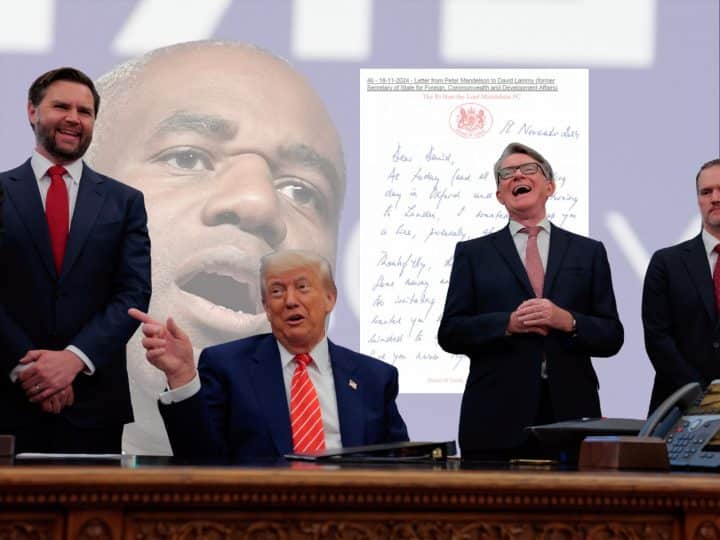

In a newly released letter, Peter Mandelson told David Lammy he would “never regret” making him ambassador to the US. While this ended up being catastrophically incorrect, Mandelson did at least get it right when he predicted the role would be “the last thing I do in public life”.
Mandelson: Petering out
As you can see, Mandelson’s handwriting is somewhat difficult to decipher:


As far as we can tell, this is what Mandelson wrote (emphasis added):
Dear David,
As today (and all week) is polling day in Oxford and I am returning to London, I wanted to drop you a line, privately, about Washington.
Thankfully, the media speculation has gone away and I hope this was not too irritating to you. I just wanted you to know that if you were minded to appoint me I would make sure you never regret it.
They’re calling it the least true statement of all time.
The disgraced Epstein associate continued:
I fear that navigating Britain’s interests through the Trump administration will require super-human skills and luck and a massive team effort.
Was there a superhero whose special ability was being best friends with Jeffrey Epstein? If there was, no doubt they based him on Peter Mandelson.
Mandelson continued:
There is so much riding on it, on security and defence, on trade and economy and on EU relationships, not to mention China. If we all put our best minds and energy to it, I think we can pull it off but we have to be realistic.
Oh yes, we have to make “realistic” decisions – decisions like hiring a twice-disgraced politician to be our ambassador to the US, and expecting no controversy to result from that.
To be fair to old Peter, he did get this next bit spot on:
For me, it would be the last thing I do in public life.
If the police do their job, this could be the truest words ever spoken.
He finished:
it would be a huge honour to serve you and the government in this role. So if you are up for it, so am I.
Very best,
Peter
We think he wrote “huge honour”, but it would be more accurate if his squiggly handwriting actually reads “huge horror”.
Warning signs
As we reported on 8 February, Lammy claims he ‘warned’ Keir Starmer not to appoint Peter Mandelson:
That’s odd because here is David Lammy describing Peter Mandelson as a “man of considerable expertise” and the “right man” to be the US ambassador.
Looks like he is trying to save his own skin. https://t.co/V1vIlscNws pic.twitter.com/Ve8AoJLdMX
— Chris Rose (@ArchRose90) February 7, 2026
With far more letters set for release, we’ll soon find out if this story holds up.
Featured image via Anna Moneymayker (Getty Images) / WPA Pool (Getty Images)
By Willem Moore


The Trades Union Congress (TUC) and the Rail, Maritime and Transport (RMT) union have highlighted the creation of a “two-tier workforce” as Govia Thameslink Railway enters public ownership.
Govia Thameslink Railway is the UK’s largest train operator, encompassing Southern, Thameslink, Great Northern and Gatwick Express.
Labour has begun the public ownership process as part of its manifesto commitment to nationalise the majority of train companies after their contracts expire.
The Department for Transport Operator Limited already manages West Midlands Trains, Greater Anglia, c2c, South Western, Northern, TransPennine Express, Southeastern and LNER under the same commitment. Chiltern Railways and Great Western Railways will follow in September and December, respectively.
Govia Thameslink Railway nationalised on 31 May
Transport secretary, Heidi Alexander, said:
Bringing Britain’s largest train operator into public ownership is a defining moment in our reform of the railway. It gives us an opportunity to tackle the bread and butter issues people want, like driving down cancellations and improving the frequency of services to Gatwick Airport.
Those “bread and butter issues” are a real grab-bag, from the genuinely important to the painfully mundane. Nevertheless, Labour crammed the whole lot into its press release.
The plans include:
- Doubling services for Gatwick Express services and increasing Saturday and Monday morning trains from December onwards. They’ll also additional Great Northern services around the same time.
- Continuing Govia Thameslink Railway’s recruitment of 75 more drives between Thameslink and Great Northern, and 40 drivers at Southern and Gatwick Express this year.
- Training 110 ‘Travel Safe Officers’ to “support revenue protection” (i.e. check more tickets) and increase security.
- Upgrading secondary signalling between Farringdon and Blackfriars. The government expects this to prevent as many as 1,000 cancellations per year.
- Providing more online payment options and a customer support channel on WhatsApp.
- Cleaning the graffiti in the Thameslink train toilets and resurfacing the toilet interiors. (Did we really need government intervention for that one?)
‘Two-tier workforce’ risk
Whilst at least half of those plans sound very worthy, the unions have been less than enamoured with one aspect of the endeavour.
TUC general secretary, Paul Nowak, explained:
This could be one of the great success stories of the Labour government.
But it is undermining its own efforts to deliver nationalised rail by leaving contracts in the hands of third-party providers who line their own pockets at the expense of the workforce and passengers.
We need a fully integrated national rail service which works for passengers and the rail workforce.
That means tackling outsourcing in the sector and ensuring all rail workers enjoy decent terms and conditions.
Govia Thameslink Railway contracts its cleaning services to private provider, Churchill. TUC analysis highlighted that Churchill makes £2.53 million gross profit annually from this tender alone. That’s the equivalent of 160,000 additional hours of cleaning or 83 extra cleaners.
This outsourcing diverts money from the public, workers and services into the pockets of private shareholders. The unions are urging that the cleaning services should instead be brought in-house.
Eddie Dempsey, general secretary of the RMT, explained:
We want to see all our members on the railway receive the same benefits of public ownership and this includes outsourced workers.
The Labour government needs to follow through on its commitment to undertake a mass wave of insourcing.
Nationalisation — in spirit or in name?
It’s not like Labour’s nationalisation doesn’t have form for continuing to enrich private interests, either.
The Canary previously reported that energy secretary Ed Milliband handed lucrative contracts to London-based firms, Deloitte and Baringa Partners. Now, the two companies will handle day-to-day operations of GB Energy, nominally Labour’s flagship publicly-owned energy corporation.
The National revealed that these contracts promise the firms up to £10 million each to be responsible for “organisational set up support”, “operational design and delivery”, market strategy and “technical support”.
Likewise, GB Energy was also supposed to create 1,000 jobs, mostly in the north of England. However, GB Energy only employes 30 staff on permanent contracts. The rest are on temporary or contingent, i.e. far less secure, government-sponsored contracts.
Don’t get us wrong, the Canary advocates for the nationalisation of public services. However, that process needs to be more than public ownership in name only. This, in turn, means spending public money on the public good, not further enriching private shareholders.
As the unions pointed out, Labour isn’t set to achieve that aim with Govia Thameslink Railway — and if its performance with GB Energy is anything to go by, that fact is a feature, not a bug.
Featured image via Charlotte Coney/ Getty Images


A new poll has shown Keir Starmer’s Labour Party is rapidly losing the support of trade unionists. And it seems to be the billionaire-backed Thatcherites and ex-Tories of Reform who are making the most of Labour’s collapse.
Trade unionists overwhelmingly say ‘Labour has lost touch’
Right-wing pollster JL Partners, whose co-founders have deep roots in the Conservative Party, asked 1,002 trade union members about political parties and leaders. And although 48% of the members who’d voted in the 2024 general election said they’d opted for Labour, only 28% said they would do the same today.
Reform, meanwhile, went up from 16% in 2024 to 28% now, despite the party wanting to take a hammer to workers’ rights.
The other winner in the poll was the Green Party, going up from 5% to 12%.
Inside the three biggest unions, which continue to affiliate to Starmer’s Labour:
- Unison members moved from 50% supporting Labour in 2024 to just 28% doing so now. Reform rose from 15% to 25%, and the Greens from 8% to 16%.
- Unite members went from 47% for Labour to 30%. Reform jumped from 20% to 36%, and the Greens only had a slight rise from 3% to 8%.
- GMB members’ backing for Labour dropped from 43% to 22%, with Reform going from 20% to 31% and the Greens only going from 5% to 9%. 50% of GMB members wanted disaffiliation from Labour.
Among the members of these three unions, there seemed to be significant openness particularly inside Unite and the GMB to backing Reform. Having to choose among major parties, they would both mostly opt to affiliate with Reform. That matters for Labour, because both unions donate massive amounts to the party.
If Unison members had to choose to affiliate to any major party, however, they would choose the Green Party (23%) over Labour (22%) and Reform (17%). The University and College Union (UCU) would do the same, with 30% opting for the Greens, 22% for Labour, and only 9% for Reform.
One thing is overwhelmingly clear from the poll, though. The vast majority of members in most unions agree that:
The Labour Party has lost touch with working people
Among all respondents, 62% agreed with that statement, and only 30% disagreed. 58%, meanwhile, believed Starmer needed to step down as prime minister.
Union members want Starmer out, but are unclear on what should follow
The Green Party under Zack Polanski has sought to position itself as the main left-wing challenger to Labour’s domination in the trade union movement, partly by calling Labour out for watering down its workers’ rights package. But the JL Partners poll suggests the Greens need to do a lot more work to convince trade unionists.
The poll respondents firmly believed Reform “represents working people” better than the Greens. Even among sympathetic unions, the Greens trailed Reform by at least 10%. The highest Green score came from the National Union of Rail, Maritime and Transport Workers (RMT), whose members gave Greens 20% and Reform 33%.
The dodgy billionaire money behind Reform is tough to beat. But the Greens and other left-wingers looking to convince trade unionists also need to be clear about why they are much better on workers’ rights than Reform. Trade unionists have already called on Greens, for example, to commit to opposing austerity cuts.
What is obvious, meanwhile, is that trade unionists oppose Keir Starmer and the direction his gang has taken the Labour Party in. They agree on how disastrous his government has been, and have an overwhelmingly negative view of him. What they don’t have is a strong positive view of any other party leader.
In short, this poll is terrible news for Starmer’s Labour. But it also serves as a warning for the left. Because unless we get our act together, Reform has more than enough money to keep benefiting from Labour’s collapse.
Featured image via Getty/Gareth Fuller
By Ed Sykes


US Democratic Party Leader Chuck Schumer joined far-right Israeli Minister Bezalel Smotrich and other far-right Israeli lawmakers and American politicians in the annual Israel Day Parade in New York City over the weekend.
Smotrich, who is wanted by the International Criminal Court, is openly genocidal and has repeatedly called for Israel to completely ethnically cleanse all 1.8 million people from Gaza, so it can ‘be settled’. Smotrich also called to annex the entirety of the West Bank during a speech at a Jerusalem Day rally last month.
Chuck Schumer is marching in NYC alongside a genocidal maniac wanted for war crimes by the International Criminal Court. https://t.co/AHlUhOWfXQ
— Mohammad Alsaafin (@malsaafin) May 31, 2026
A “record-size” delegation of the Knesset, the Israeli parliament, attended the parade, Haaretz reported.
They have to ethnically cleanse us and steal our land so multi millionaire Chuck Schumer can have a just-in-case fascist state to flee to? https://t.co/XbeD00bZz7
— Rania Khalek (@RaniaKhalek) June 1, 2026
American-Lebanese journalist Rania Khalek posted a speech by Schumer at the parade, in which Schumer was lauding Israel as a state standing for the Jewish people.
That’s the Israel that Schumer is lauding — one that ethnically cleanses Palestinians and Lebanese people alike.
Israel and Isaac Accords
Smotrich is reportedly also travelling to Washington to meet with leaders of Latin American countries to expand the Isaac Accords.
Smotrich traveled to Washington in order to meet with leaders of Latin American nations and expand the Isaac Accords, the new diplomatic-economic initiative with Latin American countries, Walla reported.https://t.co/i7EX8VK4uO
— The Jerusalem Post (@Jerusalem_Post) May 31, 2026
The Isaac Accords, which started last year and are funded by money from the Genesis Prize that Argentina’s Milei received in Jerusalem. They are meant to increase ties between Israel, Uruguay, Panama, and Costa Rica.
The Jerusalem Post reported that:
The minister is scheduled to return to Israel as early as Wednesday, after conducting an intensive marathon of meetings in the United States with key Latin American figures.
So there’s Schumer parading with Smotrich, who’s busy making business deals while calling for genocide. The bi-partisan American dream.
Featured image via Getty/Erik Marmour
By The Canary

This week brings yet more evidence of working-class voters having ditched the Labour Party for Reform UK. A new survey reveals that trade-union members, who have historically been very left-wing, are now evenly split between support for Reform and Labour. Astonishingly, Nigel Farage comes out on top as their preferred choice for prime minister. It is Farage, not Keir Starmer, who is perceived as the party leader most likely to benefit working people.
This neck-and-neck result is the result of a 20-point collapse in Labour’s support among union members since the 2024 General Election. In the same period, the proportion backing Reform has increased by 12 percentage points, leaving both parties now tied on 28 per cent.
Perhaps we shouldn’t be shocked that 62 per cent of union members now say that ‘Labour has lost touch with working people’. After all, the recent local-election results showed that Reform has picked up most support in the Brexit-backing working-class communities once branded Labour’s Red Wall. Places like Sunderland fell to Reform despite the council having been held by Labour for the previous 52 years. Even union leaders are forced to concede that ‘the working class has abandoned’ Labour.
In recent years, it has been easy to forget that large trade unions were established to represent working-class people. When unions hit the headlines, it has often been plummy-voiced junior doctors demanding higher wages, or union-backed teachers complaining about the prospect of a Jewish MP visiting their school, or National Education Union (NEU) members being given training on how to most effectively bring ‘the Palestinian struggle’ into the classroom. We have grown used to trade unions failing to defend female nurses who refused to undress in front of trans-identifying male colleagues and, even now, shamefully questioning the Equality and Human Rights Commission’s guidance on single-sex spaces. Today’s trade unions can appear to be elite institutions stuffed full of woke activists.
But not all unions are the same. Interestingly, the new polling data show that Reform comfortably beats Labour among members of two of the biggest unions, Unite and the GMB (originally the General, Municipal, Boilermakers and Allied Trade Union). Unite represents workers from industries including manufacturing, construction, transport, healthcare, hospitality and the services sector. Thirty-six per cent of Unite members back Reform, compared with 30 per cent who support Labour. The GMB organises ‘across every sector, from care and construction to local government, energy, transport and beyond’. Its members opt for Reform over Labour by 31 per cent to 22 per cent. Among Unison members, Labour wins only narrowly, by 28 per cent to 25 per cent for Reform. Unison represents nurses and healthcare assistants rather than doctors, and teaching assistants rather than teachers or university lecturers.
Meanwhile, the unions whose members are most likely to stick with Labour are Prospect (representing professional engineers, scientists, managers and civil servants), the PCS (civil servants) and the NEU (teachers). In other words, we have a tale of two trade-union movements. Union members in working-class jobs are more likely to back Reform, while those in middle-class professions are sticking with the Labour Party.
But there is another divide worth mentioning too, a split not between but within trade unions. There is a growing divide between the union leadership and rank-and-file members. Following publication of this week’s poll, Gary Smith, GMB general secretary, warned his members that Reform is ‘no friend’ of workers, claiming it wants ‘to cancel hugely important union rights and [is] targeting the pensions of the low paid’. Rather than representing the views of the majority of GMB members, Smith is telling them to think again.
Likewise, the general secretaries of Unite and the GMB have blamed the government’s cuts to the winter fuel allowance and green energy policies for Labour’s declining support. Like Tony Blair, they want Labour to make concessions in order to see off the populists.
The unions’ proximity to Labour is becoming an increasing problem for their Reform-favouring, working-class members. Eleven unions remain formally affiliated to the Labour Party, including all three of the GMB, Unison and Unite. This means that a proportion of the monthly membership fees paid by each worker goes directly to the Labour Party. This is supposed to ensure that working-class interests are represented in parliament through Labour – the party unions established to do precisely that over 125 years ago. That no longer makes sense given Labour’s abandonment of the working class. Why should hard-pressed workers be forced to shell out for a party they do not support, and that does not support them, at the behest of their union’s higher-ups?
Yet it seems that even this may be changing. In March this year, Unite members voted to cut their union’s Labour affiliation budget by 40 per cent. This leaves Labour around £580,000 out of pocket.
Yet, despite working-class support plummeting and union dues shrinking, Labour MPs continue to kid themselves that theirs is still ‘the party of working people’. Not any more. Finally, the cosy relationship between trade unions and the Labour Party is unravelling. Working people see that their interests are better represented by populism – and right now, that means Reform.
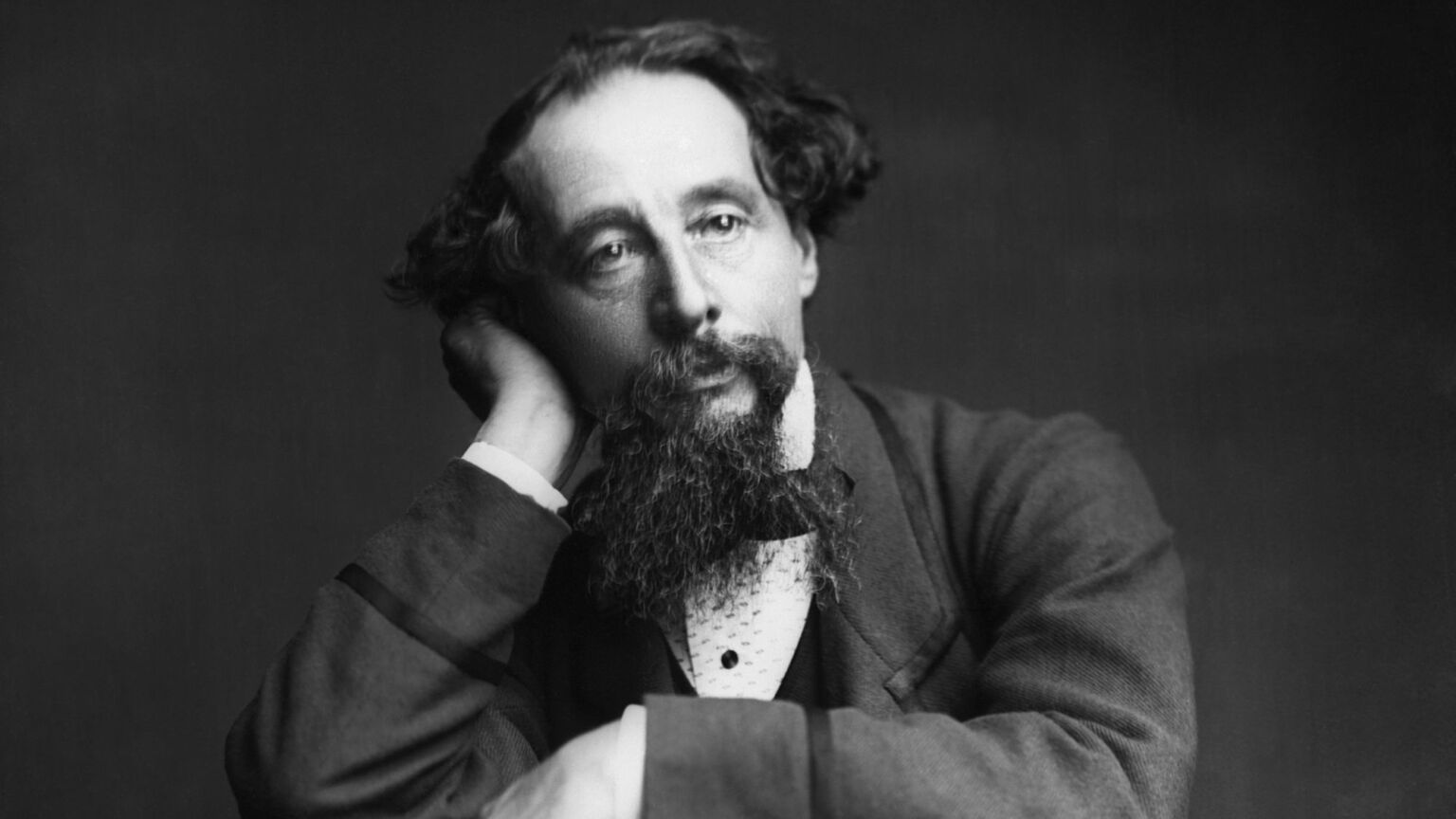
The Guildhall Museum in Rochester hosts a permanent exhibition celebrating the extraordinary life and wonderful writings of Charles Dickens. Yet it has now issued an internal document intended to warn staff about the shameful life and offensive writings of Charles Dickens.
The charge sheet alleges the usual offences against all things nice, and is no doubt written with genuine alertness to the possibility that the museum staff are incapable of coping with ‘the darker part of the writer’s oeuvre, including his lack of universalism’. Among other things that alarm the museum staff are Dickens’ support for the British Empire and ‘not for its diversity’, his calls for retribution following the 1857 Indian Mutiny and his mockery of missionaries. Dickens, it warns, had opinions that ‘can cause great offence today’ – the full horror of which we can only guess at, since he seems to have deleted his social-media accounts.
I don’t know if it’s a new thing, this attempt by a public museum to effectively cancel itself, but you have to wonder if it’s the inevitable reductio ad absurdum of cancellation movements. All revolutions eventually come after their own, after all. But it is a bit unusual for this to happen at the level of a local heritage resource.
It is also quite funny when you think about it. We are now approaching a point where there is little for the satirically inclined social commentator to do other than itemise what the grievance fetishists are up to and let their ludicrousness speak for itself. I’m sure Dickens himself would have some real fun with the whole business.
Roger Scruton said that he was brought up to believe one should strive not to cause offence, but these days too many people work tirelessly to take it. This being the case, it might, on occasion, be only polite to offer them what they so desperately want. If somebody has developed the habit of finding trivial things upsetting, the best way to help them is to ridicule them into different ways of being. Indeed, if the disputable opinions of a writer who died 156 years ago offend you, then for your sake, you need to be made fun of.
Aristotle made a similar point some 2,400 years ago. In De Anima, he argued that there is such a thing as an ‘education of the emotions’. So too did the Medievalists and the Scholastics who were able to develop a sophisticated moral psychology in which the ‘ethics of feeling’ – and the value of concepts like shame – were rightly taken to be central. Sometimes it is instructive to find oneself upset. And sometimes, it is an act of charity to be the cause of such upset.
When a writer is as astute as Charles Dickens, the danger is that a fond observation of the times in which he wrote is taken as the same thing as endorsement. The Rochester case is just one more expression of retroactive cancel culture, which urges us to reassess our best writers and thinkers through the lens of present sensibilities. There are many who would happily vaporise the national memory by going after the literature, philosophy and traditions of Common Law that currently preserve it. Unfortunately, the majority of these culture warriors were distributed throughout the arts and heritage structures of the public sector while the rest of us weren’t looking.
The targeting of Dickens is telling. While he may have written within the supposedly disqualifying prejudices of Victorian England, he managed to do so with an eye to the essentials of human beings, their failings and their absurdities. As such, he was ‘universalist’ in the only way that actually matters. People are people, no matter the era they find themselves in. Indeed, if we look at the past and find it wanting, we ought to be mindful that if it were able to look right back at us, it might feel just the same way.
Sean Walsh is associate editor of Country Squire. Find him on Substack here.


The Refugee and Migrant Children’s Consortium (RMCC) has spoken out against government plans to access asylum seekers’ age using AI.
On Friday 29 May, the Home Office announced plans to use AI in cases when an asylum seekers’ age is in dispute. However, the RMCC warned that the scheme could lead to yet more wrongful detentions of vulnerable children in adult facilities.
The news follows April’s revelations from the independent Humans for Rights Network, which exposed the fact that the Home Office routinely detains so-called “age-disputed children” as adults. Of the 76 age-disputed detainees at the time, 26 had been — or were in the process of being — reassessed as children by Social Services.
Just get an AI to do it…
Most of the unaccompanied children who brave the journey to the UK in search of asylum are 16-17 years old. The Home Office’s own data shows that social workers are more than twice as likely to confirm that these individuals are minors compared to assessments carried out by immigration officers.
Ultimately, over two-thirds of the age-disputed individuals are confirmed to be their stated age. Nevertheless, Labour choose to focus on the ‘threat’ of the perceived adult migrants.
Alex Norris, the minister for border security and asylum, argued that:
For too long, adult migrants making false age claims have exploited the system and diverted vital support away from children at risk.
That is why we are rolling out AI technology to put a stop to this, ensuring those who game the system are identified, detained and removed without delay, and those who deserve support and protection are given it.
That now-familiar appeal to AI is part of Labour’s massive push to use the technology across vast swathes of public life – including policing and the court system.
Private sector enrichment
Of course, that AI-push has also seen massive amounts of public money pad the pockets of tech-sector CEOs. One company alone – genocide-linked Palantir – currently holds over £500m in public contracts, from the NHS to law enforcement.
The government’s machine-learning obsession was championed by Tony Blair and his eponymous think-tank, which just happened to take a £250m donation from AI-specialist CEO Larry Ellison.
With regard to refugee age verification, the Home Office handed a 3-year, £322,000 contract to Akhter Computers Ltd for testing and development.
But what exactly is the AI technology that Labour is aiming to deploy in this particular case? Friday’s Home Office announcement explained that:
Facial Age Estimation (FAE) uses machine learning technology to estimate an individual’s age within seconds by analysing a facial photograph without further information about the individual. […]
FAE is not the same as facial recognition technology. While both use artificial intelligence, they serve different purposes and use different algorithms. Facial recognition compares an image against a database to identify a person. FAE does not identify individuals and does not search any databases. It only estimates an age from an image.
The Home Office isn’t using FAE at the present moment in time. However, the department plans to spend the remainder of the year testing the technology ahead of a rollout in 2027.
‘Problems with bias and inaccuracy’
However, the plans have met with strong opposition from organisations representing young refugees. Kamena Dorling, co-chair of the RMCC, stated that:
The government’s proposals are deeply concerning. AI cannot account for the factors that can significantly affect a young person’s appearance after fleeing conflict and persecution and undertaking dangerous journeys, including trauma, malnutrition, and exhaustion.
Existing evidence also shows that AI faces the same problems with bias and inaccuracy as human decision-making, with similar patterns of errors.
Whilst it may seem intensely obvious, the fact that children fleeing active warzones might look older than their years apparently escaped Labour’s notice.
Likewise, as Dorling said, AI has a tendency to replicate human errors, rather than eliminating them. Meanwhile, it obscures those errors in a cloak of cold, algorithmically-determined ‘fairness’.
‘A false sense of certainty’
Senior policy analyst and consortium member Kama Petruczenko, of the Refugee Council, said:
The government’s own figures already show that hundreds of children are being wrongly treated as adults following flawed visual assessments at the border, with devastating consequences for their safety and wellbeing.
AI and facial age estimation technology are not a simple or risk-free answer to these longstanding problems. Poor image quality and bias in datasets can also affect accuracy.
There is a real danger that this technology creates a false sense of certainty in decisions that are already extremely difficult to get right. If flawed assessments are simply automated, more children could end up wrongly placed in adult accommodation, detention centres or even prisons.
The government has already shown an awareness of these biases. However, beyond vague statements about trying to minimise errors, it simply doesn’t care. The Home Office announcement stated that:
There is evidence in testing data that FAE performance can vary depending on ethnicity, skin tone, gender, place of birth and quality of input image. NIST [The National Institute of Standards and Technology] found that error rates were almost always higher for female faces, although it didn’t find out why as testing was purely on performance rather than how algorithms work.
Vendors take bias seriously and commercial FAE technology is trained to be representative of the broadest possible demographic range of potential users.
‘The technology is racist and sexist, but we’re sure the people selling it to us are doing their best’. Well that’s all fine then, please carry on.
The RMCC will release its full report, titled ‘Benchmarks and Borders: the use of facial age estimation to assess the age of unaccompanied young people seeking asylum’, in June this year. If the current state of Labour’s AI policy is anything to go by, the consortium will have no shortage of criticisms to fill its pages.
Featured image via Leon Neal / Getty Images

The director of Backrooms has revealed he’s already got ideas for more films set within the film’s bizarre universe.
Released last week, Kane Parson’s critically-acclaimed new horror movie centres around the lonely owner of a struggling furniture shop, who stumbles upon an unsettling other dimension through the wall of his store’s basement.
As he progresses further into the seemingly limitless space, he becomes increasingly obsessed with what he discovers and how it relates to the world outside.
During a new interview with Variety published on Backrooms’ release date, its director teased: “Without a doubt, Backrooms has always been planned to be more of a series that goes outside the confines of this film.
“If anything, I would say this is a bit of a foot in the door that would lead to more of a progression towards the true root of the narrative, which has been set up online for years. But a version that maintains accessibility and lets this be the way in.”

He continued: “For people who are into it, I’ve got a contract, and I got a hold at my end, and that means I am definitely not done with Backrooms.
“I’ve got very specific things that I’m working on, things are in the works right now that I am eager to be able to talk about, but, currently, it’s still in a secret mystery world.”
Backrooms’ origin story is a bit of an interesting one in itself.
The idea stems from a 4chan post from back in 2019 showing an environment similar to the one seen in the Backrooms movie, which then became its own “creepypasta” (an online term for a widely-shared horror story that gains notoriety and viral fame by being copied and pasted around various corners of the internet) when someone came up with text to accompany it.
While Backrooms’ original “creepypasta” was shared anonymously, Kane Parsons began a YouTube series based on the idea in 2022, the success of which led to his new film.
He added to Variety that he has no intention of “leaving YouTube behind” now he’s crossed over into feature-length filmmaking.
“I immensely enjoy the work I’ve done there, and I feel creatively fulfilled by it in a way that’s proportional to what I’ve done with this film,” he insisted. “I personally think there’s merits, because there’s a lot of projects that I just could never do outside of YouTube, or outside of a more free-form internet multimedia container.
“So I wouldn’t limit myself just to one spot, but I do think it’s a way of saying that I’ve got a bit of a good thing going right now that I want to utilise with the energy and positivity around this film.”
Backrooms is in cinemas now.

Anthropic, now atop the AI bubble, files for its IPO

Big decision made on a new special school in Llanelli

Anthropic submits confidential IPO filing ahead of anticipated market debut


-

 NewsBeat5 days ago
Israel says it has killed new Hamas military leader in Gaza City airstrikes
-

 Tech6 days ago
NASA taps Blue Origin to deliver lunar rovers for Moon Base initiative
-

 Sports7 days ago
2026 NBA Finals schedule, odds: Knicks await Thunder or Spurs after winning East
-

 News Videos6 days ago
XRP *JUST* SUCCEEDED!!!! CLARITY ACT EXPOSED!!! (SHE EXPOSED IT)
-

 News Videos3 days ago
This is BROKEN! INSANE 5x MONEY CAR WASH WEEK! The NEW GTA Online UPDATE Today! (GTA5 New Update)
-
 Crypto World6 days ago
Micron Crosses $1 Trillion Market Cap as AI Demand Reshapes Memory Sector
-

 Business6 days ago
Selena Gomez Reportedly Upset Over Benny Blanco’s Comments on Her ‘Terrible’ Diet
-

 Business7 days ago
Nikkei 225 Surges Past 65,000 for First Time as Iran Peace Hopes Fuel Record Rally
-
 Tech7 days ago
China assigns ID codes to 28,000+ humanoid robots
-

 Tech4 days ago
Waymo dominates autonomous vehicle registrations as Tesla trails behind
-
 Entertainment7 days ago
‘Breaking Bad’ Star’s Easy-to-Binge 6-Part Crime Series Spin-Off Is Finally Heading to Free Streaming
-
 Tech2 days ago
SpaceX just won a second Golden Dome contract. This one is $4.16 billion.
-

 Tech5 days ago
The Samsung pay deal is the moment Korean unions changed register
-

 Entertainment6 days ago
Days of our Lives 2-Week Spoilers May 25-June 5: Gwen Rages, Abe Confesses & 2 Tragic Anniversaries!
-

 News Videos3 days ago
SHE IS KILLING XRP!!! WATCH URGENT AND ACT FAST
-
 NewsBeat3 days ago
FIRST NIGHT REVIEW: Take That bring the Circus back to life in spectacular sun-soaked style
-
 Entertainment7 days ago
Taylor Swift Fans Label Travis Kelce’s Beer-Chugging A ‘Red Flag
-

 Tech6 days ago
Millions of AI agents imperiled by critical vulnerability in open source package
-
Crypto World5 days ago
SpaceX’s $2 Trillion IPO: Why Tech Giants Nvidia (NVDA), Apple (AAPL), and Microsoft (MSFT) May Face Pressure
-
Crypto World3 days ago
CFTC Has Approved the First Regulated Bitcoin Perpetual Contract in the U.S.
You must be logged in to post a comment Login