
Politics
The House | From ‘Workington Man’ To Clubs On The Brink: Rugby League’s Fight To Survive




12 min read
Rugby league is cherished by many of the ‘left behind’ towns that become central to Britain’s electoral politics. But now community clubs are fighting to stay afloat, reports Adam Payne
In the run-up to Boris Johnson’s red wall landslide in 2019, rugby league found itself in a peculiar position. Its fans, based mostly in northern England, generally regard the London class, its politicians and media, as having little interest in their sport.
To generations of supporters, it is an ignored and underappreciated game, played a long way from the corridors of Westminster in mileage and in mind, in the towns of Yorkshire, Lancashire and Cumbria.
“Rugby union has always been the sport of the establishment, the media, Westminster, big businesses, even the Royal Family. Rugby league, like most things in the North, it had to fight just to be heard,” says Anthony Broxton, author of Hope and Glory: Rugby League in Thatcher’s Britain.
Naturally, then, there was some bemusement when, in autumn 2019, the spotlight of British politics landed on the Cumbrian coast. Onward, the centre-right think tank with close links to the Conservative Party, had declared rugby league towns to be pivotal to that year’s general election. A new voter archetype had been born: Workington Man.
Will Tanner, one of the brains behind the analysis, who was later chief of staff to Rishi Sunak in No 10, recalls when he and Onward colleague Nick Faith realised that rugby league towns were where key swing voters were hiding.
“When I was listing constituencies we thought would be most important, [Faith] was the one who said nearly all of them are rugby league towns. That was the common denominator, and it was something incredibly resonant and powerful,” Tanner tells The House.

Workington Man, set out in Onward’s subsequent report, The Politics of Belonging, was, generally speaking, a retired, non-university-educated male who backed Brexit and valued local pride and security in a fast-changing world. Johnson went on to turn swathes of rugby league towns from Labour red to Conservative blue. Trudy Harrison, the then newly elected Tory MP for Workington’s local rival, Whitehaven, was made his parliamentary private secretary.
Fast forward a few years, and rugby league certainly feels more relevant in Westminster. In Culture Secretary Lisa Nandy, the game has a genuine fan in Keir Starmer’s Cabinet; the Wigan MP tells The House it is “very close to my heart”. The same is true of Commons Speaker Lindsay Hoyle.
The knighting last year of legend Sir Billy Boston sparked tentative hope within the game that rugby league would finally play a bigger part in the national story, and there is optimism that Kevin Sinfield will soon be a knight of the realm after raising millions for Motor Neurone Disease research in memory of his former teammate, Rob Burrow. At Labour Conference in Liverpool in September, MPs and ex-players booted up for a tag war of the roses.
Community and belonging, through those rugby league clubs, was fundamental to how people were thinking
But up in the sport’s traditional heartlands, all is not well.
At the heart of the Workington Man analysis was voters in rugby league towns feeling that their local areas were crumbling – their high streets, post offices, pubs – leaving them feeling disheartened and disconnected. And perhaps nothing better captures that sense of community identity than the local rugby league club.
“Community and belonging, through those rugby league clubs, were fundamental to how people were thinking,” reflects Tanner.
The liquidation of Halifax in February stunned the town and disturbed the wider game. How could a 153-year-old club, a cherished community asset, simply cease to exist?
“There was so much shock across the community,” says Kate Dearden, Labour MP for Halifax. “To not have rugby in the town was unthinkable for lots of people.”
Halifax has since returned to the second division under new ownership, albeit with a 12-point deduction, after two weeks of frantic negotiations. It was a “huge, huge relief”, adds Dearden, who says people “travelled miles” to be at the club’s return to the pitch at the start of March.
“It made us sit back and reflect on the importance of rugby league to the town. When you’re so close to losing it – the emotional impact of that on people.”
the town has lost a part of its soul
Lower league sides like your author’s hometown club, Barrow, have recently been forced to crowdfund to stay afloat due to a lack of home fixtures, while Featherstone has been blocked from entering this season’s competition after falling into administration, leaving the West Yorkshire town without a rugby league team until at least 2027.
“The closure of the club has been really, really bad for morale in the area. Even people who don’t necessarily go to watch the match still think Featherstone Rovers is part of their identity,” says Jon Trickett, Labour MP for Normanton and Hemsworth. “At the moment, the town has lost a part of its soul.”
A local crowdfunding effort, led by the True Blue Revival Group, has raised thousands of pounds in a bid to put the club in a position to enter next season under new ownership. “For some people, [the club] is their whole life,” organisers Gareth Dyas and Jock Higgins recently told the BBC.
Why are heartlands club struggling? David Baines, Labour MP for St Helens North and chair of the Rugby League All-Party Parliamentary Group, says falling crowd numbers, driven in part by cost-of-living pressures, are an important factor.
“The communities that they represent, smaller towns in the North of England, are struggling areas. They have less money in their pockets to spend,” he explains.
“People have got difficult choices about where their money goes,” he continues. “Twenty years ago, Netflix didn’t exist, Amazon Prime didn’t exist, Apple TV didn’t exist. Plus WiFi, mobile phone costs…. entertainment that isn’t sport, that isn’t leaving the house. Traditional sports, like rugby league, are competing with that.”
Baines also believes the game has struggled in the face of football, which “dominates absolutely everything”, particularly for younger generations.

The Labour MP hopes that the government will be persuaded to look again at loans that were granted to rugby league clubs via the Rugby Football League (RFL) to help them survive the pandemic. Of the near £3m owed by Featherstone when it was put into administration, reportedly around £320,000 was Covid loan repayments owed to the Treasury.
“It’s something I’ve heard from clubs and raised with ministers, with Lisa Nandy and Steph Peacock. The APPG has discussed it. It’s something I’d definitely like the government to look at,” he says, floating the idea, for example, of extending the repayment period to ease the financial strain on clubs.
The RFL’s interim chief executive, Abi Ekoku, says the body was “fully committed to its fiscal responsibility to government” but had suggested to ministers ways “of how best we might balance Covid loan repayment obligations with the need to preserve and upgrade rugby league’s vital community infrastructure”.
He tells The House: “Grassroots rugby league plays a significant anchoring role in many of the UK’s most economically challenged areas. The sport’s social dividend is a very well-known and highly regarded part of Northern England’s social fabric. As such, we are keen to see Covid loan repayments redirected into facilities that help to deliver stability and purpose for the volunteer-led and resource-poor community game”.
Nandy acknowledges that the debt is adding to the problems facing rugby league clubs on “multiple fronts” but says that writing it off altogether is “off the agenda” as government would “have to do it” for other sports. “Forgiving the debt would open the floodgates for other stressed sports,” she says.
In terms of where ministers can help rugby league, Nandy says it must ensure it has “proper systems and governance in place going forwards, that they can act as a cohesive unit and that they can maximise the broadcast revenue that is available”.
She adds that she has been “working closely with a number of the clubs” and talking regularly to the figures in the game to support a plan to “pool their resources so that they get better broadcasters”. The amount of Sky TV money that goes to rugby league clubs has fallen significantly in recent years.
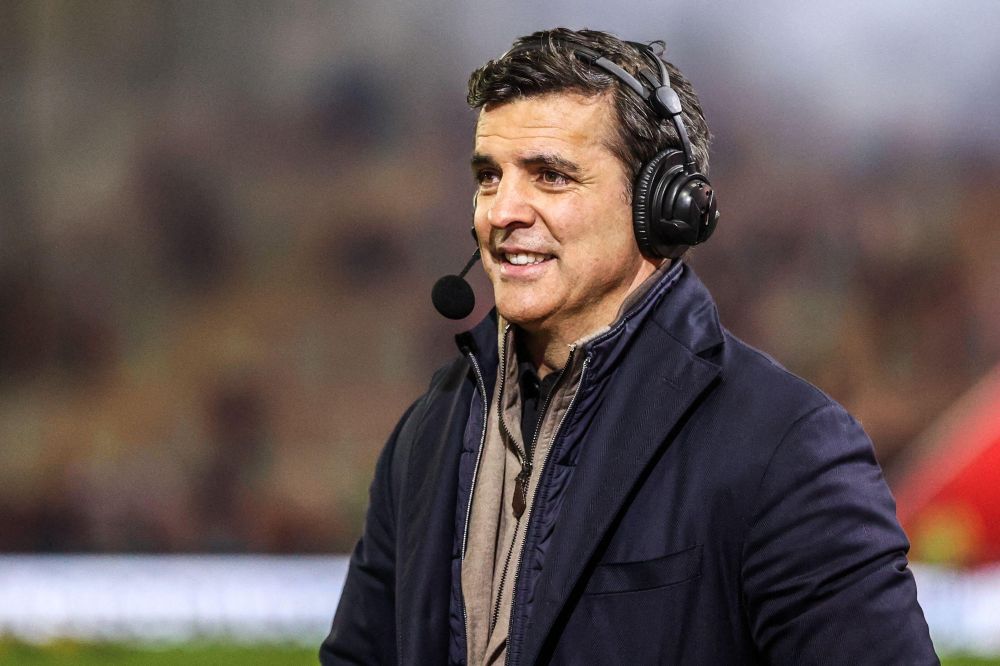
Brian Carney, TV pundit and former player, is one of the game’s most vocal proponents of reform. Speaking to The House in a personal capacity, he says the RFL governing body ought to shoulder blame for not stepping in earlier to stop “avoidable” club disasters.
“What I’d like to see is them [the RFL] getting ahead of these problems, because some of them you can see galloping at you, clear as day,” he says, pointing to players being paid salaries that clubs cannot afford.
Salford recently had to be revived under a new name after being wound up late last year with debts of over £700,000. Carney argues there needs to be stronger checks and balances, whether it be a more proactive RFL or greater government involvement, to address problems before they escalate rather than “after the fact”.
He suggests that English rugby league may ultimately require oversight like the new football regulator to protect the long-term sustainability of clubs. Reckless owners must take some blame when clubs fall into crisis, he says, but “they needed to have harnesses put on them as, otherwise, as in any other sport, they’ll just run amok, and true fans will be left to pick up the pieces”.
I’ve lived through a dozen or so so-called apocalypses facing the game
Despite the challenges, the rugby league community is defiant. “Featherstone will rise again,” declares Trickett.
Baines says: “I’ve lived through a dozen or so so-called apocalypses facing the game. These headlines have been written a lot since 1895 [when rugby league was founded] by people who want to see the game fail… It is facing challenges, but so does every sport in this country.”
He adds: “Rugby league will still be here in 50 years, 100 years. It will always survive because it’s a great sport to watch, to play, and it’s embedded in communities and loved by hundreds of thousands of people up and down the country.”
Dearden says the speed at which her local community was able to bring Halifax back to life demonstrated the resilience of rugby league fans: “From the get-go, as soon as the news was announced, it was, ‘How do we save our club?’”

There are other reasons for optimism. Crowds are up in the game’s premier division, the Super League, and the early success of York, Bradford and Toulouse’s admission to the league suggests that the contentious franchise model, which determines who plays in the game’s highest bracket, may be starting to bear fruit. Hull, home to the league and world champions, Hull KR, is a fervent rugby league city. KR, Leeds, Warrington and Wigan have played to large crowds in Las Vegas this year and last.
But there is also widespread recognition that if the game is to survive at its lower echelons, then things cannot continue as they are. “There needs to be some deep thinking about how we build community clubs that have a sustainable future. Government should be thinking about this,” says Trickett.
Does the answer lie overseas? There are talks over Australian investment in the English game, which advocates in the northern hemisphere say would bring not just desperately needed cash but expertise that is sorely lacking. While rugby league struggles for national profile in Britain, it is one of the biggest sports in Australia, centred on the National Rugby League (NRL) – brutally demonstrated in Australia’s demolition of England last year.
Peter V’landys, NRL head, has claimed in rather Trumpian terms that the English game is “heading for a train crash” without new money. “The answers don’t presently lie within,” says Carney. He believes that, ultimately, rugby league heartlands will only be lifted out of their struggles when the sport as a whole is more popular.
“It’s not relevant enough for enough people,” he puts it bluntly. “You can send development officers into schools anywhere in the world to promote a particular sport, but unless those kids are seeing it week in, week out, day in, day out, on TV, on billboards, on magazines, online, [players] modelling clothes or boots, it’s irrelevant. If we can raise the profile of the elite-level competition, all those people working at the grassroots level have an easier job selling the game.”
Baines says the English game would “be daft not to want to explore how we can work together” with Australia, but stresses that it would have to be for “the whole health of the game, from the community game upwards”. According to Broxton, rugby league must be better at telling its story: resistance, survival, “doing things differently”.
“In an age where authenticity is everything, rugby league already has the most powerful asset in sport – a genuine story. All it has to do is own it.”

I have to be honest here. I couldn’t ever imagine the possibility of the Green Party leading an opinion poll.
Ever.
I would’ve bet my vital organs on Liz Truss returning to Number 10 in a blaze of glory before a load of sensible tree-huggers topped any UK opinion poll.
But the Green Party has quite clearly changed and it looks far closer to the broad church that Labour once claimed to be.
If the Green Party continues to open its doors to people from across the left, its chances of winning some form of power increase tenfold.
The Green Party surge
Labour is now a fully-fledged centre-right government, and it has narrowed its base considerably. This is why the Green surge is happening.
So, where is the ceiling for the Greens? If we use a national projection of the upcoming local elections, could we get an idea of where and how the Greens can make serious inroads into Labour heartlands?
And where does Your Party fit in to all of this? Or are they still electing a steering group to form a committee to vote on the best method of having a vote on something that needs a committee to vote for?
Don’t fucking ask me. I know nothing.
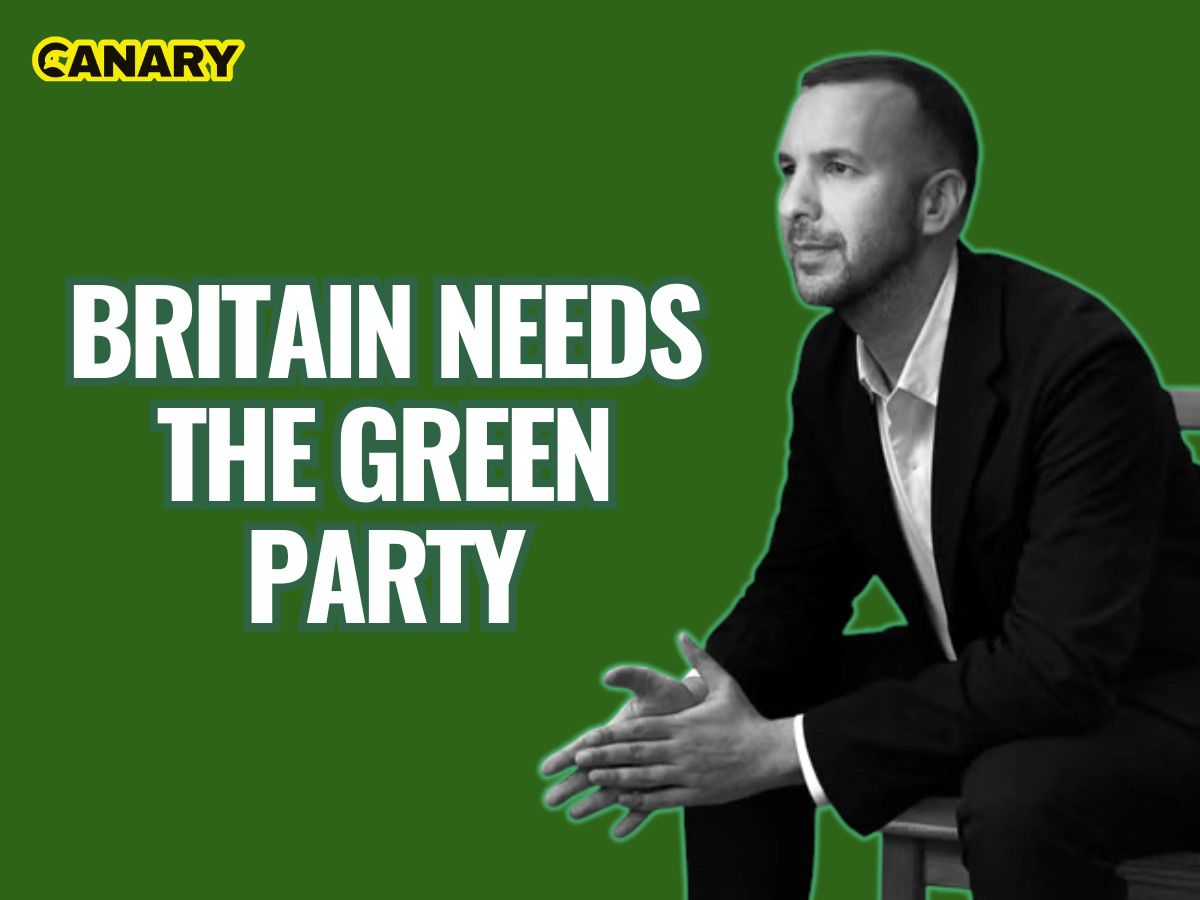
Just for one moment, take a look at where we are, and I will tell you why I think Britain needs the Green Party.
Back in April, last year, YouGov asked Britons where they would place themselves on the political spectrum.
About 29% identify on the left (including “slightly/fairly/very left-wing”), 26% on the right, 22% in the centre, and the rest, amusingly, don’t actually know. That’s nearly a third of the electorate that claim to be a lefty.
For arguments sake, let’s split that 22% that describe themselves as centrists, straight down the middle. This would take the left vote to around 40% and pretty much in-line with Jeremy Corbyn’s 2017 general election vote share.
Reinvigorating the left
Britain needs the Green Party.
With the painfully slow emergence of new left projects, some on the left have already moved to the Greens under its recent “eco-populist” shift. This really shouldn’t be seen as a problem because this pluralism strengthens the broader movement.
The Greens provide an organised, electorally viable home for eco-conscious socialists who want to fight Labour’s shift to the right and the dark forces of capitalism without waiting for the perfect socialist vehicle.
Importantly, the Greens stop the left from being reduced to a single personality or party, and they demonstrate that left ideas can win, quite comfortably, outside of the Labour brand.
Britain needs the Green Party.
I get why some people might view the Greens as insufficiently class-focused or too liberal on certain issues. I have voiced my own concerns in the past.
But the dominant view today — reflected in calls for tactical co-operation — is that Britain’s dire situation requires every left force pulling in the same direction, particularly where policies overlap.
The Greens are not the main engine of socialist transformation, but they are an essential part of the ecosystem that will make it possible. Without them, the left would be narrower, and considerably easier for centrists and the right to dismiss as outdated or unrealistic.
Humiliating Labour
Britain needs the Green Party.
Keir Starmer’s Labour has purged the left, worshipped fiscal rules, ramped up arms spending, and turned foreign policy into whatever Trump demands, but with added ‘principles’.
The Greens continue to humiliate Labour in councils and by-elections, forcing the centrists to pretend they care about Palestine, poor people, or those who aren’t in focus groups.
Jeremy Corbyn’s given them the nod because he knows without that constant pain in the arse on their left flank, Labour would sprint right so fast they’d overtake the Tories and start privatising the NHS for “efficiency savings”.
Britain needs the Green Party.
Let’s be completely honest here. Some corners of the left treat just transition like that awkward relative at Christmas — mentioned once then ignored.
The Greens have been banging on about fracking, airport expansions, and a world without nukes for decades. And right now, they are the reason we can’t just slap a red rosette on endless growth and call it socialism.
Plus, they do actually win on local stuff — cycle lanes, council housing, community energy — while the rest of us are still arguing about manifestos from 2019 and socialist purity.
The Green Party is like that friend who actually brings reusable carrier bags to the revolution.
They’re certainly not perfect and some of their activists do treat lentils as a personality trait, but they’re well organised, they win seats, and they help keep the broader left ecosystem alive.
We need the Green Party
Britain needs the Green Party.
Love him or not, Mr Polanski has become the necessary voice reminding us that when the sea levels rise, it won’t just be the Tories getting wet — we’ll all be in it together, up to our fucking necks in Thames Water sewage.
I believe we need to have some proper Greens in the mix rather than watch Starmer and Farage try, and fail to negotiate with the tide.
In my humble opinion, Britain needs the Green Party.
Featured image via the Canary
‘End Medical Misogyny’ is the title of a new campaign by Mumsnet, the women’s internet forum. It is based on a comprehensive study into the chronic dismissal of women who seek medical assistance from the NHS – particularly for conditions that solely affect females, such as polycystic ovary syndrome, endometriosis and adenomyosis.
The study examined more than a decade’s worth of posts from Mumsnet users. Close to 100,000 posts to the forum between 2015 and 2025 contain language consistent with women experiencing ‘dismissal, disbelief or de-prioritisation’ in the public-healthcare system. The stories range from being gaslit about the presence of symptoms to being left with debilitating uterine pain for years without answers.
Half of those surveyed believe they have been ‘dismissed, ignored or not believed by an NHS professional because of their sex’. Sixty-four per cent said they have been ‘explicitly told their pain or symptoms were “normal” or “in their head”’. A further 68 per cent believed the NHS fails to take women’s health concerns seriously. Disregard of pain was described as a ‘dominant feature’ among women in the dataset. Many report being treated as if their pain was ‘tolerable, expected or insufficiently urgent’.
I spoke to Elle, 33, whose experience mirrors these findings. ‘I first noticed symptoms when I was 16’, she said of her adenomyosis, a condition that causes the uterus to swell to up twice its normal size, and is often accompanied by excessive bleeding and severe pain.
‘When I was 19, I was told the contraceptive pill would help with my heavy periods, but the pain part was ignored entirely. When I was 30, a shortage of the pill meant I could no longer get it, and all of the symptoms returned tenfold once I stopped. For two years, I went to the doctors again and again, only to be given different types of contraception. Every time I asked if we could get to the root of the issue and fix it, I was ignored.’
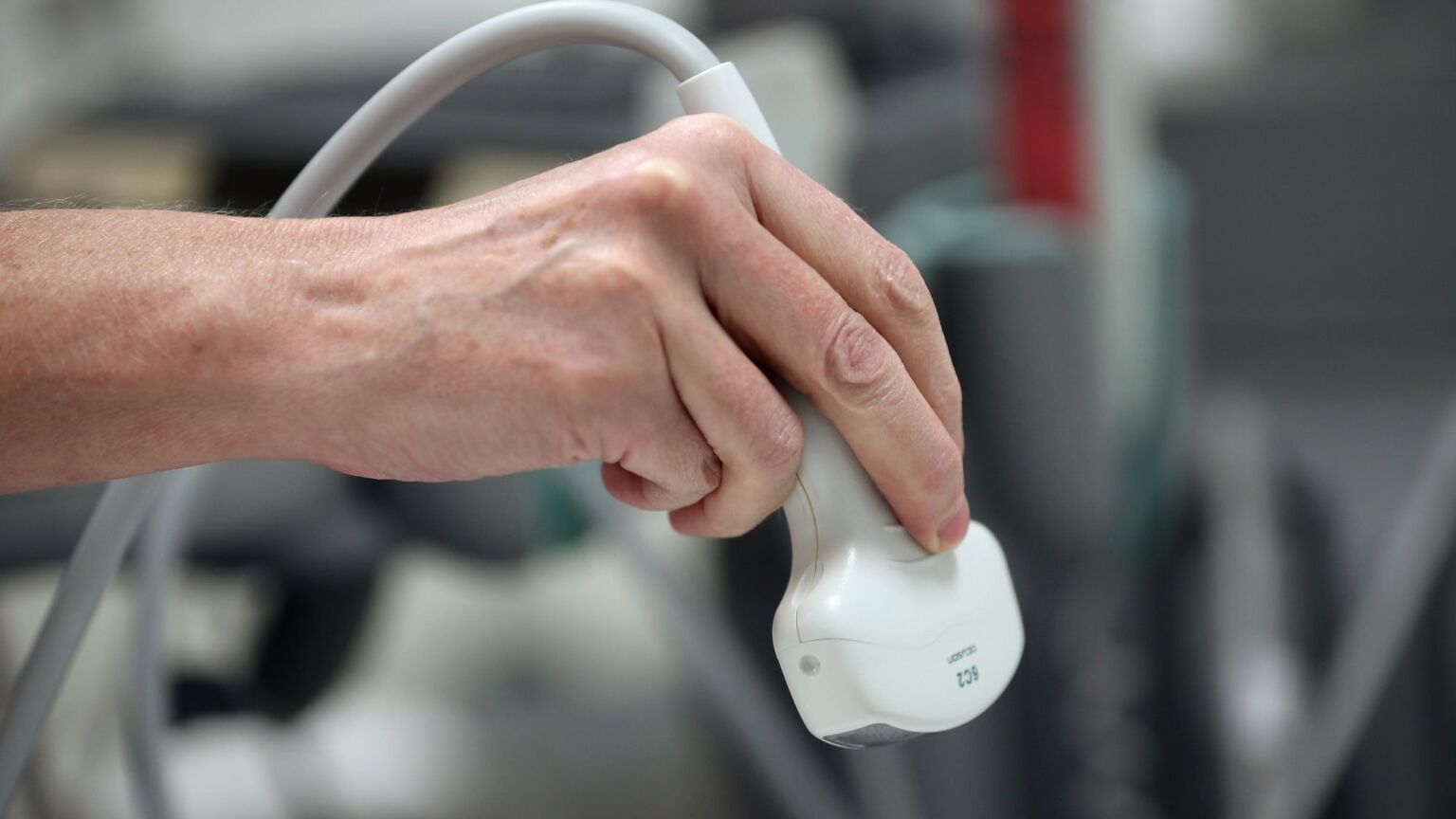
Though adenomyosis affects up to 35 per cent of women, Elle had never heard of it. Her story reflects that of many young women for whom hormonal contraception – due to its effect of masking certain symptoms – is presented as a ‘fix-all’ solution, while the possibility of an underlying issue is waved away. By the time Elle managed to procure a pelvic ultrasound, she had been living with chronic pain for 16 years.
The experience of having to ‘fight’ for a diagnosis was shared by 31-year-old Nicole. Nicole only recently discovered she has hypothalamic amenorrhoea (HA), a hormonal condition which prevents ovulation. Every time she came off birth control, she would lose her period, sometimes for up to nine months at a time. ‘I was told it was “normal”’, she tells me.
‘But years passed, and I was still being told to “wait and see”. Advice was always “if you’re not trying to conceive right now, just go back on the pill”. I had never heard of HA and only came across it through doing my own research. Even when I was telling doctors I believed I had HA, I really had to fight to see an endocrinologist who could confirm. If I hadn’t been so insistent, I might still be living in the dark with no idea my condition is actually reversible.’
The Mumsnet study compiles many experiences like Elle and Nicole’s. Those who did receive treatment hardly fared any better: some describe being left ‘screaming’ in pain during unauthorised internal examinations, crying for anaesthesia during cervical cautery, and being told to stop ‘making a fuss’ while suffering an internal haemorrhage. In a first-world country, it should be absurd to hear of such things. Yet in the NHS, such stories are routine.
Predictably, since the report’s emergence, the phrase ‘medical misogyny’ has been parrotted with fervour, including by health secretary Wes Streeting. ‘Medical misogyny has no place within our NHS’, he promised.
One has to wonder, though, if this misses the point. Misogyny denotes an ingrained prejudice. This is not to say women haven’t encountered male doctors who were genuinely sexist – one participant in the study described being asked by a male gynaecologist (on the morning of her operation, no less) if she was sure the pain wasn’t just in her head. He even asked her husband for consent before sterilising her. But it doesn’t appear that the majority of such cases, whether in the Mumsnet study or elsewhere, can be easily blamed on malice towards women.
This is demonstrated by the crisis engulfing NHS maternity services. Despite over 99 per cent of midwives in the UK being female in March 2017, NHS England has had a £27 billion legal bill for negligent maternity treatment hanging over its head since 2019. In these instances, mothers were denied pain relief, subjected to unnecessary procedures and neglected after surgery – almost exclusively by other women.
Of course, if it’s an example of real misogyny we seek, we need look no further than the medical world’s ongoing failure to confirm what a woman even is. For years, the NHS assigned trans and nonbinary individuals (ie, men) to wards based on their ‘gender identity’. Meanwhile, Endometriosis South Coast, a charity claiming to support women with the painful and life-altering condition, just appointed a biological male as its parliamentary representative. UN Women, an organisation with the power to impact women’s health policy around the globe, selected a biological male – transgender model Munroe Bergdorf – as its first UK champion. I won’t linger too long on these stupidities, however – for once, it would be nice to talk about women’s issues without having to make reference to the men who pretend to be them.
British women clearly require a much higher standard of care than they’re getting. For my part, I’d like to see this remedied not only with much-needed improvement in ‘bedside manner’, but also by affording uterine conditions the level of research that their prevalence warrants. It is inexcusable that there have been more studies into male pattern baldness than into endometriosis, an incurable condition that can cause severe pain and infertility.
The NHS has been failing the British public for years. But the systemic neglect of women’s health is a new low. This is a scandal we must not stand for.
Georgina Mumford is a content producer at spiked.
On Saturday 11 April, the Independent published what may be an alarming headline to some:
Labour faces a green apocalypse at the local elections
By ‘some‘, we of course mean ‘the Starmer loyalists and councillors who are about to lose their jobs‘. And for them, the following message from the Green Party’s Zack Polanski almost certainly hasn’t helped:
Yes. That’s the plan.https://t.co/0qbagSvIYp pic.twitter.com/TSWfw2AKof
— Zack Polanski (@ZackPolanski) April 11, 2026
Starmergeddon coming from Polanski
The piece Polanski was responding to was written by the Independent’s chief political commentator John Rentoul. The Independent was considered left-leaning back in the day, but has never recovered that reputation since it backed the Tory-Lib Dem coalition in the 2015 election.
In his piece, Rentoul wrote:
I suspect that the commentary will overshoot, in that one two-party system, Tory vs Labour, will not be replaced overnight by another, Reform vs Green. As I wrote last week, both Reform and the Greens have ceilings to their support. Farage’s party is not considered respectable and Polanski’s is not considered realistic by enough people to make the total eclipse of the old parties possible yet.
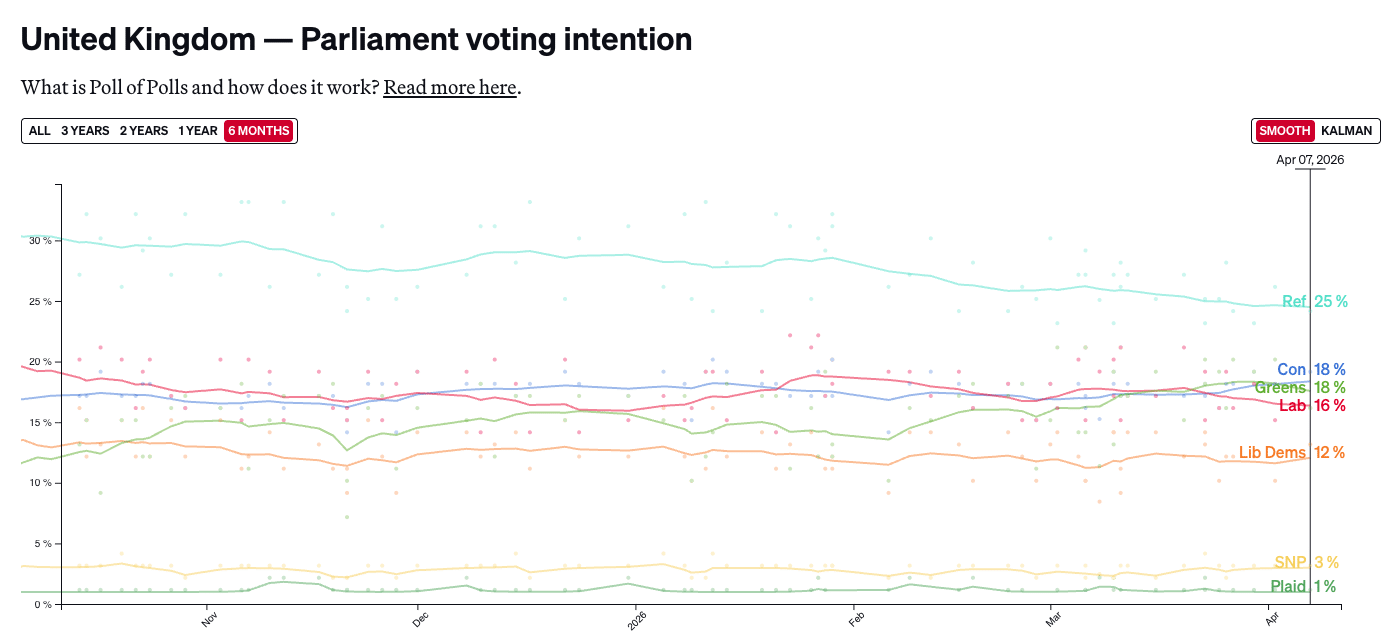
We’ve certainly seen evidence of Reform having a ceiling. The party rose to 30%+ in the polls, but has dipped below that since it accepted a mass exodus of ex-Tories:

The truth about the Greens under Polanski is it’s difficult to say where their ceiling is.
Let’s be real; until about six months ago, we all thought their ceiling was something like 10%. The fact that they’re now leading in some polls means we have to reconsider everything:
‼️BREAKING | Greens surge into LEAD (1st!!)
🟢 Grn: 21.4% (+2.1)
➡️ Ref: 20.9% (-1.4)
🔵 Con: 20.5% (+0.2)
🔴 Lab: 17.0% (-0.4)
🟠 Lib: 9.2% (-1.9)Poll: @LordAPolls, 26-30 Mar (+/- vs 19-23 Feb) pic.twitter.com/oDVw4cDaFC
— Stats for Lefties 🍉🏳️⚧️ (@LeftieStats) April 5, 2026
Rentoul also said of Polanski and the Greens’ surge:
How should Labour respond? There are two possible answers that will dominate the discussion on 8 May, which I think are both mistaken. One is to replace Starmer. That will have to be done at some point, but as long as the most likely replacement is Angela Rayner I do not think it would help. The other is to copy the Green Party’s policies.
Rentoul went on to say:
Instead of panicking and indulging in a leadership crisis or lurching to the left, Labour needs strategic patience, dealing with the difficult world situation as best it can, explaining the trade-offs and compromises needed. Reform has already peaked in the opinion polls, and the limits of the promises that won it control of several councils last year are becoming more evident. If the Greens win control of councils with a slate of untried paper candidates, they, too, will come up against the constraints of power.
The Greens are not ready to replace the Labour Party yet.
Labour and the UK at large are in a moment of crisis, in which it’s become clear to everyone that the longstanding ways of doing things don’t work; that the system we live under exists solely to direct wealth upwards, and that there’s very little wealth left to be lost.
As you’d expect, then, a UK political commentator is advising that the party of government should simply fiddle while Rome burns.
The status quo is dead
Our political leaders and commentators can bury their heads in the sand all they like, but the rest of us don’t have that choice.
We’re forced to confront the world as it is because the world is a confrontational force that demands our attention.
We feel it every time our bills increase; we feel it when our retirement age slips further and further away; we feel it when our loved ones suffer as they wait for hospital appointments which may never come.
At the same time, we do hope Labour listen to Rentoul over Polanski. It’s horrible advice, of course, but it will at least ensure it’s clear to everyone what Labour actually stand for.
Because let’s be real; Labour will never deliver actual change, but there is a risk they’ll offer enough phony to promise to retain what’s left of their dwindling vote share.
Featured image via Canva

Tucker Carlson has said Donald Trump is a “slave” to Israel over his decision to go to war in Iran.
The right-wing podcaster’s comments came as talks between the US and Tehran aimed at ending the conflict broke down without agreement.
Carlson, a former close ally of Trump, said the war was “the single biggest mistake that any American president in my lifetime has made”.
The US president, alongside Israel, launched military action against Iran on February 28.
Despite declaring victory on numerous occasions since then, the regime in Tehran remains in place, and has triggered a global economic crisis by effectively blockading the Strait of Hormuz.
On BBC 1′s Sunday with Laura Kuenssberg programme, Carlson said: “The whole thing is a fantasy. The United States went to war in Iran in order to effect regime change, to throw out the people who run the country and collapse it, at the behest and then the demand of Israel, and that’s a demand the Israelis have made of the US government for decades.
“President Trump fell for it, did it, and I think he recognised immediately that it was a mistake and that it is very difficult to extricate yourself from a war like this once it has begun.
“I think the net effect, and I think the president himself has said this, is at best to leave the regime in place, give that regime control over commodities that flow through the Strait [of Hormuz], in effect to make Iran more powerful than it was on February 27.”
Asked by presenter Victoria Derbyshire what his relationship is like with Trump now, Carlson said: “I feel sorry for him, as I do for all slaves. He is not free in this moment at all to do what is best for himself or his country.
“He’s not free and we learned that yesterday when Donald Trump announced a ceasefire, clearly with relief, and made its terms public and then that ceasefire ended within two hours because Israel potentially violated the terms by attacking not just southern Lebanon but the city of Beirut.”
Derbyshire then asked him: “Are you saying he’s a slave to Benjamin Netanyahu?”
Carlson replied: “I don’t think it’s as simple as he’s under the control of Netanyahu, but you could summarise it that way and you wouldn’t be totally inaccurate.
“We know this because the single biggest mistake that Trump or any American president in my lifetime has made was going to war with Iran in an effort to change its regime.”
Elsewhere in the interview, Carlson also denied that he is an anti-semite.
He said: “Unlike the UK, we have a first amendment. So if I was an anti-semite I guess I would just say so at this point, I don’t know why I would lie about it.
“But I have opposed it in public consistently for my entire public life.”
Carlson added: “Doubtless there are anti-semites who don’t like Israel. I’m not an anti-semite, I don’t hate Israel.
“The Israeli government steered the United States into a war that hurts the United States and the world. I’m offended by that, I didn’t want it and I’m mad about it now.
“I have every right to feel that way, that does not make me an anti-semite.”
Subscribe to Commons People, the podcast that makes politics easy. Every week, Kevin Schofield and Kate Nicholson unpack the week’s biggest stories to keep you informed. Join us for straightforward analysis of what’s going on at Westminster.

The Met Police have confirmed 523 arrests in Trafalgar Square on Saturday 11 April, where Defend Our Juries protesters staged a silent vigil against the genocide and the unlawful use of terrorism laws to silence opposition to the genocide.
This brings the total number of arrests for defying the Palestine Action ban from 2,779 to over 3,302.
Defend Our Juries out again
In March, the Met announced that the number of arrests for proscription offences relating to Palestine Action since the ban came into effect in July 2025, was 2,779 arrests.
The Met chose to make the arrests on 11 April despite the High Court ruling in February that the proscription of Palestine Action was unlawful as a violation of the democratic rights to free speech and peaceful assembly. Leading legal figures warned the Met that arrests at this peaceful vigil would be unlawful in light of the High Court ruling, pending the Court of Appeal hearing on 28 and 29 April.
Many of the Defend Our Juries supporters arrested were older or disabled people, with ages ranging from 18 to 87.
Arrestees included Robert Del Naja, the artist and musician from Massive Attack. The arrests took the number of terrorism arrests for quietly holding cardboard signs to over 3,300 since 5 July 2025.
Earlier in the day, a former Met police chief told BBC Radio 4 that arresting these peaceful protestors creates optics which are “very challenging for the police” and that there “will be a huge amount of people who have sympathy with what is going on with the views of Palestine Action”.
Bad optics
The Met Police’s mass arrests of Defend Our Juries protestors come despite their stating publicly in February that they would not arrest people for holding signs, given the illegality of the proscription order. They said at the time that not arresting people, pending the Government’s appeal, was “the most proportionate approach we can take”. On 25 March, for unclear reasons, they announced a U-turn on this policy.
Meanwhile, the Devon and Cornwall Police undermined the Met’s decision by refusing to make arrests under the Terrorism Act in Truro on 11 April. Protesters in Truro held exactly the same sign as protesters in London and police chose not to arrest, whereas the Met arrested 523 people.
Former Met Police chief superintendent, Dal Babu, previously said on BBC Radio 4:
I think the difficulty is, when you’ve got 700 or 800 people who are willing to be arrested, that just isn’t practical. The optics of this will be very challenging for the police.
It will present some significant difficulties for the police in terms of how they manage it and also be aware of the fact there will be a huge amount of people who have sympathy with what is going on with the views of Palestine Action.
“Surreal”
A spokesperson for Defend Our Juries said:
It is truly surreal that over 500 people have been arrested for defying a ban the High Court has declared unlawful. An already absurdly authoritarian measure has now descended even further into farce ahead of the Court of Appeal hearing this month.
The Met Police has inexplicably reversed its position that, in light of the High Court ruling and pending the Government’s attempt to appeal, it would not arrest peaceful protesters defying the ban. Leading legal figures warned these arrests could themselves be unlawful, and the Met now seems destined to face legal challenge over what may amount to hundreds, if not thousands of unlawful arrests.
The fact that Devon and Cornwall Police chose not to arrest protesters yesterday for holding the exact same signs only deepens the chaos surrounding the unlawful ban on Palestine Action and underlines a simple truth: this ban is unenforceable.
It’s obvious to every sane observer that the Israeli and US governments are committing war crimes in Gaza, the West Bank, Iran and in Lebanon. Instead of standing up to these atrocities, which are already having dire consequences for the British public, Keir Starmer’s government supports them, including by criminalising peaceful protest against these heinous crimes.
Everyone who cares for democracy and the rule of law should be appalled by what is happening, and should ask themselves what they can do personally to prevent the descent into fascism.
Featured image via Marly Lyman

Engaging in “mentally active” activities versus “mentally passive” ones while sitting or lounging may affect your risk for dementia, according to a recent study.
In a study published in the American Journal of Preventive Medicine last month, researchers evaluated over 20,000 adult participants in Sweden, most of whom were women. Researchers administered a baseline questionnaire to participants in 1997 to assess their mentally passive sedentary behaviours, such as watching TV and listening to music. They also assessed their mentally active sedentary behaviours, such as office work or knitting and sewing. Their light and moderate-to-vigorous physical activity was also assessed using questionnaires. The participants were evaluated for incident dementia nearly two decades later.
The study found that mentally passive sedentary behaviour ― for example, watching TV ― was associated with a higher incidence of dementia. But adding mentally active sedentary behaviour (needlepointing, anyone?) showed promising outcomes.
Researchers found that each additional hour of mentally active sedentary behaviour a day was associated with a 4% lower risk of dementia — and that adding mentally active sedentary behaviour showed a higher protective effect for participants aged 50 to 64.
The study also found that replacing one hour of mentally passive sedentary behaviour with one hour of active sedentary behaviour was associated with a 7% decreased risk. What’s more, adding one hour of mentally active sedentary behaviour, while maintaining the same passive sedentary behaviour and light and moderate-to-vigorous physical activity, was associated with a 11% decrease in incident dementia risk.
Researchers noted that the study had some limitations. For starters, the study began in 1997, before the vast introduction of smartphones, social media and video streaming — which are now very common ways people engage in sedentary behaviour.
Dr. Hussein Yassine, a professor of neurology at the University of Southern California Keck School of Medicine, emphasised to NBC News that phone and social media usage, which are considered mentally passive behaviours, may pose risks to our ability to concentrate.
“It’s going to be affecting your ability to process information and potentially build synapses in certain areas in the brain that help with concentrating,” Yassine told the outlet. “So the next time you have a serious task or you need to concentrate, you’re less capable because your brain networks have been hijacked by this passive reception.”
Among several other limitations cited in the study: Researchers pointed out that cognitive assessments were not done at the start, and it’s possible the sample may have included more prevalent cases of dementia, which may have resulted in a bias in the results.

Justin Paget via Getty Images
Dr. Leana Wen, an emergency physician and clinical associate professor at George Washington University and CNN wellness expert, told CNN that one explanation for the results of the study could be due to the fact that “the brain benefits from being challenged.”
“Cognitive engagement helps maintain neural connections and may support what’s called cognitive reserve, which is the brain’s ability to adapt and compensate for changes over time,” she said. “When people spend long periods in activities that require very little mental effort, those pathways may not be stimulated in the same way. Over the course of months and years, that lack of engagement could contribute to decline in memory and thinking.”
Wen cautioned, though, that the study doesn’t prove cause and effect.
“It’s possible that people with better baseline cognitive function are more likely to choose mentally engaging activities,” she said. “So, while the findings are compelling, they should be interpreted as an association rather than proof that choosing passive activities directly leads to dementia.”
Research has shown that engaging in mentally stimulating activities, in addition to staying physically active, can be beneficial for your brain health.
Dr. Dylan Wint, director of the Cleveland Clinic Lou Ruvo Center for Brain Health, previously emphasised the importance of strengthening the brain in an interview with HuffPost.
“You could try brain games, a new hobby, taking a class at a college or community centre, or learning a new language or instrument,” Wint said. “When determining whether an activity can have some cognitive benefit, what’s most important is that you are challenged and learning.”

At approximately 4am on Sunday, 12th April, three people from the direct action group People Against Genocide successfully evaded security and stormed the Keysight Technologies research and development plant in Hampshire:

Once inside, the activists destroyed computers, servers and machinery, directly linked to the murder of Palestinian, Lebanese, and Iranian civilians.

All three were arrested inside the factory:

Keysight Technologies: complicit in Israel’s genocide
US-owned Keysight Technologies manufactures radar and electronic warfare systems for military use. They supply UAV Tactical Systems (U-TacS), a drone factory which is now entirely owned by Elbit Systems, Israel’s biggest weapons maker.
Amongst other drones, U-TacS are responsible for developing the Watchkeeper drone, based on Elbit’s Hermes 450 drone, which has been central to the ongoing genocide in Gaza, and linked to the killing of seven aid workers from the World Central Kitchen in April 2024. They have been used to surveil and kill innocent citizens across West Asia, on behalf of the Israeli regime, and other genocidal regimes around the world.
As well as supplying Israeli weapons firm Elbit Systems, Keysight Technologies works with the US Army, US Air Force and US weapons companies, including Lockheed Martin. Keysight Technologies also specialises in 5G technology for military applications. The firm collaborates with Lockheed Martin on a 5G military solution called ‘5G.MIL Unified Network Solutions’ which provides a high-speed connection for weaponry and military applications used by the US military. Keysight Technologies also has a manufacturing plant in Israel.
In addition to Elbit weapons being used to kill thousands in Gaza, Lebanon and Iran, the Israeli weapons firm also made a $2.3billion deal with the UAE, which is accused of arming the Congolese genocide.
Shutting it down
Keysight Technologies has been targeted for some time by anti-genocide activists, with several previous actions at their site at Winnerish in Berkshire, as well as Keysight facilities in Scotland. So far, rather than cutting their ties to Elbit, which supplies the Israeli military with 85% of their killer drone fleet, Keysight has chosen to invest millions in infrastructure and security.
A spokesperson for People Against Genocide said:
Keysight Technologies makes a killing by supplying the necessary components for the weapons used to commit mass murder in Palestine, Lebanon, Iran and the Congo. By dismantling Keysight’s research and development site, we are taking necessary direct action against the US and Israeli military industrial complex, responsible for the killing of people across West Asia and in the Congo.
So long as they are directly involved in genocide, we will continue to target this murderous company, exposing their role in supplying the Israeli and US military, and shutting them down.
One action taker said:
Keysight Technologies is a key supplier of Elbit Systems, who are are supplying and supporting the genocidal Israeli army. Wherever there’s genocide, Elbit Systems is involved. They’ll participate in any and every other illegal war. Their tag line is “battle-tested” on the Palestinian people. That is their marketing line.
Recently the UAE who is heavily involved in genocide has signed a billion dollar contract with Elbit Systems. Elbit has been looking to the Congo genocide for business opportunities, and their bombs have been used in the Congo. All of the struggles are absolutely the same struggle, connected by the same genocidal maniacs.
Elbit Systems uses your tax money to make billions while you can’t afford healthcare, childcare, a holiday, groceries. “I support genocide” is legal. “I oppose genocide” makes you a terrorist. Now tell me who’s the real terrorist?
Featured image and additional images supplied

Wes Streeting has condemned Donald Trump’s “incendiary, provocative and outrageous” threat to destroy Iranian civilisation.
The health secretary accused the US president of using “rhetoric which people might find shocking” in the most outspoken attack on him so far by a government minister.
Streeting took aim at Trump after peace talks between America and Iran broke up without agreement.
Trump sparked an angry backlash last week when he claimed that “an entire civilisation will die tonight” unless Tehran re-opened the Strait of Hormuz.
A ceasefire was agreed at the last minute, but the vitally important waterway remains effectively blocked to oil traffic.
On Sky News on Sunday morning, Streeting said: “Over the course of the past week, President Trump has said some pretty bold, in Yes Minister language, incendiary, provocative, outrageous things on social media.
“I think we’ve all come to learn that you judge President Trump through what he does, not just what he says.”
Trump has also launched repeated attacks on Keir Starmer over the UK’s initial refusal to allow the US jets to use RAF bases to launch their attacks on Iran.
He said the prime minister was “no Winston Churchill” and has also compared him to his Hitler-appeasing predecessor Neville Chamberlain.
Streeting said the so-called special relationship had been “undoubtedly strained” by the split over Iran, but insisted the two countries still enjoyed a strong partnership.
He said: “We are old and close friends and we’ve got a shared outlook as democratic countries and we’ve got shared security interests.
“So all of that partnership continues to go on. The point I’m making is you have to distinguish between some of the rhetoric which people might find shocking, and then the reality.
“There were lots of people who went to bed earlier this week with President Trump threatening the end of Iranian civilisation, wondering what on earth would happen overnight, and woke up to a very different picture next morning.
“That’s the point we’re making. There’s a difference between what he says and what he does, and the prime minister has kept level-headed cool, calm leadership that I think the public have appreciated and respected.”
Subscribe to Commons People, the podcast that makes politics easy. Every week, Kevin Schofield and Kate Nicholson unpack the week’s biggest stories to keep you informed. Join us for straightforward analysis of what’s going on at Westminster.

We’ve all been there. Whether it’s a fight with a partner or a tense moment with a co-worker, something gets triggered and suddenly it feels like your nervous system has been hijacked. You say or do something you regret later and think: How could I have handled that better?
The frustrating part is that trying to “think” your way through it in the moment often doesn’t work.
“When you’re mid-fight and your nervous system is flooded, your rational brain is offline,” Erica Schwartzberg, somatic therapist at Downtown Somatic Therapy, told HuffPost. “That’s why ‘just calm down’ or ‘let’s talk about this rationally’ doesn’t work. You have to regulate your body first. Then your brain comes back online, and you can have a productive conversation.”
But when you’re already dysregulated, it helps to adjust your expectations. As Toni Teixeria, licensed clinical social worker at Strong at the Core Counseling, put it, “When you are already dysregulated, it is often hard to get regulated.” The goal isn’t instant calm. It’s to “bring your thinking brain back online so that you can make the best choice in the situation.”

Vladimir Vladimirov via Getty Images
That’s why simple actions matter. In the middle of a fight, “doing small things is best,” she said, especially because “doing something complicated or forgetting what to do may increase your frustration.”
And importantly, this isn’t about suppressing what you feel. As Schwartzberg noted, “These exercises aren’t about suppressing your feelings or ‘being nice’ when you’re legitimately hurt or angry. They’re about creating enough space between stimulus and response so you can choose how to express yourself instead of just reacting.”
Below are a few quick, physical ways to shift your state just enough to move from reacting to responding.
Take A Small Step Back
This might seem almost too simple, but it’s powerful. By taking a step back in the middle of a conflict, Teixeria said, “You are physically changing your position to move into a safer state.” It becomes a literal cue to your body that “you don’t need to fight.”
This simple movement can soften the body’s impulse to stay in “fight” mode by signaling that you don’t need to engage at full intensity.
“Research on ‘psychological distancing’ shows that stepping into more of an observer perspective can support emotional regulation,” Teixeria explains. “Creating even a small amount of physical space between you and the stressor gives you a chance to shift your perspective and interrupt the stress cycle, which may help dial down the surge of stress chemicals keeping you in a heightened, reactive state.”
Horse Flutter Breath (Lip Trills)
Schwartzberg calls this her favourite, and for good reason.
The practice is simple, and maybe a little fun. “Relax your lips and blow air through them so they vibrate/flutter (like a horse snorting or making a ‘brrrr’ sound).” Let your face soften and continue for a few seconds.
What’s happening underneath is surprisingly powerful. As Schwartzberg explains, “This technique releases tension in your face and jaw,” which are two places we instinctively tighten during conflict. When those muscles soften, it sends a bottom-up signal of safety to your nervous system.
There’s also a neurological component. According to Schwartzberg, the vibration stimulates the vagus nerve through the facial muscles while creating a gentle “pattern interrupt.” In other words, it disrupts the escalation loop just enough to give you a reset.
And then there’s the human element. “It’s nearly impossible to stay furious while making horse noises,” she said. That tiny moment of absurdity can add just enough lightness to break the intensity.
Shake It Out
This one might require you to step out of the room for a moment, but can be incredibly effective.
Basically, according to Schwartzberg, you’re going to physically shake your hands, arms, legs, or whole body for 10 to 30 seconds. “Let it be loose, floppy, and uncontrolled,” she said.
Why does it work? “When you’re in fight-or-flight, your body is flooded with stress hormones (cortisol, adrenaline) and physical tension. Animals in the wild literally shake after a threat to discharge that energy as a trauma release,” Schwartzberg explains. “Humans need to do this too, but we’ve been socialized to ‘hold it together.’”
Shaking does the opposite, said Schwartzberg, because “it completes the stress cycle your body started,” allowing that activation to move through instead of getting stuck.
Take A Deep, Audible Sigh
A sigh is more than just an expression ― it’s also a reset. “Sighing tends to reset your nervous system,” Teixeira explains, especially because it creates “a longer exhale which helps your parasympathetic nervous system to begin to settle you down.”
Physiologically, “a long, audible exhale helps your heart rate to slow down,” activating the vagus nerve ― your body’s internal calming system ― and helping shift you out of fight-or-flight.
One practical note: Sighing can be misinterpreted. People might confuse your sighing for frustration, which is why Teixeira suggests naming it so it doesn’t escalate things, letting the other person know you’re taking a pause rather than expressing annoyance.
Butterfly Hug (Bilateral Stimulation)
Coming from her work as an EMDR therapist, Schwartzberg said this one is especially useful when conflict feels emotionally overwhelming.
The setup: “Cross your arms over your chest… and slowly alternate tapping your shoulders (left, right, left, right).”
The butterfly hug uses “bilateral stimulation, alternating left-right tapping, to calm the amygdala (your brain’s fear and threat-detection center), and helps the left and right hemispheres of the brain reconnect,” Schwartzberg explains.
In a dysregulated state, those systems aren’t communicating well, said Schwartzberg, because our thinking brain and emotional brain aren’t linking up. The rhythmic left-right tapping helps restore that connection.
There’s also a deeply human layer to it, too. The motion “mimics being rocked or held, which is deeply soothing to your nervous system,” she said. “Especially if you’re feeling attacked or alone in the conflict.”
Look Around (Orienting)
According to Teixeria, conflict narrows your focus. “When there is [perceived] danger we are locked on it,” she said. And in an argument, that “danger” becomes the other person, and can easily dysregulate our nervous system.
That’s where orienting comes in. “Looking around is a way to send signals to your nervous system that you are safe,” she explains. By scanning your environment, you interrupt that tunnel vision and remind your brain this isn’t a life-or-death situation. You might even repeat: “I am in a room with four walls and a ceiling, not in a life-or-death struggle.”
This, Teixeria said, helps your brain recognise that you’re safe, so you can actually step out of survival mode.
Chef comment provided by Stuart Gillies, chef-owner for Number Eight, Sevenoaks and Bank House, Chislehurst, and Luca Meola, chef-owner of Rossella, Italian restaurant and deli in Kentish Town.
Recently, HuffPost UK asked chefs to share the very best meals they could think to make with rhubarb and leeks.
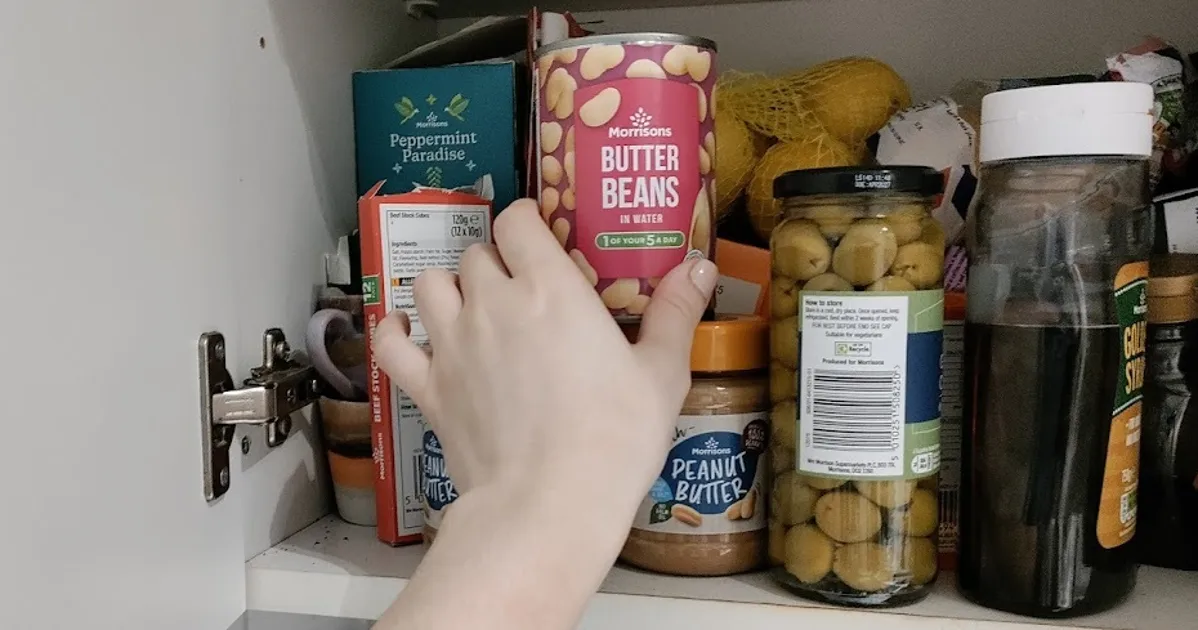
The seasonal staples are especially delicious in spring and early summer. But what about a good ol’ tin of butter beans, which lasts year-round?
Here, we asked chefs Stuart Gillies and Luca Meola to share their favourite meals to make with this “fibremaxxer’s” fave:
Stuart: a creamy Niçoise-style salad
Usually, the classic French salad contains potatoes, hard-boiled eggs, green beans, olives, lettuce, tomato, and tuna.
On top lies a tangy garlic, anchovy, mustard, vinegar, and olive oil dressing.
But for a “creamier” version, chef Gillies said you can’t go wrong with a can of butter beans in place of the usual spuds.
“I love adding them into a Niçoise-style salad ― they bring a natural creaminess and make the dish feel more substantial, while still keeping it fresh and balanced,” he told us.
“Tossed with green beans, tomatoes, olives and a sharp vinaigrette, it’s a really satisfying, protein-rich plate that works perfectly for warmer days.”
Luca: garlicky butter beans speak for themselves
One of my favourite lunches of all time is a leek and butter bean dish that takes less than 15 minutes to whip up. Another beloved version is “marry me” butterbeans, which basically just means cooking them in tomato sauce and adding something creamy and/or cheesy at the end.
Chef Meola takes a similarly minimalist approach.
“Butter beans are great cooked slowly with garlic, olive oil and a bit of rosemary until they go really soft and creamy,” he told us.
“Finish with good olive oil, and that’s pretty much it.”
He didn’t explicitly mention eating that with a hunk of crusty bread, but we’ll be trying it that way anyway.

Lessons learned in ’70s have made US, world economies less vulnerable to oil shocks

Re-Engineered Raptors Fuel 2026 Launch Hype

US Bitcoin ETFs Log Biggest Weekly Inflow Since February

Why Israel is blocking foreign journalists from entering

Bitcoin: We’re Entering The Most Dangerous Phase

Alan Cumming Brands Baftas Ceremony A ‘Triggering S**tshow’

Moneyview Personal Loan App | How To Apply Money View Loan | Moneyview Personal Loan Telugu 2026

How Small Actions Change Financial Struggles | A Simple Economics Story

GOLD AND CRYPTO LIVE TRADING || 10 APRIL || Bitcoin Live Trading | Crypto Market Analysis |
-

 Business6 days ago
Three Gulf funds agree to back Paramount’s $81 billion takeover of Warner, WSJ reports
-

 Politics2 days ago
US brings back mandatory military draft registration
-

 Fashion2 days ago
Weekend Open Thread: Veronica Beard
-

 Tech5 days ago
How Long Can You Drive With Expired Registration? What Florida Law Says
-

 Fashion6 days ago
Massimo Dutti Offers Inspiration for Your Summer Mood Board
-
 Sports2 days ago
Man United discover Nico Schlotterbeck transfer fee as defender reaches Dortmund agreement
-

 Fashion5 days ago
Let’s Discuss: DEI in 2026
-

 Crypto World3 days ago
Canary Capital Files SEC Registration for PEPE ETF
-

 Business2 days ago
Tesla Model Y Tops China Auto Sales in March 2026 With 39,827 Registrations, Beating Cheaper EVs and Gas Cars
-

 Crypto World4 days ago
Bitcoin recovers as US and Iran Agree a Ceasefire Deal
-

 Politics2 days ago
Malcolm In The Middle OG Turned Down ‘Buckets Of Money’ To Appear In Reboot
-

 Business2 days ago
OpenAI Halts Stargate UK Data Centre Project Over Energy Costs and Copyright Row
-

 Business18 hours ago
Ireland Fuel Protests Enter Day 5 as Blockades Spark Shortages and Government Prepares Support Package
-

 Tech6 days ago
Italian court says Netflix must refund customers up to $576 over price hikes
-

 Tech6 days ago
Gamer Restores the Original PlayStation Portal From Two Decades Ago
-

 Tech6 days ago
Samsung just gave up on its own Messages app
-

 Tech6 days ago
Haier is betting big that your next TV purchase will be one of these
-

 Tech6 days ago
The Xiaomi 17 Ultra has some impressive add-ons that make snapping photos really fun
-

 Politics2 days ago
LBC Presenter Mocks Trump Over Iran War Failures
-

 Tech6 days ago
Save $130 on the Samsung Galaxy Watch 8 Classic: rotating bezel, sleep coaching, and running coach for $369
You must be logged in to post a comment Login