

Politics
Troy Jackson jumps out to big lead in race to replace Graham Platner in Maine

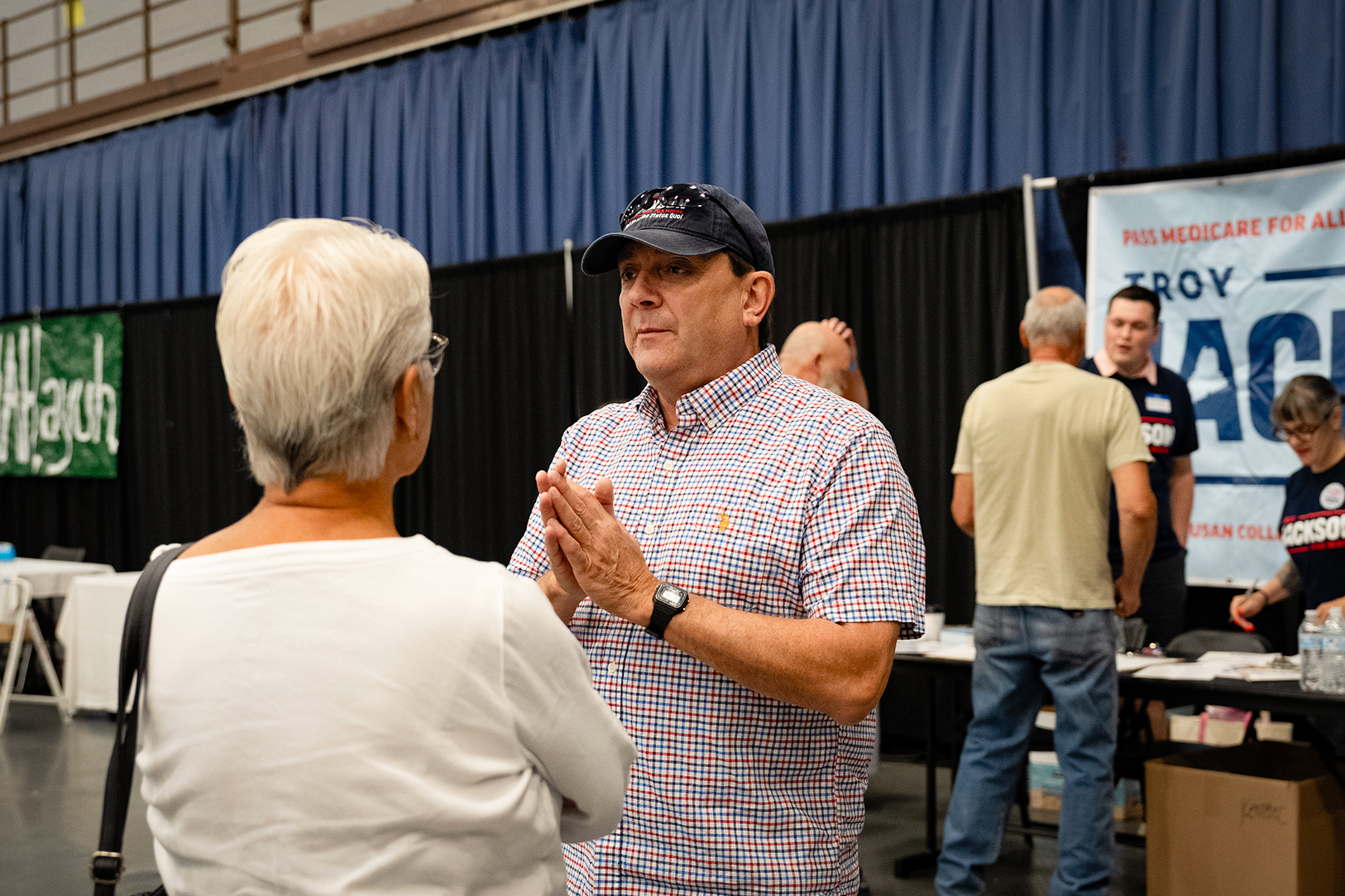

WISCASSET, Maine — As Maine Democrats began the rushed and convoluted process to name a successor to scandal-plagued former nominee Graham Platner, it became quickly clear that progressive Troy Jackson was in control.
From meetings in rural Calais near the Canadian border to urban, progressive Portland, in high school gyms and over Zoom calls across eight counties, the blue-collar logger former state Senate president ran up the score on Saturday.
His campaign dominated the first of two days of the delegate-selection process, with his longtime union allies flexing their organizing muscles to out-maneuver his rivals en route to capturing a strong majority of delegates.
“I’m asking for your vote, but I’m also asking for more than that,” Jackson told over 100 supporters at a Friday evening rally under a gazebo at a park overlooking the Atlantic Ocean in Portland, Maine.
“I’m asking you to organize,” he continued. “I’m asking you to talk to your neighbors. I’m asking you to show up at your county meetings, make the calls, send the texts and bring even more people into this movement.”
Organize they did.
On Saturday, Maine Democrats in eight counties chose 319 of the 500 open delegate slots. Jackson-aligned candidates carried an overwhelming majority of the spots selected, while supporters of former state Center for Disease Control director Nirav Shah and Secretary of State Shenna Bellows’ backers made up just a handful apiece, according to a POLITICO analysis of the campaigns’ released slates and the lists of elected delegates.
Jackson’s performance was so dominant on Saturday — capped off by a clean-sweep of the state’s largest county — that he announced he would host a celebratory tailgate during Sunday’s delegate selection caucus in York County.
The victor of Democrats’ flash pseudo-primary will be thrust immediately into the national spotlight in arguably the most important offensive opportunity for Senate Democrats this fall. Collins is the only Republican running for reelection in a state that President Donald Trump lost in 2024.
Speaking to a small group of reporters in Augusta on Saturday afternoon, Jackson acknowledged the stakes and the challenge.
“It’s probably the biggest race in the whole country,” Jackson said. “And Senator Collins is a whole different type of person to run against.”
Jackson’s campaign showed up to the county conventions with organized groups of volunteers, many of them sporting “Jackson for Maine” t-shirts from his recent unsuccessful run for governor. They also carried flyers with clear delegate slates after making a deluge of calls across the state to recruit supporters and make sure their backers were in place to push him at next week’s convention.
A logger from far-northern Allagash, Jackson made his rise in Maine politics through organized labor and has long been an ally of progressives, receiving Sen. Bernie Sanders’ (I-Vt.) backing in the gubernatorial race. He campaigned arm-in-arm with Platner during the original primary. But Jackson swiftly called for him to exit the race after POLITICO reported that a person who dated Platner said he sexually assaulted her. Platner denied the accusation, but dropped out four days later.
Jackson has been able to quickly establish himself as the candidate most in the mold of the oysterman, who dominated the Senate primary, given his longtime track record of backing similar policies.
Saturday’s strong organizational effort by Jackson and his allies — which came just eight days after Platner dropped his campaign, augmented by volunteers from more than a dozen unions that are endorsing Jackson — represents an impressive accomplishment under a tight timeline.
And it has set him up as the clear favorite over a crowded field of more than 10 candidates heading into the second day of county conventions. His nearest rivals, fellow former gubernatorial nominees Shah and Bellows, came out of Saturday’s slate of conventions with hardly any path to victory. Eight more counties will select 181 more combined delegates on Sunday, with another 101 Democratic state committee members already chosen and whose votes are less clear since they are not being elected as part of any slate. Together they will all make up the 601 delegates who will pick their party’s nominee next weekend in the crucial Senate race.
Some of Jackson’s supporters didn’t come in committed to a candidate, but had been swayed by his team’s hyper-local level of retail politics, which will be crucial in the battle with Collins, one of the strongest retail politicians in Congress.
Liam Kent, a Jackson supporter who was elected as delegate on Jackson’s slate in Lincoln County, said he had been undecided when he applied to run as a delegate. But he threw his support behind Jackson.
“I was in the middle of making a sandwich for lunch, and I was shocked to have him call me,” Kent said. “It was really nice because he’s as real on the phone as he is in person.”
The makeshift slate of county caucuses had its challenges. Voters, delegate nominees and campaigns encountered some minor hiccups while participating in the process, which was created by state and local Democrats in the two weeks after Platner’s exit from the race.
In-person and virtual county meetings provided staff to help voters resolve issues with the state’s online ballots, while campaigns scrambled to adapt to the quirks of the process.
Some delegate nominees were listed on the slates for multiple campaigns, although Jackson’s campaign featured less overlap than others. Bellows’ delegate slate included enough nominees in each county to account for the alternates that voters are allowed to select in each state. Shah’s and Jackson’s campaigns did not, causing confusion among Shah and Jackson supporters in Hancock County over where to assign their additional votes.
Nina Milliken, a state representative who coordinated Jackson’s delegate slate in Hancock County, was listed as a Shah delegate when his campaign initially released their slate. Shah’s campaign later removed her.
“It is nonsensical to me, frankly, that I’m on Shah’s list,” Milliken said. “This has been a profoundly messy process.”
The big delegate prize on Saturday was in Cumberland County, which includes the state’s largest and most Democrat-dense city of Portland. Jackson-aligned candidates claimed a clean sweep of the nominating spots in an online process that saw such high interest the party needed to extend the voting times. The final alternate delegate was a tied vote, so the county chair drew names out of a baseball cap to decide the winner.
While Jackson has a clear lead heading into Sunday, the delegates who are chosen — even if they are aligned with a particular candidate — are not formally pledged and can still change their votes at next week’s convention.
Even as he was able to rally his supporters, there were some voters who were dissatisfied with the process the Maine Democratic Party set up during the extremely narrow window they had to work with, with some who had hoped to serve as delegates feeling they were cut out of the process by campaigns that had coordinated delegate slates in advance. Other voters said the party did the best under the timeline that is outlined in state law.
Richard Zandler, a 75-year-old Democrat from Southwest Harbor, Maine, ran as an uncommitted delegate on Saturday but lost. He expressed dismay that his independence weakened his chances of being elected.
“I think a lot of the slates were established by looking at donors and people who had worked on the campaigns, because all of these candidates have just freshly come off a primary campaign,” he said.
Zandler is at least somewhat correct. A person running for delegate to back Shah said the campaign had contacted him to participate because he had previously donated to Shah’s gubernatorial race.
Other delegate-hopefuls bemoaned the sheer number of phone calls they had gotten from the want-to-be senators. Roughly 3,700 Mainers signed up to try to be delegates, and a number said they’d received 20 or 30 calls and texts from the various campaigns. Shah told POLITICO he’d personally made about 500 calls to delegate nominees ahead of the weekend meetings.
Jackon’s closest rivals were not deterred by early results on Saturday. Shah told POLITICO during a brief interview at Wiscasset Middle High School, before the scope of Jackson’s dominance had become clear, that his campaign would “keep their feet on the gas.”
“No one here is committed, and so there’s going to be a lot of persuasion that happens, without a doubt,” Shah said. “We’re going to continue.”
As the day wrapped up, Jackson posted a video to social media thanking his supporters.“All of you just smoked it,” he said. “Thank you so much. We’re well on our way to get the government we fucking deserve.”


I’ve been called out for saying “sorry” a lot – it doesn’t help that my automatic response is to apologise.
Jess Baker, a chartered psychologist and author of The Super-Helper Syndrome, told HuffPost UK: “Saying sorry a lot is not always a sign of a deeper issue. For many empathic people, apologising is a sign of awareness, kindness and a desire to maintain good relationships.”
But sometimes, the reflex might reveal something worth exploring.
“The key question is: are you apologising to acknowledge impact, or to manage other people’s reactions?” she asked.
What does it mean if I say “sorry” too much?
The psychologist, who works with “super helpers”, or those who feel a compulsion to go out of their way for others even at their own expense, said she often sees apologies “become a form of emotional over-responsibility”.
“People who are highly attuned to others can start believing it is their job to prevent disappointment, discomfort, or conflict,” she added.
“‘Sorry’ becomes a way of saying: ‘I don’t want to be a problem’, ‘I hope you’re not upset with me’, or ‘I’ll make this easier for you’.”
Baker added there are lots of reasons why people might start to over-apologise, including:
When might over-apologising be worth investigating further?
As Baker said earlier, some people say “sorry” a lot without it really being an issue. However, “it becomes something to investigate when someone apologises for having needs, boundaries, opinions or presence,” she suggested.
“If ‘sorry’ appears before a reasonable request, a challenge, or an idea in a meeting, it may point to a deeper pattern of self-doubt or people-pleasing.”
The aim, she reminded us, is not to stop people saying “sorry” when they want to – the word itself isn’t the problem here.
“A genuine apology is a sign of emotional intelligence. The aim is to make sure you are apologising from compassion, not from fear of taking up space,” she ended.

A divisive discussion thread about supposed “constant feeding” and “snacking” among children has garnered hundreds of comments on Mumsnet.
One user shared that they’d been at a swimming lesson (presumably watching their child), while sat next to two children who they described as “chomping their way through a packet of crisps and a packet of chocolate biscuits at 4pm”.
“We had a day out with friends on Tuesday at a farm park and kids are being handed food every five minutes,” they added.
“You go down the street and everywhere you look the toddlers in buggies have their little hands stuffed in packets of puffs or gripping a biscuit. It’s no wonder we have such chubby children everywhere.”
Asking other Mumsnet users if they were being “unreasonable” for bringing this up, 41% agreed they were, while 59% said they weren’t.
One commenter said: “This completely winds me up. I’m with you OP [original poster]. The snack culture in this country is doing everyone a huge disservice.”
But another parent couldn’t quite understand what the issue was: “I thought it was normal to give your children a snack, we do fruit/crackers/oatcakes/yogurt/veg sticks and hummus mid morning, mid afternoon and sometimes before bed. I also like a snack. We also all eat normal meals.”
A new “Great British Snacking Crisis” report from Imaginakery found that children ask for almost four snacks every day, on average. For one in five (20% of) parents, the snack requests start as early as before 8am.
Of those polled, one in 10 said they never refuse snack requests from their children, while nearly three-quarters (72%) said they are unlikely to refuse more than five requests in a day.
‘We have become a hugely snack-driven culture’
Baby and child nutritionist Charlotte Stirling-Reed told HuffPost UK some of the comments shared online around children’s snacking are “harsh” and “unfair”. That said, she does believe “we have become a hugely snack-dominated culture”.
She mentioned supermarket aisles, where processed snacks are commonly marketed towards young babies and toddlers. “Snacks under 12 months are not recommended at all,” she said. “But actually, right from that age and above we have become a hugely snack-driven culture.”
Off the back of a Panorama investigation into baby food pouches which lacked key nutrients, the BBC previously shared how there’s also been a “rise in sales of snacks like fruit and vegetable-based straws, puffs and wafers”.
This led former chief nutritionist to the government, Dr Alison Tedstone, to remark: “Companies are dressing these products up as being healthy, when actually they’re much like a crisp or a sweetie. They’re putting profit before health.”
Stirling-Reed understands why parents turn to snacks and highlights that “parenting is tough”. She’s right – many of us are time-starved, dashing from A to B and simply trying to keep our kids happy, satiated and any “hanger” at bay.
But often snacks are being used for reasons other than hunger or offering nutrients and balance, she claimed, suggesting parents use them to pacify, bribe, entertain or distract.
“We’re not necessarily using them for the reason we should be using snacks,” she added.
“I think a lot of parents aren’t trying to do this wrong, I think they’re actually struggling with the advertising of snacks that are available – with the bombardment that you get when you go to a supermarket or a petrol station.”
The NHS advises families that fruit and vegetable snacks are “always the best choice” for children, but if they are having packaged snacks “aim for two a day max”.
Imaginakery’s report found biscuits (69%), chocolate (59%) and crisps (57%) top the rankings for the snacks most frequently consumed by kids.
These all fall under ultra-processed foods, or UPFs, which have been linked to everything from gut disruption to “hedonistic hunger” (eating for pleasure or comfort). These snacks are typically nutritionally poor, calorie-dense, and easy to eat quickly.
The problem with placing too much of a focus on snacks
Stirling-Reed said she doesn’t want parents to feel shamed as messaging around snacking is “confusing”, but claims that how parents are using snacks at the moment “is not how they’re meant to be used”.
She explained that some children are “grazing” on food throughout the day “which means they’re not really having much of an appetite for their mealtime”.
“They’re not learning ‘am I hungry?’, ‘am I not hungry?’,” she continued. “And then, they often get to those mealtimes – it might be lunch, it might be dinner – with very little in the way of an appetite”.
This can then result in children skipping meals (or not eating much of them) – and therefore missing out on important nutrition – because they simply aren’t hungry.
“It’s not helping children with their relationship with food, with their appetite, with getting the right amount of nutrients and the right balance in, with eating those evening meals that we spend our time creating,” the nutritionist said.
How to address snacking habits at home
If you’re thinking of overhauling your snack system at home, it might be worth readdressing what a snack actually is. The nutritionist suggested they should be “mini meals” (check out some ideas here) that are “balanced, so we’re trying to get some of those food groups in”. These are fruit and veg, carbohydrates, dairy, proteins, fats and oils.
We should also be trying to address important nutrients like iron, protein, zinc, fibre and omega-3 in our snacks as well, she added.
“But they also should be timed, so we should know they’re happening at certain times through the day,” the expert continued.
“It might be between breakfast and lunch, or between lunch and dinner, and it should be a mini top-up to help them get through to the next meal, rather than what we are currently using snacks for.”
As for processed snacks aimed at babies and toddlers, Stirling-Reed added: “I’m not saying never, ever offer them – of course that’s not realistic. But actually, people relying on them as snacks most of the time is not going to be helpful.”
Nutritionist Dr Emma Derbyshire, who is working with Imaginakery, said children mimic their parents’ actions, so parents can encourage healty snacking habits by regularly eating healthy snacks with their children.
She added that it’s worth appealing to their inquisitive sides by giving them the chance to get involved with washing, peeling or chopping fresh fruit and vegetables. Growing your own produce can also help keep them engaged and interested.
Some parents swear by leaving out “veggie plates” an hour or so before dinner, which are filled with chopped veggies like peppers, cucumber and carrots.
It’s also worth considering which snacks you have readily lying around your home.
“If children see unhealthy snacks lying around, they become accustomed to these products feeling like the norm for snacking,” said Dr Derbyshire.
“Keep healthy snacks at eye level on counters, in fridges and in cupboards, while unhealthy treats should be stored out of reach and view.”

We’ve written before at HuffPost UK about how the modified Mediterranean, or MIND, diet has been linked to a 53% lower risk of dementia among its strongest followers, and a 35% reduced likelihood among moderate adherents.
And now, a new analysis published in Nutrients has reviewed hundreds of studies about interventions like these.
Researchers looked at lab, animal, clinical, and population-based studies and found polyphenols (antioxidants naturally present in some foods) “represent a biologically plausible and increasingly supported, yet not fully established, strategy for promoting healthy brain ageing”.
This included some specific foods and drinks, though the researchers stress that this isn’t so much about “superfoods” as it is maintaining a healthy overall diet.
Which foods are rich in polyphenols?
“Polyphenols are not miracle cures, but research suggests they may be promising tools for supporting healthy brain ageing,” said the study’s senior author, Dr Mónika Fekete, an Assistant Professor at the Institute of Preventive Medicine and Public Health, of Semmelweis University.
“The focus, however, should not be on dietary supplements but on a varied diet rich in plant-based foods.”
With that caveat, the study listed the following as polyphenol-rich food and drink sources:
- berries,
- grapes,
- apples,
- onions,
- flax seeds,
- sesame seeds,
- vegetables in general,
- fruit in general,
- tea,
- cocoa,
- coffee,
- whole grains, and
- extra-virgin olive oil.
These featured a variety of polyphenol sub-classes, including flavonoids, phenolic acids, stilbenes, and lignans.
Not all of these were absorbed in the same way by different people, though, possibly due to differences in individuals’ gut microbiomes.
“This may help explain why the same diet does not affect everyone in the same way,” said lead author Dr Noémi Mózes, an Assistant Professor at the Institute of Preventive Medicine and Public Health of Semmelweis University.
“In the future, personalised nutrition could help us better understand who is most likely to benefit from a polyphenol-rich diet.”
Green tea might help too
EGCG, a compound found in green tea, appeared in a lot of the studies this paper reviewed and seemed to be linked to better memory.
A 2017 trial found that consuming oolong or green tea daily could slash your risk of cognitive decline in half, while more recent research suggested that the compound might help to give our brain cells more energy.
Again, Semmelweis University reminded us that there’s no anti-dementia “miracle diet”.
However, they did say “existing evidence suggests that regularly eating more vegetables, fruits, berries, fibre-rich foods, fish, and nuts” in addition to limiting highly-processed foods “may help support healthy brain ageing and preserve cognitive function over time”.

However, before the film had even been released, there was one supporting cast member whose performance was already being singled out for praise.
British actor Samantha Morton plays Circe in Christopher Nolan’s new take on Homer’s Greek epic, and has repeatedly been mentioned as a stand-out.
In fact, her performance in the movie was so jaw-dropping, the cast and crew apparently stood around and gave her a round of applause when she was done shooting.
“This was a massive film and she is someone who comes in and changes the dynamic,” Nolan told the LA Times. “In some weird way, the film lived or died over that character. She was the fulcrum.”
While The Odyssey might be one of Samantha’s most high-profile projects to date, the Bafta winner has been working steadily in both film and TV since the early 90s – and anyone who has seen her work over the last 35 years won’t be surprised to hear that she is a highlight in Nolan’s film.
In honour of her work in The Odyssey, here are 11 Samantha Morton roles you might well have forgotten all about…
Soldier Soldier (1991)

Samantha’s very first role was in the ITV drama Soldier Soldier.
Nottingham-born Samantha discovered acting when a teacher recommended she apply to the Central Junior Television Workshop, which led to her playing Clare Anderson in four episodes of the first series.
The future Oscar nominee was just 14 when she appeared in the series, which starred Robson Green and Jerome Flynn, and took place in the aftermath of the Cold War.
Band Of Gold (1995)

Samantha followed her role in Soldier Soldier with a smart part in Robbie Coltrane’s crime drama Cracker, before being cast in Kay Mellor’s iconic series Band Of Gold.
Samantha was just 16 years old when she started filming her breakout role as Tracy Richards in the drama, alongside the likes of Geraldine James, Ray Stevenson and Cathy Tyson.
Band Of Gold centred around a group of sex workers in Bradford, with Samantha portraying a teen runaway who was hooked on drugs supplied to her by a pimp.
Years later, Samantha disclosed that there had been uncomfortable moments while shooting this series.
She told The Big Issue in 2019: “When I was in Band Of Gold, there was a scene a particular director wanted me to do topless, though that wasn’t in the script. I was 16 years old. 16! And I was having a sex scene with a man in his 60s.
“I was sobbing in the trailer and it was all, ‘Sam’s being tricky…’ I didn’t understand that I had a right to say I didn’t feel comfortable. I felt I was from the streets and I’d won the lottery even being in the show, rather than feeling I had earned the right to be there.”
“Some of the male directors working in TV drama in the 90s were delicate and kind,” she added. “And some were bullies and brutal.”
Under The Skin (1997)

BFI/Channel Four/Kobal/Shutterstock
A year after her performance in Band Of Gold, Samantha appeared in the British indie film Under The Skin.
She co-starred with Claire Rushbrook in the drama, which told the story of two sisters coping with the sudden death of their mother.
Following its release, she was lauded for her performance as the grieving teen, and winning multiple awards.
Jesus’ Son (1999)

Larry Riley/Lions Gate/Kobal/Shutterstock
As Samantha became more well-known, she appeared in Jesus’ Son, a film based on Denis Johnson’s collection of short stories of the same name.
The drama followed a hopelessly lost man – played by Billy Crudup, and known as just FH – through his stint as an orderly in a hospital, and his time in rehab to treat his addiction to heroin.
Dennis Hopper, Jack Black and Holly Hunter were among the cast who played the colourful characters FH met in his life, while Samantha played Michelle, his love interest.
Code 46 (2003)

By the early 2000s, Samantha had racked up a role in the Hollywood blockbuster Minority Report and earned an Oscar nomination for her performance in the film In America.
Around this time, she starred in Michael Winterbottom’s Code 46, a dystopian love story set in the year 2077.
The high concept sci-fi flick takes place in a divided society, split up into those “inside”, who live in high-density cities, and the others, who live in sprawling concentration camps “outside”.
Access to the “inside” is forbidden to anyone without the right paperwork – with Samantha starring as Maria, a forger who works on creating fake versions of these documents.
Meanwhile, Tim Robbins plays a detective sent to investigate this forgery operation, only to wind up falling in love with Samantha’s character.
While the film itself received a lukewarm reaction, Samantha and Tiim were praised for their performances, with Empire calling them “two fine actors at the top of their game”.
The Libertine (2005)

Isle Of Man Film Ltd/Odyssey/Kobal/Shutterstock
The Libertine is one of many period dramas Samantha has starred in over the years, having also appeared in the likes of Harlots, The Seepent Queen and The Burning Girls.
In the film, she plays Elizabeth Barry, a struggling actor in 17th-century London. Her strong-willed character is taken under the wing of the titular libertine himself, Johnny Depp’s John Wilmot, 2nd Earl of Rochester, and their subsequent affair leads to both of their downfalls.
Once again, the intoxicating biopic of the real-life poet and playboy received mixed reviews, but Samantha received widespread acclaim for her performance, in particular her moving Ophelia monologue.
Control (2007)

Warner Music/Kobal/Shutterstock
In this biopic about British musician Ian Curtis, Samantha played Deborah, the late Joy Division singer’s wife.
Control charts the ups and downs of the couple’s lives, beginning with the formation of Joy Division in 1973, all the way to his death by suicide in 1980.
Co-starring Sam Riley, the musical biopic was described by the BBC as a “gritty” tribute, “with enough wit and credibility to entertain as well as educate”.
Meanwhile, The Guardian singled out Samantha’s work as Deborah as an “intelligent, sympathetic performance”.
Elizabeth: The Golden Age (2007)

Laurie Sparham/Universal/Studio Canal/Working Title/Kobal/Shutterstock
The historical drama was a sequel to 1998’s Elizabeth, and followed the English queen as she faced the Spanish Armada, survived an assassination attempt and embarked on a forbidden romance with explorer Sir Walter Raleigh.
Samantha Morton played Mary Queen of Scots in the Queen Elizabeth biopic, which starred Cate Blanchett as the English monarch.
Joining them in the movie were impressive British names including Clive Owen, Rhys Ifans and Eddie Redmayne – not to mention a small role from a young actor by the name of Jonathan Bailey, still in the early stages of his own acting career.
Cosmopolis (2012)
You might not realise it, but The Odyssey is not the first time Samantha Morton has appeared in the same film as Robert Pattinson.
The two previously shared the screen in 2012’s Cosmopolis, a trippy adaptation of Don DeLillo’s book of the same name.
Samantha played Vija Kinsky in the David Cronenberg film, an advisor to Robert’s billionaire currency trader.
The eccentric film took place almost exclusively in the back of a limo, as Rob’s tycoon character was driven around New York with visits from various key figures in his life.
John Carter (2012)

The same year as Cosmopolis, Samantha appeared in a very different type of film, providing both the voice and motion capture for a key role in John Carter (which, sadly, was thrashed by critics and went on to become considered one of the biggest flops of the 2010s).
In the ambitious sci-fi adventure movie, she played Sola, a kind-hearted Martian who helps Taylor Kitsch’s titular character navigate the red planet.
The Whale (2022)
Samantha played a small, though memorable role, in the film which won Brendan Fraser his Academy Award in the early 2020s.
The divisive film focussed on a reclusive English teacher nearing the end of his life, who hopes to bond with his disillusioned teenage daughter before it’s too late.
Near the end of the film, Samantha appears in one key scene, sharing the screen with Brendan Fraser when she storms into his character’s apartment to give him a piece of her mind.
The Odyssey is in cinemas now.
Whether you’re a first-timer who’s barely touched a free weight or a seasoned regular who’s been hitting the same machines for years, you can still learn a lot from personal trainers.
HuffPost asked fitness professionals across the country what they wish more gymgoers understood about exercise. Their answers might just change the way you work out.
1. Consistency beats perfection every single time
“I wish people knew that consistency beats perfection every time,” Thomas Banicky, senior district fitness manager at 24 Hour Fitness, told HuffPost.
“You do not need a flawless workout plan or a two-hour gym session to make meaningful progress. Showing up regularly, building sustainable habits and focusing on gradual improvement will almost always lead to better long-term results than trying to do everything perfectly for a few weeks and burning out.”
You don’t need to overcomplicate your workouts or pressure yourself to make the “perfect” program.
“Fitness isn’t all-or-nothing,” said Denise Chakoian, a certified fitness trainer and owner of Core Cycle and Fitness LaGree.
“Too many people think that if they can’t exercise for an hour, six days a week, then they shouldn’t exercise at all. That’s simply not the case. Consistency will always trump perfection – 20 to 30 minutes of movement is better than none at all and can have huge benefits for your health.”
“The people making real progress are rarely the loudest ones in the room,” echoed April Medrano, vice president of programming, education and experience at STRIDE Fitness.
“What I wish more people understood is that progress is built in the unglamorous middle. Everyone wants the transformation, but the magic is in the boring repetition – the same lift, the same habits, the same showing up week after week.”
2. Results take months and years, not days and weeks
“Good things take time,” said Mallory Fox, a National Academy of Sports Medicine master trainer and wellness coach.
“Clients often have unrealistic expectations about the time required to meet their goals. While everyone’s progress is different, a good rule of thumb I like to share is that they’ll start to feel results in the first four weeks and see results in the first four months.”
While that timeline might feel slow and discouraging, it sets a realistic standard that promotes consistency, sustainability and injury prevention.
“We live in a society of instant gratification, but your body doesn’t work that way,” Chakoian said. “If you want to see changes in your strength, body composition and overall health, it’s going to take months and years of consistency, not days or weeks.”
Fitness isn’t about punishing your body. It’s about building a body that serves you well for decades.
– Karen Lord, trainer
Certified personal trainer Josh Schlottman recommended tracking long-term data over short-term dopamine hits. Progressive overload over time is key.
“Humans are naturally inclined to chase sensations like the pump, the burn, the sweat and the soreness,” he said.
“But I wish people understood that muscle soreness correlates very poorly with muscle growth. Soreness is mostly just a sign that your body went through some novel stimulus, but not necessarily that you had an optimal workout. If you’re not adding weight to the bar or doing more reps over time, then you’re not building strength or muscle.”
3. The hardest workout is not always the most effective
“One thing I wish more people understood is that the hardest workout is not always the most effective workout,” said Antonietta Vicario, chief training officer at PVOLVE.
“A lot of people chase a completely depleted feeling, but if you do not have the mobility, stability and core control to support intensity in movements, your body will find ways to compensate.”
Rather than setting unrealistic and counterproductive goals, she recommended starting modestly to gauge where your body is with a particular exercise and then adding incrementally as you build tolerance over time. The goal is not to wipe yourself out every time you exercise.
“Fitness isn’t about punishing your body,” said trainer and Karen Lord Pilates founder Karen Lord.
“It’s about building a body that serves you well for decades. If your workout leaves you feeling stronger, moving better, and looking forward to coming back tomorrow, that’s a much better measure of success than simply leaving completely exhausted.”
Be mindful of form and technique. Don’t push through sharp pains or clear signs of overtraining for the sake of a more intense or longer workout, either. Understand the difference between the soreness and discomfort from working out and the acute, stabbing pains that signal something is wrong.

FG Trade via Getty Images
4. What happens outside the gym matters as much as what happens inside it
“Your lifestyle influences your gains just as much as your workouts,” Schlottman said. “Psychological stress can literally double the time it takes for your body to recover from a workout and can also double your injury risk. Sleep deprivation also deteriorates nutrient partitioning. This means you’ll lose more muscle and keep more fat while dieting. Fitness is really a lifestyle, and you can’t out-train chronic stress or sleep deprivation.”
Exercise alone won’t help you reach your fitness goals without proper nutrition, stress management, rest and other healthy habits outside the gym.
“I wish more people understood how much the small things matter,” said WalkFit certified personal trainer David J. Sautter.
“Many gym-goers focus entirely on their workouts, but factors like daily movement, sleep, hydration and recovery all play a huge role in the results you see. Even something as simple as walking more each day is often underrated, despite the wide range of physical and mental health benefits it provides.”
5. Nobody is watching you as closely as you think
“Many people avoid the gym because they’re worried about being judged. In reality, most people are focused on their own workout, and trainers are usually excited to see someone taking a step toward improving their health,” said certified personal trainer Tara De Leon.
“Gymtimidation” is a real thing. But try to remember everyone was a beginner once, and people are usually too absorbed in their own workouts at the gym to scrutinise yours.
“People are far more focused on their own workout than on anyone else’s,” said Kat Pasle-Green, a health and fitness coach with Bay Club. “Walking into a gym can feel intimidating for some, but people respect consistency and genuine effort over perfection. Everyone starts somewhere, and we get better together.”
Try to resist the urge to compare yourself to others as well. Remember, everyone has a different body, different experience level and different goals. That’s why there’s no one-size-fits-all approach to fitness.
6. Don’t assume everyone is there to lose weight
“I would never assume someone’s goal is weight loss,” De Leon said. “People come to the gym for so many reasons – stress relief, strength, community, injury recovery, mental health and fun, just to name a few. No matter what their body size is, leading with a weight-loss assumption is often reductive and alienating, especially for women.”
She recalled a client who was battling cancer and had lost a significant amount of weight, but people would approach her asking what her weight loss secret was.
“She always replied, ‘Cancer! I’m dying. I’d rather be fat and alive though.’ You just never know what other people are going through, so assuming [you know] their goals isn’t a good idea,” De Leon said.

PixelsEffect via Getty Images
Fitness is about more than looks – working out builds muscle, promotes longevity, boosts confidence, improves quality of life, helps with heart and brain health, prevents injuries and so much more. Everyone at the gym has a different story and reason for being there, and all you can see is that they’re putting in the work.
“The person struggling through their workout may be fighting something you’ll never know about,” said Joshua King, training lead at Life Time Gainesville.
“The person who’s overweight may have already lost 80 pounds. The older adult lifting weights may not be training to look better, but they’re training to stay strong, independent and able to play with their grandkids for years to come.”
7. Basic gym etiquette goes a long way
Kelsey Holgate, a personal training leader and nutrition lead at Life Time Savage, said you should always “wipe down equipment after visible sweat is on the machine. It grosses people out and is not hygienic”.
Basic gym etiquette is pretty simple, and it goes a long way.
“Leave equipment cleaner than you found it,” King advised. “It’s a simple way to respect the next person. Re-rack your weights. It’s basic respect and gym etiquette.”
Skipping these steps is both inconsiderate and unsafe. Being a responsible gymgoer requires being aware that you’re in a shared space. Resist the urge to spend more time on your phone than you do actually training as well.
“I’d never hog equipment between sets while scrolling my phone,” Medrano said. “If someone’s waiting, I let them work in. The gym is shared space, and rest periods don’t require a screen.”
8. Never skip the warm-up and recovery
“I would never go into a workout without warming up,” Holgate said. “When I say warming up, I’m not talking cardio. I’m talking about movement patterns that help activate the muscles that you’re about to train. You are more likely to get injured or recruit the wrong muscle groups.”
Warm-ups help us get into the right mindset, promote mobility and support the nervous system as we embark on exercises like heavy lifting or high-intensity training – leading to improved performance. Similarly, recovery is crucial.
“One thing I wish more people understood is that recovery is productive,” Banicky said. “Many gym-goers feel guilty when they take a rest day or spend time on mobility and recovery work, but that is often where adaptation happens. Muscles do not get stronger during the workout. They get stronger when the body repairs and rebuilds afterward.”
9. It’s OK – and even smart – to ask for help
“I would recommend everyone to meet with a trainer to learn proper movement patterns,” Holgate said. “I also think meeting with a trainer helps individuals learn proper use of the equipment. It also gives them more confidence when they are in the gym vs. just roaming around.”
Even just a handful of sessions with a fitness professional can help you gain essential knowledge and skills to train effectively for life. They’ll help you learn proper form and movement to maximize safety and results. A trainer can also help you determine the best individual program for your specific needs and limitations.
“Two people can have the same goal and require completely different approaches based on their experience, lifestyle, schedule, mobility and recovery capacity,” Banicky said.
There are many considerations around biomechanics, progression and individual priorities. Working with a pro and studying fitness best practices can also help you figure out when and how to switch up your exercises to challenge yourself and see results.
“I wish more people knew it’s OK to ask for help,” Medrano said. “Most of us in this industry got into it because we genuinely want to see you win. There’s no shame in not knowing something. The only mistake is letting that stop you from starting.”

If you have just come out of seeing Christopher Nolan’s new epic film, The Odyssey and already want to immerse yourself in more of the director’s work, we have some good news for you.
The celebrated British filmmaker is responsible for some of the most awarded and respected movies of the 21st century – and most of his best offerings are currently available to stream in the UK.
So, whether you’re new to Nolan’s work and want to check out more after seeing his latest, or watching The Odyssey has just made you want to revisit your old favourites, here’s a quick round-up of where you can currently stream his films…
Oppenheimer (2023)
The non-pink side of Barbenheimer, Oppenheimer dominated the box office and pop culture upon its release in the summer of 2023.
Oppenheimer went on to earn seven Oscars, including Christopher Nolan’s first Best Picture and Best Director wins, and earned almost a billion dollars globally.
The movie features an award-winning leading performance from Cillian Murphy as Robert Oppenheimer, a theoretical physicist known as the “father of the atomic bomb”, and follows the development of the first nuclear weapon during World War II.
It also explores powerful themes like the dangers of political paranoia during McCarthyism, and the responsibility that comes with such scientific advancements.
Co-starring an Oscar-winning Robert Downey Jr as adversary Lewis Strauss and an Oscar-nominated stint from Emily Blunt as Robert’s wife Kitty (not to mention a stacked cast that also includes Florence Pugh, Rami Malek and Josh Hartnett), the film still holds a 93% Rotten Tomatoes score, and was hailed as “visually spectacular” and a “stunning masterpiece” by critics when it debuted.
Oppenheimer is now streaming on BBC iPlayer.
Tenet (2020)
Although Tenet is one of Christopher Nolan’s lowest-rated and lowest-grossing films, it’s definitely still well worth a watch.
The mind-bending science fiction thriller centres around a CIA officer, recruited by a secret organisation and trained to manipulate the flow of time, to stop an attack from the future.
Debuting in 2020, Tenet was one of the first major post-Covid cinema releases, which may have been the cause of its lack of fanfare – but it’s still a film that deserves to be revisited.
With mind-melting time travel, intense car scenes and shocking twists, it might not have been an awards season darling like Oppenheimer or The Dark Knight, but it still makes for a thrilling viewing experience.
Tenet is now streaming on HBO Max, Now and Prime Video.
Dunkirk (2017)
Dunkirk was Christopher Nolan’s first foray into the war genre. The Oscar-nominated film depicted the Dunkirk evacuation of World War II from the perspectives of those on land, at sea and in the air.
With a 92% Rotten Tomatoes score, Dunkirk has been described by NPR as “masterful visual storytelling on an epic scale”.
Dunkirk is now streaming on HBO Max and Now.
Interstellar (2014)
Considered by many to be Nolan’s best film, Interstellar is a sci-fi epic exploring time, family and the power of love.
Interstellar introduces us to an astronaut-turned-farmer played by Matthew McConaughey, who struggles on a ravaged Earth in the not-too-distant future.
Following a series of seemingly supernatural events, he stumbles upon a group of scientists on a mission to save Earth and find a new hope for humanity.
With an all-star cast which also includes The Odyssey’s Anne Hathaway and Matt Damon, as well as Jessica Chastain and even a young Timothée Chalamet, the film is beloved for its message of love and hope.
Interstellar also marked a trend of Nolan shooting primarily in IMAX – and started his collaboration with cinematographer Hoyte van Hoytema, who’s worked on all of Nolan’s movies since.
The Times called Interstellar a “gorgeous, heartbreaking epic” while the BBC compared the film to epics like Kubrick’s 2001: A Space Odyssey and Tarkovsky’s Solaris.
Interstellar is now streaming on HBO Max and Now TV
The Dark Knight Rises (2012)
Nolan concluded the Dark Knight trilogy with this divisive final instalment, The Dark Right Rises. While fans continue to debate the merits of this film and its place in the superhero pantheon, critics at the time loved the “epic sendoff” to Nolan’s gritty version of Gotham.
Christian Bale returned for a third outing as the cape crusader, roaming Gotham and protecting the city from a new set of threats.
This time, Batman was on hand to take on Anne Hathaway’s Catwoman and Tom Hardy’s Bane, with the help of Gary Oldman as Commissioner Gordon, Michael Caine as Alfred and Morgan Freeman as Lucius Fox.
The threequel also created an interesting debate, with audiences wondering if the film was an allegory for the Occupy Wall Street movement or if it explored anti-revolution sentiments – although Nolan himself has always maintained that The Dark Knight Rises isn’t political.
The Dark Knight Rises is now streaming on Prime Video, Netflix and Now.
Inception (2010)
Inception marks the first and only time that Leonardo DiCaprio and Christopher Nolan have worked together on a film.
In the movie, Leo plays a thief who can enter targets’ dreams and steal their ideas from their subconscious, who is faced with his biggest challenge of his life when he accepts a mission to plant an idea into the mind of a billionaire heir.
With an all-star cast which features The Odyssey’s Elliot Page, as well as Joseph Gordon Levitt and Marion Cottilard, Inception also reunited Nolan regulars Cillian Murphy, Michael Caine and Tom Hardy.
Critics loved the film for being the perfect mix of cerebral brain-melting, family drama and an action-packed blockbuster.
A box office success and a winner of four technical Oscars, Inception now feels like the real beginning of Nolan’s domination of big-budget summer blockbusters.
“With a brisk and unpretentious approach to making a thinking man’s popcorn movie, Nolan made and broke the mould right at the start of the decade,” Den Of Geek wrote almost a decade on from the film’s release.
Inception is now streaming on HBO Max and Now.
The Dark Knight (2008)
The Dark Knight saw Nolan elevating the idea of the traditional Batman film, turning out a movie that’s more like a Michael Mann-esque crime flick, wowing even the biggest of superhero sceptics.
While Christian Bale delivered a memorable performance in his second outing as Bruce Wayne, it was Heath Ledger’s epic portrayal of The Joker that truly stole the show.
Winning him a posthumous Academy Award, his performance as the iconic villain transcended the comic-book genre to deliver a chilling masterclass in immersive acting.
“Everything about The Dark Knight sings – its grand-scale crime saga story, its monolithic, philosophically-driven setpieces, its post-9/11 explorations of terror,” wrote Empire in 2022, when hailing The Dark Knight as the best Batman film ever made.
The Dark Knight is now streaming on Prime Video, Netflix and Now.
The Prestige (2006)
The Prestige is a magical film whose narrative mirrors the three stages of any illusion.
A Victorian-era thriller, it stars Hugh Jackman and Christian Bale as rival magicians whose obsession with creating the ultimate teleportation trick leads them into dangerous territories.
With some cinephiles even citing it as one of Nolan’s best, The Prestige has been praised for blending elements of period drama, sci-fi thriller and mystery into one movie.
On paper, it looks like your average dark suspense thriller, but The Prestige delivers an unexpected last-act twist that will make you want to watch it again and again.
The Prestige is now streaming on HBO Max and Now.
Batman Begins (2005)
The first in Nolan’s Dark Knight trilogy, the director proved that Batman can be more than a campy comic book adaptation with this origin story.
Batman Begins not only put Christopher Nolan on the map as a filmmaker, but it also opened the door to decades of superhero domination at the box office.
“It paved the way for virtually every gritty, grown-up take on superhero characters that followed subsequently,” wrote The Telegraph on the film’s 20th anniversary, before theorising that Marvel would not have had the same impact with its own cinematic universe without Nolan’s success and influence.
In Batman Begins, Christian Bale put on the iconic cape for the first time as the orphaned billionaire Bruce Wayne.
The film follows him as he overcomes his traumatic past to train with the League of Shadows and fight corruption in Gotham City.
Batman Begins is now streaming on Prime Video, Netflix and Now TV
Insomnia (2002)
Insomnia is the only movie of Nolan’s that he didn’t have a hand in writing, but it’s still an underrated gem in his filmography.
Starring Al Pacino, Robin Williams and Hilary Swank, the psychological thriller follows sleep-deprived detectives investigating a murder in an Alaskan town during a midnight sun.
While it received a 92% Rotten Tomatoes score, some critics admit it’s the Nolan film that feels less like it belongs to the auteur.
While it may not have his distinctive, epic filmmaking DNA, Insomnia has been described as “a methodically-paced yet increasingly absorbing drama”.
Insomnia is now streaming on BBC iPlayer.
Memento (2000)
Even as far back as the turn of the millennium, Christopher Nolan’s Memento features some of the hallmarks that would become synonymous with his filmmaking.
Guy Pearce takes the lead in this action thriller, playing a man with amnesia who takes a series of unusual steps to try and rediscover his lost memories and work out who is responsible for the murder of his late wife.
Co-written with his brother Jonathan Nolan, Memento earned the now-celebrated filmmaker his first ever Oscar nomination in the Best Original Screenplay category.
Memento is now streaming on Channel 4.
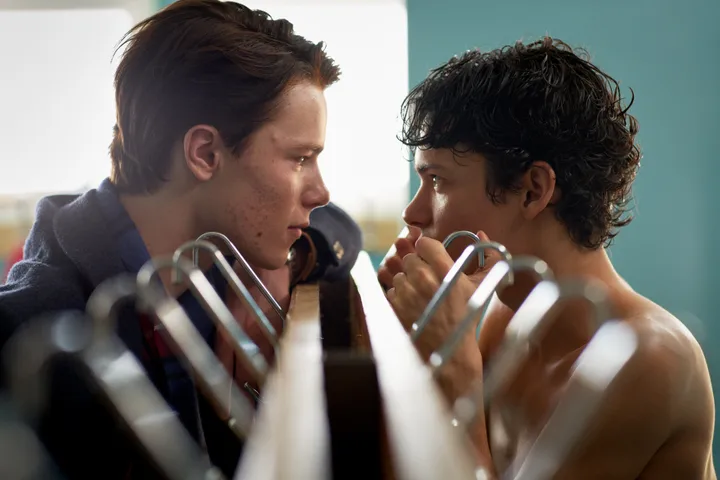
In the new Netflix movie Heartstopper Forever, one of the 2020s’ most popular love stories reached its bittersweet final chapter.
For the last four years, fans the world over have been engrossed in the romance between Kit Connor’s Nick Nelson and Joe Locke’s Charlie Spring, with the final instalment in the saga taking the form of a feature-length movie, which sees the central couple heading into the next stage of their adult lives.
If you’ve now found yourself grieving the fact that the teen drama will not be returning, we’d suggest taking this time to branch out and check out some more of the best queer romances that TV have to offer.
Here are nine of our top suggestions to get you started…
Young Royals

Effectively a mix of Heartstopper, Red, White & Royal Blue and another popular Scandinavian teen series, Skam, Young Royals takes place at an elite Swedish boarding school, where the crown prince suddenly finds he’s fallen for a scholarship student in his class.
Wille and Simon’s love story is every bit as gripping as Nick and Charlie’s, but while Heartstopper has repeatedly been both praised and criticised for its wholesome sheen, Young Royals offers a grittier look at young life more in keeping with other popular teen dramas such as Sex Education or Skins.
Young Royals is now streaming on Netflix.
Heated Rivalry

The Heated Rivalry fandom definitely matches Heartstopper’s in terms of viewers’ sheer devotion to its central couple.
What started out as a low-budget Canadian series adapting a cult queer romance novel rapidly snowballed into an international sensation when it debuted last year, making overnight sensations of its lead actors Connor Storrie and Hudson Williams.
And while much has been made of Heated Rivalry’s racy sexual scenes (and rightly so, because the show really has done a great job with them), it’s important not to overlook how fantastically Connor and Hudson bring Ilya and Shane’s romance to life on the small screen, portraying two burgeoning ice hockey players on competing teams, who are hiding a secret love affair away from the rink.
If you’ve been putting off watching Heated Rivalry, maybe take this as your sign to finally check out what all the fuss is about.
Heated Rivalry is now streaming on HBO Max and Now in the UK.
Love Victor

Originally intended as a TV spin-off of the hit teen film Love Simon, Love Victor eventually went on to take on a life of its own over its three seasons.
In season one, we’re introduced to the titular teen Victor Salazar, who is settling into a new school in Atlanta, where he’s moved with his family, all while getting to grips with themes like sexual identity, coming out and the highs and lows of first love.
Much like Heartstopper, Love Victor also explores ideas around difficult family dynamics and the importance of friendship, with many of our hero’s close-knit group going through unconventional romantic situations of their own.
Love Victor is now streaming on Disney+.
Atypical

The Netflix original series Atypical ran for four seasons, with Keir Gilchrist taking the lead as a young man with autism who announces he’s ready to begin dating.
A high school comedy unlike any other, Keir’s lead character Sam is in the spotlight for most of the series, but as the years progressed, fans became engrossed in the blossoming love story that slowly developed between Casey, his younger sister, and Izzie, a girl at her school who is introduced in the second season.
Be warned, though, despite an initial renewal for a fifth season, Netflix eventually threw the brakes on Atypical prematurely, citing the Covid pandemic as its reasoning at the time, though many fans are hopeful they may one day see a resolution to Casey and Izzie’s romance.
All four seasons of Atypical are now streaming on Netflix.
A League Of Their Own

Based on the hit 90s film of the same name, A League Of Their Own centres around a female baseball team in 1940s America, and the various relationships between its members.
Upon its release in 2022, the series was praised by critics for spotlighting queer themes that were barely alluded to in the original movie, and went on to win a prize at the GLAAD Media Awards the following year.
While its core romance is between teammates Carson Shaw and Greta Gill (played by Broad City’s Abbi Jacobson and The Good Place’s D’Arcy Carden), the series showcases a range of characters navigating queer life at a very different time in history to the likes of many of today’s popular LGBTQ+ shows.
Sadly, like Atypical, A League Of Their Own was cut short despite its popularity, this time owing to the Hollywood strikes of 2023.
A League Of Their Own is now streaming on Prime Video.
Feel Good

If Heartstopper Forever’s turn of events has got you in the mood for a queer romance that’s decidedly more mature, we’d definitely recommend Feel Good.
Mae Martin takes the lead in this dark rom-com, playing a struggling comedian in London loosely inspired by themself, who becomes quickly infatuated with a woman she meets at one of her stand-up shows, played by You’s Charlotte Ritchie.
Central duo Mae and George’s romance is definitely a rollercoaster, but it’s one you can’t help but root for, as they overcome many relatable hurdles in new relationships, such as family drama, culture clashes and sexual compatibility, as well as tackling more serious issues including addiction, mental health struggle and gender difference.
Running for just two seasons, Feel Good is perfectly binge-able, and despite its acclaim (including Bafta recognition) is still criminally underrated.
Both seasons of Feel Good is now streaming on Netflix.
Smiley

Smiley is a Spanish romantic comedy about two men who meet by chance, when one messages the other by accident.
Despite being different in almost every way, the two have undeniable chemistry, and spend the course of the series debating whether or not that’s a strong enough foundation to build a relationship on, set against the colourful backdrop of Barcelona’s queer scene.
One thing we would point out is that it is technically set over the festive period, but given its sun-drenched setting, it shouldn’t jar too much if you can’t wait until December to hit play on it.
Smiley is now streaming on Netflix.
Fellow Travelers

Alright, if Heartstopper’s more tame approach to queer love always felt a little on the sanitised side, Fellow Travelers might well be more your taste.
Jonathan Bailey and Matt Bomer won huge critical acclaim (and an Emmy nomination each) for their work in this limited series, playing two men who become embroiled in a passionate decades-spanning love affair.
Over the course of the episodes, their tumultuous romance that takes viewers on a journey through 20th century queer history, beginning at the height of McCarthyism in the 1950s and carrying on right through till the AIDS crisis of the 80s – interspersed, it should be noted, with some of the most talked-about sex scenes of 2020s TV.
Fellow Travellers is now streaming on Paramount+.
My son, Mahaan, was nine the first time I watched him fail at something in real time.
We had just moved to Sintra, Portugal, and he’d joined the local football league. No one on the team spoke English. No one looked like him. In those first weeks, I’d watch him keep glancing back at us between huddles, a look on his face that said, clear as anything, “I have no idea what these people are saying.”
There was no app or translation he could pull up mid-drill. He just had to stand there, not understanding, and figure out what to do with that.
What he did was sit in it. Over several weeks, he learned to read his coach’s hand gestures. He slowly found ways to connect with his teammates that didn’t require language – a pass, a nod, a joke that worked without words. By the second month, he was best friends with half the team.
I think about that season a lot now, mostly because of how rare it’s becoming.
Every conversation about kids and AI seems to land on the same worries: cheating on essays, shortened attention spans, a generation that can’t write a sentence without a prompt. Those are real concerns. But after two decades spent studying how children actually learn, and a handful of years watching my own two kids grow up in a dozen different countries, the thing that keeps me up isn’t plagiarism.
I’m afraid we’re raising a generation of kids who will never have to sit inside discomfort long enough to learn what they’re made of.
There’s a concept in learning science called assimilation and accommodation.
Assimilation is when new information fits neatly into what a child already understands – easy, comfortable, low friction. Accommodation is what happens when it doesn’t fit, when the old mental model breaks and has to be rebuilt; this is where things get uncomfortable, and also where almost all real growth happens.
AI, used the way most of our kids are currently using it, is an assimilation machine, and that’s what concerns me most.
My daughter, Laaha, is a writer. She carries a typewriter with her, an actual one, and disappears into it for hours. Watching her work without AI is watching someone wrestle with a sentence until it says the thing she actually means, not the thing that was easiest to produce.
The few times she’s used AI to help with a piece of writing, the results came back faster and cleaner, but something in them felt thinner. The sentence had an answer in it, but not a search. She noticed it before I had to point it out, that the writing that meant the most to her was always the writing that had cost her something to get to.
That process, that reward – that’s what I feared my kids would lose. So a few years ago, my husband and I made the decision to leave a conventional life behind and start moving our family through different countries and cultures, building our kids’ education around the world instead of around a single classroom.

Photo Courtesy Of Rekha Magon
People assumed we were running from something or chasing some Instagram version of freedom. We weren’t. We were trying to engineer something specific back into childhood: situations our kids couldn’t Google their way out of.
A new country where they don’t speak the language yet. A friendship that has to be built from absolute scratch, with someone who looks nothing like them and grew up nothing like they did. A problem – logistical, social, emotional, that has no clean answer.
When we first moved to Kotor, Montenegro, the stoic, reserved culture of the Balkans came as a shock to my daughter. Laaha was 11, and by then she was used to running small errands on her own. She’d done it in every other country we’d lived in.
But in Kotor, asking a tall, stone-faced vendor how to weigh and bag vegetables at the market felt like too much. For the first few weeks, she wouldn’t even try.
Then, slowly, walking the streets of that small historic town on her own, she met Maria, a woman in her 30s who sold boat tours outside the old town walls. The two of them became fast friends. Through Maria, Laaha’s whole sense of the place shifted; she started to see the warmth underneath what had first read as coldness.
Two months later, on Laaha’s birthday, Maria knocked on our apartment door with a gift and a card. When we left Kotor and Laaha had to say goodbye to her, the tears on both their faces are something I’ll never forget.
A beautiful relationship was formed, but it didn’t come easy and it didn’t come right away. It took the unglamorous skill of staying in a hard moment without an exit, which is what I fear children losing. The ability to sit with not knowing. To be bored without immediately filling the boredom. To be in a room with someone you don’t understand yet and stay long enough to start understanding them, instead of closing a tab.
That skill doesn’t come from a curriculum. It comes from being intentionally, repeatedly placed in situations slightly beyond what’s comfortable, and not being rescued from them too quickly, by a parent, an app or an answer that arrives before the question has finished forming.
I think about Mahaan again, a year later, in Syros, a small Greek island where we lived for three months. I put him, 10 years old by then, in charge of figuring out our washing machine. There were no instructions in English, just a panel of Greek symbols he didn’t recognise.
He sat in front of that machine for the better part of an afternoon, working through what each symbol meant by trial and error. When he finally got the first load running, the look on his face wasn’t relief. It was pride, the specific kind that only comes from solving something nobody handed you the answer to.
I don’t know exactly what the world will look like by the time my kids are adults. Nobody does, and I think that’s the honest starting point for any conversation about how to raise kids right now, AI or no AI.
What I want for them isn’t a head start on a particular set of facts. It’s the capacity to walk into a totally unfamiliar situation – a new country, a new job, a relationship with someone who sees the world differently – and stay there long enough to figure it out.
That capacity gets built the same way it always has: through repeated, real, occasionally uncomfortable practice. Not through a tool that does it for you.
So, as difficult as it is, what I’m working on is resisting the urge to hand my kids the answer the moment they look stuck. For now, while we still get to choose, that struggle is ours to protect.
Rekha Magon is the co-founder and chief education officer at Boundless Life, a global platform enabling families to live, work and learn around the world. She has spoken at SXSW, and her work has earned multiple recognitions, including Canada’s 9th EdTech Innovation Award, Skift Innovation Awards, Fast Company’s Most Innovative Companies of 2026 and a Finalist for Emerging Leader of the Year Education Pioneer Award.
Do you have a compelling personal story you’d like to see published on HuffPost? Find out what we’re looking for here and send us a pitch at pitch@huffpost.com.

From the moment the United States launched its bid to co-host the 2026 World Cup, the games were pitched as a way to elevate and promote North America’s most distinctive and glamorous cities.
There was Miami, with its fabulous beachfront hotels, described in the so-called bid book as the United States’ “gateway to the world.” San Francisco put forth a vision of fans flooding Mission Dolores Park, reveling in the city’s “iconic skyline” and its mythical bridge on the edge of the continent. Boston, one of America’s “most historic” cities, would greet the World Cup with an “elegant simplicity with distinctive New England flair.”
The members of soccer governing body FIFA bought it, and in 2018 chose the United States, Mexico and Canada. But the tournament itself was never intended to be played in many of the cities lovingly described by the bid book. Instead, in a quirk of political geography distinctive to the United States, matches would often land instead in much smaller, less wealthy outlying municipalities known to sports fans and illegible to everyone else.
“When I tell people I’m the mayor of East Rutherford, they’re like, where’s that?” said Jeffrey Lahullier, the elected leader of a New Jersey town of 10,000 hosting this weekend’s final match. “I say, do you know where the World Cup’s being played?”
It’s an inversion of American political power laid bare by the World Cup, where global events are often staged in municipalities with sometimes only a few thousand residents, forcing local officials to negotiate with billion-dollar franchises, international governing bodies and visiting heads of state.
For decades, such suburban stadium cities — often considered little more than a landing pad for enormous, polygonal sports spaceships — have existed in a strange political limbo. They find themselves alternatingly privileged and bullied from the athletic behemoths in their backyards, which come with promising financial impact but deliver it only inconsistently. With the World Cup, what was often a source of local friction between local politicians and their most famous corporate citizens moved onto the global stage.
Santa Clara, California, Mayor Lisa Gillmor welcomed Jordan’s King Abdullah II upon his arrival at the nearby airport, and Arlington, Texas, Mayor Jim Ross greeted Japan’s Princess Takamado. In Foxborough, Massachusetts, the five part-time members of a town’s select board found themselves in a staredown with what might be the world’s most famous nonprofit. In Inglewood, abutting Los Angeles, Mayor James Butts saw a labor fight with a stadium-workers union become intertwined with federal immigration debates after workers said they were fearful of being “kidnapped by ICE” agents assigned to games.
As presidents, prime ministers and kings from across at least three continents meet in East Rutherford, Lahullier’s mind will be focused less on the World Cup final taking place than on how to find room in a $34 million municipal budget to cover a $100,000-plus police overtime bill.
“It was described to me like I’m hosting eight Super Bowls,” Lahullier said of the challenges posed by the World Cup. “But it’s not a money-maker — you’re laying out money you hope you’re going to recoup.”
Long before they were massive monuments to American sports culture, the sites of suburban stadiums were racetracks, swamps, low-income neighborhoods and sandy expanses of land where locals took weekend dirtbike joyrides and came to dump their trash.
Through much of the 20th century, sports were synonymous with the hub and thrum of the city itself. Fans would walk from workplaces and homes to arenas that were centers of civic pride, their cheers and roars knit into the urban soundscape, players and coaches an extension of a city’s character.
That started to change in the 1960s, and teams began to move away from the places and names they bore on the front of their jerseys. Although the rise of the automobile and a population shift into the suburbs guided their destinations, departure was usually precipitated by conflict with local political leadership. In 1971, the Boston Patriots left their hometown after struggling to find space for a permanent stadium that could house the National Football League franchise. They found the land about an hour’s drive away along Route 1, in a small town that would not fund the stadium, but welcomed the project. In recognition of their new Foxborough home — much closer to Rhode Island than Boston’s city hall — the team renamed itself the New England Patriots.

Wellington Mara, the owner of the New York Giants, announced that same year that he would move his team from Yankee Stadium to a swampy New Jersey tideland after growing discontented with the city’s unwillingness to build them their own stadium. (“Every family dreams of moving into its own house and to get away from its in‐laws,” Mara said at the time.) After the announcement, then-New York Mayor John Lindsay called Mara “selfish, callous and ungrateful,” threatening to sue in an effort to force the team to drop New York from its name.
The Miami Dolphins decided to leave the Orange Bowl, in the city’s Little Havana neighborhood, in 1984 after Miami demanded a rent increase. Team owner Joe Robbie signed a 99-year lease with Dade County for a site in a low-income, rural, and then-unincorporated patch of land about 15 miles northwest of downtown Miami.
At the time, the populace of what was then called Lake Lucerne was little enthused about making room for a $100 million professional sports stadium. Local homeowners, many of them Black, mounted lawsuits on both land-use and civil-rights grounds to block development, but found themselves thwarted by maneuvering from the county and state agencies. Even the discovery of a Native American burial ground on the site was not enough to stop Joe Robbie Stadium from opening to the public in 1987.
Similar scenes played out across the country in the decades that followed. The Dallas Cowboys left downtown Dallas for Irving in 1971, then moved deeper into the suburbs to Arlington in 2009, having failed to convince either of its previous two homes to build a taxpayer-funded stadium. The 49ers left San Francisco’s Candlestick Point in 2013 for the warmer, less windy and more financially welcoming city of Santa Clara 40 miles down the San Francisco Bay Peninsula. In Southern California, Inglewood won out over competing sites as the home for the Rams when the football team returned to the city in 2020.
Each transformed a small municipality into a development and entertainment destination whose population could balloon by more than 800 percent on game days or concert nights. That offered an appealing new tax base along with vexing new public-safety and transportation challenges, and tricky politics surrounding it all.
As Foxborough transformed from isolated farm town into a regional destination surrounded by malls, the city wrangled with the Patriots over fan behavior, traffic concerns and their understaffed local police. In Inglewood, the arrival of a stadium led to luxury mixed-use housing developments and new hotels with yoga decks, but also significant displacement of an overwhelmingly non-white community.
Rutherford, New Jersey, is a charming borough whose compact, “20th century quaint” walkable center Forbes once described as fit for a Norman Rockwell painting. The town to its east, however, is little more than a farrago of parking lots surrounding MetLife Stadium (home to football’s Jets and Giants), Meadowlands Racetrack (thoroughbreds, harness horses) and the American Dream mega-mall (Abercrombie & Fitch, Cinnabon). It has since become the smallest city ever to host a Super Bowl.
Leaving San Francisco, the 49ers in 2010 asked voters in Santa Clara — a quiet Silicon valley suburb then best known as the home of Intel and Nvidia — to contribute to $937 million in total spending on a new stadium. Under the terms of the arrangement, a public authority would own the building and the 49ers would act as the manager of day-to-day operations, sharing revenue from non-NFL events with the city.
“The economy wasn’t great, the team was losing, there was a lot of distrust in politics at the time,” said Lisa Gillmor, a former city council member who helped run the pro-stadium ballot campaign. “We worked really hard and convinced our community that it wasn’t going to cost the city any money to build the stadium.”

By the time Gillmor returned to city government in 2016, she said Santa Clara’s relationship with the team had begun to deteriorate. A nearby youth soccer park became a flashpoint as the 49ers considered turning into parking lots, and a popular multi-use trail was diverted on game days. (A 49ers spokesperson said that the field was untouched and that the franchise now provides funding for youth teams that use it.) Most significantly, Gillmor said that money that the city was expected to receive from stadium concert revenues soon fell to near-zero, as the team claimed its security costs had increased, although the team maintains that total revenue from the general fund has outpaced initial projects.
Things turned adversarial enough that Gillmor and the city voted to remove the 49ers as managers of the stadium in 2019, prompting a lawsuit from the team. The 49ers later launched a campaign to unseat her, and in 2022, a team-backed challenger came just 700 votes short of doing so. (The city and the team later settled their lawsuit, leaving the 49ers with management of the stadium.)
Ellie Caple, the 49ers vice president of corporate communications and public affairs, said that the World Cup has been a “tremendous success with no financial risk to the city” and that the 49ers remain committed to investing in the community. Gillmor, for her part, has gone from ally of a San Francisco-based team to a leading antagonist of Santa Clara’s most famous resident.
“They were very hospitable during the election,” said Gillmor. “Then after the votes, things changed, they rolled back up the red carpet.”
A global mega-event like the World Cup is always framed in the bright terms of shared humanity and common purpose, a chance to “embrace the concept of global unity” and “the power of football to meaningfully impact the world,” as the United States’ pitch deck once put it. Still, the relationship between a host city and FIFA is also decidedly transactional in nature.
FIFA, soccer’s governing body, requires locales to sign a hosting agreement requiring cities to cover significant operational costs of matches like security and expanded transportation services, which can run to up to$150 million per city. In return, the host city is promised publicity and an economic infusion from the games, plus reimbursements from state host committees. In the United States, many cities recoiled at those terms, including Chicago, Minneapolis and Detroit, which removed themselves from host consideration in the run-up to the World Cup, citing FIFA’s demands and financial expectations.
“The big problem I had was, they wanted to treat taxpayers as dumb money at the table, and I was not gonna let that happen,” former Chicago Mayor Rahm Emanuel said in an interview with POLITICO in June, looking back on Chicago’s decision not to host World Cup matches. “I know a bad deal when I see one.”
For the cities that did end up with the games, the welcome wasn’t particularly warm. New York and New Jersey politicians have engaged in a bruising, very public argument with FIFA over its unwillingness to help pay for fan transportation, which World Cup host countries have been on the hook for in the past. New York City Mayor Zohran Mamdani, meanwhile, successfully negotiated with FIFA for $50 tickets and free transportation for 1,000 New Yorkers, and pushed the soccer giant to retreat from a ban on spectators bringing water bottles into stadiums. (FIFA President Gianni Infantino also arranged a call between Mamdani and Arsène Wenger, the legendary manager of Mamdani’s beloved club Arsenal, in an effort to build goodwill.)

Outrage from New Jersey Gov. Mikie Sherrill over FIFA’s plans to sell stadium grass as a collectible drove the organization to reverse itself and agree to return some proceeds to local organizers. (FIFA did not respond to a request for comment.)
But small-town mayors were not always able to capture the same public attention when pushing back against the Zurich-based nonprofit, and were forced to seek leverage elsewhere. The select board of 19,000-person Foxborough withheld a basic event permit for the seven World Cup matches scheduled for Gillette Stadium to extract reimbursement for an estimated $7.8 million in security costs. Less than three months before the World Cup was scheduled to begin, Patriots owner Robert Kraft delivered the money.
“The concessions are small and meaningless, they can say they’ve extracted this, but it doesn’t really matter,” said J.C. Bradbury, a sports business professor at Kennesaw State University and the author of a forthcoming book about how stadiums transformed into “billion-dollar play-palaces for the rich-built increasingly on the backs of taxpayers.”
The settlement between Foxborough and Kraft’s companies allowed the World Cup to proceed in Massachusetts even as the two entities moved their battle to court. In mid-June, Kraft Sports & Entertainment sued the town for “repeatedly misusing its state-granted licensing authority unlawfully to extract funds.” In early July, even before the final match was played there, Foxborough filed a counterclaim that asked a judge to dismiss Kraft’s suit.
“While the plaintiffs, a collection of multibillion-dollar corporations, would prefer to have Foxborough taxpayers bear these expenses, they are contractually bound to pay for the public safety services that are necessary to ensure safe and efficient events at their private venue,” the town wrote in a brief.
Kraft’s New England Revolution professional soccer franchise plays its next match in Foxborough on Thursday.
When the summer Olympics concluded in August 2024, it was Los Angeles Mayor Karen Bass who inherited the games’ flame, which she passed to a motorcycling Tom Cruise for an action hero’s escape to California. But the bulk of the ceremony that opens the Olympics in July 2028 will not take place within the city that Bass governs.
Instead it will occur at Inglewood’s SoFi Stadium, which had not been built when the World Cup and Olympic bids were formulated but is now regarded as one of the world’s preeminent sporting arenas and will be converted into a swimming venue in 2028.
Mayor James Butts credits his city’s dramatic change in financial fortunes over the last few decades to the arrival of sports teams and stadiums, along with related businesses like the National Football League, which set its West Coast headquarters and media center there. Once the home of the Los Angeles Lakers, the city’s team bucked the suburban trend by leaving Inglewood’s Great Western Forum for a stadium in downtown Los Angeles in 1999. In the decade that followed, the city struggled with crime, high unemployment rates and a $17 million budget deficit. But its fortunes began to change when the Forum reopened and sports investor Stan Kroenke bought the city’s old racetrack, which later became the site of SoFi stadium and the home of the Rams.
Butts estimates that his city now hosts 400 events a year and welcomes a half-million people, requiring “very robust” traffic management and safety resources, insisting that the city-stadium dynamic is “very healthy.”

But that relationship has also been tested by numerous disputes, including a long running legal dispute between the city and Kroenke, who owns both SoFi and the Rams. Inglewood receives millions each year from an admission tax on ticket events, amounting to nearly 10 percent of the city’s general fund revenues.
“We went from BBB- bond ratings to AA+. Median value for a home was $225,000 when I took office, it’s $850,000 now,” said Butts. “Right now we have more in reserves than any city in the county.”
Butts is not alone among local politicians to believe that having one’s city defined by a stadium is worth the hassle and financial burden, and that being too easily confused with its much bigger neighbor can bring its own benefits. In a promotional video for the World Cup, Mayor Rodney Harris of Miami Gardens — where today’s third-place match between France and England will be played — said that the tournament gives “an opportunity to sell our story” in a way that could help lure future businesses.
Ultimately, for these mayors, the moments of pageantry are few and far between. Lahullier attended the tournament’s first match at MetLife, between Morocco and Brazil, in a luxury-box row of government officials. “I wish I could tell you that I follow soccer, but I do not,” he said.
But when broadcasters grabbed shots of local politicians, it was always Mamdani — the camera cutting out the actual mayor sitting to his right. Even when the world is looking on, a small-city mayor can recede into the backdrop.
“I’ve been mayor now for seven years,” Lahullier said. “If I twisted arms I could probably get a signed football or a signed jersey.”
Sharon Graham’s former Unite election campaign organiser Matt Smith now supports her opponent, Simon Dubbins.
Having seen Graham in action as general secretary, Smith believes that another five years of Graham would be “an utter disaster for our union”.
But he didn’t only play an extensive role in her 2021 general secretary election campaign. According to senior union insiders, he “wrote her manifesto”.
Unite endured five misused years under Graham
Smith said that Graham has increased corruption at Unite rather than reduce it. He claimed that she had appointed useless cronies to senior positions and even made up a “ghost job” to buy off a potential rival.
Smith said:
[Graham had] shown all the signs of being insecure, paranoid, and suffering from imposter syndrome from the very start of her term.
Rather than progress Unite, Graham “wasted five years that should have been used to turn this union around”, Smith added.
As the person who wrote her manifesto, who could be better placed to know that she squandered the time instead of implementing her promises?
Smith also left out a lot of Graham’s appalling, anti-union record. For more detail on that, read this.
Featured image via Nurith Wagner-Strauss
By Skwawkbox

India vs England Live Score, 3rd ODI: All eyes on Rohit Sharma as India, England gear up for Lord’s series decider

Ireland looking ahead with launch of Quantum 2030 Implementation Plan

‘A 10-goal thriller’: England fans react to 6-4 win over France


-
 NewsBeat3 days ago
London Mayor Sadiq Khan handed a peerage by Keir Starmer alongside 15 other Labour figures… just days before the PM leaves No10
-

 Fashion2 days ago
Weekend Open Thread – Corporette.com
-

 Politics21 hours ago
The House | The City of London can help the new chancellor deliver growth in every postcode
-

 Crypto World3 days ago
CFTC blocks Kalshi from unwinding Michigan trades after court order
-

 Politics4 days ago
Young campaigners urge incoming PM to act on outdoor junk food ads
-

 Business3 days ago
Nvidia Stock Slips After Big Tuesday Rally as Huang Confirms Vera Rubin Chip Is Now in Production Today
-

 Crypto World21 hours ago
Ripple Payments Joins MiCA With 14 Firms, Does It Mean Anything For XRP?
-
 Entertainment4 days ago
Disney’s Most Ambitious Failed Star Wars Attraction Is Coming to SDCC
-

 Crypto World1 day ago
Ripple wins EU-wide access as ESMA adds it to MiCA register
-

 Business3 days ago
Palantir Shares Rise After Expanded Nvidia Partnership and Fresh Analyst Upgrades Ahead of Earnings Day
-

 Crypto World2 days ago
Injective Submits SEC Transfer-Agent Registration to Onchain Ownership Records
-

 Tech5 days ago
Get Your ESP32 Sunny Side Up With This Solar Dev Board
-

 News Videos4 days ago
XRP BOMBSHELL… XRP OMBOARDED FOR TRANSACTIONS!!!
-

 NewsBeat2 days ago
Registration is now open for March for Men with Kev 2026
-

 Tech4 days ago
Dark Secrets Emerge When Jailbreaking LLMs
-
 Sports3 days ago
New Cornerback Enters Vikings Trade Rumor Mill
-

 News Videos2 days ago
Money | Class 12 Economics | CBSE Board Exam 2026-27
-

 Business2 days ago
Banco Bilbao Vizcaya Argentaria, S.A. (BBVA) Discusses Global Macro Environment and Economic Outlook for Core Markets Transcript
-

 Crypto World2 days ago
Claude Fable 5 Slips to Second in AI Coding Leaderboard
-
 Crypto World2 days ago
Two July Windows Left: The CLARITY Act’s Senate Fight and What Failure Means
You must be logged in to post a comment Login