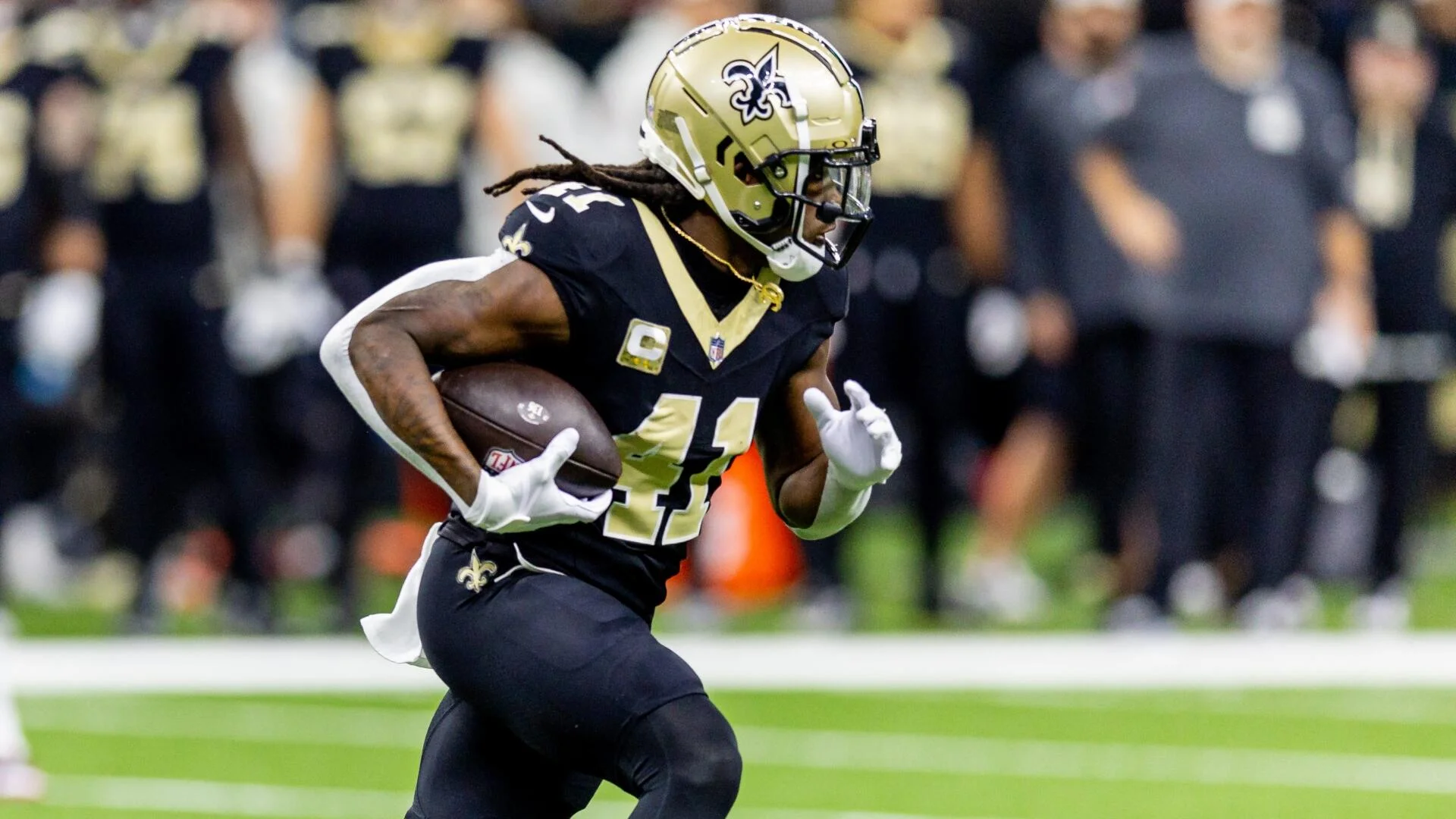
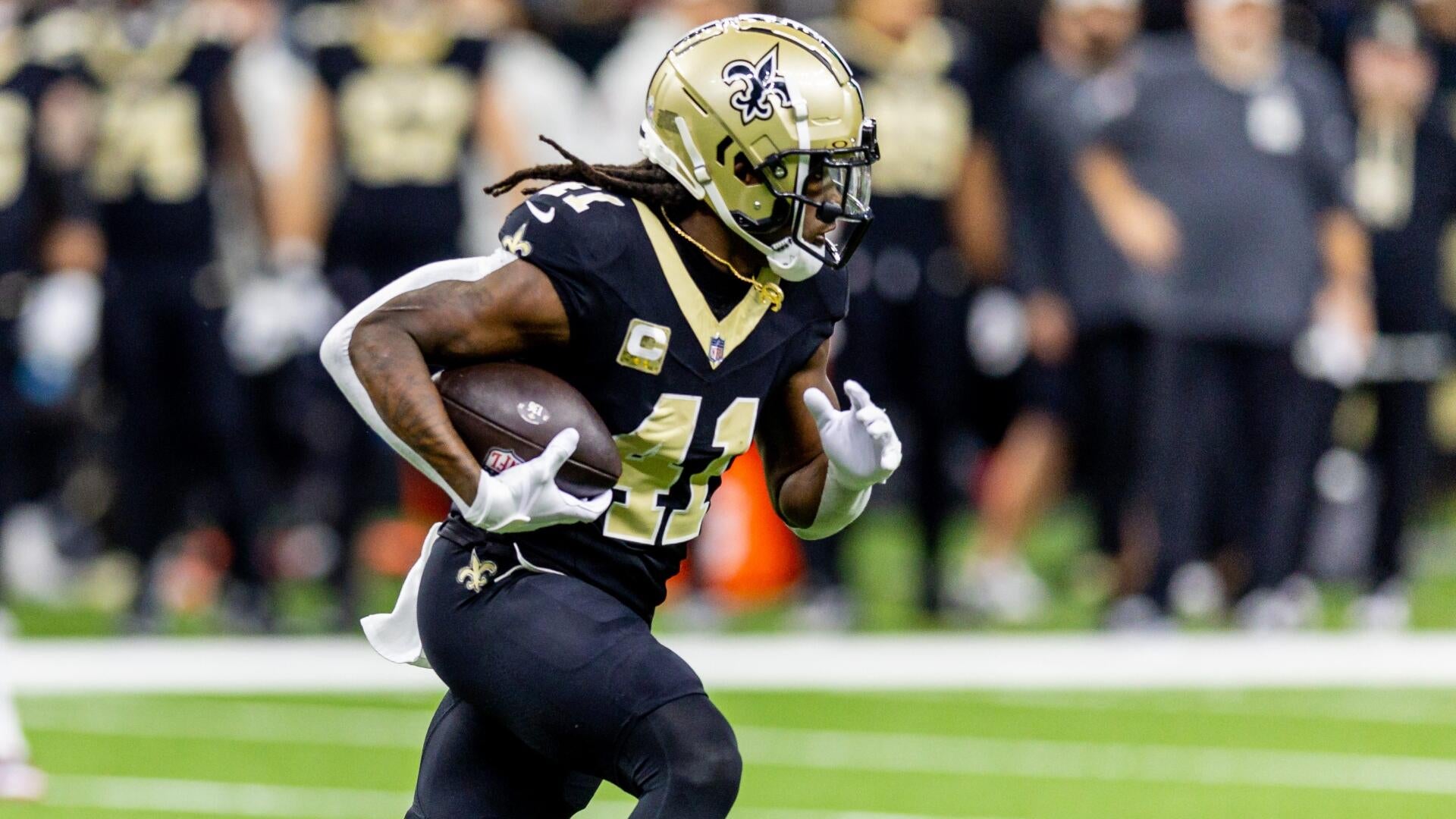
Alvin Kamara has spent his entire nine-year career in New Orleans, but right now, there’s no guarantee that he’s going to be returning for a 10th season. As things currently stand, Kamara and the Saints don’t seem to be on the same page about his future.
The Saints have done several things this offseason that would suggest that they might be ready to move on from the 30-year-old running back, but on Kamara’s end, it sounds like he wants to stay in New Orleans.
The five-time Pro Bowler has kept a low profile this offseason, but he’s finally talking. During a Monday appearance on “The Set” podcast with Terron Armstead, Kamara hinted at where he wants to play in 2026, and for the first time ever, he publicly reacted to the Saints’ decision to sign Travis Etienne Jr., his potential replacement at running back.
Let’s take a look at what Kamara had to say and what the future might hold for him.
Alvin Kamara’s thoughts on his NFL future and reaction to the Etienne signing
One of the most surprising moves of the offseason came in March, when the New Orleans Saints signed Etienne to a four-year, $48 million deal. It wasn’t a shock to see the Saints sign a running back, but it was a surprise to see them go after a top-of-the-market player. Etienne’s deal makes him one of the 10 highest-paid running backs in the NFL, just behind Kamara, who signed a two-year, $24.5 million extension back in October 2024.
As soon as Etienne was signed, there were immediate questions about what that would mean for Kamara’s future. There were also questions about whether Kamara would even want to stay in New Orleans with Etienne now on the roster.
Kamara seemed to answer both of those questions on Monday.
“I watched [Etienne] in Jacksonville these past couple years,” Kamara said. “He’s explosive, he hit home runs. He did it in college. Strong dude, seems smart. I’m excited to see what we can do together.”
That last line is the notable one. If Kamara is excited about seeing what the duo can “do together,” that means he wants to stay in New Orleans. Kamara also made it clear that he won’t have any trouble sharing the backfield with Etienne because there’s no “beef” between the two of them. Kamara said he was actually glad to see Etienne score such a big contract.
“You know I ain’t into social media and all that,” Kamara said. “I don’t do too much watching and stuff, but I think a lot of people be thinking it’s like beef or something when moves like this happen, and it’s like, ‘Man, I couldn’t be happier.’ One, my boy got paid, and two, like, it ain’t nothing but some help in the backfield. That’s the name of the game, depth. One person can’t do it by themselves, so I’m cool with it. Whichever direction we can take it, I’m with it.”
Kamara hasn’t spent much time in New Orleans this offseason, but he said he’s excited to get to work with Etienne.
“I haven’t had really a chance too much to talk to him, but definitely excited that he got a fleur-de-lis on his helmet and he got paid,” Kamara said. “Now, it’s time to go to work.”
During Kamara’s first two years in New Orleans (2017-18), he formed a powerful one-two punch at running back with Mark Ingram and he’d like to see the same thing happen with Etienne.
“I think that’s what we trying to find, me and Mark set the bar very high,” Kamara said. “That’s what efficiency looks like on a very high level. I’m 100 percent for it. If that’s what direction we’re going in, I’m with it. I think we can get there.”
Kamara and Ingram combined for over 3,000 yards from scrimmage in 2017, a season that ended with Kamara being voted the NFL’s Offensive Rookie of the Year. Kamara totaled 728 rushing yards and 826 receiving yards that year.
“I ain’t going to say we’re going to recreate that, but we’ll see,” Kamara said. “We gotta get close, we gotta reach for it.”
There had been speculation that Kamara might be considering retirement, but that certainly doesn’t seem to be the case.
Kamara clearly sounds like someone who wants to play for the Saints in 2026, but do the Saints want him? It’s an interesting question with a layered answer, but based on their moves this offseason, they seem to be setting the stage for a possible breakup.
Let’s take a look at what the Saints have done this offseason to plant the seeds for a possible Kamara exit.
March 6: Saints restructure Kamara’s deal
As we mentioned earlier, Kamara got a two-year extension back in October 2024. Less than 18 months later, the Saints decided to restructure the deal. The Saints took Kamara’s $10.155 million base salary for 2026 and converted it into a signing bonus, allowing them to spread the cap hit over five years. This lowered Kamara’s 2026 salary cap hit from $18.63 million to $10.45 million, but it didn’t add any more guaranteed money for the running back, so there was no upside for him.
On the Saints’ end, this move made sense for two reasons. Not only did they pick up more than $8 million in cap space, but the restructure made it easier to trade or cut Kamara this year, but only if the move happens after June 1. If the Saints were to release Kamara before June 1, they would take a $24.40 million dead cap hit. However, if they were to cut him after June 1, they would only take a $10.07 million cap hit and they’d actually save $376,000 against the cap.
If the Saints were to trade Kamara after June 1, they would pick up $3.38 million in cap savings, so getting rid of Kamara after June 1 — whether through a trade or release — now becomes a plausible move thanks to the restructure.
March 9: Saints sign Etienne
Three days after restructuring Kamara’s contract, the Saints handed Etienne a four-year deal worth $12 million per season. You don’t pay a running back that kind of money unless you plan to make him your feature guy, so the team’s plans for Etienne seem pretty clear.
During his final season in Jacksonville last year, Etienne rushed for 1,107 yards and seven touchdowns. The 2021 first-round pick topped 1,000 yards in three of his four seasons in Jacksonville and it appears the 27-year-old is going to be a workhorse running back for the Saints.
With Kamara also making more than $12 million per season, the Saints are the only team in the NFL with two running backs making $12 million or more per year. Maybe the Saints ask Kamara to take a pay cut, but it’s hard to see them paying out that much to two players at the running back position in 2026.
April 28: Saints general manager gives vague answers when asked about Kamara’s future
During an interview on SiriusXM’s Mad Dog Sports Radio, Saints general manager Mickey Loomis was asked about Kamara’s future in New Orleans and he couldn’t have been more vague. First, Loomis was asked a two-fold question about how Kamara reacted to the Etienne signing and whether the running back would be on the team in 2026.
“I think we’re still trying to work through that to see where we’re at roster-wise, and look, there’s a couple of areas there that we’ve got to work through,” Loomis said. “So I’d rather not comment on it right now, but it’s certainly an exciting possibility.”
Kamara has made it clear he wants to play for the Saints this year, but it feels like the Saints are still trying to decide whether they can make it work.
At a later point in the interview, Loomis was asked if the team is “on the same page” as Kamara and whether other teams are calling about a possible trade.
“I’d rather keep that to myself at this point,” Loomis said. “That’s a good question, but I think those are private conversations, at least at this point.”
If the Saints were on the same page as Kamara, it seems Loomis would have just said so, but instead, he essentially ducked the question.
What this all means is that you should circle June 1 on your calendar, because that’s when we should know more about Kamara’s future. The Saints certainly seem ready to move on, but it feels like Kamara wants to stay in New Orleans, so if he’s willing to take a pay cut, the two sides may be able to work out a deal.
On the other hand, if the Saints decide to trade him, it will be interesting to see what happens, because back in October, Kamara said he’d rather retire than play for another team.
“I don’t want to go anywhere, and I’ve said it countless times,” Kamara said before the 2025 trade deadline. “If Mickey comes down and says that, I’m going to drink a piña colada somewhere.”
If other teams are worried that he might retire, that could tank his trade value, and in that case, it could force the Saints to release him if they really want to cut ties with their all-time leading rusher.



;)
;)



;)
;)








































You must be logged in to post a comment Login