India’s ambition to build an $8.1 billion sports-equipment export industry is not merely a sporting proposition. It is a manufacturing challenge that will require the country to cut input costs, modernise factories, create internationally accredited testing facilities and use major sporting events to generate orders for domestic companies.
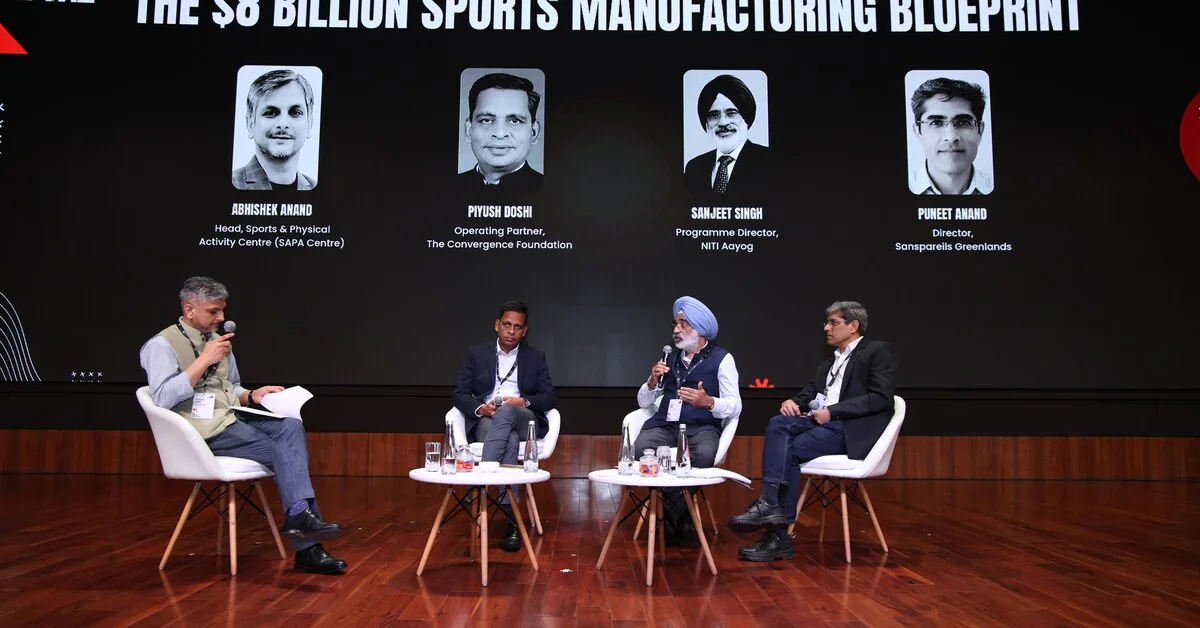
The numbers come from NITI Aayog’s March 2026 report, Realising the Export Potential of India’s Sports Equipment Manufacturing Sector. The operational challenges were discussed by policymakers and manufacturers at the IAMGAME Sports Conclave at Bharat Mandapam in New Delhi on Friday.
The panel, moderated by Abhishek Anand, Head of the Sports & Physical Activity Centre, included Sanjeet Singh, Programme Director at NITI Aayog; Piyush Doshi, Operating Partner at The Convergence Foundation; and Puneet Anand, Director at Sanspareils Greenlands.
Their discussion suggested that India’s expanding sporting calendar and rising domestic participation can provide a base for growth, but will not be enough by themselves. The country must first make its factories competitive with those in China, Vietnam and Pakistan.
What does the $8.1 billion target mean?
The $8.1 billion figure is not an estimate of the present size of India’s sports economy.
NITI Aayog’s report identifies an opportunity to increase India’s annual sports-equipment exports from $275 million in 2024 to $8.1 billion by 2036. Achieving this would require India’s share of global sports-equipment exports to rise from about 0.5 per cent to 11 per cent.
The report estimates that this growth trajectory could generate around 54 lakh cumulative jobs by 2036.
Sports equipment is also only one part of the broader sports economy, which includes leagues, broadcasting, sponsorship, fitness, infrastructure, athlete management, training, events and other services.
Karan Singh Chettri, Founder and CEO of ESP 360 Degree Solution, offered a wider industry estimate in an interview with Business Standard on the sidelines of the conclave.
“I am not an economist, so I would not want to present a precise calculation. However, over the next five years, I believe the Indian sports ecosystem could become a $20-25 billion growth story,” Chettri said.
His estimate relates to the broader sports ecosystem and is distinct from NITI Aayog’s $8.1 billion sports-equipment export target.
Why is the target so challenging?
India is starting from a relatively small base.
The NITI Aayog report says the country exported only $275 million worth of sports equipment in 2024, accounting for about 0.5 per cent of global exports. India’s share has declined from 0.7 per cent in 2014, even as Vietnam — which had a comparable share about a decade ago — expanded its presence nearly threefold.
India’s domestic sports-goods market is estimated at $2.5 billion, of which equipment accounts for around $500 million. However, about 63 per cent of the sports equipment consumed in the country is imported, with China supplying more than 60 per cent of those imports.
India must, therefore, attempt two transitions simultaneously: reduce its dependence on imported equipment and build the scale required to serve international buyers.
Speaking during the IAMGAME panel, Singh said Vietnam’s progress showed that a country did not have to be a dominant sporting nation to become a major manufacturer.
“Vietnam got a couple of things right from the very beginning,” Singh said at the conclave. “They simply said: We want to manufacture and export. So they got their policy right.”
Singh said Vietnam had rationalised duties on inputs sourced from China and other markets while creating a broader policy framework supportive of manufacturing and industrial parks.
The lesson, according to him, is that medals and manufacturing need not move together. Sporting success can stimulate domestic demand, but export competitiveness ultimately depends on price, quality, scale and delivery.
Can India overcome its 15 per cent cost disadvantage?
The NITI Aayog report estimates that Indian sports-equipment manufacturers face an average cost disadvantage of around 15 per cent compared with leading Asian competitors such as China and Pakistan.
The gap is particularly damaging because international sourcing decisions may be determined by price differences of only 2-3 per cent. The report attributes around 77 per cent of India’s disadvantage to structural factors such as expensive raw materials and machinery.
Many high-performance materials required for modern sports equipment must be imported. These include carbon fibre, polyurethane and thermoplastic polyurethane sheets, ethylene-vinyl acetate foam, advanced composites, specialised polymers and alloys.
Import duties, anti-dumping measures and Quality Control Order restrictions increase the price of these inputs. Machinery and specialised moulds are also frequently imported, making it difficult for small manufacturers to mechanise production.
Singh illustrated the problem during the conclave with the example of football manufacturing.
“Today, if India manufactures a football for Rs 100 and Pakistan manufactures it for Rs 85, do you think an international brand is going to buy that football from India? Chances are no,” he said.
Cricket equipment is one area where India has established scale and capabilities. But even there, selling overseas may be less attractive than supplying the domestic market.
Puneet Anand said during the panel that Indian consumers were increasingly able to absorb higher prices, while overseas buyers remained acutely cost-conscious.
“For a cricket bat, we are getting almost 30-40 per cent better realisation selling in India than selling globally, because globally everything is about price,” Anand said.
“The raw-material price increases, labour-price increases and duty structures increase. The Indian market will absorb it, but the export market is not able to absorb that,” he added.
Why do manufacturing clusters matter?
Nearly 90 per cent of India’s sports-manufacturing production is driven by small and micro enterprises, according to the NITI Aayog report.
Meerut and Jalandhar form the traditional backbone of the industry. Together, they contain more than 250 exporting units, over 1,000 domestic-market-focused enterprises, more than 4,000 micro enterprises and nearly 20,000 household units.
This ecosystem has preserved specialised manufacturing skills and created employment. But its fragmented structure restricts investment in technology, design, research, certification and export-scale production.
The inland location of Meerut and Jalandhar also adds to transport costs and delivery times.
The Niti Aayog report recommends spending Rs 4,000 crore on four greenfield manufacturing clusters close to ports and another Rs 1,000 crore to modernise the existing Meerut and Jalandhar clusters.
Gujarat, Andhra Pradesh and Tamil Nadu have been identified as possible locations for the new clusters because of their ports, industrial infrastructure, policy support and access to workers from adjacent industries.
The proposed hubs would include plug-and-play factories, shared machinery, research and development centres, testing laboratories, logistics infrastructure and single-window customs support.
Doshi, speaking at the IAMGAME panel, compared the industry with a car that could not accelerate until its brakes were removed.
“If I want to set up a factory and it takes six months, or if I need to get a product certified and it takes multiple months, these are brakes which kill my competitiveness in the global market,” Doshi said.
“We need to solve those first before we waste our petrol pushing on the pedal,” he added.
According to Doshi, clusters can reduce manufacturers’ costs by bringing factories, component suppliers and common infrastructure together.
“Co-location and cluster creation reduce the cost,” he said. “Cluster creation creates scale and is essential for global competitiveness.”
Such concentration can also make sourcing easier for global buyers, who would be able to meet several manufacturers and suppliers during a single visit.
The danger is that the proposed clusters could become industrial real-estate projects rather than functioning manufacturing ecosystems. Their success will depend on whether they attract anchor companies, technology providers, raw-material suppliers, skilled workers and international buyers.
Can testing laboratories reduce costs and delays?
Certification is another major barrier for Indian manufacturers.
The NITI Aayog report says India does not have enough internationally accredited laboratories for sports-equipment testing. Companies must often send products overseas, increasing both costs and the time required to launch them.
The report recommends working with international organisations such as Fifa, Fiba and the Badminton World Federation to establish recognised testing facilities in India.
At the conclave, Anand cited cricket helmets as an example of how the absence of domestic testing infrastructure affects manufacturers.
India manufactures about a third of the world’s cricket helmets, according to the discussion, but companies must still send products abroad for certification.
“Why should we be sending helmets outside India to get that certification when we are manufacturing one of the biggest chunks of helmets globally?” Anand said.
A manufacturer may have to send as many as 60 helmets to certify a product line containing different sizes and material variants. Testing one model can cost Rs 6-7 lakh and take four to six months, he said.
“If we want to make in India and move quickly, we cannot wait four to six months for a helmet to be approved,” Anand said, adding that the problem applied to several other equipment categories as well.
Does India need global sports brands of its own?
Indian manufacturers often operate as small contract suppliers and lack the resources required to promote their brands internationally.
The NITI Aayog report proposes a Rs 500 crore Brand India programme involving partnerships with international sports companies, athlete endorsements, trade fairs, buyer roadshows and demonstrations at major sporting events.
It also recommends creating a Sports Manufacturing and Export Promotion Cell in the Ministry of Youth Affairs and Sports to coordinate trade policy, testing, standards, branding and international market development.
Singh, however, said at the conclave that the absence of a globally recognised Indian label should not stop domestic companies from expanding production.
“We sometimes overfocus on branding and say that, until we have a brand, we will not be able to manufacture or sell. That is not true,” Singh said.
He identified two additional opportunities: producing training, safety and ancillary equipment, where brand visibility may be less decisive, and becoming an original equipment manufacturer for established international companies.
Singh cited Pakistan’s manufacturing of footballs for Adidas and Indian production for overseas rugby and boxing-equipment brands as examples of this model.
“Business can be done by capturing the training and support part of the market and by becoming a strong OEM for larger brands,” he said during the panel.
Which products could lead India’s export expansion?
The NITI Aayog report divides the opportunity into three broad phases.
The first phase focuses on established categories such as inflatable and hard balls, cricket equipment, boxing gear and table-tennis products. These segments could unlock about $3.4 billion of exports.
The second phase seeks to build capabilities in rackets, cycling, sports flooring, hockey equipment and other high-demand segments, with a potential contribution of about $2.4 billion.
The final phase covers more specialised categories such as water sports, shooting and golf, which could add another roughly $2.4 billion.
The sequencing recognises that India cannot become globally competitive in every product category simultaneously.
Ball sports and cricket equipment offer the quickest route because manufacturing ecosystems already exist. Categories such as rackets, cycling and sports flooring require greater investment in materials, machinery, product engineering and technology.
Can sporting events become factory orders?
India’s sporting calendar offers a possible demand anchor.
The NITI Aayog report identifies the Los Angeles Olympics in 2028, the Commonwealth Games in Ahmedabad in 2030, the Brisbane Olympics in 2032 and India’s proposed 2036 Olympic bid as opportunities to create sustained demand for domestically manufactured equipment.
However, hosting major events has not automatically created a strong manufacturing legacy in the past.
Singh said during the IAMGAME panel that India had hosted 17 major international sporting events since Independence without sufficiently using them to develop the domestic equipment industry.
“Think back and see, of these 17 Games, what have we really gained in India? Has the sporting ecosystem taken off? The answer is no,” Singh said at the conclave.
“These were 17 missed opportunities. The question is: Is this going to be the 18th missed opportunity?” he added.
Singh also questioned procurement conditions that exclude Indian products before their quality or price is assessed.
“Even in the events held in India, the tenders did not favour any Indian manufacturer,” he said. “Tenders even today mention an Australian make, an American make or a European make. That immediately disqualifies Indian manufacturers.”
The report points to the procurement models used for the Paris and London Olympics.
Paris 2024 awarded contracts worth about €5 billion, with 90 per cent of service providers based in France and 78 per cent classified as small and medium enterprises. London 2012 involved procurement of £6.9 billion, with 98 per cent of contracts awarded to UK-based companies.
For India, supporting domestic manufacturers need not mean guaranteeing orders regardless of quality. It would require giving companies advance visibility of requirements, helping them meet global standards, conducting transparent product trials and removing tender conditions that exclude them solely on the basis of origin.
That could turn major events into entry points for global supply chains rather than temporary cycles of construction and expenditure.
Is the proposed government package sufficient?
The NITI Aayog report recommends public support of around Rs 7,500 crore during 2027-31.
The package includes Rs 5,000 crore for new and upgraded clusters, Rs 1,700 crore for scale and competitiveness, Rs 200 crore for certification, Rs 100 crore for market access and Rs 500 crore for the Brand India programme.
The amount alone will not determine whether the programme succeeds. Its structure, implementation and sequencing will be equally important.
Speaking at the conclave, Doshi said public support should be used to help the industry overcome its initial disadvantage, but should not become permanent.
“Ultimately, the industry has to be competitive on its own. The industry cannot run on government money,” Doshi said.
He described initial government support as a “starter motor” that could help manufacturers build momentum before becoming self-sustaining.
Doshi also called for the assistance package to be converted into a practical scheme after consultations with manufacturers.
“The government should get the money out, build confidence and then remove some of the roadblocks,” he said. “Import duty is a big one. Until the industry has access to raw materials at competitive prices, it will not be globally competitive.”


















 Some schools have met many times over the years, while others are beginning new rivalries in the wake of recent realignment.




































You must be logged in to post a comment Login