
Connect with us

Sports

Explained: How Embolo’s red card against Argentina was both fair and rare | FIFA World Cup 2026

Published

on


The defending champions, Argentina, kept their title defence alive on Sunday when they edged past Switzerland 3-1 in the fourth and final quarterfinal of the FIFA World Cup 2026 at Arrowhead Stadium in Kansas City.



However, despite the scoreline suggesting a dominant win, La Albiceleste were not spared yet another controversy surrounding their unbeaten run in the tournament.


Advertisement


The incident in focus is the second yellow card, which resulted in a red card, awarded to Switzerland’s centre-forward Breel Embolo in the 72nd minute of the game, leaving the Swiss side a man down for the remainder of the match and allowing Argentina to seize control with the numerical advantage.


What actually happened?


The controversy unfolded in the 72nd minute when Switzerland striker Breel Embolo went down following a challenge from Argentina midfielder Leandro Paredes. Referee Joao Pinheiro initially cautioned Paredes with a yellow card for what appeared to be a reckless tackle.


Advertisement


However, the Video Assistant Referee (VAR) intervened and advised Pinheiro to review the incident. The Portuguese official watched the replay on the pitchside monitor and determined that Paredes had not committed a foul.


He subsequently overturned the yellow card shown to the Argentine. Pinheiro then booked Embolo for simulation. Since the Swiss forward had already been cautioned earlier in the match, the second yellow card resulted in his dismissal, leaving Switzerland to play the remainder of the game with 10 men. 
Check full video of the incident below: 


Swiss players protest


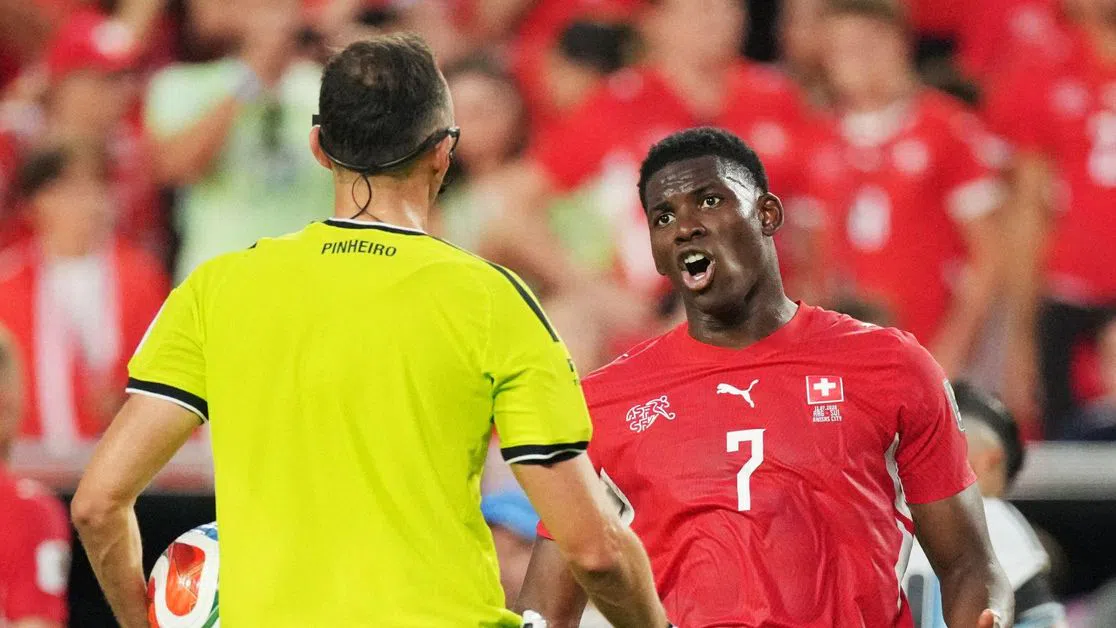
The decision sparked furious protests from the entire Switzerland team, with players surrounding referee Joao Pinheiro in an attempt to overturn the second booking.


Embolo, visibly distraught, pleaded with the official before breaking down in tears as he realised he had been sent off. The Swiss striker was eventually escorted off the pitch by his teammates, allowing play to resume. 
Advertisement


Switzerland players protesting against the red card with referee Joao Pinheiro (PIC: Reuters)


What does the rule state?


The decision to caution Embolo for simulation is supported under Law 12 of the IFAB (International Football Association Board) Laws of the Game, which deals with fouls and misconduct. The rule classifies simulation as unsporting behaviour and states that a player must be shown a yellow card if they attempt to deceive the referee by pretending to have been fouled or by feigning an injury.


Under Law 12, Section 3 (Disciplinary Action), the IFAB states that a player should be cautioned if they “attempt to deceive the referee, for example by feigning injury or pretending to have been fouled (simulation).” Since Embolo had already been booked earlier in the match, the caution for simulation resulted in a second yellow card and his dismissal. 


Why did the referee have to book Embolo?


The decision to caution Breel Embolo was also a consequence of FIFA’s updated “mistaken identity” protocol rather than a fresh disciplinary action after the VAR review.

Advertisement


Initially, referee Joao Pinheiro believed Leandro Paredes had fouled Embolo and showed the Argentina midfielder a yellow card. However, after being advised by the Video Assistant Referee (VAR) to review the incident, Pinheiro concluded that Paredes had not committed a foul and that Embolo had instead attempted to deceive the referee by simulating contact.


Under the updated IFAB Laws of the Game, when VAR determines that a referee has cautioned the wrong player, the original card cannot simply be cancelled. Instead, it must be transferred to the player who actually committed the offence under the “mistaken identity” provision. Since simulation is classified as unsporting behaviour, Embolo became the correct recipient of the yellow card once the review was completed.

Advertisement


The IFAB rule states that when a referee has “clearly penalised the wrong player of either team for the offence in question,” the disciplinary sanction remains but is reassigned to the correct player.


Because Embolo had already been cautioned earlier in the match, the transferred yellow card became his second booking, resulting in an automatic red card.

Advertisement


The same provision had already been applied earlier in the tournament during the group-stage match between the United States and Paraguay. On that occasion, Tim Ream’s yellow card was withdrawn after VAR identified Miguel Almirón as the player who had simulated, with the caution subsequently transferred to the Paraguay midfielder. 


Referee Joao Pinheiro handing Leandro Paredes yellow card for tackle before VAR intervention (PIC: Reuters)

Advertisement


A rare sight in the World Cup


While a second yellow card for simulation is justified under the rule book, it is a rare sight during FIFA World Cup matches as referees usually try to remain a little more lenient to keep the game balanced.


Notably, Embolo’s booking against Argentina put him in an unwanted piece of FIFA World Cup history. The Swiss striker became only the fourth player to be sent off after receiving a second yellow card for simulation at the World Cup.


Advertisement


The last player to be dismissed for simulation in a FIFA World Cup match before Embolo was Ghana’s Asamoah Gyan against Brazil 20 years ago at the 2006 FIFA World Cup.


Players receiving a second yellow card for simulation during the FIFA World Cup:


Player

Country

Opponent

World Cup Edition

Francesco Totti

Italy

South Korea

2002 (Korea/Japan)

Luis Pérez

Mexico

Portugal

2006 (Germany)

Asamoah Gyan

Ghana

Brazil

2006 (Germany)

Breel Embolo

Switzerland

Argentina

2026 (USA/Canada/Mexico)
Advertisement


Argentina’s World Cup campaign marked by controversies


Even before the quarterfinal, Argentina’s World Cup campaign had been marked by several controversial refereeing and VAR decisions that drew criticism from opponents and fuelled debate among fans.


The first major talking point came during the group stage against Jordan, when Argentina were awarded a late penalty following a VAR review for handball, a decision strongly disputed by the Jordanian players.


Advertisement


In the Round of 32 against Cape Verde, several refereeing decisions, including a late handball appeal and stoppage-time calls, became the subject of debate among fans and pundits.


The controversy intensified in the Round of 16 against Egypt, where VAR ruled out Mostafa Zico’s goal for a foul in the build-up before Egypt were also denied a late penalty appeal. Argentina went on to score the winner in stoppage time, prompting the Egyptian Football Association and head coach Wael Riad to publicly question the officiating. 
Advertisement


Argentina players celebrating after beating Switzerland in FIFA WC 2026 quarterfinal (PIC: Reuters)


Argentina’s journey continues


Despite all the controversies, Lionel Messi-led Argentina’s bid to achieve history by becoming only the second team to successfully defend the FIFA World Cup trophy will continue on Wednesday, July 15, when they meet England in the semifinals in Atlanta, Georgia.


Source link

Advertisement
Continue Reading
Click to comment

You must be logged in to post a comment Login

Leave a Reply

Sports

5 players who are switching states ahead of India’s 2026-27 domestic season ft. Shashank Singh

Published

on

The annual pre-season transfer window in Indian domestic cricket allows players to switch state associations as outstation or guest recruits under the Board of Control for Cricket in India (BCCI) regulations.

State teams are permitted up to three guest players to strengthen their squads ahead of the Ranji Trophy, Vijay Hazare Trophy, and Syed Mushtaq Ali Trophy campaigns. These transfers are driven by players seeking more game time, specialized roles, or leadership opportunities, while developing state teams aim to recruit veteran talents to bolster their squad depth.

The upcoming 2026-27 season features several notable moves, with prominent domestic regulars and IPL players shifting allegiances. Let’s take a look at five such moves.

#1 Shashank Singh

The Punjab Kings (PBKS) all-rounder Shashank Singh will turn up for Puducherry in the 2026-27 season after shifting base from Chhattisgarh. The Chhattisgarh State Cricket Sangh (CSCS) has already issued an NOC to the player.

Singh alleged that the state association didn’t support him while he was recovering from an injury that he suffered last season. He further claimed that the association questioned his commitment, saying that the batter only wanted to play in the Indian Premier League (IPL).

The 27-year-old added that CSCS officials didn’t give him any clarity over why he was left out of the Chhattisgarh Premier League and the team’s pre-season camp.

Advertisement

Singh has played 21 first-class games for Chhattisgarh over the last seven years. He has also represented the state in 31 List A and 42 T20s.


#2 Yash Dayal

Royal Challengers Bengaluru fast bowler Yash Dayal will represent Chhattisgarh in the upcoming domestic season. He has already joined the team’s pre-season camp in Alur.

Dayal has not played any competitive cricket since the IPL 2025 final, after which he faced charges relating to sexual assault. The left-arm pacer was retained by Gorakhpur Lions for the upcoming UP T20 League. However, he didn’t feature in the 18-member squad the franchise announced following the auction.

The 28-year-old has represented Uttar Pradesh in 27 first-class, 23 List A, and 71 T20s, picking up 186 wickets across formats, including two five-wicket hauls.

Advertisement

Dayal will look to start fresh for Chhattisgarh in the upcoming season and make his way back to the scheme of things.


#3 Dharmendrasinh Jadeja

Chhattisgarh is looking to build a strong squad for the upcoming domestic season. As a result, they have roped in Saurashtra‘s veteran left-arm spinner Dharmendrasinh Jadeja.

The 35-year-old spinner has been a stalwart in the domestic circuit, picking up 423 wickets in 100 first-class matches, including seven 10-wicket hauls and 26 five-fors. Jadeja also has 121 List A and 65 T20 wickets under his belt.

Jadeja is also a very handy batter in the lower order, accumulating almost 2900 runs across formats. He also has 10 fifties under his belt.

Advertisement

Jadeja’s addition will certainly boost Chhattisgarh’s squad depth as they look to put in a spirited performance next season.


#4 Prasad Pawar

Mumbai wicketkeeper-batter Prasad Pawar has signed with Puducherry to play alongside Shashank Singh as a guest player in the upcoming domestic season.

Prasad has struggled for game time in the Mumbai squad, with Hardik Tamore playing as the first-choice wicketkeeper-batter. As a result, Prasad has decided to shift base to Puducherry in search of more playing time.

Prasad made his List A debut in 2021, while his first-class and T20 debuts came in 2023. Overall, he has represented Mumbai in 27 matches, scoring 591 runs, including one hundred and fifty each.

Advertisement

#5 Jayant Yadav

An offspinner from Haryana, Jayant Yadav, has decided to join Chhattisgarh for the 2026-27 domestic season. He brings truckloads of experience along with him, having represented India in six Tests and two ODIs while picking up 17 wickets in total.

Yadav has 96 first-class, 74 List A, and 95 T20s under his belt, picking up 272, 68, and 61 wickets, respectively, including two 10-wicket hauls and 15 five-fors. He is also very handy with the bat in the lower order, scoring 4781 runs, including three hundreds and 22 fifties. The 36-year-old cricketer also has one Test hundred and fifty each to his name.

Chhattisgarh will rely heavily on the spin duo of Yadav and Jadeja to bring laurels for the team in the upcoming season.