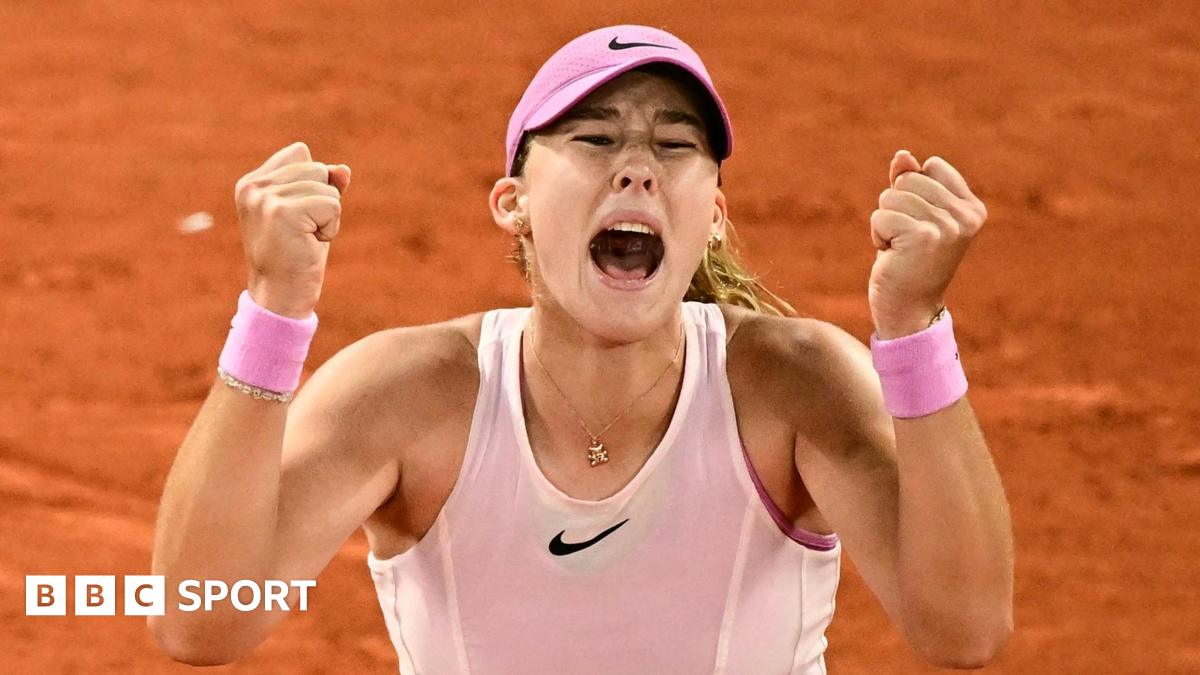
Russian teenager Mirra Andreeva reached her first Grand Slam final with a dominant victory over Ukraine’s Marta Kostyuk at the French Open.
A beaten semi-finalist in 2024, Andreeva was hugely impressive throughout her 6-1 6-3 victory and will await compatriot Diana Shnaider, the 25th seed, or Polish qualifier Maja Chwalinska in Saturday’s final.
The 19-year-old is the fourth-youngest woman to reach the Roland Garros showpiece in the past 30 years, after Martina Hingis, Kim Clijsters and Coco Gauff.
Should she prevail, Andreeva would become the third-youngest first-time Grand Slam champion this century, after Maria Sharapova and Emma Raducanu.
Advertisement
Russia’s invasion of Ukraine provided an unavoidable backdrop to the contest, with Kostyuk regularly denouncing the war since it began in February 2022 – and being highly critical of athletes from Russia who have failed to do so.
In keeping with the stance taken by Ukrainian players over the past four years, Kostyuk did not pose for a pre-match photo with Andreeva, and the players did not shake hands afterwards.
LAS VEGAS — Jeffrey Lannen plays a golf arcade game for a living. On Sunday, that living got a healthy boost.
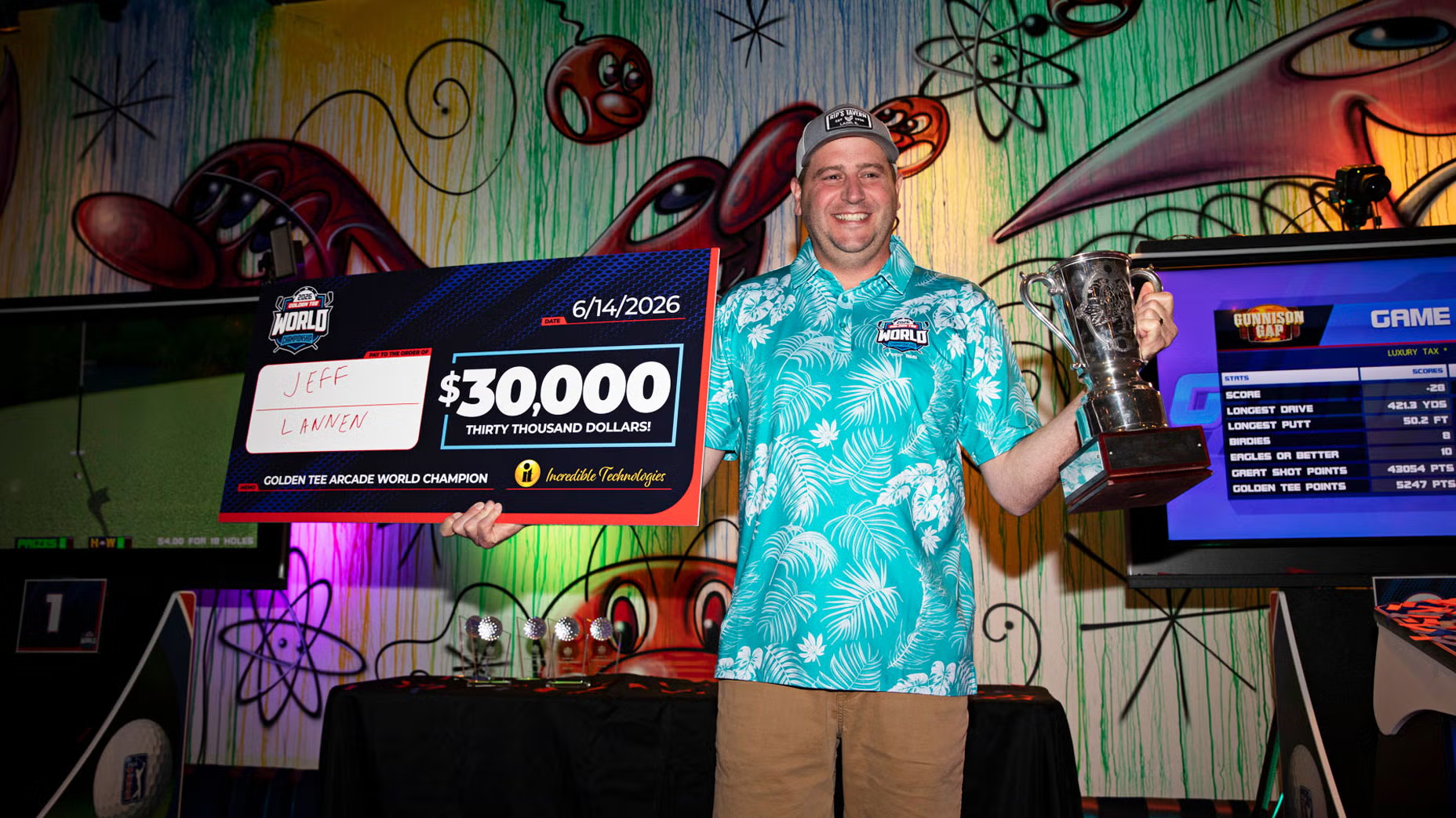
With a dramatic eagle on the 18th hole of Gunnison Gap, a wind-whipped, water-laden virtual course, Lannen won the 2026 Golden Tee World Championship, edging his friend and fellow finalist Andy Fox in a taut closing match before a lively crowd at the Palms Casino Resort just off the Strip. The victory came with a $30,000 first-place check — and a promise from Lannen to treat Fox to dinner and drinks.
“We both would have been happy no matter who won,” a smiling Lannen said, standing next to Fox, his head and shoulders dusted with red and blue confetti that rained down after his clinching shot. “But I’m definitely buying tonight.”
A 42-year-old from Ladd, Illinois — a village of just over 1,000 people about 100 miles southwest of Chicago, with no stoplights and a Golden Tee machine at Rip’s Tavern two blocks from his front door — Lannen hardly counted as a Cinderella story. He has five wins on the Golden Tee national tour and he entered the event among the sportsbook favorites. But this was his first world title in a game he has turned into a full-time career.
Advertisement
“There were some jitters very early on,” he said. “But from then on, I felt fine. I was just playing a game.”
And a popular one at that.
With apologies to Ms. Pac-Man, Golden Tee makes a strong claim to being the most successful arcade game in history, measured by both longevity and usage. Released in 1989, it also helped pioneer the computerization of traditional golf in barrooms and restaurants across the country. Though it was not the first golf game to populate those spaces — Birdie King debuted in 1982 — Golden Tee quickly outpaced its competition through inventive course design, evolving graphics and a trackball that allows players to execute a full swing with surprising fidelity, regardless of how surreal their avatars might look.
An estimated 200 million players have taken a turn over the years. Today, some 25,000 machines remain in commercial and home circulation, including at Rip’s Tavern, where Lannen used to work while moonlighting as a UPS driver before he realized he could make a better living playing Golden Tee, with greater flexibility.
Advertisement
While national tournaments offer five-figure purses, much of the money at the top of the game comes through prize-play competitions, in which players contribute to a pool and the top finishers split the payout.
Of Golden Tee’s legions of adherents, skill sets diverge wildly. The top performers play a game with which the average bar goer is unfamiliar, routinely driving par 4s, reaching par 5s in two and trading aces on par 3s. Scores in the 30-under range across 18 holes are not uncommon.
The 2026 World Championship drew the crème de la crème to Las Vegas, most of them prequalified through regional results or year-long standings into the 112-player field, though a handful of spots were available through Friday qualifying. Saturday was reserved for seeding rounds, with 32 players advancing to Sunday’s championship bracket.
Among those who progressed was Andy Haas, Golden Tee’s enduring standard-bearer. A two-time world champion and the most decorated player in the game’s history, Haas entered Sunday as the top seed, though his last world title came a decade ago, in 2016, a Rory McIlroy major-championship dry spell. Haas acknowledged the impact of that drought. “I put a lot of pressure on myself in this event,” he said.
Advertisement
It showed, and it didn’t. Heading into his opening match against Justin Seeley of Texas, Haas looked intent but loose, nodding along to the Tool pulsing through his earbuds. The Ohio native plays to a single-digit handicap at Firestone Country Club on real grass but is something closer to a plus-30 on the screen. He opened with a hole-out eagle from well off the green and appeared in perfect rhythm until an uncharacteristic error left his ball in the water and Haas barking at the machine in disbelief.
“How does that not bite?” he said. “No way that should happen.”
After his upset loss to Seeley, Haas survived two more rounds before Burak Temel ended his run. The wait continues for another year.
Sunday’s bracket play began shortly after 11 a.m. and stretched nearly 12 hours across 18 machines arranged around a ballroom at the Palms, two of them elevated on a stage for marquee matchups. Players competed in multiple divisions, including silver and bronze brackets with smaller purses and looser stakes. The scene reflected the game’s democratic reach. Some competitors paced nervously between shots. Others laughed through matches with beers in hand.
Advertisement
The farther one advanced in the tournament, the lower the blood-alcohol levela seemed to drop. Near the top of the leaderboard, water bottles replaced cocktails as players studied digital wind readings and yardages with near-ritual intensity.
The championship itself was contested in a double-elimination format. Lannen blazed through his matches undefeated, while Fox, already with one loss, needed to beat his friend twice to claim the title.
He managed the first match, forcing a winner-take-all finale.
In the deciding round, the Fox and Lannen reeled off eagles as casually as Tour pros make pars. They reached the 18th hole tied at 27-under par, facing a devilish par 4 with water guarding the green. Both players found the rough off the tee.
Advertisement
Hitting first, Lannen played a shapely 90-mph thumb shot with a 7-iron that landed just above the flagstick, spun back, and trickled into the cup on its final roll.
The ballroom erupted. When Fox’s approach found the green but not the cup, the championship was settled. Confetti burst from an air cannon beside the stage.
Moments later, Lannen, holding a trophy and an oversized check, spoke modestly of his win in a manner that would have made a PGA Tour media coach proud. “I just tried to play my game, take it one shot at a time,” he said. Sounding tired but happy, he laid out his celebratory plans: dinner with Fox; a flight home to his wife and kids in Ladd, and then, he allowed, “Maybe I’ll take a few days off.”
With 10 games on Monday’s MLB schedule and with higher temperatures, humidity and windy conditions in some spots, it’s a good time to try MLB betting and home run prop betting. With 20 teams in play, there are plenty of options, and weather, pitching matchups and ballpark characteristics are just some factors to consider when choosing a best bet to hit a home run today. Monday’s nightcap looks like the most intriguing game of the day, with the Rays visiting the Dodgers for an inter-league matchup at 10:10 p.m. ET. Anyone who wants to wager on the best home run bets today needs to see who SportsLine MLB expert Angelo Magliocca is backing to go yard.
Magliocca, also known as “Amags,” is a hugely profitable MLB capper who uses his deep knowledge of baseball to find value on player props, sides and totals. He is coming off another strong season at SportsLine. Over the 2022, 2023, 2024 and 2025 MLB seasons, Amags is up 133.4 units on straight bets and parlays while winning an additional 25.3 units on ladder plays.
Best Home Run picks for Monday
James Wood, Nationals (+393)
Wood now has three home runs in his last four games after a lead-off bomb Sunday that went 413 feet and was hit at 110 mph exit velocity. He has some of the best underlying metrics in all of baseball for home run power, with a barrel rate at 25% which puts him in the 100th percentile, and the same goes for his exit velocity and hard hit rate. In essence, he hits the ball hard in the air a lot, with many of those batted balls being on a line, affording him more opportunities for home runs and making him generally a good bet for a long ball.
Advertisement
He’ll face Mitch Spence, who was terrible in his only appearance at the MLB level this year and has struggled in Triple-A with an ERA over 6.50. He’s allowed six home runs in 42 innings, so it’s not like he’s been plagued by the long ball. However, if he’s bounced early or has his start is cut short due to workload restrictions, he’s backed up by a bullpen that is one of just five in MLB that has allowed 40+ home runs thus far.
Michael Lorenzen has some disgustingly bad stats against left-handed hitters this year, but he managed to stifle this Cubs lineup in his last start at Coors Field, allowing just two hits and no home runs. That came just one start after he allowed eight runs on 10 hits in just 3.1 innings against the Angels, so things have been very up and down for Lorenzen of late.
I think this Cubs lineup gets to him the second time around, and they’ll have the benefit of some hot weather with the wind blowing out in Wrigley Field. Lorenzen has surrendered eight home runs to lefties in just 27 innings, with 56 total hits and 13 walks allowed in that time. Just stunningly bad. Happ will bat from the left side, where he has hit 12 of his 16 home runs this year. He is hitting .254 with an OPS over .900 left-handed, which is significantly better than the other side of his split.
Advertisement
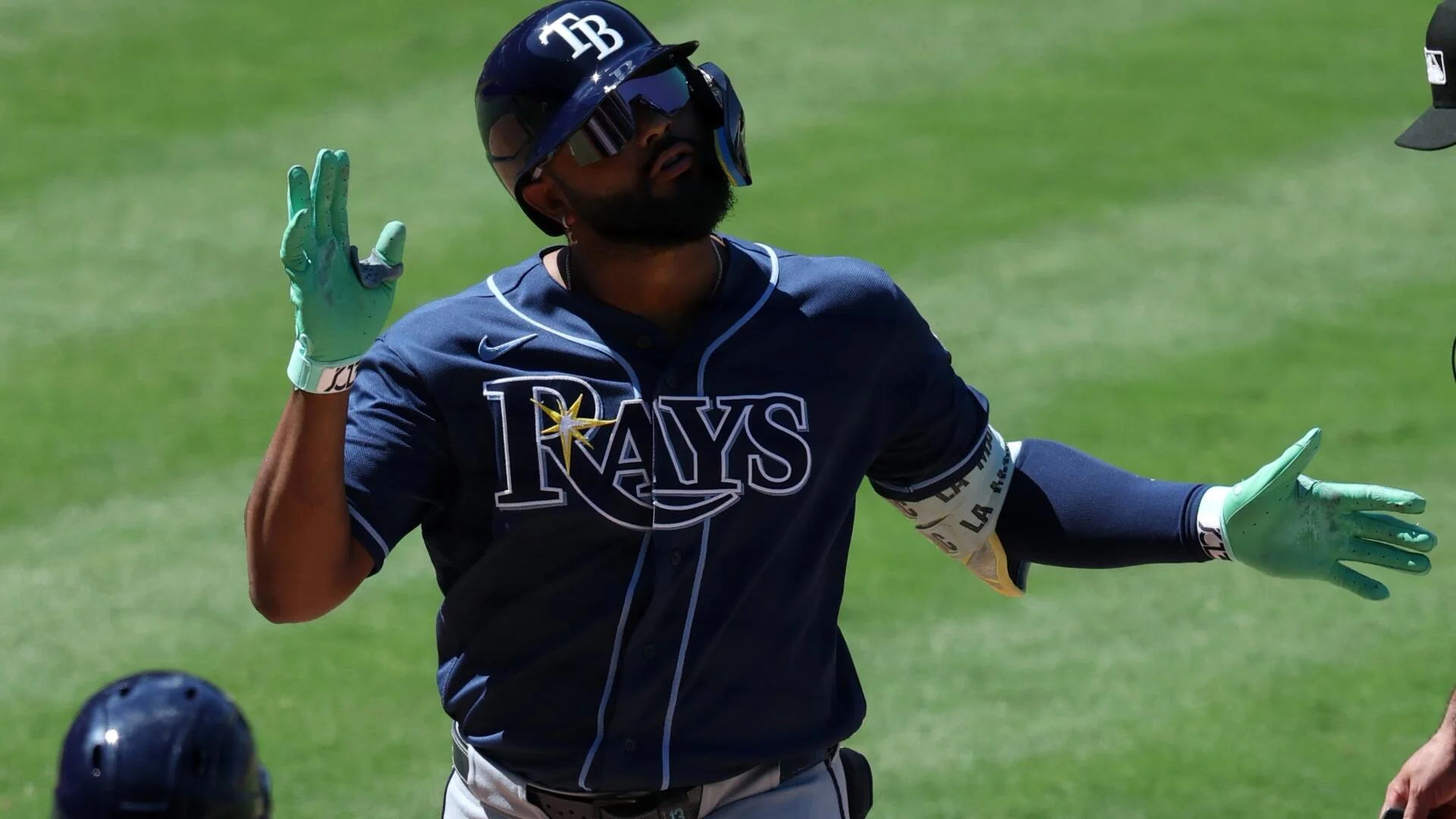
Junior Caminero, Rays (+243)
I don’t love the price here, but Caminero ranks as one of the best home run options on the slate tonight and for good reason. We get him near the top of the Rays order, and they are the away team, giving us good potential for a fifth at-bat. Eric Lauer is starting for L.A., and he has given up 11 home runs in 44 innings this year when facing right-handed batters. Lauer is also someone who’s more familiar to Caminero and the Rays than most inter-league pitcher matchups. He came over from the division rival Toronto Blue Jays earlier this year.
Caminero has hit three of four batted balls hard against Lauer over the last couple of matchups, and I think the Rays slugger actually has some room for improvement against lefties moving forward. He had 13 home runs in 176 at-bats against southpaws last year but has just three in 70 at-bats this year. Lauer won’t overpower you, and he throws the fastball more than 40% of the time to righties, which is the pitch that Caminero has two home runs vs. lefties on this year.
Worth Noting: I was on Michael Busch to hit a home run last time the Cubs faced off with Lorenzen, so I’m going to play him again, along with Pete Crow-Armstrong, who was one of the only hitters with success last time in this matchup. The value has been sucked out of both of their home run props, so I’m using various boosts across major sportsbooks to back some of the Cubs hitters for a home run in these positive conditions tonight.
Belgium and Egypt will begin their FIFA World Cup 2026 campaign with a high-stakes Group G encounter at Seattle Stadium on June 16, with both teams aiming to take an early step towards the knockout stage.
Widely considered the two strongest sides in a group that also features Iran and New Zealand, this fixture could prove decisive in determining who finishes top of the standings. With several favourites already facing stern tests from lower-ranked opponents in the tournament, neither side can afford to drop points in their opening match.
Advertisement
Belgium arrive as slight favourites despite the gradual transition from their celebrated golden generation. Led by coach Rudi Garcia, the Red Devils still possess a wealth of experience and will be eager to erase memories of their disappointing group-stage exit at the 2022 World Cup.
Egypt, meanwhile, carry the burden of history. Despite being Africa’s most successful nation at the continental level, the Pharaohs are still searching for their first-ever World Cup victory. Under Hossam Hassan, Egypt believe this could be the squad capable of ending that long wait and mounting a serious challenge for a place in the knockout rounds.
Advertisement
FIFA World Cup 2026: Belgium vs Egypt broadcast details
Country
Live Broadcast TV Channels
Live Streaming Platforms
United States
FOX, FS1, Telemundo, Universo
fubo (all matches), FOX Sports App
United Kingdom
BBC, ITV
BBC iPlayer, ITVX
India
Unite8 Sports 1, Unite8 Sports 2 (Zee Network)
ZEE5 app and website
Canada
TSN (all 104 matches), CTV (30 select matches)
TSN+, Crave (CTV matches)
Mexico
TelevisaUnivision, TV Azteca
Univision+, TV Azteca App
Brazil
TV Globo, SBT, SporTV, CazéTV
GloboPlay, CazéTV streaming
Argentina
Telefe, TyC Sports, DSports
Star+, DSports streaming
Germany
ARD, ZDF, Magenta Sport
Magenta Sport streaming
France
M6, beIN Sports
beIN Sports Connect
Spain
RTVE, DAZN
DAZN streaming
Italy
RAI, DAZN
DAZN streaming
Australia
SBS, SBS Viceland
SBS On Demand
New Zealand
TVNZ, TVNZ+
TVNZ+ (free)
South Africa
SABC
SABC streaming
MENA (Saudi Arabia/Qatar/UAE)
beIN Sports (exclusive)
beIN Sports Connect
Japan
NHK, Nippon TV, Fuji TV, DAZN
DAZN streaming
Netherlands
NOS
NOS streaming
Portugal
Sport TV, RTP
Sport TV+
Pakistan
PTV Sports
Tapmad streaming
China
CCTV/CMG, Migu, Xiaohongshu
Migu, Xiaohongshu
FIFA World Cup 2026 Belgium vs Egypt: Live streaming and live telecast details
When will the Belgium vs Egypt match in the FIFA World Cup 2026 take place?
The Group G match of the FIFA World Cup 2026 between Belgium and Egypt will take place on Tuesday, June 16.
Advertisement
What time will the Belgium vs Egypt match in the FIFA World Cup 2026 begin?
The Group G match of the FIFA World Cup 2026 between Belgium and Egypt will begin at 12.30 am IST on June 16.
Advertisement
What will be the venue for the Belgium vs Egypt match in the FIFA World Cup 2026?
Seattle Stadium in Seattle will host the Group G match of the FIFA World Cup 2026 between Belgium and Egypt on June 16.
Advertisement
Where to watch the live broadcast of the Belgium vs Egypt match in the FIFA World Cup 2026 in India?
The broadcast of the Group G match of the FIFA World Cup 2026 between Belgium and Egypt will be available on Unite8 Sports 1, Unite8 Sports 1 HD, Unite8 Sports 2, and Unite8 Sports 2 HD TV channels for Indian fans.
Advertisement
Where to watch the live streaming of the Belgium vs Egypt match in the FIFA World Cup 2026 in India?
The live streaming of the Group G match of the FIFA World Cup 2026 between Belgium and Egypt will be available on the Zee5 app and website for Indian fans.
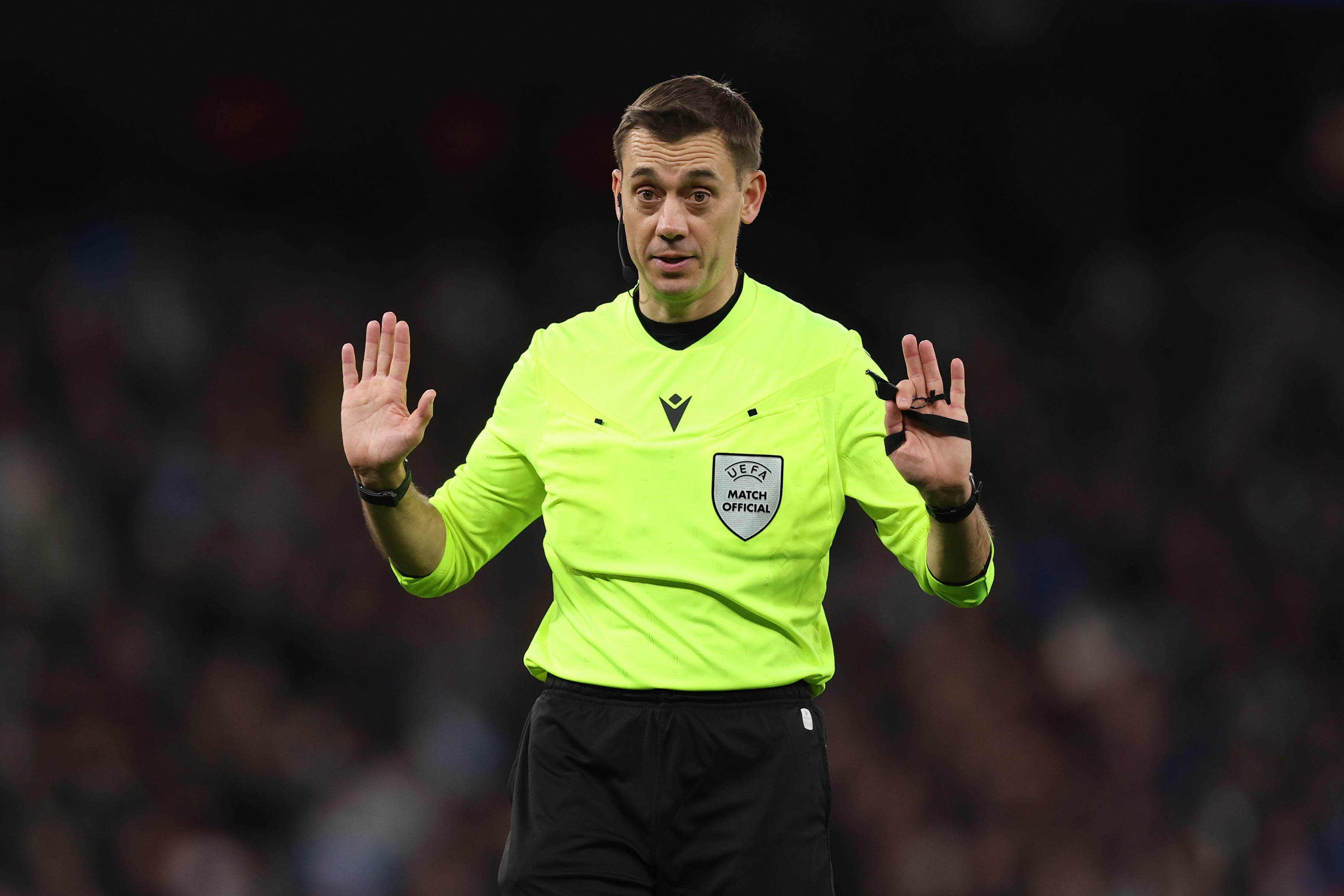
The French official once riled Three Lions boss Thomas Tuchel three years ago during his time as Bayern Munich boss.
So much so that Tuchel branded Turpin “Grade E” after receiving two yellow cards in the German club’s Champions League quarter-final second leg against Manchester City in 2023.
Tuchel was especially upset after Turpin brandished five yellow cards in the first half at Allianz Arena, while also handing Bayern’s Dayot Upamecano a straight red card as the last man for a challenge on Erling Haaland, though the French defender survived after VAR reversed the call due to offside.
Tuchel said of Turpin: “Two things couldn’t keep up with the level – the pitch wasn’t in good condition and also the referee, unfortunately, was Grade E. I’d give him a one out of 10. He was absolutely terrible. It’s unbelievable at this level.
Advertisement
Referee Clement Turpin looks on during the UEFA Champions League 2025/26 Round of 16 Second Leg match between Manchester City FC and Real Madrid CF (Getty)
“He was whistling for everything and anything. Everything was against us. In the end, we were never in a position to turn things around with three men against us. That’s a fact.”
Despite this disagreement, Turpin is widely respected in Europe and has forged a reputation as one of the continent’s finest officials with a wealth of experience on the biggest stages in football.
Turpin has experience dealing with Jude Bellingham, too, with the official firmly dealing with the Real Madrid superstar after his attempts to unsettle Harry Kane around the penalty spot in the Champions League.
Major assignments in Turpin’s career to date include the 2021 Europa League final and 2022 Champions League final. While the Three Lions had their goalless draw with Slovenia at Euro 2024 officiated by Turpin too.
Belgium and Egypt drew 1-1 in their World Cup opener on Monday after a second-half Belgian equalizer spoiled Mohamed Salah‘s 34th birthday.
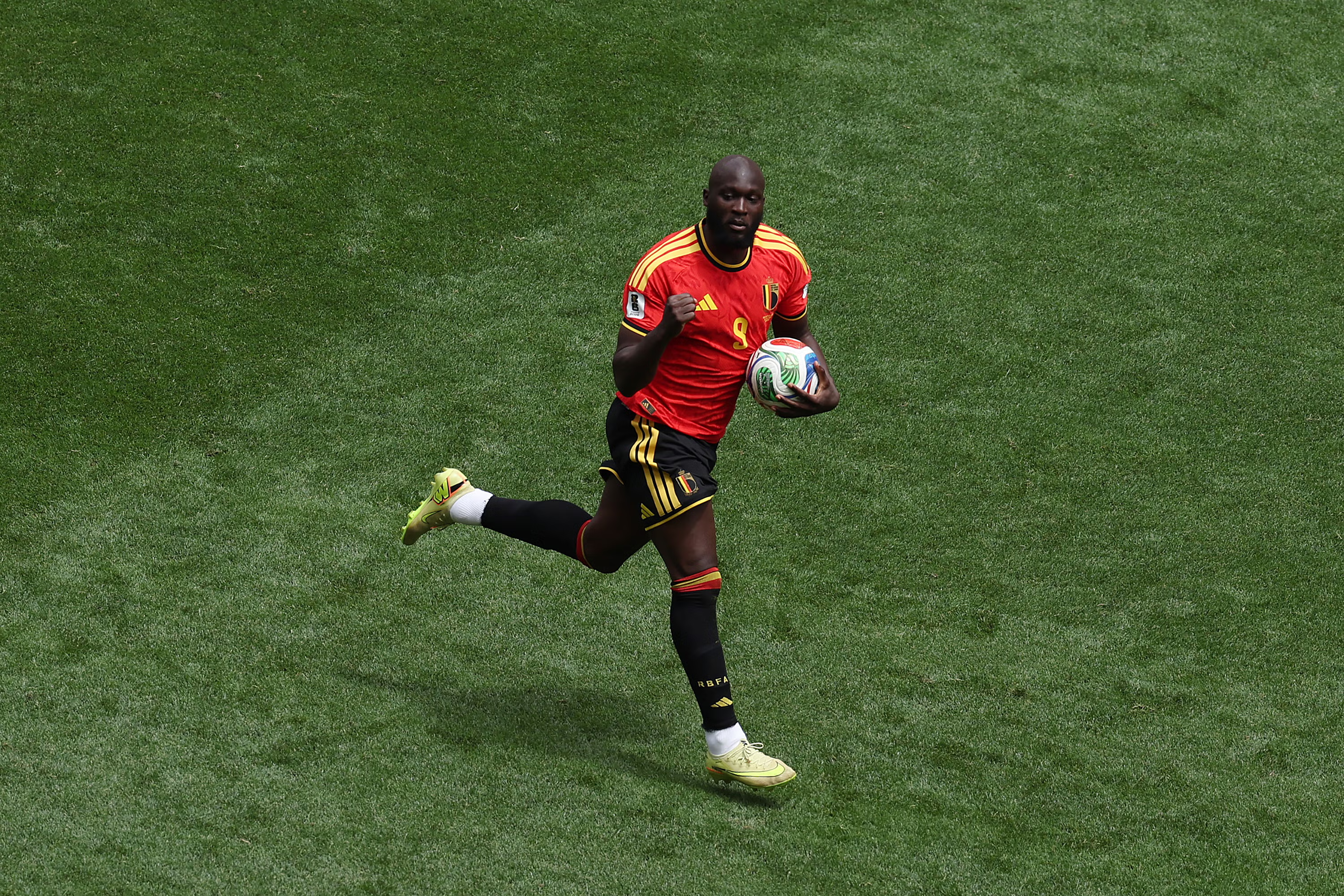
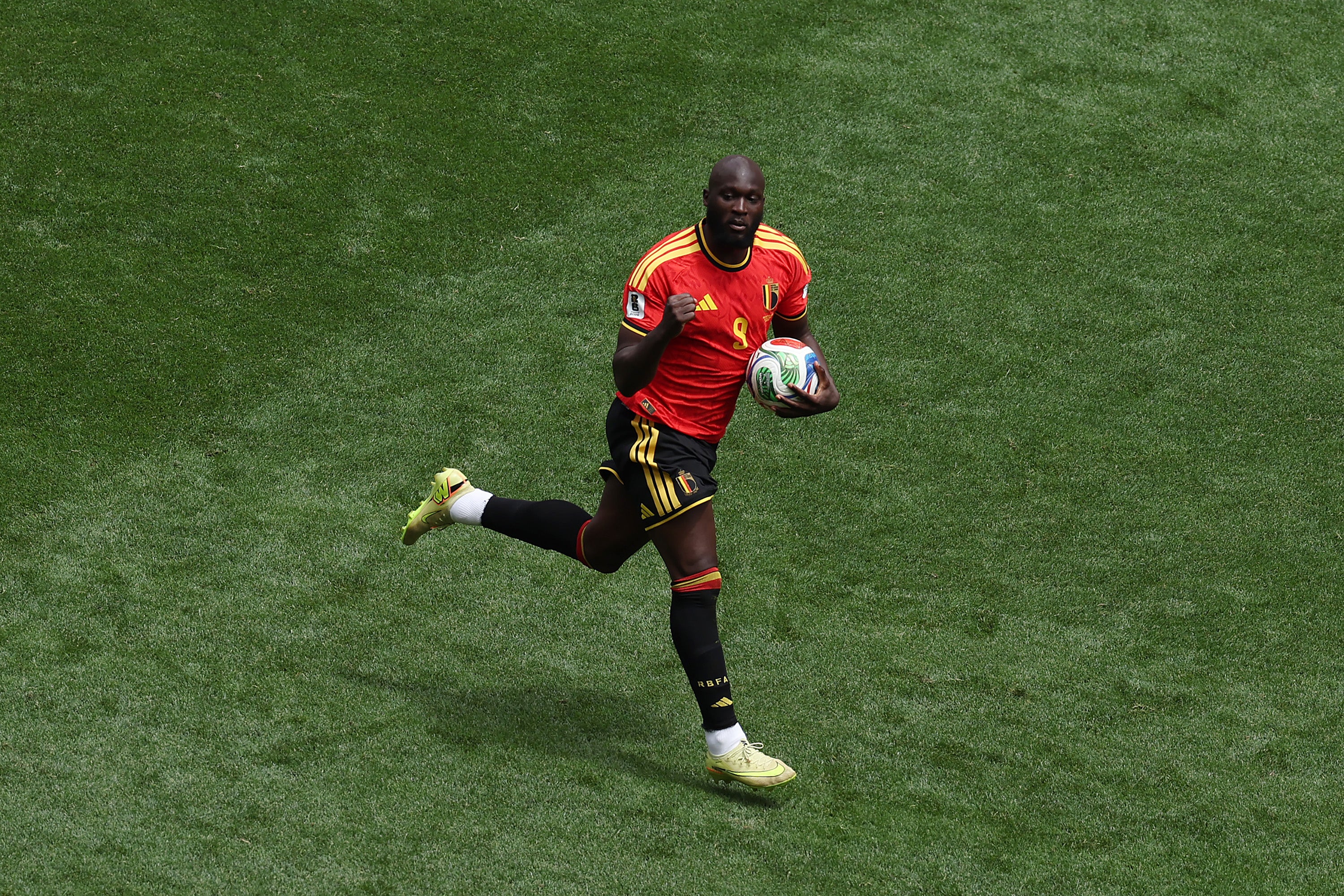
Emam Ashour opened the scoring early in the first half in Seattle, before Romelu Lukaku came off the bench after the hour to force Egypt’s Mohamed Hany into an own goal.
The draw leaves both teams level at the top of Group G, ahead of the match between Iran and New Zealand.
The result means seven-time Africa Cup of Nations champions Egypt’s wait for a first victory at a World Cup goes on.
This is their fourth participation in the global showpiece and with fixtures to come against Iran and New Zealand, they will hope to break that hoodoo in North America.
For Belgium, this tournament is likely the last chance for the remnants of their golden generation to better their third-placed finish in Russia eight years ago and finally win silverware.
Advertisement
Veterans Kevin De Bruyne, Thibaut Courtois and Lukaku are the main protagonists of that group still involved in Rudi Garcia’s squad.
Ashour’s belter
With all eyes in the Pacific Northwest on Salah and De Bruyne, it was the ex-Manchester City playmaker that created the first moment of note in the match when he dragged a sharp effort narrowly wide in the seventh minute.
However, it was Ashour who upstaged the pair just before the hydration break when he received the ball in a similar position to De Bruyne but his sweetly-struck effort left Courtois no chance as it whistled into the bottom-right corner.
It was just the second time in their history that Egypt had taken the lead in a World Cup match — after Salah opened the scoring in a 2-1 defeat to Saudi Arabia in 2018.
Advertisement
De Bruyne came within inches of levelling early in the second period when he whipped a close-range free-kick over the Egyptian wall, only to see it rocket off the outside of the post.
Salah responded at the other end as he ghosted into the box but had his downward header punched away by Courtois with Ashour getting his follow-up effort all wrong.
The match became stretched as both sides came close on a couple of occasions, including a screaming left-footed volley by Belgian captain Youri Tielemans.
With 65 minutes gone, Rudi Garcia decided to send on Lukaku.
Advertisement
The change immediately paid dividends as Belgium’s all-time top goalscorer showed his predatory instincts to dash in on a Thomas Meunier cross, with his presence enough to destabilize Hany who put through his own net.
Salah departed the field with 15 minutes remaining as Egypt sought to shut up shop and ultimately held out for a point.
For at least one golfer at this week’s U.S. Open, just making it into the field is a massive win.
Because the last time J.B. Holmes played a major championship round, it was an abject disaster.
It’s worth spelling out the details of just how miserable things were that day, just how sour the major-championship taste left in his mouth, to understand why booking a tee time this week — at Shinnecock Hills, in the big, bad U.S. Open — is so cool and meaningful.
To that round, then. It was Sunday of the 2019 Open Championship at Royal Portrush, and Holmes teed it up with a real chance to win. He entered Sunday solo third, six shots off the pace of leader Shane Lowry, set to go in the penultimate pairing alongside World No. 1 Brooks Koepka.
Advertisement
“It’s tough to finish off a major. It’s a tough test,” Holmes said after that third round. “So we’ll see what [Lowry] does tomorrow and I can go out and hopefully put up the number and give him something to look at.”
Even though he was past the Ryder Cup form of his earlier career (Holmes was part of the 2008 U.S. team that dominated at Valhalla), there was reason to believe that Holmes could be a problem in contention. He’d closed out the star-studded Genesis Open earlier that year, his fifth PGA Tour win. And he’d been a mainstay on Tour for more than a decade, persevering through multiple brain surgeries and a slew of complications.
This was just the latest in a winding trail for Holmes, whose background was the stuff of tall tales: Growing up in Campbellsville, Ky., he made the Taylor County High School golf team as an eight-year-old third-grader.
“I lettered for 10 years,” he said in an interview at Portrush. “I don’t know if that’s a record.”
Advertisement
And now he was on the brink of a breakthrough.
Can you tell which high school golfer is eight-year-old J.B. Holmes?
Instead, though, Holmes’ number to look at became noteworthy for an entirely different reason. He hit his final-round opening tee shot out of bounds, leading to a double, and things only got worse from there. As Portrush was battered with wind and rain, Holmes stacked up six bogeys, four doubles and a triple against just a single birdie, shooting 41 on the front nine and 46 on the back nine and signing for 87, the worst round of the day by seven. He plummeted from third to T67, costing himself hundreds of thousands of dollars and valuable ranking points in the process.
Holmes didn’t speak to reporters post-round, which was understandable but left his only post-mortem to Koepka, who was on a slow-play crusade at the time and spent the day frustrated by Holmes’ sluggish pace. (In his defense, it’s tough to shoot 87 with any real speed.)
Advertisement
“It’s not that he takes that long. He doesn’t do anything until his turn. That’s the frustrating part. But he’s not the only one that does it out here,” Koepka said before adding the ultimate backhanded compliment: “It was slow, but it wasn’t that bad for his usual pace. I thought it was relatively quick for what he usually does.”
So that’s how we eulogized Holmes’ big chance: as a slow, expensive sideshow. But the worst thing about Holmes’ no-good, very-bad Sunday is that he never got a chance at redemption. One of the beautiful things about competitive golf is that there’s always another tournament where you start at even par, blank scorecard in your pocket — but Holmes never got another. After playing 20 majors between 2014 and 2019, his world ranking slipped as he fought injuries and poor form. That major round appeared destined to be his last.
Until now.
That’s because last week Holmes, now 44, made it through Final Qualifying at The Lakes Golf and Country Club in Ohio, surviving a four-for-three playoff to advance to what will be his 10th U.S. Open.
Advertisement
The start will be his first on the PGA Tour — or any tour, as far as I can tell — since July of last year, when he missed the cut at the ISCO in his home state of Kentucky. He made 21 starts on Tour from 2021-2024 and made just three cuts. It’s been more than six years since his last top 20. In other words, there shouldn’t really be any expectations for Holmes.
So what has he been up to? Our best clues come from his press conference at last year’s ISCO.
“Mostly been hanging out with the boys, my two little boys and just being dad,” he said, referring to his three- and seven-year-old sons, Beckett and Tucker. “It’s not necessarily the golf part of it, it’s more of I don’t want to not be there for them. They’re only kids once, they’re learning a whole lot at this age and I want to be there for that and try to raise good human beings.”
But his sons will no doubt be proud of their dad who, 20 years after his rookie PGA Tour season, will tee it up at his national championship.
Advertisement
It’s not that he has to go low. Defining success solely by his scores at Shinnecock Hills — a famously brutish U.S. Open site — would miss the point. Holmes is a mega longshot even to make the cut. We don’t know what to expect from his golf game. He probably doesn’t either.
But we know he’s already earned a dose of redemption. He’s earned the right to make more major memories.
And if you’re teaching your kids life lessons, perseverance seems like a worthy one to show them firsthand.
Cape Verde goalkeeper Vozinha has explained why he was overcome with emotion after his heroic performance against Spain at the 2026 FIFA World Cup.
The 40-year-old goalkeeper was named Man of the Match after producing seven saves to help Cape Verde secure a historic 0-0 draw against the European champions in their first-ever World Cup match.
Speaking after the game, Vozinha revealed that his tears were not only about football but also about family.
Advertisement
“I cried after the game because I grew up with my grandparents when I was a kid, and they could not be there. They passed away a few years ago. My mum could not be here either for a visa issue, and the money we had to pay for it. We did not manage to do this in time,” he said.
Vozinha’s emotional story touched football fans around the world after his outstanding display against one of the tournament favourites.
Making his World Cup debut at the age of 40, the veteran goalkeeper stood firm as Spain dominated possession and created several scoring opportunities. However, Cape Verde’s captain refused to be beaten, making seven important saves and keeping a clean sheet.
Advertisement
His performance helped Cape Verde earn a famous point in Group H and marked a dream start to the country’s first appearance at the World Cup.
The small island nation, with a population of just over 500,000 people, showed great determination and discipline throughout the match to frustrate the Spanish side.
While Spain will be disappointed not to have taken all three points, the night belonged to Vozinha, whose journey from dreaming of the World Cup to becoming a national hero captured the hearts of football fans.
The final whistle brought tears of joy and emotion for the goalkeeper, who was thinking about the family members who helped shape his life but were unable to witness the biggest moment of his career.
Advertisement
For Vozinha and Cape Verde, the historic draw against Spain is a result that will be remembered for many years to come.
Spain were left shell-shocked after being held to a frustrating stalemate by Cape Verde in their 2026 FIFA World Cup clash. The two sides faced each other in Group H at the Atlanta Stadium on Monday, June 15.
La Roja dominated possession throughout the game but had very little to show for it. Cape Verde valiantly defended across the 90 minutes, with 40-year-old goalkeeper Vozinha making multiple saves to keep his side in the game. Ferran Torres’ effort struck the woodwork towards the end of the first half, but the Spaniards failed to be clinical going forward, ensuring that Cape Verde sealed a historic point.
Thanks for the submission!
Advertisement
Without further ado, let’s take a look at five talking points from the FIFA World Cup clash:
Advertisement
#5 Spain dominated possession but were uninspiring going forward
Spain came into the game as the favorites to secure all three points and demonstrated excellent control of the ball, garnering a possession rate of 74 percent compared to Cape Verde’s 26 percent. The former also completed a mammoth total of 734 passes (92 percent accuracy), while the Blue Sharks completed only 205 passes with an accuracy of 73 percent.
However, Luis de la Fuente and Co. were unable to break down Cape Verde’s low block, only landing seven shots on target from an attempted 27 (xG of 2.29). They also missed both their big chances and will need to be more clinical going forward in the FIFA World Cup to avoid similar upsets.
#4 Cape Verde’s game plan worked to a tee
After qualifying for the FIFA World Cup for the first time in their nation’s history, Cape Verde were undoubtedly the underdogs heading into their clash against La Roja. However, Bubista’s tactics worked to a tee as Spain were unable to break down the former’s stubborn defense.
Cape Verde’s backline were at their very best, with Vozinha making seven saves to keep his side in the game. Moreover, centre-backs Roberto Lopes and Diney Borges were outstanding and made multiple clearances, recoveries, and interceptions each, ensuring their nation picked up their first-ever FIFA World Cup point.
Advertisement
#3 De La Fuente’s decision not to risk Yamal and Williams backfired
Spain superstars Lamine Yamal and Nico Williams were both nursing hamstring injuries heading into the 2026 FIFA World Cup. Despite recovering and rejoining team training this week, La Roja boss Luis de la Fuente indicated both wingers would play limited roles against Cape Verde.
This backfired as Spain looked underwhelming going forward without Yamal and Williams. However, upon Yamal’s introduction in the 71st minute, La Roja were rejuvenated as the 18-year-old was a constant threat down the right wing. Meanwhile, Williams was subbed on in the 87th minute for a short cameo.
However, both stars didn’t have enough time to help the Spaniards break the deadlock. Had they started the FIFA World Cup match, De la Fuente’s men could have potentially walked away with all three points.
#2 Ferran Torres and Mikel Oyarzabal struggled to make an impact
In Yamal and Williams’ absence, Ferran Torres and Mikel Oyarzabal were included in the starting XI. However, both forwards struggled to make an impact, which resulted in Spain being held to a stalemate.
Advertisement
Torres hit the woodwork, despite being five yards out from goal in the 41st minute, before Oyarzabal was unable to convert the follow-up. The former missed one big chance, completed none of his two dribbles, lost eight duels, and delivered none of his four crosses.
Oyarzabal also became the first footballer on record since 1966 to play the first 30 minutes of a FIFA World Cup match without making a single touch.
#1 Spain can’t afford to slip up further in FIFA World Cup
Following their stalemate against 67th-ranked Cape Verde, Spain are currently at the top of Group H with one point. However, with Saudi Arabia and Uruguay also in their group, La Roja cannot afford to drop points again going forward in the FIFA World Cup.
They will aim to bounce back in their next fixture against Saudi Arabia on June 21.
Rosedale Cemetery, in the working-class New Jersey suburb of Linden, not far from New York City, houses a gravesite unlike any other: a 36-ton, life-size granite replica of a 1981 Mercedes-Benz 240D. The hulking monument marks the resting place of Raymond Tse, a car-lover who was only 15 when he died in 1983. Tse’s older brother, David, commissioned the Mercedes, complete with Ray’s name on the license plates, for a reported fee of $250,000, and had it installed behind the mausoleum where Ray is interred.
Not all the graves at Rosedale are so conspicuous. When John Matthew Shippen Jr. was buried there in 1966, he was commemorated only by a slab of concrete demarcated by a number. No name, no birth or death year, no acknowledgment of Shippen’s deeply important place in golf history. Just a random numeral — 70 — assigned by the cemetery’s record-keepers.
***
Advertisement
IF YOU’RE UNFAMILIAR with Shippen, that’s kind of the point. For decades, he was the trailblazing golfer who time forgot — but who is certain to get some shine this week. That’s because the U.S. Open is for the sixth time returning to Shinnecock Hills Golf Club (est. 1891) on Long Island’s East End. In the first of those editions, in 1896, Shippen, then a 16-year-old assistant professional at Shinnecock, represented his club in a 35-player field made up largely of Scottish and English pros. Shippen’s youthfulness was not what made his appearance in the second-ever U.S. Open notable — his race was.
Shippen was born in Washington, D.C., in 1879 to a Shinnecock Indian mother and Black father. When John was 9, his father, John Sr., a Presbyterian minister and former slave, moved the family to the Southhampton, N.Y., area after he’d been assigned a ministry on the Shinnecock Indian Nation.
John Jr. began caddying at Shinnecock Hills, a course he’d helped build as a member of the crew that cleared the land. He was a fast study and a fine player. By 16, he had ascended to an assistant-pro role and soon after found himself in the field at the 1896 U.S Open, aided by Shinnecock members who covered his entry fee. Playing alongside Shippen was another trailblazer with the Shinnecock membership’s backing: Oscar Bunn, a Shinnecock Indian who, like Shippen, caddied at the club and developed an aptitude for the game.
John Shippen in 1913.
getty images
Advertisement
Shippen and Bunn would become the first Black and Native American golfers, respectively, to play in a U.S. Open, though their starts didn’t come without resistance. When the other pros in the field learned that golfers of color would be competing, they threatened to boycott the championship. USGA president Theodore Havemeyer didn’t blink, proclaiming the event would proceed even if only two players remained on the tee sheet. The protesting pros stood down, and on July 18 the competitors dug in for the one-day, 36-hole contest.
In the morning round, Shippen shot 78 on the 4,400-yard setup, good enough for a six-way share of first at the midway point. His stellar play continued in the afternoon … until it didn’t. On the short par-4 13th — the same hole on which Phil Mickelson would melt down 122 years later, in the 2018 U.S. Open — Shippen missed right onto a sandy path. Things got uglier from there. Years later, Shippen, as quoted in Pete McDaniel’s “Uneven Lies: The Heroic Story on African-Americans in Golf,” said, “I kept hitting the ball along the road, unable to lift it out of the sand and wound up with an unbelievable 11 for the hole. You know, I’ve wished a hundred times I could have played that little par-4 again.”
An 11. Seven over.
It’s silly to play the what-if game in golf, but, in this case, hard to resist. Shippen signed for an 81 in the second round to finish at 159, seven behind the winner, Scottish pro James Foulis. If Shippen had made par at 13 instead of a mess, who knows — today he might have his own wing at the World Golf Hall of Fame.
Advertisement
***
SHIPPEN WASN’T ONLY the first Black club professional but also the first American-born club pro, period. He played in five more U.S. Opens, his last in 1913, when another longshot, Francis Ouimet, famously prevailed at The Country Club in Brookline, Mass. It would be another 35 years before another Black golfer would play in a U.S. Open (Ted Rhodes, 1948, Rivera); another 46 years before a Black golfer would make a cut at the U.S. Open (Charlie Sifford, 1959, Winged Foot); and another 87 years before a Black golfer would win a U.S. Open (Tiger Woods, 2000, Pebble Beach).
Soon after Shippen’s U.S. Open debut at Shinnecock Hills, he landed the head-pro role at the Maidstone Club, just east of Shinnecock, before transitioning into the same job at Aronimink, the Philadelphia-area club that hosted the PGA Championship earlier this year. In 1924, Shippen took another head-pro post, settling into a club at which he would spend the bulk of his career: Shady Rest Country Club in Scotch Plains, N.J., where he taught golf and built clubs for 36 years.
Shady Rest, which opened three years before Shippen came aboard, was the first Black-owned country club in the U.S. The property offered nine holes of golf cut into a hillside and so much more: horseback riding, croquet, skeet shooting, a baseball diamond and tennis courts, where greats Althea Gibson and Ora Washington honed their games.
Advertisement
Shady Rest, which opened three years before Shippen came aboard, was the first Black-owned country club in the U.S.
Shady Rest also had a lively social scene and was a popular venue for many top Black musicians, including Louis Armstrong, Duke Ellington and Ella Fitzgerald. Shippen, who lived on the second floor of Shady Rest’s clubhouse, was central to the club’s growth, as a manager, steward and ambassador. He never lost confidence in his game, either, challenging any comers a dollar that they couldn’t outdrive him. Few could.
Shippen lived to 88, spending his final days at a Newark nursing home, apparently with little savings. He was buried about 10 miles south, at Rosedale Cemetery, beneath an unmarked gravestone, which would remain unmarked for the next 29 years. It’s hard to fathom such an important figure in the game’s history resting in anonymity, but such was Shippen’s fate. The nondescript grave was symbolic of a larger injustice: the golf world’s general lack of recognition of Shippen’s accomplishments and contributions.
That began to change on Feb. 14, 1991, when the Newark Star-Ledger published an article by sportswriter Jerry Izenberg that detailed Shippen’s story and unheralded place in history.
“Nearly a quarter of a century has passed since his death,” Izenberg wrote, “but the life and times of John Shippen shamefully remains a patch of rarely recalled history. This comes to mind this morning because school systems everywhere are celebrating Black History Month but, in the town, where John Shippen died in 1968 nobody speaks his name, and no historical plaque marks his passing. Maybe there are too many other heroes whose stories are easier to tell or maybe there are times when it is simpler to create ersatz ones. It takes a little work to piece together his remarkable story.”
Advertisement
Scotch Plains residents Ruby and Thurman Simmons were prepared to do that work. When the Simmons were tipped off to Izenberg’s piece by a history professor of Ruby’s, honoring Shippen’s legacy became their calling. By this point, the course was owned and operated by the town of Scotch Plains and had been renamed Scotch Hills Country Club. The Simmons presented Shippen and Shady Rest’s stories to the city council and began a years-long lobbying campaign that resulted in an annual tournament, youth academy and foundation, all in Shippen’s name.
In 2015, the clubhouse underwent a $1.1 million restoration. In 2019, the township dedicated a room in the clubhouse to Shippen’s memory, filled with memorabilia, artifacts and news clippings. In 2021, the course was rechristened again, returning to its original name. “It is time, in my opinion, to right a wrong,” Scotch Plains Mayor Josh Losardo said at the time. The following year, the National Park Service granted Shady Rest a listing on the National Register of Historic Places.
Shippen’s resting place also got the respect it deserved.
Shady Rest’s restored clubhouse……and the room commemorating John Shippen.
Advertisement
***
IN THE EARLY DAYS of Thurman and Ruby Simmons’s quest to commemorate Shippen, Thurman couldn’t get past Shippen’s unremarkable burial site. “The haunting image of an unmarked grave at Rosedale Cemetery lingered in his mind, a stark reminder of Shippen’s forgotten history,” Ruby wrote in “A Golf Legend,” her and Thurman’s 2024 memoir of her and her husband’s pursuits.
Yet another wrong that needed to be righted, and Thurman dedicated himself to the cause.
“I thought I’m gonna do some research and try and find out where he is,” Thurman told me in a phone interview the other day; he’s 82 now and said he tires quickly. But over a 25-minute conversation, it was clear his passion for honoring Shippen has not waned.
Advertisement
That research, over weeks, led Thurman to an old friend who owned a funeral home. As luck would have it, the home had Shippen’s resting place in its records.
“So I went to the cemetery and I asked in the office, where is John Shippen located?” Thurman continued. “They said, ‘Well, he’s over in this area called Sunny something.’”
That would be Sunnyside, a plot with hundreds, if not thousands, of graves on the northwest side of the 125-acre property. “So I went over there and walked the whole area for about an hour or so,” Thurman recalled. “Finally, I found a slab of concrete, and there was a number, 70.”
Shippen’s number. Thurman had found him.
Advertisement
Ruby’s recounting of her husband’s discovery offers more color. Again, from the couple’s memoir: “As he returned home, bursting through the door, he shouted to me: ‘I found the marker!’ The words hung in the air, resonating with the weight of the journey, and the significance of the revelation. Shippen, once lost in obscurity, now had a marker, a beacon to guide future generations to the remarkable story of the first American-born golf pro.”
Thurman took his find to the township, along with an ask to properly commemorate Shippen with a tombstone. “I went back to my committee, and I told them what I did,” Thurman said. “And they said, ‘Why do you want to do that?’ I said, ‘Because John Shippen did what he did over 100 years ago. He should be recognized in the world of golf. They hemmed and hawed, and they finally okayed it. It cost $800 to put the tombstone there. And that was it.”
You can visit the site. Shippen’s light-gray granite headstone stands about 3 feet tall, just to the right of a cedar tree and a stretch of unmarked graves. His stone reads:
JOHN SHIPPEN 1879 — 1968
Advertisement
THE FIRST AMERICAN BORN AFRICAN-AMERICAN GOLF PROFESSIONAL
GOLF PRO SHADY REST COUNTRY CLUB 1924 — 1960
In the bottom righthand corner, in smaller type, are a letter and three numbers that signify the grave’s location but also serve as a reminder of its formerly unidentified status: S-4-12-70.
Shippen’s headstone at Rosedale Cemetery.
Alan Bastable
Advertisement
Thurman said he was satisfied with the headstone. He also takes great pride in all that he and Ruby have been able to do to honor Shippen’s legacy. But, he said, so much more still needs to be done. A college event called The John Shippen has been awarding a PGA Tour and LPGA exemption since its 2021 founding, but Thurman would like to see a professional event in Shippen’s name that annually moves from state to state. He’d like to see a Shippen statue installed in front of the Shady Rest clubhouse. And generally, he’d like to hear Shippen’s name mentioned more frequently alongside the game’s other Black pioneers.
“It’s a shame that the golf world still don’t know who Shippen was,” Thurman said. “People who teach young kids about golf only talk about Tiger Woods, Charlie Sifford, Lee Elder, Mr. [Pete] Brown — they don’t talk about Shippen. … I watch golf on TV a lot. They don’t hardly mention that man’s name. They mention everybody else.”
That will not be the case this week as the U.S. Open returns to Shippen’s old stomping grounds. Shippen look-backs, like the one you’re reading, will be published by many media outlets. But one week of attention, Thurman will tell you, cannot make up for decades of neglect.
“We wanted to correct this here wrong,” Thurman said of his and his wife’s mission to shine a light on Shippen. “The man should get his due for what he did.”








;)




;)
;)
;)
;)




































You must be logged in to post a comment Login