

Connect with us

Sports

Goalkeepers are complaining about the World Cup ball. An expert says they’re wrong

Published

on

Not every World Cup goal is a classic. Sometimes a half-hearted shot goes in as a result of little more than goalkeeper error. And on those occasions, goalies may be inclined to find an excuse.

During the 2026 tournament, some members of what is jokingly referred to as the “goalkeepers’ union” have pointed toward the performance of the ball. Joe Hart, a former England goalkeeper and serving BBC pundit, noted after one blunder: “The ball is coming into the keepers a lot faster than it feels when it comes off the foot.”

But are his concerns justified? The Conversation turned to John Eric Goff, who has been studying the physics of World Cup balls for two decades and previously wrote about what to expect from the Trionda ball being used at the 2026 FIFA World Cup.

What did your lab tests predict?

Colleagues of mine at the University of Tsukuba in Japan took the World Cup ball, put a little hole in it, stuck it on a rod, attached force sensors and then set it up in a wind tunnel to obtain all kinds of aerodynamic data. They sent that data to me to look at what the trajectory modeling for the ball suggested about how it would perform in comparison to its predecessors.

Advertisement

Central to the performance is the airflow around the ball and how it changes as the speed of the ball increases. For the Jabulani ball used in the 2010 World Cup, for example, this airflow change happened at a speed that was right in the middle of typical free kicks and corner kicks. That caused problems for goalkeepers, as it moved in the air unpredictably as a result.

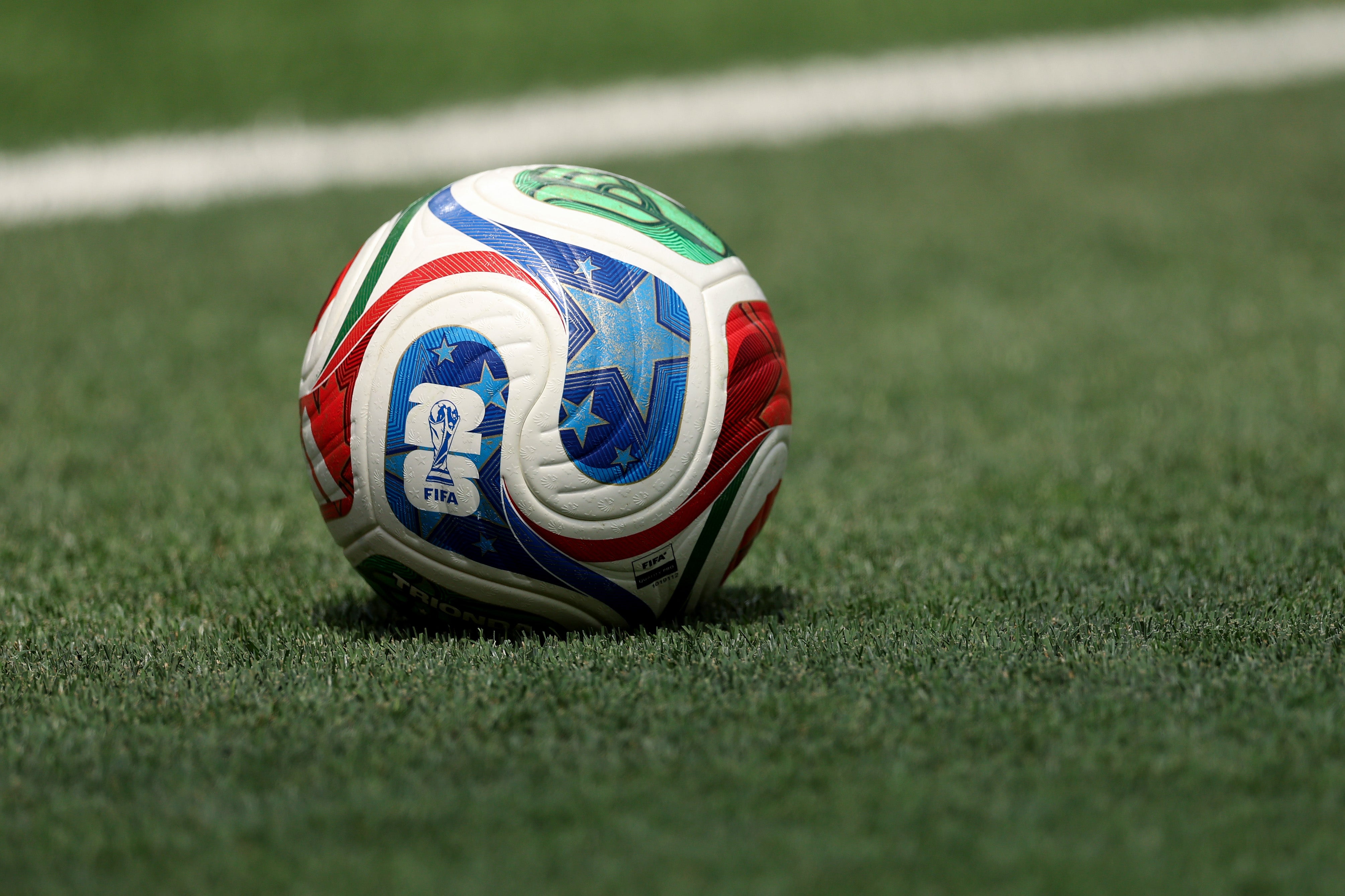
The adidas Trionda match ball during the FIFA World Cup 2026 Quarter Final match
The adidas Trionda match ball during the FIFA World Cup 2026 Quarter Final match (Getty)

Among the recent World Cup balls we tested, Trionda has the lowest critical speed at which that airflow change takes place. That led us to predict free kicks and corner kicks with fairly consistent, stable flight.

But we also found that Trionda’s drag coefficient was slightly larger than that of its predecessors, which implied a slightly rougher surface. So there was a possible trade-off; it might fall a couple of meters short.

Has the real pitch experience followed those predictions?

It has depended a little on conditions. Take the Mexico vs. England game at Estadio Azteca in Mexico City, which took place at high elevation.

Advertisement

That meant the ball had less air drag on it, so it could actually go farther than it would when kicked with the same launch speed in lower-altitude conditions. It also meant that because the sideways, or Magnus forces, are proportional to air density, it would curve less.

During the England vs. Mexico game, what I noticed, especially early on, was many of England’s kicks tended to go a little long. They would kick the ball down the pitch in those first 20 minutes and it would be just out of reach of teammates.

The sense I got was they weren’t quite adjusting for the higher elevation and lower air density.

Some have questioned the flight. Do they have a point?

Advertisement

I have heard the complaints by former England goalkeeper Joe Hart about the ball. But I haven’t heard a whole lot of detail about the substance of those complaints.

In other words, I’ve heard about the ball not being their favorite, but not why. The scientist in me really wants to interview a goalkeeper and find out: “Do you think it’s moving in erratic ways? Or is it something to do with the color scheme that’s flummoxing you on the pitch?”

John Eric Goff is a Professor of Engineering Practice at Purdue University.

This article is republished from The Conversation under a Creative Commons licence. Read the original article.

Advertisement

I think goalkeepers are always going to complain about a new ball. But the Nike Flight, which was used in the 2024-25 English Premier League season, has an aerodynamic profile most similar to that of the current World Cup ball. So players who used that ball might already be somewhat familiar with the motion of Trionda.

As far as I can tell, the ball appears to be flying in ways that not only we predicted but that don’t look completely out of touch with what players would have seen with other balls.

As the World Cup has progressed, I’ve been watching the ball come in toward the goalkeepers, and it could be that the reds, blues and greens twirling in front of the goalkeepers’ eyes are confusing them.

There’s been talk of more long-range goals. Is the ball playing a role?

Advertisement

I have read there are more goals coming from farther out than in previous World Cups. But I don’t know if I could attribute it specifically to the ball.

It’s possible, of course. But I would really have to see what the actual number is and see what the percentage increase has been, because, for a sport like soccer where you only get two or three goals in a match, the sample size is so small.

It would certainly be a very interesting research question to pursue. But I don’t think the ball alone can be credited for these longer-range goals.

Overall, how has this ball performed?

Advertisement

I think the ball has been fine. It is an attractive ball, with the colors of the original version representing the three host countries – all of whom are now out of the tournament, so it didn’t bring them much luck, unfortunately.

Source link

Continue Reading
Click to comment

You must be logged in to post a comment Login

Leave a Reply

Sports

Pochettino agrees new USA deal until 2030

Published

on

Mauricio Pochettino has agreed a new deal to remain as manager of the United States men’s national team until 2030.

The former Tottenham Hotspur and Chelsea boss has been in charge since September 2024 and led the USA to the last 16 of the 2026 World Cup on home soil.

The co-hosts topped their group after wins over Paraguay and Australia before beating Bosnia-Herzegovina 2-0 in the last 32.

Advertisement

Their World Cup run ended with a heavy 4-1 defeat by Belgium.

Under the new agreement, Pochettino and his coaching staff will have a bigger role within US Soccer. They will also advise and support the organisation on areas including youth development, coaching education, professional league partnerships and the wider national team pathway.

“Working together with US Soccer over the past two years, it has become clear to us that there is tremendous potential to make the men’s national team programme even stronger,” Pochettino said.

Advertisement

“We are excited by the opportunity to bring all our experience and knowledge to even more areas of US Soccer while helping strengthen the pathways for players, coaches and teams across the federation.

“We want to try to have a lasting impact on the sport in the country that has welcomed us so warmly and for that impact to extend beyond results on the field.”

US Soccer president Cindy Parlow Cone praised the work done by Pochettino and his staff.

“Mauricio has built a culture where players trust the group, trust the process and trust each other,” she said.

Advertisement

“We saw the impact of that belief in the way the team grew, competed and performed on the world’s biggest stage.

“That culture, and the staff who helped build it, are exactly what we want to continue investing in for the men’s national team now and for the future.”

Source link

Advertisement
Continue Reading

Sports

5 players who are switching states ahead of India’s 2026-27 domestic season ft. Shashank Singh

Published

on

The annual pre-season transfer window in Indian domestic cricket allows players to switch state associations as outstation or guest recruits under the Board of Control for Cricket in India (BCCI) regulations.

State teams are permitted up to three guest players to strengthen their squads ahead of the Ranji Trophy, Vijay Hazare Trophy, and Syed Mushtaq Ali Trophy campaigns. These transfers are driven by players seeking more game time, specialized roles, or leadership opportunities, while developing state teams aim to recruit veteran talents to bolster their squad depth.

The upcoming 2026-27 season features several notable moves, with prominent domestic regulars and IPL players shifting allegiances. Let’s take a look at five such moves.

#1 Shashank Singh

The Punjab Kings (PBKS) all-rounder Shashank Singh will turn up for Puducherry in the 2026-27 season after shifting base from Chhattisgarh. The Chhattisgarh State Cricket Sangh (CSCS) has already issued an NOC to the player.

Singh alleged that the state association didn’t support him while he was recovering from an injury that he suffered last season. He further claimed that the association questioned his commitment, saying that the batter only wanted to play in the Indian Premier League (IPL).

The 27-year-old added that CSCS officials didn’t give him any clarity over why he was left out of the Chhattisgarh Premier League and the team’s pre-season camp.

Advertisement

Singh has played 21 first-class games for Chhattisgarh over the last seven years. He has also represented the state in 31 List A and 42 T20s.


#2 Yash Dayal

Royal Challengers Bengaluru fast bowler Yash Dayal will represent Chhattisgarh in the upcoming domestic season. He has already joined the team’s pre-season camp in Alur.

Dayal has not played any competitive cricket since the IPL 2025 final, after which he faced charges relating to sexual assault. The left-arm pacer was retained by Gorakhpur Lions for the upcoming UP T20 League. However, he didn’t feature in the 18-member squad the franchise announced following the auction.

The 28-year-old has represented Uttar Pradesh in 27 first-class, 23 List A, and 71 T20s, picking up 186 wickets across formats, including two five-wicket hauls.

Advertisement

Dayal will look to start fresh for Chhattisgarh in the upcoming season and make his way back to the scheme of things.


#3 Dharmendrasinh Jadeja

Chhattisgarh is looking to build a strong squad for the upcoming domestic season. As a result, they have roped in Saurashtra‘s veteran left-arm spinner Dharmendrasinh Jadeja.

The 35-year-old spinner has been a stalwart in the domestic circuit, picking up 423 wickets in 100 first-class matches, including seven 10-wicket hauls and 26 five-fors. Jadeja also has 121 List A and 65 T20 wickets under his belt.

Jadeja is also a very handy batter in the lower order, accumulating almost 2900 runs across formats. He also has 10 fifties under his belt.

Advertisement

Jadeja’s addition will certainly boost Chhattisgarh’s squad depth as they look to put in a spirited performance next season.


#4 Prasad Pawar

Mumbai wicketkeeper-batter Prasad Pawar has signed with Puducherry to play alongside Shashank Singh as a guest player in the upcoming domestic season.

Prasad has struggled for game time in the Mumbai squad, with Hardik Tamore playing as the first-choice wicketkeeper-batter. As a result, Prasad has decided to shift base to Puducherry in search of more playing time.

Prasad made his List A debut in 2021, while his first-class and T20 debuts came in 2023. Overall, he has represented Mumbai in 27 matches, scoring 591 runs, including one hundred and fifty each.

Advertisement

#5 Jayant Yadav

An offspinner from Haryana, Jayant Yadav, has decided to join Chhattisgarh for the 2026-27 domestic season. He brings truckloads of experience along with him, having represented India in six Tests and two ODIs while picking up 17 wickets in total.

Yadav has 96 first-class, 74 List A, and 95 T20s under his belt, picking up 272, 68, and 61 wickets, respectively, including two 10-wicket hauls and 15 five-fors. He is also very handy with the bat in the lower order, scoring 4781 runs, including three hundreds and 22 fifties. The 36-year-old cricketer also has one Test hundred and fifty each to his name.

Chhattisgarh will rely heavily on the spin duo of Yadav and Jadeja to bring laurels for the team in the upcoming season.