The sport of baseball continues to evolve with time. From the implementation of the designated hitter to, more recently, the pitch clock, the game has undergone significant changes. Another aspect of that evolution involves how the media covers it. No longer are press boxes filled with smoke and typewriters. Some of baseball’s most impactful voices may never step foot in a press box all season.
Moreover, in the podcast space, there was a hole in the industry’s coverage of baseball. One that Scott Braun and Marc Weiner saw as an opportunity. The former producers leaned on their experience from various stops, including ESPN and MLB Network, and navigated a path to create a content destination that served an underserved baseball audience. In 2023, the Foul Territory Network was born as a podcast network focused on baseball the way it should be covered.
Advertisement
“We tried to take the playbook from what other sports were doing well and apply it to baseball. What we found was the baseball audience has their own uniqueness to it,” explained Braun, who serves as the executive producer and lead host of the flagship program on the Foul Territory Network.
Advertisement
Since 2023, the Foul Territory Network has grown from a single program with Braun as its lead host to a network of 30 programs serving audiences on both the local and national levels. The talent roster that comprises the network consists of a mix of personalities. From those surrounding the game, from former players and executives to local beat reporters and passionate fans of specific teams.
In less than three years, the Foul Territory Network has grown at a rate that is rare for on-demand content centered around a single sport.
“It happened a lot faster than we thought,” said Weiner, who serves as the CEO of Make Plays Media, the production company behind Foul Territory Network. “I did not think that we would grow that much this quickly. But once we started doing it, we found our formula for further growth.”
A Changing Dynamic Of Coverage
According to Braun, the origins of the network’s concept were rooted in feedback he received from former players. While other sports had former players and executives launching successful podcast platforms, baseball seemingly lagged behind. Adapting to the mission statement of covering baseball the way it should be covered, Braun feels launching the Foul Territory Network has, in turn, brought more attention to the sport itself.
Advertisement
“We want to grow the game. Our platform has grown the game in creating virality on a number of social platforms. Based on the views or stories that players share where they feel more comfortable here to share them here,” notes Braun. “You’re growing the game by allowing that player to share something they couldn’t before on one of our shows.”
Advertisement
To build a network, you need people and personnel. Currently, the Foul Territory Network houses 30 programs with multiple talents involved in each. Every show added to the network begins with a concept developed internally or someone approaching the company with either an idea or a proof of concept.
Advertisement
While the amount of growth over the past three years is impressive, it has also remained measured.
“We’re careful about growing too fast. We had never done anything like this before we started. Thankfully, people in our orbit shared some great advice about that,” said Weiner. “We’re careful about growing at the right pace. But also bringing the right people aboard to fit our vibe and putting them in places to succeed.”
Authenticity Wins
Both Braun and Weiner are students of their audience. They listen for the type of content fans desire and follow where the audience chooses to consume it. It’s a balance that requires patience and skill. With their television backgrounds, content must not only have depth but also look and sound as polished as any network production.
Advertisement
Advertisement
However, the biggest focus for Foul Territory is authenticity. With a mix of former players and executives who have worked in the game, ensuring their perspective is on point is vital. Adding current and former beat reporters to the mix provides up-to-date information and credibility. Regardless, the end product must always be consistent and honest with the audience.
“You need to be able to talk about the highs and the lows. If you’re not comfortable with that, we don’t want to put you in a bad spot,” explains Weiner. “We have so many writers and commentators who have a primary job. We’re happy they’re allowing us to work with their people. This allows them an expansion on what they’re doing and what they’re great at.”
There are many elements of Foul Territory’s approach that deserve credit for the growth it has earned over the past three years. However, perhaps the single greatest element was the company’s video-first approach from launch.
Advertisement
Advertisement
“It’s been huge and was a great call right from the jump,” said Braun. “That was super important for us. Just in the last three or four years, the industry has continued to shift to video-first. It doesn’t touch what you’re listening to; it just enhances what you’re watching… We have everything available on podcast platforms, but we wanted a true viewing experience and not a conference call.”
Weiner’s experience working behind the scenes at ESPN was a driving force behind not only the concept but also the execution. Every motion matters. Every graphic should be crisp and flow with the presentation. In an industry that continues to evolve daily in how audiences consume video content, the bar must continue to rise.
“We want it to look as close to TV as possible. There’s a lot of overhead with television. We wanted to be as close to that experience without going and buying a building,” said Weiner. “We have conversations all the time on how to improve. We’re all in this together. In a lot of ways, it’s growing, but it’s also shrinking as well. It’s a small community. We don’t look at others as competitors. We’re not just growing the game, we’re also growing the industry at the same time.”
Advertisement
With growth comes the question of expansion. While there’s a keen eye on not growing too quickly, both Braun and Weiner admit there are plenty of ideas for future expansion on the wish list. From creating different content verticals outside of sports to exploring new avenues with current talent on the roster.
An Uncertain Future For Baseball
One area where Foul Territory is already expanding is coverage of the continued labor negotiations between MLB and the MLBPA. With every step of the ongoing discussions involving a new CBA, Foul Territory plans to provide full and comprehensive coverage for as long as the conversations continue.
Advertisement
“From a content perspective, the only goal I have is to bring on as many people, ideas, and conversations to the network on all sides of the discussion,” said Braun. “No guest gets turned down that makes sense to have on. From Rob Manfred to Bruce Meyer. Anyone allowed to speak on the matter, we want to let them cook and speak on every idea while asking the right follow-ups.”
Advertisement
Because of the roster that Foul Territory has assembled, it provides perspective on all fronts of the conversation. From former players, executives, and general managers to insiders with connections around every angle of the story. The result is an objective, down-the-line approach that delivers discussions unique to the platform.
“In the digital space of baseball, who else could provide the approach we’ll provide to this topic,” asked Weiner. “Whatever your perspective is on this, we’re completely independent. That was so important to Scott and I. We’re not one side or the other. We’re bringing people on and having conversations. We must be mindful of people who are representing both sides so you can have the discussions that need to be had.”
Advertisement
Advertisement
While baseball’s immediate future is unknown, the spotlight on the Foul Territory Network continues to grow. With hopes of adding more shows and involving more current players, both Braun and Weiner believe there is no limit to how much growth the network could see over the next few years.
In many ways, Foul Territory’s rise mirrors the evolution of baseball itself. The game remains rooted in tradition, but the ways fans consume it continue to change. Braun and Weiner recognized that shift early, building a platform that prioritizes authenticity, accessibility, and meaningful conversation at a time when baseball fans were searching for more direct connections to the sport.
What began as a single show has quickly become one of the most influential baseball-focused content destinations in the industry. Yet despite the rapid growth, the mission remains unchanged: cover baseball the way fans want it covered and provide a platform where the game’s most important voices can be heard.
As the sport navigates new challenges, labor discussions, and an increasingly crowded media landscape, the Foul Territory Network appears positioned to remain at the center of the conversation.
Advertisement
Advertisement
If the first three years are any indication, Braun and Weiner are still only in the early innings of what they hope to build.
Barrett Media produces daily content on the music, news, and sports media industries. Sign up for our newsletters to stay updated and get the latest information right in your inbox.
John Mamola is Barrett Media’s sports editor and daily sports columnist. He brings over two decades of experience (Chicago, Tampa/St Petersburg) in the broadcast industry with expertise in brand management, sales, promotions, producing, imaging, hosting, talent coaching, talent development, web development, social media strategy and design, video production, creative writing, partnership building, communication/networking with a long track record of growth and success. He is a five-time recognized top 20 program director in a major market via Barrett Medi’s Top 20 series and has been honored internally multiple times as station/brand of the year (Tampa, FL) and employee of the month (Tampa, FL) by iHeartMedia. Connect with John by email at John@BarrettMedia.com.
Former India player Saba Karim has opined that Ishan Kishan pressed the self-destruct button in the first T20I against England. The analyst highlighted that the wicketkeeper-batter was responsible for his run-out as he attempted a non-existent run.
Kishan was run out for a two-ball duck as India set England a 190-run target in Durham on Wednesday, July 1. However, with rain preventing England from starting their chase, the game ended as a no-result.
During a discussion on JioHotstar, Saba noted that there would have been a slim chance of Kishan and Abhishek Sharma completing the run had the latter responded to the call immediately.
“It was self-destruction. Both Abhishek Sharma and Ishan Kishan were watching the ball. They should have been looking at each other. There might have been a possibility had Abhishek Sharma responded very quickly, but normally, the non-striker waits for the ball to beat the fielder in the infield, and he runs after that only,” he said.
Advertisement
The former India wicketkeeper-batter reckoned that Abhishek would have struggled to reach the striker’s end, urging the visiting batters to improve their communication.
“In my opinion, there was no run there. Even if Abhishek Sharma had tried, it would have been difficult for him to reach the other end because Jos Buttler did an excellent job. He came to the stumps very quickly. Both batters need to work on their communication. It happened in Ireland and here as well,” Saba observed.
Ishan Kishan was run out after being sent back by Abhishek Sharma, with Harry Brook’s throw to Jos Buttler finding him short of the crease. He was run out in the second T20I against Ireland as well after a mix-up with Tilak Varma.
“There was no run at all” – Irfan Pathan on Ishan Kishan’s run-out in ENG vs IND 2026 1st T20I
In the same discussion, former India all-rounder Irfan Pathan also reckoned that Ishan Kishan attempted to steal a non-existent run.
Advertisement
“There was no run at all. You would have heard Abhishek saying that he (Kishan) should have allowed the ball to pass the midwicket fielder, and then the mid-on fielder also wasn’t standing on the 30-yard circle. He was standing slightly ahead. When that happens, he is also attacking the ball,” he said.
The cricketer-turned-commentator concurred with Saba Karim that Abhishek Sharma would have gotten run out had he responded affirmatively to Kishan’s call.
“You played the ball softly. You have to take the run only after the ball passes the fielder who is trying to cut the ball. In my opinion, there was no run. I totally agree with Saba bhai. Abhishek would have gotten run out. It means you took a high-risk run, and when you do that, someone will be sacrificed. You got run out yourself. So it was a wrong decision from Ishan Kishan,” Pathan observed.
Ishan Kishan’s run-out reduced India to 6/2. Abhishek Sharma (59 off 24) and Shreyas Iyer (68 off 47) then bailed the team out of trouble with an 82-run third-wicket partnership before Shivam Dube’s unbeaten 21-ball 42 took them to a fighting total.
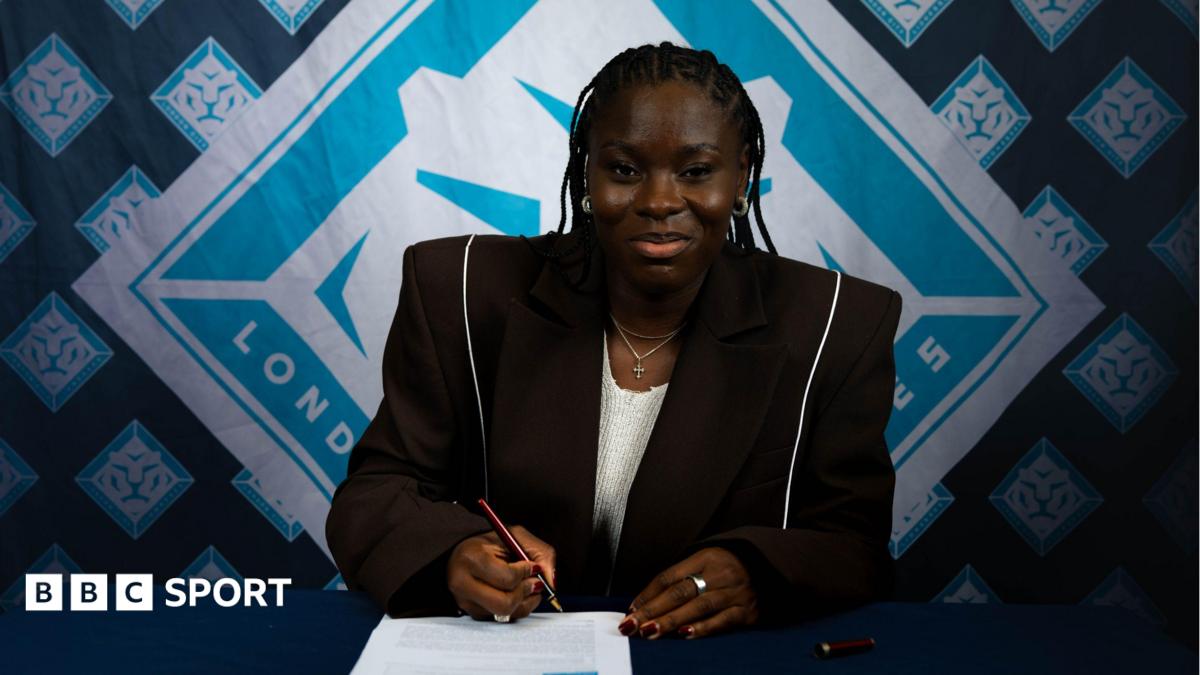
Germany forward Nicole Anyomi has joined London City Lionesses on a three-year contract.
She joins the London club after her contract expired at German side Eintracht Frankfurt, where she scored 60 goals in 130 appearances over five seasons.
Anyomi said she is relishing the challenge of playing in the Women’s Super League: “The WSL is fast and direct and there is a need to be more physical and to improve myself.”
The 26-year-old has 34 Germany caps, was part of the squad that reached the final of Euro 2022 and helped her country claim bronze at the 2024 Olympics.
Advertisement
Anyomi said she was excited by the club’s ambitions and the chance to play in England.
“I always wanted to play abroad and to have the offer from this club with their project means the world.
“My best friend is Shekiera Martinez, who was at West Ham and has now joined Tottenham. She has already told me about the league, London and about the country so I’m ready.”
Earlier this week, London City also announced defender Poppy Pattinson had signed a new contract.
The U.S. was often mocked leading up to this World Cup for not being a “soccer” country, but what about its fans? Antoine Besse went to a bar in Boston during a game to check out the atmosphere.
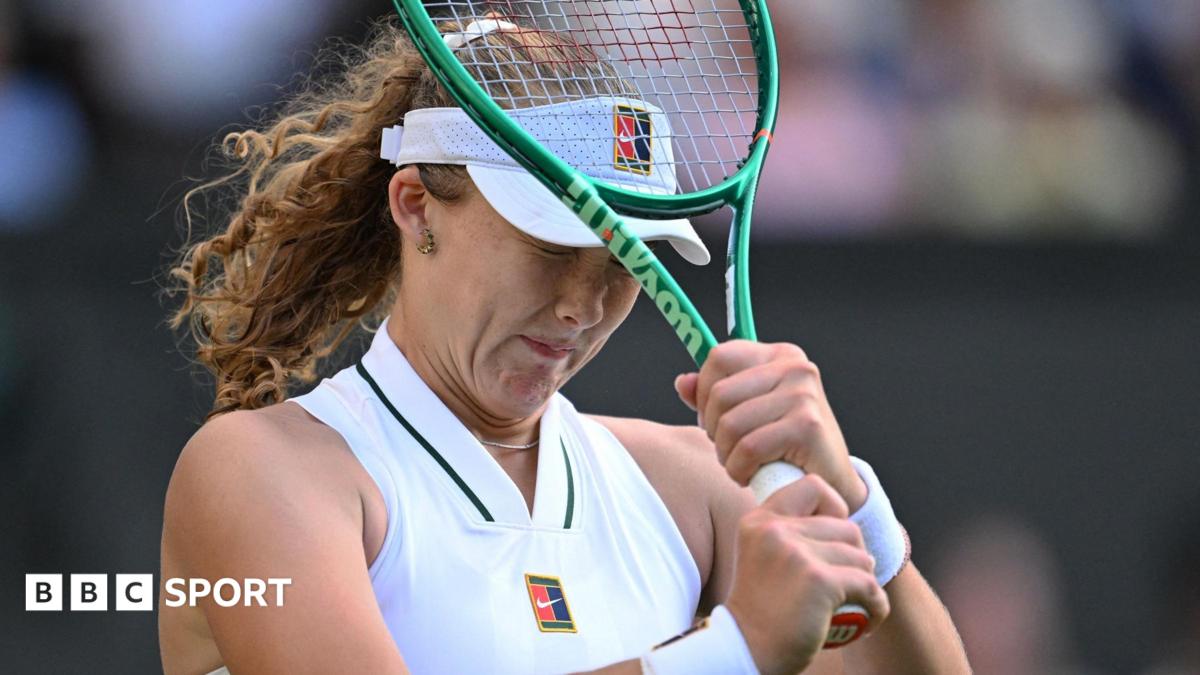
French Open champion Mirra Andreeva broke down in tears in a news conference after she was knocked out of Wimbledon by Barbora Krejcikova.
Russian 19-year-old Andreeva had hurled her racquet in frustration and shouted “I quit” towards her team before making a hasty exit off court following a 4-6 7-5 6-4 defeat in a gruelling second-round match lasting almost three hours.
Asked how long it would take to recover from the loss, she said: “It’s going to take some time, maybe a couple of days, and then I’m going to be back to practise for hard courts.”
Krejcikova dedicated her thrilling win to her tennis-loving niece, who was at home with chickenpox.
Advertisement
Krejcikova, who won the women’s singles title at Wimbledon in 2024, missed six match points at 5-3 up in the deciding set, but regained her composure to see out victory a game later.
“I believe my little niece was watching, and my nephew. She is also playing tennis and she loves it,” Krejcikova said.
“She’s actually sick – I think she has chickenpox. My nephew got it from kindergarten, so I hope my brother let her and my nephew watch this match.
“I hope she is going to be proud of me and hopefully I can give her some motivation for tennis and also for life.”
Advertisement
Krejcikova and Andreeva looked confused at one point when loud cheers rang around Centre Court when England beat DR Congo to reach the last 16 of the football World Cup.
Krejcikova has been plagued with injuries and dropped down the rankings since her triumph at the All England Club two years ago, while she suffered first-round exits at the Australian Open and Roland Garros this season.
“It’s definitely special. I have been through a lot with injuries and also in my personal life in the last couple months,” the world number 38 said.
“It was really hard to get through with the all the emotions of what has happened.”
The United States men’s national soccer team is heading to the Round of 16, defeating Bosnia and Herzegovina, 2-0, on Wednesday night in Santa Clara, California.
It’s just the second time in Team USA history that they won in the knockout stages. Their only other came in 2002 when they beat Mexico, 2-0, in the Round of 16.
Now, the USMNT will head back to Seattle to face Belgium, who came back from a 2-0 deficit against Senegal in the second half to win in extra time, in the Round of 16.
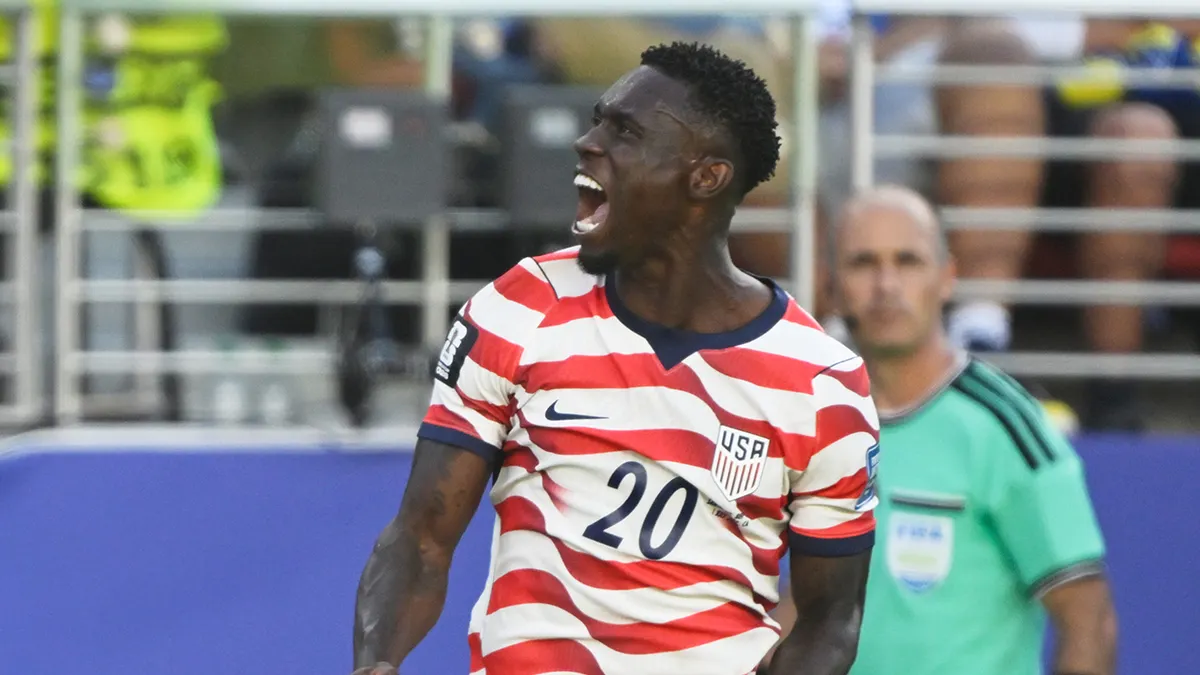
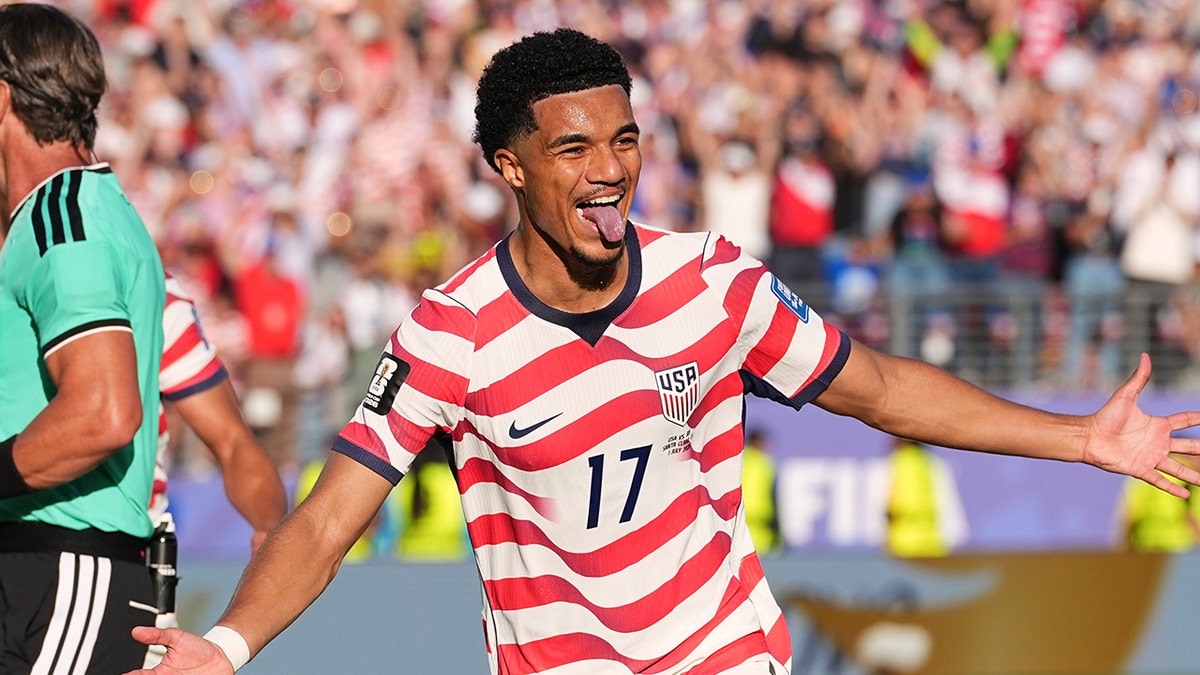
United States’ Folarin Balogun celebrates after scoring the opening goal during the World Cup Round of 32 soccer match between the United States and Bosnia in Santa Clara, Calif., near San Francisco, Wednesday, July 1, 2026. (AP Photo/Eakin Howard)
Usually, when the USMNT enters the knockout stage in the World Cup, they’re considered the underdogs, hoping to be scrappy to force an upset. This time around, in an expanded tournament format that begins with a Round of 32, the country on home soil was the overwhelming favorites.
Their play proved why, even in the face of adversity in the second half.
It was an inauspicious start for the USMNT after Bosnia and Herzegovina secured a couple corner kicks, and goalkeeper Matt Freese, who hasn’t really been challenged much in this World Cup, had to scramble to save one that was destined for the back of the net if he didn’t punch it away.
From there, though, the USMNT got to work in the first half, and controlled the match. It seemed like it was only a matter of time before they scored, and Falorin Balogun, who has had a tremendous tournament in terms of goal scoring, did he striker job when he received a pass on a turnover and put it in the back of the net in the 29th minute.
However, the sideline referee threw his flag in the air – offsides. Video replay showed Balogun was clearly off, and there wasn’t much debate from head coach Mauricio Pochettino and his sideline staff either in this case.
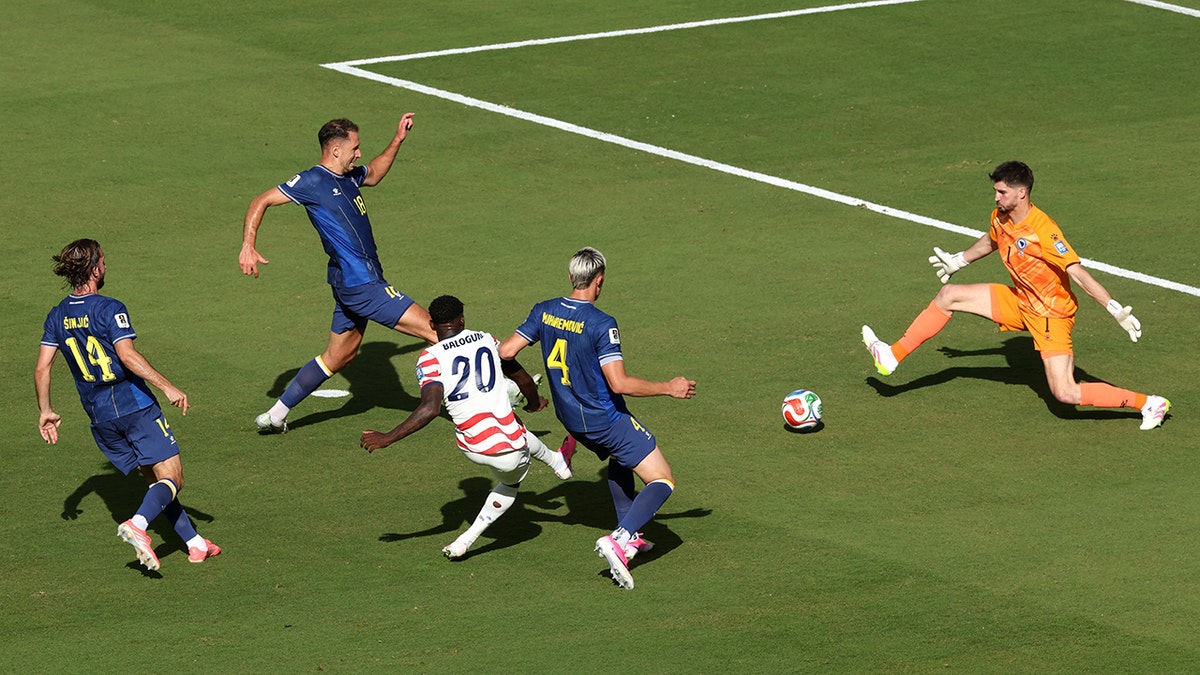
Folarin Balogun of the United States scores his team’s first goal past Nikola Vasilj #1 of Bosnia and Herzegovina during the FIFA World Cup 2026 Round of 32 match between USA and Bosnia and Herzegovina at San Francisco Bay Area Stadium on July 1, 2026 in Santa Clara, California.(Michael Steele/Getty Images)
Balogun got another chance in stoppage time, and in this instance, he was onside and still lethal.
Advertisement
With Bosnia and Herzegovina defenders draped all over him, Balogun turned and swung his left foot into the ball just inside his opponent’s box and it slipped through the goalkeeper’s legs for the first goal of the match.
The U.S.-heavy crowd went into a frenzy, and Balogun celebrated with an ode to LeBron James, doing his signature stepping move as his teammates congratulated him on his third goal at the World Cup.
But the second half saw a massive moment occur in favor of Bosnia and Herzegovina when Balogun was called for a red card after VAR review determined so following a foul where he stepped on a defender’s ankle. It was a controversial call that changed the complexity of the game with the USMNT down to 10 men to Bosnia and Herzegovina’s 11.
Also, despite the hard-fought win, Balogun will have to miss the Round of 16 due to the decision, which is an obvious loss for the U.S.
Advertisement
United States’ Malik Tillman celebrates after scoring on a free kick during the World Cup round of 32 soccer match between the United States and Bosnia in Santa Clara, Calif., near San Francisco, Wednesday, July 1, 2026.(AP Photo/Martin Meissner)
The red card came in the 64th minute, and the USMNT had to “suffer,” as FOX Sports color commentator Stu Holden said during the broadcast, to pull out a victory with a one-goal lead. While they had to defend with more tenacity, the USMNT still created chances to score despite their situation.
One was called back when Christian Pulisic found the back of the net, but was offsides. But Bosnia and Herzegovina’s Stjepan Radelijic held back Sergiño Dest just outside the box, forcing the referee to pull out a yellow card and give the USMNT a grade-A opportunity to pull away a bit in the 80th minute.
Enter Malik Tillman, the German-born son of a U.S. military veteran, who had the perfect free kick, dipping over the five-man wall in front of the net and going past the outstretched arms of goalkeeper Nikola Vasilj.
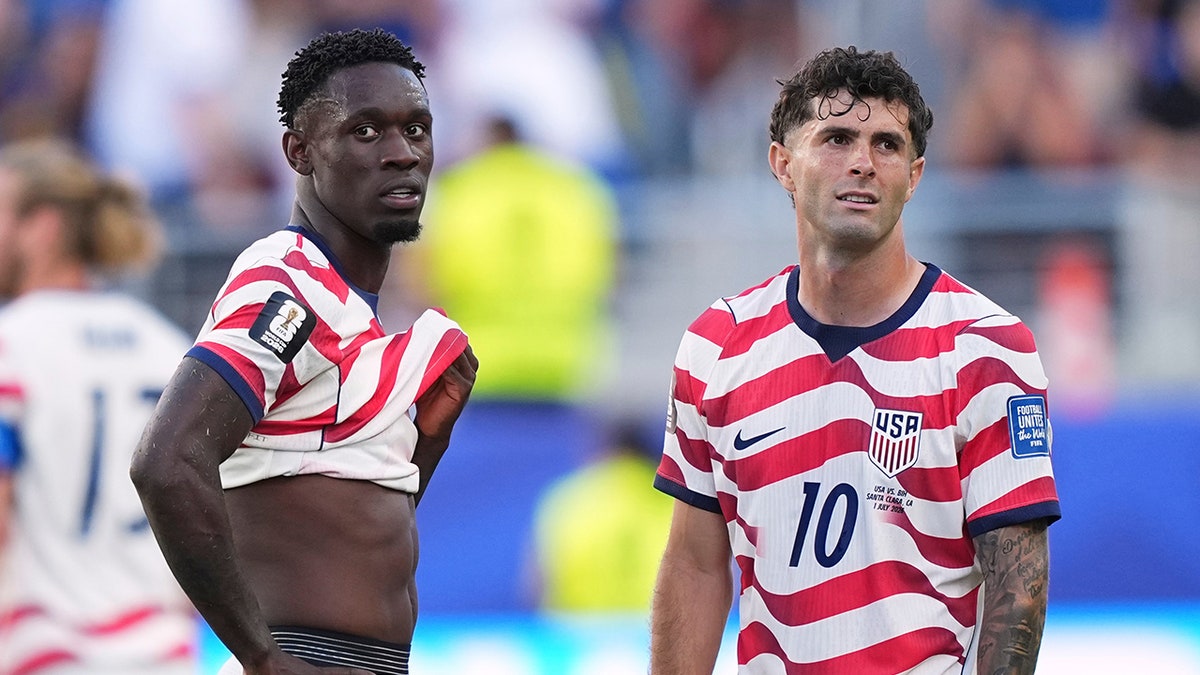
United States’ Folarin Balogun (20) and United States’ Christian Pulisic (10) stand by after Balogun received a red card during the World Cup round of 32 soccer match between the United States and Bosnia in Santa Clara, Calif., near San Francisco, Wednesday, July 1, 2026. (AP Photo/Martin Meissner)
The goal put the U.S. up 2-0, and the momentum Bosnia and Herzegovina had following Balogun’s red card decision, was wiped out. They had desperation attempts to get back into the match, but the U.S. slammed the door shut to the satisfaction of the sold-out crowd at San Francisco Bay Area Stadium and the millions watching at home.
There will be tons of debate about how the U.S. deals with the loss of Balogun in the next round, but the job got done in this match where the home-country favorites kept their title hopes alive.
PHILADELPHIA — Struggling Pittsburgh Pirates ace Paul Skenes isn’t pretending to know the answers to his sudden slipups on the mound, from where he’s dominated for two seasons.
At least he wasn’t offering any on Wednesday night after his worst outing of the year. Skenes (6-8) lasted only four innings against the Philadelphia Phillies and allowed a season-high seven earned runs in a 10-6 loss.
Since beating Colorado 3-1 on May 12 to improve to 6-2 with a 1.98 ERA, the defending NL Cy Young Award winner has not won over his last nine starts, his record falling to 6-8 and his ERA climbing to 3.62. His puzzlement is growing, too.
“I didn’t execute very well,” Skenes said. “That’s really what it comes down to. I fell behind on some counts and left some balls over the plate.”
Advertisement
He also took his time doing it. Skenes threw 35 pitches during a five-run Phillies second inning, highlighted by Trea Turner’s three-run homer.
“I think we’ve got a good team,” Turner said. “I think sometimes there’s no explanation, but I feel like we’ve got a good lineup and we battle. We know he’s really good, and he’s always going to give us a fight, and you kind of tip your cap when he gets you and move on, and try to have the next guy pick you up. I thought we did a good job keeping it moving against him.”
In an anticipated duel of aces and a rematch between Skenes and Philadelphia’s Zack Wheeler, played on a humid night with temperatures in the 90s, neither pitcher worked to his standard.
Skenes’ first loss in this slide came at PNC Park on May 17 at the hands of Wheeler and the Phillies, 6-0. In that game, he didn’t allow a run until the fifth inning.
Advertisement
On Wednesday night, the Phillies didn’t wait that long.
Pirates third baseman Nick Gonzales fielded Justin Crawford’s bases loaded grounder in the second inning and seemingly had a routine force play at the plate, but he fired the ball off runner Alec Bohm’s hand and allowed two runs to score.
Said Pirates manager Don Kelly: “The baserunner did a good job getting in the way.”
Next batter Turner hit a pitch from Skenes into the seats for his third homer in as many games to make it 5-0.
Advertisement
Skenes gave up a home run to Brandon Marsh in the third. And before he bowed out, he watched Bryce Harper’s liner get misjudged by Pirates left fielder Tyler Callihan for a two-run double.
It seemed Skenes’ luck was off just as much as his command.
“They’re a good lineup, but I haven’t made it easy on myself,” Skenes said. “I just have to execute a few pitches a little better, and I think it’s probably a different story.
“I don’t know … it happens. We’ll figure out what it is and we’ll just keep attacking it.”
If you want to hit the ball like the pros do, you need to move your body like the pros do. When I say that, I’m not suggesting you need to rotate your hips like Rory McIlroy or shuffle your feet like Scottie Scheffler. Rather, what you need to strive for is to sequence your body the same way they do.
Here’s how it works.
Sequencing is a popular buzzword in golf instruction, but all it means is the order in which each body part moves. Sequence your swing correctly and you’ll create crisp contact and effortless power. Do it incorrectly and you’ll introduce a variety of flaws and inconsistencies.
Advertisement
“>
So, how does the way pros move their body differ from how amateurs do? It all starts with how they shift and turn. When you watch a pro swing the club, take note of the order in which they do so. During the backswing, they shift their weight back and then turn their body to the top. On the downswing, they do the same sequence. Shift forward, then turn. This “shift then turn” sequence is the secret sauce that produces power, controls low point and breeds consistency.
Recreational players tend to get in trouble — particularly during the downswing — when they reverse this order. At the top, their first move to initiate the downswing is a turn. But when you turn before you shift, it throws the clubhead outside the hands and creates an over-the-top swing, often resulting in a weak slice. If your first move is a shift instead, you’ll create more space for your hands and naturally shallow the club on the downswing.
If you struggle to create power and tend to lose the ball to the right, take a look at how you are sequencing your body to start the downswing. There’s a good chance the reason you’re struggling is incorrect sequencing. To correct it, remember to feel a shift and then a turn. You’ll be amazed at how much easier hitting the ball becomes.
Advertisement
3 things I’m thinking
1. Winning is hard: The top five in SG: Total on Tour this season (Scottie Scheffler, Matt Fitzpatrick, Tommy Fleetwood, Ludvig Aberg and Collin Morikawa) have just four combined wins this season. Consistency is king in golf, but sometimes even that isn’t enough to rack up trophies.
2. Nelly’s biggest challenger: Nelly Korda has dominated the headlines in women’s golf this season, but Haeran Ryu is also putting together one heck of a 2026 campaign. In 11 starts thus far in 2026, she has nine top 15s, seven top 10s and a win at the KPMG Women’s PGA. Don’t overlook the south Korean with two more majors still to play.
3. Summer heater: Wyndham Clark is the hottest player in the world at the moment. Over the last month, he’s won twice (including at the U.S. Open), finished top 5 two other times and added a T11 in Canada. He picked a great time to showcase his best stuff.
Call the kids, Martha. They’ve gotta see this too.
On the day that Connor McDavid began what could be his final contract as an Edmonton Oiler, general manager Stan Bowman finally found the pedigree of a goalie that McDavid has never had as a teammate.
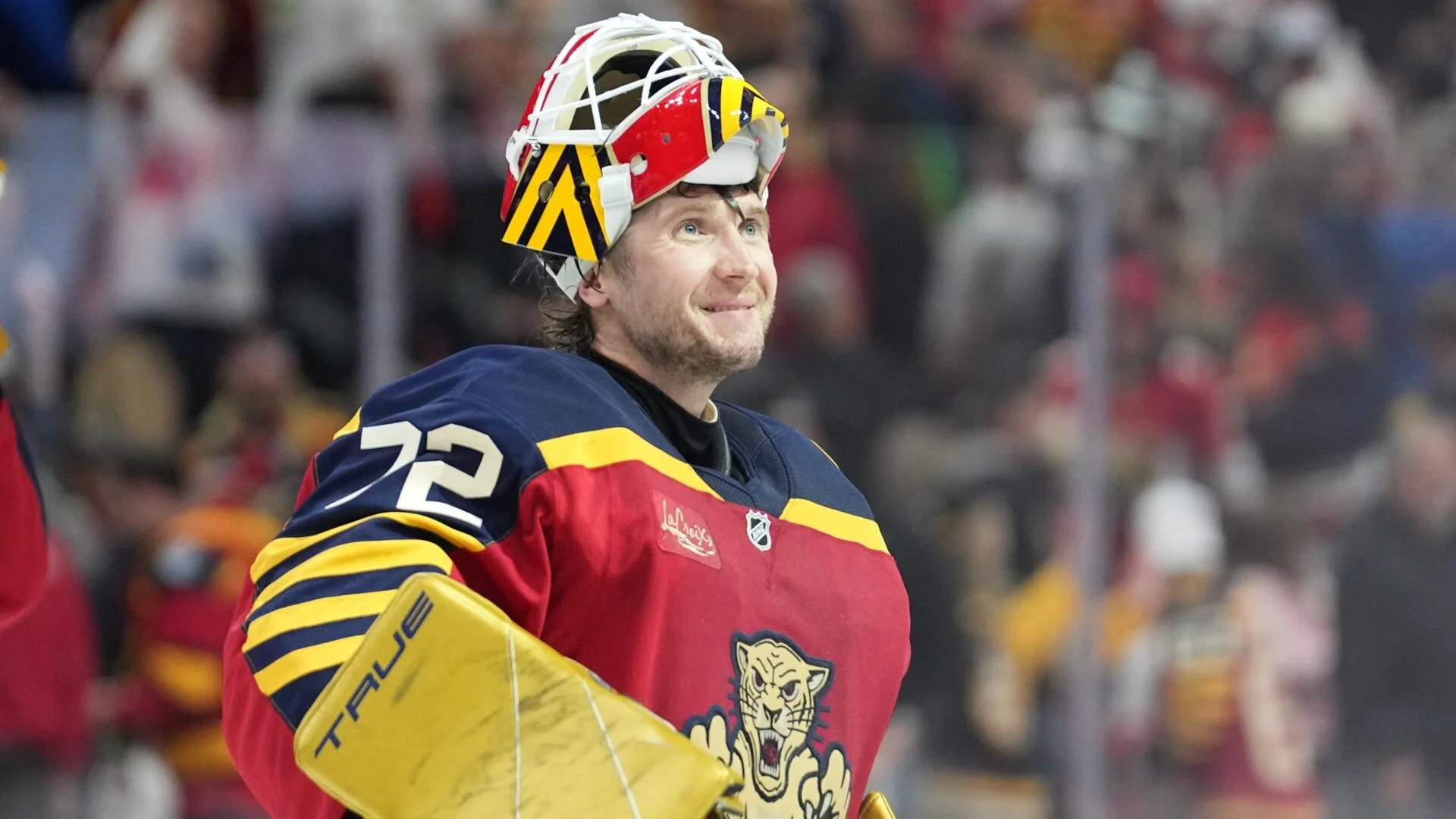
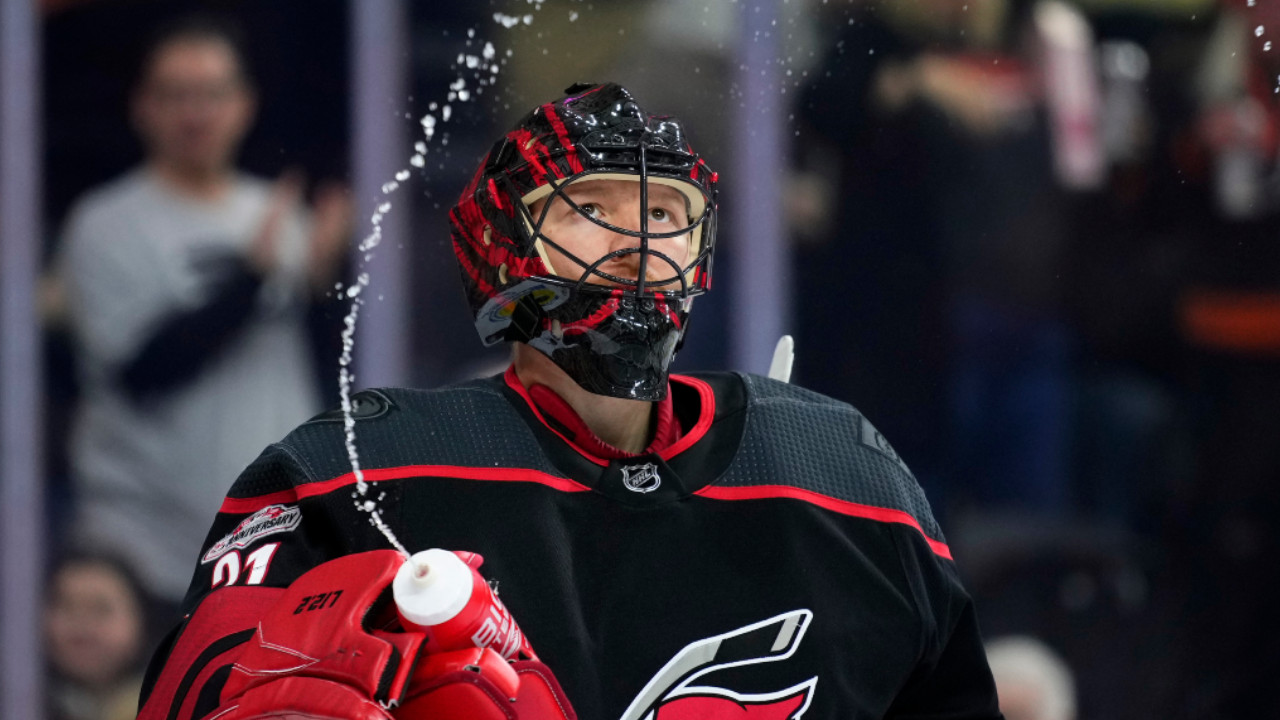
Frederik Andersen, fresh off a Stanley Cup run with the Carolina Hurricanes in which he started 16 of the Hurricanes’ 19 games, signed a bonus-laden one-year deal to try to get the Oilers that elusive Stanley Cup they seek, with the end of the McDavid window possibly drawing near.
Advertisement
From Cam Talbot to Mike Smith to Stuart Skinner to the latest tandem of Tristan Jarry and Connor Ingram, McDavid’s 11 seasons in Edmonton have played out in front of a legion of good-but-not-great netminders. The Mikko Koskinens whom Oilers fans wanted to love, but whose work in the crease did not always love them back.
July 1 started slowly, but ramped into quite possibly the best in Oiler history — better, even, than the year they signed Zach Hyman? — The fuse was lit for Bowman when Darnell Nurse agreed to expand his three-team trade list to a fourth team, the San Jose Sharks.
From there, at around 1 p.m. local time in Edmonton, Bowman did what many thought was not possible: he traded Nurse and his entire $9.25 million annual salary (four seasons remaining) to the Sharks with no retention, even getting a useful defenceman and a prospect (Shakir Mukhamadullin and Zack Sharp) in return.
With a sudden infusion of cap space, Bowman spent the afternoon and early evening reeling off seven more transactions, none bigger than when he enticed Andersen to play for a base salary of just $1 million, with incentives that could earn him an additional $1.8 million in bonuses should Edmonton win the Stanley Cup with Andersen playing in at least half the playoff games in each series.
Advertisement
The 36–year-old Anderson has averaged over $5 million in annual average value over the past 10 seasons. With Edmonton, the former Anaheim Duck, Toronto Maple Leaf and Hurricane will be guaranteed $1 million with a shot at $2.8 million — on a one-year deal that puts Edmonton in the goalie market again next summer, if they so choose.
It must be said: All those years, all that trash talk about how the Oilers GM of the day couldn’t find a goalie? They end now.
All the Jack Campbells, the Tristan Jarrys, the raised eyebrows around the July 1 trade that brought in Devon Levi from Buffalo, Bowman muted them all by snapping up one of the premier goalies on this summer’s market with a team-friendly contract.
And here’s perhaps the most intriguing part:
Advertisement
Andersen’s $1 million AAV leaves the Oilers with 23 players signed and still $6.4 million in cap space, more flexibility than a dozen other teams, including contenders like Vegas, Florida, Colorado, Minnesota, or “next tier” teams like Los Angeles, Boston and the New York Rangers.
At the Trade Deadline, $6 million worth of cap space equates to roughly $27 million in AAV. That would allow the Oilers to pick up the most expensive player available, or a combination of two or three deadline buys that make the difference between being good and great.
On June 30, it seemed a tad far-fetched that this Oilers team, by their own admission in decline since losing that Game 7 to Florida in the Stanley Cup Final back in 2024, could cobble together a roster worthy of taking a run at their third Cup appearance in four springs.
Well, even if we agree that the current roster could use a tweak or two, Edmonton’s ability to add at the Trade Deadline means that what we see today could be vastly improved come March.
Advertisement
Let’s face it: July 1 has been less than kind to this latest Oilers regime, as well as to ones that preceded it. Who can forget Peter Chiarelli welcoming Milan Lucic with a big free agent deal? Or Holland digging Jack Campbell out of a lean market, only to have to buy him out soon after?
Consecutive July 1s under Jeff Jackson (Jeff Skinner and Viktor Arvidsson) and Bowman (Andrew Mangiapane) have left Oilers fans joking that perhaps they’d be better off if the local GM went camping on Canada Day and left his phone behind.
Well, Stan Bowman’s phone rang with a call from Darnell Nurse’s agent around lunchtime Wednesday, and the rest is history.
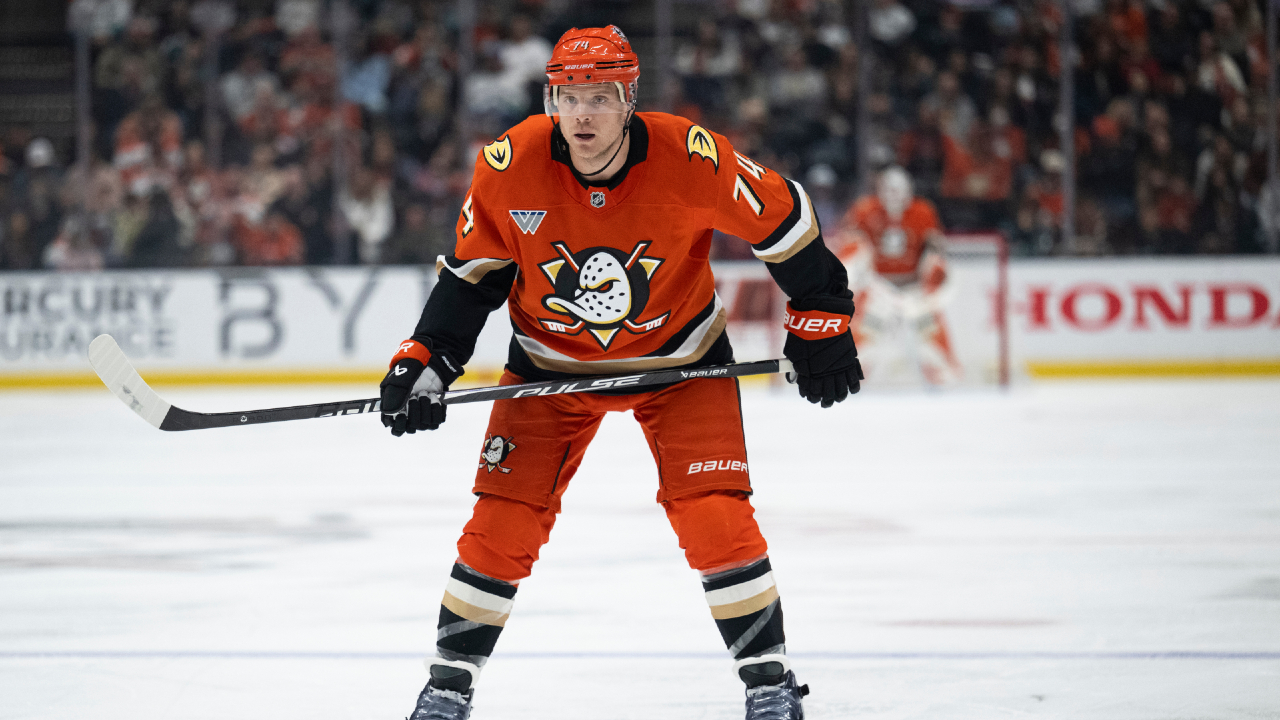
This is just Carlson’s third NHL team across his 17-year career, as the longtime Washington Capitals defenceman was dealt to the Anaheim Ducks ahead of last season’s trade deadline.
Carlson, 36, was dealt to the Carolina Hurricanes before free agency opened, but the two sides could not agree on terms for a contract.
Carolina sent the 192nd-overall pick in the 2026 draft and minor-league defenceman Kyle Masters to Anaheim to get a shot at negotiating with Carlson early.
The Ducks used the 192nd pick to take WHL forward Noah Kosick.
Advertisement
Carlson played 16 regular-season games with the Ducks, potting four goals and 14 points in that span. In 12 post-season games, Carlson had six assists and helped the Ducks dispatch the two-time Western Conference champion Edmonton Oilers in Round 1.
The Natick, Mass., native has 1,159 NHL games under his belt, with 170 goals and 785 points in that span. He won a Stanley Cup with the Capitals in 2018.















































You must be logged in to post a comment Login