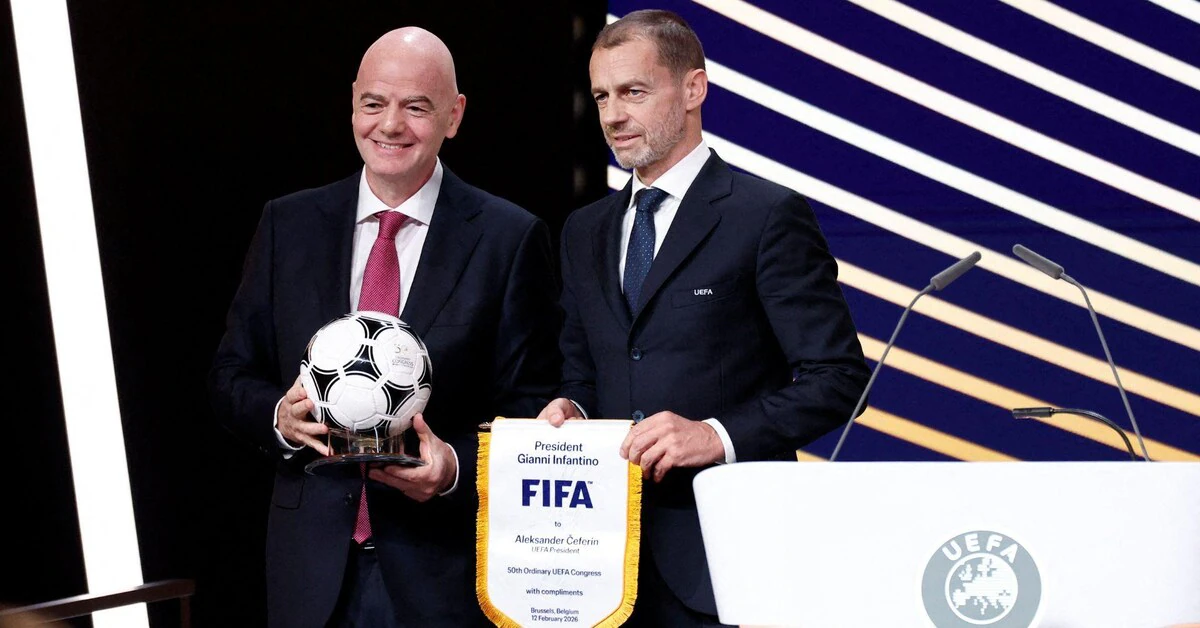
Fifa’s plan to bring private investors into the commercial operation of the World Cup was intended to release billions of dollars for football development. Instead, it has produced one of the most serious challenges to the authority of president Gianni Infantino.
European nations have threatened to boycott all Fifa competitions unless the proposal is withdrawn completely. Concacaf, representing North America, Central America and the Caribbean, has rejected the plan. The Asian Football Confederation has criticised the process, while questions have emerged over Fifa’s need for external capital, the limited consultation with its own members and the identity of the investors expected to benefit.
At the centre of the dispute is a proposed company called Fifa Forward Enterprise, or FFE. It would take over the commercial operations attached to Fifa’s tournaments, including the men’s and women’s World Cups and the Club World Cup.
Fifa would retain majority control, but plans to sell as much as 21 per cent of the company to outside investors for up to $4.2 billion. The organisation has valued FFE at $20 billion.
Fifa argues that it is not selling the World Cup or surrendering its regulatory authority. Its opponents argue that the distinction is largely technical: investors would be buying a permanent economic interest in the competitions from which Fifa derives its power and income.
The difference between those two interpretations has now placed the future of the World Cup, Fifa’s governance and Infantino’s leadership at the centre of an unprecedented institutional confrontation.
What exactly is Fifa proposing?
Fifa currently functions as world football’s governing body and commercial organiser. It sets rules, manages the international calendar, stages tournaments and sells the broadcasting, sponsorship, ticketing and licensing rights attached to them.
Under the proposed structure, those commercial functions would be placed inside FFE.
The company would manage broadcasting rights, sponsorship agreements, ticketing, licensing and the operational delivery of Fifa competitions. It would be run as a specialised commercial business, while Fifa would remain the sport’s non-profit global governing body.
Fifa says it would continue to control competition formats, regulations, sporting decisions and the international calendar. Outside investors would hold only a minority, non-controlling stake and would have no formal role in running football.
That is the legal and structural defence of the proposal: investors would be purchasing shares in a Fifa subsidiary, not in Fifa itself.
The political objection is that FFE’s entire value would come from the World Cup and other competitions built by national associations, players, clubs and supporters. Investors might not control football’s laws, but their returns would depend on how Fifa structures and commercialises its tournaments.
Once shareholders are introduced, critics argue, Fifa would acquire a permanent responsibility to produce returns for them.
How the proposed FFE model would operate
Element |
Fifa’s proposal |
Main concern raised |
New company |
Fifa Forward Enterprise would manage Fifa’s commercial and tournament operations |
Commercial control over the World Cup would be separated from Fifa’s traditional governing structure |
Ownership |
Fifa would retain the majority stake and sell up to 21 per cent |
Even a minority holding gives investors a lasting financial claim over Fifa competitions |
Valuation |
FFE has been valued at $20 billion |
Critics question how the valuation was reached and what future revenue assumptions it contains |
Capital raised |
Up to $4.2 billion from private investors |
Fifa has substantial revenue and reserves, raising doubts over why private equity is needed |
Investor role |
No formal operational or sporting authority |
Commercial pressure could still influence calendars, formats, prices and tournament expansion |
Use of funds |
Increased development payments to 211 member associations |
The financial offer could encourage members to approve a long-term structural change without adequate scrutiny |
Approval process |
Majority support from 211 associations and approval by the 37-member Fifa Council |
Uefa and Concacaf say the process lacked consultation and imposed an artificially short deadline |
Why has Fifa created the proposal?
Infantino’s central argument is that football’s global popularity has not translated into equal financial development across Fifa’s 211 member associations.
The richest football nations possess established leagues, broadcasters, sponsors, academies and infrastructure. Many smaller associations remain dependent on Fifa grants to build pitches, training centres, women’s competitions and grassroots programmes.
Fifa says FFE would unlock the full commercial value of its competitions by bringing in capital, financial expertise and long-term investors. The organisation believes a specialised commercial company could generate more from broadcast rights, sponsorships, ticketing and licensing than the existing structure.
Infantino has described this as the democratisation of football: using the enormous income generated by the World Cup to provide substantially more money to every member association.
The idea is also consistent with the direction of his presidency. Since taking office in 2016, Infantino has repeatedly sought to expand Fifa’s competitions and revenues. The World Cup has grown, the Club World Cup has been enlarged and the organisation has pursued new commercial events and markets.
This is not Fifa’s first attempt to attract private investment. A similar Infantino-backed proposal involving approximately $25 billion and an expanded Club World Cup was rejected in 2019.
FFE is more carefully constructed. Rather than appearing to sell direct influence over competition decisions, Fifa is proposing a separate company in which investors would hold a minority economic interest.
But the underlying ambition remains the same: transform the long-term commercial value of Fifa’s tournaments into immediate capital.
What would member associations receive?
The financial offer is essential to understanding how Infantino hopes to secure approval.
Each of Fifa’s 211 member associations has one vote, regardless of the size of its population, the strength of its national team or the value it contributes to the World Cup.
Under the proposed arrangement, every association could receive a one-off allocation worth $20 million. Existing development funding would also increase sharply.
The regular payments envisaged under the plan are:
-
$20 million for the 2027-30 cycle
-
$22 million for the 2031-34 cycle
-
$24 million for the 2035-38 cycle
Together with the initial $20 million allocation, an association could receive as much as $86 million through 2038.
For the first four-year cycle alone, the combination of the one-off payment and increased funding could be worth $40 million to each participating association.
For England, France or Germany, that amount would not fundamentally alter football development. For smaller or poorer associations, it could finance stadiums, national training centres, professional leagues and youth systems that would otherwise be impossible to build.
That is where the proposal acquires political force.
Uefa has 55 members, barely more than a quarter of Fifa’s electorate. European countries provide much of the World Cup’s sporting and commercial strength, but every Fifa member has an equal vote.
Infantino does not necessarily need to persuade the countries that contribute the most revenue. He needs to secure a majority among associations for which the promised funding could be transformational.
Why is Uefa opposing the proposal?
Uefa’s opposition is based on two separate arguments: how the plan was developed and what it could ultimately do to football.
The first is procedural.
According to The Athletic, the proposal became public through media reporting before many confederations and national associations had been formally consulted. Fifa then gave members only 53 days to consider the plan, with approval sought by September 19.
Uefa described the approach as secretive, coercive and incompatible with responsible governance. Its members believe a decision involving the future commercial ownership of the World Cup should have been examined through Fifa’s established bodies before being presented to national associations with a deadline and a substantial financial incentive.
The second objection is more fundamental.
Uefa says the World Cup cannot be treated as an investment product. It argues that Fifa does not own the competition in the same sense that a company owns a private asset. Fifa administers the tournament on behalf of the wider game.
“The World Cup cannot be treated as an investment product,” Uefa said. “It is one of football’s greatest sporting legacies.”
Its concern is that the commercial obligation to investors would never disappear. Even without formal control, shareholders would expect revenue growth, rising valuations and returns on their capital.
That could place pressure on Fifa to:
-
expand tournaments further
-
add more matches
-
introduce new competitions
-
increase ticket prices
-
create additional advertising and sponsorship inventory
-
alter the international calendar
-
stage events in markets offering the largest commercial returns
Fifa would formally retain every sporting power. But critics fear those powers would increasingly be exercised within a structure shaped by shareholder expectations.
That is why Uefa says the proposal crosses a line. The issue is not merely whether private investment can improve Fifa’s business. It is whether the interests of players, supporters, clubs and national associations could eventually become secondary to financial returns.
Why has Uefa threatened a World Cup boycott?
Uefa’s 55 member associations have agreed that their national teams will not participate in any Fifa competition while the proposal remains active.
The threat covers men’s, women’s and youth tournaments. Uefa has demanded that the proposal be abandoned entirely and that Fifa provide binding assurances against reopening its competitions to private ownership.
The boycott is designed to attack the plan at its weakest point: FFE may be valued at $20 billion, but that valuation depends on the participation of the world’s strongest teams and most commercially valuable players.
European nations have won 13 of the 23 men’s World Cups, including six of the past eight. According to the figures presented by The Athletic, Uefa teams have accounted for 69 per cent of World Cup quarter-finalists and 71 per cent of semifinalists historically.
A men’s World Cup without France, Spain, England, Germany, Portugal, Italy and the Netherlands would lose many of its leading teams and players.
The women’s competition would be similarly diminished. Spain are the reigning world champions, while England are among the strongest teams in the game. A European boycott could remove six of the top 10 women’s teams and many of the leading players in world football.
This produces a central contradiction in Fifa’s proposal.
FFE is meant to increase the World Cup’s commercial value. But attempting to establish it could remove the teams and markets responsible for much of that value.
Which competitions could be affected first?
The immediate consequences would be felt in women’s and youth football rather than at the next men’s World Cup.
The European play-offs for the 2027 Women’s World Cup are due to take place in October. If Uefa intends to boycott Fifa tournaments, its countries cannot logically compete in qualifiers for an event they have pledged not to enter.
The play-offs involve 32 teams, including England, the Netherlands, Wales, Italy, Sweden, Switzerland and Norway.
Four of the next five Fifa competitions are in the women’s game. The Women’s Under-20 World Cup is due to be hosted by Poland, a Uefa member, followed by the Women’s Under-17 World Cup in Morocco.
A total European boycott could therefore force Fifa to find replacement hosts, restructure qualifying competitions or stage tournaments without leading nations.
The longer-term impact would extend to the 2030 men’s World Cup, scheduled to be staged principally in Spain, Portugal and Morocco. Two of the main hosts would belong to a confederation refusing to participate.
A boycott would therefore create problems not only for team participation but also for hosting, broadcasting, sponsorship and tournament organisation.
How have the other confederations responded?
Concacaf’s rejection has made the crisis more difficult for Fifa to dismiss as another institutional battle with Europe.
All 41 Concacaf associations met to discuss the plan and expressed concern over the absence of due process, the limited deadline and the failure to secure prior review from the relevant Fifa governance bodies.
They also questioned why an organisation coming off what was described as the most profitable World Cup in history needed private investment to finance development.
Concacaf has not joined Uefa’s boycott, but it has rejected the proposal and instructed its Fifa Council representatives to examine whether the organisation’s existing reserves could fund increased development payments.
The confederation also wants any future proposal to pass through the formal processes required under Fifa’s statutes.
According to The Athletic, concerns expressed during the Concacaf meeting extended beyond the FFE proposal to the organisation’s leadership and transparency. Some members were said to have lost confidence in Infantino, though accounts differed over the strength of that sentiment.
The Asian Football Confederation said it was disappointed that a proposal of such importance entered the public domain before its members were allowed to examine it through established channels.
The African confederation has taken a less confrontational position. It acknowledged involvement in the consultation process and encouraged its associations to study the proposal.
That difference matters. Infantino has historically relied on support from Africa, Asia and smaller associations to overcome opposition from Europe. The plan can survive only if that coalition remains intact.
Does Fifa need $4.2 billion from investors?
This is one of the most difficult questions for Fifa to answer.
The governing body has generated extraordinary income from its tournaments. The material provided indicates that revenue connected to the latest World Cup and the current four-year cycle was expected to be in the region of $13 billion to $15 billion, compared with about $7.6 billion in the previous cycle.
Fifa has also accumulated reserves and expects further increases in broadcasting and sponsorship income.
Concacaf’s position is that the organisation should first explain why those resources cannot finance higher development payments without selling equity.
Fifa’s answer is likely to be that raising money immediately would allow it to accelerate investment rather than distribute funds gradually as tournament revenues arrive. Private investors could also bring expertise in media, technology, sponsorship and global commercial expansion.
But equity is not a temporary loan. An investor who contributes capital would receive a lasting stake in future income.
Fifa would gain $4.2 billion now but surrender up to 21 per cent of the commercial company’s future value. If FFE grows significantly, investors could receive returns worth far more than the initial investment.
The debate is therefore not simply about whether Fifa needs money. It is about whether selling a permanent economic interest is the best and most responsible way to obtain it.
Who are the proposed investors?
According to The Athletic, Thrive Capital, founded by Joshua Kushner, is expected to lead the proposed investor group.
Joshua Kushner is the younger brother of Jared Kushner, who is married to US President Donald Trump’s daughter Ivanka Trump and has been a close political adviser to him.
Former Liberty Media chief executive Greg Maffei has served as a commercial adviser to Fifa, while JPMorgan has worked on the proposed company’s structure and valuation.
The involvement of a Joshua Kushner-led investment group would not in itself establish any wrongdoing. But it has intensified demands for transparency because of Infantino’s unusually close public relationship with Trump.
Is there a connection between Infantino and the proposed investor?
The connection is indirect rather than evidence of a direct financial arrangement.
Joshua Kushner is connected to Trump through his brother Jared. Infantino, meanwhile, has developed a close and highly visible relationship with the US president.
The supplied material refers to Infantino creating a Fifa Peace Prize and presenting its first edition to Trump. It also notes criticism over Trump’s intervention in the disciplinary case involving US forward Folarin Balogun.
Those events do not demonstrate that Trump, Jared Kushner or Infantino has a financial interest in FFE. Nor do they prove that Thrive Capital was selected improperly.
They do, however, create an obvious appearance problem.
When the likely lead investor is run by a member of a family closely connected to a political leader with whom the Fifa president has cultivated a strong relationship, the selection process requires exceptional openness.
Fifa would need to explain:
-
how the investor group was chosen
-
whether a competitive process was conducted
-
which other investors were considered
-
what rights the investors would receive
-
how conflicts of interest would be managed
-
whether Infantino or other Fifa officials could hold future positions in FFE
The problem is magnified by the way the proposal emerged. Had the plan been developed through an open and established process, the Kushner connection might have attracted scrutiny without becoming central to the controversy.
Because the process appeared secretive, every personal and political relationship surrounding the transaction now carries greater significance.
Can investors influence football without controlling it?
This is the key unresolved issue.
Fifa says minority investors would have no authority over football governance. They could not directly decide tournament formats, qualification rules or the international calendar.
But commercial influence rarely requires formal sporting control.
Suppose investors expect FFE’s value to rise. Their returns would benefit from more matches, larger television audiences, higher ticket income and expanded sponsorship opportunities.
Fifa might then face pressure to introduce more teams, additional tournament stages, longer competitions or new events.
It could still claim that every decision had been taken independently by its sporting bodies. Yet the commercial structure would reward decisions generating the highest income.
The concern is therefore not that investors would immediately select World Cup hosts or rewrite football’s laws. It is that the line between sporting and commercial decisions would become increasingly difficult to maintain.
A tournament format is both a sporting decision and a revenue decision. The calendar is both a player-welfare issue and a commercial asset. Ticket pricing affects supporters, but also determines income and shareholder returns.
FFE would attempt to separate those functions legally. Uefa’s argument is that they cannot be separated in practice.
Why the plan may not survive
FFE needs approval from a majority of Fifa’s 211 associations and the 37-member Fifa Council.
In voting terms, Uefa cannot block it alone. But the boycott has transformed the economic calculation.
An investor considering a multibillion-dollar commitment must assess whether the World Cup will continue to feature Europe’s leading teams and players. Without them, the tournament would lose sporting prestige, broadcast audiences, sponsorship value and commercial predictability.
Concacaf’s rejection further weakens the plan. If resistance spreads through Asia, Fifa may struggle to assemble even a numerical majority.
The Athletic has compared the confrontation to the collapse of the proposed European Super League. In both cases, opponents understood that allowing the project to gather momentum could make it difficult to reverse.
Uefa has therefore chosen the strongest possible response before Fifa’s September deadline: withdraw the proposal or lose Europe.
Its strategy depends on unity. If some European associations decide that the promised funding is too valuable to reject, the boycott could fragment. Infantino would then regain leverage.
But if Uefa remains united, the proposed commercial company has little of value left to sell.
What happens to Infantino now?
The dispute has also become a test of Infantino’s leadership.
Before the FFE controversy, he appeared unlikely to face a serious challenge in the next Fifa presidential election. He retained strong support among associations outside Europe, and potential opponents doubted whether they could construct a winning coalition.
That calculation may now change.
According to The Athletic, members of both Uefa and Concacaf questioned his leadership during their meetings. The criticism is no longer limited to his commercial ambitions. It concerns transparency, consultation and whether Fifa’s formal institutions exercise meaningful oversight.
Infantino could retreat and describe the proposal as a consultation that did not receive sufficient support. He has abandoned or reshaped controversial ideas before without losing control of Fifa.
He could also redesign FFE as a wholly owned commercial subsidiary, retaining specialist management but removing private equity.
The most confrontational option would be to continue with the plan in the expectation that Uefa’s unity eventually breaks. That would turn the dispute into a contest between Infantino’s voting coalition and Europe’s commercial power.
The larger question: Who owns the World Cup?
Fifa’s case is that it is modernising the commercial structure of world football while retaining complete sporting authority.
Its opponents argue that the World Cup is not an asset Fifa has the right to monetise through a permanent equity sale.
Both sides agree that the competition has enormous economic value. They disagree over who has the authority to convert that value into private ownership.
The World Cup was built through the participation of national teams, players, supporters and host countries over almost a century. Fifa administers it, owns its commercial rights and collects its income. But Uefa’s position is that Fifa holds those rights in trust rather than possessing an unrestricted right to sell them.
That is why the argument cannot be resolved merely by stating that Fifa would retain 79 per cent of FFE.
A minority stake may not confer control, but it would create a permanent class of private beneficiaries whose financial interests are tied to the future direction of the World Cup.
Fifa sees $4.2 billion that could be invested immediately in global football. Uefa sees the first irreversible step towards making football’s greatest competition answerable to shareholders.
The proposed transaction was designed to unlock the World Cup’s commercial potential. It has instead forced football to confront a more fundamental issue: whether the game’s most valuable competition belongs to the organisation running it, the countries contesting it or the wider public that gives it meaning.























































You must be logged in to post a comment Login