Half-time is supposed to be a pause in the action, but very few supporters actually pause. The whistle goes and everyone immediately finds another small task: checking scores, replaying a disputed decision, opening a game or joining the frantic queue for drinks before play resumes.
Those few minutes have become an extension of the sporting event itself. Whether you’re watching football at home, following rugby in the pub or standing beside a GAA pitch wondering why you didn’t bring a warmer coat, the break has its own collection of habits and distractions to suit anyone.
One Match Suddenly Becomes Five
A supporter will often spend half-time discussing the first half, but the conversation now competes with an impressive amount of information arriving through your phone. You’ll check results from other grounds, look at the league table and discover that a player in another match has somehow been booked twice in four minutes. Group chats become amateur analysis desks, usually featuring at least one member who’s convinced the referee has a personal grievance against their club.
Some fans also wander beyond match coverage and into the wider selection of sports and gaming content available online. A person comparing entertainment platforms could consult something like GambleGuru’s independent Irish casino guide, while somebody else might open a puzzle, play a short mobile game or inspect the odds for the second half. None of these activities needs to become the main event. They’re simply among the many digital detours competing for attention while the players are taking a.
Advertisement
Half-time browsing isn’t very organised as you’ll begin by checking a substitution and end up reading about a former midfielder’s restaurant or watching a clip from a match played twelve years ago. The break may be short, but it doesn’t stop the internet from giving it a good slice of ambition.
The Second Screen Has Changed How You Watch
Watching sport with a phone nearby gives you access to details that broadcasters can’t always cover with immediate effect. You can check a player’s recent form, find an alternative camera angle or confirm whether the rule being confidently quoted from the sofa has existed since 2019. A tactical change becomes easier to spot once you’ve seen the average positions, while a replacement carries more significance when you know he’s returning from injury. During a busy weekend, score apps also let you follow several competitions without abandoning the game in front of you.
The downside is that your phone doesn’t understand the concept of half-time. It’ll continue offering notifications, videos and unrelated headlines after play resumes. One quick glance can become ten minutes, during which the match produces a goal, a red card and the only genuinely interesting thing the commentator has said all afternoon.
Experienced second-screen users develop a rough system. They check what they need during stoppages, silence unnecessary alerts and put the device down when the action returns. It’s hardly a heroic act of self-discipline, but it does prevent you from learning about an important goal through the group chat while the television is directly in front of you.
Advertisement
Stadium Breaks Have Their Own Logic
Half-time inside a stadium is a completely different activity from half-time on the sofa. Your priorities become incredibly basic: find food, visit the facilities and get back before anything happens.
The same break feels different across sports. A rugby crowd might spend it discussing territory and missed kicks, while football supporters examine whether the midfield is being overrun. At a GAA match, the talk can move rapidly between individual battles, shooting accuracy and whatever weather has arrived sideways across the stand.
Phones still appear, although connectivity doesn’t always cooperate when thousands of people try to use the same network. A page that loads instantly at home can suddenly behave as though it’s being delivered by a tired pigeon. Supporters adapt by checking downloaded tickets in advance, taking screenshots of travel details and accepting that video replays can wait.
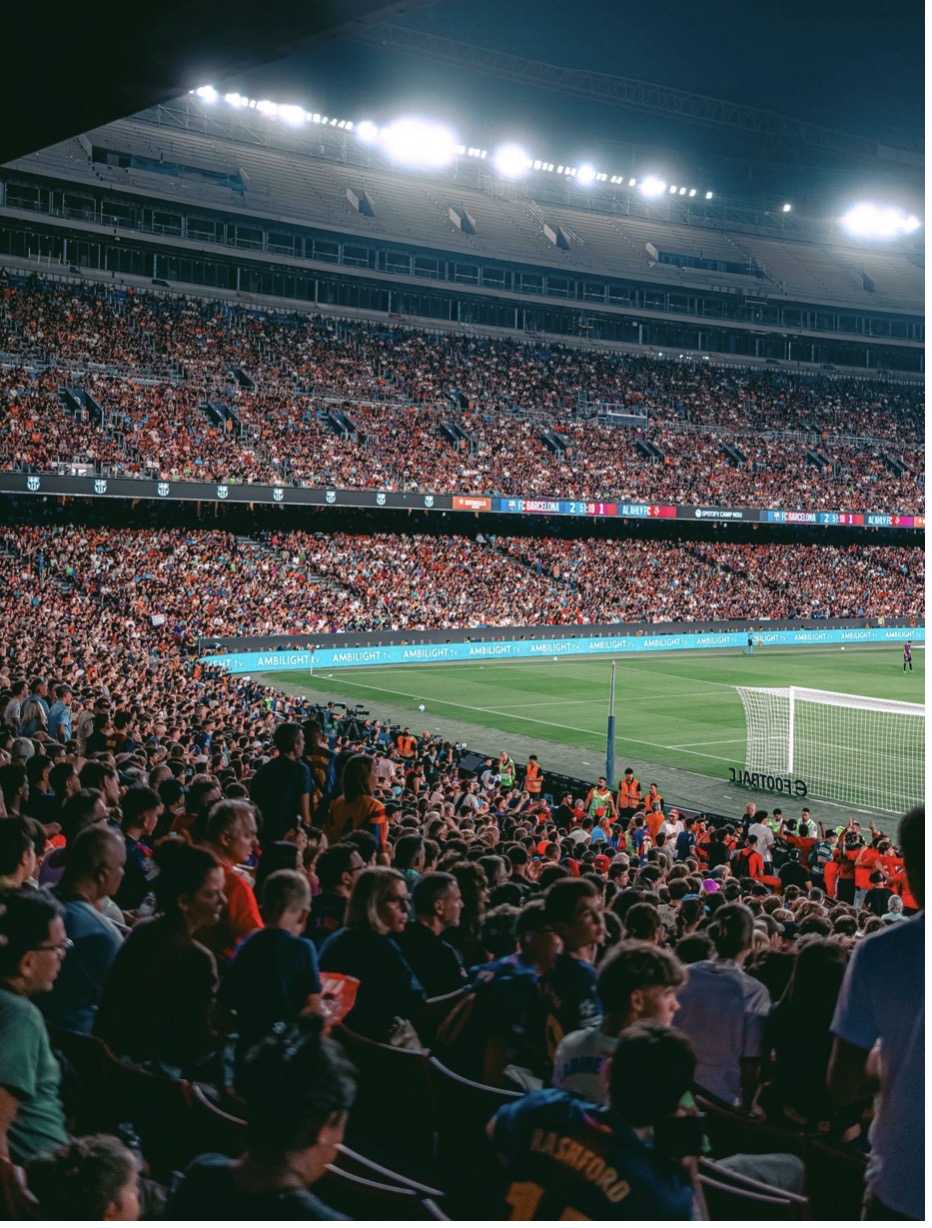
The break also belongs to the live venue. Music, announcements and on-pitch activities fill the silence, while supporters spot acquaintances several rows away and attempt conversations through elaborate hand signals. Watching at home gives you more information, but being there gives half-time a social quality that an app can’t reproduce.
Advertisement
A Short Break Can Reset the Whole Match
Half-time isn’t only useful for spectators. It can change the direction of the contest. Coaches have a small window to correct positioning, alter the press or settle players after a frantic opening period. A team that looked disorganised can return with a clearer plan, leaving everyone outside the dressing room to speculate about what was said.
Viewers perform their own reset. You refill a drink, reconsider the first half and decide whether the match is genuinely poor or merely tense. The pause can restore patience after a scrappy spell, particularly when every misplaced pass has been treated as a personal insult.
Digital distractions have made those minutes slightly busier, though they haven’t made the basic ritual disappear. Supporters still argue over decisions, predict substitutions and convince themselves the next goal is inevitable. Phones have simply added more material to inspect while doing it.
During the summer months, I asked safety Josh Metellus about the growth from Jay Ward. Optimism was the overwhelming takeaway, as is sometimes the case in June.
September has brought a harsh reality: the 4th-year Vikings defender isn’t playing.
Earlier in the week, Vikings DC Brian Flores took on a question about Ward’s playing time, or lack thereof (presser link). Like a good politician, Flores said a pile of words without saying very much at all. Each game is different and different players have different abilities, Flores explained, while trying to deflect the reasonable inquiry about why the 4th-year player has earned a whopping zero snaps in 2026.
Vikings Defender Jay Ward Yet to Get Worked into Rotation
On a basic level, Mr. Ward offers a lot to like.
Advertisement
The defensive back boasts good height and speed. So, too, is he aggressive and physical. At 26 yards old and moving into his fourth season, Ward blends youth and experience. Indeed, part of what makes him intriguing is that his employment in the Twin Cities perfectly coincides with Brian Flores being the defensive playcaller. Both arrived in 2023 and both are still part of the mix in 2026.
Shouldn’t he be getting at least some playing time?
A minor surprise so far in the 2026 season is that Ward sees his playing time sitting at 0 snaps. When does that change?
So far, the bulk of the snaps at safety have gone to Josh Metellus, Theo Jackson, and Harrison Smith. Next up has been Jacob Thomas, the super impressive UDFA rookie who has gotten into action early.
What makes the odd absence even more odd is that rookie 3rd-Round pick Jakobe Thomas still hasn’t dressed, so it’s not like the other newcomer at safety is siphoning off snaps. Consider how the total snaps look moving into the Week 3 Bucs game:
Advertisement
S1 Josh Metellus: 142 Snaps
S2 Harrison Smith: 55 Snaps
S3 Theo Jackson: 93 Snaps
S4 Jacob Thomas: 18 Snaps
S5 Jay Ward: 0 Snaps
S6 Jakobe Thomas: 0 Snaps
The official count for Jay Ward moving into Week 3 shows the defender being active for a pair of games but only getting involved in 34 special teams snaps. He has just a single tackle to his name. In Week 2, the secondary put together a much better effort, but the Vikings’ various players at safety haven’t brought back memories of vintage Hitman. In theory, getting some playing time should be possible.
Aug 26, 2023; Minneapolis, Minnesota, USA; Minnesota Vikings safety Jay Ward (20) sacks Arizona Cardinals quarterback Clayton Tune (15) and causes a fumble that would be recovered by the Vikings during the first quarter at U.S. Bank Stadium. Mandatory Credit: Jeffrey Becker-USA TODAY Sports.
Instead, Coach Flores refused to venture too fully into a meaningful answer.
There’s talk about there being a “deep room” at safety alongside Jay Ward “doing a great job.” Not long afterwards, there’s a mention of eventually needing “everybody” and Ward being an “unselfish” player. All of that sounds good, but the fourth-year player still isn’t playing. Do the team’s actions speak louder than these words?
Ward became a key piece of the effort to end 2025. Think back to the five-game winning streak to close off the year. The overlooked depth safety wasn’t the main reason for that streak but he clearly wasn’t a major hindrance, either. In fact, Ward appeared to be a solid piece of the puzzle to close out the year, seemingly pointing to some momentum going into 2026 that hasn’t yet come to fruition.
When I was a kid, putting was the strongest part of my game. I didn’t have unlimited access to a driving range, but the putting green was always free. So, after dinner most nights, I’d head over to the course and hit putts until the sun went down.
Now, as a 30-something living in New York City, I face the opposite obstacle. I can head to the simulator any time of day to work on my swing, but there aren’t many putting greens in my vicinity. So naturally, I’m now a much better ball-striker than putter.
Go figure.
In recent months, I’ve become increasingly frustrated with my lack of aptitude on the greens. What once was a huge asset to my game turned into an unmistakable liability. I used to look at 10-footers with glee, but that eventually turned into dread. Putting was no longer fun.
Advertisement
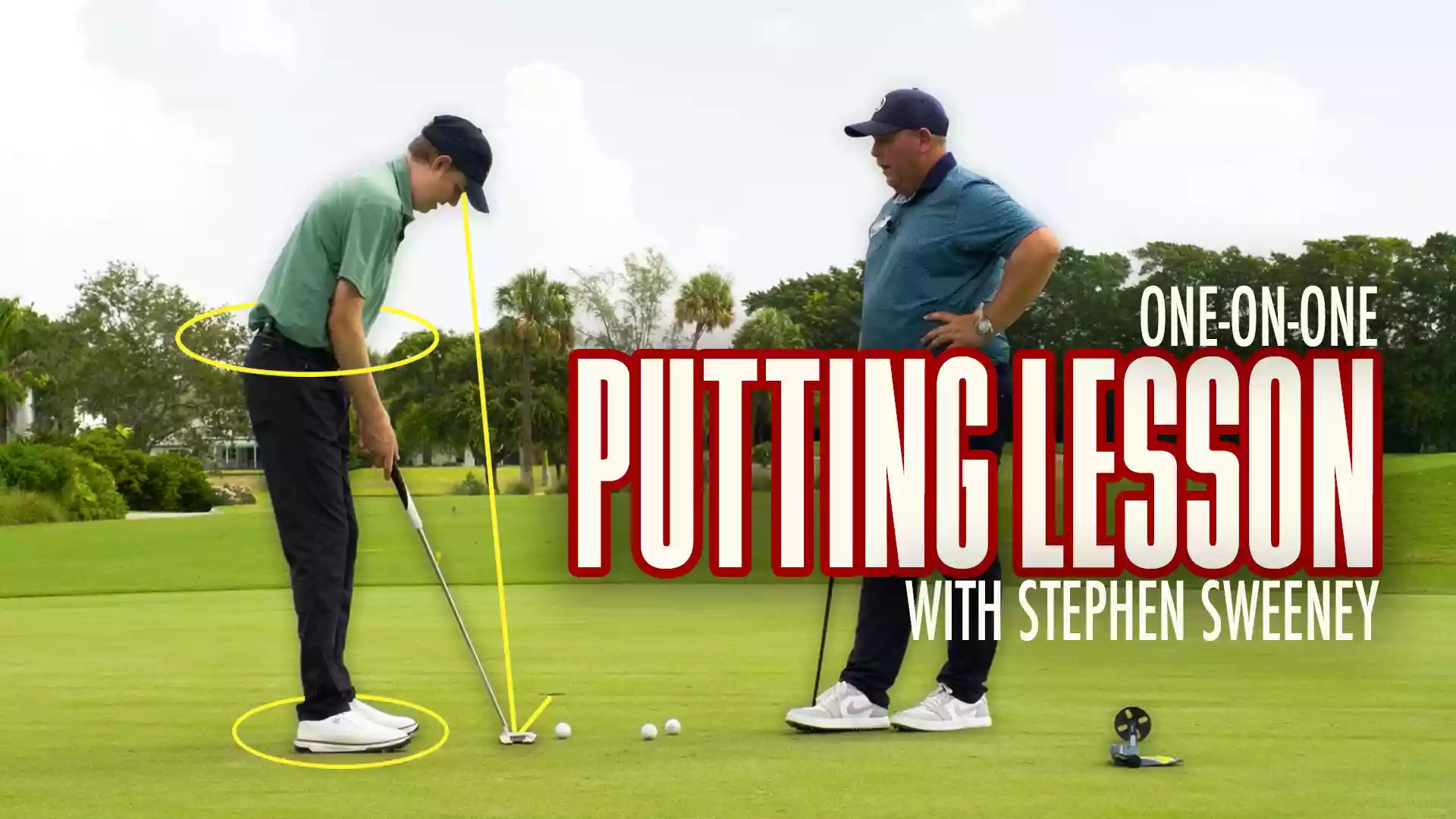
That’s when I decided to consult one of the brightest putting minds in the world, GOLF Top 100 TeacherStephen Sweeney, who teaches the likes of Collin Morikawa, Ludvig Aberg, Joaquin Niemann and more. Check out below to see a video of our “Putting Fundamentals Bootcamp,” in which Sweeney helped fix my putting with two simple tweaks.
“>
2 tweaks that fixed my putting
One thing I’ve learned in my time working with some of the best teachers in the game is that they typically always start lessons the same way: checking your fundamentals. No matter what element of the game is plaguing you, there’s a good bet that the root cause of your issue comes from something before you ever take the club back.
Advertisement
That’s why practicing your grip, posture, aim and alignment are so important. When they are off, it can cause all sorts of issues in the swing or stroke.
When I went to see Sweeney, our sessions began in much the same manner. He had me find a straight, flat putt, and I rolled several putts. That’s how he discovered I had two setup flaws that were wrecking my putting consistency.
1. Poor eye alignment
After watching me hit a few putts, and taking video of my stroke, Sweeney noticed that my eyes were misaligned when I stood over the ball. Instead of having my eyes directly above the ball, they were instead inside (closer to me) where they needed to be.
“Where your eyes are right now, I tend to see if players’ eyes are inside the ball line, they tend to look out to the right,” Sweeney said. “As the putter goes back, the putter is moving a little on the inside — but pretty square to where you aimed it.”
Advertisement
Because of my eyes being misaligned at setup, I was always subconsciously aiming out to the right of the hole. From there, I would use an inside-out club path to try to “draw” the ball back on line, much like what you would do during the full swing.
The problem with this is that the putting stroke hits shots that are so short that these full-swing compensations do no work in the putting stroke. Instead, you just end up with poor alignment and a stroke that is not starting the ball on a consistently straight line.
To fix the eye alignment problem, Sweeney had me bend forward a touch more to get my eyes more out and over the ball. He alluded to feeling as though I were in a tabletop crouch, much like Michelle Wie West at the 2014 U.S. Women’s Open.
A good way to check the alignment of the eyes after this adjustment is a trick Sweeney sees used by many older Tour pros. Once I go into my stance, he held a ball directly underneath my eyes and dropped it. With my old stance, the ball landed about two inches inside my ball position, but with the new stance, the dropped ball landed right on top of my ball on the ground.
Advertisement
“As a general rule of thumb, I like to see a two putter head-(width) from the ball to the toe line,” Sweeney said. “Then we go into forward bend at the hip until we get the eyes over the golf ball.”
Once I got my eyes more on top of the ball, it became much easier to consistently hit the ball where I was aiming.
2. Incorrect face alignment
Having the face of the putter aligned where you want to hit your putt is another crucial element of good putting. But because of my poor setup, I was not doing this correctly either. At address, Sweeney noticed my putter face was aimed a good ball or two right of the cup on every putt.
“We can see on every putt a little bit of face closure,” Sweeney said. “Then we are trying to pull that ball back on line.”
Advertisement
This aim issue was caused initially by the misalignment of my eyes, so even when I was hitting the putt “straight,” it was starting out to the right of the hole.
Once we got my eyes more on top of the ball, it became much easier get the putter face lined up at the center of the hole. To check this, Sweeney showed me a handy method that involves using your phone as a training aid.
“Just go ahead and set up and aim your putter face,” Sweeney said. “If I go ahead and set the back of my phone to your putter face, and you come back and look down that line, you can see the face aimed on the right edge. It’s a really simple way, if you put a scorecard or other square edge down against your putter face, you can see where you are aimed.”
Before adjusting my setup position, I was consistently aiming the putter face off to the right. But by making a couple of simple adjustments, I could easily aim the face right at the center of the hole.
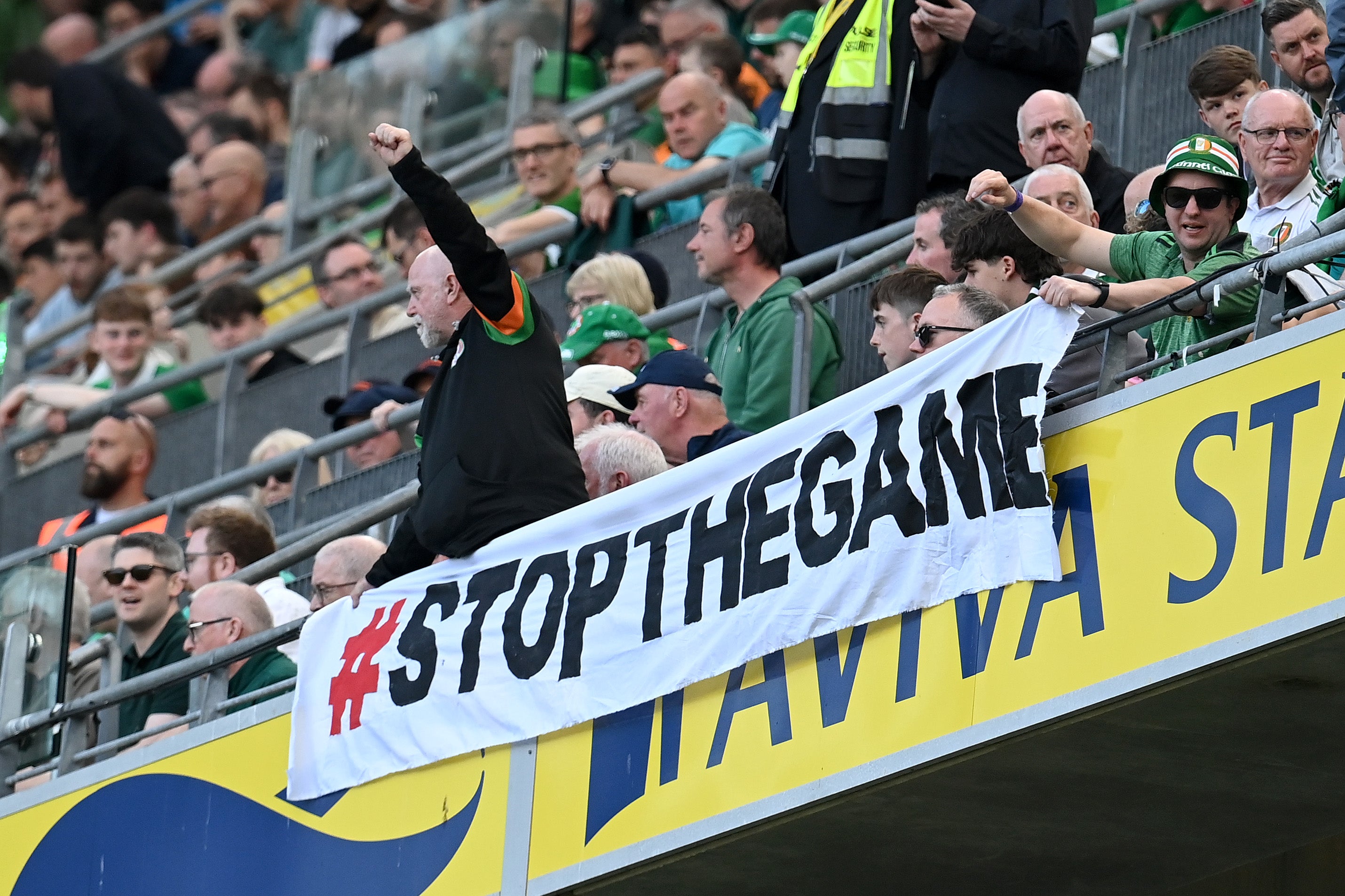
About 2km from the Republic of Ireland’s Aviva Stadium, which won’t be hosting the home leg of the two Nations League games against Israel next week, there’s a notable indication as to why. Dublin’s Liberty Hall, the headquarters of the country’s main workers’ union, features a huge banner imploring the national team to “Stop the Game”.
That is also the name of the grassroots campaign behind the banner, which adds: “Go with your conscience, don’t play ball with genocide.”
Irish manager Heimir Hallgrimsson took the last few words further at his squad announcement last week, stating: “We are not playing with genocide, we are playing against genocide. We are playing against Israel, we are not playing with Israel.”
The stridency caused surprise, but spoke to a lot of an Irish society very mobilised about this match, while infuriating Israel.
Although bodies like the United Nations Commission of Inquiry have described the conflict in Gaza as a “genocide”, that has not been currently been proven in an international court, and Israel denies the claim.
Advertisement
An Israel Football Association spokesperson stated “it is impossible to say genocide against us and not respond to him”, with an official social media post adding: “We have not yet found a cure for stupidity, ignorance and hypocrisy displayed by [Hallgrimsson]. We’re not playing with ignorance, hypocrisy and stupidity, we’re playing against the coach who embodies them.”
The Israel FA were said to be considering a complaint to Uefa, amid an expectation that players will not swap shirts at full-time and Israel coach Ran Ben Shimon will not shake hands with his counterpart Hallgrimsson.
And all of this on the Monday six days before the first game. Little wonder the Football Association of Ireland cancelled all media engagements outside those mandated by Uefa, as federation head David Courell described “a unique couple of fixtures”.
Israel play their “home” game in Debrecen in Hungary on Sunday, before Ireland “host” a return the following Sunday in Serbia’s Backa Topola. Irish broadcaster RTE is only showing a live feed of the games in order to fulfil contracts, with no additional coverage, as all the usual commercial aspects are stripped away. The LED boards in Serbia will only have “respect” messaging, while traditional protocols like dining with opposition officials will not take place.
Advertisement
This is largely because of the profound anger in Ireland about Gaza, which has contributed to what various football figures – including at the top of Uefa – have described as “unprecedented” circumstances for two countries not in conflict. “I’ve never known anything like it,” one source said.
In Ireland, debate about refusing to play has dominated national discourse, with severe criticism for the FAI over “cowardice”.
Fintan Drury, an Irish football agent who has published two books critical of the west’s support of Israel, has been a leading voice.
The ‘Stop the Game’ campaign has grown since Ireland were drawn with Israel in February (Getty)
“The public support of Palestine is smothered by institutional cowardice, starting with a government that speaks out of both sides of its mouth. Its indifference made it easier for the FAI board to back away from its call on Uefa to ban Israel but then decide to play the matches when they found themselves pitted against them.”
One reason Ireland’s home game is in Serbia is because of what Courell described as “operational challenges” that “could impact on the delivery of the game” in Dublin. Any such fixture would have faced considerable protests about “normalising” Israel at this seismic historic moment.
Advertisement
In Israel, some close to the team see this as a next step from similar fixtures they have faced over the last three years, not least a November 2025 World Cup qualifier away to Norway. Such trips have involved 16 Mossad agents travelling and snipers on hotels, amid a sense there isn’t sufficient awareness of how society – including concerned players – were affected by the Hamas attack of 7 October 2023.
As regards this specific match, some have pointed to the perceived symbolism of Ireland being one of very few countries unable to safely host Israel, unlike fellow group opponents Kosovo and Austria.
Sources in European football have actually expressed sympathy for the FAI due to the diplomatic tightrope, but there is also a frustration within the Irish body as to why they have been left with the decision to play.
Football Association of Ireland chief executive David Courell said Uefa rejected a request from the FAI to keep Ireland and Israel apart in future draws (PA)
Courell expressed his “wish” that such decisions “were taken on another level”. Hallgrimsson echoed this, while relaying a common contrast with Russia, stating there’s been no “explanation why one is banned and the other is not”.
The general view of Uefa and Fifa is not to ban associations, due to both the idea that the national team is separate to the current state – echoed in how Israel would point to Arab players in their team – and the understandable reluctance to have to repeatedly adjudicate on conflicts.
Consequently, neither Fifa nor Uefa proactively banned Russia on the invasion of Ukraine. They were forced to respond to Poland refusing to play a World Cup play-off, with the backing of multiple other countries.
The Uefa hierarchy are nevertheless understood to have been so affected by the urgency of the Gaza situation in October 2025 that informal discussions were held about a potential vote on banning Israel, only for that to be postponed by peace negotiations. That came just before the match in Norway, that foreshadowed much of Ireland’s fixture.
There were protests on the streets of Oslo and Udine before World Cup qualifiers between Norway and Italy and Israel last season (AFP/Getty)
“Stop the national match” protests surrounded a game that was the country’s most high-security sports event since the 1994 Winter Olympics. Norwegian federation president Lise Klaveness went through a tense press conference, since she had previously led calls for Israel to be banned.
Klaveness stressed that wasn’t down to the recent UN Commission of Inquiry conclusion, but Israeli teams contravening Fifa rules about playing on occupied land. First put to Fifa by the Palestinian FA, that argument was echoed by the FAI to Uefa in 2024. An independent Fifa panel didn’t rule on it, citing “the unresolved legal status” of the West Bank, despite the International Court of Justice ruling the occupation unlawful.
Advertisement
The same qualification group saw Italy stage their Israel fixture in Udine’s small Stadio Friuli, also out of security concerns. The city was essentially on military lockdown, as local politicians tried to stop the game.
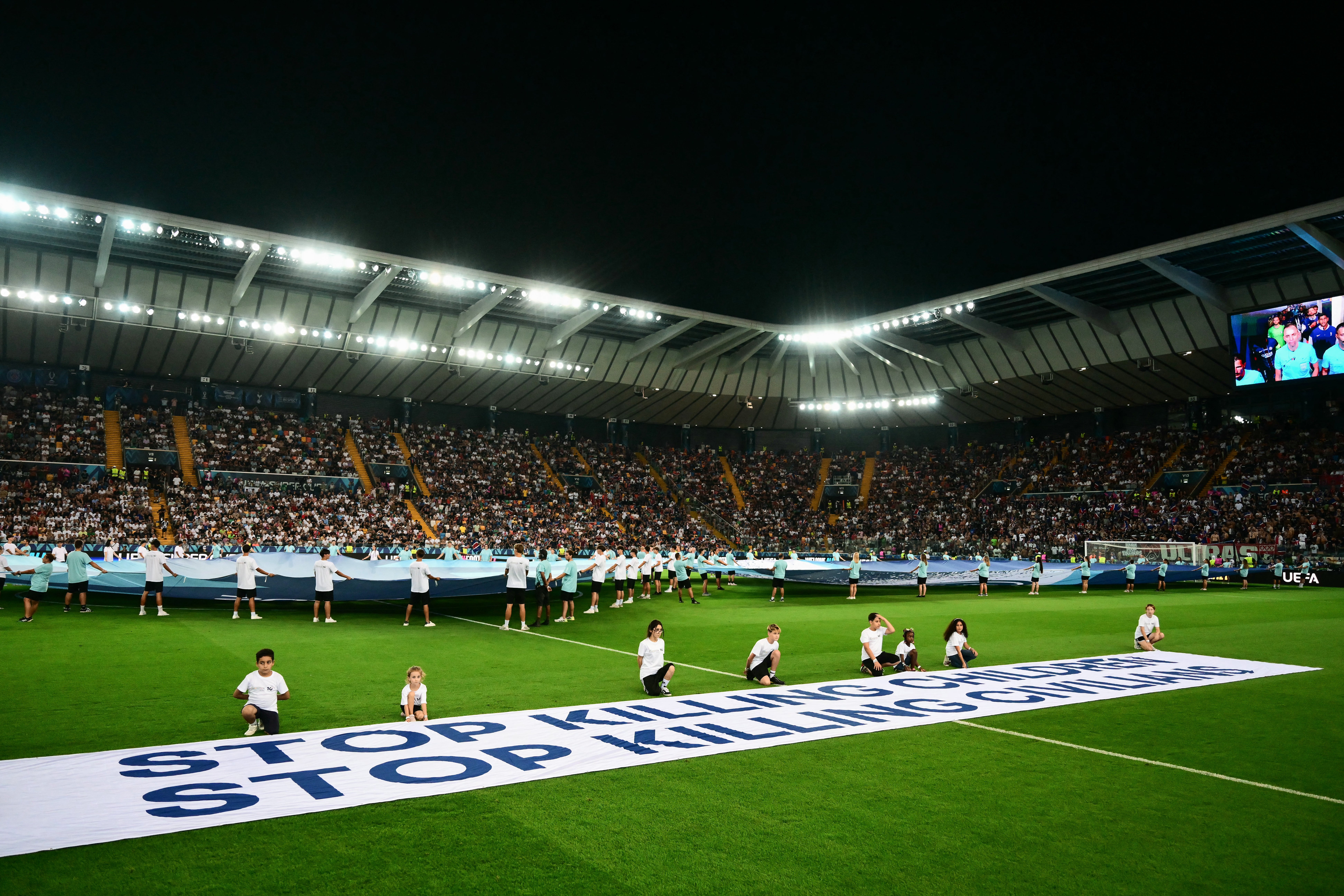
Udine also hosted the 2025 Super Cup two months before, with Uefa mascots holding up banners that read “stop killing children, stop killing civilians”. Numerous sources say Israeli officials were furious over “hypocrisy” and “sides being taken”.
Uefa displayed banners before the Uefa Super Cup match between Tottenham and Paris Saint-Germain in August 2025 (AFP/Getty)
Norway meanwhile donated the proceeds from their game to Doctors Without Borders, but neither they nor Italy ever considered going out on their own with a boycott.
Such stances have been given short shrift by swathes of Ireland, a country widely viewed as the most pro-Palestine in Europe. The connection goes back over a century, when the same British colonial officials served in both countries, as parallels have frequently been drawn – especially with Northern Ireland. Ireland were in 1980 the first European Union member to call for Palestinian statehood. Or, as one figure in Irish football put it, “pictures of dead children should be enough”. The layers of the relationships are only illustrated, however, by how a necessary neutrality in the second world war has since strained relations with Israel.
Those close to the Israeli team ultimately feel their situation and the role of Hamas just isn’t fully relayed in Ireland. All of this is why there was dismay within both federations when the draw was made. None of that, however, has extended to a refusal to play.
Advertisement
The FAI insist they have to consider Irish football’s long-term interests, arguing a boycott could cost more than €5.5m, having also warned members of further sanctions. The thinness of the line they are treading is nevertheless illustrated by Courell insisting Uefa have not made any such threats.
A Palestinian flag flutters alongside EU and Ukrainian flags outside Leinster House to mark Ireland’s recognition of a Palestinian state (AFP/Getty)
A potential test for the FAI’s position is that the Court of Arbitration for Sport upheld Poland’s refusal to play Russia. Whether that serves as a precedent is open to question, however, since Fifa and Uefa relied on safety justifications or suspending Russia – even in neutral grounds. More significantly, that decision involved numerous countries threatening a boycott. Ireland would have to risk punishment alone.
Courell has insisted the FAI are continuing lobbying efforts for Israel to be banned, but there is scepticism about this among both their members and within Uefa. Member associations closer to Ireland say they are not aware of any overtures.
Uefa, however, have intimated they may consider separation of countries based on such tensions in the future. That could be one legacy of this fixture.
In just one other break from protocol, meanwhile, the FAI have discussed the game with their squad and manager. “None of us feel comfortable playing these games but once we have decided to play them, we all stick together and play as one,” Hallgrimsson said.
Advertisement
Some players are also conscious of how the Nations League could influence qualification for Euro 2028, which Ireland part-host along with Britain. “It’s happening,” says one source, “so players have to treat it as just another game.”
Everything around it, however, suggests it is anything but.
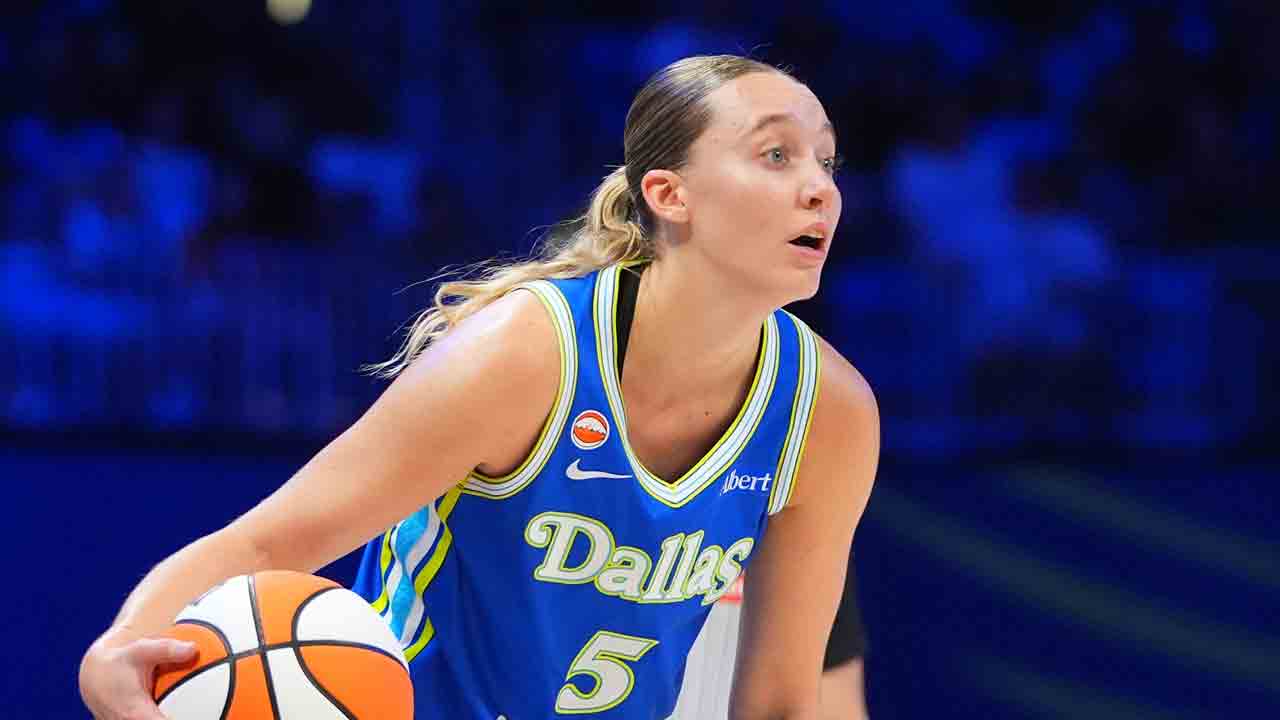
SEATTLE — Paige Bueckers scored 25 points, Jessica Shepard had 20 points, 11 rebounds and 12 assists for her WNBA-leading sixth triple-double of the season, and the Dallas Wings beat the Seattle Storm 103-91 on Wednesday night in the regular-season finale for both teams.
Dallas (27-16), which won just 10 games last season, set a WNBA record for the best single-season turnaround in league history with a 17-win improvement. The Wings have won seven of their last eight games, with their lone loss coming on Monday after leading by 14 points.
Dallas led 90-71 with 6:55 left in the fourth quarter before Seattle went on a 17-4 run to get within 94-88. But Awak Kuier and Bueckers made 3-pointers on Dallas’ next two possessions to pull away.
Arike Ogunbowale added 23 points and six assists for Dallas, which secured the No. 7 seed in the WNBA playoffs after Atlanta’s victory over New York earlier in the night. Bueckers had 20-plus points and five-plus assists for the third straight game.
Advertisement
Dominique Malonga led Seattle (8-36) with 29 points and eight rebounds. Awa Fam scored a season-high 22 points, Flau’jae Johnson added 21 points, and Natisha Hiedeman had 10 points and 14 assists.
Dallas won all four games against Seattle this season to earn its first sweep over the Storm in franchise history.
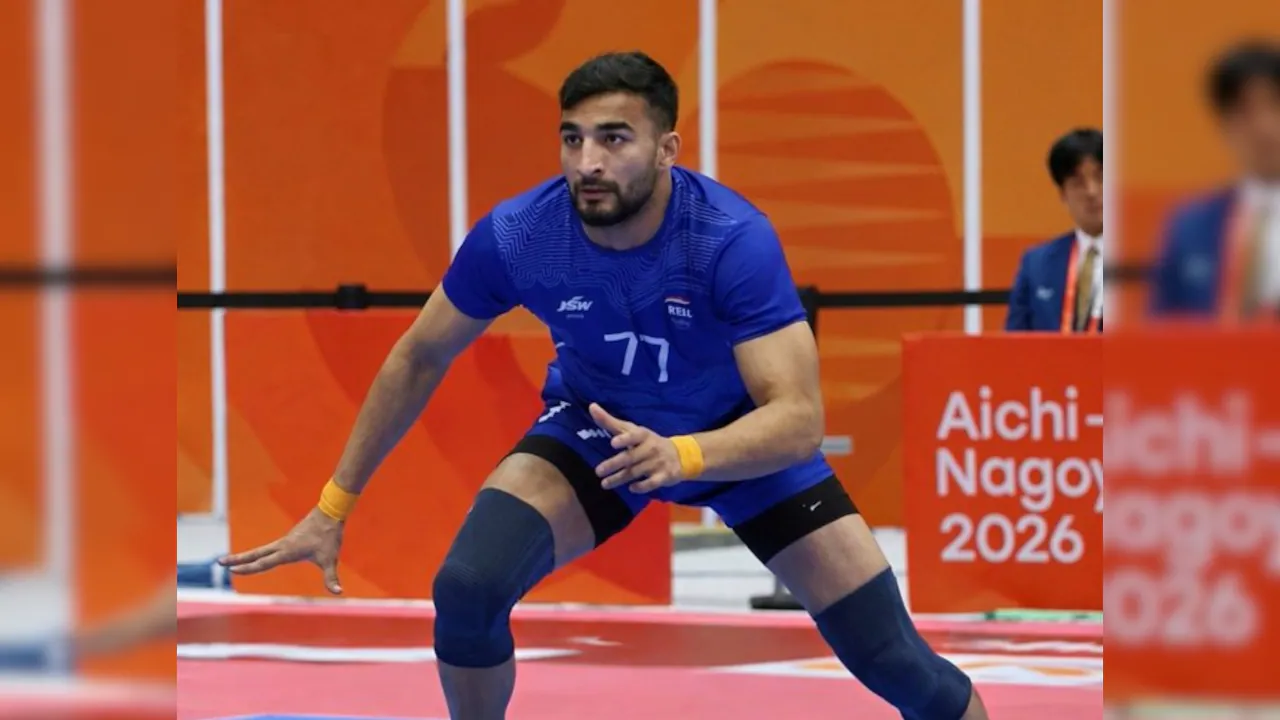
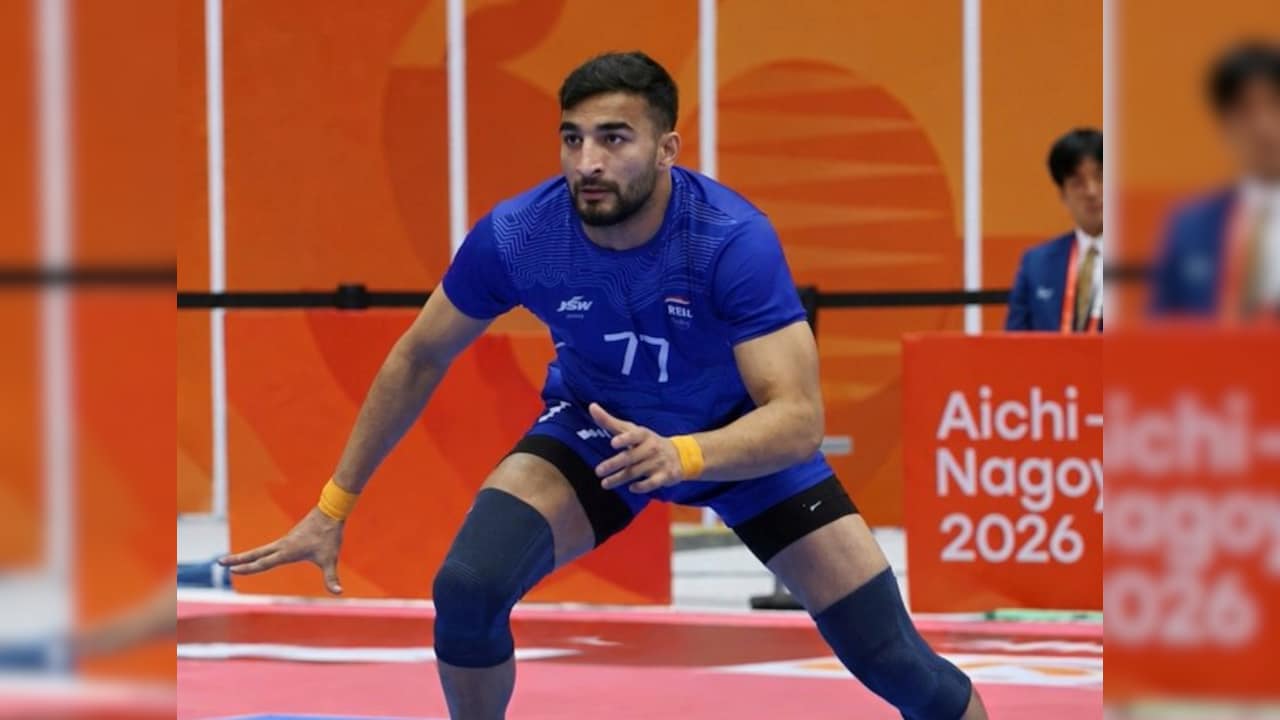
India vs Chinese Taipei Men’s Kabaddi LIVE Streaming, Asian Games 2026: India men’s kabaddi team is all set to face Chinese Taipei in their last Group A match of Asian Games 2026 on Thursday at the Tokai Citizens Gymnasium. With their semifinal berth already secured, the Indian team will look to carry its unbeaten run into the knockout stage as it targets another Asian Games title. Earlier on Wednesday, India stormed into the men’s kabaddi semifinals at the 2026 Asian Games with a commanding 48-25 victory over Bangladesh in their Group A clash. The win marked India’s third consecutive victory in the group stage and confirmed a medal in their bid for a ninth men’s kabaddi gold medal at the Asian Games.
India vs Chinese Taipei Men’s Kabaddi LIVE Streaming: Check Where and How to Watch Asian Games 2026
When will the India vs Chinese Taipei, men’s kabaddi match at Asian Games 2026 take place?
Advertisement
The India vs Chinese Taipei, men’s kabaddi match at Asian Games 2026 will take place on Thursday, September 24 (IST).
Where will the India vs Chinese Taipei, men’s kabaddi match at Asian Games 2026 be held?
The India vs Chinese Taipei, men’s kabaddi match at Asian Games 2026 will be held at the Tokai Citizens Gymnasium in Tokai City
What time will the India vs Chinese Taipei, men’s kabaddi match at Asian Games 2026 start?
Advertisement
The India vs Chinese Taipei, men’s kabaddi match at Asian Games 2026 will start at 9:45 AM IST.
Which TV channels will show the live telecast of the India vs Chinese Taipei, men’s kabaddi match at Asian Games 2026?
The India vs Chinese Taipei, men’s kabaddi match at Asian Games 2026 will be televised live on the Sony Sports network.
Where to follow the live streaming of the India vs Chinese Taipei, men’s kabaddi match at Asian Games 2026?
Advertisement
The India vs Chinese Taipei, men’s kabaddi match at Asian Games 2026 will be live streamed on the SonyLIV app and website.
(All details are as per information provided by the broadcaster)
Featured Video Of The Day
Spain Vs Argentina | Dani Olmo On WC Triumph: ‘Wanted To Set An Example For The Next Generation’
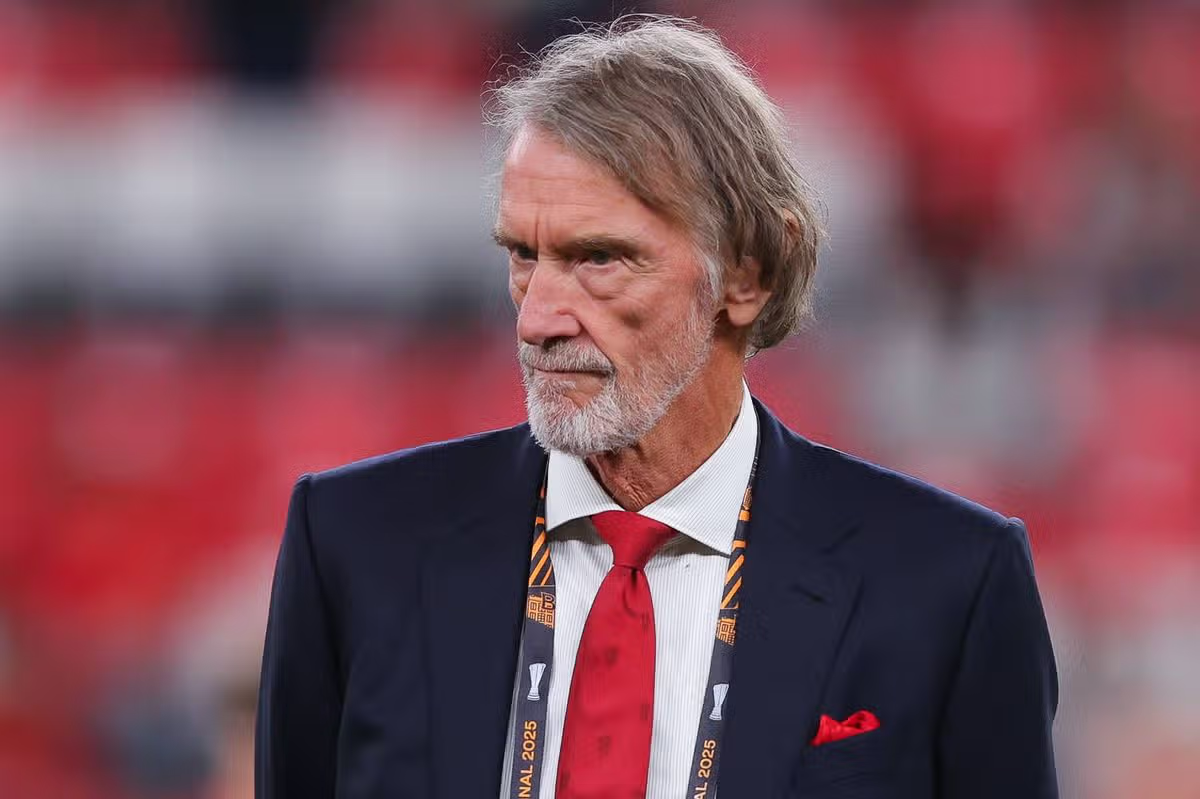
Manchester United co-owner Sir Jim Ratcliffe has attracted attention during the international break
Manchester United have continued their difficult start to the campaign, with co-owner Sir Jim Ratcliffe finding himself under scrutiny. Michael Carrick’s side, who languish in 12th position in the Premier League, face a break from action during the international window, yet off-field matters have attracted attention.
INEOS chief Ratcliffe has faced criticism following his remarks about immigration in the UK. Speaking to the BBC, the 73-year-old said: “Unfortunately, at the moment, I think the UK is on the slide. It’s quite difficult to see how we arrest it. I think ultimately, we need politicians who are tough enough to deal with some very difficult problems.”
Advertisement
He continued: “Nobody’s tough enough to deal with the immigration problem. Nobody’s tough enough to deal with the benefits problem. But somebody needs to do it, otherwise, it ends in a bad place.”
These comments have placed Ratcliffe in conflict with his favourite player Eric Cantona, whose famous “seagulls follow the trawler” quote inspired Ratcliffe’s Trawlers Ltd holding company when he acquired his stake in United. Separately, the club have released their most recent financial accounts, which show that debt levels have risen. MEN Sport examines some of the major stories surrounding United below.
Man United debt increase
United’s financial results for the 2025/26 campaign revealed record revenue numbers but also showed debt levels continue to climb. The club’s “non-current borrowings” now total £577.6million, rising from £471.9m the previous year.
The club did register record revenue of £677.6m, representing a 1.7 per cent rise despite United’s absence from European competition last season. Carrick’s team benefited from a £33.9m surge in broadcasting income following a third-place Premier League finish, up from 15th position in 2025.
United recorded a full-year operating profit of £22.6million but reported an overall deficit of £43m, which represents an increase on last year’s £33m figure. Meanwhile, the absence of European matches and early cup eliminations led to a £6.8m decline in matchday income.
Eric Cantona takes swipe at Sir Jim Ratcliffe
Cantona has hit out at Ratcliffe’s remarks, claiming he would not have joined United had the INEOS chief been at Old Trafford during his playing career. The 60-year-old helped Sir Alex Ferguson’s side claim four league titles in five years before hanging up his boots in 1997. Yet when quizzed on whether he would sign for the club under Ratcliffe, Cantona responded: “No.”
Advertisement
Speaking to United fan Peter Boyle, Cantona said: “Of course not [he wouldn’t have signed]. You know what I think about all of this, with this kind of politics. And I cannot understand that someone like this can say something like this when he’s one of the owners of the club.”
He went on: “Football is a very popular sport. Football is made – all the greatest players come from different waves of immigration. Everywhere, in France, in England, everywhere.
“In France for instance, the greatest players in France, they all come from different waves of immigration. I made a documentary on that, French Football: An Immigrant History. Raymond Kopa, in the fifties, was the son of Polish immigrants who came to France, worked in France, and worked hard in France.
“And then the Italians, Italians like Platini. And then Spanish, like me, my mother came from Spanish refugees. I cannot accept this kind of thing.”
Michigan hosts Iowa this week in one of the biggest games in the country.
The Wolverines cannot roll out of bed and just expect to beat Iowa, even at home.
On today’s episode of Locked On College Football, I am joined by ‘Locked On UCLA’ host Zach Anderson-Yoxsimer to discuss the Bruins’ quick rise in the Big Ten.
How far can they go in Bob Chesney’s first season?
Advertisement
Louisville looks like a serious contender in the ACC following their big win over SMU last week.
Could they suffer a letdown spot against Wake Forest this week?
Man Utd posted record revenues for the 2025/26 season and are already expecting to better those figures this term, but issues still remain.
In some ways, the financial picture at Manchester United for the 2025/26 season is a testament to the club’s resilience and ability to make money, even in a year when almost nothing is happening.
United played just 40 games in all competitions last season and had no European football at all, but still managed to post record revenues of £677.6million. Those figures should be smashed this season, with the Champions League back at Old Trafford.
Advertisement
Football finance expert Kieran Maguire said it was evidence of the durability of “brand United” in delivering a set of results, but the positive headline figure doesn’t tell the full story.
While United’s ability to generate cash was strong again and will only rise with European football and a new training kit sponsor, the level of debt shot up, and an interest repayment of £70million brought up a milestone that will only reinforce the view of many supporters that success while the Glazers remain in place will be difficult to achieve.
“The finance costs, that’s an emotional one,” said Maguire, on the Price of Football podcast. “There’s almost £70million in interest costs. United were stung by the exchange rate movement issue, but over the course of the Glazer ownership, we’ve now got total interest costs in excess of £1billion.
“That’s £1billion that could have gone into sports science, it could have gone into the transfer budget, it could have gone into better facilities for fans.
“And this is where United are losing out to the likes of Spurs, because if you go to Spurs, you arrive an hour before the kick-off, you can pick up a pint in 30 seconds, they’ve got a far better range of food, so people go for the experience. United, you go to the football and that’s it, and you get out as quickly as you can.
“The level of debt has gone up. They’ve admitted that. We don’t know what the club’s plans are. I know they’ve rescheduled the debt, but at higher interest rates. So that’s going to be a further handbrake on Manchester United.
“And it does mean that there is extra pressure there on the footballing side of the club in terms of delivering results.”
Advertisement
United’s gross debt now sits at around £689million and it has gone up in these latest results after a loan was refinanced in the summer, partly to buy land for a new 100,000-seater Old Trafford.
While that new stadium could be a significant long-term revenue generator, in the immediate future, it is likely to complicate the club’s financial picture.
“The club is never going to generate enough cash to be able to repay the debt, unless they produce dozens and dozens of young football players in the same way that Chelsea do and, to a certain extent, City do, through their academy,” said Maguire.
“They’re not going to make it from Old Trafford itself. And of course, the debt is going to go higher and higher with the new stadium.
Advertisement
Content cannot be displayed without consent
“Once approval is given, that’s when you get the worst scenario. You’re borrowing money to pay for the construction, so you’ve got those interest costs, and you’re not getting the benefit of having the bigger stadium. So there’s no positive when it comes to revenues and you’ve got the negatives when it comes to costs.”
Maguire expects a “big acceleration” this season, with the extra money from Europe and new commercial deals, while ticket prices continue to rise, which is partly behind better-than-expected matchday income for 2025/26.
But while the latest results are theoretically strong, questions remain about the club’s long-term direction and its ability to achieve targets such as Premier League success by the end of next season.
“These results, in my view, are as good as can be expected for a Manchester United that was not in the Champions League and not participating in Europe,” said Maguire.
Advertisement
“But the improvement on-field performance, which you’ve got to give Michael Carrick a lot of credit for, it is papering over some of the cracks elsewhere at the club, which does appear to not really have an identity in the boardroom and doesn’t appear to have a strategy and a philosophy, apart from ‘this is the INEOS way’, which worked well in petrochemicals, so therefore it’s bound to work in football.”
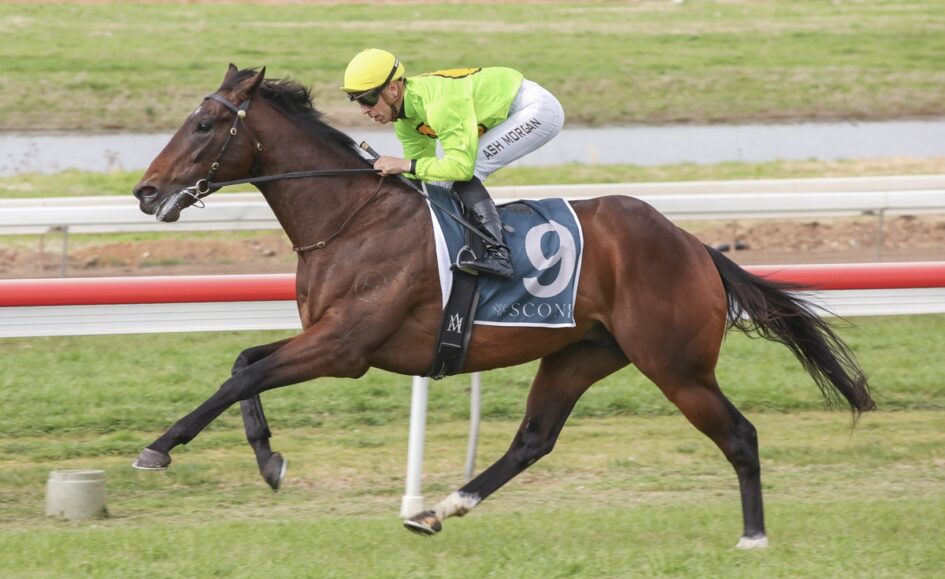
The combination of breeding and innate ability has been instrumental in Better Late’s development into a more formidable racehorse. His trainer is of the opinion that the gelding is on the cusp of another victory at Rosehill, contesting the Midway Handicap (1300m) this Saturday.
Having been gelded prior to his last racing campaign, the now four-year-old achieved two wins from his six outings. However, it is during this current preparation that two barrier trial successes were followed by two second-place finishes, with a victory at benchmark 68 level at Newcastle on August 25 occurring in between.
“He’s by Maurice so he is only going to get better with a bit of time on his side,” Newcastle-based trainer Nathan Doyle commented.
“He has come back in good order and I can’t fault any of his runs this preparation and he’s got the hoof on the till once again.
Advertisement
“The track suits him being an on-speed runner. He’s pretty bombproof.”
A consistent performer, Better Late has seen his Racing and Sports ratings improve at each of his last three starts. His most recent performance at Rosehill over 1200m on September 12 was hampered when James McDonald, aboard Formal, managed to get the better of him late.
Encouragingly, McDonald is booked to ride Better Late this time around, commencing from barrier eight.
“You can take that as you will,” Doyle remarked with a smile.
Advertisement
“But we are very happy to have him aboard.
“Better Late does everything right and gets out of the gates and makes his own luck and I will be disappointed if he isn’t in the finish.”
Doyle also has Mercy Me entered in the final race, scheduled over 1100m. This mare is first-up following a lackluster conclusion to her winter campaign, finishing out of the placings in the Listed Queensland Day Stakes (1200m) in June.
“Her work was good on Tuesday,” Doyle shared.
Advertisement
“She does need to take the step up from three-year-old grade and takes on the older horses but she seems to be in he right frame.”
Explore the competitive betting markets for the race at your favourite online bookmakers.
MEDINAH, Ill. — It was their first time doing it and it was my first time witnessing it, but it didn’t take long before all of us were thoroughly engaged by the proceedings of a Presidents Cup pairings selection session.
By they I mean both Presidents Cup captains — Geoff Ogilvy and Brandt Snedeker — sharing their well laid, and apparently very private, plans for the first session of this year’s Cup. And by me, I mean one of the 50-ish people attending the press conference and waiting, quietly, as the International Team deliberated whom to send out against Cameron Young and Xander Schauffele.
For 45 seconds that felt like many more, the room was silent. Trevor Immelman leaned in over Ogilvy’s shoulder, peering at their notes. If you didn’t know any better, you’d guess Trevor is International Assistant Captain No. 1, but then Camilo Villegas leaned in even further over Immelman’s shoulder and it felt obvious:
This is a triumvirate.
Advertisement
The other assistants deferred; Tim Clark had taken an observational knee in the background and Taylor Pendrith was removed from the deliberation enough that he didn’t even fit in the frame of the TV shot. All you could see was his right hand.
The International Presidents Cup captains deliberate.
PGA Tour
Villegas had turned away the microphone placed in front of him to keep anyone from capturing their whispers, and after nearly a minute Ogilvy pulled his mic back in front of his mouth:
Hideki Matsuyama and Ryo Hisatsune.
Advertisement
It may be a small token of this event and it may prove meaningless in the end but this team-oriented rumination among people conditioned to compete as individuals is absolutely something this team event does better than its biennial brother, the Ryder Cup. At Bethpage Black, it was Here are our squads. Let’s play ball. At Medinah, it is, one by one, Here are the pairings we think can steal the most points off yours.
If it feels like a reach to compliment the ways in which this event picks its matchups, that’s because these singular weeks each year when individual golf turns into team golf can make us a bit desperate to understand it. We beg each sides to not just have defined strategies, but sound ones, too. The advent of analytics have made team events into the Hindsight Olympics. We likely make too big a deal out of the pace of the greens and how it may impact one team vs. another. We likely make too big a deal out of the course history or event the thread count of the team hotel bedsheets. But if there is one undeniable element of strategy that gets injected into this event, it’s selecting one specific duo against a very specific opponent. And doing so as quickly as possible.
“It’s interesting,” Ogilvy said after I asked him what it was like. “I’m sure Brandt and his team have — we made some guesses based on practice round groups. We’ve got some ideas about what we want to get matched up, and I’m sure Brandt has the same thing. We just thought about it for a bit.
“I mean, these things unfold quite quickly. You just want to make sure you don’t break one of your rules that you’ve set before you come in this room.”
Advertisement
Oh, to know that list of rules.
By comparison, the Americans were much quicker with their choices. After the Internationals took another 40 long seconds to decide who would play in the their foursomes match, Snedeker waited only a few seconds before choosing Justin Thomas and Jackson Koivun. Perhaps there’s less to think about when you have the (on paper) stronger roster, but Snedeker sharply noted, “We’re not just throwing darts at the wall.”
For numerous reasons, Snedeker likes the Presidents Cup format better than the Ryder Cup, and though he is obviously biased at the moment, he thinks it a captain’s asset that he can try to influence the order of events with some strategy. (In an event with such pomp and circumstance, could this be a captain’s most important role?)
And so it feels like there is something there. Something to deciding why you’d hold Chris Gotterup and Patrick Cantlay for the final match against Tom Kim and Si Woo Kim. The captains were notably uninterested in sharing the intricacies of that thought process — at least for now — but it adds a layer of detail we don’t get at the Ryder Cup. It adds intrigue to the daily pairings affair. It adds a helluva lot more to the lineup of 12 singles matches that get decided Saturday night. We could only be so lucky for the match to be close at that point.














;)











































You must be logged in to post a comment Login