
US President Donald Trump on Sunday thanked football’s world governing body FIFA for suspending Falorin Balogun’s ban that allows the US star striker to play against Belgium this week.
Balogun was given a straight red card during the Round of 32 match between the World Cup co-hosts and Bosnia and Herzegovina on Thursday for accidentally planting his studs high on a defender’s ankle.
Balogun’s teammates and his coach, Mauricio Pochettino, had said the red card, which was given after an intervention by the Video Assistant Referee (VAR), was harsh because the star striker had not intended to harm the defender.
According to the International Football Association Board (IFAB), which is known for determining the sport’s laws, serious foul play is judged by the nature of a challenge and how dangerous it is — not by whether the player intended to cause injury.
Advertisement
Balogun (right) inadvertently caught Tarik Muharemovic high on the back of his ankleImage: Michael Steele/Getty Images/AFP
What has FIFA said about suspending Balogun’s ban?
FIFA rules say a red card triggers an automatic one-match suspension, which the player’s team cannot appeal.
But on Sunday night, FIFA issued a statement saying Balogun’s one-match ban was being “suspended for a probationary period of one year.”
FIFA did not provide any further details about why it had taken the decision.
Balogun is the USA’s leading scorer with three goals at the tournament so far, and his absence against Belgium on Monday would have dented their hopes of qualifying for the quarterfinals.
US player Christian Pulisic (left) told reporters that the decision ‘gives [the US] a boost’Image: Jamie Squire/Getty Images/AFP
Trump hails FIFA for ‘reversing a great injustice’
FIFA’s decision to suspend Balogun’s ban came after US Secretary of State Marco Rubio had called for the red card to be rescinded, claiming the US had been “screwed.”
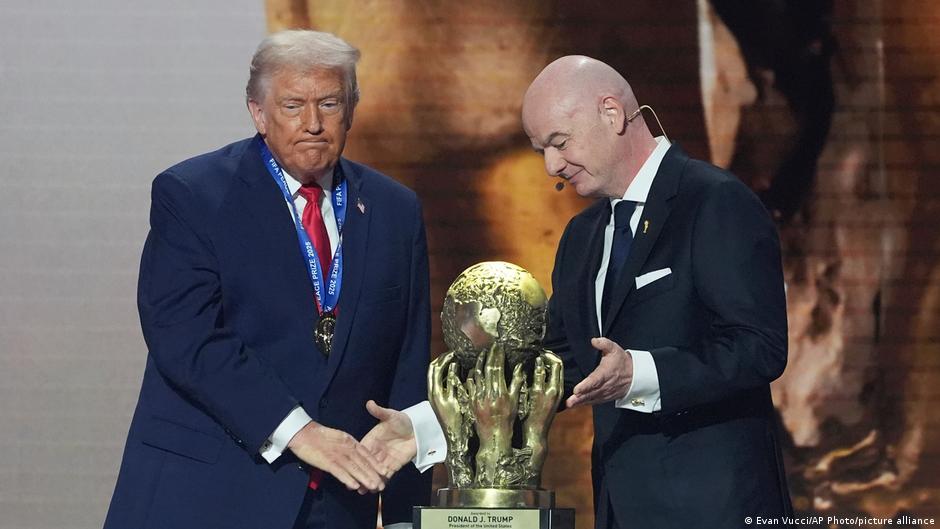
Trump, who has enjoyed a close and public relationship with FIFA president Gianni Infantino, took to his Truth Social platform to welcome the decision: “Thank you to FIFA for doing what was right, and reversing a great injustice!”
Advertisement
The White House also celebrated the decision in a post on social media.
The Associated Press cited an anonymous source that the White House had made a call to FIFA president Gianni Infantino to review the red card.
The New York Times also reported that Trump had called Infantino to ask him to review Balogun’s suspension, citing three unnamed people familiar with the decision.
The RBFA said it was “investigating all potential options” to “safeguard the legitimate rights of all participating teams and to protect the fundamental principles of fair play in our sport.”
Balogun (right) said last week that he had accepted the red card Image: Phil Noble/REUTERS
Belgium’s coach, Rudi Garcia, told a press conference Sunday that he “didn’t know that at the FIFA World Cup, the 5th of July is now the 1st of April, and that it’s April Fool’s Day.”
While this is the first time FIFA has suspended a ban stemming from a red card at a World Cup, there is some precedent for the decision.
Portugal’s megastar Cristiano Ronaldo was sent off for elbowing an opponent during the qualification phase for this World Cup, triggering a three-match ban which meant he was set to miss the tournament’s opening two matches.
But FIFA suspended the final two games of the three-game ban, meaning Ronaldo only missed one qualification match and has been eligible for all of Portugal’s matches at the 2026 World Cup.
Advertisement
Argentina’s Nicolas Otamendi and Ecuador’s Moises Caicedo also had one-game bans for red cards deferred during qualification, which allowed them to be eligible for their nations’ opening World Cupgames.
FIFA wanted a World Cup without politics — it got Trump
Edited by: Dmytro Hubenko
Don’t let the algorithm hide the news. If you rely on our team for trusted reporting, please take a moment to select us as your Preferred Source on Google by clicking here and hitting the “star” or “preferred” button, so you’ll always see our verified news first.
ARLINGTON, Texas — Cristiano Ronaldo heard the cheers while walking off the pitch after his final World Cup match for Portugal. The stoic look on his face and his brief wave acknowledging the fans showed this wasn’t the desired outcome.

The sixth and final World Cup for the 41-year-old superstar ended with a 1-0 loss to border rival Spain in a Round of 16 game on Monday. Ronaldo was denied a goal in the first half when goalkeeper Unai Simón made an impressive leaping stop.
Ronaldo, the only player to score in six World Cups in a row and the career leader in international goals with 146, took three shots against Spain.
Two of those were on target, including the one on which Simón was still in midair when he reached back to grab the ball with both hands. Ronaldo got off a backward kick with his right foot after a header by teammate Joao Felix bounced off Simón’s shoulder.
Advertisement
On the day before the Round of 16 game, Ronaldo spoke to reporters for about 25 minutes and said he hoped it wouldn’t be his last match and wanted “to enjoy what will be my last World Cup to the fullest.”
The deepest Ronaldo ever made it in the World Cup was a semifinal run in 2006, his debut in the tournament.
Ronaldo’s finale on soccer’s biggest stage came eight years after he recorded a World Cup hat trick at age 33. That was in a 3-3 draw with Spain in a group-stage opener considered one of the tournament’s best matches, although neither power reached the knockout stage.
He scored 11 goals in World Cup play, tied for ninth on the career list.
Golf instruction is ever-evolving, but the best advice stands the test of time. In GOLF.com’s series, “Timeless Tips,“ we’re highlighting some of the greatest advice teachers and players have dispensed in the pages of GOLF Magazine. Today we look back to our March 1995 issue for some advice from Jack Nicklaus on great golf as you age.
Father time may be undefeated, but that doesn’t mean you can’t take steps to preserve your golf game as you age.
Ask Jack Nicklaus. The Golden Bear won a majority of his major titles during his prime, but in 1986, he was able to turn back the clock at Augusta one last time for green jacket No. 6.
Nine years later, Nicklaus joined GOLF Magazine to share some of his secrets. Read below for his best tips for playing great golf as you age.
Advertisement
Jack’s secrets to great golf
Some senior tour candidates possibly excluded, I imagine not a whole lot of golfers look forward to becoming 50-plus players. But, as they say about every aspect of growing older, it’s better than the alternative.
The editors at GOLF Magazine asked me to talk about what has changed in my life and golf game between my peak playing years and early 50s, with particular reference to how other new or soon-to-be seniors might benefit from my experiences. I hope something in the following inspires and helps you to be a healthy person and a fine golfer for many years to come.
Power
As with most people as they age, the greatest change in my game as I advanced into seniorhood was a loss of power with the longer clubs. Although I’ve had spells where my distance has been acceptable, it’s been quite a few years since I’ve consistently driven the ball as far as I feel I need to, or hit my long-irons — the 1-, 2-, and 3- — as long as or, equally important, as high as in my prime.
In scoring terms, and particularly on PGA Tour courses (as opposed to the shorter ones used for the Senior Tour), this has produced fewer eagle or two-putt birdie opportunities on par fives, given me a harder time with long par fours, set up fewer birdie chances on shorter ones, and made muscling the ball out of the rough a much tougher proposition.
Advertisement
Mentally, the biggest downer has been knowing that, over four tournament rounds on the “junior” Tour, I just wasn’t going to get as close to the hole with 4- and 5-irons as the younger guys who were hitting 8s and 9s. That pressured my short game in general and my putting in particular.
Loss of power doesn’t happen to all players as they grow older. Dave Stockton and Bob Charles, both more successful as seniors than in their younger days, claim to be hitting the ball as far as or even farther than when they played the regular Tour. I’m pretty sure Jim Dent hasn’t lost much yardage, nor Lee Trevino when he really needs it. And I know for sure that Raymond Floyd is as long as he ever was.
What’s caused my power leakage? It’s possible that very long-hitting golfers, as I was in my prime, just naturally lose a greater percentage of yardage as they age than players who never hit the ball big distances even in their younger days.
From a technique standpoint, the problem lies mostly in my legs. Power in golf is the product of clubhead speed squarely applied. My swing still delivers the club squarely most of the time, but not as speedily due to slower or inferior leg action. At my peak, I created tremendous leverage with my feet, legs, and hips that got the clubhead moving extremely fast through impact. As my strength diminished with the years, my swing mechanics had to be perfect for me to come close to generating that much leverage and thus that much clubhead speed.
Advertisement
Injuries also have been a factor. Occasionally, when I’ve been free from pain, my leg speed and lowerbody timing have both come back and I’ve hit the ball plenty long. This happened when I won last year’s seniors’ Mercedes Championship playing La Costa at the same yardage as the young guys in their event. But such spells have not been frequent enough. Most of the time since I became a senior in 1990, some part of me — hips, back, shoulders — has troubled me just sufficiently to force holding back that critical little bit.
At the time, people remarked on how well I hit the long shots in winning the Senior Open at Cherry Hills in 1993, but they were probably overlooking the elevation factor. The course was set up at around 6,900 yards, but, at more than 5,000 feet above sea level, it actually played about 300 yards shorter than that. I can usually still handle a 6,600-yard golf course just fine—in fact, I only used the driver 15 times during that championship. It’s on those sea-level 7,000-yard-plus layouts, where the young guys were routinely tearing apart the course, that my power-leakage hurts the most.
Power clubs
Ever since my power leakage began, I’ve done everything I could think of to stop it, or at least minimize and delay it. You may not care to take your quest as far as I have in terms of lifestyle and exercise (although we’ll get to those later), but you should certainly give the third area your best shot. That’s the equipment you use.
The technology of clubs and balls has improved so dramatically over the last decade that, although you still can’t “buy a good golf game,” playing with the right equipment will definitely help you get the most out of the game you’ve got.
Advertisement
I began experimenting with drivers about six years ago, not in terms of makes or cosmetics, but with shaft and head materials, shaft flexes, head configurations, and the relationship of shaft weight to head weight. As a result, although I now know for sure that no driver will fully restore my power loss, I also know and play the specifications that allow me to most easily produce my present maximum yardage.
I’m fortunate to be able to obtain and continually update this knowledge with the help of the experts at my own equipment company. Unless you’re ready to undertake the daunting task of tracking, sifting, and comprehending the huge range of options Open to you in club technology, you should find and work with a golf professional who is also an expert clubfitter.
Here to assist him and you both is the bottom line of my discoveries.
If you suffer from skeletal, muscular, or arthritic-type difficulties, graphite shafts will help by reducing the shock of impact. If you want your tee balls and longest fairway shots to “penetrate” and roll, with minimum curvature, deliberate or otherwise, go for metal wood heads. If you want those shots to “carry” and land softly, and to be “‘workable” in terms of drawing and fading, go for wooden wood heads.
Advertisement
I’ve played much of my tournament golf in recent years with a graphite-shafted metal-headed driver and a steel-shafted wooden-headed 3-wood that I’ve used since I was 18 years old. For accomplished senior amateur players, this could be the ideal combination.
Accuracy clubs
Because my approach-shot capabilities with the medium-irons haven’t changed much, and my short-iron play has actually improved, I’m still using essentially the same iron-club specs that I have for most of my career. However, I’m sure the day will come when I might want to go to slightly softer or longer shafts, or to graphite instead of steel, or to a little lighter swing weight. Those are factors you and your clubfitting expert need to consider, using the specs you’ve settled on for the driver and fairway woods as a guide.
I never would have believed even 20 years ago that there would come a time when I would leave out a long iron in favor of a fairway wood, but I’ve done that with a 5- or a 7-wood a number of times since becoming a senior. Accordingly, when I see almost as many woods as irons in an over-50 amateur’s bag, I don’t assume, as I once might have, that he isn’t too good a player, but simply that he’s got a lot of sense. Take a peek in the bags on the Senior Tour if you still feel shamed by forsaking long-irons for well-lofted woods and extra wedges.
Offsetting power leaks
As the years inevitably cost a recreational golfer distance, it seems to me that he has two options. One is to accept an even higher handicap along with higher and higher levels of frustration. The other is to wholly or partially make up for the loss through improvement in some other area of the game.
Advertisement
I haven’t been as competitive as I would like these past few seasons, but I would have been even less so without the improvement in my short game that was forced on me by the power leakage.
The truth is that, at my best, I never really needed much of a short game. By hitting the ball very long and pretty straight off the tee, I needed relatively short clubs for most approach shots. That helped me hit a high proportion of greens in regulation or, thanks to my long-iron skills, better than regulation on par fives. I was also strong enough to be able to get the ball somewhere on the green from most of the rough I encountered.
As shorter tee shots led to missing more greens, simply being called upon to play more pitches, chips, and bunker shots produced an improvement in those areas. Then, the longer I lived with the probability that 300- yard drives were the exception rather than the rule, the harder I had to discipline myself to include the full range of recovery techniques in my practice sessions.
Like most golfers, I’d always found banging out big shots more fun than working on the little ones. A couple of years ago it became clear that I either had to sharpen my short game or quit tournament play entirely. The upshot was that I’m better around the greens today than any other time in my career. That’s particularly true of my pitching from about 90 yards in with the wedges, my biggest weakness during my peak years.
Advertisement
If you’re leaking yards but fighting to stay competitive at your own level of the game, there’s definitely a lesson for you here.
Exercise
The biggest change in my life since my peak years is the amount of exercising I do. Until I began to jog occasionally in my early 40s, I did no exercise at all from my high school days on, other than that involved in playing and practicing golf.
By my late 40s, it was clear that muscular problems in my back, hips, and legs would end my golf career entirely without radical action to alleviate them — on top of which I was looking at back surgery for disc deformities. Over the Thanksgiving holiday of 1988, this led me to an anatomical functionalist by the name of Pete Egoscue, since when hardly a day has passed without me doing the workouts he prescribes. Since the middle of last year, ve supplemented that regimen with regular strengthening and limbering routines under the supervision of Pete Draovitch, a personal trainer recommended to me by Greg Norman.
The Egoscue exercises are mainly of a stretching nature. Sometimes I do them for as little as 10 minutes, and sometimes for an hour or. more. Adding in the Draovitch routines raises my workout time to upwards of two hours. There’s no doubt in my mind that I would have had to quit tournament golf some years ago without Pete Egoscue’s regimens and my dedication to them. I also believe the program I’m now enjoying with Pete Draovitch is critical to me becoming competitive again.
Advertisement
In addition to these formalized workouts, I always walk the golf course, facilitating that when forced to put the clubs on a cart by asking a playing companion to do the driving.
As with my improved eating habits, exercising heavily has become as much a part of feeling good about myself as a contributor to my golf game. Everyone’s metabolic rate decreases with age, which I’m told by people who should know is why so many older folks don’t feel as good as they’d like. If only because exercise fights off and slows down that process, I don’t see myself cutting back on it very much, even if I quit playing tournament golf.
Will exercise help your game? Well, good golf demands strength and elasticity in many parts of the body, but it’s particularly important in the legs. I don’t know any way a senior can keep his legs in shape without using them a lot.
Derry rider Daniel Coyle had another win at the ‘North American’ show at Spruce Meadows in Canada over the weekend, while also claiming the runner-up spot in the prestigious Queen Elizabeth II Cup.
Coyle and Uruville Z were one of 10 combinations to make it through to the second round of the Kubota Cup 1.50m in the International Ring.
Scores from the opening round were not carried forward, giving all qualified athletes a clean slate heading into the deciding round.
Irish rider Daniel Coyle rode to victory with Uruville Z as the pair delivered a blistering performance in the winning round, as they crossed the finish line in a time of 48.90 seconds to secure the top spot on the podium.
Advertisement
Coyle and Uruville Z finished a full second ahead of the runner-up combination of Kyle King (CAN) and Replay Touch V/D Stapelheyde, who stopped the clock in 49.91 seconds.
Another Irish combination, Conor Swail with Casturano, took third.
The defending champion Daniel Coyle had to settle for the runner-up position this year in the $1,000,000 ATCO Queen Elizabeth II Cup 1.60m at Spruce Meadows on Saturday.
A maximum field of 40 athletes qualified for the prestigious competition, having earned their place earlier in the week during the Jayman BUILT Cup.
Following the opening round, only the top 12 horse and rider combinations advanced to round two, returning in reverse order of merit to battle for the prestigious competition.
Advertisement
Only two combinations managed to produce fault-free performances in the opening round: Abdulrahman Alrajhi (KSA) aboard 13-year-old Ventago and Daniel Bluman (ISR) aboard the grey mare Corbie V.V.. As they prepared for the decisive second round, they watched a number of competitors deliver clear rounds but carry forward faults from the opening track.
Returning second-last to compete, Alrajhi once again rose to the occasion, producing the only double-clear performance of the day to secure victory.
Bluman, had an unfortunate rail in the second round, opening the door for defending champion Daniel Coyle to move into second place. With the time from the first round carrying over to the second, Bluman ultimately finished third to round out the podium
FIFA World Cup Round of 16 Live: Team news is in! Both lineups confirmed for the blockbuster clash
The team sheets are locked in here at Dallas, and both managers have named explosive lineups for this monumental Iberian derby. England’s Anthony Taylor will be the man in charge of the whistle tonight.
PORTUGAL STARTING XI: Roberto Martínez goes with a star-studded lineup, spearheaded by the legendary Cristiano Ronaldo up top, flanked by João Félix and Pedro Neto.
Goalkeeper: Diogo Costa
Advertisement
Defenders: João Cancelo, Rúben Dias, Renato Veiga, Nuno Mendes
Midfielders: João Neves, Vitinha, Bruno Fernandes
Forwards: Pedro Neto, João Félix, Cristiano Ronaldo (C)
Subs: José Sá, Rui Silva, Nélson Semedo, Araújo, Dalot, Inácio, Samu, Matheus Luiz, Silva, Rúben Neves, Gonçalo Ramos, Trincão, Rafael Leão, Gonçalo Guedes, Francisco Conceição.
Advertisement
SPAIN STARTING XI: Luis de la Fuente keeps faith in his rock-solid core. The tournament’s best defensive backline remains untouched, while teenager Lamine Yamal starts out wide to torment the Portuguese flanks.
Goalkeeper: Unai Simón
Defenders: Pedro Porro, Pau Cubarsí, Aymeric Laporte, Marc Cucurella
Midfielders: Pedri, Rodri, Dani Olmo
Advertisement
Forwards: Alex Baena, Mikel Oyarzabal, Lamine Yamal
Subs: Raya, Joan García, Pubill, Grimaldo, Eric García, Llorente, Merino, Ferran Torres, Fabián Ruiz, Gavi, Yeremy Pino, Nico Williams, Martin Zubimendi, Muñoz, Borja Iglesias.
Cape Verde goalkeeper Vozinha (1) and Argentina’s Lionel Messi (10) compete during the World Cup round of 32 soccer match between Argentina and Cape Verde in Miami Gardens, Fla., Friday, July 3, 2026. (AP Photo/Chris Carlson)
Cape Verde goalkeeper Vozinha could complete one of the most remarkable transfers of the summer after his outstanding performances at the 2026 FIFA World Cup reportedly attracted strong interest from Inter Miami. The 40-year-old shot-stopper, who is currently a free agent after leaving Portuguese club GD Chaves, emerged as one of the breakout stars of the tournament as Cape Verde reached the knockout stage in their first-ever World Cup appearance. Reports now suggest David Beckham’s MLS club are preparing to step up their pursuit, although Brazilian sides have also entered the race for the veteran goalkeeper’s signature.
World Cup turns Vozinha into breakout star
Cape Verde’s World Cup journey may have ended in a dramatic 3-2 extra-time defeat to defending champions Argentina in the Round of 32, but Vozinha’s performances earned widespread admiration throughout the tournament.The veteran goalkeeper finished the competition with 18 saves, repeatedly frustrating some of the world’s strongest attacking sides.He first captured global attention during Cape Verde’s goalless draw against Spain, producing seven saves to preserve a famous clean sheet. The African nation then held both Uruguay and Saudi Arabia to draws to finish second in their group and qualify for the knockout stage.Against Argentina, Vozinha once again proved why he had become one of the stories of the tournament. He made another seven saves during regular time, repeatedly denying Lionel Messi and his teammates as Cape Verde twice fought back to level the score before eventually losing 3-2 after extra time. Argentina’s winning goal came via an own goal, leaving the goalkeeper with little chance to prevent the defending champions from progressing.
Cape Verde goalkeeper Vozinha (1) makes a save against Argentina’s Lionel Messi (10) during the World Cup round of 32 soccer match between Argentina and Cape Verde in Miami Gardens, Fla., Friday, July 3, 2026. (AP Photo/George Walker IV)
His exploits also triggered an extraordinary rise in popularity off the pitch.Before the World Cup, Vozinha had around 50,000 followers on Instagram. That figure has reportedly exploded to more than 25 million during the tournament, with approximately 14 million new followers arriving after his standout display against Spain before his popularity continued to surge throughout Cape Verde’s historic run.
Inter Miami reportedly preparing move after Chaves departure
Advertisement
Vozinha’s impressive displays have coincided with a pivotal moment in his club career.The goalkeeper became a free agent after his contract with Portuguese second-division side GD Chaves expired on June 30, shortly before Cape Verde’s knockout campaign concluded.Prior to the tournament, Chaves manager Vítor Martins acknowledged that the goalkeeper was preparing for a special chapter in his career.“He’s at a very specific point in his career and living a unique moment in his life, one he perhaps thought impossible, about to play in a World Cup at 40 years old,” Martins said.“I believe he will follow his best path and it probably won’t be with Chaves. He was a perfect professional until the end.”That next destination could now be Major League Soccer.According to Portuguese newspaper Record, Inter Miami have expressed “strong interest” in signing Vozinha once the World Cup concludes, with the goalkeeper said to be “highly regarded” inside the club.Mexican outlet El Informador added that although no final agreement has yet been reached, Inter Miami co-owner David Beckham wants to complete the deal after the tournament and that negotiations are expected to intensify in the coming days and weeks.TVN, via Marca, has also reported that the Florida club are “extremely interested” in signing the Cape Verde international, noting that his free-agent status makes the move financially attractive because Inter Miami would not need to negotiate a transfer fee.The reports further suggest that the opportunity to train and play alongside Lionel Messi, having only recently faced him on the World Cup stage, is viewed as an appealing prospect for the veteran goalkeeper.
Brazilian clubs also enter the race
Inter Miami, however, are not the only club monitoring the situation.Transfer expert Fabrizio Romano reported that Brazilian clubs Avaí and Atlético Goianiense have already made direct contact with Vozinha’s representatives.“Brazilian clubs Avai and Atletico Goianiense make direct contact to try and sign Vozinha,” Romano wrote on social media.“Cape Verde legendary goalkeeper is available as a free agent, and both clubs approached his agents, Brazilian press reports.”While competition for his signature is growing, Inter Miami are still expected to intensify their pursuit after the World Cup, according to multiple reports.
Cape Verde goalkeeper Vozinha celebrates as holds the flag of his country after the World Cup Group H soccer match between Spain and Cape Verde in Atlanta, Monday, June 15, 2026. (AP Photo/Mike Stewart)
Advertisement
Should a move materialise, Vozinha would likely provide experienced competition and leadership behind first-choice goalkeeper Dayne St. Clair, who joined from Minnesota United earlier this year and has established himself as Inter Miami’s regular starter. The Cape Verde captain arrives off the finest international tournament of his career, having frustrated Lionel Messi during Cape Verde’s memorable World Cup run. If the transfer is completed, the goalkeeper who stood opposite Messi on the sport’s biggest stage could soon find himself training alongside the Argentine at Inter Miami.
Obstacle course racing (OCR) has become a popular adventure sport for fitness enthusiasts. The unique race combines running and multiple physical obstacles, testing the strength, agility, balance, and resilience of participants.
Some of the popular obstacle course races include Spartan Race, Devil’s Circuit, and Tough Mudder. These events attract thousands of athletes annually.
The sport demands a lot more than just cardiovascular endurance. Athletes have to face challenges like climbing ropes, crawling under barriers, carrying heavy objects, and navigating uneven terrain. Obstacle course races need a proper training approach that focuses on various aspects.
Basics are key for new athletes and also for those looking to improve their performance. Let’s take a look at three basics every obstacle athlete should know.
Advertisement
#1 Training obstacle-specific skills
Many beginners tend to ignore obstacle-specific training. However, athletes may struggle if they have never trained for common obstacles before race day. Learning techniques for common obstacles can make a substantial difference.
Participants must practice obstacles such as rope climbs, wall climbs, and monkey bars, along with balance and crawling drills. They should also learn how to maintain composure in case of a failed attempt at an obstacle. Moving on to the next obstacle quickly without thinking about the previous mistakes is the ideal strategy.
Advertisement
#2 Developing functional strength
Athletes need to use their entire bodies in obstacle course racing. Functional strength is one of the most important factors, especially for obstacles such as wall climbs, rope climbs, and monkey bars.
Exercises like pull-ups, push-ups, farmer carries, lunges, squats, and kettlebell movements help prepare the body for common race obstacles. The grip strength is another crucial aspect. Some obstacles could feel more challenging due to fatigue.
#3 Building a strong endurance base
With obstacle races typically covering several kilometers and featuring multiple obstacles, maintaining energy is as important as pace. Several athletes start well, but their performance dips towards the end due to fatigue.
New athletes should work on building aerobic fitness through regular running. Combining long-distance runs and interval training can help improve stamina and recovery.
Zlatan Ibrahimović faced criticism after supporting FIFA’s decision to let Folarin Balogun play against Belgium despite his red card suspension
Zlatan Ibrahimović has come under fire after publicly supporting FIFA’s controversial decision to suspend the one-match ban handed to United States striker Folarin Balogun, allowing him to face Belgium in the FIFA World Cup Round of 16. The decision, announced just days after Balogun’s straight red card against Bosnia and Herzegovina, has sparked a major controversy across football, with reports suggesting political pressure may have influenced the outcome. The situation intensified after Donald Trump publicly claimed that he personally contacted FIFA president Gianni Infantino to request that the decision be overturned, with allegations of political interference quickly spreading and fuelling widespread debate about FIFA’s independence and integrity. While FIFA has insisted the ruling was made independently, the timing of the decision and Trump’s own comments have only increased scrutiny.
FIFA overturns Balogun suspension before Belgium clash
Balogun had been expected to miss the United States’ Round of 16 meeting with Belgium after receiving a straight red card in the 64th minute of the Americans’ 2-0 victory over Bosnia and Herzegovina.The Arsenal striker, who had already opened the scoring before being dismissed for a challenge on Tarik Muharemović, automatically incurred a one-match suspension under FIFA’s competition regulations.However, FIFA later announced that the sanction would not be enforced immediately.In a statement, world football’s governing body said:“In line with Article 27 of the FIFA Disciplinary Code, the implementation of the match suspension is suspended for a probationary period of one year.”The decision means Balogun, who has scored three goals and provided three assists across the tournament, remains available to face Belgium as the United States chase a first World Cup quarter-final appearance since 2002.
Ibrahimović backs FIFA’s decision
Working as a pundit for FOX Sports during the World Cup, Ibrahimović welcomed FIFA’s intervention and argued that Balogun should never have been dismissed in the first place.“What I want to say is I’m happy for the US,” Ibrahimović said.“Like Thierry said, first of all he should not have had a red card, then this decision should have come quicker.“But I’m happy for the US team because they have been amazing, but Balogun has been super amazing and with him it’s an extra force.”His comments quickly divided opinion online.One supporter wrote: “These guy’s aren’t allowed to criticise FIFA. This is blatant home cooking.”Another posted: “Zlatan fakes this big macho persona constantly but look at him with zero spine on live television when it actually matters.”
Advertisement
Henry agrees with the outcome but questions the timing
Ibrahimović’s fellow FOX Sports analyst Thierry Henry also maintained that Balogun should not have been sent off, but stressed that FIFA’s delayed decision had unfairly affected Belgium’s preparations.“Yeah, that’s exactly what it is for Belgium, the breaking news,” Henry said in a video shared by FOX Sports on X.“That must have broken their spirit a tiny bit because you also prepare the game to play a certain way and then suddenly you have to change your preparation of the game.“This is also what it does when you do something like that. Three, four days to take a decision.”Henry reiterated his belief that the original dismissal was incorrect.“Now we need to go back to the point. I do not think it was a red card, and we all said it. We all know that it was not… he didn’t do that on purpose.”He nevertheless acknowledged the disruption created by FIFA’s late intervention.“I have to say that if you’re Belgium, to prepare the game, it does change everything.”Henry added that while similar situations may have occurred previously, referencing Garrincha’s case from decades ago, the central issue remained the timing rather than the final verdict.“I was kind of like okay, it is the right call, but why so late?”
Neville, Keane and Wright condemn FIFA’s handling
The reaction on ITV Sport was considerably more critical, with Gary Neville, Roy Keane and Ian Wright all questioning both the process and FIFA’s consistency.Keane said:“It seems unfair because it is unfair.“You’ve got to look at the opposition team in terms of their preparation and it seems like a bit of a pal’s act shall we say.”Neville reserved his strongest criticism for FIFA itself.“It absolutely stinks, let’s be really clear.“The thing that stinks the most is there should be a review process in place because I actually didn’t think it was a red card.“I think there should be a process which allows it to be overturned, but if there’s no process for it to be overturned and then somehow FIFA, from nowhere, have decided to basically let a player play… and the rules are the same for everybody.“I would be absolutely raging if I was Belgium and every other team in the tournament that’s had a player sent off that might think it’s a little bit hard done by.“Do you know something? Are we surprised? No, not with this lot.”Wright also questioned the integrity of FIFA’s handling of the incident.“Suspensions are meant to be served during the tournament.“This one being suspended, it doesn’t normally happen, but we’re talking about integrity, people talking about transparency, but you look at some of the things that have happened at this tournament with certain teams… it’s shameful, especially as he’s an American player.“Whether he’s guilty of what he done, whether we think he should have got the red card or not, some of the things that have happened at this World Cup have been shameful.”With Belgium already exploring its legal options over the decision and criticism continuing from across the football world, Balogun’s availability has become one of the tournament’s most contentious talking points before the Round of 16 clash in Seattle.
True to form, Cameron Young arrives early and well prepared.
Our production crew is finishing its setup behind the clubhouse at Dutchman’s Pipe, a well-to-do West Palm Beach golf club just a few miles south of Young’s home, when the cover star himself, the third-ranked golfer in the world, pulls up in a cart and offers a wave to our photographer. He looks more casual than we’re accustomed to seeing him at Tour events, wearing an unbuttoned white polo untucked over gray shorts. Several hangers swing from the back of his cart.
“I brought options,” he says sheepishly, gesturing to a handful of logoed golf shirts and checked button-downs. He hops from the cart and shakes hands with each member of the GOLF team. For the next couple hours, he’s engaged and engaging — direct and forthright through a photo shoot, a sit-down chat and a one-sided battle with a bucket of balls.
That Young is here at all is an encouraging sign for those of us intrigued by his game and what makes him tick. His first several years on Tour were marked by a Teddy Roosevelt — like approach to the media and his on-course performance, speaking softly and carrying a big stick while leaving us to guess the rest. We got to know him, in part, from what we saw on TV — the beard, the game-time scowl, the prodigious power, the trademark pause at the top of his backswing — but not much else. Young seemed, from the outside, a reluctant star, notably declining to create even an Instagram account — almost unheard of in this multi-platform, brand-building era.
Advertisement
So who is Cameron Young? Let’s start here: He was born in New York’s Westchester County and now lives in Palm Beach Gardens, Fla. He doesn’t care if you call him Cameron or Cam. He and his wife Kelsey have two boys and a girl. They travel just about everywhere together. He’s quicker to smile in real life than in competition (or photos). His teammates at Wake Forest included Will Zalatoris and Alex Fitzpatrick. He’s sponsored by Major League Baseball but doesn’t watch much Major League Baseball. His first pro tournament win came as an amateur, at Bethpage Black, at the 2017 New York State Open. Last year he became the 1,000th unique winner in PGA Tour history. Before the biggest drive of his life, he gave himself the first pep talk of his life. As he hit the biggest one-foot putt of his life, he couldn’t feel his hands.
Thanks to his series of breakthroughs on the game’s biggest stages — his long-awaited first Tour win at the 2025 Wyndham; a starring role a month later at the Ryder Cup; victory at this year’s Players and a validating follow-up win at the Cadillac Championship; his ascent to World No. 3 — something has changed.
He’s being asked better questions and giving more interesting answers. The door has cracked open a bit wider, offering glimpses of the 29-year-old on the rise, of where he came from and how he now finds himself among the game’s elite.
Young poses for photos at Dutchman’s Pipe in West Palm Beach, Fla.
Michael Schwartz
YOUNG’S ORIGIN STORY will make you nostalgic for a childhood you never even had. You can picture how he would have looked: the little kid at the big golf club, chasing his ball into the fading sun, not a care in the world besides impending dusk, night after night after night.
Advertisement
“It was a dream place to grow up,” Young says.
That dream place was Sleepy Hollow Country Club, where his father, David, took the head pro job when his son was three or four.
“By that point, I already loved going out there and smacking it around.”
Sleepy, as it’s known, is a landmark club just north of New York City, famous for its Golden Age course design, Vanderbilt-mansion clubhouse and entrancing Hudson River views. It’s rarefied turf, but Young felt welcomed from the start. His father or his mother (Barbara, an accomplished player too) would take him out to play nearly every evening, and he could chase to his heart’s content.
Advertisement
About a decade into his dad’s tenure, the family moved on property, into a house off the fourth hole of Sleepy’s nine-hole short course. Cam developed a ritual: He’d take the train home from school, change into his golf clothes and head straight out.
“I’d get out on the course as much as I could, especially late in the afternoon — see how many holes we could play,” he says. “It’s one of the most beautiful pieces of [land] you could ever find.”
He continues to get membership emails. That’s how he knows about the occasional watch parties and clubhouse meetups supporting the kid who climbed to the top — even as every rung of the ladder brings a reminder that he’s not that kid anymore.
Cameron and his father, David.
Courtesy Cameron Young
Advertisement
A YEAR AGO AT THIS TIME, Young’s career was still defined — at least publicly — by what he hadn’t quite accomplished. He’d jacked up expectations with a red-hot rookie year in 2022 but still hadn’t been able to win a PGA Tour event. Sure, he’d almost gotten across the line, dating back to that Rookie of the Year campaign and its extremely near-misses at the PGA Championship and Open Championship as part of a season with seven top-three finishes. But no dice. He also hadn’t made a Ryder Cup team, and even that omission barely registered. When the 2023 U.S. team was announced, the spotlighted snub in Netflix’s Full Swing was Keegan Bradley, who’d finished 11th in qualifying, while Young, 9th in the standings, was passed over with significantly less fanfare.
By those lofty standards, he floundered in the years that followed, sliding from top 15 in the world to outside the top 50. By early 2025, he was off the Ryder Cup radar for Bethpage Black, the course and career goal he’d circled since high school.
But then he made changes — some essential, others sharpened by experience — that added up to something special.
Young changed caddies. After shuffling through a series of more established loopers, he passed his bag to Wake Forest pal Kyle Sterbinsky.
Advertisement
“Some of it is just grinding through tougher times and finding better ones,” Young said at the time. “[Kyle is] one of my best friends, a college teammate, and he’s great at reading greens.” Whatever the alchemy, the results were immediate: his putting stats soared, as did his iron play — and his scores dropped accordingly.
Young changed ballflights. Rather, he committed to a single ballflight. Instead of adjusting from shot to shot, he decided to lean into the draw he’d grown up with around Sleepy, a return to his swing DNA. “You watched Tiger in his prime and he hit all of them. Every shot,” Young says. “And, in theory, if you want to be as good as you can be, you want to be able to hit every shot. But for most people, it probably just isn’t practical.”
Young tweaked his mindset too, choosing to think bigger picture and stating plainly his intention to make the Ryder Cup team at Bethpage. With that as his North Star, everything else found its place.
Finally, he changed his golf ball, putting a mysterious Titleist Pro V1 prototype into play ahead of the 2025 Wyndham, which immediately helped him flight the ball better and control his distance accordingly. It had the desired effect. In his first week with the new rock, Young won the event by six strokes, putting an emphatic end to the chatter about his conspicuous winless streak on Tour.
Advertisement
To hear him describe it, it all was a massive relief.
“It was nice to just not have it be the conversation anymore,” Young says.
Young has vaulted to No. 3 in the World Ranking.
Michael Schwartz
THAT FIRST TOUR TRIUMPH proved to be a springboard. Young finished fifth the following week, 11th a week later and T4 at the 2025 Tour Championship, earning a Ryder Cup captain’s pick in the process.
He acquitted himself so well in the first two days at Bethpage that U.S. captain Keegan Bradley sent him out first in Sunday singles in front of his New York faithful. He finished a back-and-forth showdown against Justin Rose with a must-make birdie putt on the 18th green for a 1-up victory and the biggest fist pump of his golfing life, knowing he’d toppled the first domino in a rowdy comeback that the U.S. side nearly pulled off.
Advertisement
“It was maybe more rewarding, in a sense, to make the putt on Sunday knowing that there was another guy behind me and one behind him and another one behind him,” Young says, remembering the momentum. His 3-1-0 record was Team U.S.A.’s best.
In early 2026, Young picked up where he left off in 2025, finishing T7 at Riviera and T3 at Bay Hill before unleashing late heroics at TPC Sawgrass, where he chased down Sunday’s leaders, birdied the island par-3 17th, stepped to the terrifying 18th tee with a pep talk to himself — I’m going to hit the best shot of my life right here — and pummeled the longest drive in the hole’s recorded history. When he won the Players Championship outright (Matt Fitzpatrick bogeyed No. 18, the sort of help he’d never seemed to get from competitors in the past) the tee shot seemed emblematic of this new, assertive, self-believing Young — a golfer in full.
There were still more positive signs at the Masters. Young’s first point of pride was bouncing back from four bogeys in his first seven holes on Thursday to ultimately finish the event T3 behind winner Rory McIlroy and runner-up Scottie Scheffler. McIlroy-Scheffler-Young, at the biggest tournament on the calendar? Company noted.
Two starts later, Young won again, six shots clear of second-place finisher Scheffler at the Cadillac Championship.
Advertisement
“I’m just playing better,” he says. “And I think you could argue all day about which piece has influenced that the most.”
“I always thought, If I can just get to top 10 in the world, things will be easier. And they’re not,” Young says.
Michael Schwartz
THERE ARE PERKS that come with joining this club, with winning, with making the Ryder Cup, with being the world’s third best player. Youngarrived on Tour as something of a loner. Now he talks about playing at home with Sunshine State neighbors Justin Thomas, Xander Schauffele, Patrick Cantlay, Keegan Bradley and more.
Still, winning isn’t the game changer he imagined it to be.
Advertisement
“I always thought, If I can just get to top 10 in the world, things will be easier. And they’re not,” Young says. “You still start over every day, every week. I have a better handle on what I’m doing and how to approach things than I did probably a year or two ago. But, like, is it easier? Less stressful? No. I mean, golf is still really hard. You still have to hit all the shots. So,yeah, my self-belief is higher. I have more tools to deal with things that come my way. But at the same time, it doesn’t feel as different as I would have thought.”
Nevertheless, full-circle moments keep materializing. His three- and four-year-old sons have begun taking an interest in golf at about the age their father was when he first toddled along the fairways at Sleepy. Recently, on a whim, Young’s wife asked the boys if they wanted to go to the golf course.
“I thought it would be five minutes, and they’d get bored and go do something else,” Young says. “But they sat there and hit balls forever. We went and had lunch, then they both said, ‘Can we go back out and hit more?’ ”
Young and family celebrate a Players Championship title.
Getty Images
Advertisement
The Youngs travel everywhere as a unit, an achievement in patience and logistics Cam credits to his wife, Kelsey. Their presence makes weeks on the road more meaningful — even if it has the effect of ratcheting down post-win celebrations.
“My wife does a family photo album each year,” Young says. “And in this year’s, we have a picture from the Players, late that night, while I was still [at TPC Sawgrass]. Right next to it is a picture of our kids on swings at the park. The two pictures are taken, like, 11 hours apart. We drove home in the rain [from Sawgrass to South Florida], fought the kids to bed, then got up and they were ready for the park. And we’re like, ‘Okay, let’s go.’ ”
With family his first priority, Young has had to double down on fundamentals, on discipline, on managing time and energy. “It’s not glamorous and fun, but simple is the most effective [approach], I think,” he says, adding with a chuckle: “In our household, we joke about ‘being committed to your process,’ whatever it is. Making eggs, whatever.”
Outside the house, Young’s process is focused on making birdies. Does he still love the game? He does. But to get the most out of himself, he’s learned to treat it like a job.
Advertisement
“To be good at golf, I probably do a lot more things now that I don’t love,” he says. “I love the process of trying to get better, but it doesn’t mean I love endlessly hitting putts on a chalk line with a mirror.”
Does he ever chase daylight for old time’s sake?
“This past December, for probably the first time in three years, I played one round of casual golf with my friends,” he says. His Wake Forest teammates were in town for a wedding.
And that was that. But he’s at peace with the trade-off.
Advertisement
“I talk to my wife about this on a relatively regular basis, just making sure that we stop and appreciate where we are,” Young says. “It’s much easier to do when things are going well, but [it’s important] even if I was playing poorly. It’s been my dream to compete on the PGA Tour, really, for a very long time. And the opportunity to do that is something to be grateful for.”
Young knows he’s raised expectations. That winning is now the standard, that the question When will he win? has been ramped up to When will he win a major? That’s okay. He’s comfy there: under pressure late on a Sunday, the best players around him, the world watching.
It’s a chance to remind himself of the thing he learned as a kid: It’s good to be on a golf course, late in the afternoon, with something to chase.
Mikel Merino scored an injury-time winner as European champions Spain beat Iberian rivals Portugal in a tense last-16 encounter to book a place in the quarter-finals and end Cristiano Ronaldo’s World Cup career.
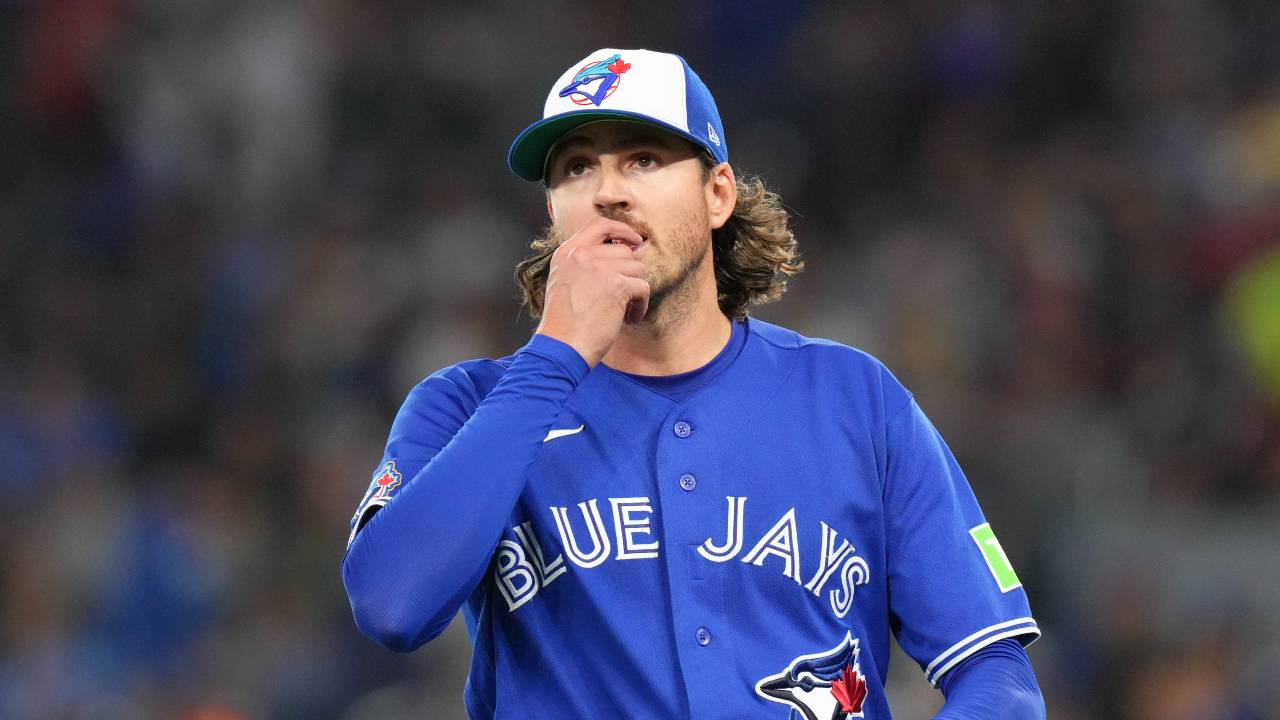
SAN FRANCISCO – In the midst of the winter meetings frenzy last December, the Toronto Blue Jays’ baseball operations department gathered in a team suite to consider their pro scouting group’s annual Rule 5 draft presentation.
Coming off a World Series appearance and determined to make another run, the notion that they would select and carry a pick all season long seemed far-fetched. The club had plenty on the go, too, between signing Dylan Cease and Cody Ponce, working through health concerns for Shane Bieber and Jose Berrios, and the pursuits of Tyler Rogers and Kazuma Okamoto, while also monitoring the Kyle Tucker and Bo Bichette markets.
Still, their scouts were so intrigued by Spencer Miles during the Arizona Fall League that they pushed for his implausible selection. Despite just 10 games and 14.2 innings since the San Francisco Giants made him a fourth-round pick in 2022, they argued that he was ready to get outs in the majors.
“It’s the job of scouting and baseball operations to present opportunities, no matter what’s going on with the roster. Miles was that,” said Ryan Mittleman, the club’s vice-president, pro scouting. “The raw stuff was impressive to us. … We had multiple looks, multiple scouts to say, ‘Hey, the raw data is good, but also, he’s carrying it out into a pretty good league.’ We didn’t let the lack of innings be an impediment. We believed in the stuff. And it carried him to the top of our list.”
Advertisement
Manager John Schneider was in the room for the presentation and remembers “looking at his numbers and I was like, ‘He has how many innings? And what are we doing? And huh?’ They were like his sinker can do this, we think he can develop a slider. I think I said, ‘This guy better be pretty (expletive) good.”
The Blue Jays made Miles the 10th pick of the Rule 5 draft on Dec. 10 and it turns out that he is indeed pretty, ahem, good, emerging into a pitcher that, in Mittleman’s words, “has been huge for us.”
Originally envisioned as an occasional mop-up man at the very end of the bullpen, the 25-year-old has steadily earned more trust in a variety of roles, including eight starts/bulk outings, a needed solution in what’s been a season filled with problems.
His next outing comes Tuesday, when he’ll be the featured arm, possibly the starter, for the Blue Jays in San Francisco, facing the Giants team that helped him through the back and shoulder surgeries that sidelined him for nearly all of the last three years. Some staffers who were close to him are trying to make it out to watch.
Advertisement
“It’s super exciting, but it’s not any different than any other outing,” said Miles laughing when asked if he hears from Giants people wondering how he got away. “Frequently, but that’s OK. Here we are and this org is awesome. So it’s worked out.”
Far more than the Blue Jays imagined, prompting them to again consider building him up with the rotation in continued flux as Max Scherzer continues to rehab from a back issue and Patrick Corbin works out of the bullpen, leaving them short a starter.
How much work Miles can reasonably handle given his lack of volume in recent years – his career high for innings is 77 in 2022 between Missouri and rookie ball – is the Blue Jays’ constant conundrum. There’s no real baseline for the player and no case studies on similar pitchers to draw from, leaving them to feel their way through in the dark.
Given that he’s already at 54 innings in 24 games and has become someone the club feels grow into a viable option for the 2027 rotation, when they project to have several openings with Kevin Gausman, Bieber and Scherzer all pending free agents, the stakes are suddenly higher given what he may become.
Advertisement
Miles, however, shows no signs of slowing down.
Physically, he said he’s holding up and during his last outing, he set a personal best hitting 99.4 m.p.h. against the New York Mets. He threw a season-high 73 pitches June 6 against Baltimore and has pitched 4.1 innings three times. Where he goes from here isn’t uncertain but even with Scherzer on track to be an option after the all-star break, the Blue Jays want to keep Miles going.
Without an objective measure of what is too much, part of the approach is avoiding too much, too fast, both in innings and in velocity.
“I got up to 73 pitches and then kind of deloaded, so I think that, in a way, gave me a new floor. I don’t think we really know what the ceiling is, but we’re just going to keep pushing it and find out,” said Miles. “My volume has reached a certain point now where my body is starting to accept the force. In years past, 98ish has been my peak. But with a new floor, your body adapts.
Advertisement
“So now your brain and your body are like, ‘OK, I can settle in here. I know what that feels like, I can accept the force.’ Then your body’s saying like, ‘Alright, maybe we can go one step above that and break a chain off that prior peak in exertion of force.’ I don’t really know what the limit is. I think there’s still another one or two ticks in a volume floor that we can get to. So, maybe there’s more in there.”
That any of this is in play at all underlines how significant a Rule 5 pick Miles has turned out to be, against the odds.
“Whenever you’re coming off a World Series, you’re usually not taking a Rule 5 pick. You’re usually pretty set. But with the uncertainty of (Yimi) Garcia, some of our starters, it was like, OK, let’s take a chance, bring him into camp and see,” said Schneider. “It’s an amazing job of scouting and trying to predict upside. A lot of that comes into the person, too, not just the stuff. Can this dude handle this? The way it’s worked out has been remarkable, really.”
In setting up 40-man rosters ahead of the Rule 5 draft, teams try to measure the likelihood of other clubs being willing to select and carry a player for a full season in order to lock in their rights.
Advertisement
The Blue Jays in recent years have taken off-the-board swings in the Rule 5 draft, selecting Elvis Luciano out of rookie ball in the Kansas City Royals system in 2018 and carrying him all season, and a post-Tommy-John Angel Bastardo from the Boston Red Sox in 2024. Luciano is now pitching with Yomiuri in Japan, while the Blue Jays returned Bastardo to the Red Sox in April, after Miles beat him out for a roster spot in spring training.
No pick required as much imagination as Miles, given where the Blue Jays had come from and all the other markets they were involved in. But Mittleman credited GM Ross Atkins for being willing to consider all avenues, when “it can be tougher to make a Rule 5 pick when there’s not as much open road for opportunity.”
“He, obviously, hadn’t pitched a ton and was pitching well in Arizona Fall League,” Mittleman continued. “So it was really just a case of our entire group of scouting, R-and-D putting the pieces together and in the end, it was really Ross trusting the process that moved Miles to the top of the list. …
You must be logged in to post a comment Login