Minnesota Vikings quarterback Jaren Hall (helmet) hands the football off during first-quarter action against the Arizona Cardinals on Aug. 26, 2023, at U.S. Bank Stadium in Minneapolis, Minnesota. Hall saw preseason snaps while competing for positioning on Minnesota’s depth chart as the rookie quarterback adjusted to Kevin O’Connell’s offense before the start of the regular season. Mandatory Credit: Jeffrey Becker-Imagn Images.
He didn’t stick around the NFL for long, and this week, former Minnesota Vikings signal-caller Jaren Hall announced his retirement on Instagram.
Minnesota once needed Hall in a hurry, and his unusual football path has now reached its end.
The BYU alumnus embarked on a tiny professional career and now heads toward his next chapter.
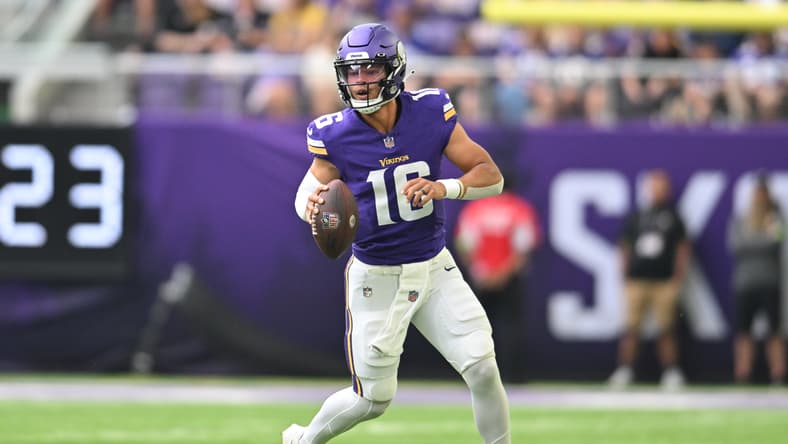
Minnesota Vikings quarterback Jaren Hall (16) rolls to his right looking for a passing lane against the Arizona Cardinals during first-quarter preseason action at U.S. Bank Stadium in Minneapolis on Aug. 26, 2023. Hall showcased his mobility and composure while competing for positioning on Minnesota’s quarterback depth chart entering the regular season under Kevin O’Connell. Mandatory Credit: Jeffrey Becker-USA TODAY Sports.
Hall Retires
The 28-year-old didn’t leave much to the imagination, scribing on social media Wednesday, “There’s a lot I could say, but mostly I just feel grateful. Sports have been woven into nearly every part of my life- they’ve challenged me, humbled me, shaped my faith, introduced me to lifelong friendships, and given me experiences I never could have imagined.”
“From growing up in this community to representing my hometown, to having the opportunity to play in the NFL, it has all been a blessing. What I’ll carry most isn’t the milestones, but the people– teammates, coaches, family, and a community that supported me every step of the way.”
Hall closed the message, “My heart is full as I close this chapter and finish my football career. I’m thankful to everyone who’s been part of the journey. The game has given me more than I could ever give back.”
Career with Vikings
Before J.J. McCarthy arrived in Eagan with significant franchise quarterback hype, the Vikings had already invested in another young quarterback: Hall.
Advertisement
Hall joined the team in 2023, fitting former general manager Kwesi Adofo-Mensah’s “lottery ticket” strategy: a 5th-Round quarterback with experience, composure, mobility, and enough talent to catch Kevin O’Connell’s staff’s attention. While he never generated the buzz of a top prospect, Hall quietly became the team’s emergency backup during Kirk Cousins’ final season in Minnesota.
For a brief period, this plan seemed viable.
Hall performed well in training camp and preseason. Teammates praised his calm demeanor, and the Vikings appeared to trust him more than they typically would a late-round quarterback. He demonstrated quick decision-making, ball security, and effective offense management, continuing the experiment.
Minnesota urgently needed a quarterback solution, and Hall was thrust into a playoff hunt before the team truly understood his capabilities. His first start in Atlanta began with promising moments. He looked poised in the pocket, delivered accurate throws, and for a fleeting moment, Vikings fans wondered if the front office had unearthed another hidden gem. The optimism then vanished almost instantly.
Hall suffered a concussion in that game, sidelining him for weeks as the season devolved into the Joshua Dobbs roller coaster. By the time Hall returned late in the year, the offense was struggling, the pressure immense, and there was no margin for error.
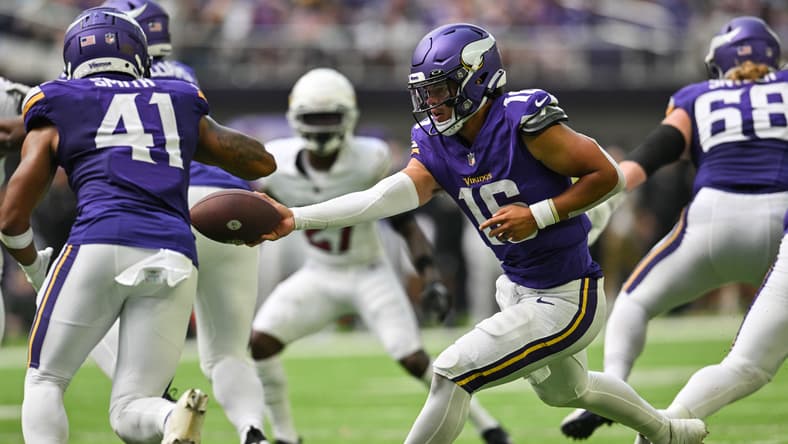
Minnesota Vikings quarterback Jaren Hall (16) hands the football to running back Abram Smith (41) during second-quarter preseason action against the Arizona Cardinals at U.S. Bank Stadium in Minneapolis on Aug. 26, 2023. Hall operated Minnesota’s offense throughout the exhibition matchup while continuing his rookie development during training camp and preseason competition for the Vikings. Mandatory Credit: Jeffrey Becker-USA TODAY Sports.
His final significant appearance against Green Bay was unsuccessful. The game’s speed overwhelmed him, the offense stalled repeatedly, and all the developmental prospect buzz surrounding him evaporated. From that point, the outcome felt inevitable.
Minnesota drafted McCarthy months later, signed Sam Darnold, and completely overhauled their quarterback room for 2024. Hall had no realistic path to making the roster. The Vikings released him during final cuts, Seattle claimed him, and his brief tenure in Minnesota faded almost as quickly as it began.
Yet, for one unusual stretch in 2023, Jaren Hall was the Vikings’ entire Plan B.
Advertisement
The Scene Thereafter
Then, everything turned ever more rotten for Hall. It was as if the “what if” of his upside in Minnesota served as his peak.
He did nothing in Seattle, and in fact, never took another regular season snap. The Seahawks released him in April 2025, right after the draft, when the club onboarded Jalen Milroe from Alabama and already had Drew Lock in line for the QB2 job behind Darnold.
Fast forward to the 2026 offseason, and Hall signed with the UFL’s Birmingham Stallions. Two weeks later, he was dropped by the Stallions, which would turn out to be his final hurrah as a professional or semi-pro football player.
Advertisement
What Could Have Been
Believe it or not, Hall arrived at the absolutely perfect time in Vikings history. The team’s QB1, Cousins, was on his way out as the franchise quarterback and even suffered the gruesome, aforementioned injury. Hall was right there to snatch the job by the throat.
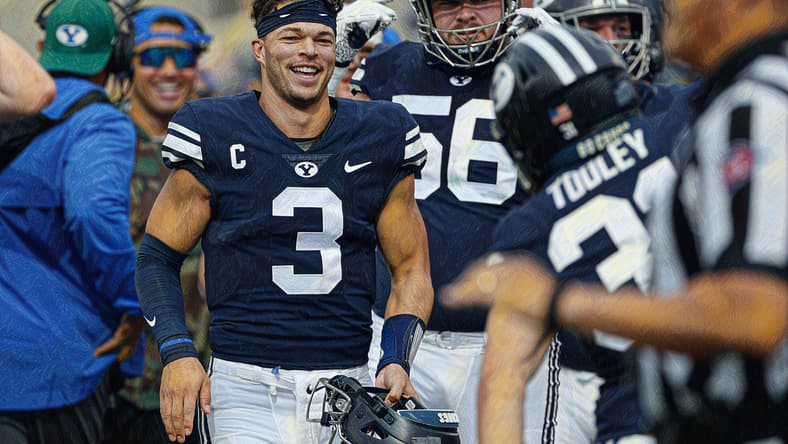
BYU quarterback Jaren Hall (3) reacts after throwing an interception against the Idaho State Bengals during first-quarter action at LaVell Edwards Stadium in Provo, Utah, on Nov. 6, 2021. Hall showed visible frustration after the turnover during BYU’s home matchup as the Cougars attempted to regain momentum early in the contest against Idaho State. Mandatory Credit: Jeffrey Swinger-USA TODAY Sports.
But he got hurt when he was given his big chance, and when he healed, he didn’t quite have the chops during a pivotal regular season game of 2023. As it turned out, he just wasn’t cut out for the NFL, evidenced by his retirement this week.
The stars aligned, though. Minnesota was desperate for a young, unsung passer to step up in 2023 — a guy who could’ve stuck around for the long haul.
That was not Hall.
Advertisement
Dustin Baker is a novelist and political scientist. His second novel, The Invaders , is out now. So is … More about Dustin Baker
Gervonta Davis is set to return to action later this year, but one former opponent has now revealed that he had signed for a rematch with ‘Tank’, only for the three-division world champion to then have a change of heart.
External issues have since kept Davis away from the ring and that inactivity has caused the Baltimore knockout artist to be downgraded from WBA champion to ‘champion-in-recess’.
Advertisement
In order to regain the full world title, Davis will need to overcome 21-year-old mandatory challenger Floyd ‘Kid Austin’ Schofield, with that fight having been ordered by the World Boxing Association.
Speaking with FightHype, recent foe Roach has now revealed that he signed for a rematch with Davis following their draw, blaming the 31-year-old for the lack of a second fight.
“Obviously that is the rematch that I want, they chose not to do the rematch, just so that everyone knows. We were ready, we signed our contract, we did our business to make the rematch happen – the other side didn’t. So let’s just make that clear.
“Other than that, I am not too worried about it. I am not hanging my hat on a Gervonta Davis rematch, I did what I was supposed to do that night in the ring, I should have got the victory but it is what it is, life goes on, man, and I am going to move on to bigger and better things.”
Over the next couple of weeks, you’re going to see a lot of companies release USA 250 merch and some limited-edition products. Some companies have already released their goods, but today PXG joined the celebration with its Stars and Stripes 250 Collection of apparel (including red, white and blue versions of my favorite workout shirt), accessories and bags.
The collection also means a little extra to PXG, and for good reason.
Bob Parsons, founder of PXG, is a Vietnam War Marine Corps veteran and isn’t shy about his love for his country and the celebration it brings. He’s a big believer in the existence of freedom in America and founded PXG on the foundation that confidence and pride carry through to performance, in the same way his service is celebrated by civilians enjoying their day to day freedoms with the trust in their armed forces.
That same exercise of trust in performance is brought to every PXG product, including their clubs, and their curated collections like the brand new Stars and Stripes 250. If Bob approves of the collection, you know it screams pride and confidence.
Advertisement
Bob Parsons, founder of PXG, is a United States Marine Corps veteran.
Fox News
The PXG Stars and Stripes 250 Collection includes accessories, bags, headcovers, towels, apparel and headwear designed with American themes and symbols throughout. But PXG takes the details to the next level. There’s nods to just about every classic Americana symbol you can think of. Patchwork inspired by Betsy Ross’s creation of the American flag and embroidery details of the Liberty Bell, an American eagle and other markings.
My favorite part of any PXG product is that PXG isn’t afraid to be loud and expressive. There’s so much detail in this product that even just going through the photos, it’s hard to find every detail at first glance. I also happen to be a huge fan of their bags (they have lots of pockets) and through the photos you can almost feel the dimension in the product with all that embroidery, the raised patterns and that unmistakable PXG brand mark.
The bags featured in the PXG Stars and Stripes 250 collection.
PXG
Advertisement
On top of the collection drop, PXG is also running a giveaway, which you can enter on their website, for some exclusive Stars and Stripes 250 gear that includes the PXG staff bag that PXG staffers will be carrying at next week’s U.S. Open. There’s also a custom 250 collection-themed set of PXG’s new Stick Em wedges.
You can view all the details for the Stars and Stripes 250 Collection and their giveaway on PXG’s website.
As the 2026 FIFA World Cup kicks off in North America, I find myself asking a question that millions of African football fans have asked for decades: can an African country finally win the World Cup?
For the first time in history, Africa will have 10 representatives at football’s biggest tournament. Algeria, Cape Verde, Côte d’Ivoire, DR Congo, Egypt, Ghana, Morocco, Senegal, South Africa and Tunisia will carry the dreams of more than a billion people across the continent.
When I look at that list, I see more than just football teams. I see decades of struggle, progress, heartbreak and hope.
Advertisement
I think about Egypt becoming the first African nation to play at the World Cup in 1934. I think about the years when Africa had only one representative and was often treated as an outsider in the global game. I think about Cameroon shocking the world in 1990, Senegal stunning defending champions France in 2002, and Ghana coming within inches of a semi-final place in 2010.
I also remember the pain.
The controversial moments. The missed penalties. The narrow defeats. The feeling that Africa was always close but never quite close enough.
Advertisement
Then came Qatar 2022.
I watched Morocco achieve something no African country had ever done before. The Atlas Lions defeated Belgium, Spain and Portugal to reach the semi-finals. For the first time, I felt that the impossible no longer looked impossible.
Morocco changed the conversation.
Before Qatar, many people spoke about African teams as outsiders. After Qatar, they started talking about African teams as genuine contenders.
Advertisement
That is why I believe the 2026 World Cup could be the tournament that changes everything.
With 10 teams competing, Africa has never had a stronger presence at the World Cup. The continent has more opportunities than ever before to produce a champion.
But if I had to choose the two African countries most capable of lifting the trophy, my picks would be Senegal and Morocco.
Morocco remains Africa’s strongest football story of recent years. Their success in Qatar was not built on luck. It was built on organisation, discipline, tactical intelligence and belief.
Advertisement
Many of the players who reached the semi-finals remain at the peak of their careers. They understand what it takes to compete with the world’s elite nations. More importantly, they no longer fear them.
The Atlas Lions have already broken one barrier. Winning the World Cup would be the next.
Senegal is my other favourite.
The Teranga Lions possess something every successful World Cup team needs: experience, physical strength, quality players and a winning mentality.
Advertisement
Over the last decade, Senegal have consistently remained among Africa’s strongest teams. They won the Africa Cup of Nations, have competed at multiple World Cups and continue to produce players who perform at the highest level in Europe.
Unlike previous generations, this Senegal team understands how to handle pressure. They know how to win difficult matches. They know how to suffer and survive when things are not going their way.
That experience could prove crucial in a tournament as demanding as the World Cup.
Of course, winning the competition will not be easy.
Advertisement
Traditional powers such as Brazil, Argentina, France, Germany, Spain and England will arrive with the same ambition. History remains firmly on their side.
No African nation has ever reached a World Cup final, let alone won one.
But history is not a law of nature.
Every record exists until someone breaks it.
Advertisement
For years, people said an African team could never reach the semi-finals. Morocco proved them wrong.
Now people say an African team cannot win the World Cup.
Perhaps they are right.
But perhaps they are only right until someone proves otherwise.
Advertisement
As I prepare to watch the 2026 World Cup unfold, I cannot ignore the feeling that African football is entering a new era. From Egypt’s lone appearance in 1934 to 10 representatives in 2026, the journey has been remarkable.
The numbers have grown.
The quality has improved.
The belief is stronger than ever.
Advertisement
And if Africa is finally going to produce a World Cup winner, I believe Morocco and Senegal offer the continent’s best chance of making history.
Bangladesh’s Mustafizur Rahman, center, celebrates with teammates (AP Photo)
Bangladesh created history on Thursday by clinching their first-ever ODI series victory over Australia, securing an unassailable 2-0 lead in the three-match contest with a composed five-wicket win in the second match.A lengthy rain interruption of nearly two-and-a-half hours forced officials to revise Bangladesh’s target under the Duckworth-Lewis-Stern (DLS) method. Chasing 192 from 41 overs, the hosts comfortably reached 195 for 5 with six overs remaining, ensuring the series was theirs with one match still to play. The final ODI is scheduled for Sunday at the same venue.The result was built on another disciplined all-round performance from Bangladesh after Australia’s batting lineup endured a disastrous start. The visitors lost their first three wickets without scoring a run, placing themselves under immediate pressure.Only resilient half-centuries from Marnus Labuschagne and Xavier Bartlett helped Australia recover from the early collapse. Labuschagne remained unbeaten on 55, while Bartlett contributed 52 as Australia eventually posted 187 for 8 from their allotted 42 overs.Bangladesh made just one change to the side that had won the opening ODI by 86 runs via the DLS method, bringing in opener Soumya Sarkar. The move paid dividends as Sarkar scored 42 and shared a crucial partnership with Najmul Hossain Shanto, who also made 42.After a shaky start, Shanto settled into his innings and, alongside Sarkar, added 86 runs to put Bangladesh firmly in control of the chase. Riley Meredith eventually broke the stand when Shanto edged behind, handing the fast bowler his first ODI wicket in five years following his return to the format.Despite being well placed, Bangladesh briefly stumbled to 144 for 5 in the 27th over, giving Australia a glimmer of hope. However, Towhid Hridoy and captain Mehidy Hasan Miraz extinguished those hopes with an unbeaten 51-run partnership that guided the hosts across the finish line. Hridoy remained not out on 40 from 55 deliveries.There was a concerning moment near the end of the chase when Mehidy was struck on the helmet by a delivery from Nathan Ellis. The Bangladesh captain dropped to his knees and vomited on the field. Although he declined the offer of a stretcher and continued batting, Shanto later revealed that Mehidy was taken to hospital for observation after the match.Australia’s decision to bat first backfired dramatically. Matthew Short registered his third consecutive ODI duck, while Cooper Connolly and Matthew Renshaw also departed without scoring. It marked only the fourth occasion in ODI history that a team had lost its first three wickets before opening its account.Mustafizur Rahman and Taskin Ahmed were the chief architects of Australia’s collapse. Both pacers claimed three wickets each, with Mustafizur finishing with figures of 3 for 27 and Taskin returning 3 for 33. Mustafizur also accounted for Alex Carey, who was caught at point.The situation worsened for Australia when captain Josh Inglis was dismissed at deep cover, leaving the visitors struggling at 68 for 5.Labuschagne, batting at No. 7, then combined with Bartlett to launch a recovery. The pair added 103 runs for the sixth wicket and gave Australia something to bowl at after appearing destined for a far lower total. Labuschagne’s innings was particularly significant as it marked his first ODI half-century in 14 innings. He also enjoyed an early reprieve when Tanvir Islam missed the stumps with a run-out attempt while the batter was on just one.Ultimately, however, Bangladesh’s batting depth and composure under pressure proved decisive as they sealed a landmark ODI series triumph over Australia.
The para-cyclist, who only first learned to ride by freewheeling down the slopes of Greenwich Park in 2012, is now a medal-winning force for Britain.
It’s fair to say Team England’s Matt Robertson is a quick learner.
The para-cyclist has become a medal machine for Britain despite only first stepping on the pedals when freewheeling down Greenwich Park in 2012.
Advertisement
And this summer, he will make his debut for Team England in the Commonwealth Games, heading to Glasgow for the C1-3 1km time trial and individual pursuit.
He said: “It’s really special, because it’s the only time you are separated off from being Great Britain to just representing England, and it’s such a successful team that you want to carry that through.
“I watched Chris Hoy on the telly at London (2012), and that was kind of the lightbulb moment where I thought, ‘you know what, I really want to do that.’
“At the time, I had no idea about cycling and the velodrome and I just threw myself into it.
Advertisement
“At that stage, I couldn’t even ride a bike, so it took quite a while for me to learn. I took myself off down to Greenwich Park, which was the local one to me, and I would get some momentum down the hill because the starting point is what I can do.
“That was a unique experience, probably one that others won’t have had to do because everyone’s disability is different. My disability affects my whole side, so it’s not just an arm problem, but a whole balance issue. But once I had mastered that, I was hooked.”
The 27-year-old suffers from hemiplegia, a paralysis of the right side of his body, meaning he sits in the C2 classification for those who can ride a standard bicycle.
Robertson also suffers from epilepsy and has done an enormous amount of campaigning, completing the Epilepsy Society’s Challenge 100 and setting up a podcast to raise awareness of the disease.
Advertisement
At the 2024 Paralympics, he clinched bronze in the C2 pursuit, then added two further medals at the Road World Championships. He is also a two-time medallist at the Track World Championships.
He said: “The more I understand and take in that I’m doing it, the more I get really excited for it.
“It makes me think back to Paris, which is the first major competition I’d say where it opened my eyes to what performing at that level was like, and I can only get excited about those memories and those feelings and know that’s going to be what it’s like when I do race in Glasgow.”
Team England are Ready to Win at the 2026 Commonwealth Games. Keep up to date on https://teamengland.org/
Long before the Korda sisters, Jessica and Nelly, there were the Curtis sisters, Harriot and Margaret. Between them, they captured four U.S. Women’s Amateur titles. But their legacy in the game is more closely linked to the biennial competition that bears their name.
The Curtis Cup returns Friday for its 44th edition, pitting elite female amateurs from the United States against counterparts from Great Britain and Ireland in three days of foursomes, four-ball and singles matches. Though the Americans own a lopsided 31-9-3 advantage in the biennial series, the visitors arrive as defending champions after their victory two years ago at Sunningdale.
Sunningdale is a fitting point of reference. Over the decades, the Curtis Cup has traveled to many of the game’s most celebrated venues, and this year’s host is no exception. The team matches will be contested at Bel-Air Country Club, the Los Angeles gem etched into the hills just a few miles from Riviera, site of last week’s U.S. Women’s Open.
Like Riviera, Bel-Air was designed by George C. Thomas (with assistance from Billy Bell). But it has a personality all its own. Before Friday’s opening tee shots, here are 8 things to know about the course and the club.
Advertisement
One of the Big Three
“Triumvirate” is a fancy word for “prominent trio,” and it gets used a lot in reference to the three most famous courses in L.A.: Riviera, Los Angeles Country Club and Bel-Air. Thomas’ triumvirate! He designed them all in the 1920s, and though Riviera and LACC rank higher on Top 100 lists, the architect himself was most proud of Bel-Air, according to Thomas biographer Geoff Shackelford, in part because of the challenges of the site.
Bridges, tunnels . . . and an elevator
Where Riviera lies along an old river bed, and LACC sprawls over expansive, rolling acreage, Bel-Air spills through four canyons whose ravines and washes posed a routing puzzle. The solution takes golfers on a memorable journey. Over 18 holes, players pass through four tunnels and ride an elevator from the 9th green up into the clubhouse. From there, it’s a short walk to the 10th hole, a long par-3 that plays over a ravine, its tee linked to the green by a 350-foot suspension bridge.
The tunnels of Bel-Air Country Club. The brilliance and audaciousness of George Thomas in routing a course that required three (and eventually four) tunnels, an elevator and a suspension bridge in 1926 is astounding. As bold and creative a routing as any golden age design. pic.twitter.com/T9Vpj8QsEB
Billy Bell played a role in the design. But another Bell made the project happen. Alphonzo Bell (no relation to Billy) was an oil and real-estate tycoon who developed the land where the course now sits. Though Bel-Air is French for “beautiful air,” it’s also a spin on the Bell surname.
Advertisement
Nips and tucks
Like a lot of big-name Angelenos, Bel-Air has had plenty of work. Aside from George Thomas and Billy Bell, at least seven architects have altered the course to varying degrees, including Dick Wilson, whose 1962 renovation so upset Thomas’ daughter, a Bel-Air member, that she boycotted the club. Over the decades, other architects — George Fazio, Tom Fazio, Jack Nicklaus and Robert Trent Jones Jr. among them — also carried out tweaks. But the most recent overhaul was conducted by Tom Doak, whose 2018 restoration erased artificial water hazards, reduced total bunkers and undid other changes made throughout the decades, all with the aim of reviving Thomas’ original design.
Comfortable on camera
Doak’s restoration was aided by ample archival material, photographs included. One of those pictures was an aerial shot of a maintenance worker hand-watering the 9th green, snapped nearly a century ago from the Goodyear Blimp. “It doesn’t get much more L.A. than that,” says Eric Iverson, who was Doak’s lead associate on the job.
Glittery crowd
It also doesn’t get much more L.A. than Bel-Air’s membership. In the Golden Age of Hollywood, Jimmy Stewart, Fred Astaire, Dean Martin and Humphrey Bogart all belonged, just as Jason Bateman, Chris O’Donnell, Luke Wilson and Dennis Quaid are in the ranks today. Actors and studio executives abound. Ditto athletes, including Marcus Allen, Wayne Gretzky and Jarrett Stoll. Then there’s Mae West, who was not a member but who left a mark on Bel-Air anyway. Two prominent fairway mounds on the par-4 12th are nicknamed in honor of the voluptuous star.
Among Bel-Air’s famous members: Jason Bateman.
getty images
Advertisement
Holes worth knowing
Thomas believed in opening his courses with a friendly handshake, and Bel-Air’s 1st — a gettable par-5 plunging into the canyon — fits that mold. But as he did at Riviera and LACC, he stiffens things up with a stour par-4 2nd, which requires a carry off the tee over a penal fairway bunker. Nine shots through two holes is a good score. On the back nine, the 14th is a rare par-5 that troubles even elite players, its narrow tee shot followed by a layup complicated by water and a green that runs away from the approach. The par-4 17th drops downhill to a fairway made elusive by the change in elevation and then to a green with trouble all around. It can be a punishing penultimate hole.
Place has stories
If Riviera is the perfect tournament course and LACC the understated cathedral, Bel-Air is the club with the best gossip. Howard Hughes once landed a plane on the property, in a rush to pick up Katharine Hepburn. Members describe a genuine club culture — people who actually know each other and rib each other. Al Michaels, a member, isn’t known for calling golf — but heckling players from the patios overlooking the 1st and 10th tees is something of a club custom, and he’s happy to oblige.
There are stadiums. There are iconic stadiums. And then there is the Estadio Azteca.When Mexico kicks off the 2026 FIFA World Cup against South Africa on Thursday, this magnificent giant in the heart of Mexico City will do what no other football stadium in the world has ever done- to host a World Cup opening match for the third time in history. In two greatest World Cup editions in 1970 and 1986 previously, and now in 2026.Often called the “Colossus of Santa Ursula,” construction of the iconic venue began in 1961 and was completed five years later, with over 107,000 fans pouring in for the inaugural match between Club America and Italy’s Torino. What followed over the next six decades was nothing short of extraordinary.
Pelé and the Golden Final of 1970
At the 1970 World Cup, as Mexico became the first country outside Europe and South America to host the tournament, the Azteca stood as the showpiece stadium. It hosted 10 matches, including one of the greatest games ever played – Italy defeating West Germany 4-3 in a breathtaking semifinal. Brazil then crushed Italy 4-1 in the final, with a young Pele parading the Jules Rimet Trophy around the pitch. “There’s just something very special about the Azteca,” the Brazilian legend had famously said. “You need to be inside it, to feel it to understand.”
Maradona’s Divine Madness
Sixteen years later, the world came back. And it gave us Maradona.In the 1986 quarterfinal against England, Argentina’s Diego Maradona produced arguably the two most iconic moments in football history, first punching the ball into the net with his left hand in what became forever known as the “Hand of God,” then completing a mazy solo run past multiple defenders to score the ‘Goal of the Century’. Argentina went on to defeat West Germany 3-2 in the final, lifting the World Cup in Mexico City. Maradona himself never forgot it. “This stadium is the cathedral of my life in football,” he said during a visit in 2000.Now, after nearly two years of renovations that included new seating, upgraded locker rooms, improved lighting and a rebuilt pedestrian bridge, the grand old lady is ready again. The historic venue will host five matches during the 2026 World Cup, including the opening ceremony.Pele called it one of a kind. Maradona called it the cathedral of his life. A new generation of players and fans are about to find out exactly what they meant.
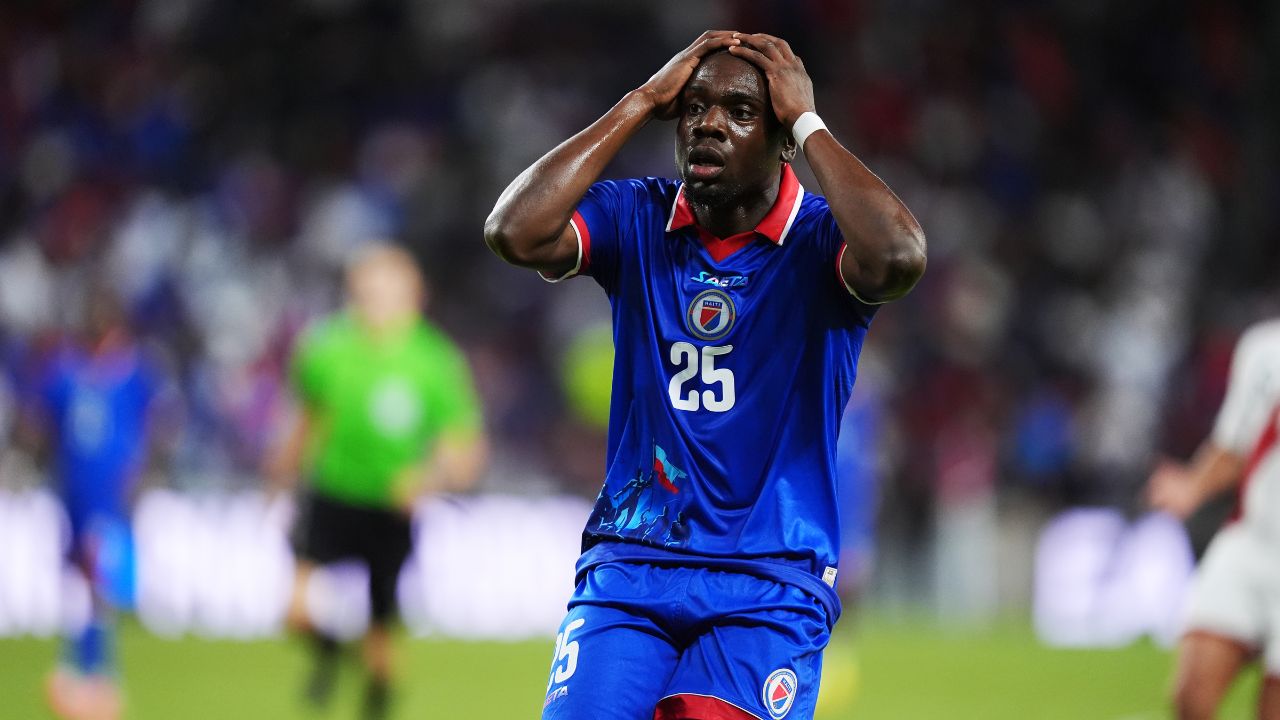
MILAN — Haiti has been forced to change the design of its World Cup jersey after it was deemed too political by FIFA just months after the Caribbean nation had to amend its Winter Olympic uniforms.
The jersey, by Colombian sportswear manufacturer Saeta, originally included a depiction of the final battle of the Haitian War of Independence in 1803 on its front. The image was rejected during FIFA’s approval process.
Saeta said in a statement Wednesday that it would comply with the ban even though the design “was not intended as a political statement,” but rather as a “tribute to the men and women who contribute every day to Haiti’s future.”
The jersey featured blue to mirror the sea and red for the nation’s “strength and passion,” the sportswear maker said. Players wore the now-banned jersey in a warmup match against Peru last week. The original design was currently marked as sold out on the SaetaUSA online shop.
Advertisement
Similarly, the International Olympic Committee required the removal of an image of Haitian founding father Toussaint Louverture from Haiti’s opening ceremony uniforms for the Milan Cortina Winter Games, ruling that it violated Olympic rules barring political symbolism.
Haiti gained independence in 1804 and is widely regarded as the world’s first independent nation founded by formerly enslaved people after a successful slave revolt.
Italian-Haitian designer Stella Jean, who designed the Olympic uniforms, came up with a creative solution: painting over the figure, leaving just a horse against the background of tropical foliage. The designs were so much in demand that Jean later created a production version featuring the original Louverture image.
“Either way, Haiti has to be setting a record: Two rebukes from the highest international sports authorities in just a few months,” Jean told The Associated Press on Thursday.
Advertisement
Haiti opens World Cup play on Saturday against Scotland in Foxborough, Mass., then plays five-time champion Brazil on June 19 in Philadelphia and Morocco on June 24 in Atlanta.
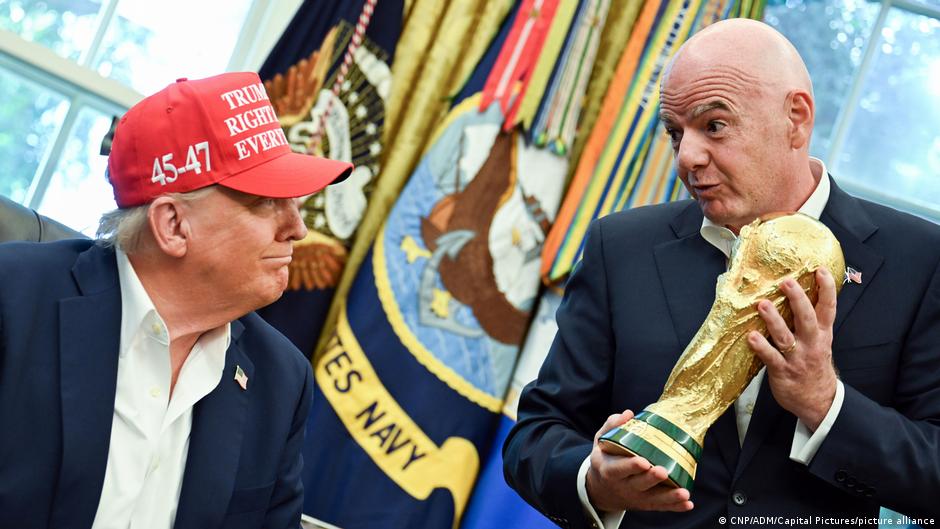
According to its own statutes, FIFA is supposed to be politically neutral. However, Infantino has created the impression that he is deliberately mixing international sports politics with the interests of a state.
2. Shouldn’t all fans be able to attend their team’s games?
US entry regulations are also drawing sharp criticism. Tightened visa rules mean fans from several participating nations are effectively barred from attending. For Iran and Haiti, a complete entry ban applies to spectators — only the teams and their support staff are allowed to enter the country.
Fans of Senegal will find it difficult to follow their team to the World Cup in the USAImage: Ulrik Pedersen/NurPhoto/picture alliance
It will also be virtually impossible for fans from Senegal and the Ivory Coast to attend games, as the issuing of tourist visas for citizens of these nations has been largely suspended — partly because, in the past, many travelers from these countries overstayed their visas in the US. At one point, the US government had introduced a security deposit of up to $15,000 (€12,874) for visitors from some countries — a sum they were to be reimbursed after their departure. This measure was lifted for many ticket holders shortly before the tournament began.
US immigration policies and the possibility of operations by Immigration and Customs Enforcement (ICE) officers are fueling a sense of unease. In the run-up to the event, the US government declined to rule out the possibility of checks or arrests in the vicinity of World Cup stadiums.
3. Should a ticket for a game really cost $690,000?
Ticket prices at the start of sales were exceptionally high; many seats went on sale for thousands of dollars each, while premium tickets for the final originally cost around $11,000.
FIFA is using “dynamic pricing,” under which prices fluctuate significantly depending on demand. Even within the same sales phase, fans are paying different amounts for identical seats.
Added to this are reports that buyers, despite selecting a specific category or location within the stadium, have received tickets for inferior seats. Fan organizations and consumer protection groups accuse FIFA of price gouging, a lack of transparency, and unfair sales practices and have filed a formal complaint with the European Union. The attorneys general of the US states of New Jersey and New York have launched investigations into FIFA’s ticketing.
Advertisement
With just weeks to go before the opening game, very few matches had sold out. As of May 28, the cheapest ticket for the final available on FIFA’s website was listed at $8,625. A seat in wheelchair areas was going for a minimum of $10,350. The very last available seat — located in the front row of a section near one of the corner flags — was listed for $690,000.
Germany failed to make it to the knockout phase of the last two World Cups, but with 48 teams, this time it should be easierImage: Frank Hoermann/Sven Simon/IMAGO
In addition to official ticket sales, FIFA operates its own resale platform, taking a 30% cut of every transaction. Critics argue that many fans have been priced out of the tournament.
4. Shouldn’t only the best teams compete at the World Cup?
This World Cup will feature 48 teams instead of 32. As a result, the number of matches will increase from 64 to 104. Experts and many fans fear this could dilute the sporting quality of the tournament.
At the same time, advancing to the knockout stage has become easier, as not only the top two finishers from each of the 12 preliminary groups will qualify, but also the eight best third-placed teams. Due to the number of teams, a round of 32 has been added.
Some observers view this reform as a politically motivated decision: smaller football associations — whose votes carry significant weight within FIFA — stand to benefit most from the allocation of additional spots. This raises the question of Infantino’s motives for pushing through this expansion. Was it primarily to consolidate his power base within the football’s global governing body?
Advertisement
5. Wasn’t this tournament meant to be sustainable and climate-friendly?
Although FIFA has publicly championed the causes of sustainability and climate protection, the 2026 World Cup is facing heavy criticism due to its environmental impact. Studies estimate that the tournament will generate more than nine million tons of carbon dioxide, primarily due to the distances between host cities and the high volume of air travel involved. Environmental organizations have labeled this event potentially the “most climate-damaging World Cup” in history.
The problem persists at the local level as well. Many stadiums are located in the suburbs and in some cases there is little or no public transportation available. Where public transportation is available, some prices have skyrocketed; a short train ride to MetLife Stadium from New York was originally set to cost up to $150 (compared to the standard fare of around $13). Following protests from fans, the organizers eventually lowered the price to $98. The shuttle bus service is now scheduled to cost $20, down from the previously proposed $80. Those driving to the stadium face high parking costs at many venues, ranging from $75 to $300, depending on the game. At least at stadiums with expensive parking, there is usually an affordable public transit alternative.
Critics say all this means that despite FIFA’s climate pledges, many fans will be forced to undertake environmentally harmful — and expensive journeys.
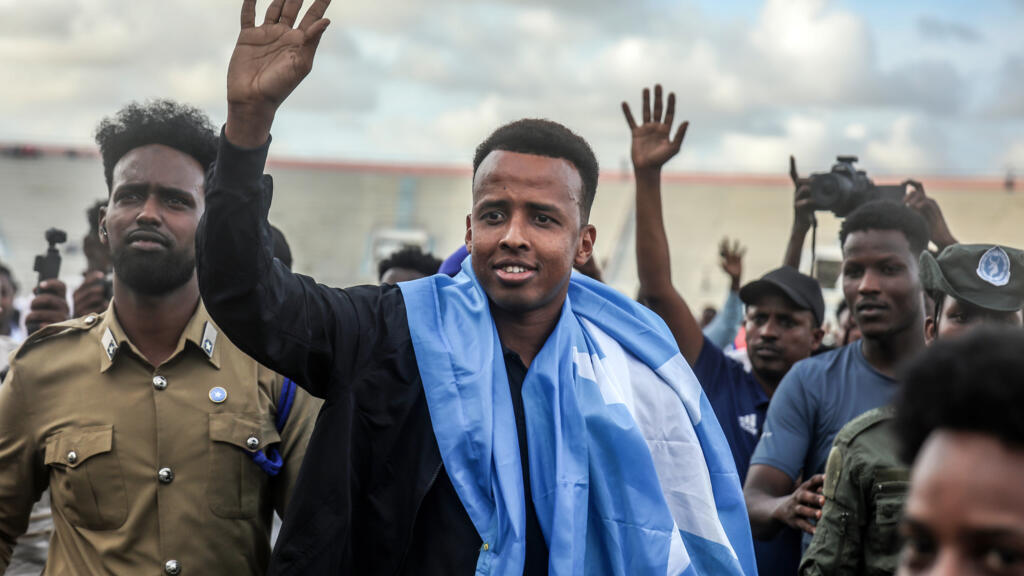
Somali referee Omar Artan, who was denied entry to the United States for the World Cup, was on Thursday named to officiate UEFA’s Super Cup, European football’s governing body announced.
UEFA president Aleksander Ceferin poured praise on the Somali referee in a statement released a few hours before global body FIFA’s flagship World Cup was to start.
“Omar Artan is an excellent young but already experienced referee, who has proven himself at the highest competition level of the Confederation of African Football,” said Ceferin.
“Football is made to connect people, and UEFA wants to show its respect to Omar and his outstanding officiating skills, which had earned him such a prestigious nomination.”
Advertisement
UEFA said that after talks with the African confederation, it “has today appointed Somali referee Omar Artan to officiate the 2026 UEFA Super Cup” on August 12 in Salzburg, Austria, between Champions League winners Paris Saint-Germain and Europa League winners Aston Villa.
Artan’s case has been on of many incidents to taint the runup to FIFA’s World Cup.
UEFA said Artan’s appointment came in the framework of an accord between UEFA and CAF to encourage cooperation.
African pride
“UEFA and CAF are united by a shared commitment to developing football at all levels and promoting the core values of unity, equality and non-discrimination,” it said.
Advertisement
CAF President Patrice Motsepe said Artan had “made Somalia and the entire people of the African continent, extremely proud”.
“His receipt of the CAF men’s referee of the year award 2025 and his appointment as a referee of the FIFA World Cup 2026 are a recognition of his world-class refereeing ability and the international respect that he enjoys.”
His appointment to referee the Super Cup “is a great honour for Omar Artan and for African referees and is also an excellent example of football, bringing together and uniting people from Africa and Europe and worldwide”, Motsepe said.
Artan was barred from entering the US on Saturday after arriving at Miami International Airport.
Advertisement
A US State Department official told AFP that the referee was “associated with suspected members of terrorist organizations”, therefore “making the traveler ineligible for admission to the United States”.
FIFA also confirmed that he would no longer be part of the World Cup.
Artan’s appointment to the 52-strong roster of referees for the finals in Canada, Mexico and the United States had been a huge source of pride for his compatriots.
He returned to a hero’s welcome in Mogadishu on Wednesday and vowed to take part in the next World Cup in 2030.






;)
;)



;)





































You must be logged in to post a comment Login