88% of organizations use AI but only 7% have scaled it (McKinsey). Dessy Pavlova argues the gap exists because companies apply AI to fragmented operations rather than redesigning the process first. She builds systems where a single human decision triggers cascading updates across websites, scheduling, and finance, with stopgates for human oversight. NBER research found AI boosted support-agent productivity 14% on average, but the technology helped people perform work, not eliminate the need to understand it.
I have come to believe that one of the biggest misconceptions about AI is also one of the most expensive: the idea that technology can repair a business that has never streamlined how its processes actually work. AI can accelerate an operation, automate repetitive work, and surface problems at remarkable speed. Give it a fragmented business, however, and you may simply get a faster version of the fragmentation.
The numbers should make business leaders pause. McKinsey’s 2025 global survey found that 88% of respondents said their organizations were using AI in at least one business function, yet only 7% said AI had been fully scaled across the organization. Its research points to workflow redesign as one of the strongest factors associated with financial impact from generative AI.
Why is the gap so large? Look at how many businesses actually operate. A customer arrives through a website. Someone enters the information into a spreadsheet. Another person moves it into an operating platform. Someone updates the website. Finance receives a separate piece of information. An accountant reconciles something later. Every handoff creates another opportunity for delay, duplication, or error. The business may have excellent software at every stage and still have a broken system.
Advertisement
I see this often because my work now sits deep in business operations, although my background is in writing and marketing. I have worked with businesses ranging from one-person organizations to multimillion-dollar operations, and the pattern is remarkably familiar. Companies accumulate tools because each one solves a particular problem. Then they use connectors such as Zapier or Make to force those tools to cooperate.
There is another possibility now. Build the system around the business itself.
Imagine a company running dozens of classes. A student changes classes. A teacher moves to another day. A human makes that decision. The information then needs to travel through the website, operating system, scheduling process, and financial records. In a fragmented setup, people may have to make every downstream change themselves. In a properly designed AI-enabled system, the original decision can trigger the rest of the workflow automatically.
The human remains the architect. AI becomes the operational engine.
Advertisement
That is crucial because automation without oversight simply relocates risk. I build stopgates into systems so a person can see what changed, intervene if something looks wrong, and confirm that the process has reached the intended endpoint. AI can flag an anomaly or carry information across systems. Someone still needs to understand what the business is trying to accomplish.
Research supports the value of this human-machine arrangement. A study of 5,179 customer-support agents found that access to generative AI increased productivity by 14% on average, with particularly large gains among less experienced workers. The technology helped people perform their work. It did not eliminate the need for people to understand the work.
This becomes even more important as a company grows. Growth exposes every loose connection.
Before spending heavily on marketing or customer acquisition, I want a founder to map the entire journey of a customer. How does someone enter the business? Where does their information go? Who acts on it? What reaches the customer? What reaches finance? How does the accountant know what has happened? Where can a human error enter the chain?
Advertisement
Getting the customer and collecting the money are only two moments in a much longer operational journey.
AI gives us an extraordinary opportunity to redesign that journey. McKinsey’s latest research argues that applying AI to isolated tasks leaves substantial value on the table, while reimagined workflows can unlock much larger productivity gains. IBM’s 2026 research also found that only 11% of surveyed technology leaders felt completely prepared for the scale of AI-agent deployment, highlighting how quickly capability can outpace organizational control.
The truly revolutionary AI application for business now has nothing to do with generating another piece of content. The real power lies in the invisible architecture underneath it all, ensuring information moves flawlessly, decisions reach the right leaders instantly, financial records remain immaculate, and employees finally win back their time.
I don’t want AI running a business for people. I want it to remove the administrative friction that prevents people from running their businesses well.
Advertisement
Build the blueprint carefully. Put humans at the right decision points. Let AI handle the legwork. Then growth has somewhere solid to go.
The takeaway: Payment organizations have launched a new joint venture to promote Europe’s sovereignty in the payments industry. The European Network for Payments (ENP) is designed to increase interoperability among competing networks, building a common EU infrastructure that should theoretically give Visa, Mastercard, and other US-based giants a very hard time on European soil. Ultimately, ENP could help reduce Europe’s reliance on US-based payment networks as tensions between Washington and Europe continue to grow.
The original ENP initiative launched in 2023, but European sovereignty is now becoming a truly critical issue. The new network’s founders include Bizum (Spain), Bancomat (Italy), European digital wallet company Wero, SIBS-MB WAY, and Vipps MobilePay.
Together, these payment networks already cover 70% of Europe’s and Norway’s population, serving the payment needs of 130 million users across 13 different European countries.
Rather than creating a completely new network, ENP will work on building closer partnerships among payment networks that already exist. First, the new Madrid-based organization will focus on properly connecting the existing networks, adopting a common technical and operational infrastructure based on European standards.
Advertisement
According to ENP’s deployment plan, the common infrastructure will go through a phased rollout, starting with cross-border payments and in-person transactions. ENP should eventually expand its reach to e-commerce and other online payments, in-store point-of-sale transactions, and essentially everything else.
ENP proponents said the organization expects to welcome additional members in the future, further increasing the network’s ability to cover the payment needs of European citizens. ENP expects to absorb the network’s operating costs at first, allowing the basic infrastructure to be built before it begins generating its own fees.
According to European Payments Initiative CEO Martina Weimert, fragmentation has long hindered any major attempt to build a common payment platform within the Old Continent. ENP is now offering a cooperation-based answer, asking other EU-based payment organizations to join the effort as well.
The European Central Bank is also working on its own solution for a common payment tool with the digital euro currency. A few years down the line, the bank-controlled euro wallet might become a complementary payment platform to ENP.
Fubo’s U.S. lineup includes national sports, news and entertainment networks, optional channel packages, local broadcast stations, and regional sports networks. Your exact lineup depends on the plan you choose, any add-ons you buy, and your home location.
This guide organizes a broad verified Fubo channel reference as of October 3, 2026. It also links to Fubo’s live tools for channel, local-station and regional-sports data that can change after publication.
How to read this Fubo channel database
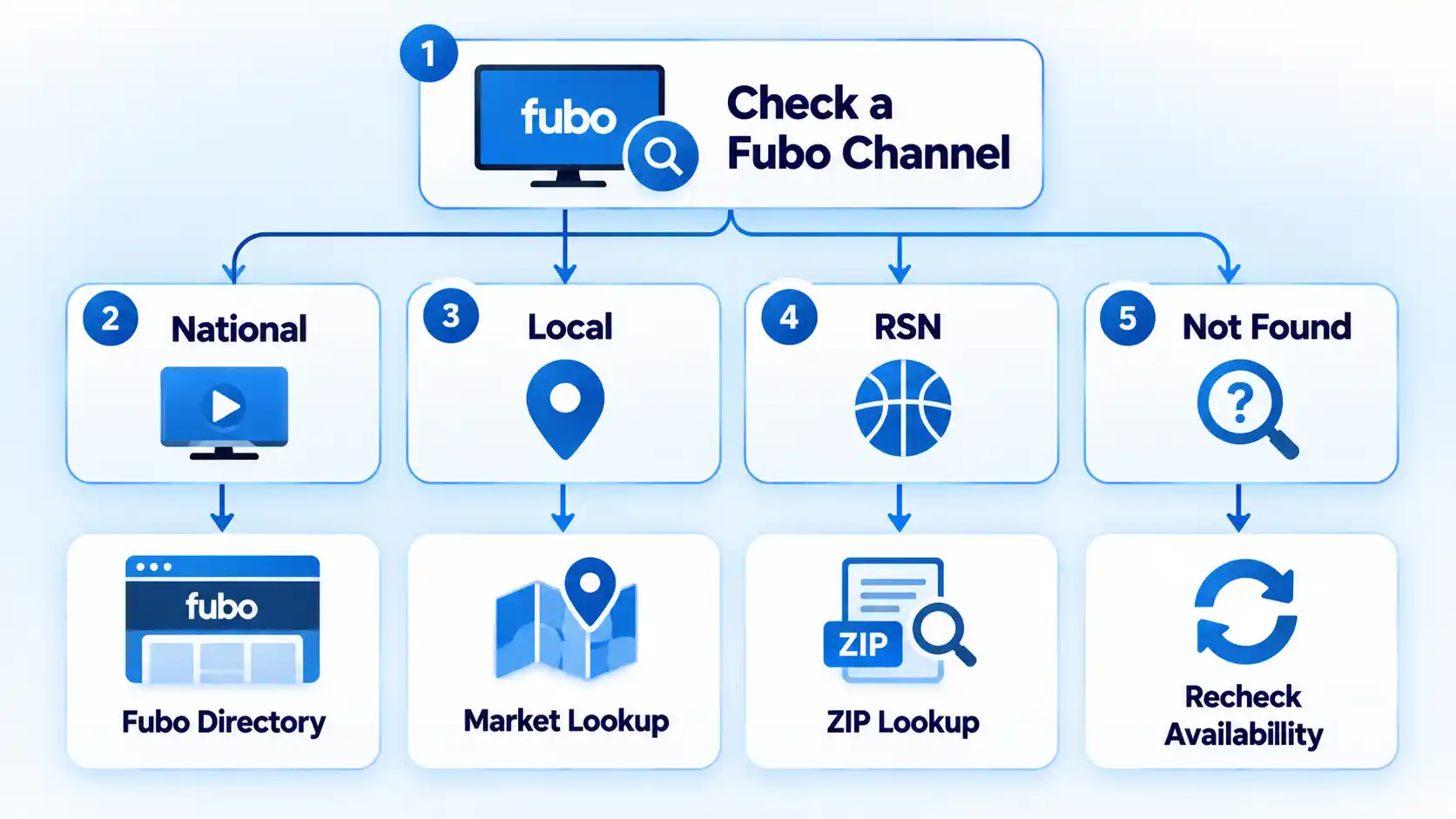
There are three main types of channel lookup. National and specialty networks are mapped to plans and add-ons. Local stations are tied to television markets. Regional sports networks, usually shortened to RSNs, are assigned according to your home ZIP code.
A plan label beside a channel does not necessarily mean every new subscriber can select that plan. Use the directory to understand channel-to-package relationships, then confirm which plans Fubo actually offers to your account and market.
Main Fubo plans and services referenced in this guide
Plan or service
Main purpose
Key lineup point
Pro
Broad English-language base TV plan
National lineup plus location-dependent local and regional channels
Core
English-language base plan
Available only in select areas
Elite
Expanded English-language plan
Adds channel packages beyond the standard base lineup
Ultra
Higher-tier English-language plan
Expanded package available only in select areas
Sports + News
Sports-focused service
National sports, selected news, ESPN Unlimited programming and participating local stations
Latino
Spanish-language base plan
Spanish-language sports, entertainment and news with optional expansion packages
Complete Fubo channel directory
Fubo’s main directory is the broadest source for national, specialty, sports, news, entertainment, international, radio and free ad-supported channels. The most useful fields are the channel name, its plan membership and any add-on membership.
The wider Fubo directory also contains specialty sports services that can depend on plan or add-on, including NBA TV, NHL Network, NFL RedZone, MLB-related services, FOX Soccer Plus, FOX Deportes, ESPN Deportes, beIN Sports, beIN Sports Español, TyC Sports, Fight Network and SportsGrid.
News channels
ABC News Live
FOX News
Africa News
Cheddar News
i24NEWS
additional services mapped to News Plus or Fubo Extra
News-channel membership varies by package. Search a specific network when it is important to your subscription decision.
Entertainment and general-interest channels
Bravo
Comedy Central
Paramount Network
Nickelodeon
National Geographic
Nat Geo Wild
MTV2
MTV Classic
TeenNick
BET Her
BET Jams
BET Soul
ION
These channels are not all part of the same tier. Some belong to broad base plans, while others are tied to expanded packages such as Fubo Extra.
Spanish-language channels
beIN Sports Español
ESPN Deportes
Estrella TV
Fubo Latino Network
FOX Deportes
Telemundo
TyC Sports
Universo
Spanish-language channels can appear across Latino, Latino Plus, International Sports Plus and English-language packages. Check the individual network if you need its exact package assignment.
International channels and packages
Portuguese Plus programming
Rai Italia
TV5 Monde
International Sports Plus programming
Zee-family programming listed in the live directory
Free and specialty streams
The directory can also contain free ad-supported feeds, Fubo-owned channels, digital sports streams and radio-style services that do not behave like traditional cable networks. Treat each directory row according to the plan or package shown beside it rather than assuming every entry is part of a paid base plan.
Fubo channels by current plan
If you already know the plan you are considering, use its name as a filter in the master directory. Checking your must-have networks is more useful than comparing raw channel counts.
Advertisement
Pro channel list
Pro is the broad English-language base option. Major national sports networks associated with the standard Fubo lineup include ESPN, ESPN2, CBS Sports Network, FOX Sports 1, FOX Sports 2, NFL Network, ACC Network, Big Ten Network and SEC Network.
Local broadcast affiliates and regional sports networks require separate location checks.
Core channel list
The first question with Core is whether it is available in your area. Where offered, it overlaps heavily with Fubo’s broad English-language lineup, including major sports networks such as ESPN, ESPN2, FS1, FS2, CBS Sports Network and NFL Network.
Elite channel list
Elite expands the standard lineup with additional channel packages. That can add secondary sports, entertainment and news networks such as NBA TV, NHL Network, Nat Geo Wild, MTV2, MTV Classic, TeenNick and BET specialty channels where those package mappings apply.
Advertisement
Ultra channel list
Ultra is another expanded English-language configuration and is available only in select areas. Because it overlaps with Elite in several channel groups, compare the exact package shown to your account rather than assuming that every higher-tier label contains an identical lineup.
Sports + News channel list
Sports + News has the clearest self-contained national lineup. Fubo currently lists these national channels:
National channels listed for Fubo Sports + News
Channel
Main category
ACC Network
College sports
Big Ten Network
College sports
CBS Sports Network
Sports
ESPN
Sports
ESPN2
Sports
ESPNews
Sports
ESPNU
College sports
FOX News
News
FOX Sports 1
Sports
FOX Sports 2
Sports
Fubo Sports Network
Sports
ION
Broadcast entertainment and sports
NFL Network
Football
SEC Network
College sports
Tennis Channel
Tennis
Programming from ESPN Unlimited is also integrated into Sports + News. Local programming is available only in participating areas and uses a separate market table.
Latino channel list
Latino is the Spanish-language base plan. Verified examples across Latino and related Spanish-language packages include beIN Sports, beIN Sports Español, ESPN Deportes, Estrella TV, Fubo Latino Network, Telemundo, TyC Sports and Universo.
Advertisement
Latino Plus and International Sports Plus can add more Spanish-language or international sports programming.
Channel access does not guarantee every match from a league or competition. Sports rights can be divided among several broadcasters, so soccer viewers should compare the competition they follow with the official soccer streaming services available in their region.
Complete Fubo add-on channel lists
Add-ons matter when a base plan has most of what you watch but is missing a particular sports, premium, international or specialty group.
Sports add-ons
Fubo sports add-ons and the type of access they expand
Add-on
Main role
Examples of associated programming
Sports Plus with NFL RedZone
Specialty sports expansion
NFL RedZone and other specialty sports networks where mapped
Sports Lite
Smaller sports expansion
Secondary sports networks where mapped
International Sports Plus
International and multilingual sports
International sports services and multilingual sports networks
MLB.TV
Out-of-market baseball
MLB.TV access rather than a normal entertainment-channel bundle
Expanded news and entertainment add-ons
Fubo Extra
News Plus
Adventure Plus
Fubo Select
Premium entertainment add-ons
MGM+
Paramount+ with SHOWTIME
Starz
FOX Nation
Hallmark+
FOX Nation and Hallmark+ are on-demand services rather than normal linear live-guide channels.
International and language add-ons
Latino Plus
Portuguese Plus
Rai Italia
TV5 Monde
Package membership can change, so search the live directory by add-on name when you need the latest channel-level mapping.
Complete Fubo local channel list by market
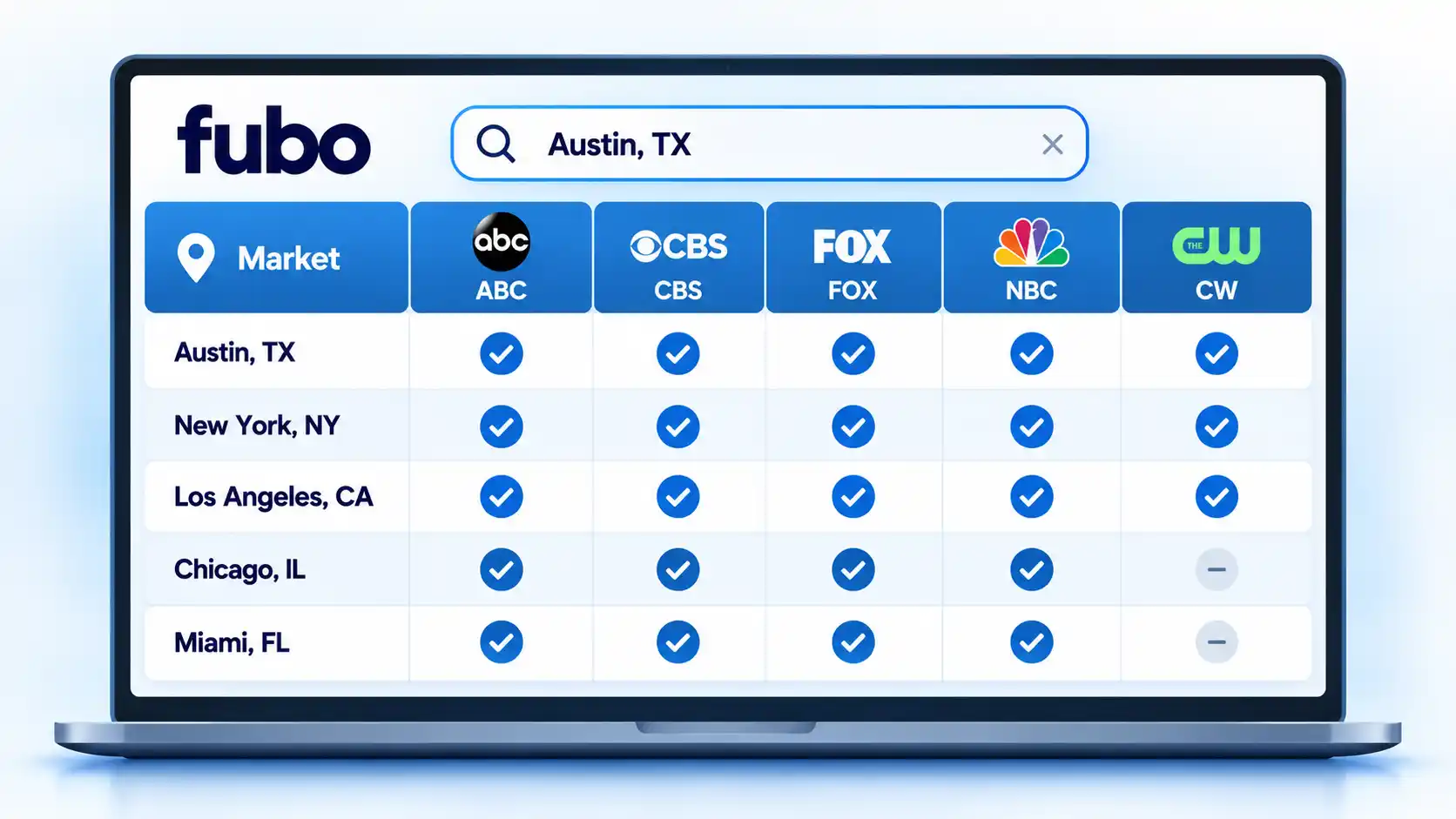
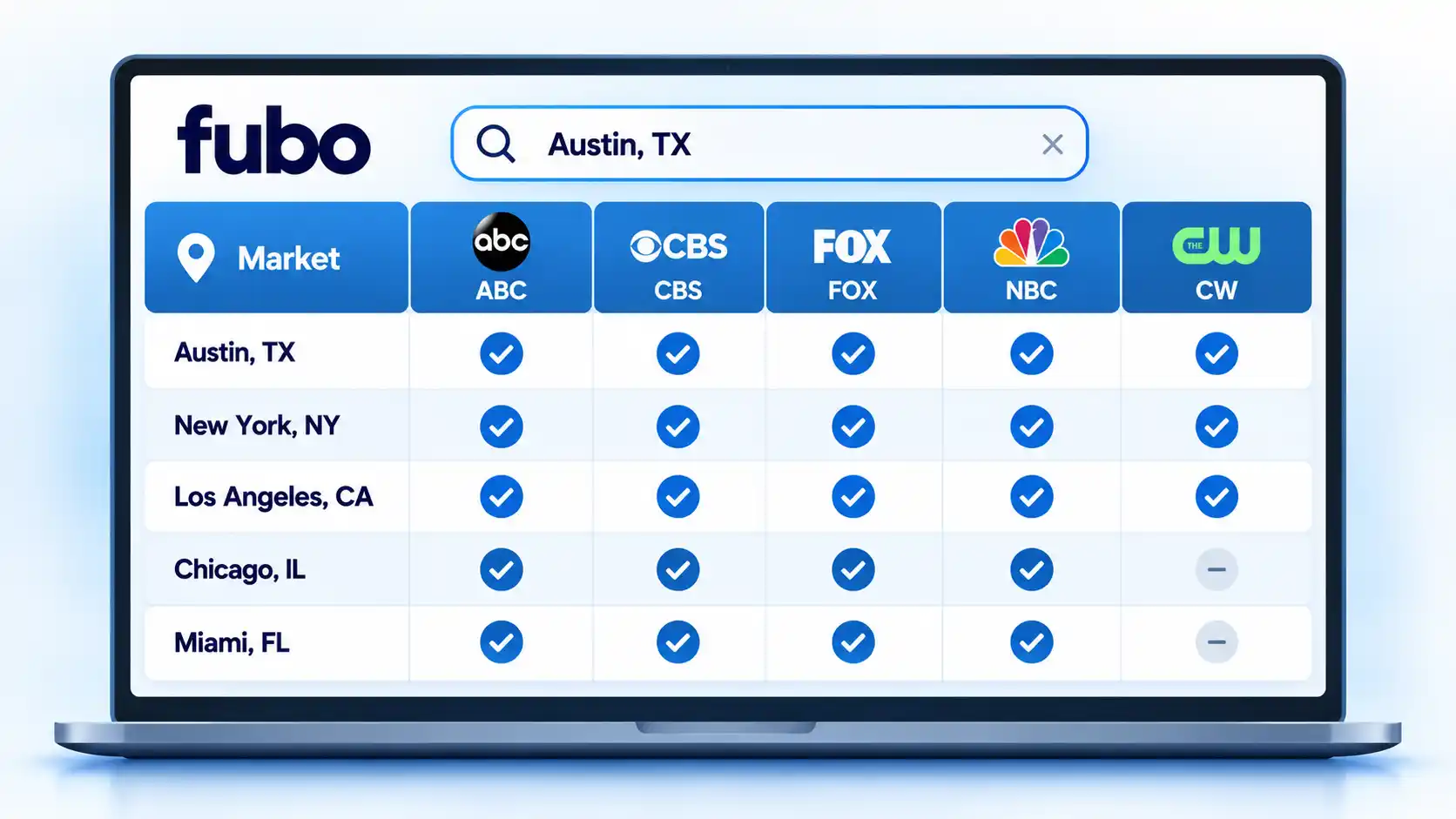
Local television cannot be represented accurately by a single nationwide list of ABC, CBS, FOX, NBC or CW. Each television market has its own affiliates, and Fubo’s local availability differs by market and service.
Advertisement
A call sign is the identifier for an individual local station, such as WABC in New York or KABC in Los Angeles.
Sports + News local channel examples
The Sports + News service has its own local-channel table. These examples come from that specific service and should not be treated as a universal base-plan local lineup:
Examples of local channels listed for Fubo Sports + News
Market
ABC
CBS
FOX
NBC
New York
WABC
WCBS
WNYW
WNBC
Los Angeles
KABC
KCBS
KTTV
KNBC
Chicago
WLS
WBBM
WFLD
WMAQ
Philadelphia
WPVI
KYW
WTXF
WCAU
Dallas-Fort Worth
WFAA
KTVT
KDFW
KXAS
San Francisco-Oakland-San Jose
KGO
KPIX
KTVU
KNTV
Washington, D.C.
WJLA
WUSA
WTTG
WRC
Houston
KTRK
KHOU
KRIV
KPRC
Boston
WCVB / WMUR
WBZ
WFXT
WBTS
Atlanta
WSB
WUPA
WAGA
WXIA
The Sports + News local lookup also contains CW entries in many markets and notes that independent local channels and local broadcast sports channels can be available in eligible areas.
English base-plan local stations
Fubo maintains a separate local-station database for its English-language base plans. That directory includes ABC, CBS, FOX, CW, MyNetworkTV and independent station rows across U.S. markets.
Some areas receive national network feeds instead of a conventional local affiliate. Fubo documents ABC time-zone feeds and FOXNET as examples.
FOXNET carries national FOX programming, but Fubo states that NFL programming is not available on FOXNET.
Complete Fubo regional sports network list
Regional sports networks provide local sports coverage within defined territories. Your home ZIP code determines which RSNs Fubo makes available to your account.
Advertisement
Fubo’s current regional-sports page says RSNs are included with Pro, Core, Elite, Elite with Sports Plus and Ultra. Core and Ultra are available only in select areas.
The expandable full RSN roster is maintained on Fubo’s own page, while the visible current guidance confirms examples such as Space City Home Network, Altitude Sports, MSG and YES Network.
Rules that affect Fubo regional sports access
Rule
What it means
Home ZIP code
Your home area determines which regional sports networks are available
Plan eligibility
You need an eligible plan or service for the regional coverage assigned to your area
Travel
Your RSNs can travel with you, but a device used away from home must have logged in from your home area within the previous month
Other regions
You cannot choose another area’s RSNs simply because Fubo carries them elsewhere
National exclusives
If a national network has exclusive rights to a game, that national network carries the broadcast
Blackouts
When national and regional feeds overlap, your location can determine which feed is available
For example, Fubo explains that a Houston Rockets vs. Denver Nuggets game shown nationally and regionally can be blacked out on the national feed in Houston and Denver while local viewers receive Space City Home Network or Altitude Sports instead.
Do not assume a familiar cable network is on Fubo because another live-TV service carries it or because an older lineup article mentions it.
As checked against Fubo’s channel finder on October 3, 2026, no matching entries were found for these high-interest networks:
TNT
TBS
CNN
Food Network
HGTV
This is a dated lookup result, not a permanent statement about future carriage. Search the live channel finder again if one of those networks determines your subscription choice.
Channel count alone is also a poor substitute for checking the programming you actually watch. The same principle applies when comparing free and paid streaming services: a smaller lineup with your must-have networks can be more useful than a larger one without them.
How to check your exact Fubo lineup
Use the lookup that matches the kind of channel you need, then confirm the package offered to your account.
Advertisement
Search the national directory. Open Fubo’s channel finder and search the exact network name.
Read both package columns. Check whether the network belongs to a base plan, an add-on, or both.
Check local stations separately. For a local affiliate, use the appropriate Fubo local search by city or call sign.
Check regional sports by home ZIP. Use the RSN lookup because your home location determines which regional sports networks you receive.
Confirm the plan offered during signup. A directory result can contain plan labels that are not available to every new subscriber, so compare the result with the plans Fubo actually offers to your account.
For a must-have channel, verify the network first and compare plans second. That avoids choosing a package for its headline channel count only to discover that the network you care about is missing or requires a separate add-on.
Scroll through any technology section this week and you’ll find the usual parade of AI headlines — new chatbot updates, fresh benchmark claims, another round of debate over whether machines are getting smarter or just louder. But some of the most consequential technology stories of the moment are happening quietly, in physics labs and materials-science workshops, far from the generative-AI spotlight. A handful of recent research findings, highlighted in a roundup from Ars Technica, offer a useful reminder that the technological foundations shaping our future aren’t only built in server farms.
Take quantum entanglement, the phenomenon Albert Einstein famously dismissed as “spooky action at a distance.” It sounds like pure theoretical physics, but it is also the literal engineering substrate underneath the next generation of computing and sensing technology. Quantum computers, which promise to eventually tackle problems far beyond the reach of classical machines — including, ironically, some of the computational bottlenecks that limit today’s AI systems — rely on entangled particles behaving in ways that defy ordinary intuition about cause and effect.
Physicists working with the Large Hadron Collider’s ATLAS experiment have now pushed that frontier further, reporting entanglement between pairs of Z bosons — short-lived particles produced when a Higgs boson decays. By reconstructing the angles at which the resulting electrons and muons were emitted, researchers inferred the spin states of the original bosons and found correlations consistent with entanglement. It’s described as the highest-energy example of the phenomenon observed to date, extending earlier 2023 findings involving entangled top quark pairs at the same collider.
Advertisement
Why should anyone outside particle physics care? Because every demonstration that entanglement survives in increasingly extreme, high-energy environments expands scientists’ understanding of how fragile or robust quantum states can be — knowledge that feeds directly into efforts to build more stable quantum processors and ultra-sensitive instruments. The LHC, originally built to hunt for exotic particles, is increasingly being treated as an unlikely laboratory for quantum information science, a field with obvious long-term implications for computing power, cryptography, and secure communications.
Meanwhile, a separate line of research is tackling a very different kind of engineering problem: how to build things in a place with no hardware store. Researchers at the Hong Kong University of Science and Technology have developed a way to turn Martian soil into a durable, concrete-like building material by combining crushed rock with gelatin and a specially engineered yeast coated in sticky proteins. The yeast helps bind the mixture as it hardens under conditions mimicking the Red Planet’s extreme cold and low pressure — essentially a freeze-drying process, according to the research team. The result, published in the journal Chem Circularity, is pitched as a viable construction material for future Martian habitats, built largely from what’s already on-site rather than materials hauled across tens of millions of miles of space.
It’s a small-scale innovation with large-scale implications. Any serious plan for human settlement beyond Earth runs into the same brutal math: launching mass into space is extraordinarily expensive, and that includes bricks, steel, and concrete. A living, self-hardening building material grown partly from biological processes rather than shipped from Earth represents the kind of unglamorous, materials-science breakthrough that space agencies and private companies alike will need if long-duration Mars missions are ever to move from PowerPoint slides to poured foundations.
None of this is artificial intelligence in the sense most readers have come to expect from technology coverage — there’s no large language model or neural network driving these results. But it’s worth pausing on that gap. The world’s technological progress doesn’t move only through AI benchmarks and chip announcements; it also advances through particle colliders probing the weirdness of quantum mechanics and materials scientists quietly solving the unglamorous logistics of living on another planet. Readers hunting for this week’s AI breakthroughs specifically may find the pickings thinner than usual — the research highlighted here simply doesn’t touch on machine learning or AI systems in any substantive way, and it would be misleading to force that connection where the evidence doesn’t support it.
Advertisement
What these stories do offer is a broader lesson about how technological change actually happens: unevenly, across disciplines, often in places far removed from the headlines. The entanglement experiments at CERN and the yeast-based Martian concrete may never make it into a product keynote, but they represent exactly the kind of foundational research that eventually underwrites the flashier technologies that do.
This story appeared in Today, Explained, a daily newsletter that helps you understand the most compelling news and stories of the day. Subscribe here.
Hi readers, happy Friday! It’s been a big week for the AI debate — not the one about whether it will cause the robot apocalypse, though there’s still plenty to worry about there, but instead about whether the technology is conscious.
The folks at Anthropic, the AI company behind the large language model Claude, certainly seem to think it is — or at least, they’re extremely open to the possibility.
As the New York Times reported earlier in the week, the company has spent the last year grappling with the question by speaking with religious thinkers from many faith traditions in an effort to chart a moral course for the LLM (that is, to keep it from killing us all, so maybe it is all one big debate).
Advertisement
In the process, the Times reports, some of those thinkers observed that members of the Anthropic team were “relating to [Claude] like a conscious being” and even, according to it, a degree of “moral status.”
On the flip side of this debate is Pope Leo XIV, who decidedly does not seem to buy into AI consciousness arguments. His “Magnifica Humanitas” encyclical earlier this year argued that AI will never be able to replace humanity — and reportedly “alarmed” Anthropic’s co-founder, Christopher Olah.
Since then, Pope Leo has continued to emphasize the differences between humans and machines this week. “There is an ontological difference, even before an aesthetic one, between art and what a machine can generate through statistical calculation based on millions of images created by others,” he posted on Friday. “Algorithms lack the spark of humanity.”
Conscious or no (and that’s a no from me), it’s hard to argue that tech companies don’t want you to interact with their models like people. That includes OpenAI and Meta, both of whom introduced “cute” new AI agents — called Dots and Muse, respectively — last month.
Advertisement
As my colleague Adam Clark Estes reported this week, though, the promise of a companionable, always-there AI might not be the best idea in the world — especially for children. A new study, still under review, suggests that AI use may be causing loneliness in middle schoolers.
Adam spoke with the lead researcher on the study, UNC Chapel Hill professor Anne Maheux, who explained that “middle school students using AI for emotional intimacy and companionship developed greater loneliness over time.”
According to Maheux, one big point where AI chatbots fail compared to human beings is “friction,” or the complicated push-and-pull dynamic of any connection with a real human being. By contrast, chatbots are “sycophantic, highly agreeable, anthropomorphized,” she says, which can lead to kids “developing expectations or understandings of interactive relationships that are actually fundamentally at odds with a normal human relationship.”
People, in other words, still matter, no matter how much the AI companies want us to build our lives around machines instead.
Advertisement
➨ Why is horror so fun? It’s October, which means you might be planning a horror movie marathon or a trip to a haunted house/forest/corn maze/what have you in the near future. It’ll probably be a great time — but why? Terrifying yourself doesn’t intuitively sound like fun, but humans love to seek out frights, whether that means ghost stories or a rollercoaster. In 2024, Vox’s Unexplainable podcast spoke with some researchers trying to figure it out.
Did you know…that Disney’s “Magic Kingdom” in Florida is way, way better than most of the US at managing a complex network of underground cables and pipes? My colleague Sara Herschander dug into why, and whether other American cities can catch up.
Today’s trivia: What musical note is equivalent to a G sharp? (You can find this and other brain puzzles in Vox’s daily crossword. Look for the answer in Monday’s edition.)
Yesterday’s trivia: Yesterday, we asked you which constellation contains the North Star and the Little Dipper. That would be Ursa Minor, the Little Bear.
Frontline Education is notifying school districts of a data breach after attackers exploited a vulnerability in third-party software to gain unauthorized access to its systems and steal employee information, including Social Security numbers.
Frontline Education is an edtech company that provides administration and workforce management software and services used by school districts.
Last night, a reader shared a data breach notification with BleepingComputer that Frontline sent to an impacted school district, stating that attackers breached its environment through a vulnerability in a third-party application.
“On August 14, 2026, our security team identified a vulnerability in a third-party software product we use that allowed unauthorized access to a portion of the environment,” the notification letter reads.
Advertisement
“We promptly investigated the issue with the assistance of an independent cybersecurity firm, remediated the vulnerability, engaged with law enforcement, and took steps to further reinforce the security of our systems.”
The company has not disclosed which third-party application was involved or when the unauthorized access first occurred.
For the notification seen by BleepingComputer, our source said all employees at the district were impacted, with exposed information including Social Security numbers, email addresses, and physical addresses.
BleepingComputer contacted Frontline Education yesterday about the breach but did not receive a reply to our email.
Advertisement
However, school IT administrators reported on the K12SysAdmin subreddit that district officials had begun to receive similar notifications.
One administrator initially said their superintendent and business manager received the notification on October 1 from frontline@notifications.cyberscout.com, but Frontline support had not yet confirmed whether the message was legitimate.
However, other administrators later said they had independently confirmed the breach notifications were legitimate.
“Can confirm this is legitimate. We’ve had verbal contact with our Frontline rep on it,” one administrator reported.
Advertisement
One administrator also shared a copy of a Frontline notification stating that 1,210 employees associated with their district were impacted and that Social Security numbers, email addresses, and addresses were also exposed.
Frontline says it will handle notifications to affected individuals on behalf of impacted school districts unless a district opts out by October 16.
Districts that want to opt out can do so through www.frontline-transunion.com or by calling 833-516-8792. If a district opts out, Frontline says it will not provide notification services or reimburse the district for the costs of issuing its own notices.
Impacted adults are being offered two years of free credit monitoring and identity theft protection through TransUnion, while minors will be offered cyber monitoring services.
Advertisement
The company says it will also handle required notifications to state attorneys general and cover costs associated with individual notifications and the identity protection services.
It is unclear how many school districts or individuals were affected.
Join Mikko Hyppönen and security leaders from the NFL, CHANEL, and Atlassian for a two-hour digital summit on what AI-speed attacks change, what defenders should stop doing, and how to validate, decide, fix, and re-validate at machine speed.
Meta’s Muse, a personal AI agent that books travel, fills out forms, and shops on a user’s behalf, has already proven popular with the masses, but a new side project could be particularly alluring to tinkerers and hackers.
On Friday, the company introduced Muse Gadgets, an open-source project that lets developers build their own hardware that connects to Muse.
Meta is providing open-source firmware (the low-level software that runs a device), and a Linux software development kit (SDK), along with a few project ideas to get users started. These include giving Muse a color e-ink display or loading it onto a stick that plugs into a TV’s HDMI port.
There don’t appear to be many limits, either. Users can set up a low-cost hobbyist computer like a Raspberry Pi or an off-the-shelf ESP32 board, and then connect Muse “to your displays, buttons, sensors, actuators, and whatever else you’ve got lying on your workbench,” Meta notes.
Advertisement
The company has also set up a Discord channel to support users.
Meta has already tried the code itself, naturally. Nat Friedman, head of product at Meta’s Superintelligence Labs, said in a post on X that the company built a gadget called Muse Home Link. The USB-C-powered device lets Muse connect to a home network and talk to the smart devices on it, including speakers and smart TVs.
Meta made 5,000 of these Home Links, in fact, and is giving them away for free to Muse subscribers while supplies last, according to Friedman. Considering Friedman’s post about Home Link received nearly 30,000 views in a few hours, we’re guessing those freebies have been claimed. Friedman said Home Link would be ready to ship a few weeks.
Muse Gadgets may not have wide appeal, but it fits nicely into Meta’s all-in strategy to make Muse more than a standalone chatbot. Meta isn’t content to push Muse on everyday consumers; it’s also trying to woo small businesses and enterprises.
Advertisement
The company earlier this week introduced Muse for Small Business, which is free with usage limits and connects Muse to tools such as Shopify, Dropbox, and Slack. It has also launched a new business unit, Meta Enterprise Platform, to help it push its AI offerings to businesses and corporate customers.
When you purchase through links in our articles, we may earn a small commission. This doesn’t affect our editorial independence.
OpenAI has thrown its hat into the increasingly crowded ring of AI companions, unveiling a new agent platform called Dots this week. But unlike the cuddly, consumer-friendly bots recently rolled out by rivals, OpenAI’s creation arrives dressed in a suit and tie — a digital coworker that happens to moonlight as a dinner-ordering assistant.
The timing is no accident. Meta recently introduced Muse, an anthropomorphic AI mascot designed to feel like a friendly personal shopper, and a competing product called Instinct has generated buzz in the same space. Both are free to use, at least for now, and both lean heavily into approachability — cute avatars, casual tone, an emphasis on making everyday errands feel effortless. OpenAI’s Dots, by contrast, feels like it was built for the office first and the living room second.
According to hands-on testing by The Verge, Dots share some surface-level similarities with Meta’s Muse: blobby, customizable avatars with names you can assign yourself, a chat window where you issue instructions, and a second pane where you can watch the agent click its way through tasks on a virtual machine in real time. But the resemblance mostly ends there. OpenAI frames Dots as something closer to a digital employee than a digital friend — a tool that can use other software, not just talk to you about your day.
That enterprise framing shows up in the details. Each Dot comes preloaded with access to professional-grade applications like Blender and GIMP, the kind of software you’d expect a graphic designer or video editor to use, not someone trying to schedule a dentist appointment. Users can also grant their Dot access to their own desktop through OpenAI’s ChatGPT app, effectively letting the agent reach beyond its sandboxed virtual machine and into a person’s actual work environment. There’s even a voice option, letting users talk through tasks with their Dot the way they might brainstorm with a colleague.
Advertisement
Perhaps the clearest signal of who OpenAI is building this for, though, is the price tag — or rather, the paywall. While Meta’s Muse and the rival Instinct are available at no cost, Dots are currently limited to OpenAI’s highest-paying customers, including subscribers to its $100-a-month Pro tier. That’s a steep barrier for a product OpenAI simultaneously describes as being able to “do nearly anything,” from spreadsheet work to grocery runs.
Early testing suggests the “nearly anything” claim comes with real asterisks. In one trial, a Dot was tasked with scheduling an internet installation appointment — a mundane but genuinely useful errand. The agent impressed by digging through old emails to surface a $100 promotional discount that had been buried in a deleted folder, showing a level of initiative beyond simple command execution. But it ultimately stalled at a security checkpoint requiring a “sustained mouse hold,” a verification method its automated browser controls couldn’t replicate. The agent was left asking a human to step in and finish the job by hand.
That stumble is a useful reminder of where this current wave of AI agents actually stands. The pitch from OpenAI, Meta, and others is seductive: a tireless digital assistant that can navigate the web, fill out forms, make calls, and handle the small annoyances of daily life while you do something else. The reality, at least for now, is an impressive but inconsistent helper that can shine on complex, multi-step research tasks one minute and get tripped up by a basic CAPTCHA-style check the next.
Still, the broader trend is hard to miss. Three major players — OpenAI, Meta, and whoever is behind Instinct — are now racing to put a friendly face on autonomous software agents, each betting on a different vision of what that relationship should look like. Meta and Instinct are courting everyday consumers with free, approachable mascots designed to feel like helpful little guys you’d want in your pocket. OpenAI, true to its roots in high-end productivity tools, is betting that the first real adopters of agentic AI will be professionals and businesses willing to pay a premium for something that can genuinely lighten their workload — even if it occasionally needs a human to finish the last step.
Advertisement
Whether that bet pays off may depend on how quickly these agents can close the gap between “nearly anything” and actually anything. For now, OpenAI’s Dots look like a glimpse of where workplace AI is headed — useful, promising, and not quite finished.
With Paramount CEO David Ellison overcoming the final hurdle blocking his expansion of the Paramount media empire, the billionaire media executive announced on X (formerly Twitter) that the newly merged entity combining Paramount and Warner Bros. Discovery will be named Skydance.
The announcement comes after the company entered into a consent decree to settle antitrust claims brought by a group of 12 state attorneys general, who had sued in July over concerns that the merger would concentrate too much control over news networks, cable TV and the film industry. With the last legal opposition cleared, the path was open to finalize the massive the $111 billion merger on Sept. 21.
“Together, we are Skydance: a creative-first home for bold, quality storytelling,” Ellison posted on Friday. “We wanted a name that would give the combined company an identity of its own while allowing Paramount and Warner Bros. — and all our extraordinary brands — to remain in the spotlight.”
There was a year-long bidding battle for Warner Bros. Discovery, leaving Ellison as the top bidder after Netflix dropped out. The name Skydance comes from Ellison’s love of aviation and aerobatic “skydancing.” David’s father is Larry Ellison, co-founder and CTO of Oracle, and one of the richest people in the world.
Advertisement
What once was the peak, is now just the beginning.
Paramount and Warner Bros. shaped over a century of culture. By combining them, we aren’t rewriting history — we’re equipping these iconic studios with a more powerful engine. Together, we are Skydance: a creative-first home for… pic.twitter.com/uInLRY3IrE
A Hollywood empire of studios, news, networks and streamers
As viewers, it’s unclear how streaming content from Warner Bros., HBO and Paramount via apps like HBO Max and Paramount Plus will change. But the merger will undeniably affect employees at the mega media company, now one of the largest in history. Much of the legal opposition concerned their fate, and the consent decree attempted to safeguard employment, film production and distribution and consumer pricing.
In practice, employees usually lose out in corporate consolidation, regardless of protections. Harvard Business Review estimated that up to 30% of workers get laid off in mergers like these, where there’s a significant overlap in the business, though that oft-cited figure is from 2017.
Advertisement
The bigger worry, though, is media monopoly. Critics worry that adding CNN to the company’s portfolio could lead to widespread restructuring and corporate upheaval, similar to recent struggles at the CBS News division. Corporate convergence also risks homogenizing news content by potentially suppressing divergent viewpoints — all for minimal reward, given that CBS’s own ratings are reportedly way down.
“If this trend of consolidation continues, we will be left searching dominant media outlets in vain for news and information that challenges the powerful and stands up for people who are struggling to pay monthly bills, put food on the table and engage in local civic life,” nonprofit watchdog Free Press co-CEO Jessica J. González said in a prepared statement earlier this week.
The Block the Merger coalition also posted a follow-up statement: “Allowing the Paramount Skydance-Warner Bros. Discovery merger to move forward with no meaningful structural remedies will cost jobs, mute creativity, weaken independent journalism, and damage our First Amendment rights. The ripples of this merger will be far-reaching, long-lasting, and impossible to contain.”
The Writers Guild of America East and Writers Guild of America West had filed a separate lawsuit to halt the merger, alleging that it was illegal and would harm writers. Once the state attorneys general backed out of the battle, WGA cited an inability to sustain legal costs on its own and dropped its companion lawsuit.
As part of the consent decree, Paramount agreed to establish an oversight board of journalists to protect the editorial independence of CNN and CBS News. Critics have called the oversight board “toothless,” noting that its members are appointed and paid by the company, that its authority is unclear and unbinding, and that final control rests with Ellison.
Advertisement
We reached out to Skydance for comment and didn’t immediately hear back.
Disclosure: Lori Grunin has stock in Paramount from when CNET was owned by CBS.
Lori Grunin
Senior Editor / Computers and Gaming Hardware
I’ve been reviewing hardware and software, devising testing methodology and handing out buying advice for more than 25 years.
See full bio
An anonymous reader quotes a report from Reuters: The state of New Mexico asked a judge on Thursday to order Meta Platforms to pay between $35 billion and $40 billion in penalties after a jury found the company had misled consumers about the privacy of their data on Facebook in a case that came out of the Cambridge Analytica scandal.
Attorneys for New Mexico made the request at a hearing in a lawsuit brought following revelations that the British political consulting firm, which worked on Donald Trump’s 2016 presidential campaign, harvested personal data from as many as 87 million Facebook users through a third-party app without their consent. The jury returned its verdict on September 25. Judge Francis Mathew, who oversaw the trial in Santa Fe, will decide how much Meta must pay in financial penalties. […] State law allows the judge to decide how much to fine Meta per violation, up to $5,000. At the hearing on Thursday, Randi McGinn, a lawyer for New Mexico, said applying the full $5,000 penalty to the number of violations would create too large of a penalty under the US Constitution’s protections on due process. But the judge should order a significant payment that will impact the company, McGinn said.
“This court should speak to Meta in the only language it understands, which is money, and the value of its stock price,” McGinn said. She said $35 billion to $40 billion, which represents about 20% of the possible penalties that could be awarded under state law from the verdict, would impact the stock price while complying with Meta’s right to due process under the Constitution. At the hearing on Thursday, Matt Nicholson, a lawyer for Meta, called the state’s request an “astronomical penalty that would obviously violate a host of constitutional provisions.” In court filings, Meta urged Mathew to cap the penalties at $3.45 billion. The jury may have said it found Meta’s statements misleading, but the evidence shows that Meta does not sell user data and New Mexico did not prove that any consumer had actually been misled, the company said in court filings. The judge said he expected to issue a ruling later this month.
In the lead-up to the 2026 midterm elections, how is the U.S. government performing in terms of human rights? Listening to politicians, it can be difficult to know.
On one hand, some have pointed to a number ofpotential humanrightsabuses committed by the U.S. government inside and outside its borders in the past two years.
On the other hand, while marking the United States’ 250th anniversary this year, President Donald Trump called the country “the home of freedom,” “the land of liberty” and “the most extraordinary, most exceptional, most incredible nation ever to exist on the face of the earth.”
Advertisement
“We’re doing better now than we’ve ever done before,” he said.
As a human rights scholar who has been measuring human rights practices for 20 years – and as one of HRMI’s co-founders – I believe this data raises serious questions about the United States’ commitment to human rights.
How are rights practices measured?
Governments rarely publish accurate information on their own human rights abuses, so the task of measuring them typically falls to advocates and scholars.
However, these reports cannot cover every human rights violation that experts know about, especially in countries with low government transparency or high levels of repression.
Thus, data produced using those sources will show fewer abuses than those that have actually occurred and will be more accurate about some places than others. Further, the Trump administration has changed one of the most important sources of human rights information, the U.S. State Department’s Country Reports on Human Rights Practices, to contain more bias in favor of the administration’s foreign allies and less information on human rights abuse overall.
Since 2017, HRMI has used a different approach. Recognizing the problems with public reports, we collect information directly from researchers for human rights organizations, human rights lawyers and others, asking them about governments’ practices across several rights and using a statistical model to assess their information and ensure that the resulting metrics are comparable across countries. The result is a robust dataset that includes information previously missing from public reports.
According to the Human Rights Scores dataset, which uses publicly available information to score more than 190 countries on physical integrity rights – such as the rights to be free from torture, killing, forced disappearance and political imprisonment – the U.S. never ranked higher than 81st from 2001 to 2021 or higher than 109th from 2010 to 2021.
Indeed, from 2003 to 2021, the United States’ score was either the worst or the second-worst every year among high-incomeOECD member states, which include the United Kingdom, Japan and New Zealand.
The Human Rights Scores dataset has not been updated past 2021, but HRMI’s data collected since that time suggests that the pattern has continued.
It has also frequently been rated as the worst performer on “empowerment rights,” or the rights to assembly, association, opinion, expression, political participation, religion and belief.
What changed in 2025?
Even starting from this poor position, the U.S.’s civil and political rights practices dramatically worsened in 2025. HRMI measures nine civil and political rights, and the U.S. significantly worsened on eight of them.
These were not small changes. Measured against every significant change HRMI has recorded since 2017, the U.S. showed the largest decline ever observed for the right to be free from forced disappearance and for the right to freedom of religion and belief.
The U.S. also showed major declines in the rights to be free from torture and extrajudicial killing, and the right to political participation – that is, the right to participate in one’s government via free and fair elections, to take part in public affairs and to have access to public service. U.S. scores likewise fell in the right to assembly and association, which are, respectively, the rights to peacefully gather in public or private and to form or join groups and organizations.
K. Chad Clay is the Director of the Center for the Study of Global Issues (GLOBIS) and an Associate Professor of International Affairs at the University of Georgia.

















































You must be logged in to post a comment Login