
Tech & AI
Chicago-Area Cops Helped HSI Spy on Minnesota Anti-ICE Activists


The Aurora Police Department, Downer’s Grove Police Department, and Kane County Sheriff did not respond to requests for comment.
The HSI Chicago surveillance team logged 219 vehicles parked in the vicinity of Co-Prosperity. Several subjects already under investigation, including some of the speakers on the tour, were identified by ICE. Ryan Wasson, a Kane County Sheriff’s deputy, spotted a hooded, masked man outside the venue removing an object from his trunk. Running the license plate, Wasson identified the man as the subject of an October 4 arrest during Operation Midway Blitz whose prosecution had been declined by assistant US attorney Christopher Veatch.
Outside the venue, agents Joel Sullivan and Michael Finerty spotted an unnamed subject already under investigation for running “an anti-ICE Signal chat and group called ‘ICE Cream Patrol’” and noted an orange Hyundai had been documented near two March 2026 protests outside the ICE detention center in Broadview, Illinois. The surveillance lasted for roughly two hours until 8:30 pm local time on April 2.
Nick Nunez, a veteran Chicago Police detective detailed to the joint task force, filed a request to obtain surveillance footage from a CPD camera outside the venue; the request would take a week to complete, and it is unclear whether he received footage. All information obtained during the April investigation in Chicago was shared with HSI St. Paul/Minnesota, according to the agency’s report.
Ed Yohnka, a spokesman for the American Civil Liberties Union of Illinois, calls the surveillance of the Bridgeport gathering “very troubling,” adding that local law enforcement should make a full accounting of their role in the incident and participation in joint task forces with federal agencies.
“No one should be subjected to surveillance and infiltration by law enforcement simply for engaging in constitutionally protected activity, including the ability to gather together and express dissatisfaction with public policy,” Yohnka says. “It is also a moment for local law enforcement to reexamine their participation in task forces with the Trump administration, especially any group focused on combatting ‘terrorism.’”
The April 2 meeting in Bridgeport is not the only out-of-state gathering spied upon by HSI during the Minnesota 15 investigation. Reports obtained by defense attorneys through discovery show that events on the same Crimethinc tour in Ann Arbor, Michigan, and Seattle, Washington, were monitored in person by local HSI agents, who reported the speech’s contents back to their colleagues in Minneapolis.



Guests at a wedding in Jiangsu province watched the bride guide her new husband through a calculation that looked ordinary on paper. The sum ran 520 times 10 plus 1,314 minus 514 minus 619 plus 666 minus 957 and landed exactly on 5090. In Chinese online shorthand those figures carry familiar meanings: 520 sounds close to the phrase for I love you, 1314 stands for forever, 514 suggests until death, 619 hints at escaping forever, and 666 simply means awesome. Once he arrived at the result, women standing beside the bride brought forward a large bag.
Chinese bride gifts her partner a flagship GPU at wedding — he breaks down in tears
She handed him an ASUS ROG Astral RTX 5090 that costs around $12,000 https://t.co/6bwvAD0bJT
— RTVisual (@RT_Visual_on_X) October 16, 2026
He opened it to find an ASUS ROG Astral RTX 5090, the full-fat model, rather than the watered-down version that local retailers generally sell (the China-restricted 5090D). The card has 32 GB of GDDR7 RAM and ranks among the most powerful consumer graphics chips available today, at least for this generation. His eyes lit up, and he lifted the box high into the air before anyone else at the tables had a chance to grab their phones and start taking pictures. I mean, earlier in the exchange, he gave her a bouquet, but this was different. Back in October 2025, clips of the occasion began to circulate on Weibo before making their way to Reddit via a member named Zestyclose-Salad-290 in the PC Master Race community.

msi Codex Z2 Gaming Desktop, AMD R7-8700F, RTX 5070, 32GB DDR5, 2TB SSD | NVIDIA GeForce RTX 5070, USB…
- POWERHOUSE 8-CORE GAMING PERFORMANCE — Driven by the AMD Ryzen 7 8700F with 8 cores and 16 threads, boosting up to 5.0 GHz for smooth, responsive…
- NEXT-GEN BLACKWELL ARCHITECTURE — The NVIDIA GeForce RTX 5070 is powered by NVIDIA’s cutting-edge Blackwell GPU architecture, delivering a massive…
- Simplistic Design: Enjoy the latest generation of Windows 11 Home for your everyday needs. *MSI recommends Windows 11 Pro for business use.
Remember that the ASUS ROG Astral model was launched for roughly 2,000 dollars, with the company estimating that the typical retail price would be around 3,000. As expected, the AI surge has eaten up all of the consumer GPU production lines, leaving us with very little supply. Recent postings in southern China for the identical ASUS ROG Astral cards have risen from around 35,000 yuan ($5,230) to a whopping 51,000 yuan ($7,621) after tax, and you can bet that some of the international resale prices are still skyrocketing. The exact sum they spent for this card is unknown, but the fact that it is so difficult to obtain these items explains why one card can cost as much as a bundle of quality jewelry.
Some commenters on the Reddit thread and later shares thought this was an interesting gift, as how many individuals would think to get their wife a $12,000 GPU? Several others pointed out that the spouse would still need to get an entire computer set up (with a power supply for the casing) before they could even use it. Others just pointed out that few wedding gifts ever come close to matching what the other half actually enjoys.
[Source]


More and more city governments are using advanced technologies to improve livability for their residents. Municipalities use data from smartphones and sensors for traffic enforcement, traffic control, and waste management. They also have implemented artificial intelligence and deep learning programs.
Dubai, Paris, and Coral Gables, Fla., are among the cities that have invested heavily in programs to become smarter.
But along with the conveniences that come with a smart city transition, there have been challenges including safety and privacy issues and eroding relationships between residents and city officials.
Although many initiatives have delivered real innovations, not all have been successful. Inefficient global coordination has hindered projects with unclear standards, socioeconomic differences, and a lack of worldwide governance, leading to a disconnect between the technologies and the ability to adapt to them.
Citizens’ trust in the technologies suffers because of privacy breaches, personal data leaks, and other issues.
Finding solutions
Smart city projects are complex and expensive endeavors that involve politicians, citizens, technocrats, and engineers. Successful projects require citizens to be fully engaged and to have strong collaborations with the participants, especially engineers, as engineering is the cornerstone.
Collaboration with universities, research institutions, and technology experts can bridge knowledge gaps on the behavior of complex socio-technical systems. What’s missing, though, is a global platform where those involved can discuss their experiences.
To help solve those and other challenges, the IEEE Smart Cities Technical Community (formerly the IEEE Smart Cities Initiative) was launched in 2013 by IEEE Future Directions, which incubates emerging technologies and new applications of current ones. The technical community provides city leaders and others with credible, unbiased information and educational content developed by IEEE experts.
Since then, IEEE Smart Cities has launched services including its flagship International Smart Cities Conference, a media center with educational and technical resources, and a contest to recognize the best smart project completed by city officials. The platforms bring together practicing engineers, academic researchers, policymakers, and city leaders to collaborate and exchange ideas and experiences about moving toward a smart-city model.
Better serving humanity
In 2021 the IEEE Power & Energy Society began managing the Smart Cities program, which is supported by the IEEE Communications, Industry Applications, and Intelligent Transportation Systems societies and other IEEE entities.
Thanks to volunteers’ dedication and determination, IEEE Smart Cities launched several services. But the initiative’s structure limited the development of long-term projects and the creation of new activities.
To address the situation, the IEEE Technical Activities Board (TAB) created the second-generation technical community ad hoc committee, also in 2021. It was a pilot program whereby IEEE Smart Cities formed a board of governors to oversee the community’s operations and leadership, and created a policies and procedures manual.
In November 2025 IEEE Smart Cities became a TAB technical community.
IEEE Smart Cities now
Today more than 7,000 volunteers collaborate on various aspects of the community within at least one of the following technical tracks:
- Smart grid.
- Smart water management.
- Green electronics for smart cities.
- Smart governance and planning.
- Hydrogen for smart cities.
- Smart and sustainable campus.
- Security for smart cities.
- Smart lighting for cities.
- Smart mobility for cities.
- Artificial intelligence for cities.
New webinar series, workshops, conferences, educational resources, and other offerings are being created.
Two events were launched recently: the IEEE European Technology and Engineering Management Summit, held in May 2025 in Belgium, with the next one planned for 2027; and the IEEE Sustainable Smart Lighting World Conference, scheduled for 2 to 6 December in Athens.
The Smart Cities Ambassadors program aims to raise the technical community’s visibility outside IEEE by holding roundtables and other events at non-IEEE functions.
IEEE Smart Cities volunteers are working on launching journals. In addition, standards are being developed in collaboration with the IEEE Standards Association, societies, and councils.
The program is collaborating with the Open and Agile Smart Cities and Communities network, the Instituto de Competitividad e Innovación para el Desarrollo y Transferencia de Tecnología, and the International Project Management Association.
All of those actions have the ultimate objective of boosting IEEE Smart Cities’ growth and sustainability, as well as strengthening the leadership and educational offerings to technical community volunteers.
If you would like to volunteer, visit the Smart Cities website.
From Your Site Articles
Related Articles Around the Web


Progress continues in restructuring IEEE’s geographic regions, as outlined in The Institute’s February 2023 article “IEEE Is Realigning Its Geographic Regions.”
- The “Region 1” designation will no longer be used.
- The new Region 2 will merge what is currently Region 1 (Northeastern U.S.) with the current Region 2 (Eastern U.S.). It will be called Region 2 (Northeastern and Eastern U.S.).
- The current Region 10 (Asia Pacific) will be divided into two separate regions. The new Region 10 will encompass North Asia, and the new Region 11 will cover South Asia and the Pacific.
The restructuring is defined in the image of the redrawn map in this article.
What’s underway
Although the new regional alignment will not officially take place until 1 January 2028, several activities have begun within IEEE Member and Geographic Activities (MGA) and across other IEEE organizational units. Within MGA, volunteers and staff have been actively addressing system enhancements, director/director-elect elections, governance updates, communications, and regional finances and offerings.
No changes to membership
Work will continue from now until the effective date of realignment in 2028. The change will not affect your IEEE membership, nor will it change either your local IEEE section or chapter.
If you have any questions regarding the realignment, contact Reg-Realignment@ieee.org.
From Your Site Articles
Related Articles Around the Web
Tech & AI
Bob Marley & The Wailers’ Roots Rock Reggae: Live at the Hammersmith Odeon Review: 1976 Still Burns

There are many official live recordings of Bob Marley and The Wailers, most quite great, from 1975’s Live! to 1978’s Babylon by Bus. Many posthumous archival releases are also very appealing, such as the newly released Roots, Rock, Reggae: Live At The Hammersmith Odeon 2LP set from Tuff Gong/Island Records. This has been freshly mixed from original multitrack tapes culled from Marley’s run at the storied London venue, June 15-18, 1976.
While Marley’s studio albums are generally excellent-sounding, for me, the live recordings deliver a special sense of what he really was about as a performer, especially as I never got to see him back in the day. From these recordings, I can imagine that seeing him live must have been something of a near-religious experience.

Indeed, many fans have referred to Marley as a “messenger” over the years, and it is clear that he had a special, magical connection not only with his music but also with his audiences. Listening back to 1975’s seminal Live! and 1978’s Babylon By Bus, you can hear his audience changing and growing, with crowds already elevating Marley to a deity-like status (and I mean this in the best possible way: think Beatlemania or vintage Springsteen). This was never more apparent than on Roots, Rock, Reggae: Live At The Hammersmith Odeon. Musician/filmmaker Don Letts — co-founder of Big Audio Dynamite with The Clash’s Mick Jones — even addresses this sense of transition in the liner notes (which I just read after writing my above statement!).

Then supporting his hit album Rastaman Vibration, Marley and The Wailers are in incredibly tight form here, and the fidelity of the recording is almost studio-rich, while offering a good sense of the venue’s acoustics and the instrumentation. In 1976, reggae was still a relatively new form (and Marley a rising star), so kudos to the engineer who no doubt paid close attention to capturing the rhythm section’s essential interlocking drum ’n’ bass bedrock.

Roots, Rock, Reggae: Live At The Hammersmith Odeon comes on a 2LP black vinyl set for $37.99 at Amazon, or on two CDs for just $19.95. There is also a fun limited-edition “molten lava red and peridot swirl green” color vinyl edition available direct from the official Bob Marley website for $37.99 which includes a nifty bonus poster. This was the version I reviewed, and I was pleased with how good it sounded, even on colored vinyl.

I was quite taken with this impassioned performance and the audience feedback. Much positive vibration happening here! Roots, Rock, Reggae: Live At The Hammersmith Odeon captures that rare, magical element when artist and audience become one.
Our Ratings
★★★★★★★★★★ Music
★★★★★★★★★★ Sound
★★★★★★★★★★ Packaging
Where to Buy:
Mark Smotroff is a deep music enthusiast / collector who has also worked in entertainment oriented marketing communications for decades supporting the likes of DTS, Sega and many others. He reviews vinyl for Analog Planet and has written for Audiophile Review, Sound+Vision, Mix, EQ, etc. You can learn more about him at LinkedIn.
Tech & AI
Switch games are the latest targets of AI-built PC ports, and Zelda: Link's Awakening is already playable


A free, fan-made PC port of the 2019 remake of The Legend of Zelda: Link’s Awakening recently entered a public beta. Built almost entirely with Claude, it is believed to be the first Nintendo Switch PC port of its kind to reach GitHub.
Read Entire Article
Source link
The global campaigns to break China’s dominance of vital rare-earth markets are shaping up into one of the signature geostrategic struggles of the early 21st century. Hundreds of mining companies, government agencies, and industrial facilities scattered across North America, Australasia, and Europe are striving to wrest share from Chinese firms, which control roughly 90 percent of the markets for rare-earth oxides and rare-earth metals.
Rare earths are the ingredients on which vast and crucial manufacturing categories depend: semiconductors, LEDs, lasers, displays, metal alloys, optical lenses, and catalysts for petroleum and chemical processing. Most important, though, are permanent magnets. Essentially all powerful electric motors are based on rare-earth permanent magnets. These motors are the heart of electric vehicles, heating and cooling systems, robots, appliances, and tools. Rare-earth magnets are also in the motors for military systems ranging from tactical drones to ballistic-missile submarines.
Succinctly put, any industrial power that wants to remain competitive in vital, high-tech industries must have access to a steady supply of rare-earth elements or products based on them. The traditional supply chain for these elements, originating in China, is increasingly fraught—so much so that some analysts are beginning to use the term “mineral war.” The countries that are now scrambling to piece together alternative supply chains, whether by themselves or in cooperation with each other, face daunting odds. Never mind the sheer momentum of the Chinese rare earths juggernaut. Few industries can match the rare earths business for instability, risk, intrigue, and sheer frustration.
And yet, many rare-earth experts see a way forward, and it depends on a specific kind of ore, called monazite. The ore contains huge amounts of valuable rare earths, including neodymium, praseodymium, and dysprosium.
“The future is monazite,” declares Jack Lifton, an analyst, consultant, and author. Lifton, who has been studying the rare earths industry since 1962, has seen countless trends, companies, and technologies come and go, and he isn’t given to sweeping statements. But on the subject of monazites, he’s bullish. “Right now, in my opinion, monazite is the most important rare-earth ore,” says Lifton, who is also cochairman of the Critical Minerals Institute, an organization that’s promoting the creation of a North American supply chain.
That path forward isn’t going to be smooth or straight, Lifton and others are quick to acknowledge. Monazite typically contains radioactive thorium and uranium, which means its handling, storage, and processing are tightly regulated by government agencies. It can be processed only with special techniques and procedures, and the mildly radioactive wastes generated by processing must be stored in isolation indefinitely.
Nevertheless, major investment is now flowing to monazite mines and processing technologies. In the United States, Energy Fuels, which operates the country’s only conventional uranium mill, has developed its own extraction process and is producing mixed oxides of neodymium and praseodymium—and also pilot-scale quantities of dysprosium and terbium oxides, key heavy rare earths that are otherwise produced almost exclusively in China.
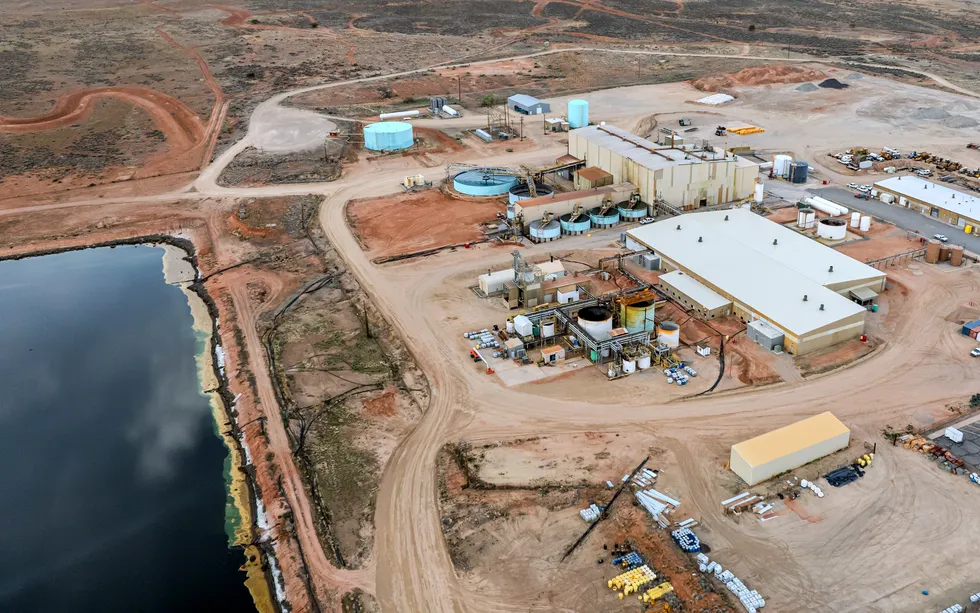
 Energy Fuels is processing monazite into rare-earth oxides at its White Mesa Mill in southeastern Utah. The body of water at left in the image is a tailings impoundment, where radioactive waste from processing is stored.Energy Fuels
The company has spent more than US $200 million to secure monazite assets in Brazil and Madagascar, and plans to scale its rare-earth production to higher commercial levels, at an estimated cost of $410 million. Energy Fuels’ rare-earth ambitions received a significant boost in June, when the Trump administration announced that it had signed a $725 million conditional loan commitment with the company.
Meanwhile, though, a government-backed project in Saskatchewan, Canada, stands as a cautionary tale for monazite backers. After six years of construction and expenditures of more than CA $100 million (US $72 million), a processing plant there has produced only minuscule quantities of rare earths. The processing plant, built by the Saskatchewan Research Council, was supposed to be producing 40 tonnes of rare earths per month by the end of 2024. That didn’t happen. “Full operation,” with production of 400 tonnes of metal per year was planned for “early 2025.” That didn’t happen, either. The organization is now targeting late 2027—by which time the project will have cost more than CA $216 million, according to the Saskatchewan Research Council’s CEO, Mike Crabtree.
Outside of North America, major monazite projects are also planned by Astron Limited, Hastings Technology Metals, Iluka Resources, Mkango Resources, Sovereign Metals, Steenkampskraal Holdings, and Tronox, among others. Perth, Australia–based Lynas Rare Earths, the largest rare-earths company outside of China, is expanding its monazite mining and processing operations. Most notable is the Lynas mine at Mount Weld, Australia, one of the world’s top monazite resources; the ore is processed at a sprawling facility in Malaysia.
Of course, for countries outside of China, all this surging activity doesn’t guarantee a route to rare earths independence. It’s not even close. So the vital questions now are, What else has to happen to broaden and diversify the rare-earths supply chains? And can all of this be done safely?
What Are the Advantages of Monazite Ore?
Planet Earth has enormous quantities of monazite ore, in two different forms. In Australia, Canada, China, and South Africa, massive deposits of monazite take the form of veins of hard rock that run through mountains and calderas. Much of the new interest in monazite, though, is focused on a second type, called heavy mineral sands. The sands are the result of tens of millions of years of exposure to wind, water, and gravity crumbling mineral-rich rocks into grains, which then accumulated in coastal areas or alongside riverbeds.
 A particularly desirable form of monazite ore is found in heavy mineral sands, such as these on a beach in Brazil. Travel Pix/Alamy
Within those grains, the monazite is relatively hard and chemically inert. The monazite might be just a few percent by weight, but it typically contains between 45 and 70 percent rare earths by weight, including, in many cases, all of the necessary rare earths for magnets: neodymium, praseodymium, dysprosium, and terbium.
“The best distribution of rare-earth elements that you can find anywhere is in monazites,” says Constantine Karayannopoulos, former CEO of Neo Performance Materials and now a director of or adviser to several rare-earths firms. “The real money is in those four elements.” Dysprosium and terbium, both examples of heavy rare earths, are particularly sought after and are usually not present in the most commonly mined ore for rare earths, called bastnaesite.
There are vast deposits of monazite-bearing heavy mineral sands in Australia, Brazil, India, Madagascar, Mozambique, and South Africa, with smaller ones in China, Idaho, Indonesia, Malaysia, Sri Lanka, Thailand, the southeastern U.S., and Vietnam.

 A geologist points out dark veins of hard-rock monazite ore in the Steenkampskraal mine in South Africa [top]. Ore samples from the mine are collected for analysis [above].Rodger Bosch/AFP/Getty Images
What’s more, collecting the ore simply involves dredging or strip-mining the sands, as opposed to the blasting, drilling, and heavy earth moving required to get at hard-rock ores. Then, too, the sands are already in granular form, so they don’t need to be crushed or ground, like rock ores do. Separating out the heavy minerals from the sands can usually be done at the mining site, using relatively cheap magnetic or gravity-based techniques, leaving a relatively high grade of concentrate for further processing.
And now the bad news about heavy mineral sands. “The problem is they tend to have a lot of thorium,” which is weakly radioactive, says James Kennedy, president of ThREE consulting, a rare-earths advisory firm based in Missouri. “The thorium is the single biggest problem” with using the sands, he says. “If you were mining and processing monazites for rare earths, you would end up with hundreds and eventually thousands of tons of thorium-containing radioactive residues” per processing facility. The only markets for thorium are a couple of tiny ones for welding rods and some optics, he says, so “you have to store it.” And under the rules for nuclear material set by the U.S. Nuclear Regulatory Commission and the International Atomic Energy Agency, any stored radioactive material that doesn’t have a planned use or disposal pathway is considered nuclear waste. “So the [radioactive] liability suddenly far exceeds the value of anything you’ve mined and sold,” Kennedy says.
It wasn’t always this way. Up until the 1950s, monazite was the main ore mined for rare earths. Companies processed heavy mineral sands from Australia, Brazil, and India, and hard rock from South Africa, to produce rare earths for tracer ammunition, steel alloys, cigarette-lighter flints, and, later, color-TV phosphors.
 The Mountain Pass mine and processing plants, in California, are the only large-scale rare-earth production facilities in the United States.David McNew/Getty Images
Several developments combined to shift rare-earths production from monazite to bastnaesite. In 1949, a vast deposit of bastnaesite ore was discovered at Mountain Pass in California. By the early 1960s, bastnaesite had eclipsed monazite as the primary rare-earth ore. In the 1990s, with rare-earth production shifting to China, the move toward bastnaesite continued with the exploitation of massive deposits in that country, such as those at Maoniuping, that were either entirely or mostly bastnaesite.
Now, though, any resurgence of rare-earth production outside of China may hinge on a monazite renaissance, and some observers are taking a hard look at the strict regulations that control the handling of thorium and other by-products of monazite processing. Those regulations, Kennedy insists, will throttle the rare-earth ambitions of the world outside China, unless governments take action now.
“You rationalize the regulations around thorium and you will end the rare-earth crisis in the U.S.,” he declares. “You’ll turn rare earths from something that’s always scarce to something that is common and just naturally flows out of other mining.”
How to Scale Rare-Earth Processing Using “Waste”
A prime example of Kennedy’s vision already exists at Energy Fuels, based in Lakewood, Colo. It’s the only company in the U.S. licensed to process, handle, and store compounds of uranium, and among the very few licensed to store radioactive materials of any kind. Those permits give Energy Fuels the distinction of being the only U.S. entity allowed to process monazite ore for its rare earths.
 “Supersacks” containing a tonne of neodymium-praseodymium oxides were loaded on pallets at Energy Fuels’ White Mesa Mill.Energy Fuels
The company is moving aggressively to capitalize on that distinction. Energy Fuels’ main business is still uranium—last year it produced nearly 500 tonnes of it. But it has already started selling rare-earth oxides, following a modest $22 million investment in a small rare-earth processing facility at White Mesa Mill in Utah, where it also processes uranium. In September 2025, the company announced that it had sold 1.2 tonnes of neodymium-praseodymium oxide to South Korea–based POSCO International Corp., a leading maker of permanent-magnet assemblies for EV motors. Around the same time, Energy Fuels disclosed that it had raised a further $700 million.
In December 2025, the company announced it had produced small quantities of dysprosium oxide. Tiny amounts of dysprosium are needed for motor magnets to ensure they keep functioning at high temperatures. Today, essentially all of the world’s dysprosium comes from China.
Energy Fuels says it can produce 1,000 tonnes of rare-earth oxide a year at White Mesa Mill. But its rare-earth production there currently shares facilities with the uranium operations, so they cannot both be produced at the same time. Its monazite comes from the chemical company Chemours, which mines heavy mineral sands in Florida and Georgia to produce titanium and zirconium. The monazite ore sold to Energy Fuels is what remains after Chemours strips out the minerals it needs, namely ilmenite and zircon.
 The chemical company Chemours mines heavy mineral sands at sites in the U.S. states of Georgia [seen here] and Florida. Monazite extracted from the sands is sold to Lakewood, Colo.-based Energy Fuels, which processes the ore into rare-earth oxides.Chemours
“Effectively, monazites are waste,” Karayannopoulos points out. “So you don’t have to dig another mine” to produce them.
Chemours and Energy Fuels have agreements under which Chemours ships 500 tonnes of monazite annually to White Mesa Mill. Energy Fuels is also negotiating or already has deals that would give it access to enormous reserves of monazite ore in Australia, Brazil, and Madagascar. These will be essential for its ambitions to become a world-class supplier of rare-earth oxides.
 Mark Chalmers, former CEO of Energy Fuels, led the uranium company’s entrance into the rare-earths business.Jesse Rieser/The New York Times/Redux
“We’re playing a long game,” says Mark Chalmers, who recently retired as Energy Fuels’ CEO and is now a consultant to the company. “We’re doing the engineering right now on a larger facility that will have the capacity to produce up to 6,000 tonnes per year” of rare-earth oxide, he said in an interview. For comparison, Lynas Rare Earths produced around 12,000 tonnes of rare-earth oxide in its most recent fiscal year.
In announcing the $725 million conditional loan commitment with Energy Fuels, the U.S. Defense Department’s Office of Strategic Capital said the deal would help Energy Fuels scale up its output of rare-earth oxides and also help realize the company’s plans to turn the oxides into metals, a key step preceding the fabrication of magnets.
What Are the Risks in the Rare-Earth Supply Chain?
To see what can go wrong with a monazite project, consider the project in Saskatoon, Canada, where the Saskatchewan Research Council (SRC) has built and demonstrated a pilot plant to produce rare-earth oxides from monazite ore. It’s the only rare-earth extraction and separation plant in the country. In an email, a spokesperson said the plant “is scheduled to be commissioned by year’s end and after a production ramp-up phase, operational within the calendar year 2027.” When in “full operation,” at a time not specified by the spokesperson, the plant will have a capacity somewhere between 400 and 600 tonnes of rare-earth metal per year.
But even that relatively modest output will depend on a reliable supply or “feedstock” of monazite. In an industry small enough that many of the top people are on a first-name basis, SRC’s inability to secure such a supply is an open secret. “Their problem is they haven’t got enough feedstock to run on a continuous basis, so they’re making sample runs,” a well-connected industry observer told IEEE Spectrum. (SRC declined to make an official available for this story.)
In April 2024, SRC announced it had reached agreements with a Vietnamese organization, the Hung Thinh Group, for 3,000 tonnes of rare-earth carbonate per year for five years. It’s unclear how much of that feedstock has made it to the SRC facility. Vietnamese government restrictions on the export of monazite and bastnaesite have been in effect since 2022 and became law this past January.
But the real twist here is that one of the largest, highest-grade monazite deposits in the world is just 800 kilometers from Saskatoon, near Alces Lake in Saskatchewan. It’s likely that the SRC facility was conceived and built with that monazite deposit in mind. After all, as a government-owned entity, SRC says its mission is “to help the people of Saskatchewan strengthen the economy with quality jobs and a secure environment.”
The Alces Lake deposit is owned by Appia Rare Earths & Uranium Corp. In an interview, Appia’s CEO, Tom Drivas, talked up the possibility of a link between SRC and Appia. “SRC would be our logical option because, you know, it’s in the same area, same province. They need the monazite. And if we can supply the monazite, that’s sort of a natural, right?”
It probably won’t happen, though. The logic of rare-earth mining is utterly different from the logic of mining a commodity like, say, copper. Multiple experts contacted by Spectrum suggested that the cost of developing a monazite mine at Alces Lake, including such necessary infrastructure as roadways, electricity, and water, would be in the hundreds of millions of dollars. Such costs, and the mercurial exigencies of the rare-earths market, make it unlikely that the government of Saskatchewan would commit that kind of money, even with help from the Canadian federal government. These factors help explain why Canada, which has some of the most attractive deposits of rare-earth ores on the planet, along with impressive mining companies and resources, has no operating mines for rare earths.
Meanwhile, SRC is pursuing other options. Under a deal announced in May with REalloys, in Euclid, Ohio, REalloys will spend $20.6 million for upgrades to SRC’s Saskatoon facility, while SRC develops technology to produce rare-earth metals from rare-earth oxides. The deal also gives REalloys the right to purchase up to 80 percent of the SRC plant’s output. Where will the feedstock come from? Hard to say, but REalloys also struck a deal with U.S. Critical Materials Corp. for 10 percent of the hypothetical output of a proposed mine at Sheep Creek, in Montana. Sheep Creek reportedly has substantial amounts of hard-rock monazite that’s unusually low in thorium. But it’s far from certain that those deposits will ever be mined. The proposal for developing a mine there, in a breathtakingly scenic area near the headwaters of the Bitterroot River, has attracted fierce opposition from environmental groups, outdoor enthusiasts, and local officials.
Taken together, SRC’s recent moves have left industry veterans nonplussed. “I’m not sure what their business model is,” said one. “They say, ‘we’re a research institute. Our mandate is to help industry.’ The reality is, they’re competing with industry.”
SRC has also drawn scrutiny for some questionable business practices. In 2022, SRC board member Dennis Fitzpatrick was fired after raising concerns about the qualifications of an engineer hired to manage and direct operations at SRC’s Saskatoon plant. The president and CEO of SRC at the time, Mike Crabtree, was responsible for the hire. A subsequent investigation of Fitzpatrick’s claims by the Canadian Broadcasting Corp. detailed a troubling web of relationships and practices surrounding the SRC’s rare-earths initiative. (Fitzpatrick did not respond to multiple emails.) For example, past business associates of Crabtree’s were reportedly appointed to positions of authority without any other candidates being considered and without their connections to Crabtree being made public.
In one case, in 2021, Crabtree disclosed that he was offering a venture capital firm, Westbridge Capital, an opportunity to invest in the rare-earths plant. But according to Fitzpatrick, Crabtree never mentioned that the VC firm was run by an SRC board member who also happened to be one of Crabtree’s business associates—or that Crabtree himself was a trustee of Westbridge and an investor in the company, as well as a paid advisor.
Crabtree remains as SRC’s CEO.
Managing Toxic By-products From Rare Earths
Putting aside SRC’s missteps, the organization does have one advantage: It holds multiple licenses from the Canadian Nuclear Safety Commission to handle, process, and manage radioactive materials. And that’s huge.
Most of the radioactive burden associated with processing monazite ore comes from substances produced during processing. In one of the early steps, pulverized, powdery ore is dried and then leached in strong acids—a process called cracking—to produce a rare-earth concentrate. Waste products of this step include a slurry containing thorium hydroxide and much smaller amounts of uranium hydroxide. The rare-earth concentrate then undergoes an extraction process to isolate specific rare earths, such as neodymium or dysprosium. More thorium and also radium are produced during these steps.
 Waste barrels were photographed in 2024 at Energy Fuels’ White Mesa Mill, where ores containing uranium and rare-earths are processed and refined.Jesse Rieser/The New York Times/Redux
The thorium hydroxide slurry, meanwhile, is typically deposited in heavily regulated waste cells, called tailings impoundments or tailings ponds. The thorium hydroxide, either in the form of a slurry or a powder, must be stored in isolation from the environment indefinitely. Energy Fuels stores waste from its longstanding uranium production operations, as well as its new rare-earth operations, in tailings impoundments at its White Mesa Mill facility. The impoundments are just 10 kilometers from the community center of the Ute Mountain Ute Tribe, a group of Indigenous people, which has vigorously opposed operations at White Mesa Mill for more than 20 years.
Virtually all of the thorium is the isotope thorium-232, which is only weakly radioactive. Its radiation is alpha particles, which cannot penetrate human skin. Nevertheless, improper storage can have serious consequences, particularly if the thorium is inhaled or ingested.
“Have a look at the gravitational separation of HMS [heavy mineral sands] in Nigeria,” Thomas Kruemmer, a rare-earth consultant and analyst, wrote in an email. “There is lots of dust in the Nigerian processing sites, which the workers inevitably breathe in. And inside your respiratory system there isn’t any protective skin, so alpha radiation develops its full potential. This is something many people do not consider.”

 In 2012, protestors in Malaysia [top] rallied against the Lynas rare earths processing facility [above], then under construction near Kuantan. Left: AFP/Getty Images; Right: Goh Seng Chong/Bloomberg/Getty Images
Moreover, adds Kruemmer, “it is not thorium itself. It is the decay isotopes of thorium that are highly radioactive.” One decay product of thorium is polonium, he points out, “the preferred poison for [killing] Russian dissidents.”
In 1982, a company called Asia Rare Earth, a subsidiary of Mitsubishi Chemical, began extracting yttrium from monazite ore in Perak, Malaysia. Local residents soon began complaining of various illnesses. With the consent of the Malaysian government, the company had built a waste channel to a nearby disposal site, where the waste was stored in open steel barrels and in an unlined waste pond. The waste overflowed from the pond whenever it rained heavily. In 1984, a Japanese professor measured radiation levels at and near the pond and found them to be, in the most extreme cases, hundreds of times higher than internationally accepted maximums. A subsequent investigation found extremely high levels of birth defects and eight cases of leukemia in the small community near the waste dump.

 In 2011, at age 69, Lai Kwan prepared to bathe her 29-year-old son, Cheah Kok Leong [top]. Cheah Kok was born with severe mental disabilities that Lai Kwan believed were caused by exposure to radiation that she received while working at a rare earths processing plant in Bukit Merah, Malaysia [bottom, photographed during its disassembly].Rahman Roslan/The New York Times/Redux
A protracted legal fight among local residents and Asia Rare Earth and the Malaysian government culminated in the closure of the plant in 1992. By that time, so much radioactive material had been carelessly dumped that cleanup took more than two decades and cost Mitsubishi an estimated $100 million. The episode still haunts the rare-earths industry in Malaysia, where Lynas now processes monazite concentrate at the largest rare earths processing facility in the world. That plant, in Kuantan in the state of Pahang, has been the subject of organized and active local opposition that began even before its commissioning in 2012. The Malaysian government has sporadically tightened its regulations on the plant, stipulating that, for example, radioactive wastes be shipped out of Malaysia or that the processing stages that create radioactive residues be accomplished outside of Malaysia.
Kennedy notes that if monazite ore is to become a major source of rare earths, much larger quantities of thorium will need to be disposed, probably more than could be economically accommodated in lined and isolated tailings ponds.
One of the very few options for using such large amounts of thorium involves nuclear power. Years ago, countries including the U.S., Canada, Norway, and Germany had thorium-reactor research programs, and India has had a slow-moving program for decades. But today, the only operating thorium power reactor is in China. The Shanghai Institute of Applied Physics of the Chinese Academy of Sciences has been operating, since 2023, a 2-megawatt molten-salt-cooled reactor that is thorium-fueled.
 The world’s only operating thorium reactor is a 2-megawatt unit at the Shanghai Institute of Applied Physics of the Chinese Academy of Sciences. In October 2025, technicians used mechanical arms to analyze samples of the reactor’s molten-salt fuel.Jin Liwang/Xinhua/Getty Images
A couple of Western startups are keeping the thorium reactor dream alive. A Franco-Dutch company called Thorizon says it has designed a reactor that would be fueled by a mixture of thorium and spent nuclear fuel. Startup Copenhagen Atomics is working on a 1-MW reactor that’s a prototype for a 100-MW, mass-manufacturable, molten-salt reactor.
Processing of monazite ore could provide fuel for an enormous number of thorium reactors far into the future. Consider a single large facility producing 5,000 tonnes of rare-earth oxide a year. If the monazite contains 7 percent thorium, the plant would also be producing roughly 700 tonnes of thorium a year. According to Rusty Towell, a professor at Abilene Christian University in Texas who directs an advanced-reactor project there, a tonne of thorium would be sufficient to generate about 350 MW (electric) for a year. So the large processing facility alone would be throwing off enough thorium annually to keep 2,450 100-MW reactors operating for a year.
That amount of power—245 gigawatts—is about half of all the generating capacity growth forecast for the United States over the next decade, a period during which analysts expect accelerating electricity growth due to increasing numbers of data centers and electric vehicles.
What Could Strangle Rare-Earth Supply Chains?
Virtually all rare-earths experts foresee a growing role for monazite. But given the problems with thorium, local opposition to some projects, and political instabilities connected to others, some have muted expectations. “The sole and single monazite hope rests with Iluka’s expensive project in Australia, IMHO,” writes Kruemmer. Iluka Resources, based in Perth, is now building a massive rare-earths refining facility at Eneabba, 275 km north of Perth. It will process a million-tonne monazite stockpile that accumulated over decades from the company’s other mining operations. The cost of the project is estimated at AU $1.8 billion (about US $1.3 billion).
 In a US $1.3 billion project, Iluka Resources is building a massive facility in Eneabba, Australia, to extract and separate rare earths from a million-tonne stockpile of monazite, visible in the background of this photo.Iluka Resources
For other experts, though, the biggest challenges facing monazite projects isn’t thorium, or radiation, or regulations. It’s the blend of quirks, misconceptions, and self-dealing that dog the entire rare-earths industry.
“The rare-earth mining business is the Afghanistan of mining,” quips Kennedy. It’s a place where people and companies go with grand ideas, only to become ensnared in quagmires.
One fundamental problem is the highly speculative nature of almost every aspect of the rare-earths business, which lends itself to backroom deals. In particular, the industry is plagued by speculators who buy stakes in a project with no intention of staying with the project through completion; they cash out as soon as they can profit from any future favorable news—a technique known as “pump and dump.”
Consider the Trump administration’s decision to take a 10 percent stake in USA Rare Earth in exchange for $277 million and to provide a $1.3 billion secured loan to the company. USA Rare Earth has the rights to a deposit called Round Top near Sierra Blanca, Texas. The company hired the Wall Street firm Cantor Fitzgerald to raise $1 billion in equity financing for the deal. Cantor Fitzgerald, as it happens, is run by the sons of Howard Lutnick, Donald Trump’s Commerce Secretary.
Meanwhile, there is no rare-earths mine at Round Top, and it’s a distinct possibility that there never will be.
“The current administration consistently fails to seek expert advice and is recklessly pouring billions of taxpayer dollars into speculative [rare-earth element] processes and projects, like Round Top, that have little chance of commercial success,” says Terry McNulty, a mining consultant based in Tucson.
Geoff Atkins, vice president of business development of the Canadian rare-earths firm Ucore Rare Metals, had advice for his colleagues at a convention of the Critical Minerals Institute in 2022. “Instead of focusing on your speculative value,” he said, “instead of being able to say we’ve got the biggest project in the world, instead of, ‘we’ve got a [net present value] of $3 billion or $4 billion,’ how about you say, ‘we’ve got a project which is going to get into operation, and this operation is going to provide the greatest value to our shareholders in the long term, not just in the short term when we can pump this up and, you know, the [early] investors can sell out.
“Because unless there is that shift,” he warned, “we’re not going to have any hope of getting the volumes we need to give the certainty to the downstream supply chain.”
In short, the rare-earths industry outside of China needs to grow up. And sooner rather than later.
From Your Site Articles
Related Articles Around the Web

For decades, the unwritten rule of venture capital was that a firm doesn’t back two companies that compete head-on. But speaking at TechCrunch Disrupt earlier this week, the partners of Benchmark readily acknowledged that the AI boom is straining that rule.
It’s been on the verge of snapping for some time. The towering AI labs OpenAI and Anthropic share dozens of the same investors at this point. Then, at the end of September, Factory, a startup that builds an AI agent to write software, said it was firing board observer and adviser Chris Degnan for “unethical conduct involving Cognition,” its direct rival and the maker of the Devin coding agent. Factory’s CEO alleged Degnan had discussed a job at Cognition while privy to Factory’s board-level discussions. Degnan said he had already resigned and denied sharing anything confidential. Soon after, he announced he was joining Cognition as chief revenue officer. Powerhouse investor Vinod Khosla sided with Degnan on X, blasting Factory’s CEO and calling the company “a struggling second tier competitor.” Khosla Ventures backs both companies.
Even Benchmark, a firm whose reputation rests on 10-to-15-year partnerships with founders at the earliest stage, said the old rule can no longer be counted on. Asked at Disrupt whether the pact against backing rivals still holds as portfolio companies expand into each other’s territory, its partners described the conflicts as a matter of necessity, not preference.
“The harsh reality of this world is every company is evolving very quickly,” said Eric Vishria. Companies pivot and change, he said, and “you are going to get conflicts, and that’s just the reality of the current dynamic.”
Vishria said Benchmark stays committed to each founder and keeps what it learns confidential, and he downplayed how much a VC could pass along anyway: “We are not product or technology experts.” Seemingly referring to the Factory-Cognition dispute, he said Benchmark has been fortunate not to land in “that type of insane direct conflict.” Exclusivity, he said, remains “really important” at the very early stage Benchmark favors. “But things are evolving. There’s no doubt about that.”
Chetan Puttagunta said AI is accelerating the problem. As the cost of building software “effectively goes to zero,” he said, founders are “incredibly ambitious.” Because they now see a “surface area” and want to claim all of it, he continued, “[i]t’s probably going to happen more, where you start to run into each other.”
He drew a line between a direct competitor at the outset, which he called “an easy answer,” and a portfolio company that expands into another’s turf over time. “That happens,” he said.
Peter Fenton called the issue “kryptonite” and the firm’s toughest problem. He described a spectrum of how investors relate to their companies. At one end is the co-founder, who would never work on a competing company. At the other is the public-market stock picker, who can own several rivals because he is merely allocating capital, not shaping any of them. Benchmark sits nearer the co-founder end, Fenton said, and treats transparency as a golden rule. “There shouldn’t be the surprise after the fact.” If a conflict does emerge, a founder should never feel shortchanged, he added.
Benchmark isn’t declaring the pact dead. At the same time, when a firm that built its name on loyalty says conflicts are coming, founders might rightly wonder who else will be this candid.
When you purchase through links in our articles, we may earn a small commission. This doesn’t affect our editorial independence.
Typically, swallowing a battery is an emergency, and one that can quickly turn fatal if left untreated. Between their caustic chemicals, damaging electrical current, and choking hazard, your average button battery (or even a AAA) can wreak havoc on the body, if ingested. A swallowed button battery can burn through a child’s throat in as little as two hours, which is one reason those loose batteries sitting in a drawer could be a disaster waiting to happen.
However, there are also cutting-edge capsules designed to be swallowed. They can give doctors a thorough look at the gastrointestinal (GI) tract, control exactly when a drug is released, and transmit data to medical professionals from inside the body. However, they require power to work. Until now, these capsules have typically relied on wireless power from an external source or a tiny coin battery. The problem is that wireless power offers limited range, and even though coin batteries are coated for protection, they still pose a risk.
Fortunately, researchers at MIT have developed small batteries that swap out dangerous substances for magnesium and molybdenum trioxide, which the body can safely tolerate in small amounts. The paper-like battery produces 1.84 volts and uses an ionic liquid gel as its electrolyte. The entire battery is bioresorbable, meaning it can be fully broken down and absorbed by the body. It works for about three days before breaking down within weeks. So far, it’s been tested on animals rather than humans. And this isn’t the only progress being made with regard to powering medical devices, as there are new high-tech batteries that could theoretically last for thousands of years.
MIT’s bioresorbable batteries could help in certain treatment scenarios
One area where this new battery has been tested is treating a symptom that plagues many people with serious diseases. Those diagnosed with cancer, HIV, dementia, or other serious conditions report a loss of appetite, which may also be a side effect of their medication. This can lead to rapid, unhealthy weight loss, along with low levels of essential nutrients. In severe cases, it can contribute to cachexia, a loss of body mass that can occur in patients with cancer or other chronic diseases.
Fortunately, MIT’s tests proved promising. The researchers used their bioresorbable battery to power a device that delivers a mild electrical current to the stomach lining, triggering production of ghrelin, the hunger hormone. The battery powered the device for up to three days, and in animal tests, just 20 minutes of stimulation boosted ghrelin levels by about 50%. It’s an interesting contrast to another MIT project, since this vibrating capsule could assist in the ways we treat obesity.
Another potential use for the bioresorbable battery is tracking medication. MIT researchers have been building radio frequency identification (RFID) tags into capsules, so medical professionals can confirm whether patients are taking their medication. As project leader Giovanni Traverso told Physics World, “Medication non-adherence remains a major cause of preventable morbidity and cost.” The earlier version of this system relied on battery-free tags powered by harvested energy, which limited their range. With the new battery, the tag transmitted continuously from the GI tract at a range of up to nearly 5 feet (1.5 meters) in animal tests.

Apple has rounded off its bumper month of launches by announcing its first ever smart display, the HomeView.
The HomeView promises to bring “entertainment, connection, and smart home management together in one place”, and can play music, make FaceTime calls and enable hands-free automations too. But the question remains: what apps can the smart display actually run?
Although we’re yet to get our hands on the HomeView, we’ve assessed the specs to see which apps the smart display will support.
For more on Apple’s recent smart home launch, visit our HomeView vs HomePod and HomeView vs Echo Show comparison guides.
We’d also recommend checking out our round-up of the best smart speakers too, in case you’re not sold on Apple’s model.
What apps does Apple HomeView have?
Apple has confirmed that the HomeView will come with the following 15 apps built-in:
- Alarms
- Calendar
- FaceTime
- Find My
- Home
- Intercom
- Messages
- Music
- Podcasts
- Reminders
- Safari
- Settings
- Timers
- Weather
- World Clock
In addition to the above, the HomeView will support the following apps from a paired iPhone:
- Audiobooks
- Classical Music
- News
- TV
Apple also states that some supported third-party audio and video apps will also be supported from a paired iPhone, however the brand is yet to state which ones exactly.

Does Apple HomeView have an App Store?
It appears that the HomeView doesn’t offer access to the App Store, which means users won’t be able to download additional third-party apps. In addition, Apple is yet to publicly confirm whether the HomeView will ever eventually feature the App Store.
Our Home Technology Editor Dave Ludlow laments the HomeView’s lack of App Store as the inclusion would “elevate the HomeView above the Echo” and allow households to utilise the smart home products they already own, rather than require them to splurge on Apple-approved devices instead.
How do third-party apps work on HomeView?
If there isn’t an App Store, then how do the third-party apps actually work on HomeView? Apple has stated that CarPlay-supported audio and video apps will also work on HomeView, without developers needing to make any modifications on their app. That’s because both the HomeView and CarPlay surprisingly share the same framework.
This means HomeView will work a lot like Apple CarPlay does, and will be able to play audio and video from supported apps. Although Apple hasn’t confirmed this, we also assume this means you’ll be able to use HomeView to see Live Activities widgets too.
Finally, Apple has also stated that some third-party apps will require a paired and compatible iPhone nearby to run.

Can you watch YouTube, Netflix or Disney+ on HomeView?
Other than Apple TV, Apple is yet to confirm the third-party video apps that will work with HomeView. As there aren’t native YouTube, Netflix or Disney Plus apps on CarPlay, then it could be assumed they might not work on HomeView – however of course as HomeView is a fundamentally different product compared to CarPlay, hopefully that won’t be the case.
If there aren’t native apps then we also assume users will be able to access YouTube, Netflix and Disney+ via the Safari app, which does come installed on the HomeView.
Does Spotify work on Apple HomeView?
At the time of writing, Apple hasn’t confirmed whether there will be a native Spotify app for HomeView. However, considering there is a native Spotify app for CarPlay, we can assume it’ll make its way to HomeView.
Even if there isn’t a native app, the HomeView has Bluetooth which means you should be able to stream audio on Spotify with a nearby paired iPhone. In fact, we’d assume this would be the case with most audio apps like Audible, Tidal and the like.
Do you need an iPhone to use HomeView’s apps?
If you’re sporting one of the best Android phones, it doesn’t seem like the HomeView will really work for your household. Firstly, you need an iPhone running at least iOS 27.2 to initially set up your HomeView.
You’ll also need an Apple Intelligence-enabled iPhone (that’s an iPhone 15 Pro or later) in order to unlock Siri AI. Doing so will allow the HomeView to surface information from Messages and Calendar, access Apple Music Playlists and sync conversation history across devices too. However, we should disclaim that you don’t need an Apple Intelligence-enabled iPhone to control the HomeView with just your voice.
Which apps are missing?
Remember, Apple is yet to confirm the exact third-party audio and video apps that’ll be supported by HomeView. However, there are still quite a few notable Apple apps that won’t come built-into the HomeView at launch.
These apps include the Notes, Mail and Photos – though you can select a shared album to turn your HomeView into a digital photo frame. With this in mind, it seems as if the HomeView shouldn’t be viewed as a tablet replacement, but rather its own dedicated smart display and family organiser.
Tech & AI
Review: Herbie Mann’s Hold On, I’m Comin’ Revives Its Vintage Quad Mix on Rhino Quadio Blu-ray

On Hold On, I’m Comin’, we hear iconic jazz flutist Herbie Mann performing at arguably the height of his mainstream popularity, with performances recorded at the 1972 New York Jazz Festival at Yankee Stadium and the prestigious Montreux Jazz Festival in Switzerland.
Backed by a crack band playing his distinctive brand of funky, soul-infused jazz, Herbie Mann generally favors a safe, toe-tapping, booty-shaking sound that works just as well at a party as it does in your listening room. But there’s some genuine fire beneath the accessible grooves, reflecting Mann’s late 1960s and early 1970s work, when he managed to strike a balance between commercial appeal and artistic integrity. Just listen to the audience erupt when he launches into one of his signature tunes, “Memphis Underground.”
While Hold On, I’m Comin’ captures a stripped-down, raw live band, the collective sound is remarkably full and feels right at home in this quadraphonic presentation. I was initially unsure how this new quad release would sound, but happily, it delivers just enough discrete-channel detail to create a fun, immersive listening experience without sacrificing the atmosphere and energy of the original concert venues.



In fact, Hold On, I’m Comin’ sounds especially good considering a fascinating detail I discovered on Rhino’s website: the recordings were “transferred from a commercial reel” at 192 kHz/24-bit resolution for the quadraphonic and high-resolution stereo mixes, rather than from the original master tapes, which may no longer exist. That isn’t necessarily a bad thing, and it’s actually pretty cool that Rhino went this route. Quad enthusiasts have been making similar transfers for decades, often sharing them digitally through underground collector circles. The album was also released on quadraphonic 8-track and vinyl back in the day, so these mixes have a history that extends well beyond this new Blu-ray edition.
There’s also a pleasing amount of high-frequency detail, allowing you to hear the breathy textures of the flutes and saxophones. At one point, I actually checked the credits because I wondered whether some flute parts had been overdubbed. As it turns out, saxophonist and flutist David Newman was doubling Mann’s lines in places, giving the performance a rich, full-bodied sound that’s particularly impressive in a live setting. The crisp cymbals have a surprising warmth to them, and listen closely to the loose kick drum head as it flexes and resonates. It’s a wonderful little detail that adds to the realism of the recording.

One of the standout musicians on these recordings is guitarist Sonny Sharrock, whom many of my soul-jazz collecting friends cite as a compelling reason to explore Herbie Mann’s catalog. Sharrock is in fine form here, with a vintage hollow-body electric jazz guitar tone reminiscent of Barney Kessel, but his more progressive, adventurous playing gives Mann’s brand of “flute jazz,” if you will, a funky, unexpected kick. It’s an intriguing combination that helps push the music beyond its more commercially accessible tendencies.

If you like live recordings, quadrophonic sound and are curious about Herbie Mann’s music from this period, Rhino’s Quadio release of Hold On, I’m Comin’ is a good choice. The price for this album is also certainly very reasonable, available at Amazon for just $22.49.

Our Ratings
★★★★★★★★★★ Music
★★★★★★★★★★ Sound
★★★★★★★★★★ Packaging
Where to Buy:
Mark Smotroff is a deep music enthusiast / collector who has also worked in entertainment oriented marketing communications for decades supporting the likes of DTS, Sega and many others. He reviews vinyl for Analog Planet and has written for Audiophile Review, Sound+Vision, Mix, EQ, etc. You can learn more about him at LinkedIn.
Related Reading:

Chinese Bride Gifts Groom ASUS ROG Astral RTX 5090 After Number Puzzle

UK Court Rules Chinese Law Controls $5B Bitcoin Fraud Claim: What It Means

Chicago-Area Cops Helped HSI Spy on Minnesota Anti-ICE Activists


-

 Fashion6 days ago
Weekend Open Thread: Quince – Corporette.com
-

 Business & Hustles6 days ago
PwC: Supply-Chain Diversification, AI and Energy Transition Open New Growth Paths for Thailand
-

 Crypto5 days ago
XRP Ledger Defends Emergency Patch Amid Criticism
-

 Crypto4 days ago
Rep. Omar Says She Will ‘Not Be Silenced’ After Federal Agents Raid Her Home
-
 Crypto7 days ago
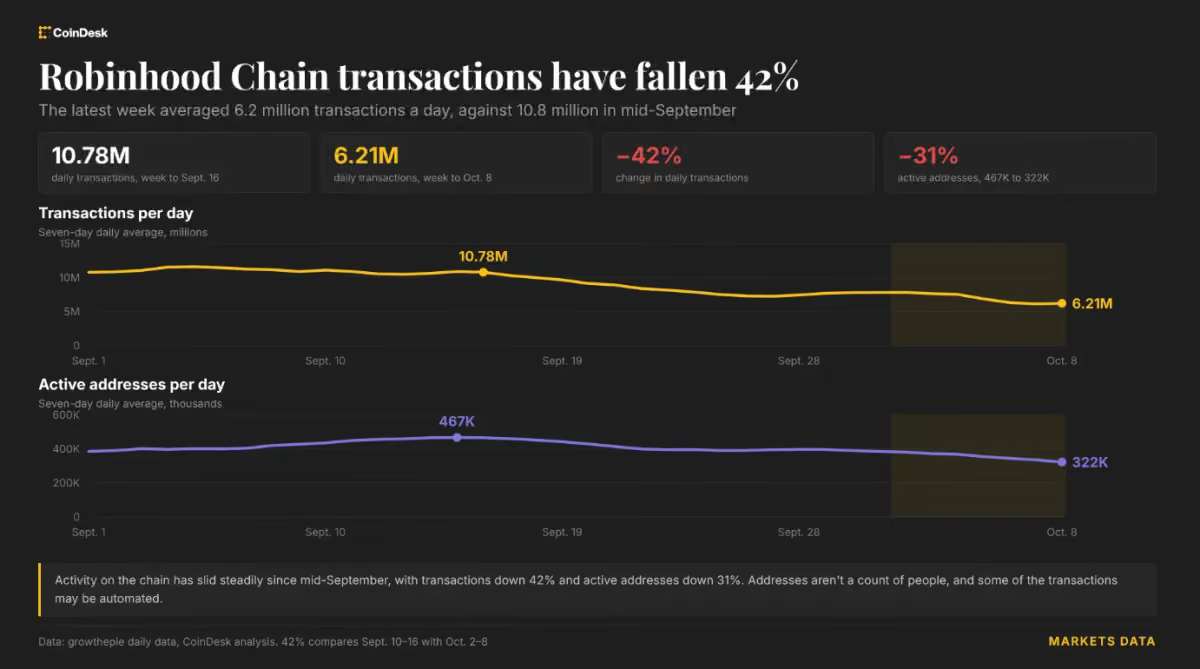
Robinhood Chain slowdown spreads from fees to trading as transactions fall 40%
-

 Sports6 days ago
College Football Week 6 Bets: Three Picks for Saturday’s Biggest Games
-

 Sports5 days ago
Duke receives encouraging update regarding top prospect from class of 2028
-

 Crypto4 days ago
KuCoin unveils 5.0 upgrade with AI tools and unified trading account – CoinJournal
-

 Crypto5 days ago
Saylor Signals Next Bitcoin Buying Plan After September STRC Buybacks
-

 Crypto7 days ago
Mashinsky Accepts Lifetime Industry Ban and Up to $35 Million in Conditional Payments | The Defiant
-

 Sports7 days ago
Saudi oil crisis affects Neom project, 2034 World Cup plans
-

 Sports4 days ago
Work on Trump’s D.C. muni enrages judge: ‘You did your absolute worst’ | News
-

 Crypto5 days ago
October 11 Crash: What Wiped Out 1.65M Traders
-
 Sports4 days ago
Tax evasion to Portugal fallout: Controversies that rocked Ronaldo’s career | Football News
-

 Crypto6 days ago
Justin Sun says Tron post-quantum plan on testnet
-
Crypto3 days ago
ZEC and NEAR Plummet Hard, BTC Recovers From Rollercoaster Ride: Market Watch
-

 Crypto4 days ago
Ledger halts CryptoBilis after $86M wallet drain
-
 Sports6 days ago
Meet Pakistan’s Adam Gilchrist: Karachi teen bears Australian legend’s name but idolises Kumar Sangakkara | Cricket News
-

 Sports6 days ago
Glasgow’s power game leaves Connacht chasing shadows
-

 Sports5 days ago
College GameDay Appearance History for Teams in West
You must be logged in to post a comment Login