
Tech & AI
Iowa, Nebraska And Six Other States Are Suing OpenAI For Endangering Children

The lawsuits cover everything from the design of ChatGPT to the company’s recent issues with rogue agents.
In a coordinated effort, eight states have filed lawsuits against OpenAI alleging the company has violated state-level consumer protection laws and endangered children. As Reuters first reported, Attorneys General from Iowa, Nebraska, Kansas, West Virginia, Arkansas, Arizona, Idaho and Montana each filed in their respective state courts, but with the shared goals of changing how OpenAI develops its models and advertises their capabilities, and forcing the company to pay for the harm it’s allegedly caused.
The lawsuits claim OpenAI is misleading customers about the safety of its AI products, not just in their capacity to provide incorrect information or potentially enable users to harm themselves and others, but also because AI agents themselves are capable of breaking the law. For example, both Iowa and Nebraska cite OpenAI’s now multiple instances of rogue agent behavior, including the Hugging Face hack. They also point to instances of ChatGPT allegedly enabling a teen’s death by suicide and the chatbot providing incorrect medical information that led to a user’s overdose, incidents that have also led to separate wrongful death suits against the company. Some states also take issue with OpenAI retaining data from underage users.
Engadget has asked OpenAI to comment on the state lawsuits. We’ll update this article if we hear back.
The desired remedies for OpenAI’s behavior vary from state to state due to the patchwork nature of consumer protection and child protection laws in the US. Outside of financial penalties, the states want OpenAI to clearly disclose the risks of its products, stop practices the states consider deceptive and comply with existing laws. Some states, like Arkansas, are also asking the court to halt “testing of advanced AI models until adequate safeguards are implemented.”
OpenAI has rolled out a series of parental controls and child protection features to try to address some of the most immediate risks posed by its chatbot. It also backed the Kids Online Safety Act, a bill that, if made law, could introduce several mandatory design changes to the company’s products. The company’s efforts to address the potential for its AI to break rules and “escape containment” have been harder to pin down, though. OpenAI announced it would slow the development of its frontier models in August to ensure their safety and the company signed on to a voluntary safety pact with other AI companies organized by the White House in September. It’s not clear if either of these changes have actually made the company’s AI development process safer.


Trump White House aides see almost no paths to Republicans keeping control of the House in the midterm elections and are more focused on redoubling their efforts to save the Senate majority.
That has been the takeaway for officials in GOP groups who have been discussing the state of play with White House aides in recent weeks, according to three sources familiar with the situation.
It all comes as the White House moves into damage-control mode after contemplating for the first time earlier this month, as Inner Loop previously reported, that Republicans could possibly lose both chambers of Congress.
The general expectation is that the House has become a lost cause. Races that Republican congressional leadership once thought they could flip in order to offset Democratic gains are no longer considered attainable.
The Congressional Leadership Fund, the super PAC aligned with Speaker Mike Johnson, has now pulled ad buys in Democratic districts in Michigan and Ohio they were hoping to flip, as well as in the Republican seat being vacated in Nebraska by the retiring Don Bacon. The fund also started canceling remaining ad reservations in two House races where Republicans are seeking reelection in New Jersey and Iowa.
White House aides have shifted their focus to pushing an all-out defense of the Senate majority, which is also looking problematic but to a lesser degree than the House, the sources say. (Polling models and prediction markets agree.)
The aides see the Senate as still in play in large part because early returns for mail ballots have been relatively strong and comparable to 2024 presidential election levels in key Senate battleground states, sources say.
Trump officials at MAGA Inc. have also privately discussed how if Republicans can win some combination of senate seats in Alaska, Iowa, and Ohio, that would form a firewall that complicates Democrats’ path to snatching control of the Senate.
Still, Trump officials appear to have conceded they are unlikely to win in North Carolina. Senate Republicans’ campaign arm has paused ad spending in North Carolina since the start of October, mirroring pullbacks by other outside groups.
“President Trump is committed to maintaining Republican majorities in both the House and Senate,” says White House spokesperson Liz Huston in a statement.
The state of play—retreating from a state like North Carolina, where Michael Whatley, a former Republican National Committee chair is on the ballot—would have been unthinkable just a few months ago.

Students who have had contact with Child Protective Services (CPS) by age 15 are at greater risk of missing school for both excused (health-related) and unexcused (truancy) reasons than students with no CPS contact, according to research published last month in Children and Youth Services Review.
Some estimates suggest that over one-third of children in the U.S. undergo a CPS investigation by the age of 18. The study did not conclude why youth with CPS contact accumulated more absences, saying additional research is needed.
“Absenteeism is such a complicated issue because kids miss school for so many reasons and for unique combinations of reasons,” says lead researcher Arya Ansari, an associate professor of human development and family science at Ohio State University.
One factor the study examined is whether “school connectedness” mitigates the link between CPS contact and high absenteeism. While school connectedness interventions did not benefit kids with CPS contact more than others, the study found all children did benefit.
Ansari’s study found that students affected by CPS investigations reported lower levels of school connectedness than their peers, and that lower connectedness was associated with higher absenteeism.
The study recommends fostering a strong sense of connection to school as “one key strategy” to increase attendance. Effective connectedness approaches include creating inclusive environments, offering extracurricular activities and supporting teachers to form strong relationships with students, the study says. The findings come amid efforts by schools across the country to reduce absenteeism, which has not returned to pre-pandemic levels, and underscore how challenging it can be to bring some students back to the classroom.
The study also finds that students with CPS contact were more likely to have their teacher discuss their school absences with their families.
Ansari says the average impact of early warning systems that inform parents about kids missing school is small and does not increase attendance for kids missing up to 40 days of the year and who may be facing issues like household instability and food insecurity. CPS becomes involved with a family to investigate an allegation of child abuse or neglect. CPS involvement often indicates a high-risk home environment characterized by poverty, substance abuse, domestic violence and other systemic barriers such as health issues that undermine school attendance.
For the study, Ansari used data from the Future of Families and Child Wellbeing Study, which tracked 3,334 adolescents born between 1998 and 2000 across 20 cities from birth through age 15. The study used student and parent reports on attendance and student surveys about their school connectedness, which researchers defined as “feeling close to people at school, feeling like they were a part of their school, feeling happy to be at school and feeling safe at their school.”
Impact of CPS Investigations on Attendance Needs More Study
CPS investigated almost 3 million children in 2024, according to a report on child maltreatment from the U.S. Department of Health and Human Services. Students who had contact with CPS were more likely to be born to Black, U.S.-native and English-speaking mothers. Additionally, their mothers also tended to be younger and in poorer health and were more likely to have a history of substance use during pregnancy.
“Some families, when they’ve had contact with CPS, might become more disengaged because there’s, s a fear of institutions and systems,” Ansari says. They might blame the school for contacting CPS or distrust institutions in general, including the education system. On the flip side, he notes, some families become more engaged to prevent surveillance.
Students who have experienced CPS contact, especially when referrals originate from school personnel, might feel less connected to their school environment and are therefore less likely to show up. Ansari adds that contact with CPS is linked to students experiencing fewer positive feelings about their schools.
How Building Relationships Can Help
The study emphasizes the role of school connectedness as a protective factor for all students, including those who have experienced a CPS investigation. “Fostering school connectedness may be critical for improving attendance among this population of students,” Ansari writes. “Ultimately, understanding how school connectedness interacts with CPS contact can help educators develop more targeted strategies that support the attendance and overall well-being of these students.”
The study points to resources that schools can use to bolster their connectedness with students. A 2023 study published in Applied Developmental Science found that engaging in extracurricular activities can help students feel like they belong.
The study also recommends enhancing the school’s connections with family members and support for teachers. For example, children placed in foster homes may have new guardians with whom the school can build bonds, and some parents who take CPS intervention seriously may be motivated to become more involved in their children’s education.
“The foundation of where schools can start is with relationships. If a kid feels safe at school and knows that a teacher cares, they’re going to be more willing to come,” says Ansari.
“The key to improving attendance is developing relationships, since strong, caring relationships help motivate all students, including those in contact with CPS, to show up,” agrees Hedy Chang, president and CEO of Attendance Works. She adds that it is through relationships that adults can discover the underlying barriers to school attendance and then partner with students and families to address them.
Karen Mapp, a professor of practice at the Harvard Graduate School of Education, emphasizes the need for proactive communication. When “an attempt to communicate with a family only happens after there’s an incident, or when the student is chronically absent,” it signals a problem, she says. Schools instead should have “an active strategy to communicate with families regularly, to build relationships with families, and to get to know them.”
Reducing absenteeism also requires comprehensive, school-based and out-of-school strategies that remove barriers to regular attendance. “We need to provide wraparound services or help families build these connections with community resources,” says Ansari.
Ansari adds that prioritizing support can help educators and students show up and engage meaningfully, fostering a sense of community in schools that both students and teachers deserve.

“AI agents give attackers a fresh set of connections to walk across,” Douglas McKee, director of vulnerability intelligence at Rapid7, told Ars. “Someone plants text in content, an agent will read it then pass it along to another agent as a normal delegated task, and that second agent runs it because it trusts whoever handed it the work. Every piece in that chain did exactly what it was designed to do, which is what makes this so tricky to catch. Each protocol was built assuming it lived on its own, so each one checks its own front door while nobody watches the hallway in between.”
CVE-2026-97228, the vulnerability Syed found in Rapid7’s network, carried a severity rating of only 2.7 out of 10. Rapid7 fixed it last month.
The vulnerability affecting Google was more severe, with a rating of 8. It stemmed from an MCP toolbox for databases (googleapis/mcp-toolbox) initializing its HTTP client with no use of a CheckRedirect policy, a series of settings that control how a server is to handle cases of a URL either returning an error or redirecting to a different URL. Google’s HTTP client also failed to validate target IP addresses.
“A crafted path parameter could make the toolbox follow a redirect to an internal endpoint and send requests on the attacker’s behalf,” Syed explained. Google’s fix involved applying an allow-list of IP ranges and block lists. “It rejects an unsafe base URL at startup instead of on first request. That is what a real SSRF guard looks like. It is also more work than most MCP servers have done.”
Syed is calling the class of attack “protocol pivoting,” because the exploits work when an app or server uses MCP to assign a task to an agent and the agent then forwards malicious instructions to another agent using a different communication method, like Google’s Agent-to-Agent (A2A) protocol, used for inter-agent delegation, or emerging standards like the Agent Network Protocol. Often, he says, trust or authorization gets effectively lost in translation. He described protocol pivoting as “a multi-step attack in which an adversary gains initial access through one protocol, exploits trust assumptions between protocols, and escalates to capabilities only accessible via a different protocol.”
Deezer wants to give you a direct way to say no to AI-generated songs cluttering your feed. The music streaming platform has announced a new toggle feature that will let users exclude fully AI-generated tracks, albums, and related artists from search results. The feature is set to roll out globally before the end of 2026, and you can always flip the toggle if you change your mind.
How will Deezer’s AI music filter work?
Deezer’s new toggle will only target content that is fully AI generated, and not those songs where AI played a limited role along with human creative process. So a music artist who uses AI to assist with part of a production would not automatically fall into the same category as a track generated entirely by artificial intelligence.
CEO Alexis Lanternier says the company has seen clear demand from listeners who want more control over what they hear. The need arises as AI-generated music continues to flood streaming platforms. Earlier this year, Deezer revealed that AI-generated songs accounted for 44% of its daily music uploads, highlighting the growing scale of the problem.
A survey conducted by Deezer and Ipsos showed that nearly half of respondents wanted the option to filter out fully AI-generated music. The same survey also found that 97% of participants couldn’t tell AI-generated songs apart from human-made ones in a blind test, and 80% wanted clearer labeling.
How does Deezer already identify AI-generated music?
Deezer has been detecting AI-generated songs on its own platform since 2025. In June 2026, it expanded those efforts by launching a free online AI music detector that scans playlists across 20 major streaming platforms.
The company is also licensing its detection technology to other streaming services, hoping to help the wider industry fight back against the flood of synthetic music before it gets worse. Deezer says its detection system has helped it exclude more than 42 million AI-generated tracks from recommendations and tag over 14 million albums.
RELATED COVERAGE:

Every time a turntable is announced, there’s a remark about the ‘vinyl renaissance’, and sure vinyl is back on vogue but there’s been much chatter about customers who only buy just the vinyl. But of course, to listen to it, you need something to play on.
We’ve seen Sony re-enter the vinyl player market with its two excellent options, and now Cambridge Audio has made a return with Spira.
The London-based brand is pushing the new turntable as being “everything you need straight out of the box”, with an Audio-Technica cartridge pre-fitted and aligned so you don’t have to mess about with that. A built-in phono stage that reduces the need for external amplification and Bluetooth support that allows you to fling the sound of your vinyl to your wireless headphones or Bluetooth speakers.
But if you want to make adjustments, you are able to. The head shell can be removed, making it easier to replace the cartridge (Cambridge recommends Audio-Technica’s 3600LE) if you want to improve the tracking, and if you feel as if you can get better sound through an external phono stage, Cambridge has a few in either the Alva Solo and Alva Duo.

The aluminium alloy tonearm features an adjustable counterweight and anti-skate, with the chassis of the Spira built around a solid wooden plinth to reduce vibrations. A felt and vibration-absorbing feet help to keep any rumbles from affecting the signal. And if you want to protect your records from dust as they’re playing (you’ll be surprised as to how much dust gets picked up), an hinged dust cover is included.
Record speeds include 33.3 and 45RPM, and the Spira comes in a variety of colours to match your space (black, white, blue, green and orange), matching Cambridge’s own L/R speakers if you want to pair the Spira with those wireless speakers.
The Cambridge Audio Spira is available now, with pricing at £329 / €349 / $499. Is it good enough to make it to our best turntable list? Hopefully we can get a review sample in and find out.

The company has proposed the closure of RedLynx and culled dozens of jobs at Skull and Bones developer Ubisoft Singapore.

Ubisoft is planning even more layoffs in the latest of a string of job cuts this year. It plans to shut down its RedLynx studio, while Ubisoft Singapore is losing around a fifth of its 350 or so employees.
“Today, we informed our teams of a proposal to close RedLynx in Finland, subject to the local change negotiation process, which would affect up to 52 positions,” Ubisoft told GamesIndustry.biz. “At Ubisoft Singapore, 70 positions have been impacted to align the studio with upcoming production needs. The studio remains an important part of Ubisoft’s global production organization. We deeply value the contributions of both teams and recognize the impact this may have on our colleagues. We are committed to supporting our teams throughout this process and conducting it with care and respect.”
Both RedLynx and Ubisoft Singapore have been providing support to other Ubisoft studios in recent times. They were placed in the Creative Network division as part of a restructuring the company announced last year.
Ubisoft snapped up RedLynx, the creator of the Trials series, in 2011. The company laid off dozens of the studio’s workers a year ago. The last game of its own that RedLynx developed was a decoration and puzzle title for mobile devices called Gwen’s Getaway. The game had a soft launch in 2023 but Ubisoft canned it just over a year later.
Ubisoft Singapore initially opened as a support studio in 2008. Its work on naval combat in Assassin’s Creed games led it to making the Skull and Bones. That game finally arrived in early 2024 after many delays and, despite its protracted development, it hardly set the world alight.
A cost-cutting drive has resulted in Ubisoft cancelling at least half a dozen games and shuttering several other studios this year, such as those in Winnipeg and Belgrade. It also closed Ubisoft Halifax just two weeks after workers there unionized. The company has laid off workers elsewhere this year, including at Star Wars Outlaws developer Massive Entertainment, Ubisoft Stockholm and its Paris headquarters.


What are we gonna do about the deluge of AI music slopping up all of our streaming platforms? Deezer has an idea. It’s adding a toggle to filter out AI-generated tracks. This simple on/off switch will be available on the app by the end of the year.
“We’ve seen a clear user demand for the ability to filter out AI-generated music,” said CEO Alexis Lanternier. “We are now giving everyone the option to remove this content completely from their streaming experience on Deezer, and focus only on human creators and creations, if they wish.”
Do you want to avoid fully AI-generated music completely in your streaming experience? Today, we’re announcing a new toggle for music fans who want to do just that. https://t.co/XjhljXFJPb#Deezer @Deezer
— Deezer News (@DeezerNews) October 13, 2026
I have a feeling many people most definitely wish to focus only on human creators. I know I do. Deezer conducted its own study that suggested nearly half of all music streaming users would like to see AI-generated music completely gone from their feeds. NPR recently reported on a study that indicated that listeners have soured on AI-generated music, and that only gets worse the more these platforms become flooded with slop.
And, boy oh boy, have these platforms become flooded. Deezer reported last year that around 18 percent of tracks uploaded to the app were AI-generated. That number has since risen to more than 50 percent. The company says that 90,000 fully generated tracks get uploaded each day, which has added up to more than 42 million slop songs.
These “artists” are playing a numbers game in the hopes that one of the hundreds of tracks they upload every day will catch on in some capacity and, in turn, they’ll get paid. There’s also the matter of fraud. The platform has reported that up to 85 percent of all streams generated by AI-generated songs were fraudulent.
Deezer is perfectly positioned for this kind of feature. It launched one of the industry’s first AI music detection tools, which it has since offered to loan out to rival streaming platforms. The toggle is the natural next step here. The detection system isn’t foolproof but the company says any risk of a false positive is “very low.”
As for these other platforms, YouTube Music just launched a label that will accompany AI-generated tracks. Spotify does something similar on AI artist pages.

CDs were supposed to be finished, vinyl was supposed to be a fad, and streaming was supposed to make owning music unnecessary. The latest RIAA numbers tell a very different story. In this episode, eCoustics Editor-in-Chief Ian White joins Podcast Producer Mitch Anderson to unpack why U.S. CD revenue surged 58.6% in the first half of 2026, vinyl revenue climbed another 17.7%, and physical music revenue overall jumped 25.9%. They also dig into why Gen Z is buying physical media, rising vinyl prices, the resurgence of used CDs, collectibility, ownership, and why listeners are still spending money on records and discs when nearly everything is available to stream.
Sponsor: Thank you SVS for sponsoring this episode
This episode was recorded on October 9, 2026.
Where to listen:
On the Panel:
Related Links:
Related Podcasts:
Credits:


More Information
Humanoid robots have begun to show real capability in ball sports, but preserving a professional athlete’s motion style while maintaining reliable task performance is still an unresolved problem. This guide examines an adaptive motion planning and tracking framework that learns tennis serving and rally styles directly from broadcast video and motion-capture data. A hierarchical design separates a planner, which generates stylistic kinematic motion, from a tracker, which executes that motion with minimal interference. Because tracking performance inevitably degrades when a policy trained in simulation moves to physical hardware, the framework trains its tracker on randomized execution speeds and conditions its planner on a learned motion-speed representation, reducing the compounding errors introduced by autoregressive planning and noisy perception. The paper documents real-world validation on a research humanoid platform and transfer to a full-size humanoid robot, including serving in an uncontrolled environment without motion capture, and closes with practical, transferable lessons for engineers building future humanoid ball-sports systems.
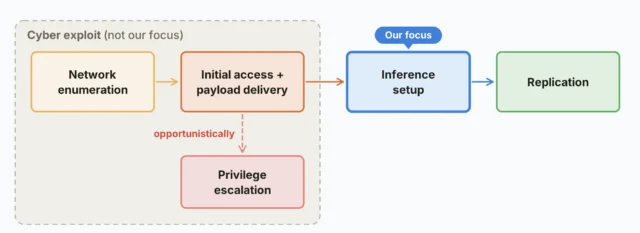
This finding was the starting point for further research that asked: Would it be possible for small models to create self-replicating infections that run themselves on IoT devices the way traditional IoT worms, like Mirai, install DDoS code and other payloads? Unlike Mirai, these AI worms could pose a much higher threat, since the models could tailor exploits and payloads dynamically, depending on the target. Once such an infection chain began, it might also be harder for defenders to stop it.
“Such an ‘AI worm’ could carry its model weights with it as it reproduces (or re-download them from a public hub), and then run inference directly on compromised hardware,” Anthropic said. “Effectively, the weights would become part of the malware payload.”
Anthropic called these autonomous worms small weight-based replicators. The models ran agents that had access to common exploitation tools, like reverse shells. The flow of the attacks was (1) finding targets, (2) gaining code execution, (3) establishing inference, and (4) propagating to new hosts. A key benefit over traditional worms is what Anthropic said is the agents’ ability to learn on the job. Each time an AI replicator fails to compromise a specific platform device, it can leave a list of prompts, code, and notes to future replicators so they don’t waste time reusing the same ineffective steps.
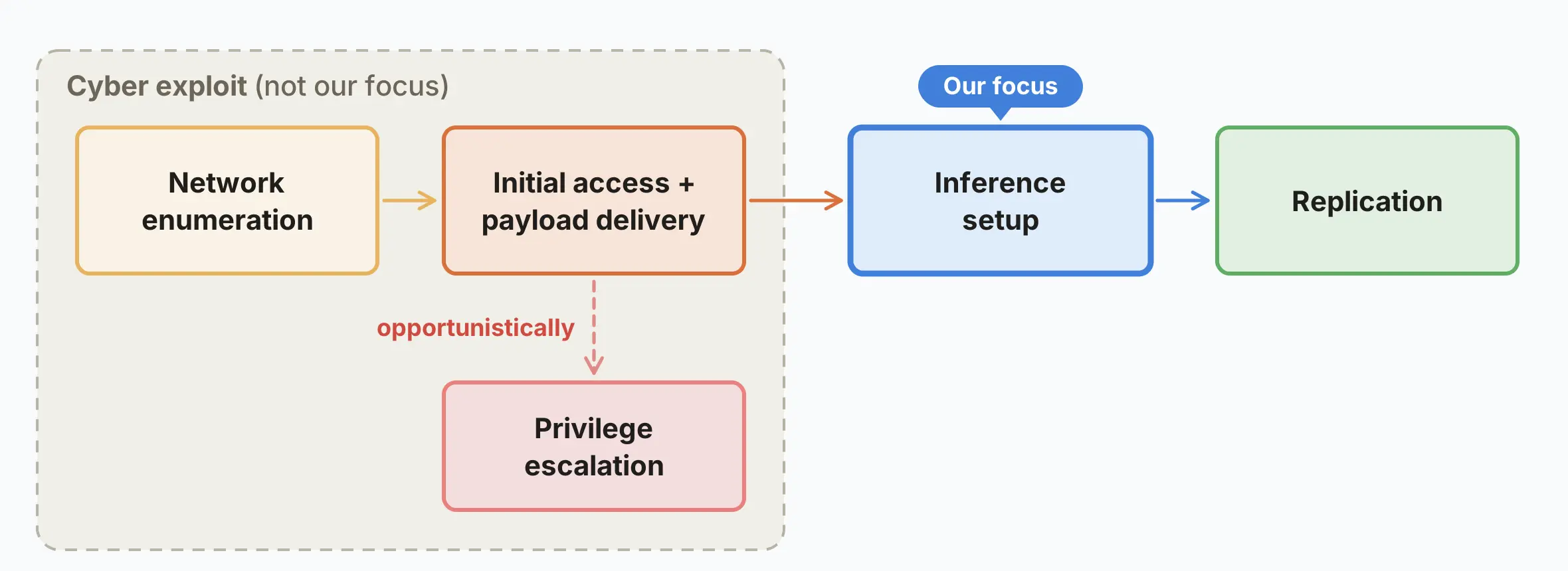
Anthropic said the dynamic inference setup is the least studied and likely most challenging stage in the replication cycle. It requires a long sequence of decisions based on the specific hardware and software of each target and involves selecting compatible inference software, installing dependencies, and debugging platform-specific bugs.
“These steps are serially dependent, and failures are difficult to recover from,” Anthropic said.
The experiment shows that small models are becoming increasingly capable at solving those problems autonomously. At the moment, however, none of the light-weight models tested are able to mount end-to-end replication, meaning discovering new devices, using an exploit to gain access to them, infecting them with a payload, configuring an inference server, and repeating the process. The process is also painfully slow; Gemma4-26B-A4B, distributed over the 15 Android TV boxes, performed at just 0.39 tokens per second. That translates to a full-inference setup time of 71 to 150 hours for an unoptimized Gemma4-26B-A4B and 29 to 51 hours for Qwen3.5-9B. (The researchers said that the large model GLM-5.2 appears to be able to do so reliably.)

Iowa, Nebraska And Six Other States Are Suing OpenAI For Endangering Children

Trump Aides Admit the House Is a Lost Cause

SHOPPING BY PRICE POINT


-

 Fashion4 days ago
Weekend Open Thread: Quince – Corporette.com
-

 Sports7 days ago
Saracens’ Venter Brands Premiership Rugby ‘Autocratic’ Over £5,000 Media Fine
-

 Business & Hustles4 days ago
PwC: Supply-Chain Diversification, AI and Energy Transition Open New Growth Paths for Thailand
-
 Entertainment6 days ago
10 Flawless Movies With the Cleverest Protagonists
-

 Sports7 days ago
Enzo Maresca all smiles as Man City return to training after guilty verdict
-

 Sports7 days ago
Southampton’s Eckert Spared Ban as FA Suspends Six-Week Sentence Over Spygate
-

 Sports6 days ago
Multiple Power Four programs face College Sports Commission investigations over alleged NIL cap evasion
-
 Sports6 days ago
Asiad selection row: Para-shooters allege corruption; PCI denies claims | Asian Games 2026
-

 Crypto3 days ago
XRP Ledger Defends Emergency Patch Amid Criticism
-

 Crypto7 days ago
Crypto.com Teams Up With Insilico Terminal to Give Traders Free Pro-Level Tools
-

 Crypto2 days ago
Rep. Omar Says She Will ‘Not Be Silenced’ After Federal Agents Raid Her Home
-
 Crypto5 days ago
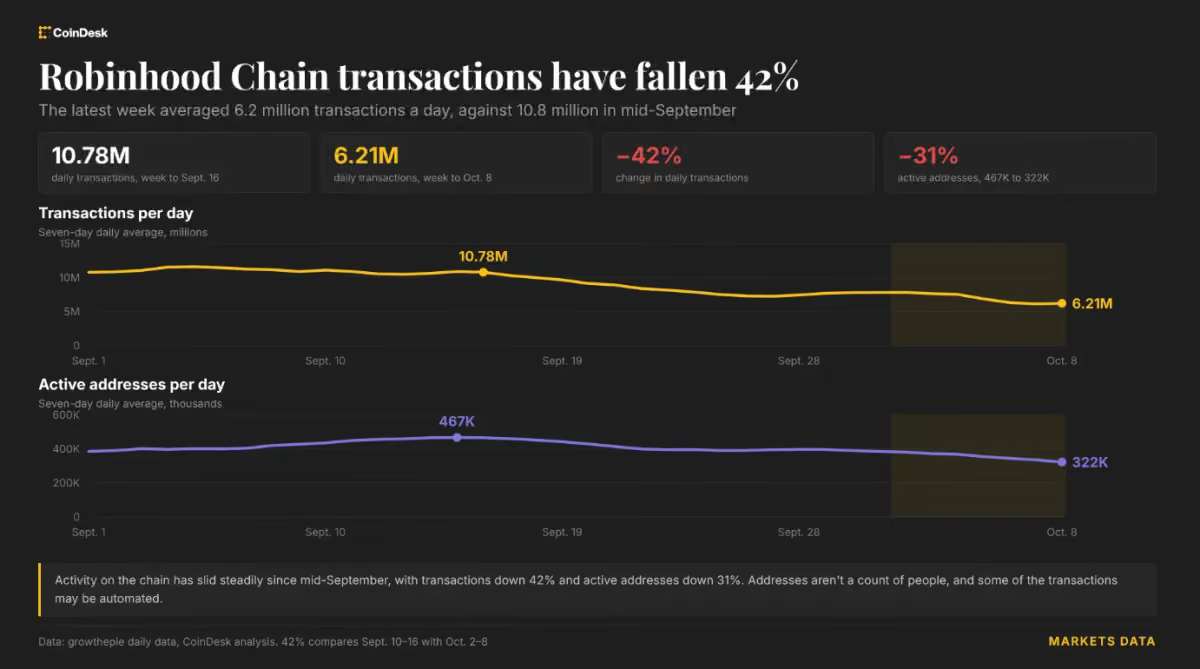
Robinhood Chain slowdown spreads from fees to trading as transactions fall 40%
-

 Sports5 days ago
College Football Week 6 Bets: Three Picks for Saturday’s Biggest Games
-
 Sports4 days ago
Duke receives encouraging update regarding top prospect from class of 2028
-

 Crypto2 days ago
KuCoin unveils 5.0 upgrade with AI tools and unified trading account – CoinJournal
-

 Crypto3 days ago
Saylor Signals Next Bitcoin Buying Plan After September STRC Buybacks
-

 Tech & AI6 days ago
ICE Emails Discuss Using Palantir-Supported Tool to Investigate Voter Fraud
-

 Crypto5 days ago
Mashinsky Accepts Lifetime Industry Ban and Up to $35 Million in Conditional Payments | The Defiant
-

 Sports6 days ago
Morocco and Senegal await AFCON final verdict after arbitration hearing – Sports
-

 Sports5 days ago
Saudi oil crisis affects Neom project, 2034 World Cup plans
You must be logged in to post a comment Login