Tech & AI
Trump’s Push to Rebrand AI as “Super Intelligence” Sparks Domain-Buying Frenzy in Slovenia

A linguistic quirk of the global internet has turned into an unlikely economic footnote to Donald Trump’s campaign to rename artificial intelligence. Since the US president declared that “AI” should henceforth be known as “SI” — short for “super intelligence” — Slovenia’s national web registry has recorded an extraordinary surge in demand for its country-code domain suffix, .si, the same two letters Trump wants attached to the future of computing.
According to Register.si, the body that administers Slovenia’s internet domains, roughly 44,000 .si web addresses were registered in September, compared with fewer than 2,000 in August — an increase north of 2,100%. Spokeswoman Klara Herman called the spike “unprecedented” relative to the previous twelve months of activity, noting that on a single day, 30 September, 11,000 new domains were registered.
The timing lines up almost exactly with Trump’s remarks. Speaking to the United Nations General Assembly in New York on 11 September, the president argued that the word “artificial” undersells the technology. “The use of the word artificial makes it sound fake,” he told delegates. “It’s not fake, it’s actually amazing. But we have to be careful… welcome to the new world of super intelligence.”
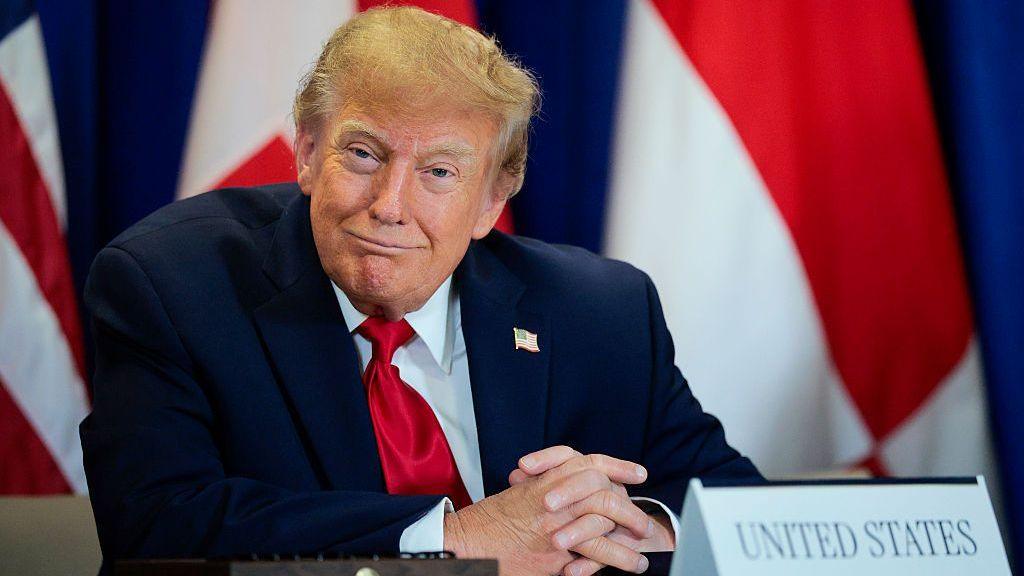

What might have been dismissed as a rhetorical flourish has since hardened into policy. This week Trump signed an executive order directing US government departments and agencies to adopt the terms “SI” and “Super Intelligence” in official correspondence, websites and reports, effectively retiring “AI” from the federal government’s vocabulary. The signing came at what the White House billed as “an extraordinary gathering” of technology executives, part of a broader push the administration describes as building “America’s Golden Age” of innovation.
The order did not escape scrutiny for other reasons: eagle-eyed observers online noted that “United States” had been misspelled beneath Trump’s signature on the official document, prompting a wave of mockery even as the substance of the rebrand drew attention of its own.
For Slovenia, the linguistic coincidence has translated into a very literal digital land grab. Herman said she remained “cautious” about crediting Trump’s comments with the entirety of the surge, but acknowledged the September numbers stood out “very clearly” against the rest of the year’s data. Industry watchers point to a familiar pattern: speculative domain buyers rushing to secure short, memorable web addresses before their perceived value rises, in the hope of reselling them later at a premium.
That kind of bet has paid off spectacularly before. In 1997, domain investor Rick Schwartz — nicknamed “The Domain King” — bought men.com for $15,000 and sold it seven years later for $1.32 million. With “SI” now carrying presidential weight as shorthand for one of the most consequential technologies of the era, it is easy to see why buyers might be scrambling to lock in .si addresses on the chance that the abbreviation becomes as commercially valuable as “AI” itself.
Whether Trump’s attempted rebrand actually catches on in everyday usage — among technologists, journalists or the public — remains to be seen. Renaming a technology that has already saturated global culture under a single acronym is no small task, and “AI” has become deeply embedded in product names, academic literature, stock tickers and regulatory frameworks worldwide. Replacing it wholesale, even with the backing of an executive order, would require buy-in far beyond the US federal government.
Still, the episode offers a striking illustration of how quickly political rhetoric can ripple into unexpected corners of the global economy. A president’s preference for one acronym over another, delivered in a UN speech, has been enough to send Slovenian domain registrars into overdrive — a reminder that in the internet age, even a two-letter abbreviation can become a commodity.
You must be logged in to post a comment Login