




Connect with us

Tech

5 Harbor Freight Boating Tools And Accessories You Shouldn’t Overlook

Published

on


While owning a super yacht is still out of reach for the average person, there are still many boat brands rolling out affordable models, and some seriously cheap. For under $1,600, you can even get a basic boat that you can pull with a bicycle from Tracker. And once you’ve done the research and found the right boat that fits your budget and your lifestyle, the next step is investing in the tools and accessories to help you keep it running for as long as possible. 

In general, everyone should know to assemble a kit of essential boat tools. Stuff like waterproof flashlights, multitools, and duct tape, as well as things for safety, like a whistle, first aid kit, and air horns are all vital. However, there are plenty of things people tend to overlook, especially when it comes to boat transport and regular maintenance.

Advertisement

Harbor Freight has a lot of tools and accessories that may not be marketed specifically for boats, but can still fulfill useful functions for it. To help you invest in the right boat-related tools and accessories, we’ve rounded up some highly-rated options from Harbor Freight. We considered different aspects of tool usages for boat owners, but also thought about ways it can be used outside of it. To know more about the actual methodology, read on to the end of the article.

Advertisement

Bauer 20V Cordless Inflator/Deflator

For some people, getting your boat to and from the water is half the battle. Since all of them work with tires, the pressure needs to be managed regularly and you can do this with the Bauer 20V Cordless Inflator/Deflator. With a maximum pressure of 160 PSI, you can have some added peace of mind when you need to top up the air in your boat trailer tires or tow vehicle tires. Bauer notes that you can expect it to do the job in under 120 seconds. As an inflator, it has a flow rate of 0.4 CFM at 30 PSI and 13.4 SCFM at 0 PSI as a blower.

Using this, you can be everyone’s favorite person when you inflate the floaties, even when you’re already out in the water. It can even work on inflatable mattresses, so it’ll be useful for setting up camp during overnight trips. The unit also comes with a bright LED and storage. But take note, it isn’t weatherproof, so it’s not supposed to be left outside under the sun or get submerged.

Priced at $49.99, the Bauer 20V Cordless Inflator/Deflator is sold as a standalone tool, which means you’ll need to factor in the additional cost of the battery. As of August 2026, it has generated an average rating of 4.5 stars from 890 Harbor Freight customers. In addition, 92% of them also said they would recommend it to other people.

Advertisement

Luminar Work 6,000 Lumen LED Work Light

Unfortunately, not all problems happen during the day when there’s sunshine, especially if you’re a fan of nighttime diving or fishing. Thankfully, whether things break at night or you need to get into a tight corner for larger boats, the Luminar Work 6,000 Lumen LED Work Light can give you enough illumination with its 5,000K daylight bulb. Measuring 10 inches by 6.1 inches by 8.9 inches, it has a wide base and skid-resistant feet. It also comes with a 5-foot cord and a lock-in-place swivel head that goes up to 90 degrees for placement flexibility. Since it is both UV and water resistant, its aluminum housing is suited for boat life, even during the wetter seasons. Not to mention, it has ETL certification for some added safety.

Sold at $29.99, the Luminar Work 6,000 Lumen LED Work Light holds an average rating of 4.7 stars from 500-plus customers on Harbor Freight, as well as a 95% recommendation rate. If you don’t necessarily need something so bright, there’s also the cheaper $17.99 Luminar Work 1,000 Lumen LED Work Light model. On Harbor Freight, it has the same 4.7-star average rating from 650 people. But if you want something super bright and have more budget to spare, Harbor Freight also sells the $49.99 Braun 12,000 Lumen LED Work Light. It’s rated to last up to 50,000 hours and even comes with a waterproof power switch.

Advertisement

Viking 6/12V Battery and System Tester

So far, there’s still no AAA towing service if your boat’s battery dies offshore and a battery that isn’t working well can lead to everything from electronics not working to flooding inside your boat. Made to work with lead acid, standard gel, marine, AGM and deep cycle batteries, the Viking 6/12V Digital Battery and System Tester can be a great addition to make sure your boat’s 12V battery is in good condition at all times. Battery testing aside, it can also be used to test alternator outputs, voltage regulation, and starting capacity. Made for one-handed operation, it also has a sound for time-measured tests. 

Advertisement

Apart from marine use, Viking also notes that its tester is made to work with motorcycles, automotive, and other recreational vehicles. That said, the 2-foot cable can be an issue if your boat’s battery is hard to reach and you can’t fully expect the same precision as a digital one.

Retailing for just under $40, the Viking 135 Amp 6/12V Battery and System Load Tester has generated an average rating of 4.8 stars from 330-plus people, as well as a 98% recommendation rate. If you’re a professional who wants to give clients feedback on the spot, Harbor Freight also sells a 6/12/24V Digital Battery and System Tester with Printer for $129.99. Although, if you want to look outside of Harbor Freight, some of the best Amazon battery testers include highly-rated options from brands like Konnwei, Mototpower, Topdon, and Foxwell.

Advertisement

Haul-Master Ratcheting Tie-Down Straps

Unlike hand-pulled straps, ratchet straps can help secure things more effectively against the elements, like a kayak or when trailering your boat. While Harbor Freight doesn’t list any marine-grade ratcheting tie-down straps, it does have a few highly rated ratchet straps from Haul-Master to choose from. For mid-sized boat owners, the $17.99 Haul-Master 3,300-pound Capacity 2 inch by 27-foot Ratcheting Tie-Down may be good enough for your transport needs. As of August 2026, more than 2,200 Harbor Freight customers gave it an impressive 4.7-star average rating, plus a 97% recommendation rate. Designed for outdoor use, it features UV-resistant webbing, J-style hooks, rust and corrosion-resistant steel. It has a working load of 3,300 pounds and break strength of 10,000 pounds. Since it’s sold a single unit, you might need to spend more for security.

If you want something to hold down light boats like canoes and kayaks, the Haul-Master 400-pound Capacity 1 inch by 15-foot Ratcheting Tie-Downs. Sold in a set of four, it retails for $12.99, has a 94% recommendation rate, and holds an average rating of 4.5 stars from 12,000 people. Haul-Master also sells the $29.99 3,333-pound 2 inch by 30-foot commercial-duty ratcheting tie-down, which is better suited to larger boats. But since it’s a new product, it doesn’t yet have a significant number of reviews. Regardless of which model you get, you’ll want to make sure you set up your ratchet straps properly to avoid any problems.

Advertisement

Bauer Modular Rolling Toolbox

Caring for your boat requires a ton of different tools, which all need a home whether you’re at home or in the water. However, since it will need to be regularly exposed to the elements, you’ll need one that can take a beating, like the Bauer Modular Rolling Toolbox. While it’s not known to be the best major portable tool box brand out there, it can still be a great choice for some people for several reasons, especially for larger boat owners.

To start with, it holds an IP65 dust and water resistant rating, which makes it both dust-tight and capable of holding on its own against water jets. Although this doesn’t mean you can power wash it, you don’t have to worry about it getting wet on the boat. Inside it, there’s a removable organizer tray, plus integrated sections to hold tape measures, extension cords, and other tools in the back. Made of high-impact resin, it measures 20⅝ inches by 19 inches by 20 inches without the handle. It has a total working load of 6 pounds. To make it easier to move around, it also comes with 8-inch all-terrain wheels, a removable handle, and hinged lid.

Advertisement

Apart from being available on Harbor Freight, it’s relatively affordable and generally well-reviewed by consumers. Priced at $69.99, the Bauer Modular Rolling Tool Box has been rated 4.8 stars by 115 Harbor Freight customers with an impressive 98% recommendation rate.

Advertisement

Methodology

To create this list, we considered the different ways boat owners need to use tools, from maintaining their vehicles to transporting them. Next, we looked through the Harbor Freight portfolio for items that fulfilled these needs. We only included options that have been rated at least 4 stars by over a hundred customers, plus a recommendation rate that exceeds 90%. To fit a wide range of budgets, we listed products that are priced between $13 to $70, as well as expected additional costs if you need to purchase batteries separately, which can impact the overall cost of ownership.

When possible, we cite limitations of each item, including whether they’re made for marine use or don’t have any significant weatherproof protection. We also mention whether or not the brand or product has been part of our other list of recommendations at SlashGear. While it didn’t affect their placement on this list, we also take note of features that may be useful outside the applications for boats as well. In some cases, we also share similar items you can get from the same brand, those you can also find on Harbor Freight, or alternatives that you can get from other online retail platforms, such as Amazon.

Advertisement


Source link

Continue Reading
Click to comment

You must be logged in to post a comment Login

Leave a Reply

Tech

CISA gives feds 3 days to fix actively exploited Ray RCE bug

Published

on

Security

Phishing, malvertising attacks could target devs to gain access to private corporate networks

CISA says attackers are exploiting a critical 2025 vulnerability in Ray, the widely used open source framework for scaling Python and machine-learning workloads. 

Tracked as CVE-2025-62593 and rated 9.4 under CVSS v4, the bug was first disclosed in November 2025. It allows an attacker to use Firefox or Safari to achieve remote code execution (RCE) on a vulnerable Ray system.

Advertisement

The open source distributed computing framework is used and supported by major tech companies, including Amazon, Apple, and OpenAI.

Vulnerable Ray versions try to identify and block browser requests by checking whether the User-Agent header begins with “Mozilla.” Firefox and Safari, however, allow scripts using the Fetch API to modify that header.

A developer running Ray could trigger the exploit simply by visiting a dodgy website or receiving a malicious ad in an affected browser. The attacker can then use DNS rebinding to reach the local Ray service.

“This vulnerability impacts developers running development/testing environments with Ray,” the project’s developers explained. “If they fall victim to a phishing attack, or are served a malicious ad, they can be exploited, and arbitrary shell code can be executed on their developer machine.

Advertisement

“This attack can also be leveraged to attack network-adjacent instances of Ray by leveraging the browser as a confused deputy intermediary to attack Ray instances running inside a private corporate network.”

Ray 2.52.0 fixes the flaw. CISA gave US federal civilian executive branch agencies three days to remediate it, rather than the standard 14.

CISA did not explain the urgency, and marked the catalog’s “known to be used in ransomware campaigns” field as “unknown.” However, Binding Operational Directive 26-04 allows the agency to impose a three-day remediation window on vulnerabilities it considers especially risky.

Ray is an open source framework that helps developers scale Python and machine-learning workloads from a local environment to a cluster with minimal code changes.

Advertisement

Now managed by the Linux Foundation’s PyTorch Foundation, the project started at UC Berkeley and was commercialized via Anyscale, the startup founded by Ray’s developers in 2019.

According to Anyscale’s figures as of October 2025, Ray had more than 237 million total downloads, and 7 million per week – representing a near-tenfold growth year-on-year.

Product analysis site NextSprints estimates that Ray has 1 million monthly active users and is used by 60 percent of Fortune 500 companies.

The security advisory blamed Ray’s longstanding lack of authentication on critical endpoints for making the attack possible.

Advertisement

Ray’s security model historically assumed that clusters would run inside a trusted, isolated network, leaving authentication and access control to the surrounding infrastructure.

Ray 2.52.0 introduced optional token-based authentication as an additional defense against unauthorized access, although it remains disabled by default. The project continues to recommend deploying clusters inside a controlled network rather than treating authentication as a substitute for isolation. ®

Source link

Advertisement
Continue Reading

Tech

Smartphones And The Next Generation Of Hearing Aids

Published

on

If you don’t actually need one, you’d be forgiven for thinking a hearing aid just makes everything louder for the wearer. Especially since there are plenty of shady products out there which will do exactly that for just four easy payments of $29.99. But the reality is considerably more complex, as a proper hearing aid needs to be capable of selectively enhancing certain frequencies while squashing down others.

The technical challenges involved in pulling that off in a device small enough to fit inside the human ear and run off of a tiny battery are considerable — and while there’s undoubtedly been some degree of artificial price inflation going on over the years, there’s a reason proper hearing aids have been so much more expensive than their “As Seen on TV” counterparts. These same challenges are also why DIY and open source hardware hearing aids have struggled to gain much traction.

But over the last few years the situation has changed. In 2022 the United States Food and Drug Administration (FDA) established the framework by which hearing aids could be sold over the counter (OTC). Although they’re generally less capable than their prescription counterparts and not suitable for individuals with profound hearing loss, the wide commercial availability of OTC hearing aids has kicked off a competition between manufacturers to deliver more affordable devices.

That competition entered a new phase earlier this month when the FDA granted approval for Samsung’s Galaxy Earbuds to fall under the same category. This follows a similar decision made about Apple’s AirPods back in 2024. The two biggest players in the smartphone market being able to offer their earbuds as OTC hearing aids represents a unique value proposition. Not only are they priced for mass market consumption, but many individuals who would be interested in purchasing an OTC hearing aid will already own them and need only to enable the feature with a software update.

Given how different the situation is today than even just five years ago it’s worth asking just what qualifies as a over-the-counter hearing aid, and how the shifting definition of these devices can inform the community’s efforts to develop open hardware solutions.

Advertisement

What is a Hearing Aid, Anyway?

We’ve already covered what a hearing aid isn’t, but before we go too much further it’s a good idea to clarify what exactly a hearing aid does in comparison to a simple audio amplifier, which in the industry are officially known as Personal Sound Amplification Products (PSAPs). This is a topic we’ve touched on previously here at Hackaday, but the short version is that since the 1980s or so, the frequencies that a hearing aid amplifies have been tailored to match the specific auditory deficiencies of the wearer.

Traditionally, getting a hearing aid prescribed would require going to an audiologist and getting an audiogram. This chart plots the results of a hearing test, and shows how well the patient can hear various frequencies. With this data, it’s possible to quantify the severity of a patient’s hearing loss and determine where a hearing aid could improve the situation. This information could then be programmed into a hearing aid to provide a bespoke amplification profile that takes into account the needs of the wearer.

It’s worth noting that this is only in the context of relatively modern digital hearing aids, essentially those created after the introduction of solid state electronics. Prior to that point, hearing aids were closer to what we would now consider PSAPs and amplified incoming audio indiscriminately.

Defining a Middle Ground

With this in mind, the primary difference between a prescription hearing aid and an OTC model is that the audiologist is cut out of the loop. That means there’s no audiogram, and in turn no data to program the hearing aid’s filters with. The specifics of this does vary from model to model, and both Samsung and Apple offer some basic audio testing tools that can help the user fine-tune their experience. But at this point, no OTC hearing aid product is capable of diagnosing the wearer’s hearing to the same level as a comprehensive hearing test performed by an audiologist

Advertisement

That being the case, it might seem like an OTC hearing aid is just a PSAP. But in their ruling, the FDA established the formal requirements for a device that falls somewhere in the middle. The full document, Medical Devices; Ear, Nose, and Throat Devices; Establishing Over-the-Counter Hearing Aids, comes in at around 200 pages if you’re looking for some light reading.

Fortunately, the agency provides a boiled-down list of what features a device must have to meet the definition of an OTC hearing aid. Some of the requirements have to do with the packaging and marketing of the product, which of course are important for a medical device, but it’s the technical parameters that we’re interested in.
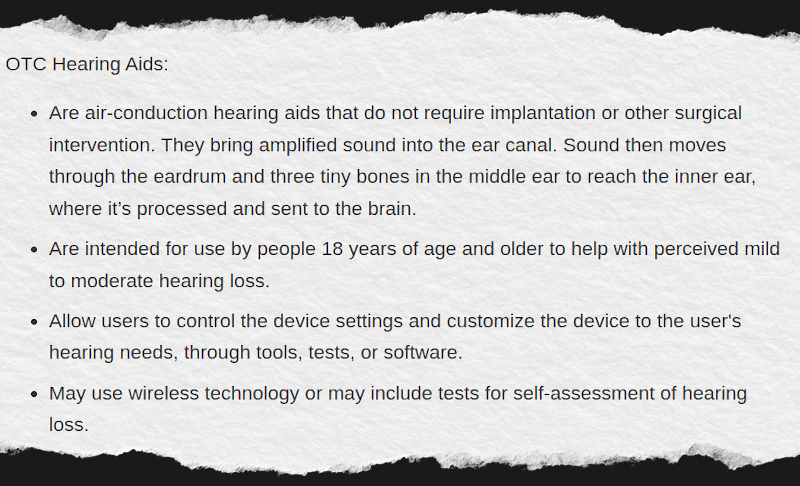
The FDA specifies that all OTC hearing aids must use air-conduction, that is, operate with a speaker inserted into the ear canal. The alternative would be bone conduction, which is generally used in cases with more profound hearing loss. The devices must also allow users to adjust, at least to some degree, the output to match their specific needs.

The intention with this second requirement goes deeper than a simple volume control as you’d have in an PSAP. In lieu of the sort of tailored output a prescription hearing aid would offer, the OTC device can offer a selection of pre-defined audio filter profiles which the user could flip through. At the risk of oversimplifying things, it’s a bit like the audio presets for different genres of music that modern headphones and earbuds usually offer in that the user can cycle through different profiles to find what best matches the current environment.

Advertisement

When combined with the acknowledgement that OTC hearing aids can utilize wireless technology to communicate with another device, it’s not hard to see how the smartphone fits into the equation. While a stand-alone device is capable of meeting the requirements necessary for OTC hearing aid classification, being able to connect to the user’s phone to easily switch between audio profiles on the fly makes for a greatly improved user experience. Additionally, by playing tones through the earbuds, software on the phone can perform a hearing test on the user — the results of which can be used to fine-tune the output beyond what’s possible with simple presets.

Hackers, Take Note

Of course, anyone looking to build an open source hearing aid probably isn’t looking for FDA approval. The goal is likely to make the technology cheaper and more accessible, especially in areas where getting a commercially produced hearing aid may be difficult. As such, the new over-the-counter classification may not seem terribly important for folks like us.

But that doesn’t mean we can’t pick up some tips from what companies like Samsung, Apple, and Jabra are doing. By bringing the user’s smartphone into the mix, they have made hearing aids more accessible and easier to operate. Instead of trying to pack all of the functionality directly into the wearable, using a smartphone to do some of that heavy lifting opens up a lot of new possibilities. There are naturally trade-offs when switching a hardware problem for a software one, especially when dealing with mobile operating systems, but it may be a compromise worth making if it means getting this sort of assistive tech to more people that need it.

Advertisement

Source link

Continue Reading

Tech

Screwworm Infections Get Worse, Government Unleashing Drone Army For Surveillance

Published

on

from the we’re-screwed dept

A couple of months back, we discussed how screwworm infections had reappeared in Texas for the first time in decades. The foreign surveillance program designed to keep this from occurring in partnership with countries south of the border dissipated after losing funding as a result of the DOGE bros deciding it just wasn’t worth it. So, just as with measles, the country had to deal with a problem that we had once essentially eradicated with a good government program.

Screwworms are a very real and serious problem if left unchecked. Flies lay their eggs in livestock, mainly cattle, and it can kill the host in a matter of weeks. There are currently reports that hundreds of Mexican citizens have also been infected. And on the American side of the border, the problem is getting worse, not better. As a result, the government is diverting drones from patrolling the border to instead look for screwworm infections in livestock.

Since the first screwworm cases were detected in South Texas in June, the US Department of Agriculture and US Customs and Border Protection have been conducting “one of the most extensive animal-health surveillance operations in the country,” the USDA said on August 10 in social media posts on platforms like X and Facebook.

The effort involves at least 200 drones owned by the Department of Homeland Security, which includes the Customs and Border Protection (CBP) agency. But the actual number in use “varies depending on availability and need,” a USDA spokesperson told Ars.

The USDA also described performing 1,226 drone flights that surveyed more than 23,000 animals as of August 11.

Advertisement

This all costs money. As does the reinvestment in facilities to release sterile flies to reduce their overall numbers in both Mexico and domestically. $21 million was spent in Mexico for this. Untold millions are being spent for a facility at Moore Air Base in Texas. $25 million is being spent right now to build another facility in Arizona. The grant that DOGE canceled funded animal disease surveillance programs generally, including that of screwworms, cost $170 million. We’ve likely already eclipsed the cost of keeping screwworms out of the country in the government’s response this outbreak.

And what it’s reappearance risks is nearly $2 billion in damage to the Texas economy.

$1.8 billion. That’s how much economic damage could be caused by another outbreak on the scale of the Texas incident in 1976, according to USDA estimates.

This is the very definition of stepping over dollars to pick up pennies. It’s governmental malpractice and a failure of stewardship of taxpayer dollars and the economic health of America, which was the very fucking thing DOGE was pitched to have as its north star.

Our government is currently very broken, and brutally stupid. And we have yet another health issue, not to mention a food supply issue, as a result.

Advertisement

getting screwed

Filed Under: cbp, screwworm, texas, usda

Source link

Advertisement
Continue Reading

Tech

The Ellisons Again Threaten To Move CBS/Paramount Somewhere Shittier And Hotter If State Antitrust Lawsuit Isn’t Settled

Published

on

from the taking-my-ball-and-going-home dept

Paramount bosses Larry and David Ellison aren’t having much fun in the wake of a 12 state antitrust lawsuit that risks derailing their $111 billion attempt to dominate what’s left of U.S. corporate media.

There’s been a certain creeping desperation apparent the last month or two; whether it’s the company’s top lawyer claiming that critics of the deal are somehow antisemitic, or the continued threats that the company will leave California if states don’t back off their lawsuit. The company has also been funding no limit of shitty editorials trying to pretend further consolidation is just what Hollywood needs.

This report (paywalled) from Puck indicates that David Ellison is laying the groundwork to move Paramount to Tennessee, Texas, Georgia, or another state if California AG Rob Bonta doesn’t settle the antitrust case. It’s kind of an irrelevant threat in some contexts given that most U.S. film and TV production was already leaving California, and may occur whether or not the deal is approved.

Unfortunately for Ellison and his nepobaby kid, the old “I’m taking my ball and going home” threat doesn’t appear to be working on Bonta, and the antitrust lawsuit case is slated to begin next March — much later than the Ellisons were hoping. From Vulture:

Advertisement

“It’s possible Ellison and his team were hoping all of this would scare Rob Bonta, the state’s attorney general, into backing down. But so far, Bonta doesn’t seem cowed and has accused Paramount of “blackmail” in trying to get its way. And outside observers seem to agree: “Paramount’s PR campaign appears to be strengthening Bonta’s hand rather than weakening it,” the analysts at Lightshed wrote in a note to clients this week.”

Amusingly, a bunch of Paramount employees told Business Insider they were mostly just happy the merger was paused so they could focus on their work:

“It’s nice to be able to focus on what we do without the impending disruption that a merger in 2026 would have brought,” a high-level advertising employee said of the merger delay.”

Ellison is also trying to apply pressure on more corporate-cozy Democrats to push Bonta to support a deal (see: California Gubernatorial candidate Xavier Becerra, and off-the record comments by Gavin Newsom), but that doesn’t seem to be working either. In part because the U.S. cultural animosity toward billionaires and shitty giant companies is bubbling over, but also because time is simply on Bonta’s side.

Starting in October the company has to start paying a $7 million per day ticking fee to investors, which clearly has the Ellisons panicking. Larry’s over-extension in AI, should a bubble pop, could also complicate the financing for what’s already a very debt-heavy deal.

And again, it’s more than possible that Ellison follows through and moves Paramount out of California regardless of whether the deal is or isn’t approved simply to grab some tax breaks, putting a stake in the heart of an already reeling Hollywood that’s steadily watched most film and TV production migrate overseas.

Advertisement

But at the same time this exact sort of consolidation is just foundationally deadly. These deals always (and 50 years of data is not subtle on this point) result in mass layoffs, higher prices, less competition, and broad enshittification as the remaining company struggles to manage debt.

So for the few remaining regulators we have concerned about the public interest and labor, the best tack continues to be to simply block this and any other “growth for growth’s sake” consolidation. Though Ellison’s megamerger is extra shitty for numerous additional reasons, ranging from the dodgy financial support from overseas autocrats, to the Bari Weiss extraction class agitprop degradation of whatever’s left of journalistic institutions like CBS and CNN.

It’s very possible that Larry Ellison likely loses either way this goes. Either the state wins its antitrust lawsuit derailing his dreams of media domination, or he succeeds with his acquisition and is overloaded with debt while a bizarre assortment of nepobabies and brunchlords (who appear to have no idea what they’re doing) struggle to remain relevant as traditional broadcast TV heads toward extinction.

Filed Under: agitprop, bari weiss, california, consolidation, david ellison, journalism, lerry ellison, media, mergers, rob bonta

Companies: paramount, warner bros.

Advertisement

Source link

Continue Reading

Tech

Hackers Tricked a Major Retailer’s AI Shopping Bot to Do Something It Was Never Supposed To

Published

on

It started with avocados and ended with sensitive information being leaked.

Onstage at the Black Hat cybersecurity conference in Las Vegas, researchers Netanel Rubin and Dan Avraham pulled up an AI shopping assistant — the kind that’s available inside most major retail apps to answer questions, compare products and help shoppers navigate a store’s enormous catalog.

But the conversation didn’t stay on groceries for long.

By the end of the demonstration, the researchers had bypassed the assistant’s safeguards and forced code to run inside the computer environment behind it. The bot returned directory listings, environment variables and other information that an ordinary shopper should never be able to see.

Advertisement

In the wrong hands, that kind of information could give an attacker clues about the retailer’s systems and potentially expose secrets or access that could be used in further attacks, putting both the company and, depending on what the AI can reach, its customers at risk.

The retailer wasn’t a small online shop experimenting with a hastily assembled chatbot, either.

According to Rubin and Avraham’s company Rein Security, it was one of the three largest retailers in the US, and the assistant was available through the same public mobile app used by everyday customers. 

A few important notes: Rein Security sells technology designed to monitor AI agents and provide visibility into what those agents are doing. Rein also didn’t identify the retailer, citing legal concerns. That means the findings cannot be independently verified with the retailer, and shoppers can’t know whether they’ve used the affected assistant.

Advertisement

How the shopping assistant was tricked

The attack started with one of the assistant’s most useful abilities: comparing products.

To answer certain questions, the AI can retrieve information from websites outside the retailer’s control. That helps it gather more information for shoppers, but it also means the assistant can encounter material created by virtually anyone, including an attacker.

The researchers placed instructions in content they controlled and got the shopping assistant to retrieve them. Instead of treating that material only as information to summarize, the AI was manipulated into treating some of it as new directions to follow.

This is known as an indirect prompt injection. The malicious code can be hidden within a website, document, product listing or other material the AI encounters while trying to complete a legitimate task.

Advertisement

That alone wasn’t enough to reach the system behind the assistant, but it gave the researchers a starting point.

The retailer had installed a security layer that examines conversations and attempts to keep the assistant focused on shopping. If you ask it something outside its approved role, the request could be rejected.

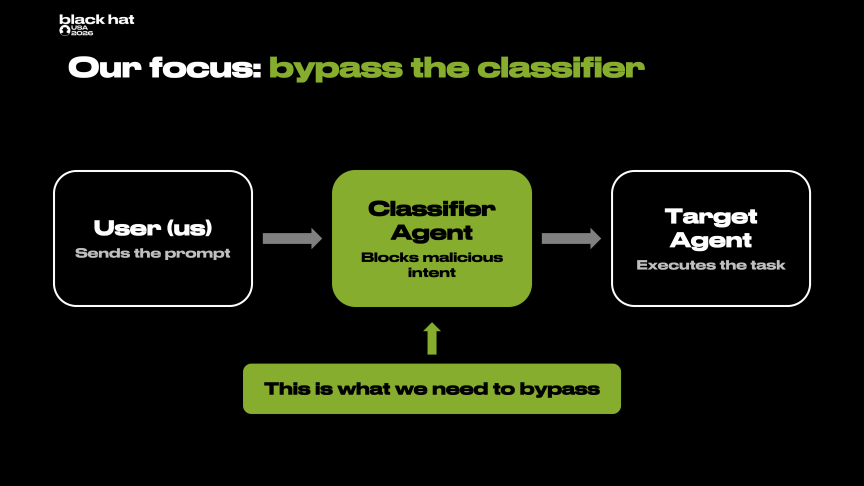
The retailer used one AI agent to screen requests before sending them to the shopping assistant. The researchers focused on getting around that first line of defense.Black Hat

The researchers found that those protections weren’t applied evenly. The main chat interface had safeguards in place, but the app’s regular search field didn’t have the same level of protection.

Through that less-protected input, Rubin and Avraham said they persuaded the assistant to reveal information about its internal setup, including the names of tools it could use and the syntax for calling them.

They then created another set of instructions that caused the assistant to run code inside its own computing environment — essentially the computer system where the AI was running. The assistant returned lists of files and other information about that system, showing that the prompt injection had worked and the researchers’ commands had actually been executed.

Advertisement
The researchers deliberately asked the assistant to divide by zero. The resulting Python error helped confirm that their code had actually run inside the assistant’s computing environment.Black Hat

Rein’s public account doesn’t establish what else the assistant’s isolated environment could potentially access or whether an attacker could move from there into systems containing customer, payment or inventory data.

But getting code to run at all means the researchers were able to cross an important security boundary.

The researchers said they reported the vulnerabilities on March 13. As of July 16, more than 90 days later, Rein said they had not been fixed. The company has not publicly provided a newer update on whether the problems remain.

The researchers also stressed that they didn’t access real customer information, alter anyone’s orders or attempt to disrupt the retailer’s systems. Their work was performed in a controlled environment using their own session.

The AI wasn’t just talking

Chatbots have been manipulated into saying strange, offensive or unrelated things for years. But AI assistants can do more than generate answers; they can retrieve information, call outside services and use software tools to complete tasks.

Advertisement

Retailers want these assistants to eventually build shopping lists, check inventory, manage orders and even complete purchases. But each new ability creates another potential risk if the AI can be tricked into following the wrong instructions.

In this case, the retailer’s security system monitored what shoppers said to the AI and what it said back. According to Rein, it couldn’t see everything happening in between, including information the assistant retrieved and tools it used.

That created a blind spot in which the security system could see the conversation, but not everything the AI was doing behind it.

During their examination of the app, the researchers also found Google Maps API keys visible in traffic they decrypted from the mobile app. If those keys weren’t properly restricted, an attacker could potentially use them to make unauthorized requests to Google Maps services on the retailer’s account, running up charges or exhausting its usage limits. 

Advertisement

The researchers did not report accessing customer information with the keys, but an attacker could potentially use them to make unauthorized Google Maps requests at the retailer’s expense.

What it all means

There isn’t much an ordinary shopper can do to prevent this kind of vulnerability. The attack targeted the retailer’s design, not a weak password or a customer mistake.

The responsibility belongs to companies giving AI assistants access to internal tools and information. Those systems have to assume that anything pulled from the open internet could contain instructions intended to mislead the AI — and put appropriate safeguards in place.

It’s still wise to avoid sharing unnecessary personal information with shopping assistants, particularly if the bot can access previous orders or other account details. Keeping retail apps updated can also ensure you receive security fixes when they become available.

Advertisement

And that also leaves one enormous unanswered question: Which shopping assistant was it?

For now, the researchers aren’t saying. But the demonstration shows what can happen as AI shopping assistants are given more control. If they can be tricked into following the wrong instructions, their most useful features can also become security risks.

Source link

Continue Reading

Tech

10 Power Tools That Are Ideal For DIY Beginners

Published

on


We may receive a commission on purchases made from links.

Beginners entering the world of DIY renovations and repairs have a lot of learning ahead of them. Getting into the swing of things isn’t always easy, not least because many jobs demand a new tool purchase when you’re just getting started. Every tool appears to be a great option, and the marketing language used by all the major tool brands make it seem like you need to buy everything — especially the newest tools available, at that.

Advertisement

Realistically, it’s a bad idea to invest in a state-of-the-art circular saw, hammer drill, or sander early on in your journey. First, the price of a premium tool can be astronomically higher than a budget-friendly one. Saving money on tools is always a good idea, especially for buyers who will be using their gear to solve small issues around the house or pulling them out sparingly for building projects of limited scope. There’ll be plenty of time to upgrade your DIY setup, but in the early days, getting all the gear you need is more important.

Looking for beginner-friendly power tools is also important because these tend to feature slightly lower power outputs, more streamlined functionality, and an easier user experience. This makes potentially dangerous tools a little safer while you build the confidence you need to expand your horizons and start tackling even bigger projects.

Advertisement

Warrior 12V 3/8-inch Drill Kit

The Warrior 12V 3/8-Inch Drill Kit is a good starting point for a beginner looking to get into DIY. This is a highly rated cordless drill running on a smaller battery system. This gives it a fairly small size on the whole, reducing fatigue when used. The tool weighs 2.6 pounds and comes in at 7.75 inches. Perhaps more importantly, the kit including the drill, a battery, and a charger will run you $20 at Harbor Freight, making it an incredibly approachable option for drilling and fastening. A drill you can rely on is one of the first purchases you should make when building up a home toolkit capable of handling basic renovations and repairs.

This model is not suitable for heavy-duty drilling applications, but it will serve you well in routine tasks across the board. It delivers a max torque of 132 in-lb and 550 rpm of max speed, so it’s more than capable of delivering enough force to deal with simple tasks. It operates with 12 clutch positions so it can deliver the right amount of force required without going overboard and making the drill more complicated than it needs to be. It also features a keyless chuck and a variable speed trigger.

Advertisement

Craftsman V20 Variable Speed Jigsaw

Once you have basic drilling and driving needs covered, it’s time to look for a saw, and the most versatile handheld saw you can pick up for cutting timber is the jigsaw. Jigsaws allow you to make straight cross and rip cuts, but also feature the ability to carve wavy lines in a workpiece. This is something circular saws and other options can’t match. Similarly, the jigsaw is a more nuanced tool whereas a circular saw delivers far more force to the workpiece and can therefore be harder to handle, while also introducing a bit more danger into the mix. The jigsaw is the clear choice for beginners seeking versatile cutting power that’s easy to contain and leverage.

The Craftsman V20 Variable Speed Jigsaw is a $71.88 purchase on Amazon. For a kit variant with a 2.0Ah battery and a charger, you’re looking at a price tag of $189. There are also corded options, including from Craftsman, that will reduce the price, but doing away with the cord on a jigsaw makes it easy to use in any environment you can bring it to. The tool features three orbital positions and a maximum blade speed of 2,500 SPM, alongside a variable speed trigger. It also features a beveling shoe that allows for cuts of up to 45 degrees for angled finish work. The saw works with both T and U shank blades and features a comfortable handle grip and a dust blower, to clear debris from the cut line for enhanced visibility.

Advertisement

Kobalt Compact 10-Inch 15 Amp Dual Bevel Sliding Compound Miter Saw

Kobalt is an in-house brand owned by Lowe’s. The toolmaker offers a range of quality DIY-grade power and hand tools, and in many cases it provides a versatile blend of function and good pricing. The Kobalt Compact 10-Inch 15 Amp Dual Bevel Sliding Compound Miter Saw is a great example of this. Listed at Lowe’s for $289, it’s a corded tool that offers just enough features to grow with you without feeling overwhelming as you find your bearings. It utilizes a 10-inch blade that you’ll grow out of eventually, but which offers more than enough cutting capacity for simple DIY projects. It can handle a 3.5-inch cut depth at both 90 and 45 degrees, allowing the saw to cut through 2×12 and 2×8 lumber at these positions, respectively.

Advertisement

The rail system uses linear bearings to make its movement smooth and consistent, miter cuts go between 55 degrees left and 60 degrees right (with ten stops at common angles), and it can bevel to 48 degrees in either direction. This might seem like overkill, but these are all useful features. The ability to bevel and miter in either direction, for example, means that you won’t have to fiddle around with your workpiece as much, since you can just move and rotate the saw. The Kobalt miter saw also includes fairly sizable wings that extend outward to better hold boards in place.

Advertisement

Ryobi USB Lithium Screwdriver Kit

The Ryobi USB Lithium Screwdriver Kit is an installation wizard. It features a pivoting head that allows you to make it either inline or as a pistol grip. The result is a unit that access awkward or recessed workspaces, and it features dual LEDs positioned on the driving head to enhance visibility. The tool is part of the Ryobi USB Lithium system, which offers small tools that still deliver plenty of capability. This unit comes with a battery, a charging cable, and two bits, all for $50.

In its inline format, the tool measures 9.4 inches, and it runs on a 4V/2Ah battery. The tool weighs less than one pound and delivers a maximum rotational speed of 200 rpm while producing 55 in-lb of torque. This is not enough torque for any kind of heavy-duty installation, but this is not a tool designed for that kind of work. Instead, the Ryobi screwdriver offers a solid option for things like disassembling gadgets and electronics, building flat pack furniture, and handling basic repair tasks around the house. This is a small lightweight option that can replace manual screwdriving to add plenty of speed and efficiency to your workflow.

Advertisement

Milwaukee M12 Fuel Orbital Detail Sander

Milwaukee’s M12 portable productivity system features a wide range of small tools that still perform well at their tasks. One interesting option in this line than home renovators might want to consider is the Milwaukee M12 Fuel Orbital Detail Sander, sold for $159. This is not a standard orbital sander, and instead fits better into corners and strange edges that you might experience in the house or on a workpiece. This is an ideal option for sanding paint off of things like banisters or cabinet doors, thanks to its triangle-shaped sanding head that’s easy to fit into the corners.

The tool weighs 1.3 pounds and features a low vibration rating, which should help keep your hand from fatiguing or feeling a tingling sensation over lengthy use. It offers a 1.5mm orbit diameter that delivers a scratch-free surface finish that can be stained directly without any additional preparation. It utilizes a variable speed trigger and a lock-on button. This is a bare tool, meaning it doesn’t include a battery, but it does ship with a few sanding pads and other accessories that will get you started right away, so long as you already have an M12 battery in your toolbox.

Advertisement

Dremel 3100 Variable Speed 1.2 Amp Multipurpose Rotary Tool Kit

The Dremel 3100 Variable Speed 1.2 Amp Multipurpose Rotary Tool Kit is a formidable addition to a tool collection aimed at delivering fine finishing details and handling crafting duties alongside renovation projects. The kit comes with a wide range of attachments, including engraving, polishing, and sanding bits, for a total price of $60 (tool included). The Dremel is a corded tool featuring a 1.2 amp motor and delivering speeds ranging from a slow 2,000 rpm all the way up to 35,000 rpm, for the most demanding tasks.

The tool features a 360-degree grip zone along its ergonomic body, making handling the tool comfortable and convenient. Meanwhile, an “innovative ventilation system” is supposed to prevent heat buildup and make the machine cooler and quieter.

Advertisement

The kit comes with a case, and the motor runs on replaceable brushes that are relatively easy to access and swap out. This won’t be a concern for quite some time among most users (brushed motors can still last a while), but eventually a brush swap will be necessary, providing an opportunity to grow your skill as a tool maintainer.

Advertisement

Bauer 20V 18 Gauge Cordless Brad Nailer

A brad nailer is a great multipurpose fastening solution that can secure workpieces permanently when working with lighter materials, or temporarily with heavier objects. This is a solid option for trim work and other decorative elements around the house, although a more capable DIYer will want to start branching out into nailer types beyond brads, including finish, pin and framing nailers. The brad nailer stands as a middle-of-the-road option that can handle lots of nailing applications well.

The Bauer 20V 18 Gauge Cordless Brad Nailer comes from an in-house Harbor Freight brand and retails for $120 from the outlet. This is a bare tool, so you’ll have to buy a battery separately, but it acts as a solid starting point for anyone looking to bring a nailing solution into their collection. The unit can handle fasteners ranging from 3/4 of an inch to two inches and it weighs 5.7 pounds.

The tool can drive up to 60 nails per minute, and being a power tool, it needs no compressor or pressurized gas. It features a tool-free depth of drive adjustment that allows you to sink fasteners to your desired depth with ease while also utilizing a simple switch trigger to swap between contact actuation and sequential fire. The tool’s narrow body allows for easier access to difficult spots as well as improved visibility when lining up the nail before squeezing the trigger.

Advertisement

Craftsman V20 Leaf Blower Kit

A leaf blower is an important outdoor power tool, as it can seriously speed up your cleanup tasks after mowing the lawn or tackling other outdoor maintenance jobs. But a leaf blower can also be important for jobsite management, especially during lengthy cutting tasks that produce a significant amount of sawdust and small debris from off cuts. Having the ability to quickly clean up after the job is done allows you to avoid the headache of diligently sweeping all of this material and trying to manage disposal by hand.

The Craftsman V20 Leaf Blower Kit comes with a 4.0Ah battery and charger, and the whole set has a price of $99. The tool produces blowing forces of up to 90 mph and 200 CFM, which is a decent performance. There are leaf blowers out there that create far more power, but for routine cleanup tasks around a yard, this is plenty. The tool’s 5-pound weight makes it easy to carry and use, and it features a nozzle scraper that helps remove debris that’s stuck inside the tool.

Advertisement

Ridgid 18V SubCompact Impact Driver Kit

Ridgid is a solid tool brand with an exclusivity deal in place with Home Depot. This means you’ll find lots of Ridgid gear at the outlet but slim pickings elsewhere. Ridgid tools also come with good warranties and tool service coverage. At $130, the Ridgid 18V SubCompact Impact Driver Kit is a valuable option that can get you started within the Ridgid battery platform at a great price while adding a crucial tool to your arsenal. An impact driver is used to fasten screws and other components, and it produces significantly more force than your drill. This makes it ideal for securing things to hardened material like brick or block, and it’s also useful when handling large timber workpieces.

Advertisement

Even if you don’t plan on tackling heavy-duty projects early on in your DIY career, having both a drill and an impact driver on hand allows you to perform both functions without having to swap bits all the time while handling tasks that require both drilling and driving.

This tool delivers 1,850 in-lb of maximum torque and includes three speed modes and a self-tapping function to prevent overdriving and stripping screws. It features a quick release ¼-inch hex chuck and is significantly lighter and smaller than the standard Ridgid model. The tool weighs just 1.72 pounds and delivers a maximum speed of 2,900 rpm. The kit comes with a tool bag as well as a 2.0Ah battery and a charger, allowing you to get going right away.

Advertisement

Ryobi One+ 10-ounce Adhesive Gun Kit

An electric caulking gun may not seem like a tool that’s particularly important as you start your DIY journey. It’s entirely possible to get by with a basic, manual alternative for less than $10, as these are widely available at every hardware store. Dropping $129 on the Ryobi ONE+ 18V 10 oz. Adhesive Gun Kit may feel a little frivolous, but your forearms will thank you for making that decision, especially early in your DIY adventure.

A standard caulking gun works fine, but the strength required to continuously squeeze out adhesive or caulk becomes very taxing after just a short time using the tool. An electric alternative takes away this physical demand and allows you to focus solely on a precise application, improving your speed and the end result you’re able to achieve.

This model from Ryobi comes with a 1.5Ah battery and a charger. It delivers up to 500 pounds of push force that can easily churn through even thick materials and provides and onboard puncture tool as well as variable pressure control settings to help manage the flow you require.

Advertisement

Methodology

I have personal experience with each of these types of tools and have used numerous options within each category, sometimes including the specific model listed. All of these tools include features that are easy to use and great for a DIYer or early stage tool users who may not need specialized or nuanced functionality that complicates the experience.

Advertisement

Moreover, all these tools are relatively inexpensive compared to other options in their categories. Each one has been rated by at least 100 buyers with a four-star rating average or better.


Advertisement

Source link

Continue Reading

Tech

Warp’s new system is an out-of-the-box software factory for AI development

Published

on

Companies are still grappling with exactly how software development should work in the AI area, but one early answer is the so-called software factory. Essentially an agent loop that’s built around the traditional stages of software development, the software factory approach has become a popular way for companies to remake their engineering organizations for the AI era.

Now, a system from Warp could make that transition a lot easier. On Tuesday, the AI coding company introduced Warp Factories, a new system designed to make building and operating AI software factories as easy as possible.

Operating as an infrastructure layer, Warp Factories gives companies a simple environment for deploying agents and a roadmap for how to use them.

To be clear, many companies are already having success with the factory model without any help from Warp. Stripe has been particularly public about its technical progress, developing a “minions” system to automate development within its own codebase. Ramp has made similar progress, developing a background agent that can monitor its own code after it is deployed.

Advertisement
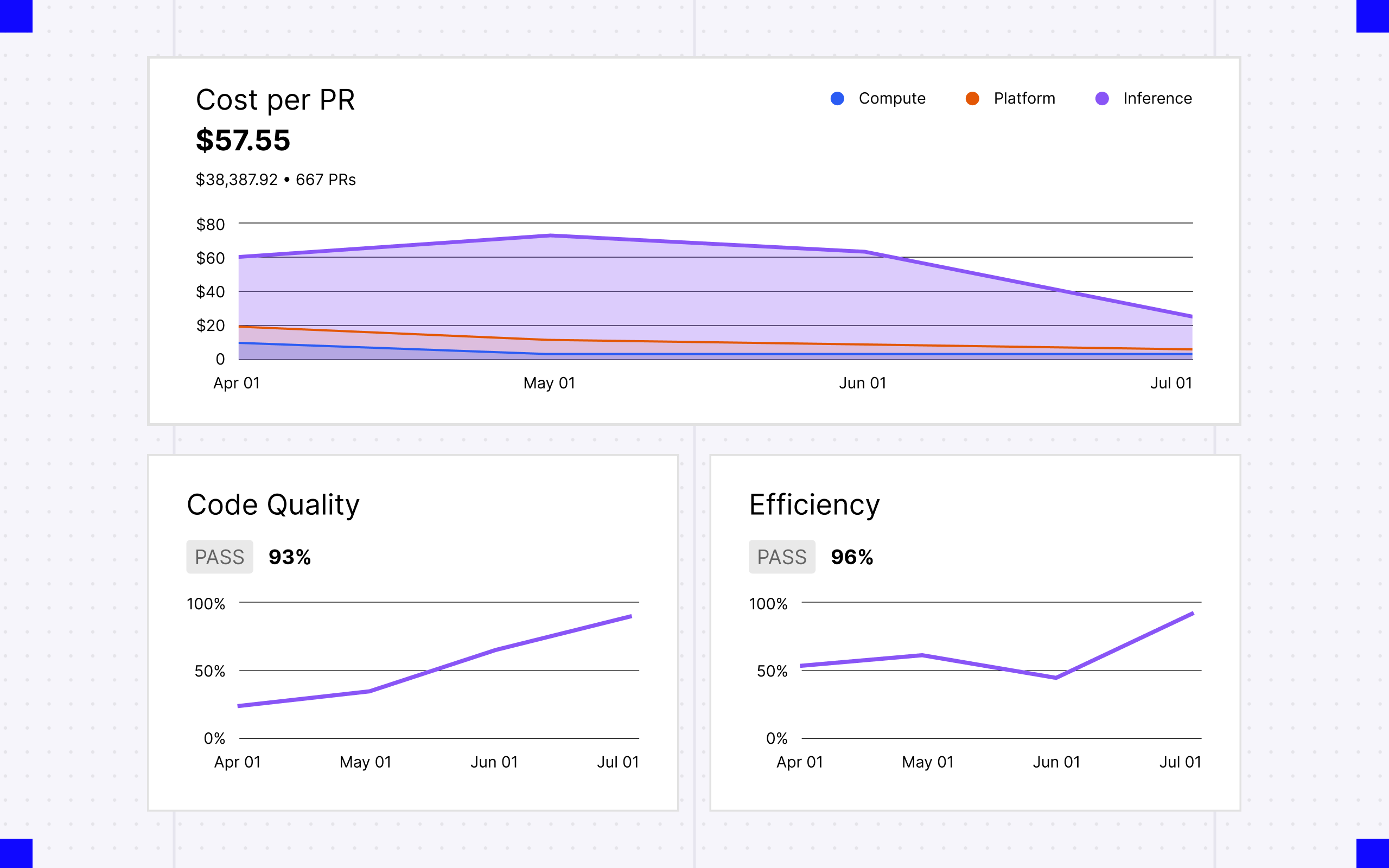
An analytics screen from Warp FactoriesImage Credits:Warp Factories

As Warp CEO Zack Lloyd sees it, the target market for Warp Factories will be smaller companies without the resources to develop a system from the ground up.

An analytics screen from Warp FactoriesImage Credits:Warp Factories

“[If you look at] things like running your agents in the cloud and steering those agents as they run, or bringing the work that they’re doing into your local environment, or setting up memory that goes across those agents, or setting up evals that go across those agents — it’s actually a huge infrastructure undertaking to do this right,” Lloyd told TechCrunch.

In Warp Factories, the architecture is already built out of the box, with many of the most difficult decisions already made. Warp’s system is based on the standard phases of software development (triage, specification, implementation, review, and verification) but the agentic approach means any of those steps can be automated.

Users can choose their own coding model and harnesses as necessary; the system works as well with Codex as Claude Code. It also integrates with ticketing systems like Linear and Jira, and messaging systems like Slack and Teams, in an effort to plug in seamlessly to existing workflows.

Beyond just shipping code, Warp Factories will also give managers the tools to track how well the factory is performing. With all the agents running in the same environment, it’s easy to compare performance metrics for different configurations, and to keep an eye on the overall token spend. Warp Factory also allows for self-improvement loops to optimize the overall system, automating management of the process itself.

Even so, Warp Factories is not built to completely replace software engineers — just give them an easier way to collaborate with the new agentic workforce. In Lloyd’s own experience, there are still a lot of tasks that require a human at the wheel.

Advertisement

“We automate like 30% of our tasks, 30 to 35% on a weekly basis,” Lloyd told TechCrunch, “and as models improve, as the context improves, as the harness improves, I think that that number is going to go up over time.”

When you purchase through links in our articles, we may earn a small commission. This doesn’t affect our editorial independence.

Source link

Advertisement
Continue Reading

Tech

Apple Wallet Driver's License Feature to Launch in Four More US States

Published

on

Apple Wallet’s driver’s license and state ID feature is set to expand to North Carolina, Oklahoma, Utah, and Virginia, bringing the total to 18 states plus Puerto Rico. The digital IDs can be used at participating TSA checkpoints and businesses without handing over or unlocking an iPhone, though users are still generally advised to carry a physical ID because acceptance remains limited. MacRumors reports: A few days ago, North Carolina’s DMV announced that it plans to launch a mobile ID program later this year. As reported by WRAL, North Carolina residents will be able to set up a digital ID through a new NC Wallet app starting in December, with Apple Wallet, Google Wallet, and Samsung Wallet support to follow in “early 2027.” As mentioned, you do not need to unlock, show, or hand over your device to present an Apple Wallet ID in person, ensuring user privacy.

Apple Wallet IDs are generally not accepted by law enforcement, so carrying a physical ID is still legally required for traffic stops. In addition, the number of businesses that accept Apple Wallet IDs is still quite small. At least for now, Apple Wallet IDs are designed to be a convenient alternative where they are accepted. “Your mobile ID is a valid form of identification in North Carolina,” the DMV said, in a FAQ on its website. “However, as retailers, restaurants and other businesses transition to mobile IDs, some may not be set up to accept them right away. For now, carrying your physical card gives you a backup when needed.” According to code seen by MacRumors, Apple Wallet IDs are also coming to Oklahoma, Utah, and Virginia, but there is no timeframe for availability.

Read more of this story at Slashdot.

Advertisement

Source link

Continue Reading

Tech

Dell UltraSharp 32 4K QD-OLED review

Published

on

The Dell UltraSharp 32 4K QD-OLED model U3226Q is a color-accurate OLED monitor with a full port hub. It makes a strong case as a Studio Display XDR alternative for Mac users, assuming you’re fine with not having a Retina-class display.

A great monitor can anchor a whole desk setup. For Mac users who can afford it, the obvious choice has long been Apple’s displays.

Those displays are beautiful, but price and port quantity have always been limiting factors for most. Third-party OLED panels are an alternative, but generally with design compromises.

The Dell UltraSharp 32 4K QD-OLED (U322Q) is one such option, with both OLED and the aforementioned design compromises. It targets designers, photographers, videographers, and other creatives who need color accuracy.

Advertisement

It’s not Retina, but more on that in a bit.

Dell UltraSharp 32 4K QD-OLED review: Specifications

Advertisement

Advertisement

Advertisement

Advertisement

Product Dell UltraSharp 32 4K QD-OLED Monitor (U3226Q)
Price $2,439.99 (sale), $2,599.99 estimated value
Panel 31.5-inch QD-OLED, anti-glare low-reflectance
Resolution 4K UHD (3840 by 2160), 140 pixels per inch
Refresh rate 120Hz with Variable Refresh Rate
Response time 0.03 ms gray-to-gray
Brightness 300 nits standard, up to 1,000 nits peak
Contrast 1,500,000:1 native
Color gamut 99% DCI-P3, 100% sRGB, 80% BT.2020
HDR VESA DisplayHDR True Black 500, Dolby Vision
Thunderbolt 1 upstream (140W), 1 downstream (15W)
Other video 2 HDMI 2.1, 1 DisplayPort 1.4
USB Multiple USB-A and USB-C, up to 27W
Networking 2.5GbE Ethernet, KVM switch
Stand Height, tilt, swivel, pivot
Weight with stand 21.7 pounds
Warranty 3 years, includes OLED burn-in coverage

Dell UltraSharp 32 4K QD-OLED model U3226Q review: Design

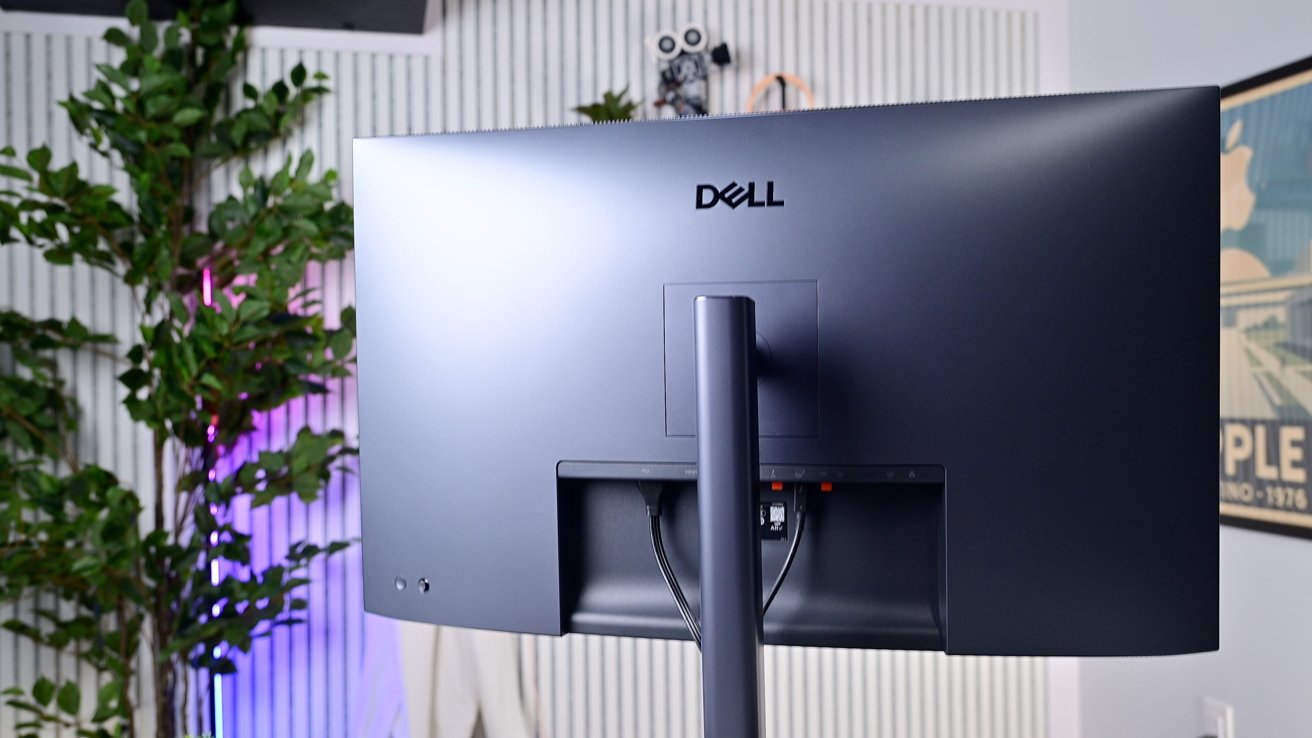
Design is the monitor’s clear weak point. It wears the same matte dark finish as most professional displays. Nobody will confuse this for a Studio Display.

Back view of a curved Dell computer monitor on a stand, showing cable area, with a potted plant and wall art in a modern, softly lit office setting

Dell UltraSharp 32 4K QD-OLED model U3226Q review: The Dell monitor still has a boring, utilitarian design

Advertisement

For a desk built around Apple hardware, the contrast is visible. The Dell looks like typical plastic-clad office fare.

That said, you’re going to be buying this monitor more for its capabilities, rather than its appearance.

How much that appearance matters, is an exercise for the reader. This doesn’t matter so much to me.

The stand is versatile, with height, tilt, swivel, and pivot. This level of articulation is helpful for anyone who has to stare at their monitor for lengthy periods.

Advertisement
Person adjusting a large Dell monitor on a stand atop a gray desk mat, in a modern office with plants, shelves, and framed wall art in the background

Dell UltraSharp 32 4K QD-OLED model U3226Q review: The monitor can pivot left and right, tilt, adjust its height, and rotate vertically

If your office environment is too light-heavy, a snap-on light hood is included for glare control. It’s a nice addition, but in this world of multiple displays on one desk for one workstation, I’m not sure how much use it’s going to get.

Dell UltraSharp 32 4K QD-OLED model U3226Q review: The panel

The panel is the reason to buy this monitor. It is a 31.5-inch QD-OLED running at 4K and 120Hz. This is notably not “Retina.”

The panel itself, QD-OLED, gives per-pixel light control for true blacks and color representation. Contrast, viewing angles, and response are all excellent.

Advertisement
Large black computer monitor on a stand centered on a desk, surrounded by plants, soft ambient lighting, and minimal office decor in a modern, tidy workspace

Dell UltraSharp 32 4K QD-OLED model U3226Q review: The display does a decent job at avoiding glare, especially when in use

The anti-glare low-reflectance coating handles bright rooms well. It diffuses my Texas office’s lighting regardless of the time of day, without washing the picture out.

Color coverage reaches 99% of the DCI-P3 gamut. This is essential for people working with color, like YouTubers editing video or avid photographers.

When it comes to brightness, HDR peaks at 1,000 nits, The 300 nits available in standard use is more than enough to work with, too.

Advertisement
Computer monitor on a desk displaying a vivid close-up of a metallic green insect on a yellow spotted surface, with blurred home office decor and plants in the background

Dell UltraSharp 32 4K QD-OLED model U3226Q review: Content has great contrast and rich colors

In extended use, the color and contrast impress the most. HDR content looks vivid, and photos and video stand out.

Dell UltraSharp 32 4K QD-OLED model U3226Q review: Resolution

The panel’s one real actual weakness is pixel density. At 32 inches in size and at 4K, it works out to 140 pixels per inch.

That is not sharp by Apple monitor standards, and is nowhere near Retina. Users of high-density Apple displays will notice softer text up close without additional software

Advertisement
Two computer monitors on a desk displaying the same scenic beach with turquoise water and rocks, in a modern office with shelves, plants, and framed wall art in the background

Dell UltraSharp 32 4K QD-OLED model U3226Q review: The Dell UltraSharp (left) is larger than Apple’s Studio Display (right)

An Apple display packs more pixels into less space. For reference, the Studio Display reaches 218 pixels per inch, while using a 27-inch screen.

For some workflows, the larger canvas is worth it. For others, density matters more than screen size. The tradeoff is size against sharpness at this price. A 5K OLED of this size would cost far more than this.

Two laptop screens side by side, each showing a blue desktop with macOS menu bars at the top, one displaying the date and time, with a blurred background behind them

Dell UltraSharp 32 4K QD-OLED model U3226Q review: There’s no missing the lower pixel density when comparing the Dell UltraSharp (left) to the Apple Studio Display (right) with their respective 4K and 5K resolutions

Advertisement

In this case, the resolution isn’t necessarily a bad thing, considering the size and what OLED delivers.

Dell UltraSharp 32 4K QD-OLED model U3226Q review: Ports and Mac connectivity

Connectivity is a major strength for Mac users. The monitor is built around Thunderbolt 4.

One upstream Thunderbolt port delivers up to 140W to a Mac, as well as handling video duties. If you’re into a single-cable lifestyle, this means you can connect a MacBook Pro and recharge it without needing separate data or video cables.

Hand plugging a Thunderbolt cable into a port on the back of a monitor or computer, near orange clips and a QR code label with small icons above the ports

Dell UltraSharp 32 4K QD-OLED model U3226Q review: The dell monitor has a full hub, including a downstream Thunderbolt port

Advertisement

A second Thunderbolt port handles data or daisy chaining. If you have enough screens available, it can drive up to three of these 4K 120Hz displays in a chain.

Hand reaching behind a monitor to press a small button near the power cable and label, suggesting adjusting settings or powering the device on or off

Dell UltraSharp 32 4K QD-OLED model U3226Q review: There are two HDMI ports on the Dell UltraSharp

The rest of the hub element of the display is generous. It adds two HDMI ports, DisplayPort, multiple USB ports, and 2.5GbE Ethernet. A front pop-down offers three more USB ports, all 10 gigabits per second.

Hand pulling a small USB hub from the bottom edge of a monitor, showing USB-C and USB-A ports, with a blurred green plant and desk surface in the background

Dell UltraSharp 32 4K QD-OLED model U3226Q review: There are two USB-C ports and a USB-A port hidden on the front for easy access

Advertisement

A built-in KVM switch lets one keyboard and mouse serve two machines, such as a Mac and a PC. This functionality is… okay. It does what it says it will do in the documentation. It’s all handled on the monitor, and it very much depends on your workflow if this matters at all.

In my case, it doesn’t matter. A display such as this one is my main working monitor, with a periodic delve into testing and so forth. In those cases, the attached peripheral either has its own I/O like a remote for a media player, a controller for a console, or for a network attached storage status display.

Even if it was my second landscape display on my desk that I use on busy days for a third display and for my PC after-hours, there’s still I/O that doesn’t need a KVM.

As with all things, your mileage may vary. It’s a nice feature to have on deck even if you don’t need it this second.

Advertisement

Dell UltraSharp 32 4K QD-OLED model U3226Q review: Versus the Studio Display XDR

The natural Apple rival is the Studio Display XDR. The two take different technical paths to a similar goal.

The Dell uses QD-OLED with per-pixel control and wide viewing angles. The Apple model uses Mini LED backlighting instead, which reaches a higher 2,000 nits.

Apple wins on pixel density, at 218 against 140. Apple also adds speakers and a Center Stage camera.

The Dell answers back with its port hub and larger screen. It also undercuts the Apple model on price.

Advertisement

The Studio Display XDR runs around $3,300. The Dell sits below it, at $2,439.99 when on sale.

Dell UltraSharp 32 4K QD-OLED model U3226Q review: A pro OLED that courts Mac users

The UltraSharp 32 QD-OLED is a strong pick for a specific buyer. It suits Mac users who prize color accuracy and connectivity, and need that extra screen estate.

Modern computer monitor on a desk displaying colorful hot air balloons in a blue sky, with indoor plants and vertical white wall panels in the softly lit background

Dell UltraSharp 32 4K QD-OLED review: A solid option for Apple users

The panel is its best feature, with reference color modes and a deep OLED contrast. The 140 PPI density is the main compromise to weigh in here, but the cost savings make a difference here.

Advertisement

Against the Studio Display XDR, it’s all about personal priorities. Apple leads on density and brightness, Dell on ports, size, and absolute blacks.

For me, those ports are critical. My workstation is cross-platform, relatively dark, and multiple machine. A one-input monitor, no matter how nice, no matter how stylish, isn’t my best choice.

For color-critical work with a big port count, the Dell delivers. If color-accuracy is less important, the consumer-focused Dell 32 Plus 4K QD-OLED (S3225QC) is a solid candidate, and has speakers, for $800.

Dell UltraSharp 32 4K QD-OLED model U3226Q Pros

  • Reference-grade QD-OLED color and contrast
  • 140W Thunderbolt with a deep port hub
  • Built-in colorimeter for automated calibration

Dell UltraSharp 32 4K QD-OLED model U3226Q Cons

  • 140 PPI looks soft against Apple displays
  • Generic design next to a Mac setup
  • Lower peak brightness than the Studio Display XDR

Rating: 4 out of 5

The Dell UltraSharp 32 4K QD-OLED display is a solid performer. Apple devout, like our videographer, won’t care for the design.

For me, though, I look at the monitor panel, and don’t need to savor bespoke aluminum. The color accuracy is a major selling point, and the Thunderbolt dock integrated into the unit is very nice.

Advertisement

A lack of speakers isn’t a big deal for the main buyers of this machine. Only Apple seems to have a handle on good and small speakers.

Where to buy the Dell UltraSharp 32 4K QD-OLED

The Dell UltraSharp 32 4K QD-QLED is available from Dell directly, with a regular price of $2,599.99. It has been spotted at closer to $2,400 when on sale.

Source link

Advertisement
Continue Reading

Tech

Solar Power and Batteries Have Been Keeping Europe's Grid Stable

Published

on

AleRunner writes: “Solar has been doing the ‘heavy lifting’ to help Europe meet its energy needs amid a string of blistering heatwaves,” Euronews tells us. Meanwhile, as Europe’s energy demands rise with the heat, jellyfish have been causing shutdowns and reduced power output at multiple reactors at French nuclear plants, as we already discussed. Euronews reports: A new analysis from energy think-tank Ember found that solar output in European countries rose by up to 17 percent on heatwave days in June and July. Researchers say that this helped power the grid as electricity demand increased by as much as a quarter on hot days. Heatwaves often trigger a spike in electricity consumption due to the sudden need for cooling, mainly from energy-intensive air conditioning (A/C) units.

The International Energy Agency (IEA) estimates that space cooling, which is mostly A/C units and fans, consumed around seven percent of the world’s electricity in 2022. Even in countries where A/C ownership is low, countries experience energy demand spikes when scorching temperatures hit. During the early summer heatwaves of 2025, France, for example, recorded an evening electricity peak that was 25 percent above the off-season average due to air conditioning.

Ember’s analysis found that during the late-June heatwave this summer, daily electricity demand rose byup to 28 percent in Italy, 23 percent in Hungary, 14 percent in France and 13 percent in Spain compared with pre-heatwave days. It says as heatwave-driven demand increased, solar was the only major power source to perform “better than usual.” Compared with other days in June and July, average daily solar generation during the heatwaves was 17 percent higher in France and Hungary, five percent higher in Spain and the same in Italy.

Read more of this story at Slashdot.

Advertisement

Source link

Continue Reading

Trending

Copyright © 2025