If you’re in the market for a new window air conditioner for summer 2026, there are a few qualities you’re likely mindful of in your search. While it’s worth taking the time to find one that physically fits your space, provides ample cooling, and is an overall budget-friendly air conditioner, one would be remiss to overlook the matter of sound. After all, air conditioners are notorious for getting rather noisy while running. Not only can this prove a nuisance for you in your living space, but those living nearby will also have to endure the rumbles and hums of the machine.
On the whole, it’s expected that a window air conditioner will make some kind of noise. Generally speaking, they pull in electricity to run one fan, which, in turn, pulls in warm air. Simultaneously, this electricity powers a compressor to push the coolant through the coils, thus cooling the air. Another fan then pushes the cooled air out into the room, quickly bringing down the indoor temperature. That’s a lot of moving parts, and even right out of the box, air conditioners are going to make noise as a result. The average window air conditioner tends to run between 50 and 60 decibels, with models below that level considered more noise-conscious examples.
Advertisement
With that said, modern window air conditioner technology has greatly dampened the noise created by these essential summer appliances. For those in want of quieter summer cooling, these are some of the best options currently available.
Advertisement
1. Midea U-shaped smart air conditioner
Throughout its existence, Midea has become recognized among the most reliable air conditioner brands out there. At the same time, the brand has worked to improve its units in other ways, such as their volume levels. The Midea U-shaped smart window air conditioner, which comes in 8,000, 10,000, and 12,000 BTU forms — models MAW08V1QWT, MAW10V1QWT, and MAW12V1QWT, respectively – is significantly quieter than most air conditioners like it for sale today. Supposedly, it’s 10 times quieter than its competitors. The company claims it can get as quiet as 32 decibels while in use, though higher cooling settings will bump that number up to some extent.
The Midea U-shaped smart window air conditioner comes with a bevy of other noteworthy specs and features alongside its remarkably low volume level. As the name suggests, it’s a smart device that can be controlled with the SmartHome app, and the U-shaped design keeps the unit held in place via brackets. Should you want or need to open your windows, you can do so without it falling out. It also claims 35% faster cooling with FlashCool mode and 35% increased energy efficiency thanks to its variable-speed inverter technology. The Midea website lists these window units at $399.99, $449.99, and $509.99 depending on the BTUs, each coming with the Midea one-year limited warranty.
Advertisement
2. GE model AHTT08BC Profile ClearView ultra quiet window air conditioner
General Electric has an incredibly deep product catalog with well over a century of development behind it. In fact, there are probably things that you didn’t know GE makes. Meanwhile, some of its most well-known offerings are its window air conditioners, including those that prioritize producing as little noise as possible. The $484.00 GE model AHTT08BC Profile ClearView window air conditioner is one such model, advertising noise levels as low as 41 decibels on low cool with Quiet Mode turned on. It reaches such low volumes while cooling rooms up to 350 square feet at 8,300 BTU.
Like any other modern air conditioner, there’s more to this GE model than producing less noise than previous models. The big draw for this unit is its unique design, which features a front portion that hangs below the windowsill. This means improved visibility out the window even while the unit is installed. Within is a pump to release condensation outside as it accumulates, and it dehumidifies rooms at a rate of approximately 1.7 pints per hour. This is another example of a smart air conditioner, as users can control it with the SmartHQ app over Wi-Fi, though it also comes with a separate remote control. GE includes limited warranty coverage on this unit, too.
Advertisement
3. Friedrich Chill Premier inverter air conditioner
Friedrich is one of the major window air conditioner brands currently on the market, and as such, it has released units that deliver comfortable cooling without compromising on noise level. For example, the Friedrich Chill Premier inverter air conditioner is somewhat expensive at over $700 through sources like Grainger, but it delivers if you need an air conditioner that keeps the noise down. When in cooling mode, this unit is advertised as delivering 42 decibels, while the fan alone drops that number to just 32 decibels. On top of that, it comes with some other key specifications.
Aside from being a comparatively quiet window unit, the Friedrich Chill Premier inverter air conditioner has some other intriguing qualities. Window-only models range from 8,000 to 12,000 BTU per hour; they can be operated via the FriedrichGo app over Wi-fi, and they’re said to operate 35% more efficiently than other traditional air conditioner models. Installation is simplified, too, featuring a frame, side curtain, and mounting hardware to keep it in place. This is because the unit is designed for window-opening even once installed, just in case you want to let some outside air in without powering the air conditioner up. No matter the specific model, the Friedrich limited warranty comes standard as well.
Advertisement
4. Frigidaire FHWW145WE1 inverter air conditioner
While the name tends to conjure mental images of its refrigerators, since it is one of the major refrigerator brands, and other kitchen appliances, Frigidaire has a lot more to offer. It has entered the air conditioner game in its own right, and it has some noise-conscious models in its catalog to boot. A low-noise option is the Frigidaire model FHWW145WE1 inverter air conditioner, typically retailing for $609 through the Frigidaire website. The company claims that this model goes as low as 42 decibels specifically on its Ultra Quiet setting, with higher speed and cool settings gradually increasing the volume.
Advertisement
Digging deeper into what this air conditioner can do, it’s said to provide 14,000 BTU of cooling, making it ideal for rooms between 550 and 700 square feet in size. Thus, Frigidaire recommends this unit specifically for larger, multi-use areas like dens and living rooms rather than smaller ones like bedrooms. The Frigidaire app allows for control from a distance, and a physical remote control comes included. Unlike other air conditioners on this list, however, it takes on a more traditional window air conditioner shape and setup, preventing window-opening while it’s installed. Should something go wrong shortly into its use life, Frigidaire’s one-year warranty comes included.
Advertisement
5. Hisense AWUS1225TW UltraSlim window air conditioner
Hisense has taken its place in the pantheon of well-known air conditioner brands, and in doing so, it has joined the industry-wide race to lower window unit decibel levels. One of its strongest efforts in this regard is the Hisense AWUS1225TW UltraSlim window air conditioner, boasting cooling at 35 decibels at the absolute lowest. At the time of publication, Lowe’s has this unit for sale for $449.14, so for a relatively average cost for a window unit, you receive an air conditioner notable for low-volume cooling in addition to several other key specs and design features.
This Hisense unit is listed at 12,000 BTU, so the brand recommends using it in rooms up to 550 square feet in size. This is another low-profile unit designed to leave the window above free of obstructions, though side privacy screens are included for those who want them. According to Hisense, installation is relatively simple, too. All it requires is setting the bracket on the windowsill, putting the unit on top of it, and adjusting and securing the bracket in place. Remote and Wi-Fi control through the ConnectLife app are built in, and a two-year Hisense warranty automatically comes included with purchase.
Advertisement
How these air conditioners were selected
Ay Moments/Getty Images
These window air conditioners weren’t chosen at random; a multi-step research process went into their selection. The first step was to find units known for quiet operation, ideally with decibel levels listed somewhere in their descriptions. For reference, we also looked at a variety of air conditioners to determine the average volume level for standard units in 2026. It also helped to know under what circumstances users could expect such low decibel levels. Ideal units highlighted their volume when actively cooling as opposed to when running their fan alone.
In addition to sound level, we wanted to include air conditioners that were more than capable of cooling down a room. If it couldn’t effectively cool, no matter how quiet it was, we couldn’t in good conscience recommend it on this list. Additionally, we prioritized seeking out air conditioner units from major, trusted brands, as well as those that weren’t too absurdly expensive. It was a given that these units would cost a fair amount of money, but we chose not to go too pricey with most of our recommendations for the sake of the consumer.
Hark, the secretive AI startup founded earlier this year by serial entrepreneur and roboticist Brett Adcock, today announced Handoff, a “computer use agent” (CUA) that it says is among the top-performing in the world at navigating the open web on a user’s behalf — ordering dinner on DoorDash, booking flights on United and Delta, or messaging job candidates on LinkedIn — all autonomously, end-to-end.
Sign-ups open to the public today at hark.com, with availability planned for later this month as part of the initial release of Hark’s software platform.
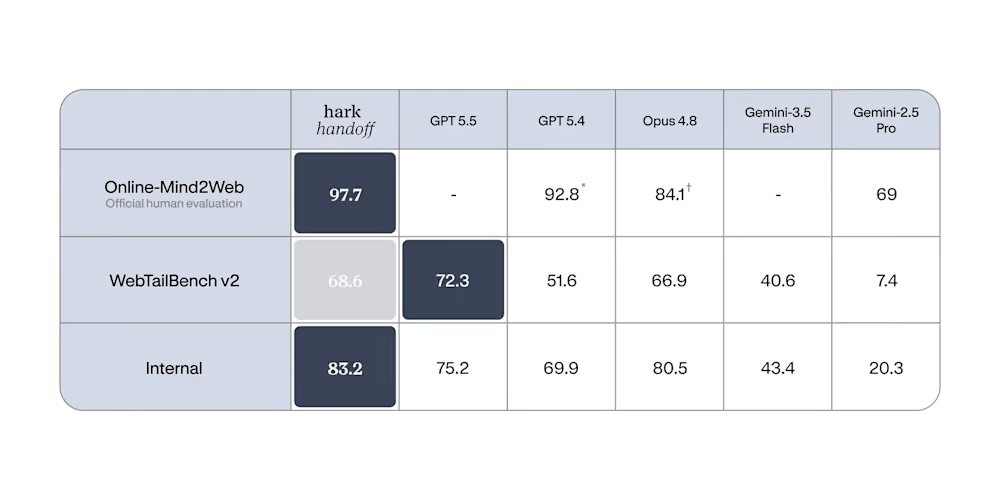
The company says Handoff recorded the top-ever score on Online-Mind2Web (OM2W), a third-party benchmark with a human-evaluated leaderboard for web agents, posting a 97.7 against 92.8 for OpenAI’s GPT 5.4, 84.1 for Anthropic’s Claude Opus 4.8, and 69 for Google’s Gemini 2.5 Pro.
Hark also says it can serve the model at less than one-tenth the token price of competing frontier models — $0.18 per million input tokens and $2.37 per million output tokens, versus $5 and $30 for GPT 5.5 — with per-turn model latency of 0.8 seconds.
For each request, Handoff spins up a dedicated virtual computer with its own browser, file system, and terminal, and users can connect existing accounts so the agent can log in and act with their saved addresses, payment methods, and history.
Hark’s research uncovered that despite people spending 75% of their screentime every day in a browser, fewer than 1 in 1000 websites have publicly accessible APIs, making it challenging for AI agents to take over the workload.
Advertisement
In a roughly four-minute produced announcement video posted on YouTube and social media, Adcock — seated in a bare warehouse space that doubles as a metaphor for the company’s build-out — speaks a request aloud to Hark (“let’s liven this place up a bit… let’s do some roses, maybe some cherry blossoms”) and Handoff is shown navigating a florist’s website to place the order, while Adcock narrates that unlike a typical chatbot, Handoff “is always working, it’s looping,” and says he now uses it for “all of my recruiting efforts end to end.” In Hark’s announcement blog post, more demos are shown in realtime and 5x speed.
But big some open questions about Handoff remain, especially for potential enterprise customers and users.
High-scoring benchmarks…but against last generation’s models
Notably, the benchmark comparisons Hark provided to VentureBeat for its Handoff AI agent are against GPT 5.5, GPT 5.4, Opus 4.8, and Gemini 2.5 Pro — the prior generation of frontier models.
Advertisement
The current leaders, OpenAI’s GPT-5.6 and Anthropic’s Opus 5, are absent, as are strong open-source computer-use contenders like DeepSeek V4, Kimi K3, and Qwen3.8-Max.
These newer models haven’t published Online-Mind2Web results, and no third party has posted them to the benchmark’s public leaderboard — meaning Hark’s “top-ever” claim cannot currently be checked against the strongest available systems.
The omission is notable because the newest frontier models have posted their largest gains precisely in computer use: on OSWorld 2.0, a related benchmark covering full computer control, Anthropic’s Opus 5 scores roughly 70.6% versus 55.7% for the Opus 4.8 model Hark chose as its comparison point.
The latency comparison comes with similar caveats: the 6.8-second and 6-second per-turn figures Hark cites for GPT 5.5 and Opus 4.8 were measured by Hark, in Hark’s own harness, with the competing models set to their highest — and slowest — reasoning level. No independent latency measurements exist for comparison.
Advertisement
Asked by VentureBeat whether Hark plans to publish comparisons against those newer models, the company did not specify.
Even within Hark’s own chosen comparisons, the “best” framing has an asterisk: on WebTailBench v2, one of the three benchmarks in Hark’s own results table, GPT 5.5 scores 72.3 to Handoff’s 68.6.
Two of the three benchmarks (WebTailBench and an unnamed internal evaluation) were also run inside Hark’s own harness, with pass rates computed by Hark’s internal LLM judge — conditions the company controls.
Hark’s pricing advantage is far clearer: Anthropic’s newer Opus 5 carries the same $5-per-million-input and $25-per-million-output list price as its predecessor, so Handoff’s roughly tenfold cost savings would hold up even against the current frontier — assuming its benchmark performance does too.
Advertisement
Training and file access
Hark’s research preview describes a sensible-sounding pipeline — supervised fine-tuning followed by asynchronous reinforcement learning using the GRPO algorithm, according to materials shared with VentureBeat prior to today’s announcement — but the company acknowledges it has only done post-training so far, with pre-training “planned for later this year.”
That means Handoff is built on top of a base model Hark did not train. Asked which base model it is, and what mix of proprietary and open data Handoff was trained on, Hark hasn’t yet specified.
Another big question mark for enterprise users: who can access the dedicated virtual computers and the files created on them?
A Hark spokesperson said “security and privacy is a primary focus, but this is a technical preview,” adding the company will share more when the product reaches market at the end of the summer.
Adcock seeded the company with $100 million of his own money and remains founder and CEO of both Figure and Hark simultaneously, a spokesperson confirmed.
Asked how the two companies interact, the spokesperson said Hark models “are being trained on the Figure robots,” but that Adcock has no plans to combine them.
Advertisement
Adcock’s promotional style has drawn skeptics. In April 2025, Fortune correspondent Jason Del Rey reported that Figure’s much-touted BMW partnership was far more modest than Adcock’s public claims of a robot “fleet” performing “end-to-end operations”: BMW spokesperson Steve Wilson said a single Figure robot was practicing picking up parts during non-production hours.
But the partnership has advanced, and as of June 2026, BMW said the Figure 02 robot supported production of more than 30,000 BMW X3 vehicles during a 10 month-period, and that the next-generation Figure 03 robot was being deployed at the plant for a parts-sequencing role in logistics.
The applications are in. The TechCrunch Startup Battlefield team made their decisions. Eight Australian startups have earned their spot on the Startup Battlefield stage at Stripe Tour Sydney on August 19 — and they’re ready to pitch for $15,000 in Stripe fee credits, investor attention, and a spot in Startup Battlefield 200 at TechCrunch Disrupt in San Francisco.
They represent the future of Australian tech — from enterprise tech to health and wellness tech to entertainment and media. Here’s who they are.
The eight finalists
Aigentsphere
Independent AI management and governance platform Aigentsphere helps enterprises scale AI safely and well, giving leaders visibility, control, and accountability over their entire AI agent workforce.
Apate.ai
Apate help banks, telcos, and governments dismantle scam operations by engaging scammers in live conversation and turning it into real-time intelligence.
Advertisement
Callease Ai
Callease Ai is the operating system for physical security control rooms, starting with voice AI that automates welfare, escalation, patrol, and many more — the entire calling engine.
Choosey App
Choosey App helps businesses hire instantly and workers get paid instantly through agentic AI-powered matching, workforce management, and same-day pay.
Doomers AI
Doomers AI helps AI and tech companies make product launches trend on X by orchestrating a vetted creator network that reaches the buyers who block ads.
equ
Startup equ helps health and wellness businesses deliver personalized nutrition at scale by embedding equ’s AI engine, built on 10 years of data and 100,000+ users, into their product.
Advertisement
LeadStory
LeadStory is the video intelligence layer powering the next generation of screens, surfacing exact video moments from sports, news, and finance clips to answer natural language queries.
Preve
Preve helps physical therapy clinics improve patient retention and clinical outcomes by automating the treatment plan creation and adherence.
Three will win prizes. One will go to San Francisco. All eight will pitch in front of investors, press, and the Australian tech community. If you want to see the future of Australian startups unfold, register for Stripe Tour Sydney on August 19 →
The stage is set. The judges are ready. Let the pitching begin.
Advertisement
Hosted and MC’d by Isabelle Johannessen, Director of Startup Battlefield.
When you purchase through links in our articles, we may earn a small commission. This doesn’t affect our editorial independence.
The four Google veterans leaving to launch Discovery Loop, from left: Oriol Vinyals, Sanjay Ghemawat, Jeff Dean, and Quoc Le. (Discovery Loop Photo)
Speaking in June at the University of Washington Allen School commencement, AI pioneer Jeff Dean told computer science graduates how he “got the itch to join a startup in 1999,” landing at Google when it had a grand total of 20 people above what is now a T-Mobile store in Palo Alto.
Twenty-seven years later, now 58, the UW alum has the itch again.
Google announced Wednesday that Dean, its chief scientist, is leaving with three colleagues to launch Discovery Loop, a startup built to automate the experimental loop in scientific research: proposing experiments, running them, evaluating results, and iterating, thousands of times over.
“Imagine a future where a handful of people can conduct scientific research and engineering tasks much more rapidly, and with higher quality, than massive teams of scientists and engineers do today,” they write on their website.
Discovery Loop is based in Palo Alto, with what it describes as a lean team of its own. Joining Dean are Google senior fellow Sanjay Ghemawat, his collaborator of more than two decades; Google DeepMind research VP Oriol Vinyals; and Google Brain co-founder Quoc Le.
Google is a founding investor and will supply computing power for at least the first year. Discovery Loop is structured as a public benefit corporation, with backing from Radical Ventures and Khosla Ventures (a name Seahawks fans will recognize from the team’s incoming ownership group).
The departures came as part of a broader shakeup announced in a memo from CEO Sundar Pichai. Demis Hassabis is handing off day-to-day leadership of Google DeepMind to become its chair and Alphabet’s chief scientist, while CTO Koray Kavukcuoglu steps up as SVP, overseeing Gemini model development. Alphabet shares fell about 4% after the announcement
“After an incredible 27-year run, Jeff Dean is at a moment where he wants to try something new, and we’re excited to support him in that,” Pichai wrote.
Advertisement
Dean, who earned his UW computer science Ph.D. in 1996, gave no hint of his plans at the Allen School commencement. He told Wired the idea came together only in recent weeks.
But the general theme was there. Listing problems he thought worth solving, he pointed the UW graduates toward “developing tools that accelerate scientific discovery and engineering.”
“One of the beauties of software,” he said during his commencement address, “is that small groups of people can build things that have enormous impact in the world.”
The Samsung Galaxy Fit 4 just leaked in FCC regulatory filings
The documents suggest it will have a screen, unlike the Fitbit Air
But the leak reveals previous few other details
The Fitbit Air has proved that you don’t need to pay a high price tag to get a great wearable, and now it looks like Samsung is getting in on the act with an alternative of its own. And with more details leaking out, we’re getting a clearer picture of the upcoming device than ever — but plenty of unanswered questions remain.
New FCC regulatory documents (spotted by Gadgets & Wearables) have spilled the beans on the much-rumored Samsung Galaxy Fit 4. There, you’ll find various nuggets of info on what we can expect from the product, as well as a few things that it likely won’t do.
For one thing, it looks as if the Fit 4 will not be a screenless device, as the FCC documents include diagrams showing a product with a very similar design to the Samsung Galaxy Fit 3 — which did include a display. That could be a key difference with the Fitbit Air, which notably forgoes the display entirely.
Latest Videos FromTechRadar
Advertisement
The regulatory filings also confirmed that the Fit 4 will come with Bluetooth 5.4, which is a slight upgrade over the Fit 3’s support for Bluetooth 5.3. And there’s a button on the side and optical sensors on the back, much like the Fit 3.
Shrouded in mystery
(Image credit: Lauren Scott)
The Samsung Galaxy Fit 3 is one of the best cheap fitness trackers money can buy, making it ideal for budget-conscious users. But if Samsung apparently isn’t planning to reduce costs by going down the screenless route, how else will it keep the price down?
That’s one of the big unanswered questions from the FCC report. Given the Fit 4 diagrams’ similarity to what we know about the Fit 3, there’s a decent chance we’ll see things like GPS omitted, meaning it might not end up being one of the best wearables for runners. But we don’t know for sure right now.
Plenty of other areas remain an enigma. The documents mention battery testing but do not specify the battery’s capacity, for instance. The Fit 3 packed in a 208mAh battery that lasted around 10 days on a single charge in our testing, but it’s unclear whether that will change with the Fit 4.
Sign up for breaking news, reviews, opinion, top tech deals, and more.
If anything, these FCC files raise more questions than they answer. They note that documents like product photos and a quick-start guide will remain confidential until January 31, 2027, but that doesn’t necessarily point to a release date. We’d expect Samsung to launch the Fit 4 sooner, but until that happens, much of this secret device will continue to be shrouded in mystery.
At a time when storage space commands a premium price, SanDisk’s Extreme Fit drive is worth a look.
SanDisk
We may receive a commission on purchases made from links.
RAMaggedon has quickly made the price of both memory and storage skyrocket, with many SSDs now sporting obscenely inflated prices. As such, more and more folks are looking for cheaper alternative storage options. Enter the SanDisk Extreme Fit. Starting at around $30 for the 64GB model, the largest 1TB edition of this USB 3.2 USB-C drive is priced at $219 (that’s double the capacity of the iPhone 17’s top config). This stick is also absolutely tiny. Just how small is the SanDisk Extreme Fit? Let’s get into it.
Advertisement
What is SanDisk Extreme Fit?
SanDisk
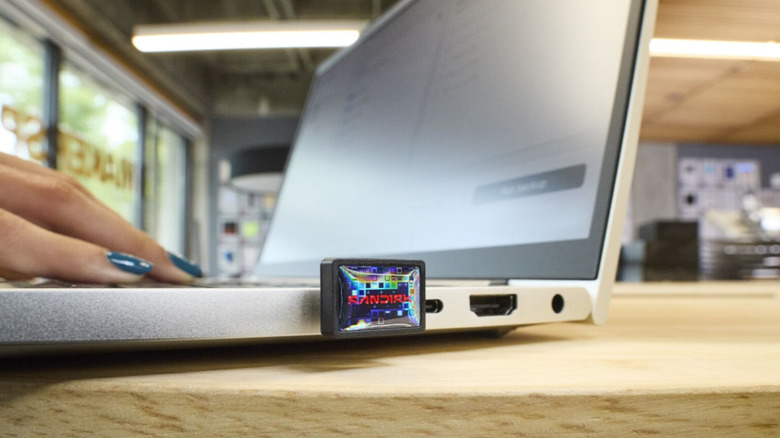
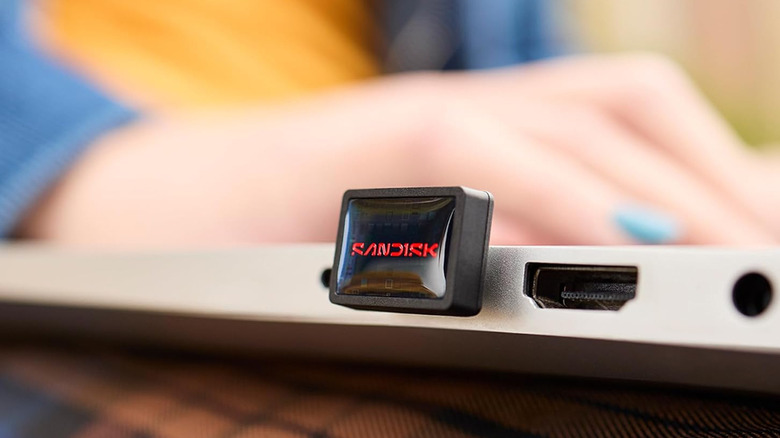
Often regarded as the smallest USB flash drive in the world, the SanDisk Extreme Fit has been designed to sit almost flush inside a USB port. Measuring in at 0.73 x 0.54 x 0.63 inches and weighing 0.1 ounces, the Extreme Fit is an absurdly small drive. SanDisk describes it as a “plug-and-stay” device. Cute wordplay aside, this USB stick is meant to remain hooked up to a laptop in ultra discreet fashion, instantly boosting its storage capacity.
“This is the smallest SiP (System-in-Package) we have and the first time we created a vertical type C connector ever,” states Deepesh Singh, SanDisk’s Principal Engineer of Systems Design says in a statement on the company’s site. The reason the company was able to engineer such an astonishingly small USB-C drive is because its engineers mounted the connector perpendicular to the SiP, which works thanks to a proprietary interposer printed circuit board. Not that it was an easy road to get there, as Singh recalls. “We built several prototypes, but they kept breaking.” Thankfully his team eventually overcame hardware hurdles to arrive upon the Extreme Fit’s final, eye-catching form factor.
Advertisement
How fast is the SanDisk Extreme Fit USB-C?
SanDisk
SanDisk’s tiny drive obviously isn’t going to hit NVMe speeds, but it’s fast for a USB stick. The four models that range between 128GB to 1TB all boast read speeds up to 400 MB/s, while the smallest 64GB drive is limited to 300 MB/s. Write speeds generally hover around 100-250 MB/s, which is respectable for a flash drive. Those speeds are certainly fast enough for transferring photos and other small files, but if you regularly move large 4K video files between devices, you’d be better off with one of the best SSDs.
Is the SanDisk Extreme Fit USB-C compatible with iPhones?
DenPhotos/Shutterstock
It sure is. Well, at least with certain models of iPhone. The SanDisk Extreme Fit works with iPhones with USB-C ports (so any model after and including the iPhone 15). You can technically get the drive working with older models with Lightning ports, though you’d need a Lightning-to-USB adapter for that. You can easily transfer files to and from the SanDisk Extreme Fit by using your iPhone’s Files app.
The U.S. Cybersecurity and Infrastructure Security Agency is giving federal agencies three days to mitigate vulnerabilities in IBM Langflow, N-central, and Apache Tomcat, all actively exploited.
Tracked as CVE-2026-9198, the security issue in IBM’s Langflow visual framework for building AI agents is the most severe, with a critical rating of 9.8 out of 10.
It allows an unauthenticated attacker to execute remotely on default Langflow deployments by chaining two API endpoints to bypass login and run code.
In late July, multiple fully functional proof-of-concept (PoC) exploits for CVE-2026-9198 emerged in the public space, with complete instructions on how they can be leveraged.
Two weeks ago, CISA issued an alert for another critical Langflow vulnerability (CVE-2026-0770) being exploited in attacks to gain remote code execution with root privileges.
Advertisement
The vulnerability in N-able’s remote monitoring and management platform N-central is identified as CVE-2026-18576 and allows attackers to hijack administrative accounts without authentication.
The flaw received a high-severity rating and has been patched by the vendor. However, the fix was insufficient, and threat actors found a new way to exploit it.
An emergency hotfix was released on Sunday. The company urged customers to install it as the flaw impacted all versions of N-central before 2026.3.
Advertisement
The Apache Tomcat vulnerability, tracked as CVE-2026-34486, has a high-severity score of 7.5. It stems from an incomplete fix for CVE-2026-29146, a critical vulnerability with a severity rating of 9.8 that is described as the missing encryption of sensitive data.
On July 30, researchers at Palo Alto Networks Unit 42 reported that a Chinese-speaking threat actor tried to exploit the CVE-2026-34486 vulnerability in a manual campaign to plant reverse shells on nine Apache Tomcat servers.
CISA confirmed that threat actors are leveraging all three flaws in attacks and added them to its catalog of Known Exploited Vulnerabilities (KEV).
However, the agency did not share what types of attacks are leveraging them, noting that it is unknown if they are used in ransomware campaigns.
Advertisement
CISA has ordered federal agencies to apply available mitigations for the three targeted products by the end of Friday, July 7th.
Security teams log 54% of successful attacks and alert on just 14%. The rest move through your environment unseen.
The Picus whitepaper shows how breach and attack simulation tests your SIEM and EDR rules so threats stop slipping by detection.
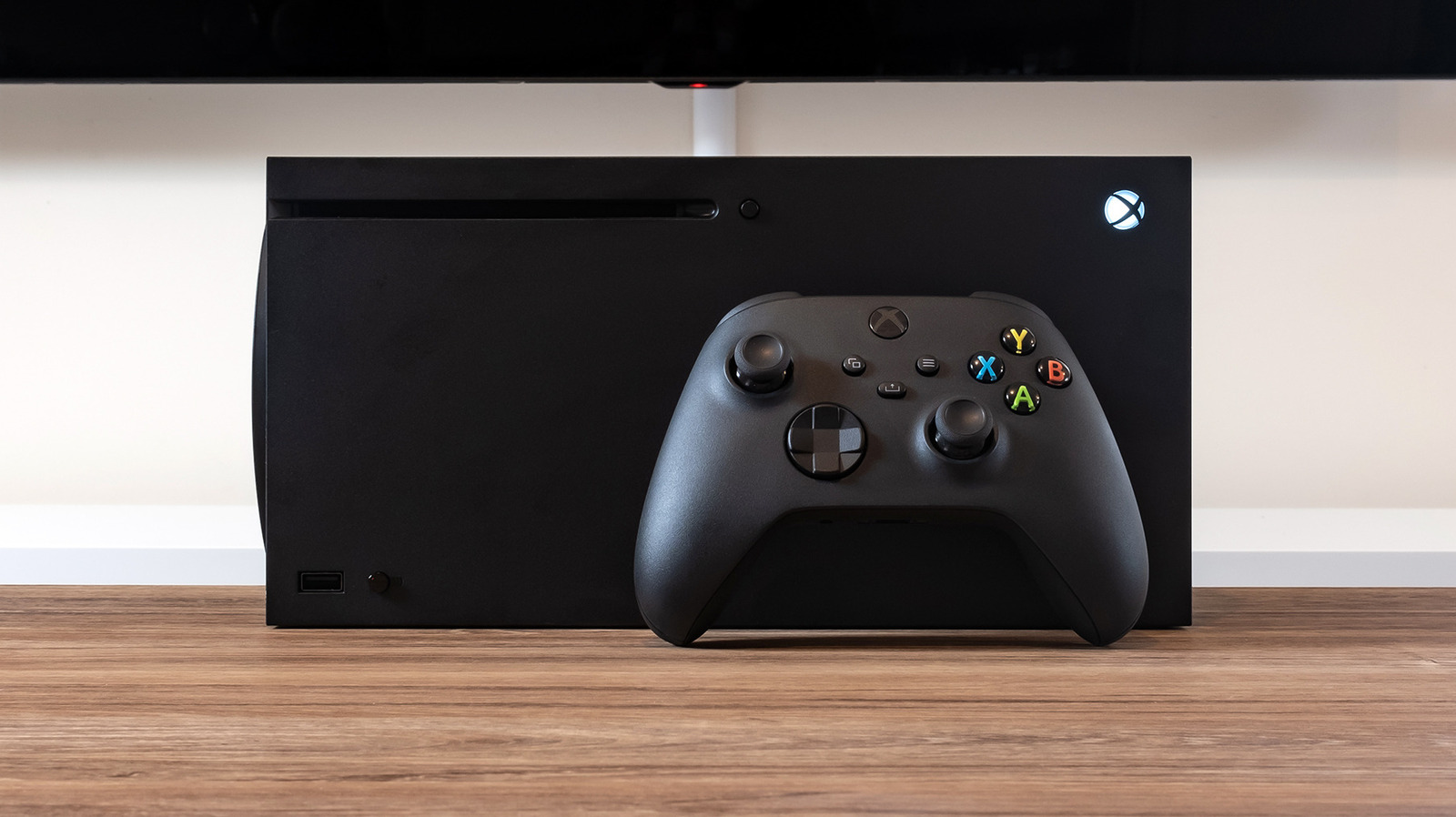
On July 6, at the dawn of a new fiscal year, Microsoft announced it was laying off 3,200 people in its Xbox division, plus an additional 3,200 employees across other departments. Of the Xbox layoffs, 1,600 jobs were cut immediately, while the remaining 1,600 will be lost over the coming year, the promise casting a morbid shadow over the immediate future of Microsoft’s gaming business. Additionally, Xbox attempted to shutter five of its development teams — Arkane Studios, Compulsion Games, Double Fine, Ninja Theory and Undead Labs — and it ended up divesting four of them, while the future of Arkane remains uncertain.
The layoffs hit Xbox at all levels: Doom creator id Software lost a reported 50 percent of its staff, Double Fine had to drop a third of its employees as it bought itself back from Microsoft, the platform team was gutted, and it appears that multiple projects were canceled at Fallout: New Vegas studio Obsidian Entertainment, including a sequel to Avowed.
Knowing it was coming didn’t ease the carnage.
Xbox CEO Asha Sharma and chief content officer Matt Booty, both of whom assumed their roles early this year in a surprise c-suite shakeup, outlined the brand’s dire financial situation in a June public memo. They highlighted broad internal issues with Xbox games, consoles, infrastructure and marketing, and ominously promised a “reset” for the business. Rumors of incoming mass layoffs and reports of potential studio closures swiftly followed, with the culling scheduled to begin just after Microsoft’s new financial year on July 1.
Advertisement
“We will end this fiscal year at about a 3 percent accountability margin, down year-over-year,” Sharma and Booty wrote in their memo. “Excluding Activision Blizzard King, over the past five years, we have spent over $20 billion on ongoing investments in our content, platform, and hardware subsidy, but our annual revenue has declined nearly half a billion during that time. Going forward, this cannot continue.” (Including Activision Blizzard King, which Xbox acquired in 2023, adds $69 billion to the company’s expenditures.)
Ahead of the layoffs, Xbox union members represented by CWA urged the company to consider the human and creative cost of repeated mass firings, and to negotiate in good faith over worker protections. Union members accused Microsoft of leaving proposals on the table for months at a time, paying little attention to meetings and unjustly allocating the company’s vast financial resources. UVW-CWA treasurer Sherveen Uduwana noted that Microsoft CEO Satya Nadella personally made $96 million in 2025.
“There is no shortage of wealth in the games industry, especially if we’re talking about Xbox, Sony, EA,” Uduwana said.
After Xbox announced the layoffs on July 6, the CWA in the United States and Canada filed lawsuits against Microsoft over unfair labor practices, and employees held protests outside their offices calling for “people over profits.”
Advertisement
Additionally in July, Xbox’s network went down for nearly a day and exposed that even physical media isn’t immune to DRM on the company’s consoles, though the disc issue was apparently a bug that will be fixed. Days later, Microsoft’s Q4 2026 financial results revealed a revenue decline of 10 percent for Xbox. Annually, Xbox’s reported revenue fell by more than $2 billion year-to-year, landing behind its closest competitor, PlayStation, by multiple billions.
All of this followed two years of rolling layoffs at Xbox, eight years of increasingly reckless studio acquisitions, and a systemic pattern of valuing potential revenue over any sort of creative process. But we’ll get to that at the end. First, an overview of Xbox’s terrible, horrible, no good, very bad July.
At first, the team envisions that those ideas will be codeveloped with humans, but their goal is deeply automating the process. If it works out, they contend, it’s possible that a few dedicated individuals may use Discovery Loop to out-invent the world’s largest research organizations. Presumably those small teams will be customers of Discovery Loop. (The startup also may make its own loops to seek and monetize breakthroughs.)
They put together a simple pitch deck and set out to talk to VCs about funding their company, which they set up as a public benefit corporation. “We just put a few slides with our backgrounds and a rough sketch of how we think our approach will be successful in a bunch of different ways,” says Dean. (They didn’t use AI to create it.) But their presence spoke louder than any PowerPoint could.
“With this team, I wouldn’t need to know what they were doing before I backed them,” says venture capitalist Vinod Khosla, who met with them in his Sand Hill Road office on a Saturday, so no one would get a hint of Google’s upcoming loss. “It’s the ultimate superstar team.” Khosla also loved their idea: “Humans have been using AI to do research, not using AI to be a researcher,” he says. “The fundamental thing [in Discovery Loop] is that AI is the researcher.”
Other meetings took place at Dean’s house. Ultimately Khosla Ventures and an AI-oriented VC firm called Radical Ventures bought in, along with a handful of other firms. (The founders aren’t sharing how much the funding was and at what valuation–but consider that some companies are paying tens or even hundreds of millions for a single AI superstar, and these guys are GOATs.) “Building something to solve all those problems is a powerful idea,” says Radical managing partner Jordan Jacobs, who will join the startup’s board. “These people have been doing this kind of work in the past so they know what they’re doing.”
Advertisement
Negotiating the exit from Google was more painful. Dean says that Alphabet CEO Sundar Pichai tried over multiple meetings to get them to keep their badges. Ultimately the team decided that they wanted the fun–and the freedom–of doing a startup.
“In a large organization there is always a lot of inertia you have to overcome to make any radical changes,” says Vinyals. “We want to build something different.” Google ultimately gave the departing engineers its blessing, along with an investment and an arrangement to provide compute power for the first year.
“Over 27 years, Jeff and Sanjay helped to drive some of the most significant technology transitions, from our early search infrastructure to the neural networks that helped create the modern AI era,” Pichai said in a statement. “We’ll continue to work with Discovery Loop as a founding investor and Cloud partner, and collaborate on a research framework for ML systems and related infrastructure advances.”
In part because of the impact this mini-exodus will have on Google. Dean and his cofounders have taken pains to maintain stealth. To date, they haven’t yet begun to hire a team (which may mean even more defections from Google) or even to rent office space. When I ask who the CEO is, there is a brief pause. “I think I’m the CEO,” says Dean, sheepishly. “Everyone pointed at me.”
Advertisement
Discovery Loop’s mission is not novel. Just about every major figure in AI—Dario, Sam, Jenson—has claimed at one point or another that AI will become an engine of scientific discovery, solving problems that humans could never crack on their own. This team is betting that their knowledge and skills will prevail in building a system that actually makes such breakthroughs. Short of that, Discovery Loop faces a narrower mark for success: Will the work they do as a startup be as significant as the talent gap they’re creating by leaving Google?
More than 200 people registered for the competition within the first eight days and applications will remain open until 9 August.
TechIreland has announced dates for the free annual National AI Challenge. Participants will engage with two intensive weeks of remote development, with teams presenting their work via coordinated regional events on 14 September.
The strongest competitors will continue on to the TechIreland National AI Meet to be held at Galway’s Galmont Hotel on Thursday 24 September. Their work and knowhow will be judged by leaders across technology, industry, investment, research and the public sector.
The 300 or so participants, from across the entirety of the island, will be made up of developers, founders, students, technologists and AI enthusiasts and will build practical AI products, prototypes and agentic workflows, with the aim of addressing real business and societal challenges.
Advertisement
The competition is supported by expert mentors, industry partners, technology providers and more than 10 regional innovation hubs. More than 200 people registered within the first eight days and applications will remain open until 9 August.
This year marks the third iteration of the National AI Challenge. Last year, participants delivered 44 AI projects, with 15 teams reaching the national final – more than twice the number in 2024.
The theme for 2026 is ‘AI and Agents: Strategy, Processes and Roles’, which reflects the shift from AI experimentation to practical implementation, according to TechIreland.
Teams will be expected to respond to industry-led ‘challenge statements’ or submit their own wildcard ideas in areas such as enterprise technology, manufacturing, financial services, insurance, health, sustainability, public services and immersive technology. TechIreland said there will be an emphasis on responsible, people-centred AI that takes into consideration how AI is governed and used.
Advertisement
Commenting on the announcement, Niall Norton, the CEO for TechIreland, said: “The AI Challenge is much more than a competition. It is becoming part of Ireland’s AI talent infrastructure. At a time when employers need evidence of practical AI capability, we are creating opportunities for people to demonstrate what they can build while helping organisations discover the talent they need.”
Brian Caulfield, board director at TechIreland, added: “I’m very proud to see the National AI Challenge and Meet go from strength-to-strength.
“Every year, the competition has generated more AI start-ups, while simultaneously educating new AI talent and connecting technical and commercial founders. I look forward to this year’s iteration being the best yet.”
The AI ecosystem has experienced a boom in Ireland, with many organisations and institutions focusing on education, scale and growth. In late July, the Tech Industry Alliance and RDI Hub teamed up to launch the Graduate AI Launchpad pilot, a new programme designed to prepare graduates, employers and industry professionals in Ireland’s south-west for AI-enabled workplaces.
Advertisement
Don’t miss out on the knowledge you need to succeed. Sign up for the Daily Brief, Silicon Republic’s digest of need-to-know sci-tech news.
[Mansour] presents an interesting idea in his essay A Common Thread — just as USB-C has become the “One Connector To Rule Them All” in the world of electronics, so too should his projects have a unified physical connection layer. A common thread, if you will.
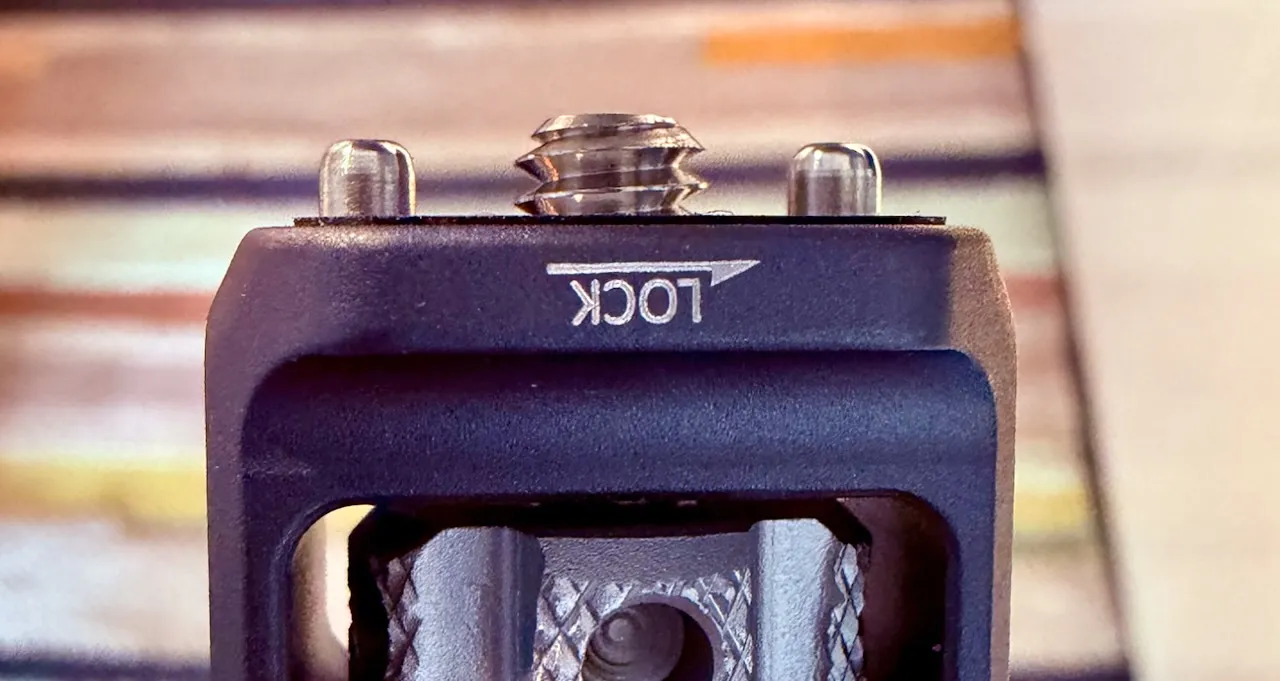
Specifically, the 1/4″-20 UNC connector that was already on all his camera equipment. Unifying his stuff around that connector wasn’t a bolt from the blue brainwave. By the sounds of it, the idea evolved over time and only became intentional after he’d already started using it.
There’s something to be said for it, though. One thing is the convenience of knowing your various bits and bobs are going to fit together like they were made with LEGO. Another is taking away a whole set of decisions in the design process: it’s going to have a 1/4″-20 UNC fitting, so [Mansour] needs only decide if its going to be tapped into the material or if he’s using an inset or captive bolt.
Advertisement
It isn’t like a 1/4″ bolt is going to introduce a weak point in most things we build — with good hardware it can take a ton or more. On the other hand it’s not exactly resilient to torque, but [Mansour]’s camera bag had the answer to that, too: spring loaded locator pins that drop into holes on the female side to take up the torque. In the photography world, these are ARRI pins. To us they just seem like a good idea.
Maybe you don’t see the point of avoiding redesigning the wheel every time for custom mounts and brackets. After all, that lets you come up the the ideal solution every time. On the other hand, [Mansour] has both simplified his design process and made decades worth of camera-holding objects — everything from tripods to stabilizing gimbals — accessible to all his stuff. It’s an interesting idea, and his full blog post is worth a read, even if it’s not likely the EU is going to force its adoption like it did USB-C.































































You must be logged in to post a comment Login