Connect with us
DAPA Banner
DAPA Coin
DAPA
COIN PAYMENT ASSET
PRIVACY · BLOCKDAG · HOMOMORPHIC ENCRYPTION · RUST
ElGamal Encrypted MINE DAPA
🚫 GENESIS SOLD OUT
DAPAPAY COMING

Tech

Accurate Split-Flap Display Can Be 3D Printed

Published

on

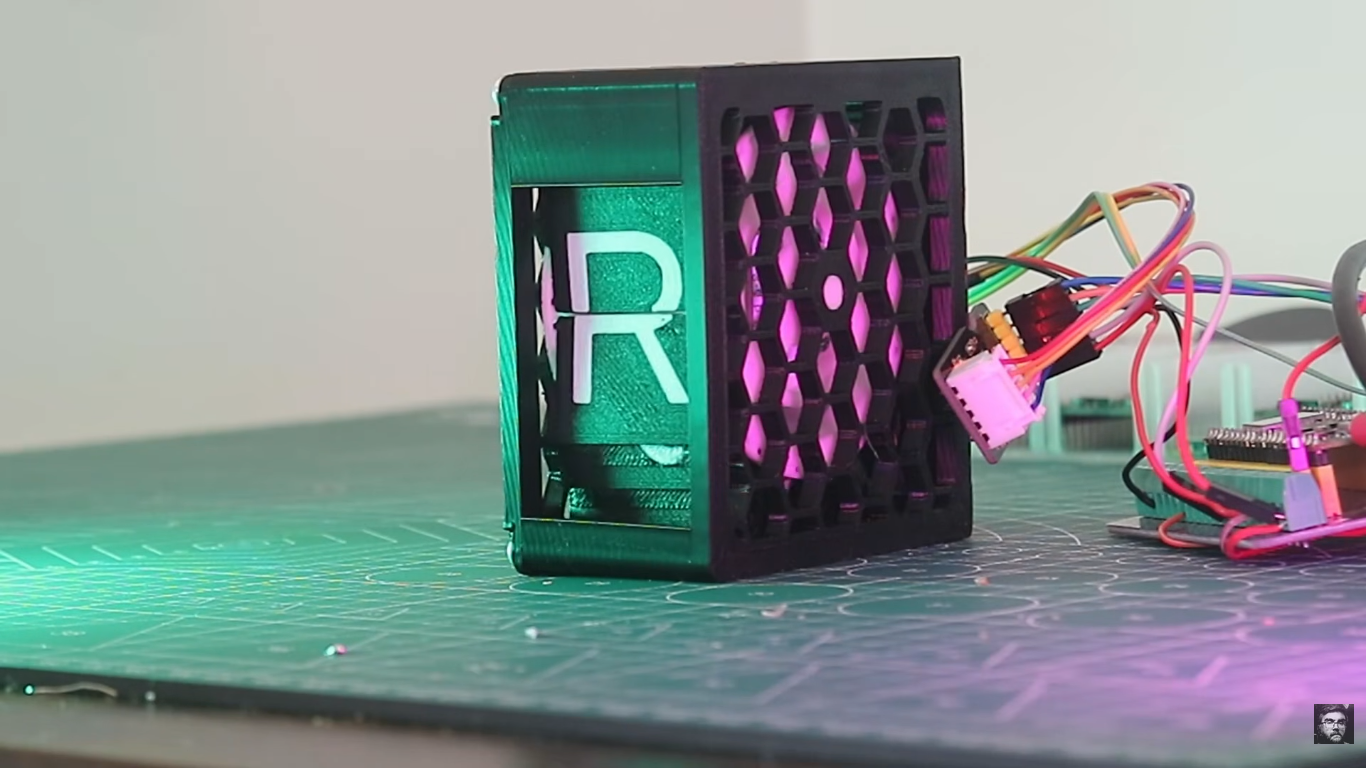
Split-flap displays are a great, low-power way to display text to a wide audience. Compared to other display technologies like LCDs they only use energy when the characters change, but have fallen out of favor partially because of their greater mechanical complexity and also because LCD and LED technology has become so inexpensive. They still retain a loyal following though, and [Jason] is demonstrating his version which boasts high accuracy and can be 3D printed.

To get good results, one of the keys is getting the motor positioning just right. The motor sits in the center and spins the flaps around, so stopping at exactly the right point to display a certain character is critical. [Jason]’s system uses a 28BYJ stepper motor with a magnetic encoder to ensure that the correct flap is displayed. The flaps themselves are completely 3D printed, using a method which allows for two colors to be printed even if the printer is only designed for a single color. Once printed, the flaps are installed on the wheel which is the outer ring of a planetary gear set with the stepper motor sitting in the middle.

Each character in the display is housed in a printed enclosure, and for [Jason]’s project he only needs five characters, so to control the entire setup he’s using a Raspberry Pi Pico. For more characters he suggests that it is still possible to use a smaller microcontroller like the Pico but a multiplexer may be needed. Of course, displays like this are not limited to characters alone. Take a look at this display which has custom flaps to display the current weather conditions as well.

Advertisement

Source link

Advertisement
Continue Reading
Click to comment

You must be logged in to post a comment Login

Leave a Reply

Tech

RAM prices expected to rise another 40-50% in Q3 2026, and then 30% more in Q4 as AI demand outpaces supply

Published

on


Ethan Tan, a memory industry consultant and former Samsung China executive, told Jefferies Equity Research analysts during a recent briefing that he expects memory prices to rise by 40% to 50% in the third quarter of 2026 compared to the prior quarter, and by another 30% to 40% in Q4….
Read Entire Article
Source link

Continue Reading

Tech

Want a cheap Yeti cooler for your 4th of July celebrations? I’m a deal-hunting outdoor expert, and I’ve tracked down the only holiday offers actually worth your money

Published

on

Looking for a deal on a Yeti cooler for your July 4th celebrations? I’ve got you covered. As the former editor of an outdoor adventure website, I know exactly where to look to find the best offers on Yeti gear, and I have uncovered some great deals that will arrive in time for the big day.

Amazon has some great offers, particularly on soft coolers like the Hopper Flip 8 and 12, both of which are ideal for cans or lunches. There are also big discounts on the roomier Yeti M Series, including backpack-style coolers that make carrying your food and drinks a breeze.

Want a hard cooler? Take a look at Yeti Rescues, where you can find heaps of like-new coolers approved by the company itself, and with big price cuts. It’s a smart way to get a top-quality cooler for a lot less than list price. I’ve tested outdoor gear for years, and these price cuts are rare, so grab them while you can.

Advertisement

Yeti deals at Amazon

Yeti’s online store often holds seasonal sales and special deals on selected colors and product lines. Here are today’s best offers.

Yeti Rescues deals

Can’t see the cooler you want in the Black Friday sale? Take a look at Yeti Rescues — an official Yeti program that takes coolers and other equipment that’s not brand spanking new (products that have been returned, for example, or that Yeti has used for demos or displays), inspects them, cleans them, and sells them at a bargain price.

Advertisement

More Yeti deals

Amazon and Yeti Rescues aren’t your only options when you’re shopping for a cheap Yeti cooler. Dick’s Sporting Goods has a decent selection of offers as well. I’ve rounded up a handful of the best below, but you can also check out the full sale yourself.


Advertisement

Google logo on a black background next to text reading 'Click to follow TechRadar'

Follow TechRadar on Google News and add us as a preferred source to get our expert news, reviews, and opinion in your feeds.


Source link

Advertisement
Continue Reading

Tech

Gemini’s personalized AI image generation is now free for US users

Published

on

Google announced on Monday that the Gemini app is now offering its personalized Nano Banana-powered image generation feature to a broader audience. Starting today, all eligible users in the U.S. can access the feature for free, a service that was previously only available to Plus, Pro, and Ultra subscribers.

Google initially announced that Gemini’s Personal Intelligence feature would get Nano Banana-powered image generation back in April, allowing users to create images that reflect their unique interests. This means that images can be generated based on Gemini’s understanding of your likes and preferences without you having to specify them in your prompt. Gemini utilizes data from your Google account connections — such as Gmail, Google Photos, YouTube, and Search — to achieve this. 

For example, instead of saying, “Create an illustration of me and my favorite things, such as coffee and baking,” you can simply request, “Create an illustration of me and my favorite things.”

Gemini can also pull actual images of you from Google Photos, so you don’t need to manually upload photos. 

Advertisement
Image Credits:Google

Google initially rolled out the Personal Intelligence feature earlier this year, making it widely available to all U.S. users in March. The company recently expanded this functionality to users in India and Japan. 

Personal Intelligence is an opt-in feature, allowing you to decide which apps Gemini can access. Once enabled, it is set as the default for every prompt, but you can disable it using a new toggle in the Tools menu.

Additionally, last month, Google announced several upcoming updates for the Gemini app, including a new “Daily Brief” feature, a revamped interface, access to AI video model Gemini Omni, and a personal AI agent named Gemini Spark.

Notably, Google’s AI chatbot Gemini surpassed 750 million monthly active users (MAUs) earlier this year, reinforcing its position as a major player in the AI space.

When you purchase through links in our articles, we may earn a small commission. This doesn’t affect our editorial independence.

Advertisement

Source link

Continue Reading

Tech

Sensitive iPhone Supplier Details Were Part Of Last Week’s Data Leak At Tata Electronics

Published

on

Some of Apple’s corporate secrets aren’t so secret any more.

On top of leaks around its next smartphone generation, Apple has had sensitive details about its manufacturing processes revealed. Reuters reported that the documents posted on “the dark web” allegedly show information about both components and their suppliers for the iPhone 18 Pro. The leak included specifics on hundreds of parts, such as chips on the main circuit board and elements of the smartphone’s battery and cameras, according to the publication. Last week, AppleInsider first reported on the cyberattack, which took more than 630GB of data from India-based Tata Electronics. Fellow clients Tesla and Taiwan Semiconductor Manufacturing Co. also had documents in the leak, but much of the information seems to center on Apple.

Tata has risen to become one of Apple’s most prominent suppliers outside of China. Apple told Reuters that it is working on long-term security measures with Tata and that it is investigating this incident. The company has typically kept quiet about the specifics of its supplier relationships, and having these details exposed could put Apple on the back foot in terms of any future negotiations with its partners, particularly as it increases prices for many products in the wake of RAM shortages. Apple is expected to announce the iPhone 18 Pro, along with the iPhone 18 Pro Max and possibly its first foldable smartphone this fall.

Advertisement

Source link

Continue Reading

Tech

Why the Giving Pledge doesn’t work, explained

Published

on

Historically, being ultra-wealthy meant that there was an obligation to share a chunk of it with the world. Gilded Age industrialists like John D. Rockefeller and Andrew Carnegie made lasting cultural and philanthropic contributions, many of which still bear their names. But increasingly, our modern billionaires don’t seem inclined to follow suit.

To show just how little they’ve given, let’s look at the Giving Pledge. Over 15 years ago, some of America’s ultra-rich promised to give at least half of their wealth to charity throughout their lives or when they died. Even Elon Musk, briefly the first-ever trillionaire in history, signed it. That pledge is now on life support.

Bella DeVaan is the director of the Charity Reform Initiative at the Institute for Policy Studies, where she co-authored a study looking at how the pledge is impossible to fulfill. To explain the study’s findings, DeVaan spoke with Today, Explained co-host Sean Rameswaram about why the pledge isn’t the road to a more equitable future and how philanthropy should be done instead.

Below is an excerpt of the conversation, edited for length and clarity. There’s more in the full podcast, so listen to Today, Explained wherever you get podcasts, including Apple Podcasts, Pandora, and Spotify.

Advertisement

Can you remind us what the Giving Pledge was and who signed it?

The Giving Pledge was a voluntary philanthropic commitment founded by Bill Gates, his then-wife Melinda French Gates, and Berkshire Hathaway chair Warren Buffett in 2010. Since then, north of 250 people in the world have signed onto this pledge. And it’s people with tons of money who feel like signing onto something like this is something that they could do, or at least want to be seen as pledging to do.

The Giving Pledge is now 16 years old. My team did a study at 15 — old enough for a driver’s permit. And we feel like there’s a significant body of evidence that the pledge is unfulfilled and unfulfillable. Of the 32 original signers who are still billionaires, they had collectively gotten 283 percent wealthier — or 166 percent adjusting for inflation — since they signed onto the pledge, and only one couple in the group fulfilled their pledge.

So the idea is to get poorer over time, and meanwhile, almost everyone, or if not everyone, has gotten significantly richer.

Advertisement

That’s exactly right. Mackenzie Scott, who is one of the most prolific and generous pledgers, has given away $26 billion. [But] she’s decreased her wealth by less than $6 billion since her separation from Jeff Bezos. So if that’s what the most generous philanthropist is struggling to keep up with, everybody else is faring far worse.

Is it because they don’t genuinely want to give their money away, or is it because they’re simply doing so well all the time and getting exponentially richer all the time that it is really hard to do?

If we want to give them some credit, yes, it is mathematically incredibly challenging to give away as much money as their skyrocketing wealth. But I definitely think these billionaires are not stepping up to the plate and giving as much as they should and even as much as they’ve committed to.

A great caveat of the Giving Pledge is that you get to fulfill it upon your death in your will. That could look like giving your children control of your charitable intermediaries. A big part of our study was finding out that 80 percent of all the gifts that these pledgers have given go into private foundations, often that they control.

Advertisement

That’s what it looks like when you can make a donation that seems like you’re parting ways with your wealth and delivering some kind of benefit to the public, but actually that money doesn’t reach public charities or public works or on-the-ground aid until it leaves the foundation, and there’s a significant lag time in there.

And what’s wrong with all the money going to their foundation that then goes and distributes money to, I don’t know, needy children, medical research firms, whatever it might be?

A weigh station lengthens the journey, right? We figured out that out of all of the living pledgers who are still billionaires, when they signed on, their median foundation payout rate was 9.2 percent a year.

If you’re getting so much wealthier and your foundation is only giving away a single-digit percentage of your foundation’s wealth every year, and you’ve gotten a tax incentive and reduction up front for your gift — which the general public is subsidizing up to 73 cents per dollar — that’s a very significant investment. You’re asking the public to shoulder it and that money is trickling out back to the public. It’s not keeping pace.

Advertisement

Is there any good news here, Bella? Have we accomplished anything? Have we eradicated any diseases? Have we cured any diseases?

It depends who you ask, but I would say no. I think that the great indignity of philanthropy and concentrated wealth at this scale is that multiple things can be true at once.

It can be true that billionaires overexert their power, that they are able to influence the state of science, innovation, the deliverance of public aid, the shape of housing policy, and that can make significant inroads and deliver benefits to people. There’s no arguing with that. But at the same time, they can be hoarding wealth, not doing enough, resting on their laurels, banking on this idea that the reputational benefit of signing the pledge is enough.

That those two things can be true at the same time, while regular people are struggling to make ends meet, means that the system is in need of a dramatic overhaul. And if the billionaires who promised to give half their money away are doing this poorly at it, that tells us everything that we need to know.

Advertisement

Tell us about an overhaul. If you designed the Giving Pledge or a system that’s altogether different, what would it look like?

If it were up to me, the number one most meaningful intervention is to figure out how to tax wealth, figure out how to restructure our economy so that people can’t accumulate these fortunes in the first place, over which they can exercise such plutocratic control.

But knowing that we live in a society that has all these billionaires already and has all these foundations with piles of money that haven’t been deployed for the public benefit, I think we have to increase transparency so that donors can’t use donor-advised funds and other popular intermediary and foundations to conduct dark-money giving or play shell games to change the timing of tax benefits, so that philanthropists have to make the gift and then see their tax benefit instead of getting it upfront without having any obligation to move money.

I’m hearing tax the Rich, I’m hearing reform tax code, I’m hearing change public policy. But as you could admit, less likely to happen. And I just wonder, have all of those things become less en vogue 15 years down the road?

Advertisement

Elon Musk talks about empathy as a weakness. He made cuts to USAID programs that directly resulted in hundreds of thousands of people dying. And people still love him and want to invest in his companies and make him even richer! Do you think we’ve seen a cultural shift around giving around empathy itself?

Yes. In these political conditions, the Giving Pledge is what we’re stuck with. We’re stuck with waiting for a voluntary effort to reshape society instead of knowing that we’ll get structural reform that would be guaranteed to deliver it.

These are all very concerning trends. Philanthropy in America has always been an expectation of the wealthy people in the country. Reaching back to Andrew Carnegie and Rockefeller, that is what is expected of a rich person in America. That value is no longer closely held at all.

Regular people are as generous as they can be. We see this in remittances. We see this in small donations to your local food bank, to your religious institution. Everyday people are as generous as they can be, and I think that our ultra-wealthy people need to take after them more.

Advertisement

Source link

Advertisement
Continue Reading

Tech

IBM Says It Can Fit Nearly 100 Billion Transistors On a Chip

Published

on

IBM has unveiled “what it says is the world’s first sub-1-nanometer chip technology,” reports ZDNet, “designed to pack nearly 100 billion transistors on a fingernail-size die, roughly doubling the density of IBM’s earlier 2-nm test chip, first shown in 2021… Today, the smallest, most powerful chips top out at about 80 billion transistors.”


At the heart of the announcement is NanoStack. This is a three-dimensional, nanosheet-based transistor design that scales vertically, or along the z-axis, by stacking and staggering CMOS devices. Unlike today’s nanosheet architectures, which IBM also pioneered and which are being adopted by leading foundries at 3 nm and 2 nm, NanoStack bonds two nanosheet transistors into a single vertical structure, with each tier optimized independently and contacted from opposite sides. Each transistor in the demonstrated structure uses three sub-5 nm-thick nanosheets, about “15 silicon atoms” across, separated by roughly 9 nm spacers. Two such devices are then bonded vertically using an ultra-thin dielectric process IBM describes as a key innovation. Because the top and bottom devices can use different channel materials, dielectrics, and metals, IBM argues NanoStack is less a single trick and more a transistor platform that can be extended through multiple generations: 7 angstrom (Å), 5 Å, 3 Å, and potentially down to 1 Å in its internal roadmap.

An angstrom, by the by, is one ten-billionth of a meter. In terms of chips, an angstrom is a tenth of a nanometer. “This is the world’s first sub-1 nanometer chip technology with a new transistor architecture,” said Jay Gambetta, Director of IBM Research and IBM Fellow, during a press briefing. “We’re not just making smaller transistors, we’re reinventing how chips are built to deliver dramatically more power and energy efficiency….” Based on internal benchmarking against its 2 nm node, the company said its new chips will deliver up to 50% higher performance at the same power, or up to 70% lower power for the same performance. Big Blue also highlighted a 40% improvement in the scaling of static random-access memory (SRAM) cell area relative to its 2 nm technology.

This is a change IBM described as a “step the industry hasn’t seen in over a decade” and one that could be particularly important for AI accelerators that live or die on on-chip memory bandwidth… According to Huiming Bu, IBM’s VP of silicon technology R&D, NanoStack is a new paradigm. It’s moving chips to scaling fully into three dimensions and giving the industry at least “another decade” of logic advances as it crosses from nanometers into angstroms… The 40% SRAM density bump could also help architects push caches and on-die memory closer to compute units, cutting data movement overhead in training and inference workloads.
IBM sees a path to production use “in as early as the next 5 years”, according to the article, and “expects NanoStack to eventually underpin CPUs, GPUs, mobile SoCs, and SRAM arrays.”

Advertisement

IBM’s VP of silicon technology R&D says the new innovation “can improve performance by 50% compared to the best available chip today, and at the same time can reduce power by 70%.”

Source link

Continue Reading

Tech

Buying a Mattress in 2026? We Tested 100+ and These Were the Standouts

Published

on

Compare Our Top Picks

Honorable Mentions

Image may contain Furniture and Bed

Photograph: Julia Forbes

We tested many mattresses last year and have hit the ground running in 2026. That said, here are a few options we enjoyed and considered but ultimately didn’t make the starter team.

Advertisement

Leesa Original Hybrid Mattress for $1,499: If you don’t mind the bouncy feel generated by the innerspring core, this is a well-engineered mattress that will appeal to most people—it’s not too firm but not too soft, with excellent edge support and an 11-inch height that won’t feel too tall or too low on your bed frame. It’s got a top layer of memory foam, but because of the Original’s sturdy hybrid construction, which incorporates 789 individual pocketed coils, you won’t get the dips or mashed-down spots over time that you might with a foam-only mattress, which can be a real problem for couples. You also can’t beat Leesa’s limited lifetime warranty. The only note is that while Leesa quantifies the Original’s only firmness level as a “medium-firm,” it is definitely on the softer side, so if you’re looking for a true medium-firm, you may want to consider a “firm” from another model. I also tested this with the optional Cooling Quilt Top, which I recommend if you sleep hot, as it was cool to the touch and helped reduce heat absorption overnight. —Kat Merck. $1,050 to $1,664

The Purple Mattress for $1,599: Purple’s signature squishy GelFlex grid is, like Tempur-Pedic’s Tempur-material, divisive: You are either a rabid super-fan or consider it the worst mattress you’ve ever slept on in your life. My household consists of the former. Along with your mattress, Purple sends a little rectangle of the material so you can see exactly what it is: A rubbery polymer grid that crumples to relieve pressure in areas where you need it, like your hips and shoulders. Because each square of the grid is open, it allows for plenty of airflow, and because the gel is squishy, it still absorbs motion transfer just like memory foam would. If you love that soft memory foam feel but hate the heat absorption, you will probably love Purple. And especially this model, as it best showcases the GelFlex grid without any additional foam layers to get in the way. The only problem I had with this mattress was its height: It’s around 9 inches, so if you have a low-profile bed frame and are used to a thicker mattress, it will sit quite low. I didn’t expect 2 or so inches to make a dramatic difference, but it did. Also, the GelFlex grid makes this mattress extremely heavy (make sure it’s exactly where you need it before cutting the vacuum seal), so placing a box spring or anything else underneath to lift the height will void the warranty. —Kat Merck. $1,099 to $2,598

Advertisement

Thuma Luxury Hybrid Mattress for $1,795: Thuma’s hybrid mattress is interesting because it blends together a smorgasbord of mattress materials: a Tencel cover, organic wool, memory foam, organic latex, and recycled-steel coils. The same rubberwood trees are used for Thuma’s popular Classic Bed frame, and for the Dunlop latex in this mattress. Of the three firmness levels offered—plush, medium, and firm—the medium was yielding some pretty strong support. The sleep trial is a bit unclear, as you only get 100 nights of coverage with your first Thuma purchase. So if you’ve already used it on a different Thuma product, like the frame, you may be out of luck here. —Julia Forbes. $1,295 to $1,995

Puffy Cloud for $1,049: This enhanced all-foam mattress offers profound pressure relief without feeling too soft, despite the name “Cloud” being in its name. The Puffy Cloud has a thinner profile and would most likely be too soft for bigger bodies. However, for lightweight and average builds, it really comes through to support the lower back and hug around pressure points. The thinness also didn’t compromise its motion isolation, which meant little to no shaking when my dogs jumped in and out of bed.—Julia Forbes. $449 to $1,298

Advertisement

The Saatva Contour5 for $3,049: The Contour5 is a newer offering from Saatva, replacing the popular Loom & Leaf in the company’s lineup. Like other Saatva mattresses, but unlike most others on this list, it is not roll-packed and comes delivered on a moving truck. The Contour5 has two firmness options and updated cooling tech that uses airflow channels in its gel foam layer, which is thinner than its predecessor, meaning it retains less heat. In my two weeks of testing, I found the Contour 5 was very good at remaining cool through summer nights, which is extra impressive given that it uses very dense 5-pound-weight memory foam. The Contour5 is soft enough for side sleeping without feeling like a saggy hammock and has excellent build quality, which is impressive for an all-foam mattress without springs. I prefer a hybrid with microcoils, but Saatva is popular for a reason, and as all-foam mattresses go, it has a true luxury feel. —Martin Cizmar. $1,899 to $3,649

The Big Fig Classic for $1,999: The Big Fig is designed for larger body frames. Being a bit overweight myself, I was eager to see how well this mattress, which is advertised as comfortably handling 550 pounds per sleeper, performed. It is a well-built mattress with an effective gel cooling layer; however, the aggressive edge support created a hammock-like feel despite the sturdy springs and three layers of high-density foam in the middle of the mattress. This was true both on my back and on my side. Others may appreciate the effect of sinking a bit into the center of the bed more than I do. —Martin Cizmar. $1,499 to $2,399

The Boring Hybrid Mattress for $799: Boring Mattress is a new company founded by two alums from Tuft & Needle. Simplicity is the company’s selling point. There is just one option: the Boring Hybrid Mattress. (You are allowed to pick a size.) This 10-inch hybrid has four layers of both foam and springs. I’m very sensitive to joint pain, and certain beds tend to make it worse, which is why pressure relief is super important for me. Having slept on a variety of different mattresses throughout the years, I was doubtful that this one would work. But I’ve slept on the hybrid mattress for months now and have yet to feel any pain at all. It strikes an excellent balance between firmness and support that my very particular self hasn’t been able to find with other options on the market. It’s worth noting, however, that its layers come equipped with an open-cell design that’s designed to move heat from your body while sleeping. I’m usually cold, so this feature isn’t that important to me. But on nights when I’ve cranked the heat up in my room and woken up sweating a bit, I can’t say it worked all that well for me. This isn’t a deal breaker, but I wouldn’t buy it solely for that. —Brenda Stolyar. $599 to $999

Advertisement

Casper The One for $899: Casper was a leader in the first wave of bed-in-a-box makers in 2014. The company has changed ownership and design a few times over the past decade but last year’s launch of The One finds the company keeping pace with competitors. This is an all-foam mattress that stands 11 inches tall. Because it’s all foam, it’s on the light side, with a queen weighing an easily movable 66 pounds. One of the main issues with all-foam beds is that they get too hot, but Casper’s The One uses an open-cell foam layer called Breathe Flex Foam on the top, which makes it both pleasantly squishy and breathable. Two more layers of foam add up to a medium-firm feel, with the middle layer designed to cradle your hips, and the base layer designed to provide support. —Martin Cizmar. $749 to $1,698

The Winkbed for $1,799: WIRED reviewer Julian Chokkattu slept on the luxury firm version of the WinkBed for almost two years and he was quite happy in that time. His favorite perk? The edge support is fantastic, so his partner never wakes when he slips into bed late at night. The plush pillowtop also adds a luxe, hotel-like feel to a relatively firm bed. —Martin Cizmar. $1,427 to $2,856

Silk and Snow S&S Organic for $950: I wouldn’t expect this to feel silky-soft, but the latex is supportive for sleep. I love how responsive (read: bouncy) this bed is, especially as someone who tosses and turns often. It’s able to move with me so I never feel unsupported, or overheated for that matter. Latex and coils are breathable, as are the organic cotton cover and wool fire barrier. —Julia Forbes. $800 to $1,300

Nest Bedding Quail for $1,299: When it comes to all-foam mattresses from classic bed-in-a-box brands, I prefer the Casper above, but the Quail by Nest is a nice option if you want an all-foam bed that’s a little firmer and you’re willing to pay a little more. My biggest issue with the Nest was that despite its claimed cooling system—the foam is infused with minerals and designed with an airflow layer—I did sleep a little hot on it during my week of testing. —Martin Cizmar. $849 to $1,499

Advertisement
Buying a Mattress in 2026 We Tested 100 and These Were the Standouts

Courtesy of Helix

Helix Sunset Elite for $3,095: Our top pick, Helix, also has an Elite collection that consists of seven mattresses along a spectrum of softness. At 15 inches high, the Sunset Elite is “the tallest mattress on the internet,” and comes shipped in two separate boxes, each heavy enough to max out FedEx requirements. The firmness is dictated by the foam density of the upper layer, which zips into a larger support system. This makes the mattress adjustable if you end up regretting your order. The bottom section has a separate layer of microcoils. I spent a month sleeping on the softest model from the Elite line, dubbed the Sunset, and appreciated the deep cradling effect. Helix offers a 100-day trial period on all of its mattresses. —Martin Cizmar. $2,871 to $4,871

Wayfair Sleep 14-Inch Plush Cooling Gel Hybrid Mattress for $324: This plush mattress has a top layer of cooling gel that conforms to your body for comfort and has classic pocket coils below for structure and support, with layers of memory foams with varying thickness surrounding the coils for extra support (the coils and memory foam mixture helps with low motion transfer, too). The top knit cover and sides help with breathability and the overall cooling effect. The mattress is also compatible with an adjustable bed base, has solid edge support, is CertiPUR-US and Oeko-Tex Certified (ensuring no harmful toxins), and has a 10-year warranty. This bed is super comfy if you like a more plush mattress. —Molly Higgins. $555 to $1,014

Mattresses to Avoid

Advertisement

Not every mattress we test can be a winner, which is why we test in the first place. Here are a few that did not make the cut according to our standards.

Birch Elite Hybrid for $2,619: This is the newest model from Birch, and frankly, you would be just fine sticking with the Birch Natural or Birch Luxe Natural instead. The Birch Elite Hybrid was incredibly top-heavy and incredibly difficult to move, given the floppiness and weight of its numerous latex and coil layers. The top layers slid around, creating a lumpy surface, and the new “CoolForce” layer was completely undetectable. —Julia Forbes. $2,499 to $4,499

Brooklyn Bedding Spartan for $1,499: This mattress is designed for “athletic recovery,” and as a former collegiate athlete, I was excited to try it. I had opted for medium firmness over the soft and firm options, but upon receiving it, I had to double-check that I hadn’t gotten the soft option by accident. The medium cratered around me, leaving me with unhappy pressure points. The lack of overall support didn’t help me recover from soreness, so I couldn’t tell you whether the Far Infrared Ray recovery tech in the cover helped at all. —Julia Forbes $1,099 to $2,399

Sleep Number Climate360 Smart Bed for $8,712: This bed can be temperature-controlled, which is amazing. The adjustable base means you can be comfortable when watching TV, reading, or sleeping. Unfortunately, the price tag has too many digits, and sleep experts recommend avoiding electronic usage before bed—advice the Sleep IQ app defies. Did we mention it costs as much as a used Buick and the weight is not far behind? —Martin Cizmar. $10,249 to $14,499

Advertisement

Tempur-Pedic Tempur-Adapt for $2,199: Tempur-Pedic is one of the country’s best-known and loved mattress brands, but two separate WIRED reviewers (Martin Cizmar and Nena Farrell) have both disliked different mattresses from the company over the past two years. Nena found the Tempur-Adapt totally lacking in support, and felt like she was sinking into a void when she lay on it. Her spine and muscles both ached after sleeping on it so she gave it to her sister who also hated it, describing it as like sleeping on a leaky air mattress. —Martin Cizmar. $1,699 to $3,398

Amazon Basics mattress for $279 (Full): This one is made of cheap foam that isn’t dense enough, causing too much sinkage. —Martin Cizmar. $189 to $386

Parachute Eco Comfort Mattress for $2,650: This mattress just doesn’t live up to its extravagant price. The model we tested didn’t have enough proper padding above its coils. —Martin Cizmar. $1,550 to $2,850

Advertisement

Frequently Asked Questions

Our testing process is simple—we dedicate a week or so to each mattress, sleeping on it at home to understand what it’s all about. The WIRED Reviews testing team has been refining our testing methodology since 2019, when we would try out mattresses side by side in a conference room, much like a mattress store experience. But just like what can happen at a mattress store, the experiences we were documenting in these brief observations could change the more time we spent with a mattress. Hence, we went back to basics and dedicated a week or more to sleeping on each one, noting down our nightly experiences.

That being said, I have spent the last six years as a certified sleep science coach and professional mattress testing becoming a mattress sommelier of sorts. Instead of devising tests to show how much a bed can support at the edge or reduce motion transfer, it really comes down to understanding the range of materials, sleeping positions, and body types in the mattress space.

What Should You Look for When Buying a Mattress?

Advertisement

Mattress shopping requires a bit of self-assessment before you even get into the particulars of a mattress. Taking note of your body type, preferred sleeping position, pain points, and material preferences for things like allergies or staying chemical-free are all data points that make the search a lot easier. From there, we can help you narrow down options for different scenarios, such as if you are a couple looking for a firm mattress to help with back pain. For that, I’d point you to some of our other guides, such as the best mattresses for sex and the best mattresses for back pain, to discuss some of our favorite options we’ve tested.

What Are Mattress Certifications?

This is one of the most critical factors to look for when buying a mattress, as it’s basically a cheat code for evaluating a mattress’s material and quality claims. For mattresses that use memory foam or organic and natural components, mattress certifications help us, as consumers, gain insight into the sourcing and safety of these materials. CertiPUR-US certification is a non-negotiable for me when it comes to memory foam because it shows that harmful chemicals were not used in its production. GreenGuard Gold is another certification that ensures any off-gassing from your mattress upon unboxing won’t affect your indoor air quality—important if you have sensitive skin, a strong sense of smell, allergies, or asthma.

How Long Does a Mattress Last?

Advertisement

As a ballpark estimate, your mattress should last eight to 10 years. I don’t recommend going much beyond that, as the mattress materials are past their prime and aren’t providing adequate support or comfort.

Just like picking out a bed, there are several factors involved that dictate how long it’ll last. Durability of the mattress’s materials always comes into play, as beds with coils tend to remain more structurally intact than all-foam beds, which can sag around the middle and edges over time. Your build also plays into this, because if your bed starts to buckle under your weight night after night, that’s obviously an issue. If this is the case for you, I’d recommend reviewing your warranty to see if it can be replaced.

How Long of a Mattress Warranty Should I Look For?

The industry standard for a warranty is about 10 years, so that should be the minimum in most cases. Many brands will offer prorated coverage beyond that decade mark, meaning the mattress can be replaced at a significant discount, depending on how long it’s been. This is where the fine print of a warranty is especially important to review, because many mattresses offer lifetime warranties. For example, DreamCloud has a “Forever Warranty” that fully covers its mattresses the first 10 years. After that 10-year mark, you have to pay $50 each way for the mattress repair or replacement to be delivered. It’s still a good deal, but something to be aware of.

Advertisement

Should I Buy My Mattress In-Store or Online?

Where you purchase your mattress is another personal preference. Many people may live near a showroom that sells a mattress they’ve been eyeballing, and want to go see it in person before buying. Others may do that and wait for an online holiday sale to secure a major deal.

The nice thing about buying online is that you get much more variety than what you’d get with a mattress store. You’ll still receive the sleep trial component that most brands offer for in-store purchases when opting to do so online. You can try the bed from the comfort of your home for a set number of days, typically 90 nights to an entire year, depending on the brand. Many companies, but not all, will require a 30-day adjustment period for you to get used to the mattress before they will process a return. If you do end up returning a mattress, some brands, both online and brick-and-mortar, may ask you to donate it to a local charity or arrange for pickup as part of the warranty. By donating, mattresses are kept out of landfills and put to good use.

Should I Wait for a Mattress Sale Before I Buy?

Advertisement

In all honesty, it comes down to how you’re currently faring with your mattress and sleep schedule. If you’re sleep-deprived and ready for a change, there’s no time like the present. We do cover coupons and promos that come up in non-holiday periods. For example, we have a special code for the Nolah Evolution running at all times.

During the holidays, the WIRED Reviews process is unique because we meticulously track price changes and sales year-round. That way, we can deliver news about the really good sales rather than what’s dominating headlines. Major mattress sales weekends include Presidents’ Day, Memorial Day, Fourth of July, Labor Day, Black Friday, and Cyber Monday. There are plenty of ad hoc sales that pop up for various events in between, too.

How Does WIRED Acquire Mattresses for Testing?

We conduct a lot of research about what’s new in the mattress world, as well as the legacy of established brands and models. To perform hands-on testing, we will request free media samples from these brands or buy them outright on sites like Amazon or Wayfair, or from smaller vendors. Some brands will engage with us in partnerships, but that does not dictate their placement within an article, what we say about the product, or even if we cover it. Even if we receive commission, it’s essential that we publish our true account of our experiences.

Advertisement

What Does WIRED Do With the Mattresses After Testing Them?

Because most mattresses we test are provided as media samples, we donate them locally upon completion of testing.

Power up with unlimited access to WIRED. Get best-in-class reporting and exclusive subscriber content that’s too important to ignore. Subscribe Today.

Source link

Advertisement
Continue Reading

Tech

The fight to preserve Australia’s underwater forests

Published

on

Catalina A Musrri of the University of Sydney and Georgina Wood of Flinders University discuss the significance of underwater seaweed forests and how to preserve them.

Click here to visit The Conversation.

A version of this article was originally published by The Conversation (CC BY-ND 4.0)

Australia’s Great Southern Reef is built not by coral but by seaweed. The seaweed forests on these rocky reefs stretch more than 8,000km around southern Australia.

Amid the swaying fronds live seadragons, rock lobsters, giant cuttlefish and southern blue devils. The reef is home to more than 1,500 seaweed species and contributes billions to the economy each year.

Advertisement

But these remarkable cold water forests face a worsening threat. The ocean is getting steadily warmer, pushing seaweed species outside their survival zone. Much of this damage is done by sudden marine heatwaves, where temperatures spike and remain high for some time. Heatwaves have driven the decline of seaweed forests across the country.

To protect these underwater forests, we need to preserve their genetic diversity. We led the first attempt to cryopreserve (freezing and storing reproductive material at ultra-low temperatures) a key Australian seaweed, crayweed, and found the idea shows promise, though the techniques need to be perfected.

Why does seaweed matter?

Most of us encounter seaweed as a slightly stinky mass spotted when walking along a beach. But underwater, these large algae (not plants) form beautiful forests swaying in the current – some as tall as 30 metres.

Seaweed forests are among the most productive ecosystems on Earth. Like forests on land, they provide habitat, shelter and food for many creatures. They underpin valuable fisheries such as lobster and abalone.

Advertisement

When local populations are wiped out, they take something important with them – genetic diversity. Species with high genetic diversity can better adapt to change. Some populations will be able to tolerate heat better, for instance. But if these populations disappear, their unique genes go with them.

In 2011, an extreme marine heatwave in western Australia led to two common seaweed species losing an estimated 30pc to 65pc of their genetic diversity. These losses may mean poorer outcomes in response to intensifying threats.

Consider the crayweed

Golden-brown crayweed (Phyllospora comosa) once formed extensive underwater forests along Sydney’s coastline. Many of these disappeared in the 1980s, likely due to sewage pollution. But crayweed didn’t return even after pollution levels fell.

Over the past 14 years, scientists and divers have replanted this species around Sydney through Operation Crayweed. Their work has led to the return of self-sustaining populations, including Australia’s first named seaweed forest – Yanggaa forest at Coogee Beach.

Advertisement

But restoration may not be enough in a rapidly warming ocean. Our research shows separate crayweed populations harbour unique genetic diversity – and some individuals appear better equipped to tolerate heat. It may make sense to plant germlings (baby seaweed) from these individuals in vulnerable populations to boost their chances of survival.

Of seed banks, biobanks and cryopreservation

For decades, thousands of land-based plant species have had their genetic diversity preserved through seed banks. The seeds stored are sleeping but still alive. If planted in the right conditions, they will grow.

Some kelp species can also be kept alive in biobanks – not as seeds, but in a microscopic form (gametophytes) able to be kept alive in laboratories for years. Current kelp collections support research, aquaculture and restoration programmes around the world, including in Australia.

These banks are important. But they won’t be enough. The majority of seaweed species dominating the Great Southern Reef are known as fucoids. Unlike true kelps, fucoids don’t have this microscopic life stage; they release sperm and eggs directly into seawater that fertilise and form germlings. This makes species such as crayweed, bull kelp (Durvillaea potatorum), Cystophora sp and Scytothalia dorycarpa more challenging to conserve.

Advertisement

It is possible to bank species which rely on sexual reproduction, such as humans, cows, corals and fucoids. Assisted reproduction methods such as IVF rely on cryopreservation: storing reproductive material, tissue or early life stages at ultra-low temperatures (around –196°C) so it remains viable for future use.

Our recent research tested whether frozen crayweed sperm and germlings were viable after being thawed. We found the sperm did well, but the germlings did not (for now). Our ultimate goal is to develop proven methods able to work across a broader range of Australian seaweed species.

Preserving the genetic diversity of seaweed species would mean these genes can be drawn on to bring them back. This buys valuable time and keeps the door open for new methods such as assisted gene flow, where individuals from better-adapted populations are used to help vulnerable ones cope with warmer conditions.

Time for seaweed biobanks?

Australia already has an impressive algal culture collection and is a global leader in coral cryobanking.

Advertisement

Even so, it will take real work to develop methods of preserving the forest-forming seaweed species that rely on sexual reproduction. We need to learn which populations contain unique or threatened genetic diversity, understand which are most vulnerable to climate change, and improve freezing and recovery techniques.

Choosing which species and populations should be done alongside indigenous custodians, governments, conservation organisations and local communities.

Cryobanking doesn’t solve climate change or replace the need to protect habitat. It’s an insurance policy for biodiversity. Much has already been lost. Preserving the remaining genetic diversity of our seaweed forests may well be critical to the survival of the Great Southern Reef.


Advertisement

The Conversation
By Catalina A Musrri and Georgina Wood

Catalina A Musrri of the University of Sydney recently completed her PhD in seaweed forest restoration in the context of climate change. She is interested in the impacts of climate change and other anthropogenic activities, such as pollution and overfishing, on coastal habitats.

Georgina Wood is an early career Australian Research Council fellow at Flinders University and adjunct research fellow at the University of Western Australia whose research focuses on repairing nature in a changing climate, particularly temperate kelp forest ecosystems.

Don’t miss out on the knowledge you need to succeed. Sign up for the Daily Brief, Silicon Republic’s digest of need-to-know sci-tech news.

Advertisement

Source link

Continue Reading

Tech

DeepSeek open sources DSpark, a new framework to speed up LLM inference by up to 85%

Published

on

Even as the geopolitical conversation around AI continues to grow more fraught following the U.S. government’s actions to limit the new models from Anthropic and OpenAI, Chinese open source darling DeepSeek is back with yet another open release that could once again change AI development around the globe.

Over the weekend, the firm released DSpark, a new, MIT-Licensed system designed to make large language models answer faster without changing what the underlying model is trying to say.

The easiest way to think about it is this: most AI chatbots write like someone crossing a river one stepping stone at a time. They choose one small chunk of text, then the next, then the next.

DSpark gives the system a scout that runs a few steps ahead, guesses the likely path, and lets the larger model quickly check which steps are safe. When the guesses are good, the model moves faster. When the guesses are weak, DSpark tries not to waste time checking them.

Advertisement

DeepSeek published the work with a technical paper, model checkpoints and DeepSpec, a codebase for training and evaluating speculative decoding systems. The release is available through DeepSeek’s public GitHub and Hugging Face pages, both under the permissive, friendly, commonplace MIT license, making the new technique broadly usable by developers, researchers and commercial enterprise operations that want to study or adapt the approach.

The system is aimed at one of the most expensive problems in AI deployment: serving large models quickly enough for real users, while using hardware efficiently enough to make the economics work. That matters for consumer chatbots, coding assistants, agentic workflows and enterprise AI systems where users expect long answers to stream quickly rather than crawl out word by word.

DeepSeek is applying DSpark to its own latest frontier open model, DeepSeek-V4.

Specifically, DeepSeek used its new DSpark framework on DeepSeek-V4-Flash, its already speed-optimized 284-billion-parameter mixture-of-experts model with 13 billion active parameters, and DeepSeek-V4-Pro, its more thoughtful and powerful 1.6-trillion-parameter model with 49 billion active parameters (Both support context windows up to one million tokens).

Advertisement

But the broader significance is that DSpark is not conceptually limited to DeepSeek-V4. DeepSeek’s own tests and released checkpoints cover other open model families, including Alibaba’s open weights Qwen and Google’s open weights Gemma.

That means enterprise teams running open-weight models could, in principle, train or fine-tune DSpark-style draft modules for their own target models. It is not a switch that any API customer can flip from the outside, but it is a method that can travel to other models when the operator controls the weights and serving stack.

Staggering speed increases for generating tokens during inference

In DeepSeek’s live production tests, DSpark improved aggregate throughput by 51% for DeepSeek-V4-Flash at an 80-token-per-second-per-user service target, and by 52% for DeepSeek-V4-Pro at a 35-token-per-second-per-user target. At matched system capacity, DeepSeek reports per-user generation speedups of 60% to 85% for V4-Flash and 57% to 78% for V4-Pro over its prior MTP-1 production baseline.

The different speed claims measure different things. The 60% to 85% figure for V4-Flash, and the 57% to 78% figure for V4-Pro, describe how much faster individual users receive generated tokens when DeepSeek compares DSpark with MTP-1 at matched practical system capacity.

Advertisement
Screenshot of DeepSeek DSpark Technical White Paper speed increases

Credit: DeepSeek, ‘DSpark: Confidence-Scheduled Speculative Decoding with Semi-Autoregressive Generation’

Those are the cleaner “generation speed” numbers. DeepSeek also reports much larger 661% and 406% increases, but these measure aggregate throughput under very strict speed targets: 120 tokens per second per user for V4-Flash and 50 tokens per second per user for V4-Pro.

At those targets, DeepSeek says its older MTP-1 baseline approaches an operational cliff, meaning it can keep only a small number of concurrent requests running while preserving that level of responsiveness.

DSpark avoids more of that collapse, so the percentage difference in total system output becomes much larger. Put simply: the 85% number is closer to “how much faster the ride feels for a user” under comparable conditions, while the 661% and 406% figures are closer to “how much more traffic the road can still carry” when the old system is already bottlenecking.

Advertisement

Why speculative decoding matters

LLMs usually generate text one token at a time. A token can be a word, part of a word, punctuation mark or other small piece of text. Every new token depends on the text already produced, so the model has to keep pausing, checking the full context and choosing the next piece.

That is accurate, but slow. It is like having a senior editor approve every word before a writer can move to the next one. The editor may be excellent, but the process creates a bottleneck.

Speculative decoding, developed in the early Transfomer era, tries to fix that bottleneck. Instead of asking the large model to produce every token one by one, the system uses a smaller or lighter draft component to suggest several likely next tokens. The large model then checks that batch of guesses in parallel. If the draft guessed correctly, the system moves ahead several tokens at once. If the draft made a bad guess, the system rejects the bad token and anything after it, adds a corrected token, and tries again.

The point is speed without changing the larger model’s intended output. In the standard speculative decoding setup, the draft model is not replacing the target model. It is acting more like an assistant who prepares a rough next sentence for the senior editor to approve or reject.

Advertisement

The idea did not appear out of nowhere with today’s large language models. A key precursor came in 2018, when Mitchell Stern, Noam Shazeer and Jakob Uszkoreit proposed blockwise parallel decoding for deep autoregressive models. Their method predicted multiple future steps in parallel, then kept the longest prefix validated by the main model. That paper established much of the draft-and-check intuition behind later speculative decoding work.

The research line became more explicit in 2022. Heming Xia, Tao Ge and co-authors introduced SpecDec, a draft-and-verify approach for sequence-to-sequence generation. Later that year, Yaniv Leviathan, Matan Kalman and Yossi Matias posted “Fast Inference from Transformers via Speculative Decoding,” which helped define the modern version of the technique for transformer-based language models. DeepMind researchers followed in 2023 with a closely related method called speculative sampling.

Those 2022 and 2023 papers are the clearest ancestors of how speculative decoding is discussed in current LLM inference work: a faster draft process proposes tokens, and the larger target model verifies them in a way designed to preserve the target model’s output distribution.

Since then, the field has moved quickly through several variants, including separate draft models, multi-token prediction heads, tree-based verification, feature-level methods such as EAGLE, self-speculation, Medusa-style extra heads and parallel/blockwise drafters such as DFlash.

Advertisement

The key metric is not how many tokens a draft model can guess. It is how many of those guesses the larger model actually accepts. Long speculative blocks help only if enough of the proposed tokens survive verification. Otherwise, the system spends compute checking guesses that it throws away.

That is the context for DSpark. Speculative decoding is already an established inference technique before DeepSeek’s release, with support in major serving stacks and multiple competing research approaches. But it is still not a solved problem. Speedups depend heavily on the draft model, the workload, the serving setup and the current traffic level. DSpark’s contribution is to improve both sides of the trade-off: it tries to draft more coherent token blocks and then verify only the parts of those blocks that are likely to pay off under real serving conditions.

What DSpark changes

DSpark tackles two related problems: bad guesses and wasted checking.

First, the system uses what DeepSeek calls semi-autoregressive generation. In plain English, that means DSpark tries to combine speed with a bit more awareness of sequence.

Advertisement

A fully parallel drafter can guess several tokens at once, which is fast, but its later guesses can become less coherent because each position is predicted too independently. A purely step-by-step drafter can keep better track of how one token leads to the next, but it loses much of the speed advantage.

DSpark tries to keep the best of both. It uses a parallel backbone for most of the drafting work, then adds a lightweight sequential head that lets the draft take nearby token relationships into account. In the paper’s example, a parallel drafter might confuse likely phrase endings such as “of course” and “no problem,” producing awkward combinations because it is guessing positions too separately. DSpark’s sequential component helps the system make the later tokens fit the earlier ones.

Second, DSpark adds confidence-scheduled verification. Rather than always asking the target model to check the same number of draft tokens, DSpark estimates which prefix of the draft is likely to survive. A hardware-aware scheduler then adjusts how much of each draft should be verified based on both model confidence and current serving load.

A simple analogy: when a restaurant is quiet, the head chef can inspect more of the prep cook’s work. When the kitchen is slammed, the chef spends attention only on the dishes most likely to be ready. DSpark applies a similar idea to AI serving. Under lighter traffic, the system can afford to check longer draft prefixes. Under heavier traffic, it trims low-confidence trailing guesses before they consume batch capacity that could be used for other users.

Advertisement

DeepSeek frames this as an answer to a common production trade-off. Static multi-token drafting can look attractive in isolation, but can hurt throughput under high concurrency because the system keeps checking tokens that are likely to be rejected. DSpark’s scheduler makes the verification budget flexible instead of fixed.

Offline results: better draft acceptance across Qwen and Gemma

DeepSeek tested DSpark offline on Qwen3-4B, Qwen3-8B, Qwen3-14B and Gemma4-12B target models across math, coding and chat benchmarks.

In those tests, the team compared DSpark with DFlash, a parallel drafter, and Eagle3, an autoregressive drafter. The paper reports accepted length per decoding round, a measure of how many tokens survive verification on average.

DSpark model speed improvement over Eagle3 and DFlash on Qwen3-4B, Qwen3-8B, Qwen3-14B, and Gemma4-12B

DSpark model speed improvement over Eagle3 and DFlash on Qwen3-4B, Qwen3-8B, Qwen3-14B, and Gemma4-12B. Credit: DeepSeek, ‘DSpark: Confidence-Scheduled Speculative Decoding with Semi-Autoregressive Generation’

Advertisement

Across the three Qwen3 model sizes, DSpark improved macro-average accepted length over Eagle3 by 30.9%, 26.7% and 30.0%, respectively. Compared with DFlash, it improved accepted length by 16.3%, 18.4% and 18.3%. The paper also says the gains generalized to Gemma4-12B.

That supports a point raised by developer Daniel Han, who highlighted on X that DeepSeek showed DSpark working beyond DeepSeek’s own V4 models, including Gemma and Qwen. I would include Han as community reaction, not as the sole evidence for the claim. The stronger support comes from DeepSeek’s own benchmarks and released checkpoints.

The offline results also show why workload matters. Structured tasks such as math and code tend to have higher accepted lengths than open-ended chat. That makes intuitive sense: a code completion or math step often has fewer reasonable next moves than a free-form conversation.

For enterprises, this means DSpark-style methods may be especially attractive for coding assistants, data analysis agents, structured workflow automation and other settings where outputs follow more predictable patterns.

Advertisement

How enterprises could use DSpark without DeepSeek-V4

One of the most important questions is whether DSpark is a DeepSeek-only optimization or a broader method that can be applied to other models. The answer is: broader method, but not automatic plug-in.

For open-weight models, the path is relatively clear. An enterprise running Qwen, Gemma, Llama, Mistral, Granite, Command-style open weights or another model it hosts itself could train or fine-tune a DSpark-style draft module against that target model.

The team would then measure acceptance on its own workloads and integrate the verification scheduler into its inference stack.

That is different from simply downloading DeepSeek’s DSpark module and attaching it to any model. Speculative decoding depends on alignment between the draft module and the target model. The draft has to learn what the target model is likely to accept. A drafter trained for DeepSeek-V4 will not automatically be the right drafter for a different model, especially one fine-tuned on a company’s internal data or configured for different reasoning behavior.

Advertisement

DeepSpec’s workflow reflects this. The process involves preparing data, regenerating target-model answers, building a target cache, training the draft model and evaluating speculative-decoding acceptance. For domain-specific use, the draft model may need additional fine-tuning, especially if the target model runs in a thinking or reasoning mode.

For proprietary models, the answer depends on what the enterprise controls. If a company owns or fully hosts the model weights and serving stack, it could theoretically train and deploy a DSpark-style drafter. If the model is available only through a hosted API from a vendor, the customer cannot directly add DSpark from the outside. The API provider could implement a similar optimization internally, but the customer generally cannot access the token verification loop, logits, batching behavior or serving scheduler needed to make DSpark work.

That distinction matters for enterprise buyers. DSpark strengthens the case for open or self-hosted AI infrastructure because it gives advanced teams another lever to improve speed and cost. But it also shows why model serving is becoming a specialized discipline. The value is not just in picking a model, but in how intelligently that model is run.

What developers get from DeepSpec

For developers, DeepSpec gives a concrete implementation path for training and evaluating speculative decoding draft models. It includes data preparation, training and benchmark evaluation steps, along with released checkpoints for several open model families. That makes the release useful not only for running DeepSeek-V4 with DSpark, but also for researchers and infrastructure teams studying how to add faster decoding to other open models.

Advertisement

There are real deployment caveats. DeepSpec’s own README says the default Qwen3-4B data preparation setup can require roughly 38 TB of target cache storage, and the default scripts assume a single node with eight GPUs. That makes the release more immediately relevant to AI labs, cloud teams and sophisticated enterprise AI infrastructure groups than to ordinary application developers.

Still, releasing the training pipeline matters. Many inference optimizations appear only as papers, vague benchmarks or closed production claims. DeepSpec gives developers something closer to a set of blueprints: not a finished enterprise product, but a way to reproduce, adapt and evaluate the method.

Early community testing

The release has already drawn fast developer attention. Developer Rafael Caricio published a GitHub pull request documenting single-stream DeepSeek-V4-Flash DSpark work, reporting warmed benchmark anchors of 26.33 tokens per second without speculative decoding, 39.88 tokens per second with MTP-1, and roughly 60 tokens per second with DSpark — about 1.5x over MTP-1 and 2.3x over no-spec decoding.

A later commit in the same thread recorded a five-run mean of 60.31 tokens per second, with a 1.51x gain over MTP-1 and 2.29x over non-speculative decoding.

Advertisement

The same work also points to an important practical limit: in realistic multi-turn coding sessions, performance can degrade as draft acceptance falls with growing context. In other words, DSpark can make decoding faster, but acceptance quality still determines how much speed the system actually realizes.

That is a useful reality check. DSpark is not magic. It still depends on how predictable the next tokens are and how well the drafter stays aligned with the target model. But the early implementation work suggests DeepSeek’s claims are not purely academic. Developers are already testing the method in practical serving environments and reporting gains close to the paper’s single-stream expectations.

The bottom line

DSpark shows how much performance remains available in the inference layer, even when the underlying model architecture stays the same. As AI companies compete on model quality, context length and pricing, decoding efficiency is becoming another major battleground.

Faster generation means lower latency for users, higher throughput for providers and better economics for teams serving open models at scale.

Advertisement

DeepSeek’s release is notable because it combines a production-tested method, open code, public checkpoints and a detailed paper. The main innovation is not just drafting more tokens. It is making the system more selective about which speculative work is worth verifying.

For enterprise teams, the broader lesson is that the next wave of AI performance gains will not come only from larger models. It will also come from smarter ways to run the models companies already have — especially when those companies control enough of the stack to tune the model, train a compatible draft module and optimize the serving engine around real workloads.

Source link

Advertisement
Continue Reading

Tech

Dynaudio Symphony Opus One Hands On: 24 Drivers, 1,500 Watts, and High End Soundbar Ambition @ High End Vienna 2026

Published

on

When eCoustics first encountered the Dynaudio Symphony Opus One at CES 2025, Chris Boylan named it our Best Concept Soundbar because it clearly was not another skinny TV speaker pretending to deliver real home theater. Opus One was something very different: a full-scale, ultra-premium all-in-one system from a serious loudspeaker company, aimed as much at music-first listeners as design-conscious home theater buyers.

Early pricing chatter suggested it could land near $20,000 USD, which made the concept feel even more audacious. Now that Dynaudio has moved Opus One closer to reality, the details are starting to look a lot more concrete.

At HIGH END Vienna 2026, Dynaudio brought Opus One back for its European debut, giving the ultra-premium all-in-one system a much larger hi-fi stage. A few days later, Dynaudio made it official with a launch event at its new Copenhagen concept showroom during 3daysofdesign, moving Opus One from impressive showpiece to actual product.

The latest confirmed hardware is substantial: 24 distinct drivers, including six soft-dome tweeters, 14 mid/bass drivers, and four dual-diaphragm force-cancelling subwoofers, powered by 1,500 watts of digital amplification and managed by Dynaudio’s proprietary spatial-audio processing. The 186.4 cm-wide chassis is built around a precision-machined aluminum-alloy frame, 72 motorized Karimoku wooden fins, and a footprint optimized for 83 to 85 inch TVs.

Advertisement

Dynaudio now lists Opus One at 1864 x 236 x 207 mm or 73.4 x 9.3 x 8.1 inches, with a weight of 45 kg / 99 pounds. In other words, this is not something you casually slide under the TV after dinner.

Dynaudio has also confirmed pricing and initial availability. The base model is listed at €13,000 RRP, with stands and mounting accessories priced between €500 and €5,000. Opus One will launch first in Denmark and China before rolling out to other markets. US pricing, US availability, and a firm global shipping timeline have not been confirmed but we believe that the $20,000 USD price will be accurate.

PXL_20260604_113937554-Dynaudio-Opus-One-900px
At about 73 inches wide, the Dynaudio Opus One matches an 83-inch or 85-inch flat panel TV quite nicely, both sonically and vidually.

Some important AV details remain unresolved. Dynaudio has not yet published the final HDMI/eARC input configuration, HDMI passthrough support, streaming platform compatibility, Wi-Fi or Bluetooth specifications, full codec support, or the complete input/output package.

The company has confirmed that setup uses a microphone built into the remote to help the system identify whether it has been placed on a stand, mounted on a wall, or positioned in free space, then optimize its performance for that location. That is useful, but it is not the same thing as a fully disclosed room correction platform.

Dynaudio also says it intends to add support for wireless subwoofers and rear surround speakers in the future, integrated into the same system. That is worth mentioning, but it should still be treated as roadmap language rather than part of the launch package. At this level, “future support” and “included in the box” are separated by a very expensive Danish fjord.

Advertisement

That matters because this is not chasing Sonos, Samsung, or Bose. Dynaudio is aiming at a far more rarefied slice of the market already occupied by Canvas HiFi, Bang & Olufsen, and Steinway & Sons Lyngdorf. Interesting wrinkle? All of them have deep Danish roots or Danish manufacturing ties, making this emerging luxury soundbar category feel less like a global arms race and more like Denmark quietly deciding that big TVs deserve better sound.

eCoustics Editor-at-large Chris Boylan was on-site in Vienna for a hands-on preview of the Dynaudio Symphony Opus One. How did it sound? In a word? “Impressive.”

Advertisement. Scroll to continue reading.

According to Chris, “Rather than simply throwing a wide wall of sound, the all-in-one Dynaudio system produced an enveloping bubble of richly layered sound that held together across multiple seating locations without rear surrounds, ceiling speakers or external subwoofers. When switching between movie and music sound, the system used its motorized fins to direct sound to specific areas of the room in order to best represent Dolby Atmos content vs. standard stereo music. And its size made it a perfect visual and audible match to the 85-inch TV it was paired with.”

Advertisement

Dynaudio has not yet published a frequency-response figure for the Opus One, which is an unusual omission for a €13,000 system. At 73 inches wide and designed to partner with 83-inch to 85-inch televisions, it is clearly aimed at large living rooms and media spaces; in a smaller room, its sheer physical presence could be harder to justify than the price tag. The current system should deliver an unusually ambitious all-in-one experience, but a true dedicated-theater role will depend on Dynaudio following through with the wireless subwoofer and surround speakers it has previously said were planned. 

Source link

Continue Reading

Trending

Copyright © 2025