
Security teams log 54% of successful attacks and alert on just 14%. The rest move through your environment unseen.
The Picus whitepaper shows how breach and attack simulation tests your SIEM and EDR rules so threats stop slipping by detection.



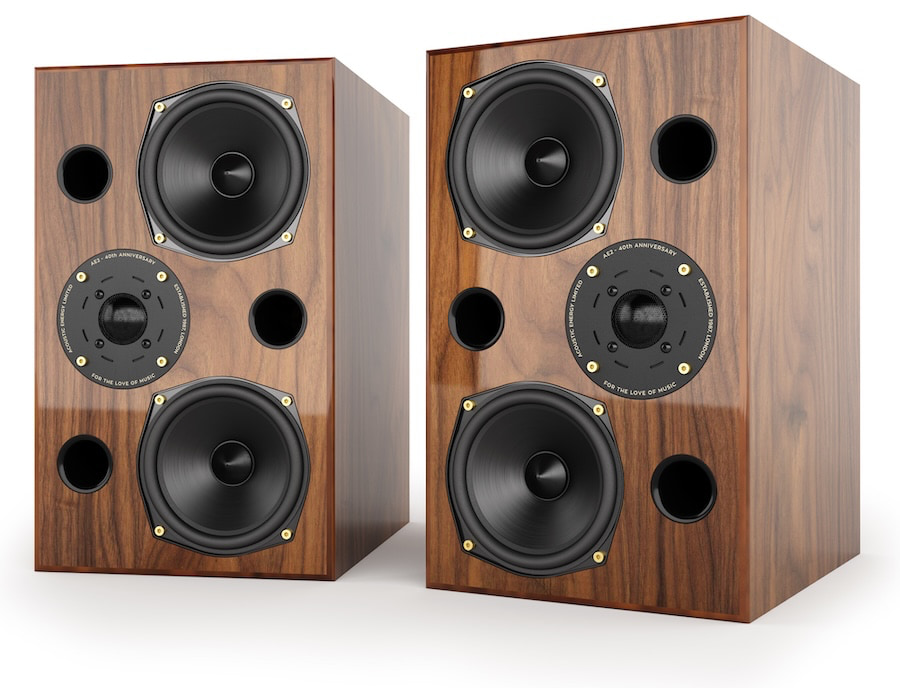
Acoustic Energy is extending its anniversary campaign with the AE2 40th Anniversary, a limited-edition standmount loudspeaker that will make its world premiere at the North West Audio Show in Cranage, UK, on June 27-28, 2026.
Following the AE1 40th Anniversary in 2025 and the launch of the fully analog AE Active at High End Vienna 2026, the new AE2 looks back to one of the British brand’s more ambitious compact loudspeaker designs—only with considerably more modern engineering under the gloss finish.
Rather than simply dusting off an old badge and hoping nostalgia does the heavy lifting, Acoustic Energy has redeveloped the AE2 around the later AE2 Signature concept. The new speaker uses technology derived from the AE1 40th Anniversary, adds internal steel reinforcement to reduce cabinet coloration, and is positioned above the AE1 for listeners who want more scale, bass weight, and dynamic capability without surrendering the placement flexibility and imaging strengths of a proper standmount.
The AE2 40th Anniversary will be demonstrated publicly for the first time ahead of its wider launch later this summer. Acoustic Energy’s intent is clear: take the compact-monitor attitude that made the AE1 famous and give it enough muscle to annoy a small floorstander.
From Acoustic Energy: “Building on the unprecedented success of the AE1 40th Anniversary Edition, the AE2 uses the same newly developed woofer and tweeter drive units from the AE1. The AE2 40th Anniversary derives from the legacy of the highly renowned flagship ‘AE2 Signature’ model of the 1990s. The same technological refinements from the AE1 have been used to update the performance to today’s level, along with aesthetic detail sympathetic to the original.”
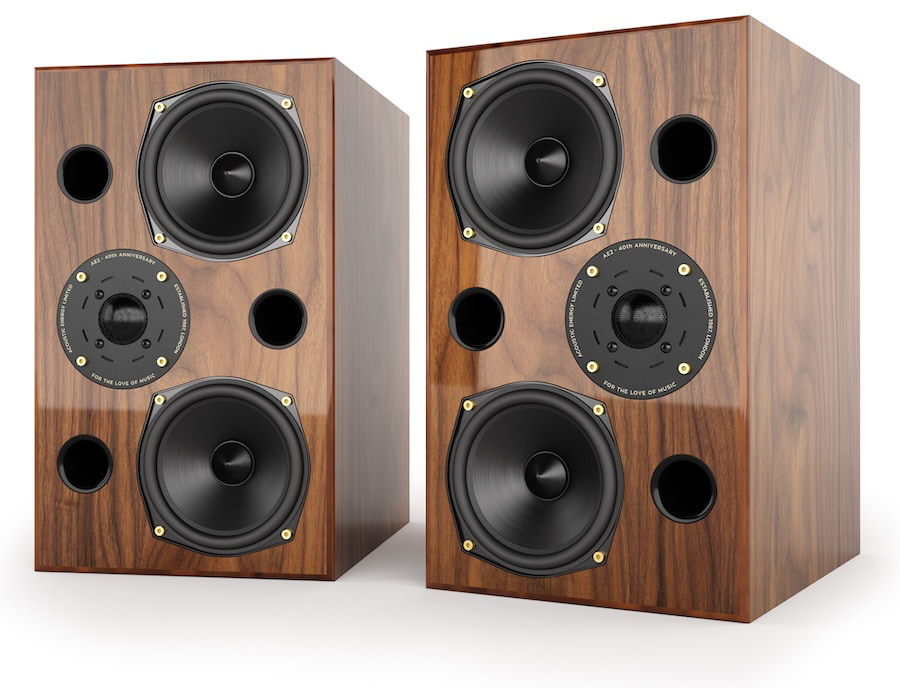
The AE2 40th Anniversary uses the same newly developed tweeter and mid/bass driver platform as the AE1 40th Anniversary, but applies it to a larger offset MTM configuration intended to deliver more bass extension, headroom, and authority. Acoustic Energy has also added strategically placed internal steel plates to reduce cabinet coloration and help the larger enclosure match the quieter, more controlled behavior of its smaller sibling.
The 29mm anodized aluminum dome tweeter carries over the AE1 40th Anniversary’s larger 29mm voice coil and slightly increased radiating area. Like the original AE designs, it is ferrofluid cooled and damped, a combination intended to improve power handling, dynamics, and thermal stability without abandoning the metal-dome character that helped define the brand.
The mid/bass drivers use Acoustic Energy’s spun, hard-anodized aluminum cone design, reinforced with a thick ceramic coating on both sides. The 125mm cone offers more radiating area than the original AE1 driver, which Acoustic Energy says contributes to higher efficiency, lower distortion, and greater air displacement. In the AE2, that shared driver platform is paired with the larger cabinet and twin-driver arrangement to give the speaker more scale than the AE1.
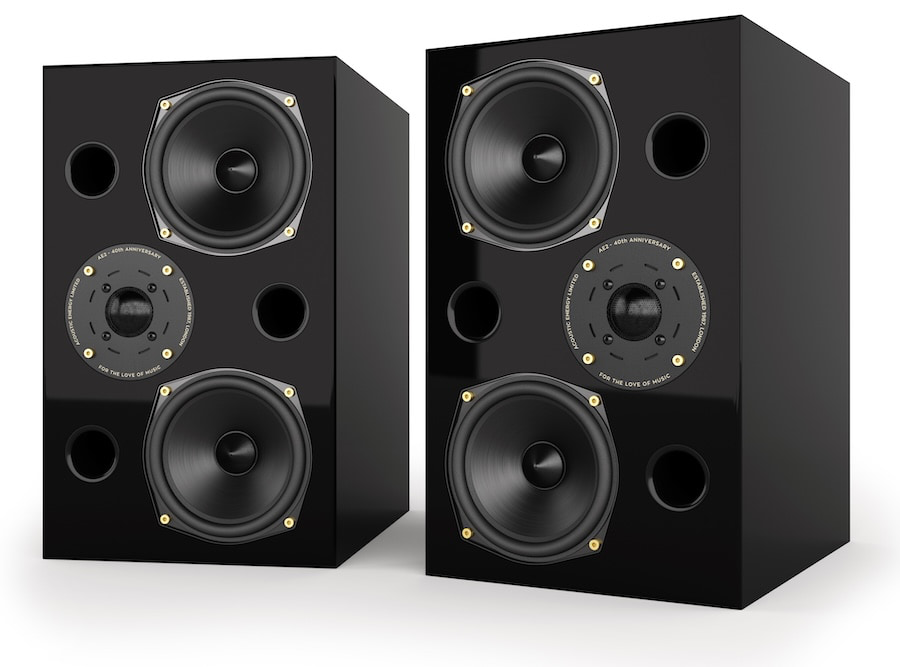
Acoustic Energy has scaled up the AE2 40th Anniversary with greater bass extension and dynamic headroom, which the company says should translate into lower distortion through the midband and greater transparency at typical listening levels.
The goal was to retain the tonal character and punchy dynamics of the smaller AE1 40th Anniversary within a larger offset M-T-M driver layout. That required more than simply adding a second mid/bass driver and three front-firing bass-reflex ports. To keep the larger enclosure’s coloration in line with the AE1, Acoustic Energy has added strategically placed internal steel plates to the cabinet structure.
The idea is straightforward: deliver the scale and authority expected from a small floorstander while preserving the low coloration, imaging precision, and placement flexibility that made the AE1 such a compelling standmount in the first place.
Acoustic Energy positions the AE2 40th Anniversary for listening rooms of around 25 square meters (about 270 square feet) and larger, where its additional bass extension and dynamic headroom should give it more authority than the smaller AE1 40th Anniversary.
Its published specifications support that positioning: a claimed frequency range of 35Hz to 45kHz, measured within ±6dB; 88dB sensitivity at 1 metre/2.83V; a nominal 6-ohm impedance; and 200 watts of power handling. Those are sensible figures for a substantial standmount designed to play with more scale and composure than its dimensions might suggest.
The AE2 is not being pitched as a difficult loudspeaker, but it should reward an amplifier with proper current delivery and some reserve power. The goal is the weight and room-filling authority of a compact floorstander, combined with the imaging, low cabinet coloration, and placement flexibility that remain central to the AE1 and AE2 design philosophy.
The AE2 40th Anniversary uses a minimalist, low-order crossover network set at 2.2kHz. Acoustic Energy says the approach is intended to preserve the lively, direct character of the original AE2 Signature, rather than bury the music beneath a small mountain of crossover components.
The cabinet is available in High Gloss Black or High Gloss Walnut, with each finished in ten layers for a properly luxurious appearance. At 385 x 235 x 315mm (HWD) and 14.5kg each, the AE2 is a substantial standmount, but not one that requires a civil-engineering permit before you put it on proper stands.
From Acoustic Energy: “Building on the unprecedented success of the AE1 40th Anniversary Edition, the AE2 uses the same newly developed woofer and tweeter drive units from the AE1. The AE2 40th Anniversary derives from the legacy of the highly renowned flagship ‘AE2 Signature’ model of the 1990s. The same technological refinements from the AE1 have been used to update the performance to today’s level, along with aesthetic detail sympathetic to the original.”

| Acoustic Energy Model | AE2 40th Anniversary Edition | AE1 40th Anniversary Edition |
| Product Type | Standmount Speaker | Standmount Speaker |
| Price (pair) | €2,799 | £1,049 – £1,500 |
| Design | 2-way, Three front reflex ports | 2-way, twin front reflex ports |
| Tweeter | 1 x 29mm anodized aluminium dome | 1 x 29mm anodized aluminium dome |
| Mid/Bass Driver | 2 x 125mm spun, hard-anodised aluminium cone | 1 x 125mm spun, hard-anodised aluminium cone |
| Frequency Range (±6dB) | 35 Hz – 45 kHz | 50Hz – 45kHz |
| Sensitivity (1m/2.83V) | 88 dB | 87dB |
| Power Handling | 200 W | 150W |
| Crossover Frequency | 2.2 kHz | 2.8kHz |
| Impedance | 6 ohms | 6 ohms |
| Cabinet | 18–32mm RSC HDF/bitumen construction, braced | 18–22mm RSC HDF/bitumen construction, braced |
| Grilles | Cloth, magnetic fit | Cloth, magnetic fit |
| Dimensions (HWD) | 385 x 235 x 315mm | 295 x 180 x 255mm |
| Weight | 14.5 kg each | 7kg each |
| Finishes | High Gloss Walnut, High Gloss Black | High Gloss Walnut, High Gloss Black |
The AE2 40th Anniversary is not simply an AE1 40th Anniversary in a larger cabinet with a fancier badge. Its real purpose is to take the newer AE1-derived driver platform and apply it to a larger offset M-T-M design with twin mid/bass drivers, three front-firing ports, and additional steel cabinet reinforcement.
That makes it the more ambitious option for AE1 fans who want greater bass weight, higher output capability, and more convincing scale in rooms of roughly 270 square feet and larger, but still prefer the imaging precision and placement flexibility of a proper standmount speaker.
It is aimed at listeners with a capable amplifier, proper stands, and no interest in buying a full-size floorstander simply because their room needs more than a compact monitor can comfortably deliver. The AE2’s appeal is straightforward: more authority than the AE1 without abandoning the fast, direct, metal-driver character that made Acoustic Energy’s original compact speakers such enduring cult favorites.
The AE2 is expected to be available by the end of 2026 with a recommended retail price of €2,799 per pair (US pricing not yet available) with a choice of Walnut or Piano Black finishes through Authorized Acoustic Energy Dealers in the US, UK, and Other Regions.
For those attending the UK Northwest Audio Show held from June 27-28, getting a listen to these will be worth the stop.

Prime Day deal: $1 a month for two months, then regular price
That’s right: Any of 29 seasons of South Park. Every sociopathic Tyler Sheridan Texas melodrama. All for a buck a month for two months. After this, it’s back to regular price.

Regular price: $14 a month
Prime Day deal: $1 a month for two months, then regular price
I don’t need to tell you who you are. If you’re the sort of person who spends your sunny months indoors watching the palest people on earth have relationship problems, diabolical mysteries, and/or sardonic ennui, here’s some Britbox! It’s a buck a month for the first two months before returning back to its normal monthly price.

Regular price: $11 a month
Prime Day deal: $1 a month for two months, then regular price
MGM Plus is a perfect candidate for a $1 trial subscription. You get access to a bunch of movies, like Fargo, that you may want to revisit. But among the series, you’re probably just going to get intentionally creeped out by From, because it’s a wonderful little creepshow. Then maybe you’ll watch a few episodes of The Institute, hoping for the same. And then you’re going to go get a different subscription.
Funimation and Crunchyroll are combining forces as relatively new entrants to anime like Netflix and Hulu are throwing their weight around.Courtesy of Funimation

Regular Price: $100/year Fan subscription, $140/year Mega Fan

We may receive a commission on purchases made from links.
A backhoe loader can make all the difference in both labor and time on a large project. Providing both an excavator arm on the rear and a bucket on the front, a backhoe loader can both dig and move around masses of dirt. However, in terms of purchase price, even a sub-compact model like the Kubota XB23S 23Hp start at just over $28,000. You can find pre-owned options for less or opt for a scaled down machine, like the Harbor Freight backhoe, which attaches to the tow-hitch of a truck but lacks a front bucket. Beyond cost, there are other considerations before purchasing a unit. For example, you may only use it occasionally, leaving the machine sitting in storage for most of the year.
In these instances, renting a backhoe loader might make a lot more sense. Home Depot offers a 6-foot dig depth Micro Backhoe for around $339 daily or an 8-foot dig depth Mini Backhoe for rent that’ll run you an estimated $379 per day. The total price you’ll pay varies slightly depending on store location, with a $10 difference between cities like Raleigh, NC and Los Angeles, CA, the latter being a bit more. Other options like Sunbelt Rentals have locations across the country for renting equipment like backhoes, which can likewise differ in cost. For example, you can rent a 4WD Micro Backhoe with a 6-foot dig depth for $402 a day and an 8-foot dig depth for around $390 per day in Seattle, WA. However, those same units cost you $295 and $380 per day if renting from Columbia, SC.

Considered a part of the earthmoving family of machinery, backhoe loaders are often measured by how deep into the ground they can dig. Before you put bucket to ground, though, remember to always verify with your utility company the area is safe for digging, and check with them if you find utility marking on your driveway. The smaller backhoe loaders, typically labeled sub-compact or micro, can make a hole up to 8 feet deep, which is usually enough for a do-it-yourself residential project (and more than deep enough to hit utility lines!). Hardware retailers like Home Depot don’t offer anything larger for rent.
One of the reasons is likely due to portability, with these smaller machines weighing under 7,000 pounds inclusive of the trailer they arrive on. A capacity that’s certainly within the capability of many trucks, including the Tundra, a Toyota model that can tow up to 10,000 pounds or more depending on the configuration.
If you need a more robust backhoe loader, some outlets have units that can go over 15 feet into the earth. Options like the 119 HP Extendahoe Backhoe w/Canopy is around $485 a day at Sunbelt Rentals. However, it tips the scales at 17,786 pounds, meaning you may need to get it dropped off and picked up. You can select even larger machines from places like Wagner Cat Rentals, which offers a 29,321-pound Caterpillar 450 4WDE Backhoe with a 17-foot dig capacity for $792 per day.
If you have an appropriate vehicle and trailer than can accommodate a backhoe loader, you won’t be charged for delivery or pickup. However, if you need transport, it’ll cost extra. For instance, if you were to have the 8-foot dig depth model from Home Depot in Los Angeles delivered, you’d incur a $150 fee — and another $150 for pickup. And this is only if the store offers delivery to your zip code, which may not always be an option.
Sunbelt Rentals offers what it calls “Round-Trip delivery,” which varies based on location. Their least expensive 6-foot dig depth unit can be dropped off and picked up in the Seattle area for an additional $350, versus Columbia, SC where it would cost around $440 in delivery fees. So, for accurate pricing you’ll need to confirm on the rental site with your specific location.
You might also encounter some other fees such as rental protection plans. These plans are meant to help protect renters in the event of damage to the unit, and are offered for around $60 at some retailers. Other charges you may see include an “Environmental Service Fee,” or even more mysterious “Other Fees,” which you should inquire about before concluding the transaction.

OpenAI is limiting the release of its newest AI models to a “small group of trusted partners” at the behest of the U.S. government, the company said Friday.
The next generation GPT-5.6 lineup includes Sol, its flagship model; Terra, a more balanced model for everyday use; and Luna, a faster, lower-cost option. Although Sol is the company’s most powerful model, the Trump administration has restricted the release of all three. OpenAI said the preview is limited to partners “whose participation has been shared with the government.”
The administration’s request comes as the U.S. government puts new pressure on AI companies to restrict their most advanced systems. After Anthropic released its most powerful public model Fable 5, the administration ordered the company to remove access for any foreign national, prompting Anthropic to take the model down entirely.
The incident has brought up questions of how much power the government should have over AI model releases. Dean Ball, a former White House AI adviser and soon-to-be OpenAI employee, says President Trump’s recent executive order — which asks certain AI companies to voluntarily submit their most advanced models for government review up to 30 days before release — has created a de facto involuntary licensing regime for frontier AI, leading to heavy-handed restrictions.
The problem compounds, Ball argues, when the government doesn’t have clearly defined safety standards, which could lead to endless launch delays that might not only give a hand to China in the AI race, but also jeopardize the billions of dollars going to AI infrastructure buildouts.
And while OpenAI did as the administration asked this time around, the AI firm made it clear it wasn’t happy with the arrangement.
“We don’t believe this kind of government access process should become the long-term default,” reads a Friday blog post. “It keeps the best tools from users, developers, enterprises, cyber defenders, and global partners who need them.”
OpenAI called the preview a “short-term step” that will put GPT-5.6 on the path to broader availability in the coming weeks, as the company works with the administration to develop a new executive order framework on cybersecurity, as well as a “repeatable process for future model releases.”
OpenAI says GPT-5.6 Sol is its strongest model yet, with improved agentic capabilities in coding, biology and cybersecurity. Sol introduces a “max” reasoning effort mode and an “ultra” mode that uses coordinated subagents to solve highly complex tasks (just the sort of neat trick that sends your token usage skyrocketing).
GPT-5.6 excels at several benchmarks, says OpenAI, including being slightly better at coding workflows than Anthropic’s Claude Mythos 5, which the Trump administration also effectively banned this month. OpenAI says GPT-5.6 Sol is also competitive with Mythos preview, but uses a third of the output tokens.
To assuage any fears of its powerful models being unsafe, OpenAI says Sol includes its most robust security stack yet. It is, OpenAI says, heavily hardened against adversarial attacks and intentionally optimized to favor defensive cybersecurity work over offensive exploits. In other words, it’s designed to be hard to jailbreak, while prioritizing showing users how to defend against exploits, rather than how to hack into systems.
OpenAI also says its safety guardrails are built directly into the core model’s behavior, rather than relying on a separate filter on top of it. The firm is likely trying to avoid the trap that caught Anthropic with Fable 5. In the brief moments when Fable 5 was available, whenever the model’s classifiers detected a high-risk topic— like cybersecurity, biology, or chemistry — it wouldn’t just block the prompt; it would route the request to an older model. The whole over-cautious flow and invisible downrouting led to many false positives and user backlash.
While the GPT-5.6 models are initially available only to a select group of partners, OpenAI plans to make them more broadly available to people using ChatGPT, Codex, and the API soon.
GPT-5.6 comes in three sizes with tiered pricing: Sol costs $5 per million input tokens and $30 per million output tokens; Terra costs half that; and Luna costs $1 and $6, respectively. OpenAI says it has also improved prompt caching to make repeated prompts cheaper and more predictable.
When you purchase through links in our articles, we may earn a small commission. This doesn’t affect our editorial independence.

Update: Added Microsoft’s statement to the article.
Microsoft has quietly extended its free Windows 10 Extended Security Updates (ESU) program for consumers by an additional year, allowing enrolled devices to continue receiving security updates until October 12, 2027.
The change was made without a formal announcement and instead appeared in updates to Microsoft’s Windows 10 ESU documentation and as an “Editor’s note” to a Windows Experience Blog post published yesterday.

“Editor’s note – June 25, 2026 – This post has been updated to reflect that the Windows 10 Extended Security Updates (ESU) program for personal use devices is being provided for an additional year, with coverage now available through Oct. 12, 2027,” reads the updated blog post.
“This extension provides customers with more time to transition to a new Windows 11 PC while continuing to receive critical security updates.”
On October 14, 2025, Windows 10 reached the end of support, and Microsoft no longer provides technical support, feature updates, or security updates for the operating system unless you are running a Windows LTSC version.
For those who are unable to upgrade to Windows 11, Microsoft originally offered consumers an extra year of security updates if they enrolled in a free extended security updates (ESUs) program that would expire on October 12, 2026.
Enterprise customers could also enroll in the ESU program for up to three years, bringing the total cost per device to $427 over that period.
With today’s quiet update, Microsoft has now extended the free consumer ESU program to October 12, 2027, giving users an additional year to upgrade to a newer operating system.
When asked why the free ESU program was extended, Microsoft shared the following statement with BleepingComputer.
“We understand that moving to a new PC can take time. As part of our ongoing commitment to helping customers stay secure during the transition, the Windows 10 Extended Security Updates (ESU) program for personal devices is being provided for an additional year,” explained Microsoft.
“Coverage will now be available through October 12, 2027. This gives customers more time and flexibility to find the best PC for their needs while keeping them protected.”
Consumers can continue to receive extended security for free using one of these methods:
Microsoft says an ESU license can be used on up to 10 devices associated with the same Microsoft account, and users already enrolled will automatically remain covered until the new October 2027 end date.
The company notes that the consumer ESU program is only for personal devices and is not available for systems joined to Active Directory domains, Microsoft Entra, or managed through Mobile Device Management (MDM). However, Microsoft Entra-registered devices are eligible.
The extension gives Windows 10 users another year of security updates as Microsoft continues encouraging customers to upgrade to Windows 11 or purchase new Copilot+ PCs.

Security teams log 54% of successful attacks and alert on just 14%. The rest move through your environment unseen.
The Picus whitepaper shows how breach and attack simulation tests your SIEM and EDR rules so threats stop slipping by detection.
Threat actors are creating OpenAI tenants that impersonate legitimate companies and inviting employees to join them, in what appears to be a ploy to trick targets into submitting sensitive company information in chats and projects.
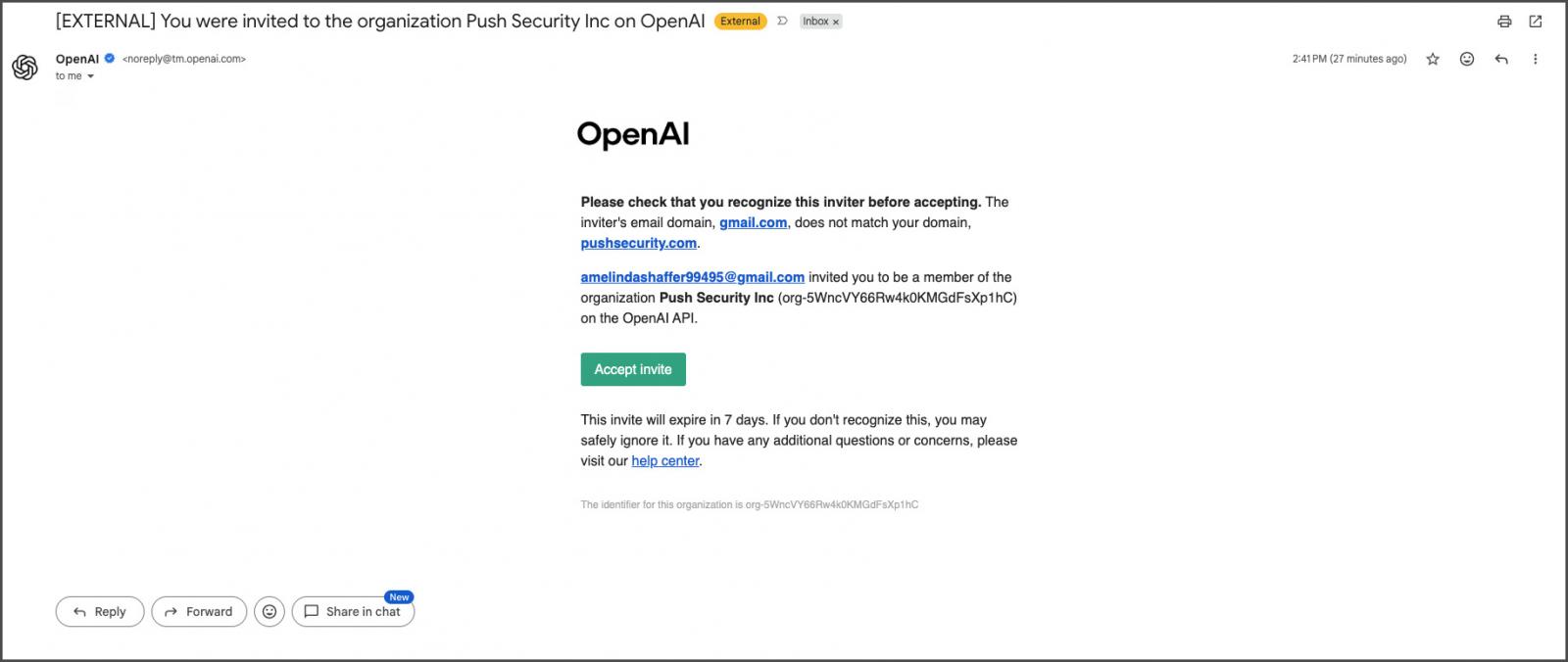
Push Security discovered what they dub as the “Poisoned Tenant” campaign after multiple employees received invitations to join an OpenAI organization named “Push Security Inc.” While the invite was legitimate, coming directly from OpenAI, the ChatGPT tenant had been created by an attacker using Gmail addresses rather than by the company.
The invitation emails were sent from OpenAI’s legitimate notification address, noreply@tm.openai.com, passed email authentication checks, and were identical to a normal invitation to join an organization’s ChatGPT workspace.

Push Security told BleepingComputer that other customers have also received similar invitations and that all are in the cybersecurity or technology space.
According to a new report by Push Security, the invitations targeted specific employees using their work email addresses, suggesting the attackers had researched the employees who work at the company before launching the campaign.
Although OpenAI includes a warning stating that the inviter’s email domain does not match the recipient’s company domain, the notice appears as a single line within the legitimate invitation email.
To better understand the attack’s goal, Luke Jennings, VP, Research & Development at Push Security, accepted one of the invitations.
After accepting, the researcher was immediately added to the fraudulent organization, which impersonated Push Security and contained a single attacker-controlled account with a Gmail address that posted as the company’s CEO, Adam Bateman.
The invited employees had all been assigned Owner privileges within the organization, giving them administrative permissions over the tenant.
As they had administrative access, they could view other pending invitations and confirm that none of the targeted employees had joined the fake ChatGPT organization. They also found that a Visa credit card had already been attached to the organization’s billing account, adding further legitimacy.
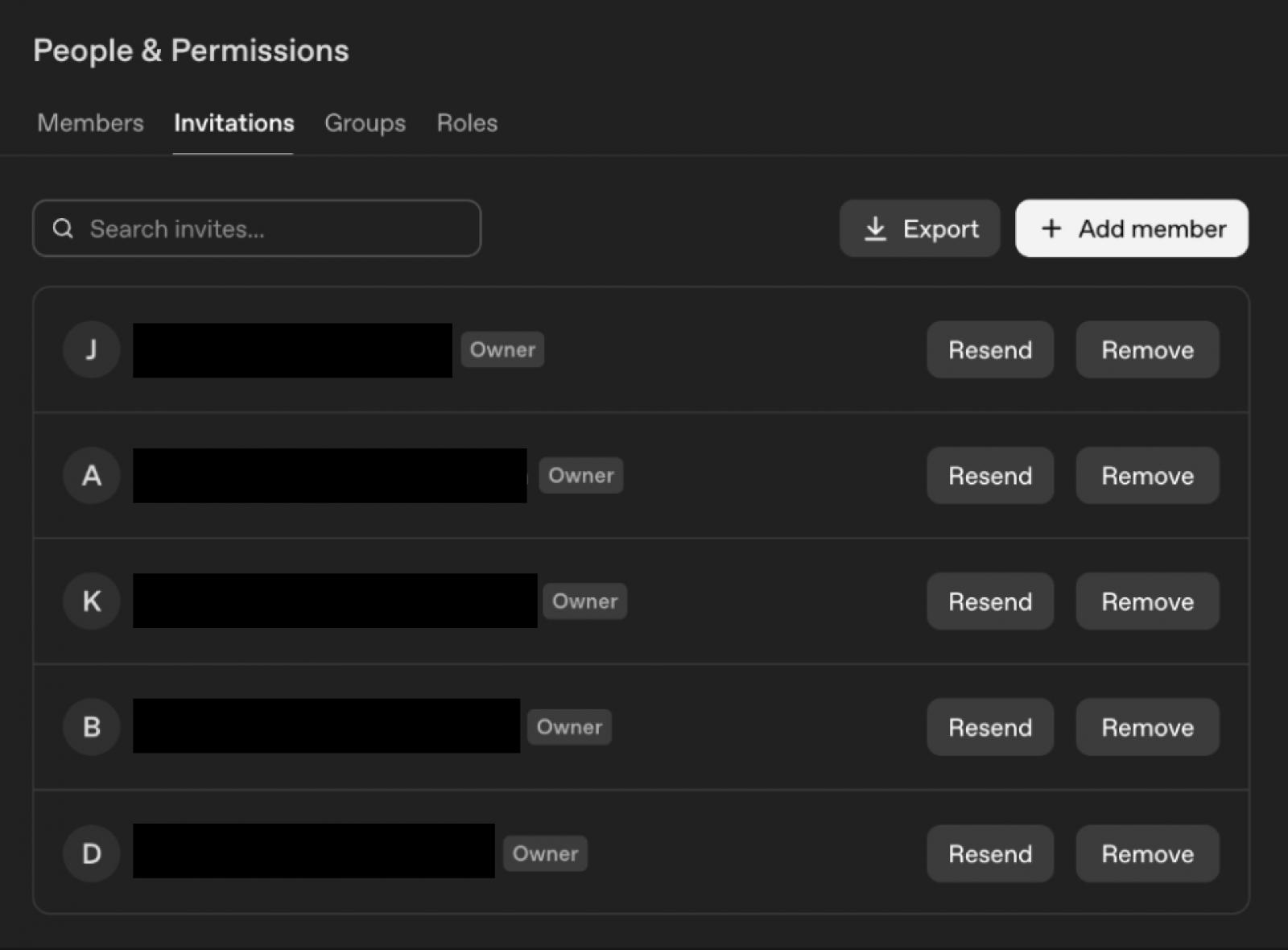
Push Security told BleepingComputer that the project was empty and contained no existing chats or projects, making it unclear what the goal of the attack was.
Push Security believes the attackers’ objective is to convince employees to use the ChatGPT workspace as if it were a legitimate corporate platform, which would then allow the attackers to collect any sensitive information that was submitted.
“An attacker who just wants to spray scam content through a trusted email channel doesn’t name the organization after their target, research individual employees, or attach a credit card,” wrote Push.
“That investment only pays off if employees actually join the organization and start using it. And on an AI platform, the data people put into prompts can be extraordinarily sensitive — source code, internal documents, customer data, security research, strategic plans.”
The company also believes that attaching a payment method removes another potential warning sign, allowing invited users to use premium features without questioning whether the organization is legitimate.
Push Security says the campaign reflects a broader trend of attackers abusing legitimate invitation and notification features built into SaaS platforms.
Unlike normal phishing campaigns, these invitations originate from the platform’s own infrastructure, and because they are legitimate, they are more likely to bypass email security controls.
To reduce the risk of these types of attacks, Push recommends training employees to verify unexpected organization invitations and monitoring SaaS organization memberships.
BleepingComputer contacted OpenAI to ask whether it has received additional reports of similar campaigns, what protections organizations can use against these attacks, and whether it plans to introduce additional safeguards to prevent attackers from creating organizations impersonating legitimate companies. We will update this article if we receive a response.
Security teams log 54% of successful attacks and alert on just 14%. The rest move through your environment unseen.
The Picus whitepaper shows how breach and attack simulation tests your SIEM and EDR rules so threats stop slipping by detection.
what-to-expect-at-the-next-samsung-galaxy-unpacked
Although it isn’t yet official, you can bet the farm that Samsung will hold a Galaxy Unpacked event this summer. The rumor mill even points to a specific time and venue: July 22 in London. But whether that’s the official date or not, you can expect a foldable-focused shindig sometime soon. Samsung will likely unveil new Galaxy Z Fold and Galaxy Z Flip phones, as well as new Galaxy Watches. And we just might get a closer look at Samsung and Google’s Android XR smart glasses.
At last year’s event, Samsung launched its most polished foldable yet, the Galaxy Z Fold 7. But now the company appears ready to shake things up. Leaks point to a wider Fold model alongside one with the more established design.
Curiously, the wider shape more closely aligns with what industry insiders expect from Apple’s upcoming foldable iPhone. Welcome to the world of Big Tech, where you have to question whether a new product was greenlit to compete with one that doesn’t yet exist.
This model would trade the narrow design of the current Fold line for something that, when opened, more closely resembles a small tablet. It may even resemble the first-generation Pixel Fold (pictured above). Leaks suggest this wider Z Fold 8 would have a 7.8-inch inner display and a 5.4-inch outer display. Its outer screen is also expected to be wider, which could make it feel more like a standard phone when closed. It’s rumored to have two rear cameras, compared to the three on the current Fold line.
When leaks about this wider Fold first surfaced, they hinted that it would be sold as an offshoot from the main series. (Think something along the lines of the Z Fold Special Edition.) However, the latest ones suggest Samsung may position this model as the standard Galaxy Z Fold 8.
Meanwhile, a foldable whose aspect ratio and feature set resemble last year’s standard model could be called the Galaxy Z Fold 8 Ultra. (Confused yet?) As its alleged name suggests, this phone would be the top-tier model.
The Z Fold 8 Ultra is rumored to include a less visible display crease than its predecessor. It could also carry a new Snapdragon chip, a 200-megapixel main camera and 45W charging.
We can speculate as to why Samsung might rebrand the previously standard model as “Ultra.” First, one heavily rumored name for Apple’s foldable is the iPhone Ultra. More cynically, Samsung’s (unconfirmed) naming could also be designed to make a more expensive Fold feel more justifiable. With AI data-center-fueled shortages driving up memory prices, it wouldn’t be surprising to see a price hike for the lineup. (The 2025 model was already $2,000, so… yikes.) But if the new phone’s upgrades are more incremental than revolutionary, that could be a hard sell — “Ultra” naming or not.
Then there’s the cheaper Galaxy Z Flip 8. It’s rumored to include a new hinge design that reduces the display crease. This could also make the phone a bit lighter at 180g. (The Flip 7 weighs 188g.)
Leaks point to a return to a Snapdragon processor, after last year’s model used a Samsung Exynos chip. (Specifically, the Snapdragon 8 Elite Gen 5.) Elsewhere, expect the same 6.9-inch inner display and a 4.1-inch cover display.
If those are the only upgrades — and we see a RAMageddon-fueled price increase — it’s hard to imagine the Galaxy Z Flip 8 as a compelling buy. Such a ho-hum launch likely wouldn’t put to rest rumors that Samsung might axe the Flip line after this generation.
Updated Galaxy Watch models typically arrive in the summer Unpacked event, too. Leaks point to a Galaxy Watch 9 with mostly incremental design changes, including a new case color and new bands. You can also expect the Snapdragon Wear Elite processor, and on the software side, it’s rumored to receive new health-tracking features.
Meanwhile, the Galaxy Watch Ultra 2 could be a similar story. Leaks suggest it will also have subtle design changes: a boxier look, thinner bezels with number markings and more muted accent colors on the side buttons.
As for the Galaxy Watch Classic — you know, the one with a rotating bezel and a more traditional watch design? Well, at least one leak suggests Samsung will skip it this year.
One of the event’s more interesting updates could be a product we’ve already caught a glimpse of. Samsung and Google teased their first Android XR-powered smart glasses at Google I/O 2026. If the companies’ stated timeline holds, this event could be the perfect stage to reveal more details.
The first model is a pair of audio-focused glasses developed with Gentle Monster and Warby Parker. They have an ever-present Gemini voice assistant — including (arguably creepy) cameras for contextual AI. In other words, it’s their answer to Meta’s Ray-Ban specs. A second Google-Samsung pair with a built-in display is in the pipeline for 2027.
Google previously said the audio glasses would arrive this fall, so don’t expect an imminent release after Samsung’s Unpacked event. But it seems likely the company would use the spotlight to tell us more about the device, which could possibly include pricing and a release date.

Polymarket says it will fully reimburse customers who lost an estimated $3 million after hackers injected a malicious script into the platform’s frontend following a breach at a third-party vendor.
The company states in a brief announcement that the hack was the result of a supply-chain attack that impacted a dependency on its website.
.png)
Polymarket is one of the world’s largest cryptocurrency-based prediction markets that allows users to trade contracts with prices that reflect the market’s collective estimate of an event’s outcome.
It offers predictions for sports, economic indicators, weather patterns, awards, political and legislative outcomes, and even military conflicts.
Founded in 2020, the platform is currently valued at $9 billion, handles billions of dollars in trading volume, and serves as an influential source of information on market expectations.
During the attack, unsuspecting users were tricked into approving fraudulent transactions on the official Polymarket website after malicious JavaScript was injected through a frontend vendor.
Polymarket’s own servers and backend infrastructure were not impacted by the incident.
The company did not share many details about the event, but independent blockchain intelligence firms estimate the losses at roughly $3 million, stolen from a small number of accounts.
According to blockchain security firm PeckShield, the incident was a phishing campaign that stole approximately $3 million worth of ParyonUSD from users. The stolen funds were later swapped for 1,893 Ether.
“The attacker bridged the stolen funds from #Polygon to #Ethereum and swapped them into ~1,893 $ETH,” PeckShield says.
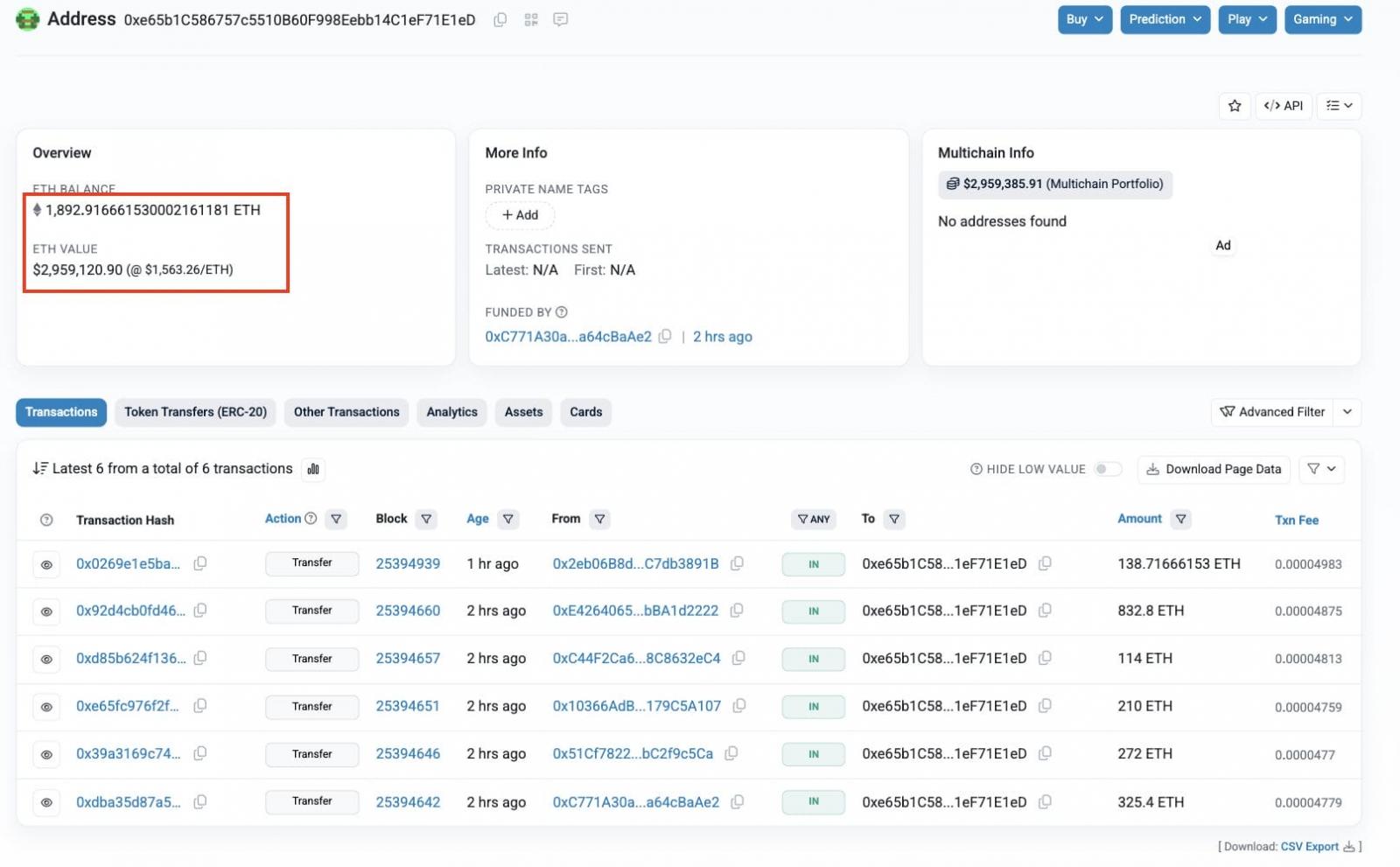
Based on visual analytics company Bubblemaps, the incident has impacted less than 15 accounts. The company published a list of some of the affected accounts as well as the wallets holding the stolen funds.
BleepingComputer has contacted Polymarket to request more details about the incident, but we have not received a response by publication time.
Security teams log 54% of successful attacks and alert on just 14%. The rest move through your environment unseen.
The Picus whitepaper shows how breach and attack simulation tests your SIEM and EDR rules so threats stop slipping by detection.


security
Researchers warn many AI coding assistants now execute commands from project configurations
A high-severity flaw in Amazon’s AI coding assistant for Visual Studio Code meant that opening the wrong Git repository could allow an attacker to execute code on a developer’s machine and potentially hand them the keys to the dev’s cloud environment.
The bug, tracked as CVE-2026-12957 and assigned a CVSS 4.0 score of 8.5, centers on how Amazon Q handled Model Context Protocol (MCP) server configurations. Wiz found the extension would automatically load a repository’s .amazonq/mcp.json file and execute the commands it contained when a developer opened the project and activated Amazon Q.
“The security model assumes the user explicitly configures these servers. After all, you’re granting an AI assistant permission to run arbitrary commands on your machine. This should require informed consent,” the researchers write. “The vulnerability arose when this assumption was violated: Amazon Q automatically loaded MCP configurations from .amazonq/mcp.json within the workspace – no prompt, no consent, no workspace trust check.”
MCP lets AI assistants launch local processes to carry out tasks. In Amazon Q’s case, those processes inherited the developer’s environment, giving them access to AWS credentials, API keys, authentication tokens, SSH agent sockets, and other secrets already loaded into the session.
“The combination meant that a single malicious config file could execute arbitrary commands with full access to the developer’s credentials – no user interaction required beyond opening the folder and activating Amazon Q,” Wiz said.
To prove the attack worked, Wiz built a repository with a malicious MCP configuration. Opening the project and activating Amazon Q caused the extension to execute a command against AWS using the developer’s existing credentials.
Amazon fixed the bug in version 1.65.0 of its language server, which powers Amazon Q’s IDE integrations. Existing installations should receive the patched component automatically unless you’ve blocked automatic updates.
“We would like to thank Wiz for collaborating with us on this issue. We have remediated this issue in language server version 1.65.0,” Amazon said in an advisory, though it didn’t respond to The Register’s questions.
Wiz argues the bug is less an Amazon problem than an industry one. More and more AI coding assistants are adopting MCP to connect models to local tools and services, allowing them to execute commands on developers’ machines.
According to the researchers, similar workspace configuration flaws have recently surfaced in other AI coding tools. It suggests attackers have found a new place to lurk: the hidden files that developers rarely think twice about trusting. ®
Nvidia has dominated the AI chip market for years, but the era of total dependence might be ending.
OpenAI just shared its plans to spice things up with Jalapeño, its custom inference chip built with Broadcom, joining Google, Apple, and SpaceX in a growing list of companies building their way out of single-supplier risk. The goal is less of a clean break and more of a hedge. Custom silicon means more control, hardware tuned to specific needs, and the kind of performance gains Apple unlocked when it ditched Intel.
On this episode of TechCrunch’s Equity podcast, hosts Kirsten Korosec, Anthony Ha, and Sean O’Kane dig into what the custom chip trend means for the industry and a few deals of the week worth watching.
Subscribe to Equity on YouTube, Apple Podcasts, Overcast, Spotify and all the casts. You also can follow Equity on X and Threads, at @EquityPod.

In this episode, Hackaday editors Elliot Williams and Tom Nardi start off by taking a trip down the Raspberry Pi memory lane and then tackle a fresh pile of listener mail. The discussion moves on to hacking bike counter, homebrew upgrades to the Nintendo Entertainment System, and building RAM from whats in the parts bin. You’ll hear about the latest drop-in upgrade for a classic Casio watch, hosting light bulbs that host subversive literature, and loading Wii U games from a weird disk drive from the 1980s. They’ll wrap things up with a dive into the evolving portrayals of brilliant rebels in media, and all the things you can do with a cheap router.
Check out the links if you want to follow along, and as always, tell us what you think about this episode in the comments!
Direct download in DRM-free MP3.




Renter of Home in Anne Heche Crash Denies Settlement With Son

Two goals and an assist by sheer aura: Cristiano Ronaldo just entered the World Cup chat


Microsoft accidentally kills epic Outlook email threads


Soccer-U.S. defends Iran World Cup travel restrictions, says discussions ongoing


The House | Manchesterism won’t survive the painful trade-offs unless it gets citizens on board


Andy Burnham and the meaning of Makerfield


Potential 2028er World Cup attendee leaderboard


A Look At A Gaggle Of Transputer Boards
Bitcoin (BTC) Dips Below $62K, Ethereum (ETH) Plunges 6% Daily: Market Watch


Securitize Wraps Roubini's SEC-Registered ETF as Dubai VARA Digital Security

Dell (DELL) Shares Tumble Over 5% Following Analyst Downgrade to Hold


Asia stock markets slide as tech shares slump
Entergy settles forward sale agreements, raises $672 million in cash proceeds

Can Charles Hoskinson Really Rescue Cardano?

Wall Street Week Ahead: Investors see Micron earnings as pulse check of AI rally momentum


Jose Alvarado Wants Taylor Swift at More Knicks Games


Weekend Open Thread: Staud – Corporette.com


HIVE shares jump as $220M AI deal speeds Bitcoin mining pivot

Hyperliquid Named on Singapore MAS Investor Alert Register


Jake Chervinsky accuses CME of protecting derivatives monopoly


You must be logged in to post a comment Login