A day after we broke the news of about 60 layoffs across the Apple Vision project, there are reportedly more in the Siri team too.
Citing people familiar with the matter, the same as we did, Mark Gurman from Bloomberg has exposed more layoffs inside Apple. This time, beyond the Apple Vision team, Apple is also laying off staff on its Siri team.
All told, including Apple Vision Immersive Video, Apple Vision gaming, and Siri, there are about 200 layoffs in total.
“While we will create new roles as part of this change, it will also impact a limited number of existing roles,” Apple said to Bloomberg. “We are grateful to these team members for their contributions, and we are committed to supporting them throughout their transition, including opportunities to apply for other roles at Apple.”
Advertisement
As we’ve said, and Gurman reiterates, Apple isn’t abandoning visionOS, Immersive Video, or gaming. Apple has reportedly told employees that the visionOS operating system isn’t going away, and the layoffs are “to evolve our business to deliver the best experiences for our users.”
The layoffs in the gaming-adjacent developers on the Apple Vision team are most likely because of a general lack of interest in gaming on the platform. While third-party efforts like iVRY are excellent, they still require an external Windows PC to work.
Immersive Video team layoffs are mostly a cost-cutting measure. The report repeats that every episode of an immersive video costs millions of dollars to film. Given the limited uptake of the platform to date, that’s been a bit of a financial strain.
Instead, Apple will make fewer videos like the impressive Submerged in-house. At the same time, it will encourage other companies to make the content instead.
Advertisement
The Siri layoffs are said to be due to an architectural change inside Siri, driven by AI integrations. Some existing roles are being eliminated in the division, and others are being created.
A new Apple Vision Pro model is still rumored to debut at some point in 2028. Plans change, and a new CEO will be in place very soon.
A former Starbucks cafe in Seattle. (GeekWire Photo / Kurt Schlosser)
Starbucks is eliminating 224 more jobs at its Seattle headquarters, according to a new state filing. The coffee giant says the layoffs don’t represent a new round of cutbacks, but rather the lingering effect of restructuring work announced earlier this year.
About 120 of the 224 are employees who were offered roles in Starbucks’ new Nashville office and declined to relocate, according to the filing. Those roles are expected to be filled in Tennessee.
The remaining 104 in the notice filed Thursday stem from the restructuring that Starbucks announced in May, and fall largely within the group that designs, sites and builds its coffeehouses.
The reductions are part of the “Back to Starbucks” turnaround CEO Brian Niccol launched after taking over in September 2024 — an effort that has paired store-level technology upgrades and a simplified menu with a restructuring of the company’s corporate ranks.
Starbucks has now eliminated 537 corporate jobs tied to its Seattle headquarters this year, across three state filings: 61 tech roles in May, 252 support center jobs later that month, and the 224 disclosed this week across tech and store development positions.
Advertisement
Starbucks is targeting $2 billion in cost reductions over two years under Niccol, and has shed more than 2,300 corporate jobs companywide since last year, according to Bloomberg.
At the same time, Starbucks is building out its Nashville office, a $100 million investment expected to house 2,000 support jobs within five years. The company has said the majority of its corporate teams will remain in Seattle.
The design and development cuts come later than the rest of the May restructuring because the executive who leads the group, Stephen Piacentini, joined Starbucks from Chipotle in April, and the organizational changes in his group weren’t finalized when the May restructuring was announced.
More than 9,300 Amazon Web Services (AWS) access keys publicly exposed between August 2022 and August 2026 are still active and valid.
Truffle Security has been tracking this exposure for the past four years and says that 817 of the exposed keys were linked to companies, 526 of them being AWS root keys.
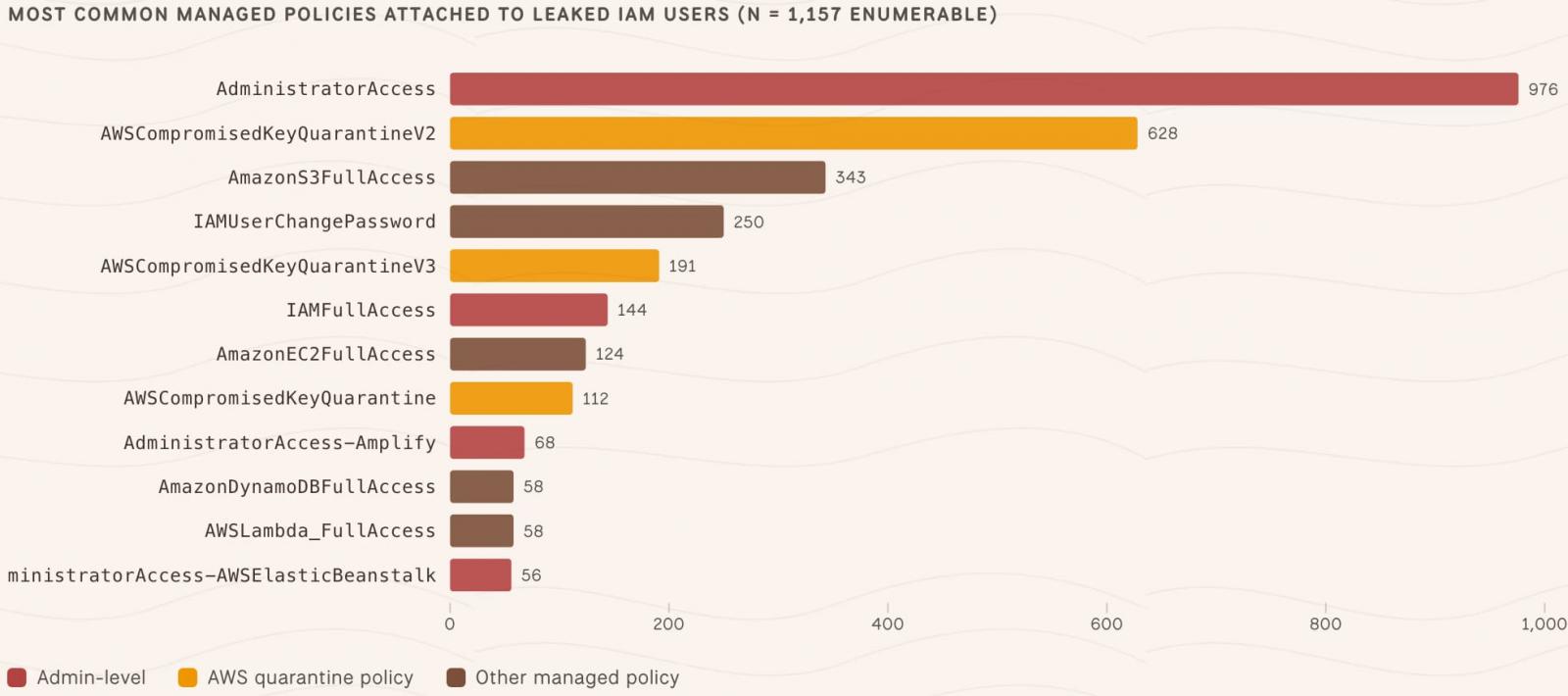
According to the researchers, 242 of the keys are associated with Identity and Access Management (IAM) users with the AdministratorAccess policy. This role has full permissions to create, modify, delete, and view virtually all AWS services and resources within an account.
They note that each key of the 768 live keys in the two sets “full control of a company’s AWS account.”
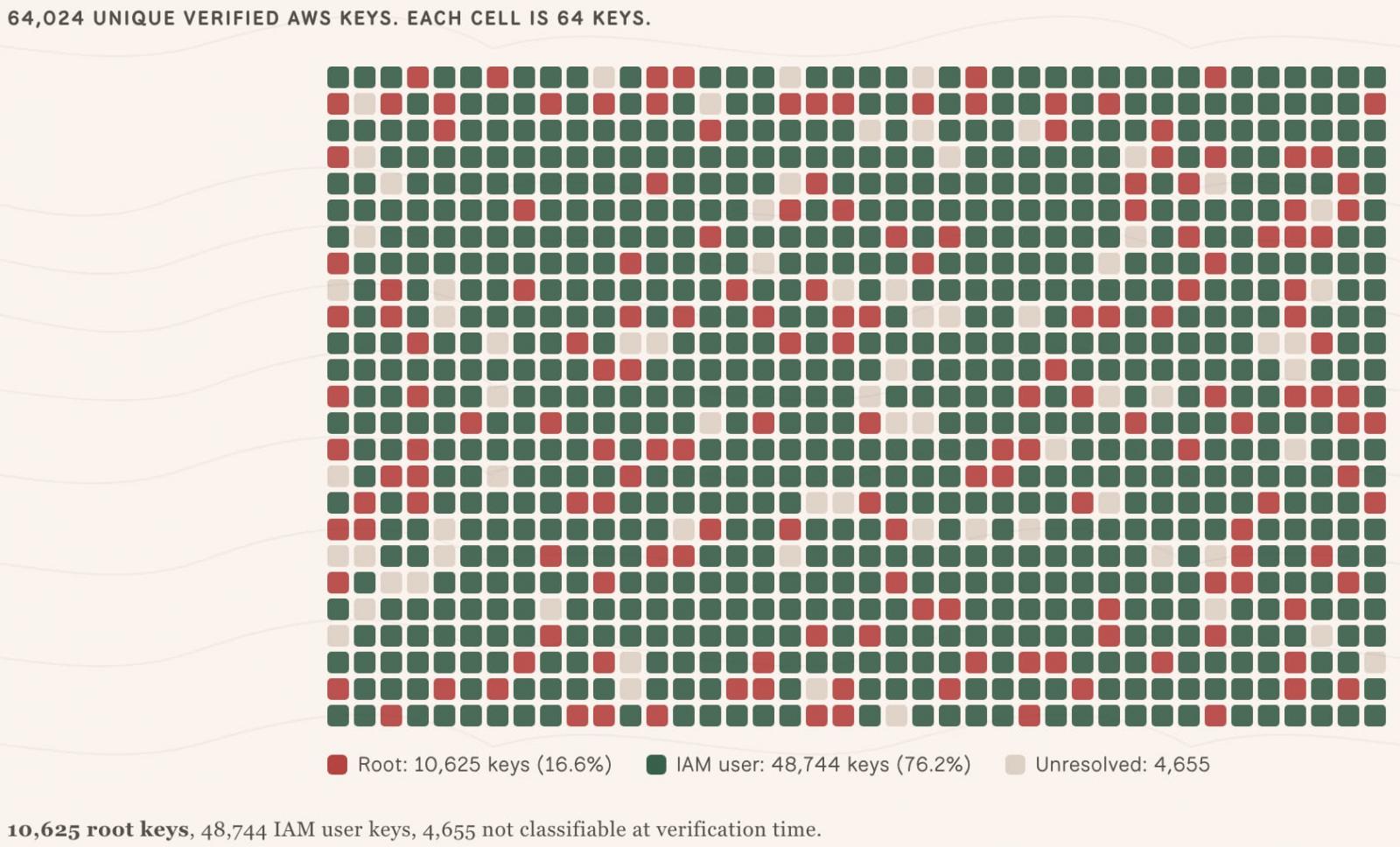
The company found 431,875 AWS secrets across code repositories, Git history, datasets, Docker images, registries, and CI logs and extracted 64,024 unique AWS keys that corresponded to 50,654 AWS accounts after removing duplicates.
However, the subset for which the researchers had complete credentials that could be used for re-verification was 10,616 keys, and 88% of them continued to authenticate as of August 10.
Amazon Web Services (AWS) is Amazon’s cloud-computing platform used by companies to host websites and applications, store data, run databases and servers, manage domains, and operate their online infrastructure.
Full control of a company’s AWS account could allow an attacker to access, exfiltrate, or wipe cloud-hosted data, take control of servers and applications, and create rogue admin accounts for persistent access
Threat actors could also use their access to deploy cryptominers, generating substantial charges for the company. Truffle Security says that only 262 of 2,754 readable accounts had a budget alert set up.
Hugging Face, a popular online platform where developers share AI models, datasets, and applications, was the largest single source of leaked AWS keys, accounting for 8,482 unique key exposures.
Advertisement
Also, 17.9% of those keys were root, meaning the highest-privileged identity, which isn’t restricted by IAM permissions.
Roles of exposed AWS keys Source: Truffle Security
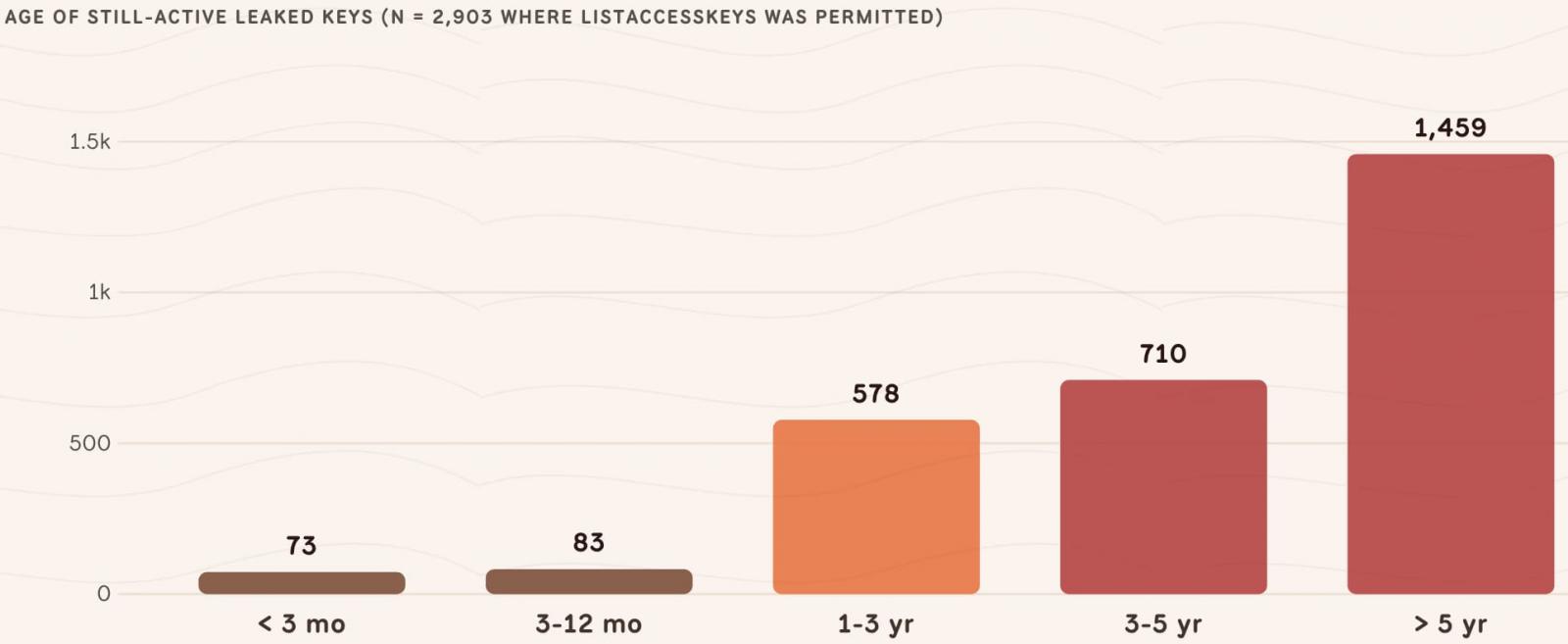
Truffle Security found that, for the 2,903 keys with available creation dates, the median age was 1,831 days (about five years), while the oldest had existed for 17.4 years.
Only 398 (13.7%) of those entries had a newer access key associated with the same user, suggesting most had never been rotated.
Age of exposed AWS keys Source: Truffle Security
To defend against potential abuse, the researchers recommend deleting all root access keys, reviewing IAM credentials by age, rotating or revoking exposed keys, and configuring budget alerts.
Also, any credential committed to a public source should be treated as compromised.
Truffle Security said its testing was limited to read-only metadata, and that it has notified all identifiable owners of the exposed credentials.
Advertisement
Overall prevention scores can hide what happens after initial access. Once attackers are using valid credentials, prevention drops sharply.
The Blue Report 2026 measures defenses technique by technique across 338 million simulations run in customer production environments.
When an agentic AI system hands a task from a small model to a larger one — or back down again — it pays a steep tax: the receiving model has to recompute the entire conversation from scratch, driving up compute costs and latency. This is a major bottleneck for enterprises building long-horizon, multi-LLM workflows.
To solve this challenge, researchers at Nvidia have introduced a cross-model KV cache transfer technique that directly maps the prefilled KV cache from a source model into the target model. This technique aligns with real-world agentic applications where large contexts accumulate across many turns.
For real-world AI applications, cross-model KV cache transfer can reduce compute costs and latency on long-running, multi-LLM workflows — and it does so with simple linear math, not an expensive deep learning model.
Experiments show that, on compatible model pairs, this linear mapping process runs 2.7 to 25 times faster than recomputing the conversation while retaining up to 98% of the target model’s standalone accuracy.
Advertisement
Why swapping models mid-session is so expensive
Examining how LLMs handle memory helps understand why multi-model workflows hit a performance wall in production. When an LLM receives a prompt, it must first execute the “prefill” stage, which is the initial forward pass that computes the keys and values for all input tokens and populates the Key-Value (KV) cache.
After that, it enters the “decode” phase, where it computes and generates the next tokens in the sequence. During this phase, the model reads from this KV cache to predict new tokens one by one, bypassing the need to re-evaluate the entire history of the conversation for each new token.
In multi-turn conversations or long-horizon agentic sessions, the context gradually becomes longer. Because the computational cost of the prefill stage scales directly with both model size and input length, processing these long sessions becomes increasingly expensive and introduces significant latency if the KV cache is invalidated.
This invalidation happens whenever the AI system tries to swap models mid-session, such as routing a complex reasoning step to a larger model or dropping to a smaller model to save costs. Because different LLMs have different architectures, they expect their cache inputs in different formats.
Advertisement
As a result, any model switch forces the receiving model to repay the entire prefill cost from scratch to recompute the KV cache for the accumulated context.
Mapping memory between models without starting over
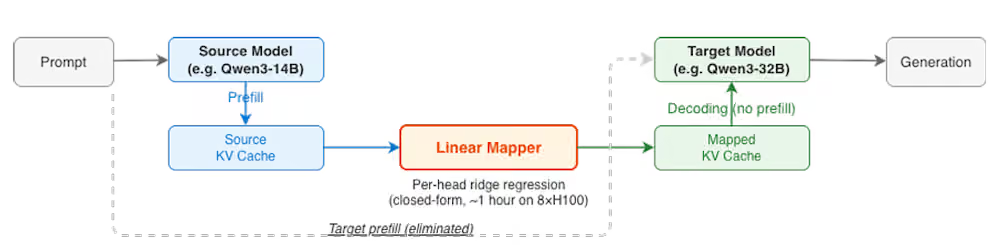
The Nvidia researchers studied cross-model KV cache transfer to see how developers can transform the KV cache of one model into the expected format of another without running the prefill phase again.
If solved, cross-model KV cache transfer has benefits in both directions. Small-to-large model transfer upgrades the quality of the output. For example, a cheap, small model handles the routine parts of an agentic workflow but struggles with a complex reasoning problem, and you map the KV cache to a larger model and continue the process seamlessly.
On the other hand, large-to-small model transfer reduces compute costs. A highly capable, large model might be used to unpack a massive, complex system prompt or synthesize a dense PDF at the start of a session. Once the heavy lifting is done, the session’s KV cache is mapped down to a smaller, more economical model to handle the rapid-fire, conversational turns that follow.
Advertisement
There have been previous efforts to solve the KV cache transfer problem, but they suffer from a few key limitations. These include the need for expensive gradient-based training or very strict architectural constraints.
Cross-model KV cache transfer (source: arXiv)
For this initial study, the authors restricted their focus to within-family transfers, such as transitioning between different-sized models in the Qwen, Llama, or Ministral families. These models share tokenizers, training data DNA, and core architectural styles but differ in size and depth. However, this framework leaves plenty of room for future experiments. The researchers note the technique could eventually be expanded to cross-family transfers, mismatched KV head counts, or hybrid architectures that blend standard attention with other memory mechanisms.
The key finding of the Nvidia study is that cross-model KV cache is a significantly linear structure. This means you can do the mapping with simple algebra tricks and without the need for heavy neural network training. For example, when experimenting on KV cache transfer from a 14-billion parameter Qwen3 model to a 32-billion parameter version, the authors discovered that a simple linear regression mapping from one source layer to a target layer can recover 56% of the variance in the target’s keys and 32% of the variance in its values. When combining multiple source layers, those numbers climbed to 79% and 65% respectively.
Advertisement
Nvidia’s three-layer KV cache transfer solution (source: arXiv)
To translate this linear relationship into a practical system, the researchers designed a closed-form per-head ridge mapper with three key components:
Per-head ridge regression: Instead of using complex deep learning to train the system, they fit a simple linear regression using a tiny calibration set of a few hundred text sequences. This technique solves a classic line-of-best-fit problem independently for every attention head.
Cross-layer source selection: Because the source and target models have different numbers of layers, the mapper evaluates and selects the most predictive source layers to feed into each specific target layer. This way, the system picks only the most helpful pieces of memory from the old model to construct the new model’s memory.
Content-space mapping: Before translating the data, the mapper strips away the RoPE encodings. RoPE, or Rotary Position Embedding, is a standard mechanism that applies a mathematical, position-dependent rotation to the data so the model understands the order of the tokens in a sequence. Stripping the RoPE values makes it possible for the mapper to generalize to sequences of lengths larger than its training data.
Putting the linear mapper to the test
To test whether the technique works, the researchers evaluated the transfer pipeline across six “matched-KV” model families. Matched-KV means the source and target models share the same KV head count and per-head dimensions, which is typical for different-sized models within the same family.
The model families included Qwen3, Llama 3.1, and Ministral 3, with tests for KV cache transfer across different sizes ranging from 3 billion to 70 billion parameters. Their experiments included a massive 8.8x parameter leap from Llama 3.1 8B to 70B.
Advertisement
To cover a wide range of tasks, they evaluated the models on five core accuracy benchmarks (ARC-Challenge, HellaSwag, WinoGrande, MMLU, and GSM8K) as well as language modeling perplexity on WikiText-2 and a multi-turn conversation task called CoQA. To fit the linear translation mapper, they used a tiny calibration dataset of just 500 text sequences of 1,024 tokens each.
The researchers compared the framework against the baseline ceiling accuracy where the target model does a full, traditional prefill. They also compared their full system against ablated configurations, such as reducing the number of selected layers or deactivating different components. Additionally, they compared their simple method against a deep neural network trained with backpropagation to see if heavier deep learning could recover accuracy on pairs where the linear method struggled.
For four of the six tested pairs, the fast, closed-form linear ridge mapper retained 73% to 98% of the target’s standalone prefill accuracy — including the massive leap from Llama 3.1 8B to 70B, which retained 72.8% of target accuracy.
The mapper also runs between 2.7 and 25 times faster than re-prefilling. For example, when translating a 32,768-token KV cache from a Qwen3 14B to a 32B model, the transfer took just 278 milliseconds, compared to nearly 7 seconds for a standard re-prefill.
Advertisement
The system also demonstrated high stability on tasks that run across many steps. When tested on multi-turn conversations, the drift, or accuracy loss, between the target baseline and the transferred cache remained incredibly small across 10 turns, proving it will not cascade into failure during long agentic sessions.
However, the straightforward linear approach did run into limitations on specific model pairs. For two of the Ministral configurations, the linear mapper degraded sharply because the simple linear fit failed to extrapolate outside calibration data. To fix this, the researchers swapped the linear mapper for a nonlinear multi-layer perceptron (MLP) with two 1,024-unit hidden layers trained on the same data. This added a complexity and training tax to the setup, but it recovered their accuracy to above 90%.
A bigger industry problem than one paper can solve
The introduction of cross-model transfer is part of a broader, industry-wide push to solve the KV cache bottleneck, which has emerged as one of the key hurdles for scaling enterprise AI. As developers push LLMs to process massive documents or code bases and execute long-running reasoning tasks, managing this memory layer is becoming as important as the models themselves.
Over the past year, researchers have attacked this compute and memory problem from multiple angles. For instance, Nvidia recently introduced dynamic memory sparsification (DMS), a technique that intelligently evicts less important tokens from the KV cache to cut reasoning costs by up to 8x.
Advertisement
Other approaches focus on aggressive data compression. MIT researchers developed an algebraic compaction technique called Attention Matching that compresses the KV cache by 50x without degrading quality. Similarly, Nvidia introduced KV Cache Transform Coding (KVTC), which borrows media compression concepts to shrink memory by 20x without altering the underlying model weights.
Beyond compression, researchers are also attacking the computational overhead of memory retrieval. Optimizers like IndexCache strip away redundant layer calculations to deliver significantly faster time-to-first-token in long-context applications. And models like DeepSeek and the GLM series are optimizing the KV cache through architecture innovations.
As AI systems take on longer-horizon tasks and more complex architectures, the underlying memory infrastructure is becoming as important as the models themselves. Cross-model KV cache transfer gives developers one more tool for keeping inference costs down as they scale multi-model agentic systems.
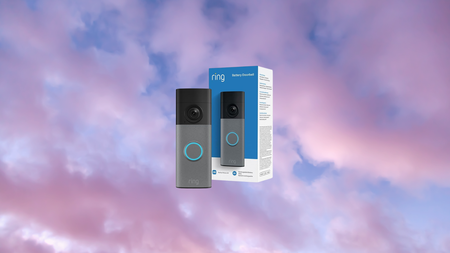
A sale price under £45 for a doorbell with proper night vision and two-way talk is unusual on its own, and knocking £35 off a device that only launched fairly recently makes the saving even harder to overlook.
Advertisement
Part of what makes the price worth it is the Retinal 2K video at the core of the doorbell, capturing a wider, clearer view of the porch than older Ring models, with up to 6x zoom to check faces or parcels.
That clarity carries into the evening too, since Night Vision keeps colour detail visible after dark, which matters most for the exact hours when parcels get left on doorsteps and porch lights don’t quite reach the pavement.
Advertisement
Live View and Two-Way Talk build on that same visibility, letting you see and speak to whoever is at the door straight from your phone, whether that’s directing a courier to leave a package round the side or simply checking who’s knocking.
When the battery does eventually run low, the removal tool included in the box lets you pop the doorbell off the wall and recharge it over USB-C without needing to buy a second battery to swap in.
Privacy Zones let you block off a neighbour’s window or a shared path from the recording, and pairing the doorbell with an Echo Dot or Echo Show brings hands-free alerts and live video straight to whichever room you’re in.
Owners already installing the Ring Battery Doorbell (2nd Gen) have been quick to praise how simple it is to set up, with several reviewers highlighting the sharp video quality and the straightforward pairing with the Ring app and Alexa.
With the Ring Battery Doorbell (2nd Gen) carrying a £35 saving, sharp night video, easy peel-off charging and glowing early reviews all bundled into one deal, why wait for an event that’s still months away?
Salesforce partners say they have yet to see any meaningful revenue from Agentforce, two years after the CRM giant launched its AI platform, promising spectacular growth.
That’s according to a recent report from TD Cowen, which surveyed Salesforce partners and found muted interest in the technology, designed to let users build AI agents for customer interactions.
The survey of partners in the US, Europe, and Asia found growing customer interest in Agentforce, but no revenue yet.
Asked about interest in Agentforce AI Agents, 11 percent of respondents said they had not seen much immediate interest, while 56 percent said they expected to see interest but needed time for initiatives to mature. A third of partners said there was strong interest in Agentforce as they were starting to see buying and trial activity. However, none were seeing Agentforce become a driver of bookings activity.
Advertisement
The report also noted weaker commercial growth among partners across Salesforce’s portfolio. A third were meeting or beating targets as opposed to 43 percent in the previous quarter. “Agentforce adoption [is] still subdued,” the report said.
Salesforce did not immediately return a request for comment.
In its most recent results for Q1 FY2027, ended April 30, the CRM vendor said its current remaining performance obligation – a measure of future contract values – had grown 14 percent year over year to $33.6 billion, “propelled by Agentforce, Data 360, and Slack, partially offset by softness in commerce and Tableau.”
“We are seeing incredible demand for Agentforce with annual recurring revenue now greater than $1 billion,” CEO Marc Benioff told analysts.
Advertisement
Salesforce has backed Agentforce to help it beat the so-called SaaSapocalypse — where AI agents perform common enterprise tasks and obviate the need for software upgrades. It says Agentforce will help customers build, test, deploy, manage, and orchestrate AI agents in the enterprise.
The TD Cowen report is not the only dark cloud over the strategy.
“Our checks and customer conversations have not been strong, nor has the feedback been on Agentforce. What we can piece together in the disclosed numbers does not signal building momentum and, most recently, our CIO survey delivered another blow with Salesforce being a standout for the wrong reasons,” the report said.
Advertisement
KeyBanc found that partners and customers thought enterprise data was not coherent enough to do meaningful AI work and that Agentforce, “as a product, just isn’t there.” ®
Nvidia is doing everything it can to keep fueling the AI buildout that has underpinned its own good fortunes. On Friday, it announced a partnership with Cloverleaf Infrastructure, a company that lays the groundwork for data centers.
Cloverleaf was founded in 2024 and raised $300 million that year. It acts as a kind of middleman between utility companies and data centers, providing power sources and other kinds of pivotal infrastructure for site development.
While the companies didn’t disclose terms, the Wall Street Journal reports that Nivida’s investment in Cloverleaf will likely add up to several hundred million dollars. Reuters reports that the chipmaker now owns a minority stake in the company. TechCrunch reached out to Nvidia for more information.
The deal is part of Nvidia’s ongoing push to use its immense profits toward keeping the AI flywheel spinning. Nvidia is increasingly playing a more direct role in financing and developing the AI data centers that turn around and buy its AI systems. Earlier this week, the company also announced that it would invest $1.5 billion into SB Energy, an OpenAI-linked data center project based in Ohio.
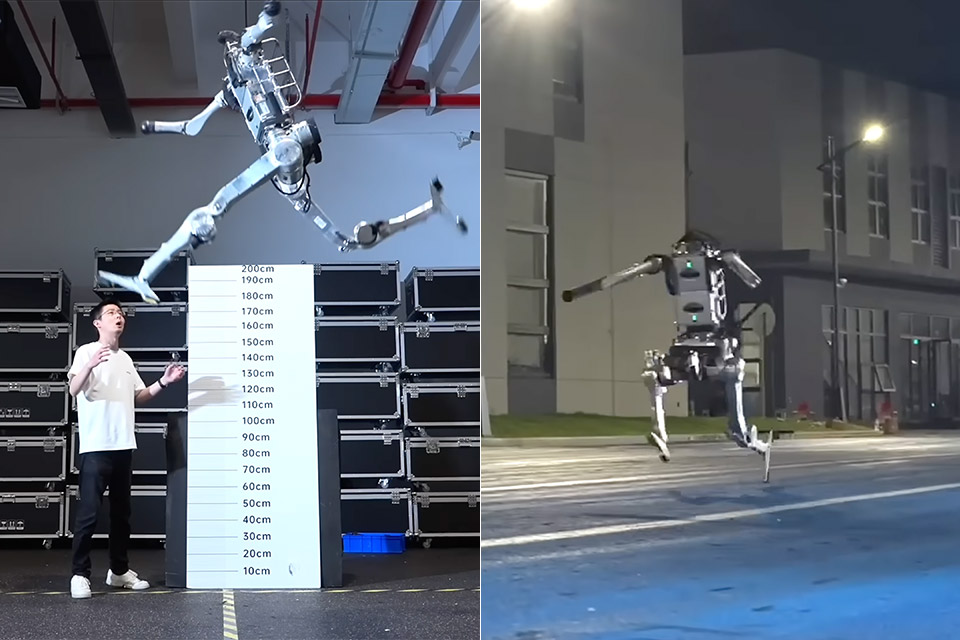
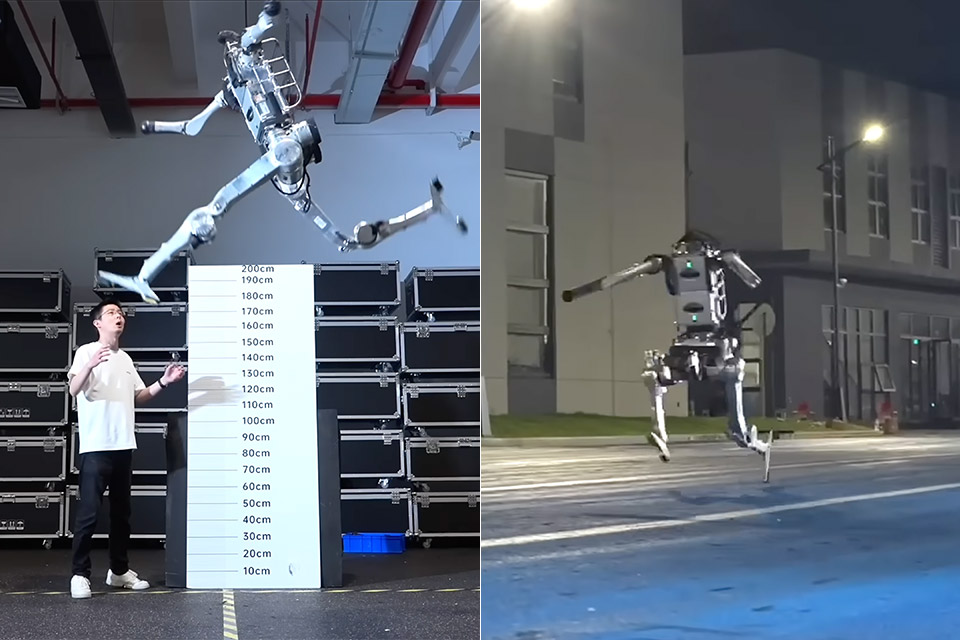
Unitree Robotics just posted a thirty-second clip of a bipedal machine labeled Superman rises from a still stance, clears a two-meter mark with both feet, lands, and accelerates into a sprint that the company measures at 12.66 meters per second. That figure converts to roughly 28.3 miles per hour, a peak that edges past the 12.42 meters per second recorded for Usain Bolt during the fastest segment of his 2009 world-record 100-meter run. The same machine stands 170 centimeters tall, weighs 45 kilograms, and carries legs only 0.85 meters long.
Unitree claims their game-changing humanoid robot came together in three months. The majority of the funding was allocated to the lower body, which has 20 degrees of freedom and handles all motion in the robot’s lower half. There are no fancy hands or grippers, but you can see a robust frame made of aluminum alloy and carbon fiber. The brains of the operation are in-house permanent magnet motors with some very sophisticated gearing, which allows the robot to jump so high and sprint like a bullet when necessary. The electronics include an NVIDIA computing stack, Wi-Fi 6, Bluetooth 5.2, and Ethernet for good measure. On a full charge, it will run for around 90 minutes. When not pushed to the limit, the walking speed is approximately five kilometers per hour.
Three models, one lightweight platform R1 Air (20 DOF, monocular camera), R1 (26 DOF, binocular camera, head+waist joints), and R1 Edu (26 DOF…
Easy setup – no coding required for basic use Unbox, power on, and start. Manual teaching feature: physically pose the robot, and it replays the…
More DOF = more expressive movement 26‑DOF models (R1 / R1 Edu) add head and waist articulation for smoother dance and running. For safety reasons…
The jump in the video is impressive, as there is no fancy run-up because the robot simply springs off the ground and clears a 2-meter-high board. That is the highest any human has ever gone in a standing high leap; the current record is 1.9 meters, set by Rune Almén in 1980. What height does the robot manage to reach? That is almost 2.4 times the length of its own legs in the air. It lands with astonishing control, and by the end, it is bouncing along without a single stumble.
Advertisement
According to the company, the Unitree robot reached a speed of 12.66 m/s. Usain Bolt hit 12.42 m/s during his record-breaking run.
The robot’s max speed is currently drawing a lot of attention. It claims to be moving 12.66 meters per second, but we won’t know for sure until they tell us how far it traveled, what the surface was like, and how they timed it. A single burst of speed is one thing; maintaining that pace for a hundred meters is quite another. If you look back at the company’s early robots, even the H1 could easily reach double digit speeds. What’s impressive is how quickly they’ve progressed in just a few months. Of course, it still appears a little unsteady, as the robot’s straight-back position gives the sense that it is only one wrong move away from toppling forward. That’s to be anticipated, given that the company has stated that motion control, stability, and energy efficiency remain areas for improvement.
Unitree is at a critical stage in its development. By the end of July, they had sold out of 18,000 bipedal robots across their whole line. They have machines that can dance, practice martial arts, and even win medals in robot competitions. Unitree recently went public on the Shanghai STAR Market, raising over 900 million dollars in what has been touted as a record-breaking IPO. They’ve got some big name backers, including significant Chinese technology companies, and everything came together just in time for the World Robot Conference and World Humanoid Robot Games in Beijing.
WTF?! Those keeping track of how many devices can run Doom can now add a digital camera to the list. Compared to previous examples, this freely available port retains an impressive amount of the standard DOS version’s functionality, supporting numerous mods and level packs.
A 12-year-old YouTuber with the username Kick recently uploaded a video of Doom running on a Canon DSLR camera. The open-source project is available on GitHub.
Unlike prior unexpected ports of id Software’s iconic shooter that barely run on things such as DNS, Microsoft Paint, or a pair of earbuds, “doom550d” appears to achieve playable frame rates on Canon’s 2009 camera. The video shows Kick using the menu buttons to move, shoot, navigate menus, and load multiple WAD files. The arrow and zoom keys control movement, the play button activates doors and switches, the DISP (or INFO) button opens automapping, and the rear wheel cycles between weapons.
Developed for Magic Lantern, an open-source alternative OS for Canon’s DSLR and MILC cameras, the port allows players to install up to 32 WADs at one time. The video showcases the camera running the open-source fork Freedoom as well as the original game. The GitHub page also confirms that Doom II, TNT Evilution, and The Plutonia Experiment are supported, but not non-Doom WADs such as Heretic, Hexen, and Doom 64.
Advertisement
Players can also maintain multiple save files for each WAD, log debugging, and access a cheat menu by rapidly pressing the delete button. The game can run in either 320 x 240 pixels or an unofficial full-screen mode that upscales to 720 x 480.
To try the port, 550D owners must install Canon’s firmware version 1.0.9 with Magic Lantern and copy the “doom.mo” and WAD files to the directory ML/MODULES/ on an SD card. Then, on the camera, select the desired WAD from Doom > WAD in the Magic Lantern Games menu, and restart the camera to begin playing. As with other Doom mods, purchasing the official WAD files from Steam or GOG is recommended.
Doom has been ported to an expanding list of increasingly implausible devices. Thus far, these include:
The creator of doom550d is also developing an NES emulator for the 550D. While no binaries are available from the project’s GitHub page yet, interested users can currently build from the source code and test a few ROMs.
Batteries Matter: Sennheiser has just introduced its latest premium earbuds. The Momentum True Wireless 5 have been completely redesigned and include several noteworthy features that could offer significantly better value, despite their substantially higher upfront cost.
Sennheiser said that the Momentum True Wireless 5 are the company’s most advanced earbuds yet. The buds have been engineered – or reengineered – to provide an uncompromising listening experience for customers on the go. However, one of the device’s most interesting features is likely the result of external pressures that Sennheiser has had to adapt to.
The Momentum True Wireless 5 are the first earbuds from the German manufacturer to feature user-replaceable batteries. Building on the same concept used in the Momentum Wireless 5 headphones, the True Wireless 5 can significantly extend their lifespan beyond the point when standard battery degradation would typically render them less useful. Users can replace the power cells in both the earbuds and the charging case using only a compact screwdriver, Sennheiser said.
The replaceable battery design likely stems from newly introduced European regulations that are forcing manufacturers to make batteries easier to replace. Nintendo has already redesigned the Switch 2 gaming console to comply with the new rules, and other major technology companies will likely follow suit sooner rather than later.
Advertisement
Sennheiser said that the new design is significantly more comfortable than the previous generation. According to figures provided by the company, 73% of testers rated the Momentum 5 earbuds as more comfortable than the Momentum 4 model. The charging case has also been redesigned and is now more compact and easier to store in “tight pockets.”
Design and batteries aside, the Momentum True Wireless 5 earbuds include several technological advancements aimed at traveling audiophiles and affluent mobile users. The device is optimized for spatial Dolby Atmos audio with interactive head-tracking capabilities and features improved noise cancellation and an AI-based voice enhancement option.
Thanks to Bluetooth 6.0 and aptX Adaptive codec support, the buds should provide faster, more stable wireless connections while supporting high-resolution audio at up to 24-bit/96 kHz. The free Smart Control Plus app, which should be an improved version of the Smart Control app I use on my Android phone to manage my HD 450BT headphones, provides a new eight-band equalizer and other customizable features.
Advertisement
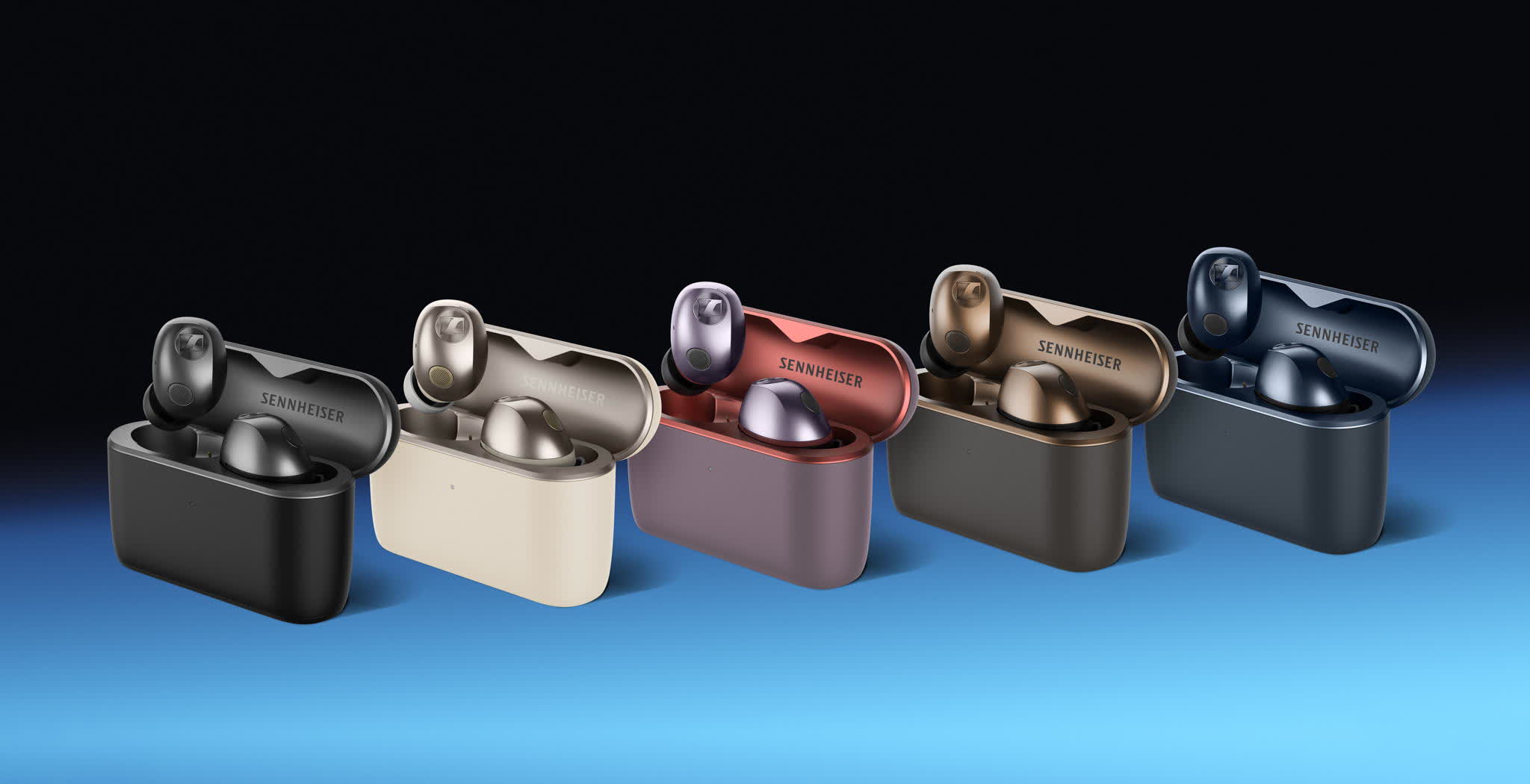
Available in five metallic color finishes – Graphite, Cream, Copper, Denim, and Lavender – the Momentum True Wireless 5 earbuds will launch on September 3 with a suggested price of $300. The batteries should provide up to 12 hours of continuous playback on a single charge, while the total battery life can reach 40 hours when combined with the included Qi-enabled charging case.
Researchers show how an expired contactless card can still complete a real purchase because the expiry date the terminal reads is not covered by its signature
The attack needs physical possession of the discarded card and two ordinary smartphones, and results vary per bank, with Visa cards being susceptible in testing
Existing EMV protections can detect the relay, but they are optional and were not enabled on any card or terminal tested, and neither Visa nor the notified banks have confirmed a fix is in the works
For a layman, the date printed on a credit card looks like a hard stop, but that might not always be the case.
Researchers at the University of Massachusetts Amherst found that a ‘zombie card’ past its expiration date can be persuaded to complete a contactless purchase at a real checkout terminal, creating a real security threat.
The irony is that it is not that EMV cryptography is not bypassed in any way, but rather that card expiry is enforced in a different way for contactless payments, as a policy check between two parties rather than as a fixed property of the card itself, and interestingly, the parties do not always know who is the one checking.
Latest Videos FromTechRadar
Advertisement
Dead plastic can still be used to pay under certain conditions
Building on the last part, a contactless transaction involves a card, a point-of-sale terminal, the merchant’s bank, a card network, and the issuer. Each holds a fragment of the decision that eventually results in a successful or declined card transaction.
The EMV contactless flow is only selectively authenticated: some fields travel between the card and terminal in unencrypted text and are linked to cryptographic verification later, opening a potential attack vector for users with physical access to an expired card.
The exposure here is not that those fields can be read, since the expiry date is printed on the card anyway, but that it can be changed with relative ease. The Application Expiration Date that the terminal reads sits in the unprotected portion.
In the Visa configuration the team tested, that field is not covered by the card’s digital signature and is subsequently not cryptographically bound to the expiry value the issuer sees in the online authorization request.
Sign up to the TechRadar Pro newsletter to get all the top news, opinion, features and guidance your business needs to succeed!
While this should not be the case, it opens an attack vector for a device between the card and the terminal that processes the charge by simply modifying the expiry value to one that is still valid. The issue is compounded by a second issue: cards carry an expiry date inside the digital certificate used to establish the card-to-terminal conversation, and researchers have found that the certificate outlasts the printed date on the plastic. In essence, a check that might have caught the problem is looking at a clock set further ahead.
Advertisement
The scope of the attack, however, is narrow: it affects Visa contactless cards only, with Mastercard, Discover, and American Express rejecting the altered expiry outright. It also requires physical access to the card and two smartphones to pull it off, making it a slightly more complex endeavor, to say the least.
The irony is that EMV does have a protection that would essentially undo such an attempt altogether: Relay Resistance Protocol, which measures timing to detect an inserted relay and can stop the transaction altogether, but it remains optional and was not enabled on any of the terminals or cards the researchers tested.
The team notified Visa and the relevant banks in May 2025 and again in December 2025, supplying a reproduction guide, transaction traces, and a video. Visa’s report passed initial triage, and the company’s red team was reproducing it.
Advertisement
However, as of publication, neither Visa nor the notified banks had confirmed a mitigation attempt, and Visa also did not respond to a press request from The Register for comment.
The underlying failure, however, is based on how payment decisions have now spread across multiple players, including chip, terminal, network, and bank architectures, all of which assume that expiry is someone else’s problem, an approach that could come back to haunt them and their customers. For now, the researcher’s advice remains important until a fix is rolled out: stop treating dead plastic as harmless, destroy the underlying chip, and cut through the card numbers to prevent abuse.































































You must be logged in to post a comment Login