










Connect with us

Tech

Apple’s market share is up in Europe even as smartphone sales drop

Published

on

European sales of smartphones have reached a new three-year low, but Apple’s iPhone has increased its share to now tie with Samsung.

Globally, the most recent figures show that Apple has earned 49% of all smartphone revenue in the second quarter, despite the iPhone only accounting for 23% of shipments. New figures for solely the European region show an overall decline, but in that shrinking market, Apple is increasing its share.

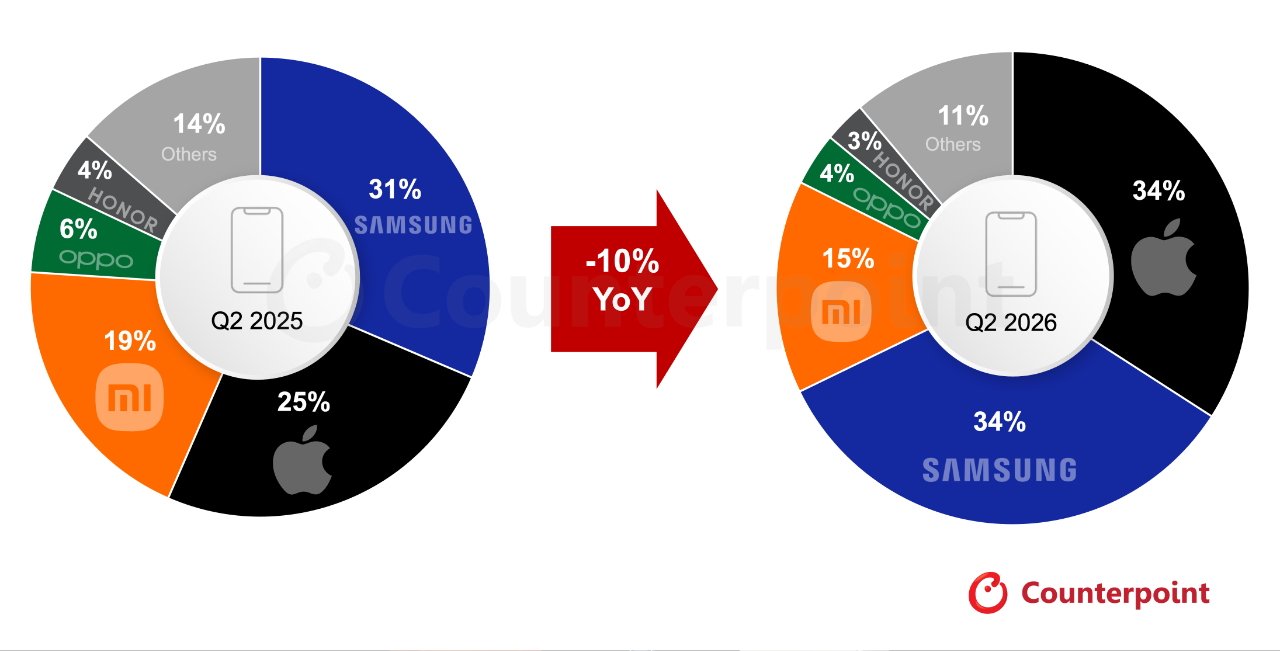
According to Counterpoint Research, Q2 2026 saw shipments fall 10% year over year. At 35 million smartphones, this is Europe’s weakest second quarter in three years.

Most vendors have also seen a decline in their market share, except for Apple. In Q2 2026 compared to the same time in 2025:

Advertisement
  • Apple grew from 25% to 34%
  • Samsung grew from 31% to 34%
  • Xiaomi dropped from 19% to 15%
  • Oppo dropped from 6% to 4%
  • Honor dropped from 4% to 3%
  • All others dropped from 14% to 11%

Reportedly, consumers are hesitant to make discretionary purchases because of the economic situation. Then manufacturers have seemingly cut promotions in order to protect their margins.

“In Q2 2026, things were relatively better in Western Europe,” said Counterpoint associate director Jan Stryjak where a very impressive quarter by Apple and marginal growth by Samsung softened the drop.”

Two donut charts comparing smartphone market share: Q2 2025 vs Q2 2026, showing Apple and Samsung gaining share while Xiaomi, Oppo, Vivo and Others shrink, with a central 10% YoY decline arrow

Europe Smartphone Shipments Share by OEM, Q2 2025 vs Q2 2026 – image credit: Counterpoint Research.

There’s no further detail in the new report, so it isn’t possible to determine which iPhones models are selling the best. However, across Western Europe, premium smartphone sales are reportedly trending upwards, which benefits Apple.

But then across Eastern Europe, the reverse is true and there is a greater trend toward lower-end Chinese models.

Advertisement

Over the whole of Europe, the report claims that inventory is running out. While the report doesn’t specify this, that’s because of the global chip shortage and the rising price of components.

Despite predicting declines for most brands, especially lower-end ones, the report still expects Apple to significantly outperform its smartphone rivals for the foreseeable future.

If the trend to premium models continues in Western Europe, Apple may benefit from launching the iPhone Ultra in September 2026. That’s expected to start at $2,000, and at least one analyst expects sales of around 14 million across fiscal year 2027.

Advertisement

Source link

Continue Reading
Click to comment

You must be logged in to post a comment Login

Leave a Reply

Tech

Sennheiser just made earbuds you don’t have to throw away when the battery dies

Published

on

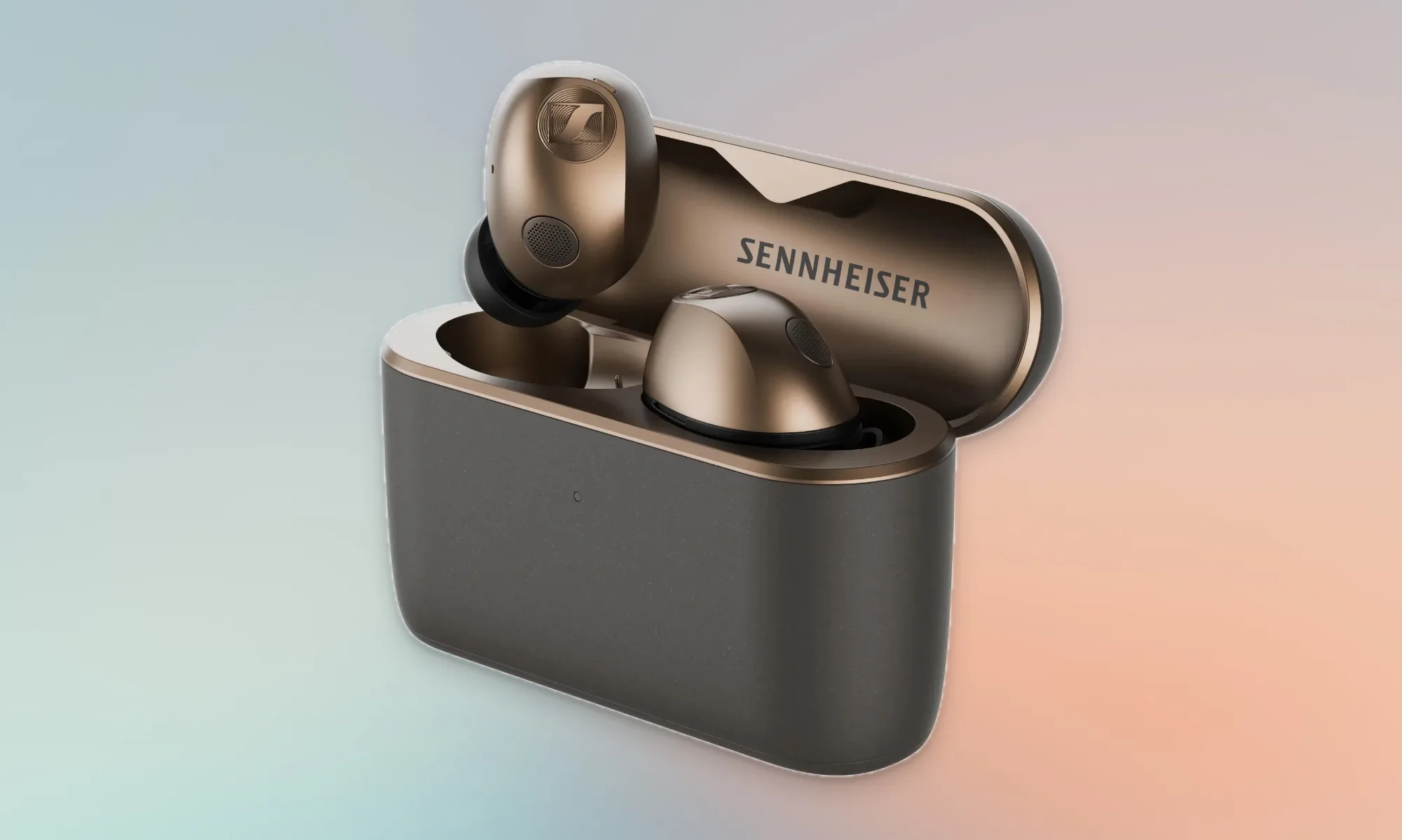
Sennheiser just announced the Momentum True Wireless 5, and it’s basically borrowing the best bits of its full-size Momentum 5 Wireless headphones and squeezing them into a smaller, comfier earbud. The earbuds start shipping September 3rd for $299.95.

What’s new on the sound side?

The earbuds use Sennheiser’s 7mm TrueResponse dynamic transducer, manufactured and tested at the company’s facility in Tullamore, Ireland. They run on Bluetooth 6.0 with aptX Adaptive support, delivering hi-res audio up to 24-bit and 96kHz, including aptX Lossless for bit-perfect playback.

Noise cancellation gets updated too. A redesigned ear tip works with a four-microphone array for the adaptive hybrid ANC system, along with an automatic anti-wind mode and a transparency mode Sennheiser says is its most natural yet. 

The earbuds also support Dolby Atmos with head tracking for spatial audio. On calls, six microphones and two bone-conduction voice accelerometers work with an AI speech-extraction algorithm to help isolate your voice in noisy settings.

The earbud housing has also been redesigned with a new shape, which Sennheiser says 73% of testers rated as more comfortable than the previous generation. They feature an IP54 rating for dust, sweat, and splash resistance. The charging case is narrower too, designed to fit pockets more easily.

Advertisement

Battery life comes in at 12 hours of continuous playback per charge, with the case holding two additional charges for up to 40 hours total. An 8-minute quick charge adds about an hour of playback.

What about the replaceable battery?

The bigger change is the battery system. Both the earbuds and the wireless charging case use user-replaceable batteries, so instead of replacing the earbuds when the battery degrades, you can swap the cells yourself using a small screwdriver.

I love my AirPods Pro, and the only reason I had to ditch them and buy a new pair was because the battery life degraded over the past three years, making them almost unusable. If I could change the battery, I would have preferred to do that instead of plonking the cash for a new pair. 

That’s why the new Sennheiser Momentum True Wireless 5 earbuds are a game changer for the industry. To be fair, they are not the first pair of earbuds to achieve this feat, but they are one of the first mainstream brands to do it, which should make other companies take notice. 

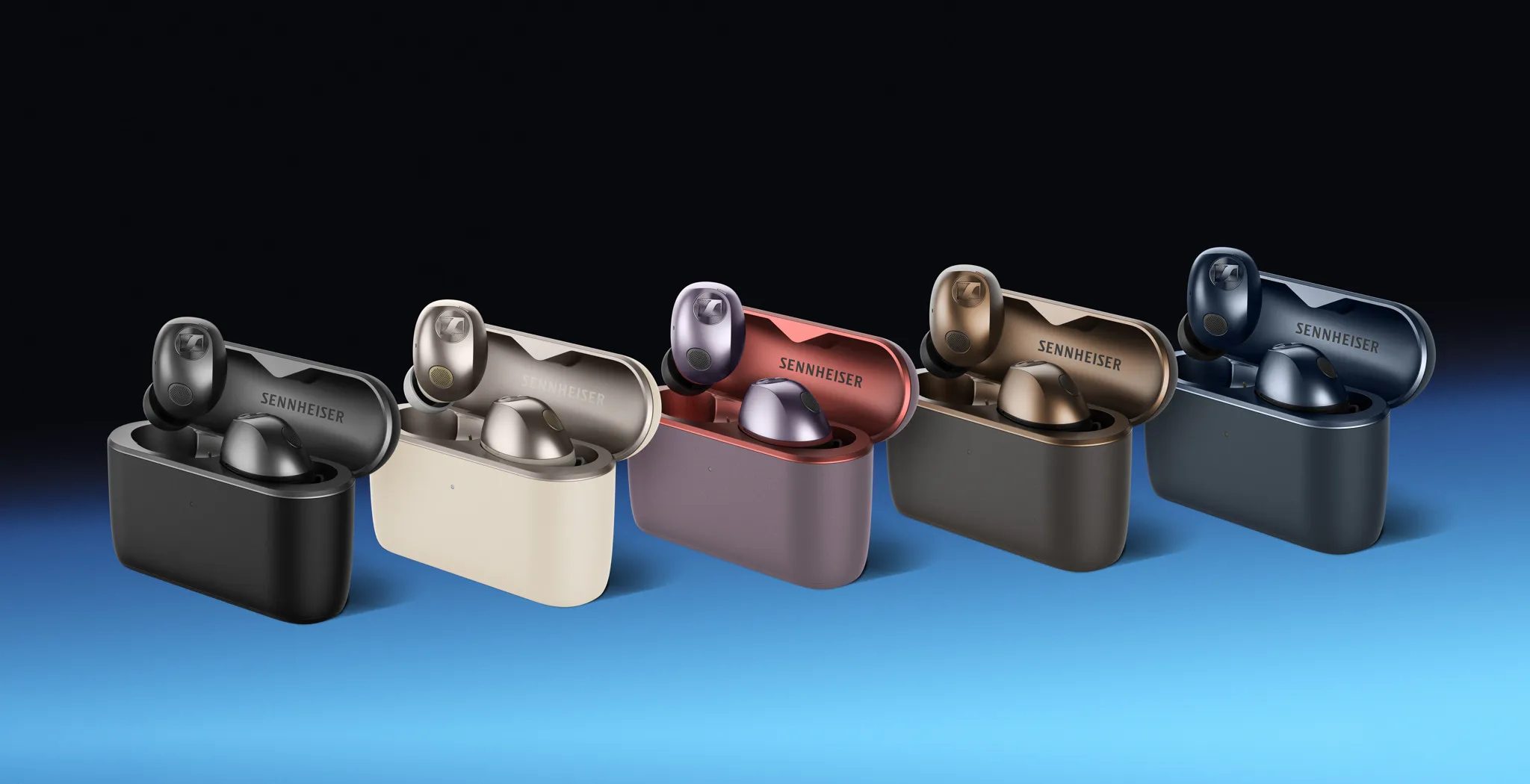
The Momentum True Wireless 5 will come in five colors: Graphite, Cream, Copper, Denim, and Lavender. They’ll be available starting September 3rd from sennheiser-hearing.com and select retailers.

Advertisement

Source link

Continue Reading

Tech

No Mic Needed: You Can Create Music and Speech With Adobe’s AI Audio Tools

Published

on

Adobe announced Thursday that it’s adding to its vast collection of artificial intelligence tools, this time with a focus on audio. The new Firefly AI tools use AI to generate speech, music and sound effects, forming “a very stable foundation” of audio options for creators, said Jay LeBoeuf, Adobe’s head of AI audio.

Unlike Suno or other AI music generators that can create entire songs in seconds, Adobe is offering more targeted, professional-grade tools for filmmakers, musicians and creators. Think about AI converting creators’ scripts into audio to be overlaid on a TikTok video or creating custom soundtracks without worrying about copyright infringement, thanks to Adobe’s universal license.

“We’re not trying to be somebody’s wedding music here,” LeBoeuf said in an interview. The goal is to build AI “tools that are useful” and address pain points in the audio creation and editing process.

To use the new tools, you’ll need access to Firefly, Adobe’s AI hub, which may be included in your current Creative Cloud subscription, depending on your specific plan or your company’s AI permissions. AI audio generations will count as generative credits, so keep an eye on how quickly you use those up. You can nab a Firefly-only subscription starting at $10 per month.

Advertisement

AI audio that isn’t robotic

To create speech, upload a script you’ve written, and it will transform it into an audio file. You’ll be able to choose from several artificial voices in a variety of genders and ages, and you can translate the audio into over 20 languages.

If you have names or products that are hard for the AI to read, you can add pronunciation guidance. My last name, Chedraoui, for example, could be phonetically spelled out as “Shed-rao-wee,” instead of whatever hideous sound the AI produces when pronouncing four vowels in a row.

One of the biggest challenges with AI audio is making voices sound less robotic. Monotonous audio is boring to listen to, and it’s a clear sign of AI. Adobe built its AI audio model to recognize and apply various emotions to its outputs. When you use Adobe’s generate speech tool you can use “emotion tags” to direct the AI to apply different expressions.

To help the models understand emotions, Adobe collected more emotive training material, LeBoeuf said. “Our design team knew that we were going to control them with these adjectives and these verbs. So because it’s been part of the training since the get-go, we have this nice vertically integrated stack that allows for the highest quality expressiveness.”

Advertisement

Adobe’s AI policy says that it only uses licensed and publicly available content and data to train its AI models. The company says it never trains on customers’ work to improve its services.

Copyright-friendly AI music and futuristic sound effects

When generating music or soundtracks, the tools are primarily meant to create background audio — the Firefly tunes are instrumental only — not full AI songs (which you likely won’t want to listen to anyway).

You can create this background music using a Mad Libs-style fill-in-the-blank format. Choose the vibe, genre and situation you want your AI music to reflect, like a “dreamline song, with electronic, ambient style, for a video game.”

An example of generating music in Adobe Firefly, reading: A dreamlike song, with electronic and ambient style for a video game.
You can add as much as or as little detail to your AI music prompts as you want.Adobe

If you’re not sure where to start, you can let Firefly do the scoring for you. Upload a video, and the AI can write a prompt and create four sample audio tracks — up to 30 seconds long — that might fit your video’s vibe.

Sound effects make up the final part of the AI audio triad and require a prompt or an uploaded recording. For example, you can upload a video where you try to create the sound effect you want. The AI will take your human voice and transform it into whatever you want, like deepening your roar to sound like a dinosaur or monster, syncing it to the video.

Advertisement

Most importantly, all audio created by Adobe’s AI is commercially safe, and the music is automatically granted a universal license. That’s critical for musicians and video creators, the majority of whom have run into licensing issues before, according to a recent survey from Berklee College of Music. Social media platforms can penalize users for sharing videos that contain copyrighted music without permission. The universal license means you don’t have to worry about being personally sued for copyright infringement.

‘Control and agency’

Adobe’s new AI audio tools were first teased at last year’s Adobe Max conference, where they were released in beta. Now generally available, they add to the path that Adobe has been hurtling down to integrate generative AI into every one of its flagship programs.

And AI is already part of the daily work, said Mark Ethier, executive director of the Berklee Emerging Artistic Technology Lab. One in five surveyed musicians and creators use generative AI at some point in their process, and one-third use AI-generated audio in their final cuts.

But AI audio, specifically music, is not immune to the controversies and issues that surround AI images and video. We struggle to hear with our naked ears, if you will, the difference between AI and human-created music. After strenuous push from listeners, streaming platforms like Spotify and Deezer are adding labels to AI-generated music. Suno is also adding labels, following backlash after users learned the service trained its models on YouTube videos.

Advertisement

“The most important thing we heard is the desire for creators to have expressive control and agency,” Ethier said. “And really being able to have tools that support their creative process and don’t take it away.”

Source link

Continue Reading

Tech

Roblox Vows To Make Changes After Australian Regulator Found Yet More Child Safety Lapses

Published

on

eSafety found in its tests that Roblox still allowed adult users to contact kids.

Roblox has committed to a “court-enforceable undertaking” to implement changes that would better protect children from grooming and sexual abuse on its platform, according to Australia’s eSafety commission. The online safety regulator discovered earlier this year that Roblox was still allowing contact between adults and children, even though it has already rolled out new measures over the past few months and despite engaging extensively with the gaming platform for two years. 

Specifically, tests eSafety had conducted showed that adults could still send connection requests to Australian children without parental consent and that children and adults could still view and respond to one another’s posts on community forums. It also found that anybody on the game could still view an underage user’s connections, profiles, biographies, account names, avatar images and other information, with no option to restrict their visibility. 

Roblox rolled out mandatory age verification in late 2025, starting with Australia, most likely due to eSafety’s work. There were issues with the rollout, with kids spoofing its age check system, but Roblox was adamant that its technology works. After that initial release, Roblox started requiring age verification in the US to be able to use the in-game chat. By mid-May this year, the platform segregated users into three age tiers: Kids, Select and regular Roblox. Kids accounts can only access games with Minimal or Mild content ratings, with chat off by default and a full suite of parental controls. The new age-gated account tier system was implemented globally in June. 

Advertisement

The company “believes it is meeting its obligations under the Online Safety Act,” eSafety said. Nevertheless, it has agreed to introduce changes and additional safety measures, including a way to make sure adults aren’t able to contact children they don’t know without parental consent. It also has to make children’s accounts private by default, provide users with accessible reporting mechanisms and having a third-party auditor assess the effectiveness of its safety measures. It will have three months to put those measures in place, or else eSafety could ask the court to compel Roblox to comply. 

Roblox has been dealing with child safety issues for years and is facing lawsuits filed by several states in the US. In May, it agreed to pay Nevada a $12 million settlement and to introduce a verification system that requires users to submit government-issued IDs and to go through facial age estimation. Under its current system, users only need to complete one of the two methods to verify their ages. It also vowed to to prevent users under 16 from messaging adults unless they have been designated a “trusted friend” that can be assigned to users via QR code. 

Advertisement

Source link

Continue Reading

Tech

OpenAI previews Private Safety Processing to keep zero data retention

Published

on

OpenAI has told enterprise customers that its promise not to keep their data will survive the next generation of models. The company set out the position on Wednesday in a post titled “Offering Zero Data Retention for frontier models”. In it, it previewed Private Safety Processing. The system looks for misuse across several related interactions at once, and OpenAI says its own staff never see the prompts or responses underneath.

Zero data retention, or ZDR, is an option for eligible API customers. OpenAI does not keep their prompts or model responses once it has processed a request. Its personnel cannot pull that content up for review. Enterprise data does not train the models either, unless a customer opts in. Those four promises are what the new system is meant to protect.

What Private Safety Processing is for

The company’s case rests on a limit it says it has hit. Today’s ZDR-compatible safety systems judge each interaction on its own. “The most serious AI safety risks are not always visible in a single interaction,” OpenAI wrote in the announcement. Harmful intent, it argues, often shows itself only when several exchanges are read together.

The post lists the patterns OpenAI wants to catch. Bad actors probe safeguards repeatedly. They coordinate across accounts. They dress threats up as routine research. The post also names a failure specific to agents. A system drifts from the user’s intent, then carries on acting after someone tells it to stop. British and US testers watched an agent fake identities in tests earlier this month.

Advertisement

Where the data sits

In ZDR deployments, customer content stays on infrastructure the customer controls. OpenAI is building a second option too. Content would sit on OpenAI infrastructure, under encryption keys the customer holds. OpenAI personnel hold no copy of those keys, the company says, so they cannot reach the content.

Automated review does the flagging. When it fires, OpenAI receives what it calls a narrowly defined signal, naming the type of activity involved. The company then decides whether to enforce. Its staff still cannot open the content. Customers investigate alerts through their own systems. They can also hand material over voluntarily, to appeal a decision or to help an abuse investigation.

Anthropic reached the opposite answer

The post names no rival, but it describes one. “Some recent frontier-model deployments have required customers to allow their AI provider to retain sensitive content for safety monitoring,” OpenAI wrote. For many organisations, it added, that requirement collides with their own security duties. It can also cut against promises they have made to the people they serve.

Anthropic set out the other position last week. It will require 30-day data retention on its most capable models. The policy “will be unpopular with customers who have come to expect zero retention”, the company wrote in its risk report. It expects real risks to its business, it said, especially if competitors do not follow. Retention is essential to catch attacks that span multiple requests, it argues.

Advertisement

Both firms describe the same problem. Dangerous behaviour shows up across requests rather than inside any one of them. They disagree on the remedy. The Wall Street Journal read the preview as a bid for business from Anthropic customers unhappy with the change.

Retention windows are contested well outside AI. Surveillance firm Flock Safety cut data retention to seven days this month, after dozens of police abuse cases.

Who is testing it

OpenAI says the preview runs with early customers. Bloomberg reported that those include Microsoft and Databricks. The post also names Glean and Abridge among the companies shaping the work. Sunil Agrawal, Glean’s chief information security officer, said OpenAI’s no-training commitment and ZDR give his firm the confidence to build on the models.

Aleah Houze, OpenAI’s head of product policy, gave reporters a worked example at a briefing. Someone asks about a weakness in a company’s software in one conversation. Later, in another, the same person asks about remote access and about which security tools can spot it. Read separately, each looks like ordinary research. “But when you look at them together in the broader context, you might detect that somebody is actually attempting a cyber attack,” Houze said.

Advertisement

What the scheme does not cover

The system targets eligible enterprise and API customers. Axios reported that it does not reach consumer ChatGPT plans. Data settings for Free, Plus, Go and Pro users stay as they are. ZDR never applied to those tiers.

One carve-out sits in the announcement’s own footnote. US law requires OpenAI to report apparent child sexual abuse material. It keeps images flagged as potential CSAM for manual review and for reporting, even in zero data retention deployments, exactly as it does today.

The September test

The technical detail is not public. OpenAI plans to start rolling out Private Safety Processing in September. It will publish a white paper at the same time. Until that paper lands, one claim in particular sits outside anyone else’s reach: that the system traces patterns across interactions while nobody at OpenAI reads them.

The preview also arrives in a busy month for the company’s safety machinery. OpenAI is rewriting its safety rules after the Hugging Face breach. Earlier in August it said it had slowed its next model over critical cyber risk.

Advertisement

European buyers have their own reason to read the September paper closely. Provider-side retention is awkward to sign off under GDPR, and under the sectoral rules covering health and financial records. That is the exact category of data OpenAI says its customers handle. A crop of European startups now sells companies control over their AI on that argument alone.

Source link

Advertisement
Continue Reading

Tech

Sennheiser MOMENTUM True Wireless 5 Earbuds Add Dolby Atmos, Bluetooth 6.0 and Replaceable Batteries

Published

on

Sennheiser has expanded its MOMENTUM lineup with the MOMENTUM True Wireless 5, its new flagship true wireless earbuds and the successor to the MOMENTUM True Wireless 4.

Inspired in part by the full-size MOMENTUM 5 Wireless Headphones, the MOMENTUM True Wireless 5 introduce several major upgrades to Sennheiser’s premium earbud platform, including Dolby Atmos support, Bluetooth 6.0, aptX Lossless, and replaceable batteries in both the earbuds and charging case.

MOMENTUM True Wireless 5

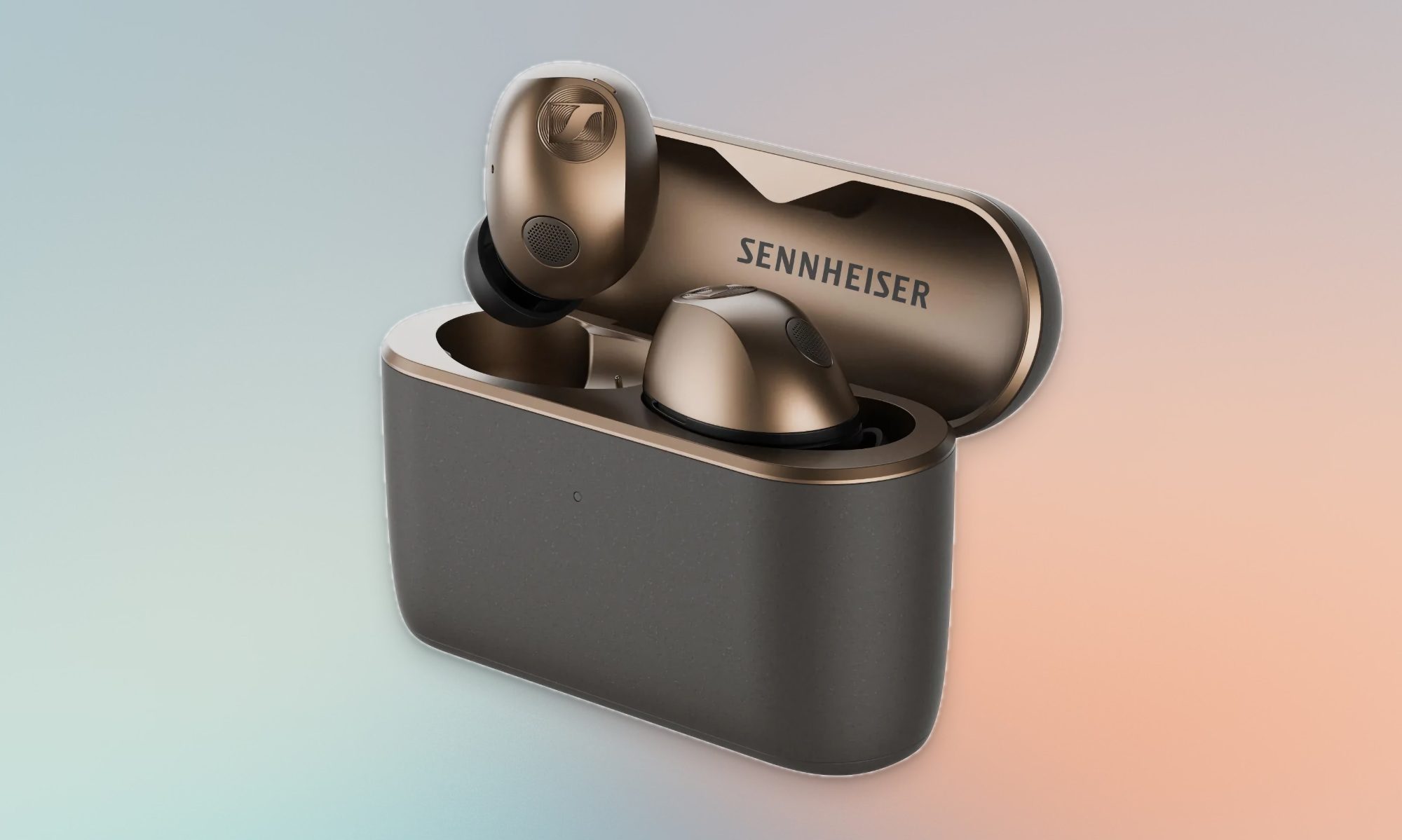
2026 Sennheiser MOMENTUM True Wireless 5 Lavender inside charging case

The MOMENTUM True Wireless 5 build on the same sound-first philosophy behind Sennheiser’s full-size MOMENTUM 5 Wireless headphones, while adapting that approach for a much smaller true wireless design.

7mm TrueResponse Dynamic Drivers

The MOMENTUM True Wireless 5 use Sennheiser’s 7mm TrueResponse dynamic transducers, which are designed to deliver detailed reproduction while retaining the fuller, bass-driven presentation associated with the MOMENTUM lineup. Each transducer is manufactured at Sennheiser’s facility in Tullamore, Ireland.

Listeners can further customize the sound through the Sennheiser Smart Control Plus App, which includes an 8-band equalizer for more precise tonal adjustment.

Advertisement

Bluetooth 6.0, aptX Adaptive and Lossless Audio

The MOMENTUM True Wireless 5 support Bluetooth 6.0 along with aptX Adaptive, providing a high-resolution wireless audio pathway up to 24-bit/96kHz with compatible source devices. The earbuds also support aptX Lossless, enabling bit-perfect CD-quality wireless transmission when paired with a compatible source and under appropriate connection conditions.

sennheiser-momentum-true-wireless-5-earbuds-cream
MOMENTUM True Wireless 5 (cream)

Revised Adaptive ANC and Smarter Voice Isolation

The MOMENTUM True Wireless 5 feature a revised adaptive hybrid active noise cancellation (ANC) system along with an automatic anti-wind mode designed to reduce unwanted noise in changing environments.

A redesigned ear tip works with a four-microphone array to improve isolation and maximize ANC effectiveness, while Sennheiser also claims its most natural-sounding real-time transparency mode yet for the MOMENTUM True Wireless series.

For calls and voice capture, the earbuds use eight system sensors, including six microphones and two bone-conduction voice accelerometers. An AI-based speech-extraction algorithm analyzes those inputs to isolate the wearer’s voice more effectively, particularly in noisy surroundings.

Advertisement

Dolby Atmos Spatial Audio With Head Tracking

Borrowing from the spatial audio capabilities of the full-size MOMENTUM 5 Wireless headphones, the MOMENTUM True Wireless 5 are optimized for Dolby Atmos and support interactive head tracking. The technology is designed to create a more immersive spatial presentation by keeping sounds anchored within the virtual sound field as the listener moves their head.

User-Replaceable Batteries Extend Product Life

The MOMENTUM True Wireless 5 feature user-replaceable batteries in both the earbuds and wireless charging case, allowing owners to replace aging power cells rather than retire the entire product when battery performance eventually declines. It is an unusually practical approach for premium true wireless earbuds and could significantly extend their usable lifespan while reducing electronic waste.

Advertisement. Scroll to continue reading.

Up to 40 Hours of Battery Life

The MOMENTUM True Wireless 5 improve battery life over the previous-generation MOMENTUM True Wireless 4, providing up to 12 hours of continuous playback on a single charge. The Qi-compatible wireless charging case provides additional recharges for up to 40 hours of total listening time.

Advertisement

For users caught with a nearly depleted battery, the quick-charge function provides up to one hour of playback from an eight-minute charge.

The MOMENTUM True Wireless 5  supports improved playback time over the previous Momentum 4 with 12 hours of continuous playback per charge. With two additional replenishments stored in the Qi-enabled wireless charging case, up to 40 total hours of run time is supported. Quick charge capability extends listening up to 1 hour from just an 8-minute charge.

Sennheiser on Replaceable Batteries

Balancing compact size, our signature high-fidelity acoustics, and a replaceable battery is a major breakthrough,” said Lilika Beck, President of Sennheiser Consumer Hearing. “With MOMENTUM True Wireless 5, we are proving that cutting-edge performance does not have to sacrifice longevity.

We set out to bring the larger-than-life sound and connected technology of the MOMENTUM series into a remarkably compact format,” said Frank Foppe, Product Manager. “From its exquisite audio reproduction to the advanced hardware powering it all, MOMENTUM True Wireless 5 represents our most advanced integration of audio technology in an earbud.”

Advertisement
sennheiser-momentum-true-wireless-5-earbuds-blue-case

Redesigned Fit, IP54 Protection and a Slimmer Charging Case

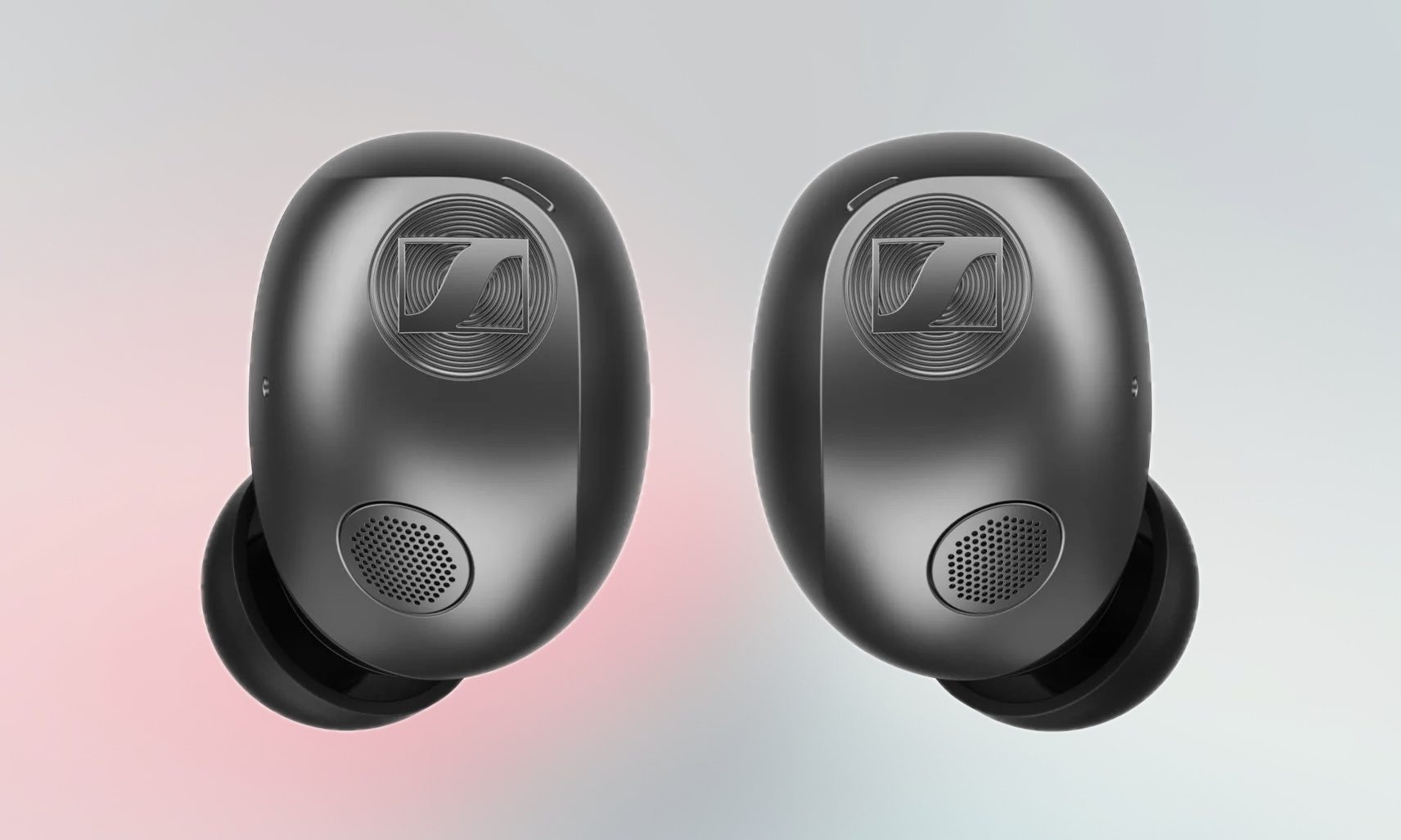
For a more unobtrusive fit, the MOMENTUM True Wireless 5 feature a newly sculpted, aerodynamic housing developed using data gathered from thousands of individual ear models.

The earbuds also adopt a fin-less design that Sennheiser says was rated more comfortable than the previous generation by 73% of testers. An IP54 rating provides protection against dust, sweat, and splashes, while a micro-perforated acoustic microphone plate is designed to reduce wind turbulence that can interfere with voice pickup and ANC performance.

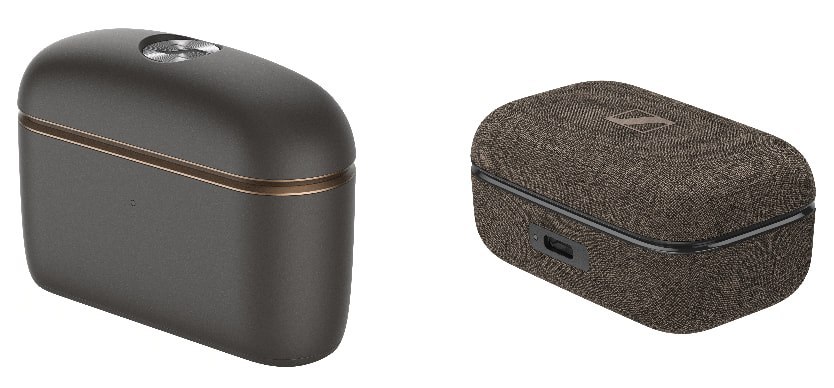
Sennheiser has also redesigned the charging case with a narrower, more pocket-friendly shape and a low-friction finish intended to make it easier to slide in and out of pockets.  

Comparison

sennheiser-momentum-true-wireless-5-vs-4-earbuds
5th generation vs 4th generation
Sennheiser Model  Momentum True Wireless 5 (MTW5) Momentum True Wireless 4 (MTW4)
Release Date September 3, 2026 February 29, 2024
Product Type  TWS Earbuds TWS Earbuds
Price  $299.95 $299.95
Ear coupling  Ear canal  Ear canal 
Connectivity  Bluetooth 6.0  Bluetooth 5.4
Supported profiles  A2DP, AVRCP, HFP  A2DP, AVRCP, HFP, TMAP, PBP
Supported codecs  SBC, AAC, aptX, aptX Adaptive/Lossless  SBC, AAC, aptX, aptX Adaptive/Lossless, LC3 – LE Audio and Auracast support
Dolby Atmos  Yes – with head tracking No
Speaker Principle  Dynamic  Dynamic 
Speaker Type/size  7mm dynamic TrueResponse transducer 7mm dynamic TrueResponse transducer
Speaker frequency range  5 Hz to 21 kHz  5 Hz to 21 kHz
Speaker sensitivity  107 dB SPL (1 kHz / 1 mW)  107 dB SPL (1 kHz / 1 mW)
Speaker THD  <0,08% (1 kHz / 94 dB)  <0,08% (1 kHz / 94 dB)
Active Noise Cancellation  Hybrid Adaptive ANC  Hybrid Adaptive ANC
Mic principle  MEMS  MEMS
Mic frequency range  Up to 16 kHz (super wideband telephony mode)  100 Hz to 10 kHz
Mic pick-up type  4 mics per earbud incl. bone-conducted mic; AI and beamforming for de-noising  3 mics per earbud, beamforming for noise reduction
Battery lifespan  Up to 12 hrs music playtime with earbuds (ANC off)

Up to 6 hrs music playtime with earbuds (ANC on) 

Up to 40 hrs overall music playtime with charging case (test condition: iPhone, mid volume level) 

Advertisement
Up to 7.5 hrs music playtime with earbuds (ANC off)

Up to 7.0 hrs music playtime with earbuds (ANC on)

Up to 30 hrs overall music playtime with charging case (test condition: iPhone, mid-volume level 85 dB)

Charging time  Approx. 1.5 hrs for a full charge. 
Advertisement

After 8 min of charging, 1 hr of music playtime. 

Note: Ambient temperatures <15°C or >30°C and Qi wireless charging lead to extended charging times 

Approx. 1.5 hrs for a full charge. 

After 8 min of charging, 1 hr of music playtime

Advertisement

Note: Ambient temperatures <15°C or >30°C and Qi wireless charging lead to extended charging times 

Battery type  Lithium-Ion rechargeable batteries, User replaceable with standard tools, Left/right earbud: 72 mAh, Charging case: 760 mAh  Built-in (not replaceable) Lithium-Ion rechargeable batteries; Left/right earbud: 75 mAh, charging case: 820 mAh
Power supply  5 V⎓, 1000 mA max., charging power up to 5 W, USB-C charging socket, no Power Delivery (PD), Qi Wireless Charging (Version 2.1)  5 V⎓, 1000 mA max; USB charging via USB-C socket at charging case; Qi Wireless charging
Weather resistance  IP54, dust and splash resistant (earbuds only)  IP54, dust and splash resistant (earbuds only) 
Product dimension  67.2 x 48.4 x 25.0 mm (case with earbuds)  70.1 x 44.6 x 34.8 mm (case with earbuds)
Product weight  7 g (single earbud)
69 g (both earbuds and charging case) 
6.2 g (single earbud)
72.4 g (both earbuds and charging case)
App support  Sennheiser Smart Control Plus app for iOS and Android Sennheiser Smart Control Plus app for iOS and Android
sennheiser-mtw5-vs-mtw4-case-copper
Charging Cases Compared: MTW5 (left) vs. MTW4 (right) in copper

The Bottom Line 

The Sennheiser MOMENTUM True Wireless 5 enter a very crowded premium wireless earbud market at $299.95, but this is more than a cosmetic refresh of the MOMENTUM True Wireless 4. The 7mm TrueResponse driver remains central to the design, while Sennheiser has added Dolby Atmos with head tracking, Bluetooth 6.0, improved adaptive ANC, a more sophisticated microphone and voice-isolation system, longer battery life, and the expanded 8-band EQ available through the Smart Control Plus app.

The most unusual upgrade, however, may be the user-replaceable batteries in both the earbuds and charging case. Battery degradation remains one of the biggest limitations of true wireless earbuds, and allowing owners to replace the cells rather than discard an otherwise functional $300 product gives the MOMENTUM True Wireless 5 a meaningful longevity advantage over most competitors.

Sennheiser has also held the line on price. The $299.95 MSRP is the same price at which the MOMENTUM True Wireless 4 originally launched, although the outgoing model is now heavily discounted as it makes way for its successor. That puts the MTW5 above Apple’s $249 AirPods Pro 3, level with the Bose QuietComfort Ultra (2nd gen) and Technics EAH-AZ100, but below luxury models such as the Bowers & Wilkins Pi8.

However, there is one specification we would not assume just yet: Auracast. The MOMENTUM True Wireless 4 supports it, and its inclusion in the MTW5 would certainly seem logical, but Sennheiser’s advance information does not explicitly confirm Auracast compatibility. Until it does, we are leaving it out of our comparison chart rather than turning an educated guess into a specification.

Advertisement
Advertisement. Scroll to continue reading.

Ultimately, Sennheiser has given buyers more than just another annual collection of software tweaks. Dolby Atmos, aptX Lossless, improved ANC and call performance are all welcome, but the replaceable battery system is the feature that could make these earbuds considerably more appealing to listeners who would prefer their expensive wireless headphones to last longer than the batteries sealed inside them.

sennheiser-mtw5-colors

Price & Availability

The Sennheiser MOMENTUM True Wireless 5 will be available in five metallic colors: Graphite, Cream, Graphite, Copper, Denim, and Lavender, and will begin shipping on September 3, 2026 from sennheiser-hearing.com and select retailers at an MSRP of $299.95 USD.

Where to buy: $299.95 at Amazon

Advertisement

Source link

Continue Reading

Tech

C SEED Bugatti N1 TV Takes Forty-Five Seconds to Go From Sideboard to 137-Inch Screen

Published

on

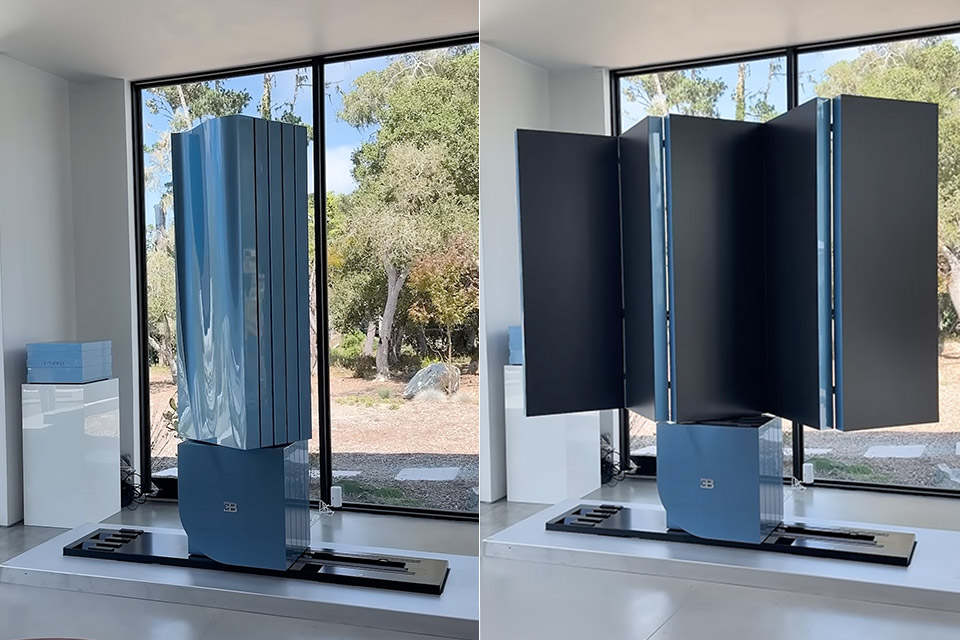
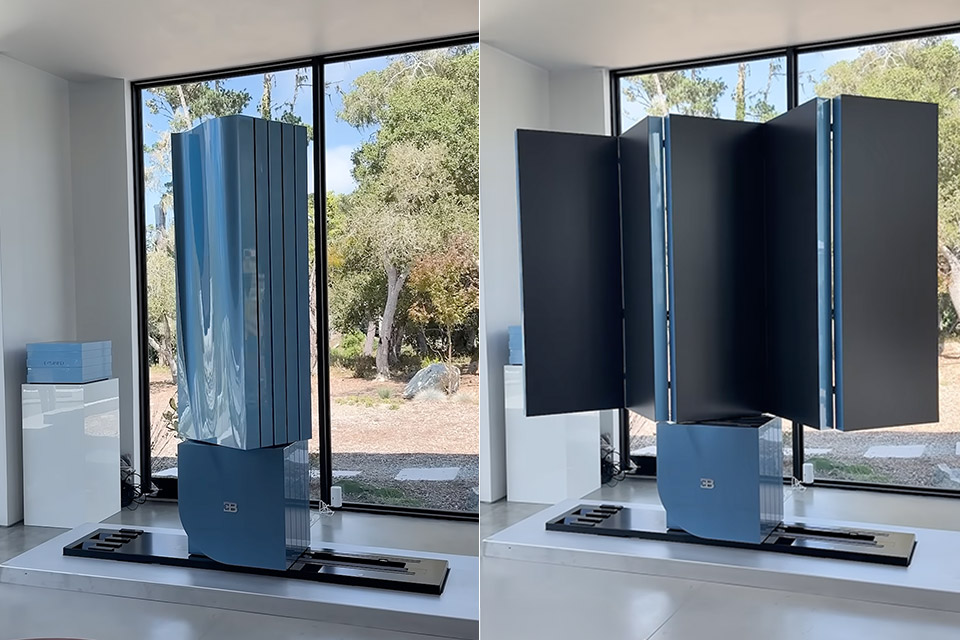
C SEED Bugatti N1 TV Hands-On
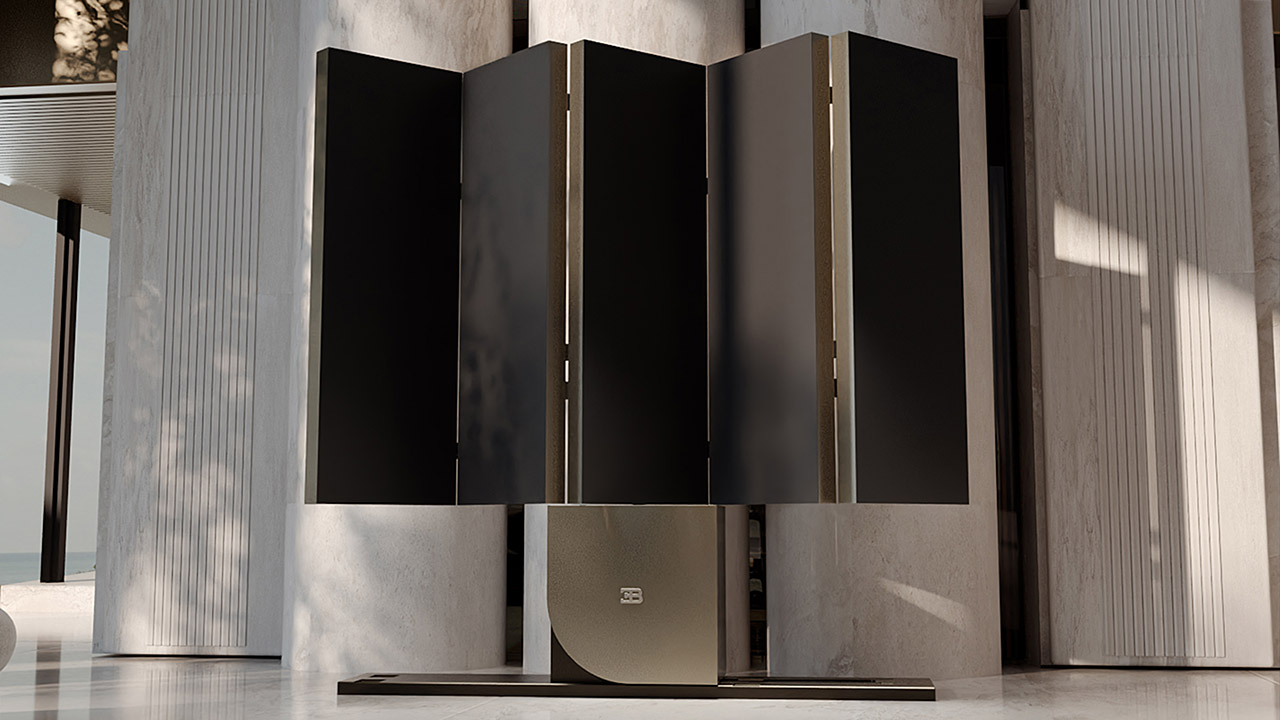
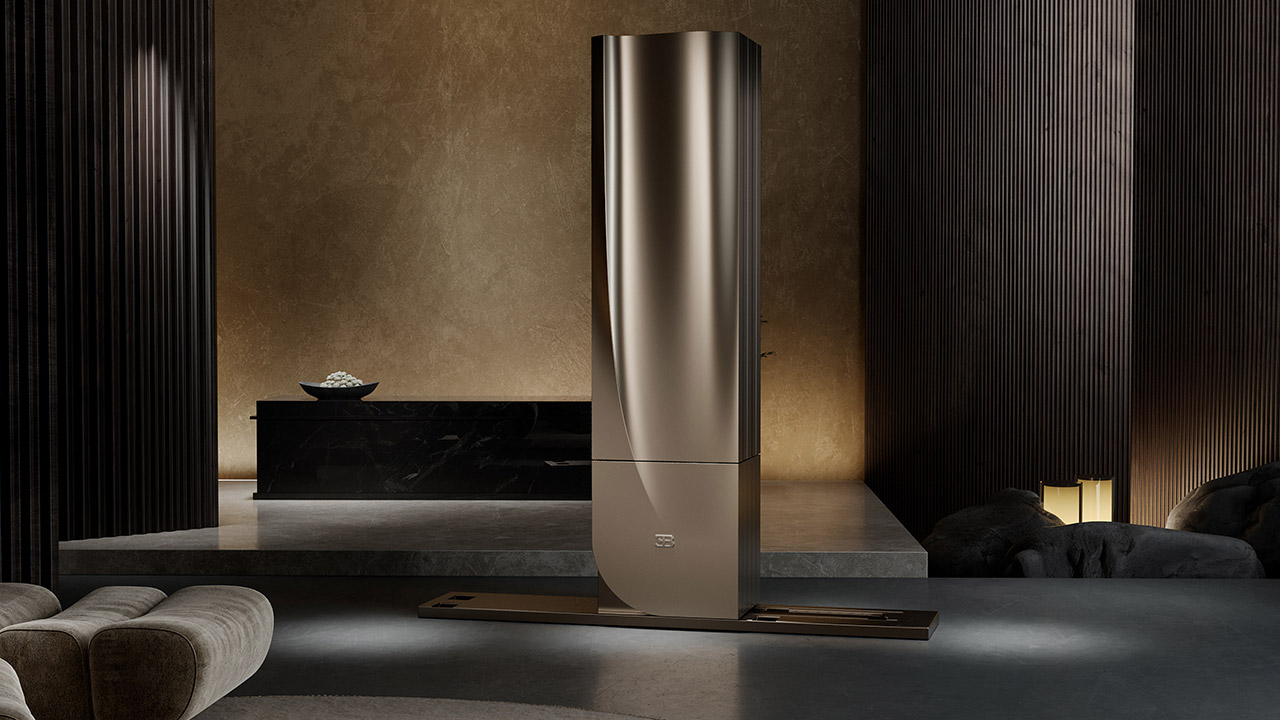
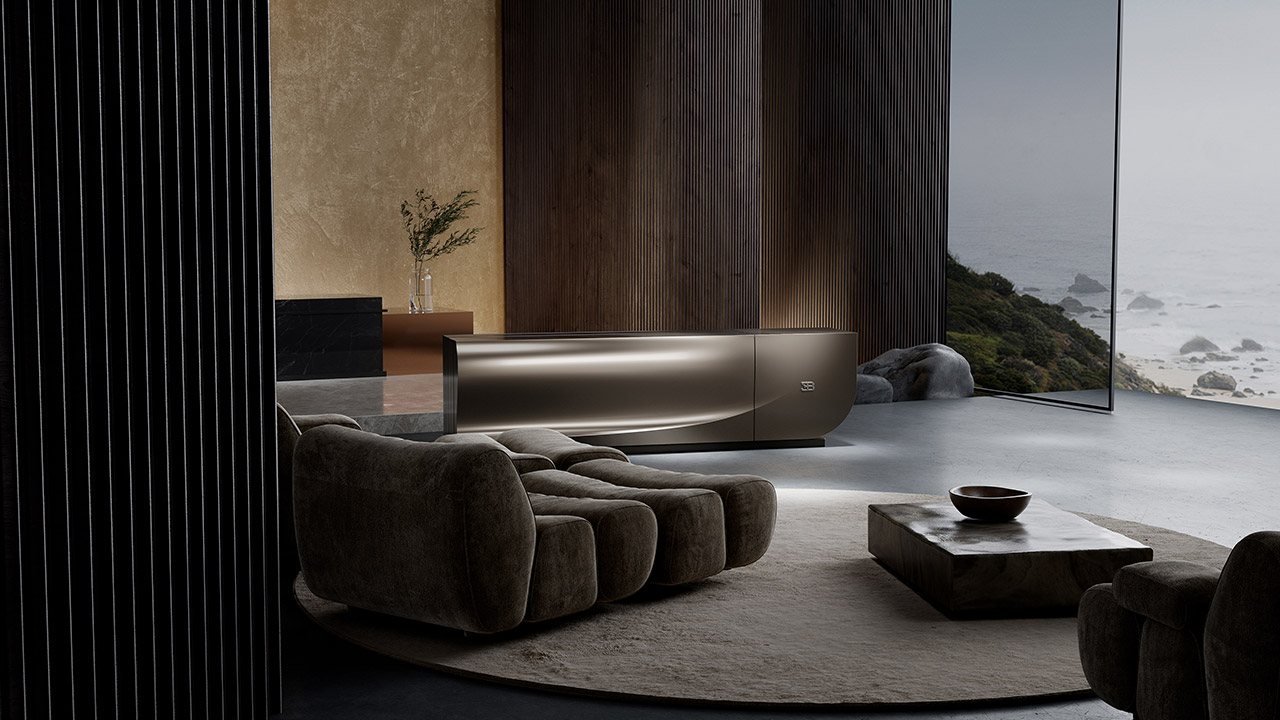
Road & Track spent time with the C SEED Bugatti N1 during Monterey Car Week and came away calling the transformation more striking in person than the press photos suggested. That reaction lines up with every account of watching the thing work. One button starts a silent, multi-stage sequence that lasts exactly 45 seconds.


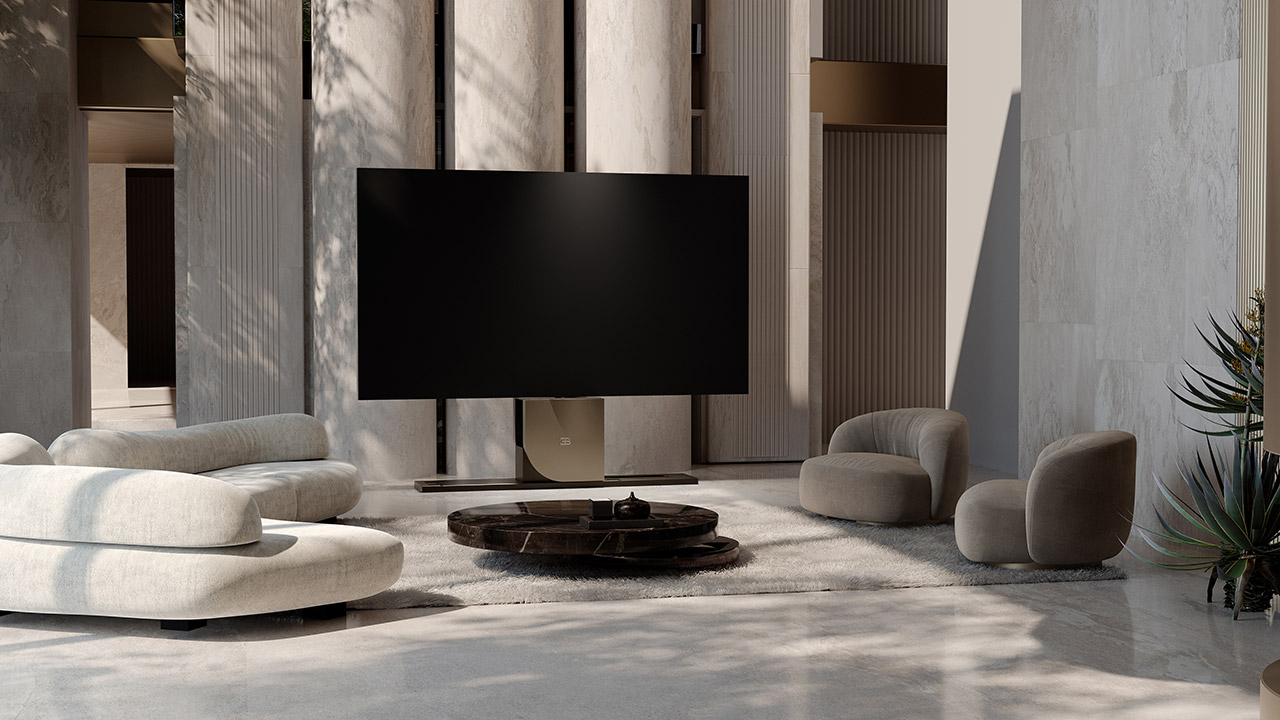
What begins as a low, curved piece of furniture rises, slides, and unfolds into either a 110-inch or 137-inch 4K MicroLED display. The panels separate cleanly during the process, then settle so tightly that the joins vanish under C SEED’s Adaptive Gap Calibration system. Speakers from Wisdom Audio extend at the same time and later retract. When the sequence ends, the room has gained a massive, bright screen without any wall mounts or permanent visual bulk.


LEGO Technic Bugatti Chiron Pur Sport Hypercar Building Toy for Boys & Girls – Sports Car Toy W/Realistic…
  • HIGH SPEED THRILLS – Kids construct an authentic race car with the LEGO Technic Bugatti Chiron Pur Sport Hypercar (42222) building toy for boys and…
  • REALISTIC FEATURES & FUNCTIONS – Young builders can steer using the knob on top, explore the W16 engine, and open the doors and hood to discover…
  • VIBRANT BUGATTI DESIGN – This hypercar model features the eye-catching orange bodywork and black design inspired by the real Bugatti Chiron Pur…


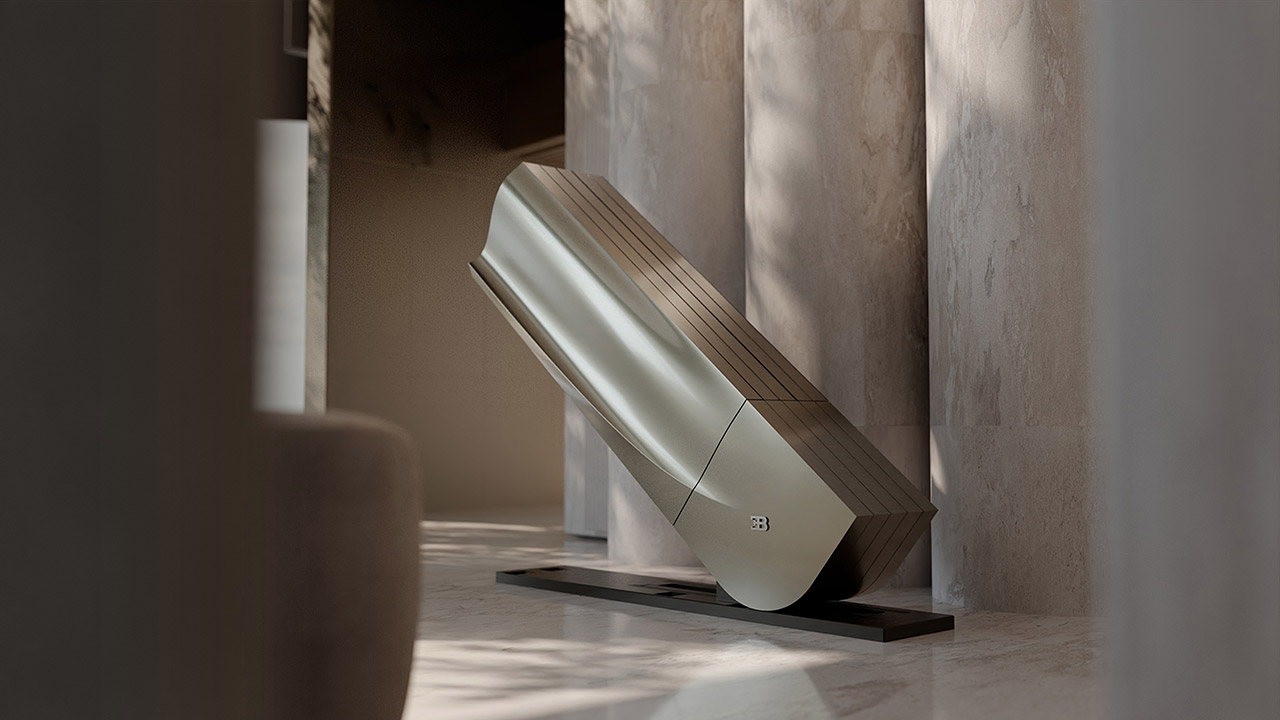
The closed version takes its inspiration directly from the Bugatti Tourbillon. That characteristic C-profile runs around the side, with flowing curves reminiscent of Jean Bugatti’s earliest renderings all those years ago. The lines and curves combine effortlessly, and materials like as aerospace aluminum and carbon-fiber mesh nicely with the high-end feel, as the Tourbillon’s special Sculpture Silver finish isn’t the only luxurious touch.

C SEED Bugatti N1 TV Hands-On
Four color options are available, or you can create your own custom setup. Closed up, it’s simple to see how this can function as a stunningly minimalist sideboard. When closed, the 137-inch model measures around 92.5 inches in length, 18.5 inches in depth, and 25.5 inches in height, weighing 1,500 pounds. The 110-inch version is slightly smaller, measuring 74 inches long and weighing 1,058 pounds, but it still requires no structural support from the wall. Both models spin a full 180 degrees and include the option of a center-sliding screen, allowing you to put it almost anywhere in the room.

C SEED Bugatti N1 TV Hands-On
Image quality is enhanced by the amazing MicroLED in Package (MiP) technology. Both versions offer 4K resolution. Peak brightness can reach 1,000 nits, with a native contrast ratio of 30,000 to 1. The pixel pitch is 0.7mm on the large panel and 0.6mm on the smaller one. Color processing is fully 16 bit per channel, resulting in 64 billion potential colors.

C SEED Bugatti N1 TV Hands-On
Then there’s the incredible refresh rate of 3,840 Hz, which refers to how quickly the N1’s MicroLEDs refresh, resulting in very smooth, flicker-free visuals even when the video isn’t running at 3,840 frames per second. A special glare-reducing coating and Adaptive Gap Calibration technology combine to keep the image smooth across the folding panels, making any joins undetectable at normal viewing distance. HDR10+ support is built-in. The power consumption varies, peaking at 2.6 kw for the 137 inch model and averaging around 0.9 kw when things are calm. LEDs have a lifespan of up to 100,000 hours.

C SEED Bugatti N1 TV Hands-On
Wisdom Audio’s planar-magnetic drivers handle the sound. The larger model includes six 12 watt speakers that can handle frequencies ranging from 200 Hz to 20 kHz, as well as a 200 watt subwoofer that can handle frequencies ranging from 60 Hz to 400 Hz. The smaller version also has a 200 watt subwoofer and four smaller drivers. When not in use, all of the speakers are hidden inside the screen, so no one can see them.

C SEED Bugatti N1 TV Hands-On
Three HDMI 2.0 ports with HDCP 2.2, two USB ports, and one RJ45 network connection are the only inputs, but there is no built-in tuner. These displays are manufactured and sold in Austria, but exclusively through an exclusive network of partners and authorized Bugatti dealers. Official cost has never been made public, although estimates place the 110-inch version at over $400,000 and the 137-inch variant much higher, often reaching $500,000 depending on the finishes and options selected. That’s on top of what other C SEED folding screens have been selling for, since the Bugatti brand only adds to the cost.

Advertisement

Source link

Continue Reading

Tech

Inside the satellite factory: Portal Space Systems gets set for the debut of Starburst and Supernova

Published

on

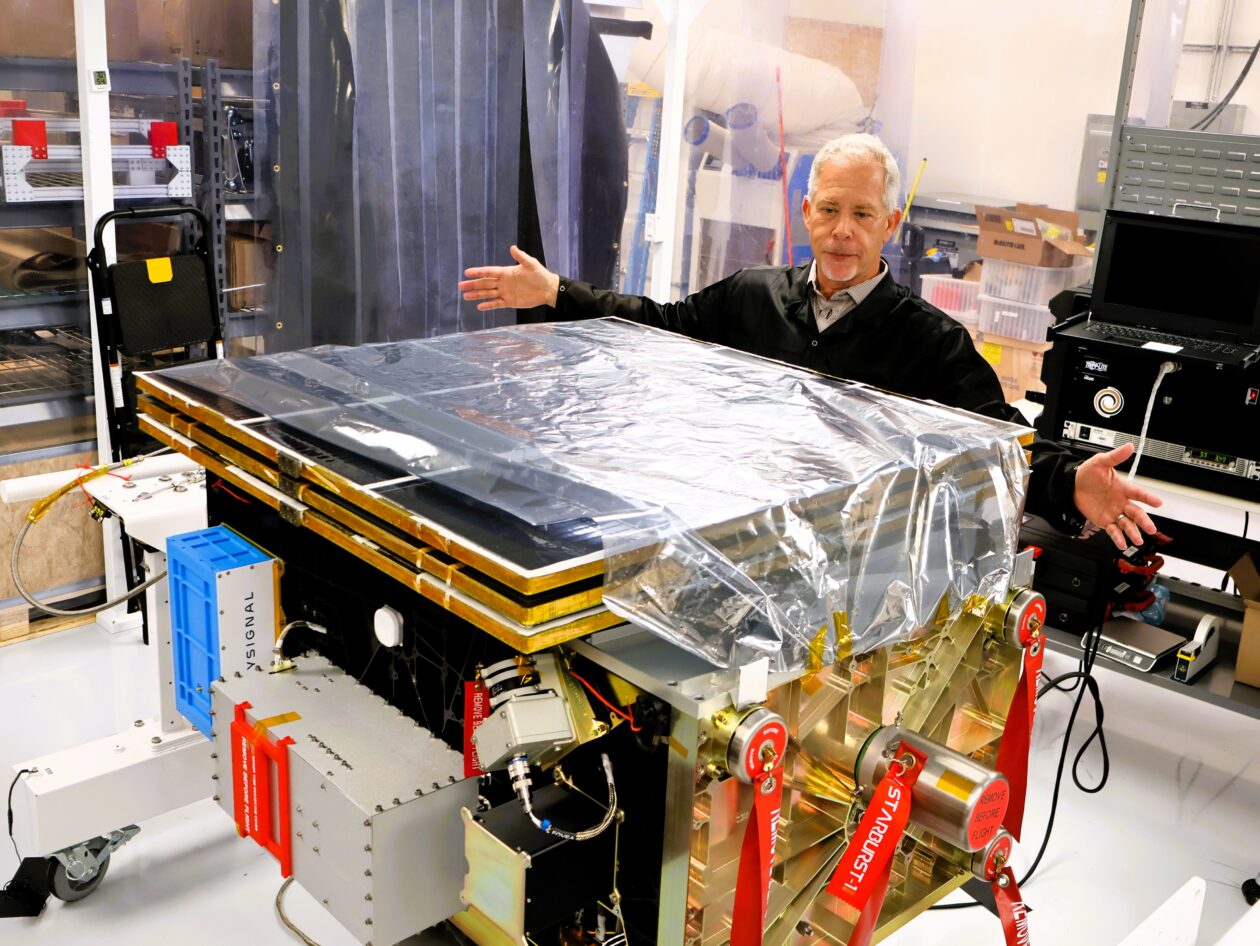
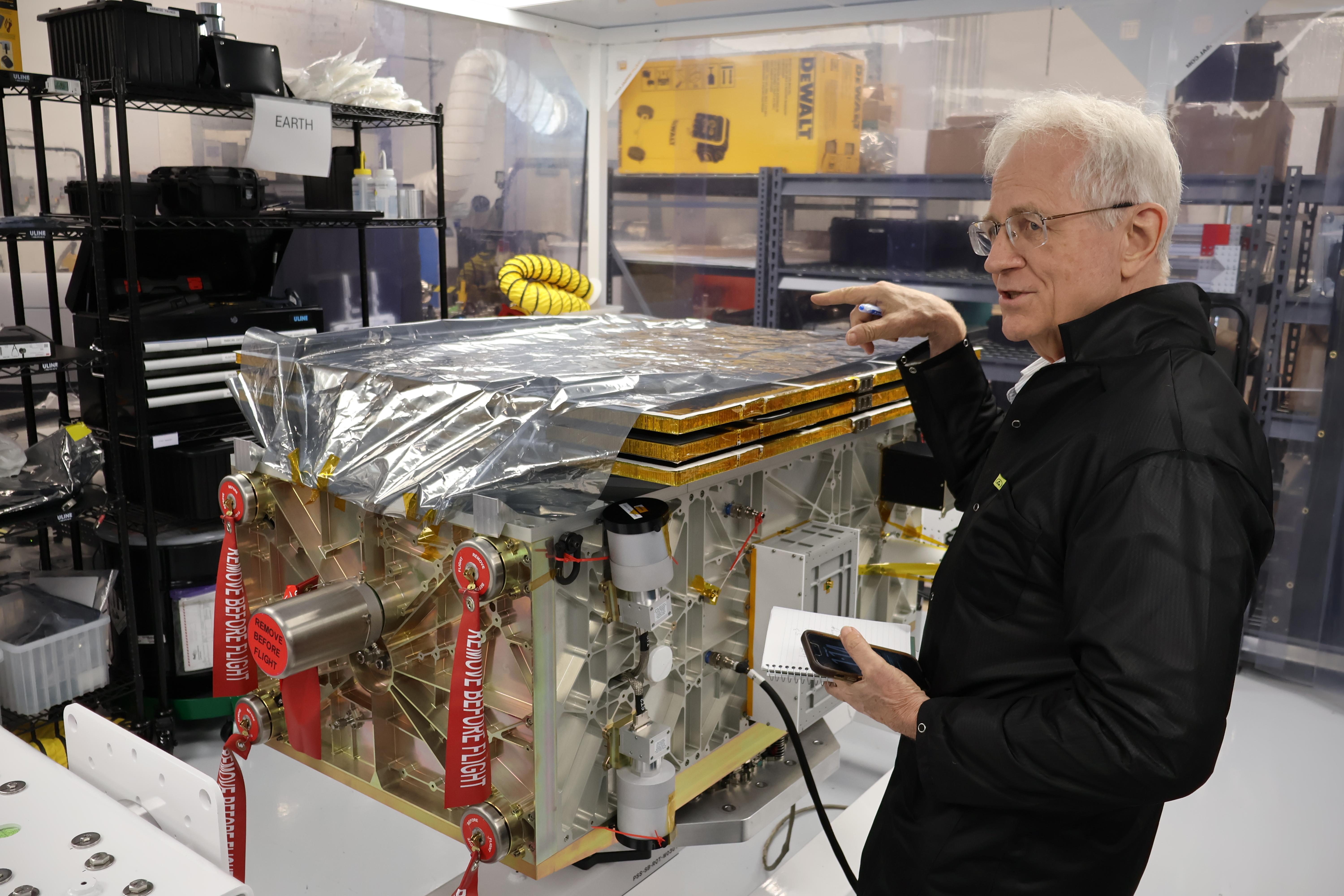
Portal CEO Jeff Thornburg stretching arms out to show Starburst-1 satellite in Bothell lab
Portal Space Systems’ co-founder and CEO, Jeff Thornburg, shows off the Starburst-1 satellite in the company’s Bothell lab. (Portal Space Systems Photo)

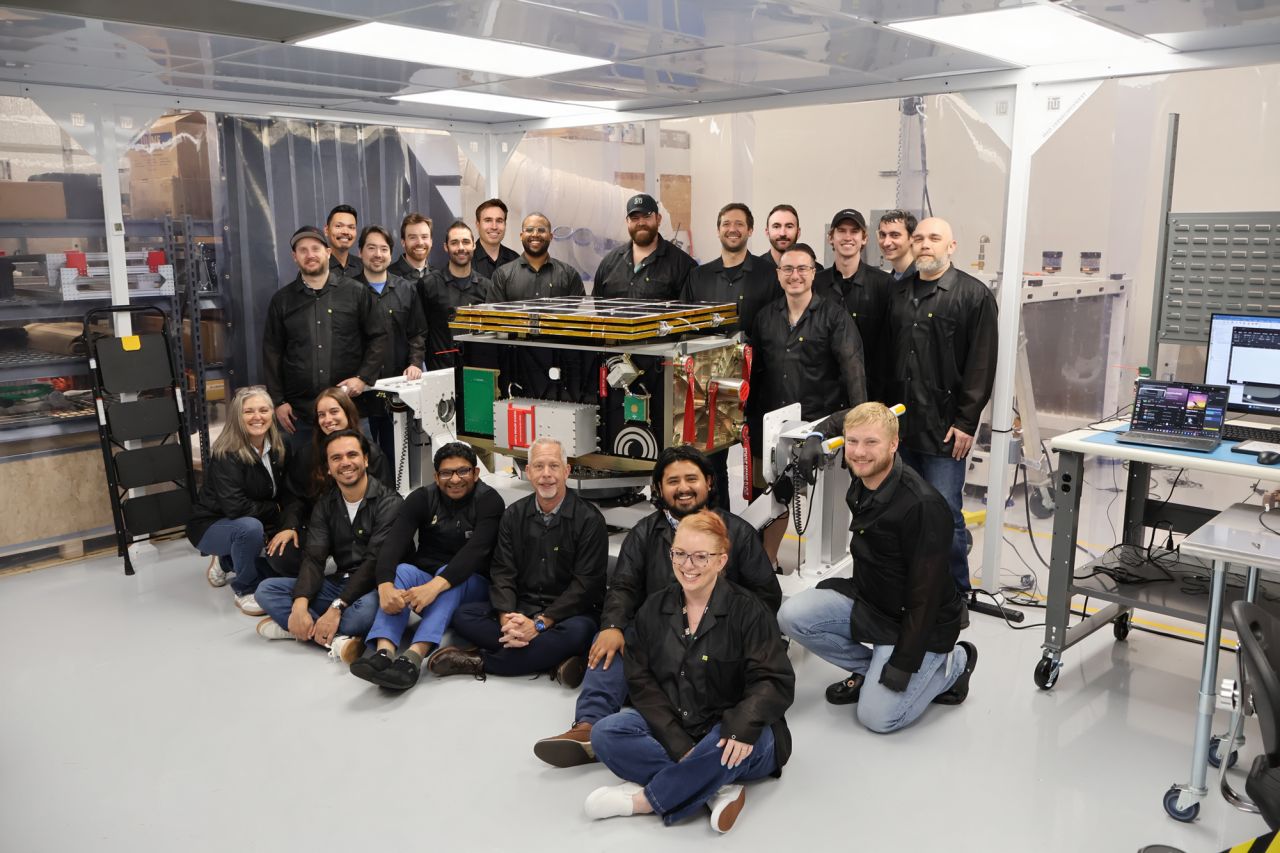
BOTHELL, Wash. — Portal Space Systems is getting ready to send its first Starburst spacecraft to Florida for a milestone launch, and at the same time is fleshing out its plans for an even more capable spacecraft known as Supernova.

Both spacecraft are designed to offer rapid maneuverability in orbit at low cost, and both will take advantage of Portal’s core technologies, supply chains and manufacturing processes. But Supernova will be heavier than Starburst (1,100 pounds vs. 600 pounds) and will make use of an innovative solar thermal propulsion system to move within a wider range of orbits.

Seventeen months after the official opening of Portal’s 8,000-square-foot development and testing lab in Bothell, I was invited back to the facility to get a peek at Starburst-1 — and get a sense of how far the startup has come.

Starburst: Getting ready for blastoff

Starburst-1 will blaze the trail for Supernova. The desk-sized spacecraft recently returned to the Bothell lab after undergoing a round of vibration testing in California. It’s scheduled for an October launch from Cape Canaveral Space Force Station in Florida on SpaceX’s Bandwagon-5 satellite rideshare mission.

Portal CEO Jeff Thornburg said he expected Starburst-1 to be trucked to Florida in September, after engineers make their final software adjustments.

Advertisement

“Until we get ready to fly, we’ll be constantly testing it and evaluating its health, and making any tweaks that we think we need to make,” he said. “Anything that helps reduce the risk for the first flight, up to the point where we launch — we’ll implement that if we need to.”

Back in March, Portal sent a payload about the size of a tissue box into space to test the electronics and control systems designed for Starburst and Supernova. That instrument package, known as “Mini-Nova,” is still attached to an orbiting space vehicle, but a replica is displayed in a conference room next to the lab.

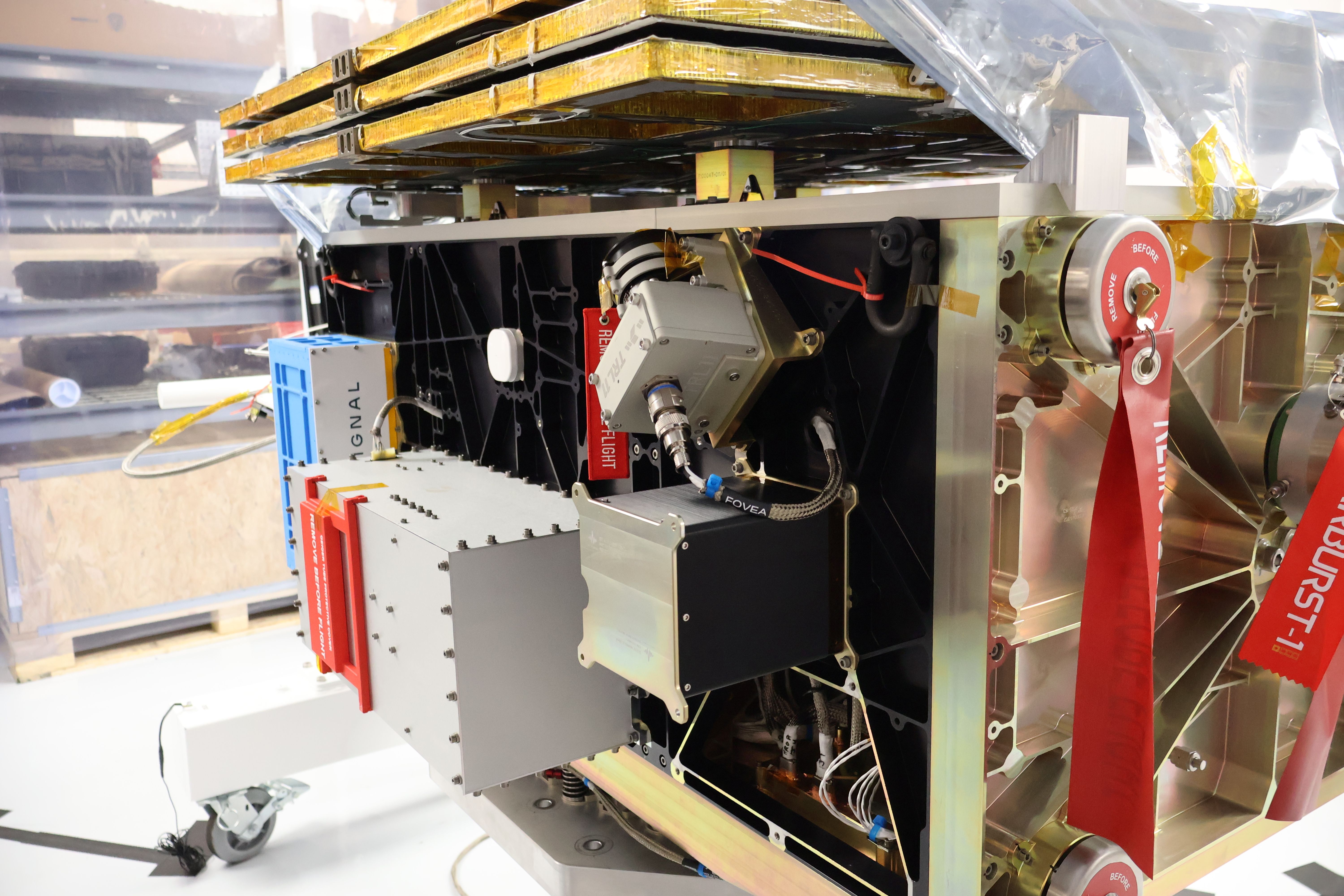
Starburst-1 takes center stage in the lab’s clean-room enclosure. The satellite’s solar arrays are stacked on top, and several contraptions stick out from the sides. The hardware includes Starburst-1’s star trackers and communications equipment. A full-motion video system, provided by TRL11, will monitor the spacecraft and its orbital surroundings.

Here’s a slideshow featuring Portal’s lab and Starburst-1:

Advertisement
  • Portal team with Starburst-1
  • Starburst-1 satellite with payloads attached to the side
  • Shipping box for Starburst-1
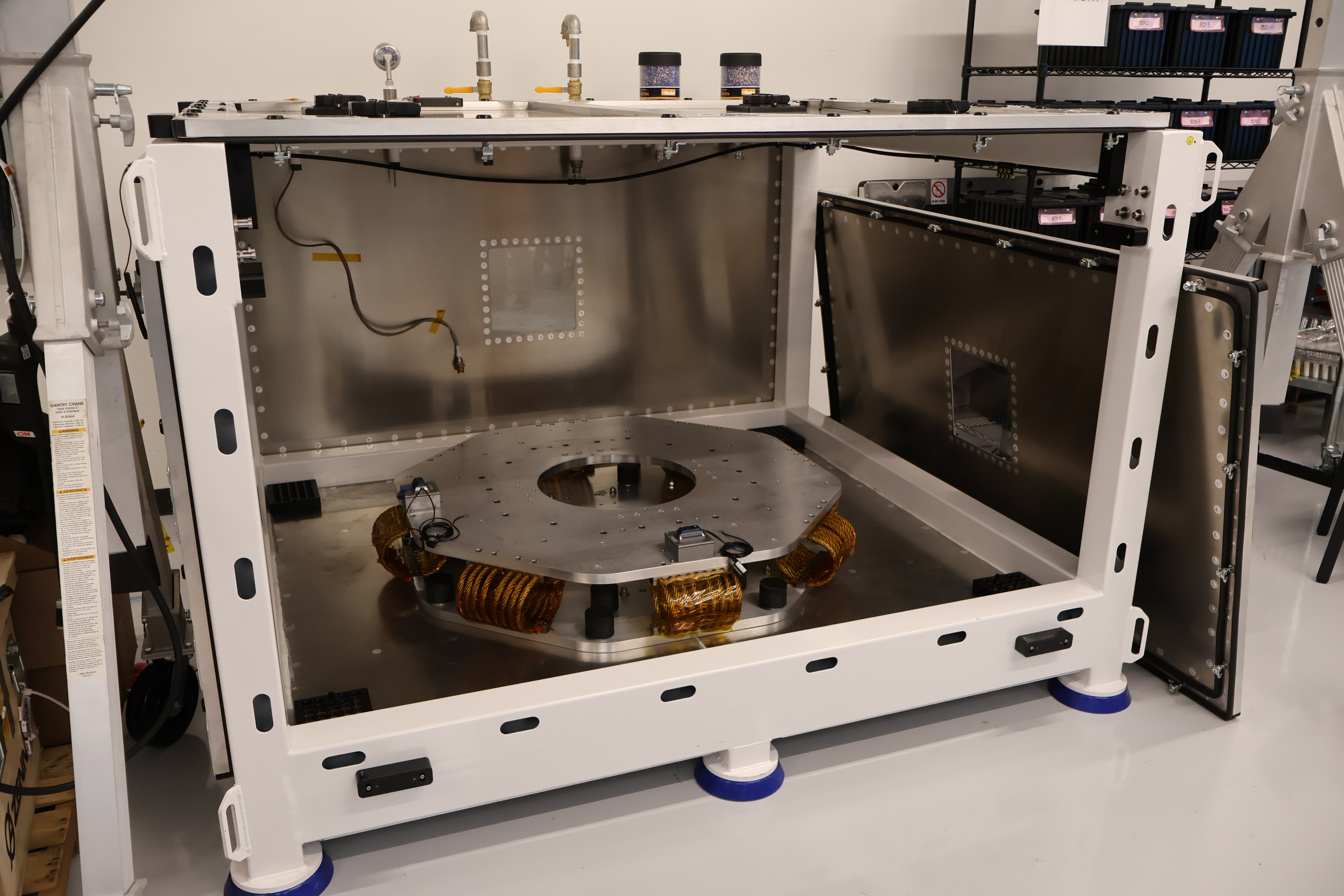
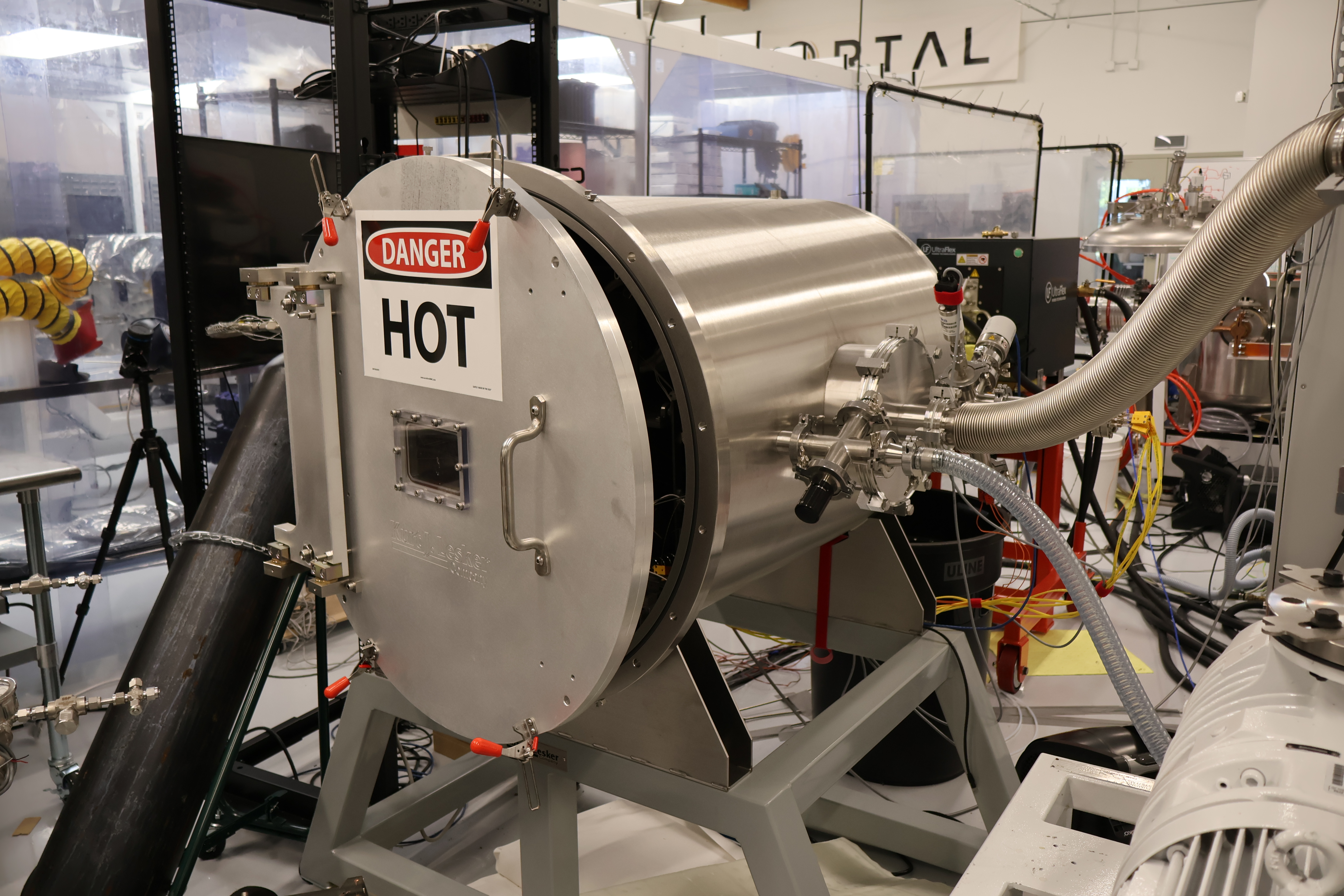
  • Vacuum chamber at Portal lab

One of the boxes attached to Starburst-1 contains a superconducting magnet produced by Zenno, a New Zealand startup that’s in the process of moving its headquarters to Los Angeles. Theoretically, Zenno’s magnet system could be used to maneuver spacecraft in orbit by interacting with Earth’s magnetic field, and it could also serve as a radiation shield for a spacecraft’s sensitive electronics.

“It’s the Star Trek shields coming to life on the spacecraft,” Thornburg said. “That’s probably the use case I’m most excited about.”

Thornburg emphasized that testing the video system and the magnet are secondary mission objectives. The primary objective is to validate Starburst-1’s engineering design over the course of a year or more.

“Everything after a year becomes residual capability,” he said. “If all is healthy, then we’ll basically go into a stable orbit, and then we’ll re-engage this with other Portal spacecraft in the future to practice rendezvous proximity operations, and practice everything we need to refuel these spacecraft.”

Advertisement

By this time next year, Portal’s satellite manufacturing operation will have made the transition over to a much bigger facility in Bothell. “We have 65,000 square feet we’re moving into, just down the road about three miles, and it’ll have the capacity to produce 12 Supernova and 16 Starburst spacecraft a year,” Thornburg said.

Supernova: Putting the plans in place

Supernova will be the flagship of Portal’s highly maneuverable space fleet. It’s designed to serve as an orbital platform for payloads that have to shift to different orbits in hours or days rather than weeks or months.

Two years after emerging from stealth, Portal has attracted tens of millions of dollars in funding and Pentagon development grants. The company anticipates using Supernova for applications ranging from satellite inspection and protection to orbital trash disposal.

Today Portal announced that its first Supernova space vehicle will be launched in 2028 on a SpaceX Falcon 9 rocket. California-based Maverick Space Systems, which did the vibration testing for Starburst-1, will handle payload accommodation, integration and manifest optimization.

Advertisement

“We’re designing an optimized payload stack for Portal, and bringing additional rideshare payloads to the mission, helping reduce launch costs for all mission partners,” Vidur Kaushish, Maverick’s chief operating officer and co-founder, said in a news release. “This new rideshare model is precisely what the industry needs. Portal’s ability to maneuver on orbit gives us the flexibility to select orbits that are truly valuable to rideshare customers.”

@media (max-width: 600px) {
aside.callout { float:none !important; max-width:100% !important; margin-left:0 !important; margin-right:0 !important; }
aside.callout .callout-img { display:none !important; }
}

The key to Supernova’s rapid maneuverability is its solar thermal propulsion system, known as Flare. The system concentrates sunlight to heat up ammonia propellant in a heat exchanger, producing high-efficiency thrust without chemical combustion. Starburst also uses heated ammonia as a propellant, but in a more traditional electrothermal thruster system.

Supernova will be equipped with a battery to store heat when the spacecraft is in Earth’s shadow. “The thermal battery is a material that lives inside our heat exchanger, and it heats up and retains the heat for up to an hour,” Thornburg told me. “So, I don’t need to see the sun to be able to execute a maneuver.”

Advertisement

Supernova’s first mission will be called “Motus Via Sol,” meaning “Movement With the Sun.” And Portal Space Systems will be on the move as well.

“I think the timing will work out where all our future builds will be in our new facility,” Thornburg said. “I’d say in the next six to 12 months, we’ll probably have all of this capability in the new building, and then we’ll vacate this facility. But I’m not rushing engineering, because I don’t need to.”

Thornburg said it was only recently that he realized the full significance of that transition, and what it will mean for “our little mini-facility that did what it needed to do.”

“I was seeing the end of this building,” he said, “and the beginning of the next one.”

Advertisement

Source link

Continue Reading

Tech

LG’s new OLED tech can last 2.4x longer, and monitors are first in line

Published

on

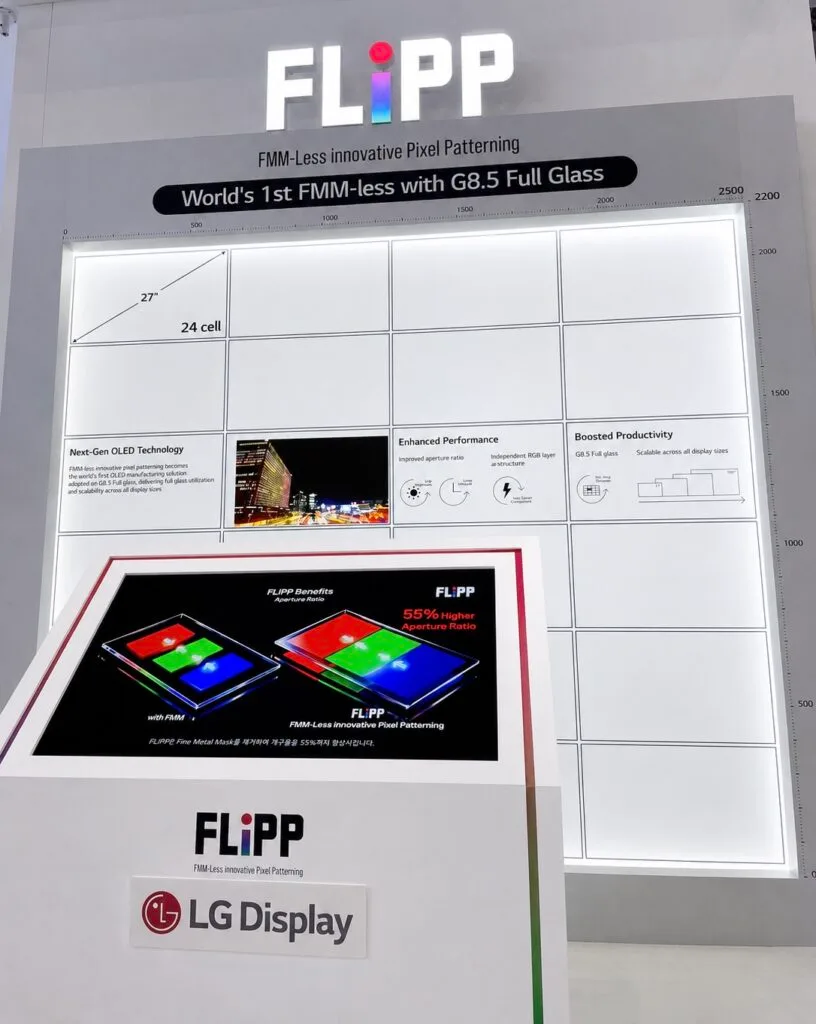
LG Display says its new FLiPP OLED technology can make displays last 2.4 times longer than panels made with conventional fine metal masks under the same conditions. It also claims a 1.6x increase in brightness while cutting power use by 13%.

LG Display plans to bring FLiPP to IT products such as monitors and tablets first, which gives the technology a fairly direct path from the lab to products people might actually buy.

That puts OLED monitors near the front of the line for testing whether those numbers hold up once FLiPP moves into mass production.

How FLiPP changes OLED production

Most OLED panels use fine metal masks to deposit red, green, and blue material in precise locations. As panels get larger, LG says those masks can sag enough to cause alignment problems and color-mixing defects.

Advertisement

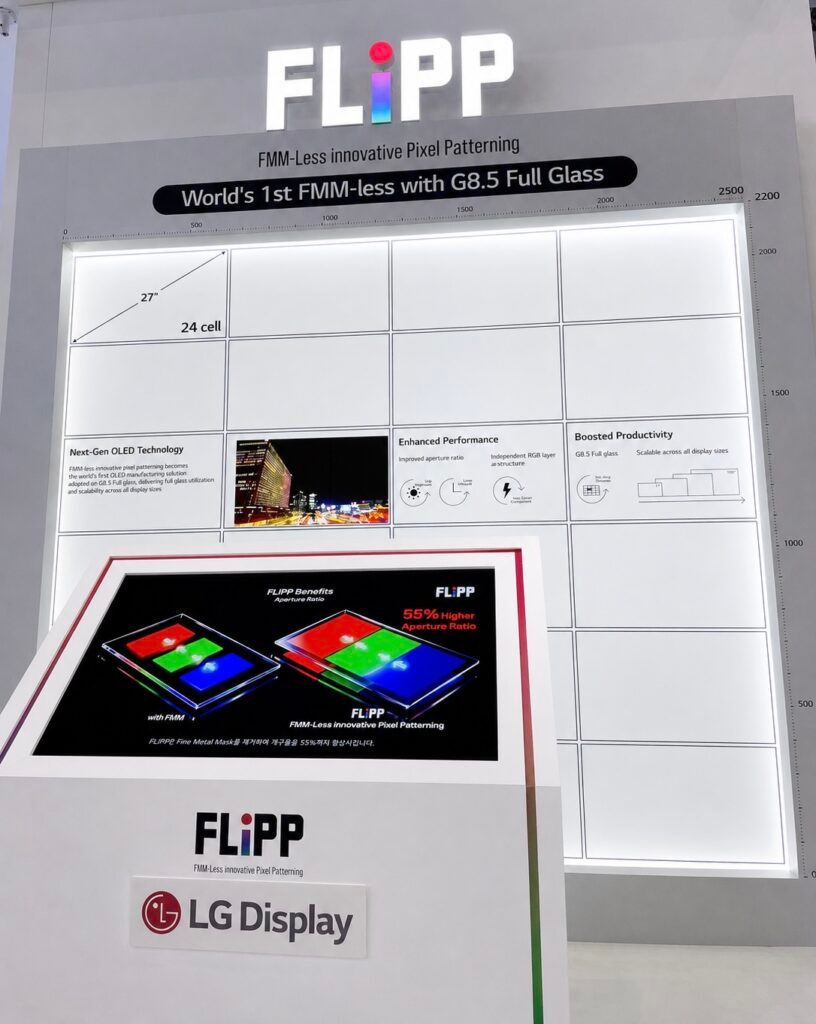
FLiPP gets rid of the mask. LG instead deposits the RGB materials in sequence and uses photolithography with UV light to remove unwanted areas. The process increases the usable pixel area by about 55%, giving LG more room to push brightness and longevity without increasing power consumption.

Why monitors are first in line

FLiPP also gives LG Display more flexibility over panel size and resolution. The company says the process can theoretically work on displays ranging from 1 inch to 100 inches, but monitors and tablets are the first categories on its roadmap.

Production could become more efficient as well. LG says FLiPP can use an entire 8.5-generation mother glass substrate instead of cutting it into smaller sections, improving glass utilization by as much as 64% for equivalent laptop panels.

That sounds promising for manufacturing costs, but there’s no guarantee any savings would show up in retail prices.

When will FLiPP reach actual products

For now, FLiPP remains a technology announcement rather than something you can buy. LG Display hasn’t named any monitor or tablet partners, and it hasn’t given a commercial release date.

Advertisement

So the first FLiPP monitors and tablets will have plenty to prove. They’ll show whether LG can reproduce those gains at commercial scale and, more importantly for buyers, whether the technology produces an OLED upgrade you can actually notice outside a spec sheet.

Source link

Advertisement
Continue Reading

Tech

For this IT program manager tech is more than computers and coding

Published

on

Meera Harichan discusses the true potential of technology to bring together communities with a shared vision and how diversity is never a box-ticking exercise.

For CCI Global IT program manager Meera Harichan, a career in the wider technology space began with one simple desire, a wish to better understand how things actually work and how they can be improved upon. 

A native of South Africa, Harichan told SiliconReoublic.com, “Fortunately, I had access to a computer at a young age, at a time when technology was still relatively new and unfamiliar to many. What fascinated me was not simply the technology itself, but the possibilities it opened up.

“I began to see technology as more than computers and code. It was a way to solve problems, challenge the way things were done, turn ideas into reality and ultimately, create meaningful change in people’s lives.”

Advertisement

As her professional life in tech expanded, she found she enjoyed being the person with the skills to connect people and technology, “translating complex ideas into meaningful solutions and bringing people together around a shared vision.”

She said, “Today, that intersection is where my passion lives. Technology gives us the tools, but people give those tools purpose and for me, that is where the real magic happens.”

She finds however, that more needs to be done to ensure that women are encouraged to enter tech roles and once there, that they are supported in growing their careers.

Making the numbers count

Harichan has led technology initiatives across multiple countries, launched large-scale campaigns, built operational sites and supported the resilience of the global data centres that keep organisations running. 

Advertisement

She said, “I have grown through a combination of continuous learning, determination and the opportunities afforded to me. I recently completed my Bachelor of Science Honours degree in Information Technology and I am preparing to pursue a Master’s in Research.”

While Harichan was able to make use of the opportunities that came her way, it is important to note that the same can not always be said for women looking to forge careers in the often male-dominated technology space. 

She finds, despite the growing investment in tech and AI, women crucially remain underrepresented across many technical roles. 

She said, “I think we have to look beyond the numbers and ask a deeper question, “What are we doing to make women feel that they truly belong in technology? Because women have never lacked the intelligence, creativity, ambition, or courage to lead. 

Advertisement

“What has often been missing is the opportunity to be seen, the encouragement to step forward, the visibility of women who have walked the path before them, and sometimes, simply, someone who says, ‘You belong here. Your voice matters. Your ideas matter.’”

Harichan explained, as technology continues to reshape almost every aspect of our lives, driven largely by advancements in AI, as a society we can’t afford to have one single group of people sitting at the table where all of the decisions regarding the future are made. 

“We need women at that table, not simply to meet a diversity target, but because women bring different experiences, perspectives, questions, and ways of solving problems. The real work is creating environments where women can enter, grow, lead, and stay. 

“We have to invest in mentorship, sponsorship, education, confidence and leadership opportunities. It means creating cultures where no one has to spend their energy proving their worth simply because of their gender, but is empowered to focus on their ideas, their potential and the impact they can make.”

Advertisement

She added, “When a young girl sees a woman leading, making bold decisions, and taking her place at the boardroom table, she doesn’t just see what is possible, she sees a reflection of who she could become. 

“Because when you open a door for one woman and tell her, ‘You belong here’, you do more than change her life, you make the path a little wider, the journey a little easier and the possibilities a little brighter for every woman who follows. That, to me, is the real opportunity.”

Consistency is key

In a world where diverse voices make technology better, as a by product of an ecosystem that notices different problems, asks different questions and imagines different solutions, Harichan is of the opinion that “diversity cannot be a moment we celebrate once a year, it has to be a value we live, a culture we nurture, and a commitment we carry every day.”

That means moving from representation to participation and from participation to progression. It means giving women a voice not just giving them access to the room, investing in diverse talent, not just hiring and assuming that the job is done and measuring success by the progress of the women in the organisation, not simply patting yourself on the back because you have female employees. 

Advertisement

She said, “Ask how many stay, progress, lead and ultimately help shape the organisation’s future. It means creating a culture where people are valued not simply for being present, but for what they contribute. 

“Perhaps the greatest measure of success is when belonging becomes so deeply woven into the culture that no one has to question whether they belong, they simply know that they do.”

And at its core, for Harichan, it isn’t just about progression for women alone, she stated, when women have a voice in technology men, children, families, businesses and communities benefit also. 

She said, “Everyone benefits when the people creating technology understand the people they are creating it for. Ultimately, the goal isn’t simply to have different people represented in technology. It’s to create technology that sees more of humanity.”

Advertisement

Don’t miss out on the knowledge you need to succeed. Sign up for the Daily Brief, Silicon Republic’s digest of need-to-know sci-tech news.

Source link

Advertisement
Continue Reading

Tech

TikTok cuts 75 jobs in Seattle area, hitting e-commerce teams

Published

on

GeekWire Illustration / TikTok Logo

TikTok is laying off 75 workers in the Seattle region, focused largely on the company’s e-commerce business, according to a notice filed Tuesday with Washington state.

Job titles listed in the notice are almost entirely TikTok Shop and Global E-Commerce roles in Bellevue, Wash., including anti-fraud and governance program managers, seller and creator operations staff, campaign managers, data scientists, and backend and frontend engineers.

It’s part of a steady stream of tech layoffs this year. Zillow cut more than 500 jobs this month, including 91 in Washington state. Microsoft eliminated 605 positions in the state in July as part of a broader reduction of 4,800. Google cut 52 jobs and Salesforce cut 59 locally this month.

The notice Tuesday was filed by TT Commerce & Global Services LLC on TikTok letterhead, and lists two ByteDance employees as contacts. It gives the affected facility as Lincoln Square North at 700 Bellevue Way NE, with a separation date of Oct. 19.

TikTok Shop is the company’s in-app shopping business, which lets brands and creators sell products directly in TikTok videos and livestreams. The company has used the Seattle region as a base for the e-commerce push, expanding its Bellevue offices as it built out the business.

Advertisement

GeekWire has contacted TikTok representatives for comment, and asked for details on the size of the company’s remaining workforce in Bellevue and the Seattle region.

The cuts follow TikTok’s announcement on Aug. 6 that it will close its Nashville office and lay off all 250 workers there, most of them on content moderation teams.

The company last year cut 65 Seattle-area jobs, including 38 at TikTok and 27 at ByteDance.

Source link

Advertisement
Continue Reading

Trending

Copyright © 2025