






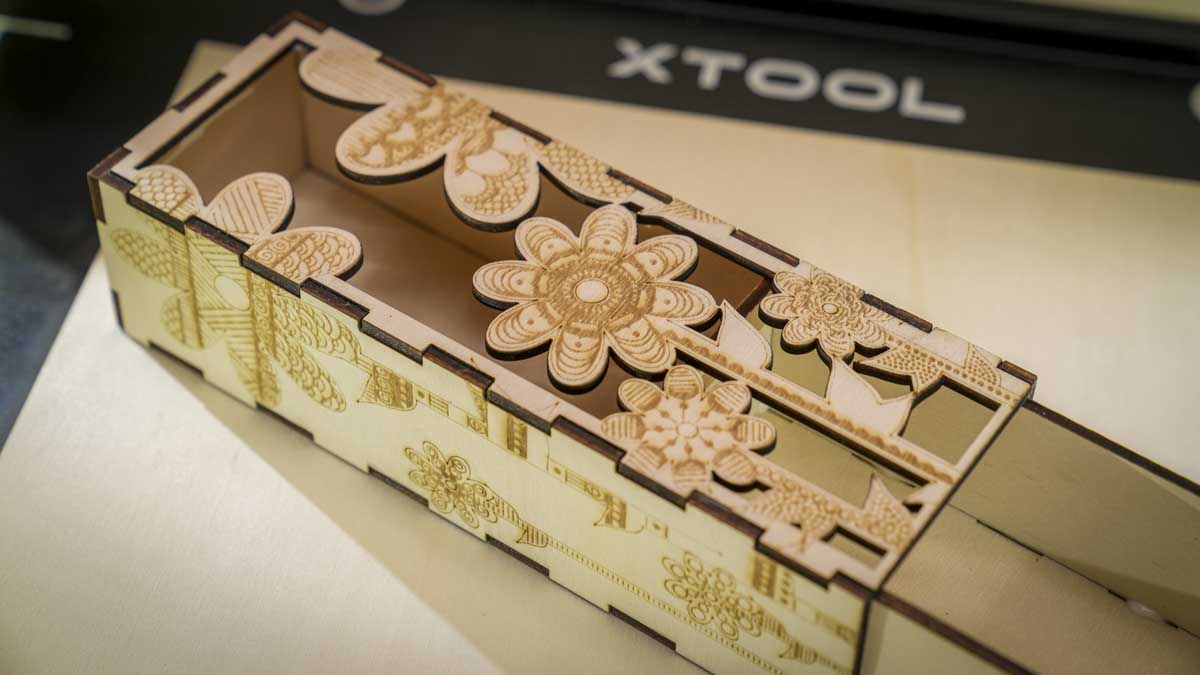
The xTool M2 is priced at the entry level of the company’s fully enclosed machines, but as ever there’s no mistaking it for anything other than an xTool laser engraver. As I got into using the machine, I could see just how finely tuned it is. Whilst it’s lighter weight than many of its more expensive siblings, the laser engraving power, even from the 10W laser in my review sample, was exceptionally good.
Having reviewed these laser engravers for a few years now, there are several essentials I look for in any laser engraver for TechRadar Pro, and one top priority is that it’s fully enclosed. While I might’ve looked at fully open designs earlier on, these days there’s really no excuse for an open-frame design other than cost. When it comes to running a business, safety is obviously paramount, so it makes sense to look for a fully enclosed rather than open-frame design.
Beyond the physical design, I’ve found a few extras that really help with the review process, simplifying the cutting, engraving, and placement of materials such as cameras. Then there are added features, such as air assist, that are essential for creating clean, crisp lines and reducing scorching.
Latest Videos FromTechRadar
What’s surprising for a machine of this price is that the M2 ticks all the boxes. It has dual cameras, one that gives you a good view of the entire workspace and a second that gives you a close-up view, air assistance built in, and, as ever, there’s a vent at the back that you can attach to your air filtration system.
But it goes even further by adding more head module options, so you can not only laser cut and engrave but also print and cut. Of course, coming from xTool, it also has a range of accessories that can further expand what you can do with this machine.
I’ve had the M2 for a couple of months and have really been able to give it a more extensive test than I usually would with these machines, partially because I’m interested in getting some of these for use within an educational establishment, and making sure that it’s easy, secure and robust enough is a major focus.
I’ve also been asked by several friends who have been looking at laser engraving machines and which option they should go for. At this price point and with the 610 × 569mm dimensions, it just, on paper at least, looks like a great option.
Sure enough, while I only have the 10W laser model to review in this test, I have looked at previous XTool machines with multiple module heads, and they’ve worked exceptionally well; I will take a look at the print and cutting heads later.
Initial setup was easy, and after I’d run through the unpacking, installing the module head and powering up, it was then just a case of connecting the USB cable directly to my MacBook Pro, installing xTool Studio, waiting for it to connect, allowing the firmware to update, and it was time to start.
The one slight oddity with the modular head is that it installs magnetically, although it requires a connecting cable for data from the head to the machine, which I found a little odd. Why this isn’t wireless or just uses contacts, I have no idea; possibly just to keep costs down, but once that cable is connected, getting into the utilisation of the machine is all pretty fast.

What I like is that xTool has now introduced a safety video at the beginning, with a longer version that you can view online, and a really good tutorial which essentially enables you to get started with cutting projects such as placemats. You can see the results of this project in the pictures.
Those initial tutorials are essentially a no-brainer setup guide to using the M2, and when you run through those initial projects, which will take you less than an hour, you’ll be pretty proficient with how the machine works.
As ever, in the software you’re able to assign different parts to different cutting, engraving and scoring methods with a simple click; you highlight a path, enabling you to then assign it to whichever type of cut you want. Again, with xTool’s knowledge in the sector, this is all incredibly well thought out.
Essentially, over my two months with the machine, it sat in the corner of the workshop, attached to one of the xTool air filters, and ran seamlessly for every project I’ve thrown at it.
The workflow, from the ability to recognise the materials through to being able to preview so that you can accurately place your designs, and through to the cutting and extraction, all just works incredibly easily.
At present, if you’re looking for a new, fast, relatively cheap professional-level laser engraver for a small business, then you really can’t go wrong with the superb M2.
xTool M2: Price & availability
At present, the xTool M2 is available for $599 / £599 direct from xTool with the 10W laser. I’ve also often seen promotional offers on this price, so just keep an eye out.
If you’re looking for the colour print-and-cut bundle, which lets you make stickers and other projects, it’s available for $749 / £749. There’s also the deluxe bundle, which includes everything, available for $989 / £989.
The laser cutter and engraver is also widely available from online retailers like Amazon.
xTool M2: Design
Specs
Connectivity: USB computer connection confirmed; xTool software required.
Audio: Status buzzer
Camera: 5MP close-view camera + 16MP distance-view camera.
Size: 610 × 569 × 180mm
Weight: 12.3kg
Software: xTool software / xTool Studio ecosystem
Accessories: Depending on the bundle: laser module, CMYK inkjet module, RA3 Lite rotary system and other accessories.
Laser: 10W or 20W blue diode; optional 3W infrared module.
Laser work area: 426 × 320mm for 10W/20W modules.
Maximum XY speed: 600mm/s.
Maximum cutting claim: Up to 8mm basswood with 10W; up to 10mm with 20W.
Safety: Class 1 enclosed laser system.
The xTool M2 is instantly recognisable as xTool, with its sleek, simple white body and protective transparent yellow hinged lift-up lid. What’s impressive for a machine at this price is that it measures 610 × 569 × 180mm and weighs 12.3kg, which is handy, as I had to move it around quite a lot over the two months to install and remove other machines.
Part of the reason that this machine has been kept out in the workshop for so long is its manoeuvrability; when I needed it, I could just move it over to my computer desk. It was very easy to lift, carry and place, something that I don’t usually find with most of the laser engravers, other than the designs that I tend to avoid.
The full enclosure means this machine has a Class 1 laser safety classification, making it better suited to domestic small business and educational environments. If you work in a business, check whether your insurance covers this device classification.
The transparent upper cover helps keep everything safe; it’s yellow and prevents the laser beams from exiting the machine. It also lets you monitor the laser engraving, and the two internal cameras let you view what’s going on remotely.
What’s impressive is that the relatively low-profile design accommodates objects up to 100mm thick. This is essentially for direct cylindrical engraving and without the use of any type of riser base.
It’s also great to see that there is built-in air assist, essentially keeping the smoke away from the beam where the laser hits the material, something which is usually done by an external pump. However, you still ideally need an air filter to use with the machine, or you can vent it out a window.
On inspection, it does feel a little more plasticky than the more expensive xTool machines. However, it’s still a great-quality, solid machine; when I moved it around the workshop, it felt robust.
Another point here is that, with such a large transparent upper cover- something that I have had issues with on other manufacturers’ models in the past, especially splitting- the design of that lid is again good on my unit, although the hinges are free and not sprung or cushioned. After what must be hundreds of openings and closings, it’s still in excellent condition.
One of the slight oddities of the design, which seems to be the case with so many of these enclosed laser engravers, is that there’s no honeycomb grid included in the box. Instead, you get four magnetic clamps that clamp onto the corners of any material you place, plus four alignment markers on the base of the machine.
At first, I wasn’t overly impressed with the design of these clamps. I would’ve preferred the honeycomb grid. However, it doesn’t take long before you realise just how useful they are, and not only do they hold offcuts of work nicely and securely, but they’re also extremely easy to use. After a few days of using them, I warmed to them and now see them as a slightly preferred method, to the point where I’ve made a few additional ones on the Prusa Core One to add to the original four.

xTool M2: Features
What you get is a feature-packed machine from xTool, and in this review I’m focusing on the 10W laser, so that’s the entry-level version, but there is also a 20W blue laser available as well if you do need a little bit more power or, for that matter, speed.
Other modular heads are available, such as the 3W IR laser, which is designed for metal and plastic engraving. However, that’s not yet available on the market, and there’s an optional full-colour CMYK inkjet system with 1200dpi resolution and 40ml cartridge capacity. This is used alongside a cutter so you can create stickers and other printable objects.
One of the big features for me is the dual camera system. You have a 2-megapixel close-view camera and a 5-megapixel distance-view camera. These are both really useful, especially if you’re trying to refine the positioning of your designs.
From my experience with these machines, especially the F2 Ultra recently, I’d say this close-up camera is especially useful when using the 3W IR module and will probably also come in handy if you’re into printing stickers.
Like any product released today, AI plays a major role through the software. You have the automatic creation system, which is just a point-and-click system: give it a text description, and it will develop something for you.
But more than that, there’s also automatic material detection, which can essentially see what’s put into the workspace, evaluate it, and come up with a close match; through the test, I was really impressed with how well this worked. Essentially, once the material is detected, it adjusts all the settings to optimise for that material, rather than you having to look at a chart or work through trial and error.
Another major feature is the built-in adjustable air assist. You can adjust this in the software, but it essentially blows air across the laser, keeping the site where the laser meets the material clear of smoke. This means you get a much cleaner cut, and it also helps reduce scorching.
When it comes to file support, xTool, as ever, has an increasing library of assets that you can dip into to get straight into producing products. However, if you do want to import your own, then the new software supports SVG, DXF and PDF, and there’s plenty of flexibility, especially with the AI tool, to have a bit of fun with those files as well.

One feature I really like, especially when trying to cram as many designs onto one sheet of 3mm basswood as possible, is the new smart nesting and batch filters, which, again, are activated through the software.
These seemed to work really well, optimising the spacing on the sheet of basswood well beyond anything that I could do myself, and once again this helps to cut down on costs.
In the software, when I entered a few materials that weren’t recognised by the system, there is a huge material database. This can be a little daunting, but you can take control of the settings manually if you need to. Just do a quick test chart, and then you should have the settings that you need for engraving, scoring and cutting almost any material.
As ever, being from xTool, there’s a range of accessories, including a rotary engraving system for cylindrical and spherical objects. Still, there’s a full list, and it is extensive on the xTool website.
xTool M2: Performance
As ever with these laser engravers, they’re either quick to set up and calibrate or it takes most of the day; thankfully, because this machine is from the xTool stable, it’s extremely easy to unbox and get up and running. That said, the paper manual inside was a little on the sparse side, even for xTool.
However, two very large QR codes on the packaging link directly to the online setup instructions and manual, which include plenty of pictures and information. The point is that the setup is extremely straightforward: position the M2, remove all the packaging, plug in the power, install the laser module with the connecting cable to the machine, and switch on.
Then, in the software, wait for it to connect, run any updates and follow, firstly, the safety guidance, which is a very quick video of less than two minutes, and then follow the tutorials. After completing it, you should be up and running.
Once I’d created some of the tutorial projects, including the placemats, I moved on to my own projects, creating a few boxes, a small display shelving unit and a few other bits and pieces, including a bracket that I needed for my van, and throughout I was impressed with how quick and easy this machine is to use.
This is, of course, an entry-level machine in the pro market of laser engraving, so whilst the machine is extremely competent, through use you do start to notice a few small design points. These points highlight that this is an enthusiast-level machine rather than a pro-level one.
The first of these is the overall design. Whilst the design is solid and works exceptionally well, there’s no kill switch on the side. If you want to use this in education or most workplaces, you’ll need to add something to kill the power yourself.
But really, other than that, there is very little here that doesn’t impress, even when you’re used to using something like the xTool P2. For me, the workflow from the P2 down to the M2 is similar; it’s just a smaller machine.
While it is obviously slower and less powerful, that 10W laser module will happily cut through basswood up to 8mm thick, as quoted by the company. Although I didn’t have any 8mm basswood available, the 3, 4 and 6mm basswood that I generally use cut through with absolutely no issue whatsoever in a single pass.
The maximum speed for the cutter is 600 mm per minute, which is mid-range, and in the test you obviously reduce that depending on whether it is cutting or engraving. What really impressed me was the engraving resolution. If you want to do some really fine detail work, the M2 is an ideal solution, and converting images into halftone and then bringing those in got some stunning results.

As I went through the pack of test materials, including paper, wood and leather, I was just really struck by how easy the M2 is to use. The software is obviously great, but those two cameras do make a real difference to the precision of the laser, enabling you to get a preview of the material and really closely align the design to a fraction of a millimetre, which is far better than I have seen on even a lot of fibre lasers, where pure accuracy is definitely needed.
What strikes me about the xTool M2 is that it makes a lot of the more expensive xTool laser engravers a little bit obsolete. You get a relatively lightweight machine you can shift and move around, take off the work surface, and easily place on a lower shelf when not in use, freeing up loads of space.
You get a 10W laser for general work, and you can purchase the 20W when you need a little extra power or speed, plus a modular head system with the inkjet so you can push it for further projects.
What I liked was that the workspace area inside the machine is pretty decent, and whilst it’s not the largest out there, it’s surprisingly large for a machine of this size and far easier and safer to use than any open-frame laser engraver on the market.
While in this review I’ve looked at the M2 in isolation, it is worth pointing out that alongside the laser engraving machine, I have also added in the extractor filter, which is essential. I will update this review with the print head and cutter and possibly the 20W head at a later date.
xTool M2: Final verdict
The M2 is really easy to recommend. It’s a very well-priced, fully enclosed laser engraving machine.
A few things really make it stand out against much of the competition, including the built-in air assist, so no extra devices are sitting around on the work surface. But for me, what appealed was that I could quickly lift it and stow it away.
It’s a big machine, but at just over 12kg it’s not particularly heavy, and it’s quick and easy to disconnect and then plug back in.
Unlike some machines that require you to disconnect various pedal switches, air assist, and more, the M2 took a couple of minutes to disconnect and stash, then bring out and get up and running again.

In the workplace, one major downside is that it doesn’t have that kill switch on the side, which will be an issue. Still, everything else is simple, and if you’re a small business, it makes a lot of sense.
Here you have a high-quality, high-end enthusiast or pro-level machine with a 10W laser. This lets you engrave plenty of materials, and you can also add the inkjet module to create stickers if you want. Plus, with a rotary tool, you can flip the head from vertical to horizontal to engrave cups, mugs, and more.
I’ve looked at plenty of these laser engravers over the last few years, and the xTool machines have always stood out for quality and attention to workflow; the M2 is especially polished for its price point and the audience it’s aimed at.
|
Value: |
One of the most versatile machines that I’ve looked at for the price, making it exceptional value |
5 |
|
Design: |
Great design; I just wish there was no need for the cable between the head and the machine |
4.5 |
|
Features |
Excellent range of features, and with a modular head and accessories, the possibilities are enormous |
4.5 |
|
Performance |
SSpeed, cutting power, and workflow are well balanced at this price range |
4.5 |
|
Total |
A superb, fully enclosed laser engraver at this price and a perfect option for any small business |
5 |
Buy it if…
Don’t buy it if…
For more crafting tech, I’ve tested and reviewed all the best 3D printers and the best laser engravers.






















































You must be logged in to post a comment Login