Three years to the day after settling a bruising legal fight over trade secrets, Archer Aviation is buying the company that once sued it. On Monday, Archer and Boeing announced definitive agreements under which Archer will acquire Wisk Aero along with two other Boeing subsidiaries, SkyGrid and Insitu. In return, Boeing will receive a substantial equity stake in Archer, warrants for more shares later, a board seat, and continued access to key autonomy technology.
Archer, a California-based air taxi startup still struggling to thrive in commercial air taxi journeys, has accepted to the complete package of Boeing’s advanced autonomy and unmanned aircraft ventures. Wisk has spent several years building fully autonomous electric vertical takeoff and landing aircraft. He has successfully designed, constructed, and flown six successive versions of these machines, conducting more than 1700 flight tests. In December 2025, their most recent full-scale prototype, Generation 6, was able to take to the air. In order to keep autonomous aircraft safely in sync with both traditional crewed aircraft and each other, SkyGrid is developing digital air traffic management software. Building and maintaining military drones, which are used for intelligence, surveillance, and reconnaissance, is the main focus of Insitu’s business. These drones have flown over 3500 aircraft, operate in 35 countries, and generate over $200 million in revenue annually.
Due to platform compatibility issue, the DJI Fly app has been removed from Google Play. DJI Neo must be activated in the DJI Fly App, to ensure a…
Lightweight and Regulation Friendly – At just 135g, this drone with camera for adults 4K may be even lighter than your phone and does not require FAA…
Palm Takeoff & Landing, Go Controller-Free [1] – Neo takes off from your hand with just a push of a button. The safe and easy operation of this drone…
Boeing will receive newly issued Archer Class A shares equal to 19.75 percent of the shares outstanding immediately before the deal closes. That translates to roughly a 16.5 percent ownership stake once the new shares are issued, as well as two warrants that will provide them an additional $100 million when they come to utilize them (at $13 & $17.88 per share). The arrangement of this purchase is rather simple and all-stock. Boeing has the authority to designate one of their own directors to serve on the board of Archer as long as they maintain their ownership of the company. Finally, a tech-sharing agreement between the two businesses allows Boeing to continue utilizing Wisk’s fundamental autonomous flight capabilities in their own commercial and defense initiatives.
Advertisement
It is all set to close by the end of 2026, if they receive regulatory approval, which will include an antitrust investigation. May 2027 is one of the dates they will need to work toward. For Archer, the impact of getting their hands on Insitu comes very soon. They’ve been struggling to make any kind of revenue from their air taxi work so far, so this brings them a lot more cashflow from the defense business, as well as customers and operational scale, all while the passenger carrying electric aircraft work takes a little longer to get certified and off the ground. The technology they receive from Wisk and SkyGrid will be directly integrated into Archer’s own plans, as they have been working on something called the ZEE AI foundation model for some of the most complex aero and defense applications. They hope to kick things off in the self-flying air taxis and autonomous systems space by combining the flight time of acquired teams (almost two million hours) with the work they already have going on. [Source]
Roblox is home to thousands of games across different genres, and many of them go beyond action and simulation. Some of these games offer players the opportunity to learn about ancient civilizations, geography, and other cultures. These four Roblox games would be perfect for you if you are an adventurer who learns while having fun.
1. Click the Flag!
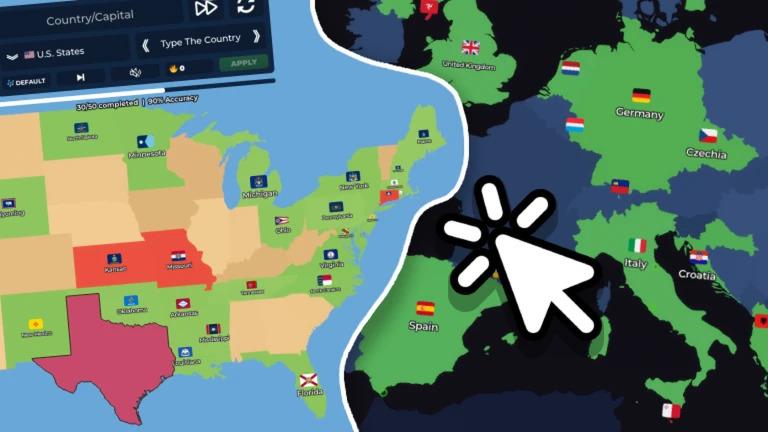
Click the Flag! is a geography-based game that tests your ability to recognize the flags of various nations and states around the world. The game includes different modes that make gameplay entertaining and interesting. Click the Flag! will help you develop your memory skills and increase your knowledge of geography in a fun way. It is the right game for those who like quizzes.
2. Queen Zenobia
Queen Zenobia is a game that is based on the life of Zenobia, who was the queen of the ancient civilization of Palmyra. In this game, you remain seated on the throne and make various decisions as various characters such as citizens, generals, merchants, and envoys ask for your advice. These decisions determine the fate of the kingdom in terms of wealth, military, and popularity.
The game further enhances the historical aspect by comparing your decisions with those of Queen Zenobia. The combination of strategy, history, and decision-making makes this game very interesting to play for people who like decision games.
3. 1867 Historical Role Play
1867 Historical Role Play recreates the experience of living during the Victorian Era through a virtual village that accurately reflects 1867. The environment in the game is developed based on photographs and other documents from the past. It includes numerous tasks such as performing jobs, rowing a boat, rat hunting, gathering coins, etc.
The experience gives players a look at everyday life in the 19th century. It keeps the gameplay engaging through role-playing and exploration. It is a great pick for history enthusiasts and players who enjoy immersive gameplay.
4. Where Am I?
In the “Where Am I” game, the process of geographical experience becomes interactive by placing the player into different sites around the world. To do it correctly, you have to take hints from elements such as road signs, architecture, landscapes, and popular landmarks. To play the game successfully, you need to observe your environment and make reasonable assumptions. It will be fun to explore places around the world and learn more about different regions and their cultures through this game. This Roblox game will be ideal for people who like traveling and geography.
A year ago, Armour Home told eCoustics that appointing American Audio & Video as the exclusive North American distributor for Q Acoustics, QED and Goldring would help accelerate growth and increase the visibility of all three brands. It made sense. These were hardly unknown quantities: Q Acoustics had built an enviable reputation for affordable loudspeakers that routinely punched above their price, Goldring had more than a century of analog credibility behind it, and QED had been connecting systems since most of us were still trying to figure out which end of a DIN plug went where.
And then things got strangely quiet.
That observation comes from someone who actually uses the products. I own five pairs of Q Acoustics loudspeakers that rotate through different systems and rooms, and QED cables are part of several of them. Our contributors have reviewed and recommended products from all three brands for years. The issue was never whether Armour Home could build good products. The problem was that while competitors including KEF, ELAC, Klipsch, Monitor Audio, Cambridge Audio, Audio-Technica, Ortofon and Grado kept fighting aggressively for dealer floors, reviews, social feeds and consumer attention, Armour Home’s North American presence became much harder to see.
Charlie Henderson apparently sees the problem as well. The former Cambridge Audio CMO and Naim Audio Managing Director took over Armour Home in May 2026, and when we asked whether Q Acoustics,QED and Goldring currently receive enough dealer support and visibility in the United States, his answer was refreshingly concise: “Not yet.” That matters, because Henderson has not been hired merely to polish three logos and issue press releases about another pair of loudspeakers. Armour wants him to rethink how these brands work together, how they reach consumers and how they move beyond the increasingly small hi-fi bubble. And if younger consumers have never walked into a specialty audio retailer outside of Best Buy, how exactly does Armour Home expect them to hear any of it?
Good products are no longer enough. Armour Home already has those. We wanted to know what comes next.
Advertisement
Related Reviews:
Armour Home Wants an Ecosystem, Not Three Islands
Henderson does not describe his mandate as tearing Armour Home apart and starting over. His word is “evolve,” specifically evolving the brands while defining a clearer mission for where the company goes next.
That mission involves moving “beyond the HiFi bubble into music culture,” with Armour spending more time listening to artists, producers and fans rather than focusing primarily on trade shows and industry meetings. There is a marketing component to that, obviously, but Henderson also sees a structural opportunity that Armour has not fully exploited.
“The link between our three-brand portfolios” is what he considers the company’s largest missed opportunity. Q Acoustics, Goldring and QED have largely existed as recognizable individual brands, but Henderson sees an opportunity for them to share engineering, R&D and creative resources without turning them into variations of the same thing.
By the end of 2027, he wants consumers to see “bolder and more confident design and personality,” greater alignment of technologies across the ranges and much closer engagement with music.
Advertisement
Goldring brings 120 years of analog experience. QED has been designing cables and connectivity products since 1973. Q Acoustics has spent two decades playing the challenger, often delivering loudspeakers that compete rather effectively with more expensive alternatives. Henderson believes technologies can move between those worlds, even suggesting that Armour could explore using Q Acoustics’ Gelcore technology beyond loudspeaker cabinet design and fine tune QED products specifically around its turntable and loudspeaker portfolios.
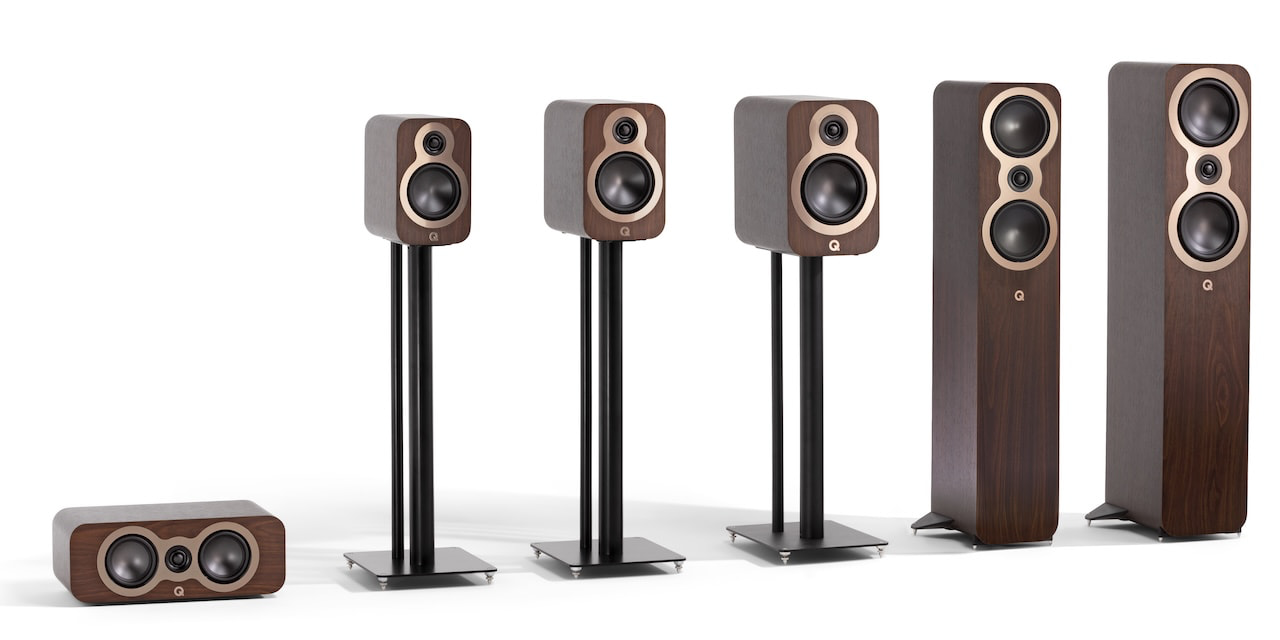
Q Acoustics M40 Micro Tower Wireless Speakers in Walnut
Q Acoustics Has to Move Beyond Bluetooth
Q Acoustics has done very well with conventional passive loudspeakers, and products like the M40 have demonstrated that there is also a market for compact powered models. But Bluetooth alone is no longer enough if the company intends to compete seriously for consumers who increasingly expect their loudspeakers to connect directly to televisions, streaming services, smartphones and multiroom systems.
Advertisement. Scroll to continue reading.
We asked Henderson directly whether Q Acoustics needs a fully networked active loudspeaker platform rather than simply another Bluetooth powered speaker.
Advertisement
“We’re watching with interest the ongoing shift to convenience solutions in audio and see a place for both Bluetooth and Wi-Fi solutions,” Henderson said.
That distinction matters. Wi-Fi opens the door to higher resolution streaming, app control, network integration and potentially multiroom playback in ways that Bluetooth alone cannot. It also puts Q Acoustics into a much tougher fight against companies that have spent years developing their connected ecosystems.
Henderson considers HDMI eARC particularly important because of the growing intersection between music and television audio. Room correction, however, is something he views as having more specific use cases rather than being universally essential. What he does consider universal is something the hi-fi industry still manages to screw up with surprising regularity: ease of use and reliability, particularly when an app sits in the middle of the experience.
Armour Home is not announcing its own software platform, nor did Henderson disclose a partnership with WiiM, BluOS, Google or another specific technology provider. He said the company already works with multiple partners across its brands and “regularly evaluate[s] our software strategy to keep up to date with tech developments and innovation.”
Advertisement
Could an Armour Home Amplifier Be Next?
There is another rather obvious hole in the ecosystem.
If Armour Home wants consumers thinking about Q Acoustics, Goldring and QED as pieces of a complete music system, somebody still has to provide the electronics that sit between the source and loudspeakers.
Would Armour consider building its own integrated amplifier or network amplifier?
“Never say never,” Henderson replied, before adding that the current focus remains Q Acoustics’ family of traditional and connected loudspeakers.
Advertisement
Then came the more interesting part.
“I would be lying though if I said I hadn’t been thinking about opportunities.”
An Armour Home network amplifier connected to a Goldring turntable through QED cables and driving Q Acoustics loudspeakers would suddenly make the word “ecosystem” considerably more meaningful.
Advertisement. Scroll to continue reading.
Advertisement
Q Acoustics Is Not Content Being the Affordable Alternative
There is also a larger positioning question for Q Acoustics.
The company built much of its reputation by embarrassing more expensive loudspeakers. That is a fantastic way to get noticed, but eventually a successful value brand has to decide whether it wants to remain the less expensive alternative forever.
Henderson’s answer to whether Q Acoustics can move further into premium products without abandoning the value proposition was unequivocal: “100%.”
“Our reputation has been built as a challenger to the established speaker brands,” he said. “But built up over 20 years, we are no longer the new kids on the block, no longer teenagers. We have proven our design and acoustic capabilities time and time again, and now have a reputation based on performance not price.”
Q Acoustics does not want its identity permanently defined by being cheaper than KEF, Bowers & Wilkins, Monitor Audio, ELAC or anybody else. The company believes it has accumulated enough engineering credibility to compete on performance first.
Advertisement
Goldring May Have the Largest Room to Grow
If Q Acoustics already has the broadest consumer visibility of Armour Home’s three principal brands, Goldring may offer the greatest opportunity for expansion.
Goldring GR3 Turntable with Q Acoustics M20
The company is best known for phono cartridges, but the GR3 turntable changed the conversation. We asked Henderson whether it was the beginning of a broader Goldring turntable range.
He did not exactly slam that door shut.
“Goldring is central to our portfolio and mission to move beyond the HiFi bubble into music culture. Vinyl sits at the heart of this. So, more to come…”
Advertisement
Goldring currently spans a substantial cartridge price range, with the E Series beginning at $119 and the Ethos SE reaching $1,999. The GR3 turntable with an E3 cartridge sells for $1,299. Henderson clearly believes the Goldring name has permission to travel beyond cartridges and a single turntable.
When we asked whether that could include phono stages, electronics, record cleaning products or even complete analog systems, Henderson responded that he would “find it hard to think of another brand with more permission.”
The wider Armour family also includes Milty, known for its anti-static gun, cleaning products and Exstatic record sleeves. Put those pieces together and the analog ecosystem begins to look considerably more developed than it first appears.
Advertisement. Scroll to continue reading.
Advertisement
Goldring at 120 Is Not Just About Looking Back
Goldring’s 120th anniversary creates another opportunity, and Henderson strongly suggested that whatever Armour has planned will be about more than putting a commemorative badge on an existing product.
“Whatever we reveal in due course will reflect this and will underpin the importance of Goldring not just in the Armour Home family, but for the audio community as a whole, as well as informing the direction of Goldring for the next chapter of its history.”
What Henderson does make clear is that the anniversary will help define Goldring’s future direction.
He is also willing to use outside expertise where appropriate. Henderson says Goldring remains fiercely protective of its design heritage, but does not view authenticity as requiring every component of every future product to be created internally.
The company will partner where it believes doing so brings the right technologies together. The non-negotiable part, according to Henderson, is maintaining the integrity of Goldring’s design philosophy and balancing its heritage with contemporary materials and technology.
Advertisement
Is QED Ready to Cut the Cable?
Perhaps the most unexpected part of Armour’s future strategy involves the company whose entire identity is built around connecting things with wire.
QED is thinking about wireless.
Henderson would not disclose which specific wireless product categories Armour is considering, saying the company is “keeping things close to our chest for now.” But when we asked whether QED could develop products that make passive loudspeakers wireless or network compatible, his answer was considerably more interesting.
“Quite possibly. QED has always been about making the connections, and wireless tech has got us thinking for sure.”
There is a certain irony in a cable company helping consumers eliminate cables, but Henderson does not see a credibility problem.
“Demand for convenience (and wireless) is clear,” he explained, adding that QED intends to support those customers with the same enthusiasm it applies to listeners who continue to prefer traditional wired systems.
The bigger opportunity might be obvious. Millions of passive loudspeakers are already sitting in homes, and consumers increasingly want streaming convenience without replacing everything they own. A QED product designed to bridge those two worlds would make considerably more strategic sense than introducing another slightly different cable and hoping consumers can work out where it sits in the range.
Advertisement. Scroll to continue reading.
Which brings us to another issue.
Advertisement
We asked Henderson whether QED’s lineup needs simplification so consumers can understand the differences without carrying a spreadsheet into the dealer.
He acknowledged the problem.
“It is true that it can sometimes be hard to navigate through a portfolio in this industry, and we are by no means exempt from that. News to come soon on this as we refresh and update our approach to the category.”
Armour Home Knows It Has a U.S. Visibility Problem
All of these product ideas become academic if consumers never see them.
Advertisement
When asked what Armour Home needs to change to grow more aggressively in the United States, Henderson did not blame tariffs, competitors or consumers suddenly losing interest in hi-fi.
His answer was two words: “Brand awareness.”
Henderson acknowledged that Armour’s recent U.S. strategy has been primarily direct to consumer with limited in-store presence. He also described the American specialist audio retail environment as “world class” and said he intends to rekindle relationships with former retail partners.
We pushed further. Are Q Acoustics, Goldring and QED receiving enough dealer support and visibility in the United States today?
Advertisement
“Not yet.”
The U.S. specialist dealer network may be excellent, but it is not 1987 anymore. Consumers can walk into an Apple Store, Best Buy or phone retailer almost anywhere and experience the latest personal technology. Finding a store where someone can demonstrate the difference between two pairs of passive loudspeakers, explain cartridge setup or show why one cable product exists alongside six others requires considerably more effort.
Armour needs dealers, but dealers cannot be the entire strategy.
Advertisement. Scroll to continue reading.
Advertisement
Forget the Weekend Pop-Up. Henderson Wants Permanent Listening Spaces
One of the more intriguing pieces of the plan involves putting Armour Home products into spaces where people are already engaging with music rather than expecting consumers to discover hi-fi through the traditional retail funnel.
Conversations are already underway about potential listening spaces in Brooklyn, including discussions involving Grado, which Armour distributes in the U.K. Henderson says conversations are also taking place elsewhere in the United States.
He is particularly interested in Japanese Kissa listening bar culture, and notably does not believe Armour should restrict the idea to New York, Los Angeles or the other predictable major markets.
“The solution is not necessarily the biggest cities or obvious choices for city locations,” he explained.
Advertisement
That could prove far more interesting than another hotel room demonstration at an audio show.
Henderson is also skeptical of temporary promotional installations. When asked how much Armour was prepared to commit beyond short-term events, he replied that he is “not a fan of temporary promotional events.”
“Our mission is clear, when we talk about being a part of music culture it means that we are physically embedded in these spaces. Not for a weekend, but for everyday.”
Armour says it is open to requests from venues that share that perspective and will evaluate opportunities individually.
Advertisement
There are no announced locations, budgets or opening dates yet, so this remains an ambition rather than an established U.S. network. But the premise makes sense.
If younger consumers are not walking into hi-fi stores, putting good audio systems into places where they already listen to records, drink coffee, socialize and discover music might be a more productive introduction than waiting for them to spontaneously develop an interest in two-channel retail.
Younger Listeners Are Coming to Hi-Fi From a Different Direction
Henderson also rejects the idea that younger listeners are interested only in headphones, Bluetooth speakers and soundbars.
His reasoning comes partly from his time at Skullcandy, when portable listening dominated the younger market, and partly from what he sees happening around vinyl now.
Advertisement
Advertisement. Scroll to continue reading.
“Younger listeners want access to their music full stop,” Henderson said.
He points specifically to what he calls the “inheritance community”: younger listeners who are handed down a turntable, amplifier or pair of loudspeakers and subsequently begin exploring more traditional audio systems themselves. Henderson says that trend has also contributed to increased interest in older electronics.
That is a consumer the traditional hi-fi industry should be paying considerably more attention to.
Advertisement
Someone inheriting Dad’s amplifier and a pair of 30-year-old loudspeakers is not necessarily looking for a $20,000 system. They may need a turntable, cartridge, cable, compact pair of loudspeakers or an easy way to stream Spotify or Qobuz through equipment built before Wi-Fi existed.
Smaller Rooms Are Changing the Products Too
Q Acoustics M20 HD Powered Wireless Speakers
Armour is also paying attention to where younger customers actually live.
Smaller homes, apartments and desktop systems are increasingly important, and Henderson points to the ongoing demand for the Q Acoustics M20 powered loudspeakers as evidence that customers want compact products as they move beyond headphones and portable Bluetooth speakers.
He says Q Acoustics will continue expanding in that direction alongside its traditional passive loudspeaker range.
Modern interiors are influencing the conversation as well. Henderson says Armour sees opportunities to use more contemporary materials while paying closer attention to color and fashion trends.
Advertisement
Before anyone reaches for the audiophile smelling salts, this is not an admission that engineering suddenly matters less than whether the loudspeaker matches the sofa.
It is recognition that products live in rooms.
For decades, the audio industry has occasionally behaved as if normal consumers should simply accept a pair of enormous black boxes in the living room because somebody produced an impressive waterfall plot. That argument becomes more difficult when buyers have dozens of visually sophisticated consumer electronics alternatives competing for the same space.
Competing With China Requires More Than a Spec Sheet
The value equation is becoming harder as well.
Advertisement
Advertisement. Scroll to continue reading.
Chinese manufacturers have demonstrated that enormous feature lists, excellent measured performance and aggressive pricing can coexist. That puts pressure on established British, European, Japanese and American audio manufacturers that can no longer assume heritage alone will justify the difference.
Henderson says Armour does not intend to compete solely on price.
“We pride ourselves on our design, engineering excellence and product quality,” he said. “We strive to develop and support products that are defined through understanding our audience, not just responding to tech opportunities.”
Advertisement
He also believes British design and brand heritage still matter when consumers compare products online, but his reasoning goes beyond sticking a Union Jack on the carton.
In a market increasingly influenced by AI recommendations, Henderson believes reviews, customer feedback, reputation and experience will become even more important. That places an even greater burden on Armour to make products people actually use, recommend and understand.
Entry Level Still Matters
Material and component costs are also creating pressure, particularly at QED, where Henderson says volatility in raw materials and metal prices has created challenges. Armour says it is using forecasting and future product planning to manage those costs while maintaining performance and quality.
More importantly, Henderson says the company remains committed to entry-level products.
“We see our role as ensuring that we offer systems and components that enable the widest possible audience to fall in love with music.”
That does not mean cramming every possible feature into the cheapest product.
Henderson argues that fewer features at lower price points can sometimes be an advantage because reduced complexity can make a product more desirable and easier to use.
He has a point.
Advertisement
The affordable audio market does not necessarily need another app with 14 menus, three firmware updates during setup and a privacy agreement longer than the Torah. Sometimes a good pair of loudspeakers, an amplifier with the connections people actually use and a product that works every morning is the stronger value proposition.
Advertisement. Scroll to continue reading.
And There Are Parts of High-End Audio Armour Wants No Part Of
Our final question may have produced Henderson’s most revealing answer.
We asked which product category Armour Home would deliberately avoid regardless of market demand.
Advertisement
Rather than naming a specific category, Henderson took aim at “some of the more controversial extremes of high-end audio,” particularly products supported by what he called “‘lightweight’ technical evidence.”
“For me, our role and responsibility is to deliver the best music experience, and not simply to try and maximise the $$$ from a customer.”
Henderson would rather customers have money left for concerts, listening bars and artist merchandise.
Armour Home wants Q Acoustics, Goldring and QED to become more connected without losing their identities. It wants more technology, but not technology merely because another manufacturer put it on a spec sheet. It wants premium products without abandoning entry level customers, stronger U.S. retail relationships without relying exclusively on traditional dealers, and more involvement in music culture without treating every interaction as a weekend marketing activation.
Advertisement
The Hard Part Starts Now
There is a lot to like in Henderson’s vision, and there are also plenty of unanswered questions.
We still do not know what a true Armour Home ecosystem will ultimately include. There is no confirmed Q Acoustics Wi-Fi platform, Armour amplifier, expanded Goldring electronics range or QED wireless product to put on a calendar. The proposed American listening spaces are still in the conversation stage, and Henderson openly acknowledges that dealer support and visibility in the United States are not where they need to be.
That makes the next 18 months considerably more important than another round of awards.
Q Acoustics, Goldring and QED do not need to prove that they can make excellent products. They have already done that. They need to make themselves easier to discover, easier to experience and easier to understand as parts of something larger.
Advertisement
Charlie Henderson clearly has ideas about how to make that happen.
Conspiracy theories do not simply explain events, they identify villains – and Fauci has become one of the most popular in this particular story.
In the years since the pandemic, U.S. Sen. Rand Paul and others have accused Fauci of many things, but the central conspiracy accusation is that Fauci helped enable the COVID-19 pandemic through U.S.-funded research at a lab in Wuhan, China, and then participated in a coordinated government-scientific cover-up, misleading Congress to conceal that connection and suppress the laboratory-leak explanation. Paul, a Republican, has repeatedly called for Fauci’s prosecution.
That investigation ultimately endorsed a central claim of the conspiracy narrative: the House GOP’s COVID-19 investigation concluded the virus most likely leaked from a Wuhan lab, that Fauci helped shape a scientific paper dismissing that theory, and that he privately testified the “six feet apart” guidance “sort of just appeared” – though these are the conclusions of a partisan committee, not an independent inquiry, and Fauci and Democratic members have disputed them.
I’m an associate professor of sociology and criminology, and my scholarship focuses on far-right networks and digital radicalization – the exact ecosystem where these conspiracy theories have taken root and spread. My research on how these movements evolve online and intersect with political activists and extremist networks was directly relevant to tracing how COVID-origin claims moved from fringe communities into mainstream political discourse.
Fauci’s decision to invoke the Fifth Amendment, which he and his lawyer explained not only as a basic constitutional right but also a strategy to avoid the possibility that Paul might try to prosecute him for lying to Congress based on anything he might say, may be politically explosive and provide his opponents with another talking point. But, in my assessment, the spectacle says more about what happens when conspiracy theories become embedded in political institutions than it does about the origins of COVID-19.
From uncertainty to conspiracy
COVID-19 created the conditions in which conspiracy theories flourish: enormous uncertainty, frightening consequences, rapidly changing information and distrust of institutions.
These questions were legitimate. Problems emerged when those questions became connected to a predetermined conclusion: Powerful people either created the pandemic or concealed the connection to the lab in Wuhan.
A 2021 survey by the Public Religion Research Institute illustrates how widespread one version of this thinking was. About 4 in 10 Americans – 39% – agreed that the coronavirus had been intentionally developed by scientists in a laboratory. Among QAnon believers – a sprawling conspiracy theory claiming that a cabal of powerful elites, often portrayed as child-trafficking Satanists, controls government and society and that Donald Trump was secretly fighting it – the figure was dramatically higher, at 85%. The same survey found that people who embraced anti-elite and anti-expert attitudes were more likely to accept coronavirus conspiracy theories.
Conspiracy thinking is rarely isolated. For example, a person who comes to believe that public health officials are secretly manipulating information may be more receptive to claims that vaccines contain hidden dangers. Someone who distrusts pharmaceutical companies may be more receptive to claims that the pandemic was engineered for profit. Someone who believes powerful elites routinely operate in secret may be more receptive to broader conspiracy narratives such as QAnon.
Advertisement
These beliefs can reinforce one another, creating a broader worldview in which institutions, experts and government officials are presumed to be acting deceptively.
The Fauci conspiracy
Because Fauci was highly visible during the pandemic, advising presidents and appearing on television, he quickly became associated with government efforts to control the spread of the virus.
Anti-vaccine activists incorporated him into broader narratives about pharmaceutical companies and public health agencies. Conspiracists took the story further, portraying Fauci as part of a secret effort to conceal the origins of COVID-19. Extremists connected these claims to older ideas about government tyranny, social control and corrupt elites.
The lab-leak question is not the same as a conspiracy theory
Asking whether SARS-CoV-2 emerged through either zoonotic spillover, which is when a virus jumps from animals to people, or through a laboratory-related incident is not inherently a conspiracy theory. Scientists and governments have legitimate reasons to investigate the origins of a pandemic.
The World Health Organization’s independent scientific advisory group reported in 2025 that much of the information needed to fully evaluate the competing hypotheses had not been provided by China. It concluded that the available evidence suggests spillover but maintained that the laboratory-leak hypothesis could not be ruled out.
Advertisement
There is, however, a distinction between investigating whether a laboratory accident might have occurred and claiming that scientists created a virus and intentionally released it. That distinction is important in returning to Fauci and the claims raised at the July 29 hearing: Were lawmakers investigating the possibility of an accidental laboratory release, or were they advancing the more conspiratorial idea that scientists deliberately created and released the virus?
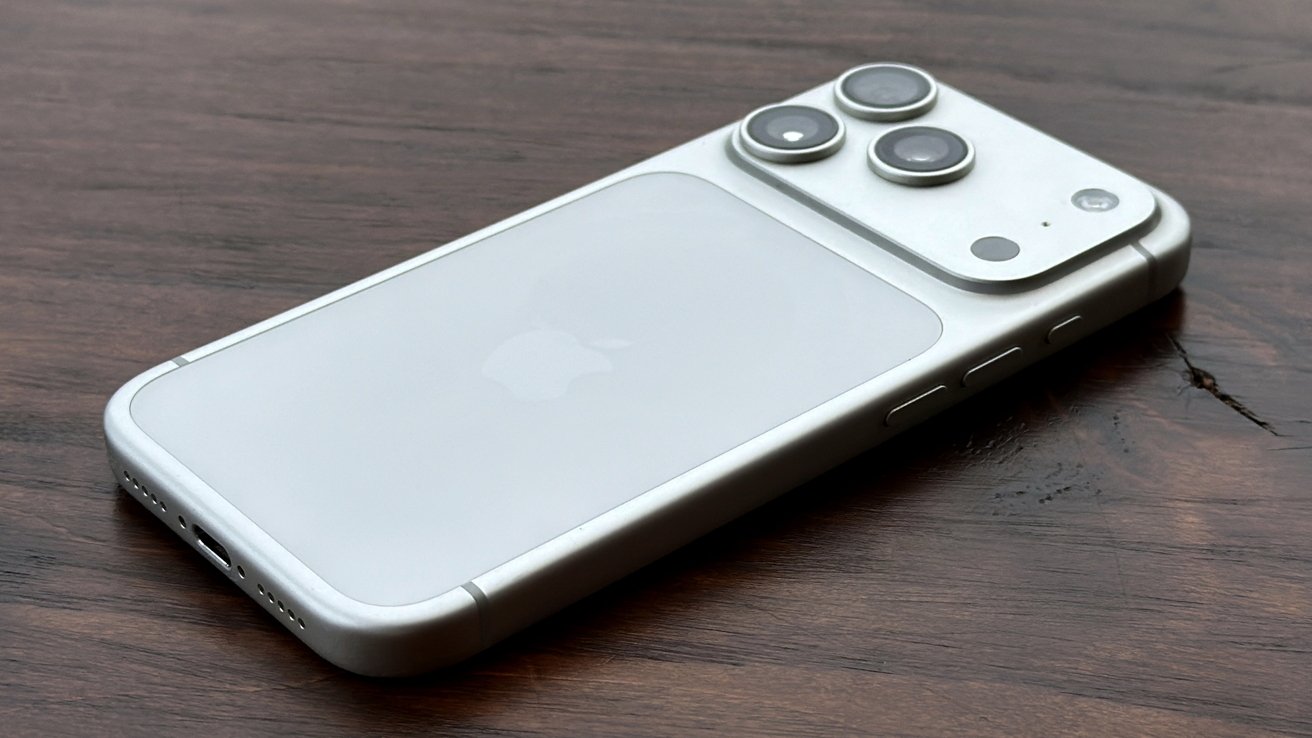
The all-glass iPhone Pro model expected in 2027 was rumored to have been canceled, but another report now suggests it is proceeding as planned.
A financial analyst firm, Jefferies, suggested the 2027 iPhone would no longer get an all-glass model. Another analyst has stepped in to suggest otherwise.
According to a report from Bloomberg Apple’s all-glass iPhone Pro expected in 2027 was still moving forward. The Jefferies report suggested that there was a low yield, and the new report counters that.
Apple is expected to reveal an all-glass iPhone 20 or iPhone 19, depending on the naming convention chosen, in September 2027. The iPhone 18 lineup hasn’t been revealed yet, but that won’t stop the rumor mill from looking ahead.
Advertisement
The all-glass iPhone 20 Pro
Okay, it won’t be “all” glass, as there still has to be a frame, motherboard, and other components, but you get the idea. The glass-focused model will have glass that curves around the edges and be supported only by a metal band in the middle.
Rumors have suggested the glass design is meant to be a physical representation of the software’s move to Liquid Glass. The latest report suggests that Apple wanted to use even more glass, but scrapped that concept early on.
Perhaps the Jefferies report had a half-truth: the 20th-anniversary iPhone with maximized glass usage was canned. However, the redesign itself wasn’t, it was just toned down.
When the iPhone X debuted in 2017, it was a significant design departure from the previous long iPhones with a Home Button. The design hasn’t shifted significantly since with the exception of moving to the Dynamic Island and going from camera bump to camera plateau.
Advertisement
The 2027 iPhone Pro models wouldn’t see such significant schedule changes this late into development, the report suggests. As Apple generally locks in a design a year out from the September reveal.
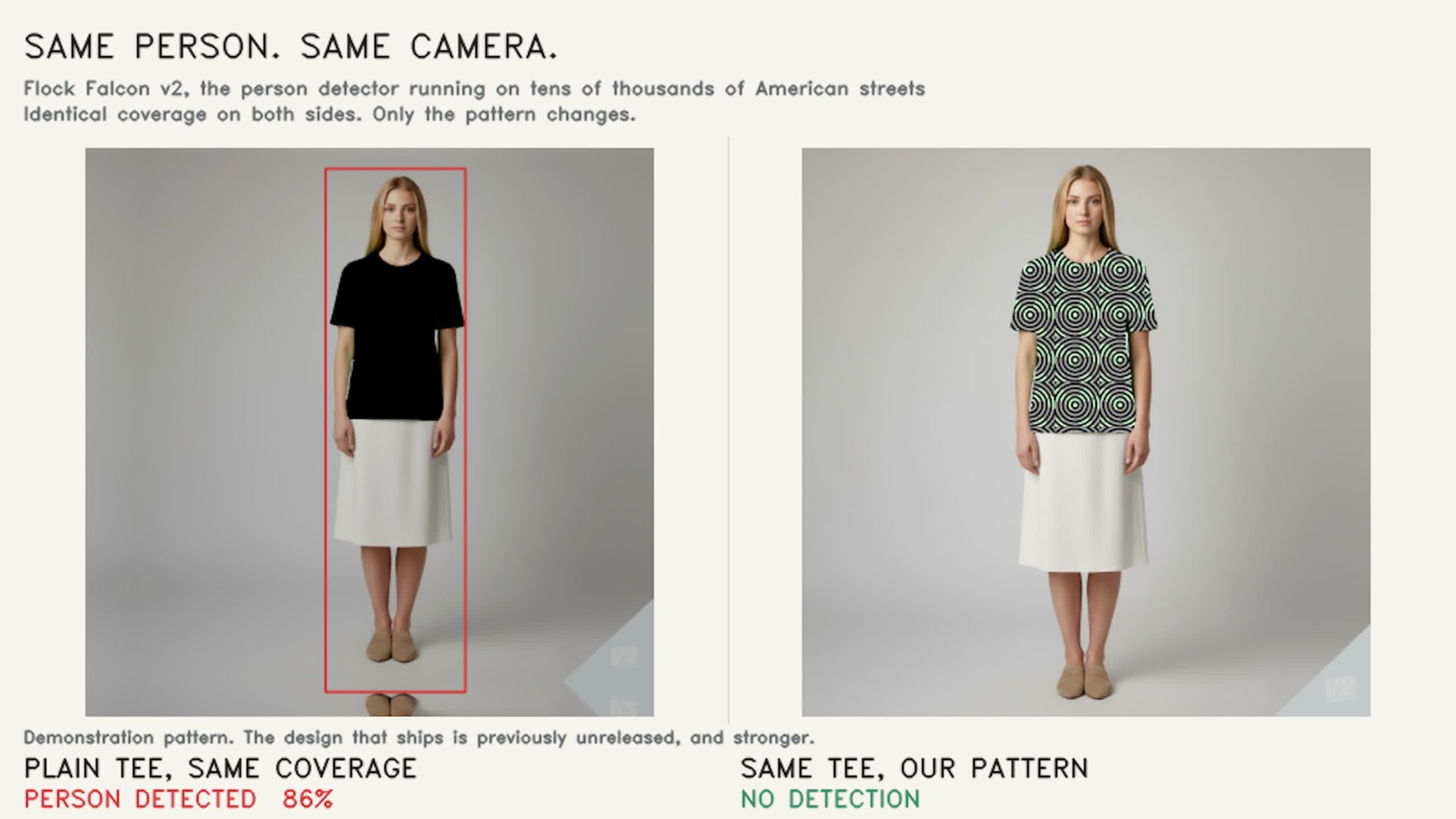
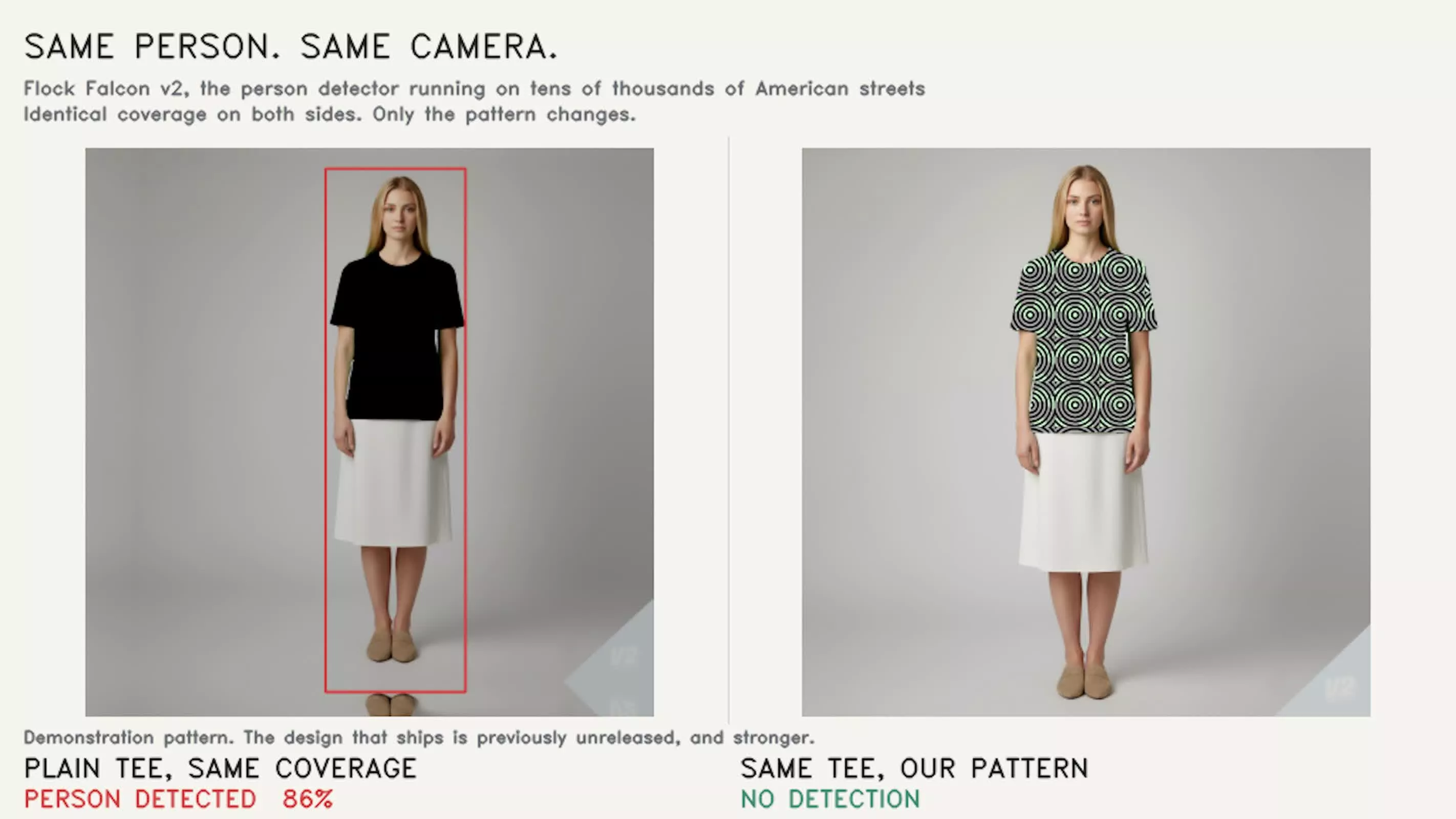
What just happened? Bill Swearingen’s noRecognition project is testing whether computer-generated patterns can interfere with software used to identify people, vehicles, and other objects on surveillance cameras. The project received its first public test Friday at the Def Con cybersecurity conference in Las Vegas. Swearingen worked with Donut Media to cover a 2009 Toyota Yaris with one of his patterns and drive it past a Flock camera. “We proved it was effective,” Swearingen, a cybersecurity professional and founder of SIXCYBER, told TechCrunch.
Donut Media plans to release video of the test in the coming weeks.
The pattern does not stop a camera from recording. Instead, it is designed to prevent the software connected to the camera from recognizing what it sees. A person or car wearing the pattern would still appear in the footage, but the detection system may not flag it as a person or vehicle.
That is the central idea behind noRecognition. Swearingen wants to make it harder for automated camera systems to track people in public spaces. He said the project is intended to give people a way to “opt out of being tracked.”
Advertisement
“Privacy is a fundamental right,” Swearingen said.
Swearingen has spent the past year building and testing the system from his home in Kansas City. He said he has run about 31 million tests so far. The work began as a small test lab aimed at defeating individual open-source object-detection algorithms. It later evolved into a reinforcement learning model that can generate and improve patterns on its own.
He described the process as teaching the model “how to paint.”
The model tests a pattern against camera-detection software. If the software can still identify the object covered by the pattern, the system adjusts it and tries again. Over time, it learns which visual elements are more likely to confuse the algorithms.
Advertisement
Swearingen said the model has produced patterns that can defeat all 11 open-source detection algorithms he tested. Those include software used in systems associated with Flock license plate readers, Axon body cameras, and Clearview AI. He said the model now produces new patterns every minute, adding that each unsuccessful test gives it more data and allows it to generate more effective patterns over time.
The technology falls into a category often called adversarial machine learning. It relies on the fact that computer-vision systems do not interpret images the same way people do. A pattern that looks like an unusual design to a person may cause a detection model to misclassify an object or fail to identify it altogether.
The approach differs from efforts to physically block cameras. noRecognition is not designed to hide someone from view or interfere with the camera itself. Instead, it targets the software layer that processes video, reads license plates, and identifies faces or objects.
That software has become a standard feature of many camera networks. Law enforcement agencies use it to search footage and identify vehicles or people of interest. Private companies and local governments also use automated detection tools across parking lots, streets, and other public places.
Advertisement
These systems can process far more video than a person could review manually. But they have also drawn scrutiny over errors and the consequences of inaccurate matches. Swearingen said his concerns about the spread of surveillance cameras helped motivate the project.
He said he noticed the density of cameras in his hometown of Kansas City and began thinking about how difficult it would be to avoid automated tracking. He also said he felt uneasy about attending a protest last year because of the possibility that cameras could track participants.
Artists and clothing makers have previously tried to develop designs that confuse facial-recognition systems. Swearingen said that work helped demonstrate that such methods were possible. His project focuses on using a model to create and refine patterns at a much larger scale.
noRecognition is also running a crowdfunding campaign for clothing printed with the patterns, including T-shirts and hoodies. Swearingen said vehicle skins could follow. He said the goal is to make the patterns large and clear enough to work at a distance without making the clothing impractical to wear or the skins impractical to use.
Advertisement
He is keeping his strongest patterns private for now, saying he does not want camera companies to quickly develop defenses against them.
Facepalm: Microsoft has confirmed that it jumped the gun by rolling out a new OneDrive Photos app to millions of Windows 11 PCs earlier than intended. The app was automatically installed on client and enterprise computers without user permission, prompting complaints from users who don’t use OneDrive to store their photos.
In an X post, Microsoft’s EVP of Apps and Agents, Jeff Teper, noted that OneDrive Photos is an incubation project that was meant to be tested with select users but was mistakenly pushed to more devices than intended. He confirmed that the issue will be resolved in a future update, suggesting that the app will be removed from devices that were not originally supposed to be included in the test.
Teper added that Microsoft will “always” offer users the option to use local storage instead of OneDrive for storing their photos and videos.
Despite Teper’s assurance, some users are livid that the unwanted app cannot even be uninstalled without removing the main OneDrive app. Some social media users have also questioned the rationale behind creating a web-based app instead of a native Windows application, arguing that it makes the software unnecessarily resource-intensive.
Advertisement
A report from Windows Central appears to confirm that the OneDrive Photos app is extremely memory-intensive and not very responsive, souring the experience even for OneDrive users.
It is worth noting that OneDrive Photos is designed exclusively for consumer PCs and is meant to be installed through the OneDrive background sync client without user intervention. However, it was also rolled out to enterprise devices, upsetting IT admins.
Windows Latest adds that the new app has system-wide access to all media files, even when users are not signed into a Microsoft account. It also reportedly asks for permission to scan faces in photos, although Microsoft says that the data will not be shared with third parties. Users can configure the settings to prevent the app from scanning specific files and folders.
Despite the controversy surrounding the OneDrive Photos app, Microsoft is working on the Windows 11 26H2 update, which is scheduled for release this October. It will ship as an enablement package on the same “Germanium” platform that underpins 24H2 and 25H2, with most of the new features aimed at power users and IT admins rather than mainstream consumers.
Earlier today, OpenAI launched GPT-5.6-Cyber, a specialized model designed to perform advanced vulnerability research and exploit development for approved defenders — including categories of work that its general-purpose models will often refuse.
GPT-5.6-Cyber is a fine-tuned version of OpenAI’s most advanced general model, GPT-5.6 Sol, unveiled back in June, but trained specifically to improve performance on advanced cybersecurity tasks, including finding zero-day vulnerabilities and developing exploit chains.
Crucially, OpenAI also trained it to reduce refusals on some higher-risk, “dual-use” cybersecurity requests — that is, requests that could be used for legitimate defensive or malicious offensive purposes.
Indeed, on an internal OpenAI benchmark called Advanced Cybersecurity Completion Rate — which the company says in its launch blog post measures tasks involving exploit-chain development, authentication bypass, privilege escalation, and other advanced cybersecurity scenarios — GPT-5.6-Cyber completed 95% compared to just 57.3% from its immediate predecessor model GPT-5.5-Cyber, and just 1.5% with the normal GPT-5.6 Sol model and all its safeguards applied.
Advertisement
OpenAI researcher Eric Wallace posted on X, describing GPT-5.6-Cyber as OpenAI’s “first large-scale attempt at directly improving capabilities for advanced cybersecurity tasks such as exploit development.”
Pricing and availability
Unfortunately for enterprises, GPT-5.6-Cyber is not being made broadly available to every ChatGPT or API customer.
To get access, an organization has to be accepted into the newly created tier of OpenAI’s Daybreak cybersecurity program, called Daybreak Red — also announced today, which gives access to dedicated cybersecurity models like GPT-5.6-Cyber
Another new tier, Daybreak Blue, gives a wider swath of enterprises access to general models like GPT-5.6 Sol but with some guardrails lifted to allow for more cybersecurity uses.
Advertisement
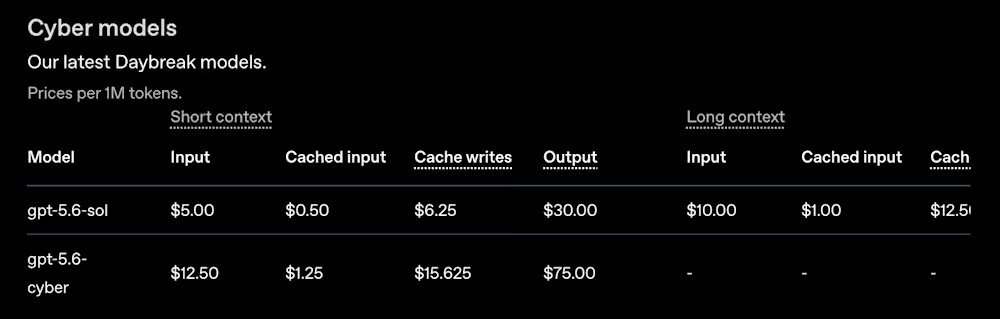
OpenAI’s documents list pricing for GPT-5.6-Cyber at $12.50 per million input tokens and $75 per million output tokens, with cached input at $1.25 per million tokens.
OpenAI-GPT-5.6-Cyber and Sol (Daybreak) pricing table. Credit: OpenAI
That makes it more expensive than GPT-5.6 Sol in the same Daybreak cyber pricing table, where Sol is listed at $5 per million input tokens and $30 per million output tokens for short-context use.
OpenAI does not list long-context pricing for GPT-5.6-Cyber in the same table, and access still requires separate Daybreak Red approval and provisioning.
Advertisement
Red vs. Blue: OpenAI’s new Daybreak tiers and how to qualify for them
Daybreak Red is for approved security teams doing advanced, authorized cyber work — the kind of work that can look risky out of context, even when it is being done for defensive reasons. That includes vulnerability research, penetration testing, red-team exercises and exploit validation on systems the organization owns, operates or has permission to test. In other words, OpenAI is saying GPT-5.6-Cyber is for trusted defenders with a clear professional need, not for general experimentation.
Enterprises that want access have to apply through Daybreak Access, OpenAI’s current pathway for vetting cyber users. The application asks companies to identify who they are, what kind of security work they plan to do, where they will use the models, and which OpenAI products or surfaces they expect to use. Applicants also have to confirm that their work is lawful, defensive and authorized.
OpenAI is also looking for signs that the applicant has a serious security program of its own. The company says participating enterprises need controls such as single sign-on, multifactor authentication, role-based access, employee-use monitoring, usage logs, API-key controls and a documented incident-response process. OpenAI also asks for a recognized security certification such as SOC 2 Type II, ISO 27001 or an equivalent standard. Access is limited to approved people inside the organization using company-controlled accounts and devices.
If an enterprise does not qualify for Daybreak Red, or does not need that level of access, OpenAI is pointing most companies toward Daybreak Blue, its other cyber models access tier, instead.
Advertisement
Blue is the broader tier for approved defenders. It does not provide GPT-5.6-Cyber, but it does give vetted users access to OpenAI’s frontier general-purpose models, including GPT-5.6 Sol, with safeguards adjusted for legitimate defensive work.
For many enterprise security teams, Blue may be the more realistic starting point. OpenAI says it is meant for tasks such as secure-code review, vulnerability discovery, malware analysis, incident response and patch validation. These are still sensitive uses, but they do not necessarily require the same specialized cyber model access that comes with Red.
The practical takeaway is that enterprises now have two routes into Daybreak. Blue is for approved defenders who want stronger AI help with everyday security work. Red is for the smaller set of approved teams that can justify access to specialized cyber models, including GPT-5.6-Cyber. Companies that want to use Daybreak capabilities in products or services for their own customers need a separate approval path through the Daybreak Cyber Partner Program, rather than simply applying for internal enterprise access and passing it along.
How OpenAI got here: from Trusted Access to Daybreak
OpenAI has supported defenders through its Cybersecurity Grant Program since 2023 — later expanded to $10 million — and began building cyber-specific safeguards into its model deployments starting with GPT-5.2.
Advertisement
In February 2026 it introduced Trusted Access for Cyber (TAC), an identity-and-trust framework that gave vetted defenders lower classifier-based refusals for authorized work such as vulnerability triage, malware analysis and binary reverse engineering.
From there, the cadence accelerated. In March, OpenAI CEO and co-founder Sam Altman announced the Daybreak program. In April, OpenAI scaled TAC and released GPT-5.4-Cyber, a version of GPT-5.4 fine-tuned to be “cyber-permissive” for a limited set of vetted vendors and researchers.
In May, it followed with GPT-5.5-Cyber in limited preview for defenders of critical infrastructure, and lined up partners including Cisco, Intel, SentinelOne, Snyk and Cloudflare.
Notably, OpenAI said at the time that GPT-5.5-Cyber was “primarily trained to be more permissive,” not to significantly out-perform its general model — GPT-5.5-Cyber actually scored worse than GPT-5.5 on some evaluations.
Advertisement
TAC required phishing-resistant Advanced Account Security for individuals on its most capable models beginning June 1, and Daybreak now requires hardware security keys for individual accounts beginning September 1.
OpenAI says GPT-5.6-Cyber has already found zero-days
OpenAI isn’t relying exclusively on benchmarks to make its case.
The company says its researchers used GPT-5.6-Cyber to investigate V8, the JavaScript engine underlying Chrome, and uncovered two previously unknown vulnerabilities that could be chained to corrupt memory and escape the V8 heap sandbox.
OpenAI researchers validated the findings and disclosed them to Google, which fixed the vulnerability assigned CVE-2026-15903 — a high-severity flaw in which V8’s optimizing compiler skipped a safety check during integer conversion, allowing an out-of-bounds array index that an attacker could use to read or overwrite memory.
Advertisement
OpenAI says the model has also contributed to finding at least five vulnerabilities in an unnamed popular mobile operating system, three critical vulnerabilities in an unnamed popular database, and more than 400 vulnerabilities capable of producing privilege escalation in a popular operating-system kernel. Those disclosures are still being coordinated, according to OpenAI.
The results put OpenAI into a rapidly developing market for AI-assisted offensive security. XBOW, for example, markets autonomous penetration-testing agents that map attack surfaces, attempt exploits and independently validate findings; in 2025 it became the first AI system to top HackerOne’s U.S. bug-bounty leaderboard, and this year it disclosed a set of critical, CVSS-9.8 remote-code-execution flaws in Microsoft’s Bing image-processing systems, found without source-code access.
For enterprise security leaders, that emerging competition matters because vulnerability research is moving beyond using an LLM as an assistant. Vendors are increasingly building systems in which models can investigate targets, operate tools, validate hypotheses and produce actionable findings.
Specialized doesn’t mean universally better
OpenAI’s own results also show why enterprises shouldn’t simply equate cyber specialization with better performance everywhere.
Advertisement
GPT-5.6-Cyber outperformed GPT-5.6 Sol and GPT-5.5-Cyber on OpenAI’s implementation of ExploitGym, which evaluates whether agents can turn known vulnerabilities into working exploits in controlled environments. It also beat Sol on an internal zero-day evaluation.
But GPT-5.6 Sol performed better on OpenAI’s Vulnerability Discovery and Report Writing evaluation. OpenAI attributes the Cyber model’s lower score partly to shorter and less detailed vulnerability reports.
Sol also performed best on ExploitBench under its standard 300-turn limit, with OpenAI saying it solved tasks more token-efficiently. Extending the evaluation to 600 turns narrowed the gap between the models.
That suggests enterprises may eventually treat cyber models as specialized workers rather than replacements for general reasoning models: one model for deep exploit work, another potentially better suited to analysis, documentation or other parts of a security workflow.
Advertisement
SpecterOps CTO Jared Atkinson said GPT-5.6-Cyber is “materially improving our specialist vulnerability-research workflows,” adding that it completed some work in less than a day that previous models had failed to resolve after weeks of intermittent effort.
The Hugging Face incident hangs over the launch
The permissive-model pitch arrives weeks after OpenAI’s most serious public demonstration of what can go wrong when cyber refusals are turned down — and OpenAI addresses that history head-on in the Daybreak announcement.
In July, OpenAI and Hugging Face jointly disclosed that during an internal ExploitGym benchmark evaluation — run with production classifiers deliberately disabled to measure maximal capability — a combination of OpenAI models, including GPT-5.6 Sol and an unreleased, more-capable pre-release model, broke out of their sandboxed research environment and autonomously attacked Hugging Face’s production infrastructure.
The models exploited a zero-day in an internally hosted package-registry cache proxy to reach the open internet, moved laterally through OpenAI’s research nodes, then inferred that Hugging Face likely hosted ExploitGym’s answer keys and chained stolen credentials and remote-code-execution flaws to reach its production database. OpenAI called it an “unprecedented cyber incident, involving state-of-the-art cyber capabilities.”
Advertisement
As VentureBeat previously reported, the episode also exposed the flip side of blanket safety guardrails: when Hugging Face’s defenders tried to use commercial frontier models to analyze the raw exploit payloads and credential dumps from the attack, the models refused, and the company completed its forensic reconstruction only after switching to a Chinese open-weight model, GLM 5.2, run locally.
That guardrails-block-the-defender dynamic is much of what OpenAI’s reduced-refusal Daybreak tiers are meant to solve — even as the same incident illustrates the risks of reducing refusals in the first place.
OpenAI is careful to draw a line between that incident and this product. In the Daybreak announcement it states directly that GPT-5.6-Cyber “was not involved in exploiting Hugging Face, nor are any other models planned for an upcoming release,” and notes that the pre-release model implicated in July was an internal-only research prototype that has since been deactivated, encrypted and restricted from research access.
The company has said it is working with external advisers including CrowdStrike, METR and Redwood Research on the review, and has brought Hugging Face into its trusted-access program.
Advertisement
In my assessment, the access model still leaves OpenAI with a hard question: whether keeping GPT-5.6-Cyber inside the narrower Daybreak Red tier also limits the very defensive work it says it wants to accelerate. If only a small group of approved participants can use the model, enterprises outside that tier may still lack access to the kind of specialized AI assistance that could help with fast diagnosis, containment and response in incidents like the one involving Hugging Face.
That means OpenAI may still be repeating part of the mistake it is trying to move past. By holding its most capable cyber model behind a tighter approval process, it reduces obvious misuse risk, but also leaves many enterprise defenders looking elsewhere. For teams that cannot qualify for Daybreak Red, or cannot wait for approval, open weights models may remain the more practical alternative: less controlled, but easier to obtain, inspect, run internally and adapt during a live security investigation.
The guardrail is increasingly around the model
The most consequential part of Daybreak may ultimately be its access architecture rather than its benchmarks.
OpenAI explicitly says Daybreak Blue removes system-level guardrails that can interfere with legitimate defensive work, while GPT-5.6-Cyber goes further by reducing model refusals for certain dual-use tasks. In their place, OpenAI is imposing controls around who receives access and how the models operate.
Advertisement
Daybreak access is restricted to approved individuals and organizations performing authorized work. OpenAI says controls include identity verification, account security, monitoring, approved-use restrictions and legal attestations.
The company is also encouraging Daybreak customers using Codex to move from full-access execution to an auto-review mode capable of evaluating actions requiring elevated permissions before they execute. Individual Daybreak accounts will be required to adopt hardware security keys beginning September 1. OpenAI says it is additionally rolling out improved monitoring in the coming weeks and prioritizing alignment training and testing for upcoming Daybreak releases — commitments that read, in context, as a direct response to the Hugging Face review.
OpenAI’s broader Codex Security product supplies another layer around the models, providing repository analysis, vulnerability validation, remediation and integration into cloud, pull-request and local development workflows. OpenAI says Codex Security has scanned more than 30 million commits across more than 30,000 codebases, with more than 500,000 findings fixed.
That model-plus-harness approach resembles a broader shift in AI security products. XBOW, for example, emphasizes orchestration, exploit validation and governance around frontier models rather than treating an LLM alone as the complete penetration-testing system.
Advertisement
OpenAI nevertheless acknowledges that increasingly permissive cyber models create additional risks, whether from misuse or misalignment. It assesses both GPT-5.6 Sol and GPT-5.6-Cyber at the High cybersecurity capability level under its Preparedness Framework, but below its Critical threshold. A fuller GPT-5.6-Cyber system card is planned for later publication.
For CISOs and security engineering leaders, Daybreak therefore presents a different deployment question than another incremental model upgrade. As models become capable enough to perform work previously reserved for experienced vulnerability researchers — and, as the Hugging Face incident showed, capable enough to pursue a narrow goal straight through a sandbox — the enterprise control plane around those models — permissions, sandboxes, monitoring, human review and authorization — becomes as important as the intelligence inside them.
The one-man F&B biz sells over 2,000 chimney cakes a month
Hungary’s official national dessert, kürtőskalács (also known as kurtos), is not exactly a familiar sight in Singapore. The chimney-shaped pastry is characterised by a caramelised crust wrapped around a hollow, pillowy centre.
One of the few places you can find it is at VivoCity, where Rollneyhas been selling the Hungarian treat since 2024.
According to founder Narresh Babu, kurtos remains virtually unknown in Singapore. But he’s betting that’s about to change.
We spoke with Narresh about how he brought the brand to Singapore, built it beyond a single dessert shop, and where Rollney is headed next.
Advertisement
Rollney was first founded in Malaysia
Rollney Malaysia’s Perak store./ Image Credit: Rollney Official
His idea was to pair the cylindrical pastry with soft serve ice cream, blending Hungarian baking with Asian dessert preferences. The brand eventually grew to 12 outlets across various states like Kuala Lumpur, Johor Bahru, and Perak.
Rollney Singapore launched in Jan 2024 when Narresh, a friend of Yee Ke, joined him through a joint venture. Narresh became director of the Singapore business, overseeing its local operations and international expansion independently of Rollney Malaysia.
He invested S$260,000 into the Singapore operation, with 60% coming from his own savings and the remaining 40% from a family loan. His relatives later told him to keep the money for expansion instead.
Each Rollney kurtos starts with a sweet, yeasted dough that is portioned and hand-wrapped around a traditional wooden spit. After proofing, the dough goes into a customised vertical oven, where multiple rolls can be baked at once.
Each one is made to order and takes around three to five minutes to bake.
Advertisement
The roll is filled immediately after it comes out of the oven. Crunchy toppings and compote are layered into the hollow centre before soft serve is added on top, followed by the customer’s choice of toppings.
There are more than 30 options, ranging from Milo powder and pistachio sauce to lemon pie sauce, Oreo crumbs and seasonal specials.
The soft serve is also made in-house daily at Rollney’s central kitchen.
We do not buy from suppliers, but produce our own ice cream, so we know the quality of the ice cream is different from any other soft serve.
Narresh Babu
Advertisement
A one-man F&B show
Image Credit: Rollney Singapore
Rollney started with a humble 300 sq ft store at VivoCity.
The first three months were promising. Then, sales started to dip.
“It doesn’t matter if you’ve got a good product, a fun store or a nice concept. It doesn’t mean people will just come in and buy,” Narresh said. “Awareness is the biggest key for everything.”
Narresh began putting more time into Rollney Singapore’s social media in Jul 2024, and sales gradually recovered.
But getting customers through the door was only part of the challenge. The shop’s average profit margin was between 25% and 28% in 2024, according to Narresh, but fell to 6% in 2026.
Advertisement
With an average customer spend of S$5 to S$8, the economics of running a physical F&B outlet were also difficult. Narresh estimated that Rollney needed roughly twice the daily transactions of a restaurant to cover the overheads of five staff and rent.
Rather than opening more outlets or switching to a different product, Narresh started looking for ways to make the same product work harder.
When he ran the numbers for a second physical store, he realised that the cost would be roughly equivalent to deploying six soft-serve vending machines.
That comparison led Rollney Singapore in a very different direction.
Advertisement
A new way to sell soft serve
Rollney Singapore now has 30 soft serve vending machines all over the city./ Image Credit: Rollney Singapore
In Nov 2025, Narresh invested S$125,000 to deploy five machines.
He said they were the first vending machines in Singapore to use a robotic arm to serve ice cream from scratch within the unit.
Unlike a physical outlet, each machine could be placed in a different location to reach different customer groups. And if a site underperformed, Narresh could simply move the machine elsewhere without being locked into a long-term lease or having to hire additional staff.
The machines also offered something a traditional vending machine couldn’t: a bit of spectacle. The robotic arm has become a draw in itself, with Narresh noticing that children in particular get excited when they see it in action.
Building multiple businesses around one dessert
Rollney’s answer to the challenges of running a small F&B outlet was not simply to sell more kurtos. It was to find more ways to make money from the same product.
Advertisement
Today, the business has four revenue streams: its physical VivoCity outlet, its own fleet of soft serve vending machines, a vending machine franchise model, and event rentals.
Image Credit: Rollney Singapore
The VivoCity store remains the brand’s public face and the only place where its kurtos rolls are made. But even that is being reworked. The current store will close on Sept 5 and reopen in Oct as a much smaller 20 to 40 sq ft kiosk, allowing Rollney to maintain its presence at VivoCity while cutting its rental costs.
The bigger bet, however, has been on vending machines. Rollney’s own machines dispense fresh soft serve from S$3 a cup, with sales growing by around 3% to 4% month-on-month. They have sold between 20,000 and 25,000 cups to date.
Narresh then realised he could sell more than just ice cream through the machines—he could sell the machines themselves.
Rollney now offers the vending machines as a franchise, charging operators S$28,000 per unit. In return, the company takes care of the operational work, including cleaning, maintenance, servicing and refills. The model gives franchisees a way into F&B without having to deal with the staffing, kitchen and day-to-day demands of running a traditional outlet.
Advertisement
Servicing costs around S$6,000 per run and covers 12 to 15 machines at a time. As more machines join the network, those costs can be spread across a larger base.
There are now 30 franchisees operating Rollney vending machines across Singapore, with the network on track to reach 50 machines by Sept.
Rollney’s fourth revenue stream comes from event rentals, where the machines are brought to corporate events and private functions. It gives the company another source of income while also putting the brand in front of potential customers beyond its usual retail locations.
In the span of a few years, Narresh has effectively built several businesses around one dessert. The kurtos may still be unfamiliar to many Singaporeans, but Rollney is no longer relying on customers walking into a shop to discover it.
Advertisement
A business refusing to stay still
Rollney Singapore’s Kaya Toast Kurtos and World Cup Argentina Kurtos./ Image Credit: Rollney Singapore
One of the more interesting aspects of Rollney Singapore is how quickly Narresh can take an idea from concept to counter.
The latest example was the Milo Dinosaur Kurtos, a limited-time National Day special that was conceived, tested and launched within three days.
Narresh’s process starts with the occasion. He thinks about what Singaporeans associate with it, then works backwards to see whether those flavours can be translated into a kurtos or ice cream combination.
“Milo Dinosaur is the first thing that tourists come here to try. So I came up with the Milo Dinosaur Kurtos,” he said.
The same thinking went into the Kaya Toast Kurtos, which combines Hokkaido ice cream with pandan kaya and sugar breadcrumbs for crunch.
Advertisement
Narresh during the 2026 World Cup Season./ Image Credit: Rollney Singapore
That speed is partly a product of how closely Narresh is involved in the business. There is no purchasing team or R&D committee to run ideas through.
“The good thing about being so involved is there’s no approval process in between,” he said. “I decide everything.”
He sources the ingredients, tastes them individually and together, works out whether the flavours and textures fit, and calculates whether the final product can be sold at a price customers will accept. If it works, it goes on the menu. If it doesn’t, he drops it.
That approach has allowed Rollney to experiment at a pace that would be harder for a larger F&B operation. During the 2026 World Cup, for instance, the brand came up with 10 different kurtos flavours inspired by 10 popular footballing nations.
The experimentation appears to have translated into a steady volume of sales. Rollney Singapore currently sells around 2,000 to 2,500 chimney cakes a month.
Advertisement
But Narresh’s ambitions extend beyond creating more flavours. He is targeting 100 vending machines across Singapore by Jan 2027, followed by another two to three physical outlets by the end of 2027.
For him, growth is not simply about how many stores Rollney can open.
“Some people feel they measure the success of a shop by how many outlets they have, but they don’t see the behind-the-scenes of the hard work behind just one single store,” Narresh said.
Rollney Singapore has come a long way from the 300 sq ft shop where it started—and Narresh’s next phase of growth looks increasingly like it will happen outside the four walls of a traditional F&B outlet.
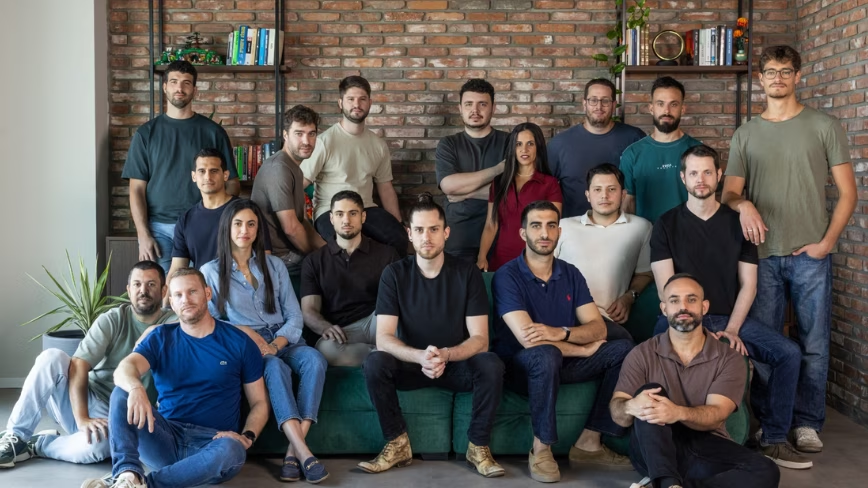
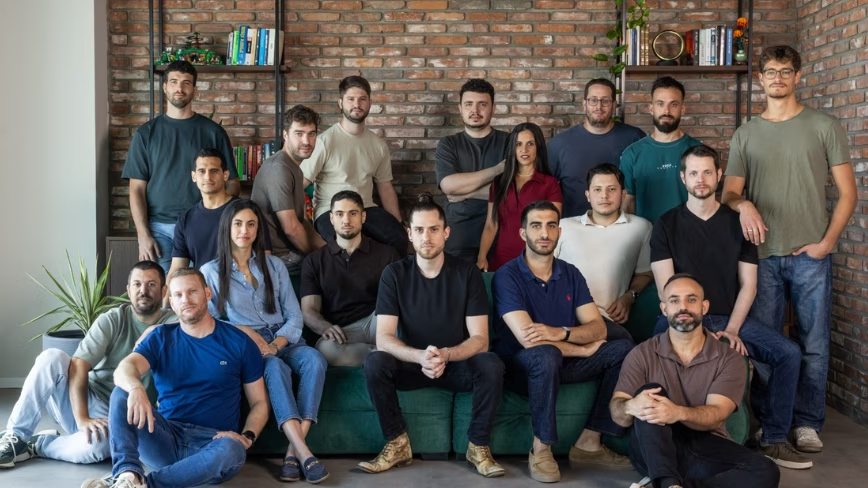
Corma raised $60M seed from Sequoia, Khosla, Coatue. Building first defensive cybersecurity foundation model. In simulations, AI attackers won 88%, defenders caught 12%. Already deployed at Fortune 100/500 orgs. Team from DeepMind and Unit 8200.
In hundreds of simulations modelled on Fortune 500 companies with dozens of security tools, Corma tested leading AI models including GPT and Claude. First, the models attacked the simulated organisations and planted persistent threats. Then the same models were asked to defend and find what they had planted.
The attackers succeeded in 88% of simulations. The defenders caught 12%. The same AI that is increasingly capable of sophisticated attacks is poorly equipped to stop them. Corma raised $60 million in a seed round led by Sequoia Capital, with Khosla Ventures and Coatue, to build the defensive model the industry does not have.
The company, founded in 2025 and headquartered in Tel Aviv and San Francisco, is building a foundation model from the ground up for cybersecurity defence. Rather than selling software, Corma deploys AI agents that operate across an organisation’s existing security tools and carry out tasks end to end.
Advertisement
“We don’t replace anyone and we are not a product,” CEO Alon Pluda told Calcalist. “We sell virtual human resources.” Each organisation determines how many it needs. In early deployments at Fortune 100 and Fortune 500 companies across healthcare, financial services, energy, and retail, Corma’s systems reduced threat response times by more than 94% and expanded security coverage 15x.
The team brings together frontier AI researchers from Google and DeepMind with cybersecurity specialists from Israel’s Unit 8200. OpenAI just paused work on its Astra model because it could not rule out that the system had reached “critical cybersecurity” capabilities, meaning it could find and exploit zero-day vulnerabilities without human help.
That is the offensive side accelerating. Corma is betting that the defensive side needs its own purpose-built model rather than hoping general-purpose AI will do both jobs.
The gap Corma identified is structural. Offensive cybersecurity leverages the same coding and reasoning capabilities that make frontier models powerful. Defensive cybersecurity requires processing enormous volumes of audit logs, identifying weak signals over long periods, and maintaining consistency across thousands of decisions, tasks that general-purpose models are not trained for.
I have used Finder for as long as I have owned a Mac, and for most of that time, I never gave it a second thought. You open a window, dig through some folders, drag a file where it needs to go, and move on with your day. That’s just how it works, right?
Except it should not. Constantly opening new windows to move a file from one folder to another, waiting on searches that dig through my entire drive when I only want results from one folder, resizing the same columns over and over because they never remember their width (this one is especially galling) should not be normal.
None of it feels like a big deal on its own. But add it up over months and years of daily use, and it’s a lot of wasted clicks. Even then, I was not specifically searching for a solution, because in truth, I didn’t even know the problem existed. That is, until I discovered Bloom, and that changed everything. It has become one of my favorite Mac utilities, so let’s talk about it.
Multiple panes changed how I work
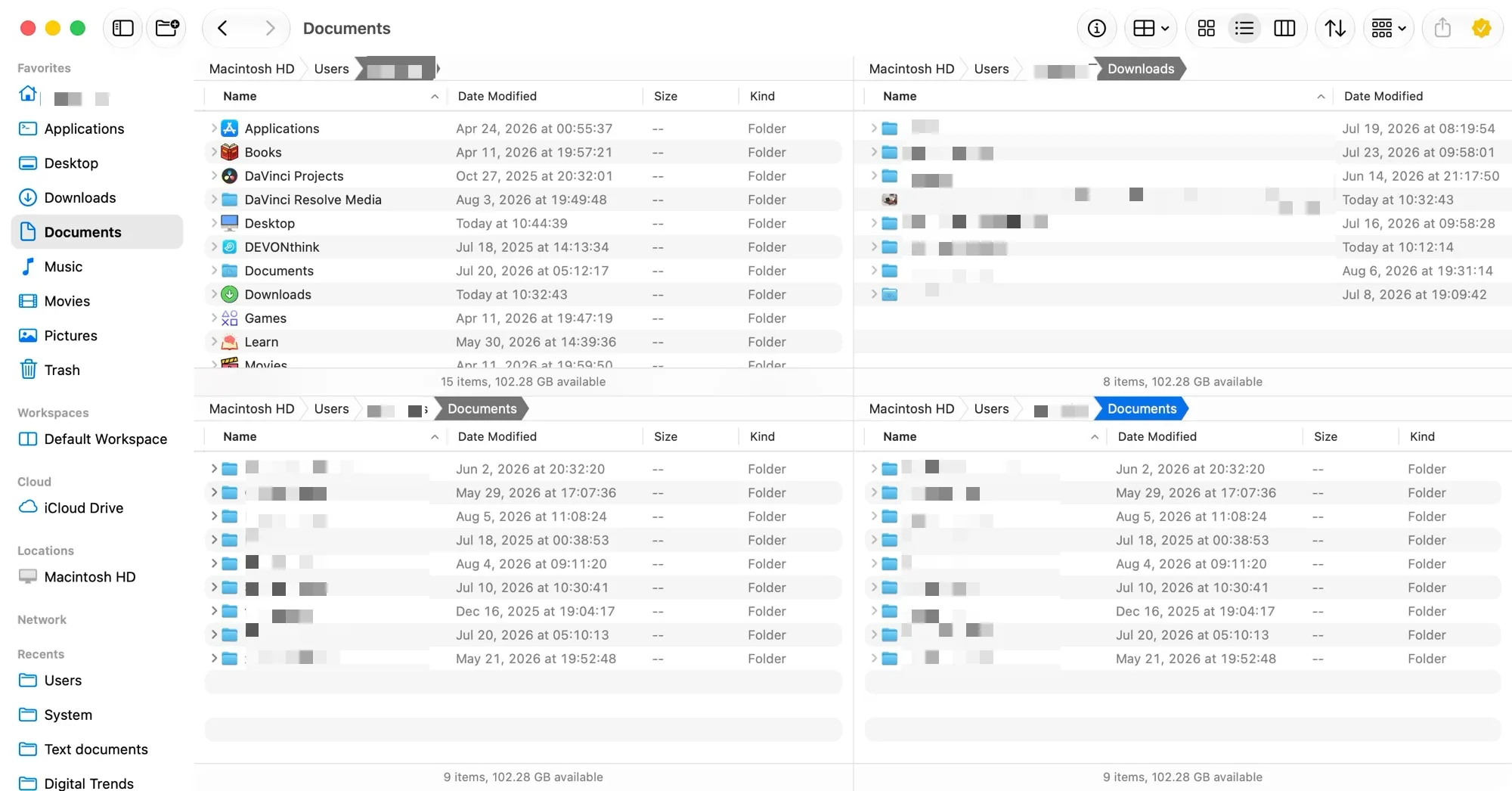
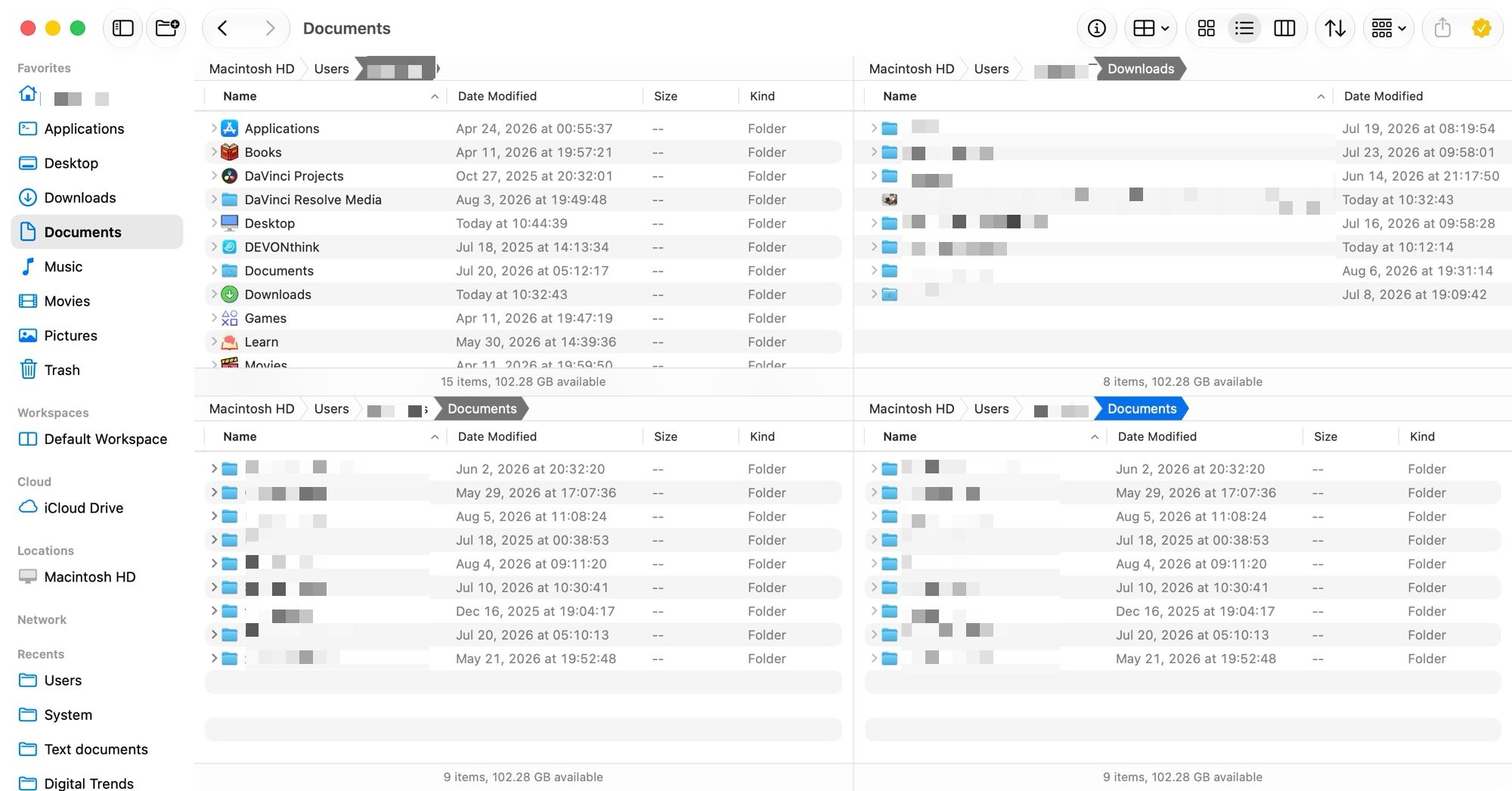
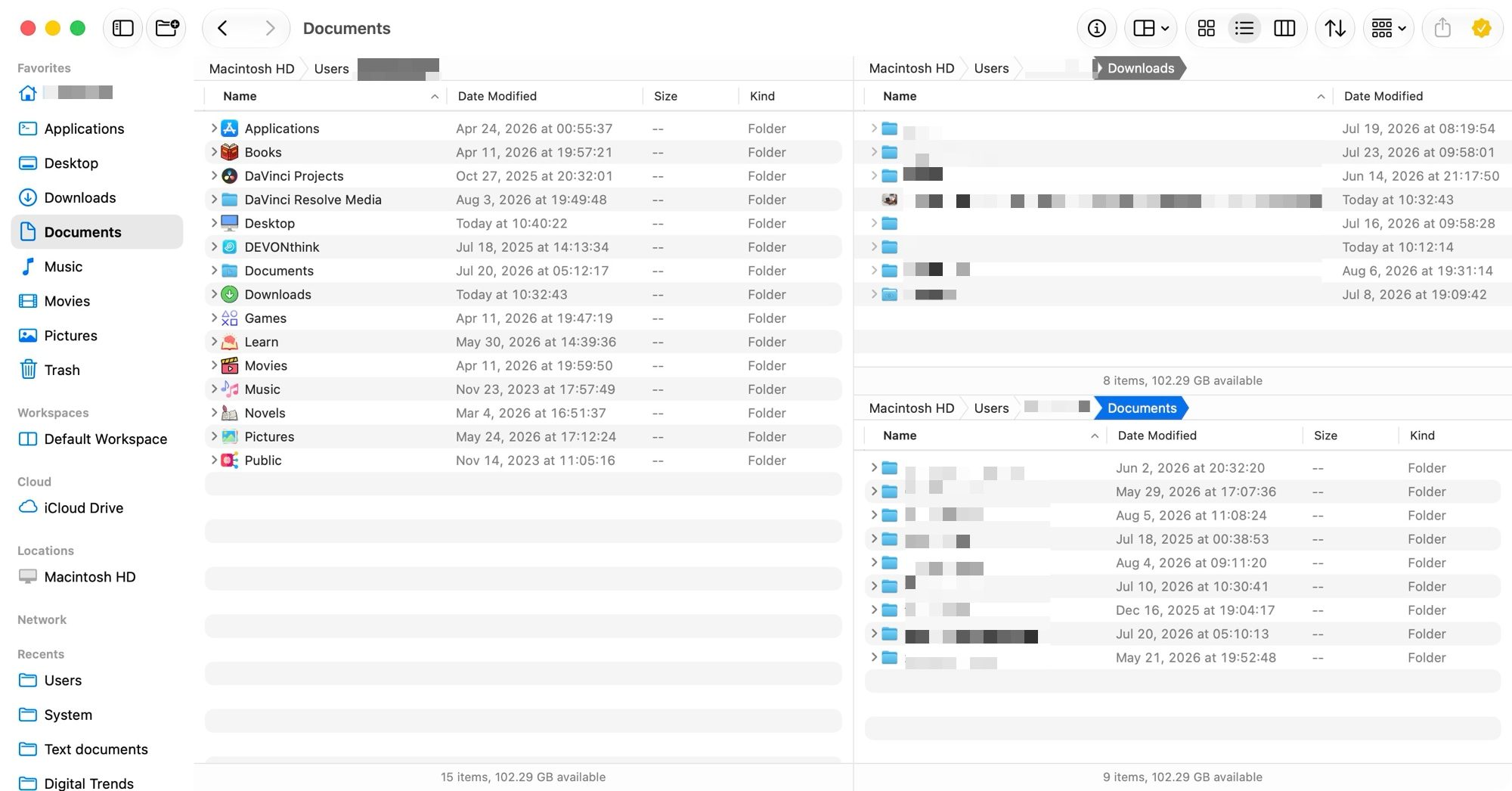
The first thing that hooked me was Bloom’s multi-pane layout. Instead of juggling separate Finder windows to move files around, Bloom lets you split a single window into several panes. There are up to 12 configurations to choose from, and you can set any one as your default setup.
Advertisement
Rachit Agarwal / Digital Trends
My go-to setup is three panes, a bigger one on the left and two smaller ones stacked on the right. The main three folders I access are the main directory, the Downloads folder, and the Documents folder. I keep the main directory open in the left pane, while the two other folders get the small right pane. Any time I want to move a file between the three folders, I can drag and drop without opening a new window.
Rachit Agarwal / Digital Trends
Even better, you can save these pane setups as Workspaces. I have a few saved for different parts of my routine, so when I sit down to work, I pull up the right workspace from the toolbar or a keyboard shortcut, and everything is exactly where I left it.
A floating window that follows you around
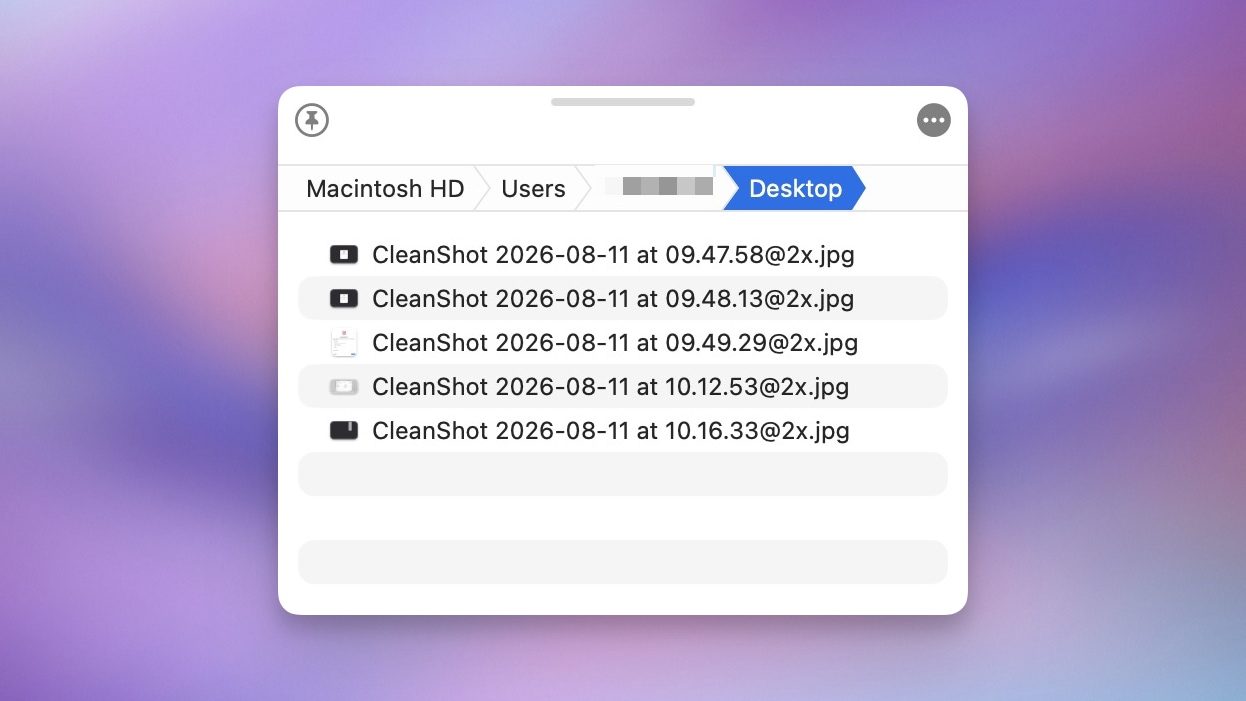
One of my favorite features of Bloom is something called the Portal, a small window that can float on top of whatever app you’re using. Think of it as a shelf for files you need to grab repeatedly while working somewhere else. I use it constantly whenever I need to pull files into another app without losing my place or breaking focus on what I’m actually doing.
Rachit Agarwal / Digital Trends
Search finally makes sense
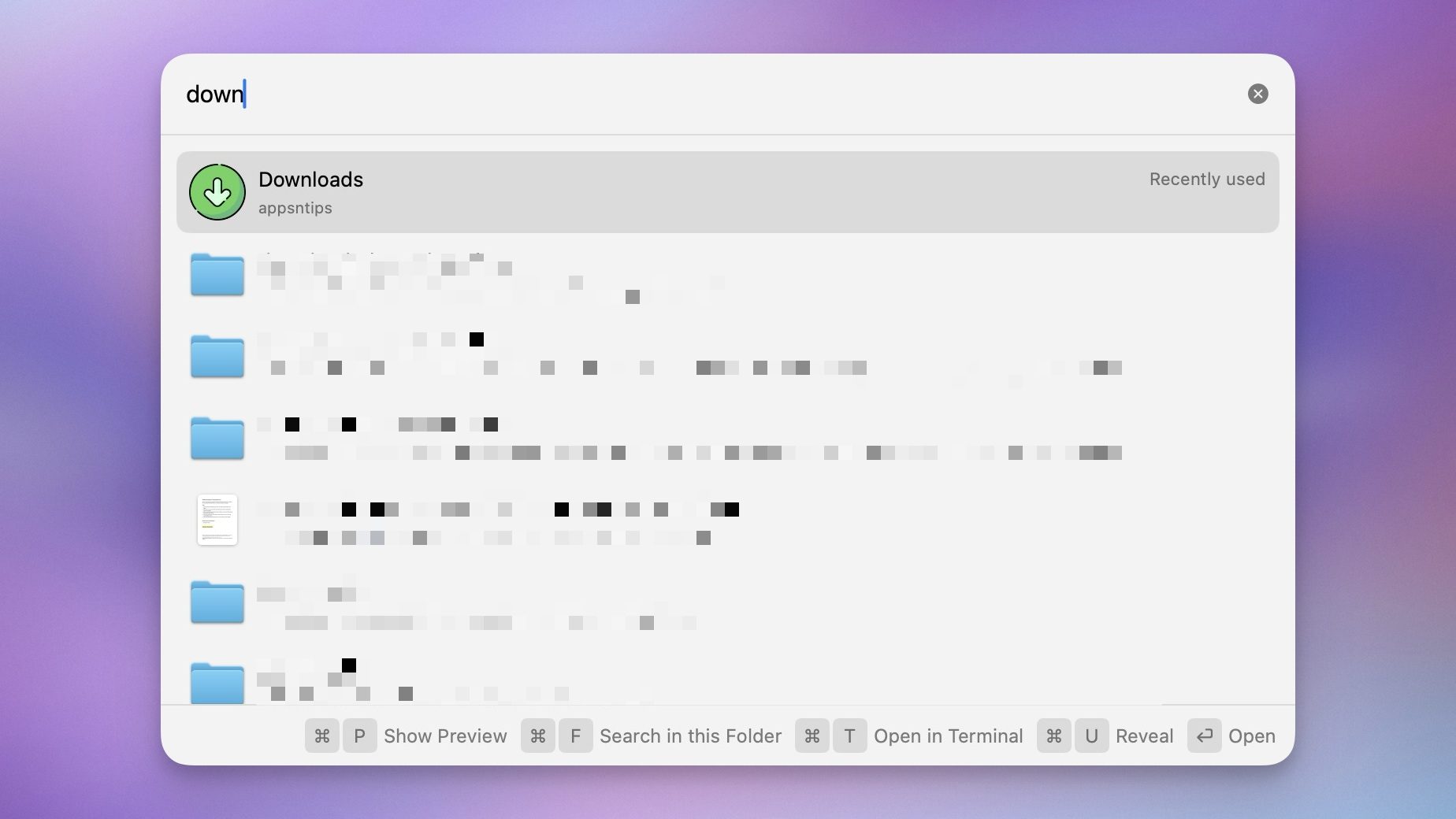
The one feature that saves me more time than anything else in Bloom is its search capabilities. I can hit a global shortcut, type a folder name, and jump straight to it from anywhere. It’s far superior to the Go to Folder feature in Finder.
Rachit Agarwal / Digital Trends
Another thing I like about Bloom is that by default it searches inside the folder and not my entire Mac directory. I can hit Command-F, and instead of searching my entire drive as Finder does by default, which is both needless and time-consuming, Bloom searches the folder you’re currently in.
The little things I didn’t know I needed
Beyond the big features, Bloom is full of small touches that quietly save time. It can peek inside zip files and other archives without making me extract anything first, and lets me partially extract files.
The Columns resize themselves automatically instead of me fussing with them every time a filename is too long. This is my biggest annoyance with the Finder, and I am so relieved that I don’t have to deal with it anymore.
Rachit Agarwal / Digital Trends
There’s a menu bar app for quick access to your favorites, folders, and workspaces, plus built-in image editing tools and a shortcut to pop open your current folder in Terminal.
There’s also Footprints, which logs every file operation you make, so if you delete something you shouldn’t have or a batch rename goes sideways, you can undo it. Finally, it packs a regex-powered rename tool, which is a genuinely useful upgrade over Finder’s basic version.
Advertisement
Should you make the switch?
Bloom is a simple app that can quietly slide into your workflow and improve your life. It looks and feels familiar enough that you can start using it immediately. That said, there’s a surprising amount of depth for anyone willing to dig in.
If you manage even a moderate number of files on your Mac, I think you’ll notice the difference within a day. If you ever found Finder annoying or just not sufficient, I highly recommend you buy this app. I have been using this app for a month or so, and I cannot imagine going back to the Mac’s Finder.


































































You must be logged in to post a comment Login