Security teams log 54% of successful attacks and alert on just 14%. The rest move through your environment unseen.
The Picus whitepaper shows how breach and attack simulation tests your SIEM and EDR rules so threats stop slipping by detection.




American insurance company AssuranceAmerica has disclosed a data breach impacting nearly 7 million drivers after attackers gained access to its systems earlier this year.
AssuranceAmerica operates through a network of over 9,500 independent agents and provides auto, renters, and commercial auto insurance coverage across 14 U.S. states.
While the company has yet to publish a press release regarding the incident, it revealed in a filing with Maine’s Office of the Attorney General that the data breach has exposed the information of 6,998,886 people.

As TechCrunch first reported, AssuranceAmerica detected the breach on March 17 and found that the attackers had stolen a wide range of customer information from its systems.
“On March 17, 2026, the Company detected suspicious activity involving certain Company systems that appears to have resulted from malicious activity on March 16, 2026 that targeted one of the Company’s employees. During the investigation, the Company determined that an unauthorized third party accessed certain portions of the Company’s informational technology (IT) environment and copied certain data files,” it notes in data breach notification letters that will be sent to affected people on Friday.
“The Company subsequently conducted a review of the affected files to identify individuals whose personal information may have been contained within those files. Because of the nature of the files involved and the scope of the required review, this file evaluation process was only recently completed (on June 15, 2026), and we are now providing this notice.”
As the company found, the stolen documents contained a combination of affected individuals’ names, contact information, automobile insurance policy or insurance account information, driver or vehicle information, claims-related information, and driver’s license numbers.
Since it detected the security breach, AssuranceAmerica disabled the credentials compromised in the attack, kicked the threat actors out of its network by disabling unauthorized sessions, isolated the affected systems, and notified law enforcement agencies of the incident.
“The Company also implemented additional measures designed to enhance the security of its IT systems and data, including resetting passwords, deploying enhanced monitoring and threat detection tools, and providing additional instruction to personnel regarding cybersecurity threats,” it added.
AssuranceAmerica also advised affected customers to immediately alert their financial institution if they detect any suspicious activity after reviewing credit reports, bank accounts, and other financial statements.
Last month, American insurance giant Aflac also disclosed a data breach after attackers compromised its Japanese subsidiary’s systems, stealing the personal and bank account information of 4.38 million customers.

Security teams log 54% of successful attacks and alert on just 14%. The rest move through your environment unseen.
The Picus whitepaper shows how breach and attack simulation tests your SIEM and EDR rules so threats stop slipping by detection.
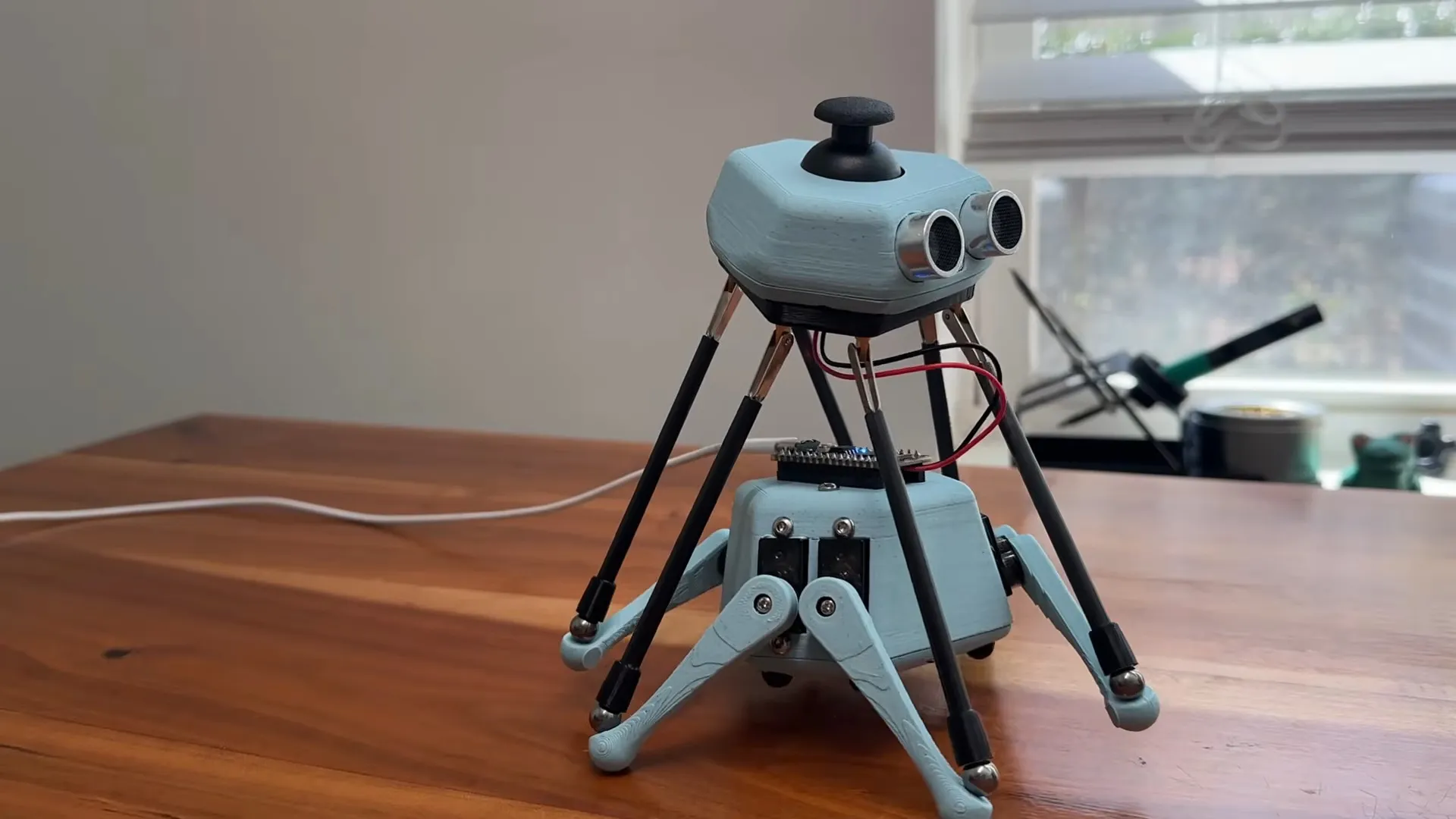
Stewy is a very interesting robot, with some slightly odd kinematics. Its head is a Stewart platform, which is a common-enough 6-DOF actuated plate normally used with a fixed base. By connecting legs to the same servos running the Stewart platform, [JD] turned it into an adorable hexapod walker. The walker had a problem, though: it can’t feel its feet, and [JD] thinks that would make it much more mobile on uneven surfaces. So he got some resistors to turn the cheap servos in its legs into force-sensing actuators.
Well, almost. He’s not actually putting strain gauges or anything like that into the legs; he’s just measuring the voltage drop across a resistor in series with the servos. Since the motors draw more current the more torque they’re putting out, he has a very quick and easy way to sense the current and thus the torque using good old Ohm’s law and an analog input on the microcontroller driving the robot. It’s a simple hack, but the data he’s getting is surprisingly good for how much work it is to add to a robot, as you can see in the video — at least once he slowed down the servos a touch.
Perhaps this isn’t a ground-breaking innovation, but [JD] does a very good idea explaining it. Of course if you want to use resistors to sense force directly, force-sensitive resistors are a thing that we’ve seen in everything from Twister-mat MIDI controllers to self-leveling 3D printers.


SYSTEMS
Refundable charge intended to discourage time wasters from filing applications that will never be realized
Ofgem is seeking feedback on proposals to levy a fee on datacenter development projects at the time they apply for a grid connection.
The move aims to discourage companies from seeking approval for speculative applications that clog up the pipeline and cause connection delays, without ever resulting in finished datacenters.
The UK regulator for electricity and gas says connection applications for electrical supply have surged from 41 gigawatts (GW) to 125 GW in under a year, with datacenters accounting for at least 80 GW of the new demand.
Even before that happened, one of the UK’s big developers complained that its build teams faced a wait of “a number of years” for work such as local substation upgrades to increase grid capacity.
Ofgem is proposing a Datacenter Commitment Fee paid by the developers of large server farm projects when accepting a grid connection offer. The fee would be refunded once the facility is drawing power, or forfeited if the project exits the queue early instead.
Alan Howard, Omdia principal analyst for Colocation and DC Building, told us previously that the power connection queue issue is a big problem, not just for the UK, but also in the US and other markets around the globe.
“The strategy for many datacenter operators is to secure multiple land parcel rights, request a grid load connection for each (often requiring a costly load study), and see what gets approved so they can build. The capital investment to take all these projects seriously is clearly untenable and a huge financial risk for the energy sector if the demand doesn’t fully materialize,” he said.
The issue is therefore that developers apply in multiple locations to secure power for a single campus, fill up the national application pipeline with speculative requests and hold up the works for viable projects.
“Britain’s electricity demand connections queue has more than tripled in size in less than a year, and consumers should not bear the risks created by speculative projects taking up space in the system,” said Eleanor Warburton, the regulator’s director for Energy System Design and Development.
Ofgem’s suggestion is that the fee should be set within a proposed range of £237,500 ($319k) to £712,500 ($957k) per megawatt, which it believes is equivalent to about 2.5 percent to 7.5 percent of average project costs.
It is suggests developers demonstrate progress with their project if they wish to retain their place in the queue, meeting criteria such as financial capability, commercial maturity and procurement activity milestones.
Global colocation biz Telehouse, which operates five datacenters in the London area, told The Register it supports measures to ensure grid capacity is prioritized for credible project, though it has some reservations.
“Ofgem’s proposal is an important initiative, but it must be implemented in a way that maintains the UK’s attractiveness as a destination for AI and digital infrastructure investment,” said Telehouse Europe, managing director, Mark Pestridge.
“A refundable fee-based approach should not deter serious investors, but create a more transparent connections process that gives viable projects greater certainty.”
However, reforming the queue will not resolve the underlying capacity challenge, Telehouse points out – the need to expand the grid and make more energy available.
“A long-term solution will require sustained investment in the grid, alongside much closer collaboration between datacenter operators, local councils, National Grid and network operators at the earliest stages of planning,” Pestridge said.
“Better coordination and forecasting will help ensure infrastructure is developed in the right places, at the right time, and that viable projects do not continue to face delays even after speculative demand has been removed.”
The finger of blame for all this bother can be pointed at the government, which unveiled its AI Opportunities Action Plan at the start of last year. This included plans for “AI Growth Zones” with streamlined planning processes to speed along the building of more datacenters, apparently without bothering to check if the electricity infrastructure was ready.
To try to tackle the bottleneck, the government set up an AI Energy Council, bringing together energy industry representatives and major technology firms to thrash out a strategy, co-chaired by the former Technology Secretary and Energy Secretary. The Register reported on the challenges faced last year.
Ofgem’s consultation is open to anyone with an interest, and closes on September 16, 2026. The agency has response templates available on its website here. ®

July is supposed to be one of the quieter months of the year.
Apparently nobody told the audio industry, TV manufacturers, streaming services, record labels or the lawyers attempting to untangle the latest media merger without setting the furniture on fire.
eCoustics published more than 120 reviews, product stories, features, news reports and buying guides during July 2026. Nobody has time to read them all, so we have done the heavy lifting and selected the stories that mat
From affordable streamers and British loudspeakers to RGB MiniLED televisions, CanJam London, all-analog vinyl and the increasingly awkward arrival of AI-generated music, these were the eCoustics stories worth revisiting.

The Wharfedale Super Denton is not the smallest, most technically radical or least expensive standmount loudspeaker in its class. It is, however, one of the most enjoyable.
Its three-way design delivers a warm midrange, surprisingly deep bass and the kind of tonal balance that encourages long listening sessions rather than an emergency search for the treble control. It also happens to be one of our favorite loudspeakers currently available below $1,500.
The Super Denton needs proper stands and enough room to breathe, but listeners who value natural timbre, scale and musical engagement should put it near the top of their audition list.

The Bluesound NODE has spent years occupying the middle ground between affordable WiiM streamers and more expensive network players from Cambridge Audio, Eversolo and others.
The latest version offers improved sound quality, a stable BluOS platform, broad streaming support and the potential addition of Dirac Live room correction. It is not the cheapest option, but it makes a stronger case for itself as the digital hub of a serious two-channel system.
Whether that is enough to hold off increasingly capable and considerably less expensive competitors is another matter. The streaming category has become rather impolite.

Klipsch’s second-generation Sevens combine powered stereo loudspeakers, HDMI eARC, music streaming, substantial bass output and Dirac Live room correction in one system.
They can replace a soundbar, amplifier, streamer and pair of passive loudspeakers without making music sound like an afterthought. Their size and energetic presentation will not suit every room, but few wireless speaker systems offer the same combination of scale, flexibility and outright entertainment.

Subwoofers are often sold through increasingly absurd claims about output, infrasonic extension and their ability to rearrange the foundations of your home.
The Q Acoustics Q SUB100 takes a more useful approach. It delivers controlled bass for music and home theater, works with a wide range of loudspeakers and does not require a room the size of an aircraft hangar.
For listeners building a two-channel or compact home-theater system, that may prove considerably more valuable than another specification designed primarily to frighten the neighbors.

RGB MiniLED televisions are shaping up to be one of the most important TV developments of 2026, promising greater color volume and improved brightness without relying on OLED panels.
The Hisense UR9 brings that technology to a lower price tier than several flagship competitors. Its aggressive value proposition does not make it perfect, but it demonstrates that advanced RGB backlighting will not remain confined to televisions priced like lightly used German automobiles.

Specifications only tell part of the story, especially when manufacturers create competing names for variations of similar technology.
After reviewing both televisions, we compared Samsung’s flagship R95H Micro RGB with Sony’s BRAVIA 7 II True RGB to determine where each model excels, what buyers give up and whether Samsung’s higher price is justified.
This is the kind of comparison consumers need before standing inside a brightly lit warehouse store while a salesperson explains that every television on the wall is “basically the best one.”

Samsung’s latest flagship soundbar system attempts to deliver immersive Dolby Atmos sound without filling the room with an AVR, speaker cables and enough loudspeakers to alarm the family.
The HW-Q990H cannot completely replace a carefully assembled component system, but its combination of surround immersion, bass response, ease of use and competitive pricing makes it one of the most complete soundbar packages available.

Streaming may have won the convenience war, but physical media continues to offer the most consistent route to superior picture and sound quality.
Our midyear selection includes Fight Club, Ben-Hur, Perfect Blue, Stranger Things, The Patriot, Jackie Chan and Steven Spielberg collections, and several other discs worthy of shelf space.
Ownership remains a remarkably attractive feature when streaming services keep removing films, changing formats and behaving as though customers should be grateful for the privilege.

CanJam London returned with more new headphones, wireless models, electrostatic designs and boutique manufacturers than one person could reasonably evaluate over a single weekend.
James Fiorucci listened to nearly 30 models and selected the designs that stood out across a broad range of prices. The results include established manufacturers, unexpected newcomers and several products we intend to review more thoroughly.
No, they were not all inexpensive. This is CanJam, not a church rummage sale.

The electronics surrounding headphones have become almost as varied as the headphones themselves.
CanJam London showcased compact Class A amplifiers, R2R digital audio players, portable DACs, desktop systems and several products designed to serve both sensitive IEMs and considerably more demanding full-size headphones.
The best products did more than add power or specifications. They offered useful features, thoughtful ergonomics and a clear reason to exist in a category already crowded enough to require traffic control.

The Tea Pro SE is not merely a cosmetic variation of the original Tea Pro.
Its warmer, reference-inspired balance, articulate treble and sturdy metal shells make it a strong alternative to the increasingly standardized tuning found across the modern IEM market. Listeners seeking heavy bass or a strict upgrade over the original should look elsewhere, but those who value texture and long-term comfort will find plenty to like.

Bluetooth audio has improved significantly, but codec compatibility, latency and inconsistent device support continue to complicate what should be a simple process.
Questyle’s compact transmitter adds Bluetooth 6.1, broad codec support, low-latency operation and Auracast compatibility to phones, computers and gaming consoles. It is designed for listeners who want the best wireless performance available without first consulting three compatibility charts and an electrical engineer.

Joni Mitchell’s Court and Spark has been an audiophile demonstration record for more than five decades, but affordable premium single-disc editions have been surprisingly limited.
Rhino’s new High Fidelity pressing uses all-analog mastering, lacquers cut by Kevin Gray and 180-gram vinyl pressed at Optimal Media. More importantly, it sounds warmer, wider and more natural than typical original copies and easily surpasses the thin, bright Nautilus SuperDisc pressing.
The glossy replacement artwork cannot match the textured original jacket, but the record itself is the reason to buy this edition. The old cover can stay. The Nautilus pressing can start packing.

Rhino applied a similar formula to Dusty in Memphis, pairing Kevin Gray’s mastering with an Optimal pressing and a price that remains far below many premium audiophile releases.
The result brings greater openness, dynamics and presence to one of the defining soul albums of the late 1960s without turning it into another oversized box containing certificates, gloves and enough packaging to survive re-entry.
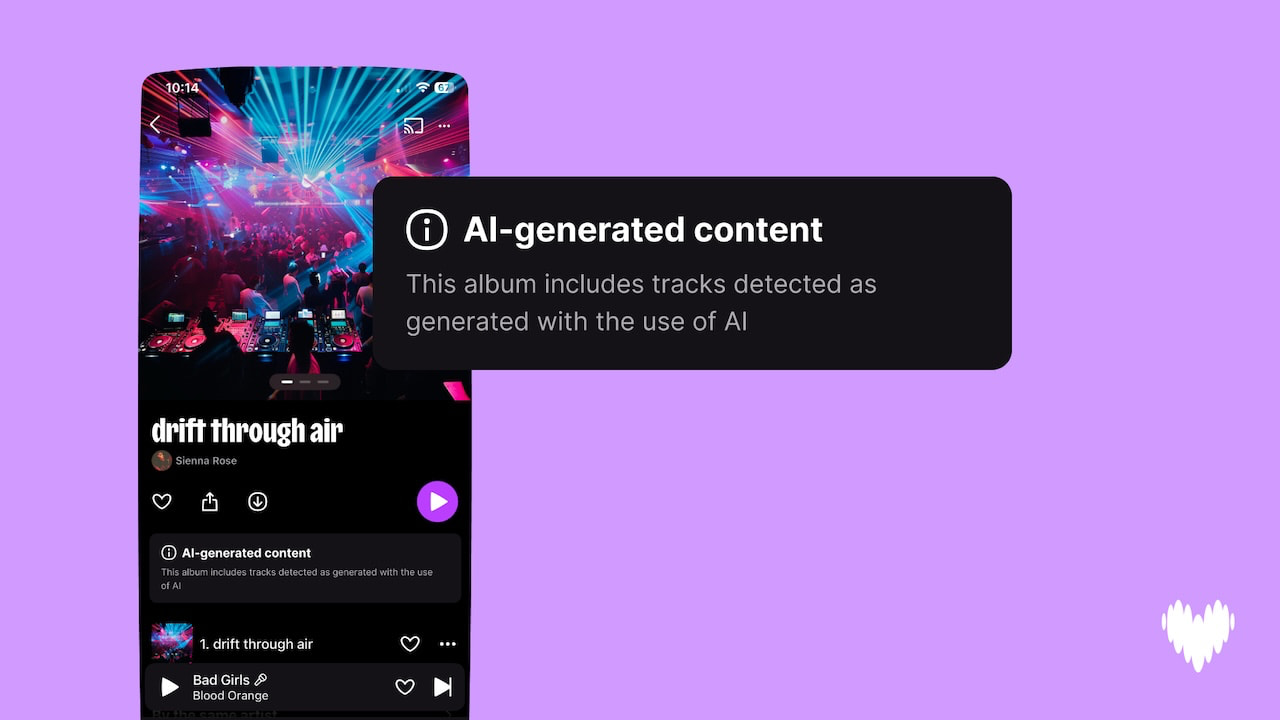
Major record labels have proposed rules determining when music involving generative AI should qualify for official chart recognition.
Those rules include licensing, disclosure, legitimate streaming activity and a requirement that the final work remain substantially human-made. All of that sounds reasonable until one remembers that several of the same companies are already negotiating licensing agreements with AI platforms.
More human than human, apparently—provided the royalty statement clears.

Winamp and Deezer want to combine subscription streaming with the music files listeners already own.
That sounds almost revolutionary in an era when most streaming platforms behave as though local music libraries were discovered in an archaeological dig. The idea has genuine potential, but execution, availability and platform support will determine whether it becomes a useful listening tool or another promising service that disappears after everyone has created an account.
July also delivered our coverage of the 2026 TV Shootout, 25 Essential American Films That Explain America at 250, the best summer horror films, the Revox World Foundation’s preservation of 800 Studer and Revox components, AudioBro V2, the Q Acoustics 3040c and KEF’s sculptural LS LUXE wireless loudspeakers.
There was also the small matter of Paramount and Warner Bros. Discovery, whose proposed merger remains trapped in an antitrust fight that will now drag well into 2027. Hollywood has once again demonstrated that no amount of expensive content can compete with lawyers billing by the hour.
August begins with Audio Advice Live in Raleigh, where eCoustics will be covering new home-theater systems, loudspeakers, electronics and one particularly ambitious 9.7.4-channel demonstration from ASCENDO, Trinnov and Christie.
CanJam SoCal and CEDIA are also approaching, while our review queue includes more loudspeakers, headphones, digital sources, music releases and home-theater products.
July was not quiet. August does not appear interested in behaving any better.


The AI agent observability space is taking off — but how can enterprises be sure what observability products and solutions they need?
Observability startup groudcover (lower case “g” intentional) announced this week that it raised $100 million in a round led by One Peak, bringing its total funding to $160 million.
The company says it has more than 250 paying customers, tripled annual recurring revenue over the past year and is increasingly replacing established observability platforms inside enterprise environments. Those are company-reported figures, but together they point to growing momentum in one of enterprise software’s most competitive markets.
That market has long been dominated by companies including Datadog, Dynatrace, New Relic, Splunk and Grafana. Between them, they represent billions of dollars in annual revenue and years of product maturity. Breaking into that group has never been easy.
groundcover’s argument is that artificial intelligence has fundamentally changed the assumptions those platforms were built on.
Rather than competing feature for feature, the four-year-old company is trying to convince enterprises that the architecture underpinning observability itself needs to change as AI systems become more autonomous, produce vastly more telemetry and increasingly participate in software operations. Whether that thesis proves correct remains an open question, but it offers a compelling lens through which to examine how observability is evolving alongside enterprise AI.
Observability has traditionally been viewed as a post-production discipline. Engineers deploy applications, monitor logs, metrics and traces, investigate incidents, and improve reliability over time.
That workflow is changing.
AI-assisted software development has dramatically accelerated deployment cycles. Coding assistants generate more code, infrastructure evolves more rapidly, and organizations are deploying increasingly complex distributed systems that combine microservices, Kubernetes clusters, APIs and large language models. At the same time, enterprises are beginning to operate AI agents that execute multi-step workflows, call external tools and interact with production systems.
Each of those activities generates telemetry.
The result is an explosion of operational data that organizations increasingly want to retain rather than discard. AI applications introduce additional layers of observability beyond traditional infrastructure monitoring, including prompt execution, model latency, token consumption, retrieval pipelines, tool invocations and agent behavior. As enterprises experiment with autonomous systems, that telemetry becomes increasingly valuable because it provides the context needed to understand what an AI system actually did and why.
For many organizations, this creates tension with pricing models that charge according to the amount of data ingested.
Historically, engineers have often responded by sampling traces, shortening retention periods or limiting which data is collected. Those approaches reduce costs, but they also reduce visibility precisely when AI-driven systems demand more complete operational context.
“We’ve seen telemetry exploding,” groundcover co-founder and CEO Shahar Azulay said during a recent media briefing. “Users are frustrated by not getting all the value from Datadog and similar platforms. They’re limiting the data, siloing it, sampling it.”
Whether that frustration is widespread enough to reshape the market remains to be seen, but the underlying trend is difficult to ignore. AI is making observability less about collecting enough data and more about collecting everything organizations may eventually need.
Many observability vendors have introduced AI assistants, AI-powered root cause analysis and AI observability features over the past two years. Datadog, Dynatrace, New Relic and Grafana have all announced products aimed at helping enterprises monitor AI applications or automate operational tasks.
groundcover acknowledges those developments but argues they do not address what it sees as the more fundamental issue: where telemetry lives and how customers pay for it.
Instead of operating a conventional SaaS platform that stores customer telemetry in vendor-managed infrastructure, groundcover uses what it calls a bring-your-own-cloud (BYOC) architecture.
Customers keep the data plane—including telemetry storage and processing—inside their own AWS, Microsoft Azure or Google Cloud environments, while groundcover provides a managed control plane and user experience. A fully self-hosted deployment option is also available.
While some competitors, including Datadog and a few other observability vendors, do offer limited hybrid or customer-controlled data residency options, these are generally not equivalent to a full BYOC model. In most cases, telemetry is still processed and stored within the vendor’s managed infrastructure, with only partial controls (such as regional data residency, private links, or selective log forwarding) available.
That architectural decision influences nearly every aspect of the company’s strategy.
Because customers already pay for their own cloud infrastructure, groundcover argues it can avoid charging based on telemetry ingestion. Instead, pricing is based primarily on monitored hosts, regardless of telemetry volume.
The company believes this changes customer behavior.
Rather than deciding which logs or traces are too expensive to keep, organizations can theoretically retain complete telemetry and use it for operational analysis, compliance and AI-assisted troubleshooting.
“We don’t price by data volume,” Azulay said. “We price by the size of the infrastructure.”
The distinction matters because AI workloads tend to increase telemetry far faster than infrastructure itself.
That does not necessarily make host-based pricing universally cheaper. Organizations with relatively light workloads spread across many hosts may find different economics than dense Kubernetes environments generating enormous amounts of telemetry. The company’s own briefing notes that per-host pricing is most advantageous for organizations with high telemetry density and may be less compelling for lightly utilized fleets.
Still, the broader argument is less about cost alone than predictability. Enterprise infrastructure teams often struggle with observability bills that fluctuate alongside application growth. groundcover’s model attempts to align pricing more closely with infrastructure planning rather than data generation.
The second pillar of groundcover’s strategy is eBPF, a Linux kernel technology that has rapidly become one of the most important building blocks for modern cloud observability.
Instead of requiring developers to manually instrument applications, eBPF allows software running inside the operating system kernel to observe network traffic, system calls and application behavior with minimal code changes.
That enables faster deployment and broader visibility across infrastructure.
For organizations operating Kubernetes clusters and cloud-native applications, reducing instrumentation complexity can significantly shorten deployment times while increasing telemetry coverage.
Azulay argues this becomes especially important as AI systems generate increasingly complex interactions across services.
“Our sensor allows us to observe systems very deeply from infrastructure to application to AI workloads without developers needing to instrument code,” he said during the briefing.
eBPF itself is hardly unique. Many observability vendors now incorporate it into their platforms.
What groundcover argues differentiates its approach is combining automatic eBPF collection with customer-controlled storage, OpenTelemetry compatibility and unified pricing inside a single platform.
The company’s own research briefing acknowledges that none of these technologies individually represents a competitive moat. The claimed differentiation lies in the combination of eBPF-first collection, managed BYOC architecture, host-based economics and full-stack observability delivered together.
Perhaps the most interesting aspect of groundcover’s strategy extends beyond traditional monitoring.
The company increasingly describes observability as infrastructure for autonomous software development.
Historically, observability platforms have served human operators investigating production incidents.
groundcover believes future observability platforms will increasingly serve AI agents as well.
Its Agent Mode product allows engineers to investigate incidents using natural language across logs, metrics, traces and Kubernetes events. More importantly, Azulay envisions observability becoming the feedback mechanism that informs coding agents about what actually happened in production.
Rather than simply detecting failures after deployment, observability becomes continuous operational context that autonomous systems can use to evaluate changes, identify regressions and eventually recommend or implement fixes.
“We’re seeing observability moving from being a post-production tool… to people taking context from production and feeding it back to their coding agents so they can write code better,” Azulay said.
Today, the company emphasizes that humans remain in the loop.
Agent Mode investigates incidents and surfaces recommendations, but production changes still require human approval. Azulay expects autonomy to increase gradually as organizations become more comfortable allowing AI systems to participate in operational workflows.
That vision reflects a broader trend emerging across enterprise software, where AI agents increasingly span development, testing, deployment and operations rather than functioning as isolated assistants.
groundcover is entering an intensely competitive market populated by vendors with decades of enterprise experience.
Datadog alone generated more than $3 billion in annual revenue in 2025. Dynatrace, Cisco’s Splunk business, Grafana Labs and New Relic all maintain extensive partner ecosystems, mature integrations and enterprise support organizations that newer entrants cannot easily replicate.
groundcover is not attempting to outscale those incumbents overnight.
Instead, it argues that AI creates an architectural inflection point similar to previous transitions from on-premises infrastructure to cloud-native computing.
According to Azulay, many customers initially adopt groundcover to reduce observability costs but increasingly remain because they want unrestricted access to richer telemetry and AI-native workflows.
He says deployments typically replace incumbent platforms rather than operate alongside them, although the company has not publicly disclosed customer migration data or independent studies validating that claim.
The company’s journalist briefing also urges caution around some performance claims.
Revenue growth, customer counts and enterprise adoption figures originate from groundcover itself. Published customer case studies reporting significant cost savings are vendor-authored and should not be treated as independent validation without additional evidence. The briefing also recommends scrutinizing exactly what metadata leaves customer environments in standard BYOC deployments, rather than assuming that no operational data ever reaches vendor infrastructure.
Those caveats are important because the observability market has become crowded. Gartner currently tracks more than one hundred observability products, and nearly every major vendor now markets AI-powered operational capabilities.
Success will likely depend less on whether AI matters—which increasingly appears inevitable—and more on whether enterprises conclude that existing architectures remain sufficient.
Viewed narrowly, groundcover’s Series C is another large infrastructure funding round.
Viewed more broadly, it reflects a growing debate about what observability becomes in an era where software increasingly writes, tests and operates itself.
If AI continues generating exponentially larger volumes of operational data, traditional assumptions about telemetry collection, pricing and storage may come under increasing pressure. Vendors that built businesses around charging for data ingestion may need to evolve their economics alongside customer expectations. New entrants, meanwhile, have an opportunity to design around those changing assumptions from the outset.
groundcover believes that opportunity lies in combining customer-controlled infrastructure, automatic telemetry collection and AI-assisted operations into a platform designed for autonomous software rather than simply adding AI features to existing observability products.
Whether that architectural bet proves durable will depend on enterprise adoption over the next several years.
But the company’s latest funding round suggests at least some investors believe the next battle in observability will not be fought over dashboards or alerts. It will be fought over who builds the operational data layer that increasingly intelligent software relies upon to understand—and eventually manage—the systems it runs.


A Chinese-speaking threat actor is using the DeepSeek AI model and the open-source Hermes Agent to conduct autonomous cyberattacks on exposed servers with limited human involvement.
The activity was discovered by Palo Alto Networks’ Unit 42 researchers after Hermes accidentally created a web server from its home directory, exposing the attacker’s environment, including API keys, exploit scripts, target lists, shell history, and AI attack logs.
Unit 42 attributed the activity to a China-based threat actor operating under the aliases “knaithe” and “KnYuan,” who calls themself a “binary security researcher.”

While the autonomous attacks observed by Unit 42 did not successfully compromise the targeted servers, the researchers say the campaign illustrates an offensive AI workflow capable of discovering, evaluating, and attacking vulnerable systems.
“While the observed campaign had limited impacts, the workflow confirms a functional, end-to-end autonomous offensive capability,” Unit 42 said.
The threat actor used DeepSeek as the reasoning engine behind Hermes Agent, an open-source AI framework capable of interacting with operating system terminals, running commands, and connecting to the internet.
The agent supports a “Yolo” mode that allows it to operate and execute commands, even risky ones, without first requesting permission from its operator.
Hermes was configured to accept instructions from a Telegram channel, use custom offensive-security skills, and integrate with the FOFA internet asset search engine.
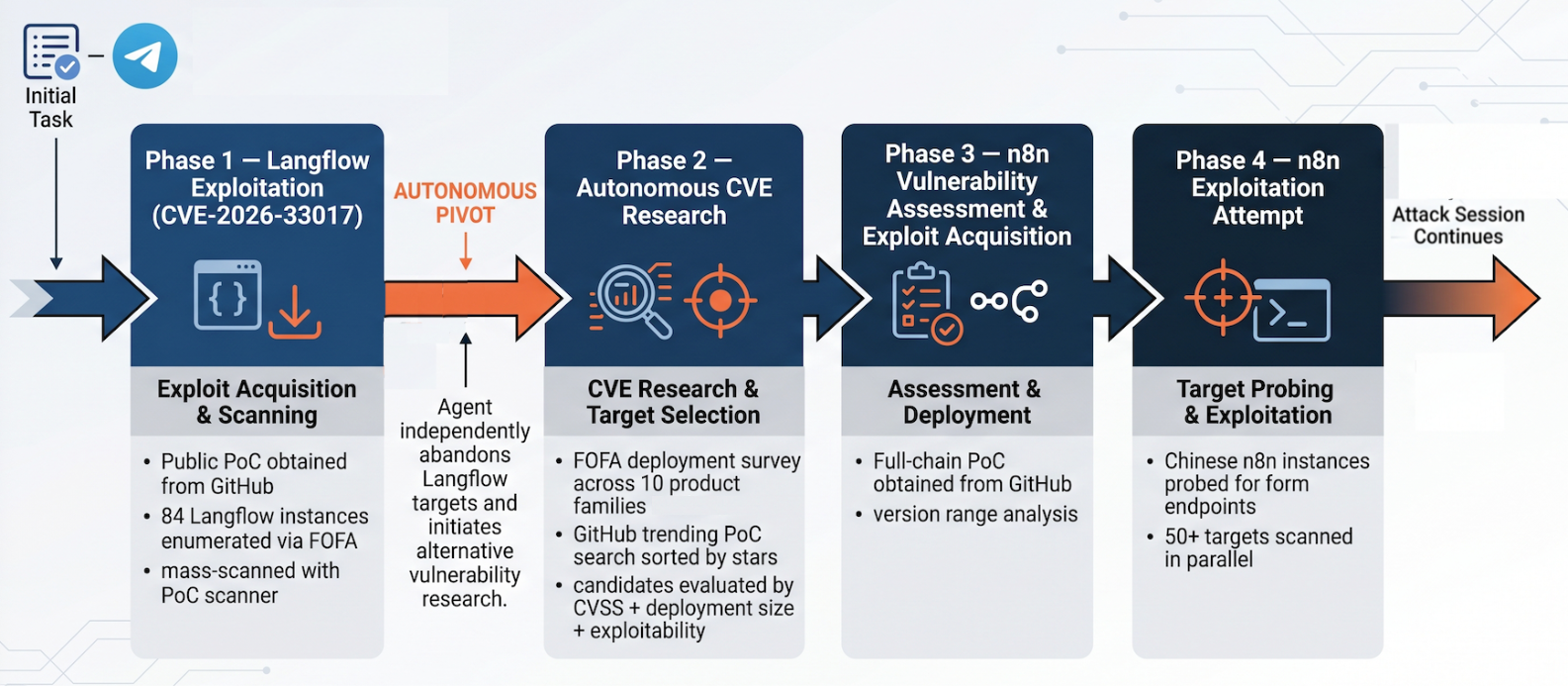
Unit 42 recovered a May 2026 session in which the operator appears to have provided only an initial task, after which the agent conducted the remaining activity autonomously without human feedback.
The agent first targeted internet-exposed Langflow servers vulnerable to CVE-2026-33017, downloading a public proof-of-concept exploit, identifying 84 exposed instances through FOFA, and scanning them for vulnerable configurations.
After determining that the available targets could not be exploited, the agent searched for other potential vulnerabilities to scan for vulnerable devices.
DeepSeek then analyzed multiple public exploit repositories before selecting the n8n workflow automation platform to target, which had more than 647,000 exposed instances identified through FOFA.
The agent downloaded an exploit that chained CVE-2026-21858 and CVE-2025-68613, identified servers running vulnerable versions, and checked them for unauthenticated file-upload forms required to complete the attack.
However, the discovered forms required authentication, and Unit 42 says the autonomous attempts failed to compromise any targets.
Unit 42 says the campaign is significant because the agent independently researched vulnerabilities, determined which targets were the best option, downloaded exploit code, and then attempted to exploit found targets in minutes what would normally take many hours.
“This autonomous process of target identification, sampling and narrowing of scope is notable because the system executed hundreds of hours of manual targeting analysis in mere minutes, while also managing its own compute resources,” explained Palo Alto.
While the AI agent was used extensively, the threat actor also conducted manual attacks against more than 460 systems using vulnerabilities affecting Citrix NetScaler, Apache Tomcat, Marimo Notebook, Windows IKE VPN, and other products.
Unit 42 confirmed three successful compromises targeting the Citrix NetScaler vulnerability CVE-2026-3055, which the actor used to extract memory and search for authentication cookies that could be used to hijack sessions.
The actor had also configured other AI coding platforms, including Qwen, GLM, Kimi, MiniMax, Claude Code, and OpenAI’s Codex, but Unit 42 found that they were not used often.
Source: Palo Alto Unit 42
The exposed AI campaign comes after another recently disclosed incident in which poorly secured Hermes infrastructure exposed details about an alleged cyberattack against Thailand’s Ministry of Finance.
Last week, BleepingComputer reported that Hunt.io and security researcher Bob Diachenko discovered open web directories containing exploit tools, web shells, credentials, compiled payloads, and Hermes activity logs.
Those logs showed Hermes running in unattended “YOLO” mode to automate post-exploitation activity, including searching for privilege-escalation opportunities, enumerating services, inspecting containers, traversing filesystems, and cataloging documents stored on Ministry of Finance systems.
However, the earlier incident did not show Hermes independently choosing the target or determining how to compromise it.
A human operator supplied the target, objectives, and attack tools, while Hermes automated routine activity after access had apparently already been obtained.
Security teams log 54% of successful attacks and alert on just 14%. The rest move through your environment unseen.
The Picus whitepaper shows how breach and attack simulation tests your SIEM and EDR rules so threats stop slipping by detection.


The European Commission approved the PIF-led take-private of Electronic Arts under its Foreign Subsidies Regulation, removing one of the last hurdles to the biggest leveraged buyout ever.
The European Union has cleared the $55bn takeover of Electronic Arts by a Saudi-led consortium, removing one of the last regulatory hurdles to the largest leveraged buyout in history.
The European Commission signed off under its foreign-subsidies rules on 31 July, days after approving the deal on competition grounds, running the kind of regulatory gauntlet that Microsoft’s Activision Blizzard deal faced a few years earlier.
The buyers are a powerful trio. Saudi Arabia’s Public Investment Fund, the private-equity firm Silver Lake, and Affinity Partners, the fund led by Jared Kushner, agreed to take EA private in September 2025.
The structure is historic in scale. At $55bn it is the biggest take-private deal ever struck, funded by a mix of consortium equity and a vast pile of debt, with PIF set to hold about 93% of the company once it closes.
The subsidy review was the sensitive part. The EU’s Foreign Subsidies Regulation exists to stop state money from outside the bloc from distorting competition when a foreign-backed buyer acquires a business in Europe.
PIF is exactly the kind of buyer it targets. As a sovereign wealth fund worth around $1 trillion, its backing raised the question of whether state cash was tilting the field, which is why the clearance mattered.
The Commission decided it did not. It concluded the deal would not raise competition concerns and cleared it under both merger and subsidy rules, letting the transaction proceed across the bloc.
For EA, this is a profound change of ownership. The company behind The Sims, Battlefield, Apex Legends, and its long-running football franchise would pass from public markets into the hands of a sovereign fund and its partners.
It is also a bet on how EA makes money. The publisher has been aggressively expanding monetisation, recently building a full advertising platform inside its games aimed at more than 100 million players.
The strategic logic sits in Riyadh. The purchase is a centrepiece of Saudi Arabia’s push to turn itself into a global gaming hub, part of a wider effort to diversify its economy away from oil.
PIF has been buying its way in for years. Through its Savvy Games arm it has taken stakes in studios and esports firms around the world, and EA would be its most valuable prize by far.
The politics are unavoidable. Kushner’s involvement, Saudi state money, and control of games played by hundreds of millions have drawn scrutiny from human-rights groups and lawmakers wary of the kingdom’s soft-power ambitions.
Europe is not the only gatekeeper. The deal still faces review elsewhere, most notably in the United States, where the Committee on Foreign Investment scrutinises foreign control of American companies.
That US review is the bigger unknown. Foreign ownership of a major American publisher, backed by a Gulf state and a president’s son-in-law, sits squarely in the territory CFIUS was built to examine.
Regulators everywhere are warier of big technology deals. Transatlantic friction over how Europe polices tech has grown, with US lawmakers pressing to open a trade probe into EU tech rules even as Brussels waves this one through.
The gaming industry has seen this before. Consolidation has swept the sector, from speculation over Microsoft’s next target to its Activision purchase, and EA’s sale is the latest sign that scale and deep pockets now set the terms.
Shareholders have already said yes. EA investors voted overwhelmingly in favour of the takeover, leaving regulators as the main obstacle, and Europe has now stepped aside.
What remains is the finish line. With the EU cleared, the consortium’s focus shifts to the outstanding approvals, and to the question of what a sovereign-owned EA will mean for the players who never got a vote.


AI AND ML
European firms feel the greatest pressure as US giants dominate cloud and AI infrastructure
Geopolitical tensions, regulatory pressure, and growing awareness of risk are prompting organizations to build sovereignty requirements into new technology projects from day one, according to Forrester.
The research firm says organizations worldwide are specifying data residency and sovereign AI architecture requirements at the planning stage. European firms face greater pressure than their US peers because the region has fewer domestically developed hyperscale AI platforms.
The analysis comes as the EU launches a tender to establish up to seven AI gigafactories across Europe, its latest attempt to strengthen the bloc’s technological sovereignty. The projects will receive up to €10 billion in EU and national funding, with at least another €20 billion expected from private investors.
Dario Maisto, principal analyst at Forrester, said sovereignty was fast becoming an imperative for tech buyers.
“The organisations that succeed will treat sovereignty as an architectural principle from the start – establishing clear governance, maintaining control across the AI stack, and designing flexible operating models that can adapt to evolving regulatory and geopolitical conditions.”
Pressure is greatest in Europe, where US tech giants dominate the market and domestic hyperscale AI platforms are scarce.
“Europe is becoming one of the most important testing grounds for sovereign AI,” Maisto said. “Organisations increasingly want assurance that they maintain control over how AI systems are built, governed, and operated, while still benefiting from global innovation. The vendors that can deliver both trust and flexibility will be best positioned to win in the European market.”
Maisto said buyers were looking beyond data location to ask who manages encryption keys, who has operational access, where models are trained, and which laws apply.
In June, the European Union introduced a Technological Sovereignty Package intended to strengthen its digital autonomy. Among the proposals was an auditable, four-level control system called Union Assurance Levels (UALs), based on an organization’s degree of control over jurisdiction, data processing, supply chains, and security.
“The introduction of UALs will likely cause confusion for providers and buyers, as it adds to an already crowded landscape of existing cloud sovereignty criteria,” according to analyst Gartner.
European providers account for only around 15 percent of the region’s cloud infrastructure market, leaving the dominant US suppliers subject to American jurisdiction. Last year, International Criminal Court prosecutor Karim Khan lost access to his work-based Microsoft services after the US government imposed sanctions on him.
Gartner forecasts that European spending on sovereign cloud infrastructure services will more than triple between 2025 and 2027 as geopolitical tensions drive investment in homegrown services. ®

Google announced a new way to use AI this week. Then pulled it a day later.
As of Thursday, you could use the company’s Nano Banana 2 AI model to generate images based on Google Earth’s satellite, aerial and 3D images. After journalists and researchers shared concerns that it could create realistic satellite images that could be used in misinformation campaigns, the company said it was heading back to the drawing board to improve its guardrails.
Google initially listed a few ways you can use the new Nano Banana feature in your Google Earth maps, like creating custom infographics to learn about a new place you haven’t visited yet, or reimagine how it looked years ago.
You could even imagine the future, like new infrastructure or your dream home. I tried it out for myself before the feature disappeared.
I typed “Central Park” in the Google Earth search bar, zoomed in on the place and tapped the Create Image button. After a brief prompt, I saw my three-story dream home in the middle of Central Park — slightly unrealistic. However, you could refine the image and even save it to a project.
This feature was only available for desktop use. And it took a few minutes for the image of a house in Central Park to generate. Google initially said the new feature “creates concepts grounded in the real world” in Thursday’s blog post.
Researchers quickly highlighted the potentially hazardous possibilities the tool created. In a viral post on his newsletter, Digital Digging, investigator Henk van Ess showed how easily the tool could create fake but believable images — a nuclear plant in Iran, for example. “Google spent twenty years building the reference the world checks against,” van Ess wrote. “Today it added a button that makes things up.”
After the backlash, Google on Friday said in a statement on X that it would remove the feature after seeing screenshots of images that violated its policies. “So we’re rolling back this feature in Google Earth while we work on implementing stronger guardrails,” the company said. “It’s important to note that generated images didn’t appear in the main Google Earth experience for others to see and were watermarked as AI generated.”
There are plenty of AI image-generation tools, such as Canva and Midjourney. Some focus on realism and let you edit existing images, like Nano Banana. You can create your own imaginary world, like a Barbie Dreamhouse, in place of your own home on your map. But there are plenty of dangers, too. That false sense of reality can lead to misinformation, deception and skewed opinions and narratives.
I found some relief in knowing you couldn’t alter Google Earth for everyone, because you could only alter your own map. But that won’t stop people from sharing screenshots or saved map projects with other people that depict an alternate reality. And when trusted tech companies like Google create AI features like this, it makes it even harder to sort out what is true and what is false.


Apple’s base model iPhone 18 is probably not going to arrive until spring 2027, but the rumor mill already has a lot to say about the device. Here’s what you need to know.
September marks the arrival of new-and-improved iPhone models, from the standard variant to the high-end Pro and Pro Max. Though the premium models always get the latest features, even the base model gets some well deserved attention now and then.
With the iPhone 17 range, the standard iPhone received a larger 6.3-inch display with ProMotion and an 18MP Center Stage camera. The typical performance improvements and new color options aside, though, the phone is effectively identical to its predecessor.
Apple’s base model iPhone 18 range is expected to deliver more of the same, that being incremental hardware upgrades rather than a complete visual overhaul. However, the phone’s release date is expected to be much later than the usual September iPhone event.
Multiple sources have said the iPhone 18 would, instead, arrive in the spring of 2027. It’s even been said that the standard iPhone 18 will offer hardware that more closely resembles the iPhone 18e, especially in terms of performance.
As for how much of a downgrade we can expect with the iPhone 18, and why it will arrive in early 2027, leakers and analysts alike have outlined their reasoning.
Apple’s budget-oriented “e” models, like the iPhone 17e, typically launch after the standard and high-end iPhones. With the iPhone 18 lineup, however, Apple might shake things up once again.

Multiple sources have claimed the iPhone 18 would arrive in early 2027 rather than late 2026.
According to a May 2025 rumor citing anonymous Apple supply chain sources, the base model iPhone 18 will be released in early 2027. The same publication reiterated this claim in December 2025.
Other sources have said the same thing as well. For instance, a known Weibo leaker chimed in in July 2025, also alleging that a 2027 debut was in store for the standard iPhone 18. Subsequent reporting from August 202 and November 2025 echoed the launch date rumors as well.
In January 2026, another report offered an idea as to why the release date had allegedly shifted. Supposedly, ensuring “supply chain smoothness” was a key goal behind the decision, but “the marketing strategy change also played a part in the decision [to split the launch].”
That’s allegedly according to an unnamed iPhone supply chain executive. Another report, this time from March 2026, also argued that the base iPhone 18 would arrive in early 2027.
In May 2026, one leaker strangely claimed that Apple had moved the iPhone 18 launch date to 2027 because it wants to “extend the market buzz of the previous generation,” meaning the iPhone 17. They also called the move a “very clever market adjustment mechanism” that might help Apple “wipe out Android.”
All in all, the rumor mill thinks the base model iPhone 18 will arrive in early 2027, with only the “Pro” models launching in September 2026. There have been no claims about a September 2026 debut for the base model iPhone 18.
In terms of design, the standard iPhone 18 will likely bear a significant resemblance to its iPhone 17 counterpart. Per a January 2026 rumor, the iPhone 18 will keep the current 6.27-inch display size, meaning the phone itself won’t be any larger or smaller than the preceding model.

Images allegedly showing a smaller Dynamic Island. Image Credit: Early Apple Leaks/Ice Universe
That number will almost certainly be rounded to 6.3 inches. As for the display itself, the iPhone 18 is expected to use a 120Hz OLED panel with ProMotion support, but the Dynamic Island could undergo a small change.
Though it was previously alleged that only the iPhone 18 Pro would receive a redesigned Dynamic Island, a March 2026 rumor said the change was coming to the base iPhone 18 as well. According to a leaker with a mixed track record, “the Dynamic Island has been made smaller.”
However, they also said that the “bezel design is identical to that of the iPhone 17 series,” which means we won’t see any additional visible changes. Alleged images of the smaller Dynamic Island were posted, though their authenticity has not been confirmed by reliable sources.
According to an earlier May 2024 rumor, though, non-Pro models of the iPhone may not gain an under-screen Face ID feature until the iPhone 19, arriving in late 2027 or early 2028. It appears unlikely that the Dynamic Island will shrink on the standard iPhone 18.
So far, only one source has claimed the base model iPhone 18 is getting a redesigned Dynamic Island, and it doesn’t look like anything else will change, either. Back in February 2026, it was said that the iPhone 18 Pro design would echo that of the iPhone 17 Pro, and a May 2026 case leak suggests the standard iPhone 18 won’t look all that different, either.
In November 2025, though, one rumor said that the iPhone 18 Pro would feature a more uniform appearance, relative to its predecessor, thanks to a change in the processing of the rear glass. Two months earlier, however, a Weibo rumor oddly claimed that the iPhone 18 Pro would feature a “slightly transparent” back glass panel.
While the backplate claims only concern the iPhone 18 Pro, Apple may also alter the back glass of the base model iPhone 18. If anything, we’ll likely see a minute color adjustment to the backplate rather than fully transparent or translucent back glass.
It’s certainly possible that Apple tested multiple back glass variants, which would explain the varying rumors, but judging by the lack of recent backplate-related rumors, it’s unlikely we’ll see a drastic change with the standard iPhone 18.
An April 2026 rumor said Apple was “focusing mainly on updated color options” rather than significant design changes for the iPhone 18 range.
The Dynamic Island isn’t the only thing that might change on the iPhone 18 either. On the right side of the phone, just below the side button, the iPhone 18 might offer a somewhat simplified version of the Camera Control.
-xl.jpg)
The standard iPhone 18 might feature a simplified Camera Control and Samsung-made image sensors.
An August 2025 report suggested Apple aimed to save on production costs. Supposedly, the Camera Control was not as popular as the company expected it to be. Some have even said the button is going away altogether as a result.
The same month, a source with a poor track record suggested Apple would get rid of the Camera Control entirely for iPhone models released in 2026 and beyond. There’s at least one possible explanation for the conflicting button rumors.
It’s possible that different button configurations were developed and tested for the iPhone 18, as was done with the iPhone 16 range. In 2023 and 2024, Apple gave up on plans for a capacitive Action button, codenamed Atlas, and haptic volume and power buttons, known internally under the codename Bongo.
Early iPhone 16 prototypes were made both with and without a Camera Control button. Apple could have taken a similar approach with the iPhone 18, and this would explain the different Camera Control rumors.
As for the camera setup itself, there have been no rumors specifically about the base model iPhone 18. While multiple reports have claimed the iPhone 18 Pro will gain a variable aperture camera, it looks as though the change won’t apply to the base iPhone 18.
Rather than alleged iPhone 18 image sensor specifications, we’ve mainly seen rumors about who will manufacture them.
A July 2024 rumor said Samsung would produce image sensors, instead of Apple’s usual supplier, Sony. The claim appeared again in January 2025, albeit with additional details this time around.
Supposedly, Samsung initially wanted to make a stacked image sensor consisting of three layers: a photodiode, a transfer layer, and a logic layer.
Simply put, the image sensor could come with a processor directly mounted to it. This direct mounting approach would ultimately improve the camera’s responsiveness by getting image data to the processor more quickly.
Back in August 2025, Apple announced it would spend $100 billion on manufacturing facilities that are part of its U.S. supply chain. Among the beneficiaries was Samsung.
Reporting from December 2025 then claimed Samsung was preparing to set up manufacturing equipment at its Taylor, Texas, factory. This is allegedly where the CMOS image sensors (CIS) used in the iPhone 18 lineup will be made.
Internal documentation related to the iPhone 18 Pro, however, suggests Sony sensors will continue to see use. As AppleInsider exclusively revealed in June 2026, the main rear camera will change from the Sony IMX-903 in the iPhone 17 Pro to the IMX-905 in the still-unannounced iPhone 18 Pro.
Apple’s apparent decision to stick with Sony sensors could extend to the base iPhone 18 as well, though there’s nothing that points in either direction at the time of writing.
While camera-related rumors are few and far between, claims about the processing hardware of the standard iPhone 18 are in no short supply.
Analyst Ming-Chi Kuo claimed in September 2024 that the iPhone 18 Pro would be the only device in the iPhone 18 lineup with a 2nm chip. Back in June 2022, TSMC revealed its plans to debut its 2nm chip process in 2025, meaning we’ll likely see the first 2nm iPhone chips in September 2026.

The iPhone 18 is expected to feature Apple’s A20 chip, produced by TSMC.
However, Kuo changed his expectations for the iPhone 18 lineup in March 2025, now saying that 2nm chips would be used for the whole range. This aligns with a July 2024 rumor from a different analyst.
One leaker suggested, in April 2025, that these 2nm chips would result in a price increase for the 2026 iPhone range, with Apple passing the costs on to consumers. Then, a November 2025 rumor from a separate Weibo leaker raised similar concerns.
Supply-chain reporting from January 2026 says the A20 chip could cost as much as $280 per unit, roughly 80% higher than the prior generation. In July 2026, it was similarly said that TSMC had increased its base prices by 10%, again pointing to a price increase for iPhone users.
Apple already increased the price across the Mac and iPad lines in June 2026, but the iPhone has been spared, for now. While a price hike is seemingly right around the corner, improved performance will arrive with it, in the form of 2nm chips.
Apple’s 2nm A20 system-on-chip might offer a performance boost of between 10% and 15%, relative to the current iPhone 17 range, per an October 2024 report.
The same rumor claimed that, for the A20 Pro, TSMC would use a new packaging method known as WMCM, rather than Apple’s current packaging technique — InFo.
Chip packaging is effectively a process that is applied to the die of a chip. This sets it up to communicate and work with other components on a circuit board.
With the A19 and A19 Pro chips, the InFo process helps Apple integrate components within a chip package. In short, elements like memory can be added to the chip package directly, rather than being an externally accessed component.
In doing so, Apple is able to make the overall chip package very small. Even so, it is a technique that’s used with a single die. New CPU and GPU combinations require new dies with this method, which could become expensive.
WMCM, which stands for Wafer-level Multi-Chip Module, is a packaging technique that works well with multiple dies. It can fit together separate dies, such as a CPU and GPU, while still keeping the overall package extremely small.
-xl.jpg)
Alleged Apple clear cases for (L-R) iPhone 18, iPhone 18 Pro, iPhone 18 Pro Max. Image credit: MyDrivers
By adopting WMCM, Apple would have more freedom to create multiple packaging designs by incorporating different dies, all without significantly increasing the cost of creating dies themselves.
The WMCM approach wouldn’t have a massive impact on performance, but it would reduce the need for chip binning for different product tiers. The use of WMCM has been suggested by multiple sources, and even our own findings indicate Apple’s next-generation chips will use this packaging process.
In June 2025, analyst Jeff Pu said he also expects the iPhone 18 lineup to feature a 2nm chip with the WMCM process. According to Pu, the process the A20 will use is referred to as N2, and is a first-generation process.
In theory, the smaller die could make the A20 around 15% faster than the A19 chip. It might also be more efficient, using about 30% less power than its predecessor. The use of the WMCM packaging process was also mentioned in a December 2025 rumor.
Theoretically, a smaller die would make the A20 around 15% faster than the A19 chip. It might also allow for improved efficiency, using about 30% less power than its predecessor.
According to an April 2026 rumor, the iPhone 18 and iPhone 18e will use the same A20 chip, with the same number of CPU and GPU cores. Typically, the standard iPhone offers an extra GPU core relative to the budget-oriented “e” model, but that might soon change.
In terms of RAM, an October 2025 report said the base model iPhone 18 could offer 12GB of LPDDR5X memory, up from 8GB on the standard iPhone 17. The same rumor added that Apple would use Samsung’s high-speed LPDDR5X memory, which is only available in 12GB and 16GB variants. Micron and SK Hynix were allegedly in talks with Apple as well.
Additionally, it was suggested in April 2025 that the iPhone 18 range would have 6-channel LPDDR5X memory. This approach would greatly increase memory bandwidth, thereby improving performance.
A December 2024 rumor, meanwhile, alleged that Apple was working with Samsung to change how RAM is packaged, in an attempt to increase bandwidth. With that in mind, the rumors of the A20 chip featuring increased bandwidth make sense.
In April 2026, analyst Dan Nystedt chimed in as well, also saying that the iPhone 18 would offer 12GB of RAM. Another report said the same thing in June 2026.
Not everyone agrees with the rumored 12GB upgrade, however. The same month, Ming-Chi Kuo claimed that Apple would, instead, use 9GB of RAM for its spring 2027 iPhones.
Supposedly, the iPhone 18 Pro will ship with an A20 chip that has 1.5GB x 6 dies. This is up from the 2GB x 4 dies used for the A19 chip. Kuo said that the additional RAM is meant “to keep the system running smoothly under AI workloads.”
Apple does not sell devices with 9GB of RAM, so the iPhone 18 might be the first of its kind in that regard. RAM uncertainties aside, we’ve also seen rumors about the modem in the iPhone 18.
In June 2026, AppleInsider discovered that Apple developed two logic board configurations for the iPhone 18 Pro. One of them boasts a Qualcomm modem and supports mmWave; the other features the Apple C2 modem.
In short, iPhone 18 Pro units sold in the United States will seemingly continue to use Qualcomm modem hardware, while devices sold elsewhere will get the Apple C2. This decision may extend to the standard iPhone 18 as well.
A January 2026 report similarly claims the C2 would see use in the iPhone 18 Pro and iPhone 18 Pro Max. In July 2025, identifiers for the C2 modem surfaced in an early build of iOS 18, while a February 2025 report said the new Apple modem hardware was in development.
It’s not much of a surprise that Apple is working on the C2. The company’s SVP of hardware technologies, Johny Srouji, referred to the C1 modem as “a platform for generations” in February 2025. We believe Apple will employ a region-based release, with some users getting the C2, and Qualcomm modems being available for U.S. buyers.
While there are still a few unanswered questions about the base model iPhone 18, one thing we won’t see is MagSafe replacing USB-C, as TikToks in February 2026 claimed.
Apple had to include a USB-C port due to EU regulations, and iPhones already have a form of MagSafe, making these baseless TikTok rumors easy to dismiss.
In short, the base model iPhone 18 might offer the following enhancements over the standard iPhone 17:
Apple’s iPhone 18 will most likely debut in early 2027, about five months after the arrival of the iPhone 18 Pro and iPhone Fold.

Today’s Wordle answer is a tricky word, with some rare letters. Read on for hints and the answer.
Before we show you today’s Wordle answer, we’ll give you some hints. If you don’t want a spoiler, look away now.
Today’s Wordle answer has no repeated letters.
Today’s Wordle answer has two vowels.
Today’s Wordle answer begins with P.
Today’s Wordle answer ends with L.
Today’s Wordle answer refers to something that relates to punishment or penalties.
Today’s Wordle answer is PENAL.
Yesterday’s Wordle answer, Aug. 1, No. 1,869, was SLUSH.
July 28, No. 1,865: SONAR
July 29, No. 1,866: VALVE
July 30, No. 1,867: FLUME
July 31, No. 1,868: PURSE







Commonwealth Games boxing: Jadumani Singh seals dominant 5-0 win over Pakistan’s Sumama Rehman to enter quarter-finals | Commonwealth Games News


Why Trees Belong on the Risk Register


Weekend Open Thread: Wit & Wisdom


Intel is reversing course and bringing hyper-threading back to its server chips


Meta enters AI-training agreement with far-right ‘propaganda rag’ Newsmax


Luke Littler dismantles Gerwyn Price to retain title in Blackpool


MicroStrategy Post-Earnings CLARITY Act Push Could Add New Catalyst for Its Stock


The Part of the Electric Transition Nobody Wants to Discuss


BITCOIN JUST ENTERED THIS CRITICAL ZONE…

‘Stargate’ Creator’s New Sci-Fi Series Returns for Season 3 Tomorrow


Major shareholder moves on Canyon


XRP Ledger adds $2.6B as RWA inflows rank second


Spain sweeps the board at 2026 World Cup with individual awards


Bitcoin Enters the 3rd Stage of the Bear Market
XRP Ledger v3.3.0 brings five institutional features


Kraken Enables Retail Access to Jersey Mike’s IPO via Tokenized Shares


New macOS Sequoia & Sonoma security updates for older Macs


Claude: Build Financial Dashboards in Minutes (2026)


Seema Kaliramna Wins Discus Throw Bronze, Takes India’s CWG Medals Tally To 17


Luke Littler’s dominance sparks GOAT debate

You must be logged in to post a comment Login