Australia’s Fair Work Commission has announced a process review after an estimated 70% workload increase over three years, partly driven by generative AI tools that enable more people to file longer, more complex, and sometimes inaccurate claims. New Zealand’s Tenancy Tribunal and Australia’s financial complaints authority report similar patterns.
Australia’s Fair Work Commission has announced a review of its processes to cope with what it described as an estimated 70% workload increase over three years, driven in part by the proliferation of generative AI assistance tools. The commission, which handles unfair dismissal claims, wage disputes, discrimination, bullying, and workplace sexual harassment, said the surge is directly affecting its ability to provide timely dispute resolution, according to a statement published on Friday.
Advertisement
The numbers tell the story. The commission received 44,039 lodgments between July 2025 and April 2026, with two months still remaining in the financial year. The full 2024–25 year saw a record 44,075 lodgments. The commission is on pace to exceed that record by a significant margin.
How AI changes what gets filed
The commission attributed the increase to several factors: more people representing themselves in workplace cases, budget constraints, resourcing challenges, and the spread of generative AI tools that make it easy to produce polished-sounding but often generic content. The implication is that AI is lowering the barrier to filing a claim, enabling people who might previously have decided a case was not worth pursuing to generate a detailed submission in minutes.
The 💜 of EU tech
The latest rumblings from the EU tech scene, a story from our wise ol’ founder Boris, and some questionable AI art. It’s free, every week, in your inbox. Sign up now!
Advertisement
The Fair Work Commission published draft guidance in March requiring anyone who uses generative AI in preparing documents for lodgment to disclose that fact. The guidance warned that AI-generated information may be incomplete, inaccurate, or fabricated. A new “Use of GenAI” section will be built into all commission forms.
What the commission is doing about it
The response includes trialling a new system in which senior staff help parties try to resolve disputes informally earlier in the process, before cases consume full hearing time. The commission has also reviewed how it manages applications and is considering deploying an AI voice agent to help triage calls to its helpline.
The irony of a tribunal overwhelmed by AI-generated filings considering an AI tool to manage the influx is not lost. Australia has already backed AI in other parts of its legal system, including a government-supported chatbot that helps splitting couples divide their assets. But the logic is sound: if generative AI is increasing the volume of inbound work, automated triage may be the only way to keep pace without proportional increases in staffing that budget constraints have already ruled out.
Not just an Australian problem
The pattern is emerging across the Tasman as well. Radio New Zealand reported last month that tenants in New Zealand are using AI to support applications to the Tenancy Tribunal, creating extra work and backlog. In one case, a tenant used AI to file a claim for $40,000 over issues including unsafe drinking water and a broken dryer. The tribunal awarded $80.
Advertisement
The case illustrates a recurring problem with AI-generated legal filings. The tools can produce arguments that sound authoritative but cite legal principles that do not apply in the relevant jurisdiction, claim damages wildly out of proportion to the harm, or reference legal frameworks from other countries entirely. Adjudicators then have to work through pages of material to identify which parts are relevant.
The financial complaints parallel
The Australian Financial Complaints Authority, which handles disputes in financial services, told Bloomberg it has also seen increased AI use in how consumers engage with financial firms and lodge complaints. A spokesperson acknowledged that AI can help some people articulate their concerns, but warned that AI-generated complaints “can sometimes include irrelevant, inaccurate or generic information, or may use legal arguments that don’t apply in Australian law.”
AFCA said it encourages people to keep their complaints simple because lengthy AI-generated submissions slow down the resolution process by forcing staff to work through large volumes of material to identify the actual issues. The advice amounts to an admission that more words do not mean a better case, and that AI’s tendency to produce verbose, confident-sounding output is actively counterproductive in dispute resolution.
Access to justice or access to noise
The tension at the heart of the issue is genuine. AI tools can democratise access to legal processes for people who cannot afford lawyers, a point governments and AI companies have promoted as a public benefit. But when the same tools generate filings that are longer, less accurate, and harder to process than what a human would produce unaided, the net effect may be to slow down the system for everyone.
Advertisement
Australia’s Fair Work Commission is the first major tribunal to publicly frame generative AI as a contributing factor in its workload crisis. It is unlikely to be the last. Any institution that accepts written submissions from the public is now dealing with the same dynamic: AI makes it trivially easy to generate text, and institutions built for a world of human-paced filing are not equipped to process the result.
A new pair of Beats headphones are on the way, as a new unnamed model surfaces in a series of Instagram posts by football star Lamine Yamal.
On May 23, some mystery headphones appeared in an FCC filing, indicating a new pair was coming out of Cupertino. One week later, an Instagram post has shown that it’s from Beats.
The shots on the official account for Lamine Yamal showed the sporting celebrity wearing and carrying around some bright pink headphones. In the four photographs and one video, the headphones are either around his neck or hanging off a bag to his side.
Three of the shots give a clear look at the headphones, complete with the side “b” logo synonymous with Beats headphones.
Advertisement
Though the post doesn’t mention the headphones directly, nor offer any real information about them, we can tell from the images that they have an over-ear earcup design. This closely matches the simple drawing shown in the FCC filing.
While there are no real rumors about Beats headphones, the most probable match would be an update to the Beats Studio Pro, originally released in July 2023. While there are no other details for the headphones as of yet, the appearance with a celebrity indicates that a launch could happen within weeks.
Celebrity tease
Lamine Yamal is a prominent football player who plays for La Liga club Barcelona, as well as the Spain national team. In the clips, he is shown traveling to a training camp ahead of the World Cup.
Close-up of the mystery Beats headphones – Image Credit: Lamine Yamal
Advertisement
At the time of publication, Yamal has 43 million followers on Instagram. After an hour, his Beats-containing post achieved more than 1 million likes and 5.1 thousand comments.
The use of a celebrity on Instagram as the initial tease for a product launch is a typical promotion strategy for the Apple subsidiary. Regularly, Beats uses sports stars to promote earbuds, headphones, and speakers long before their launch.
BORK!BORK!BORK! The National Space Centre in England took things a little too far with its simulation of a rocket launch, unless it was seeking to recreate NASA’s leaking Space Launch System (SLS) via a plastic bottle and some water.
The Leicester-based museum features exhibits aplenty, including some rockets to gawp at, an intriguing parafoil-equipped Gemini capsule, a planetarium, and lots of interactive stations to educate and inform visitors about the space age.
Advertisement
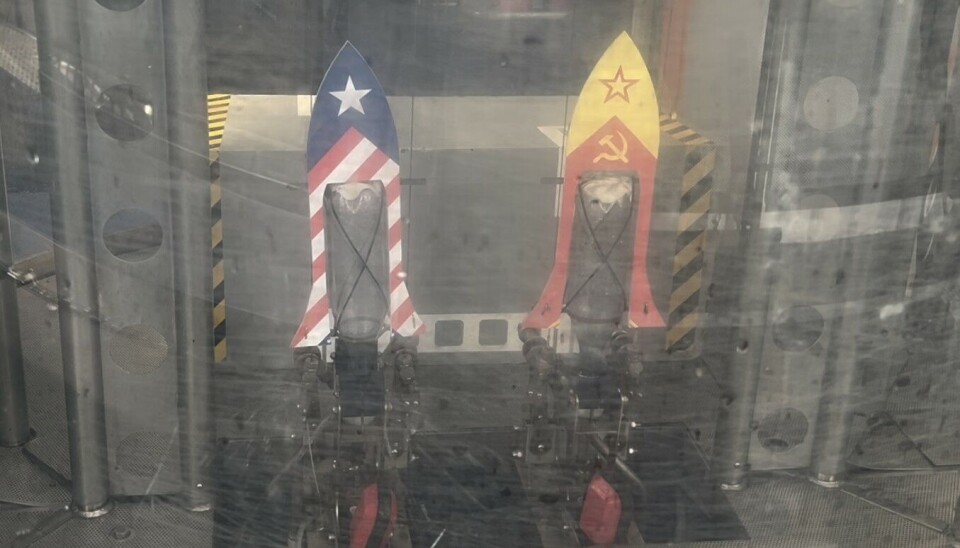
Some of those interactive exhibits can, however, be a little too realistic for comfort, such as a bottle rocket intended to illustrate the Space Race between the United States and the Soviet Union.
It’s a simple enough concept. Select a rocket type, learn some stuff about it, watch as a water bottle is pressurized, listen to the countdown, and then liftoff! It’s an activity that kids – and adults – might have attempted in a garden or park.
Things didn’t go as planned at the National Space Centre, and was reminiscent of the repeated leaks NASA’s SLS suffered during launch preparations. Where the exhibit’s Soviet Union’s bottle blasted off as expected, the American one did not. It spewed water from the base in an unintended recreation of NASA’s initial attempts to fuel the SLS, before giving a pathetic twitch when the countdown reached zero.
The National Space Centre exhibitRichard Speed
Still, it could have been worse. Had the museum decided to recreate the failure of the Soviet Union’s N1 Moon rocket, or Blue Origin’s explosive test of its New Glenn this week, onlookers might have needed a change of clothes after a sudden, and very watery, boom.
Advertisement
The interactive display might not be quite what the museum intended, but it indicates that even in the high-tech world of the space age, the curse of bork is never far away.
Unless, of course, the plan was always to remind users of SLS leakage, if not the explosive excesses of today’s commercial providers.
The National Space Centre told us:
“We currently have one water rocket out, the USA rocket. There are these bands that are needed to keep the bottle in place within its frame, the bands for that rocket snapped a few times recently so we have run out of spares and are waiting on parts be delivered for it to be back in action, but the soviet rocket is completely fine and has been all week.” ®
This is, without a doubt, more work than setting up Wispr Flow. When you’re done, though, you have a working application with no monthly subscription. I recommend trying it out.
A Few Other Free Alternatives
Like I said before: AI transcription and LLMs are both widely available technologies. It should be no surprise, then, that there are many Wispr Flow alternatives out there right now.
For Mac users, the completely free and open source MacParakeet is a great option. It’s open source and completely free to download and use without an account. There’s also no upselling in the application. Transcribing is handled using local models, either Parakeet or Whisper, and a variety of LLMs—both local and online—are supported for the formatting step. That’s the closest completely free app to Wispr Flow I’ve found.
VoiceInk, another Mac-only option, is open source and free to use if you download the code from GitHub and compile it yourself. The app otherwise costs $25, one time, after which you can use all features without any ongoing payments. Note that the formatting step for this requires an API key from a service such as Gemini, Anthropic, OpenAI, or Claude.
Advertisement
Windows and Linux users should look into FOSS Voquill, which is completely free, open source software (hence the FOSS), and works offline. It doesn’t offer a formatting step, which is disappointing, but I’m including it because it’s the best free Windows and Linux option I’ve found without any annoying upselling.
Windows users and Mac users who don’t like the above options for any reason have one more choice: OpenWhispr. This open source tool doesn’t require an account (but you’ll have to find a tiny “Continue without an account” button). The application offers a subscription, but you can opt to set up local models and external API keys instead to avoid paying.
Do You Really Need to Type With Your Voice?
Wispr Flow has its upsides. It’s easy to configure, for one thing, and has a consistent user interface. I can understand why someone might opt to pay for a subscription. But if money is tight right now, there are free options available.
I had fun exploring this growing field, but I’m going to stick to my keyboard. Wispr Flow, and apps like it, promise to let you write at the speed of thought, but I type faster than I think. If I can be philosophical for a second, writing is how I think. Typing a sentence, looking at it, and refining it isn’t an annoying part of the writing process—it is the writing process. And I often don’t know what my opinion on something is until I take the time to refine my thoughts. I can’t help but feel a lot of that would be lost if, instead of typing, I just talked to my computer.
Advertisement
But every brain is different, and these tools may work well for you. Which is why I’m glad there are so many options out there.
The Witcher 3: Wild Hunt is one of my favourite games of all time. Steeped in rich lore, abundant with characters and dripping in magic, it’s got so much to offer I’ve felt almost greedy as I devour its gameplay. And maybe I am, because I’ve certainly got a rumbly in my tumbly for more. When CD Projekt Red announced that a new Witcher game was in the works back in 2022, well, I felt a similar tingle to the one Yennefer undoubtedly bestows upon Geralt.
This time round, it’s a new trilogy, passing Geralt’s carefully-handed reins over to Ciri. Taking over from ‘daddy’, she’ll become the main protagonist. For Geralt, reportedly, he’ll hold a simple supporting role. It’s a clever move, granting players both new and old an appealing place to jump in, but it’s given players plenty to talk about.
When CDPR’s Cyberpunk 2077 was released to heavy criticism at launch in 2020 for its bugs and seemingly missing features, it’s unsurprising that the developers are taking their time. But what can we expect when this new trilogy-starter finally launches? It’s not clear.
Advertisement
Latest Videos From
Instead, here’s what I want: seven things, in fact, because I’m a ravenous monster hunter with a real hankering for more open-world tomfoolery.
Building Ciri’s story
(Image credit: CD Projekt Red)
To mark the beginning of a new Witcher trilogy, it can no longer be Geralt of Rivia’s story. Ciri, Geralt’s adopted daughter and sole heir to the throne of Cintra, is taking the lead. But Ciri is not as well-travelled and well-honed in the life of a Witcher as Geralt. For The Witcher 4, then, I’d like there to be an obvious learning curve in the storyline.
What I’d also really like from Ciri, as she picks up the Witcher (Witcheress?) gauntlet, is to flesh out her character with a depth that makes me care about her in the way I did about Geralt. This feels almost inevitable, but we can’t say it’s a given.
Advertisement
In a behind-the-scenes reveal, Sebastian Kalemba, game director, revealed: “Ciri is all about becoming the Witcher, and she is very determined to follow this path.” While my wishes will get a little more elaborate as we journey through this list, this one feels like a solid starting point.
Sign up for breaking news, reviews, opinion, top tech deals, and more.
Ciri was briefly playable in The Witcher 3: Wild Hunt, but we know there’s more to explore. Who will she meet? Who will she romance? Adding layers to her character feels very CDPR-coded, and long may it continue. After all, there’s a lot of canon to explore, and it’ll be interesting to see what CDPR stays true to and what they change.
Advertisement
A new way to fight
(Image credit: CD Projekt Red)
One of the most interesting discourses I’ve witnessed about The Witcher 4 has been around combat. It’s especially interesting because it marks the first time that CDPR has had a fully-fledged combat designer for a Witcher game. They didn’t have one until Cyberpunk 2077, and now they’ve hired another in Dennis Zopfi of Metal Gear Rising and Horizon Zero Dawn fame. Zopfi joins as the new Gameplay & Combat Director to aid Ciri in her quest to become a monster slayer.
Undoubtedly, Zopfi’s presence will have a direct impact on the way that combat was integrated in The Witcher 3, and I’m not mad about that at all. In fact, I wouldn’t mind if it were a little less clunky and even a touch more complex than the previous game. The Witcher 4 marks a perfect opportunity to expand on the groundwork of the combat mechanics, especially melee, and Zopfi steps in to make a difference. Plus, they’ve moved to Unreal Engine 5 this time round, which CDPR says: “aims to be the most immersive and ambitious open-world Witcher game to date.”
Advertisement
Deal me in — Gwent simply has to live on
(Image credit: CD Projekt Red)
Lord have mercy, I’m such a fan of Gwent that I can’t imagine another Witcher game without it. Both my parents were card dealers, so I’ve got a little soft spot for card games regardless, but Gwent is something different.
In fact, I’d be bold enough to say it’s one of the best examples of a game within a game that I’ve experienced. Integrating it into The Witcher 4 feels like a must, and the developers have dropped some heavy teasers that they agree.
What I’m saying is bring it back, please, and throw in some tournaments while you’re at it. I’ve been fervently searching for a way to scratch that mini-game card itch in other titles, and Duo in Crimson Desert most certainly hasn’t cut it. Dare I say it, I wouldn’t even mind if they made it harder. I’m not talking about the standalone Gwent game, though, which changed up some of the gameplay mechanics.
Advertisement
Monster mash
The Witcher 4 — Cinematic Reveal Trailer | The Game Awards 2024 – YouTube
Don’t get me wrong, there are plenty of monsters in The Witcher 3: Wild Hunt. It’s literally named after them. But if I’m getting a wishlist of features that I’d like, then I’m choosing to have even more of them. More variety, more crossover from the Netflix show, more terror. Fortunately, we’ve already been teased with one such addition, the Bauk, in the game’s cinematic reveal trailer, described by Kalemba as having “this ability to smell your fear, to be able to play with your traumas, to paralyze you.” Creepy.
Ciri is learning what it’s like to be a Witcher, and with that, there’s going to be trials and tribulations. What better way to cut your teeth than literally fighting against the worst of the worst? Along with new monsters, though, it’d be cool to see the return of old monsters like the Leshen and some cheeky Rock Trolls, demonstrating that while it’s no longer Geralt, the threat is still the same. Seeing how Ciri deals with this in combat, transformed by Zopfi, will be really cool to see.
A better brew
(Image credit: CD Projekt Red)
I’ve already explained my adoration for The Witcher 3: Wild Hunt, but one aspect of the game that I didn’t really love was the alchemy system. It felt a touch unimaginative at points, and I honestly feel like it could’ve done more. Considering the complexity of the rest of the gameplay, I wouldn’t mind if they made the alchemy a bit less simple, too. Maybe even, like The Elder Scrolls V: Skyrim, where it’s a little less explained and a lot more creative, seeing what you can make up without guidance.
If there’s a possibility for a deeper system, closer akin to The Witcher 1, that would be ideal. If I’m prepping my oils and potions for combat, preparing for my next fight, then I want it to feel like I’m really doing something meaningful. After all, it’s the difference between survival and death. Plus, that rings true to merely living life as a Witcher without the threat of monsters, so it’d be fun if the alchemy carried a similar weight in the main gameplay.
You spend a lot of time making a difference to the world around you in Witcher games, but the nonplayer characters (NPCs) don’t tend to treat you very differently when you leave a particular mission. In The Witcher 4, I quite fancy the idea of your reputation preceding you. I want NPCs in the wider world to have a reaction to the way I’ve chosen to live my life throughout the entire game, because it’ll weigh heavily on the decisions I ultimately make. What you’ve done and what paths you’ve chosen will ultimately affect how your game goes, and that’s the kind of deep interactivity that I crave from a role-playing game (RPG).
Especially with Ciri taking over as the protagonist, it feels like a great opportunity to weave a more dynamic reputation system into the game to see how people react to this Witcheress. The cinematic trailer showed just a glimpse of how Ciri’s involvement potentially changes the course of life in a butterfly effect. If it could impact the quests you get given, too, that would add another nifty layer.
A bigger map?
(Image credit: CD Projekt Red)
As far as reports around The Witcher 4 map go, it’s supposedly going to be a similar size to that of The Witcher 3: Wild Hunt. That’s fair enough considering it was epically expansive and plenty big enough. But I said I was feeling greedy, so I’d totally take a bigger map.
Advertisement
While I quite like the idea of a map growing in size, though, I wouldn’t want it if it just had swathes of areas with nothing in. It’s a quality over quantity situation. And, the other rumor floating around is that CDPR is going to focus on making an equally-sized map of a better quality, perhaps with regions and biomes that differentiate where you are when you travel around. None of this is confirmed, but I love the idea of it. If I’m not getting a bigger map, I’ll certainly take a richer one.
The golden age of Microsoft’s Github Copilot appears to be at an end — for the little guy, at least. The company is switching its billing system from a flat subscription rate to a token-usage system that has the potential to bill users at a significantly higher rate. Bigger enterprises may still have the juice for it, but smaller companies and workers could find themselves wondering how they’re supposed to balance the monthly budget.
The changes, which will take place June 1, mean that users will charged based on how many tokens they burn through as they work instead of a low flat rate based on requests.
Some developers with financial whiplash have taken to places like Reddit and X to bemoan what — in many cases — appears to be a drastic escalation in cost.
“What a joke,” one Redditor recently wrote, claiming that, while they currently only pay around $29 per month, the new rate will balloon their costs to nearly $750 a month. “This new usage model is just stupidly expensive. I’m adjusting mine by cancelling. At that cost, it is no longer cost-effective or useful in any practical way.”
Advertisement
Another user posted “WOW, didn’t expect new pricing model to be this ridiculous,” sharing a screenshot that appeared to show that their costs had shot up from around $50 to some $3,000.
The increases sound extreme. However, some Copilot users have bitten back at this criticism — noting that, if you know what you’re doing, you really shouldn’t be blowing through quite so many tokens on a regular basis. The people spending this much are vibe-coders with little actual development knowledge, those critics maintain.
“The vast difference between some of us working all day and still barely having overage and then these screenshots. I struggle to believe it’s complexity differences in the workload,” wrote one user. “The only way it gets crazy like that is if you are purely ‘vibe coding’ with a ton of bloated iterations,” they later added. “It’s pretty affordable for even small outfits if used as a tool, on pretty much any provider.”
Others have focused on the mind-boggling economics behind the company’s previous model. “Holy fuck how much money was copilot losing,” one Redditor asked in a recent post.
Advertisement
It’s a good question.
The economics behind Copilot have not always seemed so easy to grasp, and the amount that the company must have spent to subsidize the ongoing vibe-coding escapades of its user base is similarly mysterious and hidden from public view.
While some have criticized the changes and others have critiqued those critiques, still other online voices have argued that developers have a perfectly good reason to be upset, given that Microsoft encouraged users to use its chatbot indiscriminately and now appear to be pulling the rug out from under them.
“To all the people blaming…the people who actually used the system the way that Microsoft built it (and even encouraged it to be used this way), honestly the only one at fault here is Microsoft. Microsoft provided this billing method and they kept making it easier and easier to burn through massive numbers of tokens on single premium requests that could churn for hours or even days while spawning dozens or even hundreds of sub-agents,” one user wrote.
Advertisement
TechCrunch reached out to Microsoft for comment, but did not hear back by publication time.
When you purchase through links in our articles, we may earn a small commission. This doesn’t affect our editorial independence.
Palo Alto Networks is warning that hackers are now exploiting a PAN-OS GlobalProtect authentication bypass flaw, tracked as CVE-2026-0257, in attacks attempting to breach corporate networks.
The company fixed the CVE-2026-0257 flaw earlier this month, warning that it could be used to establish unauthorized VPN connections on the device.
“GlobalProtect portal and gateway of Palo Alto Networks PAN-OS® software allows the attacker to bypass security restrictions and establish an unauthorized VPN connection,” reads Palo Alto’s advisory.
The flaw received a Medium severity rating because it requires devices to be configured with authentication override cookies enabled and a specific certificate configuration.
Advertisement
However, on Friday, Palo Alto Networks updated the advisory to warn that the flaw was now being actively exploited in attacks against unpatched devices, raising the severity rating to High.
“Palo Alto Networks has become aware of limited exploit attempts on unpatched PAN-OS devices without mitigations applied,” reads the update.
This update comes after Rapid7 warned that it had observed the flaw being exploited against numerous customers starting on May 17.
“Rapid7 MDR identified successful exploitation across numerous customers, however we did not observe any indication of successful lateral movement from the devices. The earliest date for observed exploitation was May 17, 2026,” explains Rapid7.
Advertisement
“As of May 29, 2026, this vulnerability has been added to the CISA KEV.”
According to Rapid7, the attacks began with hackers authenticating to GlobalProtect gateways using forged authentication override cookies that targeted the local administrator account.
The company first observed exploitation on May 18 from infrastructure hosted by Vultr, with a second wave of attacks detected on May 21 originating from Dromatics Systems.
In some cases, attackers were able to connect to the device via VPN using forged cookies, granting them access to internal networks. However, Rapid7 says that in many incidents, even though the appliance accepted the forged cookie, they were unable to establish a full VPN session.
Advertisement
Rapid7’s investigation into affected customers found that the impacted devices had GlobalProtect authentication override cookies enabled and were configured in a way that allowed attackers to forge valid authentication cookies.
The researchers say the flaw stems from PAN-OS’s validation of authentication override cookies.
A GlobalProtect VPN device decrypts these types of cookies using a configured private key and then trusts the decrypted contents without performing any signature verification.
If the same certificate is reused for both HTTPS services and authentication override cookies, attackers can obtain the corresponding public key via the HTTPS session and then use it to create forged cookies that the device will accept as legitimate.
Advertisement
Rapid7 developed a proof-of-concept exploit that demonstrates how an attacker can retrieve the public certificates exposed by a GlobalProtect portal or gateway, generate a forged authentication override cookie for an arbitrary user, and authenticate without knowing valid credentials. Using this PoC, the researchers successfully authenticated to an unpatched GlobalProtect gateway.
Organizations using GlobalProtect VPN devices should immediately install the latest security updates to patch the flaws.
Admins can also mitigate the flaw by turning off the authentication override feature or utilizing a different certificate for this feature and not sharing it with other services on the device.
CISA has now added the flaw to its Known Exploited Vulnerability catalog, ordering federal agencies to mitigate the flaw by June 1, 2026.
Advertisement
Automated pentesting tools deliver real value, but they were built to answer one question: can an attacker move through the network? They were not built to test whether your controls block threats, your detection rules fire, or your cloud configs hold.
This guide covers the 6 surfaces you actually need to validate.
A group of 20 Snap alumni has come together to launch a fund called Ghost Angels to back the next generation of social media. The fund declined to disclose how much it has raised so far, but says it has backed at least five companies and plans to deploy the remaining capital within the next year into at least 15 companies.
Max Rivera, who once led global partnerships at Snap, started the fund in 2025 to formalize the already-growing Snap alumni angel-investing community. Though Rivera runs the fund, there are around 20 other founder members and investors, including a small number of those still at Snap, alongside alumni like Alexandra Levitt, who ran Snap’s corporate accelerator, and Will Wu, who was a founding member of Snap’s product and design team.
“We were intentional about the mix,” Rivera, who currently works at Microsoft’s AI lab, told TechCrunch, noting that Ghost Angels wanted to bring in former senior executives alongside those earlier in their careers, too. “That diversity of thought and experience is core to how we evaluate deals and support founders.”
Much has changed since he first started at Snap nearly 10 years ago. Today, the people building companies have much leaner teams, while “founders are launching fast and iterating in public.”
Advertisement
Image Credits:Ghost Angels
“We’re seeing experimentation of different monetization models beyond ads with subscriptions, token [and] usage-based, or even outcome-based,” he said. “Founders are also more in the forefront, with founder-led GTM as a key pillar.”
Naturally, the fund is focused on investing in pre-seed to seed AI startups that are building in social media and consumer. Rivera said one of the biggest trends he has noticed about the next generation of social media is how “social” and “media” have actually split. The idea of what consumers know as social media today is a platform that relies heavily on ads, with an algorithm driving content and recommendations.
“A lot of people are disillusioned with that relative to the original promise of connecting people in your life,” Rivera said. TechCrunch reported last year that the next generation of social media was moving away from building generalized platforms and toward niche communities.
“On the social side, we’re backing founders that are applying AI in creative ways to finally deliver on that original promise,” Rivera continued. “On the media side, [we’re backing] AI native formats and generative creative tools across different media types, from music to gaming, sports, and fashion, that are dramatically lowering the barrier to creation and distribution.”
When you purchase through links in our articles, we may earn a small commission. This doesn’t affect our editorial independence.
This is the place where you face yourself, the you that could be you with a few different parts, a pump for your heart, eyes off color, and fresh off the shelf fake hair (a bit obvious), skin smoothed. You’re not perfect, but it’s a good start.
Down to small digits, you’ll be improved. Memory maintained by small motors, as long as these gizmos don’t glitch. What’s before you? Full replacement or a constant game of test and switch, pieces peeled off, disconnected, removed, until you are not yourself, at least, not the self you knew. That self has ceased, bit by bit less you at each release.
The value of a mirror is in its clarity. If the reflection is cast by [danicakostic17]’s Uncooperative Mirror though, you’ll find anything but. It’s described as a useless machine, because it appears as a tiled mirror. As you approach it though, the tiles shake around and make it very difficult to follow what’s in front of you. It’s an art piece and a prank all in one, and we like it.
Behind the mirror is a 3D printed frame and a set of small servos with what look like some belts to hitch them up. There’s an ultrasonic sensor and an Arduino Uno, that sets those servos going as soon as the ultrasonic sensor sees anything. We can see this thing would be fun at a party.
Everything you’ll need is on the Instructables page linked above should you be foolhardy enough to want your own, and there’s even a YouTube video which we’ve placed below.
Marques Brownlee, aka MKBHD, recently accompanied the NBC production crew and Spurs staff for an in-depth look at the tools and people who transform an NBA playoff basketball game into the polished feed that millions watch from home. His tour included camera placements across the arena, specialist rigs designed for dramatic views, audio capture stations strewn throughout the court, and trucks that connect everything together as the action develops.
NBC typically sets up 40 to 50 cameras for key games. Many of their basic broadcast units rely on their trusty Sony P50 cameras, which have a sensor small enough to fit on a fingernail and can shoot 1080p video at 60 frames per second with global shutter capability. Individual units are expensive, costing close to $50,000 each. About six of these cameras work side by side with swiveling seats, and their primary function is to capture clear, isolated pictures of individual players. When the director calls out for a certain player over the headset, the operator has only about 2 seconds to track him down, frequently from behind, as he sprints down the court, and lock in a steady frame before moving on to the next thing. They have a fast reference sheet with images of the players to help them out.
Cinematic-Style Footage – Experience the power of Xtra Muse’s 1-inch CMOS sensor, capable of recording breathtaking 4K resolution videos at 120fps…
Ultra-Steady Shooting – No more shaky videos! Xtra Muse’s advanced 3-axis gimbal camera stabilizer ensures exceptional smoothness. Enjoy smooth…
Effortless Framing – Enjoy Xtra Muse’s expansive 2-inch touch screen, and switch between horizontal and vertical shooting effortlessly.
Many of these cameras now have more than just conventional lenses. One variant has an 8-to-1000 millimeter range, resulting in 122 times optical zoom. The servo controls, however, maintain focus and zoom changes smooth as silk, even while things are going at full speed, and there’s that one famous opening picture, a cable rig that runs along the arena’s ceiling, with a Sony P50 camera dangling from it on a stabilized gimbal. Two operators work together to make the photo just perfect, with one moving the entire apparatus through the air and the other handling framing, zoom, and focus.
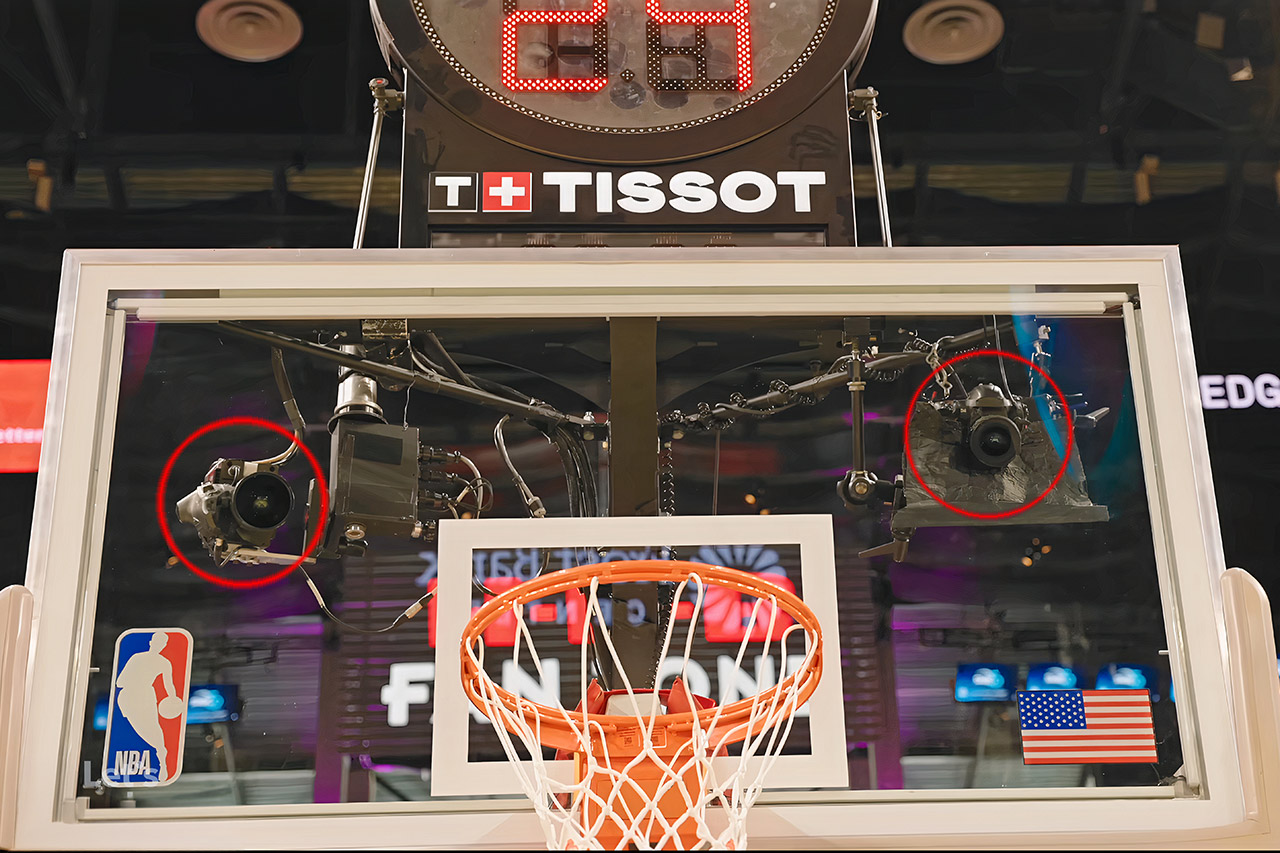
Each basket has its own support structure with extra gear on it, such as your RED and Sony cameras providing alternate viewpoints or stills, and Sennheiser shotgun mics dispersed throughout to capture the sounds of sneakers on the floor, the ball bouncing against the rim, and all that other nice things. Then there’s a remote camera sitting right above the rim, giving you those awesome straight-down views of dunks and such. Cameras aren’t the only game in town; you’ve got your wide-angle shots showing the entire court, your low-angle units providing dramatic floor-level perspectives, your dedicated feeds following key players or the bench, and your Steadicam operator moving along the baseline with a stabilized rig for silky smooth sideline coverage. If that isn’t enough, you can also use your remote dome cameras to get rotational views of the entire arena.
Of course, audio receives the same treatment, with microphones positioned all over the court and in the seats, some for capturing on-court sounds and others for layering in crowd excitement from various parts of the arena. The ultimate goal is straightforward: keep the audio in time with what’s happening on the court and make it sound like you’re right there in the action. Brownlee linked to a video by Dallas Taylor that demonstrates what happens with the audio engineer on NBC’s broadcasts.
All of that video and audio is then routed to a cluster of broadcast trucks situated a few hundred yards away from the arena. Teams inside perform their magic to color-grade all of the camera feeds, make the live audio sound clean and clear, prepare fast replays, and decide which shot to air next. The replay specialists then get to work, utilizing their fancy controls with scrubbing wheels and variable-speed levers to quickly locate and slow down critical moments.






























































You must be logged in to post a comment Login