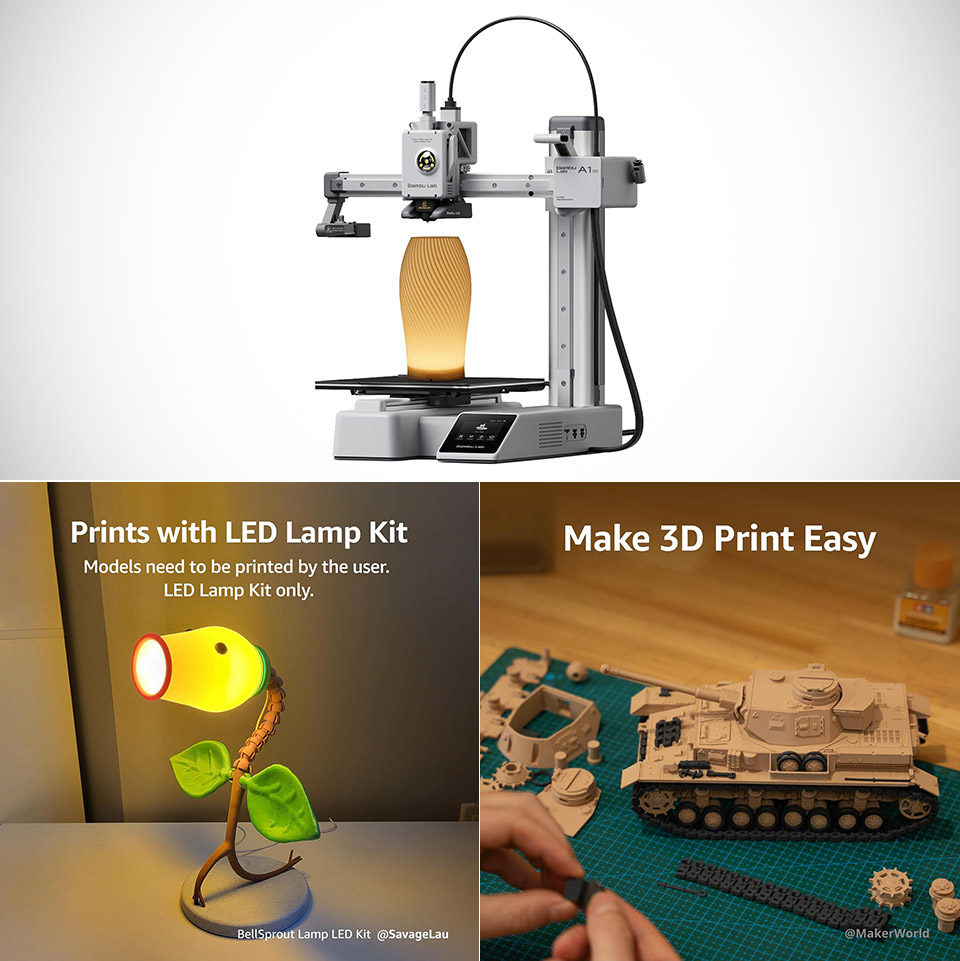
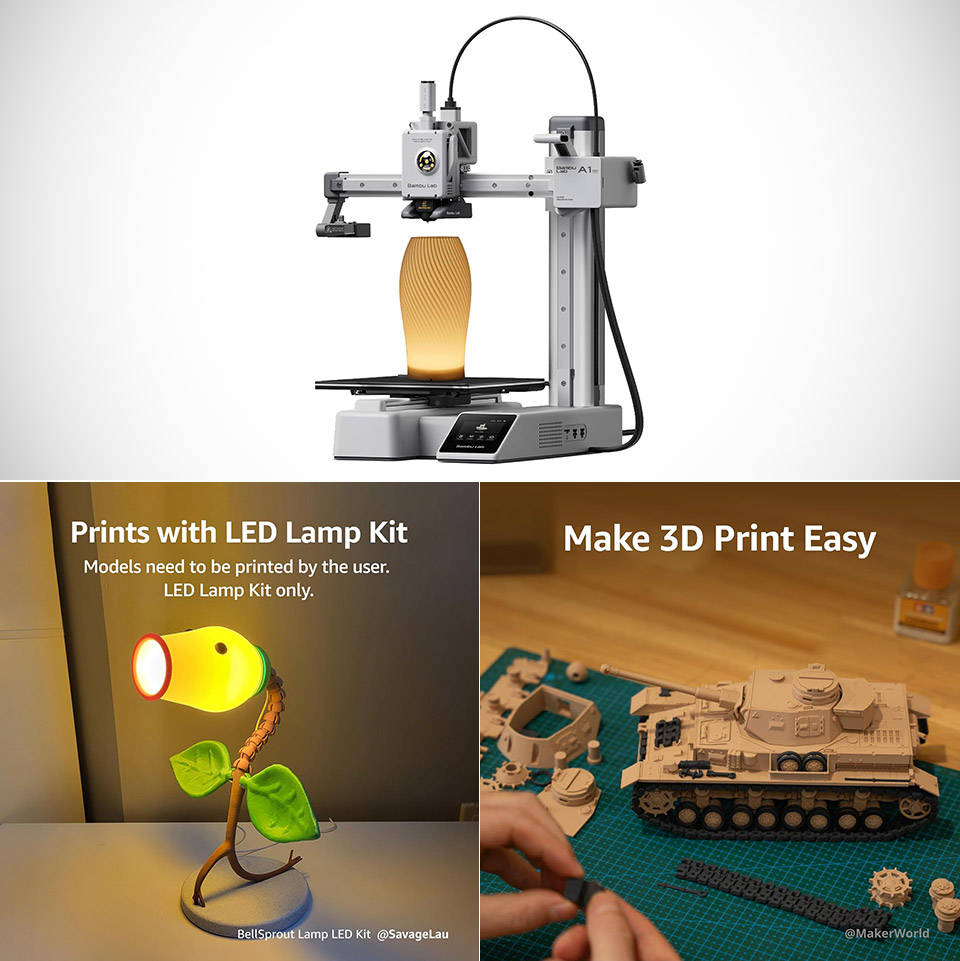
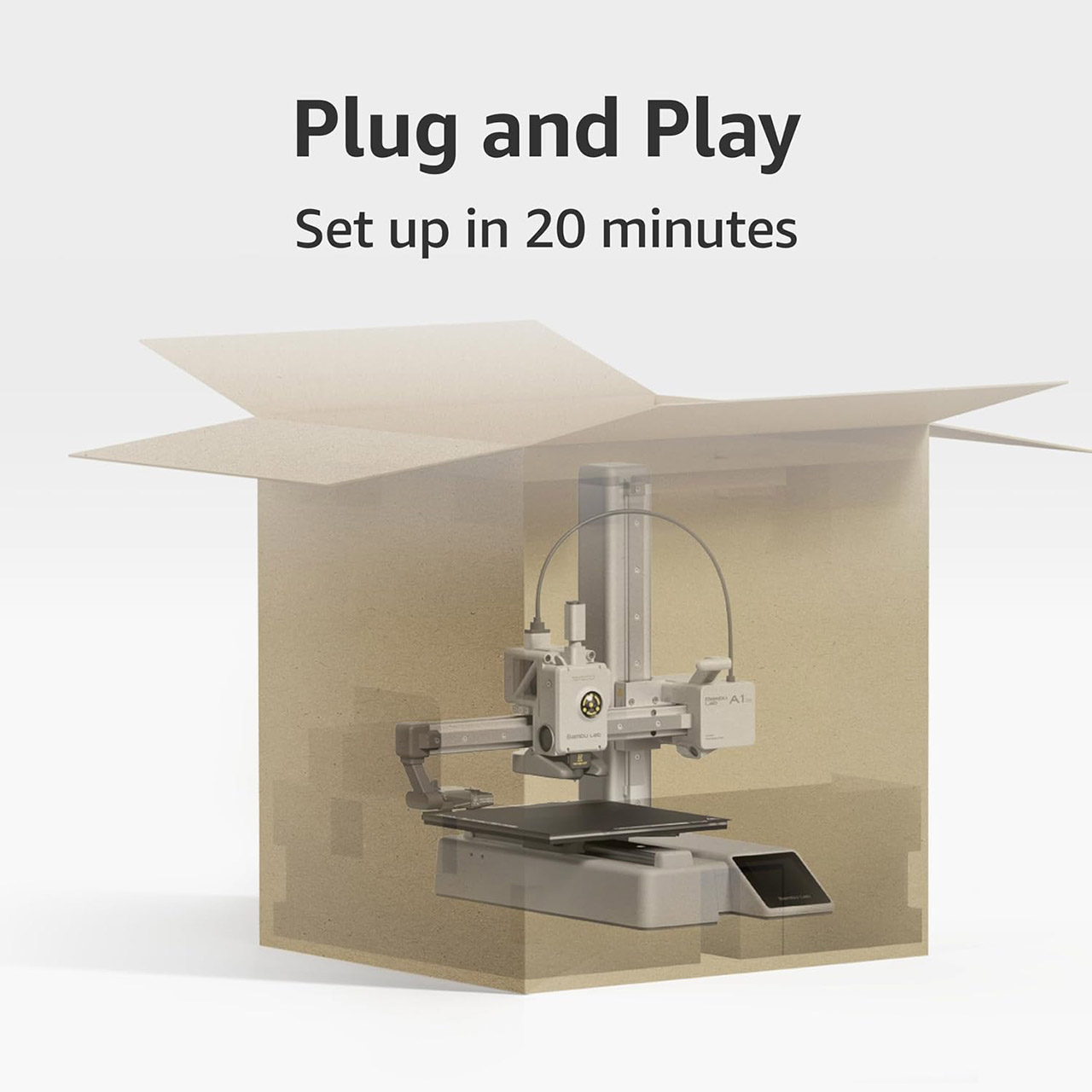
Bambu Lab packed its most approachable machine into a footprint that fits on a crowded workbench and still delivers results that used to require far more patience and money. The A1 Mini, priced at $224.10 (was $249), reaches first-time owners fully assembled, already squared, and loaded with automatic routines that handle the tedious setup steps older printers forced users to master by hand. Unbox it, remove a few shipping ties, plug in power and Wi-Fi, and the machine begins calibrating itself. Bed leveling, vibration compensation, nozzle pressure checks, and Z-offset all happen without paper tests or manual adjustments. Most people reach a successful first print inside twenty minutes.
The build volume is a cube of 180 by 180 by 180 millimeters. This little beast of a machine can tackle a variety of projects, including phone stands, desk organizers, miniature tools, figurines, and about every useful component a beginner may require. Larger projects are more difficult to complete because they must be split and glued, but it is a small price to pay for keeping the item compact and stable. The moving bed and strong frame with full-metal linear rails maintain the motion looking smooth, even when the tool head is rushing ahead.
A1 mini + LED Lamp Kit for Creative Light Projects: Bring your ideas to life with the included LED Lamp Kit. Simply print compatible lamp models and…
The Perfect 3D Printer for Beginners: A1 mini 3D Printer is designed to make 3D printing easy from day one with automatic calibration, simple setup…
Experience the Bambu Lab Ecosystem: Access MakerWorld’s huge library of ready-to-print models, manage prints through the Bambu Handy app, and enjoy…
Speed is one of the primary reasons to purchase this printer. Official top speed is 500 millimeters per second with an acceleration of 10,000 millimeters per second squared, but in the real world, most people find that quality prints top out at 180-300 millimeters per second depending on the model, which is still a lot faster than those low-cost machines that were the norm for beginners just a few years ago. In some cases, a standard Benchy test model can conclude in less than twenty minutes, which is equivalent to completing a work break.
Advertisement
The print surface is ready to go because all you have to do is place the provided textured PEI plate on it and heat it to 80 degrees Celsius. When the print is finished, simply let it cool and it will pop out with a little flex. The all-metal hotend is capable of reaching 300 degrees Celsius and includes a 0.4 millimeter stainless nozzle that can be quickly replaced. You may also modify the nozzle size to 0.2, 0.6, or 0.8 millimeters to change the print detail or flow. Direct-drive extrusion works well with PLA, PETG, TPU, and PVA. ABS, on the other hand, is out of the question since the open frame and moderate bed temperature cannot maintain a consistent heat level.
The machine monitors things as it goes, such as filament runout, tangle detection, and power outage recovery, to help prevent those annoying unsuccessful prints that can occur overnight. There’s even a camera on board that records your print progress and allows you to create time-lapse videos, which is really cool. The touchscreen is 2.4 inches in size and color, and you can operate pretty much anything from there, but there’s also free software and a phone app to help with slicing, remote monitoring, and file transfer by Wi-Fi or microSD. Best of all, there are pre-tuned profiles for most of the popular filaments, so you don’t have to go through all that trial and error stuff..
【AMS lite Filament Hub】It is an essential part for switching different printing materials smoothly when using multiple filaments. It connects to…
【Supports Multi-Color Printing】Supports up to 4 filaments for switching. Works with AMS Lite to realize multi-color and multi-material printing…
【Low Friction & Durable】Low friction design ensures smooth filament switching and fewer jams. Made of solid material, it works well with PTFE…
If you want to go fancy, there is an extra AMS Lite unit that adds four-color support. This device sits outside the printer and can switch materials on the fly during a single job; it’s like magic, I tell you. You can perform multi-color printing without constantly changing filament, but it generates waste and takes up more room, and don’t get me started on flexible filaments…
Even in the quieter modes, this machine is reasonably quiet, with noise levels of less than 48 dB, allowing you to use it in a shared living room without bothering anyone. It also weighs only 5.5 kilograms and measures 347 by 315 by 365 millimeters, making it easy to transport if necessary. The greatest part is that everything comes in one box, including a starter spool, spare nozzle, some tools, and adhesive, so you’re virtually ready to go from the start.
Government regulators have spent the last year asking serious questions about Tesla’s electronic, retractable door handles, a cool-looking automotive design flourish that has since been imitated by plenty of competitors.
The handles have been blamed, in the US and in China, for making it difficult for passengers to quickly exit vehicles and for impeding rescue efforts. A handful of crash victims’ families have even filed lawsuits against Tesla, alleging the door handle designs played roles in their loved ones’ deaths.
Now the door handles have led to Tesla’s largest recall ever—and China’s. The Chinese government is recalling more than 2.9 million Model 3s and Model Ys manufactured in China between 2019 and 2026, the State Administration for Market Regulation announced Friday.
Some of the affected vehicles will be made safer with an over-the-air software update that lowers windows after collisions, making it easier for passengers to get out in an emergency. But many cars will also need new warning stickers—affixed free of charge—that can help people find and operate emergency mechanical door handles. Those handles can currently be hard to identify because they’re colored similarly to the rest of the vehicles’ interiors. The mechanical door handles are especially important when vehicles’ low-voltage batteries fail. (These batteries don’t operate the cars themselves, but power onboard computers, displays, and other accessories, including electronically powered door handles.)
Advertisement
Tesla didn’t respond to WIRED’s request for comment.
The Chinese government simultaneously recalled more than 1 million vehicles manufactured by eight Chinese automakers, also for safety concerns related to flush door handles. The other automakers are Beijing Automotive, Chery, Dongfeng, First Auto Works, Geely, Leapmotor, Xiaomi, and Xpeng.
Separately, the Chinese government recalled nearly 50,000 imported Tesla Model 3s, Xs, and S’s for insufficiently monitoring drivers using the US automakers’ assisted steering technology. The government said the tech increased the risk of collisions. The recall affects some vehicles imported between 2019 and 2026. Some of the vehicles can be fixed with software updates, but some will need new in-cabin cameras that ensure drivers are paying sufficient attention while operating their vehicles.
China has been more aggressive than other countries in regulating new automotive technology. It put in place new rules earlier this year that will soon ban fully retractable door handles in the country. In 2021, a government agency issued regulations more tightly governing the operations of autonomous vehicles, even before that tech had widely hit the road; another agency that same year created specific rules for the data generated by its increasingly software-centric cars.
Advertisement
The US’s top road regulator has started to examine whether it needs new rules governing door handle design, Bloomberg reported last month.
The company said its ‘purpose-built’ 5nm ASIC chip aims to optimise AV systems for ‘low-latency performance’.
Waymo, the Alphabet-owned autonomous vehicle (AV) manufacturer, has built a custom AI chip to improve the future performance of its robotaxis.
In a blogpost yesterday (20 August) written jointly by the company’s vice-president of engineering Satish Jeyachandran and compute lead Daniel Rosenband, the company said its “purpose-built” 5nm application-specific integrated circuit (ASIC) chip aims to optimise AV systems for “low-latency performance”, leading to better and faster execution of real-time driving commands.
Waymo said its AV systems integrate co-designed hardware, sensors and algorithms to “process, fuse and run advanced neural networks on raw sensor data in real time”, and that its custom chip is built to “handle the massive influx of raw data” that an AV system must process.
Advertisement
Because Waymo’s system “handles the entire task of driving without a human backup”, the blogpost read, the company’s AV compute is built around three “non-negotiable” pillars, one of which is responsiveness – so the system is capable of “constantly processing decisions within milliseconds” to make safe decisions with “ultra-low latency”.
The ASIC chip can deliver more than 1,000 TOPS – trillions of operations per second – of machine-learning (ML) performance “dedicated to front-end processing and ML models”, according to Waymo.
The company said that aside from developing its custom silicon, it is also partnering with companies such as AMD, Micron, Nvidia, Samsung, Sandisk, Socionext and TSMC to scale Waymo’s technologies.
The company currently serves riders in 11 US cities, according to its website, and it has plans to expand to nearly 20 more, as well as London and Tokyo.
Advertisement
In June, a recall notice showed that Waymo was pulling nearly 3,900 robotaxis from US streets over a software issue that let AVs enter and drive in closed freeway construction zones.
In May, the company had to recall nearly 3,800 robotaxis from US cities over a software issue that could allow vehicles to drive onto flooded roadways.
Waymo raised $16bn in a February funding round led by Dragoneer Investment Group, DST Global and Sequoia Capital – with more investment from parent company Alphabet and several others – that put the AV company’s valuation at $126bn.
Earlier this week, a three-way collaboration between Uber, Pony AI and Verne began offering robotaxi services to Uber customers in Zagreb, Croatia.
Advertisement
Don’t miss out on the knowledge you need to succeed. Sign up for the Daily Brief, Silicon Republic’s digest of need-to-know sci-tech news.
Apple is cutting more than 200 jobs, roughly 100 from the Vision Pro organisation and 100 from Siri and software teams, largely shutting the headset’s gaming unit. The company says it is realigning teams and will create new roles.
Apple is cutting more than 200 jobs across the teams that build Siri and the Vision Pro. Roughly 100 roles go from the headset organisation and about 100 from Siri and the software groups around it.
The company frames it as a reallocation rather than a retreat. Apple says it is realigning teams “to evolve our business” and will create new roles alongside the ones it removes.
Two Vision Pro units take the specific damage. The team working on gaming for the headset is largely being shut down, and the group that produces its immersive video is shrinking.
Advertisement
The economics of that video explain a lot. Each 3D production requires several crews of employees and contractors, an episode of an immersive series can cost several million dollars, and the audience is small.
Apple is not killing the headset. It has told staff that Vision Pro and visionOS continue, and a new model is still under consideration for as early as the end of 2028.
The nearer product is on your face rather than over it. Apple has been testing four frame designs for smart glasses that would support neither immersive video nor serious gaming.
The Siri cuts are a different kind of change. The assistant is being rebuilt on a new technical architecture, which needs different expertise, so roles are being removed and others created around it.
Advertisement
Where Apple is heading is a market with a European centre of gravity. Meta’s glasses are made with the Franco-Italian eyewear group EssilorLuxottica, and Meta has now launched its own brand at $299.
That is the number Apple has to answer. A Vision Pro costs $3,699, which is roughly twelve pairs of the competition.
The reporting has moved quickly and the figures have moved with it. Earlier accounts this week put the Vision cuts at about 60 people, while Bloomberg’s tally covers more than 200 across several teams.
The shape of the pivot is clear enough regardless. Apple is stepping back from a headset almost nobody bought and towards an eyewear market where the incumbents are European and the price of entry is a tenth of what it charges now.
An anonymous reader quotes a report from ZDNet: According to a Bloomberg report, attributed to China’s Ministry of State Security, the country has ordered some government agencies to drop Windows 10 China Government Edition for Chinese-made Linux distributions. Why not Windows 11? Because China, like many other non-US governments, no longer trusts American companies with their software and services. This approach is all about digital sovereignty. In addition, even before the recent trend of governments outside America moving away from Windows, Beijing has started a long-running push to replace foreign technology in sensitive systems with domestic, open-source alternatives.
[…] The Chinese government did not specify which Linux versions would replace Windows 10. However, the stock prices of Chinese Linux suppliers, Kylin Software and Tongxin Software Technology (commonly known as UnionTech), immediately jumped. These companies’ respective operating systems, Kylin OS (no relation to Ubuntu Kylin) and UnionTech OS (UOS), were already positioned as domestic desktop and server replacements for Windows in government, state-owned enterprise, and critical-infrastructure environments. […] Huawei’s HarmonyOS 2, which began as an Android variant but is now a proprietary mobile and Internet of Things (IoT) operating system, is also being developed into a PC platform. HarmonyOS 2 won’t be deployed anytime soon. Kylin and UOS are the only mature desktops that are ready for institutional desktop deployments.
[…] … this transition won’t be easy. For agencies now moving off the government Windows build, the issue will be more demanding than simply swapping one desktop interface for another. Migration requires application testing, peripheral and driver validation, identity system integration, document-format compatibility, staff retraining and, in many cases, replacement or adaptation of Windows-dependent line-of-business software. The report provides no details on exactly how this transformation will occur. But the speed of the shift suggests that these issues are already being addressed in China’s centralized managed desktop stack.
Muon Space has more than 50 satellites already in development for customers.
US space-tech manufacturer Muon Space has raised $250m in a Series C round to meet the growing demand for satellites across industries.
The round was led by Eclipse Capital, with participation from Galvanize, Google, Salesforce Ventures, Wellington Management, I Squared Capital and Woven Capital. Existing backers included Radical Ventures, Congruent Ventures, Costanoa Ventures, Activate Capital, ACME Capital, ArcTern Ventures and Overlap Holdings.
The “heavily oversubscribed” round brings the 2021-founded satellite-maker’s total raise to more than $386m, and highlights investors’ hopes for the $1.8trn space-tech sector.
Advertisement
Satellite-building has become a lucrative business, as new-generation capabilities powered with AI open up opportunities across defence, surveillance, research and data processing.
Muon said it is jointly collaborating with SpaceX’s Starlink to develop differentiated mission capabilities, including advanced payloads, on-orbit AI compute and real-time, ultra-high bandwidth satellite connectivity.
The Silicon Valley company said it has the capacity to build more than 500 satellites each year, with hopes that its newly opened manufacturing facility in San Jose can take that capacity alone by 2027, marking a 10-fold expansion over what it could manufacture previously.
Advertisement
It has launched a total of 11 satellites, with seven this year alone. The company now has more than 50 satellites in development for customers, including 13 satellites set for launch over the next year.
Muon said it will use the fresh raise to accelerate production of large-scale constellations and expand the its dual-use spacecraft platforms.
“Space infrastructure needs to scale the way cloud infrastructure did,” said Jonny Dyer, the CEO of Muon Space.
“As more industries rely on space-based intelligence, communications and compute, this investment allows us to accelerate the next generation of space infrastructure.”
Advertisement
Lior Susan, the founder and CEO of Eclipse said: “Muon is redefining how space infrastructure is built.
“By integrating mission design, manufacturing, launch and operations into a single platform, the team has turned what was once a bespoke, years-long process into a repeatable model built to scale.
“With multiple successful constellations already in orbit and demand accelerating across commercial, government and international sovereign customers, Muon is positioned to become the foundational platform for the next generation of space-based capabilities.”
Don’t miss out on the knowledge you need to succeed. Sign up for the Daily Brief, Silicon Republic’s digest of need-to-know sci-tech news.
Toronto org says it wasn’t the only one to be affected by the third-party software vulnerability
Toronto’s Hospital for Sick Children, commonly referred to as SickKids, says the data of current and former staff, as well as job applicants, was exposed after an intruder exploited a security flaw in a third-party software application used by the hospital.
SickKids, which may ring a bell for those who have kept close tabs on ransomware news in recent years, said the intrusion affected its external careers site, which has now been restored.
Advertisement
“Clinical systems and patient information were not affected, and patient care has continued as usual,” it said, after explaining that the break-in was a result of a vulnerability in a “third-party software application used by SickKids and other organizations.”
Current and former employees of SickKids, the SickKids Foundation, and the hospital’s Vaughan, Ontario-based Boomerang clinic may all be affected, as were SickKids job applicants.
The hospital did not comment on the scale of the breach, but said those affected will be offered the usual identity and credit monitoring services.
“Our review of the impacted information is ongoing. Individuals determined to have been impacted will be notified directly, though, out of an abundance of caution, all potentially impacted individuals have been alerted and offered 24 months of complimentary credit monitoring and identity protection services.
Advertisement
“Safeguarding the privacy and security of personal information is a responsibility SickKids takes seriously. We remain committed to maintaining strong protections and continuously enhancing our cybersecurity measures to help protect the information entrusted to us.”
SickKids’ lucky ransomware escape
The children’s hospital is no stranger to cyber struggles. On December 18, 2022, it was targeted by a LockBit ransomware affiliate – a particularly egregious attack even for LockBit and one that attracted an overwhelmingly negative reaction.
The ransomware operator issued an ultra-rare apology on December 31, 2022, announcing that it would offer SickKids a free decryptor and that the affiliate who carried it out was expelled from the program. Banished from the darkest corner of cybercrime… now that’s a feat.
By that time, however, SickKids had been handling the recovery well, and had restored around 60 percent of its systems after refusing to pay the crooks a ransom.
Advertisement
LockBit’s gesture of goodwill later turned out to be an anomaly, however, as exactly a year later it refused to roll back the attack on Saint Anthony Hospital, a children’s healthcare facility in Chicago. ®
Travel just two hours west of Beijing by train, and you’ll find yourself surrounded by the rolling grasslands and ancient cinder cones of Inner Mongolia. This vast, arid land has long been China’s capital of sheep farming and coal mining, but over the last few years, it has become the hottest place in the country to build an AI data center.
In Ulanqab, a city in Inner Mongolia home to about 1.5 million people, nearly 100 data centers have been opened or begun construction since 2016. Chinese companies have pledged to build projects with a combined estimated capacity of 12.5 gigawatts in the city, and over 70 percent of the total commitments have been announced in just the last year, making it one of the fastest growing compute clusters in Asia, according to a research note published by Goldman Sachs last week. For comparison, OpenAI’s $500 billion Stargate Project is set to reach only 10 gigawatts of total capacity when it’s complete.
Chinese companies are flocking to Ulanqab for a number of reasons. The city sits at high elevation on the Inner Mongolian Plateau and has long, cold winters, which means data centers there don’t need to use as much energy to stay cool. It’s also relatively close to Beijing, so data can be transmitted to China’s populous regions with minimum latency. But the most enticing factor has to do with costs. Electricity is cheaper in Inner Mongolia than almost anywhere else in China, driven by both the strong growth of wind and solar energy and an abundant supply of coal.
What’s also interesting is who is building these data centers. For the first time, Chinese AI companies are making big investments in their own infrastructure, rather than renting compute from cloud companies. DeepSeek is reportedly building a massive AI data center in Ulanqab, as are ByteDance, Alibaba, and Xiaohongshu. For years, Chinese AI companies have spent far less on building physical infrastructure than their American peers, despite developing a number of popular AI models with impressive capabilities. The Ulanqab data center boom signals that now they are finally starting to catch up.
Advertisement
There’s just one problem: finding enough water. Ulanqab is about as dry as Denver, getting only roughly 14 inches of rain each year. The local government is already struggling to provide enough water to meet resident demand—before many of the planned data center projects are even up and running. Last month, the local water company in Ulanqab was forced to turn off several waterworks for seven hours each night to mitigate peak demand. The data centers being built in the city will need less water in the winter—weather data from the local government of Ulanqab shows they only require additional water for cooling during two months out of the year—but all of the new infrastructure could still pose a significant environmental challenge for the region.
The Boonies
Inner Mongolia has been a data center hot spot for at least a decade, long before the current AI boom. Huawei built its first one in Ulanqab in 2016, and Apple followed suit three years later. In 2021, the area was designated as one of the main hubs of a country-wide government project dubbed “Eastern Data, Western Compute,” which aims to build data centers in the Western hinterlands of China.
There was one major drawback, though. Because they are located far from China’s populous eastern coast, these data centers initially faced high latency rates when transferring data to the majority of users. As a result, they were initially largely relegated to backup storage—until AI gave them a new purpose. “With the rise of AI in 2022, there was the realization that actually, those remote data centers could be well-utilized for model training,” says Andrew Stokols, a professor at Singapore Management University who studies China’s compute infrastructure. A training run for an AI model can take months and doesn’t require much real-time tinkering, so latency is less of an issue.
Relatively speaking, Ulanqab is also not really that far away. Inner Mongolia is much closer to Beijing and other major metropolitan areas in China than any Western data center hub is. And it’s now connected by two dedicated fiber optics cables built in 2017 and 2019 that reduced average latency speeds to less than five milliseconds, fast enough to support real-time data exchanges like AI inference.
Fahrenheit 203, the temperature GPUs stop gorging on literature
AI companies are buying loads of physical books, hoovering up the texts for model training, and then physically destroying the originals. A group of 18 advocacy organizations on Friday asked the US Federal Trade Commission to investigate the book butchering and knowledge hoarding.
Fresh details of the practice emerged earlier this year via document disclosures in Bartz v. Anthropic PBC, a copyright case brought by authors of books that the AI company used for training without permission.
Advertisement
Anthropic’s book scan-and-destroy operation was known as “Project Panama.” It was described in a 2024 internal memo as “our effort to destructively scan all the books in the world.”
Anthropic gave the operation a codename “because we don’t want it to be known that we are working on this,” the court exhibit explains. “This document is visible to all Anthropic employees, but you should avoid talking about it in public areas, and the fact that we are working on this should not be shared with anyone outside Anthropic.”
Older books turn out to be valuable for AI training because they’re unpolluted by AI-generated text, which has been seeping into recent written work. And destroying books once they’ve been scanned avoids the cost of storage.
In some circumstances, scan-and-destroy operations may support fair use claims. In the Bartz case, the district court accepted the argument that a physical book can be digitized and destroyed, substituting the electronic copy for the physical book in a transformative act of fair use. But that didn’t work out for the Internet Archive.
Advertisement
Anthropic, which did not respond to a request for comment, is not the only company consuming and trashing texts. A recent report found Amazon has been participating in book scanning and shredding. Amazon also did not respond to a request for comment.
The subject has become a public relations headache, in part because of the barbarism of book destruction and its association with authoritarian regimes, and in part because of the broad backlash against AI companies for pillaging public resources in pursuit of private gain.
Intermediaries appear to be feeling the heat. ISBNdb, which reportedly helped broker the acquisition of books for destructive scanning, recently disavowed the practice. The biz noted last month, “We’ve removed a recent landing page, ‘Printed Books Sourcing for Your AI LLMs Dataset Needs.’ It was part of exploring demand, and we’ve chosen to pivot away from that direction.”
In light of these revelations, civil society groups want the FTC to look into book buy-and-destroy operations on the basis that they prevent competing AI developers and the public from accessing those resources.
Advertisement
“The secretive and reckless way that major AI companies like Anthropic and Amazon are acting shows that there is real smoke here that the FTC needs to investigate,” Kate Oh, special advisor to the Demand Progress Education Fund, said in a statement provided to The Register.
The groups’ letter [PDF] casts scan-and-destroy operations primarily as anticompetitive – the FTC being notionally a competition watchdog – but it hints at the anti-democratic consequences of monopolized knowledge.
“Through their practice of permanently destroying books en masse and thus removing those non-renewable resources from broader access, AI companies are engineering a future where only the wealthiest incumbents can build high-quality AI models and operate as the sole holders of humanity’s written works – after having destroyed the originals to get there,” the letter says.
We’re unaware of whether any texts have been shifted entirely into AI models without leaving any physical copies. But then how would anyone verify that when AI companies refuse to divulge their training data?
Advertisement
The letter asks the FTC to answer that question: “What the public record does not establish – and cannot, from the outside – is how often the destroyed physical books are the last or among the last surviving copies of a given work.” ®
— Mehul Shah joined Oracle as group vice president for OCI data and storage services, ending a 14-year run at Amazon and Amazon Web Services.
In his last role at AWS, Shah led engineering and product for Amazon RDS for SQL Server, Oracle and Db2, and ran the launch and expansion of Oracle Database@AWS, the partnership that put Oracle’s database inside Amazon’s cloud.
“Through that collaboration, I saw firsthand that OCI shares the same DNA that inspired me to join Amazon back in 2012,” Shah said on LinkedIn, citing “deep curiosity, a passion to innovate, the courage to make bold decisions, and relentless drive to excel.”
Shah, who is based in Seattle, spent more than eight years at AWS, earlier leading real-time data streaming services including Amazon Data Firehose and Kinesis Data Streams, and serving as director and general manager of Amazon EMR. He started at Oracle this month.
Dr. Natalie Pageler. (Seattle Children’s Photo)
— Seattle Children’snamedDr. Natalie Pageler senior vice president and chief information officer, putting her in charge of digital strategy and IT operations for the pediatric hospital system.
Pageler comes from Stanford Children’s Health and the Stanford University School of Medicine, where she was division chief of clinical informatics and earlier spent a decade as chief medical information officer. She is a pediatrician and clinical informaticist with more than 20 years of experience.
Advertisement
Seattle Children’s CEO Dr. Christopher Longhurst followed a similar path. He was chief medical information officer at Stanford Children’s Health, the same role Pageler held, before spending a decade at UC San Diego Health, most recently as chief clinical and innovation officer.
Cassandra “Sandi” Knight. (Zillow Photo)
— Zillow Group named Cassandra “Sandi” Knight its first-ever chief legal and policy officer, a role the Seattle company created this month as part of a broader leadership shuffle. Reporting to CEO Jeremy Wacksman, she oversees Zillow’s legal, compliance and government relations functions.
Knight joins from Google, where she spent four years as a vice president leading global civil litigation and discovery. She was previously vice president and chief litigation counsel at PayPal, and spent 11 years at Morgan Stanley in senior litigation and compliance roles.
She began her career as a trial lawyer at the San Diego Public Defender’s Office, the firm Keker & Van Nest and the San Francisco City Attorney’s office. She holds a law degree from Stanford and is based in the San Francisco Bay Area.
She arrives at a busy moment: Zillow and Redfin are set to go to trial Aug. 24 as defendants in an antitrust case brought by the FTC and five state attorneys general over the companies’ $100 million rental listings deal. Zillow has spent $26 million on the case so far this year.
Advertisement
Two longtime Zillow leaders are heading out:
Sara Bonert, vice president of industry engagement for Zillow Group and ShowingTime+, is leaving after nearly 20 years. One of Zillow’s earliest employees, she joined in the fall of 2006 as director of broker services, helped build Zillow’s first platform for taking in listing data, and signed the partner agreements that took the site from zero to a million listings in four months.
Jeff Tompkins, head of corporate real estate and operations, wrapped up almost five years with the company. Tompkins, who is based in Denver, ran Zillow’s workplace strategy across North America and beyond. He said he will share his next role soon.
Amir Pelleg. (Uber Freight Photo)
— Amir Pelleg, a veteran of companies including Amazon and Convoy, is the new chief product officer at Uber Freight. He is based in Seattle, working out of the shared Uber and Uber Freight office on Second Avenue.
At Amazon, Pelleg was principal product manager for Kindle Fire, launched the Dash Button and initiated Alexa’s smart home controls, then incubated and launched Amazon Shipping in India, the U.K. and the U.S. as a director and general manager in Amazon Transportation.
He was a vice president on Convoy’s executive team until the Seattle freight startup shut down in 2023, then spent two and a half years at dental tech company Dandy.
— Seattle’s Frazier Healthcare PartnersaddedWes Wheeler to its Growth Buyout team as an executive in residence, advising on diligence and on life science logistics and infrastructure.
Wheeler was most recently CEO of LabConnect, a central laboratory services company serving clinical trials, and before that president of UPS Healthcare, where he built a vertical of 10,000 employees across 35 countries. During Operation Warp Speed he was the primary industry interface to the U.S. government, overseeing distribution of more than 1.5 billion COVID-19 vaccine doses to over 100 countries.
Dr. Heather Cheng. (Fred Hutch Photo)
— Dr. Heather Cheng was announced as the inaugural recipient of the Marty Lazarus Weiden Family Endowed Chair at Fred Hutch Cancer Center, which will fund her work detecting, preventing and treating hereditary cancers.
Cheng is clinical director of cancer genetics programs at Fred Hutch and directs its prostate cancer genetics clinic. In 2016 she was part of a team that found more than 10% of men with advanced prostate cancer carry inherited mutations in DNA-repair genes such as BRCA1 and BRCA2.
The chair is named for Marty Lazarus Weiden, who was diagnosed with breast cancer in 1993 and died in 2001. The family learned only later that some of its members carry a BRCA mutation.
Advertisement
— Microsoft corporate vice president Darryl Willis was named to the board of ONE Nuclear Energy, a natural gas and advanced nuclear developer going public this quarter through a merger with Hennessy Capital Investment Corp.
Willis has led Microsoft’s energy and resources group since 2019. He was previously a Google Cloud vice president and a BP executive who ran the company’s Deepwater Horizon claims process and testified before Congress. He will officially join the board when the merger closes, and he is expected to chair its compensation committee.
Jake Milstein. (LinkedIn Photo)
— Jake Milstein was named head of healthcare solutions marketing at Zscaler, a return to healthcare cybersecurity. He joins from application security company Contrast Security and was earlier chief marketing and revenue officer at Critical Insight, the Bremerton, Wash.-based security firm acquired by Lumifi Cyber.
Before moving into technology, Milstein spent a decade at Seattle’s KIRO TV, including four years as news director.
— Michele Mehl left Amazon Web Services after nearly two and a half years to become senior public relations manager at ALSO, arriving the same week the electric vehicle company announced a $150 million Series D round led by Prysm Capital.
Advertisement
ALSO builds the TM-B consumer electric bike and the TM-Q commercial delivery quad, and counts Amazon and DoorDash among its commercial partners.
— Richard Van Bibber was named senior vice president of research and development at Verasonics, the Kirkland, Wash.-based maker of ultrasound research platforms used in fields including biomedical ultrasound, materials science and earth sciences.
Van Bibber has spent much of a 25-year medtech career in the Puget Sound region, including seven years as director of research at Kirkland’s Cardiac Dimensions and five years leading clinical affairs at Bellevue-based Aortica.
— Dave Cotter joined the board of Nickson, the apartment-furnishing startup led by Cameron Johnson, alongside MarcyPen Capital Partners and Larry Braithwaite. Cotter is CEO of Greenwood and has previously worked at Amazon, Nordstrom, zulily, RealNetworks and Leafly.
Advertisement
— PCC Community Markets president and CEO Krish Srinivasanwill retire effective Jan. 29, 2027. Srinivasan was chief financial officer at Remitly and vice president of finance at Lyft before joining the Seattle grocery co-op as CFO, and earlier held leadership roles at Amazon and Microsoft.
— Seattle FoundationnamedElizabeth Wong as chief philanthropy officer, reporting to President and CEO Alesha Washington. Wong spent more than a decade at Foundation Source and earlier worked directly with the Gates family at the Bill & Melinda Gates Foundation.
And in case you missed it:
— Jay Bartot, a co-founder of the airfare-prediction startup Farecast and former chief technology officer of Madrona Venture Labs, was named CTO of Lev, the Pioneer Square Labs spinout building an “AI co-founder” for entrepreneurs. Read more here.
Advertisement
— Expedia Group is parting ways with at least eight vice presidents and senior vice presidents, and promoted five other leaders, as it reorganizes its product and technology groups around AI. Read more in this GeekWire story.
Japan is pouring billions of dollars into its burgeoning space industry and easing restrictions on defense exports, efforts designed to build a homegrown aerospace sector filled with domestic startups that have a global reach.
Letara, a Sapporo-based startup developing hybrid propulsion systems for spacecraft, is looking to capitalize on that push. After focusing on hybrid thrusters for small satellites, the company now plans to develop large rocket systems for the space, defense, and security markets, company’s co-CEO Shota Hirai told TechCrunch.
That expansion is being fueled by ¥2.6 billion (~$16 million) in new funding that comes as the startup tries to turn years of academic research and demonstrations into a commercial business. The round was co-led by Headline Asia, JIC Venture Growth Investment and Incubate Fund with participation from strategic investors including NES (Networked Energy Services) Corporation, an energy company; Toyoda Gosei, a Toyota Group supplier of rubber and plastic automotive components; and Frontier Innovations, a Greece-based IT company specializing in data analytics and business intelligence.
“With this round, we will go beyond demonstrating that thruster in space,” Hirai said. “We plan to explore a much wider set of use cases across both the space domain and the defense and security domain, and to develop and propose hybrid rocket systems suited to each of them.”
Advertisement
At the heart of Letara’s technology is a hybrid rocket design that keeps its solid fuel separate from the liquid oxidizer needed for combustion. Inexpensive, widely available materials such as plastic and rubber are used as solid fuel. The company has developed a proprietary manufacturing process that mixes, shapes, and compresses these materials to ensure they ignite reliably and burn consistently. the end result is a system that can deliver more thrust with less waste than traditional hybrid rockets that often use expensive paraffin wax.
The aim is to solve three problems that have so far, limited the use of hybrid propulsion: generating sufficient thrust, maintaining performance and controlling combustion, Hirai said.
There is considerable opportunity if Letara is successful. The global hybrid rocket propulsion market is projected to expand to $2.6 billion by 2032, up from $848 million in 2024, at a CAGR of 15% — a trajectory that points to growing demand for the technology.
Still, Letara isn’t alone in its pursuit. A number of companies are developing hybrid rocket technology, including Japan’s Interstellar Technologies, China’s Galactic Energy, South Korea’s InnoSpace, and Singapore’s Equatorial Space are advancing hybrid rocket technology. German startup HyImpulse and Australian Gilmour Space are also pursuing hybrid rocket technology, while other U.S. companies are developing competing propulsion and launch systems.
Advertisement
Academic roots
The idea for Letara emerged while co-CEOs Landon Thomas Kamps and Hirai were researching rocket propulsion at Hokkaido University. They believed the relative safety and simplicity of hybrid rockets could make the technology useful beyond traditional space programs, particularly as private companies expand into the industry.
The company’s ambitions have grown along with the market. When Letara was spun out of Hokkaido University in 2020, it was focused on developing satellite thrusters.
Since then, the global propulsion market has become more crowded as demand for launch and defense capabilities has grown. Letara is now pursuing opportunities in defense contracts and launch services, in an effort to position itself to compete not just with other Japanese startups, but with companies around the world.
“Large spacecraft need high thrust propulsion as well, especially when they need to go from LEO (low earth orbit) to GEO (geostationary orbit) and get through the high radiation Van Allen belt quickly,” said Hirai. “And of course, there is insane growing demand for launch vehicles.”
Advertisement
Letara is targeting satellite makers and operators, launch companies and governments. It sees commercial satellites as its biggest market for in-space propulsion, while government demand for rocket systems is growing, particularly in Japan. The company says it has already won orders from rocket and satellite companies as well as the Japanese government, although it did not disclose the value of those contracts.
Its next major milestone is an in-orbit firing test with an overseas partner, which Letara sees as a key step toward commercialization. It will also need to establish a repeatable manufacturing process, backed by quality controls, and a reliable supply chain for fuel and tanks that can support production at scale.
When asked whether recycled plastic could eventually be used as fuel, Letara said it was “very much a possibility” with its hybrid technology, though more testing and development would be needed.
When you purchase through links in our articles, we may earn a small commission. This doesn’t affect our editorial independence.




































































You must be logged in to post a comment Login