Connect with us
DAPA Banner
DAPA Coin
DAPA
COIN PAYMENT ASSET
PRIVACY · BLOCKDAG · HOMOMORPHIC ENCRYPTION · RUST
ElGamal Encrypted MINE DAPA
🚫 GENESIS SOLD OUT
DAPAPAY COMING

Tech

Beneath The Enshittification, Something Amazing Is Growing

Published

on

from the rebuilding-a-better-internet dept

Last month Terry Godier published a great essay on his website about “the boring internet,” discussing how the internet that many of us grew up with, the wonderful, empowering, exciting internet that moved power to the edges of the network rather than the center, is still there. It’s just hidden beneath enshittified commercial layers put there by companies seeking to extract more and more from you. It’s a great read and here’s just a snippet:

The internet you grew up on is not gone.

Some of its commercial superstructure is, and more of it will go. The next decade is going to be strange for any company whose value proposition was: we host the place where you talk to your friends.

The platforms will keep mutating. The feeds will keep filling. The slop will keep rising. The grief is real and you are not wrong to feel it.

But the actual internet — the protocols, the federated services, the plain-text commands, the open feeds, the small servers, the personal sites, the things people built when user and developer were sometimes the same word — is still right there.

Advertisement

It was not demolished.

It was buried under a louder layer for a while.

Go read the whole thing. You won’t regret it. This is why I wrote Protocols, Not Platforms, it’s why I’ve been so focused for years on helping more people understand the inherent power of distributing technological power.

But, as Godier’s piece notes, protocols are… boring. They change slowly (for a good reason, because you need stability to build on). They tend to change by consensus, which is messy. And rather than having billion dollar companies throwing a whole massive engineering team at making everything work, in the protocol world, we rely on constant experimentation by anyone who wants to experiment.

Advertisement

Sometimes that produces silly things. Sometimes it produces things that only kinda work. And sometimes, it produces wonderful new things that would never have existed in a world of fully centralized services.

But, it takes time. And that can be frustrating for those of us who want to live in that better future. The important thing for people to understand, though, is that while the amazing new breakthroughs in the protocol world may not get giant headlines in the NY Times or flashy stories about trillion dollar IPOs, they are building real things for real people, in which the people are the most important part, rather than the bankers or the billionaire execs looking to get richer.

So I was excited recently to take part as a juror for the Open Social Awards, put on by New_Public and Public Spaces, reviewing a wide range of projects looking to build on open social protocols (mostly ATproto and ActivityPub). The energy among developers right now for what they can do on open social systems is real, and it’s building fast. Tim Trautmann recently wrote about this, saying “the nerds are building a new internet.” As he wrote:

The open web of the nineties didn’t win because the tools were better. It won because a critical mass of people decided that the alternative, a handful of AOL-style walled gardens choosing what everyone saw, was not the future they wanted. Then they built their way out of it. Slowly, unglamorously, in rooms that looked a lot like this one.

Whether atproto ends up being the thing, or a stepping stone to the thing, I don’t know. Nobody in the room claimed to know. But the work is real, the apps are shipping, and the people building them are taking it seriously without taking themselves seriously. That combination is rare, and historically, it’s the one that wins.

Advertisement

You can see that kind of excitement as well in this recent video of a bunch of developers doing an ATproto hackathon, where you see people realizing in real time how powerful ATproto is in allowing you to build a better internet:

It’s so easy these days to get down on the state of the larger internet, increasingly controlled by bigger and bigger companies trying to extract more and more from you. But if you look beneath all of that, genuinely interesting, important things are being built, some of which was celebrated at the Open Social Awards last week.

The grand prize winner was the Newsmast Foundation, which has been helping mission-driven organizations build their own social spaces online, using ActivityPub. They’ve been building some amazing community apps for news organizations, non-profits, and more. Enabling those organizations to have their own social spaces, but built on top of an open protocol.

Advertisement

The two “Excellence Award” winners were equally strong — there was a real argument that either of them could have taken the grand prize. First there’s Blacksky Algorithms, which has built out an entirely separate and differentiated ATproto experience, where thousands of users can have a social media experience interoperable with Bluesky and others on the network, but without ever touching Bluesky hardware or software. The company keeps doing really fascinating things as well, including its use of pol.is for community decision-making, and offering up its ability to build entirely independent ATproto powered communities to others via Acorn.

And there’s one of my personal favorites, Sill, which is a wonderful cross-protocol newsreader app. You login with your Atmosphere (ATproto) handle and/or your ActivityPub handle, and it will find the news that is being discussed among your followers and format it in a nice digest format. I use it as a daily review of what’s happening in the world that’s interesting to me.

And then all of the “honorable mentions” were doing interesting things as well, figuring out ways to make open social more useful: Bounce (a tool for migrating between AcitivtyPub and ATproto while bringing your community with you, from the team who also does BridgyFed, a tool for communicating across protocols). Dandelion, an events platform built on ATproto. Streamplace, which does video streaming on ATproto. Leaflet, which has become one of the go to places for long form blogging within the ATproto world, and Bonfire Networks, which is also working on helping communities build their own communities online.

There were many other entries as well, and the energy developers are bringing to open social projects right now is genuinely contagious. People are learning that they can just build stuff, and specifically the kind of stuff that you had to rely on the goodwill (or perhaps commercial agreements) of a large company to build.

Advertisement

Every day there are more creative new ideas showing up. The one thing I’m looking forward to most is when we start to break out of the “rebuilding this centralized service on open protocols” and finally get to the point where we get entirely new things that are only possible because of open protocols. This is how these things have always worked. A new medium first gets used to rebuild familiar things — almost as a way of learning how the underlying system operates. Then come the breakthroughs that are only possible because of that new medium. If I had one complaint about the entries this year, it’s that too many of them felt like rebuilding the old things, just on a protocol.

We’re already starting to see small examples, though, of what it looks like when we go to the next stage, and it’s not just “this service, but without centralized control” to “we can function entirely differently without centralized control.” That’s just starting to happen, but I expect we’ll see many more examples in the near future.

In the meantime, congrats to the winners (and all the entrants) of the first ever Open Social Awards.

Filed Under: activitypub, atproto, atprotocol, open social, open social awards

Companies: new public, public spaces

Advertisement

Source link

Continue Reading
Click to comment

You must be logged in to post a comment Login

Leave a Reply

Tech

Pool’s new app turns your screenshots into something useful

Published

on

For years, your phone’s Camera Roll has served dual purposes. In addition to helping you revisit special moments, it has also served as an archive for all sorts of things you find online, like recipes, fashion inspiration, travel ideas, interesting quotes, funny tweets, product recommendations, and more. Today, a new app called Pool is arriving to help you finally make sense of this digital clutter.

Image Credits:Pool

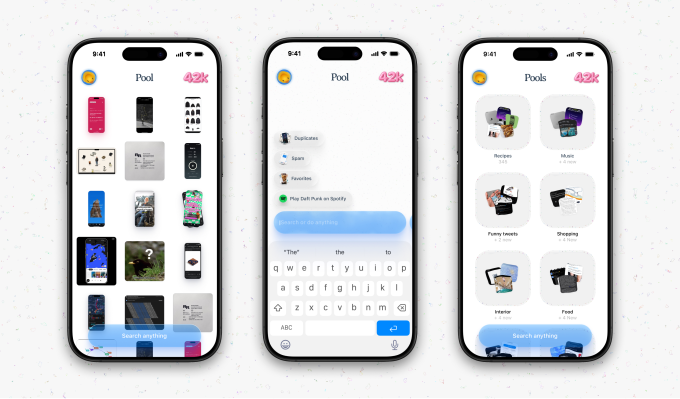
To get started with Pool, you simply give it permission to access your photos, which are moved into categories it calls “pools.” The pools created in the app are entirely dependent on the products, places, or things that you’ve saved over time, making them specific to you.

The app is one of many reinventing bookmarking in the AI era. Startups like mymind, Fabric, and Raindrop help users organize links, images, or other saved content, but Pool focuses specifically on screenshots and then uses AI to help users rediscover and act on things they intended to revisit later.

Image Credits:Pool

Once imported, Pool is able to track down the original link associated with a given screenshot. For instance, if the screenshot was of a product you were thinking of buying, it would link to the retailer’s website. If it were a recipe you saw on Instagram, it could pull up the ingredients and instructions the creator had shared. And so on.

The idea, explained Pool co-founder Maxime Junique, came about because both he and his co-founder Piet Terheyden had faced the same problem: they would screenshot things they wanted to remember, but then could never find them again.

“It sounds pretty obvious, right now, when we say it, but it’s something that we do so naturally — you don’t notice it, necessarily,” said Junique. The founders, who met years ago in a co-working space, asked their friends about the issue. The friends agreed that they would often screenshot and forget things, too, like design ideas or other types of inspiration.

Advertisement
Image Credits:Pool

The app was actually the first product to emerge from Spinoff Studio, the founders’ product and design studio, around three years ago. The first version was built in Lisbon over a couple of weeks while the founders lived out of a van, cranking out the landing page, website, and initial build. But they soon realized they needed to build some products that made money first, so they pivoted to B2B SaaS and shelved Pool.

The studio went on to build other products, including the CRM software Waitless, which was acquired last year.

What brought Pool back to life was the maturation of AI. Suddenly, its core idea of making sense of personal, largely unstructured datasets seemed feasible.

“We were like, it seems like a perfect time to go after this idea,” Junique told TechCrunch. “And it also seemed to us like it’s a super untapped, unexplored data set for AI. Everyone goes after emails, bank transactions, chat logs — all of those productivity-first datasets. Who is going after this really, deeply emotional data set we all own?”

Image Credits:Pool

Pool’s app also treats your screenshots like memories, meaning some of them are more relevant at the moment, while others disappear over time.

For example, if you screenshot the barcode to an event ticket, it could disappear later on after the event has taken place. Meanwhile, if you screenshot a flyer on Instagram about an upcoming event, Pool’s AI agents can help you find where to buy the tickets and link to the ticketing site.

Advertisement

To find things in Pool, you can search or ask its built-in AI assistant for help.

Image Credits:Pool

Next up, the founders plan to take this concept into a second, separate app that will operate as a personal assistant of sorts. Pool’s mascot — the little rubber duck you press and drag across the screen to enter Pool at launch — will become part of the brand for this agentic AI app they’re planning.

The founders were in Lisbon when we chatted — no longer in a van! — but headed to San Francisco in late May to meet with investors. The startup previously raised a pre-seed round of just over $2 million from General Catalyst, Kima Ventures, Paris-based Source Ventures, and other angels, including Winston Du, Julian Blessin, and Thomas Ricouard.

Pool is available now as a free download on iOS.

When you purchase through links in our articles, we may earn a small commission. This doesn’t affect our editorial independence.

Advertisement

Source link

Continue Reading

Tech

Dutton Ranch star claims they ‘didn’t see any disruption’ on set following Chad Feehan’s exit from Yellowstone spinoff fueled by Taylor Sheridan clash rumors

Published

on

In April 2026 — a month before Dutton Ranch made its Paramount+ debut — it was reported that showrunner Chad Feehan had exited the series following alleged “behind-the-scenes friction with series stars Cole Hauser and Kelly Reilly, as well as ‘other key players’ such as Taylor Sheridan.”

Puck News added, “Feehan finished the first season but has been told he won’t return for the second, per three sources. (I think the feeling was mutual and Feehan likely would have bailed anyway.)

Source link

Continue Reading

Tech

Coram raises $35M to turn cameras into AI detectives

Published

on

Coram AI has raised $35m to turn the security cameras already bolted to walls into something closer to an autonomous detective.

The Series B is co-led by the new investor Ansa Capital and Battery Ventures, with UP Partners, 8VC and Mosaic Ventures joining. It takes the San Francisco company’s total funding to $66m.

Coram’s pitch is that physical security is stuck in the past. When something goes wrong, staff spend hours scrubbing through footage, access logs and alarms to piece together what happened.

Its answer is software it calls ‘Deep Investigation’, an AI agent you query in plain language. It searches months of video, entry records and visitor data across hundreds of cameras and sites, then hands back a report. Work that took hours, the company says, now takes minutes.

Advertisement

Founded four years ago by Ashesh Jain and Peter Ondruska, Coram now runs at more than 1,500 locations, from schools to factories.

Privacy pitch, surveillance reality

Coram leans hard on privacy. Its boxes run AI models on local NVIDIA chips at the edge, it says, so sensitive video never has to leave the building for the cloud. It also works with any existing IP camera, avoiding a costly rip-and-replace.

But the same platform sells facial recognition, licence-plate reading, ‘tailgating’ detection and live gun detection, and it is being pointed at schools, churches and workplaces.

One customer, a Dallas megachurch, watches over 30,000 worshippers across eight campuses. A high school swapped old cameras for real-time weapon detection. The efficiency is real; so is the reach.

That trade-off, safety bought with more monitoring, is not new to AI security. But autonomous agents sharpen it. A system that can investigate on its own, across every camera and door, is also a system that is always watching, and now draws its own conclusions.

Advertisement

The ‘operating system’ land grab

Coram is part of a wave of startups trying to become the ‘operating system’ for a single industry by wrapping AI agents around it. Its bet is that every building will eventually run hundreds of agents in the background.

The money is chasing a real gap. ‘Physical security is one of the largest industries yet to be transformed by modern AI,’ said Allan Jean-Baptiste of Ansa Capital, and the incumbents largely sell cameras and dashboards, not autonomy, even as firms pour record sums into AI elsewhere.

For now, the headline numbers, ’10x more effective’, ‘hundreds of agents per space’, are Coram’s projections, not proof. But with $66m in the bank and 1,500 sites live, it has the runway to test whether the building of the future really does watch itself.

Advertisement

Source link

Continue Reading

Tech

Best Smart Chess Boards (2026): Chessnut, Millennium

Published

on

Playing chess can be challenging, fun, and at times frustrating. Garry Kasparov called the game “mental torture.” With virtually limitless possibilities, chess offers unparalleled depth, and you could easily fill a library with books on how to play it. The internet has opened up a wealth of potential competitors, and smart chess boards enable you to play anyone online or off, not to mention dabble in a variety of chess programs.

I’ve been testing smart chess boards for the past month or so, with the help of my chess-mad eldest, and these are my top picks.

The Smart Chess Boards I Recommend Most

Chessnut

Pro Electronic Chessboard

Advertisement

For my opening gambit, I’m recommending the Chessnut Pro. With a classic wooden design, the Chessnut Pro feels like a regular board, but there are smarts hidden within. The beechwood pieces are beautifully weighted, an important but often underestimated feature. They feel great in hand, and the set includes a pair of extra Queens. This is a full tournament-size board (55 cm or 21.7 inches), so you’ll need space for it.

The board is very nicely made, with subtle red LEDs hidden in the corner of each square that light up to show moves. I love that it looks like a regular board when you’re not playing online. There are discreet controls on one side with a USB-C port and Bluetooth connectivity to hook it up to your computer, laptop, or smartphone. There’s no need to press down with each move, as every piece has a sensor chip inside that’s automatically detected.

We used the Chessconnect Chrome browser extension to play matches on Chess.com and Lichess.org, and it was quick and easy to get up and running. The official Chessnut app features AI opponents, but they’re a little weak and lack variety. It isn’t great, but you don’t have to use it, and you can link up to different online services with a bit of tinkering (check out Graham’s Programs for some better options). Online play was occasionally a little glitchy. Sometimes there’s a slight lag, and we had to click to reconnect for every game. Battery life is quite good (we got seven to eight hours), though it takes a while to recharge (best to leave it overnight).

If you understandably don’t want to spend that much, the Chessnut Air ($250) is a far more affordable option. It’s also wooden but much smaller (33 cm or 13 inches), with lighter pieces and visible LEDs. The Air+ ($400) is the same size but with superior weighted wooden pieces and subtle LEDs on the board. Functionally, both give you much the same experience as the Pro.

Advertisement

Source link

Continue Reading

Tech

OpenAI could go from AI pioneer to AI’s BlackBerry, says Forrester

Published

on

As OpenAI courts investors and chases enterprise customers, Forrester says today’s AI leader could become tomorrow’s cautionary tale

OpenAI may be headed for Wall Street, but one analyst firm is already warning enterprise customers not to get too attached.

In a note published alongside OpenAI’s confidential IPO filing, Forrester urged companies to keep their AI options open, arguing that today’s market leader could easily become tomorrow’s cautionary tale.

“Don’t lock into long-term contracts; keep your architectures flexible,” the firm advised. “In fact, OpenAI could become AI’s BlackBerry FIFO (First In, First Out). The company that defines a category is often the one most painfully displaced by it.”

Advertisement

The caution comes as OpenAI takes its first formal step toward a public listing. Alongside its confidential SEC filing, the company published a roadmap built around three ambitions: AI systems that can accelerate research, AI that boosts economic growth, and eventually a personal AGI assistant for everyone. Forrester was more interested in a fourth question: what happens if OpenAI doesn’t stay on top?

The firm argues that OpenAI faces what it calls a “trifecta” of challenges: persuade consumers to use its agents instead of rivals’, convince enterprises to build around its technology, and stay ahead in the race toward AGI.

The enterprise battle may prove the most lucrative. “Whoever automates the dull, expensive middle of a company’s operations first becomes the system of record everyone else has to rip out — and almost no one does,” Forrester said. 

In other words, the first company to get AI agents woven into day-to-day business processes stands a decent chance of becoming yet another piece of software that everyone complains about, but nobody can remove.

Advertisement

However, Forrester’s advice is that, rather than standardizing on a single provider, enterprises should “anchor to the capability you need — not the brand that got there first — and keep your switching costs low.”

The warning also comes as OpenAI reportedly weighs cutting prices to fend off growing competition from rivals, including Anthropic. If the AI market is heading for a price war, enterprises may want to think twice before chaining themselves to a single supplier.

Forrester also notes that a public listing could provide customers with something they currently lack: visibility into OpenAI’s finances. Once public, the company would be required to disclose far more information about the cost of training and operating its models, giving enterprise buyers a clearer picture of the economics behind the AI systems they increasingly depend on.

For now, OpenAI remains the company that helped define the generative AI era. Whether it becomes the next Google, the next Microsoft, or AI’s answer to BlackBerry is a question investors will soon be paying very close attention to.  ®

Advertisement

Source link

Continue Reading

Tech

Stranger Than Heaven Hands-On: Harder Than Yakuza?

Published

on

Sega made a splash during this year’s Summer Game Fest opening showcase, revealing that a digitally resurrected Tupac will feature in the forthcoming Stranger Than Heaven. Snoop Dogg even took the stage to talk about working with the rapper’s estate. While my hands-on with the game wasn’t a full dive into the world of Stranger Than Heaven, exploring one of the five cities and eras, it was an extensive demo showcasing the fighting system. It demands that kind of focus, as it’s an entirely new system compared to RGG Studio’s decades-long Yakuza series.

Attack inputs are categorized into left and right sides, RB and RT control your right hand and leg, LB and LT for your left side. During my time with the demo, the trigger buttons led to slower, harder-hitting blows. Each can be held to charge up an attack, while combining LT and RT leads to grapple moves If you time them right. Releasing a charged attack at the ideal moment seemed to be crucial, too.

Several new combat dynamics come from this new system. Each side is blocked separately, meaning you can block (or parry) an attack while readying a counter with the other side. Grab moves feel practically like a street brawl, tackling enemies through furniture or even tumbling down steps, together. Pin them to the floor and you can then rain blows down on your opponent.

Advertisement

Unlike most of the Yakuza titles, weapons appear to be a more core aspect to fights. Protagonist Daigo will be able to eventually upgrade the knives, mallets and other equipment he finds.

Sega has teased that, over a journey spanning 50 years, special weapons could range from “masterworks of old” to brand-new inventions. Well, new in the ’60s. Some weapons will even come with their own special attacks, usually involving a downed enemy.

Sega set up three different demos to feel out the combat system. First, a relatively easy fight against a group of thugs that focused on fighting a group and using your opponent’s weapons against them. This was followed by a more challenging fight against another gang led by a towering heavy that hit much harder.

Fortunately, you start the fight with a heavy crowbar that was unusually heavy and slow to swing. This fight was where you could really feel a difference to the mostly button-mashing dynamics of Kiryu et al. I’m not sure if I prefer it?

Stranger Than Heaven‘s system seems to demand more from the player (which isn’t necessarily a bad thing) and the final fight was a big example of that. Facing off against a tattooed topless guy chilling in Osaka with his katana demanded some Souls-like levels of timing and dumb luck. I eventually managed to beat him because of the latter.

Advertisement

The enemy would heal himself if left alone and would occasionally kneel down, goading the player to approach him before unleashing a swift slice. Perfectly timed parries (or dodges) were crucial, enabling powerful counterattacks, as were follow-up attacks when he was downed. During this fight, my character was equipped with a short knife and could use both weapon attacks with his left hand and punch and kick with his right hand. It seemed that each weapon creates a different range of attacks.

I’ll admit, I missed the ability to ram a mafia underling into a microwave or other ridiculous contextual moves. Hopefully, some showpiece moves will appear in the full game — Sega has teased fights on moving vehicles, which is at least a start.

This was a demo focused on combat, so I’m intrigued to see how the rest of the game shapes up. Hopefully, STH holds on to some of the ridiculous humor of Like a Dragon and Yakuza. It was a welcome shift in tone from all the melodrama and violence. 

Stranger Than Heaven is scheduled to launch on January 15, 2027 on PS5, Steam and Xbox Series S/X.

Advertisement

Source link

Continue Reading

Tech

The Pixel Watch Wear OS 7 release just leaked in a very odd way

Published

on

Wear OS 7 might be closer than we thought, and Verizon may have just given that away a little early.

Updated support pages spotted for the Pixel Watch 2, Pixel Watch 3 and Pixel Watch 4 on Verizon’s website now reference the upcoming Wear OS 7 update. They also mention a June 2026 security patch and a build number (CP2A.260603.001). On paper, that sounds like a routine software note. However, the timing makes it a lot more interesting.

The pages also mention a June 9 release date. Although that looks more like a placeholder than anything concrete. The update hasn’t started rolling out yet. Google hasn’t made any official announcement, which suggests things are still in the final stages behind the scenes.

Still, the inclusion of Wear OS 7 across multiple Pixel Watch models is a fairly strong hint that the rollout window is approaching. Carriers don’t usually update support documentation this far in advance. It suggests they’ve already received at least some form of release candidate or internal schedule from Google.

Advertisement

Wear OS 7 itself was announced at Google I/O 2026 last month. It brings a fairly wide set of improvements aimed at making Pixel Watches feel faster and more useful day to day. One of the key focuses is battery optimisation. Additionally, there’s a broader UI refresh that introduces new Widgets and Live Updates designed to surface information more dynamically on the wrist.

Advertisement

Perhaps the more notable addition is support for Gemini Intelligence on select smartwatches. That effectively ties Google’s newer AI features into Wear OS in a more visible way. It brings more contextual assistance and on-device intelligence into everyday watch interactions.

If the Verizon listings are accurate, the Pixel Watch lineup could be among the first to receive the update. This would align with Google’s usual approach of prioritising its own hardware first before wider rollout.

Advertisement

For now, nothing is officially confirmed. However, the timing of the support page updates strongly suggests Wear OS 7 is in the final stretch before launch.

(via DroidLife)

Source link

Advertisement
Continue Reading

Tech

Why Thermodynamics Rules Future Orbital Data Centers

Published

on

“Space computing, the final frontier, has arrived,” Nvidia CEO Jensen Huang declared at the Nvidia GTC conference in March.

Indeed, the idea of data centers in orbit has gone from science fiction to a serious spending category. Elon Musk’s SpaceX has acquired xAI (also Musk’s) and is planning a constellation of space-based data centers. Google, not to be outdone, announced Project Suncatcher in partnership with Planet, planning to launch two satellites equipped with Google Tensor Processing Unit (TPU) AI chips by early 2027. Startup Starcloud has already filed a proposal with the Federal Communications Commission for an 88,000-satellite constellation for orbital data centers. As Starcloud’s filing suggests, these companies are all proposing fleets of satellites numbering in the thousands, each housing a rack or multiple racks of AI-grade GPUs, interconnected with each other through free-space optical links and communicating back to Earth via microwave links, either directly or through other satellites.

Proponents tout the many wonders of computing in space: abundant solar energy, free cooling, and freedom from Earth-based disturbances like earthquakes, floods, and protesters. But a sober look at the physics of space-based computing paints a much more nuanced picture.

Free cooling is perhaps the biggest misconception. Space is cold, but it also has no atmosphere. That means the best heat-removal mechanisms, conduction and convection, are off the table. The only option is radiation. To prevent a chip from overheating in space, a large, costly surface area is required to dissipate the energy and then radiate it.

Advertisement

Solar energy is abundant, but collecting it with functional solar panels that maintain perfect alignment toward the sun is a complex task requiring extensive attitude control systems. On top of that, ionizing radiation in space from cosmic rays and other sources poses a unique challenge, degrading the solar panels, the radiative coolers, and the chips themselves. Because regular maintenance in space is difficult, redundancy has to be built in at launch, and cost estimates have to account for efficiency degradation over time.

At ABI Research, where I work as an aerospace analyst, we did a rough total-cost-of-ownership comparison between a data center on Earth and one in space. It showed that the cost to launch and run a GPU in space for a year is at least an order of magnitude higher than the same feat in a terrestrial data center. Our model was simple, assuming an Nvidia H100 server rack launched with the requisite-size solar panel and radiator on a spacecraft akin to Starcloud’s pilot launch. We assumed SpaceX’s Starship was used at a highly optimistic launch cost per kilogram of US $44, and a terrestrial energy cost of $0.20 per kilowatt hour. This is a simple back-of-the-envelope calculation, but it does signal something real.

From our perspective, the cost of delivery and space hardening of the payload makes general-purpose space-based data centers difficult to justify economically today, despite the fact that data-center builders in many regions are scrambling for electric power. However, there are niche applications where the much higher costs of computing in space could be justified. Examples include preprocessing data from Earth-observation satellites, real-time detection and tracking of hypersonic missiles, and active collision avoidance in the increasingly crowded low Earth orbit. Even for these, though, contending with fundamental physics will still be a demanding challenge. And a technologically compelling one, too.

The Cooling Challenge in Space

Cooling is where physics separates the science from the fiction. The governing equation for radiative cooling, the only type of cooling available in space, is known as the Stefan-Boltzmann Law. It states that the amount of power you can radiate is proportional to the area of the radiator times its temperature to the fourth power. For a space systems architect, the implications of this law are brutal. In orbit, the only variable we can control is area. This restriction creates a geometric penalty, or a “physics tax,” for cooling in space: The more power you need to reject, the bigger the area of the radiator you need to bring along from Earth.

Advertisement
chart visualization

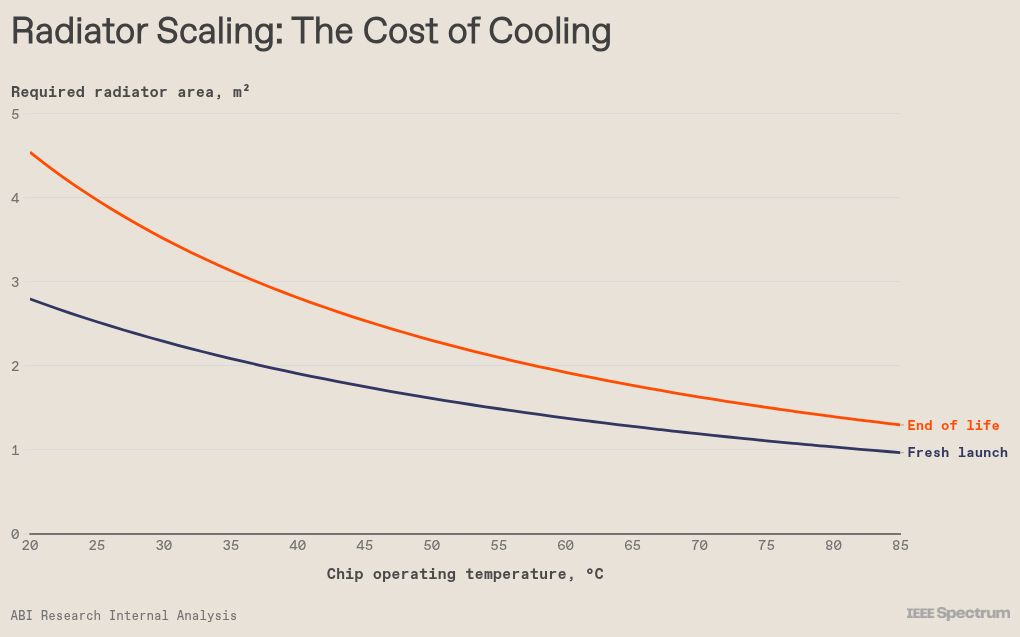
The only cooling method available in space is radiation, and the radiator area required is derived using the Stephan-Boltzmann law. For a single chip drawing 700 watts, like Nvidia’s popular H100 GPU, the area required to keep it at 20 °C is just under 3 square meters, and it goes down to 1 square meter for an operating temperature of 85 °C. However, as the radiator surface is exposed to ionizing radiation, its emissivity decreases, and after 5 years in space the required area increases by about 40 percent.

To understand how big this baseline area is in practice, I used the Stefan-Boltzmann law to model the heat-rejection area needed to keep a single chip that draws 700 watts of power—such as the H100 GPU chip, an AI stalwart—at a constant 60 °C, usually considered the sweet spot for GPU longevity and stability. I further assumed that the radiator is perfectly facing deep space, at a chilly background temperature of 3 kelvins. By this calculation, a single chip would require 1.4 square meters of radiator surface.

To put this into perspective, consider that a common AI rack can hold approximately 32 GPUs (four H100 server boards). With CPUs, memory, and networking equipment, this rack would draw around 40 kilowatts of power. This single rack includes 2.5 terabytes of memory—enough capacity to serve over 20,000 concurrent users or run 16 simultaneous instances of Llama 3, an open-source AI model. But to cool this thermal load in a vacuum, that single rack would require an 80-square-meter radiator, roughly the size of a pickleball court. For an aggregate 100-megawatt data center, you’d need at least 2,500 of those radiators.

And that’s the best-case scenario. Additional problems are hidden in the low Earth orbit environment itself. Space exposes radiators and their coatings to a chemically hostile brew of ultraviolet light and atomic oxygen, quite the opposite of a clean-room environment. Over a LEO satellite’s typical 5-year lifespan, these elements degrade the radiator’s surface properties and lower its ability to shed heat.

Including this degradation in the model reveals that as the radiator degrades from a “fresh” state to an “end-of-life” state, the physics demands a further penalty. To maintain that same 60 °C operating temperature for the GPU chips, the required surface area jumps from about 1.4 square meters per chip to nearly 2.0 square meters. In other words, the physics tax rises by 40 percent. Therefore, you must launch at least 40 percent more radiator mass, endure higher atmospheric drag, and sacrifice valuable launch volume just to survive the degradation of the thermal coating. This increase adds significantly to the launch cost and further erodes the economics of a space-based data center.

Advertisement

The Silicon Challenge in Space

Solving the heat problem is only part of the battle. The other significant challenge in low Earth orbit is ionizing radiation, which affects the computing hardware itself. Today’s satellites typically use radiation-hardened processors, which are very reliable but also much more expensive, and they perform poorly compared to commercial off-the-shelf processors.

A standard rad-hard chip doesn’t have the processing power to run a modern large language model (LLM). As a result, satellite operators aspiring to launch a data center have no choice but to make a risky compromise: to use hardware meant for terrestrial use. In order to achieve the necessary compute density, orbital data centers must use the same Nvidia H100s or Google TPUs found in terrestrial server farms. The problem is that these chips are “soft” targets in space. High-energy particles can flip bits in memory or cause “latch-ups” in logic that fry the circuit.

One possible option is to shield the computers from radiation with thick, absorbent panels. However, the shielding would add significantly to the already heavy satellites. The other option is to compensate for the radiation damage with redundancy. Indeed, edge computing architects are moving toward software-defined resilience, where instead of one perfectly hardened computer, operators fly a cluster of imperfect, commercial ones whose total cost could be as low as one-tenth to one-hundredth that of the rad-hard model.

This redundant approach is used in many spacecraft, including Artemis II, which recently carried astronauts around the moon, as well as SpaceX’s flight computers and the Hewlett Packard Enterprise edge servers for the International Space Station. By running three (or more) instances of the same calculation on three different nodes and comparing the answers, the system can detect a corrupted processor. If a node fails, the “orchestrator” reboots it while the others continue the mission. While this ensures resiliency, it also means that some fraction of the compute capacity is dedicated to redundancy, further increasing the costs.

Advertisement

The Energy Challenge in Space

An often-touted advantage of space-based data centers is the seemingly unlimited supply of free, clean energy from the sun. Solar energy in orbit is indeed abundant, at 1,361 watts per square meter. Of course, capturing that free energy is made possible only by the very costly launching of large solar panels into orbit. And those solar panels also degrade over time due to radiation exposure, typically losing 1 to 3 percent efficiency per year.

Let’s say a solar array collects 1 MW of power to run an AI cluster. The laws of physics demand that the satellite must eventually radiate 1 MW of waste heat. Because the square area needed to generate the solar power—around 400 W/m2—and to reject the heat—around 450 W/m2—are nearly equivalent, every square meter of power generation now demands approximately another square meter of cooling. The radiator needs to be a structural equal, not merely a passive coating on a surface used for something else.

As Elon Musk recently noted in Davos, the most efficient radiator is one that never sees the sun. By orienting the spacecraft so the solar panels face the sun and the radiators face the deep vacuum of space, efficiency skyrockets for both. But there’s a catch: Maintaining this perfect three-way alignment—panels to sun, radiator to the void, antennas to Earth—requires complex, high-torque attitude control systems. So this configuration means more payload and more computing power. Plus, these control systems are complex components with many failure modes, which is not optimal in a situation where maintenance is difficult.

The Killer Apps for Computing in Space

Given all these challenges of deploying massive radiators for satellites in the hostile environment of space, why build data centers in space at all?

Advertisement

While training or inference on LLMs in space doesn’t seem economical today, there are other, very compelling applications for computing in space. Here are two: solving the downlink bottleneck from Earth-observation satellites and enabling collision-preventing maneuvers in the increasingly crowded low Earth orbit.

The latest Earth-observation satellites, equipped with hyperspectral and synthetic aperture radar sensors, are used for a range of important reconnaissance missions, such as battlefield intelligence, tracking the global shadow fleet of ships carrying contraband, and assessing earthquakes or infrastructure failures down to the millimeter. These systems can generate hundreds of terabytes of raw data per day that must be transmitted to Earth. However, the radio-frequency “pipes” used to downlink the data are congested, and the ground infrastructure cannot absorb the sheer volume of raw data.

Another immediate, mission-critical application for in-space computation is protecting the orbital environment. With over 17,000 satellites in orbit, the overwhelming majority of which are in low Earth orbit, avoiding collisions between these satellites is crucial. As NASA astrophysicist Donald Kessler pointed out back in 1978, a single space collision could cause a cascading effect that renders the entirety of LEO unusable.

Advertisement

According to SpaceX’s recent annual report, the Starlink constellation executes a collision avoidance maneuver every 2 minutes on average. Each maneuver already relies on onboard AI systems but still requires most of the processing to happen on the ground.

A rendering of the Starlink satellite system depicted as bright dots surrounding the Earth.

SpaceX’s Starlink system currently has over 10,000 satellites in low Earth orbit, each depicted here as a colored dot.

Satellitemap.space

Advertisement

As low Earth orbit gets increasingly populated, collision avoidance will have to break the traditional ground-loop model. In the megaconstellation era of space, the OODA (observe, orient, decide, act) loop must happen onboard, thereby reducing the analysis turnaround from minutes to milliseconds.

The problem is that the flight computers standard on satellites are not built for this level of processing. The complex probability models required for maneuvering cannot currently be implemented by onboard computers in conjunction with their navigation systems. Clearly, more powerful computers are needed.

This is the true economic justification for moving compute to space: to move insight generation there. By placing high-performance computing adjacent to the sensors, we can process terabytes of data in orbit and downlink only the relevant data in real time, and we can do the computations necessary to avoid satellite collisions in real time.

The Future of Computing in Space

So, assuming that some form of computing is inevitable in low Earth orbit in the foreseeable future, how will the heat be handled? The industry is currently experimenting with two main classes of solutions to cope with the Stefan-Boltzmann law.

Advertisement

One creative option is to use origami-inspired radiators, the kind used for the James Webb telescope. Companies are developing flexible, high-conductivity composite radiators that fold into a tight cube for launch and unfurl into enormous yet lightweight thermal wings in orbit.

Another possibility is to use liquid-droplet radiators. This concept proposes removing the rigid radiator structure completely and instead spraying a stream of coolant oil directly into the vacuum of space. The fluid travels through an open loop, exposed to the near-absolute zero of the void, maximizing radiative surface area before being caught by a collector and pumped back into the ship. It sounds like science fiction, but as the heat loads climb into the megawatts, liquid-droplet cooling may be the only way to cheat the mass limits of this exponential reality.

Our rough total-cost-of-ownership model uses optimistic versions of current numbers, such as launch cost, chip cost, and power use. A critic might point out that future technology will improve, both in efficiency, purpose-built designs, and costs.

Sure, the technology is bound to improve. But the critical factor isn’t just launch cost; it’s the computing power per unit mass and electric-power economics. Radiators and solar arrays can consume 65 to 70 percent of total satellite mass, and space-grade photovoltaics run orders of magnitude more expensive than terrestrial equivalents.

Advertisement

Spiral polygonal grid resembling a twisted spiderweb on a light background Chris Philpot

Even as launch costs fall, the mass and cost burden of power generation and thermal management will remain a fundamental problem.

Current space-grade solar panels rely on germanium substrates, whose supply is concentrated in China. It will be extremely difficult to scale up availability of these substrates. A transition to radiation-tolerant perovskite solar panels or a similar alternative could change the economics significantly, but that possibility is five years away or more. The technology will get cheaper, but the bottlenecks of power and thermal architecture will remain.

Recognizing the thermal reality of cooling in space forces us to shift how we view satellite operations. We are moving away from the “launch and forget” era toward an era of “autonomous logistics.” As our thermal model demonstrated, the harsh environment of space steadily attacks the hardware. UV radiation degrades thermal coatings; cosmic rays degrade silicon. In a traditional satellite model, when the radiator degrades or the memory fails, the satellite becomes space junk. For a multimillion-dollar data center, that disposal model is potentially ruinous.

To make the economics of orbital computation work, the infrastructure must be serviceable and the rockets to launch them reusable. The orbital domain will require automated servicing vehicles capable of swapping out degraded radiator panels and upgrading fried servers. In these ways, the future of the orbital data centers is dependent on the innovations of an emergent in-space economy.

Advertisement

There’s a good argument to be made that the need for space-based computation is less of a hype cycle and more of an enabler for the new space economy. Look no further than SpaceX’s recent regulatory filings proposing a constellation of up to a million satellites in low Earth orbit. At such a scale, routing all raw data back to Earth is physically impossible; the network itself must become the data center.

However, the winners in this sector will be determined by the systems architects who most cleverly accommodate the thermodynamics and the companies with sufficient vertical integration to take on the massive costs of operating data centers in orbit. Ultimately, the physics tax is universal. Whether managing heat rejection in the vacuum of low Earth orbit or managing power density in a hyperscale facility in Northern Virginia, the constraint is never the silicon. It’s the thermodynamics.

From Your Site Articles

Related Articles Around the Web

Advertisement

Source link

Continue Reading

Tech

The key steps that will enable organizations to scale Physical AI

Published

on

As physical AI enters our homes, workspaces and public infrastructure, it will have a transformative effect. Autonomous vehicles will become the norm on our streets, factories and warehouses will move to full automation, AI-enabled devices will assist in surgeries and medical procedures, and greater intelligence will be embedded into domestic devices.

Such is the emerging significance of physical AI, Gartner has identified it as a top strategic trend that will shape enterprise priorities over the next five years. There is no doubt the opportunities are great. But are organizations ready to roll out autonomous robots and drones, self-driving vehicles and industrial automation at scale?

Anuj Seth

VP of IoT & Engineering for EMEA & APAC at Cognizant.

Source link

Advertisement
Continue Reading

Tech

South Korea hits Coupang with $400M+ fine for data breach that affected millions

Published

on

South Korean authorities have imposed a record-breaking fine of $624 billion won (over $400 million) on retail giant Coupang after a data breach last year compromised the personal data of more than 34 million customers.

Seoul’s Personal Information Protection Commission issued the maximum penalty on Thursday following discovery of the breach in December 2025. The retail giant, which is headquartered in the U.S. but popular in South Korea and likened to the “Amazon of Asia,” had said the months-long data breach allowed a former employee to obtain names, email and shipping addresses, phone numbers and order histories of about two-thirds of South Korea’s population.

Coupang told BBC News that it plans to challenge the regulator’s decision. The fine represents a rare case of a financial penalty issued against a U.S.-based firm. Korean lawmakers have accused some of their American counterparts of imposing political pressure after reports that U.S. representatives were linking the data breach with U.S.-South Korean bilateral ties in response to the case against Coupang’s executives.

U.S. companies rarely face financial sanctions or criminal prosecution for data breaches as a result of lacking laws and enforcement powers.

Advertisement

Source link

Continue Reading

Trending

Copyright © 2025