Tallinn-based European ride-hailing player Bolt is teaming up with Nvidia ‘to build the AI foundation for scaling autonomous vehicles in Europe’.
Bolt says the new collaboration will combine its own extensive ride-hailing and car-sharing fleet data with Nvidia Omniverse libraries, Nvidia Cosmos world foundation models, Nvidia Alpamayo AV foundation models, and Nvidia AI infrastructure “to accelerate safe AV development for European roads”. The new AV platform will be deployed on the Nvidia Drive Hyperion computer and sensor architecture.
The news could mark a major boost to Europe’s autonomous vehicle and robotaxi ambitions. Today Bolt operates in more than 50 countries and 850 cities, and claims 200m customers.
“Real-world data is the most valuable asset in the race for safe autonomy,” said Jevgeni Kabanov, president and head of autonomous driving at Bolt. “By marrying Bolt’s operational scale with the Nvidia Hyperion Platform, Alpamayo foundation models, AI infrastructure, and open models and libraries, we are creating a European-led AV offering that ensures our continent remains at the forefront of mobility innovation while maintaining full control over our data and technology.”
Advertisement
“Autonomous vehicles require a full-stack approach that unifies AI models, high-performance compute and a robust sensor architecture,” said Philippe van den Berge, EMEA vice-president of automotive at Nvidia, who said the new initiative would enable a scalable foundation for safe, high-performance autonomous mobility services designed for the “complexity and diversity” of European roads.
According to Bolt, the new collaboration will establish a life cycle for AI development – from data provision to common base models – enabling new mobility applications that will be safe, auditable and “uniquely European”, and said any processing of Bolt’s fleet data will ensure “strict compliance” with GDPR and EU cybersecurity standards.
“Globally, US firm Uber receives a lot of attention for its moves to engage with players across the autonomous mobility ecosystem,” said Forrester’s VP principal analyst Paul Miller. “But Bolt is also a strong player in the European market and, like Uber, the company has been working to build partnerships in anticipation of a future where at least some of its ride hailing vehicles have no driver.”
Miller cites Bolt’s existing partnership with Pony.ai, signed in 2025, which could see the Chinese provider’s autonomous robotaxis tested on European roads in late 2026.
Advertisement
“It makes sense for Bolt to explore where and how [Nvidia’s] stack might support Bolt and Bolt’s partners,” said Miller. “It also makes sense for Nvidia to spread its bets, helping slot its hardware and software into as many autonomous mobility projects as possible.”
Don’t miss out on the knowledge you need to succeed. Sign up for the Daily Brief, Silicon Republic’s digest of need-to-know sci-tech news.
Apple Glass will be a direct competitor to Meta’s Ray-Ban smart glasses, but it will be only a part of a larger three-pronged AI wearable strategy for the company. Here’s what’s coming.
Optimistic renders of what Apple Glass could look like – Image Credit: AppleInsider
Apple has long been working on its smart glasses, known as Apple Glass. What is anticipated to actually launch will be quite close to what the existing Meta Ray-Bans can already do. In Sunday’s “Power On” newsletter for Bloomberg, Mark Gurman writes that the Apple Glass will be easily able to handle everyday uses, including photographs and video capture, dealing with phone calls, handling notifications from an iPhone, and music playback. Rumor Score: 🤔 Possible Continue Reading on AppleInsider | Discuss on our Forums
Data quality has always been an afterthought. Teams spend months instrumenting a feature, building pipelines, and standing up dashboards, and only when a stakeholder flags a suspicious number does anyone ask whether the underlying data is actually correct. By that point, the cost of fixing it has multiplied several times over.
This is not a niche problem. It plays out across engineering organizations of every size, and the consequences range from wasted compute cycles to leadership losing trust in the data team entirely. Most of these failures are preventable if you treat data quality as a first-class concern from day one rather than a cleanup task for later.
How a typical data project unfolds
Before diagnosing the problem, it helps to walk through how most data engineering projects get started. It usually begins with a cross-functional discussion around a new feature being launched and what metrics stakeholders want to track. The data team works with data scientists and analysts to define the key metrics. Engineering figures out what can actually be instrumented and where the constraints are. A data engineer then translates all of this into a logging specification that describes exactly what events to capture, what fields to include, and why each one matters.
That logging spec becomes the contract everyone references. Downstream consumers rely on it. When it works as intended, the whole system hums along well.
Advertisement
Before data reaches production, there is typically a validation phase in dev and staging environments. Engineers walk through key interaction flows, confirm the right events are firing with the right fields, fix what is broken, and repeat the cycle until everything checks out. It is time consuming but it is supposed to be the safety net.
Once data goes live and the ETL pipelines are running, most teams operate under an implicit assumption that the data contract agreed upon during instrumentation will hold. It rarely does, not permanently.
Here is a common scenario. Your pipeline expects an event to fire when a user completes a specific action. Months later, a server side change alters the timing so the event now fires at an earlier stage in the flow with a different value in a key field. No one flags it as a data impacting change. The pipeline keeps running and the numbers keep flowing into dashboards.
Weeks or months pass before anyone notices the metrics look flat. A data scientist digs in, traces it back, and confirms the root cause. Now the team is looking at a full remediation effort: updating ETL logic, backfilling affected partitions across aggregate tables and reporting layers, and having an uncomfortable conversation with stakeholders about how long the numbers have been off.
Advertisement
The compounding cost of that single missed change includes engineering time on analysis, effort on codebase updates, compute resources for backfills, and most damagingly, eroded trust in the data team. Once stakeholders have been burned by bad numbers a couple of times, they start questioning everything. That loss of confidence is hard to rebuild.
This pattern is especially common in large systems with many independent microservices, each evolving on its own release cycle. There is no single point of failure, just a slow drift between what the pipeline expects and what the data actually contains.
Why validation cannot stop at staging
The core issue is that data validation is treated as a one-time gate rather than an ongoing process. Staging validation is important but it only verifies the state of the system at a single point in time. Production is a moving target.
What is needed is data quality enforcement at every layer of the pipeline, from the point data is produced, through transport, and all the way into the processed tables your consumers depend on. The modern data tooling ecosystem has matured enough to make this practical.
Advertisement
Enforcing quality at the source
The first line of defense is the data contract at the producer level. When a strict schema is enforced at the point of emission with typed fields and defined structure, a breaking change fails immediately rather than silently propagating downstream. Schema registries, commonly used with streaming platforms like Apache Kafka, serialize data against a schema before it is transported and validate it again on deserialization. Forward and backward compatibility checks ensure that schema evolution does not silently break consuming pipelines.
Avro formatted schemas stored in a schema registry are a widely adopted pattern for exactly this reason. They create an explicit, versioned contract between producers and consumers that is enforced at runtime and not just documented in a spec file that may or may not be read.
Write, audit, publish: A quality gate in the pipeline
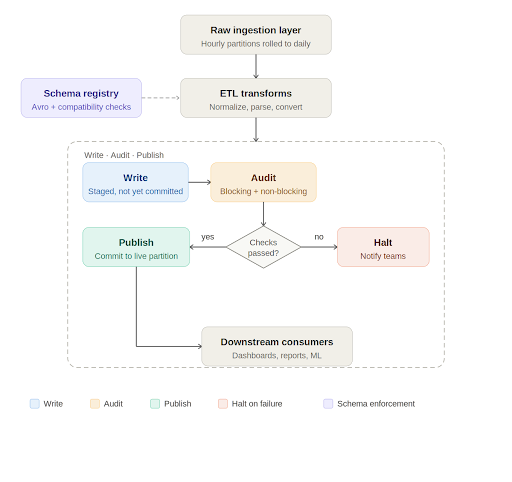
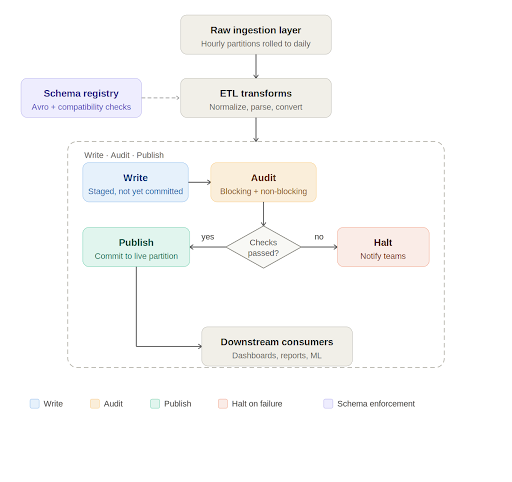
At the processing layer, Apache Iceberg has introduced a useful pattern for data quality enforcement called Write-Audit-Publish, or WAP. Iceberg operates on a file metadata model where every write is tracked as a commit. The WAP workflow takes advantage of this to introduce an audit step before data is declared production ready.
Advertisement
In practice, the daily pipeline works like this. Raw data lands in an ingestion layer, typically rolled up from smaller time window partitions into a full daily partition. The ETL job picks up this data, runs transformations such as normalizations, timezone conversions, and default value handling, and writes to an Iceberg table. If WAP is enabled on that table, the write is staged with its own commit identifier rather than being immediately committed to the live partition.
At this point, automated data quality checks run against the staged data. These checks fall into two categories. Blocking checks are critical validations such as missing required columns, null values in non-nullable fields, and enum values outside expected ranges. If a blocking check fails, the pipeline halts, the relevant teams are notified, and downstream consumers are informed that the data for that partition is not yet available. Non-blocking checks catch issues that are meaningful but not severe enough to stop the pipeline. They generate alerts for the engineering team to investigate and may trigger targeted backfills for a small number of recent partitions.
Only when all checks pass does the pipeline commit the data to the live table and mark the job as successful. Consumers get data that has been explicitly validated, not just processed.
Data quality as engineering practice, not a cleanup project
There is a broader point embedded in all of this. Data quality cannot be something the team circles back to after the pipeline is built. It needs to be designed into the system from the start and treated with the same discipline as any other part of the engineering stack.
Advertisement
With modern code generation tools making it cheaper than ever to stand up a new pipeline, it is tempting to move fast and validate later. But the maintenance burden of an untested pipeline, especially one feeding dashboards used by product, business, and leadership teams, is significant. A pipeline that runs every day and silently produces wrong numbers is worse than one that fails loudly.
The goal is for data engineers to be producers of trustworthy, well documented data artifacts. That means enforcing contracts at the source, validating at every stage of transport and transformation, and treating quality checks as a permanent part of the pipeline rather than a one time gate at launch.
When stakeholders ask whether the numbers are right, the answer should not be that we think so. It should be backed by an auditable, automated process that catches problems before anyone outside the data team ever sees them.
The word clanker — a disparaging term for AI and robots — “has made its way into the Linux kernel,” reports the blog It’s FOSS “thanks to Greg Kroah-Hartman, the Linux stable kernel maintainer and the closest thing the project has to a second-in-command.”
He’s been quietly running what looks like an AI-assisted fuzzing tool on the kernel that lives in a branch called “clanker” on his working kernel tree. It began with the ksmbd and SMB code. Kroah-Hartman filed a three-patch series after running his new tooling against it, describing the motivation quite simply. [“They pass my very limited testing here,” he wrote, “but please don’t trust them at all and verify that I’m not just making this all up before accepting them.”] Kroah-Hartman picked that code because it was easy to set up and test locally with virtual machines.
“Beyond those initial SMB/KSMBD patches, there have been a flow of other Linux kernel patches touching USB, HID, F2FS, LoongArch, WiFi, LEDs, and more,” Phoronix wrote Tuesday, “that were done by Greg Kroah-Hartman in the past 48 hours…. Those patches in the “Clanker” branch all note as part of the Git tag: “Assisted-by: gregkh_clanker_t1000”
The T1000 presumably in reference to the Terminator T-1000. It’s FOSS emphasizes that “What Kroah-Hartman appears to be doing here is not having AI write kernel code. The fuzzer surfaces potential bugs; a human with decades of kernel experience reviews them, writes the actual fixes, and takes responsibility for what gets submitted.” Linus has been thinking about this too. Speaking at Open Source Summit Japan last year, Linus Torvalds said the upcoming Linux Kernel Maintainer Summit will address “expanding our tooling and our policies when it comes to using AI for tooling.”
Advertisement
He also mentioned running an internal AI experiment where the tool reviewed a merge he had objected to. The AI not only agreed with his objections but found additional issues to fix. Linus called that a good sign, while asserting that he is “much less interested in AI for writing code” and more interested in AI as a tool for maintenance, patch checking, and code review.
The biotech industry’s engineered cells could become an $8 trillion market by 2035, notes Phys.org. But how do you keep them from being stolen? Their article notes “an uptick in the theft and smuggling of high-value biological materials, including specially engineered cells.”
In Science Advances, a team of U.S. researchers present a new approach to genetically securing precious biological material. They created a genetic combination lock in which the locking or encryption process scrambled the DNA of a cell so that its important instructions were non-functional and couldn’t be easily read or used. The unlocking, or decryption, process involves adding a series of chemicals in a precise order over time — like entering a password — to activate recombinases, which then unscramble the DNA to their original, functional form…
They created a biological keypad with nine distinct chemicals, each acting as a one-digit input. By using the same chemicals in pairs to form two-digit inputs, where two chemicals must be present simultaneously to activate a sensor, they expanded the keypad to 45 possible chemical inputs without introducing any new chemicals. They also added safety penalties — if someone tampers with the system, toxins are released — making it extremely unlikely for an unauthorized person to access the cells.
“The researchers conducted an ethical hacking exercise on the test lock and found that random guessing yielded a 0.2% success rate, remarkably close to the theoretical target of 0.1%.”
The long-rumored Nvidia N1 chip has been circulating in leaks and rumors for what feels like an eternity. But with a fresh leak, we may finally be getting our first proper look at it – and this time, it includes actual, high-quality images. From these, the product appears closer to… Read Entire Article Source link
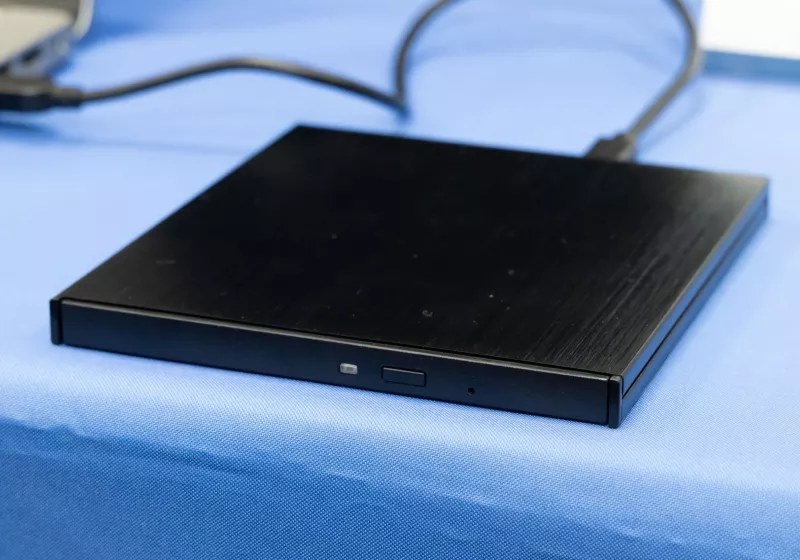
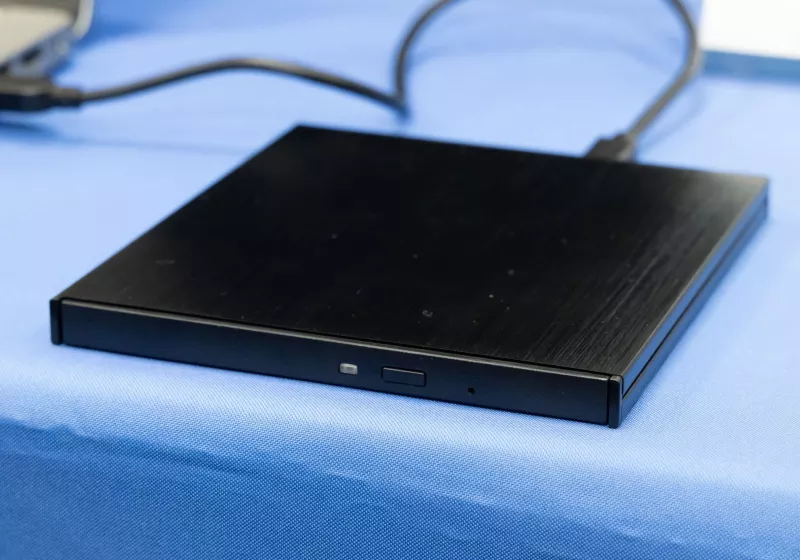
In an official announcement translated by Automaton West, the two firms recently confirmed plans to strengthen their partnership to maintain the supply of Blu-ray discs and players in Japan. Verbatim and I-O Data acknowledged that, despite the rise of digital distribution, individuals and businesses still use optical discs for recording,… Read Entire Article Source link
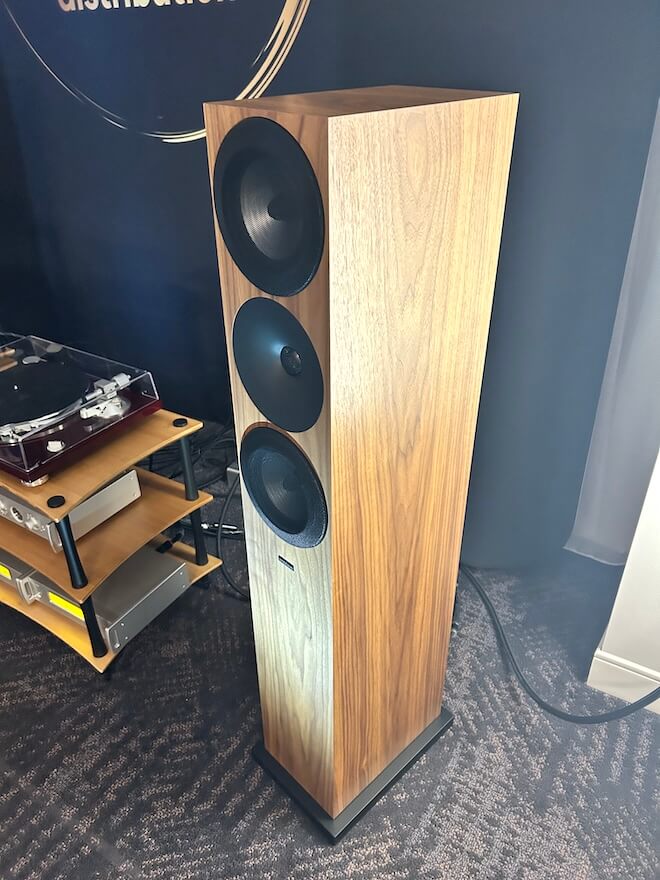
Finland usually exports two things with authority: hockey players like Teemu Selänne and beverages that feel like a dare. High-end loudspeakers? Not so much — at least that was the assumption before Amphion Loudspeakers decided to quietly ruin that narrative.
First unveiled at High End Munich 2025, the new Argon X-Series which includes the Argon3X, Argon3LX, and Argon7LX, finally made its way to AXPONA 2026, giving us our first real chance to hear what all the quiet confidence was about.
No, Amphion doesn’t offer the same overwhelming breadth of models as the Danes who practically carpet-bombed this show with options, but that’s not really the point. What Amphion brings is focus: cleaner execution, refined engineering, and a sound that leans toward honesty over theatrics. With expanded U.S. distribution through Playback Distribution, these Finnish imports are no longer a niche curiosity.
Finnish Precision Meets Studio Credibility
For more than 25 years, Amphion Loudspeakers has taken a more restrained approach to speaker design. Instead of boosting bass or adding extra sparkle up top to grab attention in a quick demo, their speakers are built to play it straight. What you hear is closer to what was actually recorded, which means better recordings sound great and bad ones have nowhere to hide.
That same approach has carried into the pro audio world over the past decade, where engineers working with Billie Eilish, Beck, and Kendrick Lamar rely on Amphion studio monitors for mixing. Film composers such as Ali Shaheed Muhammad and Jussi Tegelman have adopted them as well, where consistency and accuracy matter more than sounding impressive for five minutes.
Advertisement
Amphion Argon7LX: What It Is and What Actually Changed
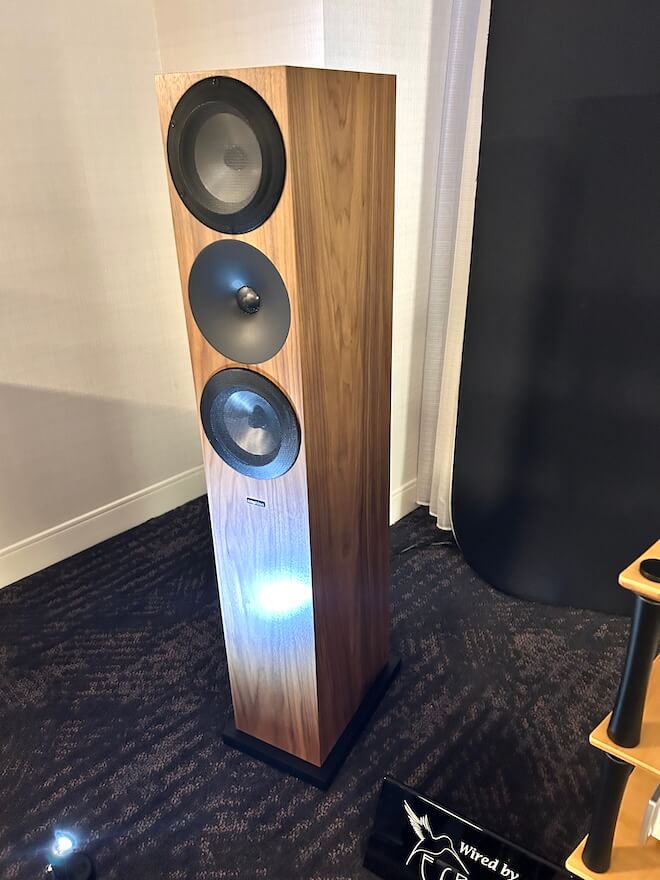
The Argon7LX is a floorstanding loudspeaker from Amphion Loudspeakers that sticks to a fairly straightforward concept on paper but executes it with a level of precision that’s anything but casual. It’s a two-way design using a passive radiator system, built around a newly developed 1 inch titanium tweeter and dual 6.5-inch aluminum woofers. That configuration is meant to deliver full range sound without relying on a traditional port, which helps keep the bass tighter and more controlled, especially in real rooms where things can get messy fast.
The biggest update here is the tweeter, and it’s not a cosmetic change. Amphion revised it to improve low level detail and clean up the top end without pushing things into fatigue. There’s more information, but it’s presented in a controlled way. The crossover has also been reworked and sits at 1600 Hz, which is relatively low, helping create a smoother transition between the tweeter and woofers. The result is better integration, so the sound doesn’t feel segmented across frequencies.
That carries into the soundstage. Imaging is stable, placement is precise, and nothing shifts around when the material gets more complex. The bass remains controlled, but the more noticeable change is how it connects with the midrange and treble. The overall presentation is more cohesive and consistent.
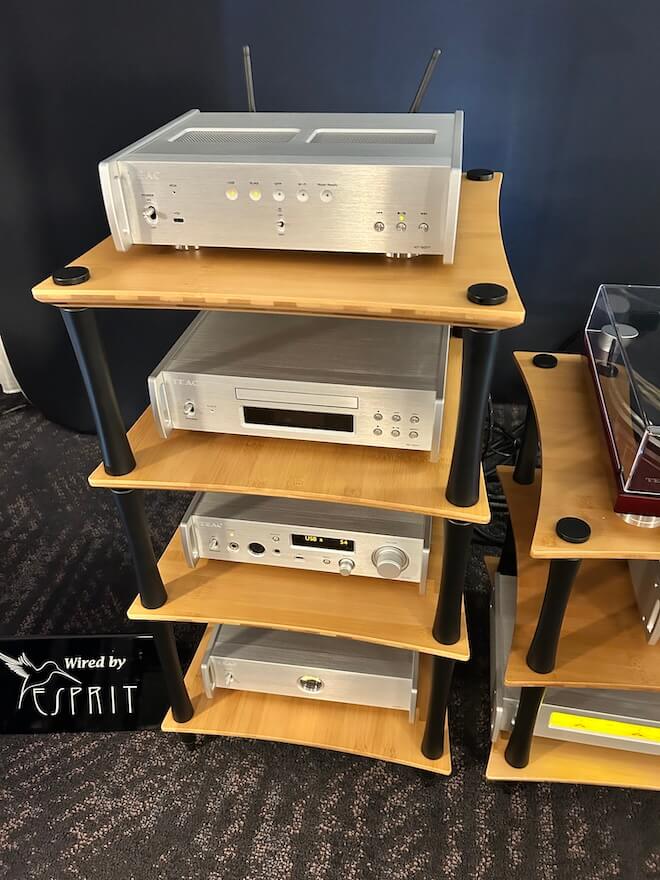
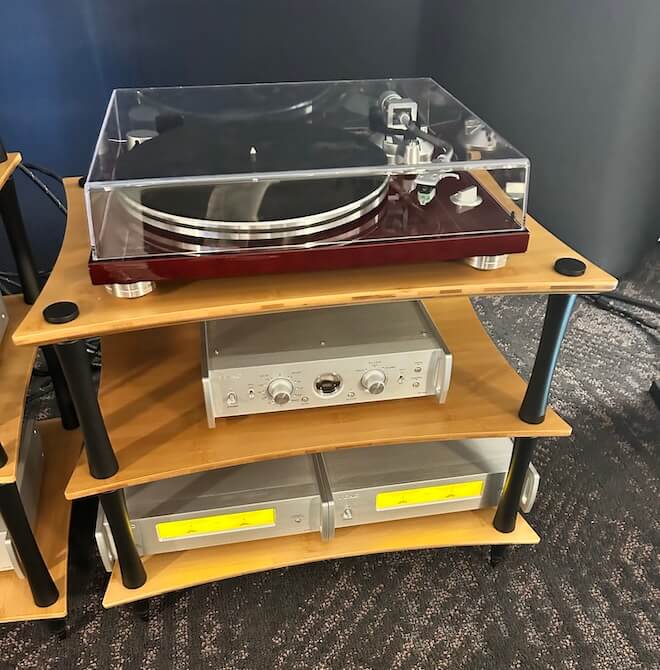
For the demo, Amphion Loudspeakers used two compact TEAC AP-507 power amplifiers, also distributed in the U.S. by Playback Distribution. Each amplifier delivers 170 watts per channel into 4 ohms and can be configured for stereo, bi-amp, or bridged operation, with higher output available in BTL mode. The pairing had no issue driving the Argon7LX to normal listening levels with control and stability, which is notable given the size of the amplifiers.
On the practical side, the Argon7LX is a 4 ohm speaker with a sensitivity rating of 91 dB, which means it’s not especially hard to drive but will benefit from an amplifier with solid current delivery. Amphion recommends anywhere from 50 to 300 watts, which gives you some flexibility depending on your setup.
Advertisement
Frequency response is rated from 28 Hz to 55 kHz at minus 6 dB, so it reaches low enough for most music without needing a subwoofer, while also extending well beyond the limits of human hearing on the top end.
Advertisement. Scroll to continue reading.
Physically, it’s a substantial speaker without being ridiculous. Just over 45 inches tall, under 10 inches wide, and weighing about 60 pounds each, it’s designed to fit into real living spaces without dominating them.
So how did it sound? Calm, controlled… and slightly judging you
I walked into the room expecting at least a small crowd and… nothing. A few seats open, plenty of space, almost suspiciously calm. This system had no business being that overlooked. My host didn’t rush anything, just handed me the reins. When I asked for electronic music, he cracked a slight smile and queued up a few tracks he clearly had ready. Finns get it. They’ll dismantle your penalty kill and still have time to argue about synth textures.
Right off the bat, the neutrality hits. No extra flavor, no “look what I can do” tuning. Just fast, clean, open sound that moves with real intent. Propulsive fits. The music had momentum, not just presence. It filled the room without feeling pushed, and there was an ease to it that made you stop thinking about the system and just let it run. Detail was there, but it didn’t feel dissected. More like everything was just… available.
Advertisement
The bass? Not trying to win any Texas BBQ competitions. This isn’t brisket dripping onto your plate. More like a perfectly trimmed filet—tight, controlled, and cooked exactly how it should be. You might want a little more heft if that’s your thing, but it never felt thin or out of place. There was even a hint of that club-like scale, just without the kind of low end that rearranges your organs and your plans for the next morning. Don’t forget to bring some protection.
The company frames the dispute not as a question of safety or bias mitigation, but as a First Amendment issue over who controls the information that large-scale AI systems generate. Read Entire Article Source link
In April 2025, a new company called Slate Auto came out of stealth and shocked the car industry. Not only was this startup focused on making an ultra-cheap, customizable electric pickup truck with funding from Jeff Bezos, but it had also been operating in secret for three years in Troy, Michigan — the backyard of major automakers like Ford and General Motors.
TechCrunch was first to the story, reporting in early April about the company’s existence, its involvement with the Amazon founder, and its curious and unique business model. The weeks between our report and Slate’s official coming out party in late April provided a whirlwind of news, with prototypes of the startup’s truck popping up around California.
Slate is an aberration in the U.S. EV sector, where bankruptcies, failed product launches, and pivots have become commonplace. And while its current backers, executive lineup, first product, and business model provide a compelling path forward, the road is still riddled with potential hurdles as it pushes toward production in late 2026.
Here’s a timeline that charts out everything you need to know about Slate Auto, from its origin story and backers to its product, business model, and production plans.
Advertisement
Inside the EV startup secretly backed by Jeff Bezos
April 8 – After a year-long investigation, TechCrunch published a story revealing that a secretive EV startup called Slate Auto had been operating for three years with the financial backing of Jeff Bezos and LA Dodgers owner Mark Walter.
Unlike other EV startups, Slate had been working on developing an extremely low-cost electric pickup truck that would start at around $25,000. This truck would be deeply customizable, leveraging the experience of many former employees from Harley-Davidson and Chrysler, two companies that have extensive accessories and aftermarket parts businesses.
Slate Auto’s pickup truck spotted in the wild
April 10 – One day later, a photo of a nondescript electric truck started circulating on the r/whatisthiscar subreddit, with Redditors speculating it could be Slate’s mystery EV.
Techcrunch event
Advertisement
San Francisco, CA | October 13-15, 2026
TechCrunch was able to confirm the photo was, in fact, of a prototype of Slate’s truck parked outside the company’s Long Beach, California design center.
Advertisement
An EV that can change like a ‘Transformer’
April 21 – Slate began putting concept versions of the Slate EV on public streets to generate marketing buzz ahead of its planned launch event on April 24. Curiously, some of them appeared to be styled more like SUVs or hatchbacks, not just pickup trucks.
TechCrunch was able to confirm the company had developed the EV to have “Transformer-like” modular capabilities, and that this stunt was a way to tease this customization.
The analog EV pickup truck that is decidedly anti-Tesla
April 24 – Slate made its debut at a launch event in Long Beach, California, where it revealed its customizable electric pickup truck. Slate also announced the truck would be available for under $20,000 — with the $7,500 federal EV tax credit.
The base version of the truck was revealed to be very bare-bones, with just 150 miles of range, no power windows, no main infotainment screen, and not even any paint. Slate promised essentially everything about the truck would be customizable, even down to the number of seats and the overall silhouette.
Advertisement
A former Indiana printing plant eyed for EV truck production
April 25 – TechCrunch reported that Slate had identified a former printing plant in Warsaw, Indiana as the location for its truck factory. The 1.4 million-square-foot facility was built in 1958 and had been dormant for around two years.
Slate Auto crosses 100,000 refundable reservations in two weeks
May 12 – Slate confirmed to TechCrunch it had already surpassed 100,000 refundable $50 reservations for its affordable EV truck. It was evidence that the company’s ideas had caught on with a wide audience, despite no one knowing about Slate just two months prior.
Slate Auto drops ‘under $20,000’ pricing after Trump administration ends federal EV tax credit
July 3 – The Trump administration pushed through a massive tax-cut bill that, among many other actions, set a September end-date for the $7,500 federal EV tax credit. That means Slate’s truck will no longer be able to lean on that credit to reach the “under $20,000” starting price the startup was touting. As such, Slate pulled that language from its website before the bill was even signed into law.
Why this LA-based VC firm was an early investor in Slate Auto
July 8 – Slate’s 2023 funding round included at least 16 investors — one of them being Bezos. While most of those investors have still not been identified, Los Angeles-based Slauson & Co. spoke to TechCrunch about why it threw in with the EV startup in that initial funding round, as well as Slate’s Series B.
Advertisement
Slate Auto appears on the TechCrunch Disrupt main stage
October 30 – Slate Auto CEO Chris Barman sat down for an interview on the main stage at TechCrunch Disrupt 2025, where she talked about Jeff Bezos’ involvement, the challenge of building an automaker from scratch, and how the company plans to make a marketplace for customization.
Slate passes 150,000 reservations
December 16 – Despite EV growth cooling off in the U.S., Slate Auto crosses 150,000 refundable reservations for its truck and SUV, showing there is still serious interest in the vehicle despite the loss of the federal tax credit. And with fewer EVs set to come to the U.S., it appears that the startup will have very little competition at the low end of the market.
2026
A surprise CEO swap
March 9 – Slate pulls a surprise and swaps in a new CEO: former Amazon Marketplace VP Peter Faricy. Former CEO (and Slate’s first hire) Chris Barman is staying with the company though, shifting over to a “President of Vehicles” role. Slate tapped Faricy to get the startup ready for its end-of-year commercial launch – starting with converting the reservation list into as many full orders as possible.
Mobile gaming is the future. At least, that’s what we’ve heard for the last decade. But it’s fair to say that plenty of us are still pretty skeptical about that notion.
It seemed that, for a while, the available technology was not making the leaps forward needed to deliver a satisfying gameplay experience in this alternative format. Console gaming excelled while mobile gaming fell behind.
However, we’ve heard a great deal recently about the incredible capabilities of the modern generation of mobile platforms; that these entertainment hubs have become legitimate consoles unto themselves. For the skeptical out there, it was important to explore that concept fully. That’s why I spent six hours straight gaming on the Samsung Galaxy S26 Ultra — to really test its mettle as a legitimate rival to the best game consoles.
Advertisement
Article continues below
The Galaxy S26 Ultra is among the best phones money can buy, and its Snapdragon 8 Elite Gen 5 For Galaxy chipset and 6.9-inch AMOLED display are billed as a formidable combo for mobile gaming. But which game did I choose for my test?
Advertisement
Choosing the game
(Image credit: Future)
Selecting the right game to test out the Galaxy S26 Ultra’s performance credentials was critical. The title in question needed to not only push the best Samsung phone to its limits, but also be well-known among the mobile gaming community. That’s why I settled on Genshin Impact.
Developed and published by miHoYo, with HoYoverse taking on distribution duties globally, Genshin Impact was released back in 2020 on Windows, PlayStation 4, and, critically, iOS and Android. The action RPG has proven extremely popular and has since been released on both the PlayStation 5 and Xbox Series X|S. It’s a title with critical acclaim, a firm player base, and crucially, the ability to perform cross-platform.
Genshin Impact received over 23 million downloads in its first week of release and has since become a staple of mobile gaming. Its stunning world, vibrant graphics, and fast-paced combat provide a perfect variety of tests to push the S26 Ultra to its limits.
Sign up for breaking news, reviews, opinion, top tech deals, and more.
Advertisement
Of course, I played the game with high SFX quality, the highest render resolution, high shadow quality, the highest environmental detailing, high motion blur, and bloom all activated.
The initial performance
(Image credit: Future)
Logging in to Genshin Impact was a breeze, with the game taking around 30 seconds to get through its various loading screens. Sure, a dedicated console goes through the same motions slightly quicker, but 30 seconds is significantly quicker than the minute-long wait times demanded by previous smartphone generations.
Running smoothly with a target of 60fps, I was instantly struck by the ease of traversing the game’s settings and menus. The Galaxy S26 Ultra showed no signs of early stress, and jumping into the game itself, I thought it appropriate to take a minute to explore the lush landscape of Teyvat, one of the game’s seven nations.
Advertisement
It’s a landscape full of rich greenery and ethereal man-made constructs, the complex lighting putting the phone’s custom Snapdragon chipset to work. Whether it was a desert-like landscape with dry, barren vistas or a more fruitful, forest backdrop, I couldn’t help but marvel at the level of detail the Galaxy S26 Ultra captured. The Snapdragon 8 Elite Gen 5 chipset showed initial promise as it powered through some difficult moments, avoiding lag where needed.
(Image credit: Future)
A quick word on the Galaxy S26 Ultra’s size. We’ve seen a drive towards larger phone displays in recent years, and sitting at 6.9 inches, Samsung‘s latest flagship mobile display offers plenty in the way of cinematic spectacle. With a high-fidelity stereo speaker system providing a promising audio balance, I felt as though there was real depth to everything I was seeing and hearing in Genshin Impact.
For a moment, it seemed that perhaps this smartphone was genuinely giving the console world a run for its money….
Advertisement
Long-term play became slightly more taxing
However, after extended play, things started to look a little different. The longer I played, the more framerate imperfections I noticed. Momentary lag started to creep in, and with the phone’s gradual but managed warming, it became clear that mobile gaming is built to be a sprint, not a marathon.
Image 1 of 3
(Image credit: Future)
(Image credit: Future)
(Image credit: Future)
Prolonged, busy set pieces began to have a visible impact on the Galaxy S26 Ultra’s performance. With combat sequences came screen cramming, as multiple enemies and detailed SFX fought for visual dominance. Inconsistencies were rare, but they were still present.
So, while the Galaxy S26 Ultra is far better for gaming than many other mobile devices I’ve tried, Genshin Impact still played as if it were not the phone’s primary focus.
Advertisement
And in fairness, why should it be? This is a smartphone after all. But there’s still a noticeable gap between the performance of phones and consoles.
Still, considering that the Galaxy S26 Ultra is not a stationary block of mains-powered circuitry à la the PS5, it handled the intense demands of Genshin Impact remarkably well. Mobile gaming isn’t yet a threat to major PC and console platforms, but it is a genuine alternative that can provide quick, easy, and satisfying access to the AAA titles you love.
For an even more complete experience, the best gaming phones offer extras like shoulder triggers and improved cooling mechanisms, but the Galaxy S26 Ultra gets the seal of approval for accessible, short-term play.























![Young Thug - Money On Money (feat. Future) [Official Video]](https://wordupnews.com/wp-content/uploads/2026/04/1776012320_maxresdefault-80x80.jpg)









































You must be logged in to post a comment Login