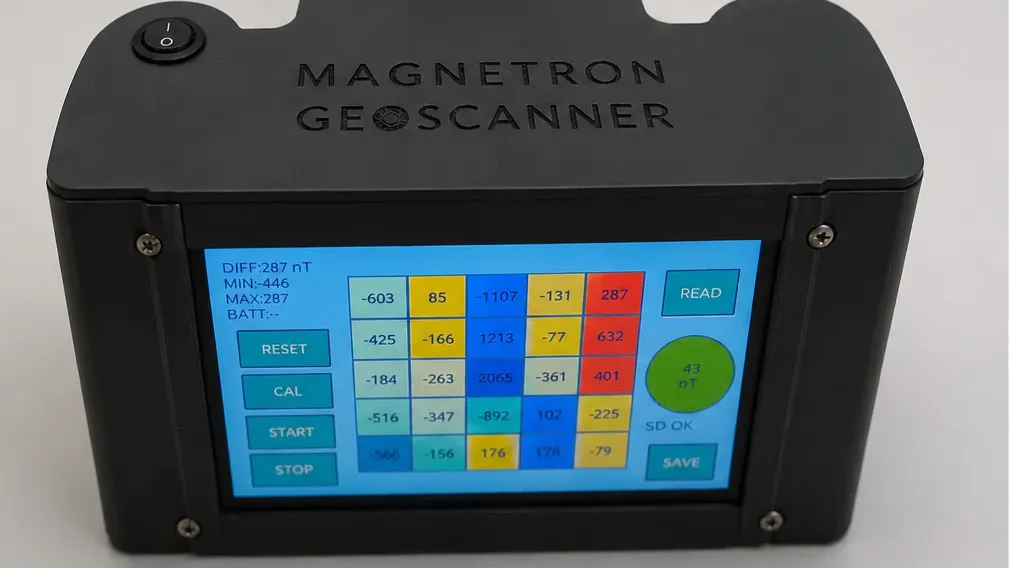
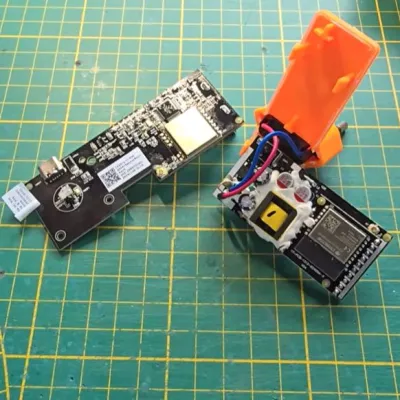
Magnetic fields are all around us. We can’t really feel or see them ourselves, per se, but we can map them with the right hardware, like this device built by [edosari50].
The build uses an ESP32 microcontroller, which is built on to a board with an integrated 4.3″ touchscreen LCD. It’s paired with an Arduino Nano, which does the work of actually talking to a pair of EMS100 Fluxgate magnetic sensors. The slower, less capable Arduino handles the low-level chatter and then passes the readouts to the ESP32 over a UART connection. Power is courtesy of a pair of 18650 lithium-ion cells, and a XL4005 DC-DC converter. A lithium-ion charging module is on hand to keep the batteries topped off safely. Scan results are visualized on the device itself using a heatmap representation, and can also be exported to SD card for later analysis if so desired.
Unless you’re in the geological field or otherwise hunting for stuff underground, this probably isn’t a tool you’ll have a lot of use for. However, if you like finding magnetic anomalies and investigating them, it might be very much in your wheelhouse. We’ve featured other tools for magnetic visualization before, too. Video after the break.
I’m not the first to say this, but it’s a strange and heartbreaking time to be a teacher and parent of young children.
As a recent transplant to New Mexico, I admire the ways the state invests in children, regardless of their identities. Seeing these state policies in action has changed my perspective and made me think differently about what students deserve and how much better things would be if we chose to care for students and families more consistently.
There are days when my own children are crawling into my lap with a book while I continue to process footage of children suffering in conflicts on the other side of the world. My high school students are writing the kind of poetry that leaves me speechless, even as I privately wonder about their career options as artificial intelligence receives more investment than the arts. Yet, my experience in New Mexico has shown me that another approach is possible.
I have a unique vantage point, both as a parent and an educator who sees these challenges reflected in the lives of my students and their families. My local school district in New Mexico has yet to pivot to hybrid learning in response to the palpable fear parents felt, while the actions of federal agents created widespread fear in their community. My state is not banning books and restricting curricula. Instead, as a recent transplant to the state, I’m in awe of the ways New Mexico invests in children and our more vulnerable residents.
Advertisement
After the 2024 election, a shockwave swept through my school as students grappled with what another Trump presidency would mean for their futures. At the performing arts school where I teach, we have a high percentage of queer and trans students, a stark contrast to my previous school in California, where most LGBTQ+ students often chose to remain closeted until well after graduation. I grieve for what my previous students lost when they did not acknowledge or affirm their queer and trans classmates. In English class, they missed robust discussions; the depth their queer and trans peers bring to literary discussions, while leveraging queer theory, translates into highly analytical and more engaging coursework. In the scope of a school day, there were countless other ways all students missed a more complete experience, while their queer and trans peers chose safety in an environment hostile to their identities.


And while New Mexico is much less hostile to trans residents, I still can’t imagine what it would be like to be growing up in a world that constantly demands you to defend and fight for your humanity. Guaranteed care by the state means nothing if authority figures are consistently exposed to negative messaging about transgender people or if your lack of insurance prevents you from getting the life-saving care you need.
And yet, trans students in New Mexico are able to attend school in an environment with teachers who are largely committed to affirming a variety of gender identities, select curriculum that allows LGBTQ students to see themselves, bond with accepting and encouraging peers from across the gender spectrum, and learn from LGBTQ teachers who embody a hopeful future of what it means to be your full self in your career. This is all possible when a school doesn’t just accommodate gender and sexual diversity, but embraces it. Extensive research confirms the ways in which affirming environments like ours can be life-saving for LGBTQ teens, especially trans students.
Earlier in my career, I felt optimistic about my queer and trans students’ futures. Today, seeing my trans students grapple with the new political realities has renewed my commitment to making an optimistic future visible for them. In a past article, I reflected on my role as a teacher in presenting a hopeful future for my students during unhopeful times. There is no one for whom this is more crucial than our queer and trans students.
Advertisement
Ultimately, I wonder what it would look like for our world to care about children as much as the state of New Mexico does. What will happen when all children can attend high-quality early childhood education without adding to the financial burden of a growing family? What does it look like when gender affirming care is protected by law? Or when our lawmakers prohibit book and curriculum censorship? Or when we finally decide that school shootings do not have to be a certainty of American life?
I know these questions will remain abstract while we watch students as young as Liam Ramos fear for their lives. But we cannot have a different future if we are not imagining a better one in the present. I’m thankful for my students, past and present, who encourage my imagination.
This story is part of an EdSurge series chronicling diverse educator experiences. These stories are made publicly available with support from the Learning Commons. EdSurge maintains editorial control over all content. (Read our ethics statementhere.) This work is licensed under aCC BY-NC-ND 4.0.
President Donald Trump is enthralled with the Ultimate Fighting Championship staging an event at the White House on his birthday this weekend—in effect his present to himself, since he came up with the idea. We have the details on both the fighting and the anticipated lobbying.
Lobbying by the Octagon
While the White House does not yet know exactly which celebrities might show up for the UFC on Sunday because they have not accepted their Ticketmaster email invitations, Trump’s aides tell Inner Loop they are expecting a parade of donors to attend.
The tickets have been free—and there is no resale—because the UFC is footing the approximately $60 million cost to stage the event, but the UFC has also offered sponsor packages for upwards of $1 million that come with ringside seats.
With limited avenues for executives and companies to get close to Trump these days, political consulting firms in Washington have been advising clients to buy the packages, and Trump’s aides say they have been inundated with requests.
Advertisement
The sponsorship requests have come on top of a stream of queries by administration officials and members of Congress trying to get into the UFC White House event, which is oversubscribed because Trump has personal control over the majority of seats and is deciding who he wants and he doesn’t, the aides say.
The most sought-after seats are under the Claw, a giant 92-foot-tall arch structure that holds lights and sound equipment above the Octagon. The structure is actually called a “beta tent” by its supplier Stageco, but it was renamed by the White House, ESPN reported.
UFC president Dana White has said that he and Ari Emanuel, the chair of the UFC’s parent company, will control 700 seats between them, while Trump will control about 1,200.
The most well known method to get direct face time with Trump during his second term in office has been to buy a $1 million seat at the so-called candlelight dinners hosted by Trump super PAC MAGA Inc. Trump would go from person to person and talk with them directly, according to one political consultant with close ties to Trump’s fundraising operation.
Advertisement
But the candlelight dinners don’t happen with regular frequency—sometimes months go by without a dinner, the consultant said—and so, companies that missed out on donating to fund Trump’s ballroom have been advised to consider sponsoring.
A White House official tells Inner Loop that they have not been involved in any sponsorship discussions and any cost information could be found with UFC. At least some of the UFC’s regular Octagon sponsors, including Meta, have ongoing business interests before the federal government.
In a statement, White House spokesperson David Ingle disputed the notion of lobbying at the event. “The Fake News’ continued attempts to fabricate conflicts of interest are irresponsible and reinforce the public’s distrust in what they read,” he said. “There are no conflicts of interest.”
Fight Night
Meanwhile, Trump’s team acknowledges that the UFC White House event won’t be featuring the biggest names; they were unable to get the likes of former UFC heavyweight champion Jon Jones and former UFC lightweight champion Conor McGregor.
Advertisement
There were conversations behind the scenes by White and his contract negotiator Hunter Campbell to book them both, but those talks fell through, people familiar with the matter tell Inner Loop.
It would have been a big deal for the White House to have landed McGregor, the biggest box office attraction in the sport’s history, for his comeback fight, after his last appearance in the Octagon in 2021 against Dustin Poirier ended with a broken leg.
What Happens to Kids When Schools Take Away Recess and Add More Screens?
Schools have been quietly chipping away at recess for nearly a decade, and a sweeping new update from the American Academy of Pediatrics says the consequences are real, measurable, and showing up well beyond elementary school. At the same time, the federal government has issued a formal advisory on children and screen time, calling on schools, parents, and tech companies to act. Both stories point in the same direction, but the path forward is far less obvious than the headlines suggest.
The Fight to Bring Recess Back
For the first time since 2013, the American Academy of Pediatrics has updated its recess guidelines, and the expansion is significant: the new recommendations extend to middle and high school students, not just younger children. EdSurge reporter Lauren Coffey has been reporting on what that guidance actually means for administrators under pressure to protect instructional time, whether the evidence on attendance and attention is strong enough to move policy, and why advocates say the answer may be simpler than schools are willing to admit.
A Federal Advisory With Unfinished Business
A formal screen time advisory from HHS Secretary Robert F. Kennedy calls for bell-to-bell phone bans, warning labels on apps, and the elimination of recommendation algorithms for children. But researchers are being careful: the evidence linking screen time to negative outcomes is correlation, not proven cause and effect, and the line between harmful social media and beneficial education technology is one that schools and families are still figuring out how to draw. EdSurge reporter Nadia Tamez-Robledo breaks down what the advisory actually asks of schools, why the tech industry response will be the real test, and what the carve-outs for students with IEPs reveal about the limits of a one-size-fits-all approach.
Join us on This Week with EdSurge where we ask whether the research is pointing toward a simpler solution than most schools are willing to try. Listen to the episode.
This Week with EdSurge is produced by the EdSurge newsroom. Subscribe to the EdSurge newsletter for the latest in education news delivered straight to your inbox.
Smartphones deliver more power and polish than ever, yet most follow the same safe template. AYANEO decided to break the mold with its first smartphone. The Pocket Play takes the sliding concept from Sony’s long-gone Xperia Play and updates it for today’s games and apps. Slide the 6.8-inch display upward in landscape mode and the magic happens. A full set of physical controls appears underneath. You get a proper D-pad on the left, ABXY face buttons on the right, two round capacitive touchpads that stand in for analog sticks, plus shoulder bumpers and triggers, while dedicated shortcut buttons sit within easy reach.
The layout is similar to the 2011 Xperia Play, but with a more modern flair. Those spherical touchpads replace traditional analog sticks, yet they still provide a remarkably natural input experience, especially with the limited time you have to check them out. Keeping your thumbs off the screen allows you to have a continuous view even during the most intense gaming sessions. The entire control deck is pushed to the bottom, leaving the huge display completely unobstructed for whatever you’re doing, whether gaming or watching media.
【Upgrade Retro Game System】-The R36s Handheld Game Console, especially the R36 Max version, comes with an astonishing collection of up to…
【64G Storage & 18000+ Pre-loaded Games】-With 64GB of storage capacity, This handheld console comes pre-loaded with 18000+ games and supports more…
【Good visual experience】The retro console comes with a 4.0-inch IPS full viewing Angle, OCA full laminated screen 720*720 high resolution to bring…
The 6.8-inch display boasts a 2400 by 1080 resolution and a refresh rate of 165Hz. An OLED panel delivers stunning colors and silky smooth action, whether you’re playing high-frame-rate Android games or streaming from the cloud. When the device is closed, it acts like a phone for calls, messages, and app use; however, when you open it, it morphs into a dedicated gaming setup.
Advertisement
The MediaTek Dimensity 9300, along with its Immortalis-G720 graphics engine, provides excellent performance. AYANEO backs it up with lots of high-speed LPDDR5 RAM and UFS 4.0 storage. You also get a microSD card slot, which is a nice touch given how useful they are for adding new games or emulator roms to your library. The active cooling mechanism keeps everything operating smoothly, even during extended gaming sessions, which is unfortunately uncommon on most smartphones.
A 5,000 mAh battery keeps the lights on, and a quick recharge means you won’t have to wait long before your next gaming session. You also get stereo speakers and a strong vibration motor, which work together to create a really immersive gaming experience with excellent audio and haptic feedback. A USB-C port with speeds of up to 3.1 Gen 2 and a DisplayPort 1.4 output enable you to connect the device to a TV or monitor and enjoy games on the big screen. You also have Wi-Fi and Bluetooth to suit your wireless requirements.
The device’s cameras are mounted on the back and include a 50-megapixel primary sensor and a 16-megapixel ultrawide lens. There is a 5-megapixel selfie camera on the front. To be fair, these cameras exist merely to handle the basics and are unlikely to impress anyone; early reports show they do the job, but don’t expect high-end photography from them. It’s clear that AYANEO emphasized gaming gear over taking beautiful photos.
You get Android 15 out of the box, and a fingerprint scanner is buried inside the power button for quick unlock. The software offers a full smartphone experience in addition to the typical gaming capabilities. There are also some useful shortcut buttons and a slide mechanism that allow you to quickly access game controls without having to deal with on-screen overlays.Pricing is unknown until the Kickstarter campaign opens. Rumors suggest that early backers will pay around $500, with future tiers perhaps providing extra RAM, storage, or higher-end finishes. AYANEO also intends to offer additional grips and cases to improve comfort for both gaming and non-gaming applications.
You can spend a whole lotta money on a good office chair these days – but however feature-rich and overly engineered they are, in my experience, you can’t beat a comfortable, solid office chair that won’t break the bank.
I’ve been sitting on this chair day in, day out for 18 months straight now and it’s as good today as it was when I first assembled it. The mesh is still firm, supportive, and comfortable. There’s no creaks, no squeaks. If I were buying a new office chair today, I’d just get another EP200. It’s worth every penny. It scored 4.5 stars in my review, with a Highly Recommended award.
Advertisement
Why I like this office chair (spoiler alert: it’s great value)
I absolutely love the EP200. I love the breathable mesh design, the lockable recline, the adjustable seat depth, even the 3D armrests with their satisfying click on every twist. I use this at work every day, but also after-hours when I’m gaming. I never feel discomfort or fatigue that some cheap chairs induce (and some expensive ones, for that matter).
Now, Boulies’ value-driven chair isn’t as rich with features as the Herman Miller and Steelcase office chairs my team and I have tested. But it’s well-built for the money, highly adjustable, and doesn’t require taking out a bank loan to afford it.
Having spent many hours in an office sitting on the iconic Herman Miller Aeron, I can tell you that while that pricey mesh chair was very comfortable, for most people working in an office or home office, the EP200 delivers everything you’d want from a seat at a fraction of the price.
In summarizing my time with the EP200 in my review update, I said “Overall, a year on, I still find the Boulies EP200 to be the archetypal office chair for most people. It’s relatively cheap, not overly engineered or designed (in a good way), and suitable for long hours in the office and home office.”
Advertisement
For more top-performing options, check out my in-depth guide to the best office chairs we’ve tested (and yep, the EP200 is on that list).
Industry 4.0 represents an opportunity for innovative, ambitious and future-focused professionals to transform the world as we know it.
The fourth industrial revolution, or Industry 4.0 as it is often better known, is the integration of smart, digital technologies into larger industrial and manufacturing processes, with the aim of creating intelligent, improved systems.
Skills in this area are absolutely vital for any professionals looking to work in a future-focused role or high-tech capacity.
SiliconRepublic.com, as part of its month-long Industry 4.0 coverage, has compiled a list of some of the most important skills to have as you face a changing world.
Advertisement
Stay human
It is not at all uncommon to assume that the most critical qualities to possess in technical and complex industries are all hard skills. It is, however, a commonly held myth, as soft skills are critical to long-term success in any professional space, including for careers under the Industry 4.0 umbrella. These are the abilities that enable you to communicate effectively with co-workers, negotiate positive change and create a better workplace environment.
Skills to prioritise are adaptability and problem-solving, as Industry 4.0 roles are often complex and ever-evolving; collaboration, as your job may demand a degree of crossover with other teams, departments or companies; critical thinking, as Industry 4.0 careers are often rooted in a need to address modern-day problems with unique solutions; and leadership, as everyone should know how to command a room and lead others when necessary.
Soft skills bring a crucial human element to careers that are often considered complex and clinical.
New dimensions
3D printing – or as it is often known, additive manufacturing – has enabled experts in Industry 4.0 careers to move beyond traditional methods as they create models and prototypes with the power to improve quality of life, reduce costs and maximise resources.
Advertisement
Clinicians may use 3D printing to develop prosthetics and implants to match a patient’s specific anatomy. Manufacturers can use the technology to create specific, necessary medical equipment and aerospace engineers often use additive manufacturing to develop small, complex parts that demand high accuracy and specific criteria.
There are a range of organisations and sectors in STEM and outside of it that are now using 3D advancements and it is undoubtedly a skill that will be carried into the next industrial wave.
Seeing double
Digital twin technology is described as the virtual representation of a physical system or process that receives data from the real world, in real-time. Its purpose is to mirror the behaviour, performance and state of the primary, physical model, so experts can explore, experiment and analyse without impacting the real counterpart.
Digital twin tech allows organisations to simulate real-world scenarios, fortify security and improve operations, while also minimising risk or accidental harm.
Advertisement
Among the skills that are useful to those who want to know more about wielding digital twin technologies are abilities in IoT, AI, data analytics, simulation software and cloud computing – and it is of particular importance to those hoping to work in manufacturing, aerospace, automotive, energy and utilities, healthcare, smart cities, and infrastructure.
Stay connected
Research suggests that IoT, as a critical element of Industry 4.0, is a skill that is under near constant demand by organisations and employers.
Anyone hoping to be an IoT expert should ensure that they have a robust education in software such as AutoCad, which allows engineers to design machines; cybersecurity for managing complex and high-risk projects; data and analytics skills that ensure clean, concise and insightful work; and AI and ML, among others.
Careers in Industry 4.0 are moving so rapidly it can be hard to keep up with the changes, but what is important to remember is that the skills of today create the future. All you have to do to keep pace is to commit to upskilling and tackle each challenge as it comes.
Advertisement
Don’t miss out on the knowledge you need to succeed. Sign up for the Daily Brief, Silicon Republic’s digest of need-to-know sci-tech news.
The JDY botnet, a malware network previously associated with Chinese threat actors like Volt Typhoon, has significantly expanded its targeting scope and reconnaissance efforts.
According to researchers at Black Lotus Labs by Lumen, who have been monitoring its activity, JDY maintains a strong focus on the United States, where many of its compromised devices are located and where it heavily targets military and associated networks.
The security firm notes that JDY has grown from roughly 650 active bots in January 2024 to over 1,500 compromised SOHO and IoT devices today.
While the numbers seem low, it’s important to note that JDY isn’t an exploitation framework or a DDoS botnet that requires large swarms to accumulate firepower, but is instead a distributed scanning and fingerprinting network that helps its operators locate targets vulnerable to newly disclosed flaws.
“Analysis of this activity shows a clear focus on identifying vulnerable infrastructure shortly after public vulnerability disclosures, suggesting that reconnaissance output is rapidly operationalized by China-nexus advanced persistent threat (APT) actors,” reads the Black Lotus Labs report.
Advertisement
“This targeted focus has been observed across a range of sectors, with the U.S. military and associated entities as the most prominent.”
Most impacted countries by the JDY botnet Source: Black Lotus Labs
CISA has previously warned about the risk Volt Typhoon operatives pose to unprotected SOHO routers, urging network device vendors to eliminate vulnerabilities in SOHO router web management interfaces (WMIs) during the design and development phases.
The JDY botnet is designed to conduct service discovery, service banner grabbing, TLS certificate collection, protocol fingerprinting, and flaw-focused reconnaissance.
Among the compromised devices are those from Cisco, Araknis, Mimosa Networks, Ubiquiti, DrayTek, Hikvision, and Linksys, for MIPS, MIPS64, MIPSEL, and MIPSEL64 architectures.
The threat actors are quick to target newly disclosed vulnerabilities, with Lumen researchers observing JDY scans targeting CVE-2026-35616 shortly after Fortinet publicly disclosed the FortiClient EMS flaw.
Advertisement
JDY targeting volume on a specific date Source: Black Lotus Labs
The operators control the botnet through hidden Tor services, which also serve as command-and-control (C2) infrastructure. The open-source reverse-shell and host-management framework Platypus is also used in some cases.
JDY network overview Source: Black Lotus Labs
The malware registers with a central “Dispatch Service” and receives scanning assignments, which it executes, compresses the results, and sends them back to the C2.
The scanning module supports the following:
TCP scanning
SSL/TLS scanning
UDP scanning
ICMP probing
Banner collection
TLS certificate harvesting
Service fingerprinting using downloadable rule sets
The botnet client repeats the same cycle until the operator specifically orders it to stop.
The TCP scanning function is one of the most technically interesting, say the researchers, explaining that, when JDY has sufficient privileges, it performs much faster and stealthier raw SYN scanning.
“If the malware can open a raw socket, which generally requires root or administrative privileges, it initiates high-speed SYN scanning using custom-crafted TCP packets,” explains the report.
“These custom packets use a fixed source port of 19000, increment the destination ports one at a time, and batch-process thousands of scan targets.”
Advertisement
Code snippet handling the raw SYN scanning Source: Black Lotus Labs
As JDY botnet activity increases, organizations should ensure routers, firewalls, and IoT devices are running the latest security updates and patches to prevent them from being recruited into reconnaissance networks.
Defenders should also reduce their external attack surface by disabling unnecessary internet-exposed administrative interfaces, restricting remote management access, replacing default credentials, and monitoring for unusual outbound scanning activity originating from edge devices.
Security teams log 54% of successful attacks and alert on just 14%. The rest move through your environment unseen.
The Picus whitepaper shows how breach and attack simulation tests your SIEM and EDR rules so threats stop slipping by detection.
iPhones are often easiest to recommend if you’re looking for a device that just works, with software that’s reliable. That said, iOS 26’s many issues pushed Apple to finally focus on performance and stability with its next big release. At WWDC 2026, the company unveiled iOS 27, which is set to roll out to the masses in September. If you’re keen to try out the new update, however, you can always install the beta build on your iPhone. Public betas are often more stable, while developer beta builds tend to get all the new features earlier.
Apple no longer requires you to pay a fee to test its beta builds, as it did a couple of years ago. All you need to do is head to the Apple Beta website and sign in using your Apple ID and password. On the terms and conditions page, click on “Agree.” Restart your iPhone and navigate to Settings > General > Software Update, and you should now be able to see a new “Beta Updates” section. Tap on it and select “iOS 27 Developer Beta.” Give it a quick second, and your iPhone should now let you download and install the newest beta version of iOS.
Depending on your internet connection, the process may take anywhere from a few minutes to an hour or more. While you won’t lose any data, it’s highly recommended you make a backup of your iPhone prior to installing any beta builds.
Advertisement
Pros and cons of installing iOS 27 early
Adnan Ahmed/SlashGear
Apple seldom makes major changes with its products, so when iOS 26 got a facelift with the Liquid Glass design system last year, everyone was excited. It did come at the cost of iOS 26 slowing down iPhones, making iOS 27’s emphasis on performance and stability improvements its biggest saving grace. We’ve been testing the first developer build of iOS 27 and can confirm that it already feels snappier than iOS 26 ever did — but this isn’t a good enough reason for everyone to rush out and install the beta.
Though you get to try out the cool new things, including Siri AI, a developer beta is meant primarily for testing purposes. We do not recommend installing a preview build on your iPhone if it’s your primary device, since there’s a chance that things may break or not function as they’re supposed to. It’s also worth mentioning that the hallmark feature — Siri AI — seems to be rolling out in phases, with many early testers still stuck on a waitlist.
Advertisement
Battery life is also almost always poor with early beta builds, so that’s another thing to keep in mind. It often takes a few developer beta updates to get the noticeable bugs ironed out. Apple usually releases the public beta version by the end of July, which should be considerably more stable if you’re still keen to try iOS 27 out before September.
If you look around your environment, you can probably pick off quite a few things that you’ve made, at least if you’ve been at this a while. You probably aren’t reading this from the bottom of a body of water though, which means you lack the incredible confidence of submarine builder [Hank Pronk]. Not only is he building himself a capable-looking diesel-electric submarine over on YouTube, he’s even DIYing CO2 scrubbers for it! Yeah, that’s a man who believes in himself.
Luckily [Hank] is not anywhere near the Caribbean, so needn’t worry about being misidentified as a narco-sub, but he still has to be concerned about his oxygen supply when tooling around beneath the local lakes. Perhaps more important than the oxygen supply in a sub is the build up of CO2. It doesn’t matter how many oxygen tanks you bring down with you if you can’t scrub CO2 out of the air to make room for it. Just like the Apollo missions, he’s using a chemical adsorbent to take carbon dioxide out of the air — and just like Apollo 13, he’s switching from square to round.
Or, rather, from a rather rectangular commercial model to a DIY little round unit. That’s because he doesn’t need the big scrubber in this sub: being diesel-powered, he expects to spend a lot of time at snorkel depth, where both the pilot and the engines can get clean air through the tube. Dives are expected to be short, and in that use case, too big of a CO2 scrubber is really a waste. If for some reason he gets stuck on the bottom, well, the lake isn’t that deep. He can swim to surface, and has a detailed bailout plan. If he wants to stay under overnight to avoid bailing at night, he’s carrying enough extra adsorbent for that.
Most of us spend more time wearing headphones or earbuds than we realize, and I know I do. Between shuffling playlists during my daily commute, jumping on work calls, listening to podcasts while walking around the neighborhood, and winding down with a late-night binge session, audio has quietly become an essential part of everyday life.
Our listening needs, however, change throughout the day. The over-ear headphones I want for a long workday are not necessarily the same audio wearable I reach for when stepping outside. Yet many audio brands seem determined to convince us that a single expensive product is the ultimate solution.
In an era where new wireless gear launches every other week at eye-watering price tags, finding tech that genuinely balances comfort, performance, and value can feel like a challenge. That is exactly what drew me to JLab. Rather than relying on exclusivity or celebrity endorsements, the brand has built its reputation on creating practical tech designed for real people and real-world routines.
This approach is incredibly refreshing. By delivering high-tier features at an accessible price point, JLab leaves a lasting impression and emerges as a compelling choice for buyers. You don’t have to nuke your wallet to enjoy great sound in your everyday life. That idea has been distilled to the very core of two products in particular — the JBuds Lux ANC Wireless Headphones and the Epic Pods ANC True Wireless Earbuds.
Advertisement
JBuds Lux ANC For the Moments You Need to Lock In
JLab JBuds Lux ANC / JLab
There are times when I want to tune everything else out. Whether I am trying to focus on work in a buzzing cafe, settling into a long flight, or simply listening to a new album without distractions, there are times when noise isolation is as important as the raw depth of tunes blasting into your ear canals. This is where over-ear headphones often come to the rescue, offering a level of immersion that earbuds cannot quite match. The JBuds Lux ANC Wireless Headphones embody that scenario, and they have been accordingly designed to make those moments feel even more effortless.
Featuring Smart Active Noise Cancelling, they help reduce background distractions so you can stay focused on your music, podcasts, movies, or work calls rather than what is happening around you. The convenience extends beyond the bliss of noise cancellation. Bluetooth Multipoint connectivity allows you to stay connected to both your laptop and phone at the same time. You can seamlessly switch from a Zoom call on your computer to a playlist on your phone without ever needing to re-pair your devices.
That same focus on practicality carries over to the per-charge battery mileage, as well. With more than 70 hours of playtime, these headphones are built to keep pace with packed schedules, extended travel, and marathon listening sessions without the need for frequent recharging.
Just as important as battery life is how the headphones feel after hours of use. The over-ear design and Cloud Foam cushions are made for extended wear, making them an easy companion for long workdays, study sessions, and travel. Heading into the JLab App, users can also fine-tune their sound settings to match their listening preferences, helping ensure every playlist, podcast, and movie sounds just the way they like it.
Epic Pods ANC For the Moments You Are On the Move
JLab Epic Pods ANC / JLab
Of course, life does not always happen at a desk. Some days are a constant cycle of commuting, unexpected errands, out-of-schedule workouts, and quick transitions between one activity and the next. Those are the moments when portability becomes just as important as performance.
The Epic Pods ANC True Wireless Earbuds are designed for the aforesaid kind of on-the-go lifestyle. Built for people who are constantly moving, they pack an impressive amount of technology into a compact form factor. Instead of relying on a single driver to do all the work, their hybrid dual-driver system handles audio output with a level of depth and clarity that is hard to find in this segment. A 10mm dynamic driver handles deep bass, while a specialized Knowles Balanced Armature focuses on crisp mids and clear highs. The result is a balanced listening experience where vocals and instruments remain clear without getting overshadowed by the low end.
Advertisement
If great sound matters to you, support for LDAC on Android and AAC on iOS ensures that your music comes through with greater detail, clarity, and depth, especially when streaming high-quality audio. The Epic Pods ANC also feature Adaptive Active Noise Cancelling that goes beyond simply switching on and off. From crowded subway commutes to quieter streets, the earbuds adjust noise cancellation on the fly, helping maintain the right balance between immersion and awareness without you having to tap a button.
But impressive audio performance means little if your earbuds cannot keep up with your active lifestyle. With more than 56 hours of total playtime and a quick charge feature that delivers up to 5 hours of listening from just a 10-minute charge, the earbuds are built to keep up with even the busiest schedules.
The Epic Pods ANC are designed with everyday use in mind. The secure fit design helps keep them comfortably in place during intense workouts, while IP55-tier ingress protection provides added protection against sweat and dust exposure. Bluetooth Multipoint further adds even more convenience by allowing seamless switching between multiple connected devices.
Why Get Personal Tech That Adapts With You
The biggest shift happening in personal audio right now isn’t just about pushing the boundaries for better sound quality, but rather about changing expectations and offering a holistic package that is practically rewarding in more ways than one. Audio wearable enthusiasts no longer want to feel forced into choosing between premium features and a reasonable price tag. Instead, they want gear that fits naturally into our daily routines, solves those annoying everyday frustrations, and delivers genuine value.
Advertisement
This is what makes JLab a compelling choice. Whether you prefer the immersive comfort and endurance of the JBuds Lux ANC Wireless Headphones or the flexibility of the Epic Pods ANC True Wireless Earbuds, both models reflect the very same philosophy. Personal tech should always adapt to your life, not the other way around. And while at it, great audio shouldn’t be reserved for just a few buyers. It should be accessible, practical, and ready for whatever your day has in store.
You must be logged in to post a comment Login