
Crypto World
What are cross-chain bridges? Why they keep getting hacked



Blockchains cannot talk to each other on their own. Bridges are the software that moves value between them, and they have leaked more money to hackers than any other kind of crypto infrastructure, billions across a handful of catastrophic breaches. Here is how bridges actually work, the different trust models behind them, and why the connective tissue of crypto is also its most dangerous single point of failure.
Summary
- Cross chain bridges move assets and data between separate blockchains by locking, burning, or swapping tokens through different trust models.
- The security of a bridge depends largely on how it verifies transactions, with cryptographic models offering stronger protection than signer based systems.
- Bridges remain one of crypto’s biggest security risks because they hold large pools of assets and rely on complex infrastructure that has repeatedly been targeted by hackers.
There are hundreds of blockchains, and by design none of them can see the others. Ethereum has no native way to know what happened on Solana; a Bitcoin holder cannot directly spend that Bitcoin inside an Ethereum application. Each chain is an island with its own ledger, its own validators, and no built-in bridge to the mainland.
Yet users constantly need to move value between these islands, to chase yield, access an application, or reach cheaper fees, and that need created an entire category of infrastructure: the cross-chain bridge.
A bridge is software that lets assets and information move between blockchains that otherwise cannot communicate. It is essential plumbing; without bridges, liquidity would be trapped on whichever chain it started on, and the multi-chain world that defines crypto today could not function. Bridges now move billions of dollars a week, and their total value locked runs into the tens of billions.
They are also the single most dangerous piece of infrastructure in crypto. Bridge exploits have produced some of the largest thefts the industry has ever recorded, with individual breaches running into the hundreds of millions and the category’s cumulative losses in the billions. The same design that makes a bridge useful, holding or controlling large pools of assets across chains, makes it a concentrated target, and a small flaw in a bridge can drain a fortune in minutes.
This guide explains how bridges work, the main architectures they use, the trust models that determine how safe each one is, why they keep getting hacked, and how to think about bridge risk before moving your own funds.
Why bridges are necessary
The root problem is isolation. A blockchain is a self-contained ledger whose validators agree only on the state of their own chain. Nothing in Ethereum’s protocol can natively verify that a transaction happened on another chain, because doing so would require Ethereum’s validators to also run and trust every other chain, which they do not. Each network is sovereign and blind to the others.
Before bridges, the only way to move value between chains was through a centralized exchange: send your asset to the exchange on one chain, trade it, and withdraw a different asset on another chain. This works but reintroduces exactly the centralized intermediary that crypto was meant to reduce, along with accounts, custody, and withdrawal limits. Bridges emerged to do the same job more directly, letting value move between chains without handing it to an exchange in the middle.
The demand is enormous because the ecosystem is fragmented by design. Different chains optimize for different things, and users want to combine them: hold an asset native to one chain but use it in an application on another, move to a network with cheaper fees, or supply liquidity where the returns are highest. The connective role bridges play is why the industry sometimes calls them the tissue linking the chains, and it is why bridge volume tracks the overall growth of multi-chain activity. As newer designs push more of that activity toward stablecoin settlement and payments, the demand to move dollar-denominated value across chains has only intensified, echoing the broader rise of payment-focused chains built around moving stable value efficiently.
The catch is that connecting sovereign, mutually blind systems is genuinely hard, and every method of doing it introduces a trust assumption somewhere. That assumption is where the money leaks.
How a bridge moves an asset
Most bridges rely on a simple-sounding trick: they do not actually send an asset from one chain to another, because that is impossible. Instead, they lock or destroy the asset on the source chain and create a corresponding asset on the destination chain.
Three main architectures implement this idea.
The lock-and-mint model is the most common. When you bridge an asset, the bridge locks your original tokens in a smart contract on the source chain, like putting them in a vault, and mints an equivalent wrapped token on the destination chain. That wrapped token is a claim on the locked original, redeemable by reversing the process: burn the wrapped token on the destination chain, and the bridge unlocks the original on the source chain. The locked assets sit in the bridge’s custody the entire time, which is precisely why lock-and-mint bridges have been the most exploited: the vault holding everyone’s locked assets is a single, enormous target.
The burn-and-mint model is used mainly for assets whose issuer controls supply across chains, such as certain stablecoins. Instead of locking the asset, the bridge permanently burns it on the source chain, removing it from that chain’s supply, and mints a fresh, native version on the destination chain. Because the destination asset is truly native, not a wrapped claim, this avoids the pool-of-locked-assets problem, but it only works when a single issuer has authority to burn and mint the asset on every chain, which is why it is common for stablecoins and rare for everything else.
The liquidity-pool model takes a different approach. The bridge maintains pools of assets on every supported chain, and when you bridge, you deposit into the pool on the source chain and withdraw the equivalent from the pool on the destination chain, often with a solver or market maker fronting the destination asset instantly and settling later. Nothing is wrapped; you simply swap into inventory that already exists on the other side. This can be faster and avoids wrapped-token risk, but it requires the bridge to keep large inventories on every chain, which is both capital-intensive and, again, a target.
Beyond moving assets, modern bridges also pass messages: arbitrary data and instructions that let a smart contract on one chain trigger an action on another. A token transfer is just the simplest message, saying an amount was locked here, so mint it there. More elaborate messages let an application on one chain react to events on another, which powers cross-chain lending, governance, and complex applications. This general message passing is powerful and expands what bridges can do far beyond simple transfers, but every added capability is added surface area for something to go wrong.
The trust models that decide safety
The crucial question for any bridge is who verifies that the source-chain event actually happened before the destination chain acts on it. The answer is the bridge’s trust model, and it is the single biggest determinant of how safe the bridge is. There is a well-known framework classifying these models, and it maps cleanly onto a spectrum from convenient-but-risky to trustless-but-costly.
The trusted model relies on a fixed set of external validators, often secured by a multisignature or multiparty scheme, who watch the source chain and sign off on events for the destination chain. This is fast, cheap, and simple, but the validator set is the trust assumption: if enough of their signing keys are compromised, the attacker controls the bridge. Many of the largest bridge hacks in history were failures of exactly this model, where an attacker gained control of enough validator keys to authorize fraudulent withdrawals. When a bridge’s security rests on a handful of keys, those keys are the whole game.
The light-client or validity-proof model is the trustless end of the spectrum. Here the destination chain actually runs a light client of the source chain and cryptographically verifies its block headers, or accepts a validity proof, instead of trusting a set of signers. This is far more secure because it removes the human validator set and replaces it with mathematics, but it is expensive in computation and complex to build, and it does not work efficiently for every pair of chains. Advances in zero-knowledge proofs, the same cryptography moving to the center of Ethereum’s long-term rebuild, are extending this model to more chains, but it remains harder to deploy than trusting a signer set.
Between the extremes sit optimistic and hybrid models, which assume transactions are valid but allow a challenge window during which watchers can submit proof of fraud, similar to how some scaling systems secure their withdrawals. These trade some speed, through the challenge delay, for stronger security than a pure trusted model, without the full cost of a light client. Where a bridge sits on this spectrum tells you almost everything about its risk: the more it relies on a small trusted group and the less it relies on cryptographic verification, the more it depends on those few parties never being compromised.
Why bridges keep getting hacked
Bridges have lost more to hackers than any other category of crypto infrastructure, and the reasons are structural, not accidental. Understanding them explains why the problem persists despite years of painful lessons.
The first reason is concentration of value. A bridge, especially a lock-and-mint one, accumulates a large pool of locked assets backing all the wrapped tokens it has issued. That pool is a single honeypot, and unlike a diffuse set of user wallets, draining it once takes everything. Attackers are economically rational, and they gravitate to wherever the most value sits behind the fewest defenses, which describes a large bridge almost perfectly.
The second reason is weak trust models. Many bridges chose the fast, cheap, trusted model, securing hundreds of millions of dollars behind a small set of signing keys. The largest bridge thefts on record were, at their core, key compromises: an attacker obtained control of enough of the bridge’s validator keys, through phishing, malware, or infrastructure breaches, and then simply authorized withdrawals that the bridge treated as legitimate. No clever exploit of the blockchain was needed, only control of the keys the bridge trusted. A bridge secured by nine keys where five are enough to move funds is, in security terms, a five-key vault.
The third reason is complexity. Bridges are among the most complex smart-contract systems in crypto, spanning multiple chains, custom message formats, and intricate verification logic, and complexity is the enemy of security. Every added feature, every new supported chain, every message type is more code that can contain a subtle flaw, and bridge exploits have repeatedly come from bugs in verification logic that let an attacker forge a proof of a deposit that never happened, causing the bridge to release funds against nothing. The fraud-proof and verification systems that are supposed to guard a bridge are themselves complex code, and a flaw there is catastrophic because it undermines the entire security model at once. The category’s history rhymes with the broader lesson that concentrated infrastructure fails hard, the same dynamic seen when any single point of control becomes the weakest link in an otherwise sound system.
These three forces combine into a grim equation: bridges hold enormous value, often behind trust models thinner than the value warrants, inside code complex enough to hide fatal bugs. That is why, even as the industry has learned hard lessons and newer designs have improved, bridges remain the place where the largest single thefts tend to happen.
The anatomy of a bridge hack
To make the risk concrete, it helps to walk through how a typical bridge exploit actually unfolds, because the pattern repeats across nearly every major incident and reveals why the losses are so total.
Most catastrophic bridge hacks fall into one of two shapes. The first is a key compromise. A trusted-model bridge secures its locked assets behind a set of signing keys, and an attacker obtains control of enough of those keys, through phishing an employee, compromising a server, or exploiting weak key management, to reach the signing threshold. Once the attacker can produce valid signatures, the bridge has no way to distinguish their fraudulent withdrawal from a legitimate one, because a validly signed instruction is exactly what the bridge is built to obey. The attacker signs a withdrawal that drains the locked pool, and the assets are gone before anyone notices, because from the bridge’s perspective nothing broke; the correct keys authorized the transfer. Several of the largest bridge thefts in history were precisely this: not a clever exploit of the blockchain, but a theft of the keys the bridge trusted, turning the bridge’s own security model into the attacker’s tool.
The second shape is a verification bug. A bridge must verify that a deposit really happened on the source chain before releasing funds on the destination chain, and this verification logic is complex code. If it contains a flaw, an attacker can craft a fake proof of a deposit that never occurred, submit it to the bridge, and the bridge, believing the fake, releases real assets against nothing. The attacker deposited nothing and withdrew a fortune, because the code that was supposed to check the deposit accepted a forgery. These bugs are catastrophic precisely because they attack the bridge’s core trust mechanism: once an attacker can forge the proof the bridge relies on, they can mint or withdraw arbitrary value until someone halts the bridge, which in a fast-moving exploit can be far too late.
Both shapes share a defining feature that explains why recovery is so rare: the theft looks legitimate to the bridge at the moment it happens. A key-compromise withdrawal carries valid signatures; a verification-bug withdrawal carries an accepted proof. Neither trips an alarm inside the system, because both exploit the system doing exactly what it was designed to do, only on fraudulent inputs. By the time the discrepancy surfaces, usually when the locked assets no longer back the wrapped tokens in circulation, the funds have moved through mixers and across other chains. The wrapped tokens left behind become claims on an empty vault, and their holders, who did nothing wrong, absorb the loss. This is the mechanism by which a single flaw in one bridge translates into hundreds of millions gone, and why the security of a bridge deserves more scrutiny than almost any other decision in a multi-chain transaction.
How to think about bridge risk
Bridges are necessary and, used carefully, reasonable to rely on, but their risk profile deserves respect. A few principles help you evaluate any bridge before trusting it with funds.
Prefer stronger trust models. A bridge secured by cryptographic verification, a light client or validity proofs, or by a canonical connection to a base chain, is structurally safer than one secured by a small external signer set. Where a bridge documents its trust model, read it; the difference between trusting mathematics and trusting a handful of keys is the difference between the safest and riskiest bridges in existence. Independent frameworks that score bridges on their trust assumptions exist precisely because this distinction is hard for users to assess alone.
Favor track record and audits. A bridge with a long operational history free of exploits, multiple independent security audits, an active bug bounty, and transparent, time-locked upgrade processes has earned more trust than a new, unaudited one, however attractive its yields. Bridges are not where to chase the newest, highest-return option, because the downside of a bridge failure is total loss of the funds in transit.
Minimize time and size at risk. Bridging is riskiest while your value sits in the bridge’s custody or in transit. Moving smaller amounts, avoiding leaving large balances in wrapped tokens longer than necessary, and using aggregators that route through the safest available path all reduce exposure, while minding the slippage a large cross-chain swap can incur along the way. For very large transfers, splitting them or accepting the slower safety of a canonical bridge can be worth the inconvenience.
Understand what you are holding after you bridge. A wrapped token is a claim on assets locked in a bridge, and it is only as sound as that bridge. If the bridge is exploited and its locked assets drained, the wrapped tokens it issued can become worthless claims on an empty vault, even though your original assets are gone. Native assets obtained through burn-and-mint or liquidity-pool models avoid this specific risk, which is one reason those models are often preferred where available, particularly for the stablecoins that dominate cross-chain settlement.
The honest summary is that bridges are indispensable and imperfect. They solve a real and unavoidable problem, connecting sovereign chains that cannot see each other, and there is no way to do that without introducing a trust assumption somewhere. The safest bridges push that assumption toward cryptography and away from small groups of keys; the most dangerous do the reverse and guard enormous value with thin trust. Knowing which kind you are using, and treating the crossing as the riskiest moment in any multi-chain transaction, is what separates informed use from the kind of blind trust that has, again and again, funded the largest heists in the industry.
It is worth ending on where the technology is heading, because the picture is not static. The industry has absorbed the lessons of its worst bridge failures, and newer designs increasingly favor stronger trust models: burn-and-mint transfers for assets whose issuers can support them, cryptographic light clients and validity proofs where the chain pairs allow, and intent-based systems where independent parties front liquidity and take on the risk rather than pooling everyone’s assets in a single honeypot. Independent risk frameworks now score bridges on exactly the trust assumptions that used to be invisible to ordinary users, making it easier to tell a well-secured bridge from a dangerous one before committing funds. None of this eliminates the fundamental tension that connecting blind, sovereign systems requires trusting something, but it does shift the trust toward mathematics and away from the small key-holding groups that account for the largest historical losses. The bridges of the next few years will be safer than those that leaked billions, not because the problem got easier, but because the industry paid for the lesson in full and is finally building as though it remembers.
Frequently asked questions
What is a cross-chain bridge?
A cross-chain bridge is software that lets assets and data move between different blockchains, which otherwise cannot communicate with each other. It typically works by locking or burning an asset on the source chain and creating an equivalent asset on the destination chain, allowing value to move across networks without going through a centralized exchange.
How does a bridge move an asset between chains?
It does not literally send the asset across; instead it uses one of three models. Lock-and-mint locks the original in a contract and mints a wrapped version on the other chain. Burn-and-mint destroys the asset on one chain and creates a native version on the other. Liquidity-pool bridges keep inventories on both chains and let you swap into the destination pool. Each avoids the impossible task of directly transferring an asset between separate ledgers.
Why are bridges hacked so often?
Three structural reasons: they concentrate large pools of value that make single, lucrative targets; many use weak trust models secured by a small set of signing keys that, if compromised, hand an attacker control; and they are highly complex code where subtle verification bugs can let attackers forge deposits. Together these make bridges the category responsible for some of the largest thefts in crypto history.
What is the safest kind of bridge?
Bridges that verify source-chain events cryptographically, through a light client or validity proofs, or that use a canonical connection to a base chain, are structurally safest because they rely on mathematics rather than a trusted group. Bridges secured only by a small external set of signing keys are the riskiest, since compromising those keys compromises the entire bridge.
What is a wrapped token?
A wrapped token is a token minted on a destination chain to represent an asset locked in a bridge on the source chain. It is a claim on the locked original, redeemable by burning the wrapped token to unlock the original. Its value depends entirely on the bridge holding the locked assets; if that bridge is drained, the wrapped token can become a worthless claim on an empty vault.
Are bridge hacks the biggest in crypto?
Some of the largest single thefts in crypto history have been bridge exploits, with individual breaches reaching hundreds of millions of dollars and the category’s cumulative losses running into the billions. Many of these were key compromises of trusted-model bridges rather than exploits of the underlying blockchains, meaning the attacker gained control of the keys the bridge trusted.
Can I lose money using a bridge?
Yes. The main risk is that the bridge is exploited while your value is locked in it or held as a wrapped token, in which case those funds can be lost entirely. Additional risks include smart-contract bugs and, for liquidity-pool bridges, issues with the pools. Using well-audited bridges with strong trust models and long track records, and minimizing the amount and time at risk, reduces but does not eliminate this.
What is general message passing in bridges?
General message passing is the ability of a bridge to move arbitrary data and instructions between chains, not just token transfers. It lets a smart contract on one chain trigger an action on another, powering cross-chain lending, governance, and complex applications. A token transfer is the simplest message, but the added capability also expands the code surface where vulnerabilities can appear.
Disclaimer: This article is for informational purposes only and does not constitute investment advice. Digital asset markets are volatile and you can lose your entire investment. Always do your own research. Information current as of July 7, 2026.


PayPal has reported $486.4 billion in total payment volume for the second quarter on July 28, up 10% year over year. It also confirmed a reorganization that hands crypto its own division inside the company.
The unit, Payment Services & Crypto, sits alongside Checkout Solutions & PayPal and Consumer Financial Services & Venmo. In the same presentation, PayPal listed stablecoins as one of three areas it is expanding into under an “innovating with discipline” heading, next to agentic commerce and identity and biometrics.
Crypto Holdings Cost $81 Million
Further, revenue came in at $8.68 billion, up 5%. Non-GAAP earnings were $1.38 per share against analyst estimates near $1.28. Transaction margin dollars rose 1% to $3.9 billion, and adjusted free cash flow reached $1.83 billion. PayPal raised full-year transaction margin guidance to about $15.6 billion and lifted the low end of its EPS range to roughly $5.38.
Net losses on strategic investments and crypto assets held for investment came to $81 million in the quarter, added back in the reconciliation to non-GAAP net income. The same line ran $74 million in the first quarter. PayPal’s full-year 2025 GAAP earnings carried a positive impact of about $0.14 per share from that portfolio.
PYUSD supply sat near $2.8 billion in mid-July, down from more than $4 billion in March. The token went live natively on Polygon on July 9 through issuer Paxos, and PayPal has said the stablecoin reaches 70 markets.
YouTube began paying US-based creators in PYUSD in December. CryptoPotato has also reported on CoinGecko research showing PYUSD and Societe Generale’s EURCV taking little share while USDT and USDC hold 93.5% of fiat-backed stablecoin supply.
CEO Restructures After Rejecting Stripe
CEO Enrique Lores, who took the role on March 1 after Alex Chriss departed, is targeting at least $1.5 billion in gross run-rate savings over the next two to three years, with about $400 million reached by year-end.
The plan runs to 2029 across three drivers: a simplified structure, operational and portfolio optimization, and accelerated AI adoption, which PayPal expects to deliver around 40% of the savings.
The post PayPal Betting Big on Stablecoins After Disclosing Q2 Results appeared first on CryptoPotato.
Crypto World
Coldcard Exploit Sparks Bitcoin Flight, ‘Bullish’ Crypto Consolidation: Hodler’s Digest,

Cold storage fears after Coldcard users lose $90M in Bitcoin
After $90 million in Bitcoin was drained from Coldcard wallet users, small hodlers desperately sought refuge on centralized exchanges and via alternative custody methods.
Bitcoin transfers below 1 BTC climbed to their highest daily level since 2022 on Friday, with 39,600 BTC moved, according to data shared by CryptoQuant head of research Julio Moreno on Saturday.
The figure was just 300 BTC below the 39,900 BTC transferred on Nov. 16, 2022, days after FTX filed for bankruptcy.
Galaxy Research, the research arm of crypto investment company Galaxy Digital, reported Saturday that the third wave of attacks on users of the hardware wallet on the weekend brought estimated losses to 1,367 BTC ($88.6 million) across 4,585 addresses.
Alex Thorn, Galaxy Digital’s head of firmwide research, warned in an X post on Sunday that the attack was still ongoing and urged users to move funds from Coldcard-generated addresses immediately if they had not already done so. The exploit reportedly targets a flaw in the Coldcard seed generation process, that did not employ a genuinely random number generator.

Clarity Act clock running out: No vote, or ‘no’ vote?

President Donald Trump is considering a revised ethics proposal for the Clarity Act that was devised by Senator Thom Tillis and Senator Ruben Gallego.
The original proposal Trump signed off on would have prevented elected officials from endorsing or profiting from crypto projects and would have been enforced by the Department of Justice. The Democrats don’t trust the DoJ and want the State Attorney Generals to enforce it. The compromise proposal would allow the State AGs to sue the DoJ if it does not properly enforce the rules, rather than allow them to sue elected officials *cough, Trump* directly.
With just five days left on the clock, the chances of any kind of Senate vote on the legislation are receding, much less the three separate votes required to pass the bill. Trump’s $1.4 billion in crypto profits are a particular sticking point, with Senate Minority Leader Chuck Schumer introducing a bill (with little hope of passing) called the Anti-Corruption Bureau Creation Act that targets “executive branch corruption.”
Ethics isn’t the only outstanding issue, with the banks still up in arms over paying any kind of yield on stablecoins, and law enforcement groups divided over the impact of the Blockchain Regulatory Certainty Act. Designed to protect blockchain developers, some argue it would thwart investigations into money laundering and fraud.
Changes to the BRCA proposed by the National Association of Assistant US Attorneys and the National District Attorneys Association look dead in the water. White House crypto advisor Patrick Witt scoffed at the proposals and the claim they resulted from “productive negotiations.”
”This is not even close,” he said.

Crypto ‘no earnings’ reports
Nobody is making much money in crypto right now it seems, at least according to this week’s corporate earnings reports for the second quarter.
Coinbase generated roughly $1.2 billion in net revenue, down 19% from a year earlier. It reported a net loss of $359 million, significantly wider than analysts’ expectations for a $122 million loss. Transaction revenue, subscription and services revenue, and adjusted EBITDA all fell short of consensus estimates.
Strategy’s habit of smash-buying every Bitcoin top, helped it to record an $8.22 billion loss in the second quarter, driven almost entirely by its unrealized losses on its Bitcoin holdings. However, the company also said it has now built a $3.75 billion U.S. dollar reserve, which is enough to cover more than two years of preferred dividend payments and interest obligations.
Online brokerage Robinhood is making loads of money, but not much of it is attributable to crypto. The firm posted record second-quarter revenue and earnings, even as cryptocurrency transaction revenue fell 38% from a year earlier, from $160 million to $100 million.
Crypto enters biggest consolidation phase in history
ARK Invest analyst Lorenzo Valente says the cryptocurrency industry is entering its biggest consolidation phase yet, with revenue increasingly concentrated among a handful of dominant protocols.
Valente noted that perpetual futures exchange Hyperliquid and memecoin launchpad Pump.fun account for roughly 67% of total crypto application revenue between them. Including synthetic dollar protocol Ethena raises the top three’s combined share to nearly 80%.
Valente added that he expects the trend to accelerate in the coming months, leading to more mergers and acquisitions, Chapter 11 bankruptcies, project shutdowns and acqui-hires. Somewhat surprisingly, he concluded that “this is extremely bullish for the space.”
World Cup generated $20B in blockchain prediction market volume
The 2026 FIFA World Cup drove $20 billion in blockchain-based prediction market volume and $24 million in digital collectible trades, with more than 400,000 wallets participating in blockchain-based betting, according to a report from blockchain analytics firm Chainalysis.
The $20 billion figure includes trading before and during the tournament, with bettors placing roughly $5.7 billion in wagers over the five-week World Cup itself. World Cup-related markets accounted for about 63% of all prediction market activity during that period, the report said.
Winners and Losers
At the end of the week, Bitcoin (BTC) is down 3% to trade at $63,350, Ether (ETH) is down 3.5% to trade at $1,879 and XRP (XRP) is down 2.3% and is changing hands for $1.08. The total market cap is at $2.18 trillion, according to CoinMarketCap.
Among the biggest 100 cryptocurrencies, the top three altcoin winners of the week are Cardano (ADA) at 14.7%, Uniswap (UNI) at 8%, and Pi (PI) at 3.2%.
The top three altcoin losers of the week are Stable (STABLE) at -16%, Venice Token (VVV) at -14.6% and Lido DAO (LDO) at -14.1%.
Prediction of the Week
Bitcoin may have bottomed before its traditional cycle low
Crypto-focused asset manager Grayscale said that Bitcoin’s price may have bottomed earlier than the traditional four-year cycle, which would imply a cycle low in September or October.
Head of research, Zach Pandl, argued that Bitcoin (BTC) has “grown up” as an asset and is increasingly driven by macroeconomic factors.
“If the Fed forgoes rate hikes and economic growth holds up well, Bitcoin’s price may already have bottomed,” Pandl wrote in a report.
However, people have been peddling this hopium for months now. Earlier in July, crypto brokerage K33 pointed to more than 50% of the Bitcoin supply being held at a loss as another signal of an imminent market bottom. In June, Swan Bitcoin CEO Cory Klippsten told Cointelegraph that the holdings of long-term investors, which reached an all-time high of 14.7 million Bitcoin, were another signal of an imminent Bitcoin bottom.
Sooner or later, someone will be right.
Top FUD of the Week
The Russians… and the Australians… are after Telegram’s Pavel Durov
Russian authorities have placed Telegram founder Pavel Durov on an international wanted list as they escalate a criminal case accusing him of facilitating terrorist activity.
Russia’s Federal Security Service (FSB) said on Wednesday that it had charged Durov with facilitating terrorist activity and issued an international warrant for his arrest, local news agency Interfax reported.
The FSB alleged that Telegram failed to remove channels, chats and bots that Ukrainian intelligence services, alleged terrorist groups and extremist organizations used to coordinate attacks, recruit operatives and conduct cyber fraud.
A defiant Durov said on Thursday the Russians had become “confused about who can ban whom from the Internet.”
Meanwhile the Australian eSafety Commisioner has launched court proceedings against Telegram seeking civil penalties, alleging the platform failed to remove terrorism-related content.

Pump.fun laid off workers before they received millions in PUMP tokens
Solana-based memecoin launchpad Pump.fun reportedly fired employees two months before they were due to receive PUMP tokens worth millions of dollars.
According to a Friday Sandmark report, at least one Pump.fun worker was due to receive PUMP tokens worth in the seven-figure range.
The employees were reportedly fired in April, just two months before they were due to start receiving the company’s tokens based on agreements signed in 2025.
Trump teleprompter operator accused over Kalshi bets leaves government
A White House teleprompter operator accused of using inside knowledge to profit from prediction market bets on President Donald Trump’s speeches no longer works for the federal government, according to the Associated Press.
Perez was accused of using nonpublic information to make more than $100,000 betting on Kalshi prediction markets tied to Trump’s speeches, according to an earlier ABC News report.
Best Magazine Stories of the Week

Crypto’s fundamentals have never been stronger, yet degens keep chasing hot new narratives. Behavioral finance may explain why get-rich-quick stories continue to beat substance.
DeFi projects that survived the fallout from the Terra and FTX collapses in 2022 are dying out in 2026. But analysts say it’s not a case of industry consolidation — but the opposite.
Cointelegraph publishes long-form journalism, analysis and narrative reporting produced by Cointelegraph’s in-house editorial team with subject-matter expertise. All articles are edited and reviewed by Cointelegraph editors in line with our editorial standards. Some articles contain affiliate links, from which Cointelegraph may earn a commission. These relationships do not influence which products we review or our editorial conclusions. Content published in here does not constitute financial, legal or investment advice. Readers should conduct their own research and consult qualified professionals where appropriate. Cointelegraph maintains full editorial independence.
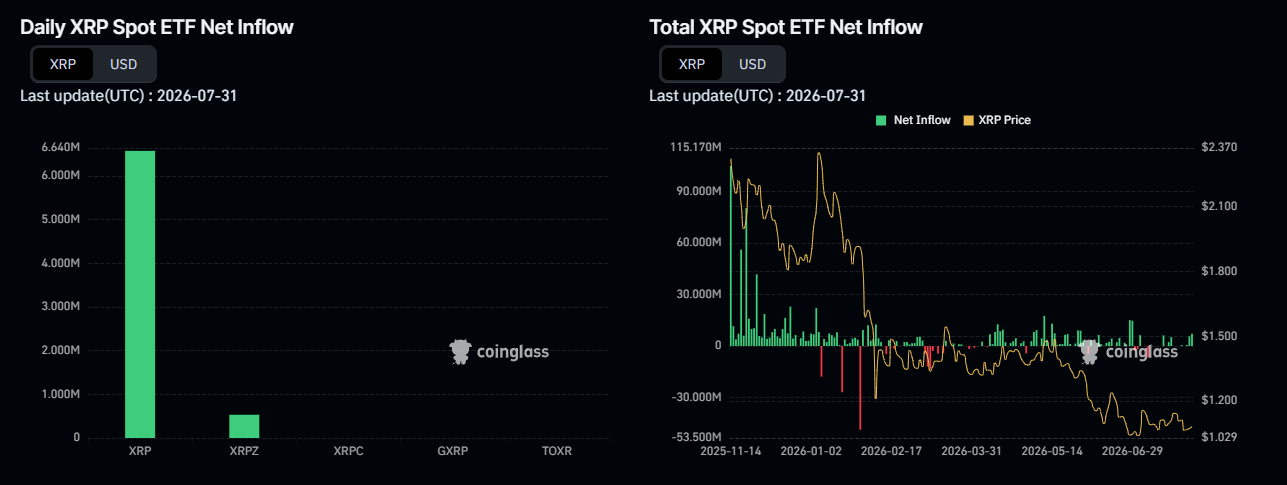
XRP-backed exchange-traded funds (ETFs) pulled in $27.29 million in July, marking a fourth straight month of net inflows.
The token itself trades near $1.08, down roughly 40% since the start of the year, in line with a generally poorly preforming crypto market. But many expect intuitional money and these products to be bolstering XRP, and others.
Instituional Money
Cumulative XRP ETF inflows now sit near $1.5 billion, the largest total among altcoin products. The price keeps sliding anyway.
XRP funds have ranked first or second in monthly inflows since April, without barely any outflows. Inflows ran $81.59 million in April, $131.94 million in May, $59.46 million in June, and $27.29 million in July, showing the pace has cooled even as the streak holds.

That steady buying stands out against a market where fresh capital keeps concentrating in a handful of tokens. Several smaller altcoin funds recorded no net flows in July. XRP kept adding, even at a slower pace.
Why the Price Isn’t Following the Flows
Steady ETF demand alone hasn’t lifted XRP’s price. Some of the pressure traces to a specific seller. Grayscale chief executive Peter Mintzberg filed to sell XRP ETF shares he acquired before the fund’s listing. He priced the sale at $20.45 a share, about half what earlier Grayscale insiders got in January.
Momentum indicators tell a similar story. XRP recently hit its most oversold readings on record. Traders remain split on whether the sell-off has finished.
Competition for capital plays a role too. Solana funds have pulled in about $1.15 billion since launch, edging back into second place in July. Hyperliquid funds added roughly $293 million in May and June before posting a first monthly outflow in July.
Bitcoin (BTC) and Ethereum (ETH) funds still dominate the category. They pulled in $172 million and $365 million in July, respectively.
Steady ETF buying shows institutional appetite for XRP has not faded. Whether that demand eventually lifts the price may depend on the broader altcoin market finding its footing first.
The post XRP ETFs Keep Drawing Cash, So Why Is the Price Down 40%? appeared first on BeInCrypto.
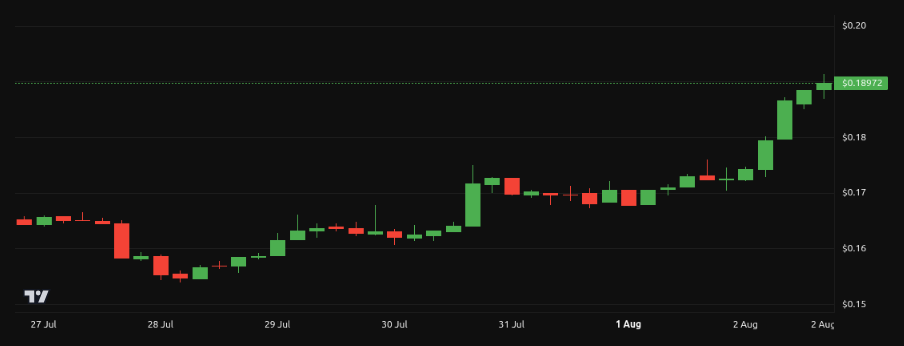
Cardano (ADA) price jumped nearly 10% in 24 hours to around $0.189, as the network turned its attention to the Dijkstra era following the van Rossem upgrade.
The rally suggests investors are pricing in the scalability roadmap rather than the upgrade already delivered.

What the Dijkstra Era Will Bring to Cardano
The Dijkstra era refers to Cardano’s next major development phase. Intersect, the organization supporting the network’s open development and governance, confirmed planning has begun.
The timing follows a completed milestone. The van Rossem hard fork, enacted on July 18, upgraded the protocol to Version 11, improving Plutus performance, ledger consistency, and node security.
Dijkstra will arrive in phases rather than as a single event. Key features include Nested Transactions, Linear Leios and Peras, all part of the broader Ouroboros Leios research programme.
The goal is throughput without compromise. Those upgrades aim to increase transaction capacity and support more complex applications while preserving decentralization and security.
Follow us on X to get the latest news as it happens.
A concrete deadline exists. The Haskell node team aims to deliver Nested Transactions and Linear Leios to the mainnet by the end of 2026. Governance work runs alongside the roadmap. Intersect defines a process that lets stakeholders shape the scope of hard forks beyond the initial Dijkstra release.
Even the name remains open, with discussions leaning toward Alexander Esgen and Fabian von Bergen as alternatives.
Can the Roadmap Sustain ADA’s Rally
Cardano researcher Dr. Cuadrado framed the distinction clearly. Van Rossem improved core performance and security, while Dijkstra addresses significantly higher transaction volumes and more sophisticated on-chain applications.
He emphasized the network’s deliberate, research-driven approach, contrasting it with projects that prioritize marketing over architectural rigor.
Other items appeared in Intersect’s latest weekly update. A new minPoolCost and Plutus memory parameter action is open for voting, alongside audited Constitutional Committee election results. Infrastructure progress continued, too. The CAP Portal reached alpha launch, and the Eryx ZK Bridge was completed.
The market response looks constructive but deserves context. ADA still trades roughly 95% below its record high of $3.09, set in September 2021, and a 10% daily move remains modest against the token’s historical volatility.
Roadmap announcements carry execution risk. Cardano upgrades have frequently generated initial enthusiasm followed by consolidation when timelines stretch.
The end-of-2026 target leaves ample room for slippage. Nested Transactions and Linear Leios both depend on research that continues evolving.
Sustained price gains will likely require measurable adoption. Developer activity, new applications, and rising total value locked matter more than announcements alone.
For now, the rally reflects renewed confidence in Cardano’s technical direction. Whether that confidence translates into lasting demand depends on what actually ships over the coming months.
Subscribe to our YouTube channel to watch leaders and journalists provide expert insights.
The post ADA Price Jumps 10% While Cardano Turns Toward Its Next Big Upgrade Era appeared first on BeInCrypto.
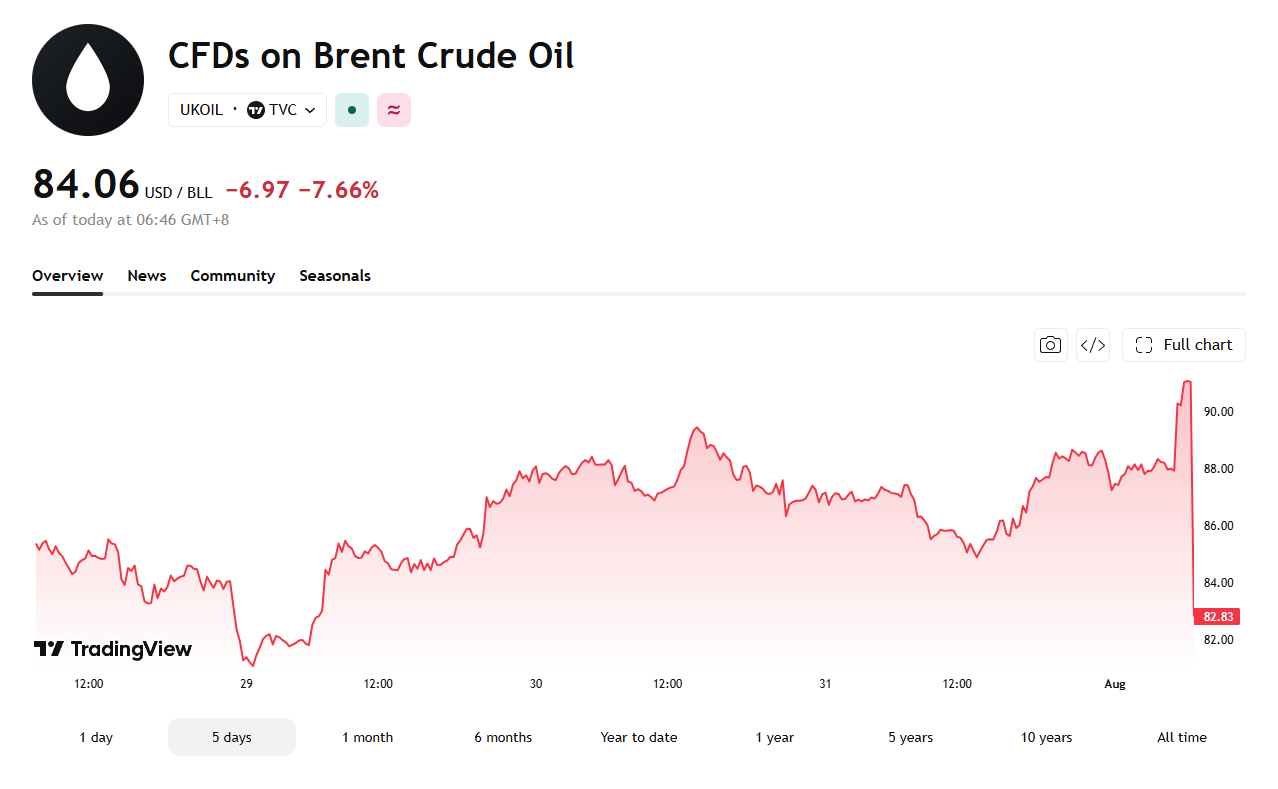
Brent crude tumbled 9% intraday on Sunday evening. It slid from a previous close of $91.03 to a low of $82.83 after US President Donald Trump said talks with Iran to reopen the Strait of Hormuz begin Monday afternoon.
The price later clawed back some ground to trade near $84.06, still down 7.66% on the day.
Another Walk-Back, or Real Peace?
Trump told reporters aboard Air Force One that negotiations start the following afternoon. He made the comment a day after he called off what he described as a massive planned attack on Iran.
Trump said Saudi Arabia, the United Arab Emirates, Qatar, and Iran itself all asked him to hold off. He said the request signals every side expects a Hormuz deal, with a separate nuclear agreement to follow.

Saudi state media confirmed part of that account. It reported that Crown Prince Mohammed bin Salman pushed Trump toward deescalation in a weekend phone call. Iran tells a different story.
State media gave no sign Tehran had shifted its stance on the strait. The semi-official Fars news agency went further and denied Iran ever asked Trump to pause the strikes, mocking his account directly.
“Trump the fool has run out of steam!”
— Fars news agency, via CNN
Uncertainty Continues to Plague the Markets
The exchange fits a pattern. Trump credits regional pressure, not his own advisers, each time he delays a strike. He still maintains on social media that US forces stand ready to resume action at any moment.
Any nuclear deal would build on the memorandum of understanding both sides signed in June. That agreement gave both sides 60 days to negotiate, and the window is now closing.
The uncertainty already hits consumers and markets on both sides. Americans pay more at the pump as shipping and output disruptions persist. Months of conflict have strained Iran’s own economy.
Every Trump signal has whipsawed oil traders since, including Wednesday’s 9.6% Hormuz-linked jump that preceded this latest reversal.
Monday’s talks may still produce only another delay. Tehran remains publicly unmoved, and the MoU clock keeps running out.
The post Oil Plunges 9% as Trump Sets Monday Talks to Reopen Hormuz appeared first on BeInCrypto.
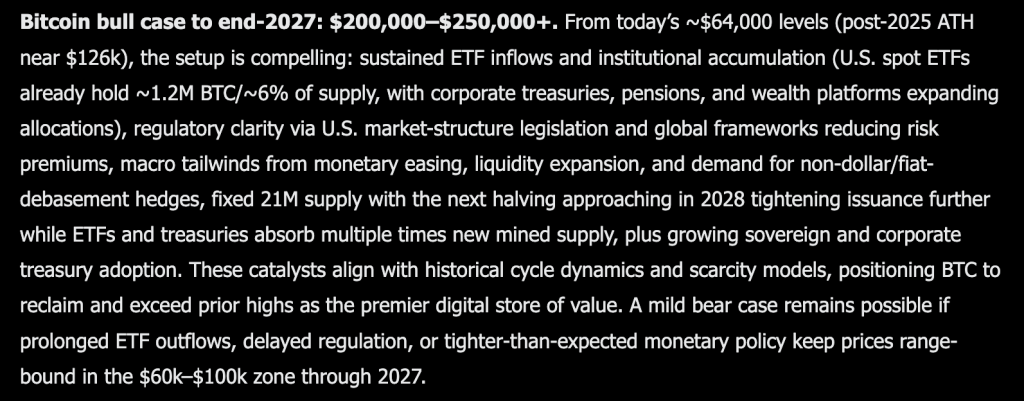
Grok AI predicts a major re-rating for Bitcoin, and this price prediction is unusual in its timeframe, targeting the end of 2027 rather than 2026. From today’s roughly $64,000 levels, well below the 2025 all-time high near $126,000, the bull case runs to $200,000 to $250,000 or higher.
The setup rests on sustained ETF inflows and institutional accumulation continuing to build. US spot ETFs already hold approximately 1.2 million BTC, roughly 6% of total supply, with corporate treasuries, pensions, and wealth platforms all expanding their allocations at the same time.
Regulatory clarity is named as a second major pillar. US market structure legislation, combined with global regulatory frameworks, is expected to reduce the risk premium investors have historically attached to holding Bitcoin.

Macro tailwinds round out the case with monetary easing, broader liquidity expansion, and rising demand for hedges against non-dollar and fiat debasement. Grok also points to the fixed 21 million coin supply, with the next halving approaching in 2028, tightening issuance even further, while ETFs and treasuries are already absorbing multiple times the amount of newly mined supply entering the market.
Growing adoption of sovereign and corporate treasuries is framed as the final piece. Grok argues these catalysts align with historical cycle dynamics and established scarcity models, positioning Bitcoin to reclaim and exceed its prior highs as the premier digital store of value.
The bear case here is treated as mild but genuinely possible. If ETF outflows persist for a prolonged period, regulation gets delayed, or monetary policy stays tighter than expected, Grok sees Bitcoin remaining range-bound in the $60,000 to $100,000 zone straight through 2027.

Bitcoin Price Prediction: BTC Has Spent Six Months Rebuilding From The Same Low Twice, Can Grok AI Predicts Work out?
Price closed at $63,931, down 1.21%, during a session that ranged between $63,547 and $65,340. That quiet red day sits almost exactly on top of a level this chart has visited and defended more than once this year.
Zoom out, and the shape since October 2025 has been a long, uneven decline. Bitcoin peaked near $128,000 that month, then broke down hard through January, gapping from above $92,000 to under $76,000 in a matter of weeks.
Since that crash, price built a rounded recovery through spring, peaking near $99,000 in April, then rolled over into a sharp flush down to $60,000 in June. A second recovery attempt through May pushed toward $82,000 before failing and dragging the price back down to retest that same $60,000 floor in June and July.
That is two separate visits to the same support level within a matter of months, which makes $60,000 one of the more tested lines on this entire chart. Support sits right there at $60,000, with limited recent history below it, before the price moves into territory not seen this year.
Resistance stacks at $66,000, then $70,000, then the heavier April ceiling near $99,000 that has already rejected two full rally attempts. Momentum here is mildly negative after today’s session, consistent with a market still consolidating rather than committing to a clear direction.
For Grok’s bull case to gain real traction over its multi-year timeframe, Bitcoin eventually needs to clear $99,000, a level this exact chart has failed at twice already. Until that happens, the current price action looks much closer to the bear-case range this prediction lays out than to the start of a run toward six figures.
Being Right and Getting Paid Aren’t the Same Thing. Claim up to $25 From Kalshi
You read the analysis. You form a view. The market proves you correct, and buying spot means you were exposed to a dozen things you had no opinion on.
Kalshi is a CFTC-regulated exchange for event contracts: one question, one outcome, one settlement. Trade the Fed, inflation, crypto price levels, and the events that actually move the market.
Contracts can resolve against you and go to zero, so size accordingly.
→ Get up to $25 to trade your first market
The post Grok AI Predicts Bitcoin Will Blow Past Its Old Record by End of 2027 appeared first on Cryptonews.
Japan could formally confirm joint currency action with Washington on Monday, and one official told Reuters the operation is still ongoing, turning the announcement into a live market event.
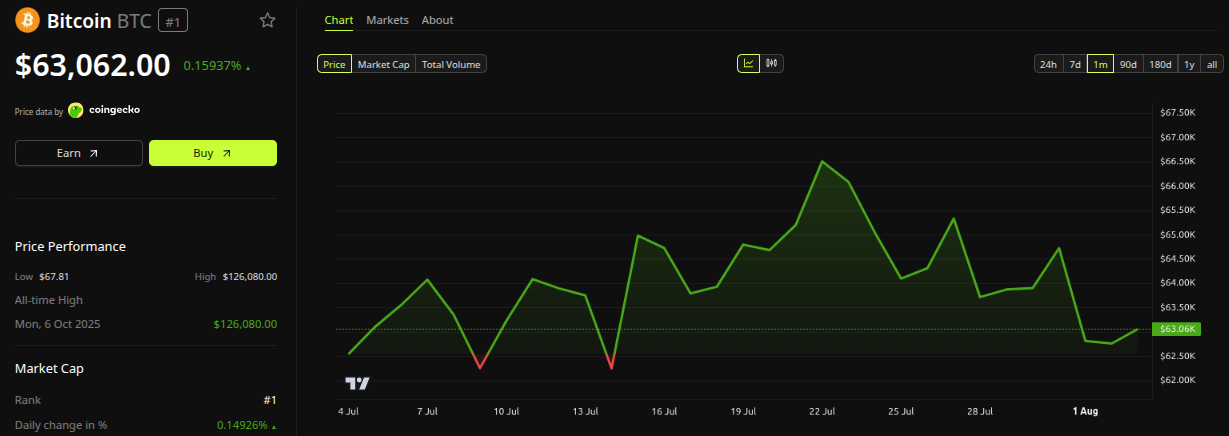
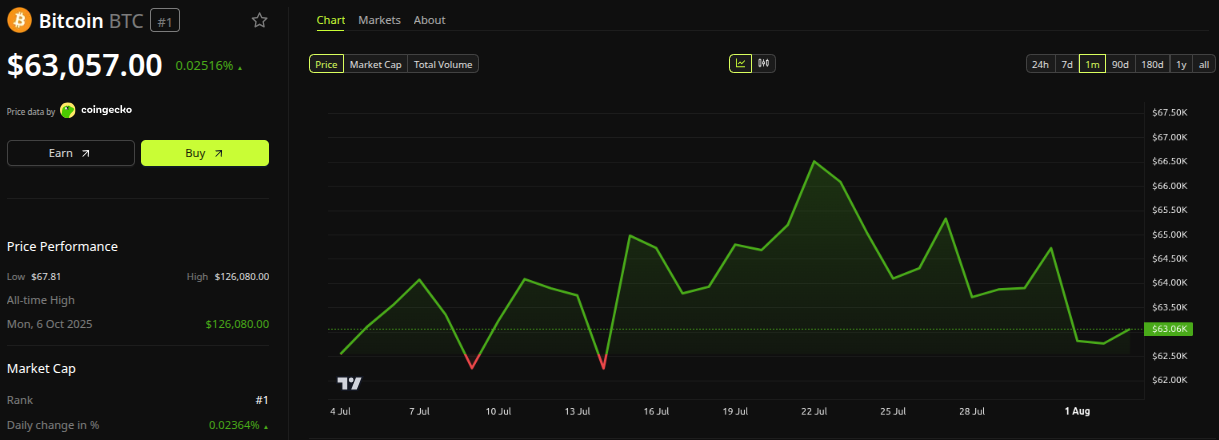
Bitcoin trades near $63,000, exposed to a bond market problem most crypto traders have not priced.
The Bond Market Reason Behind the Cooperation
The 2011 comparison matters more than it appears. That year the Group of Seven (G7) sold yen to stop it rising, meaning this is the first coordinated effort in 15 years pushing the currency the opposite direction.
Finance Minister Satsuki Katayama will make the announcement, two officials told Reuters. Her top currency diplomat, Atsushi Mimura, signaled the ministry now works in close coordination with monetary policy.
That phrasing carries weight. It suggests Tokyo will pair intervention with the rate hikes the Bank of Japan hinted at last week, rather than relying on purchases alone.
A quieter development may matter more. Japan’s finance ministry made a rare English-language post on X noting it holds a broad range of tools, including access to the Federal Reserve repurchase facility.
The mechanism deserves attention. Introduced in 2020, the facility lets Japan raise dollar liquidity without selling US Treasuries outright.
Follow us on X to get the latest news as it happens.
Critics flagged exactly that constraint. Funding intervention by liquidating Japan’s enormous Treasury holdings risks triggering a selloff in American debt and spiking yields.
Washington’s motivation becomes clearer through that lens. Analysts see the cooperation driven partly by concern over rising Treasury yields, which would worsen if Tokyo failed to stabilize both the yen and Japanese government bonds.
Former Bank of Japan official Nobuyasu Atago framed the logic directly. Both countries risk inflation running hot and leaving their central banks behind the curve, so they see merits in cooperating.
What Bitcoin Traders Should Watch on Monday
Tokyo is managing domestic pressure too. Economy Minister Minoru Kiuchi said Sunday the government will improve market communication, stressing the importance of maintaining trust in Japan’s fiscal sustainability.
Bitcoin traders should care about that bond angle specifically. Rising global yields compete directly with non-yielding assets, and Japanese government bond stress has repeatedly spilled into crypto this year.
“How will global risk assets respond if the world’s largest carry trade begins to unwind? The answers won’t come overnight. But one thing is clear. A story that started in the currency market could end up influencing everything from stocks to Bitcoin…,” Wise Advice said on X.

Positioning amplifies the risk. Non-commercial yen short contracts reached 163,412 by late July, leaving substantial leverage exposed to any sudden reversal. The immediate question is credibility rather than firepower.
Markets will test whether Monday’s confirmation carries a rate commitment or only a purchase pledge.
A hawkish pairing changes the calculus considerably. Rate differentials close permanently when policy shifts, whereas interventions fade once the buying stops.
That distinction shapes both scenarios for Bitcoin. Aggressive yen appreciation forces leveraged unwinding across risk assets, while gradual strengthening alongside a softer dollar could expand liquidity instead.
Timing determines everything here. Asian markets open first on Monday, and any gap in USD/JPY will reach crypto before American traders react.
“If the US sells dollars to buy yen, the dollar weakens and USD/JPY falls. Normally, this supports Bitcoin, gold and tech stocks. But there is a major catch: A rapid yen rally could unwind one of the world’s largest carry trades. Investors who borrowed cheap yen to buy stocks, crypto and other higher-yielding assets may be forced to sell…,” Coin Bureau noted.
The rate gap remains the structural anchor. Japan holds policy at 1% against a considerably higher US ceiling, and no intervention closes that on its own.
Watch the Japanese bond market alongside the currency. If yields stay contained after the announcement, the coordinated defense is working, and Bitcoin’s macro headwind eases with it.
Subscribe to our YouTube channel to watch leaders and journalists provide expert insights.
The post Japan Could Trigger the Biggest Market Shock of 2026: How Might Bitcoin React? appeared first on BeInCrypto.

“This is what modern warfare looks like, and it further illustrates there’s no plan to win a war with Iran,” Walz said.
Emphasizing comments that he recently shared on X, Trita Parsi, Executive Vice President of the Quincy Institute for Responsible Statecraft, said that it would be reasonable for Iran to attempt cyber attacks as a “warning” that it is prepared to retaliate for U.S. strikes.
And Parsi tells TIME that Iran is more than capable of fulfilling the threat.
“Iran is a highly capable cyber power, only one tier below the U.S., China, and Russia, and in some aspects on par with Israel,” he says. “It has in the past demonstrated a clear ability to target industrial control systems, water facilities, and energy infrastructure.”
The joint statement issued last week by federal agencies also underscored Iran’s cyber capabilities. “Iranian cyber actors continue to target U.S. critical infrastructure,” said Assistant Director Brett Leatherman of the FBI’s Cyber Division. However, he added, “The FBI is committed to identifying, disrupting, and imposing costs on those responsible. Sharing timely, actionable intelligence is a critical part of that work.”
Crypto World
Robinhood’s Q2 Revenue Hits Record $1.31B as Prediction Markets Fuel 10x Surge in Event Contracts

Robinhood posted record second-quarter net revenue of $1.31 billion, up 32% year-over-year, as activity across prediction markets, options, and equities helped offset a sharp decline in crypto income.
The company’s transaction-based revenue jumped 44% to $776 million during the quarter. Event contracts emerged as one of its fastest-growing businesses.
In fact, revenue from event contracts reached $156 million, more than 10 times higher than a year earlier. The number of contracts traded also surged more than 10x to a record 13.6 billion.
Prediction Markets Steal the Spotlight
Speaking about the growth of prediction markets, Chairman and CEO Vlad Tenev said that the space has grown steadily since March and expects the momentum to continue. Robinhood launched Rothera, a CFTC-licensed exchange and clearinghouse, in June through its joint venture with Susquehanna International Group. The company said more than 3.5 billion event contracts had been traded to date.
Meanwhile, options remained another major contributor, generating $342 million in revenue. This figure was up by 29% year-over-year. Equities revenue climbed even more sharply, rising 95% to $129 million as equity notional trading volumes reached a record $956 billion, an 85% increase from the same period last year.
The strong performance across these businesses came despite weaker cryptocurrency activity. Robinhood’s crypto revenue fell 38% year-over-year to $100 million, while crypto notional trading volume stood at $40 billion, including $18 billion from its app and $22 billion from Bitstamp.
Global Push
The online brokerage is pushing deeper into blockchain and digital assets internationally. It unveiled the public mainnet for Robinhood Chain, an Ethereum Layer 2 network designed for financial services and real-world assets, while also announcing stock tokens for eligible users in more than 120 countries.
In May, it launched Agentic Trading, which allows customers to use AI-powered agents to trade equities, options, and crypto. Nearly 100,000 customers have opened Agentic Trading accounts so far, with more than $100 million in assets under custody.
During the quarter, the company expanded its international footprint by closing its acquisition of WonderFi, a Canadian digital asset products and services platform. The move marked its official entry into the Canadian market.
Tenev also pointed to the broader expansion strategy, saying
“Whether it’s the Robinhood Chain, Robinhood Ventures, or Trump Accounts, our product velocity is focused on one goal: making everyone an owner. Broad ownership is essential to a free, stable, and prosperous society.”
The post Robinhood’s Q2 Revenue Hits Record $1.31B as Prediction Markets Fuel 10x Surge in Event Contracts appeared first on CryptoPotato.
Craig Wright, the Australian who long claimed to be Satoshi Nakamoto, resurfaced with a sharp critique of Bitcoin current governance.
His argument centers on a single idea: the base protocol should never change, and anyone who can change it holds too much power.
Why Wright Wants Bitcoin Rules Permanently Fixed
Protocol immutability means the fundamental rules of a blockchain remain permanently fixed, with no upgrades altering how the system works. Wright argues that the principle defines genuine decentralization.
In a series of posts on X, the self-proclaimed Satoshi targeted what he described as control by a small circle of developers. Bitcoin, he wrote, was designed as the opposite of a system in which a group can rewrite the rules and isolate dissenters.
Follow us on X to get the latest news as it happens.
The protocol must remain immutable, according to Wright, so no developer, miner, exchange, or corporation can alter it for private gain. Stable rules would create a level playing field.
Businesses could then compete without fearing that a future upgrade undermines their investments. Innovation, in his view, belongs at the application layer.
He expanded on the point in a follow-up post, highlighting what he sees as a contradiction. Many who called him a fraud for defending fixed rules simultaneously defend developers who can restrict capacity and set consensus.
Wright also challenged the popular narrative around running a full node. A home node without hash power cannot produce blocks, order transactions, or compel the network to follow its preferences, he said.
“…Bitcoin was never supposed to depend upon trusting the correct developers. It was designed to remove that power entirely. The rules are fixed; everyone competes above them. If you opposed me because I wanted an open protocol that no individual could change, ask yourself what you were actually defending—and who truly benefited from it…,” Wright exposed on X.
Why the Satoshi Controversy Undermines Wright’s Argument
Node operation may verify data for its owner, he argued, but it does not govern. Running nodes has been marketed as a form of sovereignty, while economic power has shifted toward exchanges and custodians.
Capacity limits push ordinary users away from direct on-chain transactions and toward centralized services, he claimed, reversing the system’s original intent.
His posts also addressed Bitcoin’s evolving public story. The marketing moved from electronic cash to digital gold, then to a store of value, and recently toward promises of generational wealth.
“…the limits pushed ordinary users away from direct transactions and towards exchanges, custodians, payment channels and other middlemen. You were taught that running powerless software at home made you independent while the economic system became increasingly dependent upon centralised services…,” Wright noted.
Wright dismissed that framing as unrealistic. A multi-trillion-dollar asset cannot repeat its early exponential returns, and market capitalization does not equal cash realizable without collapsing prices.

The critique arrives with substantial baggage, however. A United Kingdom High Court ruled in 2024 that Wright is not Satoshi Nakamoto, finding he had forged documents on an extensive scale.
He later received a suspended prison sentence for contempt of court after breaching orders related to that case. Those rulings undercut the authority his claims once carried within the industry.
The underlying debates remain genuine nonetheless. Scaling, protocol rigidity, and the balance of power between developers, miners, and users have divided Bitcoin for a decade.
Whether his comments shift any minds seems doubtful. They do reaffirm a position he has held consistently, regardless of what courts concluded about his identity.
Subscribe to our YouTube channel to watch leaders and journalists provide expert insights.
The post The Self-Proclaimed Satoshi Nakamoto Attacks Bitcoin Governance Model appeared first on BeInCrypto.

MOFSL stays bullish on Sun Pharma; sees 16% upside on innovation pipeline

Commonwealth Games 2026, Closing Ceremony Highlights: Scotland Pass Baton To India; Manushi Chhillar, Shankar Mahadevan Dazzle

Foundation’s Robotic Hand V2 Catches Baseballs Blind


-

 Business4 days ago
Why Trees Belong on the Risk Register
-

 Fashion2 days ago
Weekend Open Thread: Wit & Wisdom
-

 Politics2 days ago
Meta enters AI-training agreement with far-right ‘propaganda rag’ Newsmax
-
 Entertainment5 days ago
‘Stargate’ Creator’s New Sci-Fi Series Returns for Season 3 Tomorrow
-

 Politics7 days ago
Luke Littler dismantles Gerwyn Price to retain title in Blackpool
-

 Crypto World1 day ago
MicroStrategy Post-Earnings CLARITY Act Push Could Add New Catalyst for Its Stock
-

 Politics6 days ago
The Part of the Electric Transition Nobody Wants to Discuss
-

 Business5 days ago
Major shareholder moves on Canyon
-

 Crypto World2 days ago
XRP Ledger v3.3.0 brings five institutional features
-

 News Videos4 days ago
Bitcoin Enters the 3rd Stage of the Bear Market
-

 Crypto World5 days ago
Kraken Enables Retail Access to Jersey Mike’s IPO via Tokenized Shares
-

 Tech6 days ago
New macOS Sequoia & Sonoma security updates for older Macs
-

 News Videos5 days ago
Claude: Build Financial Dashboards in Minutes (2026)
-

 Politics3 days ago
Luke Littler’s dominance sparks GOAT debate
-

 Business5 days ago
Johnson & Johnson agrees to $5.5B settlement over talc cancer claims
-

 Sports3 days ago
Seema Kaliramna Wins Discus Throw Bronze, Takes India’s CWG Medals Tally To 17
-

 Crypto World15 hours ago
Crypto PAC spending tops $2M in Michigan House race
-

 Business2 days ago
Trump Announces Hamas Disarmament Agreement as Iran Strikes Kuwait Air Base and US Attacks Pause Overnight
-

 Tech5 days ago
Gemini can now summarize the messiest comment threads in Google Docs
-

 Tech19 hours ago
ESET tracks rise in malicious AI skills and adaptable malware
You must be logged in to post a comment Login