





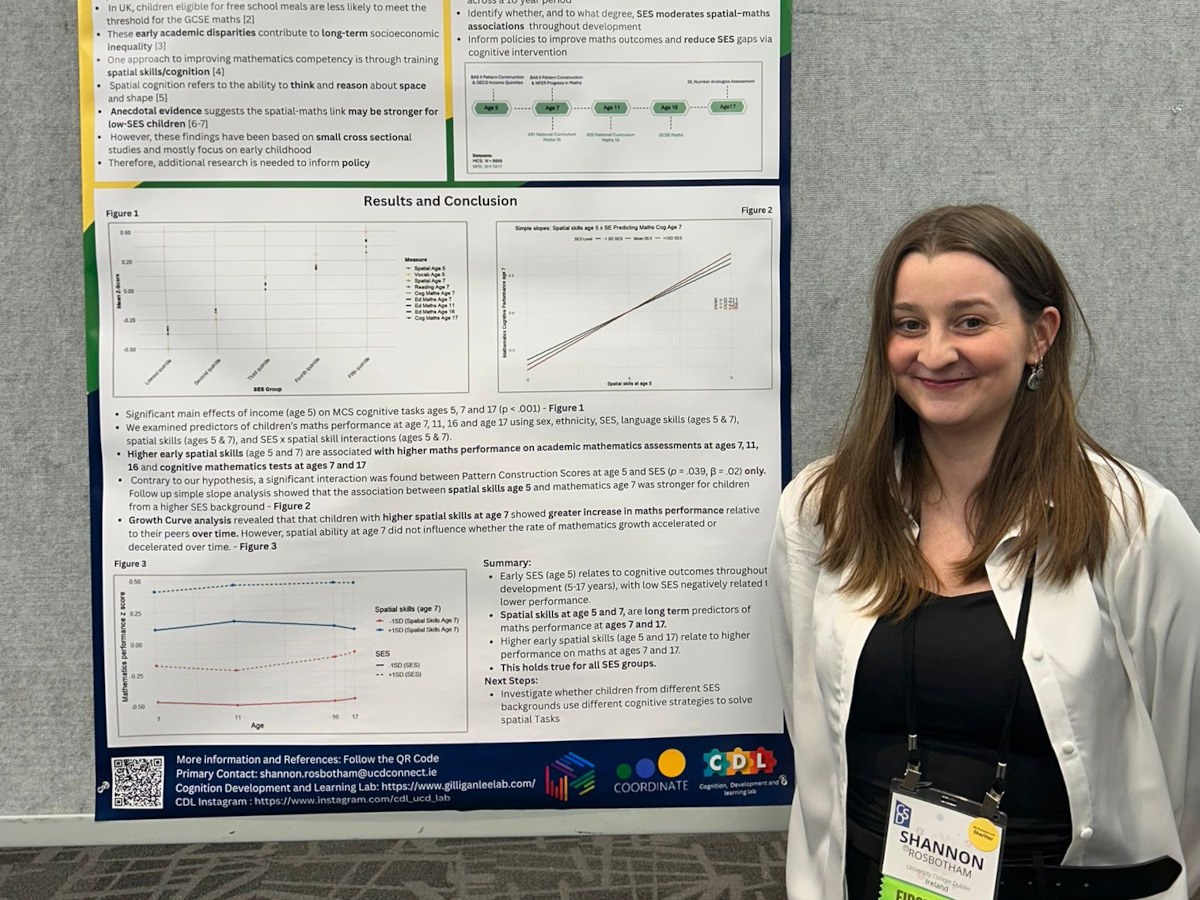

While the spatial-maths link is well established in the literature we still know relatively little about why the two domains are related.
Shannon Rosbotham is a PhD candidate in the School of Psychology at University College Dublin (UCD) studying the intersection of developmental cognitive psychology and neuroscience.
She completed her BSc in psychology at Queen’s University Belfast before moving to Dublin to complete an MSc in behavioural neuroscience at UCD.
“I am intrigued by how environmental factors can induce structural neurological change in the body and promotes neuroplasticity. Particularly, I am fascinated by how this knowledge can be extrapolated to teaching complex tasks in an educational setting,” she said.
“My PhD investigates the association between spatial cognition, the ability to recognise, process and reason with information about space, and mathematical performance. My research also looks at how environmental factors, such as socioeconomic status, may influence this relation in children.”
She is an active member of the university’s cognition, development and learning lab, and the ‘Baby lab’ – which aims to understand how the brain and behaviour of children develops in the first six years of life.
What inspired you to become a researcher?
My mum is a childminder, so I grew up surrounded by children and was always intrigued by how they navigate and interact with the world around them.
However, it wasn’t until the final undergraduate project on mind-wandering in children that I began to seriously consider a research career.
This process not only strengthened my fascination with developmental psychology but also with experimental design, I began to question how we can successfully capture and understand what someone is thinking or feeling?
This led me to completing an MSc in behavioural neuroscience. My master’s thesis explored how physiological responses, for example, heart rate and skin conductance, compared to self-reported measures of emotional arousal and engagement.
During this time, I was also able to converse with graduate researchers. Hearing about their research and experience solidified my own desire to pursue an academic career.
Can you tell us about the research you’re currently working on?
My research focuses on understanding the association between children’s spatial skills and their maths performance.
While the spatial-maths link is well established in the literature we still know relatively little about why the two domains are related.
Currently, I am recruiting 8-12 year old participants with the hope of uncovering whether participants who perform well on spatial tasks (for example, mentally rotating objects and reading maps) tend to favour certain problem solving strategies.
To investigate this, we use eye-tracking technology, to see where participants are looking on the screen, and explore whether similar visual patterns emerge. We also have a subset of trails where we ask participants to self-report how they figured out the puzzles.
The broader aim of this work is to better understand the mechanisms underlying the spatial-mathematics association. By knowing the strategies associated with successful performance, we hope to inform future spatial interventions aimed at supporting maths learning.
Another aspect of my research focuses on whether spatial training might offer an avenue for reducing socioeconomic disparities in academic performance.
In your opinion, why is your research important?
Maths is an essential skill for most people, we rely on it all the time in daily life, for example working shop discounts or adjusting a recipe.
Moreover, maths proficiency also plays an essential role in educational and occupational opportunities, with most universities in Ireland requiring a minimum grade of 06/H7 for entry.
Yet, despite its importance, many students remain anxious when it comes to learning maths content in schools. Additionally, research consistently finds evidence of a maths attainment gap between children from lower socioeconomic backgrounds and their more affluent peers. Together, this highlights the need for more research focusing on supporting children who struggle in this area.
I think my research in particular is important because it explores a pathway which is not often utilised in the education system to enhance maths competency. By bettering our understanding of the spatial-maths relation, we might improve interventions to support learning and address educational inequalities.
What commercial applications do you foresee for your research?
Although my research primarily focuses on educational applications, there are potential commercial applications.
As research has shown spatial training to be effective in improving maths skills there is room for the development of more evidence-based digital interventions, spatial toys and block construction games.
What are some of the biggest challenges you face as a researcher in your field?
I would say one of the biggest challenges I face as a developmental researcher is recruiter. Unlike many adult studies, which can recruit university students already on campus, developmental research requires parents to take time out of their day to bring their children into the lab.
Additionally, I think there is often an underrepresentation of children from a variety of socioeconomic backgrounds, which is particularly challenging for research like mine which investigates academic disparities. This also means that we risk not fully understanding the learning experience for all children.
That said, I think social media has eased some of the challenges related to recruitment, as it can enable access to a wide and diverse audience.
Are there any common misconceptions about this area of research?
I would say one common misconception is that study participation will provide children with diagnostic or clinical feedback.
However our studies are not designed to evaluate individual children, rather to give a more general overview of developmental patterns. Parents may also be concerned about privacy and confidentiality. When in fact data is anonymised and data is handled following GDPR guidelines.
Overall I think most of these misconceptions can be addressed through clear communication and transparency. We provide parents with a detailed information sheet outlining the study procedure and how data will be handled before they sign up and consent to participate.
What are some of the areas of research you’d like to see tackled in the years ahead?
I would love to see more classroom-based studies investigating how children are solving maths problems in a natural setting.
While the lab is a great starting point for understanding strategy use, I think researching how children solve problems in the classroom could provide greater insight into cognitive processes used in everyday learning.
I would also like to see more research exploring whether and how teachers are currently implementing spatial cognition into their classrooms. In doing so, we might better understand how spatial training might be embedded efficiently into the primary school curriculum in Ireland.
Don’t miss out on the knowledge you need to succeed. Sign up for the Daily Brief, Silicon Republic’s digest of need-to-know sci-tech news.

























































You must be logged in to post a comment Login