Connect with us
DAPA Banner
DAPA Coin
DAPA
COIN PAYMENT ASSET
PRIVACY · BLOCKDAG · HOMOMORPHIC ENCRYPTION · RUST
ElGamal Encrypted MINE DAPA
🚫 GENESIS SOLD OUT
DAPAPAY COMING

Tech

Canva launches in Gemini, now in all four major AI assistants

Published

on

TL;DR

Canva launched its Connected App for Google Gemini at Google I/O, completing its integration across all four major AI assistants. The tool lets users generate on-brand, editable designs from Gemini prompts, with Magic Layers converting AI images into layered files.

Canva has spent the past year quietly embedding itself into every major AI assistant. First came Claude, then ChatGPT, then Microsoft Copilot. Now Google Gemini gets the same treatment, and the strategy is complete.

Advertisement

The company launched its Connected App for Google Gemini at Google I/O, giving Gemini users the ability to generate, edit, and search Canva designs directly from a conversation. The integration started rolling out with limited availability on 19 May and will expand to full availability in the coming weeks.

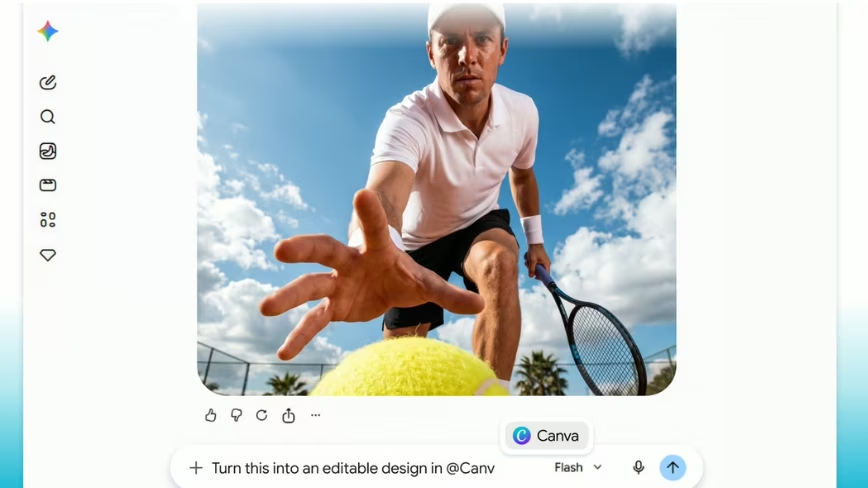
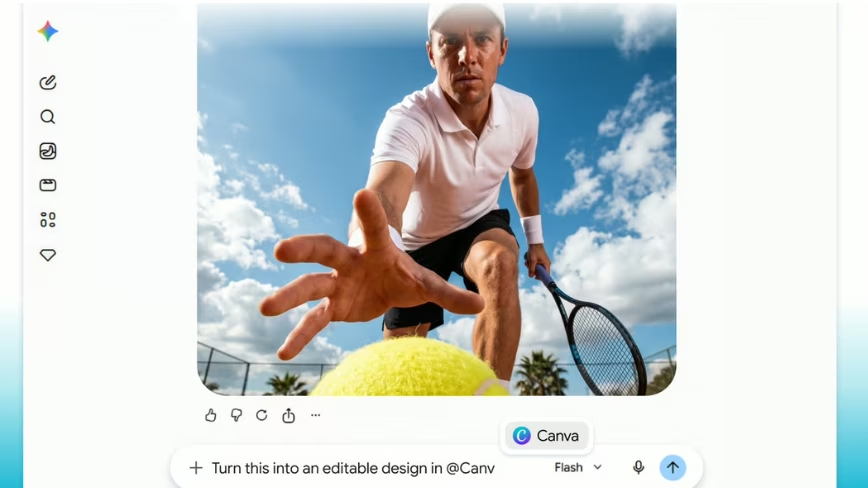
The pitch is straightforward. Type a prompt in Gemini, and Canva generates a design that arrives not as a flat image but as a fully editable file. If the user has a Canva Brand Kit configured, the output automatically applies stored logos, fonts, and colour palettes from the first prompt.

The most technically interesting piece is the integration with Google’s Nano Banana image model. Users can generate an image through Gemini’s native capabilities and then convert it into a layered, editable design using Canva’s Magic Layers tool. That solves a persistent frustration with AI-generated visuals: they are typically flat files that require re-prompting for every small change. Magic Layers analyses the image structure and separates it into individual, movable elements.

“We’re making design accessible wherever people start their work,” said Anwar Haneef, Canva’s head of ecosystem. The implication is clear. Canva no longer sees itself as a destination. It sees itself as infrastructure.

The Gemini launch means Canva’s design engine is now embedded in all four dominant AI assistants: Claude, ChatGPT, Copilot, and Gemini. Each integration works through Canva’s API, allowing the assistant to call design generation, brand kit lookup, and template search without the user leaving the conversation.

Advertisement

The timing matters. Google unveiled Pics at I/O 2026, a competing AI design tool built directly into Workspace that generates graphics from text prompts. Adobe’s Firefly holds 41 per cent business adoption. And Figma just launched its own AI agent that designs on the canvas. Canva’s response is to make its tools available everywhere rather than fight for a single surface.

That approach is paying off commercially. Canva reported that nearly every marketer in its latest survey uses AI for some part of their workflow, though consumers still want the human touch. The company now claims 220 million users globally and has positioned its AI 2.0 platform, launched in March, as a full operating system for visual content creation.

Canva AI 2.0 already connects to Slack, Gmail, Google Drive, Calendar, Notion, Zoom, and HubSpot through six intelligent workflows. It can generate meeting summaries from Zoom transcripts, turn customer emails into personalised sales materials, and build company newsletters. The Gemini integration adds another surface to that network.

The risk for Canva is commoditisation. If every AI assistant can generate decent visuals natively, the value of a dedicated design tool diminishes. Google’s Pics, OpenAI’s image generation, and Adobe’s Firefly are all improving rapidly. Canva’s bet is that brand consistency, editability, and template ecosystems still matter more than raw generation quality, and that being embedded everywhere makes it harder to replace.

Advertisement

Source link

Continue Reading
Click to comment

You must be logged in to post a comment Login

Leave a Reply

Tech

Kansas City Public Schools are going all-in on Apple

Published

on

Kansas City Public Schools have procured more than 4,500 MacBook Neos as part of its transition to an “All-Apple District”

More than 30,000 Windows PCs and Chromebooks are getting the boot as Kansas City prepares to transition its public school students exclusively to Apple devices.

On Wednesday, Kansas City Public Schools elaborated on its decision to become an “All-Apple District.” The district says the move reflects its commitment to providing the highest quality education to its students.

“Students are now proud of their schools because they have the best products,” KCPS Chief Technology Officer Scott Jones said in a statement. The district believes that Apple devices have an edge over the competition, calling them “secure, durable, and reliable.”

Advertisement

This isn’t the first time we’ve heard the news, either. Apple’s own CFO, Kevan Parekh, made mention that the school would be making the switch during Apple’s 2026 Q2 earnings call.

More than 4,500 MacBook Neos have been procured for students in 8th grade and up. Lower grades will have access to the district’s existing iPad and MacBook Air collection.

We may see more school districts make similar leaps in the future. Apple’s new MacBook Neo, which made its debut in March, has already become the darling of the MacBook lineup.

Its lower price point, $599, makes it a tempting purchase for casual users, students, and enterprise solutions. While many scoffed at the idea that the A18 Pro chip would be enough to lure in prospective buyers, Apple initially had difficulties keeping it on shelves.

Advertisement

Source link

Continue Reading

Tech

Daily Deal: Curiosity Stream Standard Plan

Published

on

from the good-deals-on-cool-stuff dept

Curiosity Stream offers unlimited access to thousands of films, series, and shows to satisfy your thirst for knowledge. Whether you’re a science enthusiast, history buff, or technology geek, Curiosity Stream has something for everyone. Unleash the power of on-demand streaming that allows you to choose what you want to watch, when you want to watch it, and where you want to watch it. From the comfort of your living room to the remote corners of the globe, your favorite documentaries are just a click away. It’s on sale to new users for $127.50 with code STREAM15 at checkout.

Note: The Techdirt Deals Store is powered and curated by StackSocial. A portion of all sales from Techdirt Deals helps support Techdirt. The products featured do not reflect endorsements by our editorial team.

Filed Under: daily deal

Source link

Advertisement
Continue Reading

Tech

Trump Sued Himself And Walked Away With A $100 Million Tax Debt Erased

Published

on

from the it’s-just-so-brazen dept

There were two rumors last week regarding the supposed “settlement” of Donald Trump’s ridiculously problematic lawsuit against his own IRS, asking for $10 billion. The first was that he was going to get an agreement to drop all audits of his taxes (and the taxes of his family members and businesses). The second was that he was going to create a $1.776 billion fund to pay off January 6th insurrectionists. The first of those came true on Monday. The second came true on Tuesday.

US tax authorities will be barred from pursuing claims against Donald Trump, his eldest sons and the Trump Organization under an agreement to halt the president’s $10bn lawsuit against the Internal Revenue Service.

Just like Monday’s news, the framing of this is absolute bullshit. There is no “agreement to halt the lawsuit.” The lawsuit was about to be drop kicked out of court by a judge who pointed out that there is no “cause or controversy” here because Donald Trump was suing himself and had full control over both parties in the lawsuit. You can’t “come to an agreement” with yourself to give yourself a tremendous benefit from the United States government.

That’s not a thing. That’s just theft.

And while it may not be the full $10 billion he sought, it’s still a massive theft from the United States treasury. As you’ll recall, Donald Trump has insisted for years that he couldn’t release his tax returns like every single President since Richard Nixon had done, because they were being audited. But that’s also bullshit. When Nixon released his tax returns, they were being audited. And, indeed, the IRS code requires it to audit both the President and Vice President’s taxes every year.

Advertisement

Reporting from a few years ago found that an audit of Trump’s taxes suggested he owed over $100 million to the US Treasury because of earlier tax fraud.

The issues around Mr. Trump’s case were novel enough that, during his presidency, the I.R.S. undertook a high-level legal review before pursuing it. The Times and ProPublica, in consultation with tax experts, calculated that the revision sought by the I.R.S. would create a new tax bill of more than $100 million, plus interest and potential penalties.

So agreeing to drop the audit entirely is, at minimum, a $100 million gift from the American taxpayer directly to Donald Trump. As a reward for tax fraud.

That seems… very bad. It’s extraordinarily, shockingly corrupt. And it’s probably not even the most corrupt thing he’s done this week.

The actual agreement from the DOJ is hilariously stupid. It’s just three paragraphs long and claims it’s part of the “settlement” of the lawsuit (which, again, cannot be “settled” because there’s only one party). The main part is this:

Advertisement

The United States RELEASES, WAIVES, ACQUITS, and FOREVER DISCHARGES each of the Plaintiffs from, and is hereby FOREVER BARRED and PRECLUDED from prosecuting or pursuing, any and all claims, counterclaims, causes of action, appeals, or requests for any relief, including injunctive relief, monetary relief, damages, examinations or similar or related reviews, appeals, debt relief, costs, attorney’s fees, expenses, and/or interest, whether presently known or unknown, that as of the Effective Date of the Settlement Agreement-have been or could have been asserted by Defendants against any of the Plaintiffs or related or affiliated individuals (including, without limitation, family or others filing jointly), or parties including trusts, parent, sister, or related companies, affiliates, and subsidiaries, by reason of, with respect to, in connection with, or which arise out of (1) any matters that were raised or could have been raised in the Case or the Pending Agency Claims; (2) Lawfare and/or Weaponization; or (3) any matters currently pending or that could be pending (including tax returns filed before the Effective Date) before Defendants or other agencies or departments.

Basically: clean slate for what appears to be many, many years of tax fraud. So he defrauded the American government, then used his role as the President to just wipe out any ability to hold him accountable for it.

And it’s not like everyone inside the government just went along with it. Reporting says that IRS officials were horrified by the lawsuit and pushed the DOJ to fight back against it.

I.R.S. officials prepared a 25-page memorandum outlining what they saw as flaws in Mr. Trump’s suit and advising the Justice Department to move to dismiss it, according to two people familiar with the memo. That memo was provided to Treasury officials in April, and it is unclear if they passed it along to its intended recipients at the Justice Department, according to the people, who spoke anonymously to discuss internal government deliberations.

And then, on Monday, just as this brazenly corrupt deal was being finalized, the Treasury Department’s top lawyer (hired by Trump) resigned, apparently in protest.

The Treasury Department’s top lawyer resigned Monday as the government announced a controversial settlement with President Trump, according to people familiar with his departure.

Brian Morrissey joined the Trump administration last year as the president’s pick to be Treasury Department’s general counsel, after previously serving at the agency and at the Justice Department during Trump’s first term. A former clerk for Justice Clarence Thomas, Morrissey didn’t respond to a request for comment late Monday. 

Advertisement

MAGA world has long since baked in the idea that Trump will rob the American taxpayer blind any way he can. Most people just assumed that came with the territory. Probably fewer assumed “the territory” included filing a $10 billion lawsuit against yourself, having the judge almost throw it out because you’re suing yourself, then “settling” with yourself — and somehow walking away with a clean slate on what appears to be over $100 million in fraud-based tax debt. If this were written up as a movie, no one would make it, as the corruption is simply too over the top and out in the open. And yet, it’s real.

Filed Under: audits, donald trump, irs, tax fraud

Companies: trump organization

Advertisement

Source link

Continue Reading

Tech

The 10 Best TV Shows to Stream This Month (May 2026)

Published

on

While streaming may be the future of television, the medium itself—much like its big-screen counterpart—often leans on familiar properties, prequels, and reboots to keep things moving along. (Which explains why Yellowstone has morphed into a full-on franchise, with four current spinoffs and more on the way.)

Why does this matter to you? Because May’s best shows to stream are full of familiar titles, from Battlestar Galactica to the Duffer Brothers’ newest project … which sounds a bit like their most famous project.

Here are our picks for the 10 best shows to watch this month.

Battlestar Galactica

More than a year before Russell T. Davies rebooted Doctor Who for a whole new generation, Ronald D. Moore breathed new life into Battlestar Galactica—Glen A. Larson’s highly anticipated but ultimately short-lived sci-fi show from 1978. The revived series, in which what remains of humanity attempts to stave off extinction at the hands of a race of sentient AI beings known as Cylons, has since become one of the most critically acclaimed and influential sci-fi franchises of all time.

Advertisement

Now, after a year of being MIA, Paramount+ is bringing the entire franchise—which was profoundly ahead of its time with its exploration of AI, politics, identity, and what it means to be human—to its streaming platform. In addition to the three-hour miniseries that served as the de facto pilot, all four official seasons of the series, starring Oscar nominees Edward James Olmos and Mary McDonnell, plus Katee Sackhoff in her breakout role, are now streaming. As are the Olmos-directed feature film, The Plan, and the 2010 prequel series, Caprica. It’s all here for the bingeing.

Worst Ex Ever

Think your former partner was the worst person that ever lived? Give Netflix’s true crime docuseries a watch, then maybe reassess. Using a mix of standard talking head interviews with authorities and survivors, plus animated re-creations of the violent actions and crimes being described, the show—which dropped its second season on May 6—explores the many ways romantic relationships can turn toxic, sometimes with fatal results.

Source link

Advertisement
Continue Reading

Tech

Tennessee Book Ban Update: State Jumps The Shark By Banning ‘Roots’

Published

on

from the doomed-to-repeat-it dept

When I was in high school, part of the mandatory social studies curriculum included watching the miniseries Roots in class over the course of several days. I remember it fondly, though I did get myself into a bit of trouble in the process. Apparently shouting things like “Hey, where is Geordi La Forge’s visor?” and “Oh, look, it’s the owner of McDowell’s!” is not appropriate fodder when watching what is indeed an important cultural touchstone for American history.

The miniseries was based on a book by Alex Haley, which follows generations of African slaves descending from slave Kunta Kinte, and highlights parts of what slave life was like in that shameful part of American history. The book won a Pulitzer in 1977, while the miniseries collected 9 Emmys and a Peabody award. And one county in the state of Tennessee just banned the book in public schools.

“Roots,” the renowned 1976 novel by Alex Haley that spurred a broad awakening in African American genealogy and history, has been banned by Knox County Schools.

“Prior to its release, the impact of slavery was easy to diminish or deny by those that benefited the most from that system,” said Annastasia Williams, bookshop director at The Bottom bookstore and cultural organization.

“‘Roots’ created an opening to reengage with how the history of slavery is taught in American schools and to the American public. Haley’s work showcased the violence, brutality, and aftermath of slavery, but it also showcased the resilience and resistance of Black people and families that spans generations. Both the book and subsequent TV miniseries were cultural phenomenons that started conversations, shifted perspectives, and contributed to a collective empathy that the U.S. had not seen or heard before.”

Advertisement

Knox County is apparently up to 119 total book titles banned from school libraries at this point. Nearly all of them are works that in some way engage in conversation about sexual experiences, race relations, or LGBTQ+ content. All of it is ridiculous, of course, as well as an attempt at infantilizing Tennessee children. Children, I’d be willing to wager, who are far more mature about such subjects than the dewy-eyed cretins cosplaying as functioning adults who are banning these books.

And this has to be a jump the shark moment when it comes to banning books. Roots is incredibly important as a major cultural moment in race relations and the historical understanding of slavery in America. Banning it isn’t about protecting children from inappropriate content. It isn’t about saving children from misinformation about American history. I would love to hear from anyone who wants to argue that the content portrayed in Roots is historically inaccurate. Go for it. I always enjoy someone who wants to demonstrate just how wrong they can be about something public.

This is about trying to bury the very real history of our country. Why? Because it makes some people feel bad? It makes it a bit harder to stand for the National Anthem at the University of Tennessee football game? Or maybe because a certain segment of the population would very much like to rewind the clock back to the 1800s?

Haley lived in Tennessee. There is a fucking statue of him in Morningside Park in Knoxville, within Knox County. So Knox County banned a book in schools that was written by an author who is celebrated with a statue in that same county. A statue for what?

Advertisement

It seems that in the future, students in the county won’t be able to tell you the answer to that question.

Filed Under: alex haley, book bans, free speech, knox county, knox county schools, roots, tennessee

Source link

Advertisement
Continue Reading

Tech

Which vacuum brand should you buy?

Published

on

Vacuum cleaners are a necessity for any household, but with so many options on the market it can be difficult to know which one is best for you.

Dyson and Shark are easily two of the most recognisable brands, with both offering numerous cordless, corded and robot vacuums to suit all households. 

But what are the key differences between Dyson and Shark’s respective offerings? Is one brand an easier recommendation than the other? Or are both similar enough performers?

As we’ve reviewed many Dyson and Shark vacuums, we’re in a great position to provide insight into how the two brands measure up. With this in mind, we’ve compared our experiences with Dyson and Shark to help you decide between the two.

Advertisement

Read on to see how Dyson compares to Shark, and decide which brand is right for you. Otherwise, our list of the best vacuum cleaners, best cordless vacuums and even best vacuums for pet hair has plenty of options across all budgets.

SQUIRREL_PLAYLIST_10208537

Advertisement


How we test

We put every vacuum that comes into our office through the same rigorous testing process. Where applicable, we test each vacuum on both carpet and hard flooring and determine how strong pick-up and general performance is (using appropriate floor heads too). We also measure the AirWatts (AW), noise level in dB and battery life for cordless models too.

Advertisement

We also ensure each product is tested for usability, and measure factors such as ease of assembly, manoeuvrability, dust capacity and an overview of the included accessories too. For corded models, we’ll naturally measure the cord length while cordless cleaners are reviewed based on their portability. 

For a more in-depth look at our review process, visit our vacuum cleaner test guide here.

Brand overviews and pricing

Overall, Dyson undoubtedly has the pricier selection of vacuums compared to Shark. While Shark’s cheapest vacuum in the UK is the Shark VacMop VM200UK with an RRP of £79.99 (though in the US it’s the Shark UltraCyclone Pet Pro+ which starts at $69.99), the cheapest Dyson is the handheld Car+Boat which will set you back a hefty £249.99/$299.99.

Dyson Car+Boat heroDyson Car+Boat hero
Dyson Car+Boat. Image Credit (Trusted Reviews)

Advertisement

Suction and cleaning performance

We’ve found that both Dyson and Shark provide impressively powerful suction and overall cleaning performance. However, in terms of AirWatts (AW), Dyson vacuums typically tend to do better than Shark’s own. Even the cordless Dyson Piston Animal saw a staggering 401AW result which is among the best we’ve seen from a cordless, and puts it on par with many plug-in models too. In fact, the corded Dyson Ball Animal surprisingly falls slightly short with a measurement of 203AW. 

Advertisement
Dyson Ball Animal Multifloor Feature ImageDyson Ball Animal Multifloor Feature Image
Dyson Ball Animal. Image Credit (Trusted Reviews)

In comparison, the Shark PowerDetect Speed Clean and Empty Pet Pro achieved a 322AW result which falls slightly short of both the Dyson Piston Animal and the Dyson Gen5Detect. Having said that, considering the Shark model has an RRP of around £499.99 while Dyson’s Piston Animal will set you back an eyewatering £749.99, that slight difference in power suction is arguably negligible.

While it is important to factor in suction power, AirWatts shouldn’t be the sole reason you opt for a vacuum, and you should also consider the specific cleaning performance. Even so, the Dyson Piston Animal does benefit from both an incredibly high AW and some of the best cleaning we’ve reviewed. In fact, we found that 99.8% of dust was collected in our controlled tests while 99% of dust was collected during our edge tests.

Otherwise, although the Shark PowerDetect Speed Clean and Empty Pet Pro achieved slightly lower results, generally it still performed pretty admirably. We found that the vacuum collected 99.1% of dust in our controlled tests and 95.9% in our edge test. Sure those results are lower than the Dyson Piston Animal, but remember that price discrepancy. 

Shark PowerDetect Speed Clean and Empty Pet Pro IA3241UKT standing up by itselfShark PowerDetect Speed Clean and Empty Pet Pro IA3241UKT standing up by itself
Shark PowerDetect Speed Clean and Empty Pet Pro. Image Credit (Trusted Reviews)

Advertisement

Both saw 100% mess collection on hard floors.

This isn’t to say that a Dyson model is guaranteed to pick up more mess. In fact, during our time with the Dyson V8 Cyclone, we concluded the vacuum collected 94.85% in our real-world test and a much lower 85.9% when cleaning against the skirting boards. However, with an RRP of £349.99, it’s a cheaper option than the Shark PowerDetect Pet Pro and still offers a solid performance.

Advertisement

Design and usability

Both Dyson and Shark include cordless, corded and robot vacuums in their respective ranges. While cordless models are usually lighter and easier to use, corded models tend to offer stronger power whereas robots are brilliant for hands-free cleaning. Deciding between the model type will depend on your preferences, with each having their own pros and cons. 

For example, although cordless models are the more convenient choice for easy whole-house cleaning without being restricted by a cord, battery life can be an issue. In comparison, corded models may require you to keep plugging and unplugging the cord for you to achieve a whole-house clean.

Dyson PencilVac removing from dockDyson PencilVac removing from dock
Dyson PencilVac. Image Credit (Trusted Reviews)

Another factor to consider is usability, specifically regarding how easy a vacuum is to push around. The Dyson PencilVac, for example, is genuinely one of the lightest and easiest vacuums to push around – however remember it is just for hard floors.

Advertisement

More premium Shark’s floor heads, like the one of the IA3241UKT, are also designed to collect as much dust on the back pass as the forward pass, which makes it easier to quickly clean areas. 

Advertisement

Otherwise, both Shark and Dyson vacuums tend to come with plenty of accessories – although there are some key exceptions to keep in mind. Models like the Dyson PencilVac, which is designed purely for hard floors, only comes with a main floor head and a two-in-one crevice and dusting tool, while the Dyson V15s Detect Submarine is equipped with two floor heads and plenty of handheld attachments too. 

Dyson V15s Detect Submarine heroDyson V15s Detect Submarine hero
Dyson V15s Detect Submarine tools. Image Credit (Trusted Reviews)

The Shark PowerDetect Speed Clean and Empty Pet Pro instead comes with a more conservative number of attachments, including a two-in-one crevice and dusting tool and a motorised pet tool alongside the main floor head. Realistically, that’s all the tools one actually needs for a whole house clean.

While you may think the more accessories the better, you should consider how you plan on storing the attachments. Vacuums like the Shark PowerDetect Clean & Empty IP3251UKT have an optional self-empty station that is fitted with clips to keep all its attachments neatly stored. In comparison, the Dyson V8 Cyclone has quite a frustrating docking station that can only take two accessories. Not only that, but if you store the mini motorised tool then the second port is blocked. On the other hand, the PencilVac allows you to store the tool you aren’t using on the dock, with no issue.

Battery life (cordless models)

Battery life is undoubtedly a key factor to keep in mind when choosing a cordless model, as ideally you’d want a vacuum that can handle a whole home clean on a single battery. Otherwise you’ll have to stop to charge during a clean, which isn’t practical. 

Advertisement

Advertisement
Dyson V15s Detect Submarine battery lifeDyson V15s Detect Submarine battery life
Dyson V15s Detect Submarine battery. Image Credit (Trusted Reviews)

Fortunately, we’ve always been impressed with the battery life across both Dyson and Shark’s cordless vacuums. While the Dyson V16 Piston boasts one of the highest capacities and can last a whopping one hour seven minutes on Eco Mood, and a solid 16 minutes and 26 seconds on Boost, both the V8 Cyclone and Gen5Detect still see a brilliant average battery of 26 minutes. That should be enough to see you through a whole house clean.

Shark models also offer a solid battery life, although generally it tends to be slightly lower than Dyson’s own. For example, the PowerDetect IA3241UKT sees an average of just over 32 minutes with Boost mode resulting in 12 minutes and 17 seconds. In comparison, the Freestyle Pro (SV2000UK) powers for just under 20 minutes while the PowerPro Pet (IZ380UKT) has a pretty low battery of just over 17 and a half minutes. 

Shark PowerDetect Clean & Empty IP3251UKT screen and battery lifeShark PowerDetect Clean & Empty IP3251UKT screen and battery life
Shark PowerDetect (IP3251UKT) battery. Image Credit (Trusted Reviews)

While those figures may sound small in comparison, keep in mind your home. If you live in a smaller house or flat then a battery of under 20 minutes should be enough to clean your home.

Maintenance and emptying

Keeping your vacuum well maintained is seriously important, as doing so can significantly improve its lifespan and ensure it works as well as possible. If you’ve noticed your vacuum’s suction isn’t as strong as it once was, visit our guide on how to unclog a vacuum.

Advertisement

Otherwise, it’s worth checking your device’s manual to see whether you can manually remove and clean its filters. Vacuums like the Shark PowerDetect Clean & Empty IP3251UKT and Dyson V16 Piston Animal (alongside many others from the brand) are equipped with washable HEPA filters that can be easily accessed. 

Advertisement
Dyson V8 Cyclone filtersDyson V8 Cyclone filters
Dyson V8 Cyclone filters. Image Credit (Trusted Reviews)

Many cordless vacuums are supported by a self-empty station which, although they are usually sold separately, we would always recommend the extra investment. Take the Shark PowerDetect Speed Clean and Empty Pet Pro IA3241UKT as an example, as its self-empty station sucks all the collected dust into the bag-free bin. Then, when the docking station is full, you simply need to remove and empty it directly into the bin. 

This is much easier than emptying the vacuum cleaner’s 0.47-litre bin which can be a bit fiddly and cause dust to go everywhere. However, the Dyson V16 Piston Animal does sport a clever eject mechanism which is much more streamlined.

However, that doesn’t mean all Dyson vacuums are as easy to empty. For example, while the Dyson PencilVac cleverly compresses collected dust into the handle, emptying it does take some getting used to. Having said that, as long as you point the handle directly into the bin then there shouldn’t be too much of an issue.

Advertisement

Best for pet hair

If you have pets, then you’ll know how quickly hair tends to accumulate on surfaces and floors. Not only that, but you’ll likely have experienced the pretty gross need to manually cut tangled hair from your floor head. Fortunately, many Dyson and Shark models are equipped with anti-hair wrap technology that promises to ensure long and pet hair doesn’t get tangled in floor heads.

Advertisement
Shark Stratos Pet Pro Anti Hair Wrap Plus Anti-Odour Upright Vacuum NZ860UKT DuoClean headShark Stratos Pet Pro Anti Hair Wrap Plus Anti-Odour Upright Vacuum NZ860UKT DuoClean head
Shark Stratos Pet Pro Anti Hair Wrap head. Image Credit (Trusted Reviews)

Generally speaking, we’ve been impressed with both brand’s anti-hair wrap technology and rarely note an issue. Both cordless and corded models do an admirable job or both picking up hair and ensuring it doesn’t get tangled either. 

Having said that, if one of your main household concerns is dealing with an endless shedding of pet hair, then we’d recommend opting for vacuums that are specifically designed to deal with this. Vacuums such as the Shark Pet Pro not only sport anti-hair wrap technology in its main floor head, but also come with a mini motorised pet hair tool to remove hair embedded from furniture too. Similarly, the Dyson V16 Piston Animal also comes with relevant tools to help remove hair.

SQUIRREL_PLAYLIST_10208537

Verdict: Which brand should you buy?

As shown in our tests, Dyson vacuums generally tend to boast stronger suction power and a longer battery life than Shark’s own – however Dyson cleaners usually come with a considerably higher price tag. In comparison, Shark vacuums have a more modest price tag and are only just shy of meeting Dyson’s specs.

Advertisement

Advertisement

Essentially, this means that deciding between a Dyson and a Shark will boil down to your budget and needs. If you genuinely need the most powerful and battery-efficient vacuum, and have the cash to spare, then a Dyson is an easy recommendation. On the other hand, those with a more modest budget will undoubtedly find that Shark serves them well.

Source link

Advertisement
Continue Reading

Tech

7 best office chair deals in the Memorial Day sales right now

Published

on

The Amazon Memorial Day sale has arrived – and as an office furniture expert, I’ve selected the 7 best office chair deals in the sale right now, from FlexiSpot, Steelcase, Sihoo, and more – including a bonus Branch chair deal from Best Buy that you won’t want to miss.

Shop Amazon’s full Memorial Day sale

Advertisement

Source link

Continue Reading

Tech

‘You don’t listen to this jacket. You feel it’: someone made a sci-fi jacket that includes 180 built-in speakers, and for way weirder reasons than you’d expect

Published

on


  • Vollebak reveals a Sonic Jacket with 180 built-in speakers
  • It’s designed to immerse you in frequencies, not music
  • The idea is to help get your brain into “entrainment” states

If you saw the jacket worn in the picture above and thought it looked like something out of a sci-fi movie, you’re not wrong. It was designed by a special effects team that’s worked on movies such as The Martian, Dune and Marvel projects. But it’s no costume.

This is a new technological monstrosity from clothing brand Vollebak, which we previously saw release a graphene rain jacket, and quite a few other novel pieces of science-inspired clothing. This is the Sonic Jacket, and it’s a big puffy coat bearing 180 speakers.

Source link

Continue Reading

Tech

VR Gives North Dakota Kids an Early Career Jump Start

Published

on

As one fourth grader peers over the top of a 300-foot-tall wind turbine, a classmate stands next to surgeons operating in an emergency room. Nearby, another fourth grader shuffles through an autobody shop.

They are not visiting high-risk job sites, at least not in real life.

These experiences are the result of a series of investments into virtual reality in North Dakota.

The state hopes that putting VR headsets with career-focused software in classrooms will eventually boost local employment. While many schools across the country are looking to limit screen time, North Dakota is pushing for increasingly younger students to use these digital tools.

Advertisement

Because North Dakota is largely rural, students’ face significant travel hurdles to visit job sites that could be several hours away, says Mackenzie Tadych, director of Northern Cass School’s college career and readiness program.

The VR investment “was an attempt to engage students at an earlier age and develop an awareness of [the careers] the state has to offer,” says Wayde Sick, state director for the Department of Career and Technical Education. “This is the first glance to show what is out there without throwing a bunch of students on a bus where you drive two hours for a field trip and two hours back.”

Tech to Supplement Lower Resourced Areas

In North Dakota, the virtual reality program works directly with employers in the state in an effort to bring awareness to careers and fields students may be unfamiliar with or have misconceptions about, such as manufacturing.

The statewide program first started in 2023, after the North Dakota state legislature passed a bill that allotted a half-million dollars to the state’s Department of Career and Technical Education to purchase virtual reality headsets that would be used by middle and high schools. Late last year, that was expanded to all elementary schools in the state.

Advertisement

While more traditional career exploration modes – like career aptitude tests – are still used, VR is a way for more children to literally visualize potential new careers. The initiative, which is an expansion on the RUReady ND career exploration program, offers 118 different modules for students through Fargo-based CareerViewXR.

Ann Pollert, a career exploration coach, has a mobile van that visits schools at every level throughout six counties in the northeastern part of the state. Her bus is outfitted with seven headsets and she works on average with five students at a time, helping find their interests and guiding them through the modules.

“I would go into classroom after classroom and give a 50-minute spiel, but they had no visual,” Pollert, a former diesel technician recruiter, says. “With this, I could take it to the school and show those kids what it means to replace an excavator. It helps me identify the students I need to further encourage.”

add caption here

She says the headsets as a whole are not meant to replace guidance or career counselors, particularly in high schools. As those counselors find themselves with increasingly higher workloads and less time, this is seen as a supplement.

Advertisement

“We still need career counselors, work-based learning counselors and great teachers that notice something about a student, saying, ‘You would be good at this,’” Pollert says, adding that some smaller schools do not have the resources for those counselors. “It’s everything together to make it work. It’s not the van that’s solving the problem.”

So, is it working?

Future Tech — And Potential

Sick, the state director, says it’s too early to measure the impact of these programs, including whether it’s increased the number of students staying in the state to work post-graduation.

Most of the efforts are focused on students who have yet to graduate high school, he points out. But he does believe this program serves as a starting place for younger students to explore their interests at an early age.

Advertisement

“In my eyes, this content is most important for elementary and middle school-aged kids, so the high school students have seen those experiences, have an idea of what they want to pursue and can do so in a series of courses based on what they have seen in virtual reality as a fifth or sixth grader,” he says.

Students in North Dakota can explore lesser known careers, like veterinary technician and manufacturing engineer, in the new initiative.

Provided/CareerViewXR

Sometimes in VR, the students find what they dislike.

Tadych, of Northern Cass School, recalls a student vehemently reacting to a virtual reality module that placed them in a high-stress operating room.

Advertisement

“It’s just as beneficial being able to find what you don’t want to do,” she says, adding that the district also requires students to job shadow before graduation, following around professionals as they go through their work day.

And as the VR experiences get more lifelike, students will get more useful information about possible careers.

For example, Sick believes the technology could evolve down the road to include augmented reality, where students would be able to more fully interact with their environment. He believes the interactions will not only alert children of more local career opportunities, but keep them in the state upon graduating.

“We’re a rural state, and my goal is to make sure every student has the best experience they [can] have, to find what they should become, and try to help them figure it out sooner,” he says. He adds that the only way to do that is to provide a rich variety of experiences that start at the elementary level.

Advertisement

Source link

Continue Reading

Tech

Enterprise AI agents keep failing because they forget what they learned

Published

on

RAG architectures are good at one thing: surfacing semantically relevant documents. That’s also where they stop.

A framework called a decision context graph addresses that gap by giving agents structured memory, time-aware reasoning, and explicit decision logic. Rippletide, a startup in the Neo4j ecosystem, has built one. The key capability: agents that are non-regressive, able to freeze validated sequences of actions and compound on them over time.

“The key point you want is non-regressivity: How do you make sure that, when the agent will generate something new, you can compound on the previous discoveries?” said Yann Bilien, Rippletid’s co-founder and chief scientific officer. 

Why RAG doesn’t go far enough

Enterprise context is sprawled across ERP tools, logs, databases, vector stores, and policy documents. Generative AI tools can retrieve from all of it — through keyword search, SQL queries, or full RAG pipelines — but retrieval has a ceiling.

Advertisement

Notably, data retrieved may not be relevant to the decision at hand (thus causing hallucinations); and, even if agents do pull the right data, they often lack guidance to make decisions backed by a strong rationale.

That is, RAG retrieves documents, not decision context. “Everyone starts with RAG: Pull relevant docs, stuff them in the prompt, let the model figure it out,” said Wyatt Mayham of Northwest AI Consulting

While that works fine for chatbots, it “breaks immediately” for agents that need to make decisions and take actions, he pointed out. “The biggest thing builders struggle with is the gap between retrieval and applicability.” 

A retrieved document doesn’t tell the agent whether it still applies, whether it’s been superseded, or whether there’s a conflicting rule that takes priority, Mayham said. “Agents need decision context, not just information.”

Advertisement

In construction (the human world), that might mean knowing that a pricing exception expired, that a safety policy only applies in certain jurisdictions, or that a standard operating procedure was updated a month prior. “Miss any of that, and the agent confidently does the wrong thing,” Mayham said. 

Without structured decision context, agents combine incompatible rules, invent constraints to fill gaps, and rely on what Bilien calls “probabilistic guesses over unbounded data.” Errors are difficult to reproduce because builders can’t trace why the agent made a given choice.

The compounding error problem is real, too, Mayham said: A small miss rate per step becomes “catastrophic” across a multi-step workflow. “That’s the main reason most enterprise agents never leave the pilot phase.” 

How decision context graphs get to the relevant answer 

A decision context graph solves this by encoding a structured map of what is applicable, what the rules are, and when they apply.

Advertisement

The framework is optimized for one question: “Given this situation, which context applies right now?” Time is treated as a first-class dimension; every rule, decision, and exception is scoped to when it is valid.

“The goal is to explicitly address missing, incoherent, or contradictory data when building the graph to avoid probabilistic [errors] once the agent is running,” Bilien said. 

The system is built around three principles:

  • Applicability: Logic is explicitly encoded so the agent knows what rules to remember and apply in a given situation. Context is returned only when it is relevant to the situation. 

  • Time‑aware memory: Every rule, decision, and exception is time-scoped. This allows agents to reason about “What was true then versus what is  true now,” then reproduce or explain its decisions.

  • Decision paths: The system can explain how it got from A to B and the “why” behind its rationale (for instance, why one piece of context was included and another was not). Agents are given “decision path” examples of how similar cases were handled before. 

At setup, unstructured data is ingested and structured into an ontology: what entities exist, what rules apply, what counts as an exception. Neuro-symbolic AI handles the pattern recognition and encodes formal, machine-readable logic. Over time, the system refines its knowledge base as new decisions are made.

Advertisement

“Neuro-symbolic brings two parts: A neuronal part giving a large autonomy to agents and a symbolic part to reduce the number of data needed and bring control,” Bilien said. 

The agent is tested at build time (pre-production) to validate its behaviors or pinpoint improvements. This reduces risks as well as computation needs during inferencing, he noted. 

Agents learning, rather than regressing 

When it comes to non-regression, the key piece is compounding both on intelligence (models) and on knowledge (shared between agents), Bilien said. It’s important that agents can explore; when they don’t know how to accomplish a task, they can attempt different possibilities, typically in a controlled environment or simulation (like a support bot trying multiple response patterns). 

Then, “once a solution is evaluated as satisfactory, the graph freezes that sequence of actions,” Bilien said. Future exploration then starts from this “stable base of validated behaviors” to prevent newly-acquired skills from overwriting previously learned good behavior. 

Advertisement

Before an agent acts or affects a customer, it checks against the graph: Is it violating a rule? Hallucinating? Staying within constraints? Can it generalize the solution across similar cases?

At a macro level, the system assesses outcomes: Did the behavior improve long-term performance? Did it generalize across similar contexts? Did it preserve previous capabilities?

“This determinism is key for agents to run reliability at scale,” Bilien said. It leads to behavior that is more consistent, predictable, explainable, and allowing for stronger control and auditability. 

“You want your agents to be able to learn by themselves when they face something they don’t know,” he said. “You want them to be able to explore and find new solutions.”

Advertisement

Getting beyond “episodic” memory

While the team initially assumed it would deploy RL everywhere, “that actually proved very difficult in an enterprise setting,” Bilien said. “Data are scarce for some specific use cases and messy for others.”

Typically, using raw data for reliable predictions has been a manual and time-consuming challenge, but “now with agents we entered a new era where building ontologies is possible automatically,” Bilien said. 

Classic supervised fine-tuning methods can lead to oscillations, when models forget the last skill they learned while learning the next tone. Overall, learning is not compounded, compression is “dramatic,” and models improve “episodically” rather than continuously, leading them to continually fail on new or unseen tasks. 

As Bilien noted: “You will never have a fully self-learning model if you are regressing every time.” 

Advertisement

In enterprise use cases — like banking where millions of transactions are processed a day — a high level of reliability is critical, he noted. “One question I ask all customers: Is 95% enough? In a lot of use cases, it’s not. You need 99.999%. 1% off is way too much.” 

Decision context graphs can close that gap, he contends: When the same customer support question is asked repeatedly, the agent will return a “satisfactory” answer predictably and without regression, all while retaining autonomy. 

Encoding applicability and temporal validity into a structured graph — rather than relying on an LLM to infer it — is a “sound approach” to a real limitation in existing retrieval frameworks, Mayham said. The open question is whether the automatic ontology generation holds up against the messy, diverse data that enterprises actually have. “That’s always the hard part,” he said.

Source link

Advertisement
Continue Reading

Trending

Copyright © 2025