The Shiller CAPE ratio stands at 38-40, the second-highest in 155 years behind only the dot-com peak of 44.19, and S&P 500 top-10 concentration exceeds dot-com levels by nearly 50%. But AI companies are massively profitable unlike their dot-com predecessors, with Nvidia alone earning $120 billion in net income and the tech sector trading at 30x forward earnings versus 50x at the 2000 peak. The resolution depends on whether $660-690 billion in annual hyperscaler capex generates returns that justify the investment, a question that cannot be answered until the infrastructure cycle produces results.
The Shiller cyclically adjusted price-to-earnings ratio for the S&P 500 stands at approximately 38 to 40, depending on the day you check. In 155 years of recorded data, the CAPE has been higher exactly once: March 2000, when it reached 44.19, one month before the Nasdaq began a decline that would erase 78% of its value over the following two and a half years. The ten largest companies in the S&P 500 now account for 36% to 40% of the index’s total market capitalisation, nearly 50% above the dot-com peak concentration of roughly 27%. Deutsche Bank’s latest fund manager survey found that 57% of institutional investors now identify an AI valuation crash as the single greatest risk to markets. Jeremy Grantham, the co-founder of GMO who correctly called the dot-com and housing bubbles, has said there is “slim to none” chance the current AI rally does not end in a bust. These are the numbers that make the comparison to 2000 feel inevitable. They are also, by themselves, incomplete.
The case for alarm
The structural parallels between the current AI equity rally and the dot-com bubble are not superficial. They are mechanical. Market concentration has exceeded dot-com levels by a wide margin. The Nasdaq-100’s performance is dominated by a handful of companies whose valuations are predicated on AI revenue growth that has not yet fully materialised at the scale the market is pricing. Hyperscaler capital expenditure, the combined infrastructure spending of Microsoft, Google, Amazon, and Meta, is approaching $660 billion to $690 billion in 2026, a figure that represents the largest corporate investment programme in history outside of wartime mobilisation. That spending is being funded, in part, by converting human labour into AI infrastructure:Meta and Microsoft collectively cut up to 23,000 jobswhile simultaneously committing to record capital expenditure, a direct transfer from payroll to data centre construction.
Bank of America’s Savita Subramanian has set a year-end S&P 500 target of 7,100, with a bear case of 5,500, and expects multiple compression as earnings growth slows in the second half of 2026. The Motley Fool identified four factors it associates with bubble conditions: retail investor euphoria, speculative capital concentration, decoupling of valuations from fundamentals, and a narrative so compelling that scepticism feels intellectually disreputable. All four are present.OpenAI’s $852 billion valuationprices a company that has never earned a profit at roughly double the market capitalisation of Coca-Cola, a company that has earned profits continuously since the 1890s.Accel’s $5 billion AI-focused fund, the largest in venture capital history, exemplifies the capital flooding into AI at the private market level. The public and private markets are reinforcing each other: venture-backed AI companies raise at extraordinary valuations, public AI companies spend at extraordinary rates to stay ahead of them, and the cycle pushes both valuations and capital expenditure higher.
The most important difference between 2000 and 2026 is profitability. At the dot-com peak, the technology companies driving the market were, in aggregate, destroying capital. Cisco traded at 200 times earnings. Pets.com had no earnings. The entire thesis rested on future revenue from an internet economy that, while real, was years from generating the cash flows the market was discounting. In 2026, the companies driving the AI rally are among the most profitable in corporate history. Nvidia reported net income exceeding $120 billion for fiscal 2026. Its forward price-to-earnings ratio is approximately 41, elevated but not in the same postcode as Cisco at 200. The technology sector’s aggregate forward P/E is roughly 30, compared with 50 at the dot-com peak. Apple, Microsoft, Alphabet, Amazon, and Meta generated a combined $350 billion in free cash flow in their most recent fiscal years. These are not speculative enterprises burning venture capital. They are cash-generating machines that have chosen to reinvest at historically unusual rates.
Advertisement
Capital Economics analyst John Higgins has made the most nuanced version of this argument. He distinguishes between a “stock bubble” and a “fundamental bubble.” The stock bubble, in his analysis, may already be deflating: the Nasdaq-100 corrected more than 10% from its February 2026 highs before recovering on trade deal optimism and strong earnings. But the fundamental bubble, the one built on actual earnings growth, is still expanding. Nasdaq-100 earnings grew 19% year over year in the most recent quarter. As long as AI-related revenue continues growing at that pace, the earnings justify elevated multiples. The bubble pops not when P/E ratios are high, but when the “E” stops growing. JPMorgan has suggested the S&P 500 could reach 8,000 if earnings momentum continues. Goldman Sachs sees a multi-year AI “supercycle.” The bull case is not that valuations are reasonable. It is that earnings growth will make today’s prices look reasonable in retrospect, the same argument that was wrong about Cisco in 2000 and right about Amazon.
The capex question
The variable that will determine which analogy holds is capital expenditure returns. Hyperscalers are spending $660 billion to $690 billion this year building AI infrastructure.Meta’s $27 billion deal with Nebiusfor AI cloud capacity is one transaction among dozens, each individually larger than most companies’ entire capital budgets. The question is not whether this infrastructure will be used. It almost certainly will. The question is whether it will generate returns that justify the investment at the price paid. The fibre-optic cables laid in 1999 carry today’s internet. The companies that laid them went bankrupt. The technology was correct. The financial model was not.
There are structural reasons to believe the AI capex cycle is better supported than the fibre-optic buildout. Cloud computing operates on a consumption model where customers pay for usage, providing revenue visibility that speculative fibre networks lacked. The hyperscalers building the infrastructure are also the primary consumers of it, reducing the demand uncertainty that destroyed independent fibre companies. Oracle’s $553 billion in remaining performance obligations, Microsoft’s Azure backlog, and Amazon’s AWS contract pipeline all represent committed future revenue. But committed revenue is not collected revenue, and the concentration of AI demand in a small number of large model developers and enterprise customers creates fragility. If OpenAI, the anchor tenant of Oracle’s Stargate project, were to experience financial difficulty, the ripple effect through the infrastructure financing chain would be severe. If enterprise AI adoption plateaus at the “copilot” stage without progressing to the autonomous agent workflows that justify the next order of magnitude in compute spending, the return on $660 billion in annual capex would fall below the cost of capital.
The verdict the market cannot reach
Both sides of the debate are correct, which is what makes the current moment so difficult to navigate. The bears are right that market concentration, CAPE ratios, and speculative euphoria have reached or exceeded dot-com levels. The bulls are right that the underlying companies are profitable in ways their dot-com predecessors were not. The resolution depends on a variable that neither side can observe directly: the long-term return on the hundreds of billions being invested in AI infrastructure this year. If those returns materialise, the current valuations will be seen as fair prices paid early for a genuine technological transformation. If they do not, the CAPE chart will add a second peak to match the one from March 2000, and the comparisons that feel alarmist today will feel prescient.
Advertisement
The Federal Reserve’s benchmark rate sits at 3.50% to 3.75%, providing less of a cushion than the near-zero rates that inflated asset prices between 2020 and 2022 but not the restrictive rates that typically trigger corrections. Section 122 tariffs of 10% to 15% on a range of imports expire on July 24, 2026, and their renewal or escalation will affect corporate earnings forecasts and consumer spending.The trajectory that brought technology markets to this point, a year of accelerating AI investment, record venture funding, and corporate restructuring around artificial intelligence, has created conditions that resemble a late-stage expansion more than an early-stage bubble. Late-stage expansions can last longer than sceptics expect. They also end more abruptly than optimists imagine. The honest answer to whether AI stocks are in a bubble is that the question cannot be answered until the capex cycle produces results, and the capex cycle has barely begun. Grantham is betting it ends badly. Goldman is betting it does not. The market is pricing in both possibilities simultaneously, which is why it has been volatile in both directions, and will remain so until the revenue either arrives or does not.
Both left and right-wing accounts claimed, without evidence, that the attack was staged.
President Donald Trump, Vice President JD Vance, and dozens of other high-profile administration officials and journalists were attending the dinner at the Hilton hotel in Washington, DC, when a suspect, later identified by media reports as Cole Tomas Allen from California, allegedly ran past security towards the event. He was detained by law enforcement while the president and vice president were evacuated. Police said that they believe Cole acted alone, but did not expand on who his intended target was or what his motive may have been. “We believe the suspect was targeting administration officials,” acting attorney general Todd Blanche told NBC’s Meet the Press on Sunday morning.
On Bluesky, which has a predominantly left-leaning user base, many people simply wrote the word “STAGED” over and over again, echoing the response to the Trump assassination attempt in Butler, Pennsylvania in 2024.
Advertisement
On X, many claimedthe shooting was staged as a way to bolster support for Trump’s plan to build a new ballroom in the White House. The president referenced the ballroom in a press conference after the incident and a Truth Social post on Sunday morning. Many prominent online Trump boosters echoed the need for the ballroom, including far-right podcaster Jack Posobiec, Libs of TikTok creator Chaya Raichik, and Tom Fitton, the right-wing activist who runs Judicial Watch.
Their quick response, conspiracy theorists claimed, was evidence of a coordinated campaign following the shooting. “Is this another staged event,” one X user asked in a post that has been viewed more than 5 million times.
Other social media users who claimed the incident was staged pointed to a Fox News clip that featured the station’s White House correspondent Aishah Hasnie speaking from the Hilton hotel. Hasnie told viewers that prior to the shooting, press secretary Karoline Leavitt’s husband allegedly told her “you need to be very safe,” before the call was cut off.
“Fox News just cut one of their reporters off as they seemed to indicate the shooting was a pre-planned false flag,” one X user wrote in a post that has been viewed more than 2 million times. Hasnie later clarified in an X post that her cell service had cut out in a location with notoriously bad service, adding: “He was telling me to be careful with my own safety because the world is crazy. He was expressing his concern for my safety.”
Advertisement
“I don’t want to be fomenting conspiracies,” wrote Angelo Carusone, the chair and president of Media Matters, on Bluesky about the Fox News interview. “But I mean…this was super weird. Super weird.”
Leavitt herself was also the focus of conspiracy theories after she said “shots will be fired” in an interview ahead of the dinner, referring to the jokes Trump was scheduled to deliver. Following the attack, X users claimed the comment was “strange,” “sus,” or a “curious choice of words,” while sharing memes that suggested the shooting was staged. At least one mainstream outlet appeared to amplify the conspiracy theory as well, describing Leavitt’s comment as “eerie” and “bizarre.”
If you’re a small business selling products to consumers, you’d better have an e-commerce site and operation. But where to begin? You can choose a solution like Shopify or BigCommerce and risk spending top dollar. You can also go the open-source route and use a product like CubeCart.
With CubeCart, you can develop and maintain an entire e-commerce platform and install it on your company server or use a web-based solution like Hostinger. I did this recently when I wanted to set up an online store.
What is CubeCart?
Advertisement
CubeCart is a popular open-source e-commerce shopping cart solution that enables businesses of all dimensions to develop and manage their online commercial platforms. The British company provides a full suite of online store management tools, including product and order management, customer account features, and reporting capabilities. All CubeCart versions are free and don’t require licensing keys.
Article continues below
CubeCart’s primary advantage stems from its ability to adapt to specific business needs. The Smarty engine, together with user-friendly templates, enables users to design and modify their online store appearance with ease. The platform features a responsive design that guarantees both form and functionality across every device, including desktop computers, smartphones, and tablets.
Advertisement
CubeCart allows users to organize their inventory easily, manage products by category, and upload detailed product information and digital download content. The platform’s central order management interface simplifies order processing, order history viewing, and customer information management.
The platform enables global e-commerce because it supports both multi-currency and multi-language functionalities. It also supports secure transactions through various payment gateways, SSL encryption, and payment transaction log capabilities.
The platform delivers improved online visibility through SEO optimization, which produces search engine-friendly URLs alongside manual metadata controls. The CubeCart marketplace provides users with numerous plugins and integrations that help expand platform functionality through shipping methods, social plugins, abandoned cart recovery, and marketing tools.
Sign up to the TechRadar Pro newsletter to get all the top news, opinion, features and guidance your business needs to succeed!
Advertisement
The intuitive admin interface of the system makes managing an online store easy for both beginners and experts. The platform features an analytics dashboard that tracks sales performance and customer activity. You can run CubeCart as a self-hosted system or choose official optimized hosting solutions.
What is Hostinger?
Hostinger provides compelling benefits tailored for small businesses, making it a popular choice for establishing an online presence. One of the most significant advantages is its affordability. Hostinger offers competitively priced plans with essential features such as a free domain name, SSL certificates, and professional email accounts. This combination can significantly reduce initial setup costs, making it an ideal option for budget-conscious entrepreneurs looking to launch their websites without breaking the bank.
In addition to cost-effectiveness, Hostinger prioritizes performance. With features like LiteSpeed web servers and SSD storage, users benefit from fast loading times, crucial for user experience and search engine optimization. A website that loads quickly is more likely to retain visitors, enhance engagement, and improve search engine rankings. This focus on performance ensures that small businesses can create a seamless online experience for their customers, which can be a deciding factor in today’s competitive digital landscape.
Advertisement
Hostinger also makes website creation and management accessible, even for those with limited technical expertise. Their user-friendly hPanel control panel and intuitive drag-and-drop website builder allow anyone to create a professional-looking website without extensive coding knowledge. This ease of use empowers small business owners to focus on their core operations rather than getting bogged down in technical details, enabling them to bring their visions to life quickly and efficiently.
Customer support is another vital aspect in which Hostinger excels. With reliable 24/7 customer support via live chat, small business owners can promptly address technical issues or questions, ensuring minimal downtime. This level of support is crucial for businesses that rely on their online presence to attract and retain customers, as delays can lead to lost sales and damaged reputations.
Security is a top priority for Hostinger. The platform includes robust security measures such as daily backups, malware scanners, and DDoS protection to safeguard valuable business data and customer information. By prioritizing security, Hostinger helps small business owners gain peace of mind, knowing that their websites and customer data are well-protected against potential threats.
Advertisement
Finally, one of Hostinger’s standout features is its scalability. As small businesses grow, so do their online needs. Hostinger offers the flexibility to easily upgrade hosting plans as traffic and resource demands increase. This scalability ensures that businesses do not have to worry about outgrowing their hosting solutions, allowing them to confidently focus on growth and expansion.
Installing CubeCart on Hostinger
(Image credit: Future)
You can install CubeCart manually on a company server or use an auto-installer tool if you are a Hostinger customer.
To get started using the Auto Installer:
Advertisement
Log in to your Hostinger account on the official Hostinger website.
From the left-hand menu, click on Websites.
Next to your account name, click Dashboard.
In the left-hand menu, go to Websites again and select Auto Installer.
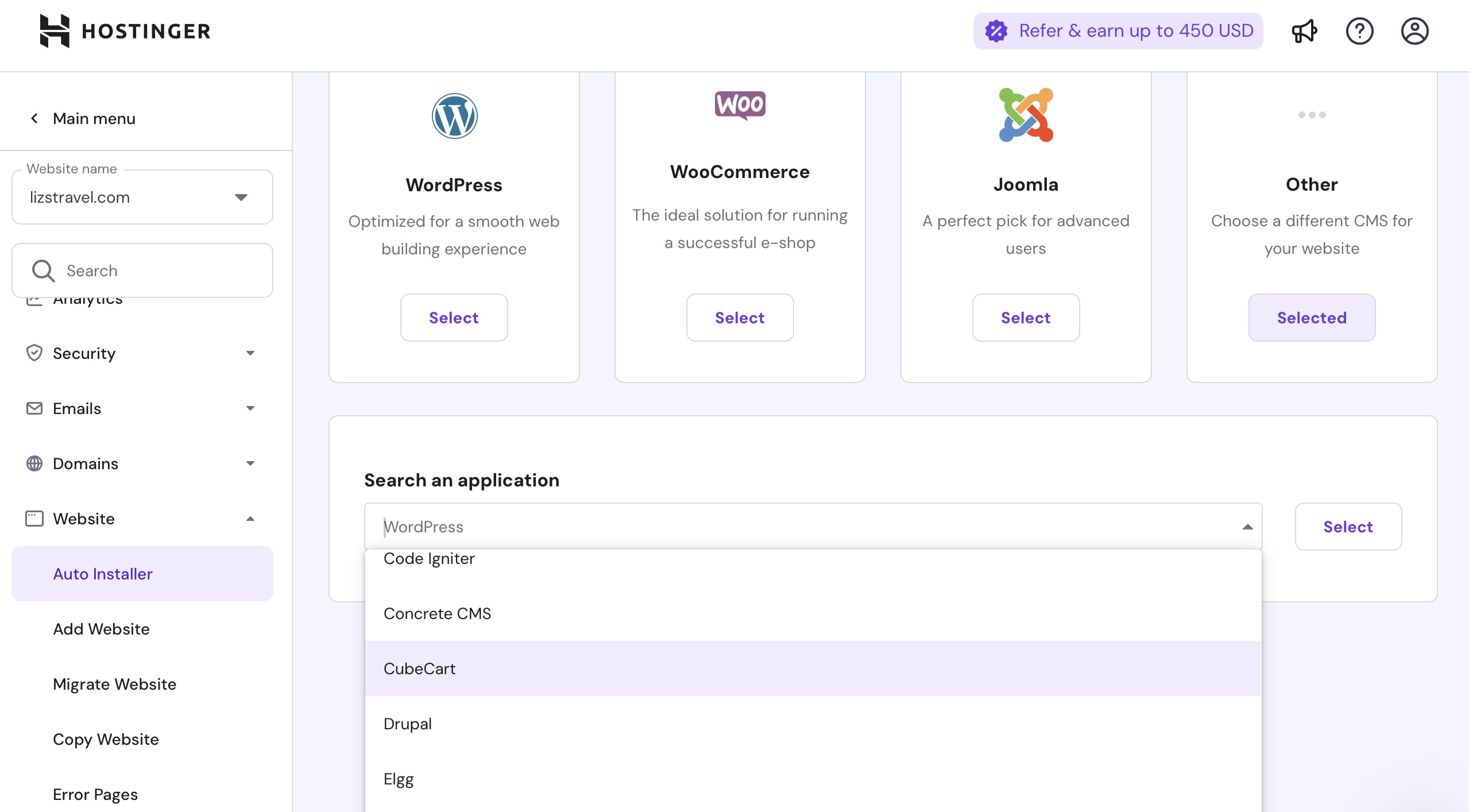
Under the “Other” section, click Select.
From the dropdown menu, choose CubeCart.
Click Select.
A pop-up window will appear to configure your CubeCart installation. To keep it separate from your main site, it’s recommended that you install CubeCart in a subdirectory of your website (e.g., `yourdomain.com/store`).
During these next steps, you must assign a Website Title, Administrator Email, Administrator Username, and Administrator Password at the top of the pop-up window.
Next, click Advanced, then:
In the Enter Subdirectory box, type the name you want for your subdirectory (e.g., `ls`, `store`, `cubecart`).
Ensure “Create new database” is selected, and then assign a strong password for this new database.
Advertisement
Final steps
(Image credit: Future)
It’s time to set up CubeCart using the new site’s administrator control panel. This page is tricky to find because of how it’s set up. Many installations include an “admin.php” file for this, but CubeCart does not. For security purposes, it changes the name of this file to something like “admin_xkdlsdf.php.” That’s the location where you’ll find the control panel.
You can go into the FTP section of Hostinger to find the example name of this file.
In my example, I installed CubeCart as a subdirectory for my website called “store.” Therefore, the control panel is located at http://mywebsitename.com/store/admin.xkdlsdf.php.
You can log in from this page using the credentials you created above. On the next page, you can set-up CubeCart to your liking.
Some teachers say the efforts are helping, at least a little… To engage students, teachers say they often feel the need to deliver teaching not only in shorter bursts, but also in more entertaining ways. “The new word is ‘edutainment,’” said Curtis Finch, superintendent of Deer Valley Unified School District in Arizona. “How can you make your lesson applicable, interactive? Teachers are going to have to be more engaging for students….”
In a kindergarten classroom at McKinley STEAM [a K-8 public school], students start the day with a meditation. The classroom of two dozen children is perhaps its quietest during this short activity every morning. Imagine you’re in the Arctic, a voice from a meditation video tells them, with snowflakes melting on your skin. Silently, the children lay down on the carpet and close their eyes for a moment. After the meditation, the students gather in a circle and do a few deep breathing exercises before taking turns proclaiming what they are capable of each day. “I can be a good student,” one little boy said before the child next to him replied: “I can listen to the teacher.” The goal is that these mantras will stay with the children hours later, when they have to sit through the more tedious lessons of the day. An instructional coach at McKinley STEAM says the strategies are working students aren’t reaching for their phones during class and sometimes actually get drawn into lessons.
The article also explains why some teachers find this necessary:
Advertisement
In recent years, educators say, it has grown more challenging to get students to pay attention. Eighty-eight percent of respondents in an international survey from 2025 of more than 3,000 teachers believed their students’ attention spans were getting shorter. In a study published last year about kindergarten through second-grade classrooms in the United States, 75 percent of teachers said attention spans had dropped since the coronavirus pandemic, when the use of laptops and other technology for schooling spread rapidly. A growing body of research says that excessive screen time and short-form content such as TikTok videos are part of the problem. At least 36 states, including Ohio, have laws requiring schools to have some form of a cellphone ban.
There is debate over whether screen time reduces people’s ability to focus or their desire to — many developmental experts lean toward the latter, suggesting that it is possible to help students regain longer attention spans.
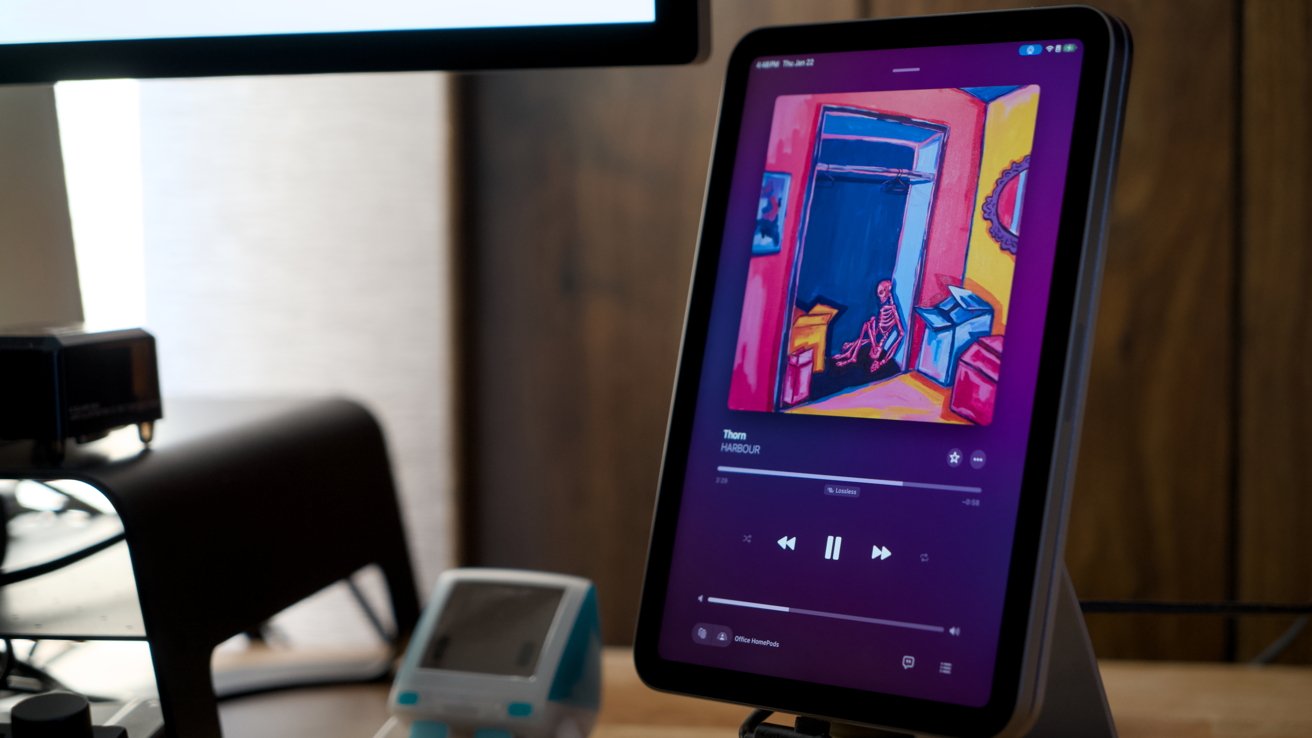
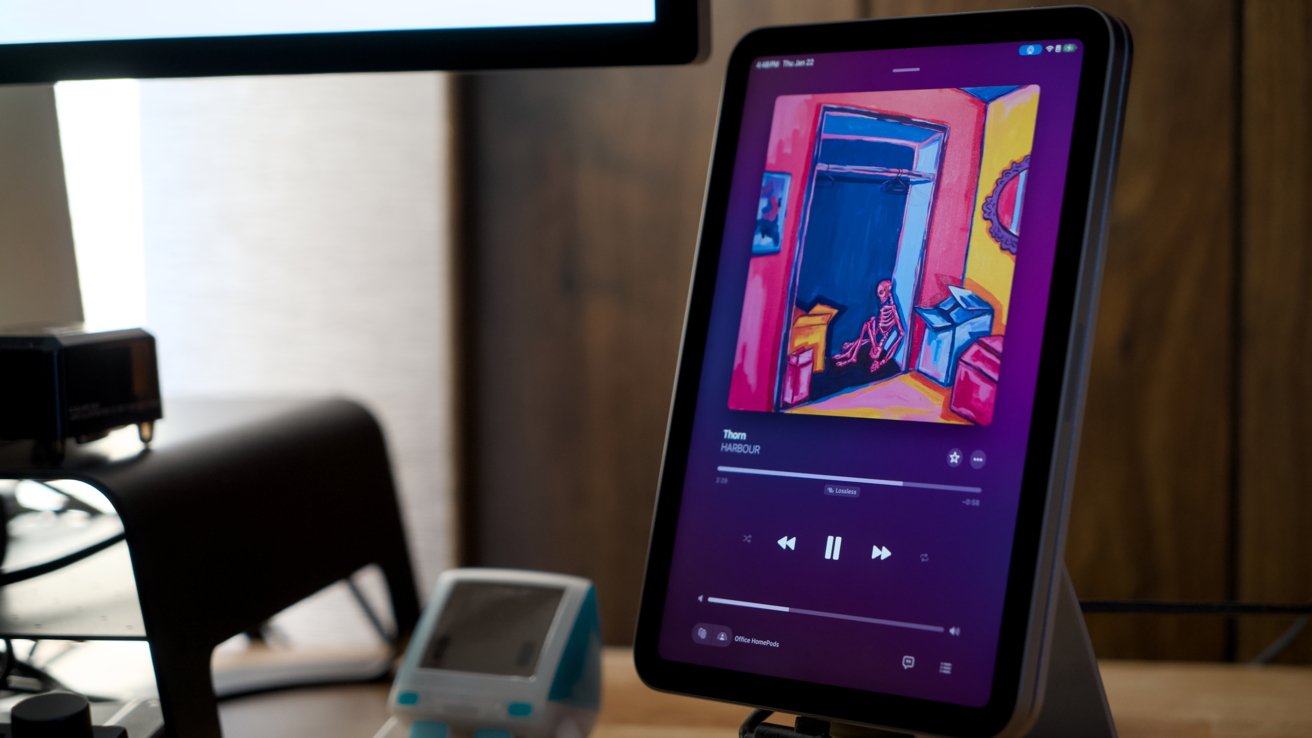
The long-awaited Apple Home Hub and more will finally arrive thanks to the revamped Apple Foundation Models trained by Google Gemini. The release window is still in question, though.
Apple’s Home Hub tablet will attach to various products via magnets
There have been rumors about various AI-centered products for years. However, their release has been pushed back with each Apple Intelligence upgrade delay. According to thePower On newsletter, Apple is focused on releasing three AI-powered smart home products. This is repeat information shared on Thursday with details that have been repeated ad nauseam since the products have been ready for production for some time. Rumor Score: 🤯 Likely Continue Reading on AppleInsider | Discuss on our Forums
The Dodge Stratus R/T was a sporty coupe that was discontinued in 2006 — over 20 years ago — due to its lack of sales. Mid-size vehicles were losing out to full-size sedans around that time (the 2007 sixth-generation Dodge Charger offered more power and more muscle), causing automakers to pivot. Since then, you probably haven’t heard much about the Stratus R/T. There doesn’t seem to be a lot of hype around it, with good-condition examples selling at auction for just a few thousand dollars. While there may not be a ton of people jumping to buy a used Stratus R/T in 2026, that doesn’t meant there aren’t fans of the car with fond memories of driving it in the 2000s.
While the Dodge Stratus R/T may have not stood out enough back in the day, the ones who did notice it were drawn in by its affordability. It was a way to get a fun, sporty manual car for less money. The 2002 Stratus R/T was $17,755 when new (about $32,600 in 2026 dollars), offering drivers a 200 horsepower car that fans felt was just enough to make it feel pretty zippy. While that may not have offered the best performance out there, it was enough to have fun. And it had the looks to match — it came with a sporty-looking rear wing. One owner on Cars.com reported: “I think its styling is so unique. Kind of looks like a Maserati from the front. The women at work think it’s an exotic sports car.”
Advertisement
Is the Dodge Stratus R/T as unreliable as they say?
One of the reasons the Dodge Stratus R/T lost sales over time was due to reports that it was unreliable. The 2.7L V6 engine gained notoriety for early failure due to a common oil sludge buildup issue. Drivers across social media have continued to lament about the downfall of the otherwise handsome and fun Stratus R/T due to the engine — there is even a website dedicated to the notorious oil sludge horrors of Chrysler’s 2.7L V6 engine.
However, long-time Dodge Stratus R/T owners would beg to differ. You’ll find those that have driven their Stratus R/T on the daily for nearly 20 years without any issue. Some examples are even nearing 200,000 miles on the odometer and have owners reporting that it’s still smooth sailing. Many Stratus R/T drivers have noted that the little coupe can handle severe weather, gets decent mileage, and offers a pretty exciting driving experience if you opt for the manual transmission.
Advertisement
While the Stratus R/T may not be the most iconic sporty 2000s car out there, those that drive it will stick up for it with passion, with many calling it the best car they’ve ever owned after decades of memories. Even SlashGear has called it an underrated Dodge model, often forgotten in conversations where it belongs.
XChat, the standalone app for accessing X’s messaging feature, is available to download now for iOS. X first suggested it would be stripping direct messaging from X in 2025, but at least for now, XChat is available in the original X app, the web and this new app.
Based on its launch video, the new XChat app offers many of the elements of modern messaging X had already introduced to its chats feature, like the ability to delete and edit messages, block screenshots and send disappearing messages. The new XChat app also supports video and audio calls, and X claims that all messages sent with XChat are end-to-end encrypted.
XChat will also be expected to be the home of any groups that formed around X’s Communities feature. The social platform recently announced that it was retiring Communities at the end of May, and suggested that XChat’s support for larger group chats could be a worthwhile alternative. XChat’s group chats can currently have 350 participants, but X plans to expand that number in the future.
Elon Musk’s original pitch after he rebranded Twitter as X, was to turn the platform into an “everything app,” where things like an algorithmic feed, messaging, job boards and even payments could exist side-by-side. A standalone messaging app seems like the exact opposite of that, but it might also reflect where X finds itself in 2026. The company is now a subsidiary of xAI, and xAI itself is part of SpaceX. Musk’s push into AI appears to be the going concern, and cloning something like WeChat might just be less important.
Utility technology company Itron, Inc. has disclosed that an unauthorized third party accessed some of its internal systems during a cyberattack.
The company states that it activated its cybersecurity response plan when detecting the activity last month, notified law enforcement authorities, and engaged external advisors to support the investigation and incident containment.
“On April 13, 2026, Itron, Inc. was notified that an unauthorized third party had gained access to certain of its systems,” the company says says in an 8-K filing with the U.S. Securities and Exchange Commission (SEC).
“The company activated its cybersecurity response plan and launched an investigation with the support of external advisors to assess, mitigate, remediate, and contain the unauthorized activity.”
The unauthorized activity has now been blocked, and the company stated that it has observed no follow-up activity.
Advertisement
Itron is a Washington-based public company that provides utility technology products and services for energy and water resources management.
The company is listed on NASDAQ, employs roughly 5,600 people, and in 2025 reported revenue of $2.4 billion. It serves 7,700 customers in 100 countries and manages 112 million endpoints.
Itron’s business is interwoven with critical infrastructure such as electricity grids, water distribution, and gas networks.
However, the company noted that in this case, business operations recorded no material disruption, and it does not currently expect any subsequent impact. Also, it expects a significant portion of incident-related costs to be covered by insurance.
Advertisement
Itron has also noted that the unauthorized activity did not extend to customers. However, it’s important to note that the investigation into the incident’s scope and impact is still ongoing.
No ransomware group has claimed the attack on Itron. BleepingComputer contacted Itron with a request for more details about the attack and will update this post once we hear back.
AI chained four zero-days into one exploit that bypassed both renderer and OS sandboxes. A wave of new exploits is coming.
At the Autonomous Validation Summit (May 12 & 14), see how autonomous, context-rich validation finds what’s exploitable, proves controls hold, and closes the remediation loop.
The company also launched the latest iteration of its TPUs.
Google has made a series of new enterprise-focused launches, including a new platform to build and manage AI agents and the latest generation of its AI-specific Tensor Processing Units (TPU), as competition between tech giants targeting the lucrative enterprise sector continues to intensify.
The announcements were made at the company’s annual Cloud Next conference in Las Vegas yesterday (22 April), with around 32,000 in attendance.
There is no shortage of companies offering agentic AI services, including OpenAI, Anthropic, Microsoft and China’s Alibaba, among more, with Google being the latest to join the enterprise AI race.
To bolster its positioning, Google launched a new Gemini Enterprise Agent platform to build scale, govern, and optimise agents.
Users can manage aspects of the agents and deliver them through the company’s existing Gemini Enterprise platform, which saw a 40pc growth in paid monthly active users quarter-to-quarter in Q1.
The new launch is Google’s answer to Amazon’s Bedrock AgentCore and Microsoft Foundry.
Advertisement
The agent platform provides access to Gemini 3.1 Pro – Google’s most advanced model yet – the viral Nano Banana 2, audio model Lyria 3, and leading models from Anthropic, including Claude Opus, Sonnet, Haiku and Claude Opus 4.7.
Plus, a central monitoring unit lets users oversee and guide all agents from one location.
“The agentic enterprise is real – and deployed at a scale the world has never before seen,” said Thomas Kurian, Google Cloud’s CEO.
In a blogpost on the company’s site, CEO Sundar Pichai noted: “The conversation has gone from ‘Can we build an agent?’ to ‘How do we manage thousands of them?’”
Advertisement
Alongside this, Google is adding to its vertical stack offerings with a new cybersecurity platform that combines Google’s Threat Intelligence and Security Operations with Wiz’s cloud and AI security platform to detect and respond to threats.
Moreover, the company also launched the latest iteration of its TPUs, but this time, separating them into two distinct processors. Both chips will become available later this year.
TPU 8t will be used for “accelerated” training, while 8i will be used for “near-zero latency” inference, the company said.
These new systems are key components of Google Cloud’s AI Hypercomputer, an integrated supercomputing architecture that combines hardware, software and networking to power the full AI life cycle, Google said.
Advertisement
Don’t miss out on the knowledge you need to succeed. Sign up for the Daily Brief, Silicon Republic’s digest of need-to-know sci-tech news.
Jury selection begins Monday in Musk v. Altman, the federal trial over whether OpenAI’s nonprofit-to-profit conversion constitutes unjust enrichment and breach of charitable trust. Musk dropped fraud claims Friday to sharpen focus on the two remaining counts. The most damaging evidence is Greg Brockman’s 2017 diary entry calling the nonprofit commitment “a lie.” Judge Gonzalez Rogers found “ample evidence” and rejected nearly every dismissal attempt. The advisory jury will hear testimony from Musk, Altman, Nadella, Murati, and Sutskever, but the judge alone decides remedies, which could include $150 billion in damages and the unwinding of the conversion.
Jury selection begins Monday in Oakland federal court for the trial that will determine whether OpenAI’s conversion from a nonprofit to one of the most valuable companies in the world was a breach of charitable trust. Elon Musk, who co-founded OpenAI in 2015 and donated at least $38 million to it, is suing Sam Altman, Greg Brockman, and OpenAI on two remaining claims: unjust enrichment and breach of charitable trust. He wants up to $150 billion in damages directed to the nonprofit arm, the ouster of Altman and Brockman from leadership, and a court order unwinding the for-profit conversion. On Friday, Musk voluntarily dropped his fraud and constructive fraud claims, narrowing the case from 26 claims to two but sharpening the focus on the question that has defined the dispute since it began: did OpenAI’s leadership promise a nonprofit and build a $852 billion company instead?
Advertisement
The evidence
The most damaging piece of evidence in the case is not an email from Sam Altman. It is a diary entry from Greg Brockman, OpenAI’s co-founder and president, written in 2017: “I cannot believe that we committed to non-profit if three months later we’re doing b-corp then it was a lie.” Judge Yvonne Gonzalez Rogers, who is presiding over the case and who will make the final ruling on remedies if the jury finds liability, cited that entry directly in her January 15 ruling that sent the case to trial. She found “ample evidence” supporting Musk’s claims and rejected “nearly every attempt by OpenAI and Microsoft to make the lawsuit disappear.” The ruling was a 28-page signal that the court considers the case serious enough for a jury to hear, which in itself is a significant validation of the underlying allegations.
Musk’s legal team has also produced a 2017 email in which Altman claimed he remained “enthusiastic about the non-profit structure” after Musk threatened to cut off funding, a statement that Musk’s attorneys frame as a misrepresentation designed to keep donations flowing while leadership privately planned a different path. Hundreds of pages of discovery materials unsealed from depositions in the autumn of 2025 include emails, texts, and Slack messages that Musk’s team says show leadership “said one thing publicly and planned something completely different privately.” A February 2023 text from Altman to Musk, sent after Musk had publicly criticised OpenAI, read: “You’re my hero and that’s what it feels like when you attack OpenAI.” The witness list reads like a Silicon Valley tell-all: Musk, Altman, Microsoft CEO Satya Nadella, former OpenAI CTO Mira Murati, co-founder Ilya Sutskever, and Shivon Zilis.
OpenAI has called the lawsuit “baseless” and described it as a “harassment campaign that’s driven by ego, jealousy and a desire to slow down a competitor.” The competitor is xAI, the AI company Musk founded in 2023 and recently merged with SpaceX in an all-stock transaction valuing the combined entity at $1.25 trillion.Musk’s own AI venture was folded into SpaceX in a $1.25 trillion all-stock dealthat raised its own corporate governance questions, a fact OpenAI’s defence team will use to argue that Musk’s motivations are competitive rather than charitable. OpenAI contends that Musk left the board in February 2018, reneged on a larger planned donation, and has no standing to dictate the organisation’s structure years after his departure. Judge Gonzalez Rogers herself noted that “this country likes competition,” flagging the potential self-interest in Musk’s claims.
The structural defence is that OpenAI’s conversion was reviewed by attorneys general in both California and Delaware, that the nonprofit entity now operates as the OpenAI Foundation holding approximately 26% of the company’s valuation, roughly $130 billion, and that the Foundation retains oversight of mission alignment and the ability to appoint members of the for-profit board.The $25 billion commitment the Foundation announced when OpenAI completed its recapitalisationmakes it one of the most well-endowed philanthropic organisations in the world. OpenAI argues this structure preserves the charitable mission while enabling the scale of investment required to pursue artificial general intelligence. Altman, Brockman, and Microsoft have all denied wrongdoing.
The structure
The trial structure is unusual. The nine-member jury’s verdict on liability will be advisory only. Judge Gonzalez Rogers, not the jury, will make the final determination on both liability and remedies. Opening arguments are expected Tuesday. The liability phase runs through mid-May. If OpenAI is found liable, the remedies phase begins May 18, where the court will consider Musk’s requests for damages, the ouster of leadership, and the unwinding of the conversion. The advisory jury format means that even a unanimous jury verdict does not bind the judge, but a strong jury consensus would carry significant moral authority in the judge’s deliberations.
Advertisement
Musk’s decision to drop the fraud claims on Friday was strategic, not a concession. Fraud requires proving intentional deception, a higher evidentiary bar that would have diverted the trial into arguments about Altman’s state of mind. Unjust enrichment and breach of charitable trust focus on outcomes rather than intent: did the conversion enrich insiders at the expense of the charitable mission, and did it violate the trust under which the nonprofit’s assets were held? These claims are easier to prove because the facts are largely undisputed. OpenAI was founded as a nonprofit. It converted to a for-profit. Its leaders hold equity in the for-profit entity. The question is whether that sequence constitutes a legal violation, not whether anyone intended it to be one. In his April 2026 amendment, Musk asked that Altman and Brockman be required to hand over “all equity and other personal financial benefits they obtained as a result of OpenAI’s for-profit operations” to the OpenAI charity.
OpenAI quickly stepped in to fill Anthropic’s Pentagon contract with no usage restrictionsafter Anthropic refused the military work on principled grounds, a contrast that has become part of the broader governance debate about whether OpenAI’s “benefit all of humanity” charter survived the conversion. Eyes on OpenAI, a coalition of more than 60 California nonprofits, has separately argued that the restructuring deal is “full of holes” and could establish a precedent for startups to use nonprofit status for tax advantages before converting to for-profit. Public Citizen and the San Francisco Foundation have urged the California attorney general to ensure that conversion payments go to a new, independent charitable enterprise rather than one controlled by the same leadership that approved the conversion.
The trial is not only about OpenAI. It is about whether the nonprofit-to-profit conversion model is legally sustainable in AI. OpenAI was not the first technology organisation to start as a nonprofit and accumulate enormous value. Mozilla did. Wikipedia resisted. The question the Oakland courtroom will address over the next month is whether the people who built OpenAI with charitable donations and a stated commitment to benefit humanity can legally convert that work into an $852 billion for-profit enterprise and keep the equity. Musk says they cannot. Altman says the conversion serves the mission better than the original structure ever could. Brockman’s diary says it was a lie. The jury will hear all of it, and the judge will decide what it means.






















































You must be logged in to post a comment Login