
TL;DR
Parafin secured a Goldman Sachs-led credit facility to scale embedded small business lending through Amazon, DoorDash, Walmart, and TikTok Shop.



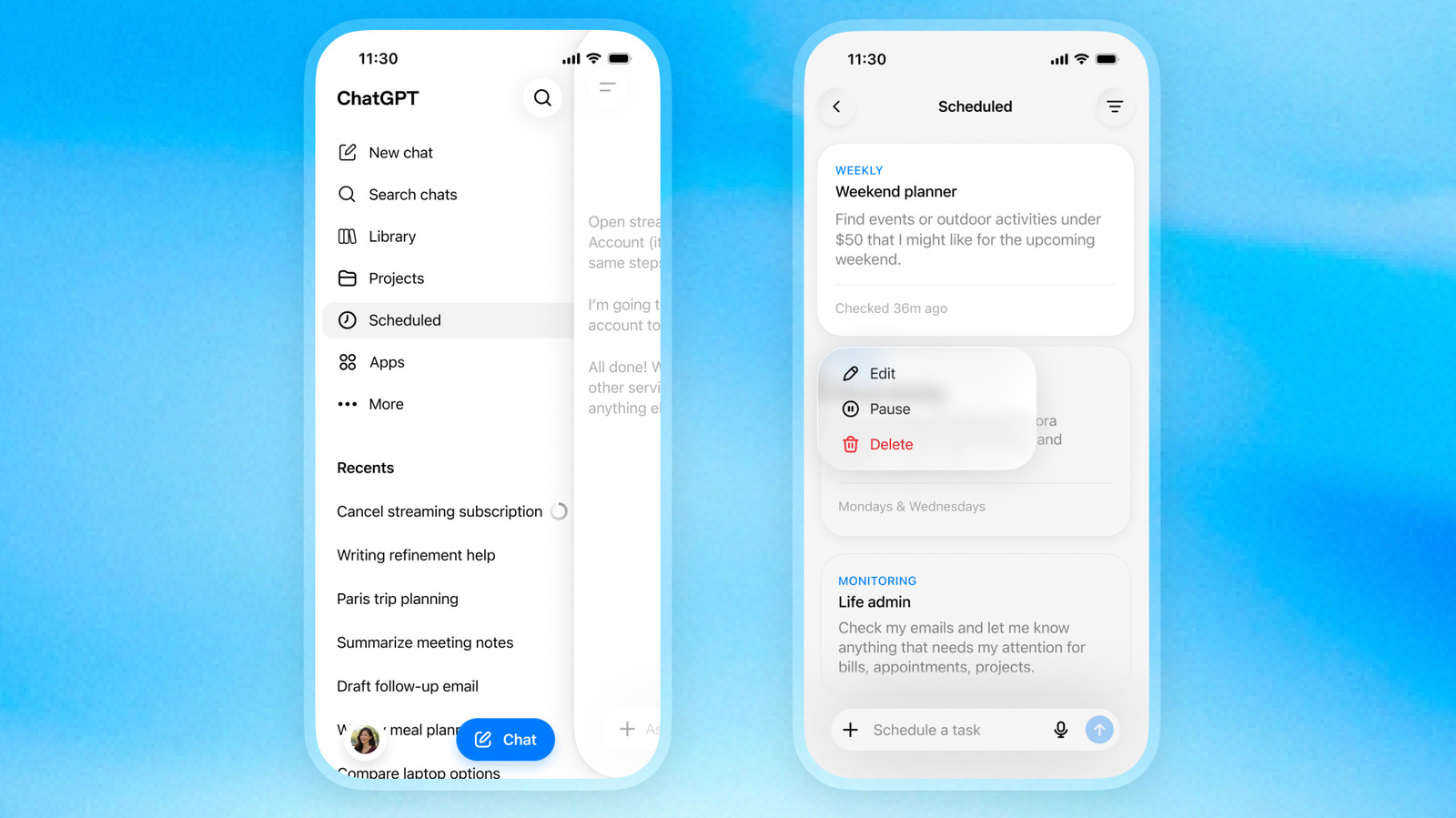
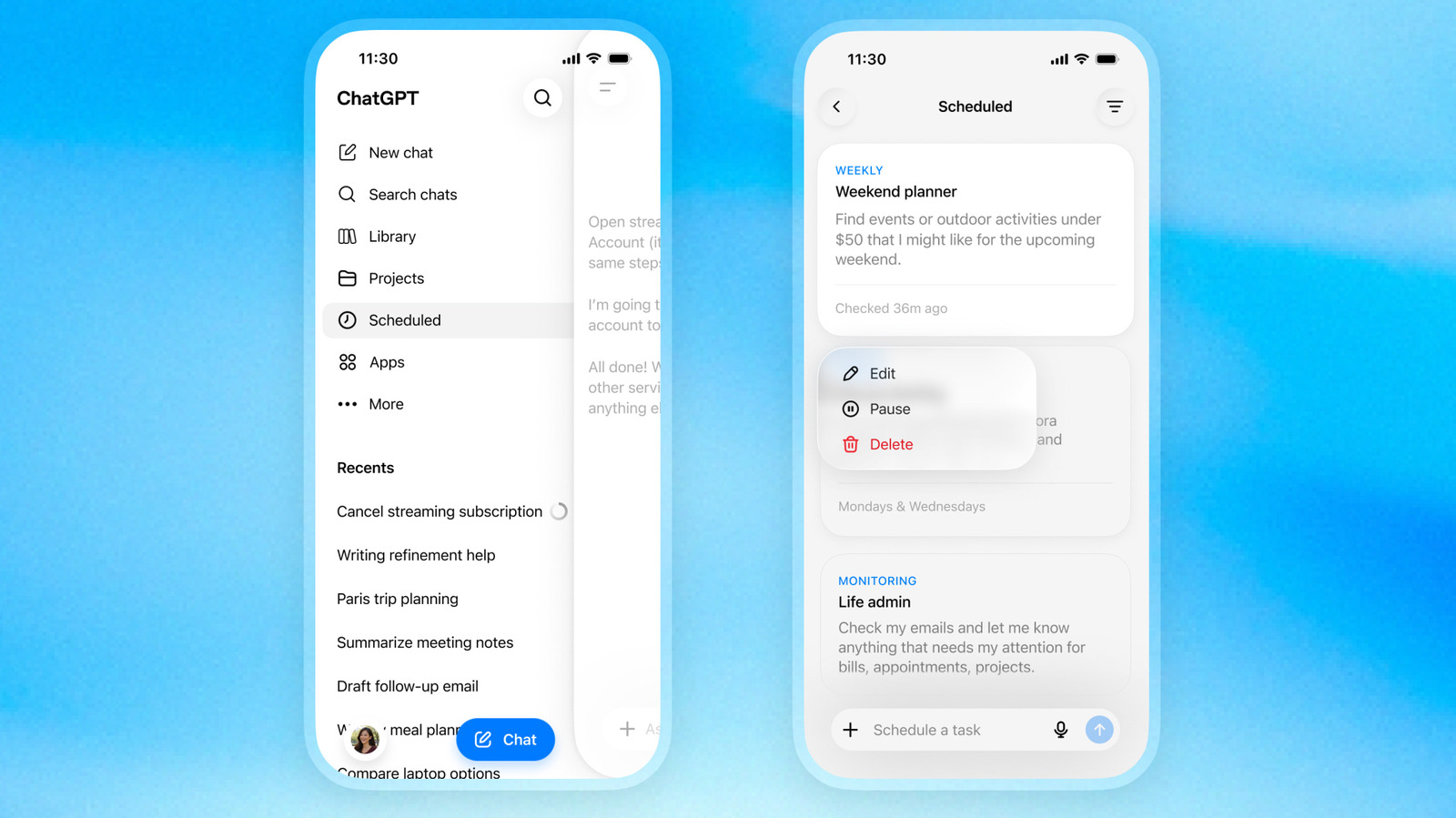
Did you know you could schedule tasks in ChatGPT? I’ll be honest, I never thought to ask OpenAI’s chatbot to do something in the future, and it seems like a lot of you didn’t either, because the company has begun rolling out an update that better highlights ChatGPT’s ability to do just that.
The next time you open ChatGPT’s sidebar, you’ll see a shortcut to a new Scheduled page that gives you a place to see any active tasks you might have assigned to ChatGPT, including when they’re set to run. From this page, you can also pause, edit and delete any upcoming requests. At the same time, OpenAI has made ChatGPT’s ability to handle scheduled prompts more robust, stating “all tasks are faster and more reliable.” What’s more, when you ask the chatbot to do something in the future, you can either tell it to complete that task at a specific time or sometime during a broader timeframe, such as the morning, afternoon or evening.
New in ChatGPT: a better way to schedule tasks.
Scheduled tasks are faster, more reliable, and easier to manage from the new Scheduled page.
The new scheduled tasks experience is rolling out to Go, Plus, Pro, Business, and Enterprise users on web and mobile. pic.twitter.com/YC7JON6Hxn
— ChatGPT (@ChatGPTapp) June 17, 2026
As you can see from the video OpenAI shared, it’s also possible to set up monitoring tasks, which will see ChatGPT proactively search the web or your connected apps on your behalf. OpenAI is rolling out Scheduled tasks to Plus, Pro, Business and Enterprise customers. No word yet on when the Free tier might get access. With today’s update, OpenAI is also sunsetting Pulse, the personalized daily summaries the company began offering last year. Pro users can continue using the feature for the next 14 days. After that point, you can use the new scheduling hub to generate future summaries.


Public sector
Every buzzword deployed in quest to transform into ‘country that is equipped for an AI world’
The UK Cabinet Office is looking for an AI and Innovation Director who can develop civil servants’ use of artificial intelligence and change the way the civil service works.
The task of persuading public sector workers to love AI involves “re-imagining the future workforce and business model” for the UK’s civil service, promoting adoption of AI tools, “championing, coordinating, and tracking AI adoption” across government departments, and instilling an “AI-first culture,” according to the job advert.
As that list implies, the individual will need to be “a natural influencer” with a “deep understanding of the AI landscape,” both traditional and generative, ideally with experience of building AI services.
“My ambition is for the civil service to be a global leader in AI government transformation, to enable a more productive civil service that achieves world-class outcomes for citizens and a country that is equipped for an AI world,” writes Cabinet Secretary Antonia Romeo in an information pack published with the job ad. “We are seeking an exceptional individual who is an experienced strategic leader, can deliver under pressure, and will help shape the direction of the civil service at a pivotal time.”
The exceptional individual in question will need to be content to serve King and country for a relatively modest £100,000 to £163,000 a year, albeit with generous pension contributions, compared with some private sector equivalents. They will have to agree to an expected assignment period of at least three years, although this is not contractual, and be British, a national of most European countries, or any Commonwealth country. The right to work in the UK is another requirement.
Reg readers who fit the bill can apply by submitting a CV and a 1,000-word statement about why they are suitable by five minutes to midnight on Monday, July 13. While candidates can use AI in applying, “all examples and statements provided must be truthful, factually accurate, and taken directly from your own experience,” so perhaps championing AI adoption should wait until after getting the job given the technology’s propensity to make things up. ®


Parafin secured a Goldman Sachs-led credit facility to scale embedded small business lending through Amazon, DoorDash, Walmart, and TikTok Shop.
Parafin, an embedded financial infrastructure company on the 2026 Forbes Fintech 50 list, has secured a new credit facility led by Goldman Sachs alongside One William Street Capital Management. The facility will expand access to embedded lending for small businesses through platforms including Amazon, DoorDash, Gusto, TikTok Shop, and Walmart.
The company’s model is straightforward. Instead of applying to a bank, a small business selling on Amazon or delivering through DoorDash gets financing offers built into the platform it already uses. The capital helps with cash flow, growth investment, and day-to-day operations. Parafin handles the underwriting, servicing, compliance, and customer support behind the scenes.
The numbers show the model works. Parafin has funded more than 50,000 businesses to date and extended over $35 billion in offers across the US and Canada. The majority of fundings go to repeat borrowers, a signal that the product solves a recurring need rather than a one-time problem.
“Small businesses increasingly expect financial products to be built into the software and platforms they already use to run their businesses,” said CEO Sahill Poddar. “Embedded lending is becoming a critical part of how businesses access capital.”
The Goldman Sachs facility builds on a recent warehouse credit expansion with Silicon Valley Bank, EverBank, and Trinity Capital. The additional capacity supports financing products that help businesses manage cash flow and invest in growth. Parafin was founded in 2020 by Poddar, Vineet Goel, and Ralph Furman, and is backed by Ribbit Capital, Thrive Capital, GIC, Notable Capital, and Redpoint Ventures.
The deal reflects a broader shift in how small businesses access capital. Traditional bank lending requires separate applications, credit checks, and weeks of processing. Embedded lending companies like Capchase have shown that financing built into existing workflows converts better and retains borrowers longer. Parafin applies the same logic at the small business level, where the platform is not Salesforce but Amazon or DoorDash.
The repeat borrower rate is the metric that matters most. It means the product is not just accessible but useful enough that businesses return. For Goldman Sachs, the credit facility is a way to deploy capital into a lending channel that traditional bank branches cannot reach. For the fintech infrastructure market, Parafin’s growth confirms that the platforms where businesses already operate are becoming the default distribution channel for financial products.

When a water-treatment plant outside Denver discovered an algae problem in its pipes, it did not call an engineering firm. It called the students.
The aquatic robotics team at the Innovation Center at St. Vrain Valley Schools in Longmont, Colorado, sent underwater robots into the facility, collected data, identified the algae species and helped eradicate it. The plant now contracts with the student team for quarterly checkups. Neighboring towns have started calling, too.
This is not a simulation or a classroom exercise conjured up to look like real work. It is real work, and it reflects a broader shift underway in districts. Increasingly, schools are building career learning pathways that connect students directly with professional challenges, industry mentors and, in some cases, a paycheck.
The urgency behind these efforts is hard to ignore. A 2023 review from the American Institutes for Research, drawing on two decades of studies, found that career and technical education participation has statistically significant positive impacts on academic achievement, high school completion, employability skills and college readiness.
The question districts are now wrestling with is not whether to offer career pathways, but whether those pathways lead anywhere real.
Policy leaders are paying attention. The Education Commission of the States has identified building aligned career pathways and removing barriers to economic opportunity as one of its top priorities through 2027.
At St. Vrain, Assistant Superintendent of Innovation Joe McBreen has spent years trying to answer that question through a program known as project teams.
After school each day, roughly 264 students log in at the district’s Innovation Center and begin work as paid district employees, billing hours against accounts for actual clients. Students can join a drone show team, a cybersecurity unit, an AI development group or a dozen other teams, rotating among them as their interests evolve.
“It’s low threat, high reward,” says McBreen. “Students get paid, grow their network, develop soft skills and test drive careers. And if they get into a team and realize it’s not for them, there’s real value in that, too.”
NEWSLETTERS
Sign up for EdSurge newsletters for timely news, insights and analysis.
The model relies heavily on industry mentors who bring in real work rather than invented classroom projects. Damon Brown, a senior cybersecurity adviser for the U.S. Department of State focused on Ecuador, mentored seven St. Vrain students on a complex assignment.
He asked them to design the architecture for a cyber intelligence fusion center using open-source tools — work that could have cost hundreds of thousands of dollars if contracted from a professional firm.
“The students knocked it out of the park,” says Brown.
They built the system architecture, wrote user manuals, recommended equipment and conducted a threat analysis of countries surrounding Ecuador. Brown was so impressed he is now hiring six St. Vrain interns.
“This experience binds people together,” he says.
The program also has a way of growing in unexpected directions. After one student’s grandparent was victimized by a cybercrime, the cybersecurity team created an awareness curriculum for senior citizens. They taught five classes to 24 senior citizens in the first year; the second session was standing room only. Senior facilities now pay the students to come in and teach.
Meanwhile, the drone team flies commercial shows for companies across the country on Friday afternoons, billing clients at rates few drone pilots in the country can match. One former member is now studying aerospace engineering and using money from drone flying to help pay for college.
St. Vrain’s work has drawn attention from educators around the country, some of whom are adapting pieces of the model to fit their own communities.
Kris Hagel, chief information officer of Peninsula School District in Washington state, visited the Innovation Center and came away convinced he could build something similar.
Two years ago, Peninsula launched a paid drone internship program, starting with seven students and gradually expanding. Students work alongside industry partners while learning how to navigate FAA regulations, program autonomous flight paths and repair drones.
“When you’re willing to look at what’s cutting edge and think innovatively without being constrained by traditional systems, you can create opportunities for kids that transcend what we think of as traditional education,” says Hagel. “This program has become so much more than I thought was possible.”
The district partnered with Firefly Drone Systems, one of the few American drone manufacturers, to train students and help them operate drone shows.
The program also includes multiple roles beyond piloting, including marketing, animation design and equipment maintenance. Hagel envisions a future where students studying business management hire other students to operate the program.
A skilled drone operator who leaves high school with the capital to purchase equipment can enter a six-figure career almost immediately, says Hagel.
Not every district is building toward robotics contracts or drone shows. For Michele Davis, CTE department chair at Metropolitan School District of Steuben County in Indiana, the real-world pathway is entrepreneurship.
Working with the StartED Up Foundation, Davis guides students through a three-year sequence: identifying an actual problem, developing a solution, building out the business model and presenting it to real audiences.
Students take “opportunity walks” around the school, documenting everyday frustrations and brainstorming solutions. They learn how to market their ideas professionally by practicing elevator pitches, presenting case studies to various audiences and explaining their ideas to elementary school students.
“Opportunities are everywhere,” says Davis.
The ideas that emerge can be surprisingly practical. One student designed a reversible outfit to solve a quick-change problem in theater productions. Another class developed a mobile trailer concept that could help unhoused people access hygiene services.
Beyond the business concepts themselves, Davis says the program focuses heavily on communication skills and confidence. “We get students comfortable doing things that are normally uncomfortable,” she says.
At Suffern Central School District in Rockland County, New York, Superintendent P. Erik Gundersen has taken yet another approach.
Through a partnership with the League of Innovative Schools and curriculum provider Paradigm, the district launched a three-year cybersecurity certification pathway embedded directly into the high school. About 60 students are currently enrolled.
The program was designed to reach students who might not otherwise see themselves in a cybersecurity career. The district actively recruited students from immigrant communities and others who are new to the U.S.
Students work in a “sandbox” environment that simulates real cyber incidents, allowing them to practice identifying threats and responding to attacks.
“The means to send a kid to college is not as great as it was, and a lot of what we’re reading questions the importance of a college education,” says Gundersen.
Those economic realities, he says, are pushing districts to rethink how they prepare students for the workforce.
Career credentials embedded with traditional high schools can open doors for students who may not otherwise have clear pathways into high-skill industries.
Across these programs, the details vary widely, but the philosophy is the same: Authentic experience is not a supplement to education. It is education.
As McBreen says, “I encourage districts to expand their vision. Anyone can do this. Start small.”

The company pretty much invented the hardware superstore when it began in 1978, just by being so big. They inflated the neighborhood tool shop into a whole city of lumber, hammers, caulk, power saws, and big rolls of wire. I would know I’m in a Home Depot blindfolded, because of a distinct quality to the air—crisp and particulate, smelling like wood dust and paint and the oiled metal of power tools. The Home Depot smell is buried deep in my childhood, filed somewhere between “building a deck” and “first day of spring.” Anyway, the Home Depot website is just as big. And while it doesn’t smell like sawdust, it’s easier to find stuff. Our roundup includes Home Depot promo codes from 20% to $100 off, new customer coupons, free shipping offers, and Pro discounts to drop prices by as much as 50% when you buy online.
If you register for Home Depot’s Style and Decor newsletter, you get a special code for 10% off on furniture and home accents. Otherwise, you can sign up for the Home Depot coupon newsletter or text alerts to get an immediate $5 off the next in-store purchase of $50 or more. Another easy way to save sitewide at Home Depot is to set up a subscription for your go to products and automatically get 5% off and free delivery on your order.
If you already shop a lot at Home Depot and are looking for other ways to save, signing up for The Home Depot’s Promo Text Program is a good idea. You’ll receive text messages with special promotions, offers, how-to guides for projects, and great design ideas. Plus, you’ll get $5 off your next purchase when you sign up.
Home Depot deals are in full swing with huge discounts on a myriad of gifts and home project-related items, like 10% off flooring for Pro members with promo code SAMPLESAVE10, or 20% off Electrolux handheld electronics with code ELECTROLUX20, like the ever-popular Electrolux handheld garment steamer. There are also offers for free tools with battery kit purchases, and buy one get one free deals from top names like Milwaukee, DEWALT, and RYOBI.
Power tools and hand tools are discounted up to 50% this season, as well as extremely handy lawn and outdoor power equipment that can help with shoveling and general pesky snow removal and home upkeep.
Summer’s here and that means rising temperatures, longer days, and higher heat index. Don’t be caught in the next heat wave without being prepared. With this Home Depot coupon, you can get up to 30% off air conditioners, plus everything else you need to stay cool like fans, smart thermostats, and more. This means saving hundreds on potentially lifesaving (and house-cooling) devices from top air conditioning brands like Midea, Windmill, LG, GE, Frigidaire, and more.
The best grills now offer a fair amount of tech to measure and control temperature (think: temperature probes and fans to modulate airflow). The WIRED Reviews team has been testing grills for more than a decade—searing, smoking, grilling, and even baking on them in all kinds of weather—to find the best choice for everyone. And Home Depot has a wide selection of grills for up to 15% off online right now. Get ready for outdoor summer grilling for less with Home Depot’s discounted grills—there’s something for every type of home chef, including gas, charcoal, pellet, portable, and kamado grills, plus smokers.
And as it turns out, the hardware giant also goes hard on discounts, slashing grills and garden and outdoor power tools by up to 50%, not to mention smokers like the new Traieger Woodridge (8/10, WIRED Recommends) also sold at Home Depot.
But that’s not all; Home Depot is covering the whole house! There are appliance deals of up to $1,400 off appliances, $1,000 off washer and dryer sets, and bathroom deals of up to 40% off vanities, 25% off bathtubs, 20% off on toilets, and 15% off showers.
Plus, Home Depot has appliance bundle deals where you can get major discounts when you purchase multiple appliances at once.
Home Depot coupons of the moment include whopper deals like 15% off storage solutions, and 35% off washers and dryers. Explore more deals on kitchen and other furniture too, by checking out the deals of the moment here. Like we’ve stated, there are so many ways to save at Home Depot, even when you’re shopping online. Special Buy of the Days include steep price drops on certain products or entire brands—but the significant price drops only last for 24 hours. That’s a whole lot of savings for one of the most expensive home renovations you can do. Another saving hack? Ensure you jump on products marked with “New Lower Price” to find them at their lowest price yet.
Winter is a great time to stay inside and focus on home improvement projects. Home Depot has everything you need for remodels (including bulk buys). Right now, vinyl plank and tile flooring is up to 30% off, with options starting at 99 cents per square foot. Plus, power tool kit combos to save even more, with bundle deals of up to 70% off—including Deals of the day flash sales on tools, and appliances with rebates of up to $1,000. Deals include smart home items WIRED has covered extensively, like Nest learning thermostats (9/10, WIRED Recommends). Need advice on setting up a smart home? WIRED has your back. Not only do Deals of the Days (and over 1 million products) qualify for free shipping, but you can also get free delivery to your local Home Depot store or straight to your door with online orders over $45.
Home Depot also offers a loyalty program called Pro Xtra for frequent flyers, whether you’re a contractor or just undergoing a serious remodel this year. This means exclusive prices up to 20% off, 10% discounts on bulk buys, a rewards point system, and occasional $50 off $250 coupons too. Painting the house? The program also nets you 10 to 20% off paint and primers. Pro Xtra offers multiple tiers, from basic membership to Elite and VIP.
Special Buys of the Week are bargains that are worth checking out, and pros can get discounts with the Pro Special Buy of the Week—and that’s on top of exclusive coupons, bulk product discounts up to 20% off, and everyday discounted pricing on items. Hot offers this week include: free tools or batteries with your purchase of tools from Milwaukee, RYOBI, and more premium brands, plus 20% off flooring. Also grab 40% off bathroom products like Kohler showers, tubs, vanities, faucets, tubs, and toilets, including luxury upgrades like Horow smart toilets and bidets.
Home Depot has long maintained a program offering discounts to active service members, veterans, and their spouses, offering 10% off all eligible purchases. You’ll need to register to verify your military status through SheerID, and from then on you can just scan your virtual ID or enter your phone number at checkout, same way you do at the grocery store. Note that military discounts are limited to $400 each calendar year, and this resets each year. Some commodity products are excluded, including lumber, wire, and building materials. Appliances are also out in the cold, but military families may still find special deals or tax-free shopping through Home Depot’s Military Exchange Program.
If you haven’t opened a credit card at Home Depot, now is a great time. If you have a new account, when you place your first order using your credit card, you can save up to $100 dollars (on qualifying purchases).
Plus, you can also get up to 24 months financing on special order and installed blinds, shades and shutter purchases with Home Depot promo code YU8QTSVQ3. You can also get up to 24 months financing on installed custom closet purchases with Home Depot coupon code 7MD4H2YQ2.
Not sure what to get for your dad, the grad, or the newlyweds in your life? That’s where Home Depot gift cards come in. Home Depot gift cards are the perfect present for the person in your life who’s always starting a new DIY project, or new homeowners who can use all the help they can get. It’s a great way to say ‘thank you’ or ‘congrats,’ and the giftee can choose what they want to invest in, so you can ensure it’s their perfect present. Plus, Home Depot gift cards come in both physical, plastic cards and eGift Card options, with a variety of designs available for even more gift personalization. You can redeem a Home Depot gift card in-store or online, and the gift card value never expires.


Midjourney, known for its AI program that can generate images from text prompts, has announced its new project: A medical machine that can scan your whole body in just 60 seconds. It’s so far removed from what Midjourney is known for that we had to check the date and make sure it wasn’t April 1st. Well, it’s not April Fools: The Midjourney Scanner is real, and the company is even building spas where you can find the machines and get scanned.
In its announcement, Midjourney admitted that the project is not related to anything we’ve seen from the company so far. However, it’s at the point where it’s asking itself “How do we want to be different?” and “What do we want to become?” Its answer to those questions, apparently, is to launch Midjourney Medical, with the Scanner being its first hardware product. “We’ve dreamed of something as powerful as MRI, and as casual as a trip to the spa, and we’re unveiling a path to that – today,” it wrote in its blog post.
After you step on a platform, Midjourney’s scanner will submerge you in water at a rate of 2 inches per second. Your body passes through a ring made of half a million squares the size of a grain of sand, with each one of them capable of emitting ultrasonic waves and of recording the ripples that bounce off your body and back to it.
The company compares them to dolphins that use echolocation, so going through a scan is like being surrounded by half a million tiny dolphins from every angle. It says the result of the scan is a “3D map of your body, down to a fraction of a millimeter, that looks a lot like today’s MRIs but at nearly a hundred times the speed.” Midjourney’s goal is for the scan to take less than 60 seconds, a tiny fraction of the 60 to 90 minutes it typically takes to do a full-body MRI.
As Crypto Briefing notes, the company is developing the machine with handheld ultrasound device maker Butterfly Network. Midjourney signed a licensing agreement with Butterfly Network in November 2025, securing exclusive rights to its ultrasound-on-chip technology. The project is led by Ahmad Abbas, Midjourney’s head of consumer hardware projects, who joined the company in late 2023 after working on the Vision Pro at Apple.
Over the next 12 months, Midjourney will be fine-tuning its algorithms and the Scanner, doing research trials and working on a second-generation hardware design. It plans to open its first Spa housing Scanners in San Francisco sometime next year. The next step is to get the machine’s diagnostic capabilities approved by the FDA. In 2028, Midjourney hopes to expand to more cities and launch its third-generation machine that will use custom silicon to enable much better image quality. It says that’s when things will get “serious,” perhaps in relation to how the Scanner can compete with standard MRIs.
Midjourney’s ambition is to have 50,000 Scanners available worldwide by 2031. “We think it’s completely possible that with enough early imaging in the future, the world could avoid 30 percent of all deaths and 50 percent of all healthcare costs,” the company said.

Microsoft has unveiled the latest edition of the Surface Laptop. While the new Snapdragon-powered machine brings some notable upgrades, it’s the combination of a claimed 20-hour battery life and a $1599 starting price that’s likely to get people talking.
The new laptop arrives in 13.8-inch and 15-inch variants, both featuring touchscreen displays and powered by Microsoft’s latest Snapdragon X2 processors. There’s also a new Surface Pro.
Moreover, according to Microsoft, the new chip delivers up to 58% more graphics performance than the Snapdragon X Elite found in the previous-generation Surface Laptop 7.
Battery life is the headline feature, particularly on the 13.8-inch model. Microsoft claims it can last for up to 20 hours on a single charge.
This is a figure that, on paper at least, puts it ahead of some of the best laptops. If that translates into real-world use, it could make the Surface Laptop 8 one of the most compelling Windows alternatives. This may appeal to users who prioritise endurance over everything else.
Elsewhere, the 15-inch model gets a sharper display, increasing pixel density from 201 PPI to 262 PPI. Meanwhile, both versions feature what Microsoft describes as the highest-rated laptop camera tested by DXOMARK. A new Jade colour option also joins the 13.8-inch lineup.
The Surface Laptop 8 starts at $1,599, which gets you a Snapdragon X2 Plus 10-core processor, 16GB of RAM, and 512GB of storage. In addition, business configurations will follow on July 14, 2026.
That price, however, may prove harder to justify than the battery claims. The new laptop launches at a significant premium over both its predecessor and Apple’s latest MacBook Air. Microsoft’s own Surface Laptop 7 debuted at a considerably lower price. Meanwhile, Apple’s comparable MacBook Air configuration undercuts the new Surface by several hundred dollars.
Microsoft appears keenly aware of that. To soften the blow, the company is bundling a free Arc Mouse. It is also offering up to $900 in trade-in credit until June 30, and discounting its two-year Microsoft Complete protection plan by 50% when purchased alongside the laptop.
On paper, the Surface Laptop 8 looks like a meaningful upgrade, especially if Microsoft’s battery life claims hold up. The bigger question is whether buyers will be willing to pay the premium required to find out.


devops
Got big binaries? Tired of other version control systems that treat them like inferior files? Lore might be worth a look
Fortnite maker and Apple nemesis Epic Games has decided to git good all on its own with the open-source release of its homemade version control system, dubbed Lore.
The project began life as Unreal Revision Control, and was used by internal teams and as the version control system (VCS) built into Unreal Editor for Fortnite. Now, Epic is ready to share its handiwork with the world.
Lore is a centralized, content-addressed VCS that’s meant to be more flexible for developers, as it’s licensed under the less restrictive MIT License instead of the copyleft requirements inherent in the GNU standard. MIT is generally considered more permissive because, unlike GNU, it doesn’t require derivatives to be licensed in the same way (e.g., a fork of Lore could be proprietary).
Lore can be installed on macOS, Windows, and Linux and its server side is designed to be transportable into different cloud services as well. The biggest difference between Lore and other VCS is its equal treatment of text files – e.g., code – and binaries.
“All content is treated as opaque byte streams on the hot path,” Epic explains in its system design explanation document. “Text-aware features are layered on top, never assumed by the storage or transport paths. Binary content gets the same first-class treatment as text.”
With that in mind, it’s obvious who Epic is targeting with the release: Game developers.
Lore is purpose-built for projects that use large binary files such as games, Epic said, but that doesn’t preclude other use cases with heavy binary loads, like AI model builders, systems developers, and others who work with large amounts of machine-readable data alongside their own code.
There are plenty of VCS options out there: Git, Perforce, Mercurial (and its descendent Sapling) are all mentioned by Epic as alternatives that resemble Lore in its design and use. So, why a new VCS? That’s easy, says the Fortnite studio: None of ‘em do it all.
Git, says Epic, has great revision graphing, but treats binaries as “second class citizens” and lacks multi-tenant isolation that ensures users on the same infrastructure can’t access each others work. Perforce requires multiple server round trips to conduct standard operations, making it too slow. Mercurial and Sapling elegantly solve “the scale of source repositories” via their distributed architecture, but again treat text as king and everything else as second-class data.
“The motivation is not that prior systems are bad,” Epic explained. “What Lore offers that the prior art does not is the union” of all those features, and some others too.
Key design goals Epic had in mind when designing Lore included the aforementioned binary-first design, a sparse-by-construction architecture that only downloads necessary fragments from the server to clients to ensure fewer round trips, the elimination of partially-applied revisions, in-between states are invisible to readers, and a full-surface API that allows Lore to work with a variety of programming languages.
If you want to give Lore a spin Epic has published a thorough quickstart guide, and pre-built binaries are available, ironically enough, on GitHub. ®


[Editor’s Note: Agents of Transformation is an independent GeekWire series, underwritten by Accenture, exploring the adoption and impact of AI and agents. See coverage of our related event.]
Amazon is legendary for its process of “working backwards.” Start with a customer problem, imagine a future in which it’s solved, draft a press release and FAQs as if it had already happened, obsess over the document until it’s just right, and then go make it a reality.
But sometime last year, it dawned on Swami Sivasubramanian, Amazon Web Services VP of agentic AI, that new coding tools had suddenly made it easier for his teams to develop a demo — actual working software — than to write the classic six-page Amazon “PRFAQ.”
So they began starting with the prototype instead.
If something is “a low-risk bet where we just want to prove our intuition, then I actually say, let’s first go build the demo, and then iterate,” Sivasubramanian said in an interview last week, in advance of his keynote address Wednesday at the AWS New York Summit.
It’s an illustration of how agentic tools are reshaping even the most entrenched workplace practices and traditions. But it’s just one of the ways that the AWS agentic AI team is departing from the company’s established norms, and in some ways returning to its roots.
Inside Amazon, CEO Andy Jassy says he wants the company to run like the world’s largest startup. Sivasubramanian’s division may be the closest thing to what that looks like in practice.
The AWS agentic AI division is organized into dozens of small teams, many of them just large enough to feed with two pizzas. That was the organizing principle that Amazon pioneered in its early days and that much of the company outgrew as it scaled to 1.5 million employees.
When Matt Garman, the CEO of AWS, carved out agentic AI as its own division last year, Sivasubramanian went with small teams on purpose. It matches the new reality of the AI era: projects that once required 30 to 40 people, he said, can now be done by teams of six to eight.
Case in point: the Amazon Quick desktop app, which connects to a user’s email, calendar, Slack, documents, and other apps in a single workspace, and uses AI to search across them, answer questions, and perform tasks. It’s Amazon’s entry in a market where Anthropic, Microsoft, Google, and OpenAI have captured much of the attention.
It traces its roots to late January of this year, when Sivasubramanian said it became clear to him and others on the team that the underlying models had gotten good enough that the main missing ingredient was connecting them to the systems where people actually work.
He pulled together a team of about six engineers to build it. Six weeks later, 200 people inside Amazon were using it. Ten weeks in, it was up to 10,000 internally. The team circled back to write the PRFAQ after the product was already in beta, to help refine their approach to the external launch. They shipped on April 28, three months after they got started.
Under the old system — writing the PRFAQ, routing it through layers of review — the paperwork alone could have taken as long as building and shipping the actual product.
Similar stories are playing out across the division.
What’s happening inside Amazon’s agentic AI division is part of a trend across the tech industry toward smaller teams and flatter organizations, driven by AI and agents.
Microsoft’s 2026 Work Trend Index, a survey of 20,000 workers in 10 countries, found that the biggest factor behind AI’s real impact in the workplace isn’t individual skill but whether the organization has restructured around the new technologies.
Vijaye Raji, OpenAI’s CTO of applications, said during a recent Technology Alliance event that the company’s “ambitions are growing faster than we can hire people” — but the profile of who gets hired is changing. OpenAI increasingly looks for engineers who work with AI tools natively, and the gap between those who do and those who don’t is stark: the top engineers at OpenAI use roughly 100 times more AI tokens than the median.
All of this leads to a natural question: what does this mean for jobs? Amazon has cut roughly 30,000 corporate jobs since late 2025 as part of what Jassy has described as an effort to reduce bureaucracy. He has said he expects AI to shrink the corporate workforce over time.
Similar cuts are playing out across the industry, from Meta to Block to LinkedIn, as companies rethink not only the roles they need to fill but also how many people they need overall.
Sivasubramanian describes the shift differently: In his division, the same number of people are now pursuing a bigger charter. With the new structure, they’re able to take on more projects, and faster, accomplishing things in weeks that would have taken much longer in the past.
The nature of the roles inside those teams is changing, too. Increasingly, product managers write code, and engineers make product decisions. On the Kiro team, for example, a product manager built the first version of a cost analysis dashboard using Kiro itself.
This also requires leaders to operate differently. For example, Sivasubramanian said he is careful to monitor which decisions need his approval, even when traveling. At the current pace, even four or five days of delay can add as much as 10% to a team’s shipping timeline.
Managing these teams also raises new questions. Sivasubramanian said his division has started tracking how much it spends on AI tokens — the basic unit of interaction with an AI model — the way it would track any other operating cost.
So far, the numbers have been manageable: tools like Kiro invest upfront in defining specs and pulling in the right context before generating code, which makes them more efficient with tokens rather than burning through them in aimless back-and-forth.
Even the heaviest users consume only a few thousand dollars a month, he said. But he expects that over time, companies will need a full picture of their operating expenses that includes not just headcount but the cost of the AI agents working alongside them.
This gets to a bigger point: “The bottleneck is not about the time it takes to build something,” Sivasubramanian said. “The bottleneck is about crafting the right specification and the tests and the right product and customer experience.”
In a blog post published last week, Sivasubramanian wrote that teams across the company that restructured their workflows around AI saw a median 4.5x productivity gain, with some exceeding 10x gains. The teams that simply added AI tools to their existing way of working didn’t see the same results.
That shift has created its own challenges. Teams can generate code faster than ever, but if they don’t define what success looks like up front — the specs, the tests, the edge cases — the agents don’t have as much chance of success.
Amazon is now pushing testing to the moment of coding rather than handling it in stages, so agents can check their own work before anything reaches production.
Sivasubramanian learned this first-hand, the hard way. Earlier this year, jet-lagged and unable to sleep in his hotel room on a trip to India, he decided to try a fun project: He used Kiro to rebuild a piece of AWS infrastructure he’d originally developed by hand nearly 20 years ago — a replication engine that still underpins core services like S3 and DynamoDB.
He and one of Amazon’s earliest distinguished engineers, Allan Vermeulen, had spent four months on the original. Sivasubramanian figured the agent would make quick work of it. Instead, he spent four nights going back and forth, babysitting each step.
On the fifth night, he realized the problem: he hadn’t given the agent the tools to test its own output. Once he wrote the right spec and set up the testing environment, it was done in about two hours. Asked what he did with his rebuilt version of the engine, Sivasubramanian laughed. He never shipped it. “Maybe I should have,” he said.
With the right team and a couple of pizzas, maybe he still can.

Relativity Space—a rocket maker acquired by former Google executive chair Eric Schmidt last year after stumbling on the path to orbit—might just beat SpaceX to Mars.
On Tuesday, NASA said it hired the company to build a spacecraft to house a suite of scientific instruments, launch it into space, and fly it to Mars.
The structure of the contract is akin to the deals that NASA made with SpaceX to fly cargo to the International Space Station, or Firefly Aerospace to put a lander on the Moon. The government agency handles the science, while the private company provides low-cost infrastructure.
Aeolus, as the mission is dubbed, will contain four instruments to measure and image Mars from orbit, providing what NASA expects to be the first daily, global view of dust, winds, and temperature in its atmosphere. The agency said that data will make it safer for landers and, someday, astronauts, to visit the surface of the Red Planet.
“By pairing NASA’s world‑class instruments with commercial innovation and investment, we can deliver more science, more often, and reduce the time it takes to get essential data into the hands of researchers preparing for future human missions to Mars,” NASA administrator Jared Isaacman said in statement.
The mission is set to launch in 2028—a rapid pace that will require Relativity to design and build the spacecraft to carry the Aeolus instruments, and finish building the rocket that will carry it to space, all on a tight timeline. NASA did not disclose how much it is paying Relativity for the mission, and Relativity did not respond to questions from TechCrunch.
Isaacman, who has flown to space twice on private SpaceX missions, has championed public-private partnerships like this. Under this model, the company working with NASA takes on some of the development cost of the project, in exchange for allowing NASA to stretch its budget further—a structure that has become a template for how the agency funds ambitious missions without bearing all the financial risk itself.
But NASA is taking on risk as well: Relativity is unproven, and there’s no guarantee the mission will even make it off the ground. Past startup partners of NASA have gone bankrupt or seen Moon landers arrive askew. The potential payoff for the company is meant to extend beyond the NASA contract itself, including commercial applications, like launching satellites or delivering cargo to the Moon. Still, the further out into space these partnerships reach, the murkier the market becomes for commercial services.
Relativity was founded in 2015 by two former SpaceX and Blue Origin engineers, with the idea of using 3D printing to its maximum potential as a path to building a cheaper rocket. The company’s first design, Terran-1, launched in March 2023 and failed mid-flight. Relativity doubled down by moving on to a larger design, dubbed the Terran R.
Before Relativity could get it to the launch pad, the company ran into fundraising challenges, and Schmidt took a majority stake in the company in it last year, installing himself as CEO. He’s been tight-lipped about the investment but has expressed interest in orbital data centers, and is thought to be using Relativity to launch a space telescope, Lazuili, financed by his family philanthropy, Schmidt Sciences.
The former tech executive’s decision to take over a space company last year puzzled some observers because rocketry is a crowded and capital-intensive field. But pent up demand for new rockets—fueled by delays at Jeff Bezos’ Blue Origin—could still lead to a payoff for Schmidt if Terran R can actually make it to space.
And the new contract might give Schmidt a chance to put one over on Elon Musk, a regular sparring partner of his on the issue of AI safety. While Musk has long talked of his Martian ambitions, SpaceX has never actually sent its own mission to Mars (no, the Tesla he launched into space in 2018 missed).
If Relativity’s Aeolus launches on schedule, it could be the first private mission to reach the Red Planet.
When you purchase through links in our articles, we may earn a small commission. This doesn’t affect our editorial independence.

Why you can trust TechRadar
We spend hours testing every product or service we review, so you can be sure you’re buying the best. Find out more about how we test.
.Oukitel seems to have a particular strategy in the rugged phone market that involves launching lots of products, presumably on the assumption that a percentage of them will find favour with some customers.
The WP66 is at the end of a long list of recent phones, which includes devices I’ve covered, like the WP61 Plus, WP60 and WP30 Pro. Typically, these devices are affordable, rugged designs which avoid the latest SoC technology but often have some core features that make them attractive.
On paper, the WP66 isn’t much of a step away from its WP61 Plus predecessor, using the same MediaTek Dimensity 7025 SoC, identical memory and storage sizes, However, the WP66 has roughly half the battery capacity, and that makes it much easier to use as a daily driver.
With this level of practicality baked in, this is probably Oukitel’s most design-aware rugged phone yet. It trades brute bulk for a slimmer profile and adds a neat 1.81-inch secondary display that does real work. The 11,000mAh battery is the headline number, and it delivers genuinely exceptional runtime. The Dimensity 7025 is capable enough for daily tasks, but it is not a performance chip.
Camera quality is fine in good light and ordinary in other conditions. At under $450 from the makers, this is a competitive proposition for anyone who needs genuine ruggedness without the usual aesthetic punishment.
It’s mostly the SoC that stops this from being one of the best rugged phones we’ve seen this year.

Oukitel is one of those phone makers that likes to discount its phones at launch and sets a huge MSRP that the device is never sold at. Doing that in Europe isn’t legal, but it’s something Chinese phone makers don’t appear concerned about.
It’s available in the US via Oukitel’s official site, where the MSRP for the WP66 is $639.99 – but at the time of review, it’s down to $450. On Oukitel’s UK site, it retailss for £474.99, while currently being discounted to £287.99.
Considering the specifications and features of this phone, the price seems competitive enough, but how they came up with the MSRP values is a mystery.
The phone most likely to be compared is the Doogee S200, as it also has a rear display. The Doogee phone typically sells for $360/£285/€328 via AliExpress. But the processor in it is less powerful, it has half the storage and can’t do 4K video. However, it has twice the battery capacity if you need longer runtime.
Given the recent price increases for both RAM and storage, the Oukitel WP66 is probably priced right, but maybe in the next six months, it needs to get a little cheaper to cope with phones with more concurrent technology being released into the busy mid-tier market.

|
Item |
Spec |
|
CPU: |
MediaTek Dimensity 7025 (Octa-core, up to 2.5GHz) |
|
GPU: |
IMG BXM-8-256 (PowerVR IMG GPU) |
|
NPU: |
MediaTek NPU 550 |
|
RAM: |
12GB |
|
Storage: |
512GB |
|
Screen: |
6.6″ IPS TFT 750 nits and 1.8” rear screen |
|
Resolution: |
1080 x 2408 (FHD+) |
|
SIM: |
2x Nano SIM, or 1x Nano +TF |
|
Weight: |
365g |
|
Dimensions: |
172.2 x 81.0 x 15.8mm |
|
Rugged Spec: |
IP68 IP69K dust/water resistant (up to 1.5m for 30 min), MIL-STD-810H Certification |
|
Rear cameras: |
108MP Samsung S5KHM6 (f/1.9, no OIS) + 2MP GalaxyCore GC02M1 macro |
|
Front camera: |
32MP Sony IMX616 |
|
Networking: |
WiFi 6, Bluetooth 5.3 |
|
OS: |
Android 15 |
|
Battery: |
11,000 mAh battery (Max 33W charge wired, 7.5W Reverse) |
|
Colours: |
Orange, Black |

The WP66 that Oukitel sent was the orange model, and I think this version looks much more interesting than the one with a black colour scheme.
One oddity I noticed almost immediately is that on the rear of the case is a GT logo, and this also appears on the maker’s webpage. But this phone isn’t the WP66 GT; it’s just the WP66, which suggests a change of plan in the naming scheme before launch.
Another chin-scratcher is that this phone has holes in the bottom-right corner for a lanyard, but there isn’t one in the box. It also comes with a TPU bumper that has a slot for the same purpose.
I’m glad about the bumper, because if it weren’t attached, the camera cluster would be excessively prominent, with each of the three elements sticking out at least 2mm. The included bumper guaranteed that this phone doesn’t have wireless charging, and to confirm that, I removed it and tested for wireless functionality. That’s a shame, because below the camera and rear display, the underside of the WP66 is extremely flat.
What I liked was that WP66 bucks the rugged phone aesthetic in a meaningful way. Most rugged devices lean into aggressive styling: heavy frames, pronounced corner armour, and military-surplus colour palettes. The WP66 is comparatively restrained. The Orange colourway is vibrant rather than utilitarian, and the Black variant suits a professional context.

At 15.8mm thick, this is slim territory for a phone carrying an 11,000mAh battery. The trade-off is visible: the bezels around the main display are wider than a mainstream consumer phone would accept in 2026. The screen-to-body ratio sits at roughly 75%. For a rugged device, that is acceptable. For anyone accustomed to modern frameless designs, it might feel dated.
The secondary display on the rear panel is the most distinctive design element. It sits cleanly within the casing and gives the phone a dual-screen character that most rivals lack entirely.
Oukitel has packed the rear display with functionality, showing you a calendar, battery status, messages, and a million other things. My only issue with it is that by the time you’ve scrolled through all the functions to find the one you want, you could have easily turned the phone over and gone directly to that information three or four times over.
The button layout is by-the-numbers, and the designer has resisted the temptation to add extra buttons when they’re not specifically required. The right side has the power button with integrated fingerprint reader and volume controls, and the left has a single user-definable button and the SIM card slot. The card slot supports a MicroSD card and a Nano SIM, or you can forgo the MicroSD card and use a second Nano SIM. As this phone comes with 512GB of storage, not having a MicroSD card isn’t that limiting.
Overall, for a business user who might want a rugged phone for site visits or other outdoor work, the WP66 is pleasantly restrained, and it’s not so big and heavy that it couldn’t be used as a daily driver.
Design score: 4/5
In other reviews, I’ve talked about the current MediaTek strategy that involves taking older technology and rebranding it with relatively small changes to make it look current.
What they can’t paper over is that the Dimensity 7025 is a 6nm SoC, because its origins are the Dimensity 930, an SoC that first appeared in 2022.
Oukitel used this in the WP300, WP60 and WP55 Pro, so this will be the fourth design to use the same platform.
My view of this silicon is that the CPU is workable, but the PowerVR IMG BXM-8-256 GPU is a poor GPU that struggles with the OpenGL and Vulkan APIs.
What challenges the GPU in this phone design is that the display is 1080 by 2408 pixels, whereas in the WP60, as an example, it only had a 720 x 1560 pixel screen.
If you like to game or use more demanding 3D titles, this probably isn’t the platform for you, but for everyday use, it works well enough to navigate Android.
What many people might consider a high point of this design is the 512GB of storage, which is enough when combined with the 12GB of RAM to handle plenty of applications and the data that comes with them. This SoC doesn’t have an NPU; instead, it has an APU, which is the CPU and GPU merged to perform a similar function. Thankfully, most AI done from phones is cloud-based anyway.

One interesting change from its predecessor is that the battery is now rated at 11,000mAh, where the WP58 Pro and WP60 had 10,000mAh. That’s not a huge increase, but it might take you 10% further depending on how you use it.
While the makers did source a larger-capacity battery, they didn’t find one that charged any faster or delivered more power to other phones.
It’s got the same 33W wired charge and 7.5W reverse-charging specs as the 10000mAh devices, which translates to a full recharge from flat in under two hours.
Like most of the Oukitel designs I’ve seen in the past two years, the WP66 doesn’t represent cutting-edge technology. It’s assembled from a collection of parts that are chosen based entirely on price, and that create an ensemble of functions that can attract customers at the right cost.
Oukitel aren’t the only Chinese rugged phone maker using the same approach or with a selection of middle-of-the-road devices that use older technology, but there aren’t any huge surprises here for those willing to do their research about this brand.

The Oukitel WP66 has three cameras:
Rear camera: 108MP Samsung ISOCELL S5KHM6, Macro 2MP GalaxyCore GC02M1
Front camera: 32MP GalaxyCore GC32E1
This is a similar camera arrangement to the WP61 Plus, with the primary sensor being the excellent Samsung S5KHM6, supported by a less-than-epic 2MP macro camera from GalaxyCore. What’s missing, and was on the WP61 Plus, is a night vision sensor.
The primary sensor can produce some top-notch results in bright lighting, ideally outdoors, but it’s not as impressive when there is less light. But the worst aspect of this design is the 2MP macro camera, a camera that produces results from the dawn of cameras on phones.
It’s grainy, difficult to get the optimal focus and often not worth the effort.
What’s also crushingly disappointing is that even with a 108MP sensor and 512GB of storage to handle some big recordings, this phone doesn’t offer 4K video. The best it can manage is 2K video at 30fps, which, considering the capabilities of the ISOCELL S5KHM6, is pitiful.
Also, like all the Oukitel phones I’ve tried recently, this phone doesn’t support Widevine L1, so streaming services are often reduced to 480p resolution.
You can take good pictures with this phone, but it takes more effort than it should.
Image 1 of 15
|
Phone |
|
Oukitel WP66 |
Oukitel WP61 Plus |
|
SoC |
|
MediaTek Dimensity 7025 |
MediaTek Dimensity 7025 |
|
GPU |
|
IMG BXM-8-256 |
IMG BXM-8-256 |
|
NPU |
|
MediaTek’s APU 780 |
MediaTek’s APU 780 |
|
Memory |
|
12GB/512GB |
12GB/512GB |
|
Weight |
|
365g |
656g |
|
Battery |
|
11000 |
20000 |
|
Geekbench |
Single |
897 |
959 |
|
|
Multi |
2296 |
2362 |
|
|
OpenCL |
156 |
failed |
|
|
Vulkan |
137 |
failed |
|
PCMark |
3.0 Score |
10912 |
13080 |
|
|
Battery |
27h 27m (20%) |
32h 7m + 25% |
|
Charge 30 |
% |
33 |
28 |
|
Passmark |
Score |
6691 |
6620 |
|
|
CPU |
5391 |
5284 |
|
3DMark |
Slingshot OGL |
3592 |
3741 |
|
|
Slingshot Ex. OGL |
2549 |
3738 |
|
|
Slingshot Ex. Vulkan |
2490 |
2614 |
| Row 19 – Cell 0 |
Wildlife |
1447 |
Failed |
| Row 20 – Cell 0 |
Nomad Lite |
131 |
Failed |
Even if initially, this looks like a pointless comparison, since both phones use the same SoC, there is some interesting data in these tests to examine. For most benchmarks, the difference between the two is within the standard deviation.
But it’s interesting to note that now running Android 16, the WP66 can run Wildlife and Nomad Lite, where the WP61 Plus, which was also running the same OS, could not. The obvious conclusion is that the WP61 Plus launched with some issues that may have been resolved, or that UL has tweaked 3DMark to make it more forgiving.
This isn’t to say that the WP66 runs either of the benchmarks well, but at least it pops out a number. It also succeeds on GeekBench for OpenGL and Vulkan, where it previously failed on the WP61 Plus, but the numbers are still horrible. The IMG BXM-8-256 isn’t a GPU anyone would want if they got a choice.
What I found most fascinating about these results was the battery performance, with the WP61 Plus running longer than the WP66. That’s not much of a revelation given the relative battery capacities, but it is worth noting that the WP61 Plus lasts only 17% longer despite having nearly twice the battery capacity.
This makes little sense, since they use a practically identical platform, and if I still had the WP61 Plus, I’d be curious to see what it was when running that used up the battery. It would be guesswork to pin this on any aspect of that phone, but it does suggest that the WP66 may be in a better place at launch than its predecessor.
Looking at these numbers overall, neither of these phones is ideal for gaming or VR, since the GPU can’t offer the range of features that more modern silicon can.
Battery life is decent, but everything else is bordering on an entry-level performance envelope.

The Oukitel WP66 is the rugged phone that does not punish you for choosing durability. The slim profile, the secondary display, and the extraordinary battery life form a compelling package. The Dimensity 7025 processor is an honest mid-range device that does support 5G, but isn’t a gaming platform.
The camera is capable in daylight and ordinary in poor light. The 33W charging rate is the one frustrating limitation in an otherwise well-considered design. At the launch price of $450, this is one of the more interesting propositions in the mid-market rugged segment.
With Oukitel having so many phones in the WP series, the company’s shotgun approach aims to make a handset that’s perfect for most customers. The WP66 is aimed at those who want a rugged phone without impractical size or weight. It manages that, and it even shows off a little with its rear-facing display.
I’m just not convinced that with such relatively old technology on the SoC, there is much longevity to be had. There are similarly priced rugged phones with better cameras and newer silicon for those who can spot them. The WP66 has a platform on its fourth outing for Oukitel, and that might be one or two bites of that cherry more than the Dimensity 7025 deserves.
|
Attributes |
Notes |
Rating |
|---|---|---|
|
Value |
No an excessive price for the spec |
4/5 |
|
Design |
Slim for a rugged phone; secondary display is a standout touch |
4/5 |
|
Hardware |
The fourth time Oukitel used this SoC |
3.5/5 |
|
Camera |
Good 108MP primary camera sensor, poor Macro, but only 2K video |
3.5/5 |
|
Performance |
Dimensity 7025 handles daily use; not a gaming chip |
3.5/5 |
|
Overall |
Other than the rear display, a bit forgetable |
3.5/5 |
For more ruggedized devices, we’ve reviewed the best rugged tablets, the best rugged laptops, and the best rugged hard drives






No Jackpot Winner as $257 Million Prize Rolls Over to $269 Million Monday Draw


Weekend Open Thread: Tuckernuck – Corporette.com


Oppenheimer backs SpaceX as $70 billion retail frenzy builds


Markets Rally as SpaceX IPO Looms Amid Iran Tensions and Inflation Surge

Zimbabwe Requires Crypto Businesses to Register Annually Under New FIU Regulations


Bitget enters Argentina’s regulated crypto market through PSAV registration


NanoClaw integrates JFrog registries to secure AI agent downloads


This Week In Security: Microsoft On Microsoft, Register Your Domains, Linux On ARM, And FreeBSD Joins The File Cache Club


El Nino has formed in the Pacific and could set records, forecasters say

Dutton Ranch star claims they ‘didn’t see any disruption’ on set following Chad Feehan’s exit from Yellowstone spinoff fueled by Taylor Sheridan clash rumors


Politics Home | Healey Resignation Is “Colossal Failure Of Government”, Says Former Labour Defence Secretary

Donnie Wahlberg & More Heat Up Las Vegas at Circa’s Barry’s Downtown Prime


First Time Since 1971: Australia Register Historic Low In ODI Cricket

Opendoor Ends India Operations, Fueling a Bigger Conversation About AI and Outsourcing


Belfast burns, while Met chief points finger at Iran and Russia


FBI searches office of Ohio voter registration group


AT&T: Verizon's 27% Outperformance Sets Up A Solid Entry Point

Anthropic is spending $150M to embed 1,000 AI fellows inside nonprofits. No degree required.


Modi thanks Trump for wishes as US attacks Indian seafarers

‘The Pitt’s Fan-Favorite Doctor Confirms Noah Wyle Gave His Blessing to Return [Exclusive]


You must be logged in to post a comment Login