Security teams log 54% of successful attacks and alert on just 14%. The rest move through your environment unseen.
The Picus whitepaper shows how breach and attack simulation tests your SIEM and EDR rules so threats stop slipping by detection.




The U.S. Cybersecurity and Infrastructure Security Agency (CISA) urged Fortinet customers to secure their devices after nearly 74,000 firewall and VPN credentials were exposed in a data leak dubbed “FortiBleed.”
This warning comes after threat actors used compromised credentials to target internet-accessible Fortinet devices across government and private-sector organizations worldwide.
“CISA is aware of global reports that malicious cyber actors have targeted internet-accessible Fortinet devices across government and private sector organizations using compromised credentials,” it said.

“This activity, referred to as FortiBleed, involves the exposure of leaked credentials associated with approximately 74,000 Fortinet devices, including firewalls and virtual private network (VPN) gateways.”
The agency called on affected FortiGate appliance owners to terminate all SSL VPN and administrative sessions, reset all VPN and administrative passwords, enable phishing-resistant multifactor authentication, and review logs for signs of unauthorized access or lateral movement.
CISA also advised Fortinet customers to store admin credentials using the modern Password-Based Key Derivation Function 2 (PBKDF2) hashing algorithm, and to restrict firewall management interfaces from public internet access and remove any unauthorized accounts to reduce the attack surface as much as possible.
The FortiBleed data leak was uncovered by security researcher Volodymyr “Bob” Diachenko, who discovered a server containing what appeared to be valid Fortinet VPN credentials, including usernames, email addresses, and plaintext passwords for 73,932 firewall URLs worldwide.
The exposed data also includes each organization’s industry, revenue, and employee count, which Diachenko said appeared to be compiled to assist in planning future attacks.
Threat intelligence company Hudson Rock, which also analyzed the dataset, described it as one of the largest known collections of compromised Fortinet credentials, spanning 21,632 unique domains and 194 countries.
Among the organizations represented in the dataset are Samsung, Mercedes-Benz, Foxconn, Chevron, Comcast, AT&T, and Toyota, along with many government agencies and critical infrastructure operators across telecommunications, healthcare, financial services, and manufacturing industry sectors.
The highest number of affected devices were from India, the United States, Taiwan, Mexico, Turkey, Thailand, Colombia, Malaysia, Chile, and the United Arab Emirates.
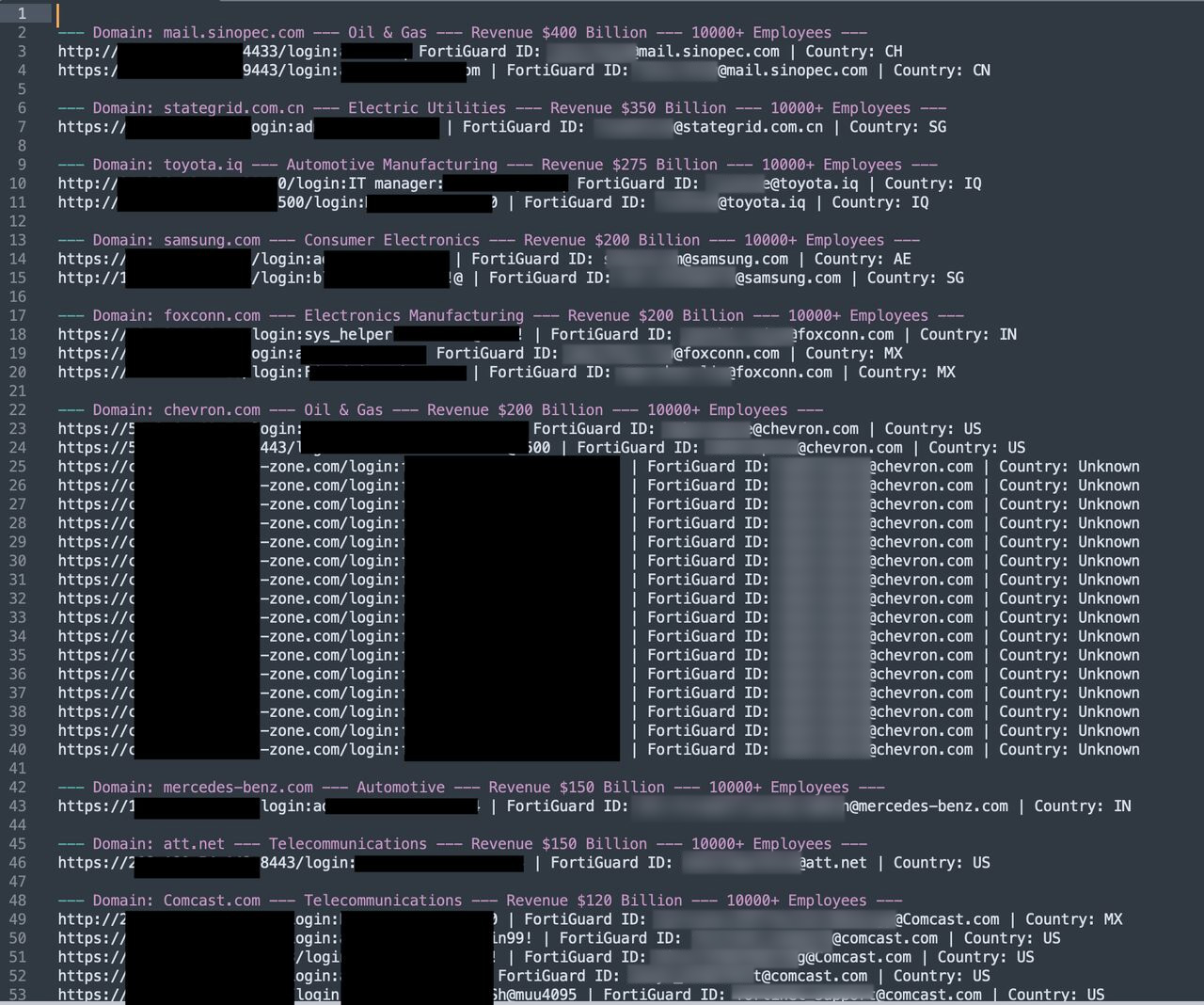
Diachenko also said the operation was conducted by a Russian-speaking threat group that allegedly carried out approximately 1.16 billion credential attempts against more than 320,000 FortiGate targets to intercept SSL VPN authentication hashes. The source of the configuration data remains unknown.
Cybersecurity expert Kevin Beaumont has also independently confirmed the authenticity of some credentials and noted that most affected devices remain online.
“The data is legit. It is around 75k devices. Almost all are still online, and Fortinet devices. It appears to be recent data,” Beaumont said, adding that the leaked data appears to have originated from Fortinet configuration files.
However, the source of the data remains unknown, and it is unclear whether it was stolen through exploitation of previously disclosed Fortinet vulnerabilities, a newly discovered security flaw, or another method.
Hudson Rock has also created a free FortiBleed lookup tool to help organizations check whether they are affected.
On Monday, threat intelligence company Defused also reported that several critical vulnerabilities in Fortinet’s FortiSandbox cyber threat detection platform are now exploited in attacks. In total, CISA tracks 26 Fortinet security flaws that have been exploited in the wild in recent years, 13 of which were abused in ransomware attacks.

Security teams log 54% of successful attacks and alert on just 14%. The rest move through your environment unseen.
The Picus whitepaper shows how breach and attack simulation tests your SIEM and EDR rules so threats stop slipping by detection.

An iPhone app designed to alert users when smart glasses may be nearby has climbed to No. 3 on the US paid App Store chart. Its name, AntiZuck Smart Glasses Scanner, leaves little doubt about how the developer feels about Meta’s camera-equipped glasses.
The app costs $2.99 and scans for Bluetooth signals linked to smart glasses. It can spot Meta Ray-Bans, Snap Spectacles, Amazon Echo Frames, and RayNeo glasses, then sends an alert when it believes one is nearby.
Its rise comes as anxiety around being filmed in public continues to grow, particularly among younger people who have spent most of their lives knowing that an awkward moment could be uploaded within minutes.
AntiZuck presents detected devices on a radar-like screen, alongside a rough proximity estimate and confidence rating. It can remember repeat sightings, send local notifications, and let users mark familiar devices so they stop triggering alerts.
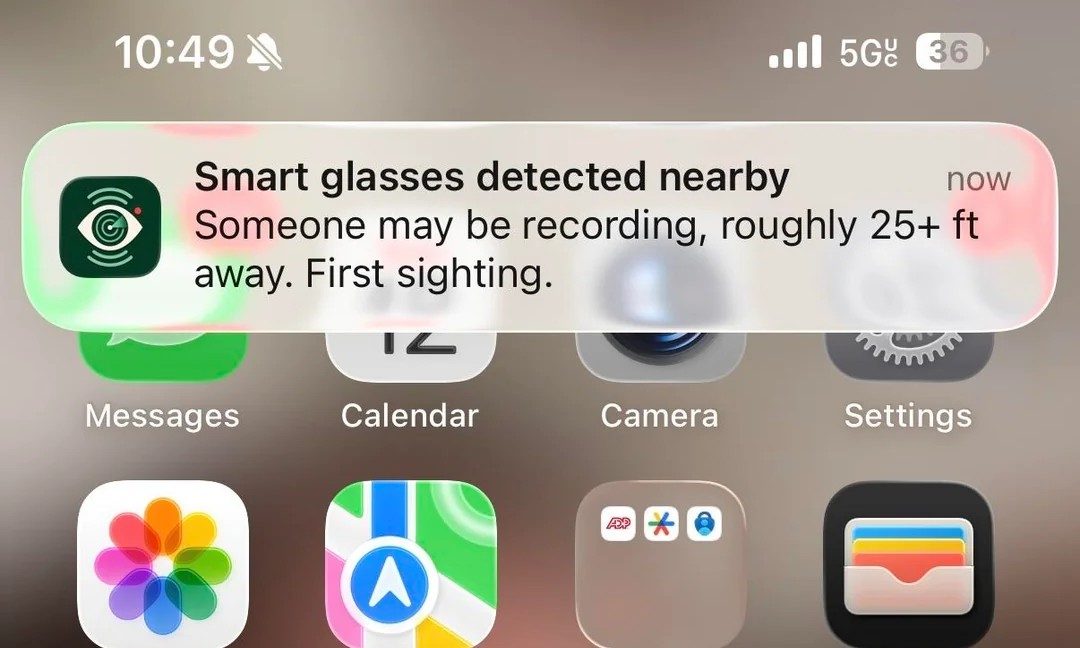
Unfortunately, the app cannot tell whether someone has started recording or taking a photo. It only detects Bluetooth signals broadcast by supported hardware, often during actions such as powering on, pairing, or opening a charging case.
Other Meta hardware, including Quest headsets, may also trigger a detection. Smart glasses can disappear from the scanner once they stop actively advertising over Bluetooth, so an alert is not proof that someone nearby is secretly filming.
A recent BBC report found that some young adults are becoming increasingly wary of cameras on nights out. Students said they watch for people holding up phones and club promoters recording content. Smart glasses make the situation harder because they can pass for an ordinary pair, so someone may not realize they are being filmed.

The discomfort is not limited to clubs or parties. A YouGov survey found that 54% of Americans consider filming and sharing strangers in public without consent usually or always unacceptable. Research also suggests people change how they behave when they know they are being watched. It helps explain why people are willing to pay for AntiZuck, since even the possibility of a discreet camera nearby can make it harder to relax in public.

Ukraine’s Defense Ministry has codified the MUL.E, its first all-wheel-drive electric military motorcycle built for frontline conditions.
The MUL.E cleared for Armed Forces service after completing testing confirming its stated operational capabilities.
Unlike conventional military motorcycles, the vehicle also functions as a mobile power station capable of recharging drones, communications equipment, and other electronic devices during combat missions.
Latest Videos FromTechRadar
The MUL.E was developed by a Ukrainian defence enterprise following requests from soldiers operating in demanding frontline conditions where mobility and flexibility remain increasingly important.
The motorcycle carries two soldiers, transports wounded personnel, hauls small cargo, and can tow a loaded trailer across difficult terrain where larger vehicles often struggle.
According to the Defence Ministry, the vehicle combines a 2×2 all-wheel-drive layout with two independent electric motors, allowing continued movement even if one motor becomes inoperable.
Officials also said the motorcycle operates with minimal noise, deploys quickly, offers extended autonomous operation, and delivers a range approaching 100 km on a full battery charge.
Its most distinctive battlefield feature involves travelling across anti-vehicle minefields without triggering many explosives designed for heavier military equipment.
Its wide off-road tyres combined with low ground pressure reportedly spread the motorcycle’s weight similarly to an infantry soldier’s foot, reducing the likelihood of activating mines intended for trucks or armoured vehicles.
The design also allows movement across sand, marshland, deep snow, washed-out ground, and other challenging environments where military mobility frequently becomes restricted.
The motorcycle also performs a second operational role through an onboard detachable petrol generator extending battery life while supplying electricity to frontline units.
Instead of becoming unusable after exhausting its battery, the additional generator recharges the motorcycle before operating independently as a portable energy source.
Soldiers can reportedly use the generator to recharge FPV drone batteries, radios, mobile phones, communications systems, or other electronic equipment.
That combination effectively transforms the motorcycle from a transport platform into mobile infrastructure supporting small units operating far from regular electrical networks.
The Defence Ministry said testing confirmed the MUL.E achieved its expected performance before entering military service.
Earlier in June, Ukraine approved the WOLFSTORM electric motorcycle capable of reaching 80 km/h while carrying two fully equipped soldiers and reducing thermal and acoustic detection.
The MUL.E extends that concept with additional capabilities designed for frontline mobility and field logistics.
Ukraine also continues expanding motorcycle procurement, with the Defence Procurement Agency contracting 1,500 motorcycles in 2026.
Military officials also said competitive bidding reduced procurement costs, saving the state budget by nearly $290,000 during the latest motorcycle purchase.
Whether these specialised vehicles achieve lasting battlefield success will likely depend upon operational performance rather than technical specifications alone.
Via Euromaidan

Follow TechRadar on Google News and add us as a preferred source to get our expert news, reviews, and opinion in your feeds.

This story was originally published by ProPublica. Republished under a CC BY-NC-ND 3.0 license.
Across the country, federal judges are calling out Department of Justice lawyers, questioning in unprecedented ways whether they can be trusted to tell the truth or uphold centuries-old legal norms.
From Washington, D.C., to Rhode Island to Oregon, federal judges nominated by presidents from both parties, including Donald Trump, have zeroed in on what’s called “the presumption of regularity.” It essentially means that judges must presume that the government — whether it be federal prosecutors, an IRS auditor or an FBI agent — did their jobs according to the rules and in good faith.
Until Trump’s second term, which has seen an exodus of veteran DOJ lawyers and a transformative shift in priorities from issues like enforcing civil rights to instead defending a mass deportation agenda, this foundational tenet had rarely been discussed in federal courtrooms, former judges, lawyers and scholars say. But as Trump’s DOJ exhibits behavior that judges have called “unlawful,” “unethical,” “unseemly” or otherwise dishonest, adherence to that bedrock standard is now being questioned.
ProPublica reviewed hundreds of cases since Trump retook the White House in which judges criticized the actions of DOJ lawyers and found more than 40 in which they explicitly referenced the presumption of regularity. In many cases, judges have expressed frustration that they can no longer take the government at its word.
“Judges simply don’t believe the representations that are being made by United States attorneys, assistant United States attorneys and the like,” said John E. Jones, a former federal judge for the District of Pennsylvania, appointed by President George W. Bush.
“I don’t think in the annals of the Department of Justice, in the history of jurisprudence in the United States, we’ve ever seen anything close to this.”
In Rhode Island in May, Trump-appointed federal Judge Mary McElroy rebuked federal prosecutors’ conduct — saying they withheld information and misrepresented facts — as she quashed their requests for a subpoena in their investigation into a hospital’s care of transgender children. The judge alleged the DOJ had inappropriately claimed its investigation was operating out of Texas to secure subpoenas targeting sensitive medical records of patients in another state and that it falsely claimed the Rhode Island hospital hadn’t communicated with the department.
“The discrepancy between the honorable conduct expected of federal prosecutors and DOJ’s tactics in this case is unsettling,” McElroy wrote. “The Court cannot help but share the sentiment that ‘[t]he presumption of regularity that has previously been extended to [DOJ] that it could be taken at its word — with little doubt about its intentions and stated purposes — no longer holds.’”
Judges have emitted a chorus of condemnations against the legal basis for some of Trump’s political agenda, including the mass firings of federal workers, an immigration dragnet that has imprisoned hundreds of U.S. citizens and retribution campaigns against the president’s political enemies.
In doing so, federal judges are imbuing forceful language into their orders in a way that scholars say signals to the Trump administration that the third branch of government is losing trust in the Justice Department.
Federal judges rarely grant interviews, and none of the judges who criticized the Justice Department in their orders granted interviews to ProPublica.
In a statement, a spokesperson for the DOJ said its attorneys are “dedicated public servants who represent the United States with integrity, in accordance with their ethical obligations and the law.”
“The Department stands firmly behind the professionalism and good faith of its attorneys,” said spokesperson Kiersten Pels. The White House did not respond to a request for comment.
Federal judges have found that the government filed statements generated by artificial intelligence that referenced nonexistent case law, wrote briefs that ignored facts and filed declarations with inaccurate dates, the ProPublica review shows.
In one case, the government included documentation claiming a detainee had been convicted of marijuana possession in 2009. That detainee, the judge noted, citing what she called the government’s persistent “sloppiness,” would have been 4 years old.
“This Court will no longer blindly accept statements of fact from [the U.S. government] unless they are made under oath by an individual with personal knowledge,” Judge Christine O’Hearn, a President Joe Biden appointee, wrote in New Jersey while reviewing a writ of habeas corpus petition filed by a man who claimed he was unlawfully imprisoned by immigration officers. O’Hearn accused the government of defying her orders when, instead of releasing the man, Immigration and Customs Enforcement transferred him to a different facility in New York.
In Minnesota, the state’s top political leaders had publicly clashed with the administration following the violent ICE raids that led to the deaths of two U.S. citizens. Then the administration filed a flurry of subpoenas against them.
Last month, Judge Patrick J. Schiltz, who was appointed by George W. Bush and clerked for Supreme Court Justice Antonin Scalia, slammed the government’s actions and “spurious claims,” saying the presumption of regularity was being abused.
“Initiating a criminal investigation in order to harass political opponents or to coerce them into taking official action — particularly official action that the federal government cannot directly require those political opponents to take — is a blatantly unlawful and unethical use [of] the grand-jury process,” the judge wrote.
The presumption of regularity creates a high bar for those suing the government or defending themselves against it in criminal cases. They often must provide evidence that the government willfully violated a policy or otherwise deviated from its charge — that is, did something irregular — to overcome the standard.
It’s a shield the government wields often, with little notice, and one that is almost always successful. But overcoming that presumption has become increasingly common under Trump’s second term, according to court watchers.
About half of the cases ProPublica identified as questioning the presumption come from districts, including D.C., Maryland and Virginia, where by proximity and jurisdiction many of Trump’s actions are challenged and often heard by Democratic-nominated judges. The Southern District of New York, which has issued repeated rebukes of Trump administration actions, and the Northern District of California, another Democratic stronghold, are other hotbeds of judicial scrutiny.
Last September, D.C. District Magistrate Judge Zia M. Faruqui accused the administration of working around the federal grand jury process, getting an indictment from a state court after prosecutors had failed to get one in his court, which he called “unseemly,” if not “unlawful.” He fired off one of the earliest signs that the presumption itself could come into question.
“This only deepens the growing mistrust of the actions of prosecutors,” the judge wrote. “That is a sentiment that was once unthinkable, but the irregular is now the regular.” While the case was largely managed by assistant U.S. attorney Caelainn Carney, according to court transcripts, Faruqui was aiming his frustration at her bosses, including senior prosecutor Jonathan R. Hornok, and the leadership at DOJ. Neither attorney responded to requests for comment.
Pels, the DOJ spokesperson, told ProPublica that Faruqui “was wrong on the law” and noted that after the government appealed to the district’s chief judge, his order was overruled. “Judge Faruqui has a long-standing documented pattern of editorializing from the bench beyond the scope of the cases before him,” Pels added.
But in recent months, skepticism about the presumption has also come from judges appointed by Republicans, such as McElroy, or in GOP strongholds.
In Indiana, Trump-appointed federal Judge James Patrick Hanlon ordered the release of Salah Sarsour, president of the Islamic Society of Milwaukee and a lawful U.S. resident, from ICE custody in March. Sarsour’s lawyers argued the government had targeted him to suppress his First Amendment right to free speech. The DOJ invoked the presumption of regularity and argued his arrest was part of an anti-terrorism dragnet, which the judge threw out.
In the Southern District of Ohio, Judge Michael R. Barrett, appointed by George W. Bush, ordered ICE to release a detainee after concluding the presumption had been overcome because the government hadn’t presented a reasonable argument that the man was a flight risk.
News outlets, including CNN, have documented federal judges’ ire with Trump’s DOJ, and some of the cases under question have been well-publicized, such as the government’s illegal deportation of Maryland resident Kilmar Abrego Garcia to El Salvador. In that case, Judge Paula Xinis, a President Barack Obama appointee, criticized the government, saying, “You have taken the presumption of regularity, and you’ve destroyed it.”
Many of the rulings challenged one of Trump’s hallmark efforts: immigration enforcement and deportations.
“The presumption of regularity and integrity previously and routinely afforded to the Executive branch and the United States Attorney’s Office has been undeniably eroded in this jurisdiction and across the country,” O’Hearn wrote in February, noting that the federal government had repeatedly violated court orders in her district and others related to immigration operations.
In another immigration detention case, this one in Washington state, Biden-appointed Judge Lauren King said, “[t]he ‘presumption of regularity’ is dislodged here by the numerous factual errors in Respondents’ filings and by their conflicting representations.”
Jeremy Fogel, executive director of the Berkeley Judicial Institute and a former federal judge from California, said what’s happening in the courts feels more like a “political conflict” than the normal ebb and flow of the justice system.
“It’s really one branch that is really sort of questioning the legitimacy of the other one,” Fogel said. “I think the judges are trying to stand up for the legitimacy of their branch.”
Just Security, an online law and policy journal, has been tracking cases in which federal judges have admonished Trump’s prosecutors, including those involving the presumption.
“We’re witnessing a breakdown in the ways in which any administration ordinarily carries out its responsibilities, through the Justice Department in particular,” said Ryan Goodman, Just Security’s co-editor-in-chief.
The erosion of trust from the federal bench comes as Trump has profoundly shifted priorities at the DOJ to align with his political platform: ending civil rights and diversity programs, deporting immigrants and stripping away environmental protections.
Those who deal with DOJ lawyers have noticed the difference in court.
Mitch Bernard, chief counsel at the nonprofit Natural Resources Defense Council, has faced off on environmental issues with the DOJ many times. Although they may disagree, he said, he always expected his opponents to be “fair and above board.”
That dynamic is gone, he said.
“I would call it a transformation of the role of the Justice Department,” he said. “There are many different judges in different jurisdictions not only ruling against the government but calling the government out for dishonesty and dissembling, and that’s an extraordinary thing.”
The result, Bernard said, is that “the government will lose more cases as a result of the way the Justice Department is behaving.”
Meanwhile, groups such as his are benefitting from the government brain drain. “We hired 10 litigating attorneys last year,” he said. Of those, eight came from the DOJ.
Judges aren’t just losing faith in the DOJ. Some are pushing to sanction Justice Department lawyers.
This month, Miami federal Judge Kathleen M. Williams ruled that Trump’s lawsuit against the IRS was an improper exercise in self-enrichment, citing the president’s lawyers for a series of misstatements in the case.
The Obama appointee referred the lawyer who brought the president’s case against the IRS, Alejandro Brito, to the Florida Bar for potential disciplinary proceedings. She also forwarded her ruling to disciplinary officials in New York, who had earlier received an ethics complaint about acting Attorney General Todd Blanche.
A DOJ spokesperson called the Blanche case “nothing more than a politically motivated bar complaint, filed by partisan activists who disagree with this Administration’s policies.” Brito did not respond to a request for comment.
In Rhode Island, McElroy referred DOJ lawyers to a review board for possible discipline for their handling of the hospital investigation.
“As citizens, we trust that federal prosecutors, when wielding this awesome power against a state, a company, or certainly against vulnerable children, will play fair and be honest with its counterparts and the judiciary,” McElroy wrote. “DOJ has proven unworthy of this trust at every point in this case.”
Filed Under: abuse of power, doj, donald trump, fbi, federal judiciary, judges, presumption of regularity, prosecutions

Roblox has announced a major update to its app that aims to make discovering games and connecting with friends easier. The redesigned app brings game discovery, chat, and player profiles together in one place. The update adds Moments, Chat, and Me tabs. Players in New Zealand will also see the new Build tab during the initial rollout. Roblox says these changes make it easier to discover games and stay connected with friends. The rollout has started in Canada, New Zealand, and Singapore, with more countries expected to receive the update over the coming months.

The Moments tab brings gameplay videos directly into the Roblox app. Players can browse clips shared by friends and selected content creators to explore new games. Every video links to its featured game through the Join button, making it possible to start playing with one tap. This creates a faster and more seamless game discovery experience. Roblox says the feature helps players connect with games they may want to keep playing. Gameplay videos are currently available for age-verified players aged 16 and above, where supported.
Beyond that, there’s the Chat tab that allows easy communication among players while they are playing. The players can initiate conversations before starting a game and continue while they are playing. Roblox will also be able to enable chats across various games without stopping the chat. This makes it easier to recommend games and invite others to play with them. It also uses age checks and chat safety features to protect users.

The game has now changed the title of the Avatar page to Me. Players can manage their profile and avatars from this page. There are also new background options for avatars that players can select for their personal accounts. The update makes it easier to customize their Roblox identity without switching between different sections.
Roblox has introduced the Build tab for eligible users in New Zealand as part of a public alpha rollout. This allows you to develop games using the mobile-first Build Tab that goes hand in hand with Roblox Studio. You also have access to the same back-end, models, and even chat history.
Creators can start building a game on their phones using the Build tab and continue editing it later in Roblox Studio with more advanced tools. Once the feature is fully available, they will also be able to start a project in Studio and track its progress from the Roblox app. Roblox says the Build tab is designed to make game creation more accessible and encourage more users to create games on mobile devices.

Apple has spent 12 years strengthening Beats without folding it into AirPods, preserving a separate brand that can reach Android users, compete at lower prices, and sell products that wouldn’t fit under Apple’s own name. Here’s what it looks like inside the Beats lab.
The strategy emerged from a rare look inside Beats’ Culver City operations. Executives described how the company combines its original design and marketing culture with Apple’s engineering resources.
Apple completed its $3 billion acquisition in 2014. Many employees who worked at Beats before the deal remain with the company.
Matthew Costello, Apple’s vice president of hardware engineering, told TechRadar that Beats was developed to complement AirPods rather than duplicate them. The company sells colorful headphones, fitness-focused earbuds and lower-cost products with support for both Apple and Google platforms.
“We took this bet that we would be sort of the dual ecosystem play,” Costello said. “And we said, Google and Apple together.”
The approach expanded Beats’ potential customer base and gives Apple access to buyers who might never consider AirPods. Beats Studio Buds and other products support native features on Android, while AirPods remain designed primarily around Apple devices and services.
Beats also operates at prices Apple has largely avoided with its own audio products. Solo Buds cost $79.99 and use a case without a battery, charging electronics or a pairing button, allowing Beats to make the smallest earbud case either company has shipped.
The buds instead provide up to 18 hours of listening from a single charge. A mechanical switch inside the case wakes the earbuds when the lid opens, preserving the familiar pairing experience without adding electronics to the enclosure.
 Beats Studio Buds and other products support native features on Android. Image credit: Beats
The design illustrates why maintaining Beats as a separate operation matters. Apple can apply its manufacturing standards and engineering expertise while allowing Beats to make unconventional trade-offs that would be harder to introduce under the AirPods name.
Beats products now go through the same reliability, environmental, wireless and quality testing used for Apple hardware. Its engineering facility includes five anechoic chambers, laboratories dedicated to studying human ears, a listening room and equipment used to examine returned products for recurring failures.
“We’ve learned so much from the teams up in Cupertino, and leveraged the core technologies, the processes, the discipline,” Costello said.
Apple’s influence has also changed the Beats sound. Costello acknowledged that early products were “super boomy,” while newer models have moved toward a more balanced profile shaped by customer feedback and improved testing.
Beats has retained control over its product shapes, colors and cultural partnerships. The company maintains a small customization team that produces one-off headphones for athletes, musicians and celebrities while experimenting with materials and finishes that can later reach retail products.
The transparent Beats Studio Buds Plus followed that path. Engineers originally made a clear prototype to inspect the product’s internal construction, but the marketing team pushed to turn the engineering sample into something customers could buy.
 Beats’ value to Apple extends beyond headphones. Image credit: Beats
The positive response influenced the later Solo Buds line, which launched with another transparent option. Beats executives described the custom operation as an incubator where concepts developed for individual partners can eventually become commercial products.
Beats’ value to Apple extends beyond headphones. The company has moved into iPhone cases and charging cables, and executives said it could explore additional categories as long as the products reflect Beats’ emphasis on design, color and culture.
The difference in style protects Apple from stretching its own brand too far. Beats can support Android, use louder styling, pursue athlete-focused designs and compete at lower prices without changing what customers expect from AirPods.
Apple also benefits from Beats’ approach to marketing. The company has repeatedly placed unannounced products with prominent athletes before formally introducing them, including a forthcoming pair of over-ear headphones spotted at sporting events.
Beats hasn’t announced the product’s name, price or release date. An FCC filing has confirmed that the headphones are real, but predictions about their features or competitive position remain speculative.
Apple’s ownership strategy is clear from what Beats has become. The company didn’t keep the Beats brand just for its logo or celebrity ties, but turned it into a capable hardware business that reaches customers, price points and platforms beyond AirPods.
Beats still looks and behaves like a separate brand from the outside. Underneath, Apple provides much of the technology and discipline that allow it to remain one.

Although it might have some trouble earning its ‘Ultra’ moniker, Samsung’s premium book-style foldable has never felt more well-rounded.
Really good sustained performance
Thin, lightweight design that’s very easy to open
Battery life is improved from the last generation
Anti-glare coating on the internal display is the real deal
The 3x zoom camera is still quite poor
Battery life still doesn’t match competitors
Cover screen feels a little narrow
No stylus support
SQUIRREL_PLAYLIST_10208647

Review Price:
£1899
Upgraded ultra-wide camera
Now bumped up to 50MP
Larger capacity 5000mAh battery
Alongside faster 45W charging
Faster Snapdragon 8 Elite Gen 5 chip
Flagship level performance
With all the hype around the new, squatter form factor of the Z Fold 8, you could be forgiven for forgetting about the Samsung Galaxy Z Fold 8 Ultra.
This is, for all intents and purposes, the natural successor to the Galaxy Z Fold 7 – and while a lot of it seems the same as before, there are enough small changes here to make it a much better experience than before too. The real question is, is it enough of an upgrade to be deserving of its Ultra branding?
Let’s get into it.
You could be forgiven for looking at the Z Fold 8 Ultra and thinking, not a lot has changed since the Z Fold 7, its natural predecessor. And, for the most part, you would be right. Beyond some new splashes of paint, not a huge amount has changed since the last one.

To say nothing has changed would be inaccurate though. There are some very subtle changes that have made the experience of holding and using it better than before.
Samsung might claim this is thinner than the last one, and it may well be if you ignore the clearly chunkier camera bump. But that’s such a small difference, it’s really neither here nor there. And to be fair, it is difficult to see how they’d ever make it meaningfully thinner without removing the Type-C charging port, or, y’know, all the internal components that make it work.

What makes the biggest difference is the shape of the phone, and the upgraded hinge. Every edge, corner and angle has been softened ever so slightly. This makes it a softer shape that’s just that tiniest bit more comfortable in the hand, but more importantly, the slight rounding of the edges means it’s easier to get your thumb between the two halves of the display.

Opening this phone is much easier for that reason, and for the reason that the hinge has more snap. Literally. There’s such a satisfying clap sound when you open or shut the phone, it’s almost addictive. Good job it’s been designed to be pretty durable too then.
There have been a few more durability tweaks made that aren’t as obvious to the senses though. The raised bumps on either end of the hinge have been increased in size, presumably to offer better obstruction to any dust or fluff from your pockets that might otherwise get in there.

The display itself has also been sured up with an additional layer of titanium alloy film. So it not only has that backplate from before, but also has another film bonded to the display to make sure this screen can survive daily use as your phone.
It’s clearly not rigid glass still, so won’t offer much protection against scratches, but it will be better able to cope with being opened and shut repeatedly than any previous fold. And – it’s early days clearly – but the crease on the display is quite minimal.

After a few days using it, it went from invisible to just about perceptible on a dark screen, but it’s very much ignorable once the screen is on and you’re in your content. It’s not that big a dip, and so easy to ignore when you run your finger over it as well. Still, not quite on the same level as Oppo’s Find N6 crease, which is virtually non-existent.
Another area it’s not quite at the same level as some of its competition – namely the Honor Magic V6 – is in water and dust resistance. Its IP48 rating means it’s very well protected against water getting inside, but isn’t completely dust-tight.
It’s safe to say that one area that’s seen very little (if any) change from the last version is the cover screen. While the regular Galaxy Z Fold 8 has completely changed to a new, wider, squatter form factor, the Z Fold 8 Ultra retains the same long, fairly narrow screen as the Z Fold 7.

I still find it a little cramped to use two-handed when typing and replying to messages, but it’s a pretty comfortable one-handed phone. It gives you enough surface area to make tasks like scrolling through messages and social media feeds convenient.
Otherwise, it’s a sharp, bright and smooth panel that’s capable of hitting up to 120Hz refresh rates when required. Still, its shape and size don’t exactly make it well-optimised for video or gaming. It’s still subject to letter or pillar-boxing – or heavy cropping – for anything that doesn’t match its narrow, long aspect ratio.

One thing you might see as a positive is that you can customise it totally separately from the main internal display. While most foldables just mirror the internal panel, Samsung lets you make it different. You can set different wallpapers, lock screens and always-on displays.
Personally, I see it as a chore having to set these things up twice. You might disagree though.

It’s on the internal display you’ll find the bigger visual differences. Most of the upgrades on that flexible panel are quite subtle, but there is at least one that makes a big difference: anti-glare.
Flexible plastic displays typically struggle more with visibility under bright lighting than glass, but the anti-reflective nature of the Z Fold 8 Ultra’s film is so much better than the Z Fold 7 that came before. Looking at it under bright lighting in my studio, the difference is significant. In fact, it’s better at cutting out reflections than the Razr Fold, Pixel 10 Pro Fold and isn’t far off the levels offered by the Honor Magic V6.

The fact the display can also reach higher levels of brightness than its predecessor also means it’s capable of cutting through any reflections that are on the screen better than before. It’s a big, expansive screen too, hitting 8 inches diagonally, and with more pixels packed into that space than the Fold 7, it’s a panel that elevates content more than its predecessor.
When you combine that improvement with the – so far – less visible crease, it’s a further step towards removing the optical compromises associated with flexible, plastic-coated displays.

Sadly though, the S Pen support remains missing from last year. Samsung removed the digitising layer required to make it possible, in an attempt to keep the phone as thin as possible. So if that’s a bit of a deal-breaker for you, there’s always the Razr Fold, which supports a stylus and ships with one, too.
Otherwise, it’s very hard to fault the quality of the display. It’s bright, clear, and has vibrant colours without being too over-saturated and enough contrast to make content pop. Viewing angles could be improved slightly, but that’s really nit-picking at this point.
Cameras are, typically, the area where foldable phones are compromised. Even those with bigger sensors like the Honor Magic V6, Razr Fold and Oppo Find N6 won’t compete with the top-tier camera slabs. That’s to say, there’s a bit of expectation management necessary.
Even compared to some of its direct competitors though, I still feel like Samsung has some work to do on the camera front.

The primary 200MP camera is largely the same as before, and the ultrawide camera has had a welcome upgrade to a new 50MP sensor. Still, the 3x zoom camera is pretty small and comparatively low-res compared to the other two, and, compared to the zoom cameras on devices like the Razr Fold and Honor Magic V6, it comes up a little short.
The relatively small sensor size means it’s less capable of gathering light, and the depth of field isn’t amazing. So if you’re using that 3x zoom as a macro or portrait lens where you want some tasty, smooth background blur behind the subject, Samsung’s isn’t the best out there. Compared to the larger sensor on the Razr Fold – for example – the bokeh or background blur looks a bit rough.
Those who like to use the zoom lens to go to mega distances and take advantage of the digital crop will also be a little disappointed.
Its 10-megapixel makeup means there’s not much additional digital cropping space without heavily relying on artificial processing to try and come up with some form of sharp detail. And so you’ll find, just like the 3x zoom lens on other Samsung phones, that once you get past the 3x zoom range, images can get a bit grainy and take on that tell-tale oil painting effect at the extreme end of the zoom range.
Still, the primary camera is decent, and Samsung has done a lot to improve its overall processing of scenery. Its colours are generally quite neutral, combined with its balance of highlights and shadows, it gives you a lot of scope for tweaking and editing.
One thing I really appreciated while shooting out and about, and comparing with other phones, is that the colours and overall look of the preview image were pretty consistent with the end result – and looked the closest to the colours I could see with my eyes.
I’d maybe like some richer colour, and a bit less emphasis on cranking up the contrast and artificial sharpness in the end result – it can sometimes lead to a bit of a grainy feel – but it’s hard to complain too much.
Consistency in the colours when switching between the lenses could also be improved. I often found the primary camera warmer than the other two – particularly than the zoom lens – which tends to produce cooler, less vibrant colour when the camera is shooting in its automatic mode.
The upgraded ultrawide camera is a very welcome addition though. Its results are nowhere near as harsh as previous models, with good sharpness, contrast and colour, and without the extreme levels of distortion and warping at the edges.
At night, the camera makes good use of its night-mode algorithms, holding the shutter open for a couple of seconds and then snapping an in-focus shot. Only once or twice did it fail to counteract the hand motion from shooting handheld.
Results aren’t super bright, so shots still retain their nighttime feel without going to town too much on saturating colours to make it lively. Still, like the daytime, some of the shots had that over-sharpened processed look.
As far as folding phones go, the performance on offer from this Snapdragon 8 Elite Gen 5-powered phone is about as good as it gets.
Even playing Destiny: Rising with the higher graphics settings enabled, I was able to churn through 20 minutes of constant gameplay without the phone getting warm, or with any signs of stuttering or struggle. It’s a really solid performer for a foldable phone, especially given the lack of space inside this ultraslim phone for massive cooling components.

If you’re a fan of the more graphically intense games like Withering Waves of Genshin Impact, you might notice it stutter a bit in their highest settings after 15 minutes or so, but for a foldable phone, this level of sustained graphics performance is good.
When I ran it through the demanding 3D Mark graphics stress tests, its reliability score of almost 70% – while hitting peak scores not far off what the Galaxy S26 Ultra can manage – points to a phone that’s supremely comfortable with pretty much any task you throw at it.

Opening multiple windows side by side or as floating windows won’t pose any issues for those who like to use these big, expansive displays for multitasking with several apps at the same time.
The Galaxy Z Fold 8 Ultra, along with the rest of the Z8 collection, are the first to sport Android 17 out of the box with Samsung’s snazzy new One UI 9 overlay.
It’s not a massive change compared to previous versions of One UI, though look closely and you’ll see a few new Gemini-powered smarts – like app automation – that were previously exclusive to Pixel devices.

Samsung’s software makes good use of the fact that it’s a big, flexible panel too. Flex mode remains on the Ultra, so you can partially fold the screen in any app and use the bottom half as a trackpad for scrolling, clicking, and zooming.

There’s scope to have multiple apps running at once when it’s fully open, either through split screen mode – which puts two 6.5-inch apps side-by-side – or by using the pop-up view, which launches them into more desktop-like floating windows.
And, as we’ve come to expect, the Z Fold 8 Ultra offers seven years of OS upgrades and security patches, making it a great candidate for long-term use.
If there was one major improvement the Galaxy Z Fold series has been crying out for over the past couple of years, it’s undoubtedly been the battery life.
Samsung has been a bit late to the game jumping onto the more dense Silicon Carbon battery tech, but has finally done it and brought the capacity from 4400mAh to 5000mAh, in a phone that desperately needed it.

For a phone positioned as a productivity, do-everything powerhouse, having a phone that struggled to last a day for the most demanding users was something of a misstep. Those days are very much in the rear view mirror now, though.
The new, larger capacity doesn’t offer market-leading performance, but it’s big enough that it’s finally no longer as much of a compromise. On my heaviest use days where I used over five hours of screen-on time, mostly doomscrolling on Threads and chatting in WhatsApp (which both seem to be surprisingly thirsty apps), I’d finish a full day having used somewhere between 50-60 percent of the capacity.

That’s not quite enough to make it a two-day phone on my heavier use days, but on my quieter weekdays where I’m working – and use 2-3 hours of screen time on my phone in a day – it is.
Even for the more power-draining users, it’s a phone that shouldn’t kick into power-saving mode before the end of a day. Or at least, nowhere near as often as the Z Fold 7 did. And it refills really quickly when it is empty, too.
Samsung claimed in its announcement that, with a fast charger, you could charge this battery to 67% in 30 minutes. In fact, I got to that level with just 25 minutes plugged into an Anker Prime power adapter.

That to me is a huge convenience. It means when I get into that second day and the battery is dropping below the 20 percent red zone, I can plug it in for 20 minutes and have more than enough juice to get through the rest of the day.
In our charging test, it half-filled from 1% to 50% in about 18 minutes. A full 1-100% charge took just over an hour.
SQUIRREL_PLAYLIST_10208647
In the end, clearly, the Galaxy Z Fold 8 Ultra is a better phone than the Z Fold 7. But with the new Ultra naming, it’s fair to be disappointed that features like the camera unit and cover screen haven’t received a more significant upgrade. I won’t complain about the increased battery, but it’s still short of the competition.
Still, on balance, it’s a very, very good folding phone. It strikes the right balance between performance, compact design, and useful software features for me. It’s just whether people will still want this form factor when the (slightly) cheaper and easier-to-use Galaxy Z Fold 8 is now a thing. To see how it compares to the competition, take a look at our selection of the best foldable phones.
Final Thoughts
Aside from being more expensive, the Z Fold 8 Ultra carries three rear-facing cameras (there are just two on the Fold 8), alongside a larger 5000mAh battery and a taller display that’s better suited to productivity.
| Samsung Galaxy Z Fold 8 Ultra Review | |
|---|---|
| Manufacturer | Samsung |
| Screen Size | 8 inches |
| Storage Capacity | 256GB |
| Rear Camera | 50MP wide, 50MP ultra-wide, 10MP telephoto |
| Front Camera | 10MP + 10MP |
| Video Recording | Yes |
| IP rating | Not Disclosed |
| Battery | 5000 mAh |
| Wireless charging | Yes |
| Fast Charging | Yes |
| Size (Dimensions) | 158.4 x 4.1 x 143.2 MM |
| Weight | 215 G |
| Operating System | Android 17 (One UI 9) |
| Release Date | 2026 |
| First Reviewed Date | 31/07/2026 |
| Resolution | 2256 x 2504 |
| HDR | Yes |
| Refresh Rate | 120 Hz |
| Ports | USB-C |
| Chipset | Snapdragon 8 Elite Gen 5 for Galaxy |
| RAM | 12GB, 16GB |
| Colours | Graphite, Cream, Violet Shadow, Green Shadow |
| Stated Power | 45 W |
| UK RRP | £1899 |
| USA RRP | $2099 |
| Samsung Galaxy Z Fold 8 Ultra | |
|---|---|
| Geekbench 7 single core | 3125 |
| Geekbench 7 multi core | 10755 |
| Geekbench 7 GPU | 19651 |
| 3DMark Solar Bay | 46.3 fps |
| Time from 0-100% charge | 63 min |
| Time from 0-50% charge | 18 Min |
| 30-min recharge (no charger included) | 73 % |
| 15-min recharge (no charger included) | 45 % |
| 3D Mark – Wild Life | 6284 |
| 3D Mark – Wild Life Stress Test | 68.4 % |


We may receive a commission on purchases made from links.
Even though the brand is available every month of the year, July 2026 has proven an especially big month for Milwaukee. For one, there are several Milwaukee tools on deep discount in July, allowing supporters to stock up on niche and essential items alike. There’s some expansion going on in the Milwaukee catalogue as well. July has been a month full of new drops, including new tools and a lot more.
According to Home Depot, several intriguing new Milwaukee items have hit physical and digital storefronts. First and foremost are some newly-released Milwaukee Packout options, like the Packout low-profile crate, the Packout wire-pulling XL crate, and the regular Packout XL crate. Battery-wise, Milwaukee has released a new M12 and M18 four-bay simultaneous charger, and joining the starter kit lineup is the M18 Fuel rear handle cordless circular saw kit, featuring the titular saw, an M18 HD12.0 battery, charger, and other add-ons. Of course, the real highlights of Milwaukee’s July 2026 releases are the new tools.
There are a lot of choices on the tool market for quick shrub trimming, with numerous major electric pruners for sale, but that’s not to say that simple hand tools aren’t worth using. For $54.98 comes the Milwaukee 1-inch capacity pruning shears, which are intended for trimming branches up to 1 inch in diameter. For such a small tool, Milwaukee put a lot of helpful features and design elements into these trimmers to justify such a high price point.
The main draw is the ultra-sharp blade, which can be resharpened as needed and has a low-friction coating for smooth cutting. The head is angled, too, which is helpful when cutting at overhead height or low to the ground. The pruner also has a two-position adjustable lock plate; this way it can be adjusted for easier cutting of small branches. The handles are made of lightweight aluminum and feature dipped grips to reduce the likelihood of slippage while in use. These pruners automatically come with Milwaukee’s limited lifetime warranty, so if the workmanship isn’t up to par, having them repaired or replaced is possible with no hassle or additional cost.
When large branches get out of control, something more than a small set of clippers is needed. One option is a unit from one of the major pole saw brands, but for low, small branches, a set of loppers is more than enough to get the job done. Milwaukee has released a new set of 1-1/2-inch capacity bypass loppers this July, which cost $89.98 through Home Depot. Despite being a rather straightforward tool that appears more than capable, there are a lot of notable aspects for potential buyers to be aware of.
This new set of loppers comprises two 20-inch handles made from lightweight aluminum, held together by a set of high-carbon steel blades (which can be resharpened) covered in low-friction coating for smooth, free movement. Between them is a rubber bumper, reducing shock once the blades make it through their branch and the handles thump together. Speaking of the handles, they also feature rubber grips to increase comfort and reduce slipping. Additionally, this set of loppers comes with the same Milwaukee limited lifetime warranty as the pruners for the sake of buyer protection.
For branches that can’t simply be lopped off or clipped with a small pruner, you’ll need a different tool. Fortunately, Milwaukee has delved into this category, recently providing two new pruning saws: the 10-inch straight blade pruning saw and the smaller 7-inch variant. These two saws have numerous similarities, but they’re different enough that we’re counting them as two separate tools.
Both boast hollow ground blades with quadruple-ground teeth for effective cutting into soft materials. Topping off the similarities between these two tools, both also come with Milwaukee’s limited lifetime tool warranty.
Moving onto their differences, these saws retail for $39.98 and $29.98, respectively, and both come with storage options. The 10-inch version has a reversible scabbard included, while the 7-inch version allows the blade to fold into the handle. As far as cutting capacity, these saws promise maximum cuts at 6 inches for the 10-inch blade and 4 inches for the 7-inch one. The 10-inch saw consists of chrome-plated SK5 high carbon steel while the 7-inch blade is made from standard high-carbon steel. The 7-inch blade is adjustable for easier undercutting.
Milwaukee has a lot of new outdoor wood-cutting tools for sale, but indoor woodworkers and metalworkers, who already have a host of Milwaukee tools at their disposal, haven’t been left out of the equation. The M12 Fuel 1/4-inch straight die grinder arrives this month at the cost of $229.00. For that price, buyers receive the titular tool and a wrench for part swapping, though a 12-volt Milwaukee battery is required for the tool to run. At the very least, also included is Milwaukee’s five-year warranty to cover any functional issues not attributed to misuse or abuse on the user’s end.
With a battery attached, Milwaukee claims to deliver 0.5 horsepower and reach a maximum of 20,000 RPM with the aid of the internal Powerstate brushless motor. The grinder has four speed settings, works with 2-inch cutting wheels and 3-inch sanding accessories, features a built-in LED work light on the front, and is compatible with accessories with a 1/4-inch shank. On top of all of this, the tool is cordless, making it easy to maneuver into tight spaces and use virtually anywhere.

Xiaohongshu, or RedNote, is another social platform that has become increasingly popular among the young, urban, and educated classes in China. Some junior AI researchers have opened accounts on Xiaohongshu recently and use them to share details about their work, but the audience is less technical than what they might find on X.
When Moonshot published a new research paper in March, it caused quite a stir on both Chinese and Western social media, even attracting praise from Elon Musk. But “almost everyone on Zhihu and Xiaohongshu were talking about the background and age of the authors—one of them is only 17—and who their parents are, things that I find very superficial and gossipy,” says a current researcher at Moonshot who requested anonymity because he was not authorized to speak to media. “It was the foreign readers who actually discussed technical details and praised its breakthroughs.” He says readers on Zhihu also tend to be more mean-spirited, and the platform is plagued by higher amounts of AI slop than X.
Moonshot did not immediately respond to a request for comment.
The Chinese newcomers have generally received a warm welcome from academics and researchers at Western AI companies who were already on X, many of whom have been eager for direct information about Chinese AI labs. “Before they all came to X, we already saw a lot of influential researchers translating Chinese [AI] blogs into English,” says Wang. He points to Su Jianlin, a well-respected AI researcher who keeps an active blog in Chinese documenting his thoughts, as an example of the kind of voices that Western AI communities crave. Now, Su is working for Moonshot and has a public X account, too.
Beyond the desire to participate in open discussions, Chinese AI companies are also finding that X is an effective place to market themselves and their products. “X is the platform with the highest traffic and exposure. To some extent, the AI industry works just like the finance industry now, each individual and company needs their own branding,” says Meng.
When AI researchers become minor social media celebrities, that helps boost the profile of their employers, too. Wang says he personally advised Moonshot during a one-off consultation session for the company in 2025 to push more of its researchers to the front on social media. When a startup releases a new model or paper, “it’s more interesting to see what they as a person want to post, instead of the official announcement,” Wang says, “And this would definitely help them gather more feedback from the audience. And they can talk to other researchers and potentially trigger some collaboration.”
Moonshot has already proven that it has an ample supply of charismatic personalities. The company is often described in China media as one of the AI labs with the most interesting internal cultures, where the CEO plastered his office with band posters and other souvenirs celebrating his love for rock music. The Chinese name of the company, 月之暗面, literally comes from Pink Floyd’s album The Dark Side of the Moon.
Having Chinese AI researchers explain their work in their own words on X is a net benefit for the United States, Wang says, because it reduces the need for blind speculation about what Chinese AI labs are doing. “People have a lot of wrong hallucinations about what China is doing. And now, X is the door for them to better understand China,” Wang says.
This is an edition of Zeyi Yang and Louise Matsakis’ Made in China newsletter. Read previous newsletters here.

In February 2024, a young man lay somewhere on the frozen shore of James Bay, Canada, surrounded by snow and darkness, succumbing to hypothermia. When he failed to get home on time, his frantic mother sent a Facebook message to Elizabeth Kataquapit, then chief of the indigenous community Fort Albany First Nation in northeastern Ontario. Kataquapit used Facebook to alert the community’s search-and-rescue squad, who jumped onto their snowmobiles and drove into the night. Before dawn, they returned with the dazed man, who told rescuers he’d given up until wolves nudged his hypothermic body. “The wolves told him to wake up,” Kataquapit says. “I really believe they saved his life.”
A fiber-optic network also played a key role.
Not long before the young man’s mishap, the indigenous-owned Western James Bay Telecom Network (WJBTN) had built its own fiber-to-the-home network in this remote Cree community, some 975 kilometers north of Toronto. Before the network, the rescue squad relied on a few handheld radios to pass information along. This time, a Facebook message to the full list of volunteers triggered the search.
 An aerial view shows the remote community of Fort Albany in northern Ontario.Gavin John
Building Canada’s first fully Indigenous-owned-and-operated fiber-optic network was an uphill battle for Brian Nakogee, WJBTN’s finance officer, who had to secure capital from agencies less familiar with the challenges of remote northern life. For the people of Fort Albany First Nation, accessing many vital supplies and services means traveling about 500 km to the regional city of Timmins. By land, the trip is possible for only a few weeks each winter, when the swampy tundra freezes hard enough to construct a temporary road. “The southern way of doing things is very different than how we here in remote areas piece things together,” says Nakogee.
Telecommunications giants long saw little profit in serving the subarctic coast of James Bay. But even as satellite internet started to become available in remote communities, WJBTN staff saw the value in building and owning its own hard-wired internet service instead of relying on outside companies. Today, the nonprofit operates one of the fastest networks in Canada, while keeping both infrastructure ownership and revenue within the First Nations communities it serves.
WJBTN is part of a broader movement among Indigenous and remote communities seeking more control over their telecommunications infrastructure. In the United States, 30 tribes now operate fiber-to-the-home networks, many launched during COVID. Canada has since created a dedicated Indigenous broadband funding stream. And as more communities pursue the expertise and funding to build their own networks, WJBTN’s experience offers a blueprint for what locally owned connectivity can look like in some of the hardest places to serve.
While many towns in North America were connecting to optical fiber in the early 2000s, the subarctic communities were left out.
The residents of Fort Albany saw the earliest sign of improvement in 2008. That’s when their locally owned power company, Five Nations Energy Inc. (FNEI), strung fiber-optic cable on the utility poles that were delivering electricity from the dusty railway town of Moosonee, 135 km away across the peat bogs. On the shore of the Moose River, Moosonee is the last stop for Ontario’s telecommunications providers. Its only link to the province’s highways is a 5-hour train ride that shuttles passengers, freight, and vehicles through the Boreal forest.

 Elizabeth Kataquapit [top], former chief of Fort Albany First Nation, says high-speed internet has transformed her community. Search & Rescue volunteers now coordinate emergency responses through a Facebook group [bottom]. Gavin John
Soon after, regional Cree leaders formed WJBTN to provide high-speed telecommunications in Moosonee and the three Indigenous communities to the north. WJBTN would lease the fiber-optic backbone from the power company, with just 1 gigabit per second of total capacity for the entire population of about 6,000 people.
But the new fiber backbone did not mean fast internet for residents. One of WJBTN’s first commercial clients was a telecom company called Xittel, which used microwave links and local access points to beam wireless internet to homes across each town. It wasn’t what subscribers were hoping for. This system frustrated users with delays, glitches, and strict data caps. Kataquapit calls it a “turtle.”
Everybody complained about the wireless. Xittel advertised a 10 megabit-per-second connection, but speed tests consistently showed 3 Mb/s for both uploads and downloads. And customers paid dearly if they ever exceeded their data limit. “You were billed close to CA $7 per megabit,” Nakogee recalls.
WJBTN’s dream had always been to connect everyone’s home to fiber optic and make it affordable. Without a technical team, roads, or any major funding, the company just had to figure out how.
When Nakogee joined WJBTN in 2014, the telecom company was still in its infancy. It was “a department huddled in the corner, trying to latch onto the services of FNEI,” he says.
Nakogee was asked to prepare a proposal to deliver 40 Mb/s fiber connections to each of the roughly 1,000 homes and businesses spread across 300 km of the James Bay coast. Back then, WJBTN operated on revenue from its early commercial and institutional customers—including Xittel, local government offices, hospitals, air navigation facilities, and family service centers that were connected to the first few strands of fiber. To make a residential fiber network possible, WJBTN first had to build both revenue and trust within the communities it hoped to serve; it had to convince people that the small new organization would follow through on its plan.
 WJBTN finance officer Brian Nakogee played a key role in financing and planning the community-owned fiber network. Gavin John
Nakogee especially needed support from Moosonee and Attawapiskat, the communities at the start and the end of the line. “They’re the bread that holds this sandwich together,” he says. Through years of diplomacy, the budget grew enough to support a business proposal for a fiber-to-the-home network. Together with engineer Dirk MacLeod, in 2015 Nakogee began hashing out the details of a bare-bones version of the system. The plan required both upgrading the network’s long-distance fiber backbone—known in telecom as the backhaul—while also building the local infrastructure that would connect individual homes to the internet.
 Andrew MacLeod, WJBTN’s field project manager, reviews a map of the fiber network.Gavin John
The first step was upgrading the network’s backhaul using newer “coherent optics” technology, which can transmit much larger amounts of data over long distances, explains Dirk’s brother, Andrew MacLeod, another network engineer, who joined as a consultant. Using equipment from telecom supplier Infinera, the new backhaul would deliver 100 Gb/s to distribution points in each town, with redundancy in case a fiber line failed.
Next came the challenge of connecting individual homes. Rather than extend a direct line from the central office for every customer, the engineers designed the network around a telecom architecture called GPON (Gigabit Passive Optical Network), which reduced the fiber needed to connect each customer to the network. Fiber from the backbone would run to networking equipment at each town’s electrical substation, where passive optical splitters would distribute the connection among many households without requiring powered equipment at every junction. In remote communities where maintenance and repair are difficult, reducing the amount of active infrastructure was a necessity.
The total estimated cost was CA $4.7 million, or CA $4,700 per household. By comparison, the Fiber Broadband Association estimates that urban fiber-to-home construction in the United States costs the equivalent of about CA $1,400 to CA $1,800 per household—a stark contrast in expense.
 Fort Albany resident Thomas Scott says high-speed internet has improved his work as a mental health counselor. Gavin John
A radio broadcast in 2018 heralded the good news: The fiber-to-home construction project was a go. Fort Albany mental health counselor Thomas Scott says he “couldn’t wait.” People seeking guidance for addiction or grief typically called him on landlines, and it was hard to help them over the phone without seeing their faces. Businesses, too, rejoiced—including the Kataquapit family store, which relied on the phone system for transactions.
Winning approval for the project was one thing; building it across hundreds of kilometers of remote subarctic terrain was another.
Dirk MacLeod started with a schematic documenting the GPS position of every house, pole, and length of cable that would ultimately form the network. When WJBTN hired Montreal-based Fonex Data Systems to upgrade the backhaul, the detailed plan made it easy for contractor Tasso Varvarikos to design the deployment. Still, tuning the optical system to operate reliably across transmission lines stretching hundreds of kilometers required extra care. “Once you go up north, there’s no fiber store,” he says,
To minimize surprises in the field, Varvarikos traveled to telecom supplier Infinera’s laboratory in Stockholm, where he and other engineers assembled and tested the network before shipping it to the installation site. The Stockholm lab gave the team access to testing tools and technical specialists who helped configure the system before deployment in the remote fly-in communities. Using Infinera’s simulation software, Varvarikos says he and his colleagues “kicked the crap out of it in the lab” until the network performed reliably.
 The Western James Bay Telecom Network connects remote communities along the western shore of James Bay in northern Ontario.Chris Philpot
Finally, in the spring of 2019, it was time to pack up and head to the sites. First, more than two pallets’ worth of Infinera equipment were squeezed onto two charter aircraft in Timmins. Bush pilots, unfazed by the stringent logistics, made sure that one box reached Moosonee; the other one, Attawapiskat. Varvarikos says they packed extra fiber-optic transceivers, patch cables, tools, and “the kitchen sink and then an extra sink just in case.” By May, the team was ready to install the new backhaul—a months-long process that necessarily preceded household connections. Once the equipment was in place, the engineers tested the network to make sure the systems in each community could communicate reliably and that data moved correctly across the backbone.
During the switchover to the new system, the MacLeod brothers worked from substations in different communities along the coast while Varvarikos coordinated from Fort Albany. Communicating over a spotty phone line, they started moving connections from the old network to the upgraded backhaul, carefully reconnecting cables and verifying that traffic still flowed correctly between communities. Within days, the anchor customers—including hospitals, schools, and air-navigation systems—were hardwired to a 100-Gb/s backbone.
However, households were still relying on the slow legacy network. WJBTN’s next step was flying huge reels of fiber-optic cable into the remote communities at enormous cost. Nakogee recalls cutting predetermined lengths of cable, then repackaging it onto spools to load onto cargo aircraft. The backbone was finally in place; now WJBTN had to bring fiber to every home.
Then, in a turn of events that rocked the communities, lead engineer Dirk MacLeod had a heart attack and died in July 2019. “My chest was ripped open,” Nakogee says. The grieving company shut down for the summer.
WJBTN had intended to spend three summers training local crews from each community’s power company to maintain and manage the network. After MacLeod’s death, one line worker quietly took it upon himself to finish extending fiber to distribution points in Fort Albany. The team made a plan to begin connecting homes the following spring.
 Utility poles carry power and fiber-optic lines through Fort Albany First Nation.Gavin John
Then COVID hit. Fearful and with limited medical facilities, the communities closed themselves off. Nobody was allowed in.
“COVID really screwed things up,” says Andrew MacLeod. People were screaming for better internet, he recalls, but they wouldn’t let outsiders in. So instead of training local crews and building each town’s network simultaneously as planned, WJBTN made a tantalizing offer: The first community to allow MacLeod in would have its fiber-to-the-home network completed first. Fort Albany jumped on it.
Peyton Reuben, a recent computer systems graduate in Fort Albany, was seeking a new job when his cousin mentioned that there was a “fiber guy” in town. Reuben’s coursework covered coding and how routers and ISPs communicate—a distant relative to Andrew MacLeod’s hands-on infrastructure work.

 WJBTN network coordinator Peyton Reuben looks up at the overhead fiber network in Fort Albany [top]. A splice enclosure joins fiber-optic cables at a distribution point [bottom]. Gavin John
“They were looking for helpers to splice fiber,” says Reuben, something he knew nothing about. Nonetheless, he started work the day he met MacLeod and got a crash course in building an aerial fiber network, running cables from utility poles into neighborhood connection boxes that ultimately served individual homes. The fun part was reaching every pole in every neighborhood in a town crisscrossed by tributaries of the Albany River. “We didn’t have a bucket truck, so we had to climb up the poles,” says Reuben. “It was quite the experience, going through thick brush and thigh-deep water.”
The hard part was splicing the fiber—fusing together hair-thin glass strands that connected homes to the larger network. Inside each connection box, distribution fibers had to be joined to cables leading to individual houses, one strand at a time—around 150 in each box. Reuben’s first attempt “looked like a plate of spaghetti,” says MacLeod. More splicing waited back at the substation, where optical splitters connected neighborhood lines to the town’s central GPON equipment. “It took me four times as long as Andrew to complete a splice tray back then,” says Reuben.
 A worker installs a new fiber-optic line for the Western James Bay Telecom Network.Gavin John
Slowly but surely, every building in Fort Albany saw a strand of fiber drop from overhead and come through a box drilled into the wall, ready to connect to a router. By springtime, aerial cables linked every house—and future building sites—to the substation. Reuben calls it “a spider web that goes everywhere across town.”
Without much fanfare, on a night in April 2022, WJBTN flipped the switch in Fort Albany. The next morning, Kataquapit woke up to a different world. With 250 Mb/s download and 30 Mb/s upload speeds, she found herself just a click away from her children in faraway cities.
MacLeod and Reuben continued working up the coast, splicing cables and adding connection boxes. As COVID eased, they hired more local help, and the power company lent a hand with bucket trucks. “We were working 12 hours a day, 7 days a week,” says MacLeod. “Guys were sitting in the heat, in bucket trucks, learning on the fly how to do splicing.” By late 2022, the network reached every home.


 Fiber-optic cables and networking equipment inside the Fort Albany substation distribute internet service throughout the community [top, middle]. Large spools of fiber-optic cable were flown in to connect homes [bottom]. Gavin John
Around that time, Starlink’s satellite internet service was becoming widely available. Many of WJBTN’s potential clients asked why they shouldn’t just purchase that instead of a fiber-optic connection that involved drilling into their homes. But speed tests comparing Xittel, Starlink, and the new WJBTN connections showed a major difference in latency: In applications like video calls, Xittel and Starlink’s round-trip signal delays became painfully obvious. Unlike satellite systems, fiber networks don’t need to send signals hundreds of kilometers into orbit and back. That gave WJBTN a significant performance advantage.
MacLeod recalls a conversation with one line worker who wanted to turn to Starlink. “We told him our latency is so much better,” MacLeod says, explaining that ISPs measure performance by both bandwidth and latency. From Attawapiskat, a data packet traveling over WJBTN’s fiber network reached Toronto in 20 milliseconds. Comparable satellite connections took closer to 60 milliseconds. And Xittel’s latency was much worse, at several hundred milliseconds. (Since then, WJBTN has reduced latency further, to about 12 milliseconds.)
The team’s success has bolstered other Indigenous broadband companies. WJBTN representatives have shared their experiences at Indigenous Connectivity Summits since 2017, and how-to workshops have sprung up across Canada (and the United States). And Canada has since created a dedicated broadband funding stream for Indigenous communities. Within Fonex Data Systems, the company hired to do the backbone work, the WJBTN implementation is now considered the model for a successful installation in a remote location.
Nakogee says ownership remains the key advantage. Unlike earlier telecom providers that leased infrastructure or delivered service wirelessly, WJBTN owns the backbone fiber, the right-of-way, and the poles carrying the network. That makes it far harder for outside telecom companies to displace the service. “That’s our secret weapon,” he says.
Fundamentally, it’s about sovereignty. By controlling the infrastructure that carries internet traffic, the communities can govern and maintain the network according to their own priorities rather than the financial goals of distant providers.
Shortly after the fiber network was installed, Elizabeth Kataquapit became chief of Fort Albany First Nation. During her term as chief, she kicked the community’s digital era into full gear, encouraging individuals who couldn’t attend community meetings in person to join over Zoom.
Counselor Scott now conducts grief and addiction sessions both in person and via video calls and can connect immediately in a crisis even if he’s away. And as a search-and-rescue volunteer, he responded to the Facebook message when the young man got lost in a winter snowstorm on James Bay. “If we were a half hour later, the person would have [been] gone,” says Scott.
Broadband has also changed everyday life in quieter ways. Residents run small businesses from their homes. Telehealth links patients to specialists in southern cities. More people are working remotely and taking classes online. “Quality of life is so much better,” Reuben says.
But the network has also brought to these northern communities the more isolating side of fast internet. Community members stream more movies and play more video games, and they meet face-to-face less frequently. Standing beside an enormous canoe in his front yard, Scott explains that while he’s grateful for Fort Albany’s new connection to the outside world, he’s equally intent on preserving close connections within the community. Today, he says, as he starts loading fishing nets into the canoe, “I’m taking the kids out after school to harvest whitefish.”
This article appears in the August 2026 print issue as “Wiring the North.”
From Your Site Articles
Related Articles Around the Web

The best streaming services have added more new movies in August, and even though we’re light on the horrors this month, I’ve still managed to find seven new arrivals.
Prime Video doesn’t have any new horrors this month, but thankfully Paramount+ has stepped up in August to bring us one of my favorites. So despite the lighter selections, there’s still enough for the macabre among us.
Ready to dive in? Here are my seven horror streaming picks for August 2026.
Latest Videos FromTechRadar

When: August 1
Where: Paramount+ (US); rent or buy (UK, AU)
Cloverfield is one of the best found footage movies out there, but if you think the follow ups wouldn’t be as good, you’re mistaken. In fact, 10 Cloverfield Lane is one of my favorite movies and a worthy addition to the series.
Here, Mary Elizabeth Winstead plays a woman who survives a car crash. When she wakes up, she realizes she’s been taken in by two men who insist that the outside world is uninhabitable, and they must remain in the underground bunker. It’s well worth checking out if you’re a fan of the original Cloverfield movie.

When: August 1
Where: Netflix (US); rent or buy (UK, AU)
It’s double trouble for Chucky fans this month, as this iconic horror movie sees the murderous doll finding himself a wife. Bride of Chucky is one of my favorites of the franchise, largely due to Jennifer Tilly’s great performance as Tiffany Valentine.
Bride of Chucky stands out from the first three movies in the franchise because it relies on self-referential parody and isn’t afraid to make fun of itself. In my opinion, it’s the funniest entry into the franchise for this reason. So if you want a perfect blend of horror and comedy, it’s right here.

When: August 1
Where: HBO Max (US); rent or buy (UK, AU)
Everyone’s talking about Zach Cregger’s Resident Evil, and his recent feature Weapons won at the Oscars, so now is a great moment to check out his excellent horror movie Barbarian.
It’s hard to believe that Barbarian is Cregger’s directorial debut because it is terrifyingly good. It starts as a seemingly normal tale of a woman who rents a vacation house, but when she finds out it’s occupied by someone else it descends into something entirely unexpected. Believe the hype, it’s really good.

When: August 3
Where: Netflix (US, AU), rent or buy (UK)
Get ready for Freddy, because US and Australian audiences can watch horror sequel Five Nights at Freddy’s 2 on Netflix in August. Despite being panned by the critics, the movie and its predecessor have received a loyal following of fans, many of whom loved the famous video game series.
If you’re among them, then you can relive Five Nights at Freddy’s 2 at home, as we follow Abby Schmidt a year after the first movie as she is manipulated by the Marionette, an animatronic from the original Freddy Fazbear’s Pizzeria, who is plotting revenge against adults. There’s plenty of familiar faces here including two Scream icons Matthew Lillard and Skeet Ulrich.

When: August 7
Where: Shudder (US)
Big monster movie fan? Don’t miss The Yeti when it arrives on Shudder, as it looks like a promising directorial debut for filmmakers Gene Gallerano and William Pisciotta which should tick all the right boxes for those needing a creature feature.
Set in Alaska, The Yeti centers around two people who go off in search for their respective missing fathers who have disappeared without a trace. This journey to locate them is dangerous enough with the weather conditions, never mind a huge yeti prowling the area. Sounds like a nailbiting watch.

When: August 7
Where: HBO Max (US); Prime Video (UK); Binge (AU)
The recent reboot of The Strangers has proven divisive, with some fans thinking it’s not as good as the original 2008 movie. But if you can’t get enough of these masked villains, you might be interested in watching The Strangers: Chapter 2.
Set in the fictional small of Venus, Oregon, Maya (Madeleine Petsch) survives being stabbed by the strangers, but discovers that they are still hunting and trying to kill her. The locals are acting strange too, so what’s up with this small town?

When: August 21
Where: Shudder (US)
Finally, Buffet Infinity might be the most unique horror movie I’ve seen in a while. It’s told entirely through mock television commercials, as we watch two restaurants who are fighting each other for dominance, which ends up spawning cults, sinkholes, and other apocalyptic consequences.
Buffet Infinity is intended to be a satirical look at consumerism, and it certainly caught my interest. If you’re in the mood for something different, I highly recommend giving it a go.
Follow TechRadar on Google News and add us as a preferred source to get our expert news, reviews, and opinion in your feeds. Make sure to click the Follow button!
And of course you can also follow TechRadar on TikTok for news, reviews, unboxings in video form, and get regular updates from us on WhatsApp too.



Commonwealth Games boxing: Jadumani Singh seals dominant 5-0 win over Pakistan’s Sumama Rehman to enter quarter-finals | Commonwealth Games News


Why Trees Belong on the Risk Register


Intel is reversing course and bringing hyper-threading back to its server chips


Ripple bought a bank in pieces. The $4 billion audit


Luke Littler dismantles Gerwyn Price to retain title in Blackpool


Weekend Open Thread: Wit & Wisdom


The Part of the Electric Transition Nobody Wants to Discuss


BITCOIN JUST ENTERED THIS CRITICAL ZONE…

‘Stargate’ Creator’s New Sci-Fi Series Returns for Season 3 Tomorrow


XRP Ledger adds $2.6B as RWA inflows rank second


Major shareholder moves on Canyon


Bitcoin Enters the 3rd Stage of the Bear Market


Spain sweeps the board at 2026 World Cup with individual awards


Sara Gilson Killed By Husband After Viral “Pedophile” TikTok Video


Kraken Enables Retail Access to Jersey Mike’s IPO via Tokenized Shares


Anthropic launches Claude Opus 5, a cheaper AI model for coding, agents and enterprise workflows


New macOS Sequoia & Sonoma security updates for older Macs


Claude: Build Financial Dashboards in Minutes (2026)


Luke Littler’s dominance sparks GOAT debate


Seema Kaliramna Wins Discus Throw Bronze, Takes India’s CWG Medals Tally To 17



You must be logged in to post a comment Login