
Join Mikko Hyppönen and security leaders from the NFL, CHANEL, and Atlassian for a two-hour digital summit on what AI-speed attacks change, what defenders should stop doing, and how to validate, decide, fix, and re-validate at machine speed.
Tech
Citrix confirms two NetScaler RCE zero-days exploited in attacks

Update: Article rewritten with official confirmation from Citrix.
Citrix has confirmed that two critical NetScaler remote code execution vulnerabilities, tracked as CVE-2026-88771 and CVE-2026-88772, are being exploited in attacks and that it has released security updates to fix the flaws.
The vulnerabilities are the same zero-days that cybersecurity researchers, IT providers, and national cybersecurity agencies began privately warning organizations about over the weekend.
NetScaler appliances are particularly valuable targets because organizations commonly deploy them as Internet-facing edge devices that provide remote access and application delivery services for internal corporate networks.
Compromising one of these devices can give attackers an initial foothold at the perimeter of a victim’s network and potentially provide a path to internal systems without first compromising an endpoint inside the organization.
The first signs of the incident appeared when Citrix administrators began reporting on Reddit that IT suppliers and security teams were privately contacting their organizations and advising them to shut down their NetScaler appliances.
“We got a call from our IT supplier’s security team, they couldn’t give any details but they advised to shut our Netscalers down immediately,” one administrator wrote.
Other administrators said law enforcement, CERTs, and national cybersecurity agencies had also been contacting organizations about the issue.
Cybersecurity firm watchTowr later publicly warned that it was “rapidly reacting to rumors” that multiple unpatched Citrix NetScaler remote code execution vulnerabilities were being exploited in the wild after verifying the information with “authoratitive sources.”
“We are currently rapidly reacting to rumors that multiple unpatched Citrix NetScaler RCE vulnerabilities are circulating in the wild. While details are scarce, the information is credible,” watchTowr said.
Citrix confirms active exploitation
Citrix has now published security bulletin CTX697096, confirming the vulnerabilities and releasing patches for affected NetScaler ADC and NetScaler Gateway appliances.
CVE-2026-88771 is a remote code execution vulnerability caused by improper input validation, allowing an unauthenticated attacker to execute arbitrary commands. It has a severity score of 9.5.
Citrix says the flaw affects all NetScaler ADC and NetScaler Gateway deployments, including those using the default configuration, and does not require any additional feature to be enabled.
CVE-2026-88772 is a memory overflow vulnerability that can lead to remote code execution or a denial-of-service condition, also with a severity score of 9.5.
This vulnerability can be exploited when DTLS is enabled on a NetScaler ADC or NetScaler Gateway. Citrix notes that DTLS is enabled by default on VPN virtual servers.
Citrix has confirmed that both flaws have been exploited in attacks against NetScaler devices as zero-days.
“Exploits of CVE-2026-88771 and CVE-2026-88772 on unmitigated NetScaler deployments have been observed,” Citrix said in the security bulletin.
Citrix says the following versions are affected:
- NetScaler ADC and NetScaler Gateway 14.1 before 14.1-73.37
- NetScaler ADC and NetScaler Gateway 13.1 before 13.1-64.23
- NetScaler ADC FIPS before 14.1-73.37 FIPS
- NetScaler ADC FIPS and NDcPP before 13.1-37.279
Secure Private Access Hybrid deployments using NetScaler instances are also affected and must be upgraded to the recommended builds.
Citrix says the bulletin only applies to customer-managed NetScaler ADC and NetScaler Gateway appliances. Cloud Software Group is upgrading Citrix-managed cloud services and Citrix-managed Adaptive Authentication.
The security bulletin also fixes six other NetScaler vulnerabilities, bringing the total to eight flaws fixed in this update.
NCSC warned organizations before disclosure
Before Citrix publicly disclosed the vulnerabilities, the Dutch National Cyber Security Center (NCSC-NL) reportedly sent a pre-notification to organizations in the Netherlands warning about two critical NetScaler zero-days.
Multiple people shared copies of the notification online, which said the agency had received information from a European partner CERT regarding two vulnerabilities that could independently lead to remote code execution.
According to the notice, one vulnerability allowed attackers to place shellcode directly into memory, while technical details about the second vulnerability were still being researched.
At the time, no CVE identifiers had been assigned, and Citrix had not yet published an advisory.
The notification said Citrix discovered the vulnerabilities while investigating incidents in customer environments and identified active exploitation.
It also said Citrix submitted a notification under the European Union’s Cyber Resilience Act after discovering the attacks.
The NCSC said exploitation had been identified at multiple Citrix customers worldwide, although it did not know whether the attacks were widespread.
The agency also warned that exploitation attempts could increase once Citrix released patches and additional technical details.
Because NetScaler upgrades can cause downtime, the NCSC said the warning was intended to give organizations time to prepare, implement safeguards where possible, and install patches quickly once they became available.
BleepingComputer contacted the Dutch NCSC to confirm whether the advisory circulating online was legitimate.
The agency declined to confirm the notification, saying it could not provide further information to organizations outside its constituency.
“As part of our role as the National CSIRT and sectoral CSIRT for designated organizations, the NCSC-NL monitors relevant developments and cyber threats affecting the Netherlands 24/7,” the NCSC-NL told BleepingComputer.
“We provide information and advice to organizations so that they can take appropriate measures. As you’re not part of our constituency, we cannot disclose any further information at this time.”
Now that Citrix has released fixes and confirmed exploitation, administrators should upgrade affected NetScaler ADC and NetScaler Gateway appliances to the patched versions as soon as possible.
Organizations that cannot apply the updates immediately should reduce Internet exposure where operationally possible until they can patch the appliances.


Continue Reading

The Microsoft co-founder said that the more present danger is bad actors with access to AI tools.

After several CEOs of leading AI companies have agreed on slowing down the pace of AI development, Bill Gates has offered supporting sentiments and called for more regulation and safeguards. In an interview with NBC News‘ Meet the Press, the Microsoft co-founder said that “it’s completely irresponsible not to require every AI to have these safeguards and monitoring capabilities.” To that end, Anthropic recently tapped Accenture to act as a third-party evaluator for its latest AI models.
As for other approaches to deal with AI’s rapid rate of evolution, California’s governor, Gavin Newsom, proposed a “kill switch” as part of a larger solution. When asked about the kill switch approach to curb AI, Gates said that, “I would never want to say that I’m against a kill switch,” but added that this approach wouldn’t address a more imminent danger. Instead, Gates said the more pressing concern is when bad actors tap into the power of AI to aid with bioterrorism or mass financial fraud incidents.
“The most dangerous thing we’re facing right now is people with bad intent using AI,” Gates said during the interview. “There’s never been a weapon as powerful as the combination of people with ill intent using the latest AI tools.”
When it comes to legislation, Gates supported law enforcement and politicians getting into the conversation of what safeguards and monitoring should be incorporated into AI companies. The former Microsoft exec said that this approach would add some overhead to the industry, but it wouldn’t be cause a “dramatic slowing of what they’re doing.”


Ace Combat 8: Wings of Theve is earning strong reviews for its thrilling aerial combat, cinematic presentation, and excellent soundtrack. Critics call it one of the series’ best entries. Multiplayer adds 100-player lobbies, but the single-player campaign remains the star.
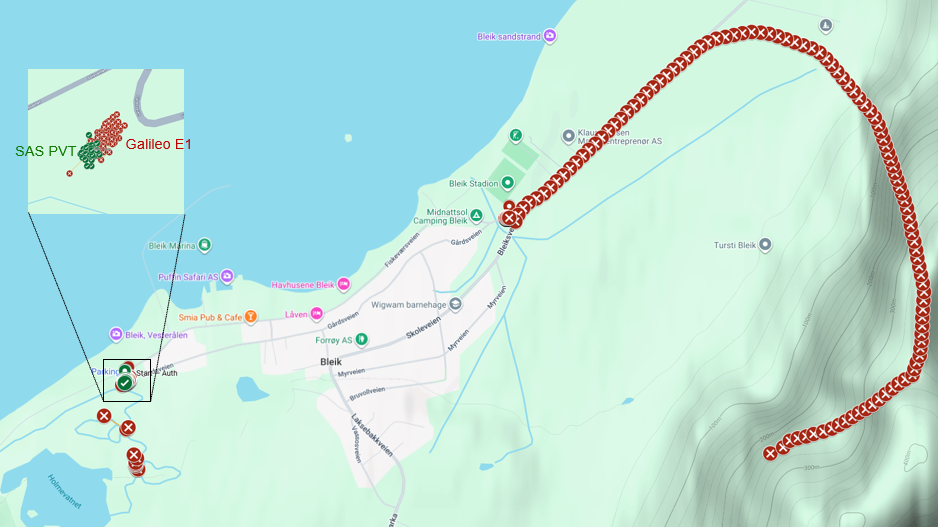
Considering how important it is for everything from navigation to keeping clocks in sync, satellite navigation systems are surprisingly vulnerable to a variety of attacks, ranging from simple jamming to more sophisticated spoofing attacks. This may be changing, though, as Galileo, Europe’s GNSS, recently demonstrated its first cryptographically-secured position fix under spoofing conditions.
Most GNSS systems, including GPS, have no verification measures to keep an adversary from transmitting a false signal at a higher power and hijacking a receiver; since GNSS signals are extremely weak by the time they reach the ground, this presents no great difficulty to a moderately well-equipped attacker.
Galileo’s Signal Authentication System (SAS) aims to fix this. The Galileo ground station pre-selects signal spreading codes, which it then encrypts with a regularly-changing secret key and publishes. A receiver which anticipates needing a verified signal can then download these encrypted codes ahead of time and store them. Galileo satellites then transmit on the E6-C pilot signal, and the receiver records the signal. After transmitting a message block, it then transmits the decryption key on a separate signal, which the receiver uses to recover the spreading codes. The receiver then correlates these spreading codes with the recorded signal to find the satellite’s pseudorange.
It’s a rather complicated system, but it works: earlier this month in Andøya, Norway, the annual Jammertest GNSS testing event took place. For one week, a wide range of organizations tested the resilience of their GNSS systems against various attacks, including jamming, delayed retransmission, and spoofing. Using five Galileo satellites, the European Space Agency was able to obtain a stable lock on their receiver even during spoofing.
In principle, this method could be extended to other GNSS systems. There’s certainly motivation to do so; very large-scale attacks have been demonstrated recently.


Tesla announced its electric semi-truck back in 2017, but deliveries to its first customers are just about to start nearly a decade later in September 2026. On September 24th, Tesla held a launch event for the Semi at its manufacturing plant in Nevada, where it plans to build 50,000 Semis a year. It may seem like a lofty goal, but Tesla CEO Elon Musk said in a pre-recorded video message that there is already a big waiting list for the Semi. At $290,000 for a Long Range Semi, it’s predicted that Tesla will deliver 15,000 in 2026 at most.
One of those early customers includes Zero-Emission Truck Shipper-Carrier Alliance Leading Electrification (ZET SCALE), a shipper alliance with brands like Microsoft and PepsiCo that reportedly ordered 2,500 of the electric semis — the largest electric Class 8 order ever made in the U.S. Tesla’s announcement made it sound as if it was providing all 2,500 of the trucks, but it’s just the primary supplier along with other brands. The fleet of 2,500 electric trucks will be deployed in Los Angeles, Houston, Dallas, New York, Atlanta, and other freight hubs over the next few years.
Said Dan Priestley, Director for the Tesla Semi Program: “We are proud to have been the primary selection in this RFP and look forward to giving shippers and carriers a new competitive edge.”
Tesla Semi faces delays and big claims ahead of launch
The Semi has a pretty typical history, as far as Tesla goes. Musk announced the vehicle in 2017 and had lofty goals of launching it in 2019, claiming it would be cheap to operate, carry a full load, and reach 500 miles on a single charge. At the time, experts responded that this was nearly impossible to pull off due to technology limitations. Tesla continued to miss various launch dates, eventually shipping some early examples to PepsiCo in 2022. Next year’s launch date was also missed, although brands like Walmart, Costco, and the NFL were given one Semi to test. Those have now been used for over 5 million miles.
If that timeline sounds familiar, it’s likely because the second-generation Roadster was announced in 2017, delayed multiple times, and is finally getting a reveal October 2026. The Cybercab was revealed in 2024, Musk claimed 2 million would be produced a year, and as of 2026, there are only 69 active Cybercabs besting tested in a few cities.
“This is going to be a revolutionary truck that’s capable of carrying the heaviest loads over very far distances,” Musk stated ahead of the launch event. He also added that it will be the “funnest truck to drive” due to its fast acceleration, which echoes previous statements, noting it will get Full Self-Driving in the future. There will be a Standard Range Semi that has 350 miles and a Long Range that gets 500 miles.
These are also claims that drivers should remain skeptical about. The Cybertruck was originally said to have a 500-mile range when it was revealed, but the reality is less than 300 miles. No comment on Musk’s claim that the Cybertruck could act as a boat.

Anthropic CEO Dario Amodei seems to be everywhere this weekend: He was lampooned on the season premiere of Saturday Night Live, and tonight, he’s set to have dinner with President Donald Trump at the White House.
Axios first broke the news of Amodei’s dinner plans, which TechCrunch subsequently confirmed with a source familiar with his plans.
This will be the first one-on-one meeting between the two men, who recently found themselves on opposite sides of the AI safety debate. Amodei released a plan to slow AI development (or at least proceed with more caution), while Trump has insisted, without evidence, that the AI backlash is a Democratic hoax; he also wants to rebrand the technology as “super intelligence.”
Even before the current back-and-forth, Amodei and Anthropic have to had a fraught relationship with Trump’s administration. Earlier this year, the Pentagon designated Anthropic a supply-chain risk in response to the company’s attempt to put guardrails around the use of its technology (Anthropic has been fighting the designation in court), although other administration officials have been friendlier.

Waymo’s self-driving car technology “continues to outperform human benchmarks,” the company claimed this week. “It was involved in 841 fewer injury-causing crashes — an 82% reduction compared to human drivers.”
Electrek reports:
We’ve seen various Waymo crash data before, with Waymo claiming crash reductions. That’s all well and good when the company says it, but we’ve also seen independent data confirming similar (though lower) crash reduction numbers…
Waymo has enough miles that it’s ready to start quoting how many injuries it has prevented, and the number is pretty high. Its newest crash data states that it had operated a total of 271 million driverless miles through June of this year, which is 50 million more miles added in the 3 months since its end-of-March update. Over those miles, Waymo says there was an 82% reduction in crashes that caused injury, and a 95% reduction in crashes that cause “serious injury or worse” [compared to human drivers].
Waymo also says that compared to human drivers it’s reduced injury-causing crashes involving pedestrians by 93%, cyclists by 86%, and motorcyclists by 82%.
Waymo’s analysis comes from San Francisco, Los Angeles, Austin, Atlanta, and Phoenix, and its blog post includes video showing some near-misses where it says its automated system prevented an injury-causing collision.


Read more of this story at Slashdot.

In this week’s Sunday Reboot, the Apple Watch is better for your health, but maybe the rumored screen-free wearable could be better for your peace of mind.
Sunday Reboot is a weekly column covering some of the lighter stories within the Apple reality distortion field from the past seven days. All to get next week underway with a good first step.
Keeping customers alive with simplification
The September event schedule usually covers the key portable touch points Apple has with its customers. That is, iPhone, AirPods, and the Apple Watch. This year was no different, and for the wearable side, that meant new wrist-mounted models.
There’s a lot to talk about, including things like Audio Intelligence and the privacy implications, as well as Siri‘s overhaul. But health is a big thing here, too.
It is a bit for me too, on a personal note. After attending a funeral earlier in the week, it certainly makes you think about your life and about doing something that stops you from being the perennially overweight guy. But I digress.
Apple’s added a new health-sensing system with an expanded electrode surface area, more electrodes, and a better photodiode array. It’s now checking your heart every five seconds, so you know how your heart varies throughout the day.

So many electrodes…
The new Readiness score also sounds like a decently simple way to measure your capacity to work out, or quite frankly, to deal with the day ahead. It’s a fairly clear signal to anyone that they need to care more about themselves.
It’s not quite the Apple Watch screaming “Get more sleep!” or “Work out more!” but it’s going to be helpful to some of its audience.
This all plays into Apple’s changes in the Health app on iPhone and iPad, with a greater use of Apple Intelligence. Though I fear many will look at Health Age with some trepidation.
Some people will see Apple Intelligence comparing them to someone five years younger and think they’re extremely fit for their age. Others will see a Health Age that’s added a few too many years, and quietly laugh it off if it’s brought up by anyone.
I fear that if I check that figure out, I’ll face questions from Apple Intelligence asking how I’m not dead yet.
Would you just stop already?
These notifications and metrics also tie into something else that came up this week. There were rumors that Apple was prototyping a new fitness and health tracker.
Specifically, a tracker that isn’t intended to be a mini iPhone on your wrist, but more a collection of sensors that hands off the data to your iPhone. Something similar to trackers like the ones sold by Whoop, which collects data on your activity and nothing else.
You may consider it to be a dumb Apple Watch, and you’re right. It’s not going to provide you with information directly, but that is the point.
I have been a long-time user of the Apple Watch Series 4, specifically the Nike Edition one. As if the swoosh will make me do more exercise.

The Apple Watch Series 4, still working on my wrist. It’s more scuffed now, though.
I have written before about how the Apple Watch is great at data collection, but also that it is also insanely good at nagging you. Every so often, your wrist dings as yet another notification comes in, and you’re too lazy to keep looking at your iPhone for once.
The amount of dings I get every day on my wrist is infuriating at times. On many occasions, I have wanted to punt the Apple Watch through a window because I hear the chime and immediately do Pavlov proud by looking at my wrist.
I have, in recent months, started wearing the Apple Watch with Do Not Disturb enabled. It has certainly helped me become less wound up and more relaxed because I’m able to ignore those wrist pings, but it doesn’t stop me from checking.
This is a problem that Apple has partially solved. With the introduction of the fitness tracking capability in the Beats Powerbeats Pro 2, it does mean I can do some workouts and exercise without the Apple Watch at all.
However, if I want to check my health from throughout the day, that’s not an option. I still have to stick with the Apple Watch and live with the potential auditory distraction.
At least the Whoop-like tracker will be there for keeping tabs on my day.
It’ll still be silently judging me, but that’s the point.
Last week’s Sunday Reboot discussed the Battersea Power Station Apple Store, and how it should be a more-used design in Apple’s retail landscape
Tech
Russia targets Ukraine’s data centers as attacks disrupt internet access for 100,000 households

What just happened? It appears that Russia has followed in Iran’s footsteps and decided to target data centers in its hostilities. A Russian drone hit a business centre in the Ukrainian capital Kyiv on Friday, killing four people and damaging a data center, which Russia later confirmed had been a target.
The September 25 attack struck Kyiv’s Solomianskyi district. Mayor Vitali Klitschko said seven people were injured, including a child, while three of those killed were found in a parking lot outside the building. The blast damaged the facade and shattered windows.
The facility belonged to Ukrainian telecommunications company Datagroup. It said none of its employees were injured and customer data remained safe. Services continued operating from backup sites, with specialists assessing the damage and working to restore the infrastructure.
“All this affects people’s ability to stay connected, study, work,” said Ukraine President Volodymyr Zelensky in a social media post. He also wrote, “The Russians are constantly expanding their escalation operation: American and other businesses, data centers, internet providers – for Russia, all ordinary life is simply a target. It is important that the world responds to all of this and that Russia feels the response to its terror.”

Russia’s defence ministry acknowledged the strike, claiming the data center processed and transmitted intelligence for Ukraine’s armed forces. Moscow also claimed attacks on facilities operated by New Telco, United DC, Kyivstar, and Parkovyi earlier in the week.
Ukraine’s digital transformation ministry said around 100,000 households in Kyiv and the surrounding region experienced internet problems following Wednesday’s attack, which damaged infrastructure belonging to providers Pavutyna and UTELS.
Some companies are already moving data from damaged servers to facilities outside Ukraine, according to the BBC, helping businesses keep their digital infrastructure beyond the reach of Russian strikes.
Losing connectivity in a war zone is obviously more serious than being unable to stream Netflix. Foreign Minister Andrii Sybiha said the strikes disrupted access to mobile air raid warnings. Banks, online payments, businesses, and government services also depend on the infrastructure now coming under attack.
There is some reassurance, however. The Institute for the Study of War’s September 25 assessment cited Ukrainian officials reporting no indications of damage to military or state communications. Providers also said Ukraine’s extensive, distributed networks make a complete internet shutdown unlikely, although repairs could push up customers’ bills.
Data centers are becoming a common target in conflicts. It was reported earlier this month that Iran’s attacks on Amazon’s Middle Eastern infrastructure left AWS unable to recover resources and data hosted exclusively in its Bahrain region. Resources in one UAE availability zone were also destroyed. Datagroup’s backups appear to have prevented a similar data-loss disaster in Ukraine.
Back in July, Iran claimed it had destroyed Amazon’s main data hub in Bahrain with cruise missiles. Tehran had also threatened the Stargate AI data center in Abu Dhabi, backed by OpenAI and Nvidia.
Image credit: DSNS Kyiv


Mitxela wanted noise. Years of fluid simulations on LEDs had given him mercury-like sloshing on screens and a tiny wearable pendant, yet every version stayed silent. Flip-dot panels solve that problem by themselves. Each pixel is a physical disk with magnets that slaps from black to yellow and back, and a few thousand of those slaps at once sound like water moving in a shallow tray. The name sealed it. FLIP already stood for Fluid Implicit Particle. Putting that algorithm on flip dots was too cool to ignore.
Commercial high-speed flip-dot walls from places like Breakfast Studio may cost a whopping $50,000, and they simply do not bother with smaller budgets. In contrast, Mitxela struck gold when he discovered eight excess Hanover panels from 2007, the most of which had been given after sitting idle in a friend’s stash of antiquated technology. Each panel is 13 dots tall by 28 broad, and 8 of them set up in a 2 by 4 grid provide a reasonable 3000 pixels and a square meter of display space. Mitxela had originally planned a truly massive setup with 18 panels and a giant gimbal system that visitors could use to physically flip the entire thing, but with only two weeks until Electromagnetic Field 2026, he scaled the design back down to 8 panels on a static plywood frame so that the local hackspace’s laser cutter could handle the parts in one go.
Sale

MNN 15.6″ FHD 60Hz Portable Monitor USB-C HDMI IPS HDR Gaming Laptop
- Full HD Portable Monitor – MNN 15.6inch portable laptop monitor with 1920*1080 resolution, advanced IPS glossy screen support 178° full viewing…
- Double Type-C Port -For Plug & Play, the MNN monitor provides 2 Full Feature Type-C ports. Only One USB Type-C Cable is required to connect to the…
- Lightweight Ultra Slim for Travel – As a portable external monitor,MNN portable laptop monitor easily accommodate to every suitcase and backpack and…

Figuring out how to connect the dots proved to be a far greater problem than finding them. The original manufacturing electronics can refresh an entire panel in roughly a second, which is simply too sluggish for the fluid animation Mitxela desired. So he created his own driver boards, which sit on top of the original PCB and are crammed with H-bridge chips, shift registers, and a cheap CH32V003 microcontroller to monitor things via an RS485 link. It took a long time to get all of the solder joints to function on each panel, which there were over 400 of. The copper traces had to be carefully cut with a Dremel and diamond wheel, and the capacitors went through several iterations, from tiny ceramics that kept failing to 47-microfarad electrolytics, and finally to banks of eight 1000-microfarad cans per panel, just to get the 12-volt supply to cope with the massive 50-amp inrush when all the coils fired at the same time. Eventually, the whole device was able to pull more than 10-15 amps from a reworked 40 amp supply. A few dead coils had to be unwound and resoldered, short circuits on the standoffs had to be repaired, and at one point, one of the panels was erected upside down and had to be broken down and rebuilt.
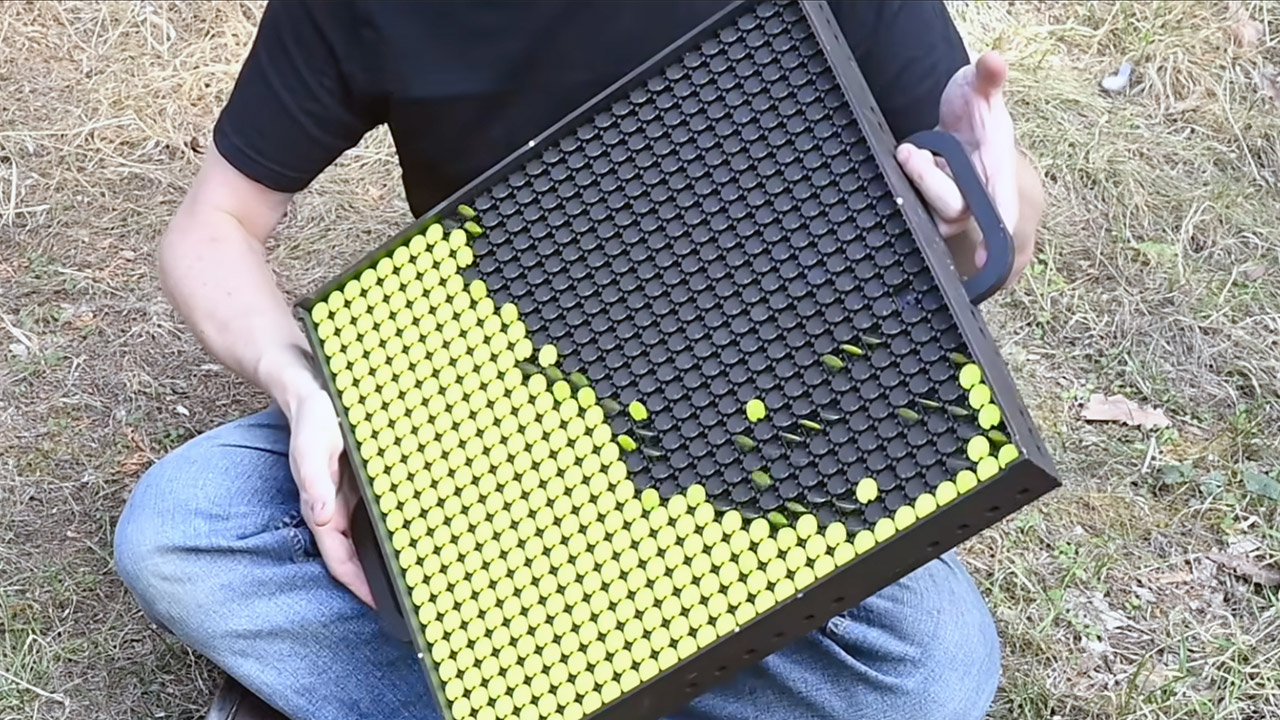
A two-panel prototype was already chugging along smoothly at about 40 frames per second using a Raspberry Pi Pico 2, but the final motherboard is an STM32H7R3 running at 600 MHz and connected up to all eight of the decoder boards, it talks to a throwaway joystick Mitxela picked up from AliExpress (aptly labeled GRAVITY CONTROL) and even listens out for any movement from an accelerometer so the whole thing can respond properly to being physically tilted, and the whole frame weighs in at a quite substantial 15 kg. Viscosity, of course, was adjusted to zero, so the energy just sort of… dribbles away as the particles knock into the walls, and the display eventually settles into all sorts of bizarre, beautiful patterns that look like they belong in an art gallery.

The finished piece sat four days in the EMF lounge tent before anyone began to play with the joystick, and at nite, when the tent was quiet and nobody was troubling the item, the fluid would simply drift into those zero-gravity formations. A handful of the dots proved to be fragile and died owing to dust or over-enthusiastic fiddling by curious observers, but the most were easily repaired. Overall, the parts and boards cost less than five hundred pounds, or a few penny per dot, assuming you ignore the donated panels and the months of sweaty evenings Mitxela spent sweatily soldering it all together. When you consider the time and work required to create it, the commercial price tag appears much more acceptable.
[Source]
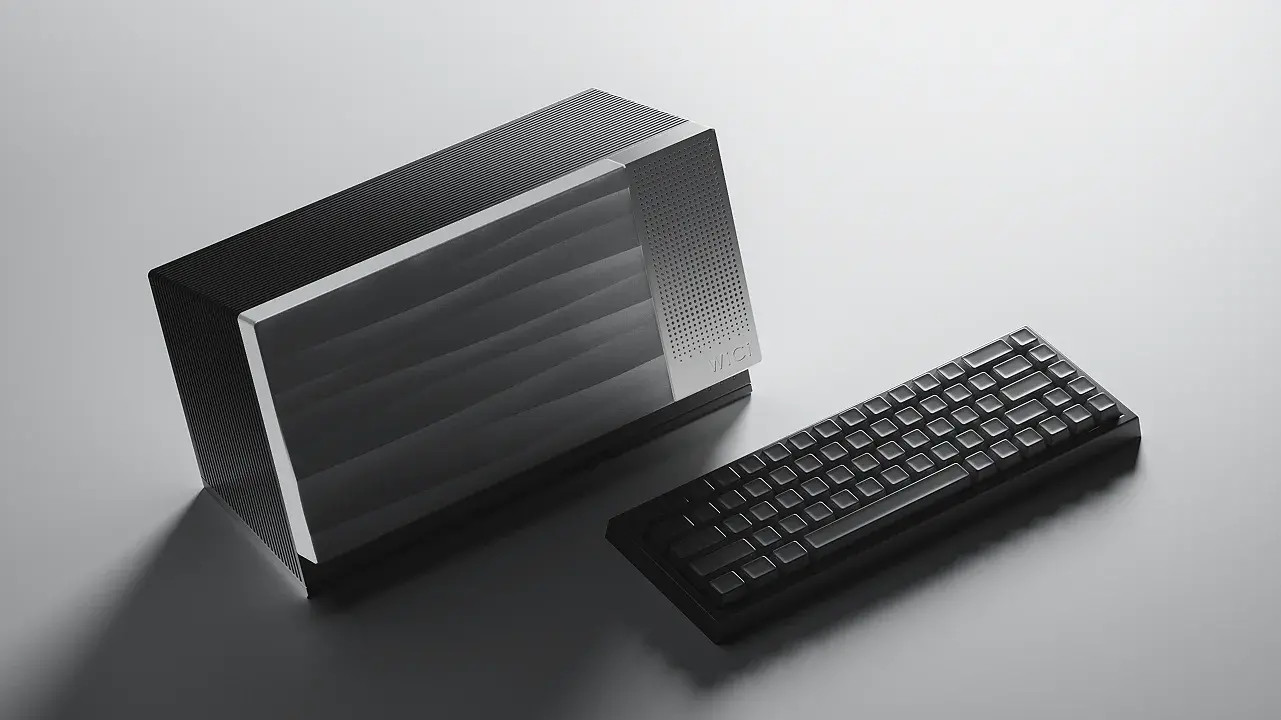
First look: External graphics cards have so far been limited by their need for high-bandwidth ports such as OCuLink and Thunderbolt 5. WiCi aims to address the issue by transmitting a GPU’s horsepower over Wi-Fi. The company claims that multiple devices on a network can share an eGPU’s compute for gaming and AI workloads.
WiCi recently began inviting interested parties to sign up for updates about the WiCi One, which aims to become the first successful wireless external graphics card. The device, sponsored by Nvidia’s Inception Program, aims to support popular AI tools, games, tablets, laptops, and phones.
A few companies have floated eGPUs as a way to achieve desktop-class GPU performance on smaller devices such as laptops and mini PCs. However, to maintain the bandwidth a desktop GPU normally uses over PCIe, eGPUs have so far required the latest cable technologies such as OcuLink, Thunderbolt 5, and USB4, which many devices still do not support.

WiCi believes that Wi-Fi 7 networks can support GPU instructions across multiple devices. In one demonstration, the eGPU appears as a Wi-Fi network that a user logs into on a modest-looking laptop. Although the video does not show the exact graphics settings used, the Cyberpunk 2077 benchmark can be seen running at over 90fps. The firm says the WiCi One also handles various AI models and tools such as Hugging Face, Ollama, Blender, Unreal Engine, CapCut, OBS Studio, and more, all without modifications.
The WiCi One is expected to begin shipping in the fourth quarter of 2026 with two available models. The cheaper variant, which uses an Nvidia RTX 5060 Ti, starts at $2,000 for early birds but carries a $2,600 MSRP. Pricing information for the other version, equipped with an RTX 5090, will be available closer to launch.
According to WiCi’s internal benchmarks, the 5060 Ti edition handles Cyberpunk 2077 at approximately 80fps and Black Myth: Wukong at 60fps in 4K at ultra settings using DLSS. Meanwhile, the 5090 variant achieves 110fps in Cyberpunk and 90fps in Wukong.

Regarding LLM throughput, the 5060 Ti edition runs DeepSeek V4 Flash at 8 tok/s and Gemma 4 at 140 tok/s, while the premium model reaches 20 tok/s in DeepSeek and more than 500 tok/s in Gemma. Meanwhile, CapCut can export to 4K at 75fps on the 5060 Ti and 90fps on the 5090, while Adobe Premiere Pro can output 4K H.264 videos at 70fps and 90fps, respectively.
Interested parties can also win a WiCi One for free by submitting ideas for use cases, with prizes going to the 10 most interesting concepts.

Tech27 seconds ago
Bill Gates Says It’s ‘Completely Irresponsible’ For AI To Not Have Safeguards

Crypto World2 minutes ago
Pump.fun moves $5.83M in SOL to Kraken

Entertainment5 minutes ago
13 Bestselling Beauty Items on Sale





-

 Fashion2 days ago
Weekend Open Thread: J.McLaughlin – Corporette.com
-

 Crypto World5 days ago
Goldman Sachs and Deutsche Bank Agree: The S&P 500 Rally Isn't Over
-

 Tech7 days ago
Researchers escape OpenAI Codex sandbox to run commands on host
-

 Fashion3 days ago
8 iPhone Accessories That Add Personality
-

 Crypto World7 days ago
Who Needs CLARITY Anyway? ARB Could See 70X Increase: Hodler’s Digest
-

 Entertainment5 days ago
These 17 Fall Amazon Dresses Seriously Look Like Anthropologie
-

 Business7 days ago
Analog Devices (ADI) Bets $1.35 Billion on Chips that Let Machines Think for Themselves
-

 Crypto World7 days ago
Coinbase, Robinhood, Circle Seen as Tokenized-Stock Winners
-

 Tech5 days ago
Reolink’s solar 4K security camera falls to its lowest price in months
-

 Crypto World5 days ago
This Bearish Netflix Stock Trade Can Cash In On Video Streaming Giant’s Woes
-

 Crypto World5 days ago
Trump-Xi Polymarket Odds for Handshake Hit 50%
-

 Tech6 days ago
Google’s $899 Googlebook is a bet that you’ll buy a new laptop for Gemini
-

 Crypto World4 days ago
Crude Oil Prices Pressured by Diplomatic Hopes in the Middle East
-
 Business5 days ago
Oil Price Today (September 23): Crude oil below $100 on hopes of US-Iran talks. What did Trump say?
-
 Crypto World4 days ago
Bitcoin price tests $83,600 Supertrend support after $87K rejection
-

 Crypto World4 days ago
Bitcoin Threatens Sub-$84,000 Breakdown as Long Liquidations Spike
-
 Crypto World6 days ago
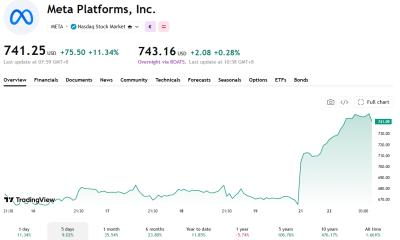
Meta Jumps 11% As Muse Shines and Investors Show an Appetite for Advancing AI
-

 Crypto World5 days ago
Did Jim Cramer Just Give GameStop Stock the Kiss of Death When He Said the Turnaround Is Working?
-

 Crypto World7 days ago
Bitcoin price holds above $81K as key catalysts line up
-

 Crypto World5 days ago
BitGo says Bitcoin absorbed Fed hike, CLARITY failure
You must be logged in to post a comment Login