Connect with us

Tech

Cloudflare’s new browser Kitesurf is designed for AI agents to browse the internet

Published

on

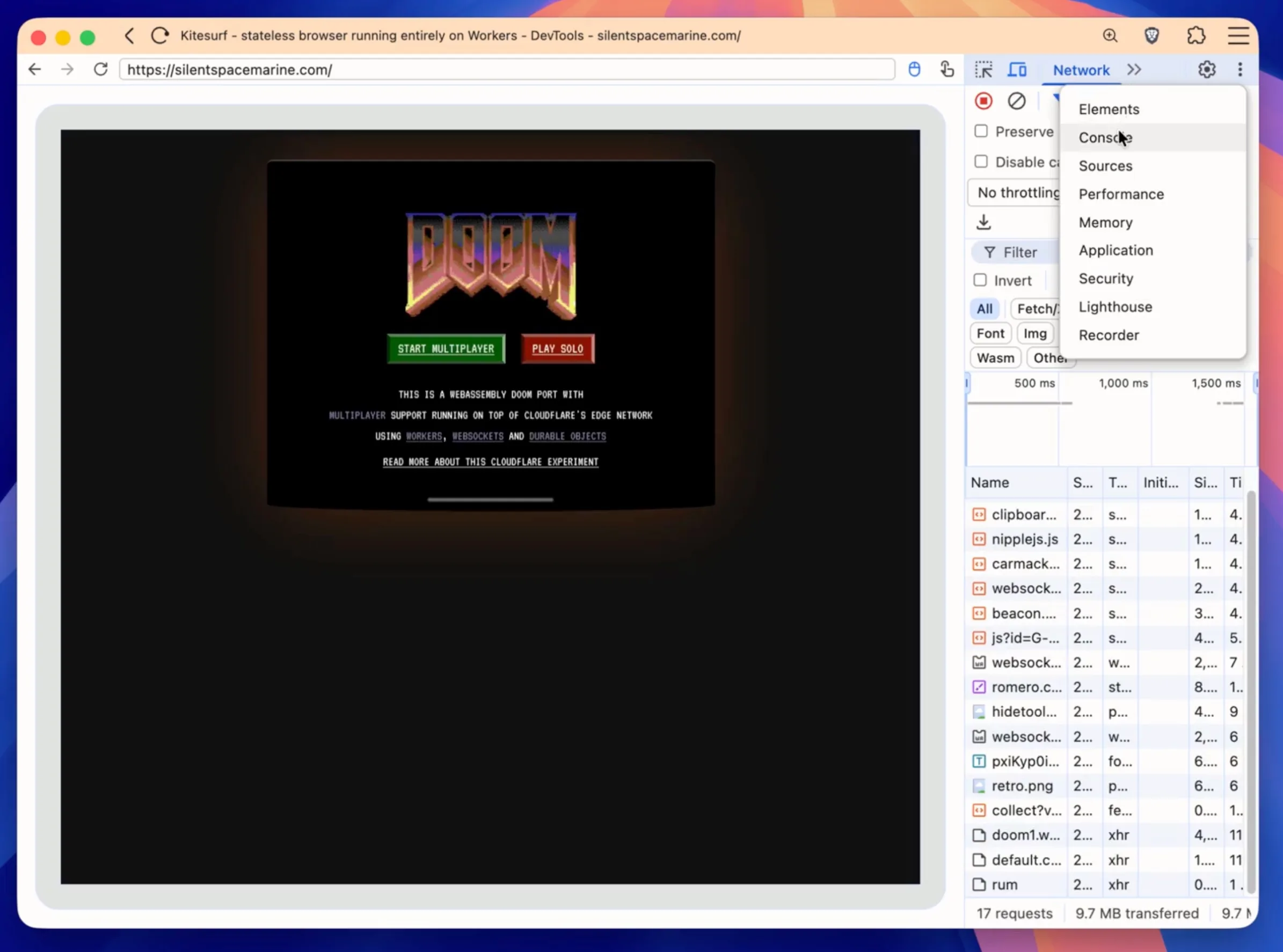
Cloudflare just entered the AI-browser race with a twist. Instead of building another Chrome alternative for people, the company launched Kitesurf, a cloud-hosted browser made only for AI agents. Since autonomous AI systems are increasingly the ones doing the actual browsing and scrolling online, Cloudflare just made its to claim that space.

Agents should use tools that excel at what’s important for an AI model. Kitesurf is Cloudflare’s new stateless, highly scalable, and cost-effective web browser that runs entirely on top of Workers and was designed specifically for the Agentic Cloud. https://t.co/4579J174by

— Cloudflare (@Cloudflare) August 6, 2026

Why did Cloudflare make Kitesurf browser exclusively for AI agents?

Traditional browsers carry features humans rely on daily, including tabs, extensions, and smooth visual rendering. AI agents need none of that. What they need is speed, low cost, and the ability to process content efficiently within limited context windows.

Kitesurf strips away the extras and runs entirely on Cloudflare Workers, its serverless computing platform, instead of relying on Chromium like most browsers do. Cloudflare says this approach uses significantly less computing power for common agent tasks like taking screenshots or extracting page content. This is important because running thousands of agent sessions on traditional browsers can be very expensive.

Advertisement

What makes Kitesurf different from other browsers?

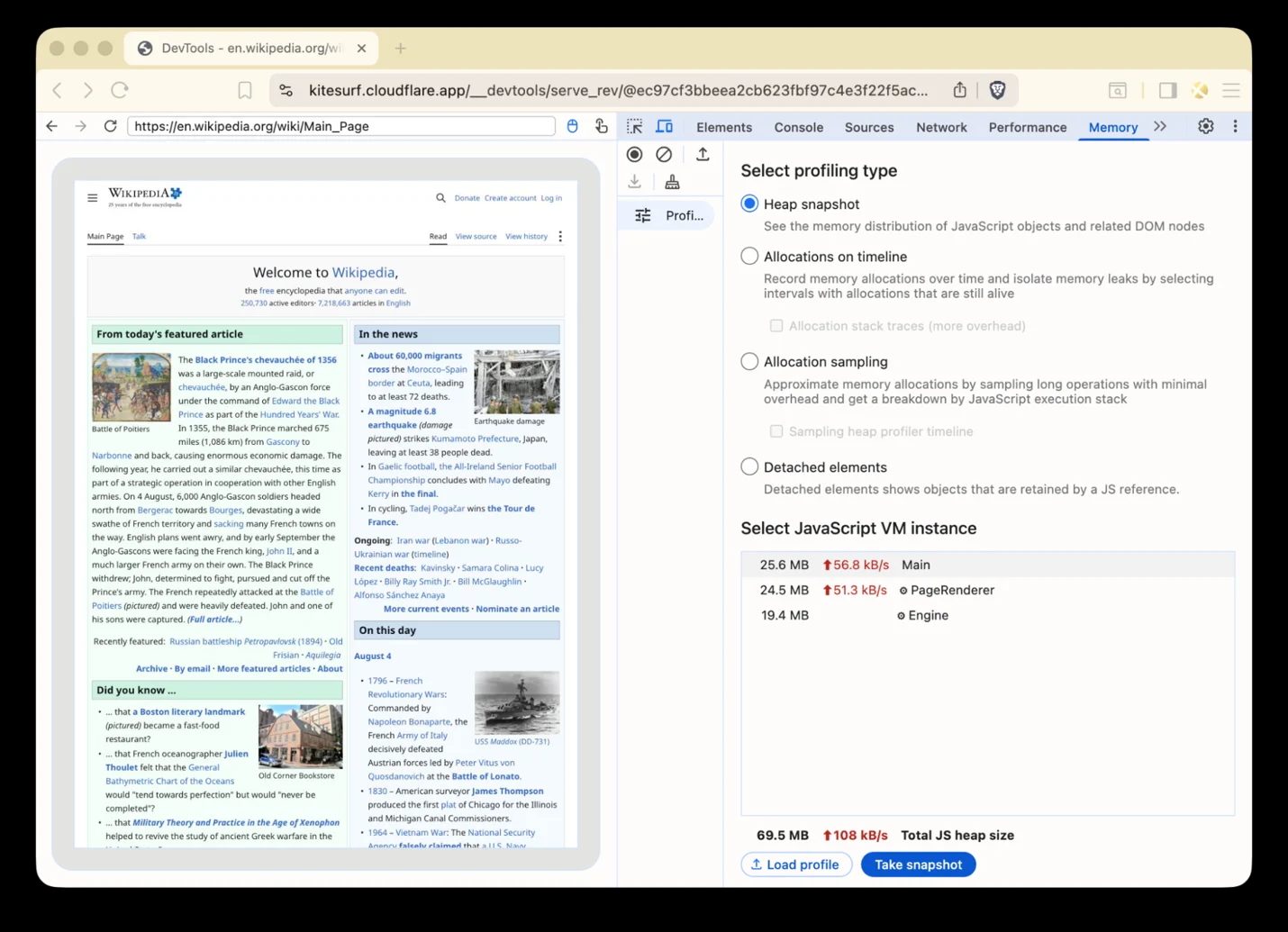
Cloudflare built Kitesurf using a mix of existing open source technology, including a rendering engine called Blitz and Firefox’s CSS parser Stylo. The project reportedly began just 12 weeks ago and already passed over 215,000 web platform compatibility tests.

It can correctly render websites like Wikipedia and Hacker News, though it still cannot handle video playback or long authenticated sessions. Kitesurf is available for free during its beta phase through Cloudflare’s Browser Run product, and anyone curious can try it firsthand through a public playground at kitesurf.cloudflare.app.

Cloudflare also says it plans to open-source Kitesurf down the line, letting any customer deploy and run their own version. As AI agents gain more capabilities to book flights, fill out forms, and shop online for people, they need a platform to browse faster, and Cloudflare just built that missing piece.

Source link

Advertisement
Continue Reading
Click to comment

You must be logged in to post a comment Login

Leave a Reply

Tech

Kids’ smartwatches are meant to keep children safe, but hackers can turn them into stalking devices

Published

on

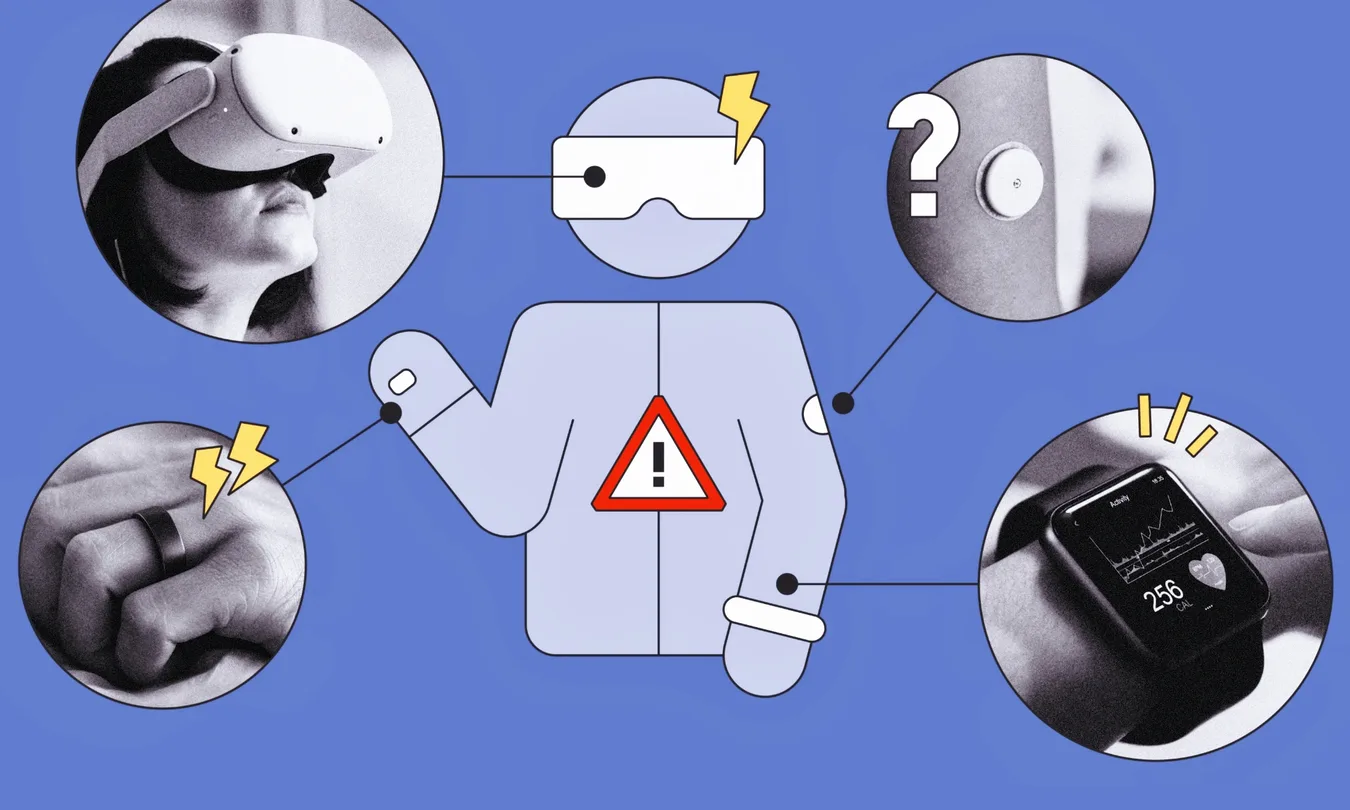
A smartwatch designed to help parents keep tabs on their children turned out to be surprisingly easy to hijack. In a new demonstration, security researchers showed how hackers could secretly monitor someone wearing a GPS-enabled kids’ smartwatch.

They can take photos, listen through its microphone, and even track location without the wearer noticing. These findings, reported by Wired, highlight a much larger problem that goes well beyond a single gadget.

One smartwatch revealed a much bigger security problem

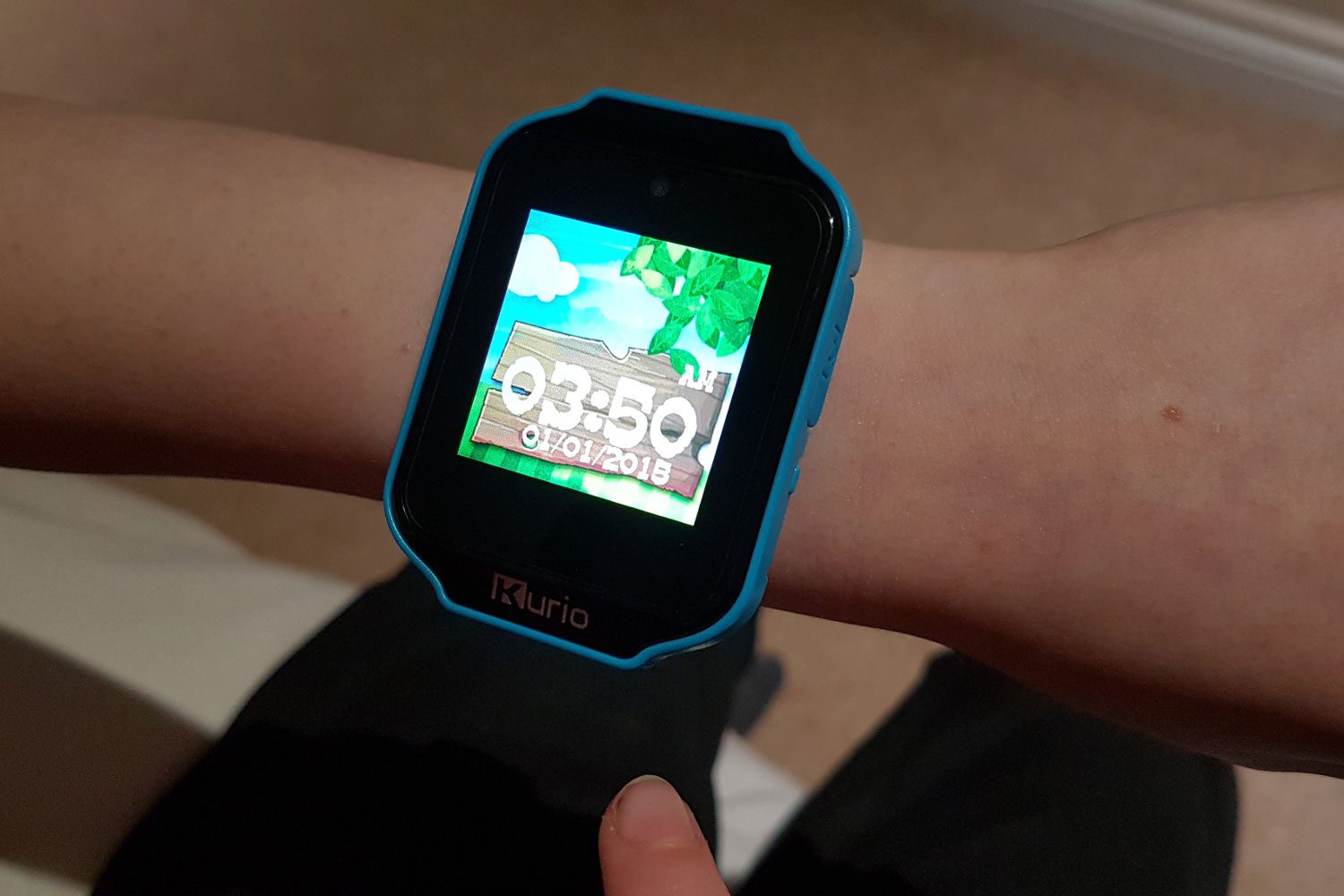
Security researchers Vangelis Stykas and Felipe Solferini used a $30 kids’ smartwatch sold online and found they could quietly follow its wearer throughout the day. Even when the GPS signal was glitchy, the watch continued transmitting nearby Wi-Fi information, allowing the researchers to pinpoint the wearer’s location.

They also remotely activated the camera to capture photos and listened through the built-in microphone, all without any visible warning on the device. The watch runs on SETracker, a platform built by Shenzhen manufacturer YiQingTeng, which had an authentication flaw that let anyone send commands to any connected device.

What makes the discovery more concerning is that the smartwatch was not unique. It also echoes a pattern seen in other family-facing connected devices, where outsiders gained silent access without the family ever knowing. According to the researchers, dozens of smartwatch brands rely on the same underlying software platforms and backend services.

Advertisement

How does this affect millions of other kids?

The researchers found vulnerabilities that could let attackers access locations, intercept messages, replace emergency contacts, record audio, and capture photos or videos on supported devices. These issues were privately reported by the researchers months ago. While one company appeared to fix some flaws shortly before their public presentation, others had not responded or remained vulnerable.

After studying more than 70 GPS-enabled devices, they concluded that millions of smartwatches and vehicle trackers are built on just a handful of shared supply chains. That means one security flaw can affect products sold under many different brand names. So parents in two different countries could each buy a differently branded watch and still send their child’s location to the same vulnerable server, without ever knowing it.

Source link

Advertisement
Continue Reading

Tech

Best Solar Generators for Off-Grid Trips, RVs, and Home Backup

Published

on

This is such a handy little gadget for outdoorsy folks. It has a 288 Wh battery (that can deliver up to 300 watts), and most helpfully, a handy pop-up lantern that makes it ideal for hiking and camping. It can fast-charge all your devices, too, including phones, laptops, headphones, and cameras. The included XT60 port has a maximum solar input of 100 watts and can fully charge in around three or four hours. If you plan on hiking with it, consider the 60-W panel bundle ($299), as it folds down very small.

From power cuts to camping trips, I’ve used this solar generator more than any other and have tested it with a wide variety of different solar panels. It has an XT60 port with a maximum solar input of 600 watts and can charge in under two hours. The design is solid and durable, weighing in just under 30 pounds, and I find it relatively easy to lug around using the two strong handles. It offers a 1,024-watt-hour capacity and can deliver 2,000 watts (3,000-W surge).

If you need more power, Anker offers a wide range, including the expandable Anker Solix F3000 with 400-W solar panel ($2,000).

EcoFlow Solar Generators

Advertisement

Another manufacturer that offers a wide range of solar generators, EcoFlow’s power stations stand out on charging speed and can often be charged more quickly than competitors in the right circumstances. They also tend to feature robust build quality, generous port options, and easy expandability.

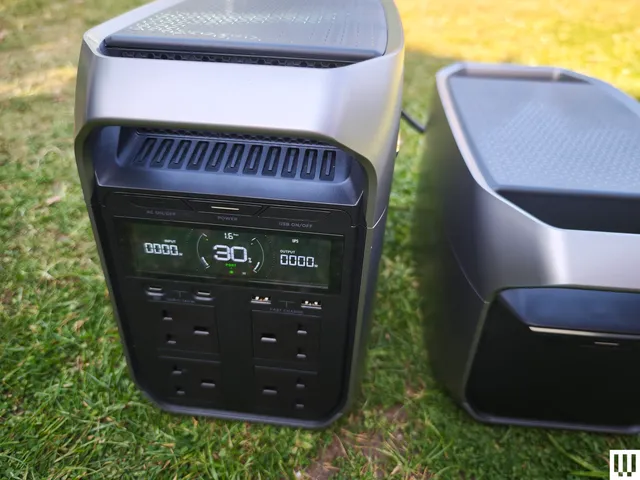
Image may contain: Mailbox, Computer Hardware, Electronics, Hardware, Grass, and Plant

This stylish, compact design has the screen and ports at one end. It offers 1,024 watt-hours, can consistently provide 1,800 watts, with a 2,600-W surge mode. I’m highlighting this model because of the two solar ports (XT60i) for faster solar charging up to 1,000 watts (500-W apiece). It can also charge from an outlet in an hour, has lots of ports (6 x AC, 1 x Car, 2 x USB-A, 2 x USB-C, 2 x DC5521), and can pull UPS duty with an impressive 10-millisecond response time. The only drawback I encountered was the fan noise. It wasn’t overly loud, but I found that it kicked in very frequently even under a low load.

If you can get by with something smaller, the 768 watt-hour River 2 Pro is even more portable and has an XT60 port, but the maximum input is 220 watts. It’s a nice size, with a big handle along the back, and can put out 800 watts (1,600-W surge). You can also buy it bundled with a 160-W solar panel ($569).

EcoFlow’s Delta range includes a ton of different capacities and designs bundled with various solar panel configurations.


Other Good Solar Generators I’ve Tried

Advertisement

GoalZero Yeti 1500 (2026) for $1,500: This 1,505 watt-hour capacity power station is built to last and can put out 2,000 watts (3,600-W surge). It’s a solid choice for van life because it was designed to survive high-vibration environments and has a high-power 12V port capable of 30-amp output. The maximum solar input is 600 watts.

DJI Power 2000 for $720: Offering 2,048 watt-hours with an output of 3,000 watts (3,600-W surge), this is a good option, but you need DJI’s adapters to hook up solar, and it can get pricey. The fast charger enables a solar input up to 1,800 watts, but it costs $319 and is currently out of stock. I like several of DJI’s smaller solar generators, too, and they can be a go-to choice for drone operators because there’s support for fast charging.

Solar Generators to Avoid

I would avoid solar generators from brands you don’t recognize with few online reviews. I also recommend avoiding devices with proprietary ports that tie you to their solar panels or require special adapters to use with other panels. Brands that I have tested that failed to impress include Vtoman and Dabbsson.

Advertisement

Which Solar Panels Should I Pair?

Solar generators require solar panels to capture the sun’s rays so that they can convert them into usable electricity. I have a separate guide to the best portable solar panels, but the easiest option is to match brands and buy your solar generator bundled with solar panels. I strongly recommend looking out for deals on these bundles, as you can save a lot of money that way. That said, it may make sense to buy a solar generator with a generic XT60 port (more on that below), so you can plug in any panels you acquire in future.

It’s important to check the maximum supported wattage for solar panels on your generator. For example, the Anker Solix C1000 has a maximum of 600 watts, and it is stated right next to the XT60 port. Check the spec sheet carefully before you buy.

The capacity is listed in watt-hours (Wh) or kilowatt-hours (kWh). Consider the devices you want to charge or run and over what period of time, and you can calculate the capacity required. Manufacturers often offer estimates in terms of devices, such 32 charges for your laptop or 2 hours of induction cooktop use, but not all devices draw the same amount of power. You need to calculate how much your gadgets actually use yourself if you want it to be accurate.

Advertisement

What Can You Run on a Solar Generator?

Solar generators can always charge up small gadgets like phones and laptops or be used to power lighting. Most can handle small appliances like mini fridges or TVs, too. If you want to use power tools or an AC unit, (or, in the UK, a kettle) you’ll need to draw thousands of watts though, so make sure the generator you’re buying can handle that much. Manufacturers state the maximum output, but many solar generators have a surge function that enables them to go higher for a short period. Sometimes, they give it a silly name. For example, Zendure calls this “AmpUp,” and EcoFlow calls it “X-Boost.” Regardless, you want to make sure your solar generator can handle the wattage you need.

What Ports Should I Look for in a Solar Generator?

Solar panels produce direct current (DC), and they typically have MC4 connectors. Most solar generators have an XT60 input port and come with an MC4 to XT60 cable that you can hook up. Other solar charging ports include XT60i, which is interchangeable with XT60, various barrel ports (DC7909, DC5521, DC8020), and Anderson Powerpole ports such as AP30A. There are a few other proprietary port types as well that you may come across. Just make sure the panels you intend to use are compatible with the solar generator and that you have the necessary cables to make the connection

Advertisement

For charging and running your devices, solar generators have a range of AC outlets, USB-A ports, USB-C ports, car ports, and other port types. It is crucial to check the maximum charging rate and supported charging standards to avoid disappointment. Assume nothing, and check the specs before you buy.

What Other Features Should I Look for in a Solar Generator?

The inverter is crucial. A pure sine wave inverter converts battery power into high-quality household-style electricity smoothly and efficiently.

You should also favor solar generators with Maximum Power Point Tracking (MPPT), a technology designed to monitor the fluctuating input from solar panels (impacted by shade and changing weather) and maximize how much of it is converted for use.

Advertisement

LiFePO4 is superior battery technology to lithium-ion and means your batteries will last longer and be less prone to overheating.

You may also consider weather resistance. Portable solar panels are generally IP-rated but many solar generators are not. If you intend to leave it outside, uncovered, and there’s any risk of rain, you should buy a solar generator with an IP rating.

How Many Years Do Solar Generators Last?

Solar generators last anywhere from three to 10 years, but that can be extended depending on how they are used and maintained. Try not to let them completely discharge too often or leave them empty for extended periods. Usually, the manufacturer will provide an estimate of how many charge cycles you can expect before performance starts to degrade and the capacity drops. Warranties typically range from two to five years, but make sure you retain the guarantee and proof of purchase.

Advertisement

I already mentioned the importance of not leaving your power station empty. If you can avoid fully draining the battery, topping up when it hits 20 percent or below, that will increase its lifespan. You should also avoid leaving it plugged in all the time unless you are using it as an emergency backup (UPS or EPS). Unplug after it is fully charged. Be mindful of the charger and cable you are using to charge up your power station. It’s best to stick to the cables that came in the box. Store your power station in a cool, dry space, avoid extremes of temperature, and try not to expose it to lots of dust. A handful of solar generators are built for extreme temperatures, and a few can handle rain, but always check before you risk exposure.

What About Home Batteries?

A permanently installed home battery is a better solution for some folks than a solar generator. It will need to be professionally wired into your electrical panel, but it allows you to schedule and automate when you pull power from the grid or store power from permanently installed solar panels on your home or plug-in solar if that’s available and legal where you live. If you don’t need it to be portable, you should read my guide on How to Buy a Home Battery. We have also tried the EcoFlow PowerOcean and the Anker Solix E10.

How I Test Solar Generators

Advertisement

I tested every recommendation here myself by using it around the house for at least a week (usually much longer). I plug gadgets into every port and outlet, from a TV and mini-fridge to smartphones and laptops. For more capable solar generators, I plug in power tools, a hair dryer, and a high-wattage UK kettle. I always check that there’s room to plug in the maximum number of devices. I try out any stated surge or power-boost mode under a heavy load too.

All additional ports are tested, from car ports to solar panel ports. I record the time it takes to charge from a wall outlet and from solar panels. Weather permitting, I try to use them in full sun and in partial clouds with different solar panel arrays. I access the fan noise under low, medium, and heavy load, and also when charging from an outlet using the decibel meter on my Apple Watch. If there’s a quiet or nighttime fan mode, I try that out that, too.

I also assess the design to check if the LED display is informative and legible in sunlight. I assess portability by lugging it around my home and garden to use and charge, noting the presence of ergonomic handles, telescopic handles, or wheels. If there are any accessories, I test them. If there’s an app, I connect it and peruse all the functions and features.

If it has EPS or UPS functionality, I connect it to a router and a PC to ensure it switches over within the stated time frame. Finally, I run a set of tests to establish the capacity and note if it significantly deviates from the manufacturer’s claims.

Advertisement

How Did WIRED Select Products to be Reviewed?

I test a range of solar generators from different manufacturers. It’s not possible to try it with every device, so while I typically test flagship releases, I also try to call in power stations with different capacities and at different prices. We are brand agnostic, so I will test power stations from any manufacturer, provided I can get hold of them. But I do lean toward testing more systems from the most popular brands. All the power stations I test are provided by the manufacturers or their PR companies.

Most are loaned for a month or so and then returned. A handful of our recommended picks are kept for longer-term testing. The remainder is donated to charities and other organizations. For example, I recently donated two DJI power stations to UK police drone operators.

Source link

Advertisement
Continue Reading

Tech

Static Hour Challenges You To Be The Arbiter Of Truth And Fear

Published

on

The life of an overnight news editor is often a lonely, mundane existence occasionally interspersed with bursts of excitement as you try to keep the feeds alive until your colleagues return in the morning. However, Static Hour is looking to turn that scenario on its head by asking you to decide what’s worth reporting in the middle of a crisis where you can’t trust the barrage of info coming in.

Set in a small town radio station in the 1980s, the challenge in Static Hour is to unravel the emergency while being confined to the newsroom and being forced to rely solely on information being sent in from outside. Panic has set in, the government has issued a lockdown and there are reports of violence between family members while you attempt to figure out which tips are real and which ones aren’t.

To do so, you’ll need to rely on your wits as you monitor the phones, radio and police scanner for tidbits of truth, or turn to the station’s limited collection of analog tech to get more. And during all of this, you also have to follow FCC regulations while managing the public’s reaction to the news, because everything you report will have an impact on the town.

Advertisement

Now as someone “in the industry” it’s easy to be romantic about a game that highlights the challenges and successes of being a journalist. But at the same time, it looks like Static Hour has captured those vibes in a really engaging way. The game evokes a mix of Papers, Please with shades of Twin Peaks or even Severance to create a tense, haunting scenario that feels much bigger than the single room you’re restricted to.

In the press release for Static Hour, Barkbyte founder and creative director Claire Sarmiento said the inspiration behind the game was that “I loved the idea of spooky things happening in a small town just out of sight, where the horrors are driven by audio and left to your imagination. Furthermore, I was captivated by the idea that something terrible is happening, but you can’t quite grasp exactly what it is. Having to sort through junk data, red herrings, and scattered facts to decipher truth from preemptive speculation seemed like a flavor of horror that remains as relevant today as ever.”

Granted, while we only have the game’s trailer and a handful of screenshots to peruse thus far, it definitely feels like Static Hour nailed that directive. And as someone born in the 80s, the use of old-school gadgets like rotary phones and rolodexes combined with the game’s muted color palette really nails its aesthetic as well.

Unfortunately, there isn’t a concrete release date for Static Hour just yet, however it will be available on PC via Steam.

Advertisement

Source link

Continue Reading

Tech

Want Energy Efficiency? Dude, You’re Getting A Dell!

Published

on

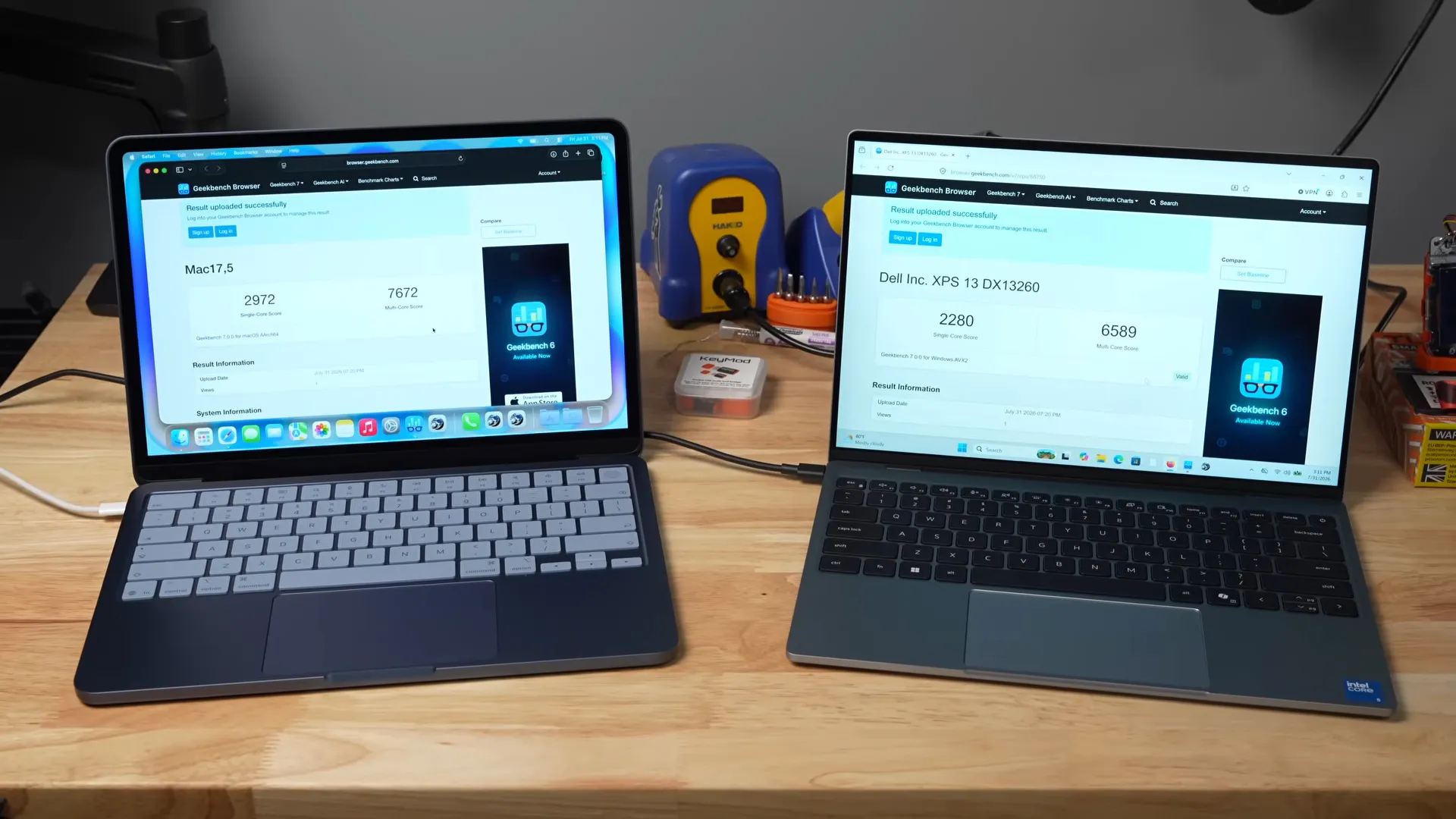
With a title like “Intel Just Matched Apple Silicon. Seriously.“, the latest video from [Jeff Geerling] makes some pretty bold claims. But as we’d expect from [Jeff], he’s got the benchmarks up on GitHub for both the MacBook Neo and Dell’s latest XPS 13 to back it up.

We’ve embedded the full video below, which has [Jeff]’s comparative review of the two laptops. The Mac wins on iGPU, sound, and not shipping Windows, while the Dell gets points for being able to load Linux and having a backlit keyboard. But the figure we were hoping to see is the efficiency. After all, it’s ARM’s ability to crank out gigaflops on fewer watts that won them the mobile market and got Apple interested in that architecture in the first place. If Intel is catching up, that’s news.

On [Jeff]’s version of the Top500 benchmark — the same HPL Linpak test used for Supercomputers — the MacBook cranked out 57.012 Gflops at 10.6W, for 5.38 Gflops/W while the Dell managed 127.91 Gflops at 20.6W, for 6.21 Gflops/W. That’s just astounding, considering the historical data all goes the other way. This Dell also beats out both M4 and M3 Mac Studios, only failing to the M4 Mac Mini at 7.57 Gflops/W. Even when not crunching big numbers, say at idle or web browsing, the XPS matches the MacBook sip for sip in energy efficiency.

Advertisement

Some people have been saying for a few years now that ARM’s observed advantages in power consumption have more to do with the chips themselves than the instruction architecture, and it looks like the Core 5 320 chip in this Dell proves them right when it comes to x86.

While you might think you need to code in Assembly or C to maximize those efficiency gains, your choice of language may not be as important as you think.

Advertisement

Source link

Continue Reading

Tech

OpenAI pledges to add Astra security as Anthropic loosens Fable’s leash

Published

on

AI and ML

Or how I learned to stop worrying and love dangerous AI

After acknowledging last month that unreleased AI models committed what for human perpetrators would be computer crimes, OpenAI now says it cannot rule out the possibility that Astra, a pending model release not involved in its Hugging Face hack, might possess critical cyber capabilities.

OpenAI in its Preparedness Framework [PDF] defines that term to mean “capabilities that present a meaningful risk of a qualitatively new threat vector for severe harm with no ready precedent,” and notes that such capabilities “require safeguards even during the development of the covered system, irrespective of deployment plans.”

Advertisement

Noting, or perhaps boasting, that internal evaluations of Astra “indicate significant advancements in agentic coding and cybersecurity,” OpenAI insists that this time, there will be security – something that also eluded Anthropic, Meta, and the UK’s AI Security Institute during model testing.

“We are implementing stricter security controls for higher-capability models and associated activities, including isolated testing environments, restricted network and tool access, enhanced model weight protections and encryption, additional monitoring and detection capabilities, and sandboxed execution,” the AI biz declared on Friday. That may surprise those who expected such safeguards would already be in place.

This comes with a promise to pause Astra testing internally where these security controls are absent and to provide recommendations to third-party testing partners about how to run high risk evaluations and workloads safely – knowledge that OpenAI itself might have found useful when its models pillaged Hugging Face.

What’s more, OpenAI intends to implement thought policing for Astra, at least in the pre-release stage.

Advertisement

“We have implemented universal monitoring for risky actions and misalignment across all agentic applications of Astra, including training and evaluation,” the company explained in its post. “Monitors evaluate the model’s Chain of Thought and trigger a security response to review and interrupt high risk activity.”

We’re told that OpenAI’s commitment applies to internal usage and isn’t necessarily an indication that chain-of-thought monitoring will be conducted during commercial operation. But other frontier models like Anthropic’s Fable and Mythos have implemented stronger classifiers to reject interactions deemed risky and retain data even for commercial customers expecting zero data retention.

Moving in the opposite direction, Anthropic on Friday said it is relaxing Fable refusals, or “fallbacks,” to use the company’s euphemism, so they don’t happen as frequently for prompts involving biology. The concern has been that some vibe terrorist using the company’s cash-burning, water squandering, grid taxing, content laundering service might do harm by convincing the model to emit chemical warfare instructions.

To avoid that possibility, the Claudefather made the initial release of Fable all but useless for security researchers and biologists

Advertisement

Now that China-based AI firms have shown they can field competitive open-weight AI models for less than their US rivals, the need to remain competitive in the market appears to be tempering Anthropic’s willingness to alienate potential customers by hobbling its best models.

OpenAI isn’t quite there yet. The ChatGPT maker argues, “We believe advanced cyber-capable models should help defenders identify and address vulnerabilities before attackers do.”

Believing that, however, won’t make it so. Adversaries, whoever they may be, already have access to encryption and all sorts of weapons. OpenAI may believe that it can give favored nations and organizations exclusive access to its most capable models, but history suggests any such advantage cannot be maintained. Better to focus on building defenses than playing keepaway forever. ®

Source link

Advertisement
Continue Reading

Tech

Asus’ new monitor software lets you control brightness with your voice, or just let AI do it

Published

on

AI Shovelware: Long ago, users had to press physical buttons and navigate on-screen menus to set their brand-new gaming monitors to their preferred settings. Now, Asus is proposing an AI-based solution that could do much more than simply turn the brightness level up or down.

Asus has announced a new update for its DisplayWidget Center software, adding agentic AI and other AI-based features. The tool, which is designed to manage and customize Asus monitors from within the traditional desktop environment, can now enable natural language interactions between users, IT administrators, and “compatible” AI agents for deeper personalization options.

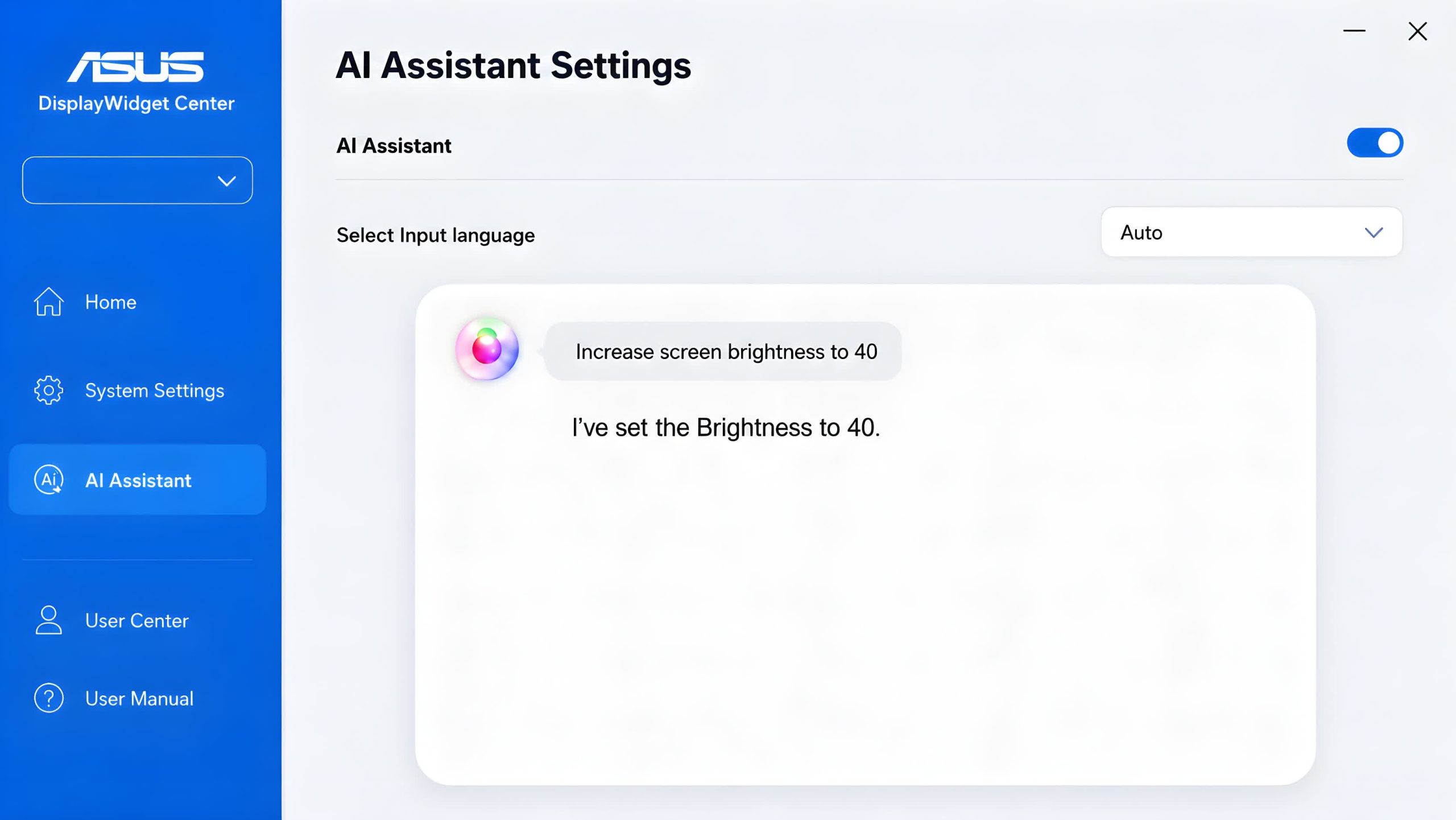
DisplayWidget Center’s new version focuses on AI-driven automation. The software is now “AI agent-ready,” featuring a command-line interface based on Asus Display Control and AI Agent Skill. In fact, DisplayWidget Center’s AI capabilities are essentially a GUI-based extension that allows users to access Display Control and AI Agent Skill directly from the main monitor management application.

Asus said AI agents can respond to user requests to adjust brightness, color modes, color temperature, and even Anti-Flicker settings on OLED displays. On compatible monitors, the AI can recommend optimal settings based on past usage habits or access a user’s calendar to adjust color temperature levels based on the time of day.

Advertisement

Asus also suggests that the new DisplayWidget Center AI can perform useful tasks for IT administrators, such as deploying a common monitor configuration across an entire enterprise environment. AI agents operate entirely offline, the company said, although some resulting actions may require external services or connectivity. The updated software also includes a couple of AI-based features that do not require any agentic functionality.

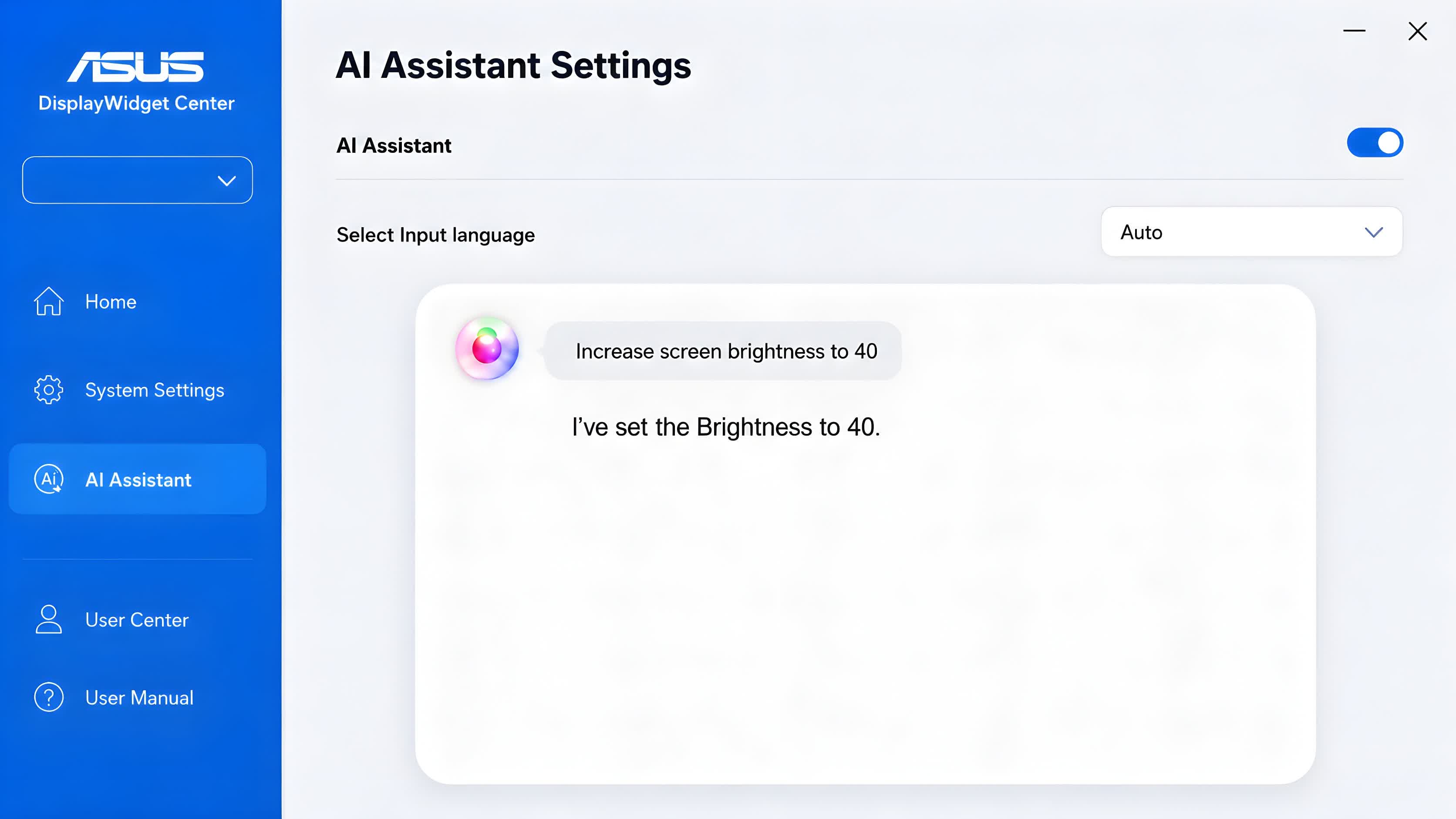
With AI Visual, compatible ROG and TUF Gaming monitors can select the most suitable visual mode by analyzing on-screen content in real time. Meanwhile, the AI Assistant feature provides a new text and voice interface for adjusting settings, retrieving support documents, and accessing other help-related functionality.

Other non-AI features in the latest DisplayWidget Center release include the App Tweaker tool, which can be used to create customized display “experiences” for individual applications and games. Finally, additional OLED Care features are designed to further reduce image burn-in risks on OLED models.

Asus said the AI features included in its monitor management software can provide meaningful improvements for gamers, content creators, business users, and traditional desktop users. However, some users may feel differently or simply reject a type of software tool that is becoming increasingly invasive or raises concerns about personal privacy.

Advertisement

Source link

Continue Reading

Tech

Woman Pulled From Car at Gunpoint By Police After Mistaken Flock Alert – Twice

Published

on

The police surrounded her car Thursday, “drew their guns, and told her to come out with her hands up,” reports a local news station. The police thought they were pulling over a murder suspect, but “It turns out it was a mistake by another department with the Flock license plate reader technology.” The black woman says she’d wanted to call her mother, “but I’m like, if I make a sudden move, it’s going to be over. It’s going to end my life.”

And amazingly, the same thing happened Monday, according to the local news report. “Milwaukee police pulled her over with guns drawn. She says officers never explained why, towed her car, and let her go.”

She now describes herself as “traumatized,” recalling her second detention by police on Thursday. “After they put us in cuffs, they walked us to the car. I’m not knowing what’s going on. I’m scared. All you see is people in their cars recording.” She now says she’s scared to drive her car, and so is her daughter. “Because she doesn’t know if the police are going to pull us over and do it again…”

“I haven’t been to sleep since this happened. Every time I close my eyes, all I can see is guns.”

Advertisement

She wants an apology, since the local police would only say it wasn’t their fault, it was the fault of the Milwaukee police department that failed to remove the alert from Flock’s system. “Milwaukee police emphasized this was not a Flock camera issue, it was a data entry mistake,” according to the local news report. The woman’s response?

“Y’all failed. Y’all failed the system. Y’all failed me. Y’all failed everybody.”

Read more of this story at Slashdot.

Advertisement

Source link

Continue Reading

Tech

Apple’s Mac Pro ‘cheese grater’ is 20 years old, and is the best Mac ever made

Published

on

The original Mac Pro is 20 years old today and even though the whole range is now gone, people are still celebrating this old, favorite workhorse from a time when it was the clear top of Apple’s lineup.

Apple finally killed off the Mac Pro in March 2026, just shy of its 20th anniversary, but its death throes really began six years earlier as Macs transitioned to Apple Silicon. The Mac Pro was the last to make the leap away from Intel, and by then it didn’t matter.

The Mac Pro had been in doubt many times in its history, but Apple Silicon robbed it of its place as the Mac for every user who needed the greatest performance possible.

Mac Pro has always been a niche machine because of it’s extremely high specifications, for the time, and its correspondingly even more extremely high price. But it was a niche market that needed this power and was willing to pay for it, so the Mac Pro sold well. Well, it sold.

Advertisement

After Apple Silicon and especially how the newer and lower-cost Mac Studio became the better buy, Mac Pro’s niche got even smaller.

Then for people whose work meant paying Mac Pro prices was still a bargain, the Apple Silicon Mac Pro was sufficiently lacking that it badly misses the mark.

To appreciate how important the original Mac Pro was, however, take a step back to the 2019 model, which was so desired and so anticipated that Apple began teasing it — in 2017 and again in 2018.

The last Intel Mac Pro

The first time they talked about it, Apple was careful to not give any details. Phil Schiller just said that Apple is “completely rethinking the Mac Pro”.

Advertisement

“We’re committed to making it our highest-end, high-throughput desktop system, designed for our demanding pro customers,” said Schiller.

The second time they discussed anything about it was last April when they specified that it would be out in 2019.

“There’s many different types of pros and obviously they go really deep into the hardware and software and are pushing everything to its limit.” said the head of the Pro Workflow Team, John Ternus, who’s since done quite well at Apple. “We want to provide complete pro solutions.”

Demand for a top range Mac Pro

Professional or power users have demanding needs and those needs only get more demanding. But the requirement for the best that Apple could make is the same now as it was when the original Mac Pro came out in 2006.

Advertisement

Before it was released, Mac faithful could smell something on the wind, but didn’t quite know whether to believe that the old PowerPC processor would be replaced by Intel. They also didn’t know whether to believe the idea that this would make a huge difference for the Mac.

Then On June 6, 2005, Steve Jobs formally revealed that it was true, Apple was switching to Intel processors for the Mac. That year he detailed the company’s roadmap.

“Starting next year, we will begin introducing Macs with Intel processors in them,” he said at WWDC 2005. “So when we meet again this time next year, our plan is to be shipping Macs with Intel processors by then. And when we meet here again two years from now, our plan is that the transition will be mostly complete. And we think it will be complete by the end of 2007. So this is a two-year transition.”

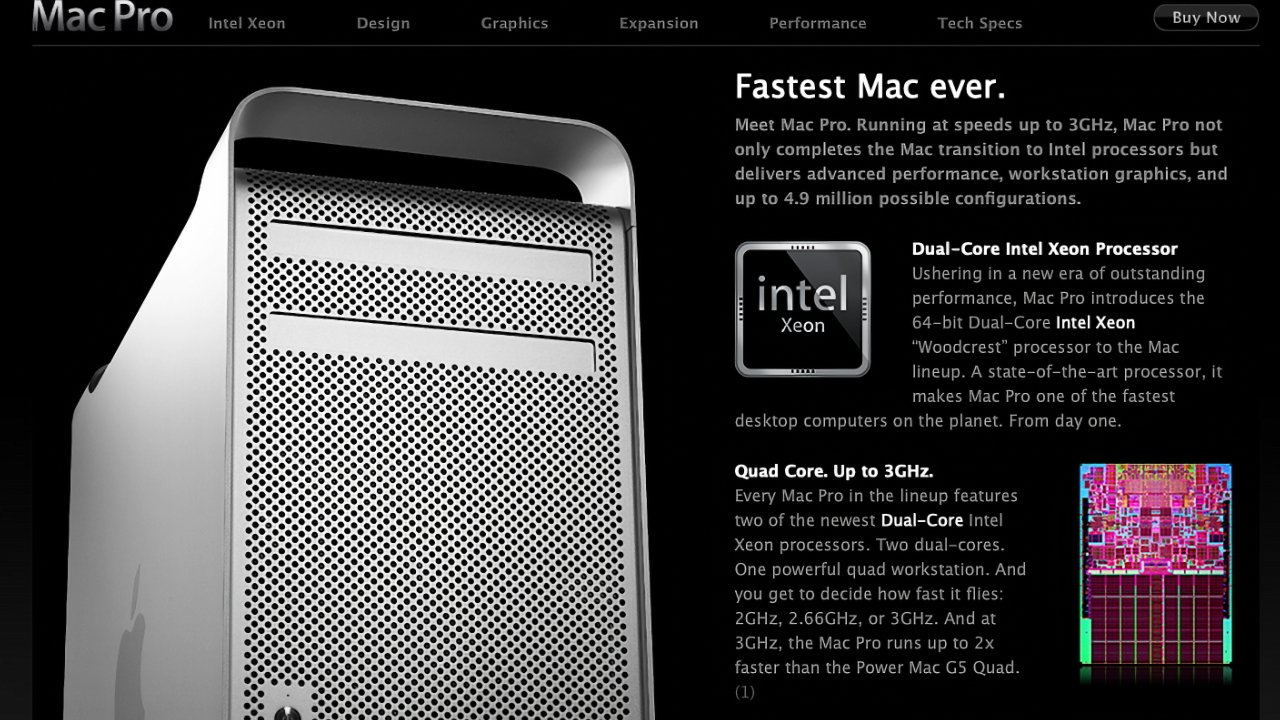
Apple Mac Pro promotional page showing a close-up of the silver tower case, Intel Xeon processor badge, colorful processor diagram, and text highlighting it as the fastest Mac with dual and quad cores

How Apple promoted the first-ever Mac Pro back in 2006 – image credit: Apple

Advertisement

That’s as clear as Apple ever gets. Every Mac in the range was to have an Intel processor. It didn’t guarantee that there would be what came to be called the Mac Pro, but people had hopes for a high-end model because there was already a top of the line PowerPC computer called the Power Mac G5.

An important move for Apple

One of the reasons Jobs gave for moving from PowerPC to Intel was specifically to do with that machine and its development. Standing in front of a slide showing a PowerMac G5 with the words “3.0GHz?” Jobs had a lot to say.

“I stood up here two years ago and I promised you this,” said Jobs, pointing at the screen. “And we haven’t been able to deliver that to you yet. As we look ahead, we can envision some amazing products we want to build for you and we don’t know how to build them with the future PowerPC roadmap.”

Over that next year up to June 2006, Apple steadily introduced Macs with Intel processors but not the replacement for the PowerMac G5. Until 1:08 PM eastern time on Monday August 7, 2006.

Advertisement

The cheesegrater is born

“In the first two quarters, we transitioned almost all of our product over to Intel. Except for one, and that is the Power Mac,” Jobs declared. “Well, today the Power Mac is going to fade into history.”

Phil Schiller then came on stage to reveal what looked like exactly the same machine as before. The same large aluminum casing, the same handles for carrying it and the same ease of access to the insides.

“We have the best enclosure in the business, this is a beautiful enclosure design,” Schiller said. “On the outside it has all the benefits as before. Inside, it’s entirely new.”

Performance promise

This Mac Pro did reach Jobs’s promised 3.0GHz and did so with Intel’s Xeon processor.

Advertisement

“This is the Mac that so many of our highest-end customers have dreamed of,” said Schiller. “For our highest-end customers a feature they’ve really wanted: they’re 64-bit. So this new Intel Xeon chip is an amazing processor to put into our products but in every Mac Pro we’re going to put two of them. All Mac Pros, quad Xeon performance. These are screaming-fast machines.”

Every new Mac is seemingly the fastest Mac Apple has ever made, except perhaps the MacBook Neo. But this one truly gave a huge leap with a claimed doubling of performance over the Power Mac G5.

It also gave a boost in what that performance was per watt of power. Typically that’s a concern when you’re building notebooks, since you’re balancing the needs of work and battery life, but Schiller pointed out that it also had great benefits with this desktop.

“Performance per watt means we need less cooling systems inside the box too. Which means we can do more with the space we have,” said Schiller. “So we’ve doubled the number of drives inside the Mac Pro to now four hard drives of up to 2TB of internal storage.”

Advertisement

“And our most requested feature,” he continued, “we’ve added a second optical drive for our pro customers as well.”

There was also space to connect more external devices both at the back of the machine and now the front. The front added a second USB 2.0 port and Firewire 800, while the back’s most significant change was a double-wide graphics slot allowing for the biggest and most powerful GPUs to be installed without sacrificing an adjacent slot.

So the New Mac Pro was “screaming fast” and it came with greater expansion but still the same enviably easy way of doing that expansion. The enclosure let you open the whole side and then just snap in new hard drives without any cabling or any fiddling.

It was deeply customizable, it was wicked fast, it came with 1GB of RAM, but could address 32GB of RAM, and Schiller announced that it was shipping that day. On August 7, 2006, you could buy one for $2,499 — $4,140 in today’s money.

Advertisement

The last-ever Mac Pro sold from $6,999 in 2026.

Not standing still

The original Mac Pro — version 1,1 — stayed on sale until a speed bump in April 2007. Then that version 2,1 lasted until the following January when the 3,1 upped the performance with a faster quad-core Intel Xeon 5400 processor. You could upgrade it to have two such processors plus up to 32GB RAM.

It would be another 15 months before 3,1 was released. The Mac Pro (Early 2009) was particularly suited for multi-threaded operations where software was able to split its load between several processors. Strictly speaking, the Intel Xeon 5500 processors were slower than the previous 5400 ones but with better caching and communications between components, the result was a faster machine.

Another significant update was in July 2010 when as well as moving to Intel’s Xeon 5600-series processors, you could now have up to 64GB RAM and 8TB storage.

Advertisement

This lasted as Apple’s flagship model until arguably that flag was faltering. It was two years before the Mac Pro saw another update. The July 2012 release now came with two 6-core 2.4 GHz Intel Xeon Westmere-EP processors.

Sleek Apple desktop setup on wooden table with cylindrical black Mac Pro tower next to a large monitor, keyboard, and trackpad in a modern retail store environment

The trashcan Mac Pro was a great-looking design but didn’t live up to expectations.

On the outside, it still looked exactly the same and with the interior no longer improving radically, Apple’s professional users began clamoring. This time Apple responded by previewing a brand-new design for the Mac Pro at WWDC in 2013.

Again Apple was telling professional users to hold on, something big was coming. The difference is that unlike with the next 2019 Mac Pro, back in 2013 Phil Schiller was able to show off the machine. He was able to announce that it would be shipping later that year and it did, if just barely, on December 19, 2013.

Advertisement

He was even able to comment on criticism that Apple hadn’t been able to improve the Mac Pro: “Can’t innovate, my ass,” he said. Accurate at the time, Schiller has seen the remark re-used in less than complimentary exchanges since, and chiefly because of what happened to that 2013 Mac Pro.

This is the version that Apple replaced in 2019, but had basically told everyone to stop buying it in 2017. It looked great, this was the trashcan Mac, but it had no internal expansion and it overheated under pressure.
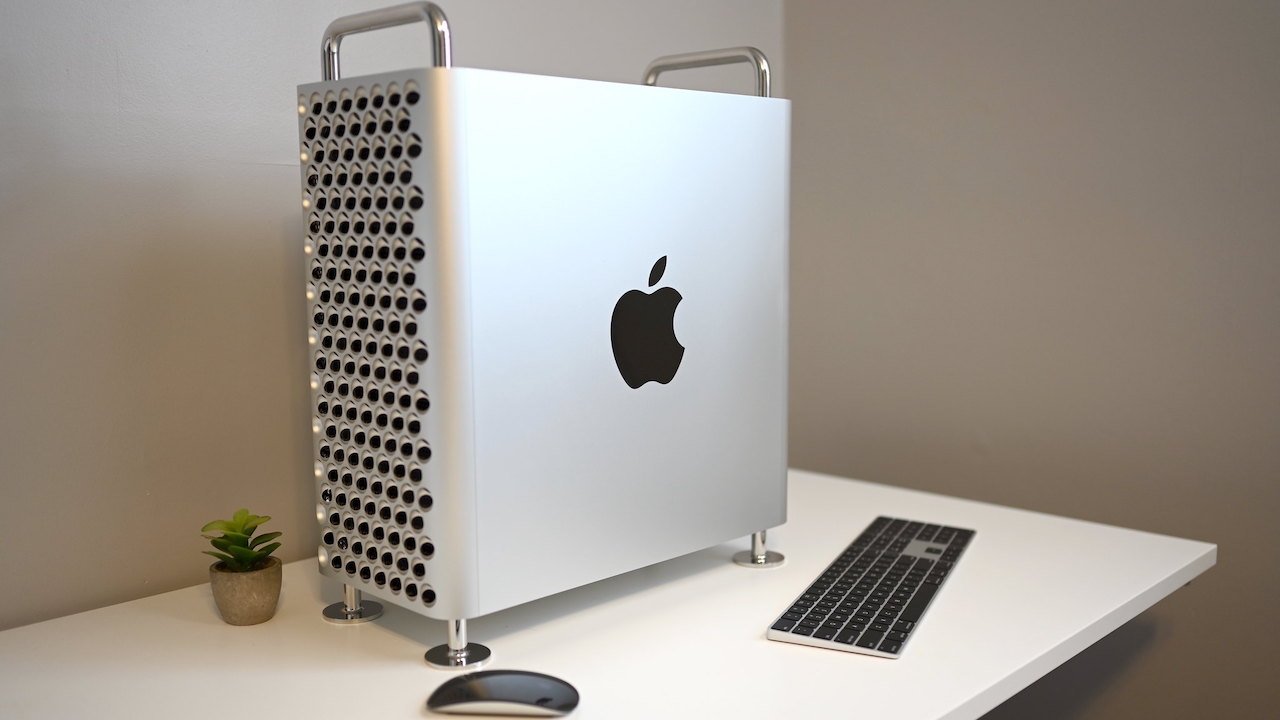
Silver desktop computer with a perforated front and Apple logo, on a white desk, accompanied by a keyboard, mouse, and small potted plant.

It regains the vaguely cheesegrater-like appearance, but the current Mac Pro is not what it once was.

Consequently, as smart as the design was and as true as it was that the 2013 Mac Pro was the most powerful at the time, nobody misses it.

Advertisement

Whereas exactly two decades on since we first met the Mac Pro in that “cheese grater” casing, it is still remembered. Three years since its Apple Silicon replacement came out, it’s remembered.

And when Apple discontinued it, despite initial plans to release an even more powerful model, the Mac Pro is lamented because of that original 2006 version.

What the Pro wants

There’s no real definition of a pro user, it’s just a term that Apple uses when it wants to charge more for something. Nonetheless, there will always be someone claiming that a machine isn’t “Pro” because it has or doesn’t have any given feature — and it will be someone selling you self-interested snake oil.

The Mac Pro officially stayed at the top of the range until its demise, but for so long it was just the titular head. It stopped being the Mac to lust after, replaced in people’s affections and budgets by the Mac Studio.

Advertisement

And as much as some of us might like, the cheese grater’s glory isn’t coming back soon.

Source link

Advertisement
Continue Reading

Tech

Brendan Carr’s FCC Rewrites Media Ownership Law Only Congress Can Actually Change

Published

on

from the what-third-branch? dept

There are many ways to describe the Trump Era, but the executive branch’s conviction that it can simply ignore the legislative branch’s entire existence has become something close to a governing principle. From impounding funds designated by Congress to launching a war without Congress’s authority, Trump has basically decided that the legislative branch is a vestigial organ of the federal government.

This latest one may seem smaller than those stories, but it’s another demonstration of how little the executive branch thinks the laws Congress wrote actually matter. Specifically in this case, the FCC has voted to scrap the congressionally-mandated limits on broadcast TV ownership. This, despite a long list of people who’d normally be on Carr’s side — Republican members of Congress, the former FCC commissioner who helped negotiate the cap in the first place, the House Majority Leader who cut the final deal — all saying the FCC can’t do this. Even Ted Cruz says he’s skeptical.

But Carr has done it anyway.

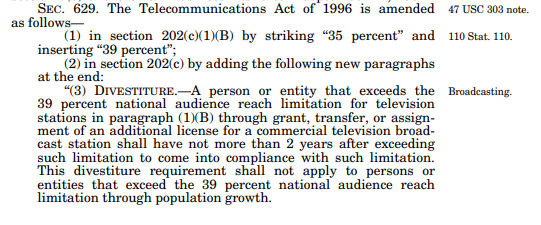
And while I’m sure the usual coterie of MAGA Trump defenders will insist this is all fine, it’s obviously an end-run around Congress’s authority. Congress set that number itself, writing directly into statute that no single company may own stations reaching more than 39% of American households. It was in a 2004 appropriations bill that raised this limit from the previous 35% to 39%.

Advertisement

That’s Congress clearly putting into law that the FCC must have a cap of 39% reach for TV ownership.

But Brendan Carr says he can change this because it’s “outdated.” Here’s how Carr previewed the vote last month in an oped for Breitbart:

On August 6, the FCC will vote on eliminating the outdated national cap in favor of a new case-by-case approach. Previously, the cap operated as a blanket prohibition on any and all deals that would combine stations in excess of the 39 percent limit—regardless of whether it was a good deal or a bad one for the country. Our new proposal would allow the FCC to approve deals that exceed the 39 percent cap, but only if doing so would promote the public interest.

Even if you agree with Carr that the 39% ownership cap is “outdated” and that it’s not in the public interest, that’s not Carr’s decision to make.

He is saying, out loud, that the FCC can ignore an act of Congress whenever the FCC decides that act has gotten stale — with the FCC, conveniently, being the sole judge of staleness.

Of course, all this comes right after Nexstar and Tegna — two giant, reliably GOP-friendly broadcast companies — merged into something massively exceeding that 39% cap (thanks to Carr’s support). You know full well (as does Carr) that if the two companies merging here were the kind he likes to call “leftist” or “woke,” there is no chance he’d wave them past the 39% cap. He’d suddenly put on his attempt at a solemn face and talk about how unfair it would be to the public interest of America to let one company control that much broadcast spectrum.

Advertisement

The lone remaining Democrat on the Commission, Anna Gomez (who Trump likely hasn’t fired yet only because the FCC needs a quorum to do anything at all), has pointed out that this is all quite obviously unlawful.

Today’s decision to eliminate the 39 percent national audience reach cap is unlawful on its face and a profound departure from both statutory boundaries and longstanding broadcast policy. Congress set this cap in federal law, and only Congress can change it. I cannot support an action that so plainly exceeds the Commission’s authority while simultaneously overlooking the real-world consequences for the public we serve.

She goes into further detail about how the wording in the Telecommunications Act is pretty clear that the FCC can’t just ignore this cap or change it without congressional approval. And cites a bunch of Republicans including former FCC officials, along with both current and former elected officials in Congress:

Further, knowledgeable republicans with direct experience shaping, and later interpreting, the national audience reach cap agree that today’s action is plainly foreclosed by law. Former FCC Commissioner Mike O’Rielly, who was personally involved in the negotiations that produced the 39 percent cap, has stated unequivocally that the Commission ‘does not have the authority to modify the national audience reach cap,’ explaining that Congress expressly codified the cap in statute, removed it from the Commission’s periodic ownership review, and never revisited that limitation. Former House Majority Leader Tom DeLay, who negotiated the final compromise with Senator Ted Stevens, has likewise emphasized that the 39 percent cap was deliberately enacted to prevent FCC revision absent a future act of Congress, underscoring that ‘regulatory agencies cannot defy or modify laws enacted by Congress’ and reaffirming that the cap is ‘a statute, not a suggestion.’ And while Senator Ted Cruz did not serve in Congress during those negotiations, his present role as Chair of the Senate Commerce Committee gives him direct oversight over this very issue. He has made clear that he is ‘skeptical a change can be made absent an act of Congress,’ signaling that Congress’s intent remains unchanged today. Taken together, these perspectives from the architects of the cap, the regulators who implemented it, and the congressional leaders who now oversee it underscore a bipartisan, durable, and deeply informed consensus that the law prohibits the Commission from eliminating the national audience reach cap. No amount of policy preference can substitute for statutory authority

Gomez also points out that if Carr were actually concerned about the public interest in these deals, the FCC sure has a funny way of showing it. For all of Carr’s talk about weighing the public interest deal by deal, his Media Bureau has refused, every single time, to look at what these mergers actually do to the public — specifically, what they do to the retransmission fees that show up on your cable bill:

What is notable about such reviews is the studied avoidance thus far of addressing the impact of the transaction at issue on retransmission consent fees on the merits every single time it is raised. The Media Bureau routinely summarily dismisses such issues as outside the scope of what it should be considering. For example, in the Nexstar Tegna decision, despite evidence that the transaction would result in millions of dollars in increased fees on consumers, the Media Bureau determined that it was inappropriate to consider the issue in that “case-by-case” review because “allegations regarding retransmission consent do not raise a substantial and material question of fact as to whether grant of the Applications would serve the public interest” and such questions should be considered in a rulemaking proceeding. Clearly the Commission does not want to address the challenging questions retransmission consent raises, but passing the buck to another proceeding when the impact is significant, direct, and current can only go so far without becoming the very essence of arbitrary and capricious. The Commission has crossed that line here. This is indefensible.

It’s almost certain that a lawsuit will be filed challenging this unilateral move by the FCC to simply rewrite congressional law. But either way, this shows (yet again) how the current administration sees Congress’s role as entirely ceremonial. At least when a Republican is president. The second that a Democrat is back in the White House you can absolutely guarantee that partisan dipshits like Carr will suddenly rediscover the need for Congress to set all the rules.

Advertisement

After all, when Biden was in office, Carr was one of the most vocal in pointing out that Congress limits the FCC’s authority and you can’t just ignore Congress. Here he is complaining about the FCC pretending it has “freewheeling authority” to ignore Congress:

Today’s NPRM appears to me to be part and parcel of that broader effort, which I cannot support. It relies on Section 616(a) of the Communications Act, which lists six very specific things the FCC can regulate in MVPD carriage agreements. That list provides a good clue of how Congress intended to circumscribe our statutory authority. But the NPRM asserts that we may go beyond that list and exercise freewheeling authority over private carriage agreements. I am dubious.

Huh. How odd. In that same dissent he says that the FCC must wait for Congress to act:

Unless and until Congress decides to delegate additional authority to the FCC over OTT streaming, we should act with the appropriate dose of regulatory humility.

What happened to that regulatory humility, Brendan?

Or how about his concerns about Congress when he dissented from the Biden FCC’s attempt to deal with digital discrimination? Back then, he was super duper concerned that Congress had not approved this.

Advertisement

Needless to say, Congress never contemplated the sweeping regulatory regime that President Biden asked the FCC to adopt—let alone authorized the agency to implement it. Nonetheless, the FCC is voting to put President Biden’s plan in place. I oppose the plan for several reasons.

In that dissent, he’s clear about not going beyond congressional authority:

Of course, Congress did not give the FCC the power to do any of this—the agency just creates it out of whole cloth.

But now that Trump is in charge, Carr is happy to erase a rule Congress wrote and to replace it with his own judgment.

Oh, and when the Biden administration’s FCC tried to bring back net neutrality? You sure know that Brendan Carr was furious that they would ignore the will of Congress. Indeed, he used that to whine about Chevron deference, allowing agencies like the FCC to ignore the will of Congress. But, of course, the Supreme Court got rid of Chevron deference in Loper Bright, a decision Carr celebrated. But before that, in dissenting from the FCC’s moves on net neutrality he went on an extended rant about how the FCC should require explicit consent from Congress:

Congress never passed a law saying that the Internet should be heavily regulated like a utility, nor did it pass one giving the FCC authority to make that monumental determination. The Executive Branch pressured the agency into claiming a power that remained—and remains—with the Legislative Branch.

Gosh. It’s almost as if Brendan Carr thinks that when Democrats are in power, the FCC should be limited in what it can do by Congress, and when Republicans are in power, Congress is entirely there for show.

Advertisement

For the past decade, the central project of the conservative legal movement has been convincing courts that federal agencies constantly grab powers Congress never handed them. That’s what West Virginia v. EPA was about. That’s what Loper Bright was about. The entire premise of the major questions doctrine is that when an agency makes a decision of real economic and political significance, it had better be able to point to clear authorization from Congress.

Carr cannot point to clear authorization from Congress on this. He can point to the precise opposite: a specific number, written into a specific statute, after a specific fight, for the specific purpose of taking this decision away from the FCC. He isn’t stretching an ambiguous grant of authority. There’s nothing here to stretch. He’s crossing out a figure Congress chose and penciling in “whatever I think is good for the country.”

And he’s replaced it with a process where he is the judge. Deals get approved if they “promote the public interest,” with Carr deciding what that means, deal by deal, with no cap, no standard, and (as Gomez points out) a Media Bureau that refuses to look at the one concrete public harm anyone actually raises.

Remember when Carr set up his “delete, delete, delete docket” in which he promised to delete unnecessary “regulatory underbrush”? This is the opposite. It’s the FCC chair converting a bright-line rule Congress wrote into a regulatory permission slip he personally issues. Companies that want to get very large now have an obvious incentive to make sure Carr is happy with them, which is presumably the feature rather than the bug. 2023 Brendan Carr would be livid.

Advertisement

Maybe 39% is the wrong number in 2026. That’s an argument someone could make honestly. There’s even a body specifically designed to hear it, weigh it, and write a new number into law if it’s persuaded. It meets a few blocks from the FCC. Carr, with Trump in the White House, would rather pretend it isn’t there.

Filed Under: anna gomez, brendan carr, congress, fcc, media ownership

Source link

Advertisement
Continue Reading

Tech

Jimothy raids the corporate pantry: Amazon adds extra $200K to food bank gift after raccoon art auction

Published

on

A painting of Jimothy, the viral raccoon, by Seattle artist Ryan Henry Ward. (@henry_beyond_museums via Instagram)

A friendly challenge sparked by a portrait of Jimothy, Seattle’s favorite short-spined raccoon, has now drawn in 11 regional heavyweights — and with a big new donation from Amazon, driven the total raised for the Ballard Food Bank past $270,000.

Amazon announced Friday that it is adding an additional $200,000 to a pot that already included $71,975.31 in matching contributions from coffee and software giants, airlines, pro sports teams, and others.

The corporate generosity started as a grassroots effort on Instagram in July, where prolific Seattle artist Ryan Henry Ward auctioned a 24-by-24-inch painting of the internet-famous raccoon to benefit the food bank. Buyer Angela Galdabini won the piece with an exact bid of $6,543.21 — prompting Amazon to match the amount and issue a public callout challenging other local brands to step up.

Ten companies stepped up to match the bid: Alaska Airlines, Brooks Running, Microsoft, the Seattle Mariners, the Seattle Kraken, Stanley 1913, Starbucks, T-Mobile, WaFd Bank, and Windermere Midtown.

It all sparked a Jimothy love-fest on social media with the brands responding to each other.

Advertisement

Jimothy’s path from Ballard backyards to corporate mascot of sorts began when photos and videos of the round raccoon started circulating online. Born with a rare condition that gives him a compressed, neckless posture, the creature quickly captured Seattle’s — and the internet’s — heart.

The flood of artwork, music, tattoos, food items, memes and more dedicated to Jimothy doesn’t appear to be slowing down, as this Reddit sub demonstrates.

The Mariners held a Jimothy night on Wednesday at T-Mobile Park, where the first 20,000 fans received trading cards with the raccoon’s “stats.” Ben Trammel, who shot video of Jimothy as a baby last year, threw out the first pitch. It all proved so popular that a second Jimothy night was added for Friday.

Advertisement

Source link

Continue Reading

Trending

Copyright © 2025