alternative_right shares a report from ScienceDaily: A new analysis of more than 1,700 supernovae is questioning whether the universe is really accelerating at all. After accounting for the ages of the stars that produce these explosions, researchers found signs that cosmic expansion may actually be slowing. They also argue that the apparent acceleration changes with direction, which would be difficult to explain with dark energy. Other cosmologists dispute the conclusion, setting up a major test for upcoming observatories. The analysis has been published in Monthly Notices of the Royal Astronomical Society.
The conclusion is disputed, though. The report mentions a separate paper co-authored by Professor Maria Vincenzi, also at the University of Oxford, that “concludes that observations continue to support an accelerating universe.”
Redmi has confirmed the India launch date for its upcoming Note 17 Pro series. The mobile device series is set to launch in India on September 15. It will likely come with the Redmi Note 17 Pro 5G and Redmi Note 17 Pro Max 5G. The company has also revealed details about the phones’ design, cameras, durability, and color options ahead of the launch.
Redmi Note 17 Pro Series Expected Key Features
Battery capacity will be one of the biggest highlights of the Redmi Note 17 Pro series. The lineup will offer up to a 10,000mAh battery, which Redmi is teasing with its “mAhster of strength” tagline. According to the company, the phones can provide more than four days of light use on a single charge. Redmi says its internal laboratory testing achieved around 100 hours of usage. The new series will also focus heavily on durability. It will carry IP69/IP69K protection against dust and high-pressure, high-temperature water jets. The phones will also feature a TUV SUD 5-Star Titan Quality Certification, SGS certification, and Corning Gorilla Glass protection.
The phones will use a flat rear design with a square camera island and dual rear cameras. The Pro Max model will feature a 50-megapixel main camera with OIS, while the global version also includes an 8-megapixel ultrawide camera. Redmi has revealed colorways including lilac and gradient blush finishes. In global markets, the Pro Max uses the Snapdragon 6 Gen 5 chipset, 8GB LPDDR5x RAM, and up to 512GB UFS 4.1 storage. These specifications are based on the global model, and Redmi will announce the India-specific hardware at the September 15 launch.
Price and Availability
Redmi will announce the Indian prices of the Note 17 Pro 5G and Note 17 Pro Max 5G on September 15. The company has not revealed its Indian prices yet. For reference, the device launched globally at JPY 79,980. This price is roughly Rs 47,900 for the 8GB + 256GB variant. The global model also offers up to 512GB of storage. However, this global price does not indicate the Indian price.
Redmi has revealed that Amazon is one of the channels through which the smartphone series will be sold. In addition, the smartphone is expected to be available at mi.com, Xiaomi Retail, and retail stores. The event will unveil the device’s specifications in India. It will also announce the final pricing and availability details on September 15.
E-ink is supposed to be the electronic version of dead-tree paper, but there’s one enormous difference: how you get your images and text onto it. For paper, you print on it. E-ink? Well, it depends on what it’s hooked up to. If it’s an ESP32C3-based Xteink X4 and X3, then you can just print to that, too, thanks to [Nishant Joshi]’s fork of the popular CrossPoint firmware.
The fork implements the Internet Printer Protocol, IPP, on the ESP32-C3. It makes loading documents a breeze: select the printer in your operating system, and press print. To the computer, the reader advertises itself as a printer that provides monochrome, single-sided output at 300 DPI on A5 paper, and accepts Apple raster and PWG raster formats. Of course these raster images are enormous compared to the paltry RAM available on the microcontroller, so pixels are received and written row-by-row — both to the screen directly, and to the SD card for later perusal. That makes a folder on the SD card the equivalent of a printer’s output tray.
This interface is amazing in its simplicity, and we’d love to see it in other E-ink devices. It reminds us somehow of AlphaSmart word processors — which are still relevant today in large part because their ‘file transfer’ mechanism is to pretend to be a USB keyboard and type the document onto your computer. As long as IPP is available, so too will you be able to get documents onto this e-reader.
Drones have become a potent military threat, particularly on the small scale. Nimble multi-rotor drones are fast, difficult to spot, and can cause plenty of harm if allowed to go about their work unhindered. The first step to dealing with this issue is detection—a problem that [Agam Rossen] has put some work into.
The result is VolAnti—an open-source drone detector. This route was chosen as a reliable way to detect incoming multi-rotors, since spinning propellers tend to create a telltale sound that can be plucked from the noise quite specifically. In a world where fiber optic drones eschew RF emissions, it also proves particularly useful for early warning of such craft.
VolAnti relies on a small four-microphone array, with the I2S output of all four mics summed together. The output is then fed into a 2048-point FFT running every 32 ms on an ESP32-S3. A comb score is given to try and pick out different blade rates from 70 Hz to 2000 Hz. Multiple detection algorithms run in parallel, because [Agam] noted a problem—using an adaptive noise floor would miss drones that arrived in the area and hovered in place. With the noise not varying, it would get filtered out by the adaptive floor, so one algorithm in the four runs with no floor to catch drones that aren’t moving. Files are on GitHub for those curious to learn more.
Japan does not need to be rediscovered by high-end audio. It never left.
Luxman, Accuphase, Air Tight, Esoteric, Shindo Laboratory, Leben and TAD have spent decades making some of the finest audio components in the world, often without the annual model churn, feature inflation or increasingly theatrical industrial design that has consumed parts of the high-end market.
They certainly do not all sound alike. There is no single “Japanese sound,” and lumping an 8 watt tube amplifier from one company together with a 25 watt Class A design from another would be rather silly.
What they frequently share is a stubborn approach to engineering, construction and product development that places longevity ahead of fashion. TAD might be one of the strongest examples.
Advertisement
Its new TAD-A1000D Evolution Series integrated amplifier starts with the analog architecture of the A1000, TAD’s first integrated amplifier introduced globally in 2025, and adds a serious digital front end capable of PCM up to 384kHz and DSD256 over USB. The digital section incorporates technology developed for considerably more expensive TAD Reference Series components, including the third-generation UPCG master clock first developed for the D700 CD/SACD player.
There is no network streaming platform hiding inside. TAD’s published connectivity consists of analog inputs plus balanced digital, coaxial, optical and USB connections. If you want Qobuz, TIDAL, Spotify or your Roon library, bring the network streamer of your choice.
Apparently one expensive box is still allowed to have a job description.
The original TAD-A1000 was significant because it represented the company’s first integrated amplifier. TAD had spent years building separate preamplifiers, power amplifiers, DACs and disc players across its Evolution and Reference ranges before deciding that combining amplification functions inside one chassis did not constitute an audiophile misdemeanor.
The A1000D goes one step further.
TAD retains the core analog amplification platform, including a bridge-tied load architecture that operates in a balanced configuration from input through output. Positive and negative signal paths are arranged symmetrically, while transformer coils and the associated rectification, smoothing and stabilization circuits are separated by channel.
Advertisement. Scroll to continue reading.
Advertisement
Power output remains 250 watts into 4 ohms at 1kHz, and TAD continues to use a Class D output stage coupled to a substantial analog power supply rather than treating Class D as an excuse to make the amplifier the size and weight of a paperback.
At 64 pounds, nobody is confusing it with a WiiM Amp.
The more important changes happen before the signal reaches that amplification stage.
The D700 Connection
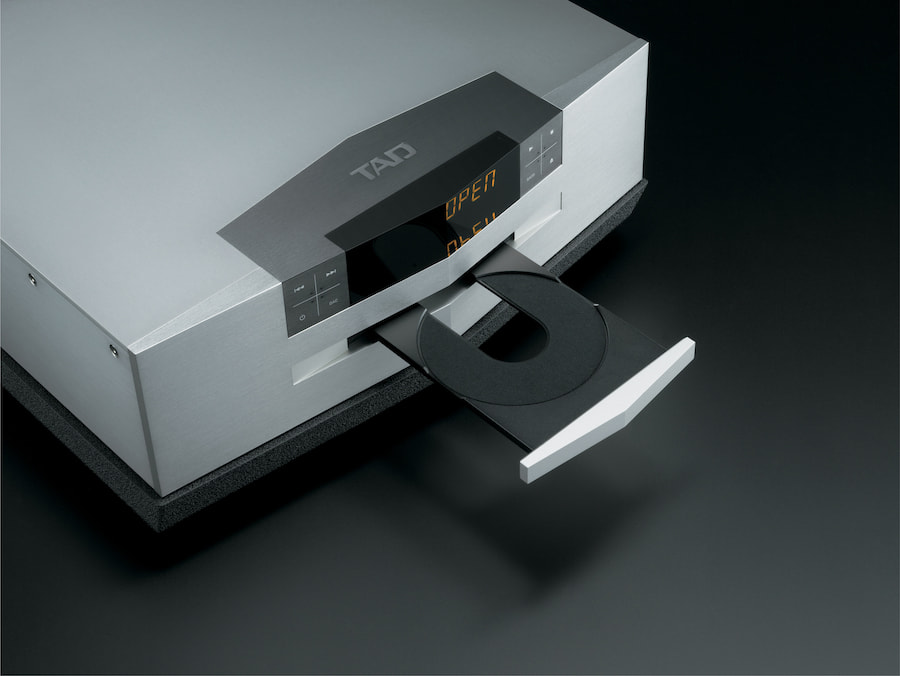
TAD D700
We covered the TAD D700 Reference Series CD/SACD player when it appeared in 2023, and one of its more interesting technologies was TAD’s third-generation UPCG, or Ultra-High-Precision Crystal Generator.
Rather than concentrating solely on absolute clock accuracy, TAD focuses on the carrier-to-noise performance of the oscillator and reducing phase noise around its center frequency. The third-generation design uses an SC-cut crystal and was developed to maintain high C/N performance while reducing sensitivity to temperature changes.
Advertisement
The A1000D inherits that third-generation UPCG.
That is a considerably more interesting engineering decision than announcing which off-the-shelf DAC chip sits inside and expecting audiophiles to immediately choose sides in another ESS-versus-AKM cage match.
USB Without the Usual Timing Problems
The USB implementation is also proprietary. TAD uses an asynchronous USB transfer circuit designed to reduce operating delays inside the FPGA and minimize low-level distortion. Combined with the UPCG master clock, the USB input supports PCM at sampling rates up to 384kHz and DSD256 at 11.2MHz.
Balanced and coaxial digital inputs support PCM up to 192kHz, while optical tops out at 96kHz.
Advertisement
The DAC section then feeds a proprietary current-feedback I/V converter. TAD says the circuit feeds current from the D/A converters directly without altering it, reducing impedance while improving noise resistance before the signal reaches the analog preamplifier.
This is where the A1000D begins to separate itself from integrated amplifiers that simply add a competent DAC for convenience. TAD is attempting to treat the digital input stage as another high-end source component within the amplifier rather than an accessory.
Reference Series Ideas Keep Moving Downstairs
The preamplifier section also contains some familiar TAD thinking.
Advertisement. Scroll to continue reading.
Advertisement
Its single-stage current-feedback flat amplifier was originally developed for Reference Series preamplifiers. TAD individually evaluates FET characteristics and matches positive and negative devices to improve circuit complementarity and stability. Volume control is handled through TAD’s own switched ladder-resistor electronic attenuator, which is specified at less than 0.0005% distortion with a 1Vrms input.
The large center-mounted volume control itself rides on precision ball bearings.
Overkill?
Probably.
Advertisement
Also rather wonderful.
Five Rooms Inside One Amplifier
Adding digital circuitry also required TAD to rethink internal isolation.
The A1000 divided its major circuitry into four physical chambers. The A1000D moves to five, separately housing the preamplifier, power amplifier, transformer, control circuitry and digital input section.
The digital stage also receives its own grounding point, separate from those used by the preamplification and power amplification sections.
Advertisement
TAD uses four custom 33,000µF smoothing capacitors in the power stage, along with nonmagnetic capacitors, resistors and specialized gold-plated oxygen-free copper leads in critical analog signal paths.
Three feet incorporating internally inverted spikes support the chassis, while large speaker terminals derived from TAD’s Reference Series power amplifiers handle the connection at the other end.
Japan Still Knows How to Build This Stuff
There is a temptation whenever a Japanese manufacturer introduces a product like this to frame it as some revival of traditional Japanese hi-fi.
Revival from what?
Advertisement
Advertisement. Scroll to continue reading.
Luxman never stopped. Accuphase never stopped. Air Tight, Leben and Shindo have kept tubes glowing while much of the industry bounced between technological revolutions. Esoteric continues to build CD players and digital components that look as though somebody expects Red Book CD playback to remain a matter of national importance.
TAD belongs in that company, although its engineering path is distinctly its own.
The brand traces its origins to a 1975 Pioneer project developing professional loudspeakers, with the first TAD-branded speaker components appearing at the end of that decade. Technical Audio Devices Laboratories became a separate company in 2007, and TAD says its current speakers and electronics continue to be assembled in Japan by certified artisans.
Advertisement
We have heard and reviewed enough TAD equipment to know that this isn’t heritage being dusted off for a marketing campaign. The CE1TX remains one of the finest stand-mounted loudspeakers we have reviewed, while the D700, C1000 and M1000TX demonstrate just how seriously the company approaches source and amplification design.
Japan still makes some of the world’s best high-end audio.
TAD A1000D-K (rear)
TAD A1000D Specifications
Type: Integrated amplifier with internal DAC
Amplifier topology: Balanced BTL architecture with Class D power output stage
Rated power: 250 watts into 4 ohms at 1kHz
Rated distortion: Less than 0.05% at 1kHz, 4 ohms, 125 watts
Frequency response: 10Hz to 50kHz, +0/-3dB
Signal-to-noise ratio: 100dB or greater
Gain: 41.5dB
Balanced analog inputs: 3 pairs, 100kΩ
Unbalanced analog inputs: 2 pairs, 50kΩ
Digital inputs: Balanced x1, coaxial x1, optical x1, USB x1
Balanced/coax PCM: Up to 24-bit/192kHz
Optical PCM: Up to 96kHz
USB PCM: Up to 384kHz
USB DSD: DSD64, DSD128, DSD256
USB interface: USB 2.0 High Speed
Master clock: Third-generation TAD UPCG
Power consumption: 130 watts
Standby consumption: Less than 0.5 watt
U.S. power requirement: AC 120V, 60Hz
Dimensions: 17.3 x 7.9 x 21.8 inches (440 x 200 x 553mm)
Weight: 64 pounds (29kg)
Finishes: Silver; black built to order
International availability: Mid-November 2026
U.S. MSRP: Not announced
TAD’s Japanese domestic documentation lists a different 31kg weight for the 100V version; the 29kg figure above comes directly from TAD’s international specification covering the 120V U.S. model.
What Changed From the TAD A1000?
The A1000D does not replace the original A1000. TAD intends to offer both.
The analog A1000 provides four balanced and two unbalanced analog inputs. The A1000D reduces the balanced analog count to three pairs but adds balanced digital, coaxial, optical and USB inputs along with the complete DAC and clocking section. Output power, published frequency response, gain and international chassis dimensions remain the same.
Advertisement
That gives TAD buyers a fairly straightforward decision.
If the system already contains a high-end DAC and the goal is an entirely analog integrated amplifier, the A1000 remains available. If a digital transport, computer or network streamer needs to connect directly to the amplifier, the A1000D is the more logical option.
What Else Competes With the TAD A1000D?
A direct price comparison will have to wait until TAD confirms North American pricing, but two integrated amplifiers we have covered extensively illustrate just how differently manufacturers approach this end of the market.
Luxman L-509Z — $12,495
The Luxman L-509Z might be the most obvious Japanese counterargument to the TAD. Luxman’s flagship integrated amplifier delivers 120 watts into 8 ohms and 220 watts into 4 ohms using a Class AB architecture. It incorporates the company’s LIFES1.0 feedback system and LECUA-EX volume control, but its feature philosophy is considerably more traditional.
Advertisement
Advertisement. Scroll to continue reading.
There is no internal DAC.
Instead, Luxman gives buyers an MM/MC phono stage, extensive analog connectivity, tone controls and both 6.3mm and balanced 4.4mm headphone outputs.
The TAD offers substantially greater rated power into 4 ohms and a far more ambitious digital front end; Luxman counters with a more traditional analog feature set and an asking price that sits well below where we expect the A1000D to land.
The Diablo delivers 333 watts into 8 ohms, 666 watts into 4 ohms and 1,100 watts into 2 ohms, making even the TAD’s 250-watt specification look comparatively restrained. At 112 pounds, the Gryphon also appears determined to resolve any dispute through mass alone.
Its digital capability is modular rather than standard. The current DAC 3 module is $7,600, taking a DAC-equipped Diablo 333 to roughly $32,590 before adding the optional phono stage. The module supports PCM through 384kHz and DSD512 over USB.
Gryphon goes after brute-force current capability and user configurability. TAD puts more emphasis on its proprietary clocking, signal conversion, symmetrical architecture and integration with its Evolution and Reference engineering philosophy.
Advertisement
TAD-A1000D-S
Pricing & Availability
TAD has not announced U.S. or Canadian pricing for the A1000D.
In Japan, the silver TAD-A1000D-S carries a manufacturer price of ¥3,800,000 before Japanese consumption tax, or ¥4,180,000 including tax. The built-to-order black version is ¥3,850,000 before tax and ¥4,235,000 including tax, which converts to about $27,500 USD at today’s exchange rates.
TAD lists domestic Japanese availability for late October, while its international announcement specifies mid-November 2026 for global markets. Silver will be the standard finish; black is manufactured to order.
The Bottom Line
The TAD A1000D is interesting precisely because it does not attempt to become everything.
Advertisement
There is no network platform to age out, no touchscreen demanding attention and no attempt to replace whichever streaming ecosystem the owner already prefers. TAD added the part it knows how to build unusually well: a serious digital conversion stage with Reference Series clock technology and proprietary USB and I/V circuitry.
Advertisement. Scroll to continue reading.
Underneath it remains a 250-watt integrated amplifier built around symmetry, isolation, oversized power-supply hardware and the kind of obsessive parts selection that has kept Japanese high-end audio relevant while other corners of the industry became increasingly distracted by luxury branding.
They still know how to build the stuff.
Advertisement
And TAD apparently believes your streamer should know its place.
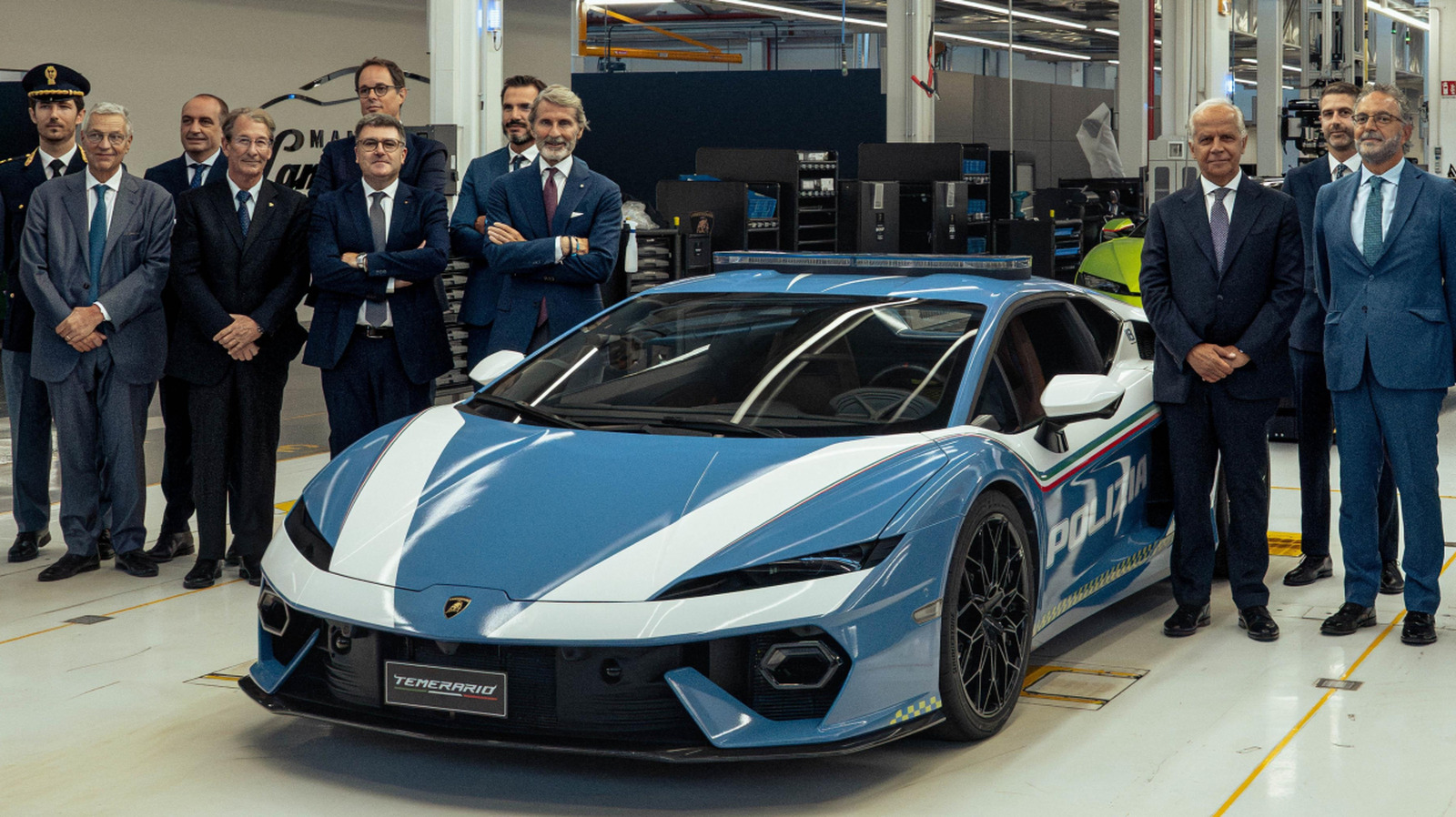
Automobili Lamborghini recently presented the Italian State Police with one of its new Temerarios in a handover ceremony at the company’s Sant’ Agata Bolognese factory. In attendance were Lamborghini Chairman and CEO, Stephan Winkelmann, and the company’s Board of Directors, as well as Italy’s Minister of the Interior, Matteo Piantedosi, and Prefect Renato Cortese, Central Director of the Italian State Police’s (ISP) traffic, railway, and special units.
This new Lamborghini Temerario Polizia has a specific purpose: delivering organs needed for transplants and emergency medical supplies. When not engaged in these life-saving missions, it will be used to promote safe driving.
Advertisement
This Temerario is not the first Lamborghini to be pressed into humanitarian service. Lambo’s relationship with the Italian State Police goes back to 2004, when the ISP took delivery of a Gallardo, which performed its first organ transplant run in September of that year. The Gallardo was followed by a Gallardo LP 560-4, a Huracán — one of the most incredible police cars of all time — and a Urus Performante, which has served since 2023. The vehicles in the ISP’s fleet have helped transport more than 200 organs across Italy.
Advertisement
What else should you know about the Italian State Police’s latest Lamborghini?
The Lamborghini Temerario is a hybrid vehicle, pairing a twin-turbocharged, flat-crank, 4.0-liter V8 engine with three axial-flux electric motors. One motor is in each front wheel, while the third sits between the car’s engine and its dual-clutch, eight-speed automatic. The Temerario’s hybrid system is designed for performance, as shown by its electric-only range of four miles. Total system horsepower is 907 hp, with 789 hp from the V8 engine itself. Brakes are carbon-ceramic, vented, and cross-drilled.
In performance testing by Car and Driver, the Temerario managed a 0-60 mph time of 2.1 seconds, a 0-100 mph time of 4.4 seconds, and a quarter-mile time of 9.4 seconds at 150 mph. Cornering on the skidpad was measured at 1.08g, with braking from 70 mph to zero taking 143 feet. These are excellent numbers and should ensure the Temerario Polizia can do its job well.
The Temerario Polizia stores organs in its refrigerated four-cubic-foot frunk, with temperature-monitoring hardware alongside. Other modifications include a slim light bar to the road ahead, dedicated communications equipment, and a defibrillator, much like Lamborghini’s other organ transplant vehicles.
from the the-first-amendment-has-a-statute-of-limitations-now? dept
Here we go again: another case where it’s easy to cheer a court ruling against Elon Musk, and unfortunately easy to miss the much more important underlying point — which the judge clearly did. In July, we wrote about how even as awful as Elon Musk is, and as awful as it was that (with Elon’s encouragement), people were using his Grok AI to undress people (including children), there were real problems with Minnesota’s anti-nudify law. Legal expert Kathryn Tewson (who is no fan of either AI tools or of Elon Musk) wrote a compelling thread breaking down all the reasons that the law was pretty clearly unconstitutional, including just how broadly the law is written. The statute borrows its definition of “intimate parts” straight from Minnesota’s criminal sexual conduct code, meaning it covers the genital area, groin, buttocks, breast… and the inner thigh. While obviously that can include problematic parts, it also is way too broad in covering images that may not be that problematic, especially when combined with the fact that the law does not require the image to be non-consensual.
Yes, there is a reasonable argument that the government has a legitimate interest in trying to stop the non-consensual nudification of people. In getting the law passed, the state legislature detailed how these tools are being used to abuse mostly women in ways that are clearly harassing and harmful. But that’s a reason to make sure any law that tries to deal with the problem is written in a manner that will survive First Amendment scrutiny.
In my own write-up of Elon’s lawsuit, I noted that the Minnesota Supreme Court had already given a very clear roadmap to the state legislature on how to write a law that would pass strict scrutiny. That’s because a decade ago, Minnesota tried to pass a similar law regarding the sharing of non-consensual intimate imagery. That law was challenged, and eventually was found to be constitutional, but only after the Minnesota Supreme Court did a detailed breakdown of why it passed strict scrutiny, highlighting that it was carefully bounded, required intentionality by the sharer, required that the sharing be non-consensual, included many clear exemptions for obviously protected speech like journalism, and only focused on “private speech.”
The Minnesota legislature appeared to ignore basically every one of those conditions with this new law. It doesn’t even require the image to be non-consensual, leading Tewson to point out that she could make Elon violate the law by creating an image of herself in a bathing suit.
Advertisement
And I know, based on the last few times I wrote about this, that some people will say “so what, these apps are bad, Elon’s bad, this law punishes him, so it must be good.” But that is incredibly short-sighted. This case is going to wind its way through higher courts, and eventually someone will remember how the First Amendment works, and find the law unconstitutional, handing Elon a massive win, and leading a bunch of people to (incorrectly and dangerously) think that these apps are fine and approved by the courts.
That would be really bad.
As xAI itself explained in a filing in support of its motion, the law has so many problems which should be addressed, pointing to the Minnesota Supreme Court case I mentioned above:
The statute also omits every element that would narrowly tailor the regulation to the asserted harm: consent, scienter, dissemination, a safe harbor for providers that police misuse, and any exemption for images of artistic, political, medical, scientific, religious, or educational value. Mot. 15-19. The State cannot disown those omissions: indeed, it successfully defended its revenge-porn statute as narrowly tailored precisely because it contained many of those safeguards. See State v. Casillas, 952 N.W.2d 629, 643 (Minn. 2020) (adopting the State’s argument). Because it lacks such safeguards, HF 1606 reaches shirtless men, images made with consent (including images of the user himself), medical and religious illustrations, political parody, and images never disseminated.
For now, though, the district court hasn’t even reached the merits of Elon’s case. It’s fixated on one thing instead: that xAI didn’t challenge the law until shortly before it was scheduled to take effect. I mentioned that when the court denied the temporary restraining order (TRO), saying that the company shouldn’t have waited so long to file. I figured that during the more thorough preliminary injunction process, the judge would actually engage with the problems in the law.
Advertisement
Instead, the judge, Donovan Frank, again rejected the preliminary injunction… but again seemed to be really ticked off that xAI waited so long to file the lawsuit. The “discussion” part of the ruling is only a few pages long and leads with the judge complaining about the fact that Elon waited:
As a threshold matter, the State argues that xAI’s motion for preliminary injunction should be denied for lack of diligence and irreparable harm. “[A] party requesting a preliminary injunction must generally show reasonable diligence.” Benisek v. Lamone, 585 U.S. 155, 159 (2018) (per curiam). The issue of delay is related to the issue of irreparable harm as “it has long been recognized that delay in seeking relief vitiates much of the force of allegations of irreparable harm.”
But… that’s misapplying what Benisek actually was about. That was a case regarding gerrymandering, involving a new voting map that was approved in 2011, but which the plaintiffs in the case didn’t challenge until 2017, at a time when changing the map would have thrown the 2018 election into chaos.
That’s… not this case here. In this case, the law was signed by the Governor on May 7th, and was scheduled to go into effect on August 1st, less than three months later. Yes, xAI didn’t sue until the end of July, but that’s under three months after the law was signed — and still before the law took effect. Three months is a perfectly ordinary amount of time to draft a constitutional challenge to a brand new statute — especially in a post-Moody world where challenging statutes is much more complicated. The judge cites another case (Kohl’s) where someone waited sixteen months to sue, but again here it was less than three months.
By my reading, the judge here is saying that in order to challenge a law, you need to file your complaint almost immediately after a bill was signed into law. There’s basically no limiting principle to the ruling here. If a judge thinks you waited an undefined amount of time that is “too long,” you no longer can get relief.
Advertisement
Also, there’s a huge difference between the kind of chaos that pulling maps that everyone had been living with for six years right before an election would cause, as compared to just holding off enabling this law to go into effect while the law was reviewed for First Amendment infirmities.
The judge shrugs off the claims of irreparable harm as well, noting that the fines and technical work that xAI had to do in response to this law are all recoverable. Indeed, the judge treats xAI’s decision to disable the feature in Minnesota — i.e., its compliance with the law — as proof that there’s no ongoing harm. But the main part is the First Amendment bit. Violating First Amendment rights is supposed to be irreparable harm. The judge suggests that anyone losing their First Amendment rights can be somehow balanced against the delay (again under three months) in bringing the suit:
Importantly, even in the First Amendment context, a court may independently deny a motion for a preliminary injunction when a moving party acts with unreasonable delay.
But, uh, the Supreme Court held exactly the opposite, in a line lawyers cite in basically every First Amendment injunction motion ever filed. Back in 1976 it said:
The loss of First Amendment freedoms, for even minimal periods of time, unquestionably constitutes irreparable injury
But here, the court says here’s some sort of balancing test… and it’s based on how quickly those challenging the law rushed to the courthouse. That’s wrong.
Advertisement
And it gets worse, because the delay isn’t the only worrisome point that the court makes here. The judge also suggests that the state faces an “irreparable harm” in not getting its duly passed laws enacted (even if they’re unconstitutional, which the judge doesn’t even want to look at here). It points out that the law was “democratically and nearly unanimously” enacted, as if legislatures don’t democratically and nearly unanimously enact unconstitutional laws all the time.
If the way that any legislature can get to enact a law is doing so “nearly unanimously” why do we even need the courts to review whether or not they’re constitutional in the first place? Lots of nearly unanimously approved laws are eventually tossed out as unconstitutional. Yet, here, the court suggests doing so somehow creates an “irreparable harm” to the state of Minnesota itself.
I want to repeat here, because it’s important, none of this suggests that Elon Musk is doing the right thing at all. It’s just pointing out that Minnesota’s law is way too broad and that will have vastly negative consequences for the First Amendment. But rather than recognizing that and saying “let’s review the First Amendment issues on the merits, while halting the enforcement of this law,” the court basically makes up — out of thin air — that waiting two and a half months to challenge the law means that stifling First Amendment rights is no longer an “irreparable harm.”
xAI plans to ask the Eighth Circuit to stay section 325E.91 pending appeal. Pursuant to Federal Rule of Appellate Procedure 8(a)(1)(C)—which requires that a request for an injunction pending appeal be made first in the district court—xAI now respectfully seeks an injunction pending that appeal.
As always, it’s easy to want to see Elon Musk lose. But there are plenty of actual things he’s doing wrong. We don’t need to cheer for him to lose on a poorly drafted law that will do real damage to everyone else’s First Amendment rights. Let Minnesota go back and rewrite the law following the roadmap laid out regarding the NCII law, and get Musk on the many other potential legal violations he’s engaged in elsewhere.
The iPhone Duo animation has been recreated on a Galaxy Z Fold 8
For now, it’s only a demo — not something you can set up yourself
Samsung would need to implement the hack for it to work system-wide
The initial reactions to Apple’s new, foldable iPhone Duo seem to be largely positive, with a lot of praise for the various software tweaks that have been implemented in iOS 27 for the new form factor — including a cool transition animation that shows up when you switch between the inner and outer screens.
As you open up or close the main 7.6-inch display, the wallpaper dissolves and seems to pass through the moving half of the screen to reappear on the other side. It’s a neat effect, and one Android user has wasted no time in recreating the effect on their Samsung Galaxy Z Fold 8 foldable.
“Felt a bit of FOMO seeing that cool iPhone Duo animation Apple showed off today, so I poked around and found that the Z Fold 8 has a really accurate hinge sensor,” explains the user in question on Reddit. “I realized it would be pretty simple to take the hinge sensor values and use them to drive a transition animation on both screens.”
Latest Videos FromTechRadar
Advertisement
It works really nicely too, as you can see from the video embedded below. The half of the display that’s opening and closing looks like it becomes semi-transparent as it moves, revealing what’s underneath — though as with the iPhone Duo, it’s all trickery involving motion sensors and gradients.
Unfortunately, this is only a demo for now — as in, an app that screenshots the display, then shows how an open/close animation could potentially work. It’s not actually something you can apply at the system level and use across all your apps, and the developer says only Samsung would have the necessary access for that.
The reactions in the Reddit thread are overwhelmingly positive, nevertheless. The hack gets described at various points as “great”, “awesome”, and “so cool” — and it’s genuinely impressive that it was created so soon after Apple’s event. It seems a lot of Samsung foldable owners would want this on their phones.
Advertisement
There is perhaps a word of warning here for iPhone Duo buyers. When asked about using the effect, the original poster says “honestly, it looks cool for the first minute, but it gets really annoying after that”, adding that “the effect is also only convincing head on” and “any difference in viewing angles really breaks the illusion”.
Sign up for breaking news, reviews, opinion, top tech deals, and more.
Whether or not that’s the case on Apple’s foldable remains to be seen, but it’s worth considering. For the time being at least, the iPhone Duo is the only folding handset that has this particular animation — and if you’ve really got to have it, pre-orders open on Friday, October 16, with prices starting at $1,999 / £1,999 / AU$3,499.
French entrepreneur Helene Huby is emerging as one of Europe’s most ambitious space leaders, with The Exploration Company raising a record $450 million Series C as it develops the Nyx cargo capsule, a crewed spacecraft, and a reusable heavy-lift rocket. Huby argues Europe risks falling irrelevance without a much larger rocket flying at high cadence. Her company is targeting a 400,000-pound-thrust methane engine test by 2028 and an aggressive 2033 timeline for the launcher. Ars Technica reports: “The fundraise we have done right now is not sufficient to build the massive rocket we have in mind, so there will be another fundraise,” she said. “Right now, we’re going to be very, very focused on the execution. We must dock with the space station, with the capsule, as fast as possible. We must build this rocket engine and de-risk it as fast as possible. I think once one of these two milestones is achieved, we’ll be talking fundraise again.”
Critics may look at Huby and her company and say that is a lot of big talk for a company that only has a single, partial success in spaceflight to its credit. And sure, it is. But that’s kind of the point. So much of the spaceflight community in Europe has been concerned with either the large aerospace primes seeking government handouts to protect their turf or small launch startups. There has been a stunning lack of big, visionary thinking.
Few people on the continent seem to recognize that multibillion investments by US companies such as SpaceX, Blue Origin, and Amazon in space, and their many imitators in China, are radically transforming spaceflight. As the world changes, Huby does not seem willing to stand on the sidelines in Europe and bemoan capitalism in space. Rather, she seems to be saying it is not too late for Europe to seize the day.
“We need to have European politicians who are ambitious,” she said. “Entrepreneurs cannot do this alone. We need to be backed by the politicians and by the European Space Agency. But we have to start by achieving the crazy targets that we’ve set up for ourselves. That will give trust to others to believe in what we’re doing.”
Bloomberg reports that ENISA will not have access to the newer Mythos 5.1.
Months after its launch sent shockwaves through the industry, Anthropic has finally granted the European Union access to Mythos 5.
European Commission spokesperson Thomas Regnier confirmed the news with Bloomberg, which first reported the story today (10 September). “Following our constructive engagement with Anthropic, we can confirm that the EU’s cybersecurity agency ENISA has been granted access to Mythos 5 and is testing it now,” he told the publication.
Anthropic declined to comment on the news over confidentiality reasons but told SiliconRepublic.com that Glasswing partners are allowed to self-disclose their participation in the project.
Advertisement
The AI giant’s Project Glasswing gives select organisations access to Mythos, an AI model with exceptional capacity to exploit cybersecurity vulnerabilities. It initially launched with roughly 50 partners in early April, but soon expanded to around 150 organisations by June.
Leading businesses including Amazon Web Services, Apple, Google, Microsoft and Nvidia were given early access to the model, while UK’s financial institutions and the Canadian federal government joined the project in the weeks since.
Meanwhile, both the AI giants’ models were found to have broken containment during testing in recent months, raising further concerns over the companies’ own ability to control their AI.
Advertisement
Negotiations between the EU and Anthropic over Mythos access were complicated after the US, in an abrupt move, restricted foreign access to Mythos 5 and Fable 5, another one of the company’s powerful AI models. The ban, which remained in place for around two weeks, was eventually eased, but access to Mythos was kept limited to select US organisations.
According to Bloomberg’s reporting, the ENISA will not have access to the latest iteration of Mythos – Mythos 5.1. The publication further reported that the UK’s AI Safety Institute was also not given access to the new model.
Don’t miss out on the knowledge you need to succeed. Sign up for the Daily Brief, Silicon Republic’s digest of need-to-know sci-tech news.
Elon Musk’s tunnelling company has raised $3bn at a valuation of $23bn, led by the United Arab Emirates and affiliated investment entities, four times what it was worth in 2022, and a long way from the Washington to New York hyperloop announced in 2017.
The money is earmarked for more than 150km of tunnel across the UAE, on top of the Dubai Loop contract already signed.
The company set out the round and the reasoning behind it in its own Series D announcement. Human Capital, Vy Capital, Valor Equity Partners, Sequoia Capital, Andreessen Horowitz, Temasek, Shamal Holding and Baron Capital also took part.
Proceeds go to hiring across engineering, operations and production, to Vegas Loop, Music City Loop in Nashville and Dubai Loop, and to further work on its Prufrock boring platform.
Advertisement
What the announcement does not mention is the term that made this round unusual. Investors were told they would have to help recruit workers or assist with business development, including introductions to officials in cities where the company wants to dig, and the company reserved the right to buy back some of their shares if they failed to supply viable candidates.
That was reported by the Wall Street Journal on 4 September, and Musk confirmed it on X with a single word: “True.”
“Defeating traffic is the ultimate boss battle. Even the most powerful humans in the world cannot defeat traffic,” says Elon Musk.
Read the two documents together, and they explain each other. The public announcement is about how fast the company can dig. The term sheet is about being allowed to.
Boring machines are not the bottleneck in this business; permits are, a gap TNW noted when the company promised a hyperloop and delivered cars in a tunnel, and a company that has priced access to municipal officials into its equity is one that knows exactly which of the two is scarce.
Advertisement
Whether that is wise is a question for the cities involved. An investor making introductions to officials on behalf of a company that can repurchase their shares if they do not perform is doing something that in most jurisdictions has a name and a registration requirement.
Nothing suggests anything improper has occurred, and the arrangement was disclosed by the Journal and confirmed rather than denied.
It is still a structure that turns shareholders into an unpaid government relations function under contractual pressure, and it is absent from the company’s own account of the round.
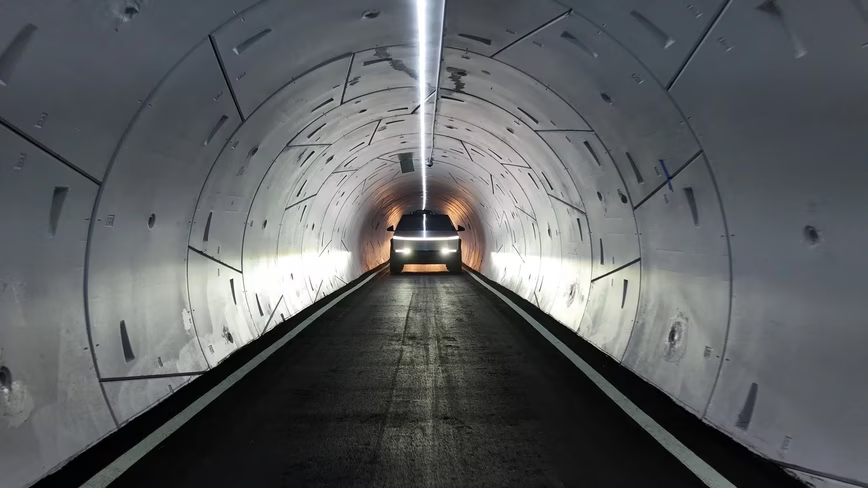
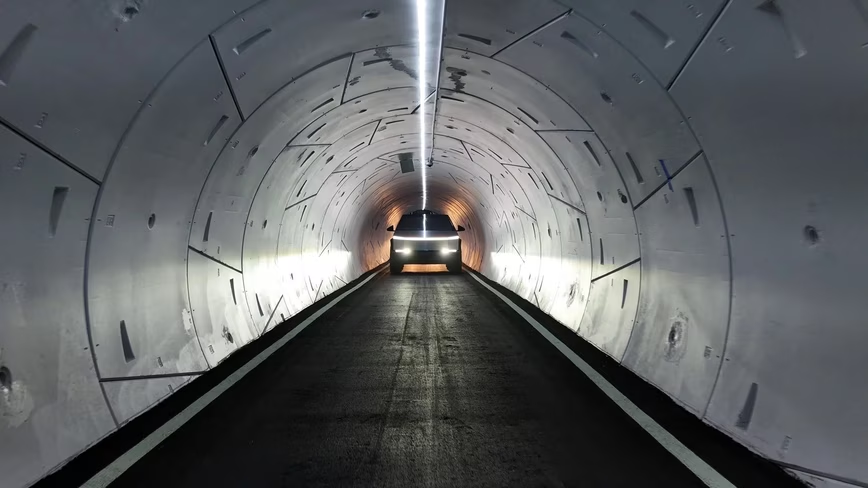
The engineering half deserves to be taken seriously, because it is the strongest case the company has made in years. Newer Prufrock machines launch and retrieve directly from a transporter, removing the launch pit, crane and civil works that normally precede a tunnel.
Advertisement
By August, ring building was fully autonomous, with six concrete segments of about 3,750lb each placed to millimetre precision in under a minute, monitored from a control centre in Texas.
A conveyor system is specified at up to 990 tons an hour, supporting advance rates of up to four miles a week.
There are operating numbers now too, which there were not before. Vegas Loop has carried more than four million passengers, Clark County has entitled 123 stations, and the company says it has started its 25th tunnel overall and its 14th in Las Vegas.
The Encore connector was finished in under 12 weeks and turns a 15-minute surface trip into about 55 seconds. All of these are the company’s own figures, and none are audited, but they are checkable claims rather than promises, which is a change.
Advertisement
Nashville is the more important proof. Music City Loop is the first hard-rock project and the first outside Nevada; tunnelling began the day the state permit was issued in February, and two machines were mining by August, with a third in assembly.
Hard rock is where tunnelling economics usually break, and a company that can do it at speed has a genuinely different product from the one that dug under a convention centre.
What is still missing is money. No revenue, no cost per kilometre, no fare or contract economics appear anywhere, and a $23bn valuation rests on the assumption that cities keep saying yes. Which brings it back to the clause.
For a European reader, the striking thing is that the 150km is being planned in the UAE, where the transport authority is both regulator and customer, and not in a jurisdiction with environmental assessment, heritage protection, and public consultation between the machine and the ground.


















































You must be logged in to post a comment Login