Iran’s internet has been intermittently disrupted for months. After years of bombardment, Gaza’s telecommunications infrastructure remains fragile. In India, recurring shutdowns and throttling have become a routine response to protests and unrest, cutting millions off from news, work, and basic services. Across dozens of other countries, governments increasingly treat connectivity itself as something that can be weaponized—cut, slowed, or selectively restored to shape what people can see, say, and share. In 2024 alone, authorities imposed 304 internet shutdowns across 54 countries—the highest number ever recorded.
In 2011, when protesters in Tunisia, Egypt, and beyond used social media to broadcast their uprisings to the world, many observers heralded a new era of networked freedom. Governments, however, responded quickly by developing and refining systems of control that have only grown more sophisticated over time. Today’s landscape of regulation, blackouts, and degraded networks reflects that trajectory, as early experiments in censorship and disruption have hardened into a durable system of control—what began as an emergency measure has become a normalized infrastructure of control.
A Brief History of Internet Shutdowns
Egypt’s 2011 internet shutdown wasn’t the first. Although the government’s heavy-handed response after just two days of protests caught the world’s attention, Guinea, Nepal, Myanmar, and a handful of other countries had previously enacted shutdowns. But Egypt marked a turning point. In the years that followed, shutdowns increased sharply worldwide, suggesting that governments had taken note—adopting network disruptions as a tactic for suppressing dissent and limiting the flow of information within and beyond their borders.
Advertisement
On January 28, 2011, at 12:34 a.m. local time, five of Egypt’s internet service providers (ISPs) shut down their networks. At least one provider—Noor, which also hosted the Egyptian stock exchange—remained online, leaving only about 7% of the country connected.
In the aftermath of President Hosni Mubarak’s resignation, rights groups sought to understand how such a sweeping shutdown had been possible—and how future incidents might be prevented. There was no centralized “kill switch.” Instead, authorities leveraged the country’s highly consolidated telecommunications sector, which all operate by government license. With only a handful of ISPs, a small number of directives was enough to bring most of the network offline.
In the years following Egypt’s 2011 shutdown, telecommunications companies—many of which had been directly implicated in enabling state-ordered disruptions—began to organize around a shared set of human rights challenges. Beginning that same year, a group of operators and vendors quietly convened to examine how the UN Guiding Principles on Business and Human Rights applied to their sector, particularly in contexts where government demands could translate into sweeping restrictions on access. By 2013, this effort had formalized into the Telecommunications Industry Dialogue, bringing together major global firms to develop common principles on freedom of expression and privacy and, through a partnership with the Global Network Initiative, engage more directly with civil society. The initiative reflected a growing recognition that telecom companies—unlike platforms—operate at a critical chokepoint in the network. But it also underscored the limits of voluntary approaches: while the Dialogue helped establish shared norms, it did little to constrain the legal and political pressures that continue to drive shutdowns—or to prevent companies from complying with them.
From Emergency Measure to Legal Authority
If the early aughts were defined by improvised shutdowns, the years since have seen governments formalize their power to control networks. What was once exceptional is now often embedded in law.
Advertisement
In India, the 2017 Temporary Suspension of Telecom Services Rules—issued under the Telegraph Act—provided a clear legal pathway for cutting connectivity. The Telecommunications Act, 2023, further entrenched the government’s ability to enact shutdowns, granting the central and state governments, or “authorised officers” the power to suspend telecommunications services in the interest of public safety or sovereignty, or during emergencies. The government has used these measures repeatedly, particularly in Jammu and Kashmir. India’s Software Freedom Law Centre’s Shutdown Tracker shows India as instigating more than 900 shutdowns, 447 of which were in Jammu and Kashmir.
In Kazakhstan, shutdowns have also become common. Over the years, the government has passed legislation that allows state agencies to shut down the internet. The 2012 law on national security enabled the government to disrupt communications channels during anti-terrorist operations and to contain riots. In 2014 and 2016, laws were further amended to expand the number of actors able to shut down the internet without a court decision, and a government decree in 2018 enabled shutdowns in the event of a “social emergency.”
Elsewhere, governments have built or expanded legal and technical frameworks that enable similar control over information flows. Ethiopia’s state-dominated telecom sector has facilitated sweeping shutdowns during periods of conflict, including the war in Tigray, where the internet was disconnected for more than two years. In Iran, authorities have developed regulatory and infrastructural capacity to isolate domestic networks from the global internet, allowing them to restrict external visibility while maintaining limited internal connectivity. This year alone, Iranians have spent one third of the year offline. And amidst the ongoing war, Iranian officials have made it clear that the internet is a privilege for those who toe the government’s official line.
Even where laws do not explicitly authorize shutdowns, broadly worded provisions around national security or public order are routinely used to justify them. The result is a growing legal architecture that treats network disruptions not as extraordinary measures, but as standard tools for managing populations.
Advertisement
When that authority is exercised over a population beyond a state’s own citizens, the consequences can be even more severe. Israel’s Ministry of Communications controls the flow of communications in and out of Palestine and has used that power to shut down internet access during periods of conflict. Over the past two and a half years, Gaza has experienced repeated outages, and experts now estimate that roughly 75% of its telecommunications infrastructure has been damaged—leaving essential services severely disrupted.
Elections and the Expansion of Control
Historically, most blackouts have occurred during moments of intense political tension. But authorities are increasingly using them as a tool to preempt dissent.
In 2024, as more than half the world’s population headed to the polls, shutdowns followed. That year alone, authorities imposed 304 internet shutdowns across 54 countries—the highest number ever recorded, surpassing the previous record set just a year earlier. The geographic spread also widened significantly, with shutdowns affecting more countries than ever before. The Comoros imposed a shutdown for the first time, while other countries, such as Mauritius, instituted broad bans on social media platforms during elections.
What stands out is not just the scale, but the normalization. Notably, the number of shutdowns in 2025 broke the record set the year prior. Whereas network disruptions were once a rare occurrence, they are now a routine measure, increasingly treated by authorities as a standard response to periods of heightened political sensitivity.
Civil Society Fights Back
Governments use all sorts of justifications—national security, curbing the spread of disinformation, and even preventingstudents from cheating on exams—for internet shutdowns. But civil society is watching, and documenting, network disruptions and their impact on citizens.
Advertisement
In 2016, as shutdowns became an increasingly common tool of state control, Access Now launched the #KeepItOn campaign to coordinate global advocacy against network disruptions. The campaign includes a coalition composed of 345 advocacy groups (including EFF), research centers, detection networks, and others who work together to report on, and fight back against, internet shutdowns. Anyone can get involved by signing on to campaign action alerts, sharing their story, or reporting a shutdown in their jurisdiction.
Ending this harmful practice remains the goal. In 2016, the UN passed a landmark resolution supporting human rights online and condemning internet shutdowns, and UN agencies have continued to warn against the practice. But the fight to change government practices remains an uphill battle, leading civil society—and even companies—to get creative.
During repeated shutdowns in Gaza, grassroots efforts mobilised to distribute eSIMs so Palestinians could stay connected. In 2024, EFF recognized Connecting Humanity, a Cairo-based non-profit providing eSIM access in Gaza, with its annual award for its vital work. Satellite internet such as Starlink has been supplied to people in Ukraine and Iran, though it, too, is not immune to state control. Alongside these efforts, civil society continues to share practical guidance on circumventing shutdowns and maintaining access to information.
EFF’s mission is to ensure that technology supports freedom, justice, and innovation for all people of the world—and we’ll continue to fight back against internet shutdowns wherever they occur.
Advertisement
Republished from the EFF’s Deeplinks blog. This is the fourth installment of a blog series reflecting on the global digital legacy of the 2011 Arab uprisings. Read the rest of the series here.
For decades, the IQ test has been one of the most familiar — and most contested — yardsticks for human intelligence. Now, a startup project called AI IQ is applying the same metaphor to artificial intelligence, assigning estimated intelligence quotients to more than 50 of the world’s most powerful language models and plotting them on a standard bell curve.
The result is a set of interactive visualizations at aiiq.org that have ricocheted across social media in the past week, drawing praise from enterprise technologists who say the charts make an impossibly complex market legible — and sharp criticism from researchers and commentators who warn the entire framework is misleading.
“This is super useful,” wrote Thibaut Mélen, a technology commentator, on X. “Much easier to understand model progress when it’s mapped like this instead of another giant leaderboard table.”
Brian Vellmure, a business strategist, offered a similar endorsement: “This is helpful. Anecdotally tracks with personal experience.”
Advertisement
But the backlash arrived just as quickly. “It’s nonsense. AI is far too jagged. The map is not the territory,” posted AI Deeply, an artificial intelligence commentary account, crystallizing a worry shared by many researchers: that reducing a language model’s sprawling, uneven capabilities to a single number creates a dangerous illusion of precision.
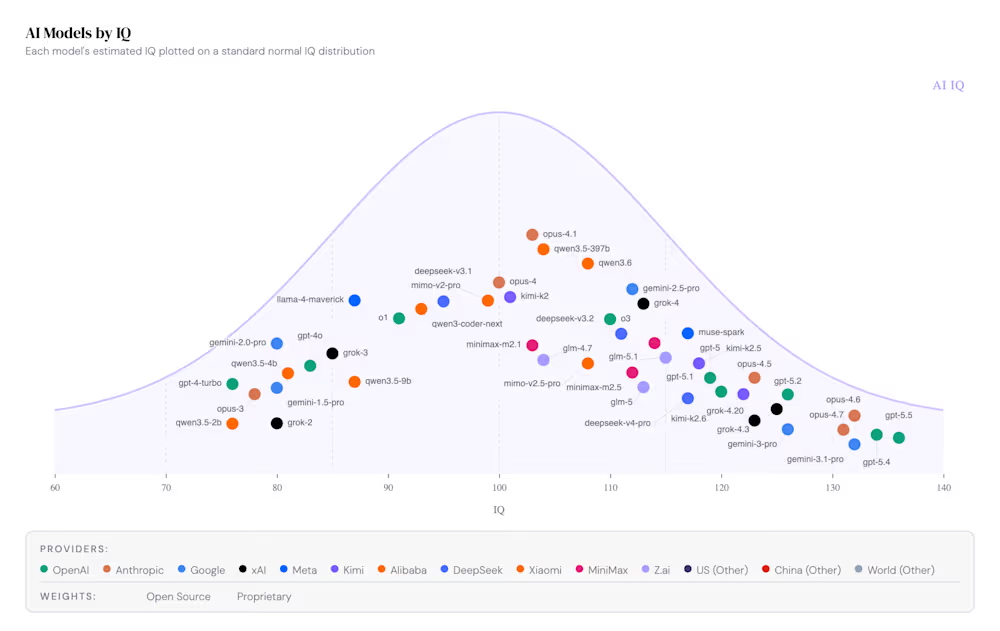
More than 50 AI language models, plotted on a standard IQ bell curve by the site AI IQ. The most capable models crowd the right tail of the distribution. (Credit: AI IQ)
Twelve benchmarks, four dimensions, and one controversial number: how AI IQ actually works
AI IQ was created by Ryan Shea, an engineer, entrepreneur, and angel investor best known as a co-founder of the blockchain platform Stacks. Shea also co-founded Voterbase and has invested in the early stages of several unicorns, including OpenSea, Lattice, Anchorage, and Mercury. He holds a Bachelor of Science in Mechanical Engineering from Princeton University.
The site’s methodology rests on a deceptively simple formula. AI IQ groups 12 benchmarks into four reasoning dimensions: abstract, mathematical, programmatic, and academic. The composite IQ is a straight average of those four dimension scores: IQ = ¼ (IQ_Abstract + IQ_Math + IQ_Prog + IQ_Acad).
Each raw benchmark score gets mapped to an implied IQ through what the site describes as “hand-calibrated difficulty curves.” Crucially, the methodology compresses ceilings for benchmarks considered easier or more susceptible to data contamination, preventing them from inflating scores above 100. Harder, less gameable benchmarks retain higher ceilings. The system also handles missing data conservatively: models need scores on at least two of the four dimensions to receive a derived IQ, and when benchmarks are absent, the pipeline deliberately pulls scores down rather than up. The site states that “every derived IQ averages all four dimensions, so missing coverage cannot make a model look better by omission.”
OpenAI leads the bell curve, but the gap between the top AI models has never been smaller
As of mid-May 2026, the AI IQ charts tell a story of rapid convergence at the top of the frontier — and widening diversity in the tiers below.
According to the Frontier IQ Over Time chart, GPT-5.5 from OpenAI currently sits at the peak of the bell curve, with an estimated IQ near 136 — the highest of any model tracked. It is closely followed by GPT-5.4 (approximately 131), Opus 4.7 from Anthropic (approximately 132), and Opus 4.6 (approximately 129). Google’s Gemini 3.1 Pro lands near 131, making the top cluster extraordinarily tight.
Advertisement
That compression is not unique to AI IQ’s framework. Visual Capitalist, drawing from a separate Mensa-based ranking by TrackingAI, recently observed the same dynamic, noting that “the biggest takeaway is how compressed the top of the leaderboard has become.” On that scale, Grok-4.20 Expert Mode and GPT 5.4 Pro tied at 145, with Gemini 3.1 Pro at 141.
Below the frontier cluster, the AI IQ charts show a crowded midfield. Models from Chinese labs — Kimi K2.6, GLM-5, DeepSeek-V3.2, Qwen3.6, MiniMax-M2.7 — bunch between roughly 112 and 118, making the cost-performance tier increasingly competitive for enterprise buyers who don’t need the absolute best model for every task. One X user, ovsky, noted that the data “confirms experience with sonnet 4.6 being an absolute workhorse as opposed to opus 4.5” — pointing to the way the charts can validate practitioner intuitions that headline rankings often miss.
The trajectory of frontier AI models from October 2023 to mid-2026, as tracked by AI IQ. Provider-colored step-lines connect each lab’s flagship releases, showing roughly 60 points of estimated IQ improvement in 30 months. (Credit: AI IQ)
Why emotional intelligence scores are becoming the new battleground in AI model rankings
What distinguishes AI IQ from most other benchmarking efforts is its inclusion of an “EQ” — emotional intelligence — score. The site maps each model’s EQ-Bench 3 Elo score and Arena Elo score to an estimated EQ using calibrated piecewise-linear scales, then takes a 50/50 weighted composite of the two.
Advertisement
The EQ scores produce a meaningfully different ranking than IQ alone. On the IQ vs. EQ scatter plot, Anthropic’s Opus 4.7 leads on EQ with a score near 132, pushing it into the upper-right quadrant — the most desirable position, signaling both high cognitive and high emotional intelligence. OpenAI’s GPT-5.5 and GPT-5.4 cluster in the high-IQ zone but lag slightly on EQ. Google’s Gemini 3.1 Pro sits in a strong middle position on both axes.
One notable methodological choice has drawn attention: EQ-Bench 3 is judged by Claude, an Anthropic model, which the site acknowledges “creates potential scoring bias in favor of Anthropic models.” To correct for this, AI IQ subtracts a 200-point Elo penalty from the EQ-Bench component for all Anthropic models before mapping to implied EQ. The Arena component is unaffected since it uses human judges. That self-correction is unusual in the benchmarking world, and it suggests Shea is aware of the methodological minefield he has entered. Still, the EQ dimension captures something IQ alone cannot: the growing importance of conversational quality, collaboration, and trust in models deployed for user-facing work.
Plotting IQ against EQ reveals that the smartest models aren’t always the most emotionally intelligent. Anthropic’s Opus 4.7 dominates the upper-right quadrant. (Credit: AI IQ)
The AI cost-performance chart that enterprise buyers actually need to see
Perhaps the most practically useful chart on the site is not the bell curve but the IQ vs. Effective Cost scatter plot. It maps each model’s estimated IQ against an “effective cost” metric — defined as the token cost for a task using 2 million input tokens and 1 million output tokens, multiplied by a usage efficiency factor.
Advertisement
The chart reveals a familiar pattern in enterprise technology: the best models are not always the best value. GPT-5.5 and Opus 4.7 sit in the upper-left corner — high IQ, high cost, with effective per-task costs north of $30 and $50 respectively. Meanwhile, models like GPT-5.4-mini, DeepSeek-V3.2, and MiniMax-M2.7 occupy a sweet spot in the middle: respectable IQ scores between 112 and 120, at effective costs ranging from roughly $1 to $5 per task. At the cheapest extreme, GPT-oss-20b (an open-source OpenAI model) appears near $0.20 effective cost with an IQ around 107 — potentially the most economical option for bulk classification or extraction workloads.
The site also offers a 3D visualization mapping IQ, EQ, and effective cost simultaneously. A dashed line running through the cube points toward the ideal: higher IQ, higher EQ, and lower cost. Models near the “green end” of that axis are stronger all-around deals; those near the “red end” sacrifice capability, cost efficiency, or both. For CIOs staring at API invoices, the implication is clear: the intelligence gap between a $50 model and a $3 model has narrowed enough that routing — using expensive models for hard problems and cheap ones for everything else — is no longer optional. It is the dominant architecture for serious AI deployments.
Critics say AI’s “jagged” capabilities make a single IQ score dangerously misleading
The loudest objection to AI IQ is philosophical, and it cuts deep. Critics argue that collapsing a model’s uneven capabilities into a single score obscures more than it reveals.
“IQ as a proxy is fading — we’re seeing reasoning density spikes that don’t map to g-factor,” posted Zaya, a technology commentator, on X. “GPT-5.5 already hit saturation on MMLU-Pro, but still fails ClockBench 50% of the time.”
Advertisement
That observation touches on what AI researchers call the “jaggedness” problem: large language models often exhibit wildly uneven capabilities, excelling at graduate-level physics while failing at tasks a child could do. A composite score can paper over those gaps.
Pressureangle, another X user, posted a more granular critique, calling out “complete lack of transparency” and arguing the site never fully discloses how its calibration curves were created or validated. In fairness, AI IQ does list its 12 benchmarks and shows the shape of each calibration curve in its methodology modal. But the raw data and precise mathematical transformations are not published as open datasets — a gap that matters to researchers accustomed to fully reproducible methods.
Others questioned the premise itself. “As useless as human IQ testing,” wrote haashim on X. Shubham Sharma, an AI and technology writer, offered a constructive alternative: “Why not having the Models take an official (MENSA-Grade) test? Wouldn’t this be the most accurate and most ‘human-comparable’ way to benchmark intelligence?” That approach already exists through TrackingAI, which administers the Mensa Norway IQ test to language models. But Mensa-style tests measure only abstract pattern recognition, while AI IQ attempts a broader composite across coding, mathematics, and academic reasoning. As Visual Capitalist noted, “an IQ-style benchmark captures only one slice of capability.” Each approach has tradeoffs — and neither has won the argument yet.
The real race isn’t for the highest score — it’s for the smartest model stack
For all the debate about methodology, the most important signal in AI IQ’s data may not be any single model’s score. It is the shape of the market the charts reveal.
Advertisement
There are now more than 50 frontier-class models available through APIs, from at least 14 major providers spanning the United States, China, and Europe. Each provider publishes its own benchmarks, often cherry-picked to showcase strengths. The result is a Tower of Babel where no two companies measure the same thing in the same way. Academic research has highlighted that “most benchmarks introduce bias by focusing on a particular type of domain,” and the Frontier IQ Over Time chart on AI IQ shows just how fast the targets are moving: in October 2023, GPT-4-turbo sat near an estimated IQ of 75. By early 2026, the top models were brushing 135 — roughly 60 points of improvement in 30 months.
That pace raises a fundamental question about whether any scoring system can keep up. The site compresses ceilings for saturated benchmarks, but as models continue to max out even the hardest tests — ARC-AGI-2, FrontierMath Tier 4, Humanity’s Last Exam — the framework will face the same ceiling effects that have plagued every AI evaluation before it. Connor Forsyth pointed to this dynamic on X: “ARC AGI 3 disagrees,” he wrote, referencing a next-generation benchmark that may already be undermining current scores.
AI IQ is not perfect. Its methodology is partially opaque. Its IQ metaphor can mislead. And its creator acknowledges known biases while likely missing others. But the alternative — wading through dozens of provider-specific benchmark tables, each using different test suites and scoring conventions — is worse. The site offers enterprise buyers something genuinely scarce: a single framework for comparing models across providers, dimensions, and price points, updated regularly, with enough nuance to show that the right answer to “which model is best?” is almost always “it depends on the task.”
Maybe. But if the AI IQ data shows anything clearly, it is that orchestration — knowing which model to deploy, when, and at what price — has become its own form of intelligence. And for that, there is no benchmark yet.
A man accused of stealing hard drives containing unreleased Beyonce music, tour plans, and other materials from a rental car in Atlanta has pleaded guilty and accepted a five-year sentence, including two years in custody. Slashdot Bruce66423 shares a report from The Guardian: Kelvin Evans was by the Atlanta police department in September in connection to a July 2025 car robbery where two suitcases containing Beyonce music and tour plans were stolen from a rental car. […] According to a July police report, Beyonce choreographer Christopher Grant and dancer Diandre Blue called 911 to report a theft from their rental vehicle, a 2024 Jeep Wagoneer, before Beyonce’s Cowboy Carter tour dates in Atlanta. An October indictment stated that Evans entered the car on July 8 “with the intent to commit theft.”
The stolen hard drives contained “watermarked music, some unreleased music, footage plans for the show and past and future set list,” according to a police report. Clothing, designer sunglasses, laptops and AirPods headphones were also stolen, Grant and Blue said. Local law enforcement searched for the location of one of the stolen laptops and the AirPods to try and locate the property. One police officer wrote in the report: “I conducted a suspicious stop in the area, due to the information that was relayed to me. There were several cars in the area also that the AirPods were pinging to in that area also. After further investigation, a silver [redacted], which had traveled into zone 5 was moving at the same time as the tracking on the AirPods.”
Evans was arrested several weeks after Grant and Blue filed a report, and was publicly named as the suspect in September. He was released on a $20,000 bond a month later. At the time of his arrest, Atlanta police said that the stolen property had not been recovered. It is unclear whether it has since been found.
Bruce66423 commented: “Just for stealing a couple of suitcases from a car. Funny how the elite punish those who inconvenience them. Can you imagine an ordinary victim see their offender get that sort of sentence?”
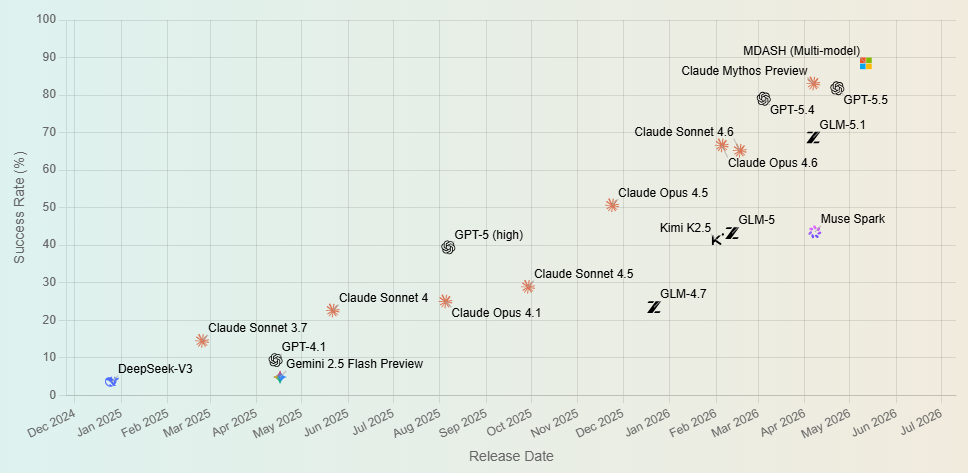
CyberGym benchmark scores over time, showing the rapid improvement in AI vulnerability discovery capabilities. Microsoft’s multi-model MDASH system (top right) tops the leaderboard at 88.4%. (CyberGym / UC Berkeley)
Mythos has been MDASH’d.
A new AI-powered system from Microsoft surpassed a headline-grabbing rival from Anthropic on a leading cybersecurity benchmark, using more than 100 specialized AI agents working together across multiple AI models to find real-world software vulnerabilities.
Microsoft’s system, codenamed MDASH, was introduced this week alongside the disclosure of 16 new vulnerabilities it found in different versions of Windows, including four “critical” remote code execution flaws fixed in this month’s Patch Tuesday release.
The company, which has faced persistent criticism over security lapses, is betting that multiple models can discover vulnerabilities at a pace that individual models can’t match.
MDASH, derived from the term “multi-model agentic scanning harness,” works by running specialized AI agents through a staged pipeline. Different agents scan code for potential vulnerabilities, then a separate set of agents debate whether each finding is real and exploitable, and a final stage constructs proof-of-concept attacks to confirm the bugs exist.
Advertisement
By comparison, Anthropic’s Mythos, which raised concerns over its ability to find and exploit software vulnerabilities when it was previewed earlier this year, is a single AI model running inside an agent framework. Anthropic restricted its release to a handful of companies through a consortium called Project Glasswing, which includes Microsoft.
OpenAI’s GPT-5.5 and others on the leaderboard are also single-model systems.
MDASH scored 88.45% on the CyberGym benchmark, a test developed by UC Berkeley researchers that measures how well AI systems can reproduce real-world vulnerabilities across 1,507 tasks drawn from 188 open-source software projects.
Mythos Preview was second at 83.1%, followed by GPT-5.5 at 81.8%.
Advertisement
The benchmark gives each system a description of a known vulnerability and an unpatched codebase, and measures whether it can produce a working attack that triggers the bug.
The scores on the CyberGym leaderboard are self-reported by the companies, including Anthropic’s Mythos result. The benchmark code is public, but no independent party has verified any of the scores. Also, benchmark results don’t necessarily reflect real-world performance.
The results also highlight growing concerns about AI’s use as an offensive hacking tool. The same capabilities that allow AI to find vulnerabilities in friendly hands can be used to discover them for exploitation by attackers. Microsoft said MDASH is being used internally by its security engineering teams and will be entering a limited private preview with customers.
Microsoft is telling customers to expect bigger Patch Tuesdays going forward as AI accelerates the discovery of vulnerabilities.
The Iran-linked hacking group MuddyWater (a.k.a. Seedworm, Static Kitten) launched a broad cyber-espionage campaign targeting at least nine high-profile organizations across multiple sectors and countries.
Among the victims are a major South Korean electronics manufacturer, government agencies, an international airport in the Middle East, industrial manufacturers in Asia, and educational institutions.
Researchers at Symantec say that the threat actor “spent a week inside the network of a major South Korean electronics manufacturer in February 2026.”
Symantec’s Threat Hunter Team believes the attacker was intelligence-driven, focusing on industrial and intellectual property theft, government espionage, and access to downstream customers or corporate networks.
Advertisement
Fortemedia and SentinelOne abuse
Seedworm’s campaign relied heavily on DLL sideloading, a common technique in which legitimate, signed software loads malicious DLLs.
Two of the binaries leveraged in the attack are ‘fmapp.exe,’ a legitimate Foremedia audio utility, and ‘sentinelmemoryscanner.exe,’ a legitimate SentinelOne component.
The malicious DLLs (fmapp.dll and sentinelagentcore.dll) contained ChromElevator, a commodity post-exploitation tool that steals data stored in Chrome-based browsers.
Symantec also found that PowerShell, used in previous Seedworm attacks, was still heavily used in the recent incidents, although the payloads were controlled through Node.js loaders rather than directly.
Advertisement
PowerShell was used to capture screenshots, conduct reconnaissance, fetch additional payloads, establish persistence, steal credentials, and create SOCKS5 tunnels.
Attack on a Korean firm
According to Symantec’s observations, the attack on the South Korean electronics manufacturer lasted between February 20 and 27. The researchers did not disclose the name of the targeted organization.
In the first stage, Seedworm performed host and domain reconnaissance, followed by antivirus enumeration via WMI, screenshot capture, and the download of additional malware.
Credential theft occurred via fake Windows prompts, registry hive theft (SAM/SECURITY/SYSTEM), and Kerberos ticket abuse tools.
Advertisement
Persistence was established through registry modifications, beaconing occurred at 90-second intervals, and sideloaded binaries were repeatedly relaunched to maintain access.
“The cadence is again consistent with implant-driven activity rather than continuous operator presence,” the researchers said.
The attackers leveraged sendit.sh, a public file-sharing service for data exfiltration, likely to obscure the malicious activity and make it appear as normal traffic.
Overall, Symantec has found the latest Seedworm campaign notable for the threat actors’ geographic expansion, operational maturity, and the abuse of legitimate tools and services, which mark a shift toward quieter attacks.
Advertisement
AI chained four zero-days into one exploit that bypassed both renderer and OS sandboxes. A wave of new exploits is coming.
At the Autonomous Validation Summit (May 12 & 14), see how autonomous, context-rich validation finds what’s exploitable, proves controls hold, and closes the remediation loop.
Artificial intelligence has posed a multi-layered problem for Apple in recent years. We’re expecting to hear some big news at WWDC this year about how AI will be integrated into the company’s gadgets, but there are still other wrinkles still to be ironed out in its broader approach to the use of this influential technology. According to The Information, one of those challenges is the recent interest and development of agentic AI.
To date, Apple has not permitted vibe coding tools on the App Store because they would violate its policies. They could also potentially be used to create original apps for people who would have otherwise gotten software from the App Store, which could pose a threat to Apple’s revenue as well as creating a loophole for spreading malware or taking other malicious actions. But applying that same block more broadly to any agentic AI services, which can take active control over a device and its programs, could keep Apple out of the loop as those tools are generating a lot of interest among both developers and casual users. Apple is reportedly trying to maintain its control over the App Store, while capitalizing on the current buzz around AI agents.
“While details couldn’t be learned, its staffers are designing a system to adhere to its standards of privacy and security and prevent the more freewheeling behavior some users of agentic systems such as OpenClaw have experienced, where agents can go haywire and delete all of a user’s emails, according to the people briefed on the matter,” the article states.
Advertisement
It sounds like a high wire act for a company that has been struggling to keep pace with AI’s breakneck development. Add this to the long laundry list of information we’ll be curious to see addressed at next month’s keynote.
Netflix has more than 250 million monthly active users on its ad-supported tier. The figure, which was revealed during the company’s Upfront presentation, marks a huge spike for this subscription option. In 2024 the plan with ads had 70 million users and in 2025 it reached 94 million.
Starting next year, Netflix will also launch the ad-supported plan in 15 more countries: Austria, Belgium, Colombia, Denmark, Indonesia, Ireland, the Netherlands, New Zealand, Norway, Peru, Philippines, Poland, Sweden, Switzerland and Thailand.
The Basic with Ads tier of access started rolling out in 2022. It appears to be an increasingly popular option as Netflix, like most streaming services, has continued to get ever-more expensive. The company just upped all monthly subscription costs by a dollar earlier this year.
Advertisement
And of course, because this is 2026, the Upfront included plenty of talk about AI. Netflix started using the tech in its ads last year, and one of the new potential applications the company is testing will serve “personalized ad loads and frequency caps that dynamically adjust the ads our members see, based on their viewing behaviors.” Netflix is currently facing a lawsuit from Texas on claims that it illegally sells user data to ad tech companies, although the streaming service said the suit was “based on inaccurate and distorted information.”
Ukrainian developers claim the laser weapon costs far less than Western systems
The Trident laser reportedly damages aircraft optics, electronics, and structural components effectively
Ukrainian company Celebra Tech is putting the final touches on a Trident laser weapon which it claims can destroy drones, helicopters, and even missiles at significant distances.
The Trident burns through enemy optics and structural components from up to three miles away.
Western defense giants have spent enormous sums on similar technology, such as the £120 million DragonFire laser unveiled by Britain, yet Ukrainian developers claim their Trident system will cost a tiny fraction of that amount.
Latest Videos From
Advertisement
What the Trident Can Actually Do
Celebra Tech says its laser system can shoot down reconnaissance drones from up to 1.5 kilometers away.
FPV drones, which have become a major threat on the battlefield with an effective range of 800 to 900 meters, were destroyed by the system, which also damages optics, electronics, and wing bodies of larger aircraft.
Developers say the Trident can strike helicopters and airplanes at a distance of 5 kilometers.
At 10 kilometers away, the laser still retains enough power to blind enemy surveillance equipment.
Advertisement
Sign up to the TechRadar Pro newsletter to get all the top news, opinion, features and guidance your business needs to succeed!
The system has recently received new targeting features, including radar integration and automatic target tracking, and a re-guidance system now allows operators to correct the beam during active engagement.
Tested for combat
The company revealed that a prototype called the Trident-120 underwent combat testing in 2021 and 2022, when it resembled a light rifle in its physical form and handling.
Advertisement
The earlier prototype successfully struck the optoelectronic equipment of Ka-52 attack helicopters, and also damaged Orlan reconnaissance drones and Murom ground observation stations during those field tests.
“Today, we can shoot down planes at an altitude of over 2 km with this laser,” said Vadym Sukharevskiy, former commander of the Unmanned Systems Forces.
The company adds the Trident laser system is also suitable for demining contaminated areas, although this secondary function has not been demonstrated publicly or verified by external observers.
Advertisement
Celebra Tech has developed other products, including the Laurus-13F fiber-optic FPV drone, and says it is also working on bombers, electronic warfare equipment, and specialized software packages.
The company employs only about fifteen people to work on this laser development project, which seems remarkably small for such a technically ambitious weapon system.
For most of the stated destroy ranges, including the 5-kilometer anti-aircraft claim, no independent verification or third-party confirmation has ever been published.
The demining function mentioned by the manufacturer appears particularly far from proven operational capability based on available evidence.
Advertisement
A low-cost laser that solves every aerial threat remains an appealing idea, but without proper verification, it remains a theoretical project.
KitchenAid has released a smart thermometer, the first from the popular cooking brand. The single probe model will retail for $100 while the dual option will cost $200. Although a maximum temperature isn’t listed in the specs, the company says that the Smart Thermometer can be used for a range of processes, including grilling, roasting, smoking, air frying and stovetop cooking.
The probes are waterproof and dishwasher safe, and when fully charged, the battery life can top out at 24 hours, so you can keep tabs even on long projects like smoking a hefty brisket. The quick-charge option can boost the probe to an extra five hours of cooking from five minutes of charging.
The KitchenAid Smart Thermometer connects to the company’s app, which offers a graph view for visualizing the cooking process, a collection of up to 20 saved cooks, and timers or alerts. Notifications can let the cook know when it’s time to take different steps in a recipe based on temperature. The probes use Bluetooth, and the Range Extender Mode can stretch the device’s 285-foot range with a second internet-connected device if needed.
Advertisement
KitchenAid’s offering joins several other products on the market, some from grilling-focused specialists such as Meater and ThermoWorks, and others from similarly major kitchen brands like Whirlpool, which just so happens to own KitchenAid.
Simplify your daily charging experience and replace most of the chargers and cables on your desktop. The 5-in-1 Wireless & Wired Charging Station is a compact and powerful charging station to charge all your favorite gadgets at the same time, and can also double as a bedside lamp with 3 brightness levels. Having 3 wireless charging spots, and one USB-A port, it enables charging for up to 4 devices simultaneously, including iPhone, Apple Watch, AirPods Pro, AirPods with Wireless Charging Case, other Qi-compatible Android Phones, and Bluetooth earbuds. The Apple Watch Stand is for charging any Apple Watch from Series 1 to 9. Save your workspace and charge all your favorite techs in one elegant solution. It’s on sale for $40.
Note: The Techdirt Deals Store is powered and curated by StackSocial. A portion of all sales from Techdirt Deals helps support Techdirt. The products featured do not reflect endorsements by our editorial team.
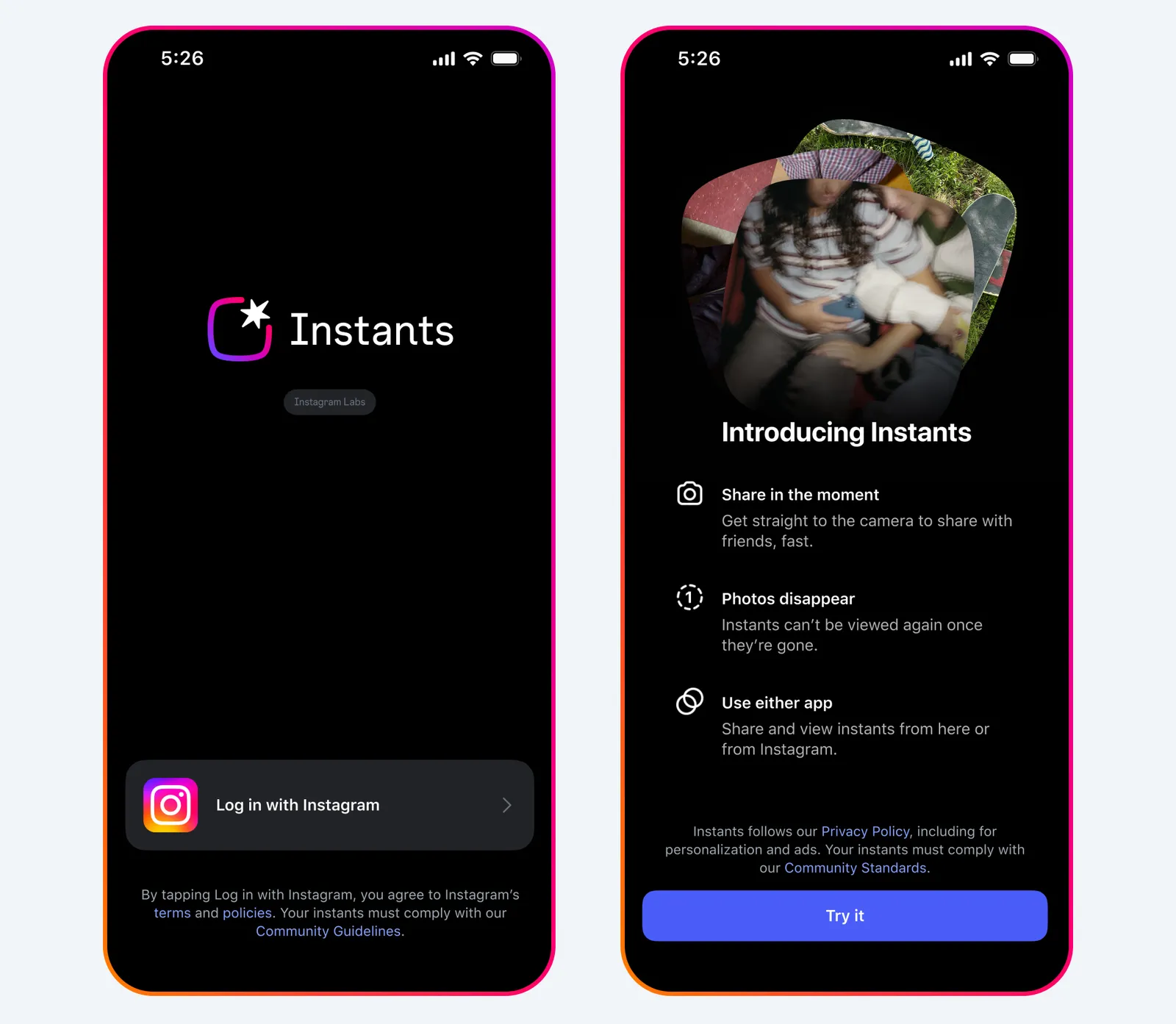
Meta launched a new app on Wednesday, called Instants, that integrates with existing Instagram accounts and allows users to send unedited, disappearing photos. Instants leans into the popularity of Instagram’s Stories feature and Close Friends lists, where users can selectively share images with a smaller audience.
Instants is available as a stand-alone app on iOS and Android in select countries, and it’s accessible through Instagram’s direct messaging tab.
The core of Instants, from its name to the bare-bones layout, is designed to evoke a sense of ephemerality. Yes, it’s a conceptual clone of Snapchat, with images that disappear after viewing, which can also be unsent before the person on the other end views them. (Instagram’s Stories feature, launched a decade ago, was also influenced by Snapchat.)
Unlike Snapchat, Instants is much more focused on capturing raw moments, like the once-viral BeReal app, and doesn’t allow any filters or retouching. That’s striking for a company that helped make sepia-toned filters like Valencia household names, and is hell-bent on adding generative AI to every other corner of its apps.
Advertisement
Courtesy of Meta
There’s one specific kind of raw image I fully believe adult users will be sharing with their Close Friends list through Instants: dick pics.
Instagram’s Close Friends feature, which arrived in 2018, earned a reputation as a way to share thirst traps. As a gay man living in San Francisco, I’m fully aware of what I’m going to see when someone adds me to their list and posts to Close Friends. No one’s posting full hog on main—that would be blocked by Meta—but there’s plenty of skin on display in those green bubbles.
Similar to Instagram, Instants is available to teenage users. Even so, content posted on either app may feel adult in nature. While Instagram’s community guidelines ban posting most kinds of nudity, with exceptions for sculptures and breastfeeding, in practice, the main feed on my Instagram is full of ass shots—nothing frontal. Images posted on Stories just to Close Friends lists, rather than being more publicly shared, often seem to avoid the stricter moderation rules. The Instants app is governed by the same guidelines as the main Instagram app.




























































You must be logged in to post a comment Login