
TL;DR
Anthropic launched Claude Corps: $150M to place 1,000 AI fellows at 400+ nonprofits. $85K salary, no degree needed. First 100 start October. Apps close July 17.




Summer is here, and Disneyland is continuing its year-long 70th anniversary, a celebration of the original Disney theme park opening its gates in 1955. Three new rides are also being built at the California Disney Parks, as well as a sprawling new Avatar area.
Over at Walt Disney World in Florida, four new lands are being constructed right now, themed around villains, Pixar characters and more.
Here’s everything you need to know about Disneyland and Disney World — starting with offerings coming this summer and then exploring what’s arriving beyond 2026.
Disneyland continues its celebration of its 70th anniversary, following its kick-off in May 2025, for much of the summer. Its last day is Aug. 9, 2026 — after which the parks will transition to Halloween decor on Aug. 21, then the holidays on Nov. 18, before fully returning to its natural state in early 2027.
There are many 70th anniversary shows to see, including the Paint the Night parade, Celebrate Happy Cavalcade and the Wondrous Journeys fireworks and projection show on the castle. Mickey and friends are also wearing 70th celebration outfits.
You can catch 70th anniversary-themed merchandise, food and drink items as well as a projection show at Carthay Circle and a 50-foot sculpture of Sleeping Beauty Castle on the esplanade between Disneyland and California Adventure; you can also find decorations sprinkled throughout Downtown Disney, Main Street USA, Disney’s hotels and even inside rides.
Disneyland’s Paint the Night parade.
While MuppetVision 3D closed last year to make way for an entire land themed around the Monsters Pixar movies at Hollywood Studios, the Muppets are being moved to the Rock ‘n’ Roller Coaster. That overlay didn’t take long to complete — Rock ‘n’ Roller Coaster Starring Aerosmith had its last day of operation on March 1, and the Muppets-themed version opens on Tuesday, May 26.
“The legendary ride roars back to life with a rock-charged remix that drops guests straight into the middle of The Electric Mayhem’s biggest night yet. With high-speed thrills, a pulse-pounding soundtrack, and a VIP list like no other, this reimagined attraction hits all the right notes,” the Disney Parks Blog posted on April 16.
Concept art of the Monsters, Inc. suspender coaster.
Replacing the old Muppets area of Hollywood Studios, meanwhile, Monstropolis — home of the Monsters, Inc. movies, shorts and Disney Plus streaming series — will feature Disney’s first suspended roller coaster inside the city’s laugh/scream factory.
“The first time I saw Monsters, Inc., all I wanted to do was ride on one of those doors like Mike and Sulley,” Disney Experiences Chair Josh D’Amaro said at D23 in 2024. “Remember in the movie how those claws grab the doors and hoist them up into the air to take them away? We’re doing that too. And you’re going along for the ride.” This TikTok shows the design concept for the Monsters Inc. ride.
MuppetVision 3D closed permanently on June 8, 2025, but we don’t expect Monstropolis to be complete for another year or two.
At Disney’s California Adventure and Disney World’s Epcot, the Soarin’ Around the World attraction is getting a US-themed makeover. Soarin’ Across America will arrive on July 2, 2026, and will feature scenes, sounds and scents from more than a dozen cityscapes and scenic areas.
Disney released a trailer starring Patrick Warburton, the original Soarin’ narrator and pilot, in which he says we’ll soon “sail across spacious skies” and may see “amber waves of grain” and “purple mountain majesties.” It’s part of Disney’s celebration of America’s 250th anniversary.
On June 19, Downtown Disney will host Disney on the Yard Presents Yardfest: Part of Celebrate Soulfully, which celebrates HBCUs, including performances by drum majors.
This event on Juneteenth kicks off the Celebrate Soulfully: Summer Vibes celebration, which goes from June 19 until July 19 to celebrate Black music, food, art and culture. Concerts will be held on certain days at Paradise Gardens in California Adventure, as well as “special character encounters and live variety acts” on Fridays and Saturdays, per Disney.
Bluey and her family are now hosting a stage show and themed area at the original Disney park. Debuting two months ago, Bluey’s Best Day Ever is located at the Fantasyland Theatre next to Mickey’s Toontown, which has been transformed into Bluey’s school classroom and grounds, including a gnome village and fairy garden.
Bluey and her sister, Bingo, appear several times each day, along with actors and musicians, to “bring to life the popular music and games emblematic of beloved Bluey episodes.” Those games will include “keepy uppy” and the “grannies,” as well as appearances by Chattermax and Unicorse.
There are also puzzles, games and photo ops throughout the Bluey area, and Disneyland is serving up Bluey-themed foods at Troubadour Tavern.
The hugely popular Australian cartoon about a family of dogs is a worldwide hit, and Disney is slated to release a Bluey movie in 2027. (In the meantime, you can watch Bluey episodes and minisodes on Disney Plus.)
New characters have begun roaming around the Star Wars-themed lands in Disneyland, as the area “expands its timeline” to include Luke Skywalker, Leia Organa and Han Solo. The original trio of Star Wars main characters arrived in Batuu on April 29 and are now interacting with guests and other characters.
To help tie them in with the more modern Star Wars land, there are also new props, merch, graphics and music (featuring the legendary John Williams score) in Galaxy’s Edge.
“Black Spire Outpost will roll back in time several decades, thoughtfully introducing beloved characters from across the Star Wars timeline,” the Disney Parks Blog announced in April. “Each era will be brought to life with the same care and attention to detail that the land was originally designed with, masterfully weaving together stories from across time and space in one location.”
Darth Vader has also joined the fun, and you can still see Ahsoka Tano, The Mandalorian, Grogu, Rey, Chewbacca and R2-D2.
Over in Tomorrowland, Space Mountain has transformed into Hyperspace Mountain for a limited time.
Disneyland (and Hollywood Studios at Disney World) has also now added Mandalorian and Grogu missions to the Millennium Falcon: Smuggler’s Run ride in Star Wars: Galaxy’s Edge, tying in with the release of The Mandalorian and Grogu in cinemas. The new missions launched on May 22.
Disneyland now has a Kids’ Summer Ticket deal, with a one-day Park Hopper ticket costing $50 per child, ages 3 through 9. It can be used until Sept. 7.
Disneyland is also adding (and removing) a Magic Key option: The Explore Key will replace the Enchant Key. All California residents will be able to purchase it — not only Southern California residents. It will allow access on weekdays in June and July, which were blocked out for Enchant Key holders. The Explore Key costs $999, with a $99 down payment and 0% APR on repayments for 12 months. Disney said its “full value” can be unlocked in just four visits to the parks, thanks to Park Hopper admission, 25% off parking, Lightning Lane Multi-Passes and 10% off merchandise and dining.
Disneyland’s World of Color 70th anniversary show.
For what Disney World is calling Cool Kids’ Summer, it’s offering two free nights and two free theme park days when you buy a four-night, four-day Disney hotel and ticket package for a visit during May 26 through Sept. 15. You can also save up to 30% on some Disney hotels between May 1 and Oct. 4.
Also part of Cool Kids’ Summer is a free day at a Disney World water park (Typhoon Lagoon or Blizzard Beach) on your check-in day when staying at a Disney hotel between May 26 and Sept. 8; and a free dining plan for kids aged 3-9 when you buy a dining package for guests over 10 and a room at a Disney hotel.
The second Disney theme park built in Anaheim opened 25 years ago on Feb. 8, 2001. While the look of the park has changed a lot over those years, California Adventure has a few ways it’s celebrating the quarter-century milestone: It’s switching the Soarin’ attraction back to Soarin’ Over California until July 1; dressing Mickey Mouse and Minnie Mouse on Buena Vista Street with new outfits, featuring sun motifs like the one originally on the roller coaster; and offering anniversary-themed food items, merchandise and drinks.
Concept art showing an aerial shot of the Avatar-themed area coming to Disneyland Resort.
Disneyland is finally expanding after unveiling plans almost five years ago. The expansion is expected to take a couple of years to complete and will push the park’s current boundaries past Downtown Disney and into the nearby parking lots. It’ll also transform “a portion of the current Hollywood Backlot area,” leading to the closure of the Monsters Inc. attraction permanently in 2027.
The biggest part of the expansion will be adding an Avatar-themed land, based on the second film, The Way of Water, as well as Avatar: Fire and Ash. It will include a dark boat ride much like Pirates of the Caribbean, “taking guests all the way to the wide-open seas of Pandora.”
It follows the success of the world of Pandora, based on the original Avatar film, in Disney World’s Animal Kingdom. Disney has no dates or details yet on when it’ll be complete.
Coming sooner than the Avatar land, however, is a new esplanade entry “experience” to replace the current walkway entry at the east side of Disneyland, as well as a new parking structure and pedestrian bridge over Harbor Boulevard. Construction on this begins in the fall.
Concept art of the new pedestrian bridge that will cross Harbor Boulevard.
It won’t be launching this year, but construction has begun backstage at California Adventure to build a new dark ride. It’ll be themed for the beloved Pixar movie Coco and populated by audio-animatronics.
The Coco ride will be located in the area near Pixar Pier and Paradise Gardens, in what is primarily backstage areas for cast members currently. It’ll have characters and music from the movies as you travel through the land of the dead with Miguel.
Concept art for the new Coco ride.
Avengers Campus already has two rides: Spider-Man Web Slingers and Guardians of the Galaxy. Soon, this will double as Disney builds two more Marvel attractions at California Adventure.
“We’re doubling the size of the land with two new attractions,” a structural engineer said in a video posted to Walt Disney Imagineering’s Instagram account on Feb. 26. The engineer showed off how the Avengers Infinity Defense structure is looking now, including its columns, foundations and a catwalk that will “support projectors, speakers and other types of show elements.”
Avengers Infinity Defense will see you assemble alongside the Avengers, battling King Thanos — set in a multiverse — featuring appearances by Black Panther, Ant-Man and Hulk.
Concept art of the Avengers Infinity Defense attraction coming to California Adventure.
Stark Flight Lab, the second ride, will see you help test Tony Stark’s latest tech.
“In Stark Flight Lab, guests will sit in ‘gyro-kinetic pods’ and roll along a track before stopping in front of a giant robot arm,” Disney said. “This robot arm will hoist you into the air where you’ll make several high-speed maneuvers inspired by Iron Man and some other Avengers.”
Construction began in 2025, but no launch dates have been revealed yet.
While it won’t be ready in time for 2026, construction is well underway for Disney’s first villains-themed area. Villains Land, which will celebrate all the classic baddies from Disney films, is coming to the Magic Kingdom at Disney World in Florida.
Imagineers have been drawing inspiration from architectural structures in Paris and Barcelona — like Gaudí’s buildings in the latter — to design Villains Land, Disney revealed during Destination D23 in August 2025.
Concept art for the new Villains Land.
“Paris is a city full of classic Art Nouveau … natural motifs and swirling designs there make nature appear to be ‘cursed,’ like magic has frozen it into place,” Disney said on its Parks Blog. “Barcelona’s art style is Modernisme, which has less natural patterns but gives the architecture an otherworldly, unnerving appearance.”
Villains Land, first teased during D23 2022, will be positioned on the other side of Big Thunder Mountain at the top left edge of the current Magic Kingdom map and will stretch around to where the Haunted Mansion is.
Two major attractions are planned, along with dining and shopping. Still no word yet on when it’ll open.
Piston Peak National Park: the setting for the new Cars-themed land at Magic Kingdom.
The Rivers of America and Tom Sawyer Island at Disney World’s Magic Kingdom have been closed and removed from the online map, as Disney works to construct a new land themed after Pixar’s Cars movies. Cars Land, which was added to Disney’s California Adventure back in 2012, remains extremely popular in the west, so it was only a matter of time before it was added to the eastern outpost.
In an expansion of Frontierland — which also includes Tiana’s Bayou Adventure and Big Thunder Mountain Railroad — Route 66 will feature a look inspired by the Rocky Mountains and the “American Frontier and its national parks.”
The Disney Parks Blog described the new area as “an awe-inspiring wilderness filled with towering trees, snowcapped mountains, breathtaking waterfalls, roaring rivers and impressive geysers.” Disney Imagineers are “using a style of architecture called ‘Parkitecture,’ which was developed by the National Park Service to create structures that harmonize with the natural environment.”
Concept art of the Cars rally race attraction coming to Disney World.
There will be two attractions, one of which is a rally race. Pixar Chief Creative Officer Pete Docter and Imagineer Michael Hundgen spoke about the new ride vehicle for this, and you can see a TikTok of Imagineers testing out off-road vehicles in the Arizona desert to create what the ride will feel like. Each rally car will have its own personality, name and racing number, Docter said.
“These are all things Lightning McQueen and Mater haven’t experienced before, like racing over rocky terrain, ascending to mountain peaks and dodging around geysers — how do you take these real-world elements and put a Cars spin on it?” Disney Parks said in a previous blog post.
While construction has begun and Disney has even released a map showing what the land may look like (geysers shooting water, a running river, an off-road rally track, mountains, a visitor’s lodge, a Ranger HQ and walking trails), we don’t expect Piston Peak to open until at least 2027 or 2028.
Concept art of Tropical Americas.
Animal Kingdom’s DinoLand USA area is no more, with the area on the Disney World map now a blank sea of grass as Disney slowly builds out the new Tropical Americas Land.
Construction began in the fall of 2024, with TriceraTop Spin and the midway area closing down in January 2025. The Dinosaur ride remained open until Feb. 1 this year, but has since closed its doors as it’s transformed into a new Indiana Jones ride through a Maya temple (a relatively easy overlay since Disneyland’s Indiana Jones reportedly follows almost exactly the same ride track as Disney World’s Dinosaur).
The Pueblo Esperanza area will be themed like a South American village, with an Encanto-themed attraction, where you get to explore Antonio’s rainforest room inside the Casita, as well as a huge quick-service dining location, a fountain and a carousel.
Tropical Americas is planned to open in 2027.
Disney has been all in on launching cruise ships over the last few years, including the Disney Wish in 2022, the Disney Treasure in 2024 and the Disney Destiny in 2025.
The Disney Adventure sailed on its maiden voyage from Singapore on March 10, the first of four new ships set to embark soon. Disney’s next cruise liner, the Disney Believe, was unveiled by new CEO Josh D’Amaro on March 18.
“The Disney Believe will bring to life the magical worlds of Encanto and Frozen, the wishing wells of Snow White and the Seven Dwarfs, and the depths of the sea with Moana and The Little Mermaid,” Disney said.
The Disney Believe is expected to set sail in late 2027. The other ship names and destinations have yet to be revealed, but they’re expected to sail before 2031.
Here’s what else is new and coming soon to the theme parks:
Concept art of the overhauled version of Buzz Lightyear’s Space Ranger Spin, which will have two different colored lasers in each ride vehicle.


Anthropic launched Claude Corps: $150M to place 1,000 AI fellows at 400+ nonprofits. $85K salary, no degree needed. First 100 start October. Apps close July 17.
Anthropic is donating $150 million to place 1,000 AI fellows inside nonprofit organisations across the United States. The programme, called Claude Corps, will pay early-career workers $85,000 plus benefits for a year-long placement where they help nonprofits use Claude more effectively. Applications opened Wednesday and close on July 17.
No college degree is required. Applicants must be 18 or older, hold US work authorisation, and have no more than two years of full-time work experience. The first cohort of 100 fellows starts in October 2026. Subsequent cohorts begin in January and August 2027.
Each of the 400+ host organisations will receive a $10,000 grant and free Claude credits. Anthropic partnered with CodePath, a San Francisco nonprofit that helps first-generation and low-income students enter the tech workforce, to manage recruitment and training.
“We hope this program will expand and become a pillar of our strategy to help humankind realize the benefits of AI while also managing its risks,” said Anthropic President Daniela Amodei.
The programme is modelled loosely on service corps like AmeriCorps and Teach For America, but with a corporate sponsor and a product at its centre. Fellows are trained specifically on Claude. The organisations they serve will build their workflows around Claude. When the fellowship ends, the nonprofits are left with AI infrastructure tied to Anthropic’s ecosystem.
That dual purpose has drawn criticism. Fortune noted the “fox guarding the henhouse” dynamic: a $965 billion AI company is training the nonprofit sector to depend on its own product, funded by a donation that represents less than 0.02% of its valuation. Anthropic frames it as philanthropy. Sceptics see distribution strategy wrapped in a public benefit narrative.
Regardless of the framing, the programme addresses a real gap. Most nonprofits lack the staff, budget, and technical knowledge to adopt AI tools, even when those tools could meaningfully improve operations. Anthropic’s $100M Claude Partner Network, launched earlier, targets enterprises. Claude Corps targets the organisations that cannot afford enterprise partnerships.
The timing is deliberate. Anthropic is preparing for an IPO and positioning itself as the responsible AI company in a field dominated by OpenAI’s commercial aggression and Google’s scale. A $150 million nonprofit fellowship is a narrative play as much as a product play. Whether 1,000 fellows can make a meaningful difference across 400 organisations depends on whether the programme outlasts its PR value. Anthropic’s policy framework, published this week, calls for AI’s benefits to be “broadly shared.” Claude Corps is its first concrete attempt to deliver on that promise.

IPOs can be volatile, especially for retail investors. SpaceX is no exception.
I just did a quick Google search for SpaceX IPO. How many hundreds of articles are we actually expected to read about this?
Given the buzz around Friday’s big IPO, there are a few misconceptions worth addressing upfront. While many people view SpaceX as a massive, dominant space enterprise, it’s more complicated than that.
“In reality, it’s a very successful but fairly small satellite launch company, bolted onto a stagnant money-losing social media company and a money-incinerating AI company, and then sprinkled with a lot of hype about humankind going interplanetary,” said Robin Wigglesworth, editor of the Financial Times’ finance blog, Alphaville.
In other words, perhaps it’s more akin to a vertically integrated space and communications company with ambitious, high-risk side bets. Sure, at its center, SpaceX is a launch company that designs rockets (like Falcon 9 and Starship) and sells access to space. But around that, it has those related businesses — most notably Starlink, its satellite internet network, and xAI, which SpaceX acquired in February 2026. And since xAI includes the social media platform X and X’s chatbot, Grok, they’re also under the SpaceX umbrella.
X hasn’t been durable in terms of revenue. And, like most cash-burning AI enterprises, xAI is expensive to run and is reporting very large losses.
One could say the SpaceX ecosystem revolves around a single goal: building the infrastructure needed for global connectivity and, eventually, space settlement. But a major concern is that SpaceX’s overall package is driven more by hype and momentum than by its proven profitability.
Wigglesworth said the biggest immediate risk is straightforward: The stock could drop soon after it begins trading. That outcome would affect both the company and investors, though it wouldn’t necessarily signal broader economic trouble. As he noted, IPOs “do badly all the time.”
In the first few weeks after the IPO, price movements may be misleading. The opening day can be volatile, with banks helping stabilize prices and strong retail demand potentially pushing shares higher. We’ll also see index funds start to buy in, which can help nudge the price up a bit.
However, as Wigglesworth pointed out, the more meaningful test will come after a month, when the market determines whether there is sustained demand “for a company trading at some of the juiciest valuation multiples we’ve seen in history.”
So here’s another misconception to address: If SpaceX is popular, it’s safe to buy, right?
I didn’t have to read too many articles to get an answer to that.
“Popularity and renown are bad indicators for what makes a successful investment,” Wigglesworth told me. “Even good companies can be bad investments at a dumb price.”

Artificial intelligence coding assistants have spread across development teams faster than security frameworks can adapt to.
New Salt Security research has claimed 90% of security leaders now report active concerns about risks posed by AI-generated software.
However, organizations continue embracing AI tools because they accelerate coding tasks, reduce time spent on repetitive work, and increase software delivery speed.
Security leaders believe that development practices designed before AI became mainstream may no longer provide sufficient oversight.
Nearly a third (29%) of respondents identified insecure coding patterns as the primary risk introduced by AI assistants.
These systems learn from massive training datasets that contain their own flaws and outdated practices.
An AI tool can generate code that appears fully functional while quietly reproducing vulnerabilities a human might have caught.
This problem resembles how antivirus software must constantly update its definitions because new threats emerge faster than signature databases can grow.
The difference here is that no central authority tracks every insecure pattern an AI might replicate – as despite the widespread anxiety that AI introduces, more than one-third of organisations still depend on manual code reviews before any launch.
Reliance on human checking becomes structurally problematic when AI produces code at volumes no team can inspect thoroughly.
That method worked when developers wrote software at human speed, but it fails when AI accelerates output dramatically.
Reviewer fatigue sets in quickly, teams apply standards inconsistently, and security requirements get interpreted differently across departments.
AI coding assistants are fundamentally changing how software is built, but governance has not kept pace,” said Roey Eliyahu, CEO and co-founder at Salt Security.
“Most organisations recognise the risks, but many are still trying to manage AI-generated code using security processes designed for a pre-AI world.”
This approach does not scale any better than using a single email inbox to handle millions of daily messages without filtering or automation.
Larger organisations with more than 500 employees face governance challenges that smaller firms simply do not encounter.
Distributed teams use different tools, follow varied workflows, and apply security standards with inconsistent rigour across regions.
The risk of developer overreliance on AI assistants grows proportionally with team size and delivery pressure.
Security agencies, including government cybersecurity bodies, have previously warned that AI systems expand attack surfaces and complicate accountability structures significantly.
Without better visibility into where AI-generated code enters the pipeline, governance remains guesswork dressed up as process.
Treating AI coding assistants as components of the software supply chain — similar to vetting any third-party malware risk — offers a more realistic path forward than hoping manual review will somehow catch up.

Follow TechRadar on Google News and add us as a preferred source to get our expert news, reviews, and opinion in your feeds.
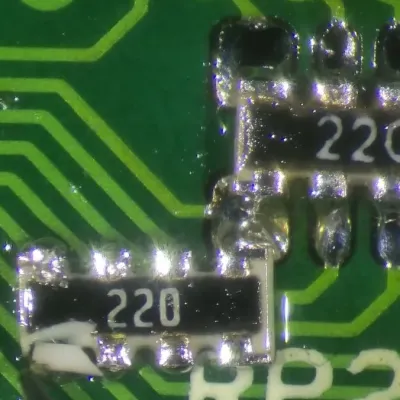

Recently [Bits und Bolts] stumbled over a pair of Dragon 3000 branded 3dfx Voodoo 2 cards in his unfixed cards pile, and decided that the best course of action was to not only fix them, but also run them in SLI for some sweet Unreal Tournament action. Naturally, these cards being in the broken cards pile meant that he first had to figure out why they were broken and fix all issues.
The advantage of having two identical Voodoo 2 cards is of course that any missing components, like some resistors on one card, could be referenced on the other card. Beyond that it was mostly a matter of reflowing clearly corroded pins on the ICs and replacing damaged resistors and resistor arrays before the first tests could be run.
Using the mojo utility it was easy enough to spot that there were still some lingering issues, with clear issues visible in 3D games as well. These were tracked down to a dodgy pin on one of the texture mapping units (TMUs) that needed some more reflowing, and a very sneaky resistor array that was cracked but not obviously so until prodded with a multimeter.
With both cards now making happy noises when individually tested, it was time to go full SLI, fire up the Pentium 2 system and enjoy the glory of 24 MB of VRAM at high resolutions in Unreal Tournament. Considering that the bloke who had sent in these cards had found them while cleaning up a shed, it’s quite amazing how little rework was needed to once again party like it’s 1999.
GenAI image generators like Stable Diffusion do not draw a picture pixel by pixel from left to right. They start with noise and iteratively refine the entire image in parallel until it converges, in a process known as diffusion. For years, applying that same principle to text generation had remained out of reach at scale.
Standard language models work like a typewriter: one token at a time, left to right, with no ability to revise a committed output. That pattern works in the cloud, where batch sizes keep GPUs saturated. For local inference or low-concurrency deployments, the GPU is idle most of the time.
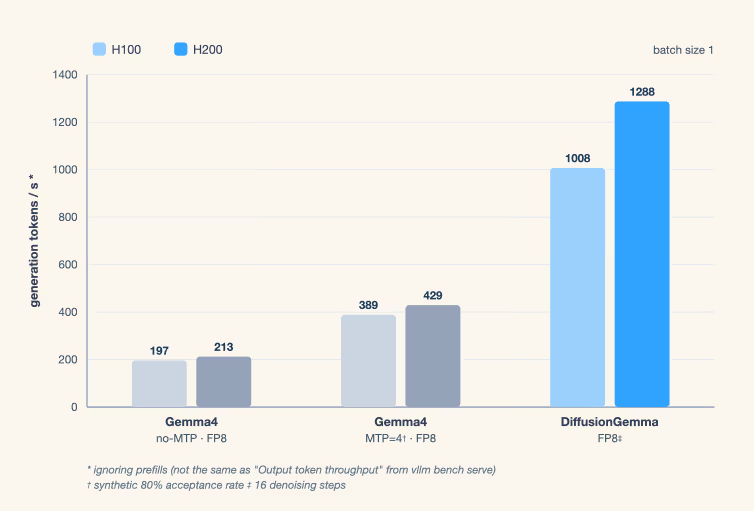
Google’s DiffusionGemma, released this week, is an open source experimental model that applies diffusion to text generation at production scale. Built on the Gemma 4 backbone and released under the Apache 2.0 license, it is the first diffusion language model natively supported in the open source vLLM inference platform. It generates a 256-token block in parallel rather than sequentially, with every token position attending to every other. Google says DiffusionGemma generates text up to 4x faster than standard models on GPUs. At batch size 1 on a single Nvidia H100, the FP8 version reaches 1,008 tokens per second. On H200, it hits 1,288 — roughly six times a standard autoregressive baseline, according to vLLM benchmark results published today.
Despite the speed gains, Google did not oversell the release. The company’s launch post acknowledged directly that DiffusionGemma’s overall output quality is lower than standard Gemma 4, adding “For applications that demand maximum quality, we recommend deploying standard Gemma 4.”
DiffusionGemma does not generate tokens in order. It starts with a block of 256 random placeholder tokens, effectively a blank canvas, and runs multiple refinement passes over the entire block at once. On each pass, it evaluates every position and locks in the ones it is most confident about. Uncertain positions get randomized and reconsidered on the next pass, with the model using what it resolved in the previous round to inform the next attempt. The block converges progressively until enough positions stabilize to anchor the rest.
Two things follow from that architecture.
Self-correction. An autoregressive model that commits to a wrong token is stuck with it, because subsequent tokens are already conditioned on the mistake. DiffusionGemma can identify low-confidence positions and re-evaluate them on the next pass.
Bidirectional context. Every position attends to every other position in the block simultaneously, including tokens that appear later in the sequence. That makes the model structurally better suited to constrained generation tasks where left-to-right generation fails.
Google demonstrated both properties with a fine-tuned Sudoku solver. The base model solved zero puzzles. After fine-tuning on a Sudoku dataset, it reached an 80% success rate and converged in 12 denoising steps rather than 48. The efficiency gain came directly from the model’s ability to self-correct and stop early.
DiffusionGemma runs as a 26B Mixture of Experts model that activates only 3.8B parameters during inference. Quantized, it fits within 18GB VRAM on consumer hardware including the Nvidia RTX 4090 and 5090. Google and NVIDIA also optimized for enterprise Hopper and Blackwell servers using NVFP4 kernels.
The vLLM integration required new work because DiffusionGemma does not fit the standard serving model. A typical vLLM batch applies the same attention type to every request. DiffusionGemma requests alternate between causal and bidirectional attention as they cycle through prompt reading, canvas refinement and block commit. The team built per-request attention switching into both the Triton and FlashAttention 4 backends and reused the existing speculative decoding path for the refinement loop.
The new ModelState interface the team built for this integration is designed to support additional diffusion models in vLLM as they emerge.
DiffusionGemma’s speed advantage is real but conditional. Where it applies depends entirely on deployment context.
The numbers. At batch size 1 on a single H100, vLLM’s published benchmarks put the FP8 model at roughly five times a standard autoregressive baseline. On H200, roughly six times. Those peak figures reflect optimal conditions: single user, dedicated hardware, FP8 quantization.

Where it wins. Local inference, single-user applications and low-concurrency serving. In those conditions the GPU has spare compute and memory bandwidth is the bottleneck. DiffusionGemma’s parallel block generation fills that gap.
Where it does not. High-throughput cloud serving. When a server is batching hundreds of concurrent requests, autoregressive models already saturate available compute and DiffusionGemma’s parallel decoding provides diminishing returns.
The quality ceiling. Guilherme O’Tina, an AI researcher, put a finer point on it on X. “Local artifacts vs hallucinations are different problems and that decides where this actually wins,” O’Tina wrote.
Diffusion language models are not new. Researchers have built them at smaller scales for several years, and Inception Labs’ Mercury Coder applied the approach commercially to coding tasks in 2025. What DiffusionGemma adds is scale — a 26B MoE backbone, native vLLM serving and a general-purpose instruction-tuned model rather than a domain-specific one.
The more useful comparison for engineers evaluating this against existing inference tooling is speculative decoding, and the distinction matters. Speculative decoding keeps a standard autoregressive target model and uses a smaller draft model to guess several tokens ahead. The target model verifies them in one pass. If sampling is correct, the output distribution stays identical to the target. The architecture is unchanged.
Andrew Kuncevich, an ML and AI researcher focused on production AI systems, put it directly on X. “DiffusionGemma is different. It does not just guess future tokens. It creates a noisy 256-token canvas and repeatedly denoises the whole block in parallel. So it’s not just a decoding trick — it’s a different generation paradigm,” Kuncevich wrote.
Compared to standard Gemma 4, the trade is speed for quality. Google’s benchmark data shows DiffusionGemma below standard Gemma 4 on general output quality metrics, with the gap varying by task.

On structured constrained tasks, including code infilling, template generation and problems requiring bidirectional constraint propagation, the architecture has a structural advantage that fine-tuning can surface, as the Sudoku result demonstrates. On open-ended generation, standard Gemma 4 remains the stronger option.
DiffusionGemma serves via a standard vLLM OpenAI-compatible endpoint with no diffusion-specific pipeline changes required.
This is not a general-purpose model upgrade.
For teams running local or low-concurrency inference, the architecture choice just expanded. Until now, cutting generation latency on dedicated GPU hardware meant using a smaller model and accepting the quality trade-off. DiffusionGemma offers a third path at the same parameter footprint, on consumer hardware, with same-day vLLM support.
For constrained generation workloads, bidirectional attention is worth evaluating. Code infilling, structured data generation and tasks where correct output depends on context not yet generated are where this architecture has a structural edge.
The ModelState interface built for this integration is designed to generalize as additional diffusion models emerge.
The quality trade-off is real and Google acknowledges it. For teams running local inference on dedicated GPU hardware, this is worth testing.
Xiaomi’s MiMo AI team has open-sourced MiMo Code V0.1.0, a terminal-native AI coding assistant that the Chinese electronics giant says outperforms Anthropic’s Claude Code on key agentic coding benchmarks, especially on long-horizon, multi-step tasks (200+ steps) — at least, according to its own internal beta release and survey of 576 developers.
It’s also bundling limited-time free access to MiMo-V2.5, its multimodal flagship model with a million-token context window, requiring no registration to get started.
The release was announced June 10, 2026 in a post on the social network X from the official @XiaomiMiMo account, which described the tool as “more than an AI coding assistant in your terminal — it’s the smartest coding partner you’ll ever work with.”
MiMo Code is available now on GitHub under an MIT license, and installs with a single terminal command (curl -fsSL https://mimo.xiaomi.com/install | bash) on macOS and Linux or via npm (npm install -g @mimo-ai/cli) on Windows.
The project is a fork of the open-source OpenCode agent, which Xiaomi has extended with its own memory architecture, workflow modes, and model harness.
As any avid vibe coder would surely attest, AI coding agents degrade over long working sessions: as the context window fills, earlier decisions, conventions, and task state get compacted away or lost entirely, forcing developers to re-explain their projects.
Xiaomi argues this approach is doomed at scale. “What we need is not better compression, but an explicit storage-and-retrieval mechanism that decides what information should be written into persistent structures, and when it should be recalled,” the MiMo team noted in their launch blog.
MiMo Code attacks this with a cross-session memory system, powered under the hood by SQLite FTS5 full-text search, that spans four layers: project memory (a persistent MEMORY.md file), session checkpoints, scratch notes, and per-task progress logs.
The note-taking is key, here: Rather than forcing the primary coding agent to pause its work to take notes, the system deploys an independent “checkpoint-writer” subagent.
Think of it the primary coding agent as a construction contractor working to build a massive mansion alongside a dedicated architect, the checkpoint-writer subagent. While the main agent focuses on building out the physical structure, the subagent updates the blueprints in real time, noting decisions, issues, and the actual lay of the land as the construction project progresses.
When the context window approaches its limits — the contractor gets lost in the half-built mansion — it can consult the subagent and find its place again. In the case of MiMo Code, the system simply rebuilds the environment from structured checkpoints with the relevant context, ensuring no loss of operational momentum.
Two self-improvement mechanisms round out the system: a /dream command that periodically (roughly every seven days) reviews historical sessions, deduplicates them, and compresses them into long-term memory, and a “distill” function that mines past sessions for repeated workflows that can be automated, following a similar approach taken recently by OpenAI and Anthropic with their various models.
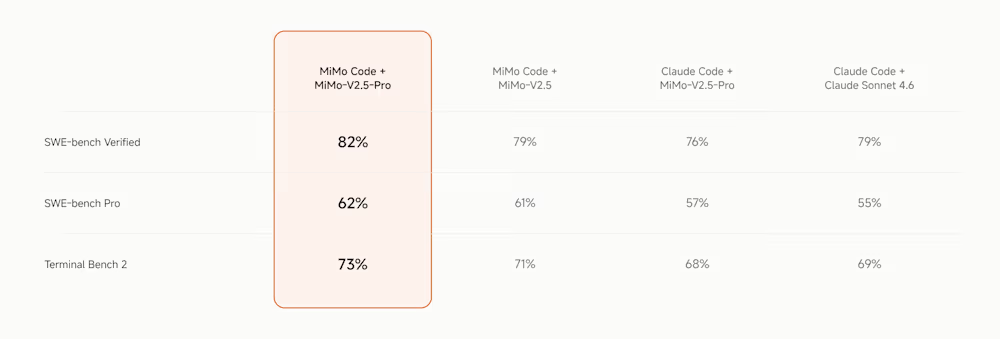
According to benchmark figures published in Xiaomi’s technical blog post, MiMo Code paired with MiMo-V2.5-Pro outperformed Claude Code paired with Claude Sonnet 4.6 on all three evaluations tested:

SWE-bench Verified: 82% vs. 79%
SWE-bench Pro: 62% vs. 55%
Terminal Bench 2: 73% vs. 69%
The harness itself accounts for a measurable share of the gain. Running the same MiMo-V2.5-Pro model in both harnesses, MiMo Code scored 62% on SWE-bench Pro versus 57% for Claude Code, and 73% on Terminal Bench 2 versus 68% — roughly five points each, attributable purely to the agent system rather than the model.
Xiaomi notably did not publish comparisons against OpenAI’s Codex or Google’s Gemini CLI — Claude Code is the sole named competitor throughout its materials, a telling choice of benchmark target.
Independent reference points suggest why. On the official Terminal-Bench 2.0 leaderboard maintained at tbench.ai, OpenAI’s Codex CLI running GPT-5.5 scores 82.2% — roughly nine points above MiMo Code’s self-reported 73% — and OpenAI’s own GPT-5.5 announcement claims 82.7% on the same benchmark.
On SWE-Bench Pro, however, the picture flips: OpenAI reports GPT-5.5 at 58.6%, below MiMo Code + MiMo-V2.5-Pro’s claimed 62%. (MiMo Code does not yet appear on either official leaderboard, and cross-comparing self-run numbers against leaderboard submissions carries the usual configuration caveats.)
Perhaps more interesting than the offline benchmarks: Xiaomi says it ran a human double-blind A/B evaluation during its internal beta, covering 576 developers working in 474 real private repositories, producing 1,213 judged head-to-head pairs against Claude Code using the same target model.
Under 200 execution steps, the two systems split roughly 50/50 — but past 200 steps, MiMo Code’s win rate rose above 65%, supporting the company’s thesis that its memory and state-management architecture pays off specifically on long-horizon work.
Xiaomi itself concedes the standard benchmarks “still measure one-shot problem-solving ability” and don’t capture the tool’s multi-session design goals.
As always, these are vendor self-reported numbers that haven’t been independently verified, and head-to-head harness comparisons are sensitive to configuration. But the claims are consistent with a broader industry pattern: scaffolding and harness engineering are becoming as important as raw model capability in agentic coding performance.
From a user experience standpoint, MiMo Code is designed to live where developers already work. It operates directly in the terminal, reading and writing files, running commands, and managing Git.
Out of the box, the tool requires zero configuration, connecting automatically to “MiMo Auto”—a free-for-a-limited-time channel powered by Xiaomi’s multimodal MiMo V2.5 model, which boasts a massive million-token context window. For developers migrating from existing environments, the transition is frictionless: MiMo Code automatically imports MCP servers, custom skills, and API configurations from Claude Code.
Other noteworthy features include:
Compose mode: Pressing Tab switches the agent into a specification-driven workflow in which the developer describes a high-level goal and the system autonomously executes the full development cycle — design, planning, coding, testing, and review — following what Xiaomi describes as a “heavy planning upfront, stable verification later” strategy.
Voice control: Built on Xiaomi’s MiMo-ASR speech recognition with TenVAD voice activity detection, developers can dictate and modify instructions verbally and speak commands like “send” and “execute” for fully hands-free operation (available for logged-in users).
According to Xiaomi, the gains from the agent harness itself are measurable. Running the same underlying MiMo model in both harnesses, the company says MiMo Code scored 62% on SWE-Bench Pro versus 57% for Claude Code, and 73% on Terminal Bench 2 versus Claude Code’s 68% — roughly five percentage points better on each, attributable purely to the agent system rather than the model.
As always, these are vendor self-reported numbers that haven’t been independently verified, and head-to-head harness comparisons are sensitive to configuration. But the claim is consistent with a broader industry pattern: scaffolding and harness engineering are becoming as important as raw model capability in agentic coding performance.
The bigger lure for many developers may be what’s bundled in.
MiMo Code ships with “MiMo Auto,” a zero-configuration channel offering free, limited-time access to MiMo-V2.5 — the natively multimodal model Xiaomi released in late April 2026, a sparse mixture-of-experts design with 310 billion total parameters (just 15 billion active per inference) and a 1 million token context window, which the company positions as matching Anthropic’s Claude Sonnet 4.6 in multimodal agentic work.
As VentureBeat reported when the MiMo-V2.5 family launched in April, the models are MIT-licensed and among the most efficient and affordable available for agentic tasks.
The larger MiMo-V2.5-Pro — a 1.02-trillion-parameter mixture-of-experts model with 42 billion active parameters and a hybrid-attention architecture — led the open-source field on Xiaomi’s ClawEval agentic benchmark with a 63.8% success rate while consuming only about 70,000 tokens per trajectory, roughly 40–60% fewer than Anthropic’s Claude Opus 4.6, Google’s Gemini 3.1 Pro, or OpenAI’s GPT-5.4 needed for comparable results.
Notably, the V2.5-Pro’s post-training was explicitly designed to instill “harness awareness” — training the model to manage its own memory and context within agent scaffolds like Claude Code or OpenCode — making a Xiaomi-built harness optimized around that capability a logical next step.
Pricing is similarly aggressive: MiMo-V2.5 starts at $0.40 per million input tokens and $2.00 per million output tokens, while V2.5-Pro runs $1.00/$3.00 per million (input/output) up to 256K context, doubling beyond that, with cache hits dropping input costs to as little as $0.20–$0.40 per million, making it among the cheapest frontier models available globally.
|
Model |
Input |
Output |
Total Cost |
Source |
|
MiMo-V2.5 Flash |
$0.10 |
$0.30 |
$0.40 |
|
|
deepseek-v4-flash |
$0.14 |
$0.28 |
$0.42 |
|
|
deepseek-v4-pro |
$0.435 |
$0.87 |
$1.305 |
|
|
MiniMax-M3 |
$0.30 |
$1.20 |
$1.50 |
|
|
Gemini 3.1 Flash-Lite |
$0.25 |
$1.50 |
$1.75 |
|
|
Qwen3.7-Plus |
$0.40 |
$1.60 |
$2.00 |
|
|
MiMo-V2.5 |
$0.40 |
$2.00 |
$2.40 |
|
|
Grok 4.3 (low context) |
$1.25 |
$2.50 |
$3.75 |
|
|
MiMo-V2.5 Pro (≤256K) |
$1.00 |
$3.00 |
$4.00 |
|
|
GLM-5 |
$1.00 |
$3.20 |
$4.20 |
|
|
Kimi-K2.6 |
$0.95 |
$4.00 |
$4.95 |
|
|
GLM-5.1 |
$1.40 |
$4.40 |
$5.80 |
|
|
Grok 4.3 (high context) |
$2.50 |
$5.00 |
$7.50 |
|
|
MiMo-V2.5 Pro (>256K) |
$2.00 |
$6.00 |
$8.00 |
|
|
Qwen3.7-Max |
$2.50 |
$7.50 |
$10.00 |
|
|
Gemini 3.5 Flash |
$1.50 |
$9.00 |
$10.50 |
|
|
Gemini 3.1 Pro Preview (≤200K) |
$2.00 |
$12.00 |
$14.00 |
|
|
GPT-5.4 |
$2.50 |
$15.00 |
$17.50 |
|
|
Gemini 3.1 Pro Preview (>200K) |
$4.00 |
$18.00 |
$22.00 |
|
|
Claude Opus 4.8 |
$5.00 |
$25.00 |
$30.00 |
|
|
GPT-5.5 |
$5.00 |
$30.00 |
$35.00 |
|
|
Claude Fable 5 / Claude Mythos 5 |
$10.00 |
$50.00 |
$60.00 |
For developers who don’t want Xiaomi’s models at all, MiMo Code also supports third-party backends — including token plans from DeepSeek, Moonshot’s Kimi, and Zhipu’s GLM — along with any OpenAI-compatible API, mirroring the bring-your-own-model flexibility of its OpenCode parent.
MiMo Code lands in an increasingly crowded field of terminal-based coding agents: Anthropic’s Claude Code, OpenAI’s Codex CLI, Google’s Gemini CLI, and open-source players like OpenCode and Aider.
What’s new is the entrant. Xiaomi — the world’s third-largest smartphone maker, with a fast-growing EV business — has been methodically building its MiMo AI division since the release of the MiMo-7B reasoning model in April 2025, following with the MiMo-VL vision-language series, MiMo-V2-Flash, the 1-trillion-parameter MiMo-V2-Pro in March 2026, and the V2.5 flagship family in April.
The effort is led by Fuli Luo, a veteran of DeepSeek’s disruptive R1 project, who has characterized Xiaomi’s frontier push as a “quiet ambush” — and backed it with a 100-trillion free token grant for builders announced alongside the V2.5 launch.
The playbook is familiar from DeepSeek, Alibaba’s Qwen, MiniMax, and Moonshot AI’s Kimi series: release genuinely capable models and tooling under permissive licenses at a fraction of U.S. lab pricing, and convert the resulting developer mindshare into a durable ecosystem.
By pairing an open-source agent harness with a free frontier-class model, Xiaomi is effectively eliminating both the licensing and the usage cost of entry — at least for now.
For engineering leaders, MiMo Code is a low-risk, potentially high-value evaluation candidate: MIT-style licensing permits modification and commercial integration, the OpenCode lineage means the architecture is inspectable, and the bring-your-own-model support means it can be pointed at an internally approved endpoint rather than Xiaomi’s cloud.
The persistent memory system addresses a real and widely felt pain point in agentic development workflows — one that competitors are also racing to solve.
The countervailing considerations: the “free for a limited time” model access is by definition temporary and routes code context through Xiaomi’s servers, which will be a non-starter for organizations with strict data-residency or IP policies; the benchmark edge over Claude Code is self-reported; and a V0.1.0 release number signals exactly what it suggests about maturity.
Teams subject to U.S. government procurement restrictions on Chinese technology vendors should also weigh that context before adopting.


Many mid range phones stick to familiar shapes and modest power reserves, yet Tecno stepped forward with the Pova 8 5G carrying both a giant battery and an unexpected visual flourish on the rear. That flourish takes the form of a small dot matrix panel tucked into the camera module. What looks like a third lens from a distance actually serves as a compact LED grid capable of displaying simple animations and patterns. Tecno named it the Alive Matrix Display, and it activates for incoming calls, new notifications, charging progress, or even active gaming moments. Around 49 different animations come preloaded, with options to personalize the behavior and appearance.
Owners can watch the lights on the camera island pulse or evolve into shapes that correspond to the situation, transforming what would otherwise be a rather standard video setup into something considerably more dynamic. The rear panel that snaps on features a sequence of geometric lines that give it a semi-transparent appearance, and it comes in a range of colors, all of which help the lights show through when switched on. The front panel includes a 6.76-inch screen with a 144Hz refresh rate, allowing videos and games to run smoothly. That screen is also bright enough to be seen outside, and the built-in eye strain reduction is especially handy if you plan on using it for extended periods of time.
Sale

Under the hood, a MediaTek Dimensity 7100 CPU handles all of the daily tasks and mild gaming demands, with some specialty chips helping to boost signal strength in areas where it is a little weak. A large graphite layer provides cooling, and the phone remains comfortable to handle even after hours of gaming. In terms of storage and memory, the launch models hit a good balance for most people: not too much, but enough to avoid feeling limited. The camera setup is quite standard, with a 50-megapixel Sony sensor that supports autofocus and zooming, as well as a second lens for group shots. The selfie camera is decent for video calls, but let’s be honest, the lights on the phone’s back are the main attraction.
Another important feature is the power delivery system, which incorporates an 8000 milliamp hour battery with a certified multi-day runtime in regular use, as well as 45 watt wired charging that can charge the battery to 50% in 35 minutes. If necessary, you can even use the phone to charge your wired earbuds or another phone. As an added benefit, it appears that the battery will still perform effectively after thousands of charge cycles.

The phone runs Android 16 with Tecno’s HiOS 16 on top, and the company promises to keep the software updated for an extended period of time. There are also some AI-powered extras, such as photo cleanup and video summaries, as well as noise reduction during calls, which will only be available in specific areas. If you buy in a supported region, you will also receive additional cloud storage. When it comes to making sure the phone survives the rigors of everyday life, Tecno has it covered. The phone is resistant to dust and water splashes, and it’s been built to withstand a few accidental drops and bumps. Even though it has a pretty healthy battery, it’s only 9 millimeters thick, though it’s a little heavier due to the power inside.

The starting price in India is approximately 30,000 rupees ($314) for the lower memory version, which will be available from all major online retailers within the next week or so. So, if you’re searching for a phone with a long battery life and a nice design, this one might be worth considering, even if it’s not the most powerful camera phone on the market or made of highest-quality materials.
[Source]

If you’re a CrossOver user on Intel or use 32-bit gaming bottles, your time is up with version 27. 64-bit bottles and Apple Silicon are now required.
Gaming on Mac has always been a bit of a wasteland, but that doesn’t stop some folks from trying. The CrossOver app for Mac brings Windows games to the platform, and it gets better with each update.
However, the latest update, CrossOver 27, will have to make some sacrifices to make development a little more streamlined. It is getting ARM64 builds for both Mac and Linux, but CrossOver 27 will only work on macOS Sonoma or newer.
It’s also limited to Apple Silicon Macs since Apple phased them out between macOS Sonoma and macOS Golden Gate.
There’s also a final warning about those who still may be using 32-bit gaming bottles. Users are urged to move their 32-bit games to 64-bit bottles, or they will no longer function.
The developer did note that this should affect a small percentage of users overall. Around 97% of CrossOver users are running macOS Sonoma or newer.
Removing legacy support will allow the development team to focus on UI and optimization for one set of computers instead of maintaining Intel-compatible systems. It also means that a new user interface will debut at some point in a future release.
If you are on an Intel machine or running an older version of macOS, the good news is that CrossOver 26 won’t suddenly combust. Simply don’t pay for the new version or attempt to upgrade and everything will work as is, hopefully.
However, note that if you do keep CrossOver 26, your games could run into compatibility issues if they are updated. Also, newer operating systems may cause problems with the older software.
Eventually, your only choice might be to finally move to Apple Silicon.

Two recent studies argue that smartphones may have contributed to falling birthrates by reducing in-person social interaction, sexual frequency, and other conditions tied to unintended pregnancies. “One of the studies published in May is called ‘The Collapse of Teen Fertility in the Digital Era‘ and the other, published just Monday, is titled ‘Is the iPhone Birth Control? Causal Evidence from AT&T’s 2007-2011 Carrier Monopoly,’” reports KTLA. “Both were chronicled in a New York Times piece by political writer Sabrina Tavernise on Monday.” Slashdot reader sabbede submitted the story. From the report: The one from May, authored by two University of Cincinnati professors, posits that teen fertility “collapsed globally” starting around 2007 — the same year the first iPhone was released. “Smart phones changed how teens spend time with each other … this change in turn drove the collapse in teen fertility,” the study’s abstract reads. “Once enough teens are on the phone, being on the phone is where the peer network is; in-person time falls sharply, and with it the unstructured contact in which most unintended teen conceptions occur.” The study claimed that countries “across the income and policy spectrum” were affected by the teen fertility drop, and that researchers used data from multiple countries, including the U.S., England and Wales, to rule out “country-specific contraceptive access and welfare reform stories.” “This model predicts that the shift towards the phone-mediated equilibrium affects multiple aspects of teen behavior,” the abstract continues, concluding that “the same instrument that produces a collapse in teen fertility produces a surge in teen suicides.”
The study published on Monday looks more closely at the United States, explaining that nationwide general fertility rates have fallen 22% since 2007. “[This is] a sustained decline not readily explained by economic conditions, contraceptive use, housing or childcare costs, or other commonly cited factors,” the National Bureau of Economic Researchers study states. “We assess the potential role of a different shock: the diffusion of the smartphone.” As mentioned before, the first iPhone was rolled out in 2007, and this study makes use of that timeframe as “a natural experiment” by using data from 2007 through 2011, when iPhones were only sold on AT&T. “From June 2007 through February 2011, the device was sold only on AT&T, allowing us to identify its effect from variation in AT&T’s mobile broadband coverage,” the study says. “Entropy-balanced Poisson and synthetic difference-in-differences event studies imply that access to the iPhone reduced births by 4.5-8.0% at ages 15-19 and 3.2-6.6% at ages 20-24, with statistically significant but smaller declines among older cohorts. Placebo analyses applied to Verizon and Sprint’s pre-2011 coverage footprint are null.
Taken together, these cohort effects imply that the diffusion of the iPhone deepened the decline in births among women under 30 while suppressing the rise in births among older women.” “Overall, the diffusion of the iPhone explains 33-52% of the decline in the general fertility rate among women aged 15-44,” researchers continued. “National-survey evidence on time use and sexual behavior is consistent with the iPhone reducing in-person interactions, increasing pornography use and reducing sexual frequency.”

Polish lawmakers have voted to criminalize “trash streaming,” with up to five years in prison for online broadcasts of serious crimes such as rape or murder, animal cruelty, humiliating violence, gambling promotion, or even simulated depictions of those acts. Reuters reports: The move is part of a broader push by Poland to tighten regulation of online content. Recent measures include banning the use of mobile phones by children under 16 in schools and introducing stricter age verification rules to access pornography. Under the new provisions, broadcasting crimes punishable by more than five years in prison, including murder or rape, will itself be classed as a separate offence punishable by up to five years behind bars.
The law also covers content showing cruelty to animals, violence aimed at humiliating others, and the promotion of gambling. The same penalties will apply to individuals who simulate or falsely portray the commission of such crimes while streaming, lawmakers said.




Weekend Open Thread: Evereve – Corporette.com

Jensen Huang Approves Samsung, SK Hynix, and Micron for NVIDIA (NVDA) HBM4 Memory Supply


Anatomy of the June crypto crash: Fed, Iran, Saylor

The Best Mystery Series of All Time Is Surging on Streaming 30 Years After It Ended


Alexander Zverev wins the French Open to finally earn a 1st Grand Slam title


Suspicious Polyfill login prompts pop up on Toshiba, Muji websites

Senator Cynthia Lummis Calls CLARITY Act the Most Consequential Financial Legislation of This Generation


Microsoft launches MXC, an OS-level sandbox for AI agents, with OpenAI and Nvidia already on board


Microsoft unveils seven homegrown AI models in new bid for ‘long term self-sufficiency’


(VIDEO) Justin Bieber Delivers Surprise Happy Birthday Serenade to Diners at Los Angeles Mexican Restaurant

Alexander Zverev conquers demons and outlasts Flavio Cobolli to win French Open for first major title

The Pain Points Taking a Fragile Tech Rally Down a Notch


High Stakes for Wembanyama as New York Pushes for 3-0 Lead

Eli Lilly (LLY) Stock Surges 4% Following Breakthrough Sleep Apnea Trial Results


Von der Leyen’s AI envoy pick draws conflict-of-interest fire


Meta steals a tactic from Tesla and builds data centers in tents
LBank Surpasses 25 Million Users Worldwide as AFA Partnership Continues to Drive Global Growth


Hackers now exploit SolarWinds Serv-U flaw to crash servers


Trump’s AI Ownership Plan Could Benefit Anthropic at OpenAI’s Expense

Bangladesh beat Australia after 20 years in ODIs, register only their second win over six-time world champions | Cricket News




You must be logged in to post a comment Login